25 Stunning Cover Up Tattoo Ideas for Women
A cover-up is equal parts artistry and engineering: the right design borrows the darkest ink and busiest shapes to swallow an old name, a blown-out outline, or a scar you'd rather stop explaining. These 25 ideas run from whisper-fine botanicals to full blackout, each with candid notes on what it can realistically cover, how it wears, and what to ask before you commit.
 Edited by Lena Rose · Published July 11, 2026 · 38 min read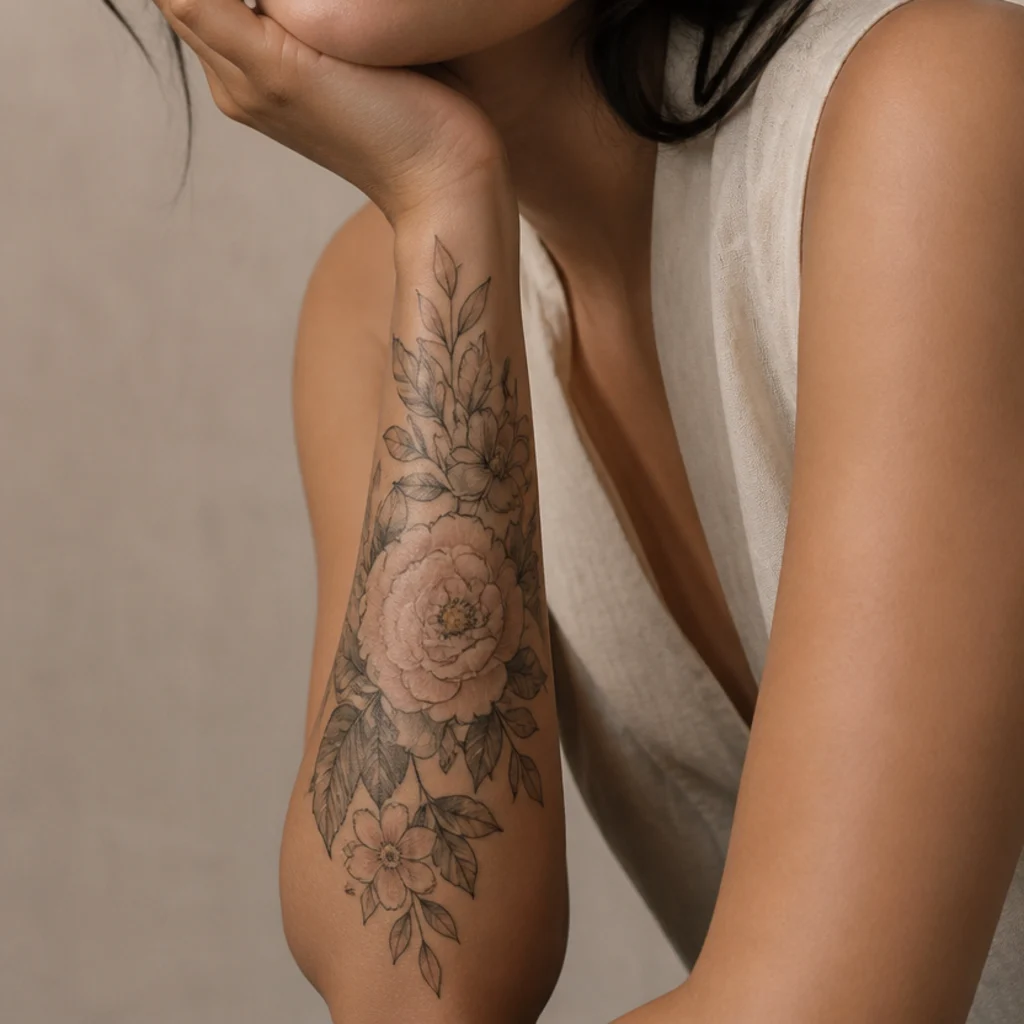
Quick Answer
- Best for: Reworking an old tattoo, a dark or blown-out outline, faded lettering, or a healed scar into a design that finally reads as yours.
- Who might skip it: Anyone whose original is very large, freshly saturated, or heavily black without lightening first, or anyone unwilling to size up; laser fading a few sessions ahead usually pays off more than forcing coverage.
- Maintenance: Moderate to high. Dense black and black-and-grey age gracefully with disciplined SPF; color and watercolor need periodic refreshing to stay vivid.
- Difficulty: Advanced for the artist; your part is patience, honest photos, and realistic expectations across one or several sessions.
- Cost: Highly variable, typically billed at an hourly or session rate that runs higher than a comparable fresh piece because of the planning and layering involved; large multi-session work scales accordingly. Ask for a written estimate, never assume a flat number.
- Wear time / longevity: Permanent, but coverage reads best in the first years; darker designs hold longest, and a touch-up every few years keeps edges and saturation crisp.
- Standout variation: Layered botanicals (peony, dahlia, ivy) that use natural, overlapping shapes to absorb an existing design without looking like a patch.
- How to ask your tattoo artist: Bring clear, well-lit photos and say, "Here's what I'm covering and where; what design, size, and number of sessions would give me clean coverage, and what are the limits with my specific ink or scar?"
A note before you scroll: design, sizing, placement, coverage feasibility, and healing should always be confirmed with a licensed tattoo artist, and no cover-up is guaranteed to fully hide an existing tattoo or scar.
In This Guide
- Layered Peony Cover-Up
- Small Blackwork Moth
- Watercolor Wildflower Wash
- Botanical Sleeve Extension
- Delicate Name Rework
- Blackout Band
- Ornamental Mandala
- Rose and Shadow Leaf
- Fine-Line Scar Softener
- Dark Raven Silhouette
- Trailing Ivy Wrap
- Neo-Traditional Songbird
- Small Moon Phase Cluster
- Koi and Water Ribbon
- Lace Filigree Panel
- Blackwork Snake Coil
- Soft Butterfly Swarm
- Geometric Blossom Grid
- Autumn Branch Drape
- Small Constellation Fill
- Dark Dahlia Statement
- Feather and Vine Blend
- Ocean Wave Cuff
- Blooming Name Transformation
- Full Forearm Garden
Cover-up tattoos ask more of the artist and the wearer than a fresh piece, but the payoff is real: a design you actually want, sitting exactly where something you outgrew used to be. The mechanics are simple to state and hard to execute. A successful cover-up almost always runs larger and darker than the original, uses busy or organic shapes to break up recognizable lines, and puts its heaviest ink over the stubbornest spots. That's why blackwork, dense black-and-grey botanicals, and ornamental patterns dominate this list, while airy color and watercolor stay reserved for lighter, already-faded originals. The ideas below are grouped by mood, density, and placement so you can picture what your skin, existing design, and pain tolerance will actually support: saturated blackwork for stubborn old ink, softer fine-line and watercolor options for scar cover up tattoos, decisive black cover up tattoos for a true reset, playful small cover up tattoos for tiny faded marks, and large cover up tattoos that reclaim a whole limb. Read each idea critically, then bring it into a conversation with a licensed artist who can tell you what your specific skin and ink actually allow.
01Layered Peony Cover-Up
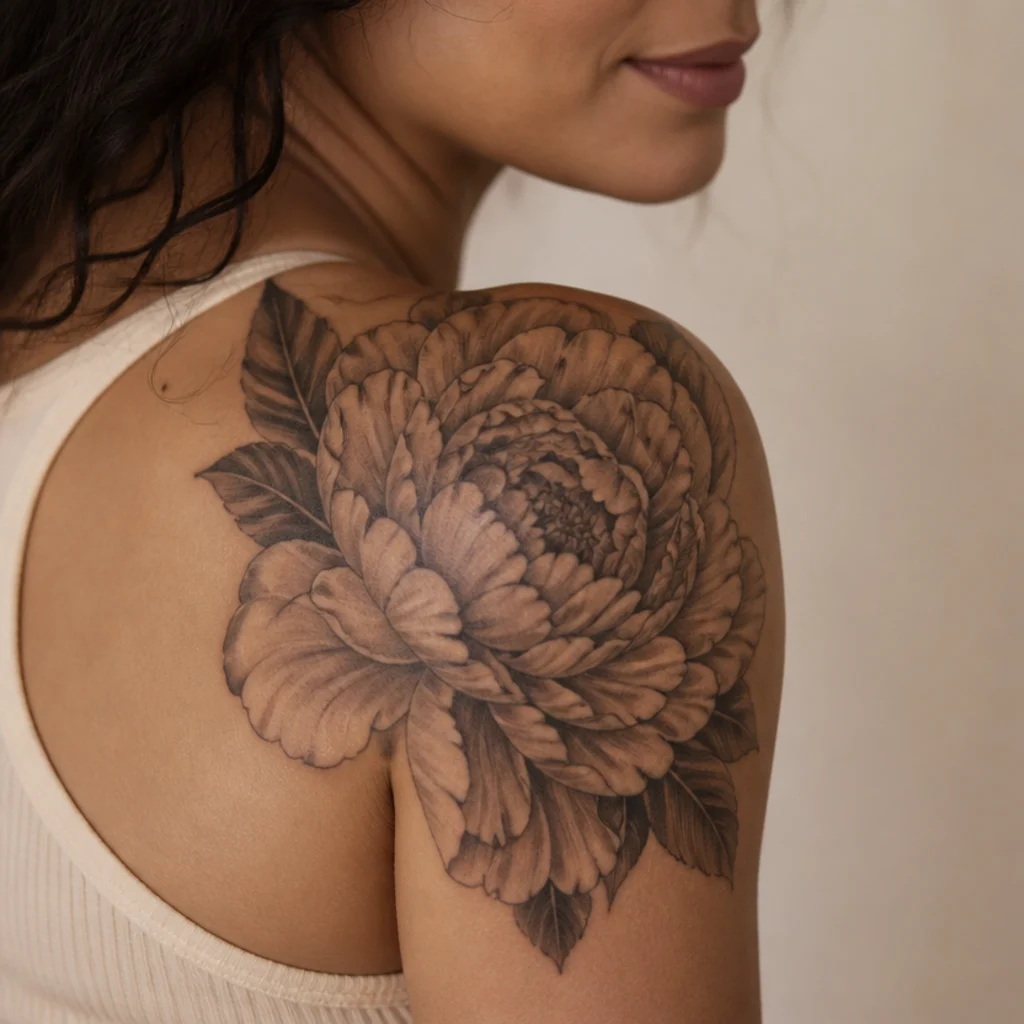
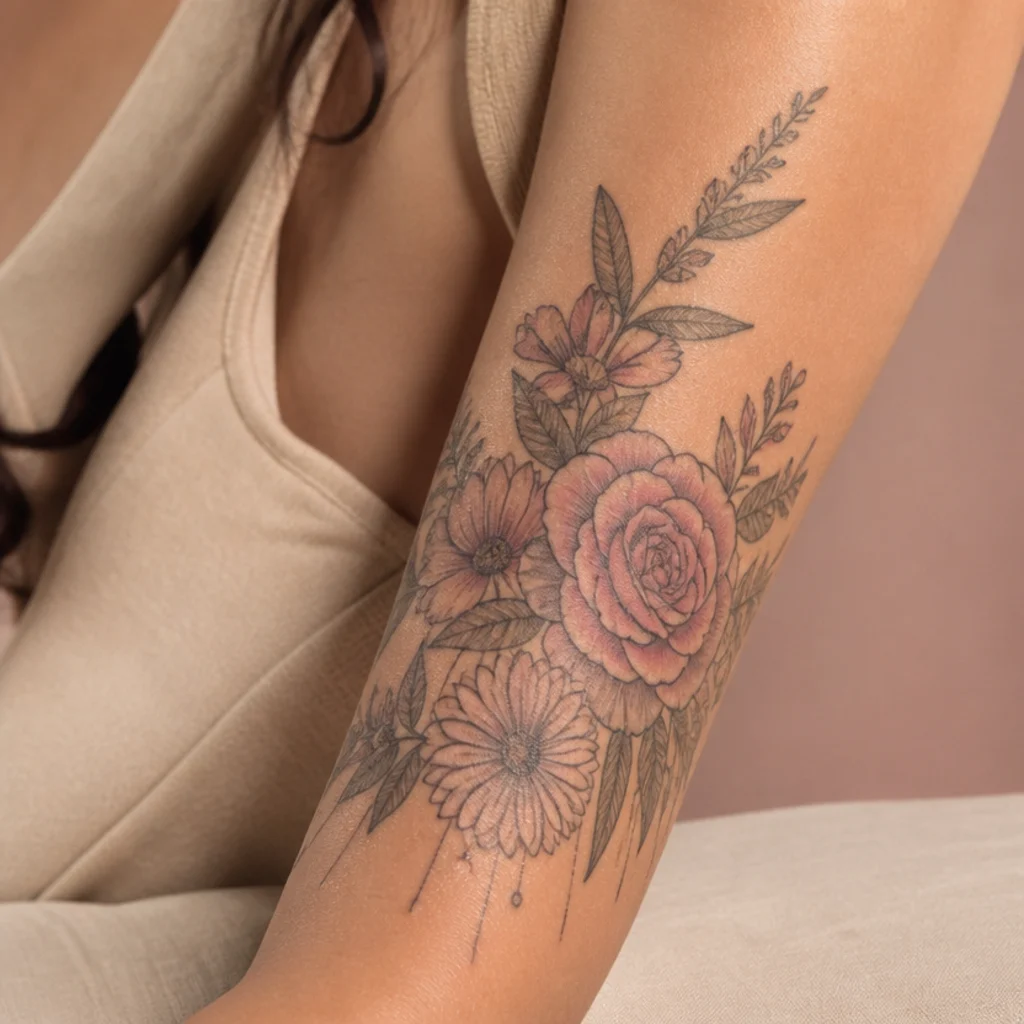
Peonies are a cover-up staple: their ruffled, overlapping petals form dense, irregular masses that read as intentional even where they're doing the heaviest lifting. Put a single full bloom next to two or three tight buds and your artist has room to bank the darkest black-and-grey right over the old outline, while the outer petals fade into a softer grey wash. Shoulders, upper arms, and thighs all take the form well, since the curve of a bloom tends to follow the curve of a limb. Sizing is the whole game here: the flower should sit at least a petal-width wider than the original tattoo on every side, so nothing peeks out at the edges. Expect moderate upkeep, mostly diligent SPF to keep the grey gradients from muddying, and a light touch-up around year three to five is realistic. Pair it with trailing leaves if the old piece runs long or angular. Pro tip: look at the artist's healed peony cover-ups, not just fresh ones, since grey wash can lift as it settles. Worth asking: whether added shadow leaves would help fully dissolve the shape underneath.
02Small Blackwork Moth
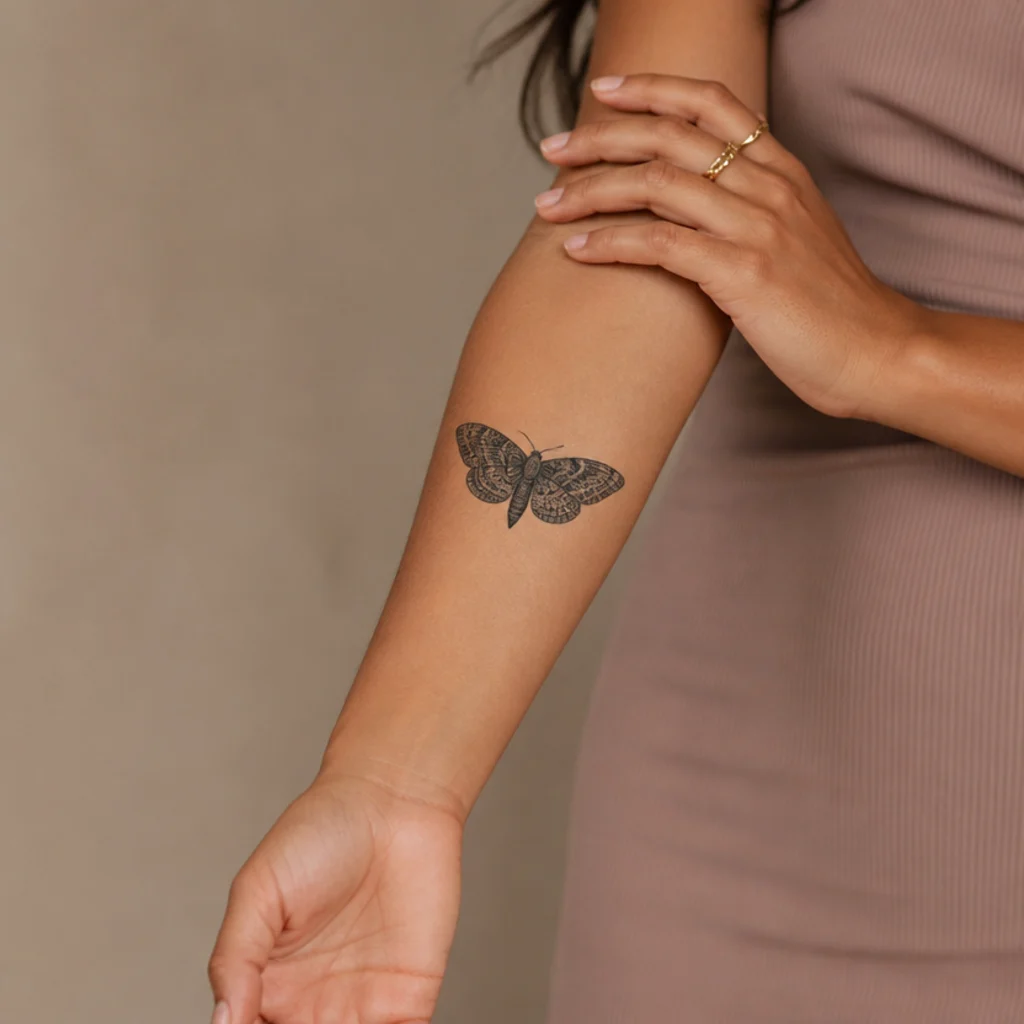
A blackwork moth is one of the more efficient small cover up tattoos for a compact old tattoo or a small dark blob. Its symmetrical wings carry heavy solid fill and an intricate mandala-style pattern, which masks density without looking like a patch job. The vertical, tapered shape suits the inner forearm, calf, and sternum, and the bilateral symmetry lets the artist center the darkest thorax and upper wings right over the original. Solid black ages more predictably than any other ink, so upkeep stays low, with a crisp-up on the finest wing detailing realistic every few years. Difficulty sits at moderate rather than advanced, which can make this a more affordable single-session option. The trade-off is scale: a moth only works if it can fully enclose the old mark with a comfortable margin, so a tiny original is ideal and a broad one is not. Pro tip: choose ornamental filigree wings over photorealistic ones, since pattern hides unevenness better than smooth shading does. Bring an exact photo and measurement, and have your artist confirm the wingspan covers your piece with room to spare.
03Watercolor Wildflower Wash
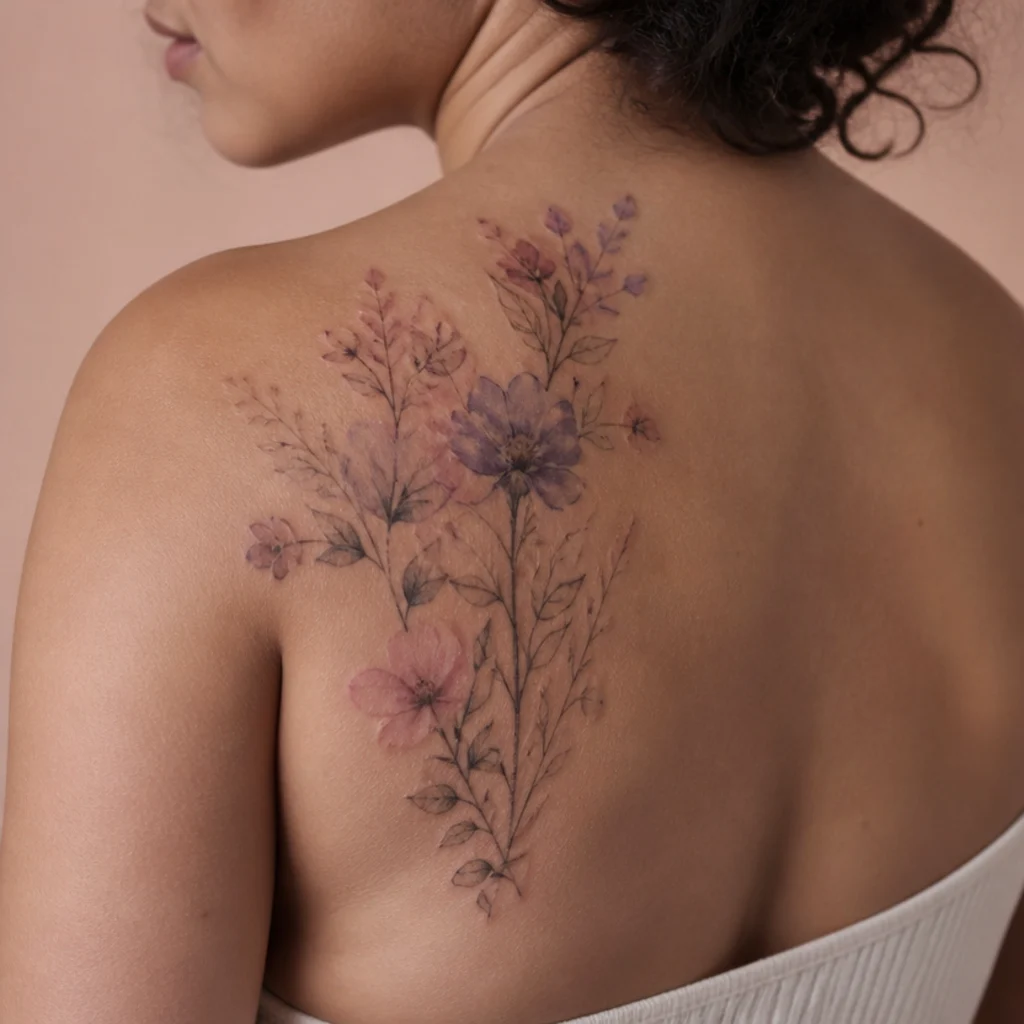
Watercolor styling softens the transition between old and new, using loose, bleeding washes of color to pull the eye toward movement rather than any single edge underneath. Its limits matter here: it only reliably covers light, already-faded, or laser-lightened originals, because those airy pigments sit translucent and won't mask a hard black line. Shoulder blades, upper arms, and outer thighs give the color room to disperse naturally. The look suits warmer and medium skin tones especially well, where pigments read true; on deeper skin, ask which hues will actually show. Maintenance is the real cost, since soft washes are the fastest style to fade, so plan on committed SPF and a refresh every few years. Difficulty runs high because the artist has to balance real coverage against a deliberately weightless finish. Pro tip: ask for a small anchoring set of fine black or dark stems within the wash, which gives the piece structure and quietly handles any lingering old ink. Have your artist tell you honestly whether your original is light enough for watercolor, or whether a black-based design is the safer call.
04Botanical Sleeve Extension
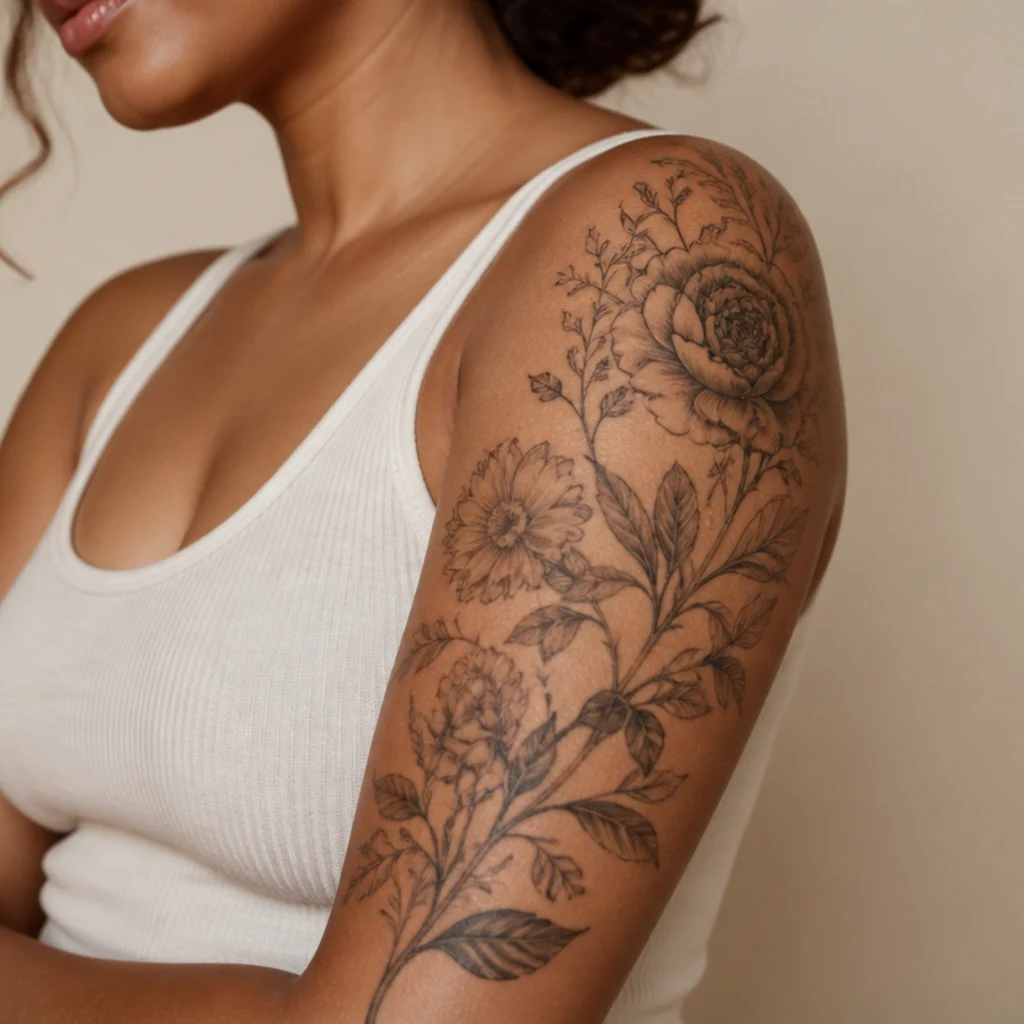
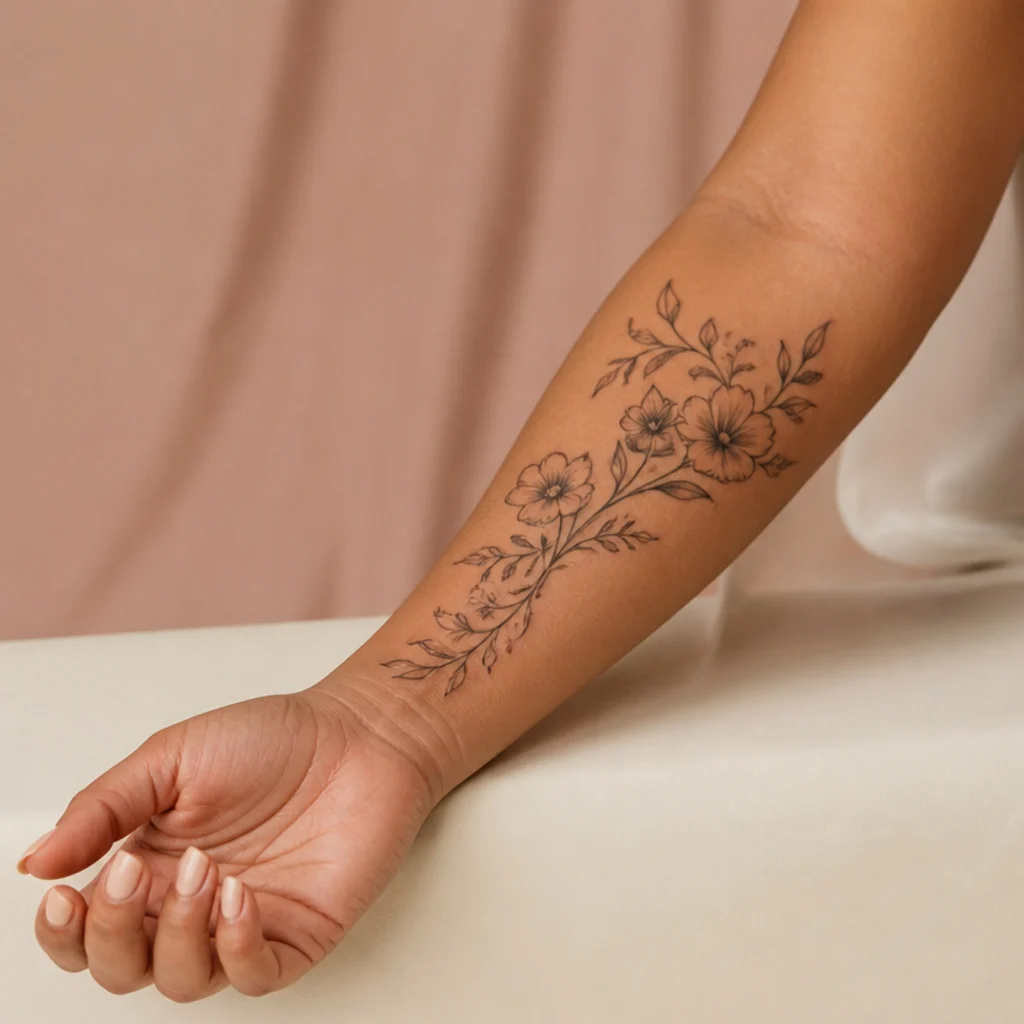
When one tattoo is too dark or too big to cover on its own, extending into a botanical half-sleeve gives the artist the one thing coverage needs most: room. Trailing stems, layered leaves, and two or three focal blooms let the heaviest shading land squarely on the old piece while the surrounding negative space keeps the whole composition breathing. This is a large cover up tattoos approach, best suited to forearms and upper arms with the length and circumference to carry a flowing design, and it works on slimmer and more muscular arms alike because botanicals wrap and taper naturally. Expect multiple sessions, moderate ongoing maintenance across a wide area, and a healing window of a few weeks between appointments. Pro tip: ask your artist to map the darkest focal element over the original first, then build the rest of the garden outward, rather than designing a pretty sleeve and hoping the old ink disappears inside it. In your consult, get a written session plan, healing intervals, and a total-cost range so nothing surprises you mid-project.
Save this to Pinterest to build your cover-up moodboard as you scroll.
05Delicate Name Rework
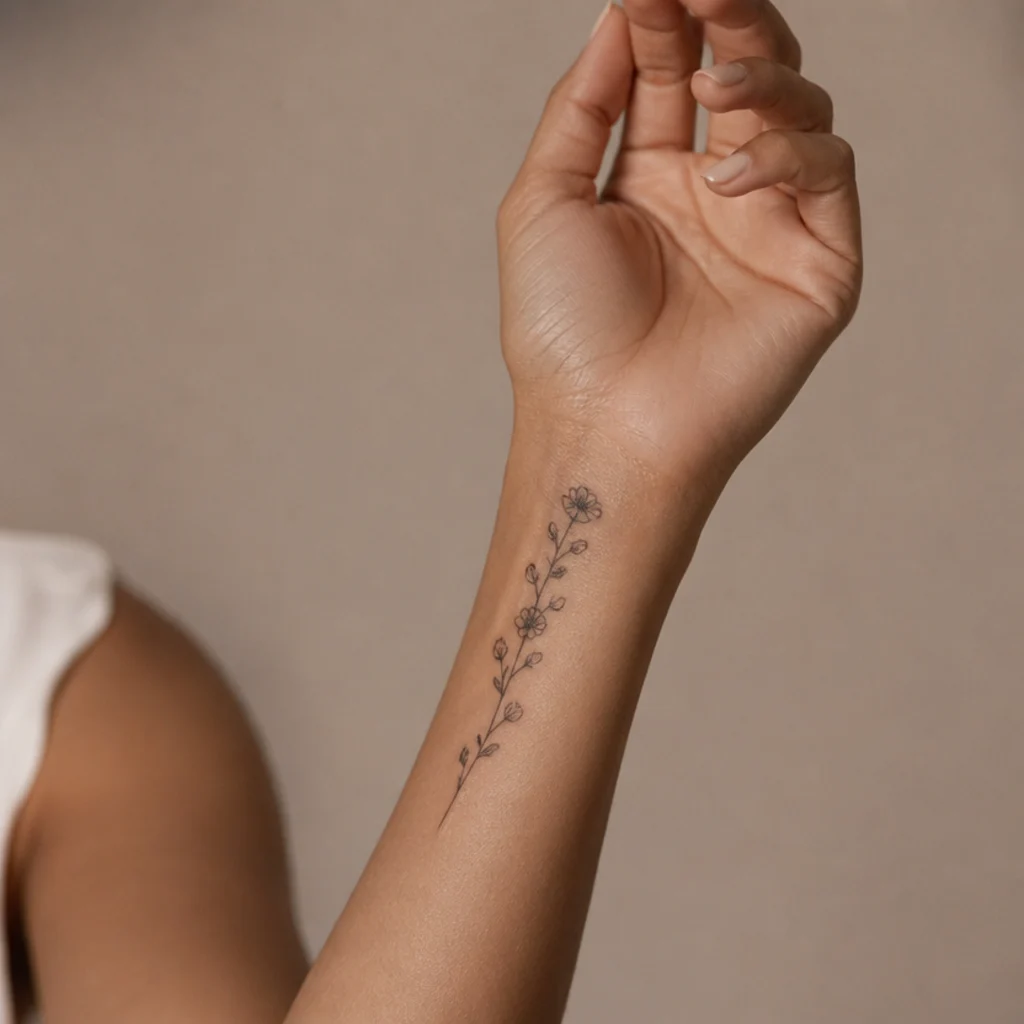
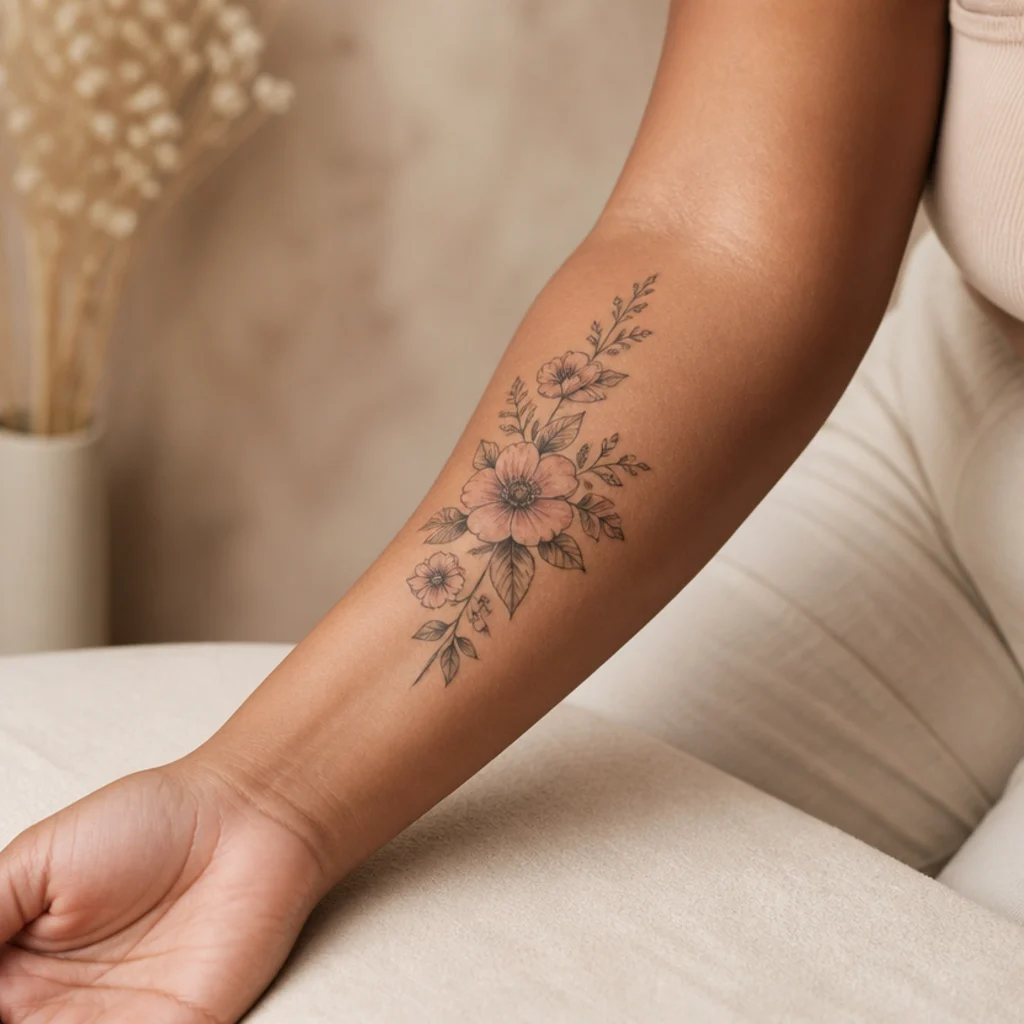
An old name is one of the most common reasons people book a cover-up, and a fine vine of small blossoms is one of the more graceful ways to move on from one. The physics are worth knowing up front: letters are compact, dark, and defined, so name cover up tattoos almost always need to be denser or larger than the original text rather than a wispier design laid over it. Delicate script gives a delicate vine a chance; a bold, blocky old font usually doesn't, and may need a heavier floral cluster instead. Wrists, inner forearms, and ankles are the classic spots, and slimmer limbs suit it best, where a slender vine feels proportionate. Maintenance runs low to moderate; difficulty ranges from moderate to advanced depending on how bold the lettering is. Pro tip: staggered buds and leaves placed directly over each letter's darkest strokes break up the readable rhythm of a name far better than one continuous line does. Ask your artist to tell you straight whether your specific name can be covered at the size you want, or whether the design needs to grow to do it cleanly.
06Blackout Band
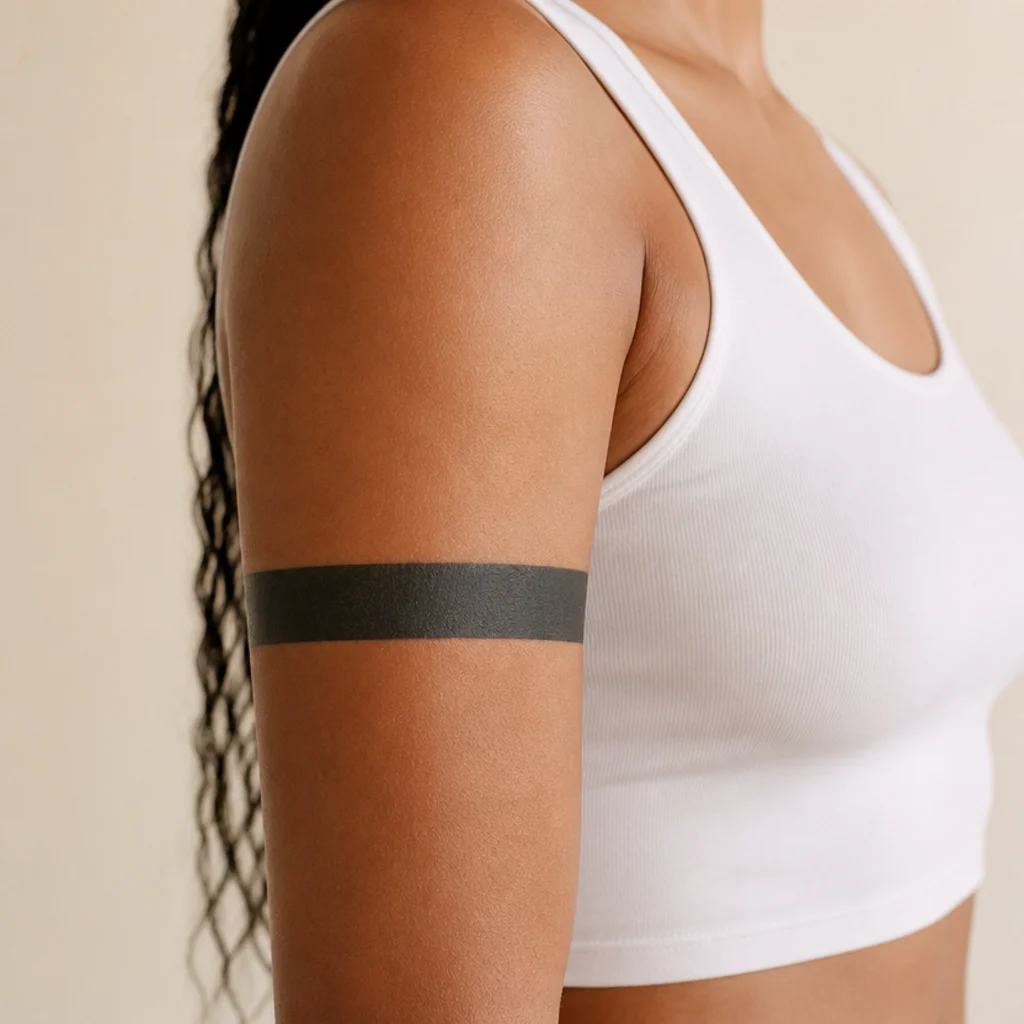
When an old tattoo is very dark, or you just want a clean, modern reset, a solid blackout band is the most decisive of the black cover up tattoos on this list. A wrapped cuff of even matte black fully absorbs whatever sits beneath and reads as an intentional, architectural statement rather than a cover-up at all. Upper arms, wrists, and calves suit the band, and a clean horizontal wrap tends to streamline most limbs visually. The trade-offs are real: large solid saturation is demanding on the skin, often needs a second pass for a flawless finish, and shows any patchiness clearly, so artist skill matters here more than it does with a busy design. Maintenance is otherwise low once it's fully healed. Pro tip: on deeper skin tones, ask about a small negative-space detail or a fine linework border, which frames the band and adds interest without compromising coverage. Ask how the artist plans to manage healing for a large solid area, whether they'd split it across sessions, and how even the saturation looks in their healed portfolio.
07Ornamental Mandala
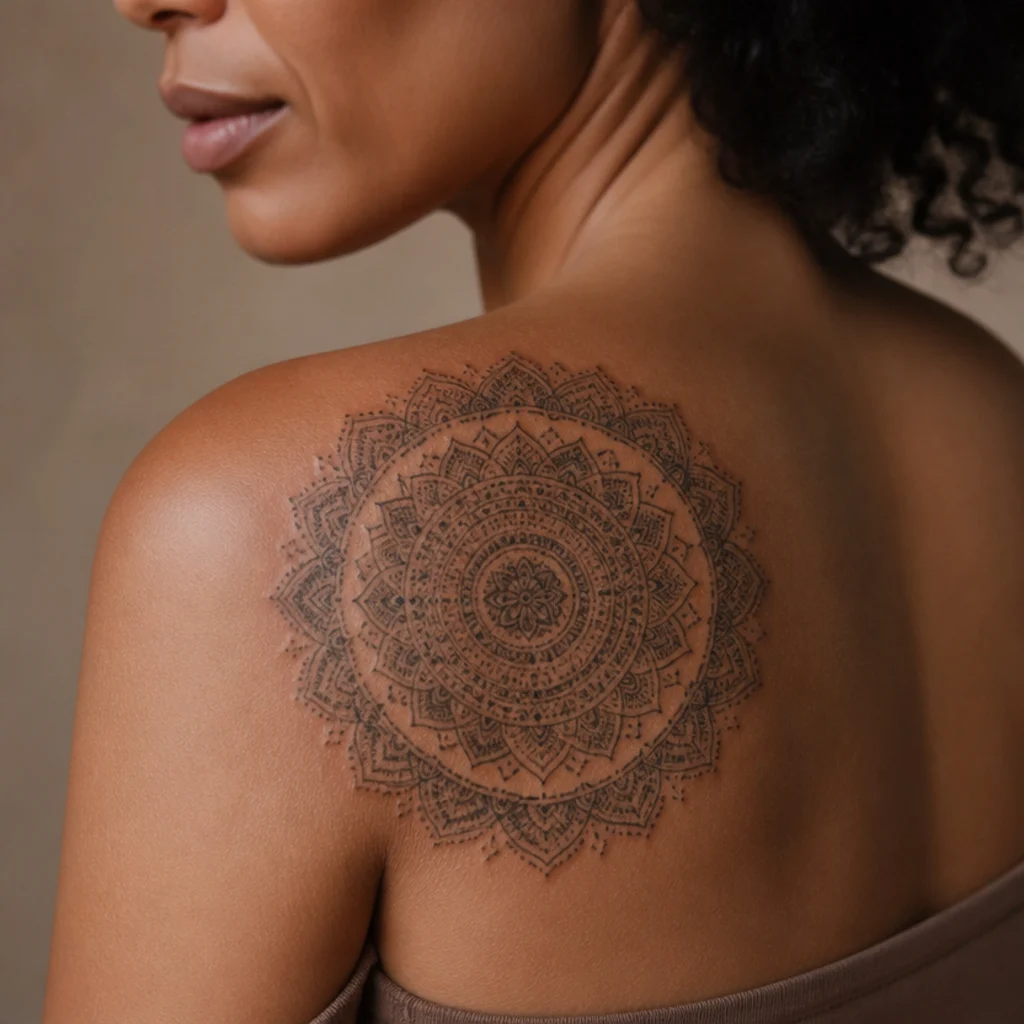
A mandala's dense, repeating geometry is good at swallowing an irregular old shape into a pattern that looks purely deliberate. Concentric rings, fine dotwork, and layered petals let the artist bank darkness precisely where it's needed, while the overall effect stays intricate rather than heavy-handed. The circular form wants a broad, relatively flat canvas, so shoulders, upper backs, and outer thighs suit it best, and the symmetry works well when centered on a natural landmark. Maintenance is moderate; dotwork holds up cleanly with sun protection, though the finest stippling can soften over many years and reward a touch-up. Difficulty is advanced, since true radial symmetry has to survive being built over an existing design that may distort the grid. Pro tip: ask the artist to anchor the mandala's densest central rings over the old ink and let the pattern radiate outward, so the original hides in the busiest zone rather than the airy edges. Ask how they'll center and stencil the piece so the old design disappears into the geometry instead of warping it.
08Rose and Shadow Leaf
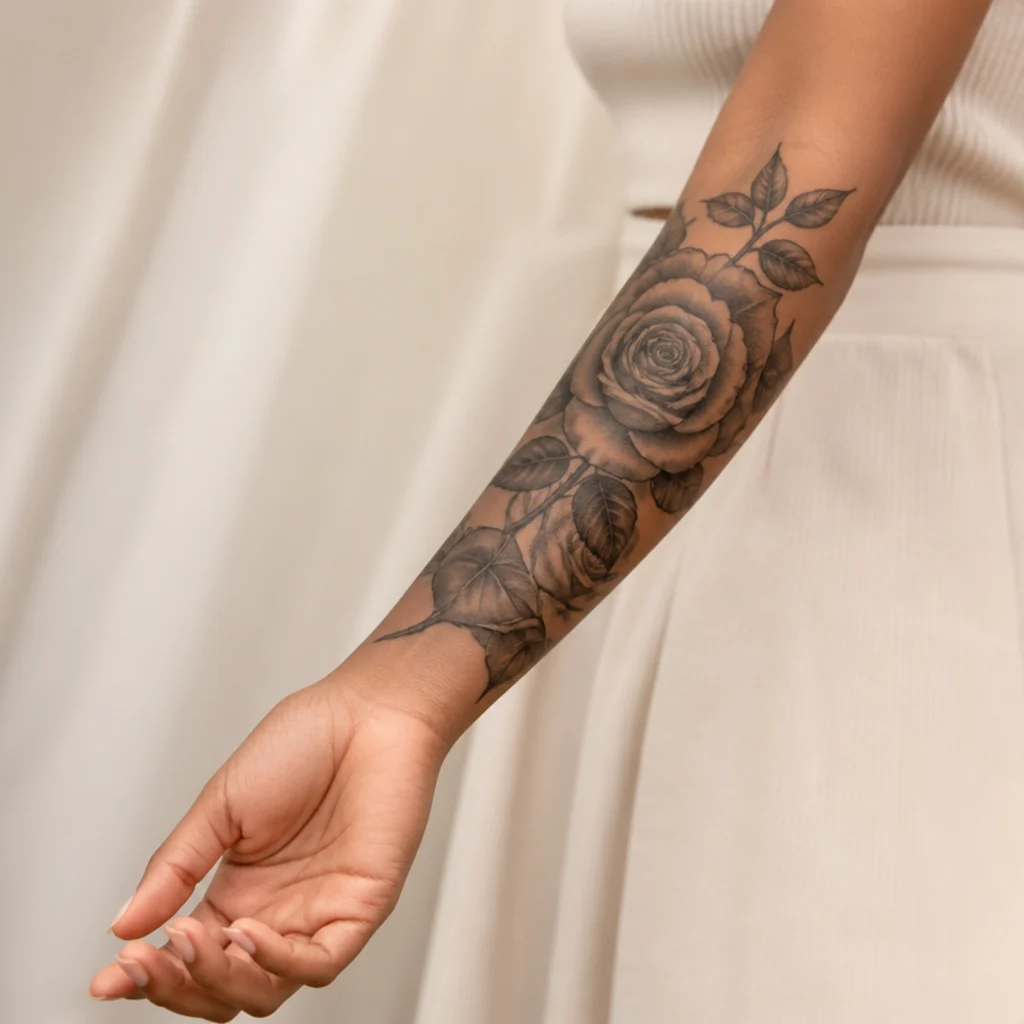
A classic rose paired with heavily shaded leaves is a workhorse cover-up because it splits the job cleanly: the bloom supplies a recognizable centerpiece while the dark foliage does the actual covering. Black-and-grey leaves can go as deep as needed, right up to near-solid, to mask stubborn old ink, and their organic edges hide the seam between old and new. The template works on forearms, thighs, and shoulders and suits nearly every build since leaf placement is fully adjustable. Maintenance is moderate; difficulty sits at moderate to advanced depending on how dark the leaves must go. Pro tip: the leaves, not the rose, are your coverage tool, so ask the artist to design foliage that shadows the exact footprint of your old tattoo rather than defaulting to a symmetrical arrangement. A second bud or a trailing stem can rebalance the composition once the coverage dictates where the darkness lands. Ask them to adjust leaf density and direction to wherever your original sits, and whether a supporting bloom would help.
09Fine-Line Scar Softener
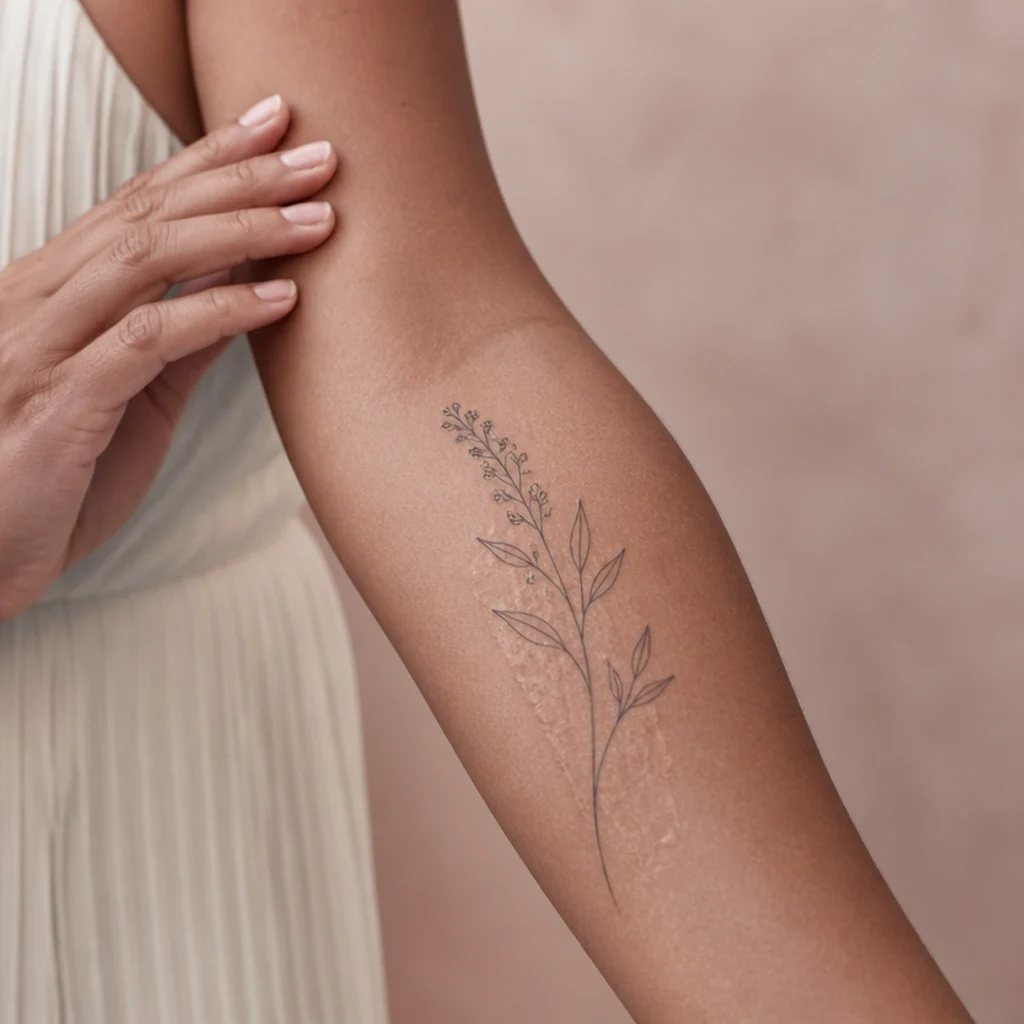
For scar cover up tattoos, fine-line botanical work can redirect attention toward delicate, intentional linework and away from the texture underneath. This is the most sensitive idea on the list, physically and emotionally, and it comes with the firmest caveats: not every scar is suitable for tattooing, scar tissue takes ink unevenly, and the goal is softening how a scar draws the eye, not erasing it. Forearms, ribs, and thighs are common placements. Difficulty runs high because raised, indented, or shiny tissue responds unpredictably and may need a lighter hand or spaced sittings. Maintenance is low to moderate once healed. Pro tip: look for an artist who specifically lists scar or stretch-mark work in a healed portfolio, and expect them to recommend a small test area before committing to the full design. Above all, confirm with a licensed tattoo artist that the scar is fully matured and appropriate to tattoo, and go in understanding that a cover-up over a scar reimagines how it reads rather than removing it. No design will make a scar disappear.
10Dark Raven Silhouette
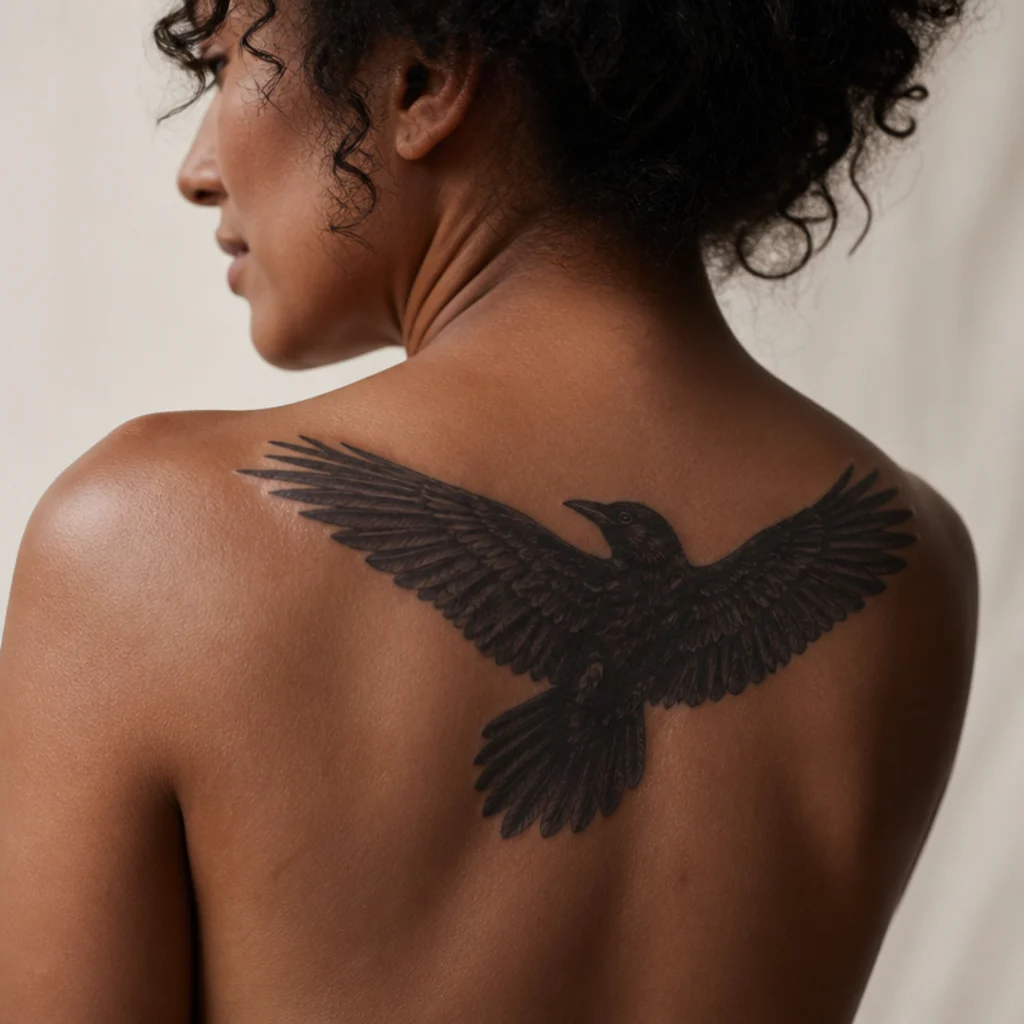
A raven or crow rendered in near-solid silhouette is among the boldest of the black cover up tattoos here, using a large, confident expanse of black to overtake an old design completely. The bird's natural, irregular form makes good camouflage, and outstretched or folded wings can be scaled and angled to blanket exactly the area you need. Shoulder blades, upper arms, and calves suit the silhouette, and a bird reads as graceful at almost any size, so the shape works across most placements. Maintenance is low thanks to the solid black; difficulty is moderate, which can keep it to a single session for a mid-size original. The risk is flatness: a purely solid bird can look heavy up close. Pro tip: ask for subtle negative-space feather texture or a hint of grey in the wing tips, which keeps the black reading as a detailed raven rather than a dark shape. Confirm the wingspan is wide enough to enclose your existing piece, and ask how they'll add just enough texture to keep it dimensional.
Save this to Pinterest and note which placements keep catching your eye.
11Trailing Ivy Wrap
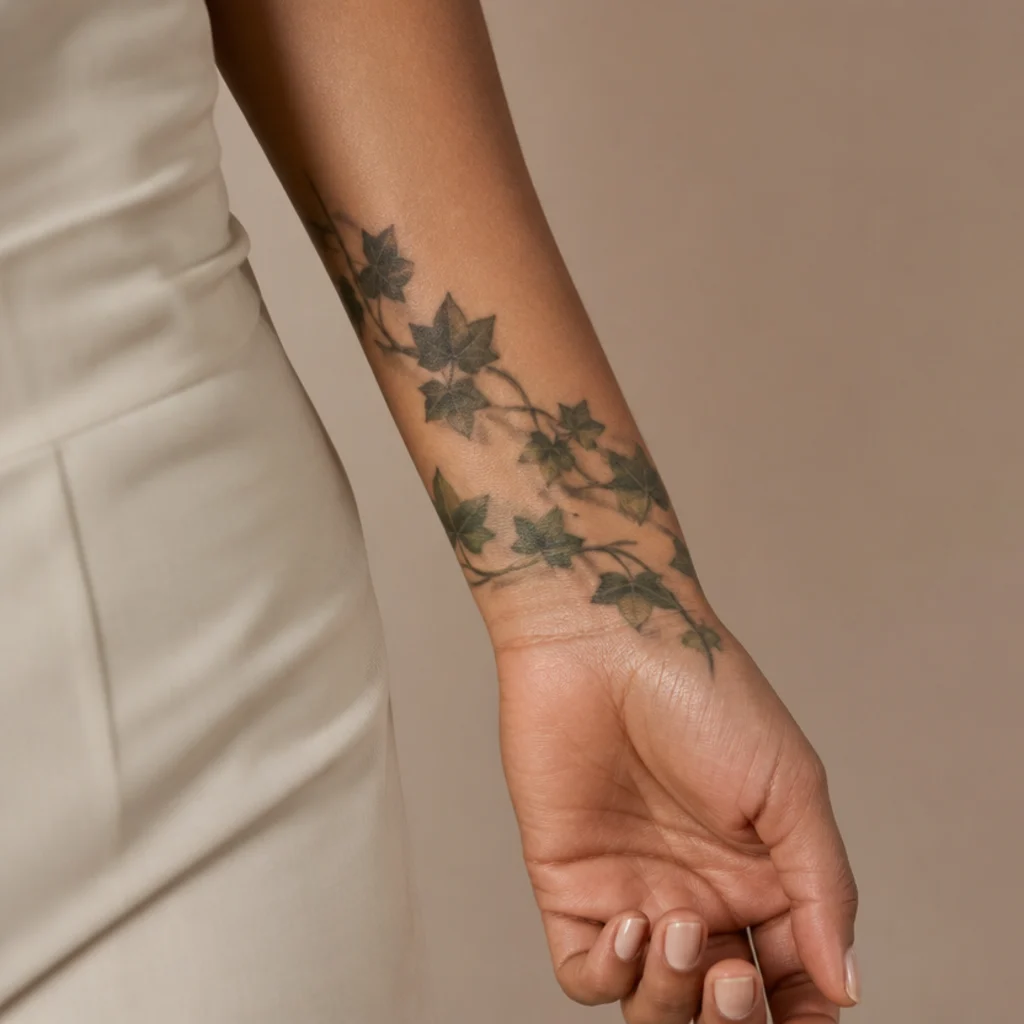
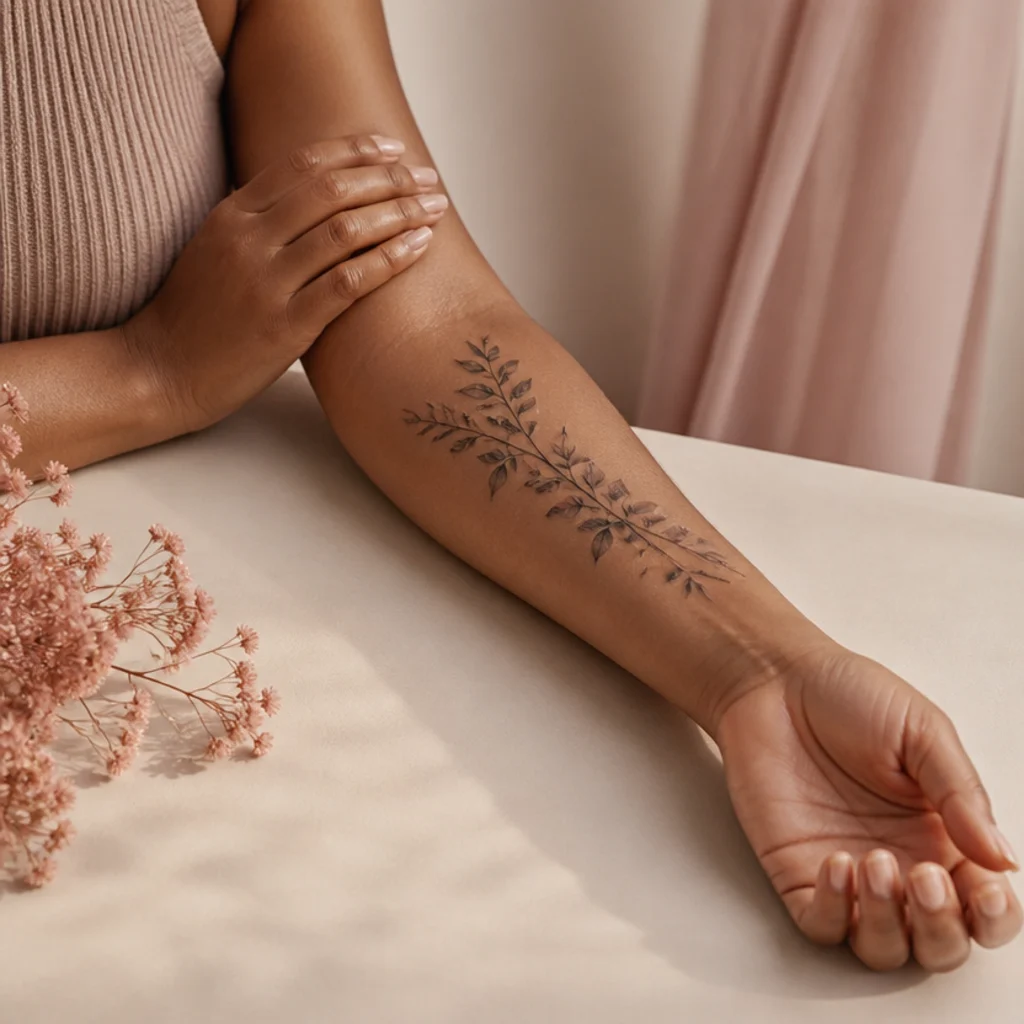
Ivy is one of the more versatile cover-up motifs because its irregular, wandering leaves can be routed to sit wherever an old tattoo lives, then keep trailing so nothing looks patched or interrupted. A wrap around the wrist or lower forearm turns coverage into an elegant, continuous vine, and slimmer limbs suit the winding form well, since it can spiral without crowding. Maintenance is moderate, edging higher if living green tones are used, since green and other cool colors soften faster than black; a black-and-grey ivy is the lower-upkeep choice. Difficulty is moderate. Adaptability is the real advantage here. Pro tip: ask the artist to design the leaf placement freehand around your specific original rather than working from a fixed stencil, so the densest cluster of leaves lands precisely over the darkest old ink while thinner runners carry the eye onward. That custom routing is what separates a convincing ivy cover-up from an obvious one. Have them concentrate the fullest leaves over your existing piece and let the vine extend naturally beyond it.
12Neo-Traditional Songbird
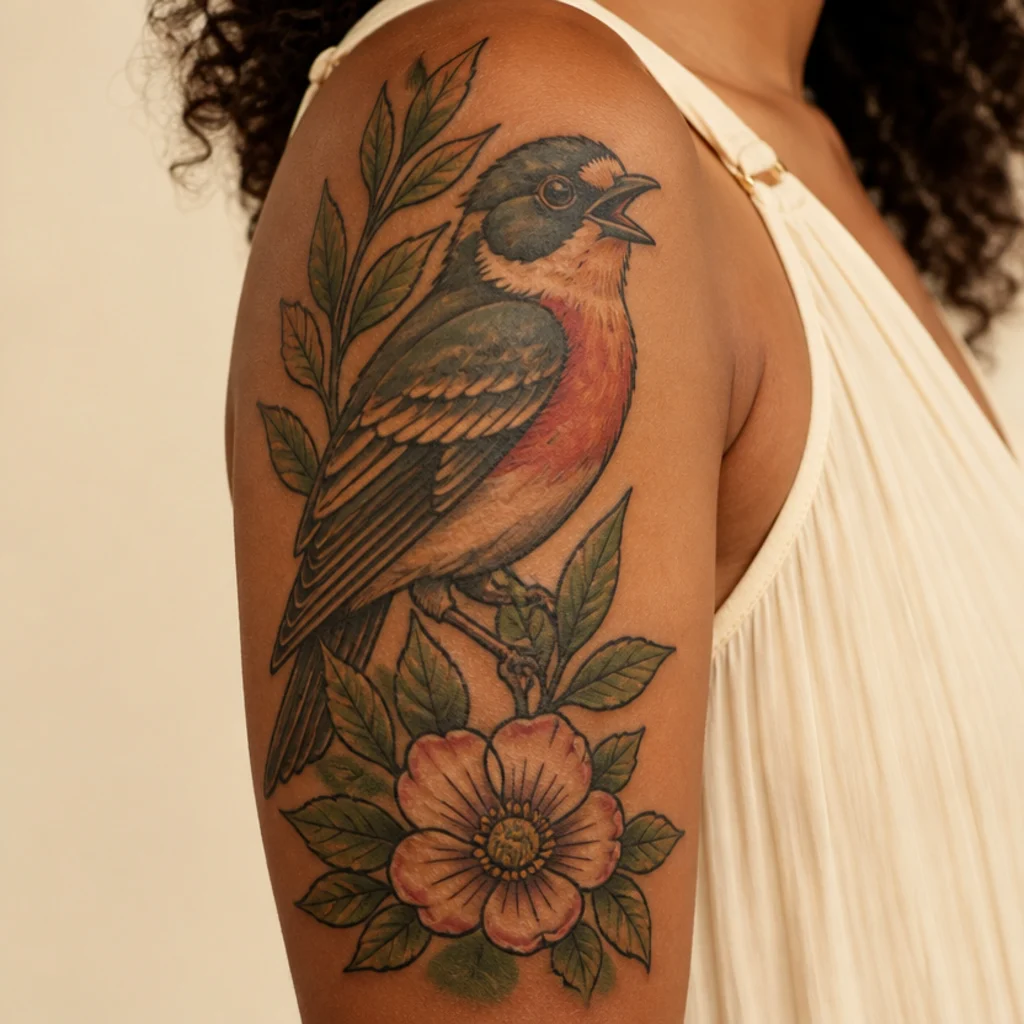
Neo-traditional style leans on two things that happen to be ideal for covering: thick, confident outlines and richly packed color. Bold linework can trace directly over an old edge, while dense saturation buries faded ink beneath it. A songbird mid-song, framed by leaves or blossoms, makes a lively, characterful centerpiece with plenty of surface area to work with. Upper arms, thighs, and calves suit the scale, and fuller placements flatter the look best, giving the saturated color room to read. Maintenance is moderate, and color rewards consistent sun care to stay punchy. Difficulty is advanced, and results depend heavily on the artist's color-packing skill over existing ink. The key limit: color covers color but struggles over dark black, so a heavily lined original may still need black-based shadow zones within the design. Pro tip: ask to see healed, not fresh, color cover-ups, since color is where lifting and patchiness show most. Find out whether your specific faded piece can be covered with color alone or needs black shading underneath the brights.
13Small Moon Phase Cluster
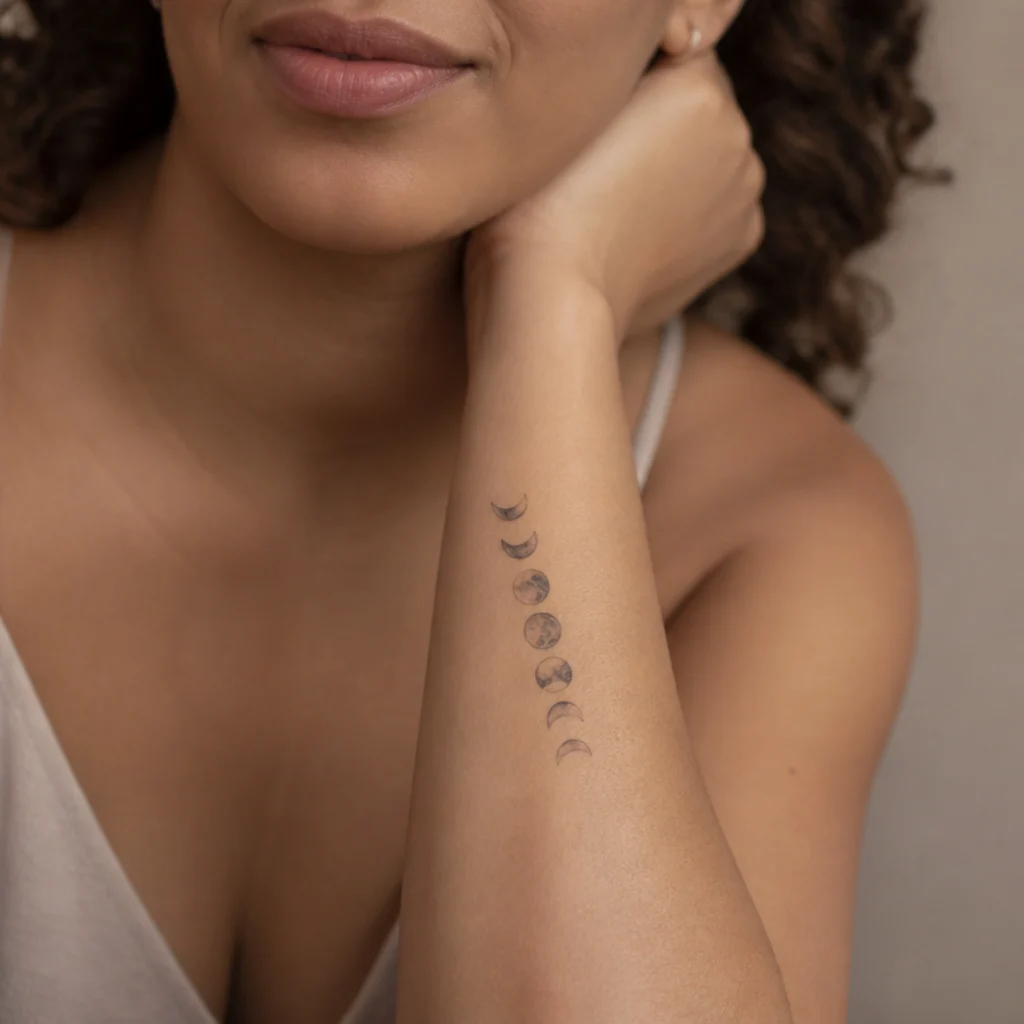
A row of moon phases is a clever entry among the small cover up tattoos here, best when the original is a small dot, an initial, or a short line. Each moon can be rendered solid, textured, or fine-line, and the artist places the fullest, darkest moon squarely over the old mark while the waxing and waning phases carry the design outward. The linear layout suits inner forearms, ankles, and the spine, and it flatters slim, straight runs of skin. Maintenance is low, especially with solid black moons; difficulty is moderate, often single-session. The one constraint is scale, since a cluster only covers what its darkest moon can enclose. Pro tip: bring exact dimensions of your existing tattoo so the artist can size the full moon to cover it while keeping the whole row evenly spaced and rhythmic; an off-size moon throws off the balance that makes the piece look intentional. Consider a subtle fine-line arc connecting the phases for cohesion. Confirm the full moon is large enough for full coverage, or ask whether the cluster should scale up slightly.
14Koi and Water Ribbon
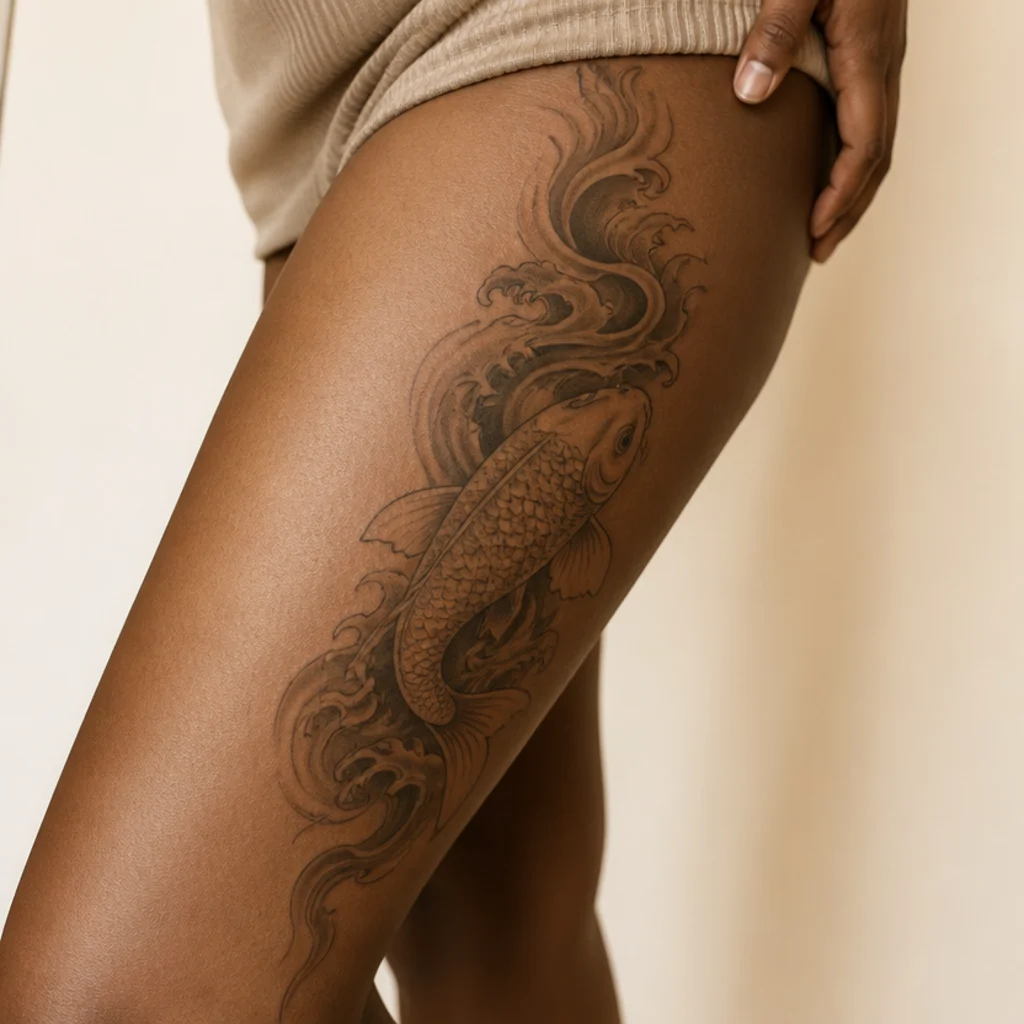
A koi swimming through ribbons of water is a large cover up tattoos classic for one practical reason: flowing water gives the artist an almost unlimited supply of dark, organic shading to place wherever it's needed. The fish anchors the composition while the swirling currents around it absorb an old design and dissolve its edges. Thighs, upper arms, and calves suit the movement and scale, and larger placements flatter the elongated, curving form best, since it has room to travel. Expect multiple sessions, moderate maintenance across a wide area, and advanced difficulty. Water's freeform nature makes it forgiving of irregular originals, but it also demands strong composition so it doesn't read as busy for its own sake. Pro tip: ask the artist to route the darkest troughs and foam shadows directly over the old ink and extend the current beyond the original footprint, so coverage never stops in an obvious line. In your consult, find out how the water flow will be arranged around your existing tattoo and whether the piece should extend to fully break up the old outline.
15Lace Filigree Panel
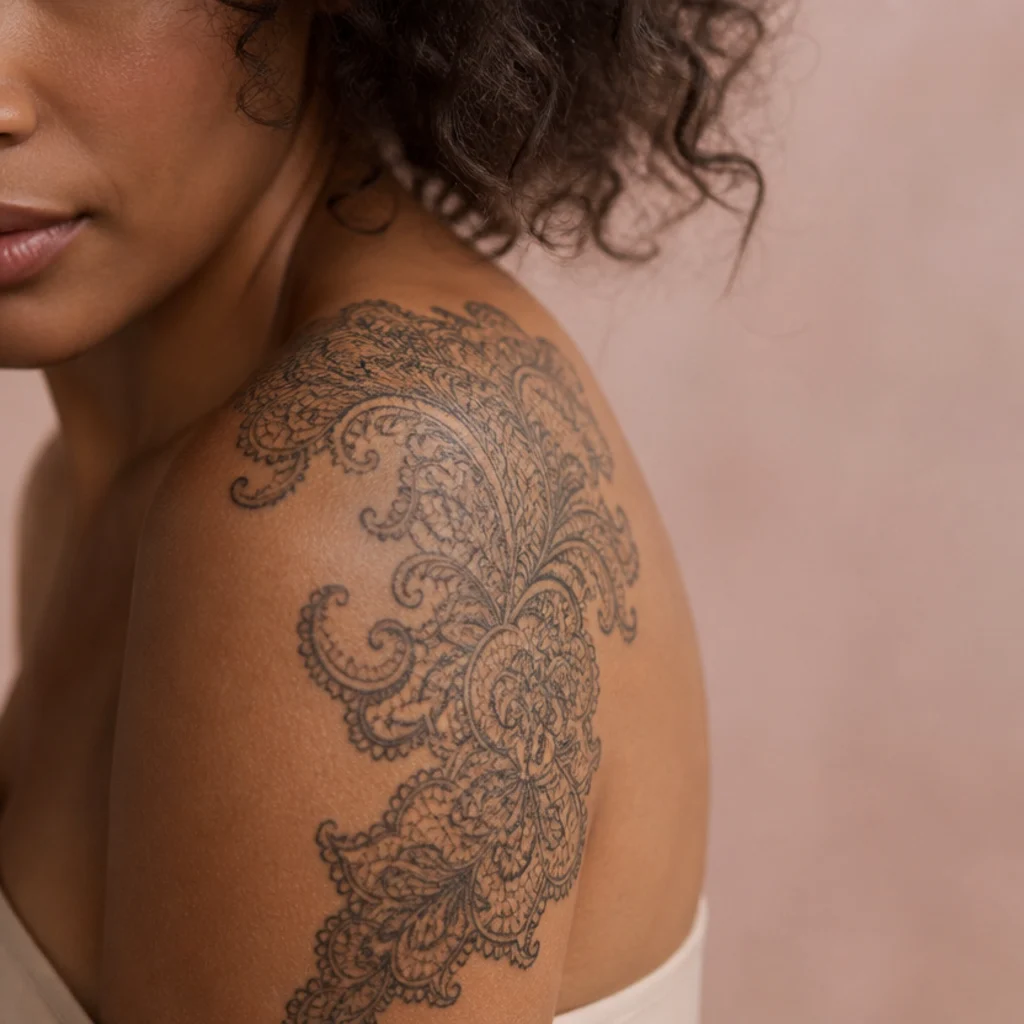
Lace and filigree turn coverage into pure ornament, using repeating scrollwork and delicate negative space to distribute darkness evenly across an area so no single point looks like it's hiding anything. Even at its densest, the pattern reads as decorative, which makes it an elegant solution for masking an old piece. The panel shape suits shoulders, upper backs, and thighs, and those broader canvases flatter the draped, jewelry-like effect. Maintenance is moderate; difficulty is advanced, since fine, symmetrical detail has to stay crisp while also carrying real coverage. The subtlety is the challenge here, since very fine lace alone may not fully bury dark ink. Pro tip: ask whether small solid dark accents, beads, or teardrop motifs can be worked into the pattern directly over the stubbornest spots, so the lace stays airy overall while quietly concentrating darkness exactly where the old design needs it. That mix of delicate and dense is what makes filigree cover-ups convincing. Ask how the pattern will be anchored so the original dissolves into the scrollwork rather than showing through it.
Save this to Pinterest to compare your delicate and bold options side by side.
16Blackwork Snake Coil
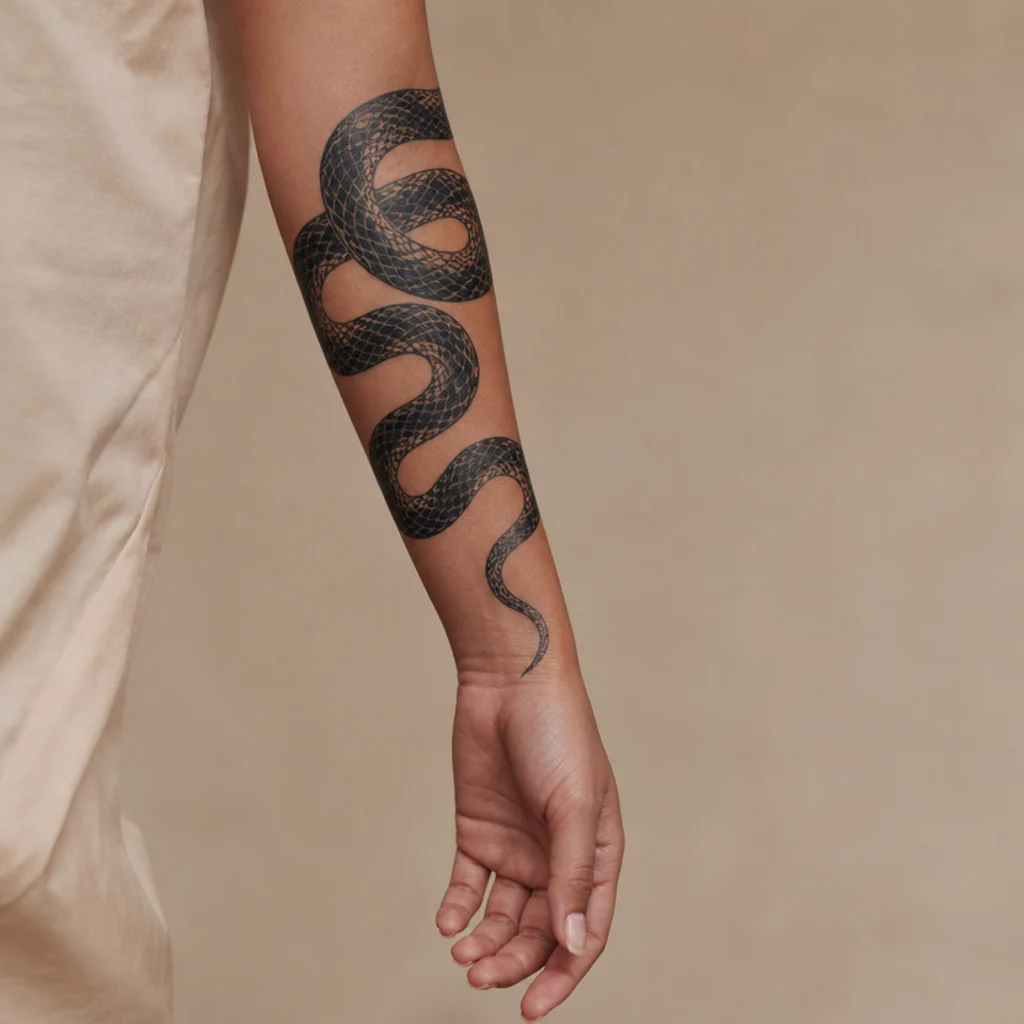
A coiling snake rendered in blackwork is a striking way to cover a linear or awkwardly shaped old tattoo, since its winding body can be routed to follow the exact path of the original. Solid or patterned scales carry heavy ink well, and the sinuous form turns an irregular coverage job into a deliberate, dynamic shape. Forearms, calves, and the spine suit the long silhouette, and the vertical flow flatters limbs and adds length. Maintenance is low with solid black; difficulty ranges from moderate to advanced depending on scale detail. The snake's great strength is that it can bend anywhere, which makes it one of the more accommodating covers for a stubbornly placed original. Pro tip: decide between a solid-silhouette body and a scaled, patterned one based on your ink; a smooth silhouette maximizes raw coverage, while textured scales add detail but need the underlying darkness handled first. Have your artist sketch the coil so the body passes directly over the old design, and ask which finish gives cleaner coverage for your specific piece.
17Soft Butterfly Swarm
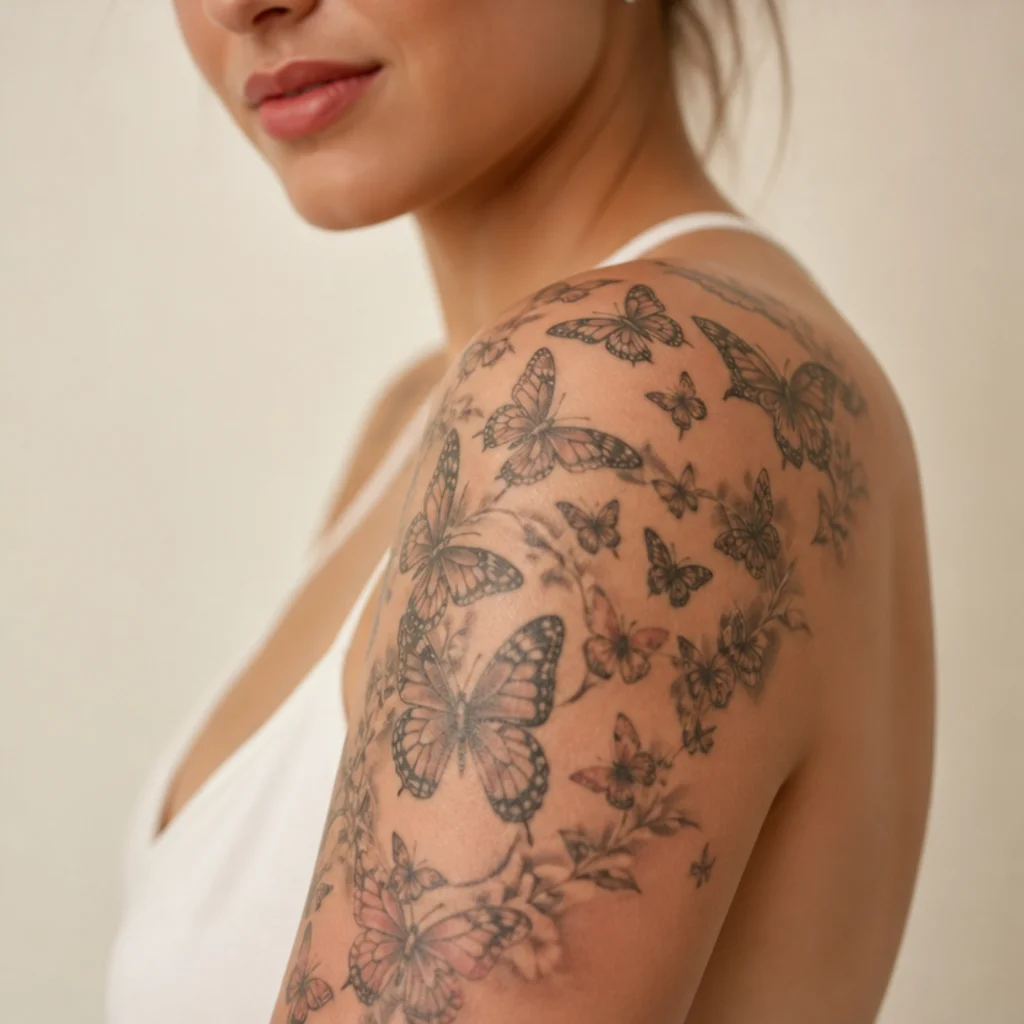
A scatter of butterflies at graduated sizes lets the artist place the largest, most detailed wings precisely over an old mark while smaller ones trail off and dissolve the edge of the coverage. It's a softer, romantic take that still delivers real masking through wing density, especially when the hero butterfly goes in rich black-and-grey. Shoulders, upper arms, and the upper back suit the drifting layout, and broader placements flatter it best, since the swarm needs room to disperse. Maintenance is moderate, higher if color is added; difficulty is moderate. The design's charm is also its limit: a swarm only covers what its largest wings can enclose, so a compact original is ideal. Pro tip: ask the artist to commit the central butterfly fully to covering your old tattoo with margin, then let the trailing smaller ones handle transition and movement rather than spreading coverage thinly across all of them. Decide on black-and-grey versus a light tint based on your skin tone and how bold the original is. Have them size the hero butterfly for full coverage and advise on palette for your complexion.
18Geometric Blossom Grid
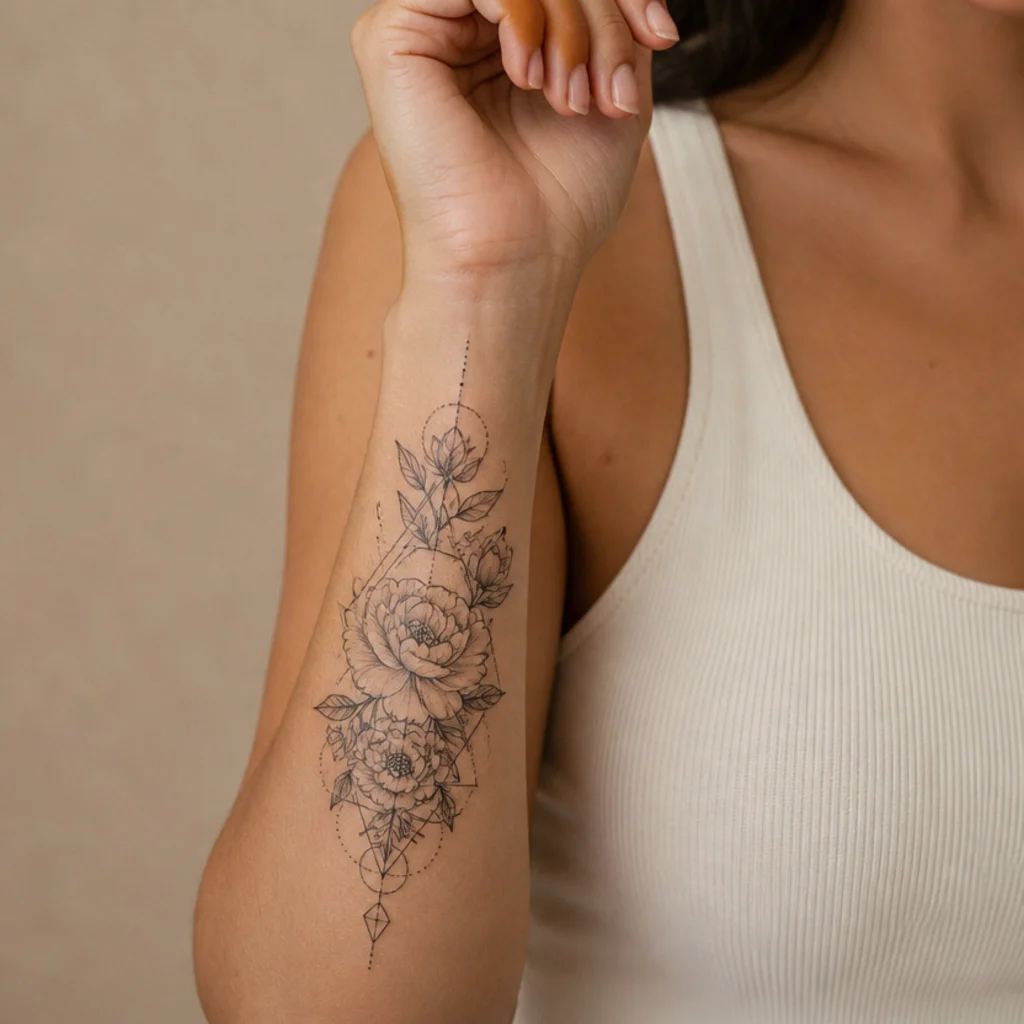
Combining florals with geometric framing gives a cover-up something soft designs often lack: structure. Clean lines, frames, and dot shading impose order that helps disguise an irregular old shape, while fine-line blossoms keep the piece feeling organic rather than clinical. Forearms, thighs, and shoulders suit the balanced composition, and most builds take it well since the geometry can scale to the limb. Maintenance is moderate; difficulty is advanced, since crisp geometry is unforgiving over skin that already holds ink, and any wobble in a straight line shows immediately. Dot shading is the quiet workhorse here, letting the artist build controllable density exactly where the old design needs burying. Pro tip: ask how the artist will keep straight elements true over existing ink, and request that the geometric anchors, radiating arcs, or frames be positioned to draw the eye deliberately, pulling attention from the original while the stippling covers it. That interplay of precision and softness is what makes these convincing. Have them concentrate dot shading over your old piece and place the geometry to pull focus.
19Autumn Branch Drape
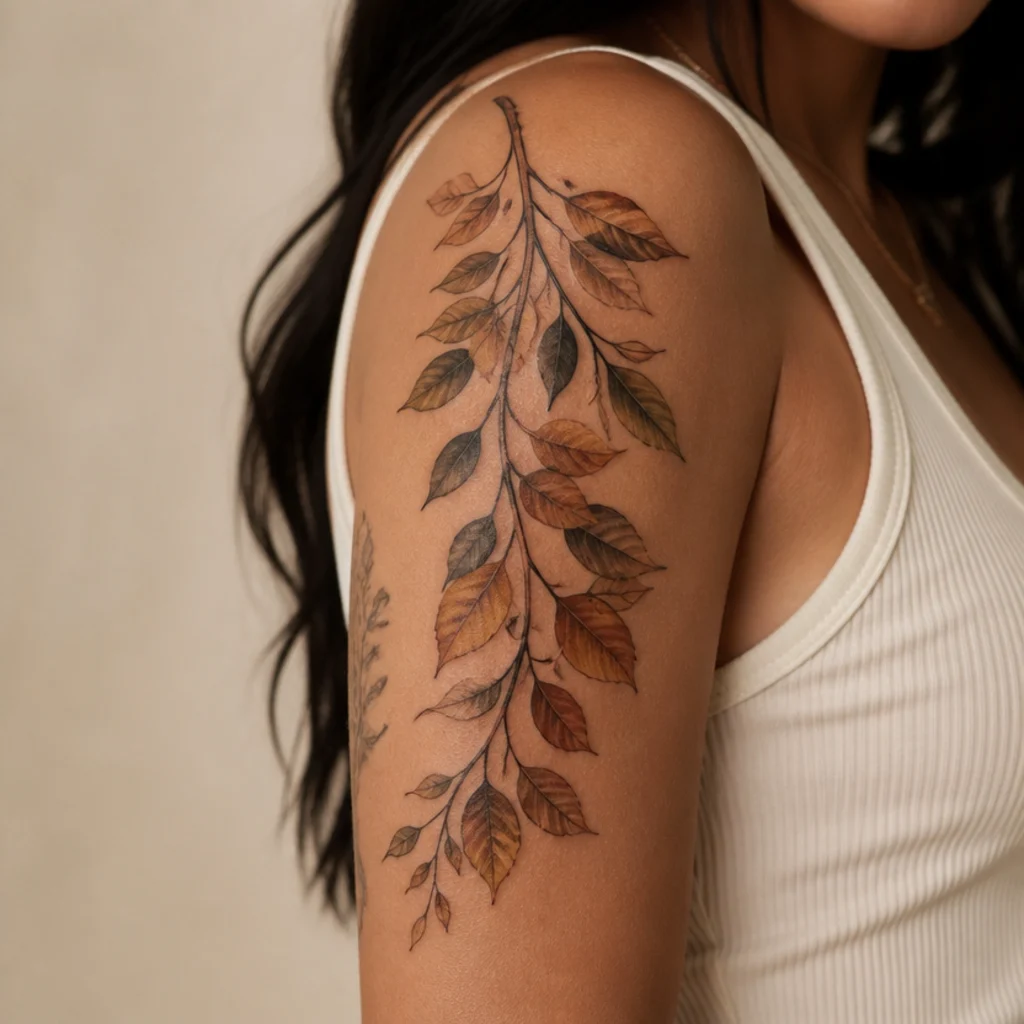
A draping branch with clustered leaves is a graceful, elongated cover-up that follows the natural line of an arm or leg, so coverage reads as flow rather than effort. Leaves can bunch densely over the old tattoo and thin out elsewhere, letting the artist bank darkness where it's needed while the design tapers naturally. Upper arms, forearms, and calves suit the vertical drape, and longer placements flatter it best, since it can visually lengthen a limb. Maintenance is moderate, more so if warm autumn color is used, since amber, rust, and gold soften faster than black and reward periodic refreshing. Difficulty is moderate to advanced. The branch's asymmetry works in its favor, since a naturally uneven cluster hides an irregular original better than anything symmetrical. Pro tip: ask the artist to weight the leaf clusters over the darkest part of your existing ink and let bare branch stretches carry the eye along the length, so the density looks like nature rather than necessity. A black-and-grey version lowers upkeep if you'd rather skip color maintenance. Have them design the leaf clusters around your specific ink's darkest zones.
20Small Constellation Fill
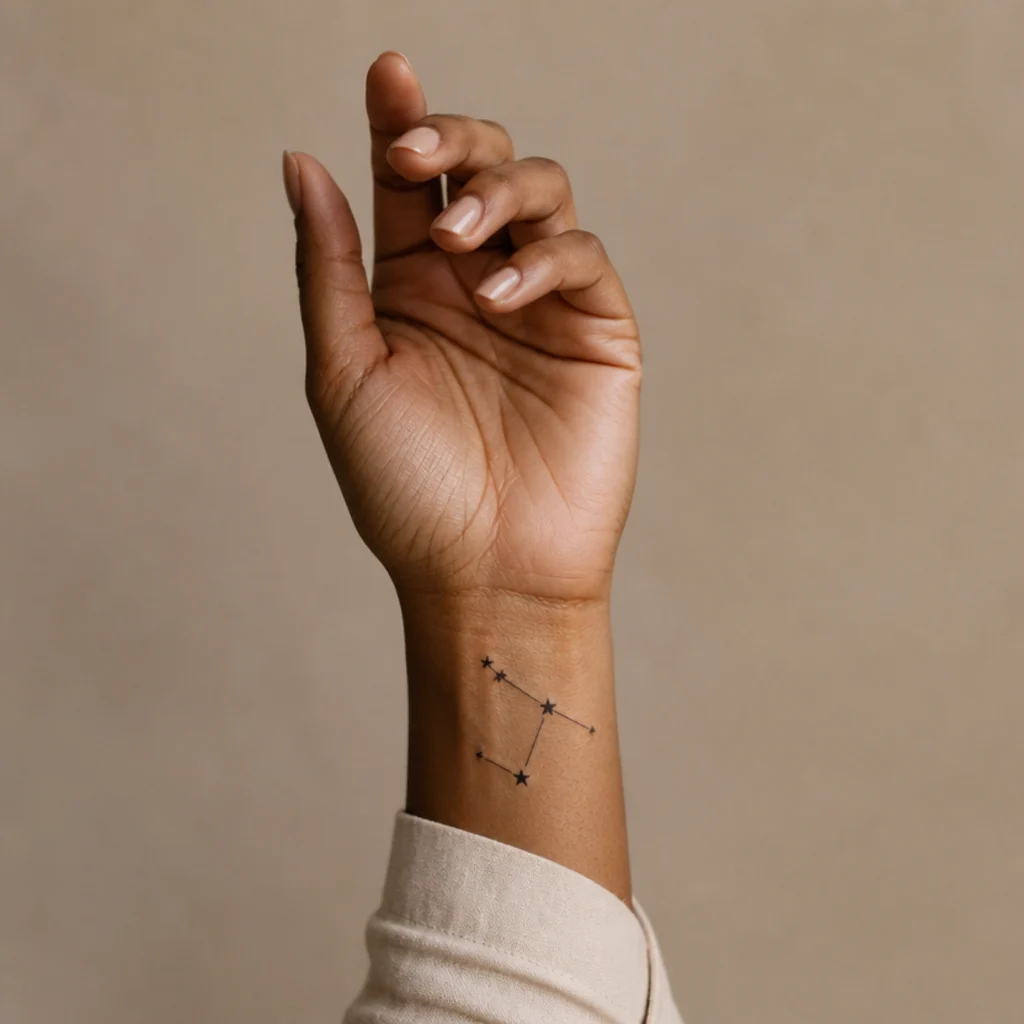
For a tiny, faded old tattoo, a small constellation of connected stars is one of the more subtle small cover up tattoos available. Solid star points sit directly over the original mark while fine connecting lines add shape and context, turning a spot of coverage into a considered little map. Inner wrists, ankles, and behind the ear suit the minimal scale, and delicate placements flatter it best, since anything larger would feel heavy. Maintenance is low; difficulty is moderate. Be honest about the constraint: this only works when the old piece is genuinely small and light, since a single star point can only cover so much and won't touch a bold or dark original. Pro tip: ask the artist to place the largest, most solid star squarely over the old mark and keep the connecting lines fine, so the eye follows the pattern rather than lingering on the covered point. If the original is even slightly too dark, a denser cluster or a small solid motif is the safer route. Confirm a constellation is dense enough for your coverage, or ask whether to size up.
Save this to Pinterest so your artist can see the direction you're leaning.
21Dark Dahlia Statement
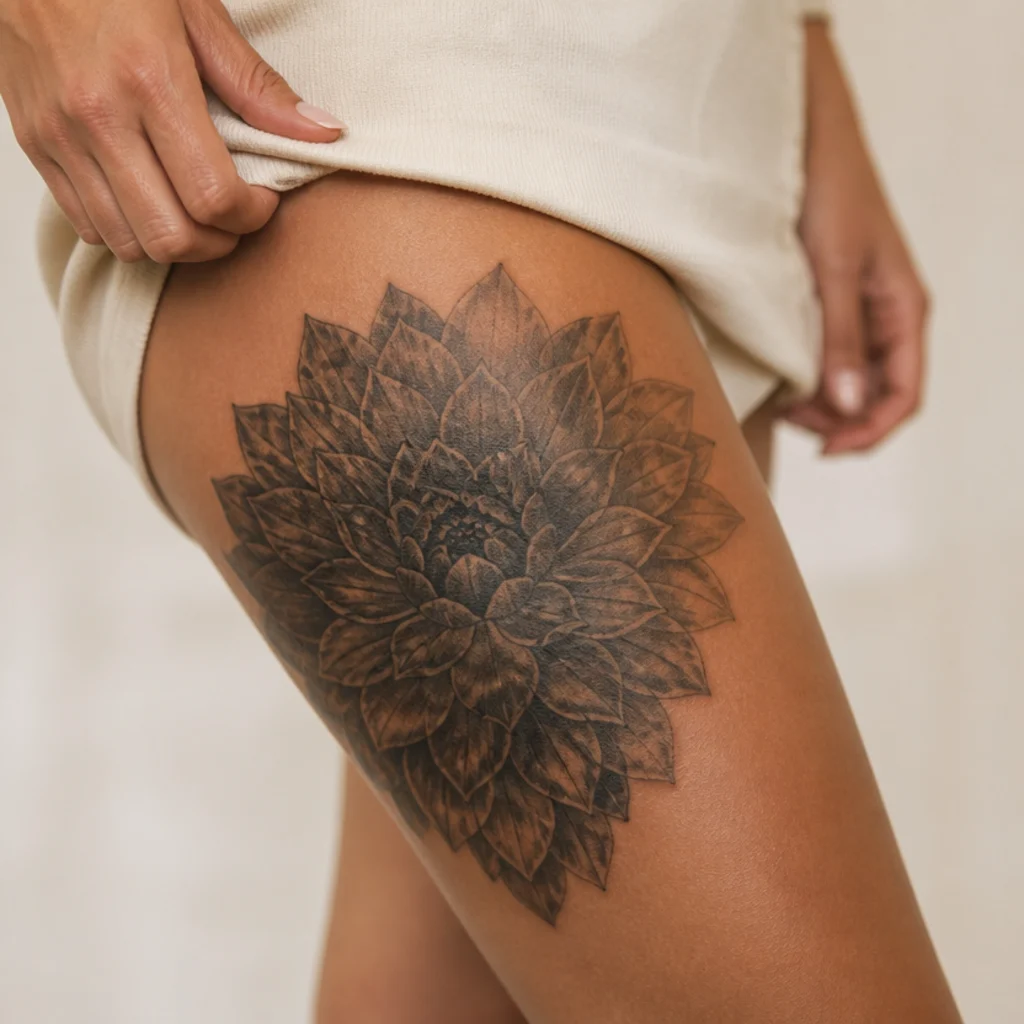
A dahlia's dozens of tightly layered petals make it a coverage powerhouse, arguably even denser than a peony and better at burying a saturated original. The deep black-and-grey shadows that fall between each petal give the artist a natural, repeating supply of darkness to place over old ink, while the bloom itself stays composed and elegant. Thighs, shoulders, and upper arms give it room to scale, and fuller placements suit the round, full form best, where its density reads as lush rather than crowded. Maintenance is moderate; difficulty is advanced, since that intricate petal layering has to be mapped deliberately onto the old design, not just laid on top. Pro tip: because coverage lives in the inter-petal shadows, ask the artist to plan those dark negative spaces around your original's footprint first, then build the petal geometry to suit; a second smaller bloom or a cluster of buds can rebalance the composition once coverage dictates the layout. Find out how large the dahlia needs to be for full coverage on your specific placement and whether a supporting bloom helps.
22Feather and Vine Blend
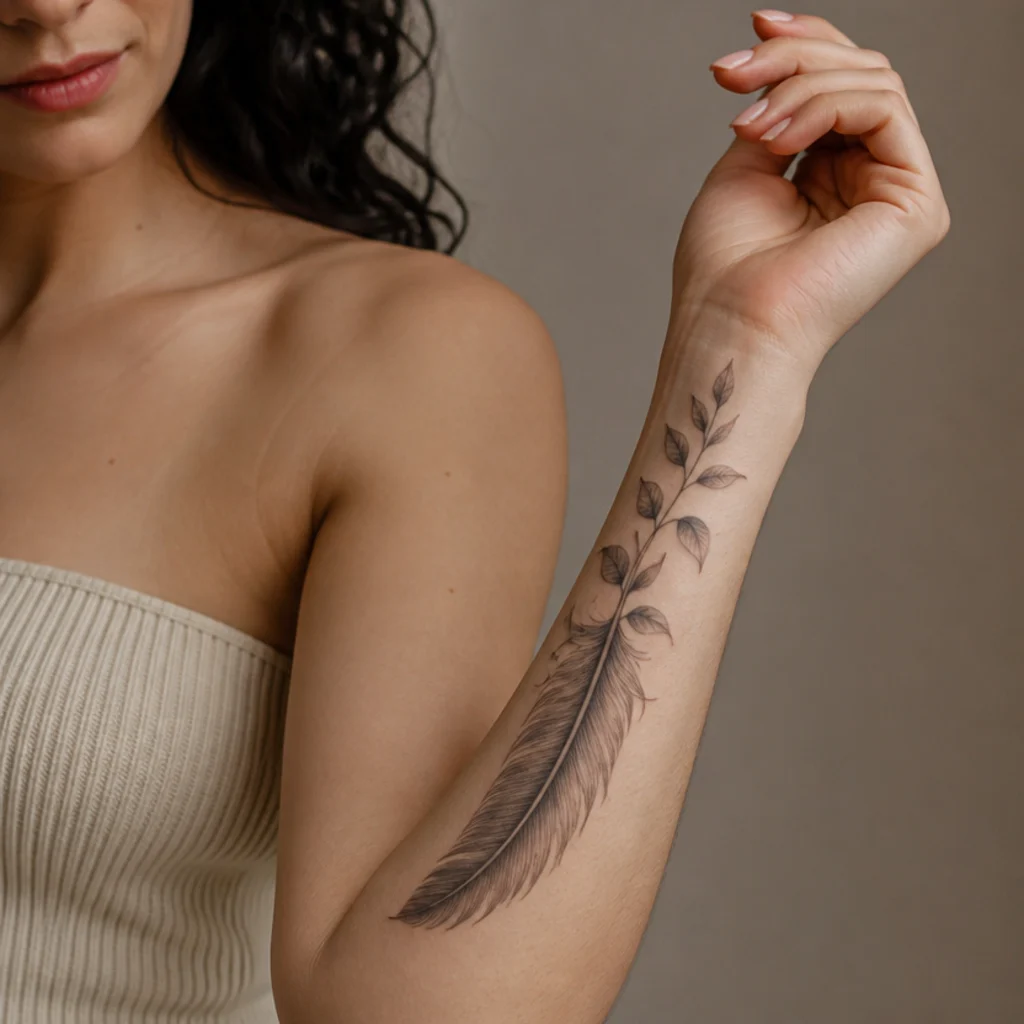
A detailed feather softening into a trailing vine pairs a strong central shape with endlessly flexible filler, a smart combination for coverage. The feather's dense barbs and central shaft carry concentrated darkness over the heart of an old tattoo, while the vine extends the design naturally down the limb so nothing terminates in an obvious edge. Forearms, calves, and the spine suit the elongated blend, and longer placements flatter it best, letting the design travel. Maintenance is moderate; difficulty is moderate to advanced. The blend's advantage is transition: the feather handles the heavy lifting and the vine dissolves the boundary between covered and uncovered skin. Pro tip: ask the artist to position the feather's densest, darkest section directly over your original and let the vine wander beyond the coverage zone in a deliberately uneven, organic way, since a too-tidy vine can give away where the covering stops. Small leaves or berries along the vine add texture and give the eye somewhere else to go. Have them place the feather's core over your old ink and carry the vine past it.
23Ocean Wave Cuff
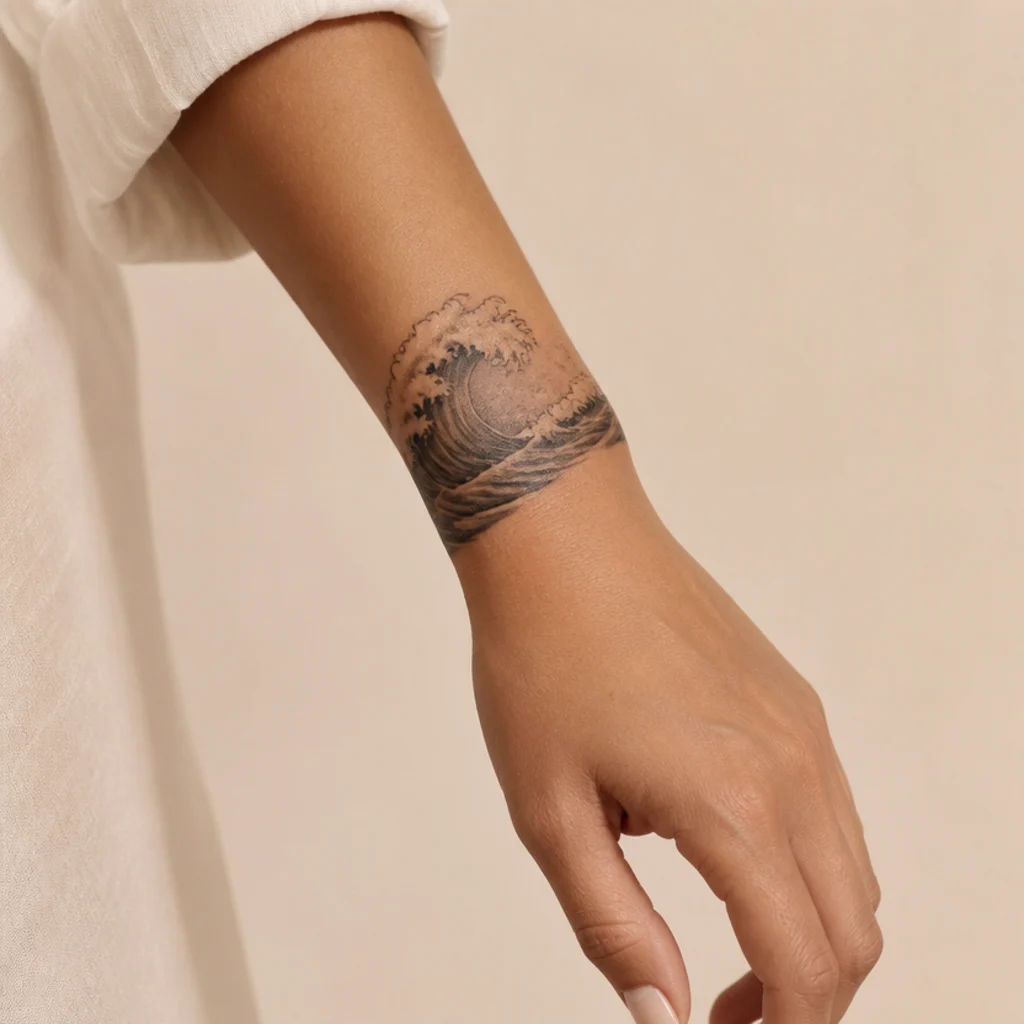
A wrapping wave cuff turns coverage into a clean, moving band around the wrist or ankle. Curling foam and dark troughs hand the artist a ready-made mix of bright highlights and heavy shadow, so masking an old design becomes a matter of routing the darkest water over it. Wrists, ankles, and lower forearms suit the cuff, and slimmer joints flatter the encircling form best, where it reads like a bracelet of movement. Maintenance is moderate; difficulty is moderate to advanced, largely because a full wrap-around means tattooing all sides of a limb. That circumference is the main practical consideration, since a complete band sometimes heals better split across two sessions to spare the skin. Pro tip: ask where the artist plans to drop the darkest trough of the wave, and make sure that heaviest shadow falls over your old ink while the foamy crests handle the lighter transitions; the natural light-to-dark rhythm of water is what keeps the coverage invisible. Ask how they'll manage healing for a full wrap, and exactly where the darkest water will sit over your original.
24Blooming Name Transformation
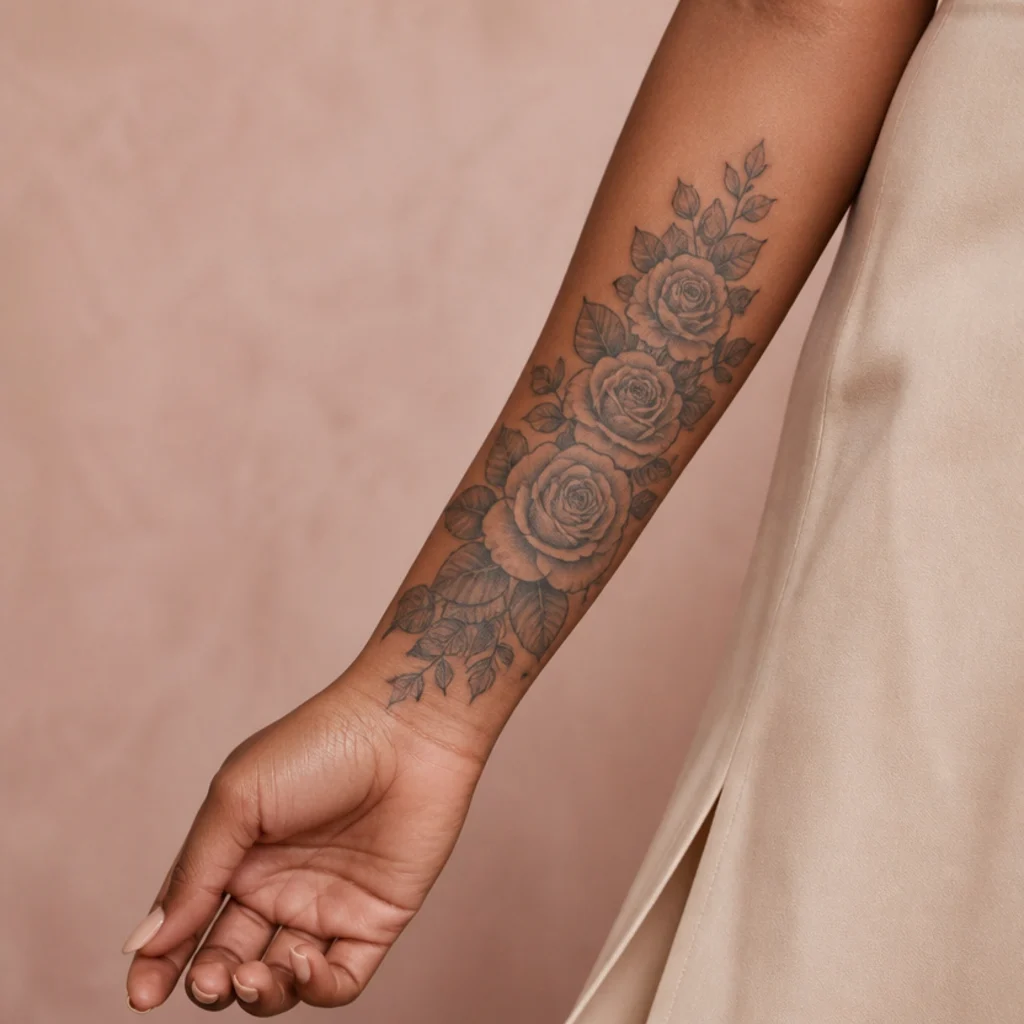
For bold, blocky lettering that a delicate vine can't handle, a full cluster of roses or mixed blooms turns name cover up tattoos into something entirely new. The sheer density of a floral grouping, with its overlapping petals and deep inter-bloom shadows, can absorb thick, dark letters that resist any lighter design. Forearms, upper arms, and thighs give the cluster the space it needs, and the generous scale suits those placements well. Maintenance is moderate; difficulty is advanced. Set expectations honestly here: lettering is among the hardest things to cover cleanly, so the new design almost always needs to be both larger and darker than the name it replaces. Pro tip: ask the artist to align the darkest cores of the flowers, the shadowed petal centers, over the heaviest letter strokes, and let leaves and buds break up the readable spacing between characters; that disruption of the eye's left-to-right reading rhythm is what actually erases a name. Ask directly whether your specific lettering can be masked at your preferred size, or whether the piece needs to grow to cover it cleanly.
25Full Forearm Garden
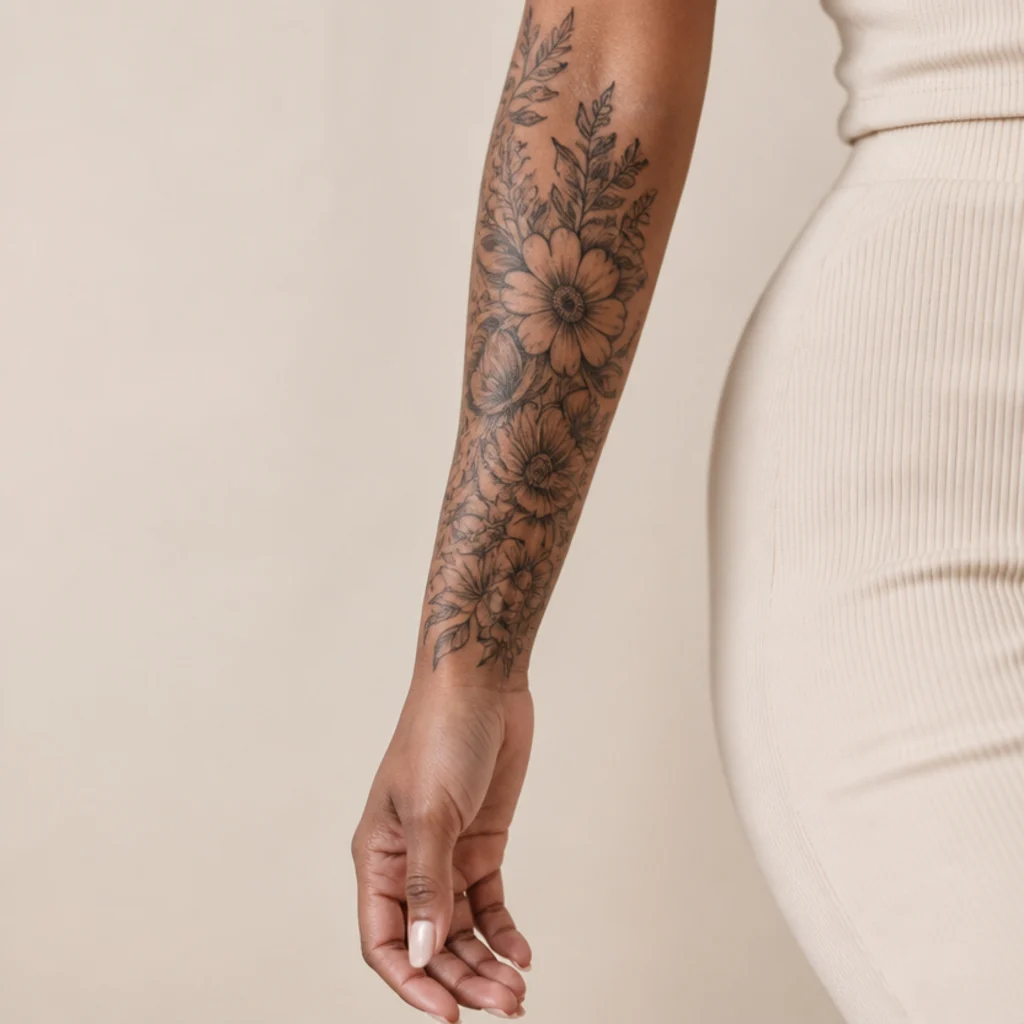
When you want to reclaim an entire area rather than patch one spot, a full forearm garden of mixed flowers and foliage is the most complete of the large cover up tattoos on this list. Multiple blooms, buds, leaves, and filler give the artist total freedom to bank darkness precisely wherever the old design sits and let everything else flow around it, so no single element has to carry the whole cover-up. Forearms and calves suit the wrap, and most builds take a composition that travels the full length well, since it reads as a cohesive garden rather than a coverage exercise. Expect multiple sessions, moderate maintenance across the larger canvas, and advanced difficulty. Pro tip: ask the artist to identify the two or three darkest points of your original and place a central bloom or a dense leaf cluster over each, then connect them with vines and filler; designing around the coverage anchors first is what keeps a big piece from looking busy. In your consult, get a full session plan, a realistic total-cost range, and healing intervals, and confirm how the composition will fully dissolve your old tattoo.
Pro Tips from the Editor
- Size up on purpose. A cover-up almost always has to run larger and darker than the original; if you're wedded to keeping it small, budget for a few sessions of laser lightening first and let that expand your options rather than forcing a tiny design to do an impossible job.
- Judge artists on healed cover-ups only. Fresh ink always looks fully covered; the truth shows six to twelve months later. Ask specifically for healed cover-up photos, and ideally ones where you can spot what was underneath.
- Photograph the original in flat, even light. Harsh light hides how dark old ink really is. Send well-lit, straight-on photos with something for scale so the artist can plan coverage accurately before you're in the chair.
- Let the artist route the darkness. The most seamless designs place their heaviest black-and-grey exactly over the old ink and taper outward. If a design can't get dark where your original is darkest, it's the wrong design.
- Match style to what's underneath. Color covers color but struggles over black; watercolor needs a light or lasered original; blackwork and dense black-and-grey handle the stubborn cases. Choose by physics, not just by taste.
- Plan maintenance before you commit. Color and green tones soften faster than solid black. If low upkeep matters to you, lean black-and-grey and be disciplined with SPF, which is the single biggest factor in how crisp coverage stays.
- Treat scars as their own category. Insist on a scar-experienced artist, a maturity check on the tissue, and often a small test area; go in to soften how a scar reads, never expecting to erase it.
How to Choose / Get the Look
Work through it in order. First, assess the original honestly. Gauge its size, darkness, ink density, and age, since a small, faded piece opens far more options than a large, freshly saturated one, and dark lettering is the single toughest category to hide. Accept the core rule up front: a cover-up usually needs to be bigger and darker than what it replaces, so let go of any hope that a tiny new design will erase a bold old one.
Second, decide whether to lighten first. If your heart is set on a small, delicate, or colorful result but the original is dark, a few sessions of laser lightening spaced over months can transform what's achievable. It's slower and adds cost, but it frequently produces a cleaner final piece than coverage alone.
Third, match design to physics, then taste. Use the table below as a starting filter, then refine with your artist. Blackwork and dense black-and-grey botanicals cover the widest range; color and watercolor are for light or lasered originals; scars are their own specialist category.
| Your original | Realistic coverage approach | Style to favor | Typical scope |
|---|---|---|---|
| Small & faded | Small motif placed over the mark | Constellation, moon phases, fine botanical | Often single session |
| Medium, moderately dark | Focal shape with dark filler | Rose & shadow leaf, moth, raven, snake | One to two sessions |
| Large or heavily saturated | Extend and redistribute darkness | Sleeve extension, koi & water, blackout | Multi-session |
| Dark lettering / name | Denser, larger design over strokes | Rose cluster, dense florals | One to two sessions |
| Light or lasered, want color | Saturated color over faded ink | Neo-traditional, watercolor | Varies |
| Healed scar | Redirect the eye, specialist work | Fine-line botanical | Consult-dependent |
Fourth, choose a specialist and vet the portfolio. Cover-ups and scar work are distinct skill sets, so look for a licensed artist with a genuine healed cover-up portfolio, not just fresh photos. Ask how many sessions your idea needs, how they'll place the darkest elements over the old ink, and how healing will change the final look. For scars, confirm the tissue is fully matured and suitable to tattoo. Design, sizing, placement, coverage feasibility, and healing should all be confirmed with your artist, and remember that no cover-up is guaranteed to completely hide what's underneath, only to reimagine it.
Frequently Asked Questions
Can any tattoo be covered up?
Most can be reworked, but coverage depends on the size, darkness, ink density, and age of the original. Faded, lighter tattoos are the easiest; large, saturated, or heavily lined pieces often need a bigger, darker design or a course of laser lightening first. A licensed artist can tell you what's realistic for your specific tattoo after seeing it in person.
Do cover-up tattoos have to be black?
Not always, but darker and denser designs cover more reliably. Solid blackwork and black-and-grey absorb old ink best, while color and watercolor styles generally suit lighter or already-faded originals because their translucent pigments won't mask a hard black line. Your artist will steer you based on exactly what's underneath.
Can a tattoo cover a scar?
Sometimes, if the scar is fully healed and suitable to tattoo, but results vary because scar tissue takes ink unevenly and can be raised, indented, or shiny. This is specialist work that may involve a test area. Always confirm with a licensed artist, and view the tattoo as softening how a scar draws attention rather than erasing it.
How big does a cover-up need to be?
Usually noticeably larger than the original. Extra size gives the artist room to redistribute dark areas, break up the recognizable old shape, and taper coverage so nothing looks patched. If you want to keep it small, laser lightening beforehand is the most reliable way to expand your options.
How much do cover-up tattoos cost?
Costs vary widely and are typically billed at an hourly or per-session rate that runs higher than a comparable fresh tattoo because of the extra planning and dense layering involved. Large or multi-session pieces scale accordingly, and laser lightening, if you choose it, is a separate cost. Ask for a written estimate rather than assuming a flat figure.
How many sessions will a cover-up take?
It depends on size and complexity. A small motif over a faded mark can be a single session, while sleeve extensions, koi-and-water compositions, blackout work, and full forearm gardens are usually multi-session, with healing time built in between appointments. Ask your artist for a session plan up front.
How long do cover-up tattoos take to heal?
Healing is broadly similar to a regular tattoo, though larger or multi-session cover-ups take longer overall, and each area needs to settle before the next sitting. Follow your artist's aftercare closely, protect it from sun, and expect the design to look denser or darker until it fully settles over a few weeks. Confirm the timeline with your artist.
Is laser removal or a cover-up better?
They solve different problems and often work together. Full laser removal aims to erase the original but takes many sessions; a cover-up reimagines it in one project. A few sessions of laser lightening before a cover-up is a popular middle path that widens your design options, especially if you want something smaller, lighter, or more colorful.
Will a cover-up completely hide my old tattoo?
Not guaranteed. A skilled cover-up can make an old design effectively disappear into the new one, but visibility depends on the original's darkness and your skin, and some pieces still show faintly in certain light. A licensed artist should give you an honest assessment of your specific case rather than a blanket promise.