25 Gorgeous Wrist Cover Up Tattoos for Women
The wrist is small, always visible, and never stops moving — which makes it one of the hardest spots on the body to cover cleanly. These 25 ideas show how design logic, ink density, and smart placement turn an old piece into something you actually want to show off.
 Edited by Lena Rose · Published July 11, 2026 · 36 min read
Quick Answer
- Best for: Covering names, faded script, small dark blobs, blown-out linework, or a piece that no longer fits your life, on the inner or outer wrist without committing to a full forearm sleeve.
- Who might skip it: Anyone with very recent, heavily saturated black ink (under a year old and still settling), or a keloid-prone scar underneath, until an artist has assessed it in person.
- Maintenance: Moderate. Wrist skin flexes, sees daily sun, and meets soap and sanitizer constantly, so denser, darker designs hold their edges longest; color needs periodic refreshing.
- Difficulty: Intermediate to advanced. A good cover-up depends on the artist reading the old ink and building over it, not drawing on top of it.
- Cost: Variable. Small single-motif cover-ups typically start in the lower hundreds; wrapping bands, color work, and multi-session blackout pieces run higher. Ask for a written estimate after the consult.
- Wear time / longevity: Permanent, with bold blackwork and dotwork aging most gracefully and fine-line or watercolor needing touch-ups sooner.
- Standout variation: A layered floral band that circles the wrist like a bracelet, burying the old piece inside the pattern rather than sitting on top of it.
- How to ask your artist: "I want a wrist cover-up sized and shaded to fully absorb this existing tattoo, planned around where the old ink sits darkest."
In This Guide
- Blackwork Floral Band
- Watercolor Wildflower Wrap
- Fine-Line Botanical Sleeve Start
- Bold Peony Bloom
- Geometric Mandala Cuff
- Delicate Lace Bracelet
- Butterfly Cluster
- Ocean Wave Band
- Blackout Bracelet
- Dotwork Moon Phases
- Rose and Vine Wrap
- Feather Into Birds
- Abstract Brushstroke
- Snake Around the Wrist
- Sunflower Statement
- Celestial Star Map
- Fern and Foliage
- Ornamental Filigree
- Hummingbird and Blossom
- Koi and Water
- Wildflower Meadow Strip
- Blackberry Bramble
- Art Nouveau Woman
- Minimalist Mountain Range
- Layered Watercolor Poppies
Why the Wrist Is Its Own Challenge
Covering a tattoo on the wrist is a different problem than covering one on the shoulder or thigh. The skin here is thin and low on cushioning fat, it bends at a hinge dozens of times an hour, and whatever you choose sits in full view every time you lift a coffee cup or check your phone. That's why gorgeous wrist cover up tattoos depend on design intelligence, not just sheer darkness. A skilled artist maps the old ink first — its value, its saturation, any blown-out lines, any scarring — then builds a new composition with enough contrast, pigment, and deliberate negative space to swallow it whole. The best cover up tattoos for women in this spot lean on organic forms: flowers, waves, vines, feathers. Their natural irregularity breaks up the hard, straight edges of old letters and outlines. Whether you're hiding a name, a faded symbol, or a piece that no longer fits who you are, these 25 wrist cover up tattoos and forearm cover up tattoos show how placement, density, and value planning add up to a real fresh start instead of a patch job you spend years hiding under a watch.
01Blackwork Floral Band
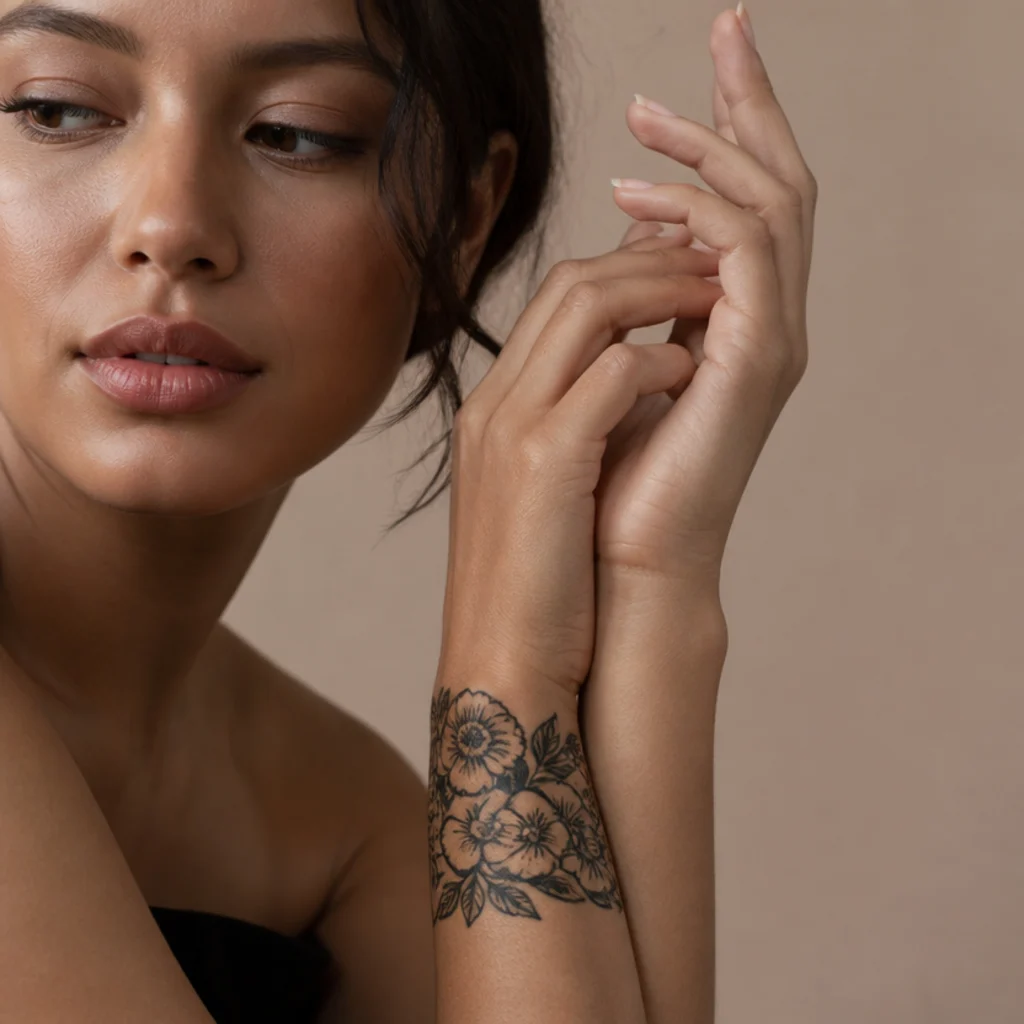
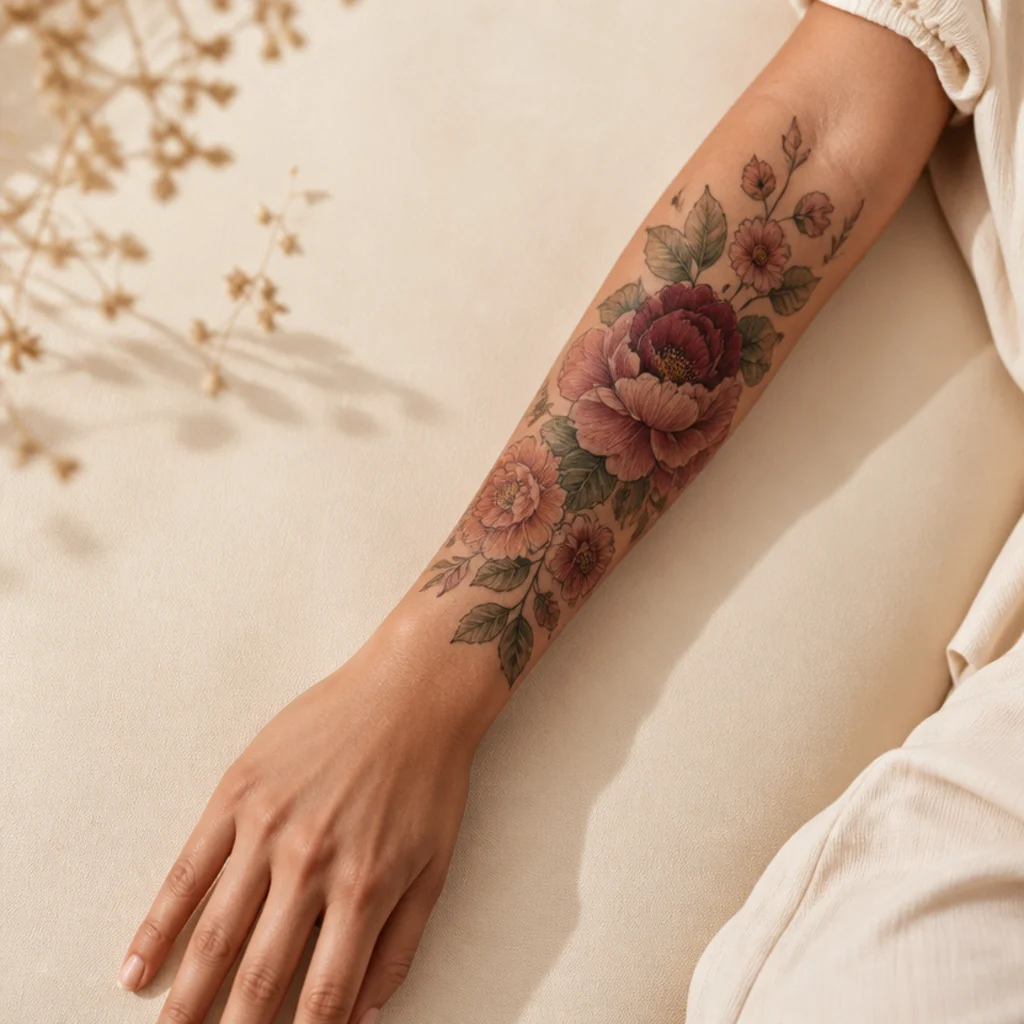
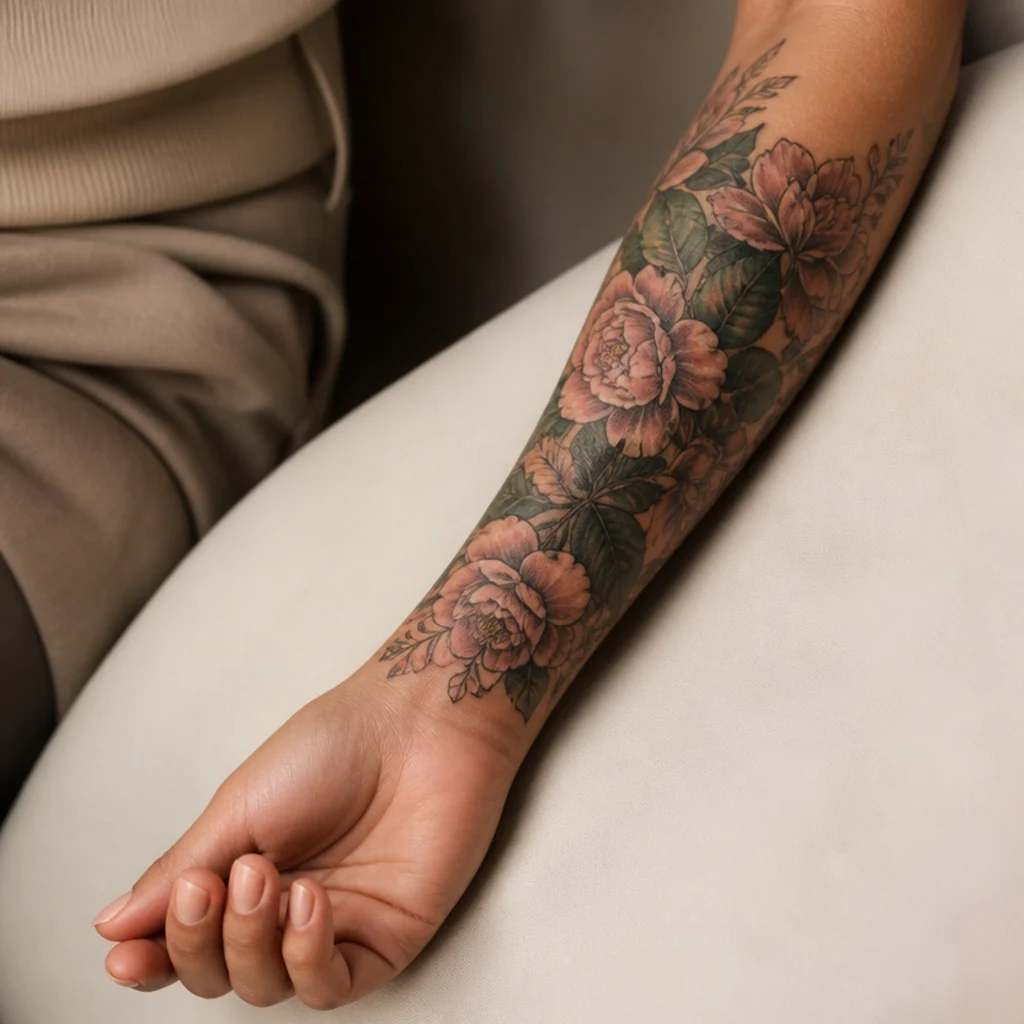
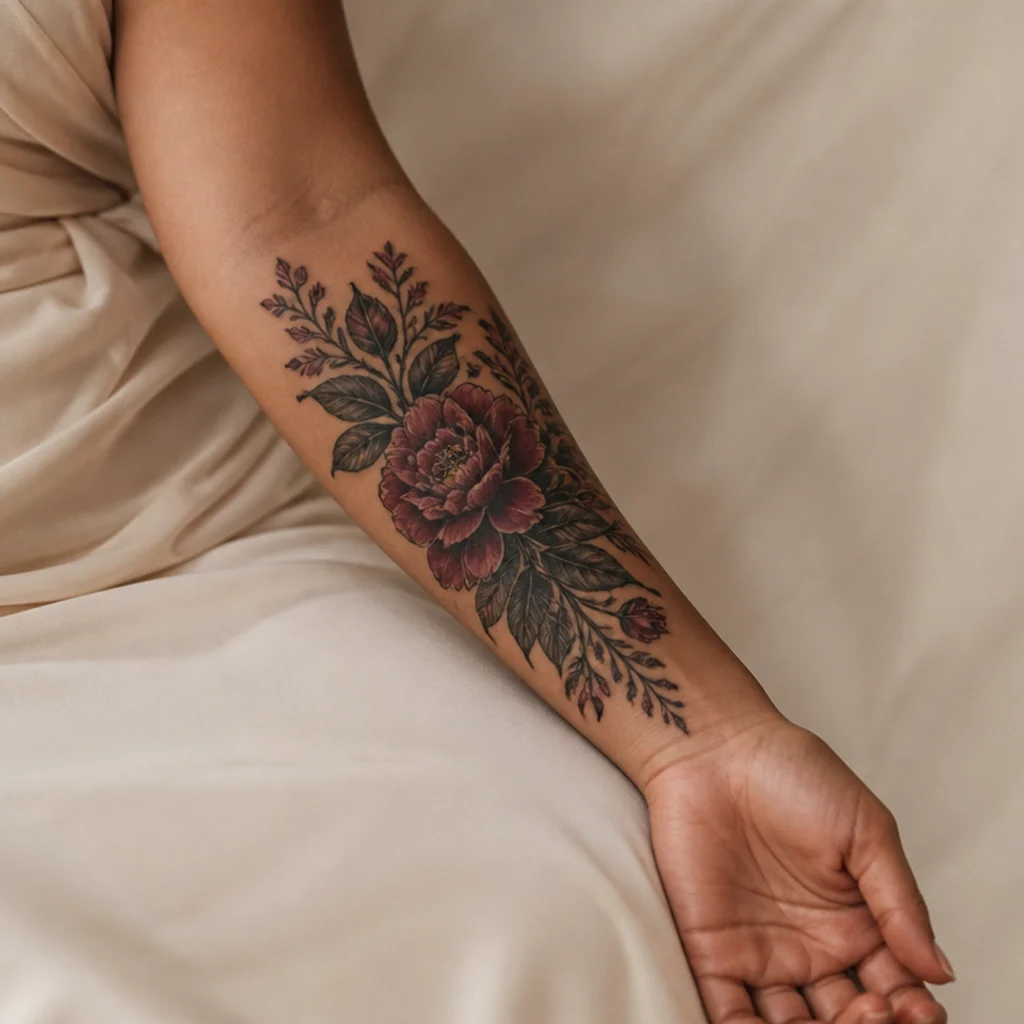
Solid blackwork is the workhorse of wrist cover-ups: fully saturated black is the single most reliable way to bury old ink, whatever color or value sits beneath it. This design wraps the joint in a band of stylized peonies and negative-space leaves, using heavy petal fills and confident gaps that read as intentional design, not something hiding a mistake. On medium to deep skin tones, solid black settles evenly; on fair skin, an artist can open up more negative space so it doesn't read as a heavy slab. There's no color to shift here, so upkeep is low, though a light touch-up every three to five years keeps edges crisp as the wrist flexes. Slimmer and average wrists both wear it well, and it scales wider for a bolder cuff. Pro tip: ask to see the stencil wrapped fully around before the first line goes in, since band symmetry gets judged in the round. Ask your artist for a "blackwork floral wrap sized to cover the existing piece, with the densest fills placed over the darkest old ink."
02Watercolor Wildflower Wrap
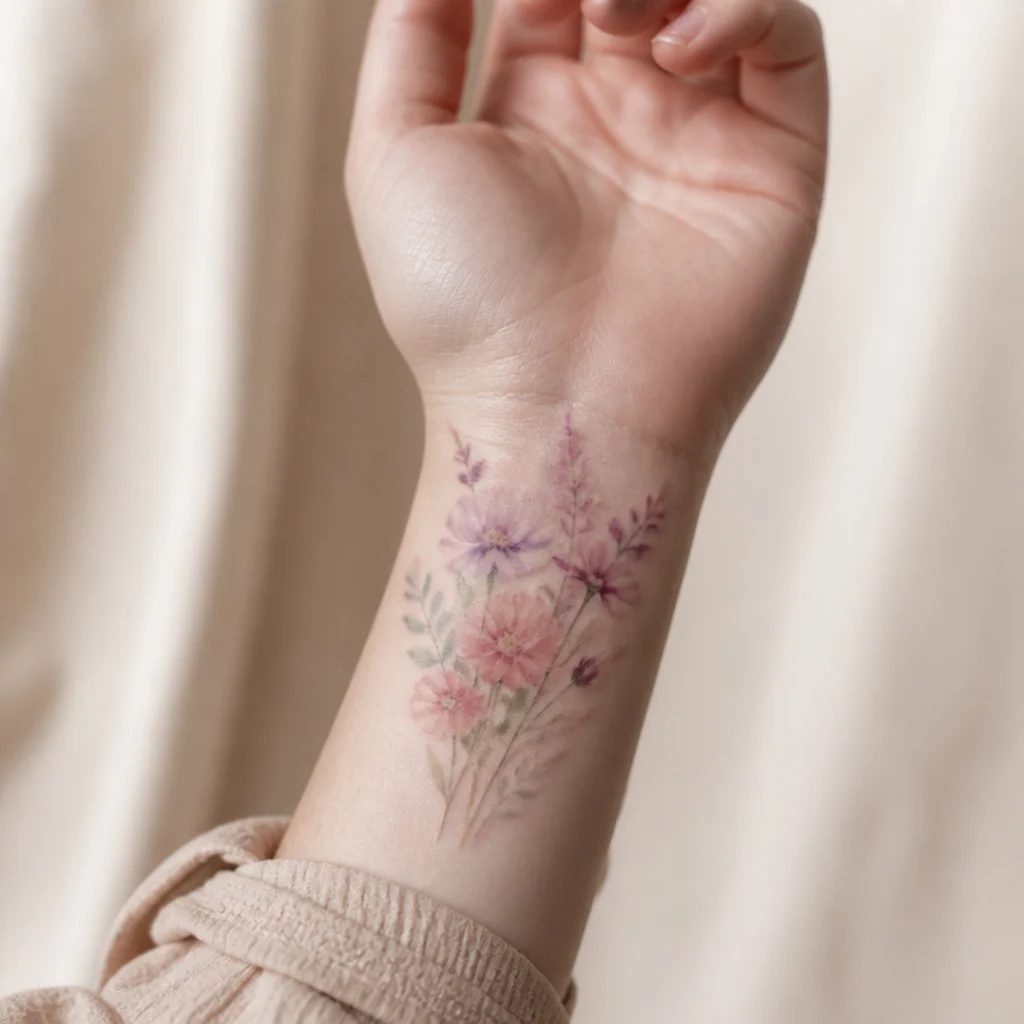
Watercolor trades hard outlines for washes of pigment that bleed and layer — an elegant way to disguise old ink, but only when the piece underneath is already light. Blush pinks, soft lavender, and muted sage overlap into a painterly, brushed effect. Because there are few dark anchoring lines, this works best over faded, small, or previously lasered tattoos rather than heavy blackwork, which will ghost through the transparent layers. Color softens naturally over five to ten years, and this style fades sooner than most, so plan a refresh and keep it out of direct sun and off tanning beds. Cool and neutral undertones carry it especially well, where the lavenders and sages stay true. Pro tip: ask for one or two subtly deeper pigment pools placed directly over the old shape — that adds covering power without breaking the airy look. Tell your artist you want a "loose watercolor wildflower band with a couple of concentrated pigment areas layered to break up the old shape."
03Fine-Line Botanical Sleeve Start
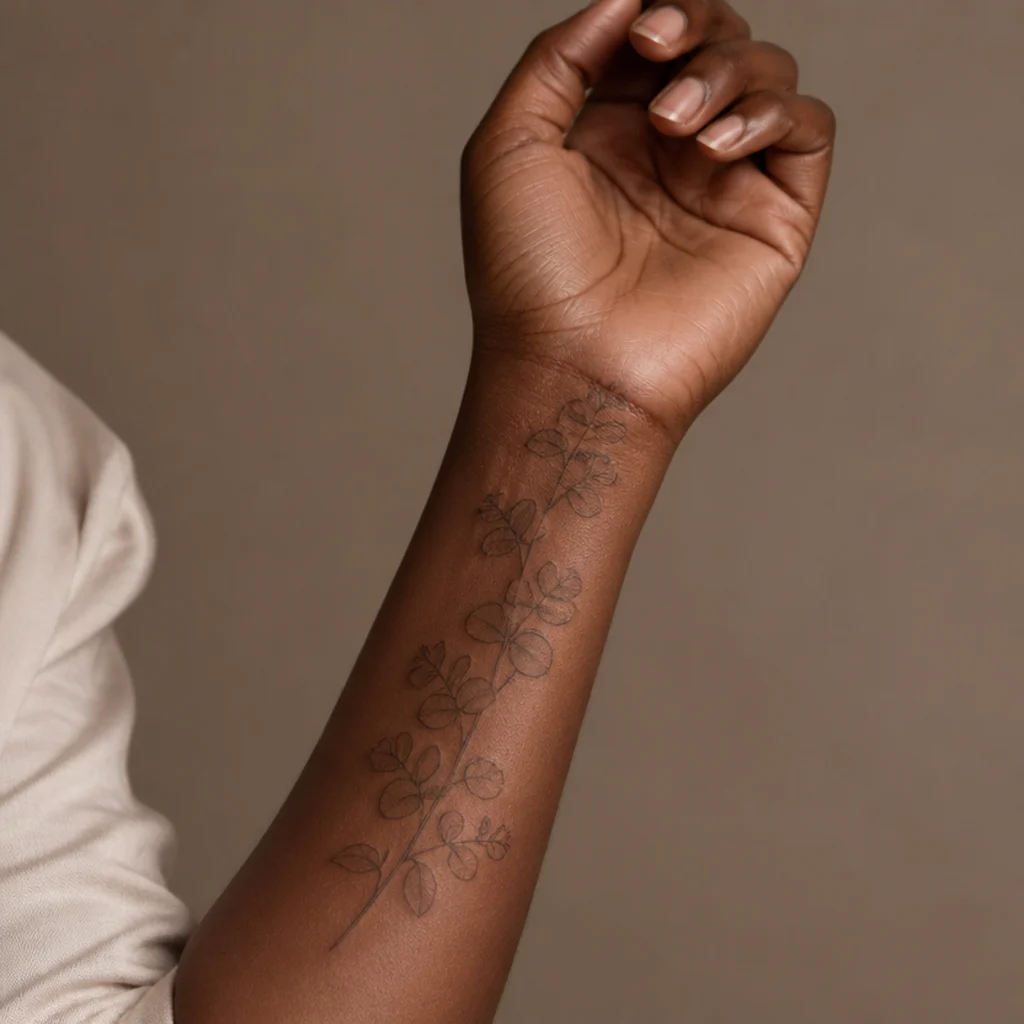
Sometimes the smartest cover-up strategy is to stop treating the wrist as the whole canvas. Extending delicate botanicals up toward a forearm cover up tattoo gives the artist more real estate to redirect the eye, reworking the old piece into a larger composition where it disappears among the elements. Trailing eucalyptus, seed pods, and fine stems build rhythm and movement along the inner arm. This is the go-to route when the original is stubborn, mid-value ink that a small design can't convincingly absorb. Be realistic, though: fine-line and single-needle work fades faster than bold styles, especially on flexing wrist skin, so it needs diligent SPF and a touch-up roughly every three to four years. Minimalists who still want scale tend to gravitate here, and it flatters longer, slimmer forearms. Pro tip: have the artist anchor at least one denser leaf cluster over the old ink so coverage doesn't rely on thin lines alone. Ask for a "fine-line botanical trail that starts as a wrist cover-up and extends up the forearm, with a fuller cluster over the old tattoo."
04Bold Peony Bloom
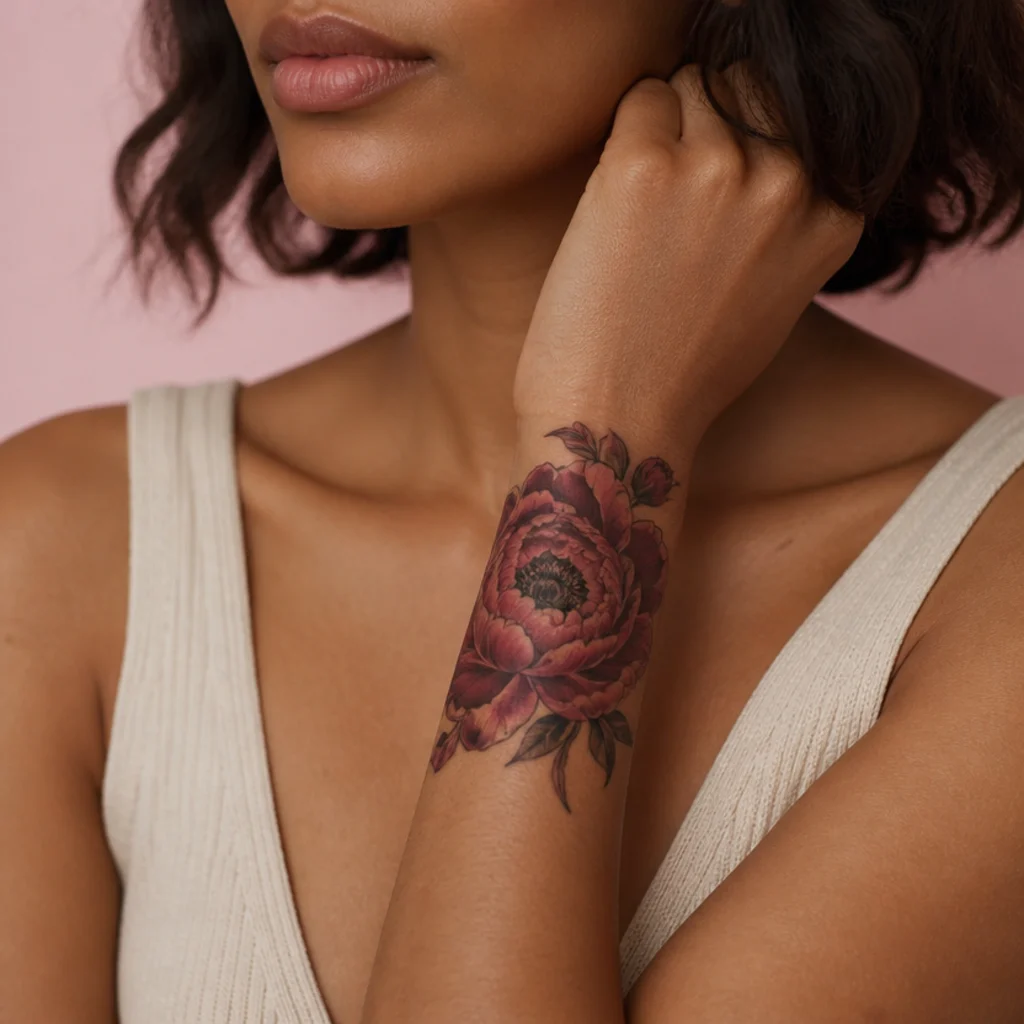
One large, saturated bloom can carry the whole cover-up on its own. A single peony with deep magenta petals and rich black shading at the throat brings plenty of pigment to bury an old design, and the ruffled, layered petals work well over irregular shapes because there's no flat, even area where old ink could peek through. It's a confident, feminine choice rather than something subtle, and it sits beautifully on the outer wrist where it stays fully on show. Color and shading hold up well with disciplined aftercare and a refresh every three to five years, with the black core doing the long-term covering as the magenta softens. Warm and neutral undertones suit it particularly well. Pro tip: position the darkest part of the flower's center directly over the heaviest old ink, and let the outer petals fade into skin to disguise the boundary. Say you want "a bold peony with a heavily shaded center placed so the darkest area sits over the existing tattoo."
Save this to Pinterest to compare bold blooms against softer wildflower styles.
05Geometric Mandala Cuff
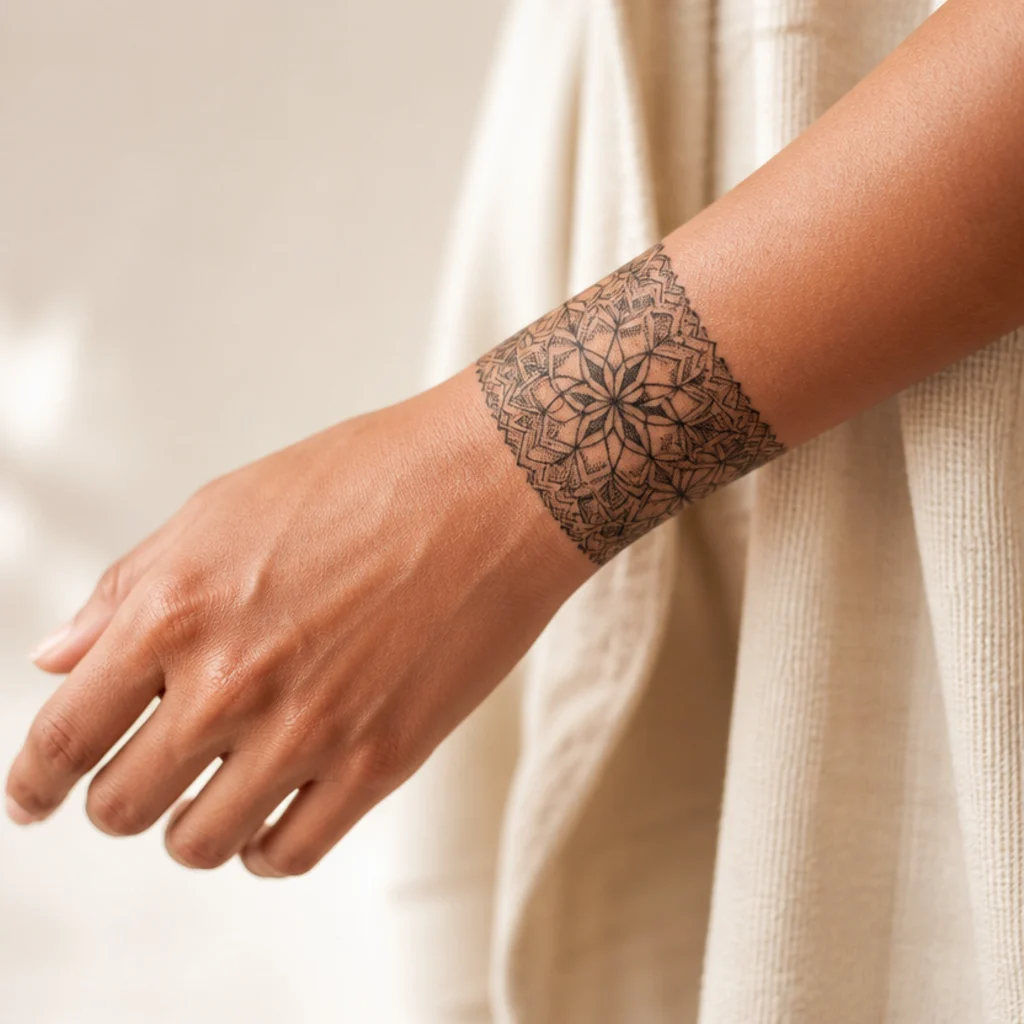
A mandala cuff circles the wrist in symmetrical, repeating geometry, and it's a clever cover-up because the pattern's overall density pulls the eye to the piece as a whole rather than any single point where old ink might hide. Fine black linework paired with graded dotwork fills space evenly and reads as precise on every skin tone. People drawn to order, symmetry, and sacred-geometry symbolism gravitate toward this one, and it flatters wrists of any size since the repeating motif scales to the circumference. Because it lives or dies on clean, true lines that meet correctly in the round, pick an artist with a strong geometric and dotwork portfolio — a wobble in a mandala shows far more than one in a loose floral. Maintenance is low, and dotwork ages gracefully at the right density. Pro tip: ask for a slightly heavier dotwork zone worked into one quadrant over the old ink rather than a uniform gray; it covers better while keeping symmetry intact. Request a "geometric mandala cuff with dotwork shading sized to enclose the old piece, weighted over the darkest area."
06Delicate Lace Bracelet
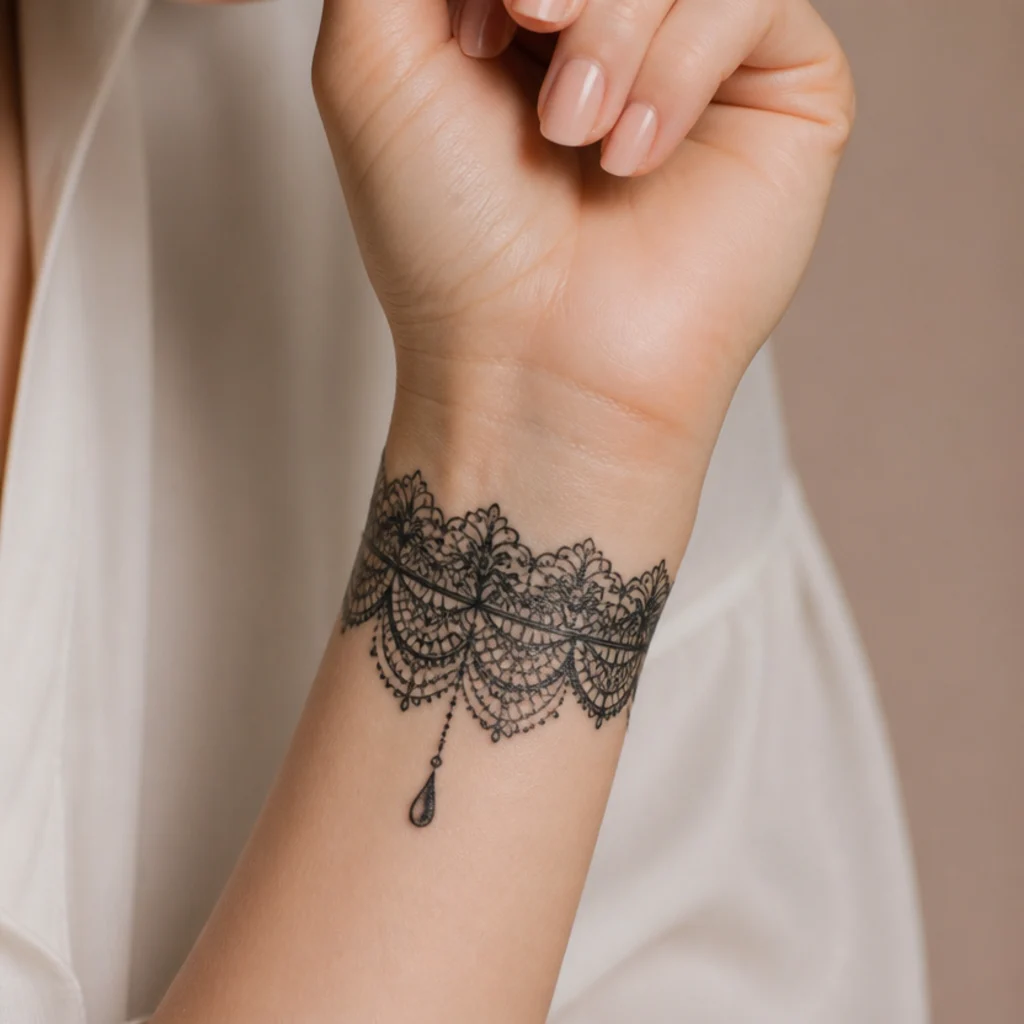
A lace bracelet mimics fine fabric wrapped around the wrist, with scalloped edges, looping motifs, and an optional hanging charm or teardrop. That busy lattice of loops and dots is what lets it absorb the shapes underneath, since there's little open background left for old ink to surface through. It's romantic and ornamental, flattering slimmer wrists and delicate frames especially, reading like real jewelry. One thing to know: the very finest lace can soften and blur over decades as the skin moves, so a slightly bolder weight of lace ages far better than the most gossamer version. It works across skin tones with the black density adjusted for contrast. Pro tip: keep the smallest connecting lines a touch thicker than they look in the reference photo, because wrist flex spreads fine ink over time. Ask for a "black lace bracelet cover-up with a small drop charm, kept bold enough to age well over the old tattoo."
07Butterfly Cluster
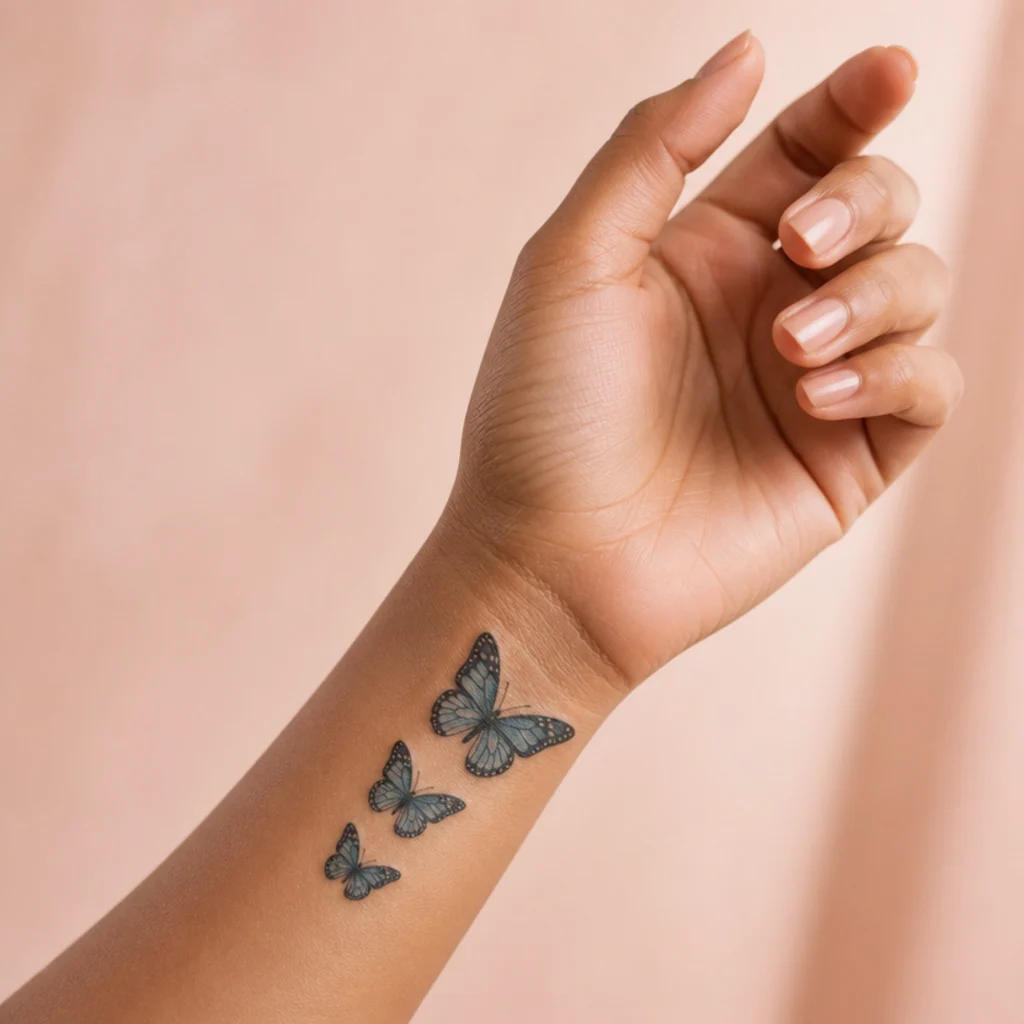
A cluster of butterflies in graduated sizes can be arranged so the wings sit precisely over the toughest areas of an old piece, giving the artist real control over where the coverage lands. Soft blue and black shading builds dimension, while measured negative space between the insects keeps the wrist from feeling crowded. It's a popular, meaningful motif and one of the easiest to personalize with color or a small added element. Butterflies with solid, fully shaded wings cover far better than open, outline-only versions, so lean into saturation if the old ink is dark. Blue and violet tones flatter most skin tones and read cool against warm undertones. Pro tip: place the largest butterfly's most solid wing over the densest old ink and angle the smaller two so they trail off into clean skin — that disguises the coverage boundary. Tell your artist you want "a butterfly cluster arranged and shaded to cover the existing wrist tattoo, with the largest solid wing over the darkest area."
08Ocean Wave Band
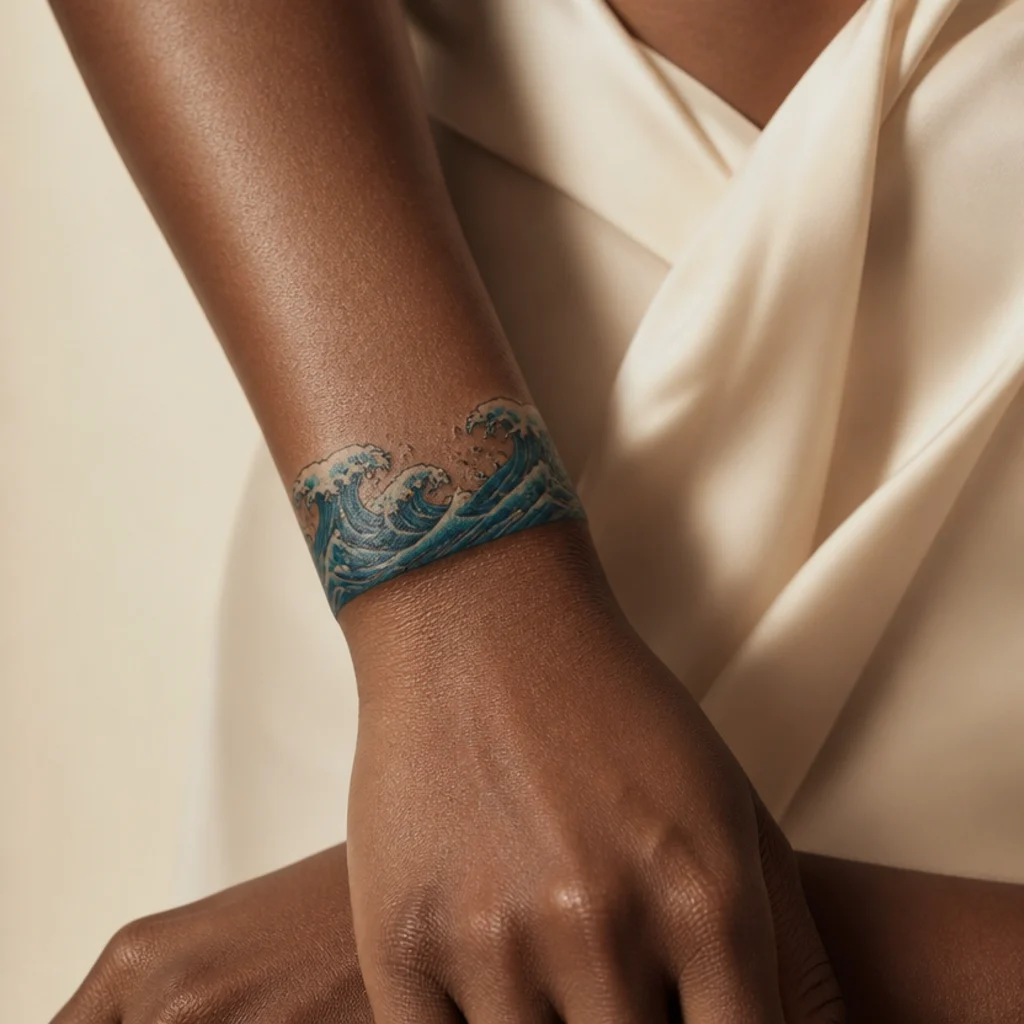
A wrapping wave band brings movement and a sense of calm to the wrist. Styled after a classic Japanese woodblock print, the curling water and cresting foam create irregular, interlocking shapes that break up old linework naturally, especially straight edges from names or bands. Blues and teals with white foam highlights give it life, though an all-black or black-and-gray version covers even more reliably if the old ink is heavy. Ocean lovers gravitate here, and it works around the full circumference for a bracelet effect that flatters any wrist size. Colored versions need consistent SPF to keep the blues from graying toward sea-glass. Pro tip: the darkest troughs of the wave carry the coverage, so ask the artist to route a deep trough directly across the old ink rather than a foamy highlight. Ask for "a wrapping ocean wave band with foam detail, the darkest troughs placed to cover the existing tattoo all the way around."
09Blackout Bracelet
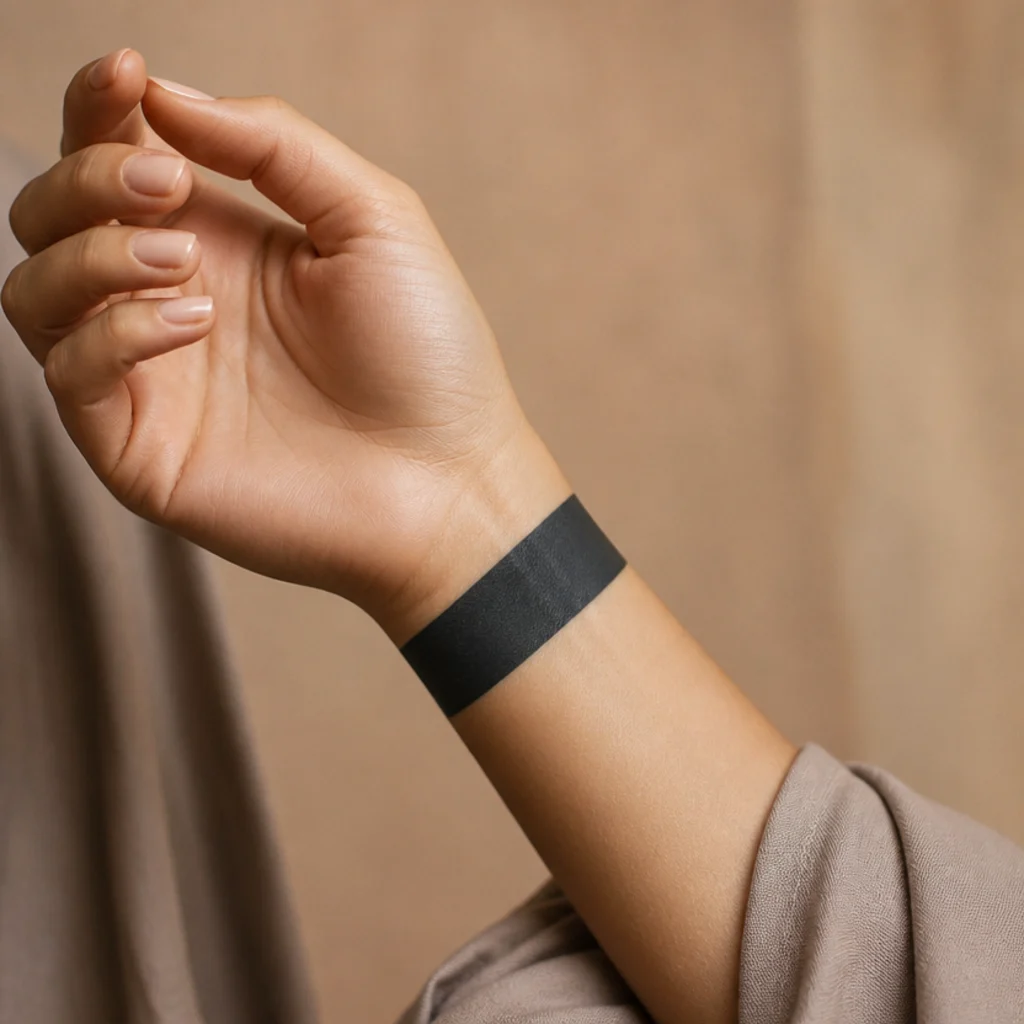
When an old tattoo is very dark, blown out, or scarred, a solid blackout band is the most dependable cover of all. A smooth ring of saturated black reads like a minimalist cuff and erases whatever sits beneath it — a promise no lighter design can make over heavy ink. It's bold and modern, and it looks striking on every skin tone. Many people add interest later with a thin negative-space line, a small skin-tone gap motif, or delicate white-ink detail laid over the healed black. Blackout demands a skilled hand for even, patch-free saturation, and it's usually built over two or more sessions with the edges kept clean and deliberate. Pro tip: ask specifically how the artist handles healing and re-saturation on wrist blackout, since uneven fade-out on flexing skin is the most common complaint. Say you want "a solid blackout wrist band with crisp edges and even saturation to fully cover the old ink, planned over the sessions it needs."
10Dotwork Moon Phases
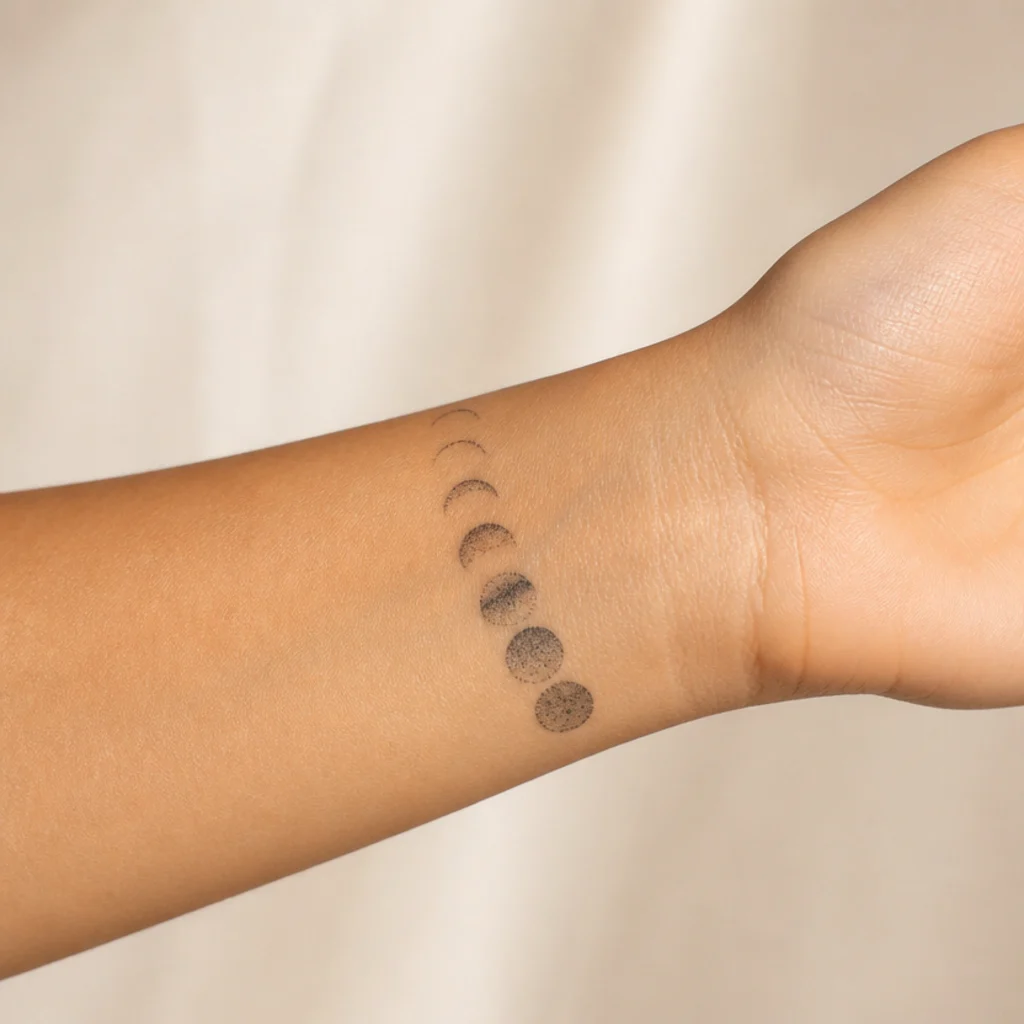
A row of moon phases marching around the wrist pairs celestial meaning with practical coverage. Each moon is built from stippled dotwork, and the full and gibbous phases give you solid, dense circles to position over the heaviest parts of the old tattoo, while the crescents lighten the rhythm. It's understated yet detailed, ideal for minimalists who still want a piece that carries a story. Dotwork ages remarkably gracefully when stippled at the right density, softening evenly rather than blurring into a smudge. It flatters all skin tones with the stipple contrast adjusted accordingly. Pro tip: sequence the phases so a full or waning-gibbous moon lands squarely over the old ink, and let the artist add a faint dotwork wash between moons if extra coverage is needed. Request "a dotwork moon phase band positioned so the fuller moons cover the heaviest old ink, with subtle stippling linking them."
Save this to Pinterest if you love celestial and dotwork styles.
11Rose and Vine Wrap
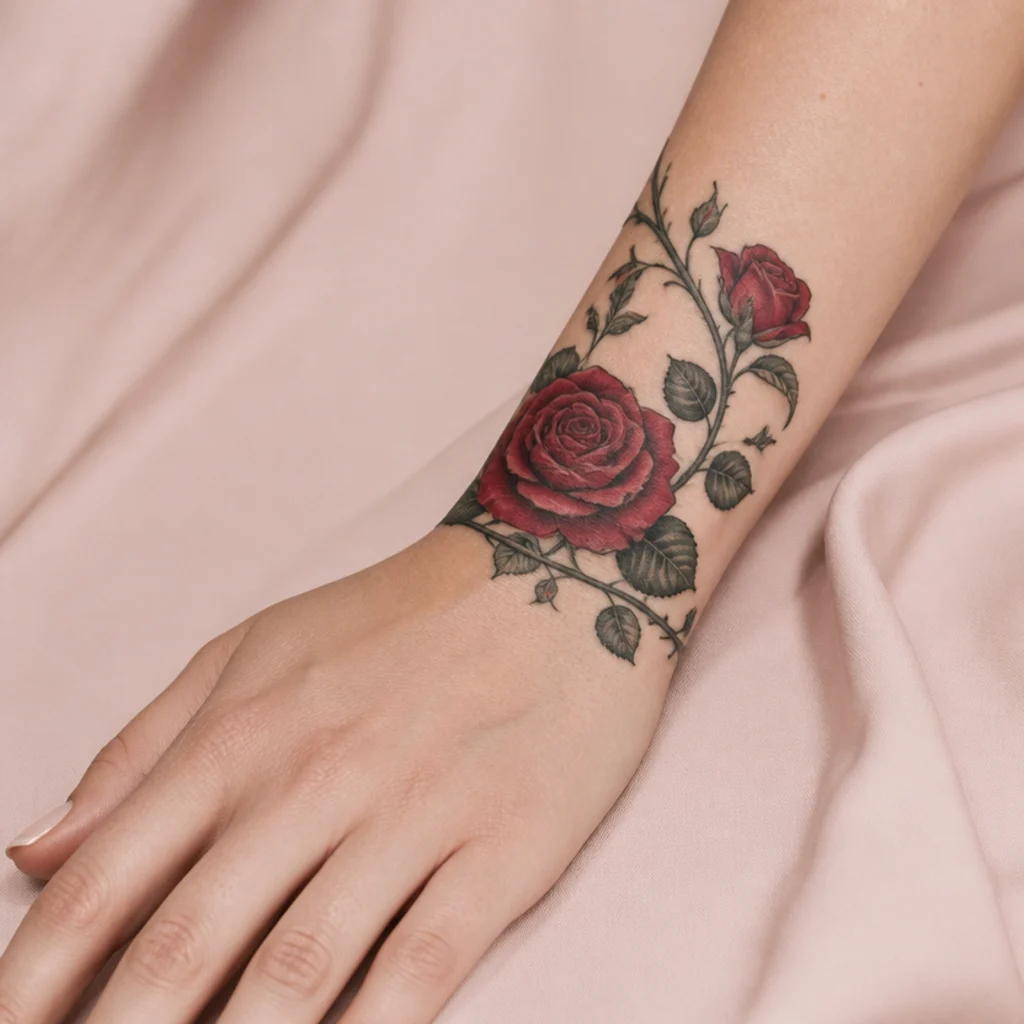
A rose and vine spiraling up and around the wrist is a classic cover-up choice because the trailing composition lets the artist drop blooms exactly where coverage is needed and route stems to swallow straight old edges inside their curves. Deep red roses with dark green leaves offer rich, layered pigment, while an all-black or black-and-gray version reads more graphic and covers even more surely. The winding vine ties separate elements into one flowing piece, which is exactly why it hides names and dates so well. Romantic, classic taste suits this one, and it works on any wrist size, extending easily toward the forearm later. Color roses need refreshing roughly every four to six years. Pro tip: cluster the fullest rose over the darkest old ink and have the vine cross any remaining straight lines at an angle — that disguises far better than a parallel stem. Ask for "a spiraling rose and vine wrap with the fullest blooms over the existing tattoo and vines crossing the old edges diagonally."
12Feather Into Birds
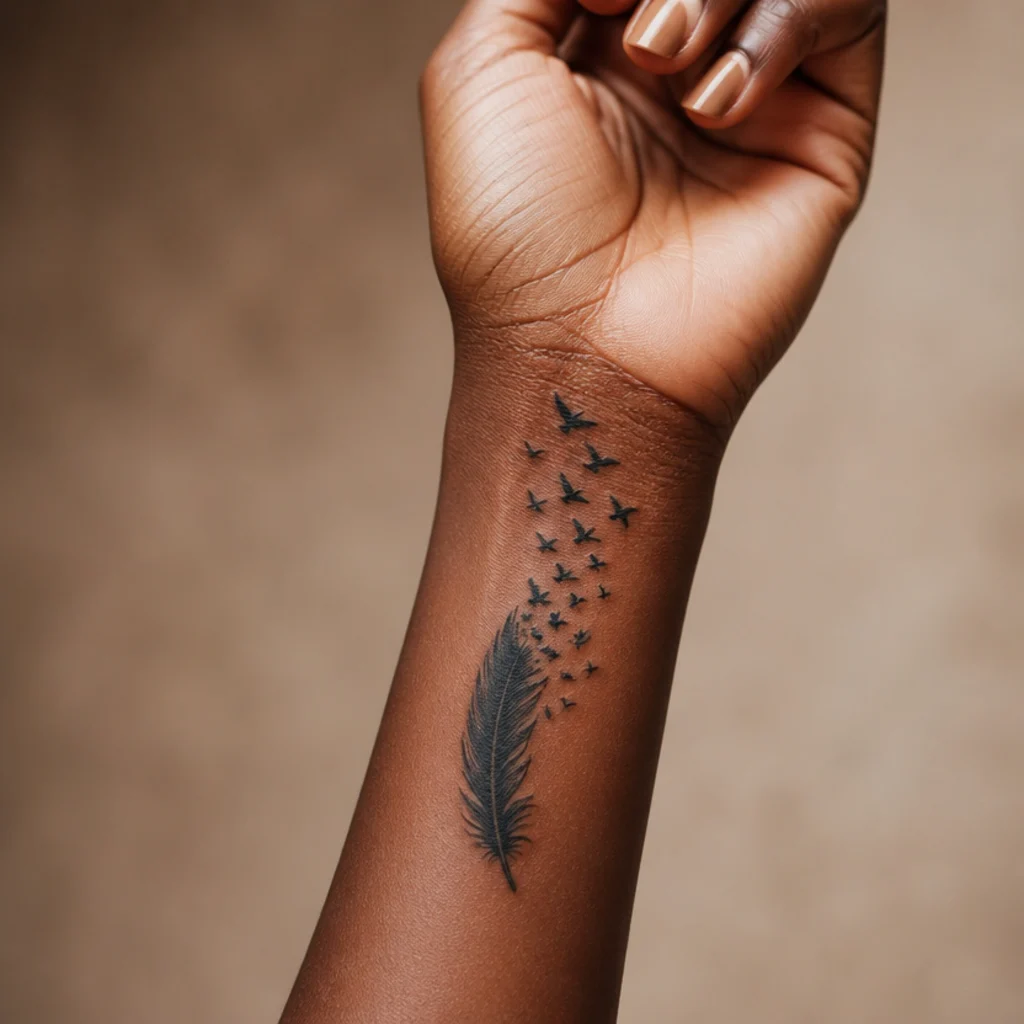
A feather that dissolves into a flock of small birds is a graceful, flowing motif. It covers well when the feather's solid quill and dense barbs sit over the old piece, doing the heavy lifting while the dispersing birds carry the eye up the wrist and add lightness. Rendered in a soft black gradient, it feels airy despite the real coverage the feather provides. Anyone drawn to themes of freedom, release, and change tends to pick this one, and it flatters the inner wrist and the vertical run toward the forearm. Keep the birds a sensible size, since anything too tiny will blur into dots within a few years on this high-movement skin. Pro tip: ask the artist to weight the feather's spine and lower barbs with solid black over the old ink, keeping the birds as the airy, decorative payoff rather than the coverage itself. Tell your artist you want "a feather-into-birds design with the solid feather body covering the old tattoo and the birds kept a readable size."
13Abstract Brushstroke
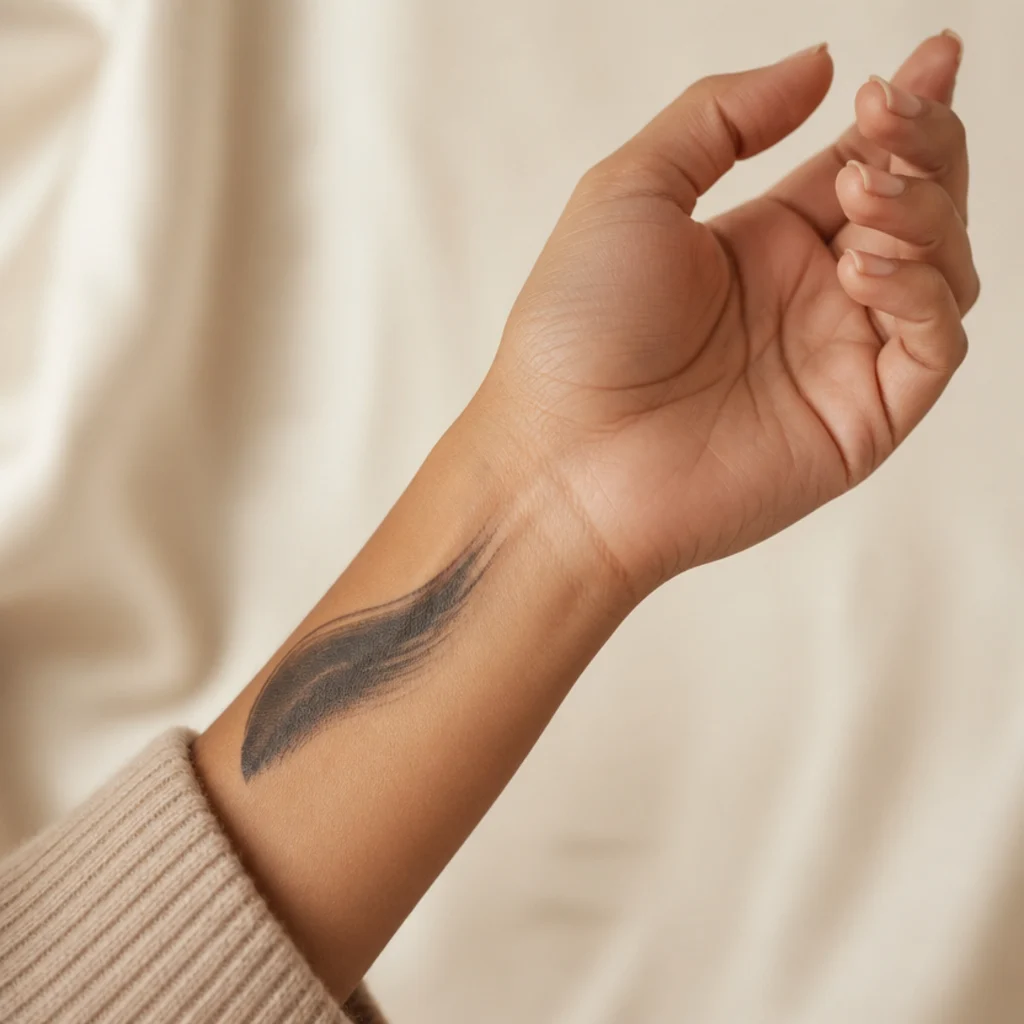
For a modern, artful cover-up, an abstract brushstroke sweeping across the wrist reads like a single confident swipe of ink. The textured, painterly edges and deliberately varied opacity make it easy to conceal irregular old shapes while looking entirely intentional, not like a fix. Contemporary, minimalist taste suits it, and it pairs cleanly with an all-black palette or one restrained accent color. Because the form is loose by nature, the artist has real freedom to build density exactly where the old ink demands it and feather the stroke into skin where it doesn't. The solid, opaque core of the stroke covers best, so that section should sit over the darkest old ink. It flatters every skin tone and any wrist size. Pro tip: bring reference of the specific brush texture you like, since "abstract" means very different things between artists, and confirm the opaque zone lands on the old piece. Ask for "an abstract brushstroke cover-up with the most opaque part of the stroke passing directly over the existing tattoo."
14Snake Around the Wrist
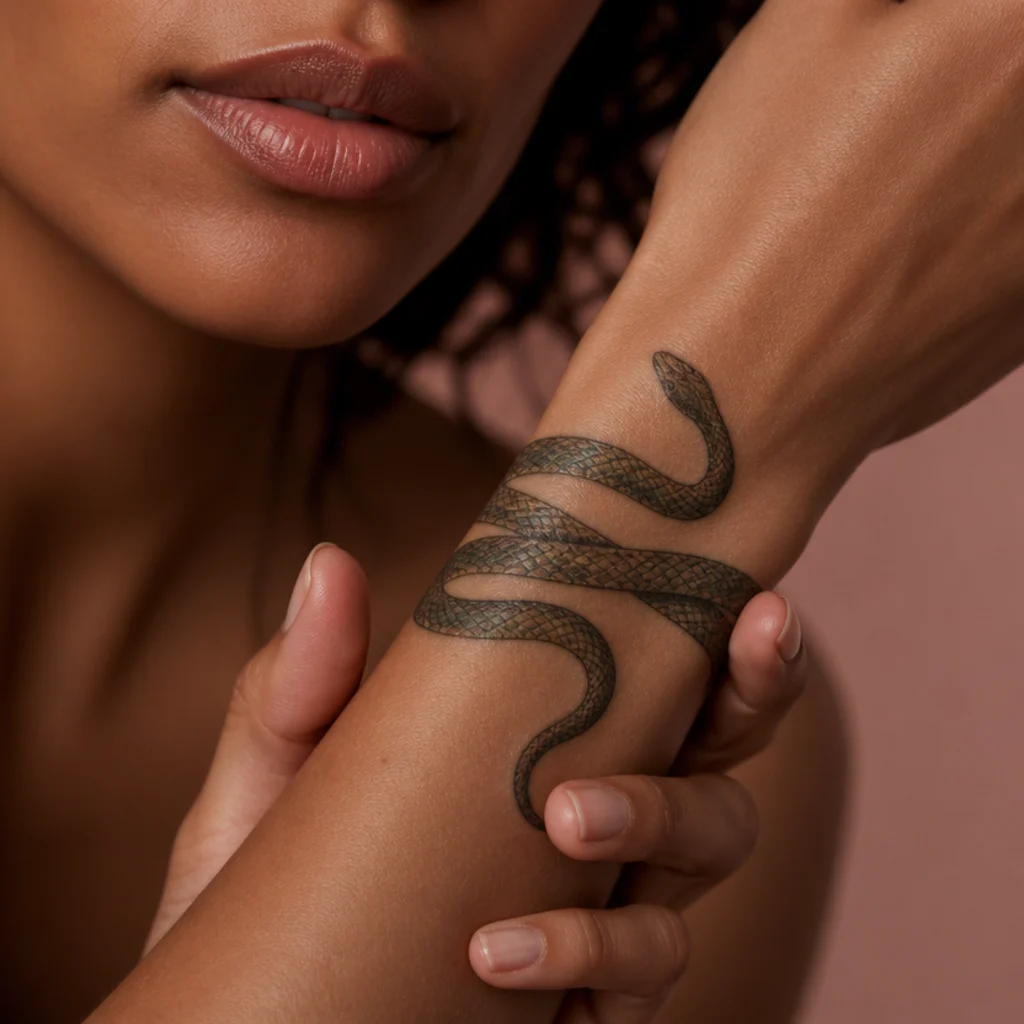
A slender snake coiling around the wrist works as both a strong cover-up shape and a bold statement of transformation and renewal. The body can route directly over the old tattoo, and the scale detail plus belly shading provide dense, continuous pigment along its whole length. A subtle green or oil-slick iridescent sheen adds interest, or keep it solid black for a graphic, high-coverage look. People after edge and symbolism gravitate here, and the coiling form flatters the wrist's natural taper toward the hand. Maintenance is low for blackwork versions and moderate if you add a color sheen. Pro tip: have the artist wind the thickest part of the body across the old ink and use the head or tail as the decorative endpoint on clean skin, so coverage and composition line up. Request "a coiling snake sized so the thickest part of its body covers the old ink, with detailed scale shading and a solid belly."
15Sunflower Statement
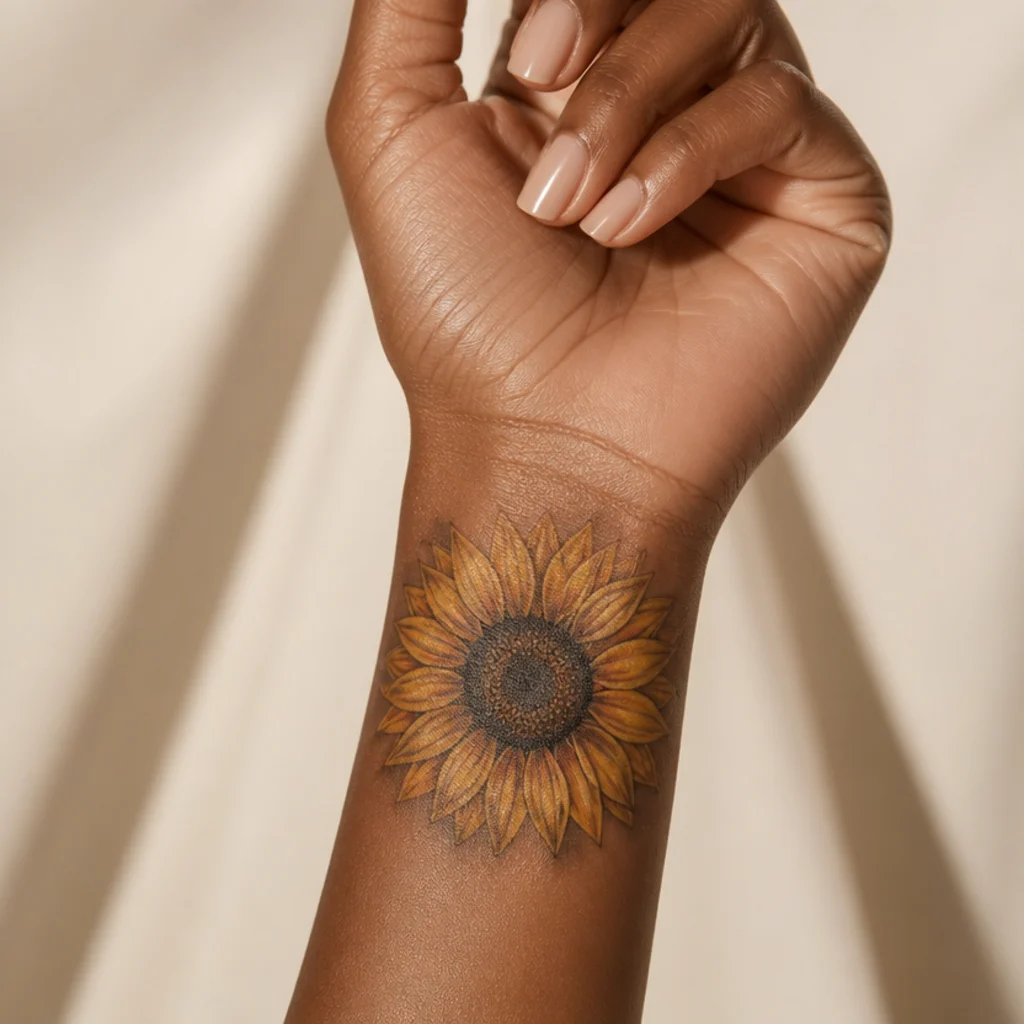
A single sunflower makes a warm, expressive statement while covering effectively, and its structure suits the job well. The dark, heavily textured seed center is a dense disc you can drop over the busiest part of an old tattoo, while the radiating golden petals fan out to fill the surrounding space and disguise the boundary. Sunny, outgoing personalities tend to pick this one, and it flatters warm and deep skin tones, where the gold reads richest. Be realistic about pigment: yellow fades faster than nearly any other color, so the dark center and its shading do most of the long-term covering while the petals will want a refresh sooner. Keep it off direct sun and tanning beds to preserve the gold. Pro tip: ask the artist to build the seed center with real black texture rather than brown, since that dark core is your permanent coverage engine. Ask for "a bold sunflower with a dark, richly textured center placed over the densest part of the existing tattoo."
Save this to Pinterest to build a floral cover-up mood board.
16Celestial Star Map
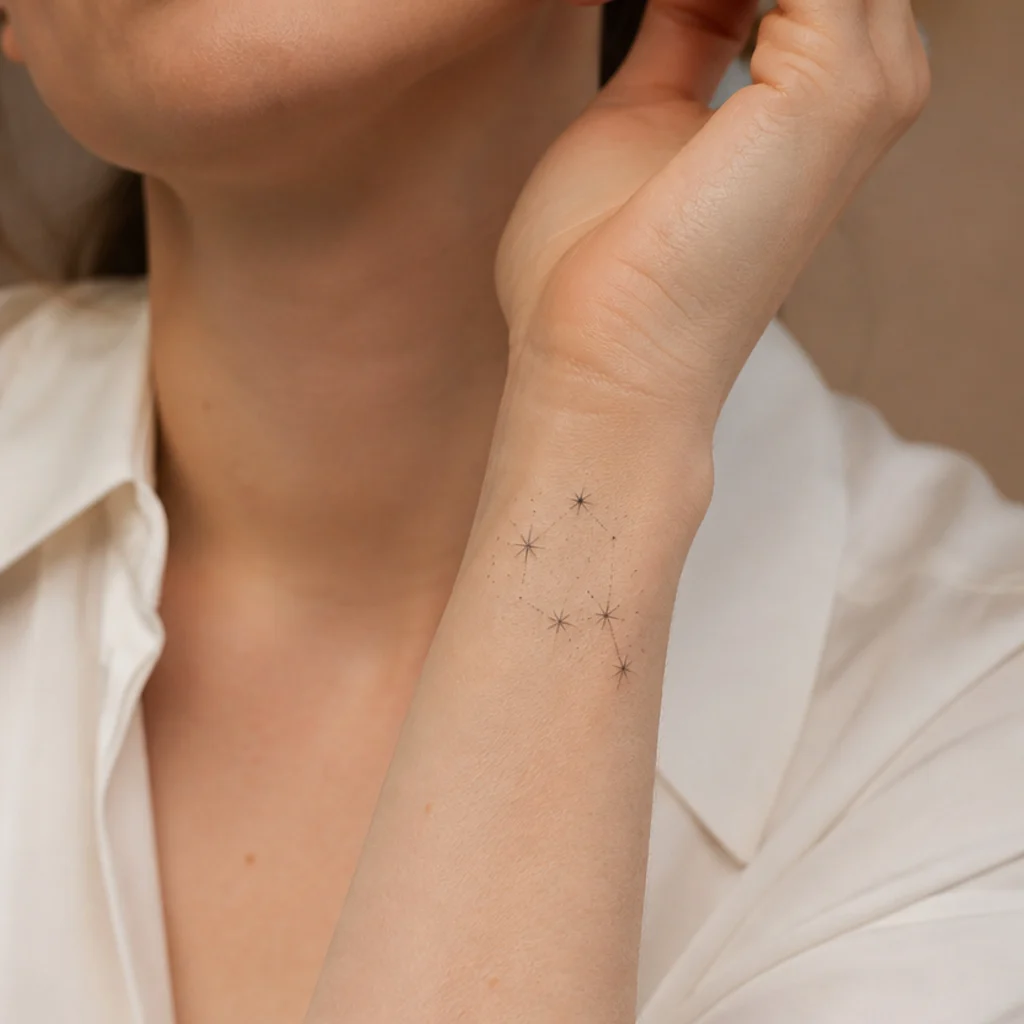
A scattered constellation with a few bolder anchor stars can be composed so the largest, most solid elements cover the old ink while finer stars fill in around them for balance. It's delicate and meaningful, a natural choice for marking a birth sign, a coordinate, or a significant date. Because much of the design is fine and open, it works best over lighter or already-faded tattoos, or paired with one solid anchor element for extra covering power over anything darker. Fine celestial linework needs conscientious SPF, since it's among the first styles to fade on sun-exposed wrist skin. Understated, sentimental taste suits it, and it flatters slim inner wrists. Pro tip: if the old ink is at all dark, insist on a solid moon, a filled star, or a small dotwork wash over it — pinpoint stars alone won't hide mid-value ink. Tell your artist you want "a celestial star map with one solid focal element, a moon or filled star, positioned over the old tattoo."
17Fern and Foliage
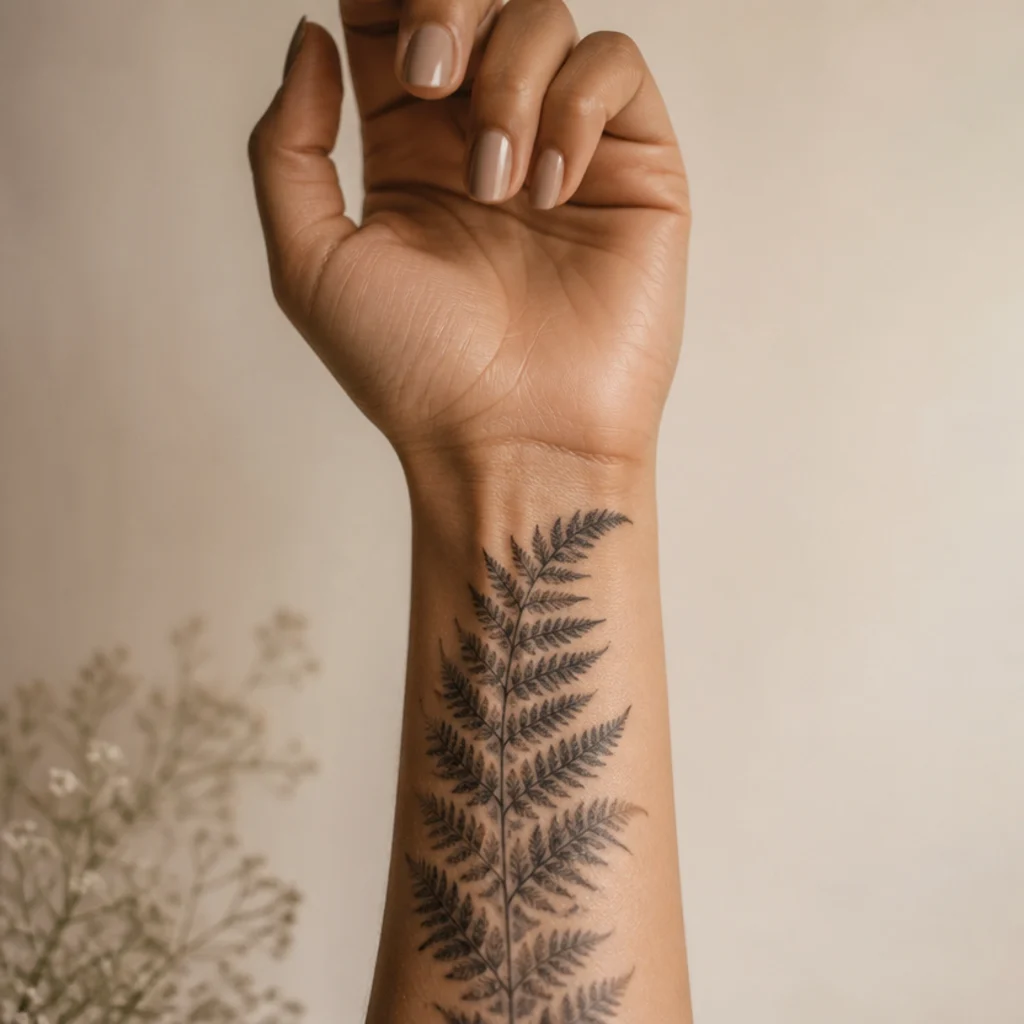
A trailing fern frond, with its many overlapping leaflets, is a naturally busy, organic shape that covers old linework well, since the layered foliage leaves almost no open background for old ink to surface through. The overlapping leaves build real depth and let the artist concentrate density exactly where it's needed. Rendered in soft graded black, it has a botanical-illustration feel that suits nature lovers and reads calm rather than heavy. Ferns also make a good starting point that can extend into a forearm cover up tattoo later if you decide to grow the piece. Detailed, shaded leaflets age far better than the thinnest outline-only versions on flexing skin, and it flatters longer inner wrists and slimmer arms. Pro tip: ask the artist to overlap two or three leaflets into a denser knot over the darkest old ink, which covers without looking like a deliberate patch. Ask for a "detailed fern frond with shaded, overlapping leaflets and a denser cluster placed over the existing wrist tattoo."
18Ornamental Filigree
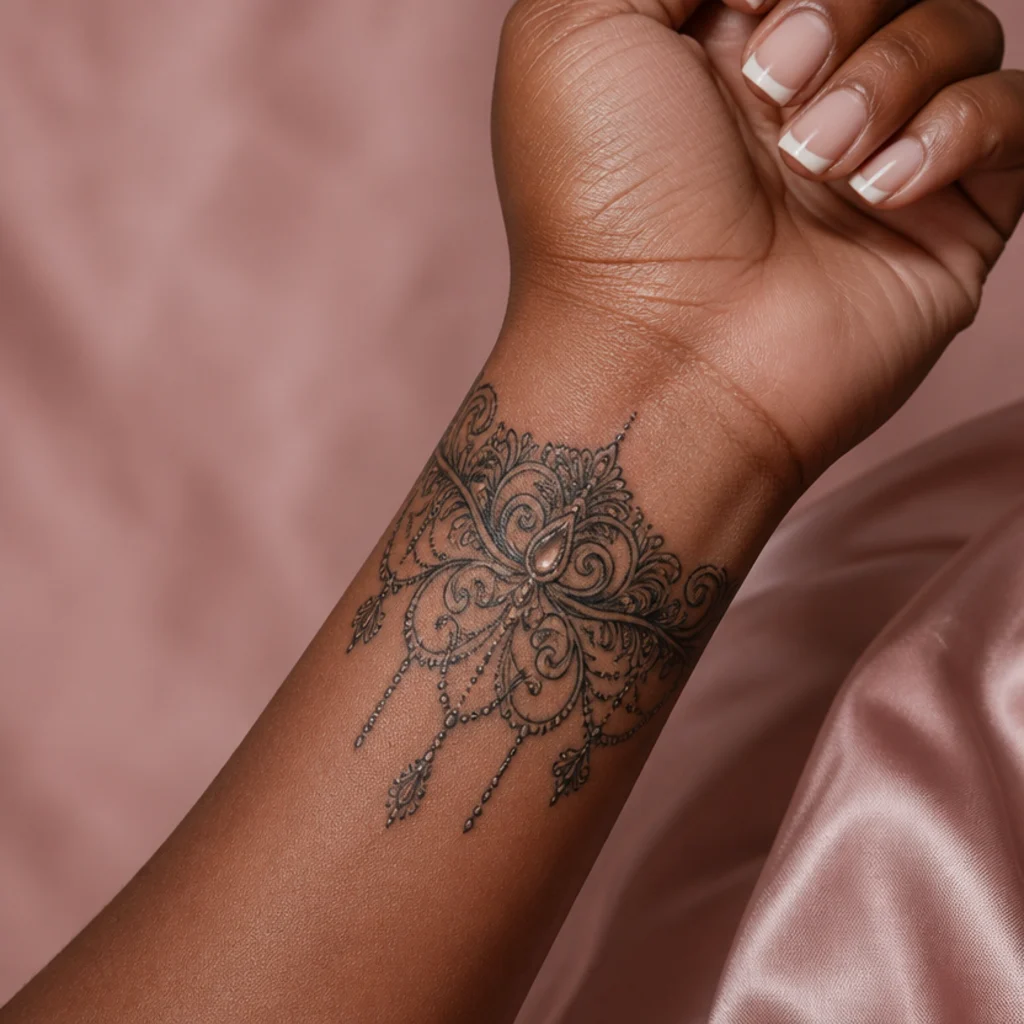
Ornamental filigree brings a jewelry-like elegance to the wrist, built from symmetrical swirls, teardrops, and small illustrated gems that read like an heirloom bracelet. That dense, decorative pattern excels at concealing old ink precisely because there's no plain background for anything to show through, and the mirror symmetry keeps the eye moving around the design rather than settling. Vintage, adorned, maximalist taste suits this one, and it flatters all skin tones. Filigree lives on crisp, confident detail, so pick an artist with a strong ornamental and blackwork portfolio and keep the linework bold enough to survive decades of wrist flex. Maintenance is low for solid-black versions. Pro tip: place an illustrated gem or the densest swirl cluster directly over the old ink — those solid shapes cover far better than the delicate connecting scrollwork. Request an "ornamental filigree band with a solid gem or swirl cluster sized to cover the old tattoo, kept bold enough to age well."
19Hummingbird and Blossom
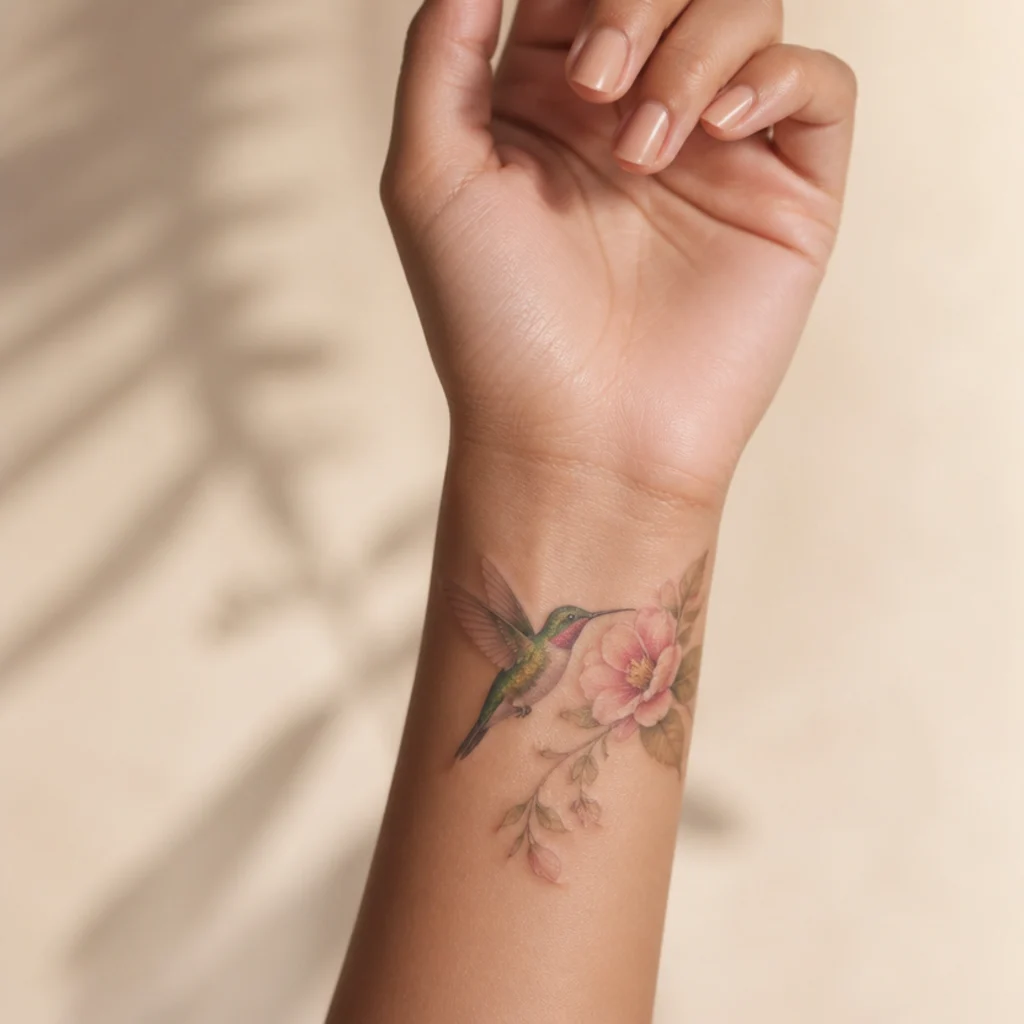
A hummingbird hovering beside a blossom combines movement and softness, and it gives the artist two solid anchor points — the bird's body and the flower head — to place over the old design, while the wings and stem tie the composition together. Iridescent greens and soft pinks make it lively, though a black-and-gray version covers just as reliably and reads more classic. People who want something delicate but still substantial enough to conceal old ink, rather than a tiny motif that leaves ghosting, tend to pick this one. Color needs refreshing every four to six years, especially the iridescent greens, and it flatters the inner wrist and the run toward the forearm. Pro tip: have the artist place the bird's densely shaded body over the darkest old ink and use the blurred, fast-motion wings to soften the surrounding boundary. Tell your artist you want "a hummingbird and blossom arranged so the shaded body and the bloom cover the existing tattoo."
20Koi and Water
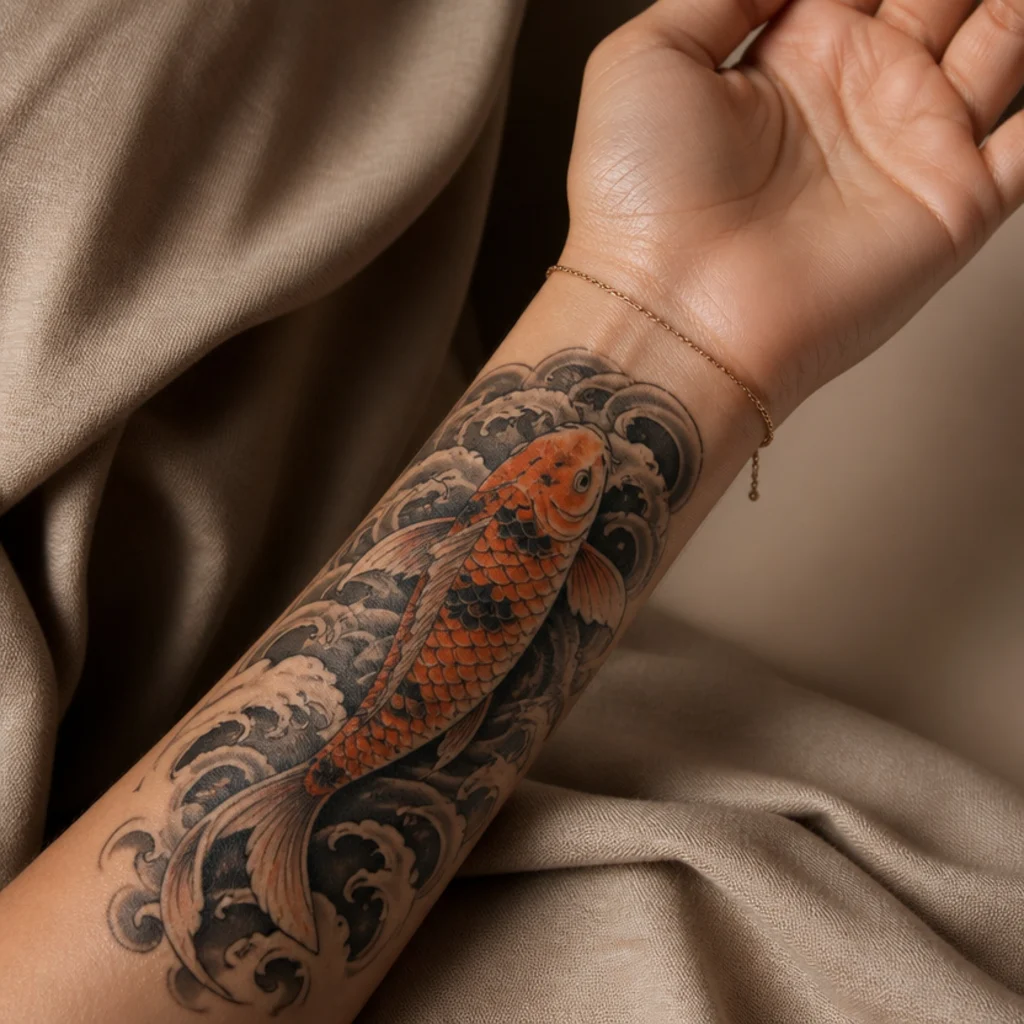
A koi swimming through stylized water is a rich, traditional motif that covers exceptionally well thanks to its solid body, bold scale shading, and the surrounding ripples that fill every gap. Orange and black scales over grey water give abundant pigment, and the flowing water disguises any old edges the fish itself doesn't reach. Fans of Japanese-inspired work like it for the symbolism too, perseverance and upstream determination. Traditional and neo-traditional styles are built to age well, with strong outlines and high saturation that hold their read for decades — a real advantage on a high-movement wrist. It flatters all skin tones and looks especially strong wrapping the outer wrist. Pro tip: route the koi's solid body over the old ink and ask for denser water shading, not open negative space, anywhere the old tattoo extends beyond the fish. Ask for "a koi and water design with the fish body over the old ink and dense ripples filling the surrounding space."
Save this to Pinterest for bold, high-coverage cover-up inspiration.
21Wildflower Meadow Strip
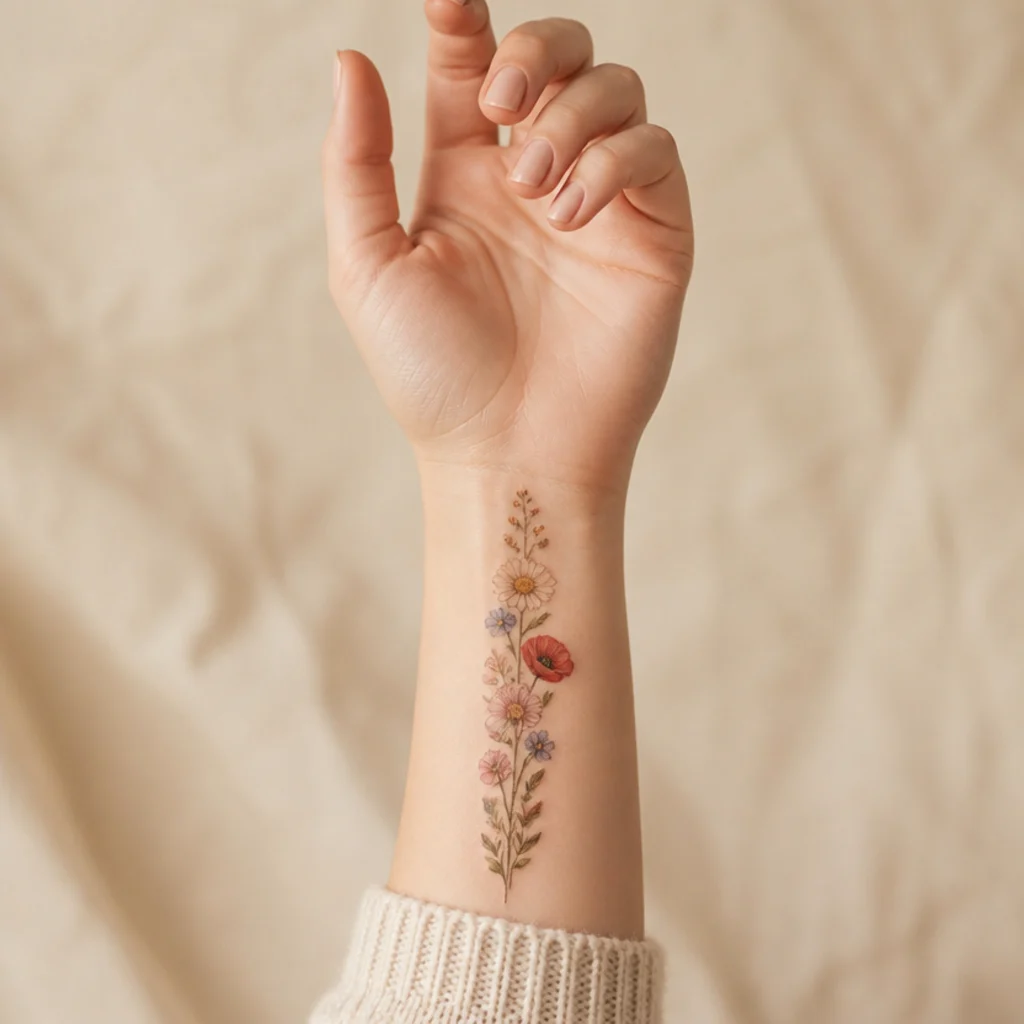
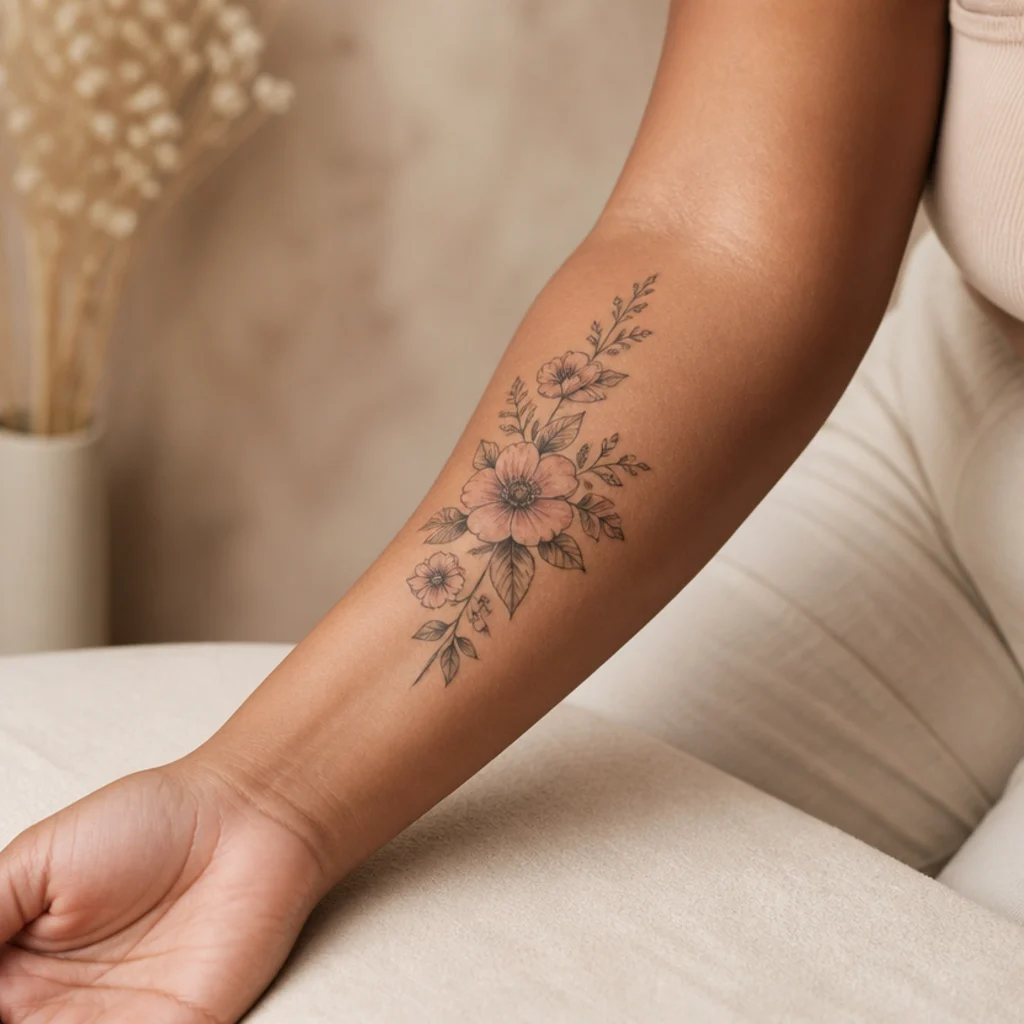
A vertical strip of assorted wildflowers running along the inner wrist reads like a little roadside meadow. Mixing daisies, poppies, and small buds at staggered heights creates an irregular, layered silhouette that hides old edges well, since there's no repeating symmetry for the eye to lock onto. Soft muted color or restrained black both work, and the variety keeps it feeling personal and collected over time rather than mass-produced. Romantic, nature-forward taste suits it, and it extends naturally up the forearm later. Because it blends fine and bolder elements, the real coverage comes from the denser blooms, so those need to sit over the old ink while the delicate fillers decorate clean skin. It flatters slim inner wrists and longer forearms. Pro tip: place a poppy or fully shaded daisy center over the darkest old ink and let wispy buds trail off the ends. Request "a wildflower meadow strip with the fullest, densest blooms placed over the existing tattoo and finer buds on clean skin."
22Blackberry Bramble
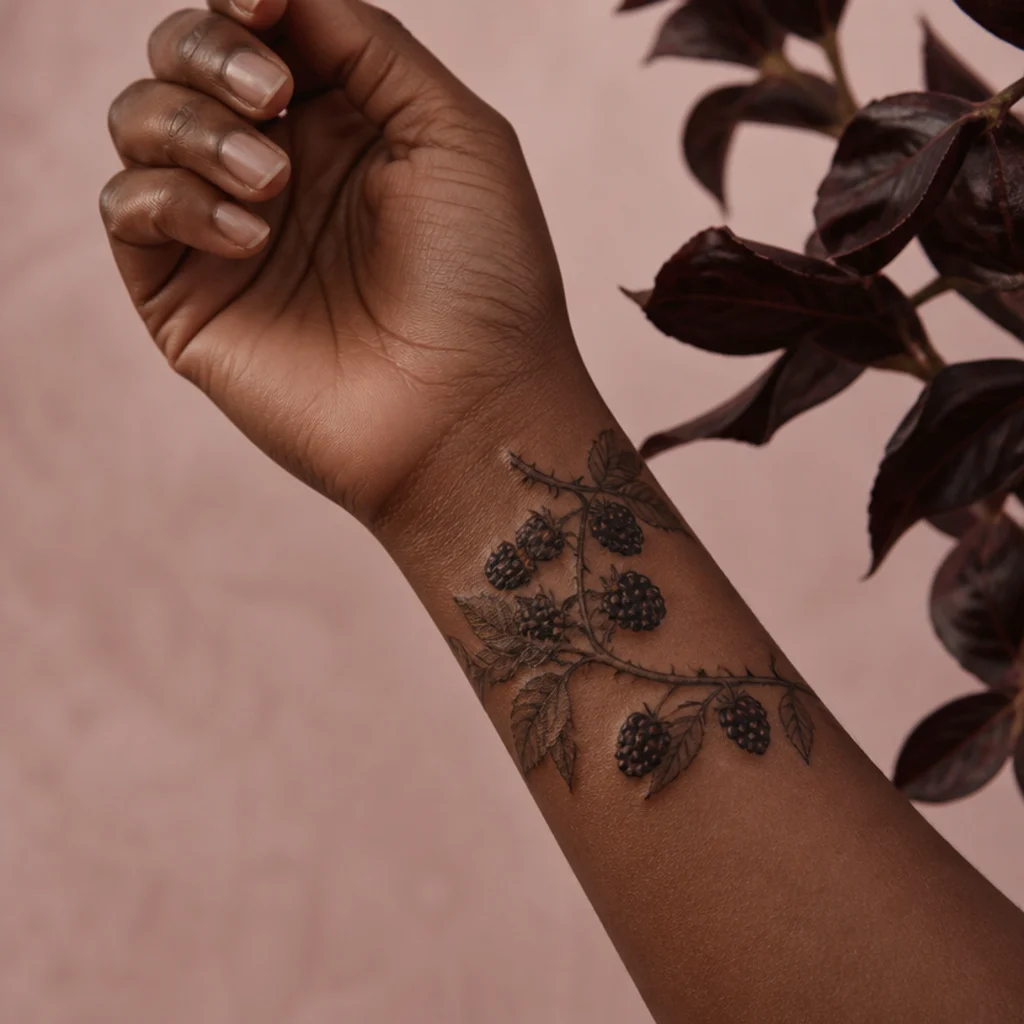
A blackberry bramble gathers dark, moody berries, thorny stems, and leaves into a naturally dense composition that works well for cover-ups. The clustered berries read as almost black-purple, giving you solid, rounded masses of dark pigment to drop over heavy old ink, while the winding, thorny stems disguise straight old edges inside their tangle. It suits a cottagecore or dark-botanical aesthetic and flatters all skin tones, reading richest on medium to deep skin. The deep berry tones and blackwork hold up well over time, with the berries doing the long-term covering as any lighter leaf washes soften. It's detailed, so allow enough size for the berries to stay distinct rather than merging into a blob. Pro tip: ask the artist to cluster the darkest, most solid berries directly over the old ink and route a thorny stem diagonally across any remaining straight line. Ask for "a blackberry bramble with dark clustered berries over the old tattoo and thorny vines crossing the old edges."
23Art Nouveau Woman
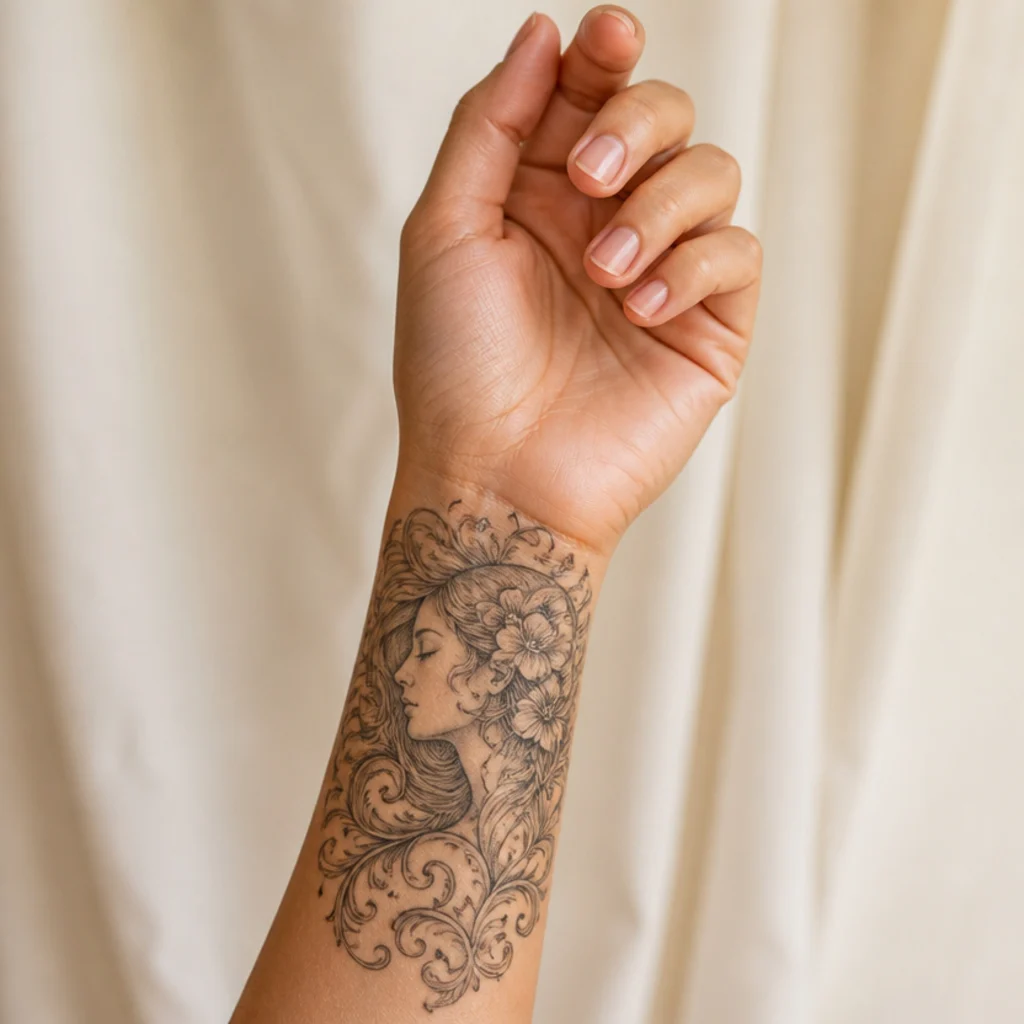
An Art Nouveau profile — a woman's flowing hair dissolving into flowers and ornamental swirls — makes a striking, showpiece cover-up. The flowing hair and decorative frame supply generous density and organic, curving shapes to conceal old ink, while the serene face becomes the centerpiece that owns the composition. Rendered in black and grey, it carries an illustrative elegance in the Mucha tradition that doesn't date. This suits people who want a real statement and are comfortable committing to a larger design that likely reaches toward the forearm. It ages well thanks to solid, structured shading, though the face demands an artist skilled in portrait and value work, since flat or muddy shading shows immediately. It flatters longer outer wrists and forearms. Pro tip: route the darkest sweep of hair and the densest ornamental swirls over the old ink, keeping the face itself on the cleanest skin available. Tell your artist you want "an Art Nouveau woman with flowing hair and floral framing, the darkest hair and swirls sized to cover the existing tattoo."
24Minimalist Mountain Range
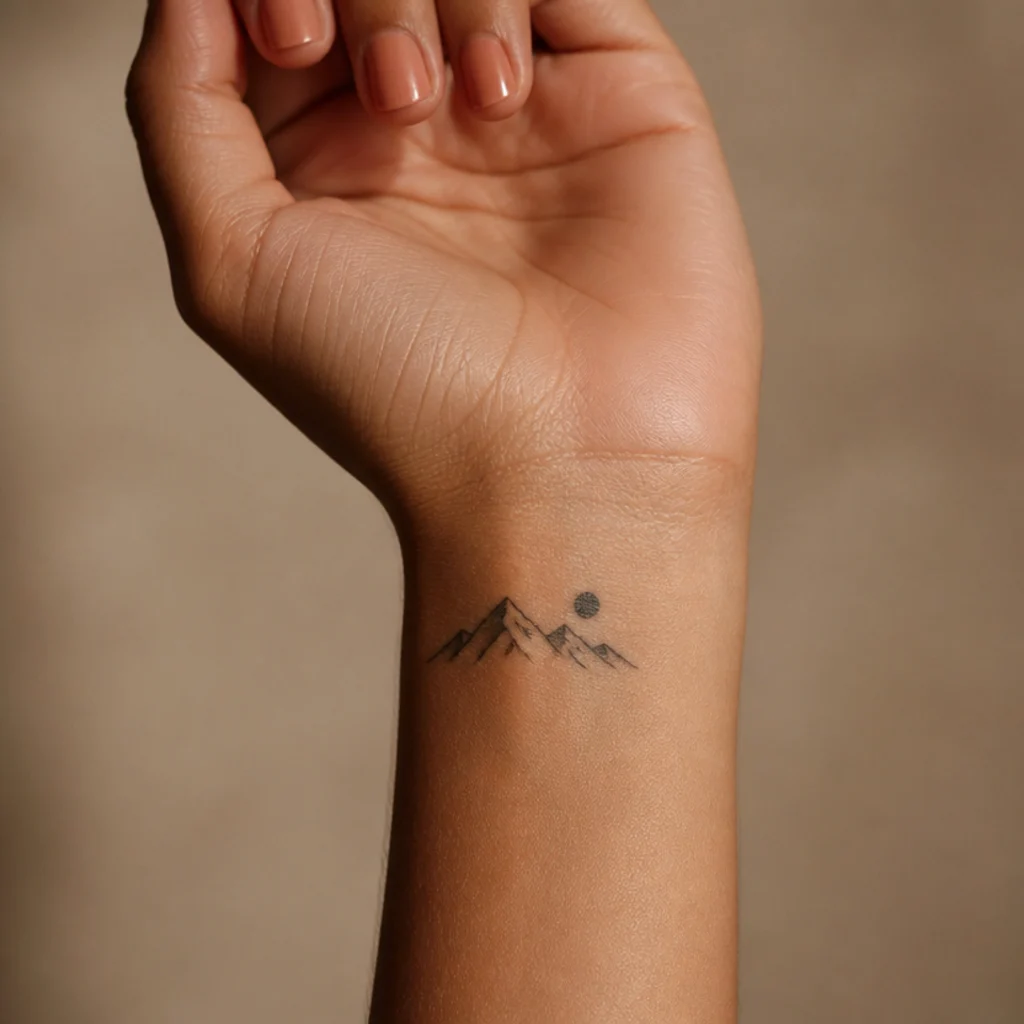
A minimalist mountain range with fine peaks and a small sun or moon is a clean, understated option, but it's honestly best reserved for covering lighter or already-faded tattoos. On its own, spare linework can't hide mid-value or dark ink, which will ghost between the peaks. Adding real shading to the mountainsides, a solid filled sun, or a subtle dotwork sky gives the extra coverage a stubborn piece needs. It suits travelers and minimalists who want something meaningful yet quiet, and it flatters slim inner wrists. Fine linework needs conscientious SPF to hold its crisp read. Be candid with yourself here: if the old ink is dark, either commit to added solid shading or pick a bolder style from this list instead. Pro tip: ask the artist to fill the sun solid and shade the nearest slope heavily, placing both over the old ink as your coverage anchors. Ask for "a minimalist mountain range with a solid sun and shaded slopes positioned to help cover the old piece."
25Layered Watercolor Poppies
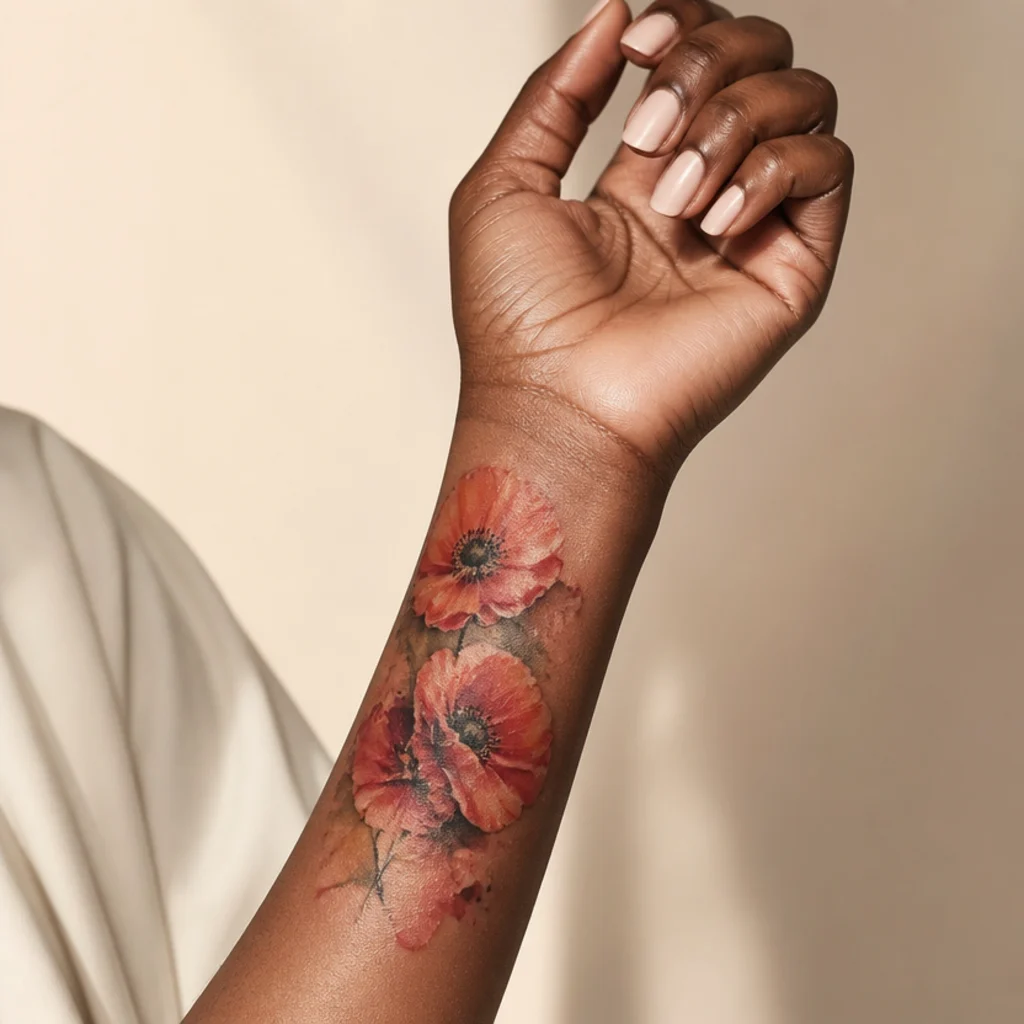
Layered poppies in vivid red and coral, painted watercolor-style with soft bleeding edges and dark seed centers, close the list with color and drama. The dark poppy centers and overlapping petals do the real covering, while the watercolor washes add a painterly, gallery finish over the top. Anyone who wants a bold, artistic piece with real warmth will like this one, and it sits well on both the inner and outer wrist. Be realistic about longevity: red and coral pigments benefit from diligent SPF to stay vivid, and like all watercolor work this style softens sooner than blackwork, so the dark centers carry the long-term coverage as the reds mellow. It flatters warm and deep skin tones especially. Pro tip: ask the artist to build the seed centers with true black and stack at least two petal layers over the old ink, using the washes to blur the outer boundary into skin. Request "layered watercolor poppies with solid dark centers and stacked petals positioned over the existing tattoo."
Pro Tips from the Editor
- Photograph the old ink in daylight, three ways. Bring straight-on, raking-light, and slightly stretched-skin photos to your consult so the artist can judge true value and spot blowouts a single flash photo hides.
- Value beats color for coverage. How dark the old ink is matters far more than what color your new design is; a saturated black-and-gray piece covers better than a bright but light-value colorful one.
- Let organic shapes cross straight lines. Names, dates, and old bands disappear best when a stem, wing, or wave crosses their edges diagonally rather than running parallel to them.
- Ask about laser lightening honestly. Even two or three laser sessions can open up what designs are possible over very dark ink; a good artist will tell you when it's worth the wait rather than forcing an over-dense cover.
- Budget for a touch-up, especially with color. Wrist skin flexes and sees sun, so plan and price a refresh at the outset instead of treating the first session as final.
- Match the artist to the style. Blackout, geometric mandala, portrait, and fine-line are distinct specialties; review a portfolio of healed cover-ups, not just fresh work, in the exact style you want.
- Never assume total erasure. No design guarantees an old tattoo or scar vanishes completely; ghosting can appear as the new ink settles, so confirm realistic expectations in person before you book.
How to Choose / Get the Look
Start by being honest about what you're actually covering, because that single fact drives every other decision.
Read the old ink first. Dark, dense, blown-out, or scarred pieces need a bolder, more saturated design: blackwork, a blackout band, koi, a heavily shaded bloom, or a blackberry bramble. Lighter or already-faded tattoos open up the delicate end of this list — fine-line botanicals, watercolor, celestial maps, minimalist mountains. Bring clear daylight photos and let the artist tell you what's realistic rather than what you hope to hear.
Use the table below as a quick coverage map.
| Old ink situation | Best-fit styles here | Approach |
|---|---|---|
| Faded / small / previously lasered | Watercolor, fine-line botanical, celestial, minimalist mountains | Delicate work with one denser anchor element |
| Mid-value lines, names, script | Rose and vine, wildflower strip, fern, filigree, snake | Organic shapes crossing the old edges diagonally |
| Very dark, dense, or scarred | Blackout band, blackwork floral, koi, peony, bramble | Maximum saturation; possibly multiple sessions or laser first |
Think about size and growth. Sometimes a wrist piece needs to expand slightly, or extend into a forearm cover up tattoo, to fully absorb the original; a design squeezed too small to cover is the most common regret. Name cover up tattoos in particular hide best inside florals, vines, waves, and filigree, where irregular pattern dissolves straight letters.
Factor in your lifestyle and undertone. Wrist skin meets sun, soap, and constant flex, so darker and denser designs age most reliably and colored work needs SPF and periodic touch-ups. Cool and neutral undertones carry lavenders, sages, and blues cleanly; warm and deep undertones make golds, corals, and magentas sing.
Confirm everything in person. Design, sizing, placement, coverage feasibility, and healing all need to be confirmed with a licensed tattoo artist who can assess your existing ink in person — no article, and no design saved online, can guarantee a cover-up will fully hide an existing tattoo or scar. Some ghosting is possible as new ink settles. The best cover up tattoos for women come from that honest, collaborative planning, not a look chosen in isolation.
Frequently Asked Questions
Can any tattoo be covered on the wrist?
Most can, but not all in one session or with any design you like. Very dark, dense, or scarred tattoos need bolder cover-ups and sometimes multiple sessions, or a round of laser lightening first. A skilled artist will assess your specific ink in person and tell you honestly what's realistic — no design guarantees complete erasure.
Do cover up tattoos need to be bigger and darker than the original?
Usually somewhat larger and more saturated, yes. The new design needs enough pigment and surface area to fully absorb the old shapes, which is why bold florals, blackwork, koi, and wrapping bands dominate wrist cover-ups. It doesn't always have to be dramatically bigger, but "same size, lighter" almost never works over dark ink.
Are name cover up tattoos harder to hide?
Names and script can be trickier because letters have straight, recognizable edges the eye finds easily. They disappear best inside organic, flowing designs, vines, florals, waves, filigree, where the irregular pattern breaks up the old lines. Having a stem or wave cross the letters diagonally hides them far better than any element running parallel.
Will a wrist cover-up fade quickly?
Wrist skin gets a lot of sun and daily use, so colored and fine-line work in particular benefit from consistent SPF and occasional touch-ups. Bold blackwork, dotwork, and dense traditional designs generally hold up longest here. Plan on a refresh every few years for color, and treat that as normal maintenance rather than a failure.
Should I get laser removal before a cover-up?
Sometimes. A few sessions of laser lightening can give your artist far more design freedom, especially over very dark or previously reworked ink, and can mean a less dense final piece. Your tattoo artist, and where relevant a licensed removal provider, can advise whether it's worth the time and cost for your specific tattoo.
How much does a wrist cover-up usually cost?
Costs vary widely by artist, region, size, and complexity. Small single-motif cover-ups often start in the lower hundreds, while wrapping bands, color work, portraits, and multi-session blackout pieces run higher. Cover-ups also take more planning time than fresh tattoos, so expect to pay for that expertise. Ask for a written estimate after your in-person consult.
How long should I wait before covering an existing wrist tattoo?
Give the original tattoo time to fully heal and settle, generally at least a few months, before covering it, so the artist judges its true healed value rather than raw, inflamed ink. If you are lasering first, follow your provider's spacing between sessions and their guidance on how long to wait before the cover-up.
Can a wrist scar be covered like a tattoo?
Sometimes, but scars behave differently from tattooed skin and aren't guaranteed to hold ink or heal predictably. Texture, age, and type of scar all matter. This must be evaluated in person by a licensed tattoo artist, who may decline or adjust the design; never assume a cover-up will fully hide a scar.
Does a cover-up hurt more than a regular wrist tattoo?
The wrist is a sensitive, bony area for any tattoo, and cover-ups can involve more saturation and sometimes longer or multiple sessions, which some people find more demanding. Comfort is individual. Talk to your artist about session length and breaks, and follow their aftercare closely, since well-healed skin is part of a clean-looking cover-up.