20 Forearm Cover Up Tattoos for Women
The forearm is one of the hardest spots to cover cleanly: thin skin, year-round visibility, and old saturated linework that ghosts through anything too pale. These 20 ideas use density, botanicals, and directional shading so a new design reads as intentional art, not a patch over a mistake.
 Edited by Lena Rose · Published July 11, 2026 · 31 min read
Quick Answer
- Best for: Hiding an old name, faded lettering, a first tattoo, or a dark saturated piece on the inner or outer forearm.
- Who might skip it: Anyone whose original is fresh, very black, and small enough that one to two laser sessions plus a simpler design would be cheaper and cleaner than an oversized cover.
- Maintenance: Blackwork and geometric pieces are near set-and-forget with an occasional touch-up; color florals, watercolor, and pale filler want a refresh roughly every 3 to 5 years.
- Difficulty: Advanced. This is specialist work, not walk-in flash.
- Cost: Variable and usually higher per hour than fresh work because it takes longer; budget for multiple sessions on larger pieces, plus separate laser fees if lightening is needed.
- Wear time / longevity: A well-planned cover stays hidden for years; the failure mode is old ink ghosting back when the new piece was too light or under-saturated.
- Standout variation: A dense floral half-sleeve that flows past the old design and climbs toward the elbow, so the original becomes one bloom among many.
- How to ask your tattoo artist: "This is a cover-up over [dark black name / faded outline], roughly [size] on my [inner/outer] forearm. I want a design that sits larger and darker than the original with the densest detail directly over it. Can I see healed cover-up work in your portfolio?"
In This Guide
- Dark Peony Cluster
- Watercolor Botanical Wash
- Blackwork Mandala Panel
- Trailing Wildflower Vine
- Neo-Traditional Rose and Leaves
- Moth and Moon Motif
- Ornamental Lace Cuff
- Realistic Feather Fan
- Koi and Water Ribbon
- Dotwork Snake Coil
- Filler Foliage Blackout Edge
- Bold Sunflower Statement
- Wrist-to-Forearm Bracelet Band
- Name Cover Up in Script Redirect
- Butterfly and Baby's Breath
- Geometric Sacred Panel
- Ocean Wave and Coral
- Phoenix Wing Sweep
- Vintage Botanical Illustration
- Full Floral Half-Sleeve Flow
Covering a tattoo on the forearm is a different problem from covering one on the shoulder or thigh. The skin is thinner and closer to the surface, the area stays visible year-round with no easy way to hide a rough heal, and old saturated ink can ghost through anything applied too light. The best forearm cover up tattoos work by stacking density and depth exactly where the old design sits, then extending the new artwork outward so your eye travels along a shape instead of hunting for what was underneath. Botanicals, blackwork, neo-traditional, and dotwork all work well here because they layer naturally and give an artist somewhere to hide contrast. The inner forearm reads softer and is a touch more sensitive; the outer forearm takes bold graphic work well and holds saturation longer. Whether you're burying faded lettering, an ex's name, or a first tattoo that no longer fits who you are, the 20 ideas below map out what's actually possible, from delicate wildflower vines to full half-sleeve flow. For each one you'll find who it suits, honest upkeep notes, and the exact language to use so you leave your consultation with a plan, not a maybe. Think of this as a briefing document for the conversation with your artist.
01Dark Peony Cluster
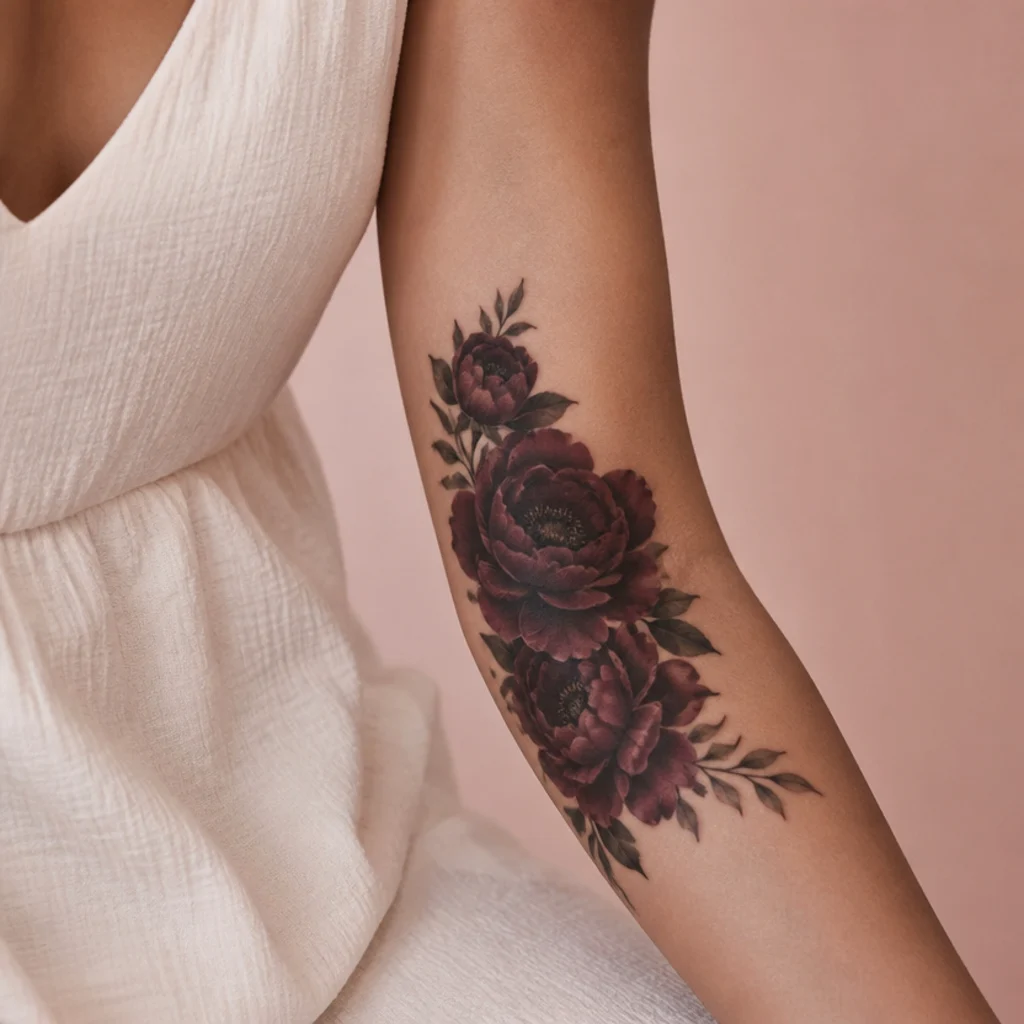
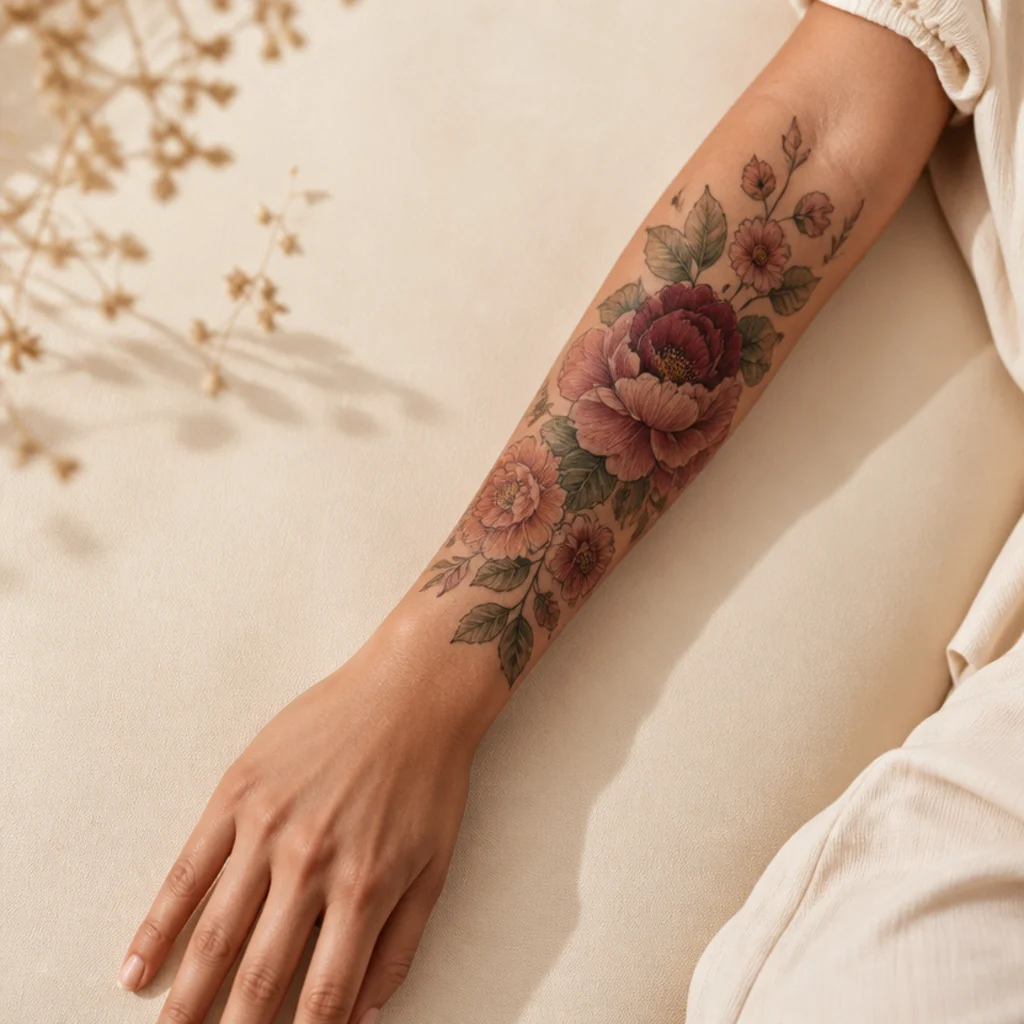
A tight cluster of two or three peonies is the workhorse of forearm cover work because layered, ruffled petals throw natural shadow that swallows almost anything beneath. Lean into deep burgundy, oxblood, plum, and near-black centers: the cooler the undertone in the shadows, the more it neutralizes a warm faded original. Peonies flatter medium to deep skin especially, where saturated color reads rich rather than muddy, though the same shapes work on fair skin if the artist drops overall opacity slightly. Placement matters more than size here: the densest flower head should sit directly over the busiest part of the old ink, with buds and leaves feathering outward to enlarge the footprint. Expect a color refresh around the 3 to 5 year mark, sooner if you tan the area often, since UV is the fastest way to fade a cover back toward transparency. This is advanced work, so ask your artist for healed peony cover-ups specifically, and ask them to build a "dark anchor" in at least one bloom center so there's a guaranteed opaque zone over the original.
02Watercolor Botanical Wash
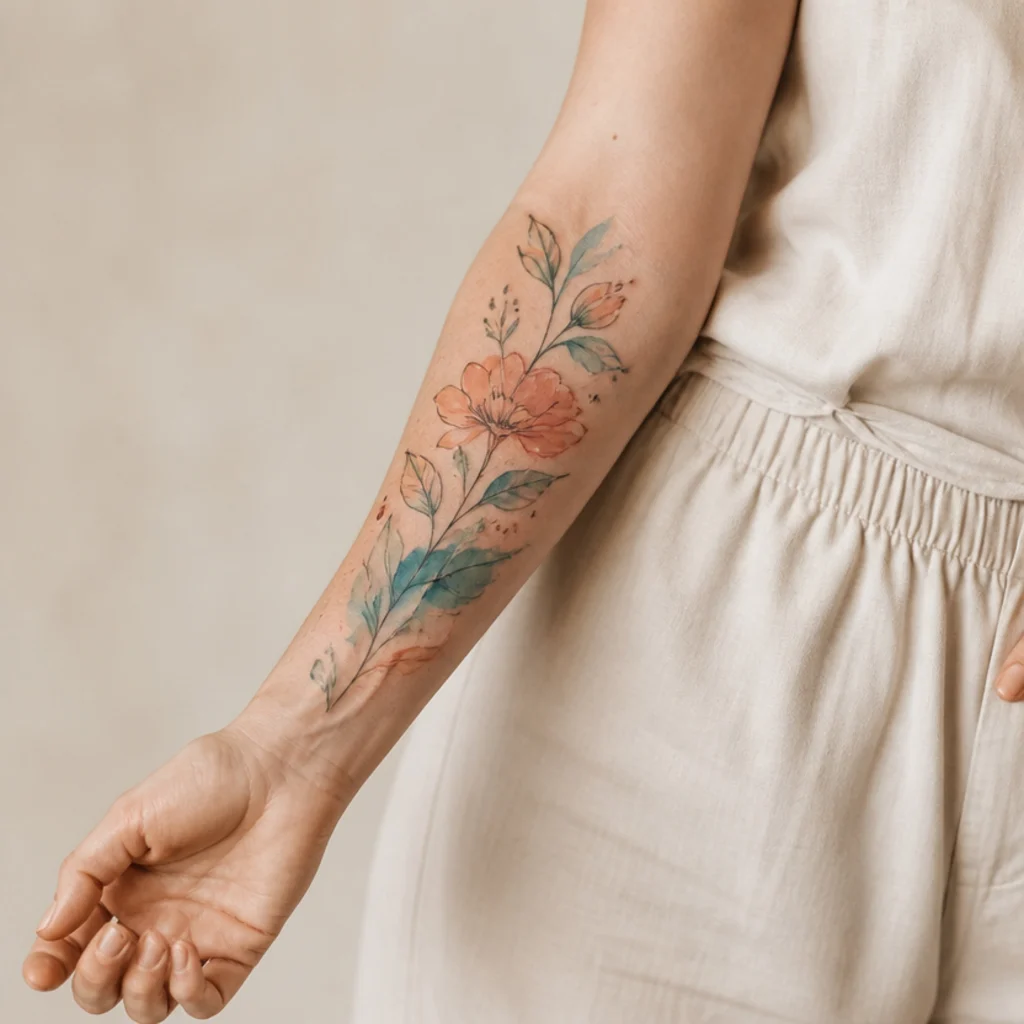
Watercolor pieces look weightless, which is exactly the trap in a cover-up: pure washes have no opacity and let old ink read straight through. The fix is structure. A skilled artist grounds the loose teal and coral splashes over a skeleton of darker botanical linework, so the stems, seed heads, and leaf spines do the concealing while the color misdirects the eye. This idea works best over lighter or already-faded originals rather than a solid black band, and it favors fair to medium skin where soft pigment stays luminous. Maintenance runs higher than most: diffuse washes lighten faster than lined work, so budget a touch-up every few years to keep it from going ghostly. When you consult, bring reference that clearly shows visible line "anchors" inside the watercolor, and say plainly you want coverage, not splatter, so the artist doesn't under-build the darks. Ask your tattoo artist to keep at least one saturated element positioned over the darkest part of the old design.
03Blackwork Mandala Panel
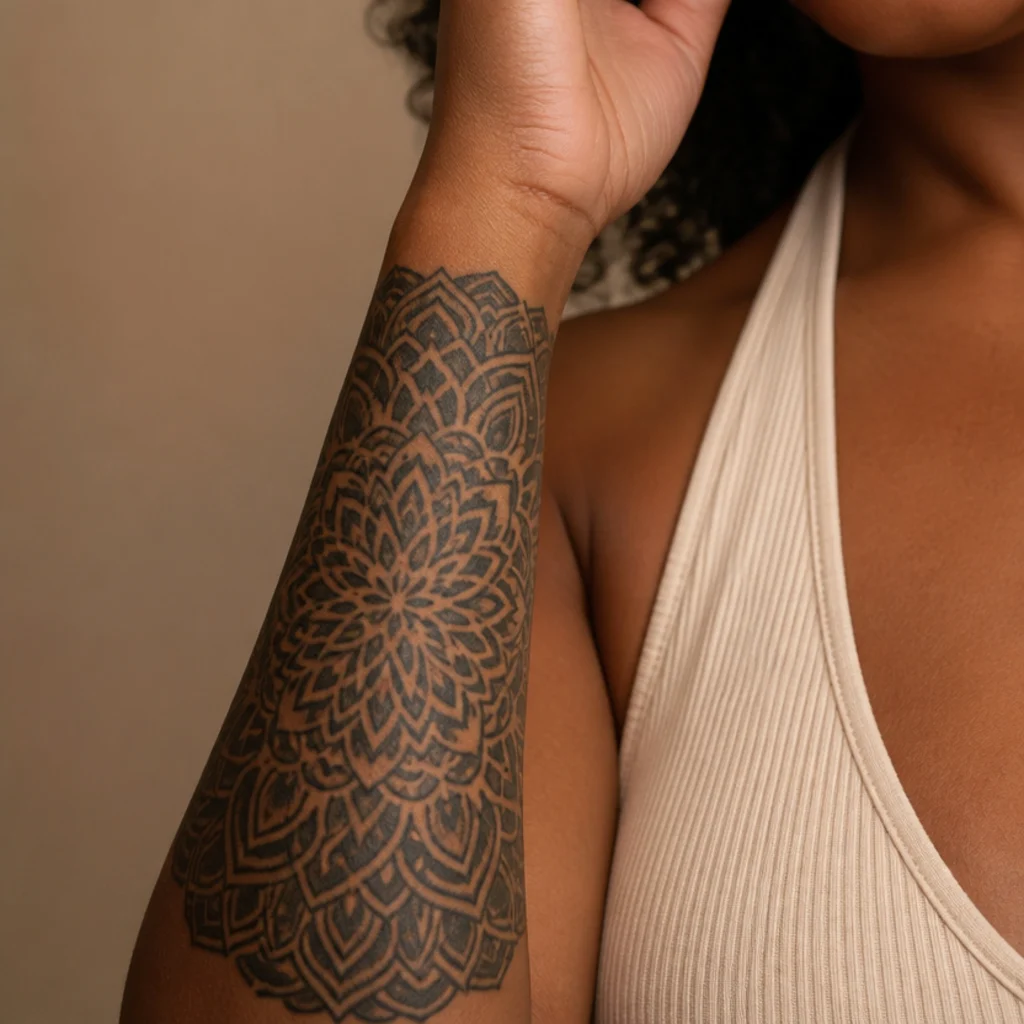
For a heavily saturated or solid black original, dense blackwork is the most reliable route on the whole list. A mandala panel uses repeating geometry, controlled negative space, and pools of solid fill to absorb whatever's beneath while looking entirely deliberate and symmetrical. It sits beautifully on the outer forearm, following the flat plane of the arm, and it's striking on deep skin, where the black and skin tone play against each other cleanly. Because it's largely solid work with bold structure, it ages exceptionally well and rarely needs more than an occasional touch-up to sharpen line edges. This is one of the best cover up tattoos for women who want a graphic, modern, jewelry-like result rather than something pictorial. The one caution: on deep skin, insist on healed blackwork references so you can see how the artist's black settles over time. Ask your tattoo artist to center the mandala's densest ring and core directly over the old ink, with negative-space petals kept clear of it.
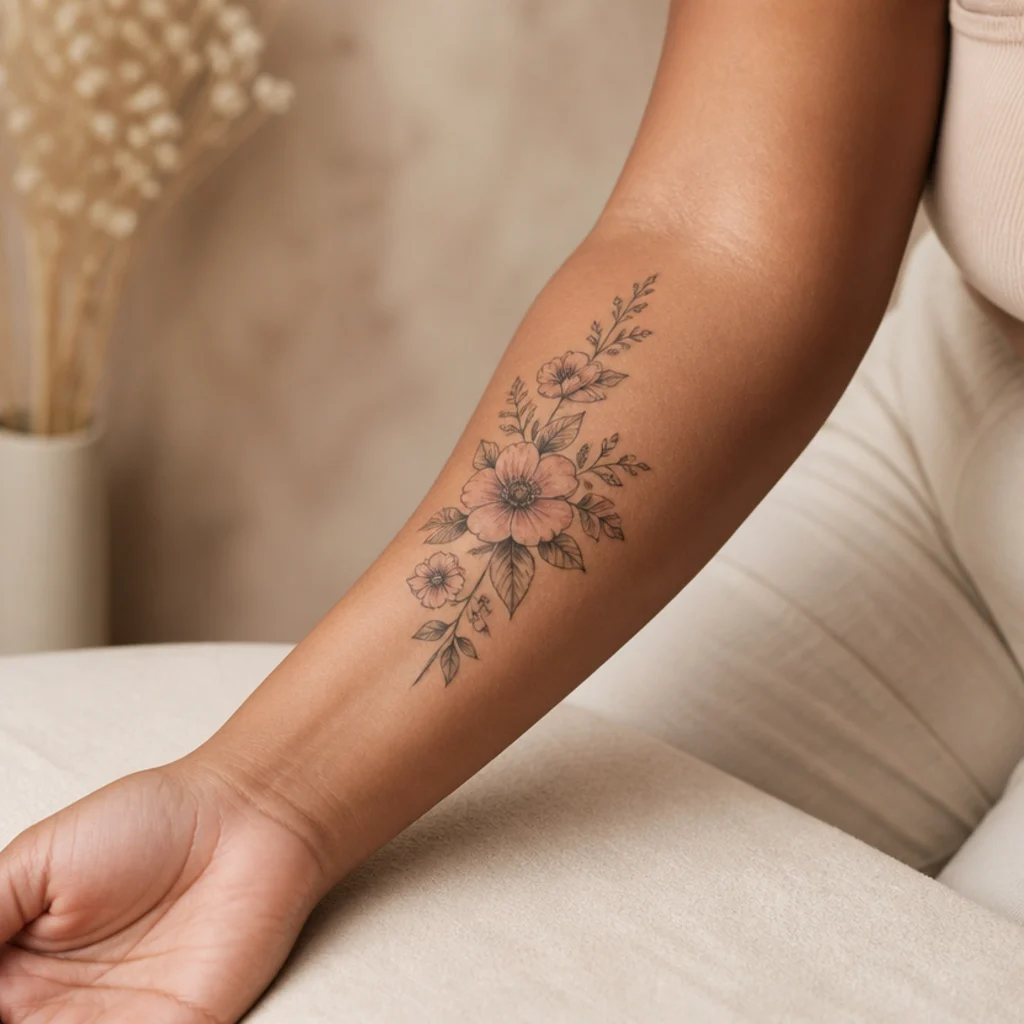
04Trailing Wildflower Vine
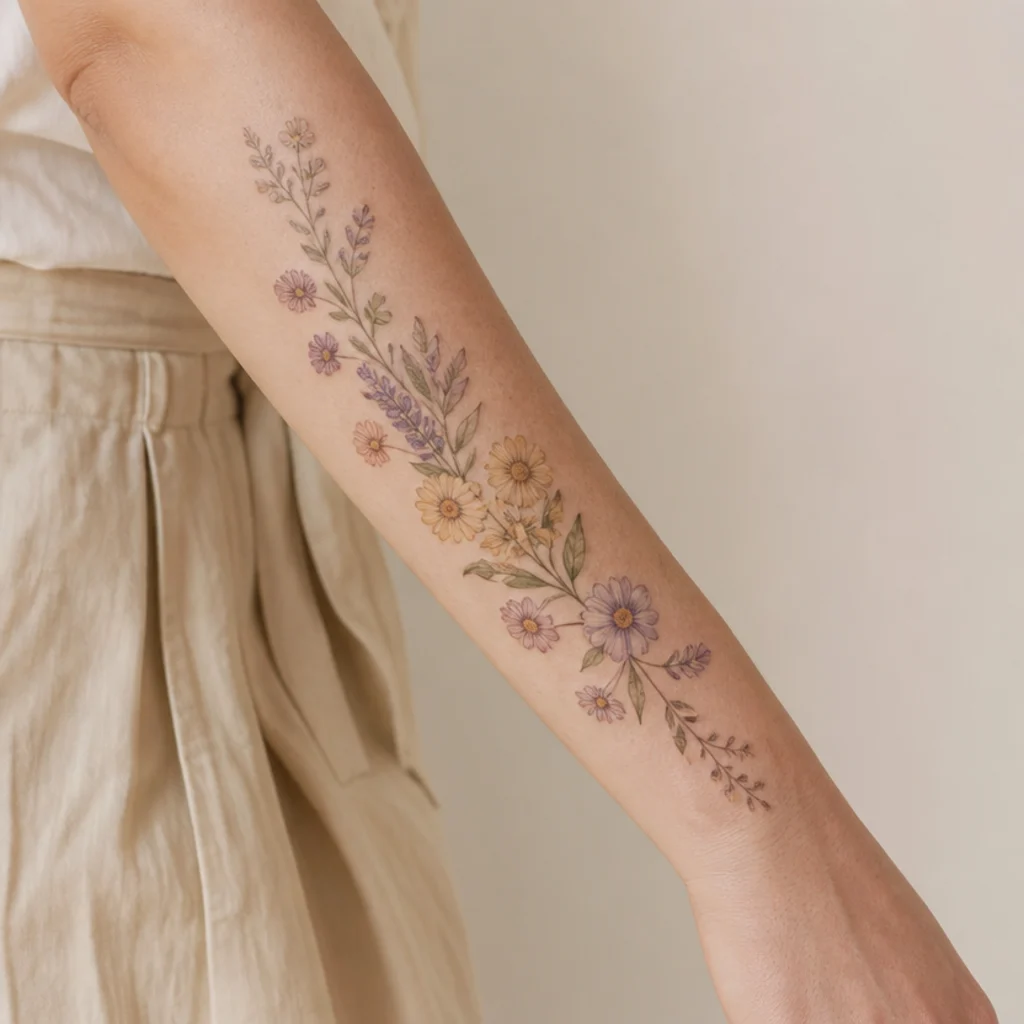
A trailing vine is the gentlest option here, and it only works when the original is small or already faded to a soft outline. Because the design is scattered rather than solid, the artist places denser blooms and darker leaf clusters precisely over the spots that need hiding, then thins out into sprigs and buds elsewhere so the piece breathes. Muted sage, dusty lavender, soft ochre, and a warm charcoal for the stems keep it delicate and modern rather than sweet, good if you want something feminine and low-commitment that still reads as intentional, not accidental. Upkeep is easy on the leaves and stems, but the palest petals fade first, so plan a light refresh down the line. The honesty point matters most with this one: because it looks airy, an artist can accidentally under-build the coverage. Say plainly that it's a cover-up, not a fresh delicate tattoo, so enough visual weight lands over the old design. Ask your tattoo artist to map the three or four "coverage anchor" blooms before drawing the rest freehand.
05Neo-Traditional Rose and Leaves
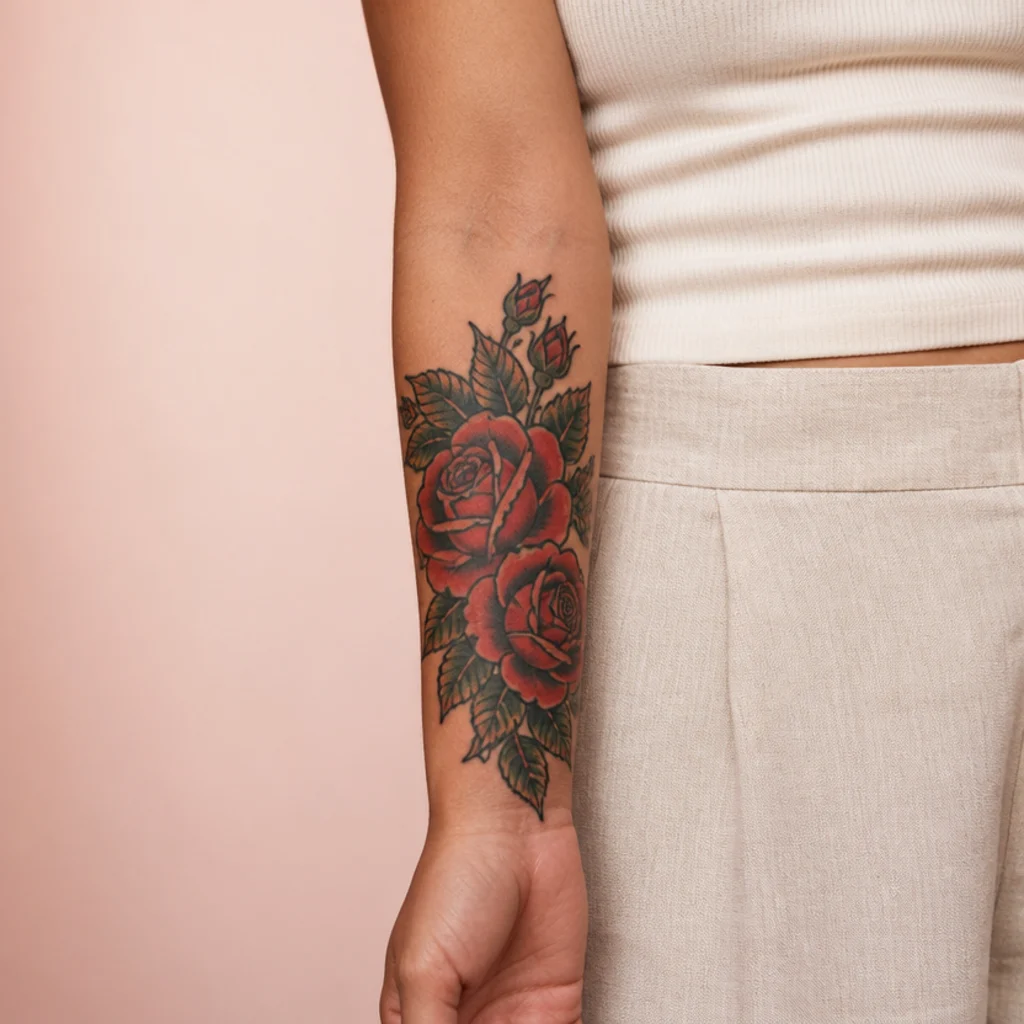
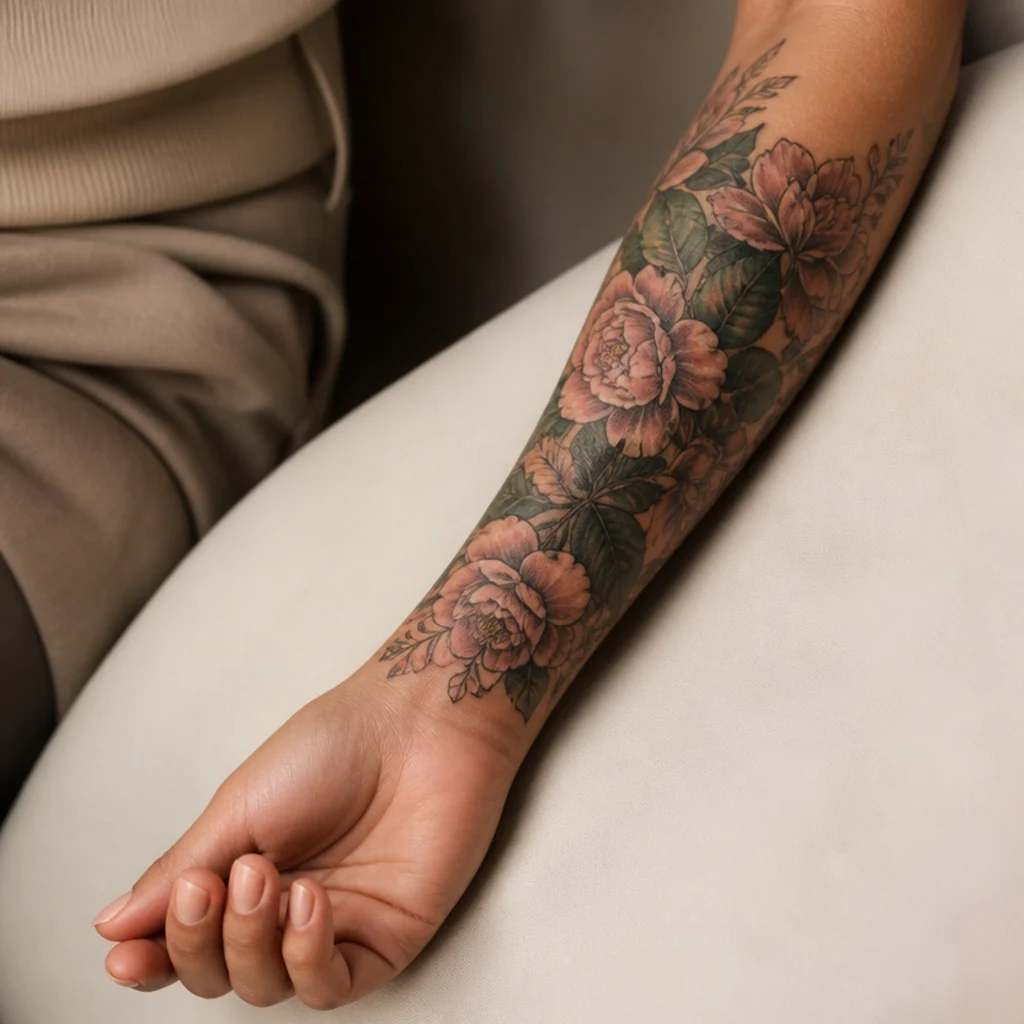
Neo-traditional style is practically engineered for cover-ups: heavy confident outlines, saturated flat-to-blended fills, and decisive shading all bury old ink with room to spare. A classic rose with layered leaves gives a structured, polished result that flatters nearly every skin tone, since the bold black linework carries most of the concealing load while the red and green add life on top. Expect strong longevity: the thick outlines age gracefully, and usually only the brightest reds want a minor touch-up over the years. This is a smart pick if you want something that looks deliberate, a little vintage, and unmistakably art rather than a repair. The style's boldness is also its safeguard, since there's no delicate area for old ink to sneak through. Ask to see the artist's healed neo-traditional pieces, note the exact position of the old tattoo, and ask your tattoo artist to seat the rose's darkest core and outline weight over the original.
Save this to Pinterest to compare floral cover up styles side by side.
06Moth and Moon Motif
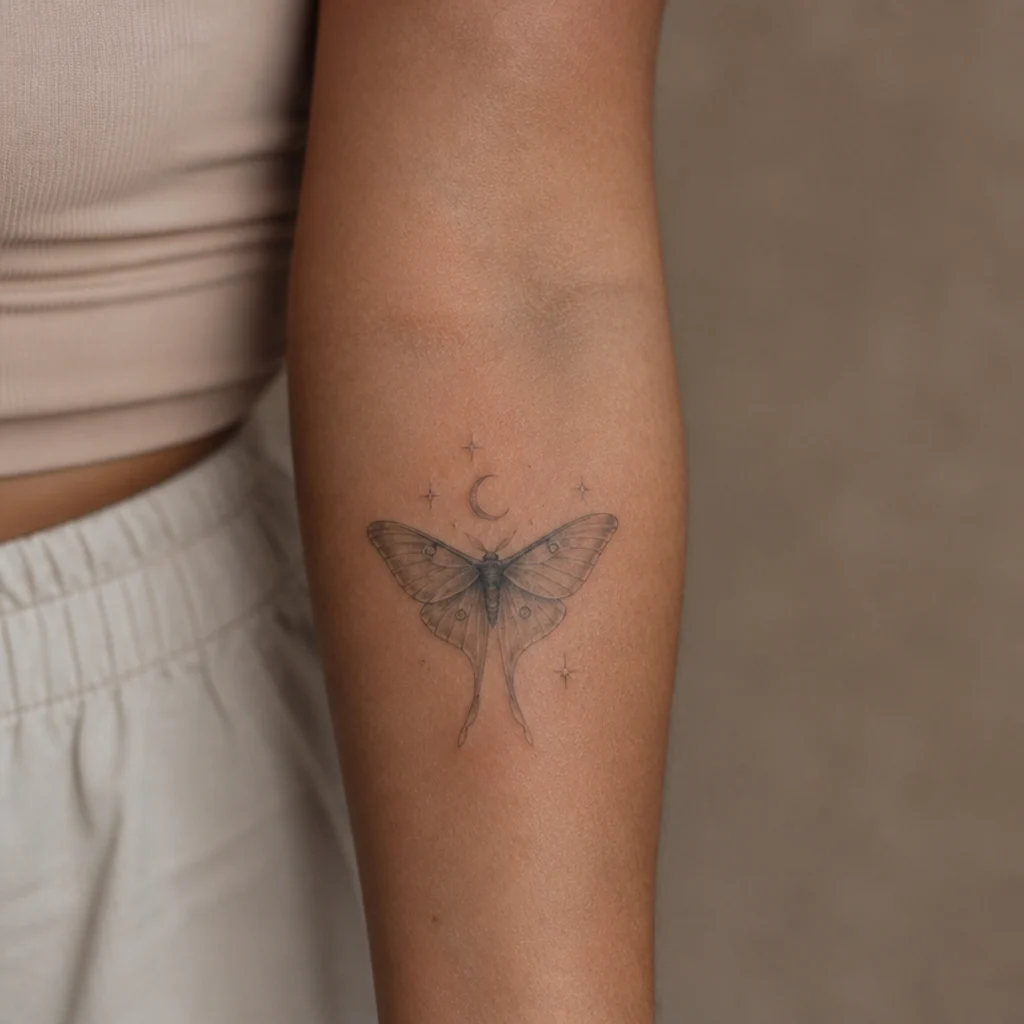
A moth with spread wings is one of the most useful shapes on this list for a squarish or blocky old tattoo, since the wingspan is naturally wide and symmetrical and can be sized to fully enclose the original. Pair it with a small crescent moon and a scatter of stars to extend the composition up or down the arm without adding bulk where you don't need it. Soft grey wash with darker body and antenna detail keeps it moody and contemporary, and it suits olive to deep skin particularly well. Maintenance is low, since so much of the piece is shading rather than fine color. The risk with grey wash is under-saturation over old ink, so the body and inner wing sections need to be built darker than they might be on a fresh piece. Tell your artist the exact dimensions of what you're covering, and ask your tattoo artist to widen the wingspan a touch beyond the old tattoo's edges so nothing peeks out at the borders.
07Ornamental Lace Cuff
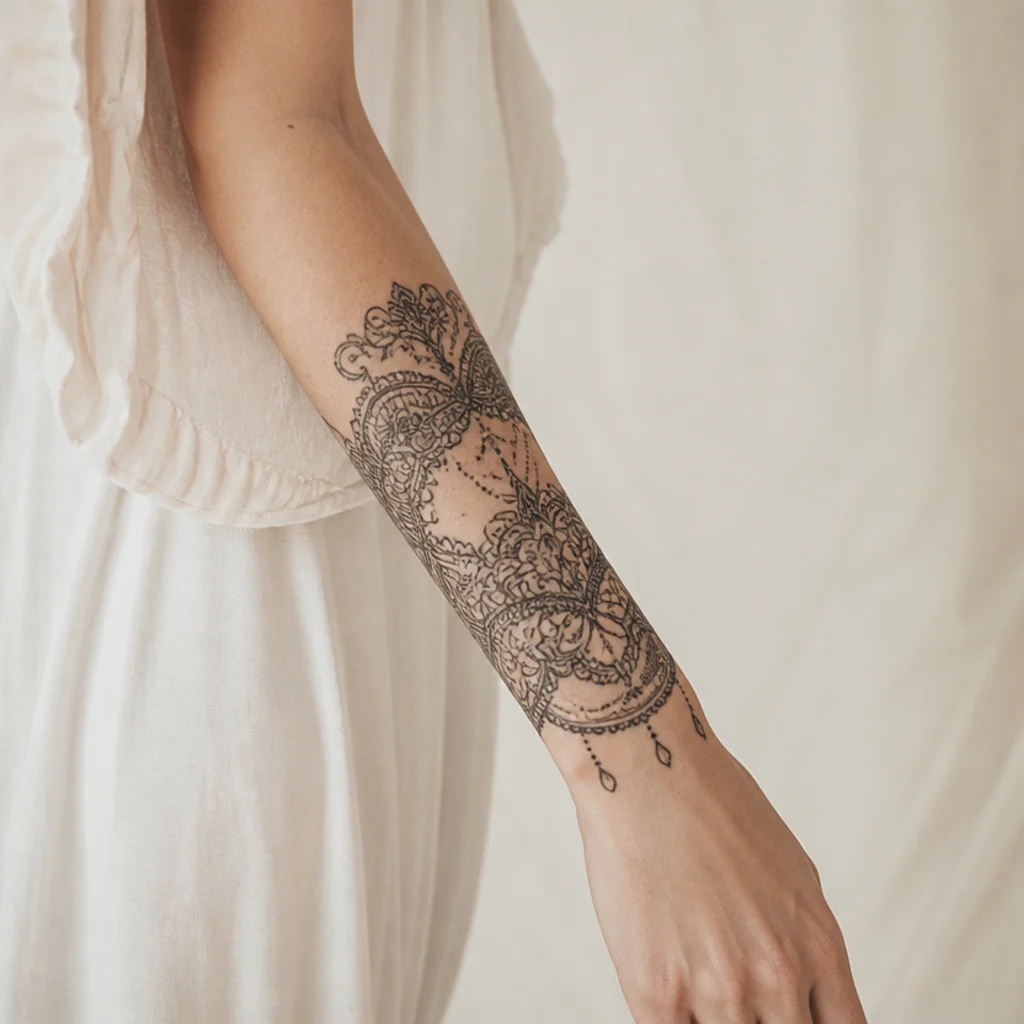
An ornamental lace or filigree cuff wraps the forearm like a piece of jewelry, which makes it ideal when the old tattoo runs horizontally or bands across the arm. Repeating swirls, dots, teardrops, and pearl-like accents give the artist endless small places to concentrate density wherever the ghost of the old ink might show. Decorative and architectural rather than pictorial, it bridges neatly into wrist cover up tattoos when the original sits low near the joint. The trade-off: it's built from fine black linework, so the thinnest filigree can soften over the years and want a touch-up to stay crisp. Placement height is everything for a flattering result — too high looks stranded, too low crowds the wrist. Ask for a mock-up drawn directly on your arm, and ask your tattoo artist to thicken the cuff's central motif so its densest band lands over the old design.
08Realistic Feather Fan
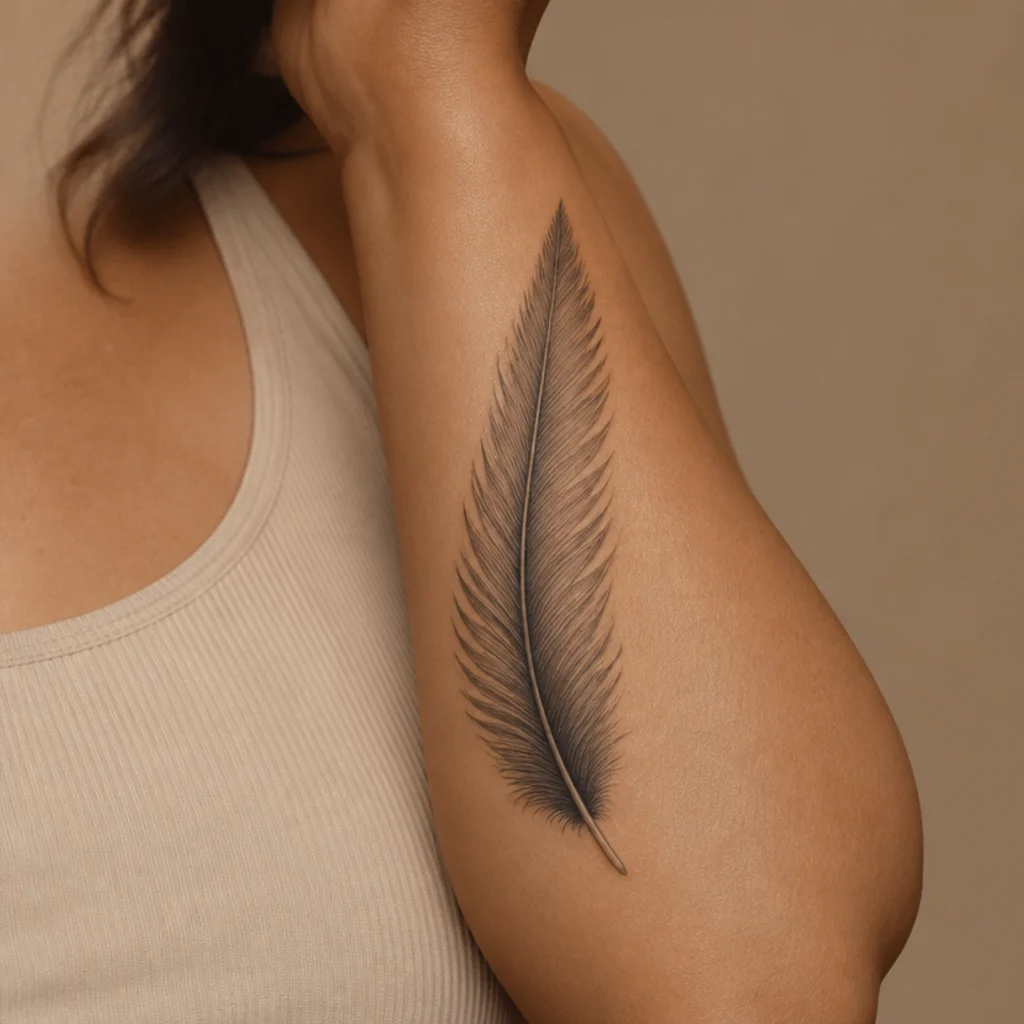
A single large feather angled along the length of the forearm gives a long, narrow footprint that mirrors the limb and stretches neatly over an elongated old tattoo like a name or a linear piece. Realistic barb detailing with a gradient from dense black at the shaft to soft brown at the tips creates the depth that does the concealing, while the frayed edges keep it from looking like a solid block. The look is subtle, monochrome, almost photographic, a good fit if bold color isn't what you're after. The fine barb tips may want occasional refreshing, but the shaded quill and base hold up well. The key structural decision is the base: it must be solid and dark enough to cover the heaviest part of the original, so the feather should be oriented with its densest end over the worst of the old ink. Ask your tattoo artist to weight the quill and lower barbs for coverage rather than spreading the darks evenly.
09Koi and Water Ribbon
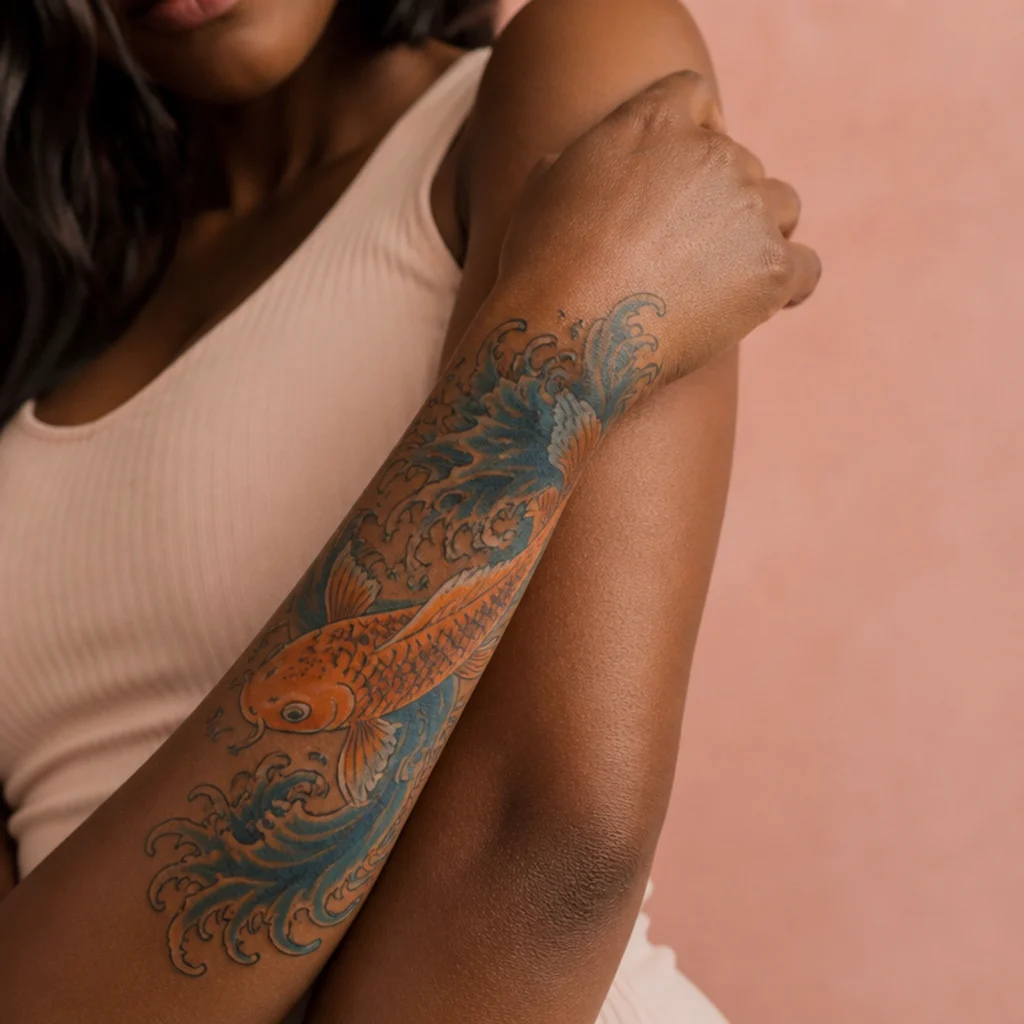
A koi swimming through a ribbon of water is a dynamic, flowing composition that curves naturally around the forearm and hides old ink inside its own movement. The classic orange-and-blue palette is saturated enough to cover a dark original, and the water splashes, bubbles, and finlets give the artist total freedom to drop concealing shadow exactly where it's needed without it looking placed. Medium to deep skin suits this one especially well, and it appeals to anyone drawn to Japanese-inspired art with narrative and direction, since a koi swimming upstream carries its own symbolism of perseverance. This is a larger commitment with moderate upkeep, as the brightest oranges and the water highlights may soften first. The compositional trick is flow: the busiest, darkest passage of water or the koi's body should be routed directly over the old tattoo. Ask your tattoo artist to plan the current so the heaviest detail sits on top of the original rather than beside it.
10Dotwork Snake Coil
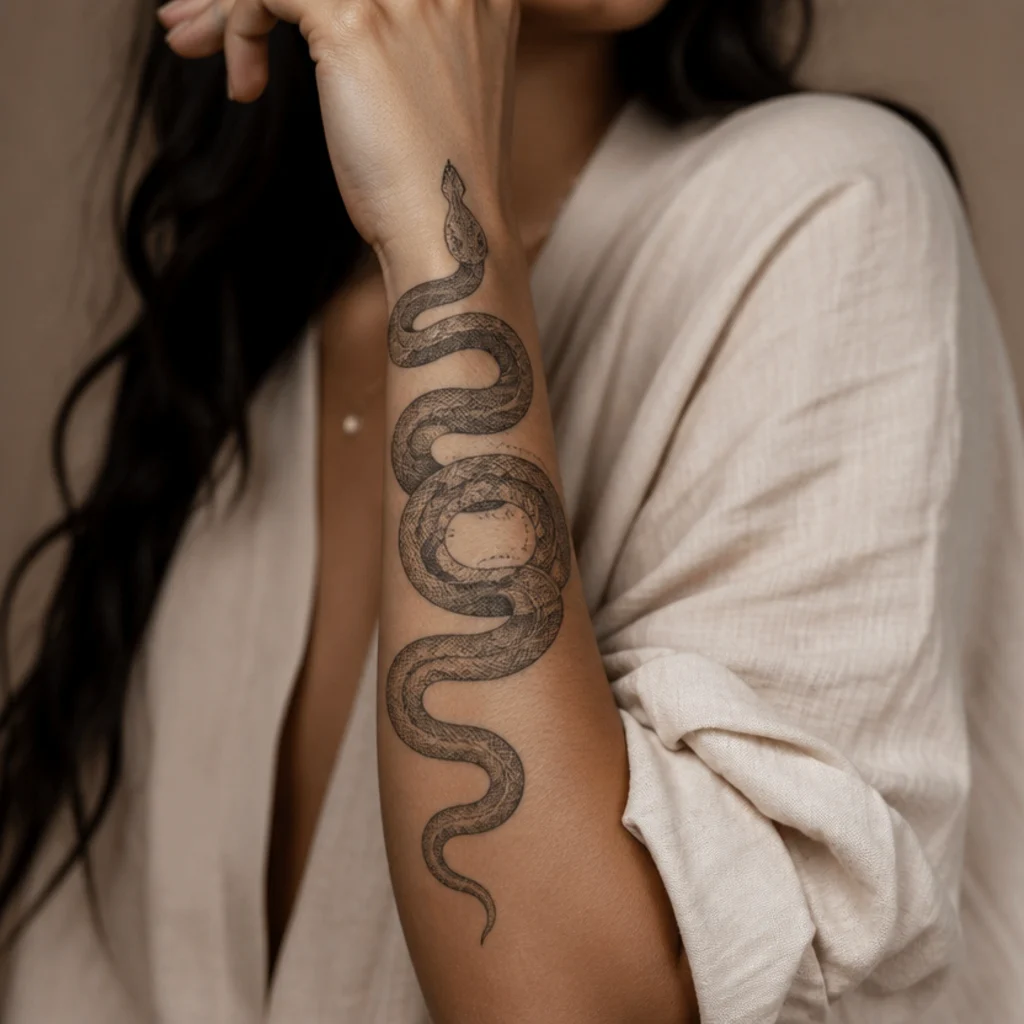
A coiled snake winding up the forearm gives a long vertical composition with a generous, continuous body to work with, a gift when you're covering something irregular. Rendered in dotwork or fine stippling, the scales build a texture that camouflages what's underneath while looking intricate and intentional, edgy and illustrative, a little esoteric. The honest caveat is that pure dotwork reads lighter than solid work because it's built from separated points of ink, so over a very dark original it can leave gaps; the reliable fix is to combine the stippling with passages of solid blackwork in the deepest coils and shadow lines. Upkeep is otherwise low once healed. Bring a clear photo of your old tattoo so the artist can plan the snake's thickest coils to fall over the areas needing the most coverage, and ask your tattoo artist whether solid black accents are needed to guarantee opacity.
Save this to Pinterest if you're drawn to bolder blackwork cover ups.
11Filler Foliage Blackout Edge
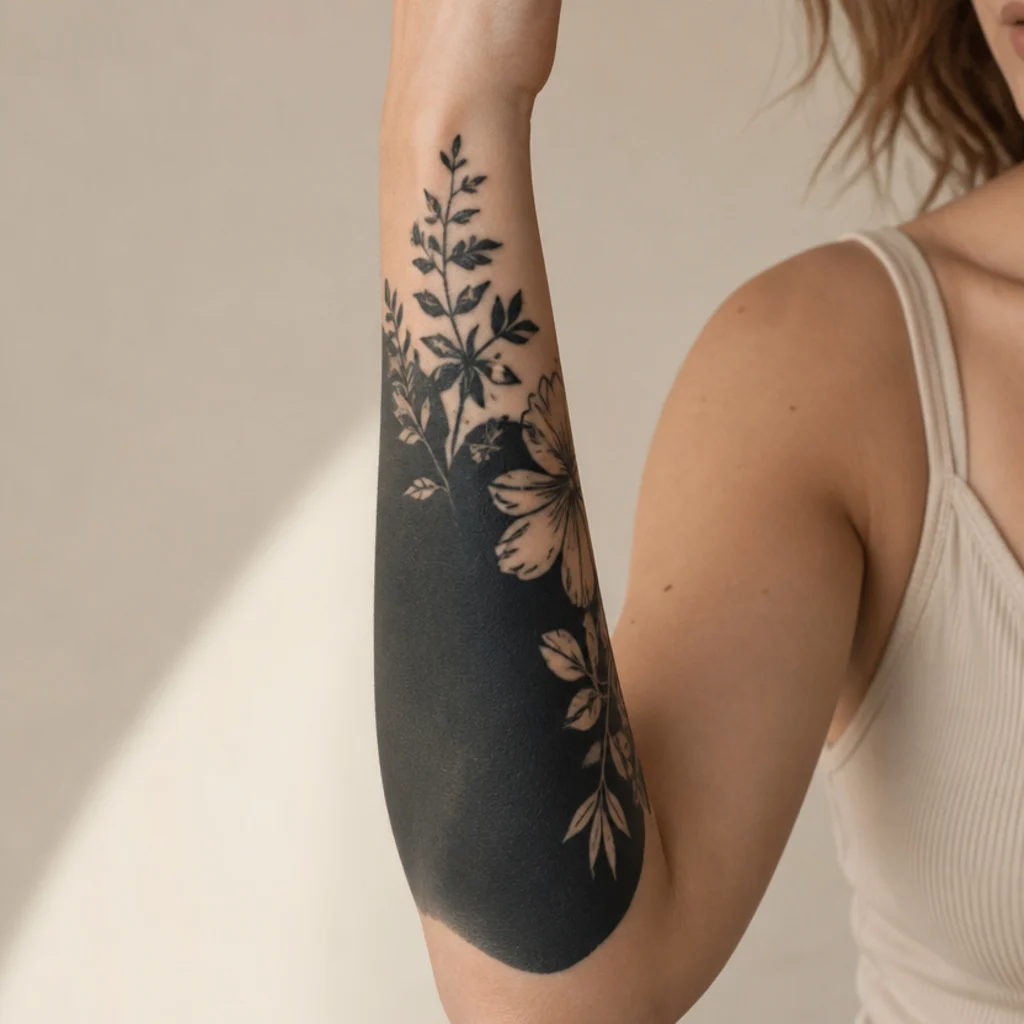
When an original is too dark for a conventional cover, a partial blackout softened by botanical filler is the modern, honest solution. The solid black section fully conceals the old ink, guaranteed, while leaves, ferns, and negative-space flowers along its border keep it from reading like a plain censored block. This one's for people comfortable with a graphic, high-contrast statement and a bit of commitment. Blackout ages remarkably well and rarely needs touch-ups on the solid area, though the negative-space details should be checked over time since skin can slowly reclaim thin light gaps. The real conversation is about permanence: solid blackout is very difficult to lighten later, and laser struggles with large dense black fields, so this is close to a final decision. Discuss exactly how much blackout you're willing to commit to before the stencil goes on. Ask your tattoo artist how the negative-space botanicals will be kept crisp as the surrounding black heals and spreads slightly.
12Bold Sunflower Statement
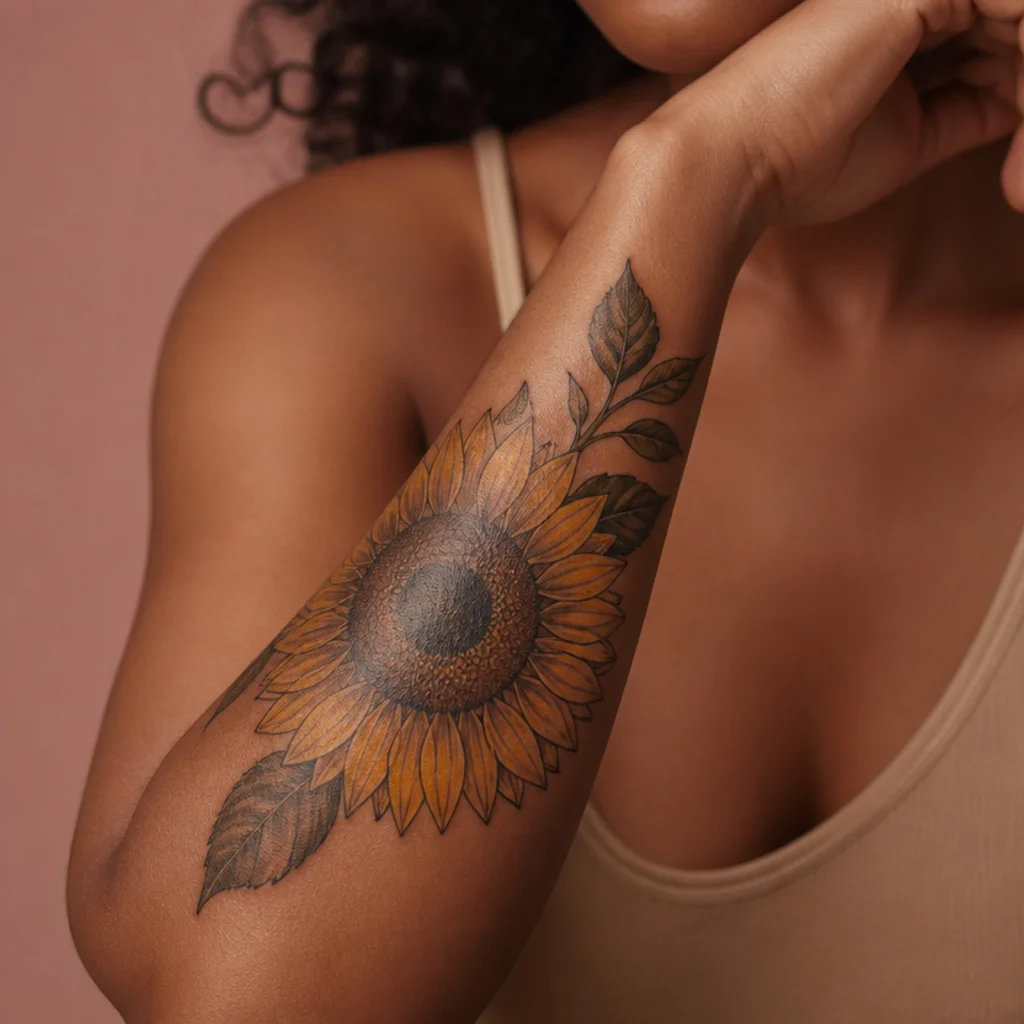
One oversized sunflower makes a cheerful, high-impact cover that's easier to plan than it looks. The dark brown, textured center is a built-in place to concentrate the heaviest shading over the busiest part of the old design, while the golden petals radiate outward to enlarge the footprint and pull the eye into a clean sunburst shape. It flatters warm and medium skin tones especially, where the golds glow rather than wash out. The one thing to plan around is pigment behavior: yellow and gold fade faster than almost any other color, so expect a refresh every few years to keep it vivid, and ask the artist to lay the petals down saturated rather than thin. The center should carry the coverage, the petals the drama. Ask your tattoo artist to position the seed-head core directly over the old ink and to keep the petal bases dense where they meet the center.
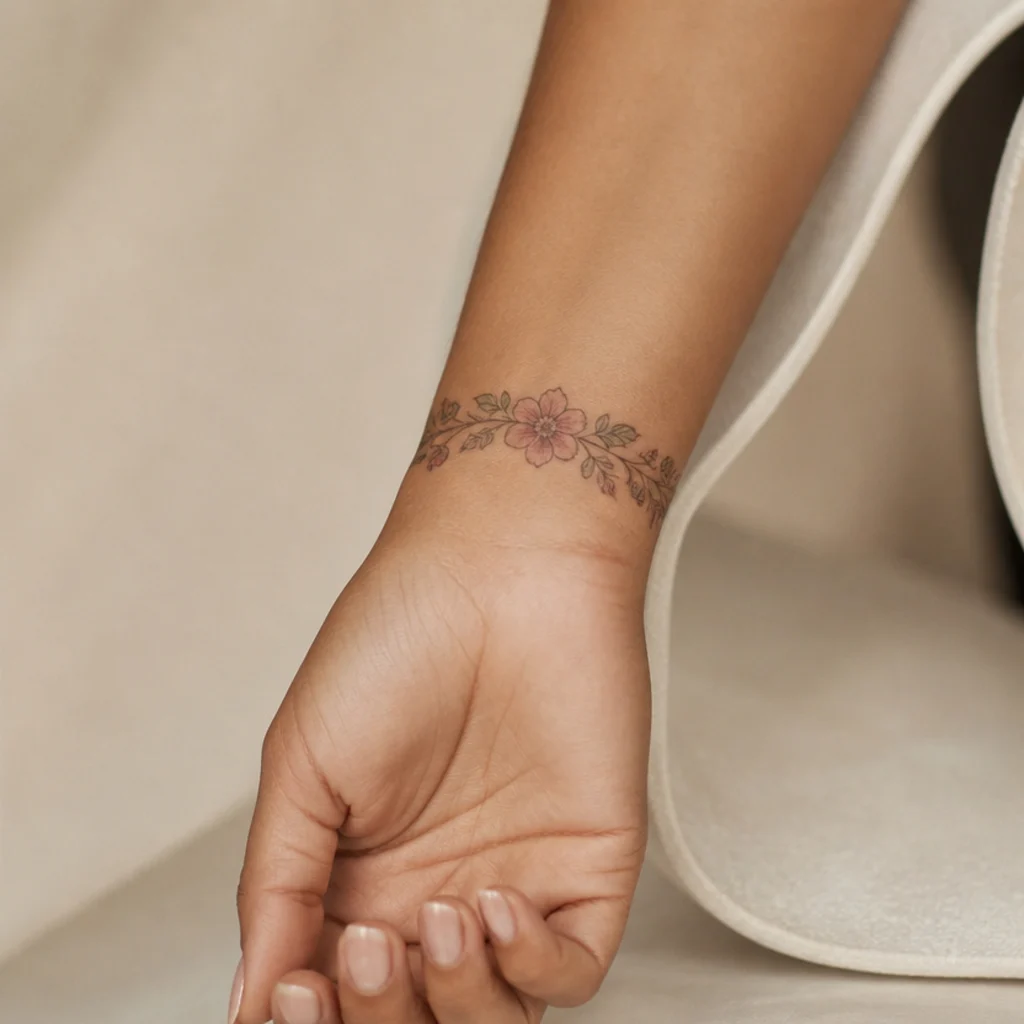
13Wrist-to-Forearm Bracelet Band
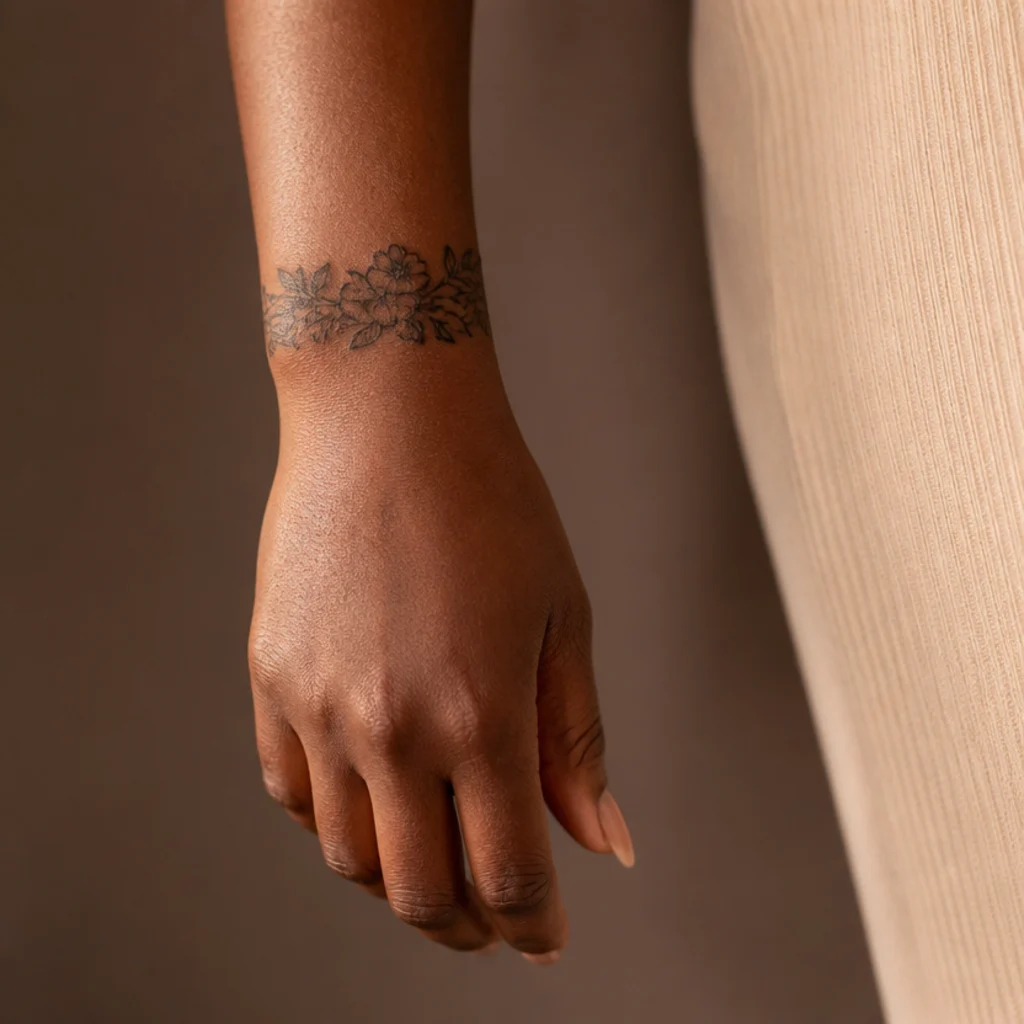
A band that circles the arm, beginning at the wrist and rising onto the lower forearm, is the go-to when the old design sits near the joint where a standalone motif would look awkward. Because small blooms and leaves wrap the full circumference, there's no obvious "front" where the original could peek through, and the continuous loop reads as an intentional accessory. It overlaps directly with wrist cover up tattoos and suits anyone wanting a bracelet-like accent rather than a large statement. The practical caveat is wear: skin near the wrist flexes constantly and rubs against sleeves and watch straps, so fine details there fade faster and want more frequent touch-ups than mid-forearm work. Band height also makes or breaks the look. Ask your tattoo artist to test the band's height and circumference drawn on your arm first, so it fully clears the old tattoo and sits at a flattering point above the wrist bone.
14Name Cover Up in Script Redirect
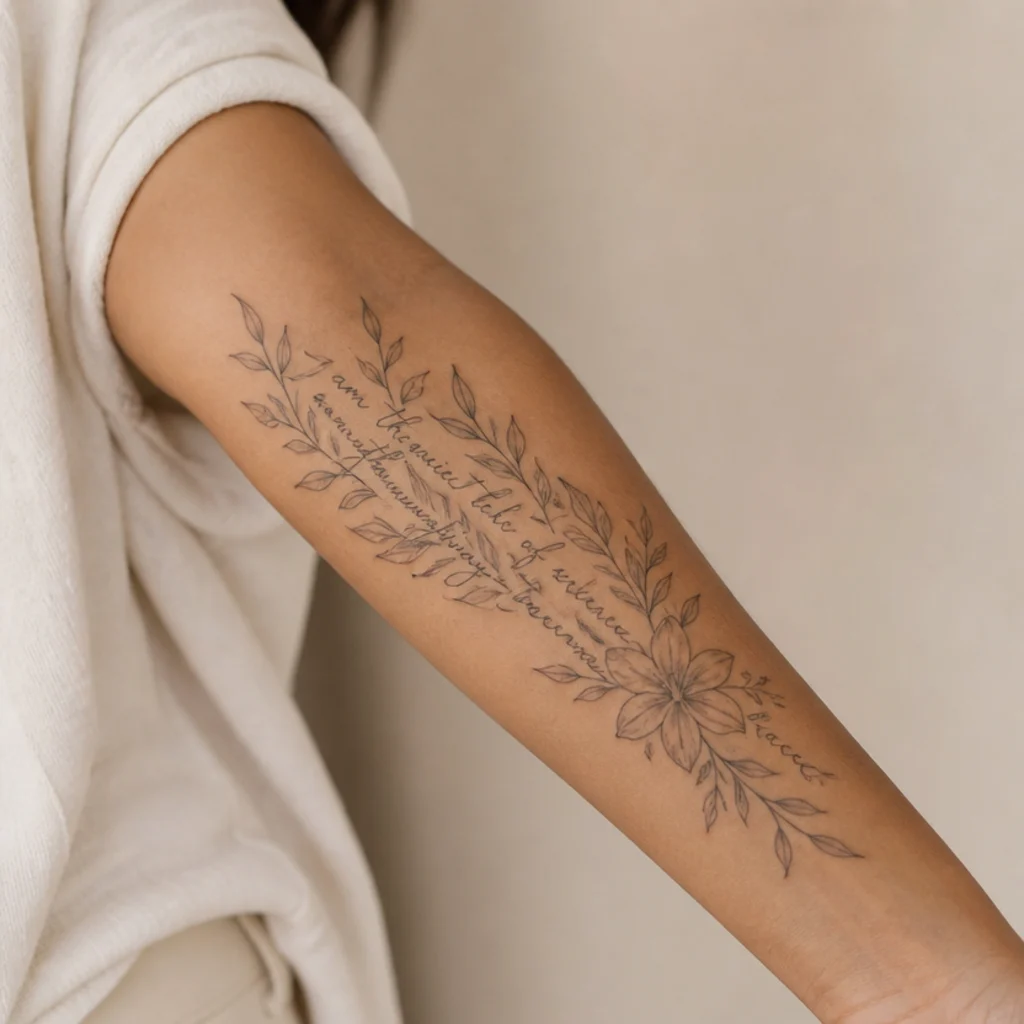
Covering old lettering is the single most common cover-up request and one of the trickiest, because the brain reads letterforms almost involuntarily; a stray ascender or the ghost of a capital can give the whole thing away. Writing new words directly over old ones rarely works. The reliable approach is redirection: bury the original inside a larger design so the eye never lands on letter shapes. New script woven through leaves at a different angle, or a floral spray that crosses the old baseline diagonally, breaks up the letterforms most effectively. Name cover up tattoos succeed when the new piece is noticeably bigger and clearly darker than the original, and when the composition runs across the old text rather than parallel to it. Be upfront about how dark and how deeply saturated the lettering is, since heavy old black script often needs a session or two of laser fading before a clean cover is realistic. Ask your tattoo artist whether your specific lettering needs pre-lightening before the redirect design.
15Butterfly and Baby's Breath
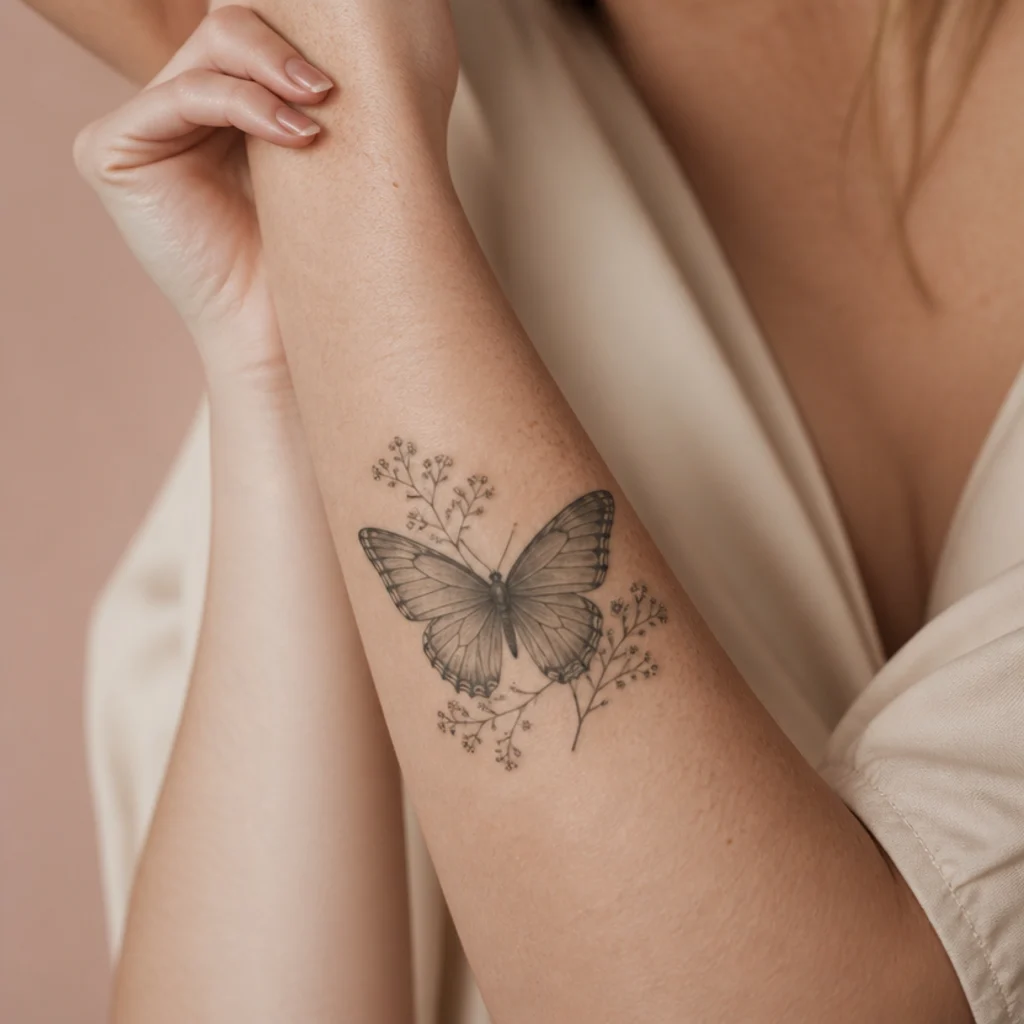
A butterfly with open wings offers a broad, symmetrical footprint, and ringing it with sprigs of baby's breath extends the coverage outward without piling on heaviness. Soft grey wings with darker vein detail do the concealing at the center, while the tiny white and grey florals fill the surrounding space and blur the edges of the old design. Fair to medium skin suits this one best, and it's a good match for anyone wanting something delicate that still has real substance behind it. The pale filler is the maintenance item: white and light grey soften first, so light touch-ups keep the piece crisp. The structural point, as with the moth, is that the body of the butterfly must carry enough weight to bury the darkest part of the original, and grey wash tempts artists toward under-saturation. Ask your tattoo artist to build the butterfly's body and lower wings darker than a fresh version would need, so the center of the old ink fully disappears rather than shadowing through.
16Geometric Sacred Panel
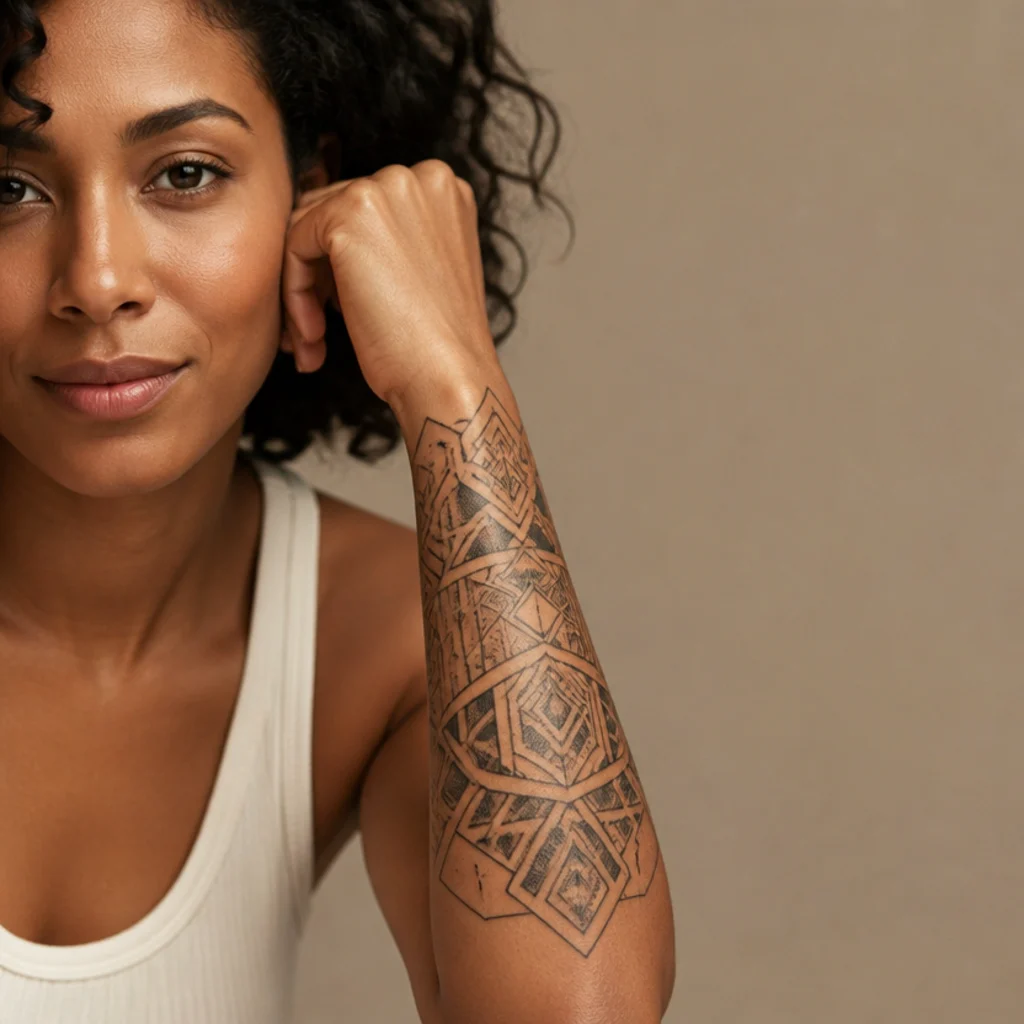
Sacred-geometry panels combine crisp repeating lines, nested shapes, and pockets of solid shading, a combination that makes an excellent cover for a medium-dark original. The structured, mathematical look reads precise and modern, and the shaded triangles, diamonds, and mandorlas can be placed strategically so the densest geometry lands over the old ink while the open linework floats clear of it. Anyone drawn to symmetry and graphic-but-minimal art will like this, and it's striking on deep skin where clean lines stand out. It ages well thanks to bold structure, though its precision is also its demand: crooked or blown-out lines are obvious in geometry, so this style lives or dies on the artist's linework and healing. When you consult, ask to see healed geometric pieces at full size. Ask your tattoo artist to map the solid-shaded sections over the old design and to confirm the fine linework will stay clean as it settles.
17Ocean Wave and Coral
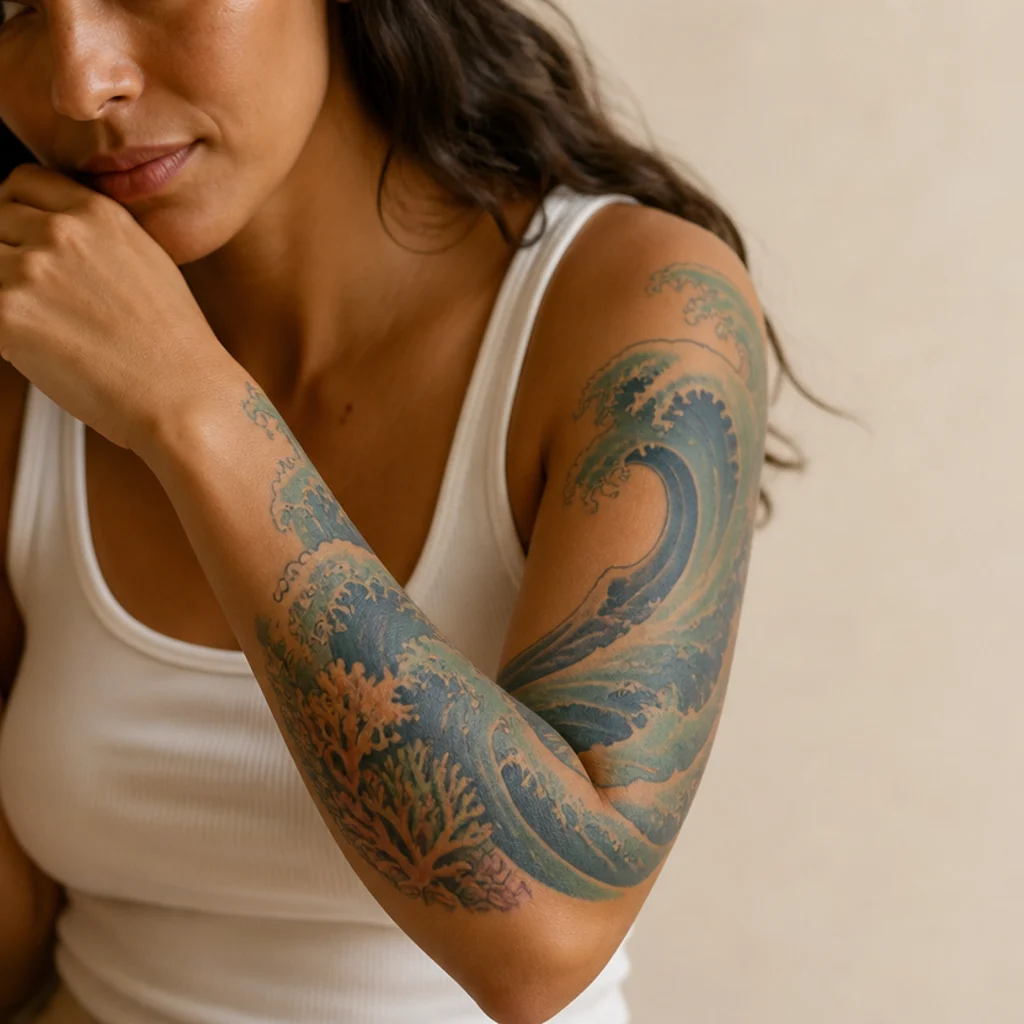
A curling wave with coral and sea foam brings movement and a cool palette that layers blues and teal densely enough to cover a dark original. The busy foam, spray, and coral texture give the artist natural, non-obvious places to concentrate concealing detail, and the composition flows along the length of the arm, which suits the shape of the forearm well. It appeals to ocean lovers and anyone wanting color without florals. Blue and teal pigments hold reasonably well over time, though the white foam highlights fade first and want refreshing to keep the wave dynamic. The compositional key is the curl: the deep shadow inside a breaking wave is the darkest, most opaque passage in the whole design, so it should be routed directly over the heaviest section of the old tattoo. Ask your tattoo artist to place the wave's curl and its shadow over the busiest part of the original rather than filling the old ink with light spray.
18Phoenix Wing Sweep
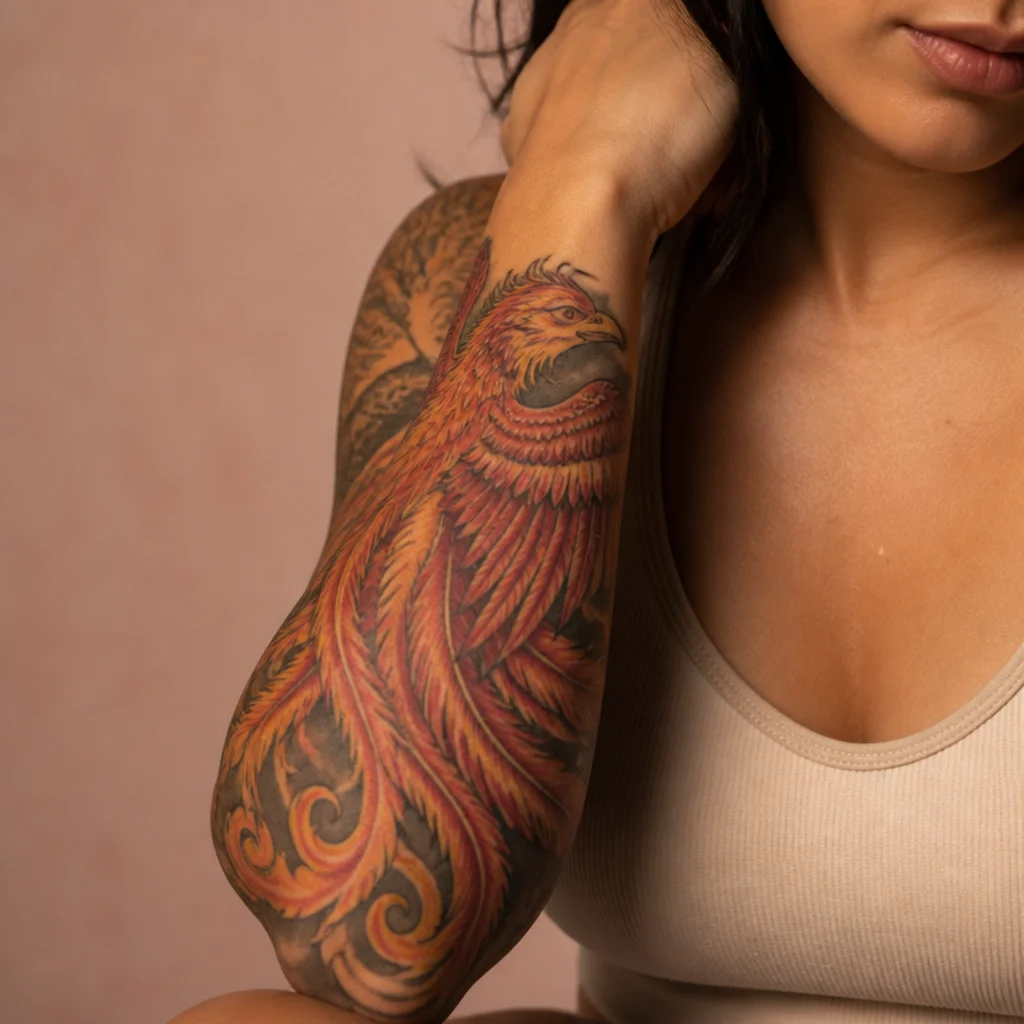
A phoenix wing sweeping up the forearm is a bold, symbolic cover that suits larger or darker originals precisely because of its dense feathering: there's a lot of built-in opacity to work with. Warm reds and gold layered over solid black feather bases give both saturation and drama, and the sweeping motion carries the eye toward the elbow rather than back to what was covered. The rebirth symbolism resonates with anyone starting over, which makes it a fitting choice for covering ink tied to a chapter you've closed. As a larger color piece it carries moderate upkeep, with the brightest reds and golds needing occasional attention while the black feather structure holds. Plan the flow before the color: the darkest feather bases should stack over the old ink, with the lighter tips fanning outward. Ask your tattoo artist to concentrate the solid black feather roots over the original and to map how the wing sweeps toward the elbow.
19Vintage Botanical Illustration
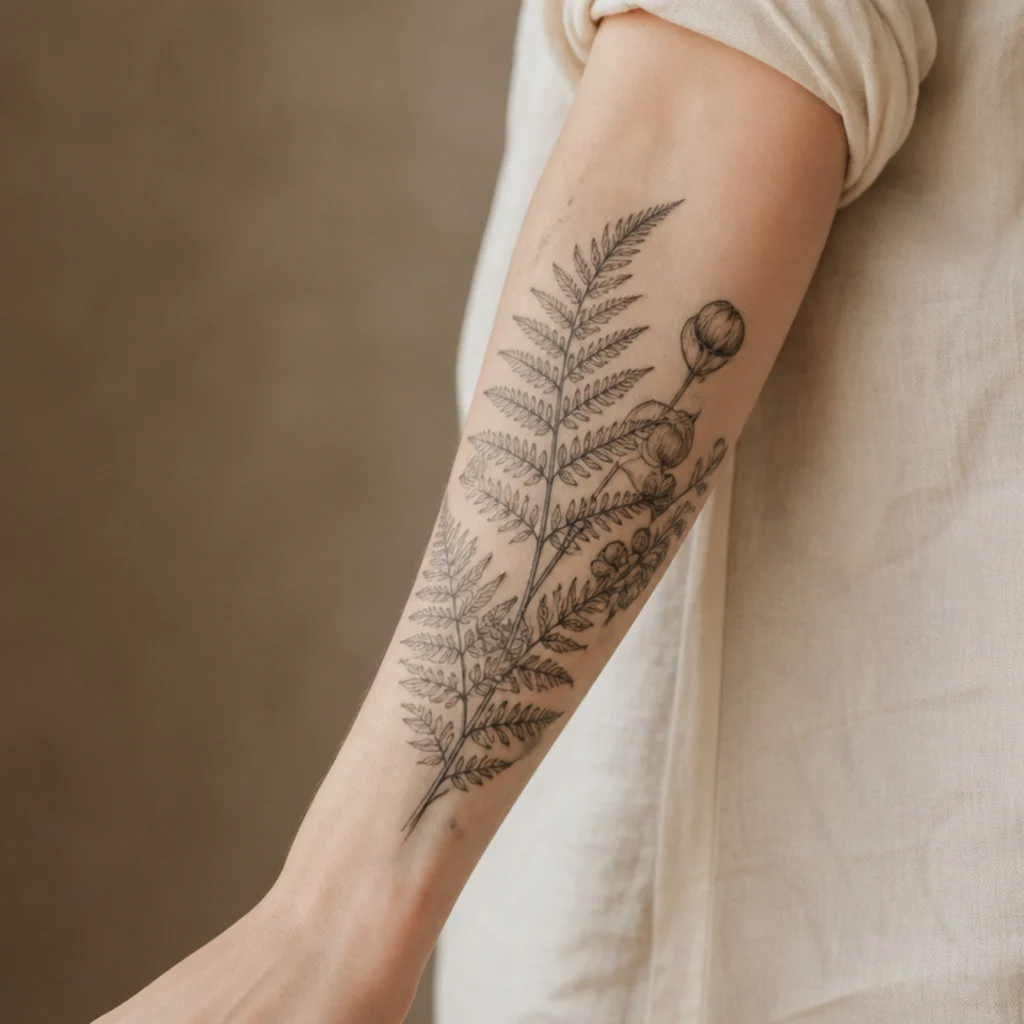
A vintage botanical illustration drawn in the style of an old engraving uses fine crosshatching, stippling, and detailed linework to build texture that conceals quietly, without any color. Ferns, seed pods, thistles, and stems layered together create enough packed density to hide a light-to-medium original while looking like a plate torn from a botanical field guide. Understated, monochrome, a little intellectual, it's for anyone who wants something quieter than bold or bright. The honest limitation is coverage strength: delicate engraving styles are built from thin marks with gaps between them, so over anything but a faded original they can leave the old ink whispering through. The finest crosshatching also softens over years and wants a refresh. When you book, confirm the design packs enough dark linework directly over the old tattoo. Ask your tattoo artist whether your original is faded enough for engraving-style density, or whether a heavier element is needed over the darkest spot.
20Full Floral Half-Sleeve Flow
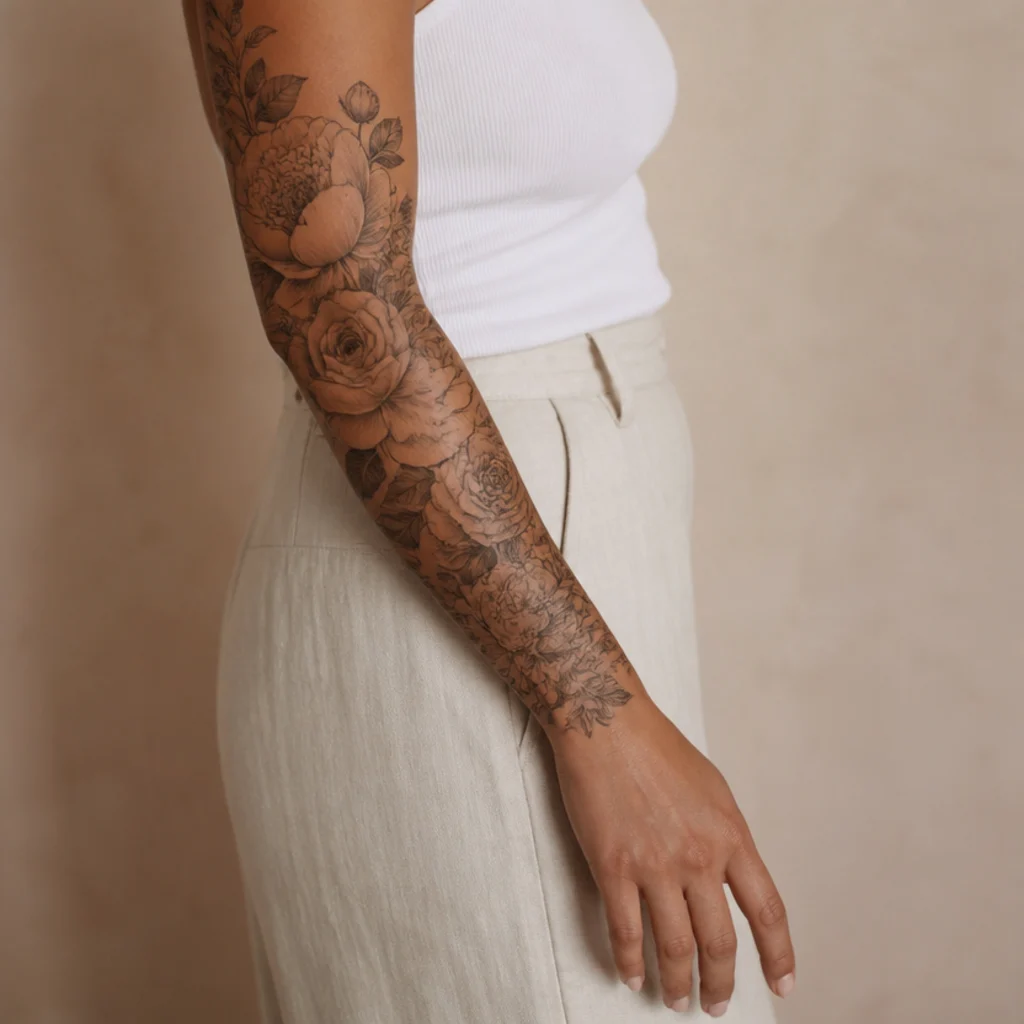
When a cover needs to disappear completely and nothing smaller will do, extending into a full floral half-sleeve is the most effective route on the list. By flowing roses, peonies, and foliage from the wrist to the elbow, the artist surrounds the old tattoo with so much artwork that it becomes one bloom among dozens, with no isolated patch for the eye to interrogate. This suits anyone ready for a larger commitment and the smoothest possible result, and it gives the artist freedom to route density anywhere without composition constraints. This is a multi-session project with moderate long-term upkeep on the color, and it rewards planning: a good artist stencils the whole sleeve first so the flow reads as one piece across sessions rather than a stitched-together patchwork. Discuss a staged plan and a realistic session count up front. Ask your tattoo artist to build the densest, darkest flowers directly over the original ink and to design the negative space so it never falls on the old tattoo.
Pro Tips from the Editor
- Photograph the original in daylight, flat and flash-free, then again stretched. Stretching the skin shows an artist how the old ink shifts and where it is deepest, which changes where the coverage anchors need to sit.
- Ask for "healed, not fresh" portfolio work, specifically cover-ups. Fresh photos hide the one thing that matters: whether old ink ghosts back after the new piece settles. If an artist can only show fresh cover-ups, keep looking.
- Understand the size-and-value rule. A cover generally needs to be larger than the original and equal to or darker in value; "darker" can mean saturated color or dense shading, not only black.
- Treat laser as an ally, not a failure. One to a few sessions of laser lightening on a very dark or black original dramatically widens your design options and often produces a better final cover than forcing an oversized blackout.
- Route the composition, don't just place a motif. The best covers put the busiest, darkest passage of the new design directly over the worst of the old ink, then flow lighter detail outward.
- Respect pigment fade order. Yellows and whites go first, reds and light greys next, black and cool dark tones last, so schedule refreshes around the lightest colors in your piece.
- Never let anyone promise a "perfect" cover on the spot. A trustworthy artist assesses your specific skin, ink depth, and colors first and gives a candid read, including whether pre-lasering is needed.
Cover-Up Style Cheat Sheet
| Style | Best over | Skin tone note | Upkeep | Coverage strength |
|---|---|---|---|---|
| Blackwork mandala | Very dark / black | Striking on deep skin | Low | Very high |
| Blackout + botanical edge | Dark, unworkable ink | Any | Low on solid | Highest |
| Neo-traditional florals | Medium to dark | Most tones | Low to moderate | High |
| Color florals (peony, sunflower) | Medium to dark | Warm to deep | Moderate (color fade) | High |
| Watercolor with line anchors | Light / faded | Fair to medium | Higher | Moderate |
| Dotwork / fine linework | Light to medium | Any | Low once healed | Moderate (add solids for dark) |
Coverage strength assumes an experienced cover-up artist; confirm feasibility for your specific ink at consultation.
How to Choose / Get the Look
Start by being honest with yourself about what you're covering, because the original dictates the design far more than your Pinterest board does. Snap clear, well-lit photos of the old tattoo, flat and stretched, and note its true size and how dark and saturated it is; a faded grey outline and a solid black band call for completely different solutions.
Match the design to the original. Faded or light ink opens the door to delicate options like a wildflower vine, watercolor with line anchors, or vintage botanical linework. Medium-dark ink suits neo-traditional florals, geometric panels, koi, or a moth. Very dark or solid-black originals realistically want blackwork, a partial blackout with botanical edging, or laser lightening first, before anything softer becomes an option.
Weigh commitment versus concealment. A bracelet band or single feather is a smaller, faster piece but demands the original be modest; a full half-sleeve gives the smoothest result but is a bigger, multi-session investment. Decide which you actually want before you fall for a photo.
Vet the artist, not just the art. Book a consultation with someone who specifically shows healed cover-up work in their portfolio, ask them to draw or stencil the concept directly on your arm so you can judge the fit before any needle touches skin, and listen for candor about laser prep. If your original is very dark, a few sessions of laser lightening first can widen your options dramatically.
Finally, confirm the exact design, sizing, placement, coverage feasibility, and healing expectations with a licensed tattoo artist before you commit, since only a professional can assess your specific skin and ink in person. No design, and no article, can guarantee that a cover-up will fully hide an existing tattoo or scar; that is a judgment only your artist can make for your body.
Frequently Asked Questions
Can any tattoo be covered on the forearm?
Most can be covered or dramatically disguised, but very dark, heavily saturated, or solid-black tattoos are the hardest and sometimes cannot be fully hidden with ink alone. A skilled cover-up artist can often work around them, and one or more sessions of laser lightening beforehand makes almost anything coverable. Only a licensed artist can assess your specific ink in person and tell you honestly what is realistic; treat any promise of a guaranteed perfect cover with suspicion.
Do forearm cover ups have to be big and dark?
As a rule the new design needs to be larger than the original and equal to or darker in value to hide it, but "dark" does not have to mean black. Saturated color, dense shading, and packed linework all raise the value enough to conceal old ink. A good artist balances the coverage your original demands with a look you actually love, rather than defaulting to the biggest, blackest option.
Are name cover up tattoos harder than other cover ups?
Usually, yes, because the brain reads letterforms almost automatically and a single recognizable stroke can give it away. The reliable fix is redirection: bury the lettering inside a larger design such as florals or new script set at a different angle, running across the old baseline rather than along it. Heavy or deeply saturated old lettering often benefits from a session or two of laser fading first.
How much do forearm cover up tattoos cost?
Cost varies widely by size, detail, artist experience, and region, and cover work almost always takes longer than a fresh tattoo of the same size because of the planning and density involved. Expect a higher effective rate than fresh work, budget for multiple sessions on larger pieces, and factor in separate laser fees if your original needs lightening. Ask for a written estimate at your consultation rather than a phone quote.
Will the old tattoo show through over time?
A well-planned cover should stay hidden for years, but old ink can occasionally ghost back as the new piece ages and lightens, especially if the cover was too pale or under-saturated over the original. This is exactly why you want an artist who shows healed cover-up results and who deliberately stacks enough density and value over the old design. Keeping the area out of strong sun and moisturized also slows the fade that lets old ink resurface.
How long do I have to wait before covering a tattoo, and how long between sessions?
A fresh tattoo generally needs to be fully healed, commonly around four to six weeks, before it is covered or lasered, and your artist will confirm the right window for your skin. If you laser first, clinics typically space sessions several weeks apart to let the skin recover and the ink break down, so a cover-up that involves pre-lightening can span a few months end to end. Rushing the timeline risks poor healing and a weaker final result.
Does laser removal hurt more than getting the cover-up, and is it worth it?
Laser sessions are quick but intense, often described as sharper than tattooing, though each pass over a forearm is brief. Whether it is worth it depends on your original: for a very dark or black piece, even partial lightening can be the difference between a heavy forced blackout and the softer, more colorful design you actually want. Discuss it as an option, not an obligation, with both a tattoo artist and a reputable laser technician.
Which forearm, inner or outer, heals and holds a cover-up better?
The outer forearm generally takes bold graphic and blackwork covers well and tends to hold saturation a little longer, while the inner forearm is softer, slightly more sensitive, and flatters delicate or flowing designs. Neither is off-limits for a cover-up; the better choice depends on where your original ink already sits. Your artist will factor placement, movement, and sun exposure into how they build density.
Can a cover-up hide a scar as well as an old tattoo?
Sometimes, but scars behave very differently from tattooed skin: raised, textured, or still-maturing scar tissue can hold ink unpredictably and may not conceal as cleanly. Many artists want a scar to be well healed, often a year or more old, before tattooing over it, and some will patch-test first. This is strictly a case-by-case, in-person assessment; never assume a design will fully cover a scar without a licensed artist evaluating it.