20 Cover Up Tattoos for Women That Are Genius
A cover-up is part design, part problem-solving: you're outsmarting the shapes and values already sitting in your skin, not just adding ink. These 20 directions show how motif, density, and undertone turn old ink, a faded name, or a healed scar into a piece you actually want to show, and each one comes with the exact language to hand your artist.
 Edited by Lena Rose · Published July 11, 2026 · 33 min read
Quick Answer
- Best for: Covering an old, faded, or unwanted tattoo, an ex's name, or a fully healed flat scar with a design that reads intentional rather than apologetic
- Who might skip it: Anyone whose original is very fresh and dark and who is not ready to commit to a larger, darker piece, or who would rather laser it fully and start clean
- Maintenance: Cover-ups run larger and more saturated, so plan for one healing touch-up and disciplined SPF; solid-black areas need moisturizing to resist greying
- Difficulty: Moderate to advanced; outcome depends far more on the artist's cover-up portfolio than on the motif itself
- Cost: Variable and usually higher than fresh work of the same size; more saturation, more sessions, and any pre-laser add to the total. Get a full quote at consultation
- Wear time / longevity: Permanent once healed; expect a touch-up within 1-3 years for fine detail, longer for bold blackwork
- Standout variation: A dense blackwork floral or foliage panel, which reliably hides almost anything underneath
- How to ask your tattoo artist: "This is a cover-up over existing ink. Here are photos in daylight. What can you fully cover as-is, and where would laser-lightening first widen my options?"
In This Guide
- Layered Peony Bouquet
- Blackwork Botanical Sleeve Start
- Watercolor Wildflower Wrist
- Name Cover-Up Into a Songbird
- Ornamental Mandala
- Dark Rose and Thorn Forearm
- Fine-Line Constellation Scatter
- Moth With Spread Wings
- Scar Cover-Up Fern Trail
- Neo-Traditional Snake and Blossom
- Small Blackout Band
- Koi and Water Motion
- Lace and Filigree Panel
- Dotwork Lunar Phases
- Trailing Ivy Around the Wrist
- Bold Butterfly Redraw
- Abstract Brushstroke Blackwork
- Name Into a Ribbon Banner
- Hummingbird and Trumpet Flowers
- Full Forearm Garden Wrap
Covering an old tattoo is one of the smartest reasons to book new ink, and it rewards a plan more than a panic decision. The physics are simple: fresh pigment sits under the skin, not on top of it, so you can never lift an old design, only out-value and out-density it. That's why the strongest cover up tattoos for women run larger, darker, and more deliberately placed than the piece underneath, using overlapping shadow, saturated cores, and busy negative space to reorganize what your eye reads first. Bigger and bolder doesn't have to mean heavy and dated anymore; contemporary cover-ups lean on layered botanicals, ornamental patterning, and considered blackwork that reads intentional from day one. Below are 20 directions spanning soft florals, blackwork, name solutions, and scar-friendly options, each noted for who it flatters, how much coverage power it actually has, a realistic maintenance timeline, and language you can borrow at your consultation. Use it as a save-and-compare tool: note which shapes match what you're hiding, then bring two or three screenshots so your artist can tell you honestly what your existing piece will allow.
01Layered Peony Bouquet
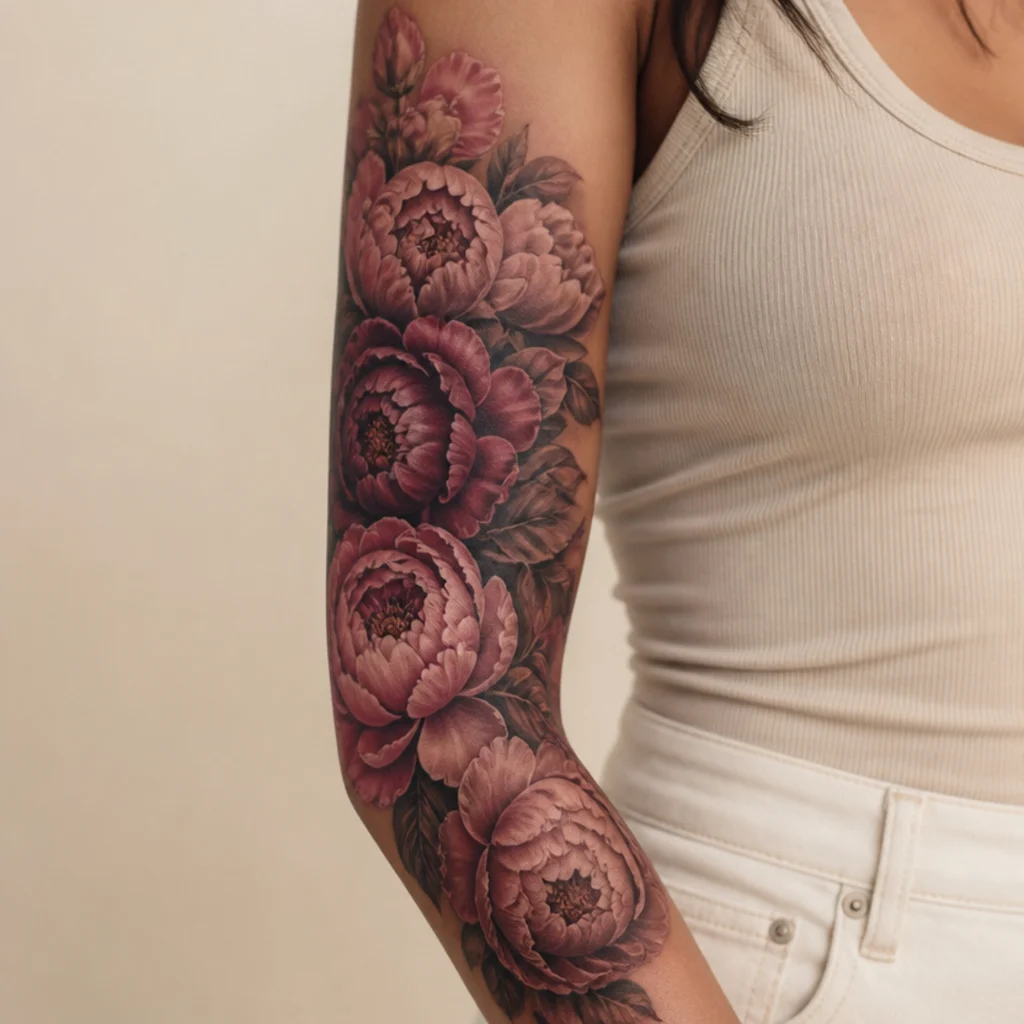
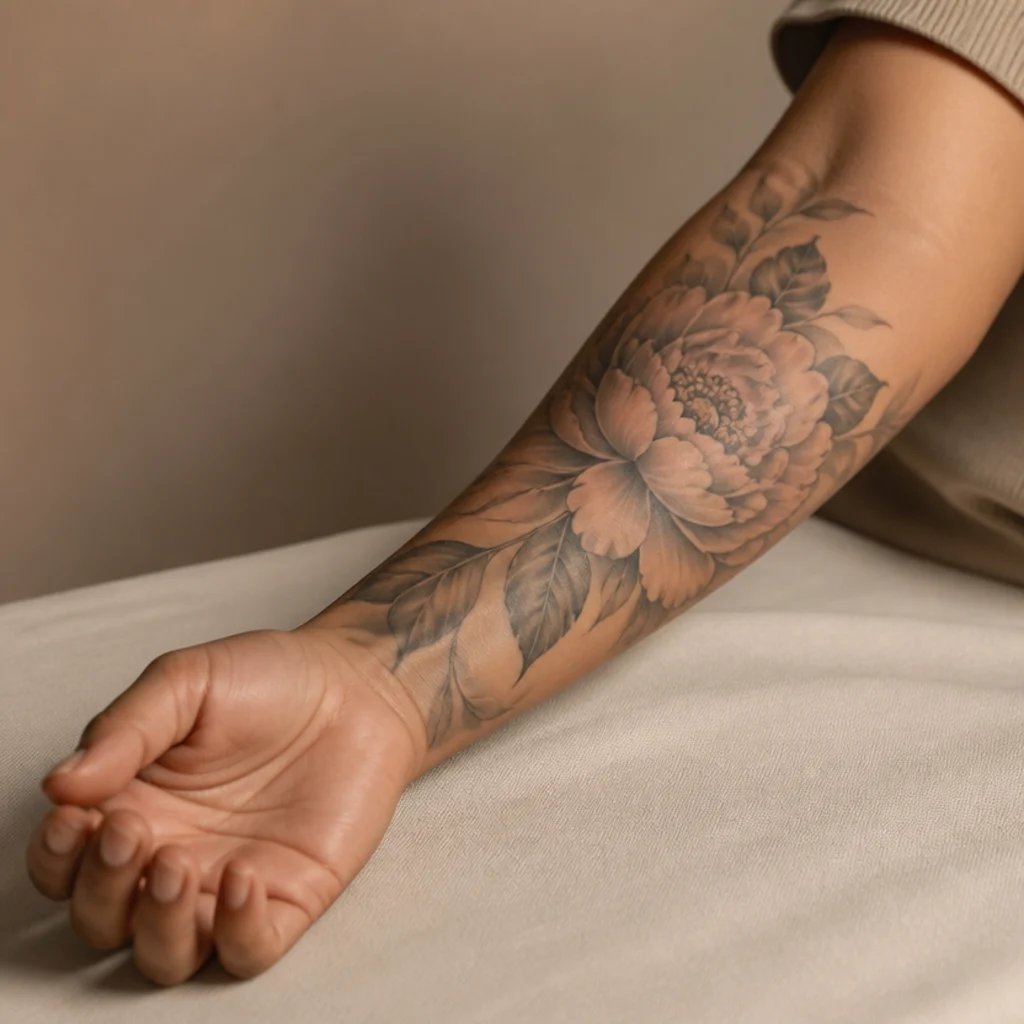
Peonies are a cover-up workhorse. Their ruffled, overlapping petals stack pockets of shadow, and shadow is what buries a busy or dark original. Aim for a two-value approach: a saturated deep-berry or oxblood core in the petal folds, softening to muted dusty rose at the edges so the piece still reads romantic rather than heavy. A clustered bouquet works on medium to large canvases like the inner forearm, outer thigh, or shoulder cap, and it flatters most skin tones since the warm reds sit rich on deep skin and stay dimensional on fair skin. Plan on two sessions — layered petals need real saturation to hold their coverage over time, and rushing the packing is where old ink ghosts back through. Pair it with a few negative-space buds so the composition breathes instead of going solid. Pro tip: have your artist map the darkest values of your original and place a petal fold, not a light gap, directly over each one. Ask your artist for a "high-density peony cluster with deep-value petal cores placed over the heaviest existing ink."
02Blackwork Botanical Sleeve Start
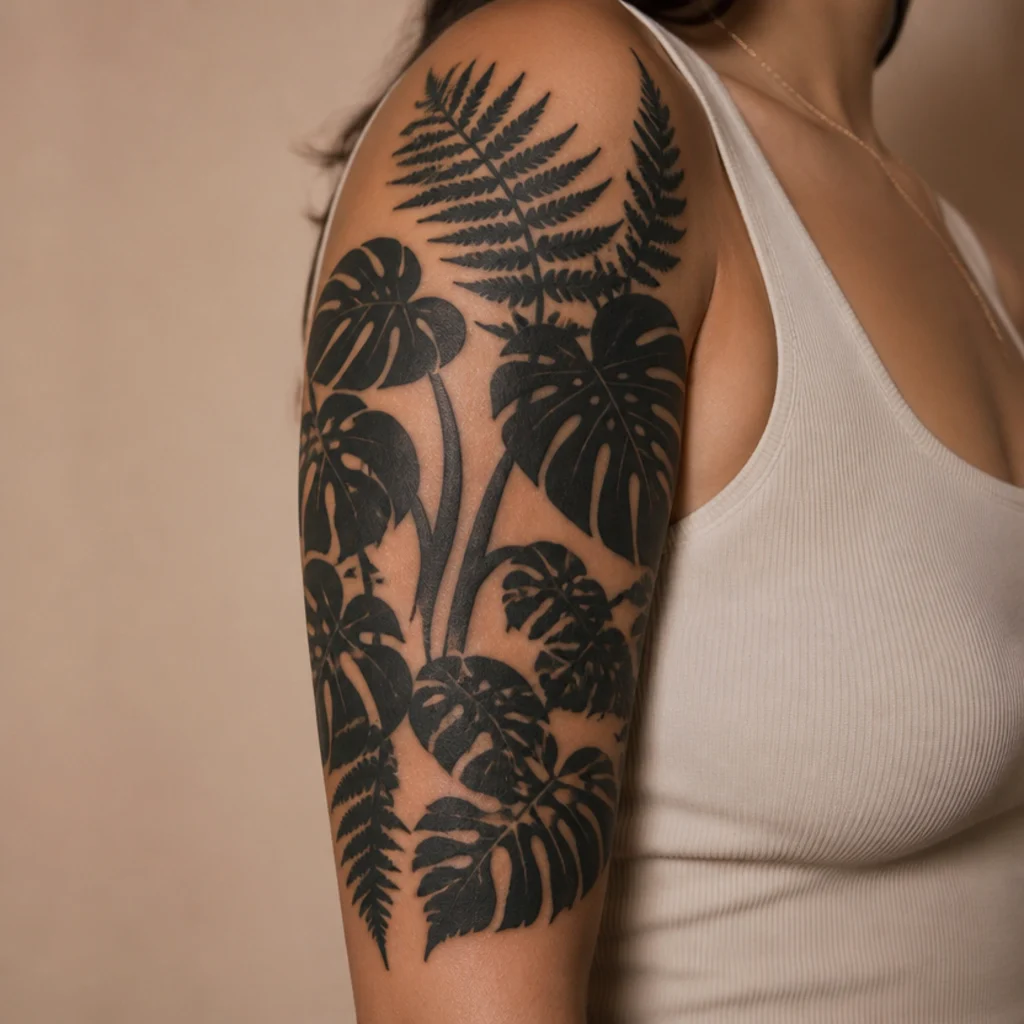
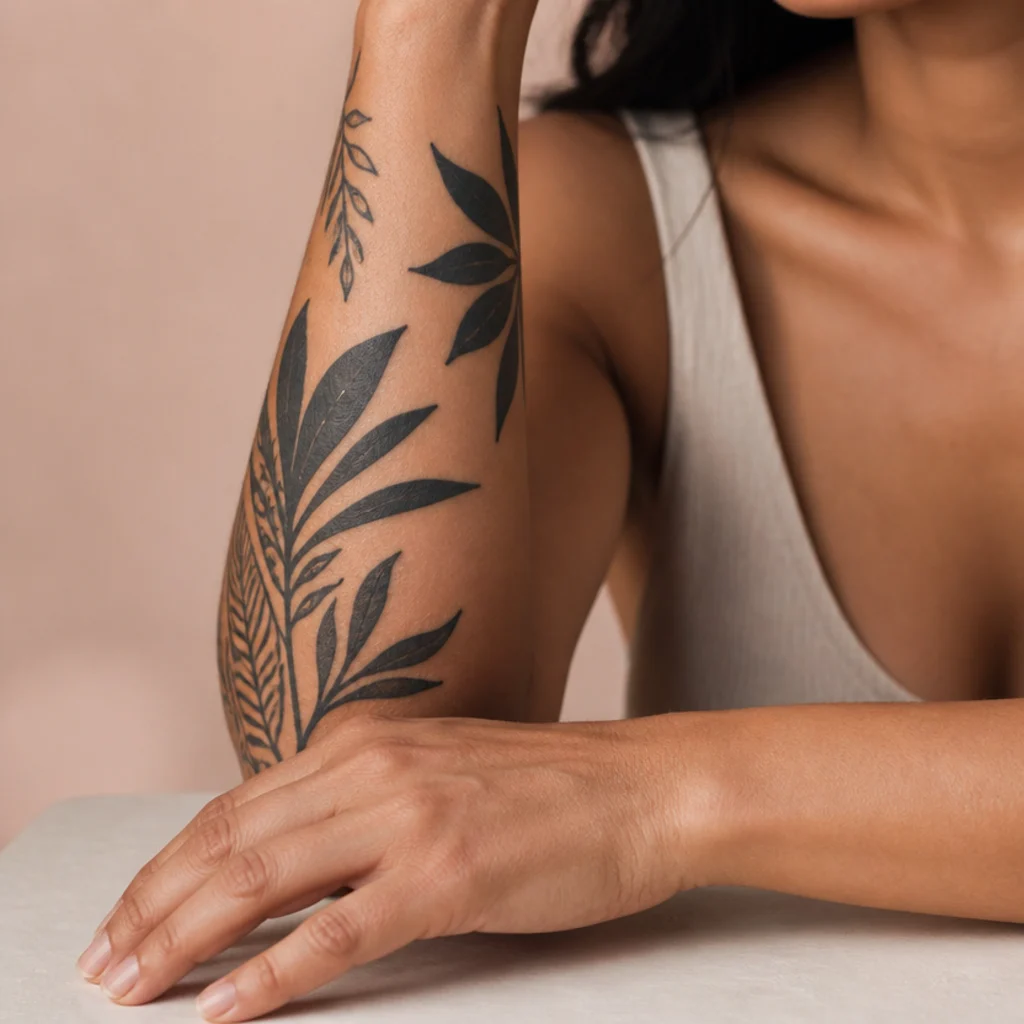
If an original is very dark, blown out, or scarred, the cleanest fix is often to go bolder instead of lighter. Solid black over black is the most forgiving relationship in tattooing. Blackwork botanicals — fern fronds, monstera splits, thick curving stems, seed-pod filler — cover almost anything while reading modern and graphic. This suits anyone open to a bigger, more committed look, and doubles as a strong first panel if you might build toward a half or full sleeve later. The craft is demanding on the artist's end, so vet portfolios specifically for even, patch-free black packing on healed skin. Position matters: heavier leaf masses sit over the old ink, crisp negative-space gaps fall over clean skin, so the design keeps contrast instead of turning into a blob. Once healed, upkeep is low, though large solid-black fields do best with gentle moisturizing and consistent SPF to keep them from fading to a cool grey. Pro tip: ask for a quick spacing on your skin before the stencil is committed. Ask your artist for "bold blackwork foliage engineered to cover, with negative space landing only over clean skin."
03Watercolor Wildflower Wrist
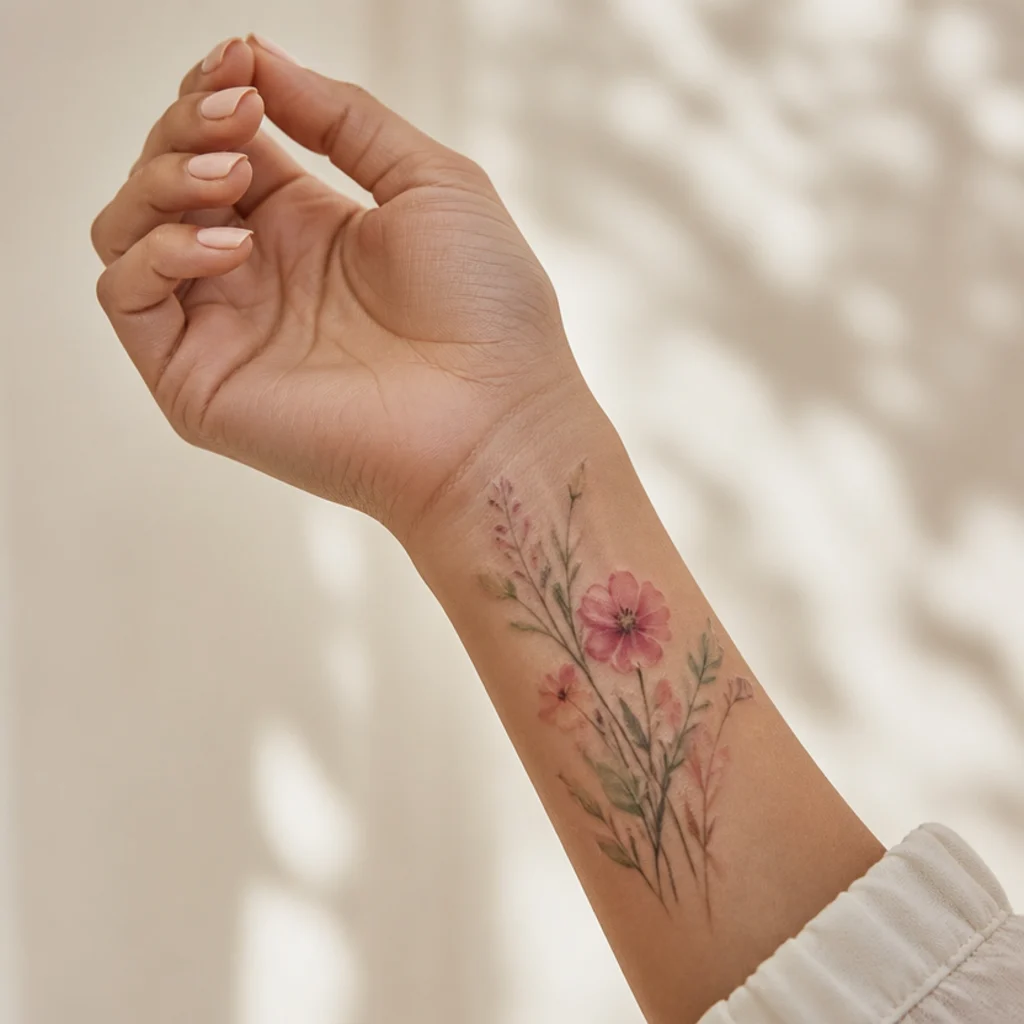
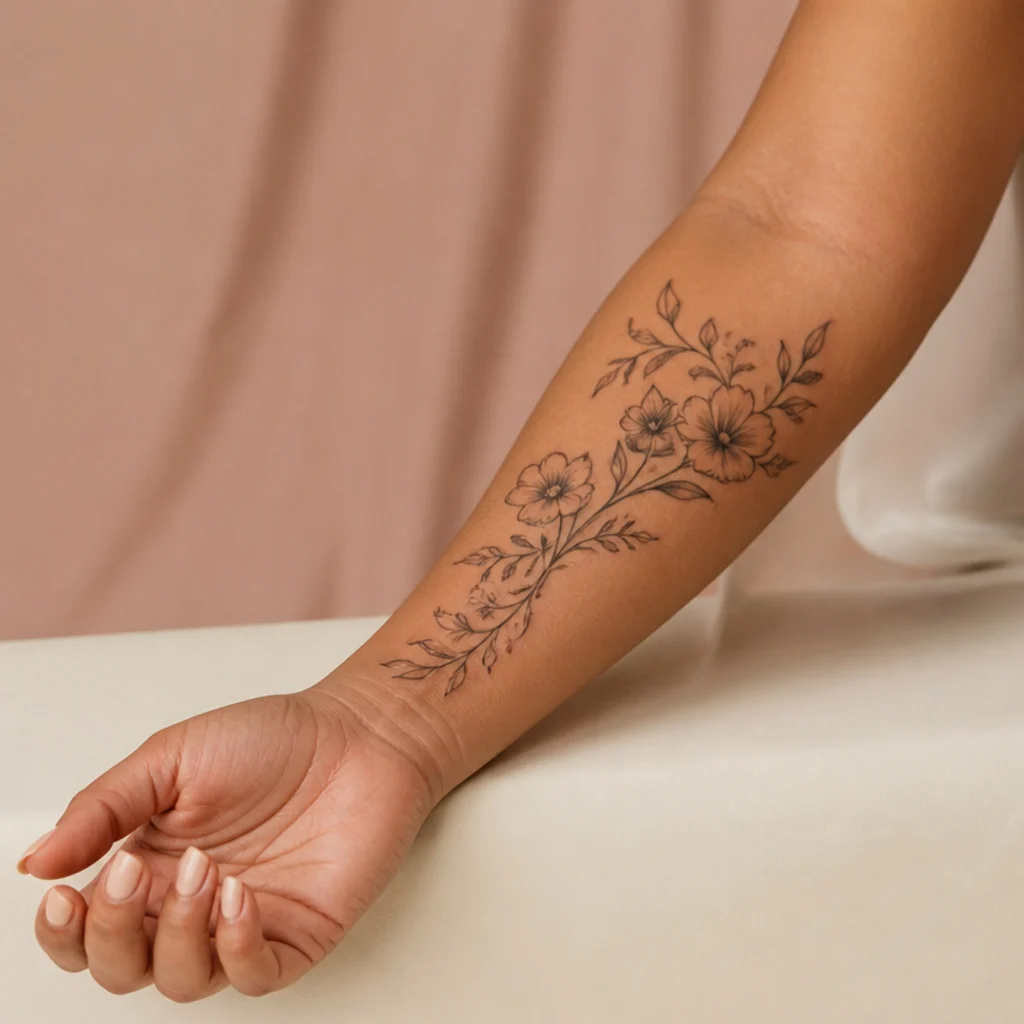
Watercolor looks weightless, but as a cover-up it needs a hidden skeleton doing the real work. A small wildflower spray is one of the gentler wrist cover up tattoos for women, and it only works over a light, fine-lined, or already laser-faded original — never a dense one. The trick is contrast of function: a few saturated, grounded stems and flower centers handle the covering, while the loose blush-and-sage washes distract the eye and soften the edges. Slim inner wrists and the inner forearm suit it best, and it flatters anyone who wants something pretty rather than heavy. Be clear-eyed about longevity: softer pastel pigments and airy washes sit shallower and fade faster than solid black, so budget for a refresh within a couple of years and keep the area out of strong, direct sun. An honest artist may recommend one or two laser sessions first to make the delicacy actually possible. Pro tip: keep the palette warm-cool balanced so it complements your undertone instead of looking muddy. Ask your artist for "watercolor wildflowers with saturated anchor linework strong enough to cover the old design."
04Name Cover-Up Into a Songbird
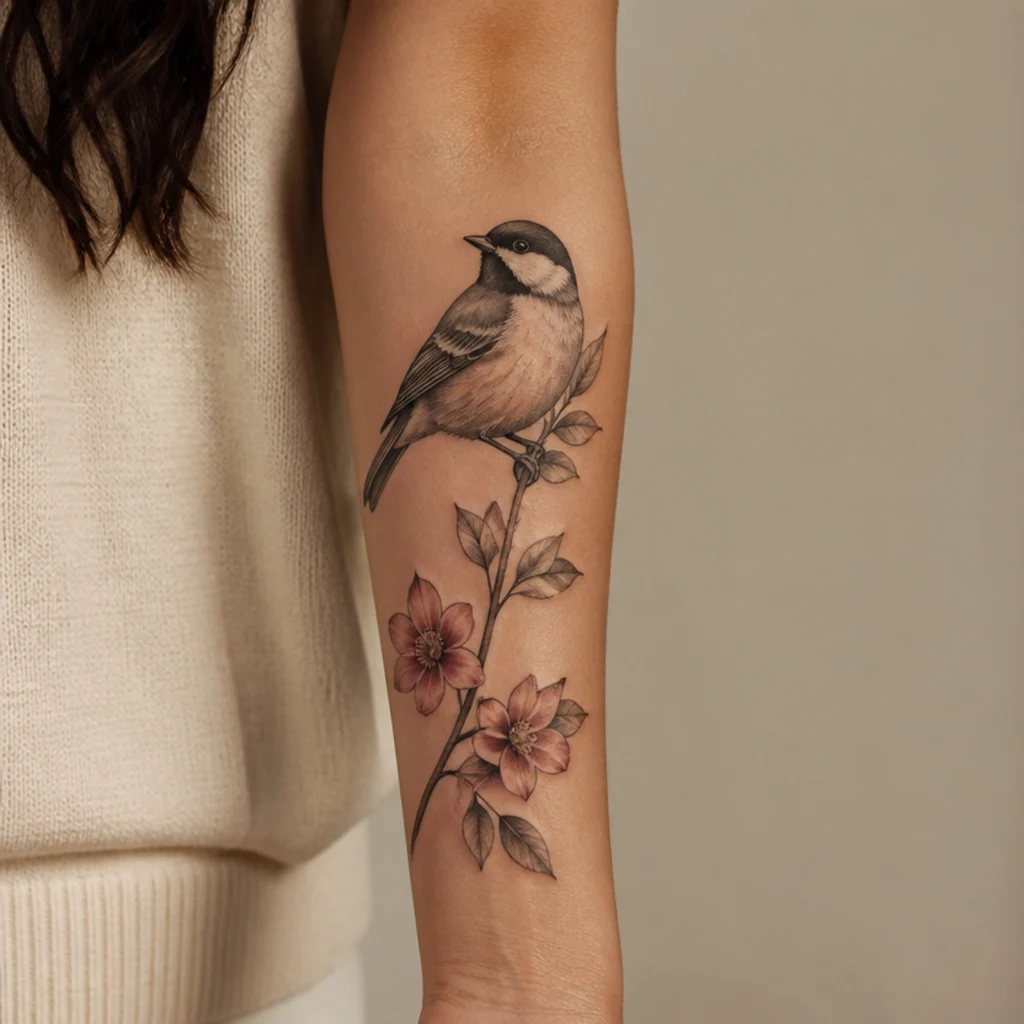
An old name is one of the most common reasons people book a cover-up. A compact perched songbird is an elegant solve because script is linear and low-density, which gives an artist plenty of room to maneuver. The bird's body and folded wing sit over the bulk of the lettering, while a trailing branch and a few leaves soak up the stray ascenders and descenders that stick out past the silhouette. It works on the inner forearm, shoulder blade, calf, or behind the arm, and suits a wide range of ages and styles since it can lean sweet or graphic depending on line weight. Ask for full coverage, not clever incorporation — you don't want a "hidden" letter surfacing as your eye adjusts. Difficulty is moderate, and the main upkeep is protecting the finer feather barbs and beak line from sun so they stay defined instead of blurring into a soft mass. Pro tip: choose a bird posture wider than your longest word so nothing peeks past the wings. Ask your tattoo artist to "cover this name completely and reuse none of the letters."
05Ornamental Mandala
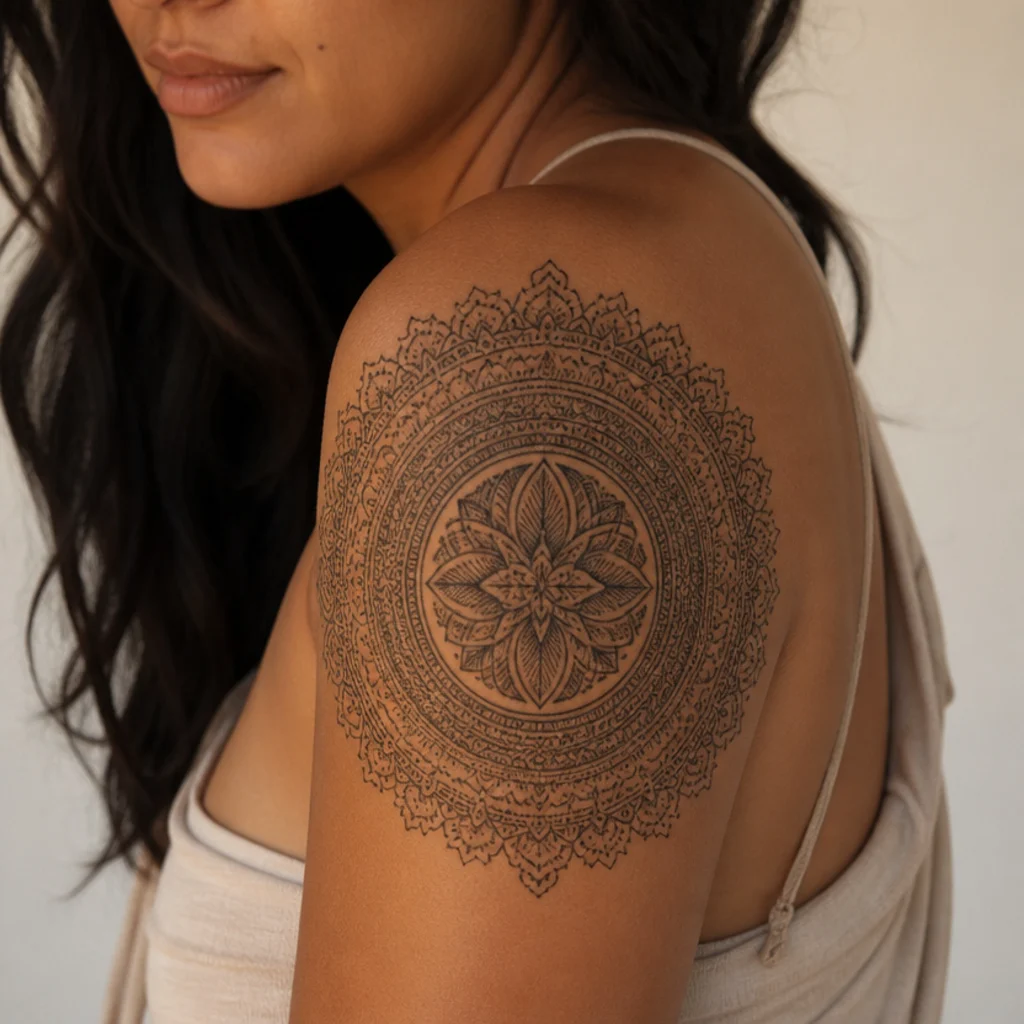
A mandala's dense, symmetrical geometry ranks among the best cover up tattoos for women when the original is round, centered, or emblem-shaped — an old symbol, a small heart, a faded flower. The repeating rings, mandorlas, and stippled fills reorganize whatever sits beneath into deliberate pattern, and symmetry works as a distractor because the eye tracks the whole design rather than any one flaw. It suits the outer shoulder, upper back, sternum, or outer thigh, and flatters people who prefer structure and precision over illustration. Clean radial linework is unforgiving, so choose an artist who specializes in ornamental and dotwork, and ask to see healed geometry, not just fresh photos. Sizing is the quiet key: the mandala has to fully enclose the old shape with a margin, so a heavier ring or a band of dense dotwork can land exactly over the darkest edge. Maintenance is low, though fine stippling softens over the years, so SPF keeps the geometry crisp. Pro tip: ask for the densest detail ring to sit directly on the old outline. Ask your artist for "a mandala sized to fully enclose the existing tattoo with a coverage margin."
Save this to Pinterest to keep your top five directions in one place.
06Dark Rose and Thorn Forearm
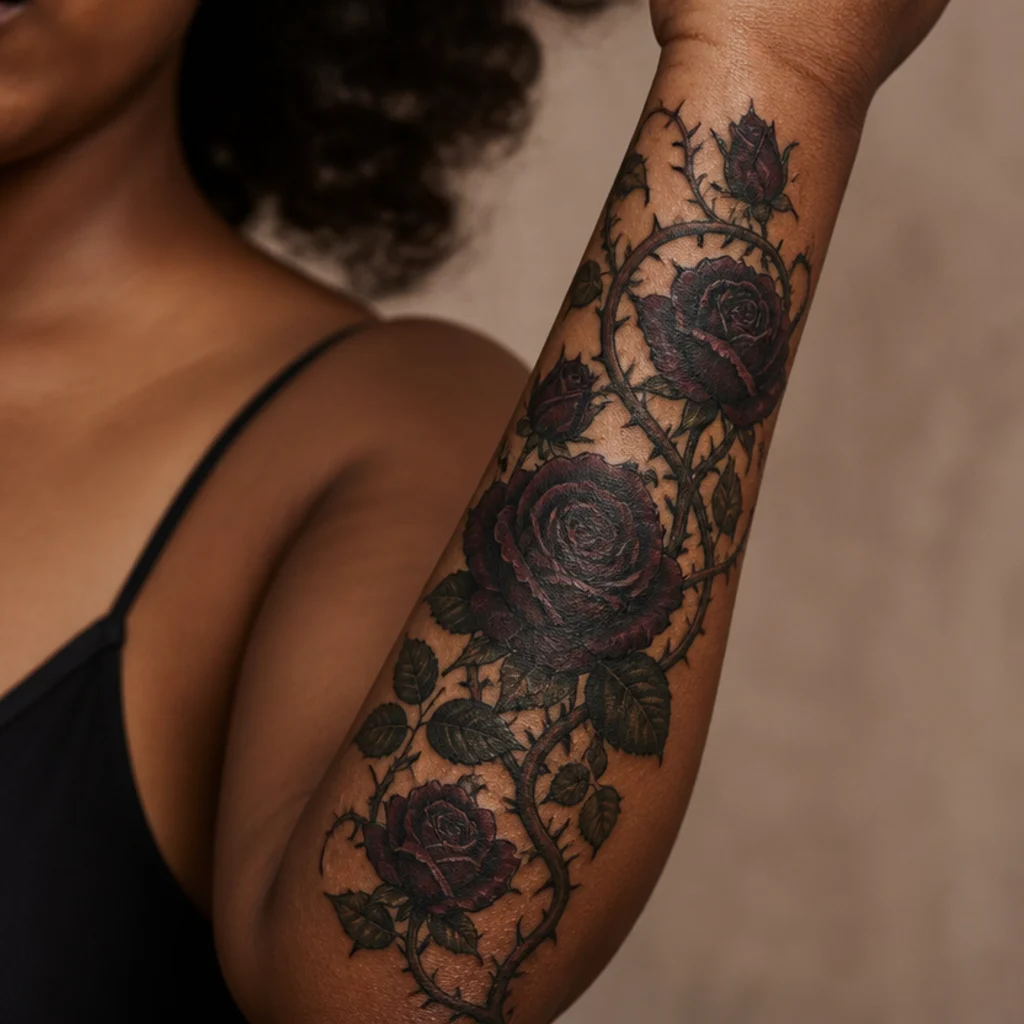
For a moodier register, deep-toned roses with winding thorns are among the most dependable forearm cover up tattoos for women. Saturated berry and near-black petal cores swallow older ink while the stems get routed like a road map over stubborn dark spots. Think oxblood, plum, and charcoal rather than bright pillar-box red — the deeper palette covers better and ages more gracefully as pigment softens. It suits anyone wanting something romantic but not sweet, and it follows the forearm's muscle line well along its length. Expect a couple of sessions to build real saturation, and leave the composition open-ended so you can extend the stems toward the wrist or elbow later if the sleeve bug catches you. Coverage strength here is high, which makes it a smart pick over medium-dark originals. Upkeep is moderate; basic sun care keeps the darks from cooling to grey. Pro tip: have the artist wind a thorned stem directly over the single darkest line of your old piece. Ask your artist for "dark, high-contrast roses arranged to cover, with extendable stems over the heaviest ink."
07Fine-Line Constellation Scatter
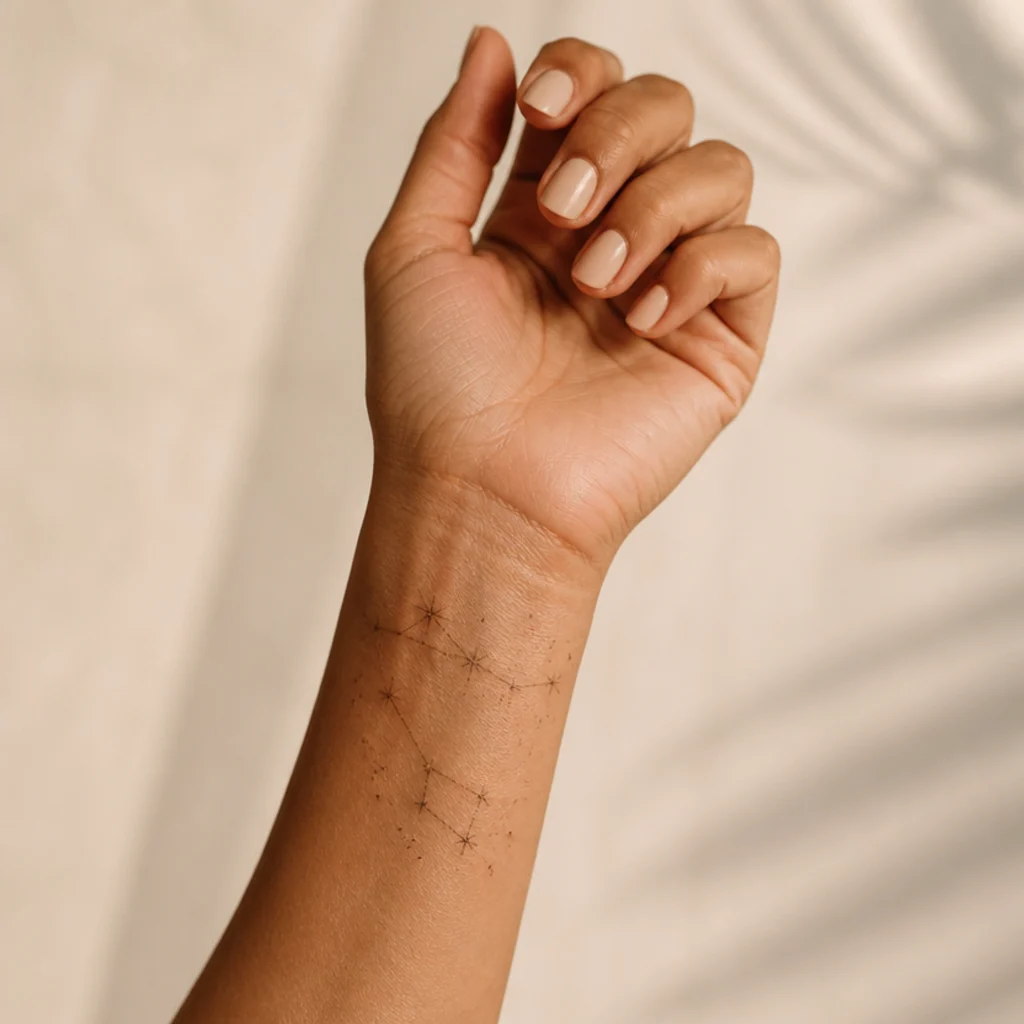
Not every cover-up needs heavy ink, but honesty matters most with this one. A scattered constellation of fine stars and connecting lines covers almost nothing, so it only works over the faintest originals — a nearly gone stick-and-poke, an old freckle-sized symbol, or a piece already lightened by several laser sessions. Over anything darker it just floats on top and the old ink still shows through. Where it does suit, it's quietly clever: the irregular scatter and varied dot sizes break up the eye's search pattern so it never settles on the ghost underneath. It reads best on the inner wrist, ankle, forearm, or behind the ear, and flatters minimalists of any age. A conscientious artist will tell you plainly if you need laser first rather than promise a miracle. Upkeep runs higher than average, since fine lines and small dots blur and spread over the years, so plan for a touch-up. Pro tip: cluster a few slightly larger, denser stars over the most visible remnant. Ask your artist "is my original faint enough for fine-line, or do I need laser sessions first?"
08Moth With Spread Wings
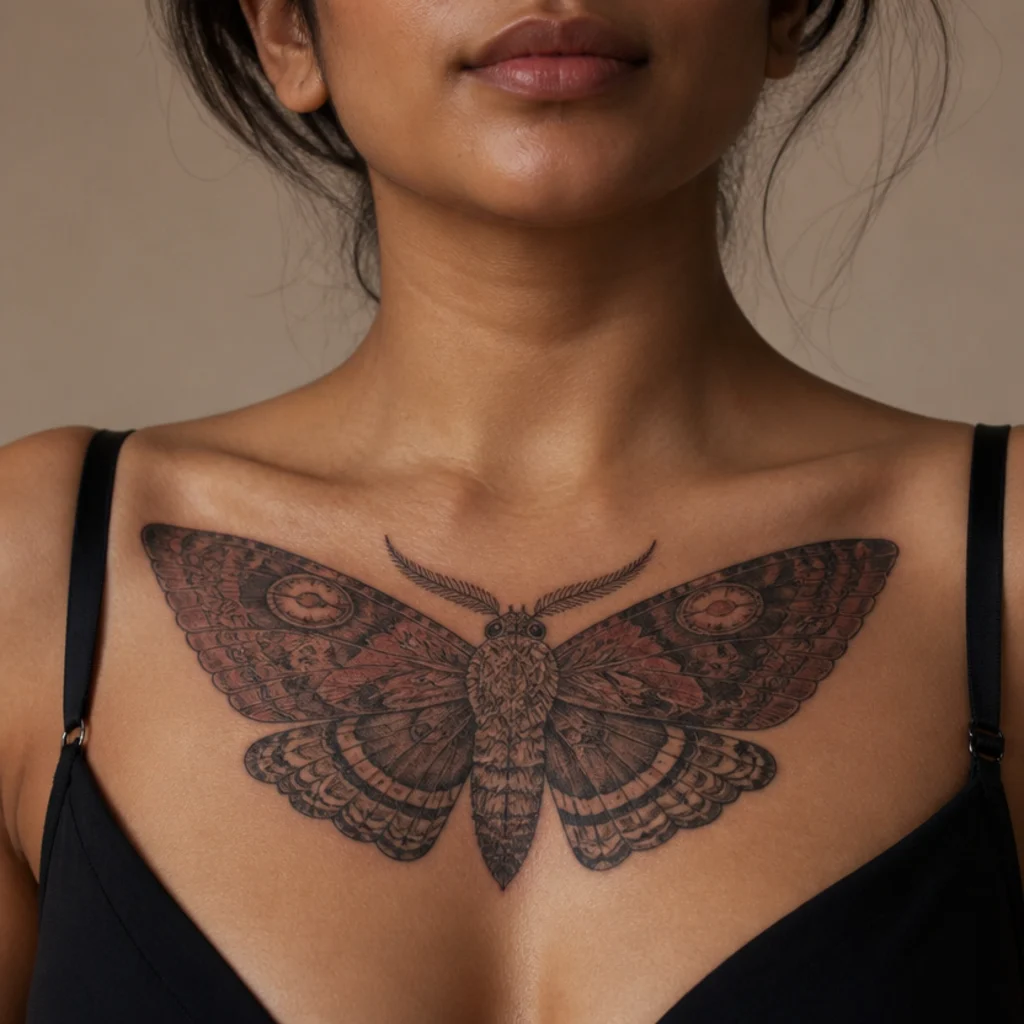
A moth's broad, patterned wings make an efficient cover-up shape — they fill a wide horizontal field with detail, symmetry, and shadow all at once. Spread flat, they work on the sternum, upper back, or back of the forearm, and the intricate wing markings, eyespots, veining, and shaded borders give the artist plenty of room to disguise a boxy, wide, or rectangular original that florals would struggle to enclose neatly. It flatters people who want something detailed with a touch of gothic, and it scales up well for larger canvases. Because the shape is symmetrical, sizing should run a hair generous so the old piece disappears fully under one wing or the body instead of peeking out at a wingtip. Difficulty ranges moderate to high depending on how much realism and micro-detail you want. Maintenance is low to moderate — the fine wing patterning stays crisp longest kept out of direct sun. Pro tip: center the thick furry body over the densest part of your original, since that's the darkest coverage the design offers. Ask your artist for "a spread-wing moth sized to cover, with the body over the heaviest ink."
09Scar Cover-Up Fern Trail
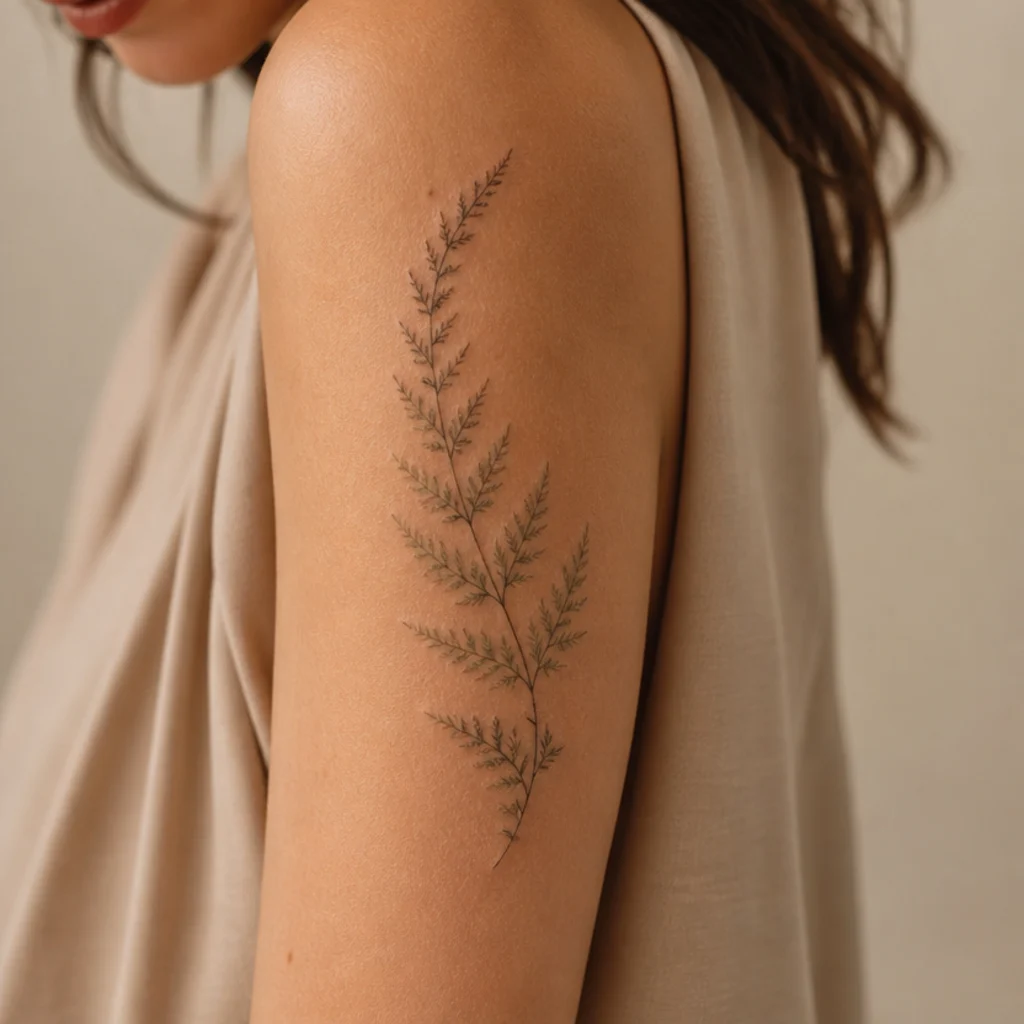
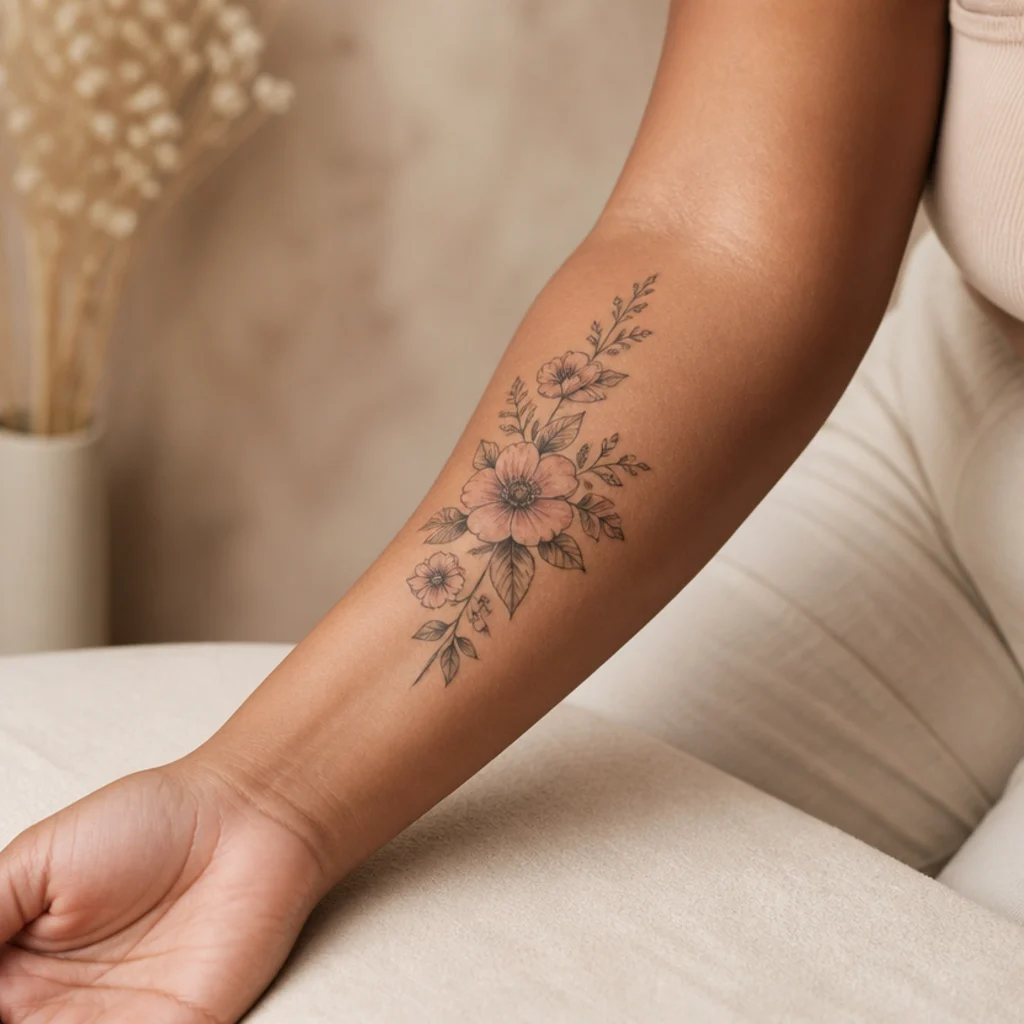
Trailing ferns are a thoughtful option among scar cover up tattoos for women because their organic, irregular branching can follow a scar's line instead of fighting it, softly interrupting the texture rather than drawing a hard shape across it. This is a design idea, not a promise — scar tissue takes ink unpredictably, and a tattoo disguises texture; it does not erase a scar. Any scar has to be fully healed, flat, and stable, often a year or more old, and needs an in-person assessment by a licensed artist who works on scars, since raised, shiny, or still-changing tissue may not be suitable at all. Where it is appropriate, feathery green-black fronds suit linear scars on the arm, along the ribs, or on the thigh, and the loose, asymmetric form hides small inconsistencies in how the tissue holds pigment. Upkeep is moderate with attentive SPF, since scarred skin can fade differently across its length. Pro tip: keep the fronds fine and spaced so healed pigment variation reads as natural detail. Ask your artist to "assess whether this healed scar is ready, then route a fern trail along it."
10Neo-Traditional Snake and Blossom
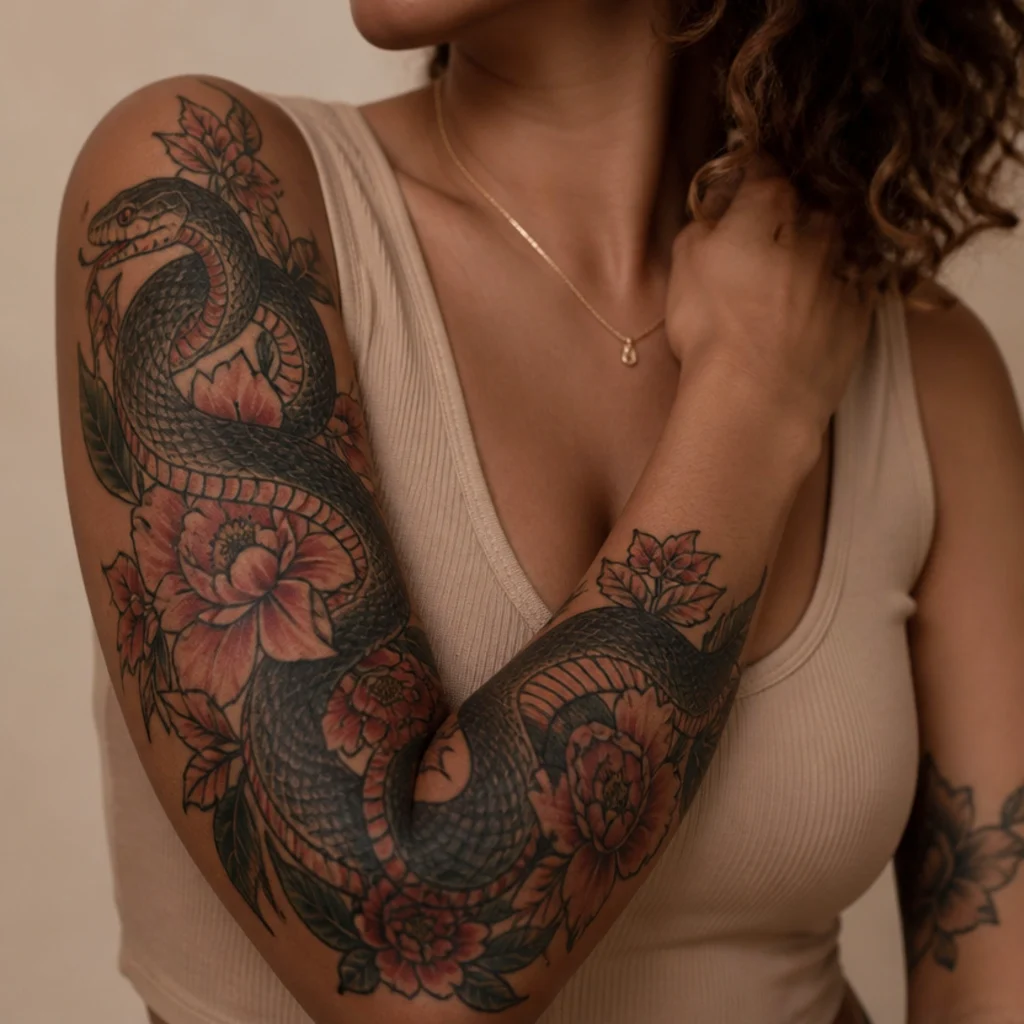
A neo-traditional snake winding through blossoms makes a strong cover-up because the serpent's body is one long, bold, continuous shape you can route directly over the darkest, most stubborn parts of an old tattoo, while the surrounding flowers fill and soften whatever's left. The style's signature bold outlines and saturated, slightly muted palette — dusty rose, sage, charcoal, ochre — cover well and age predictably thanks to the confident line weight. It suits people who like a little edge with their florals, and it flows down the forearm, calf, or outer thigh, following the limb naturally. Since the snake is your primary coverage tool, the composition should be sketched over your specific old shape rather than pulled from generic flash. It reads intentional and current from day one, which matters when you're covering something you'd rather forget. Maintenance is moderate; the strong linework holds up well with standard aftercare and SPF. Pro tip: ask for the body's thickest coil to sit over your heaviest ink and the head to point toward clean skin. Ask your artist for "a neo-traditional snake and florals composed over my existing piece, body over the heaviest ink."
Save this to Pinterest before you compare artists and their cover-up portfolios.
11Small Blackout Band
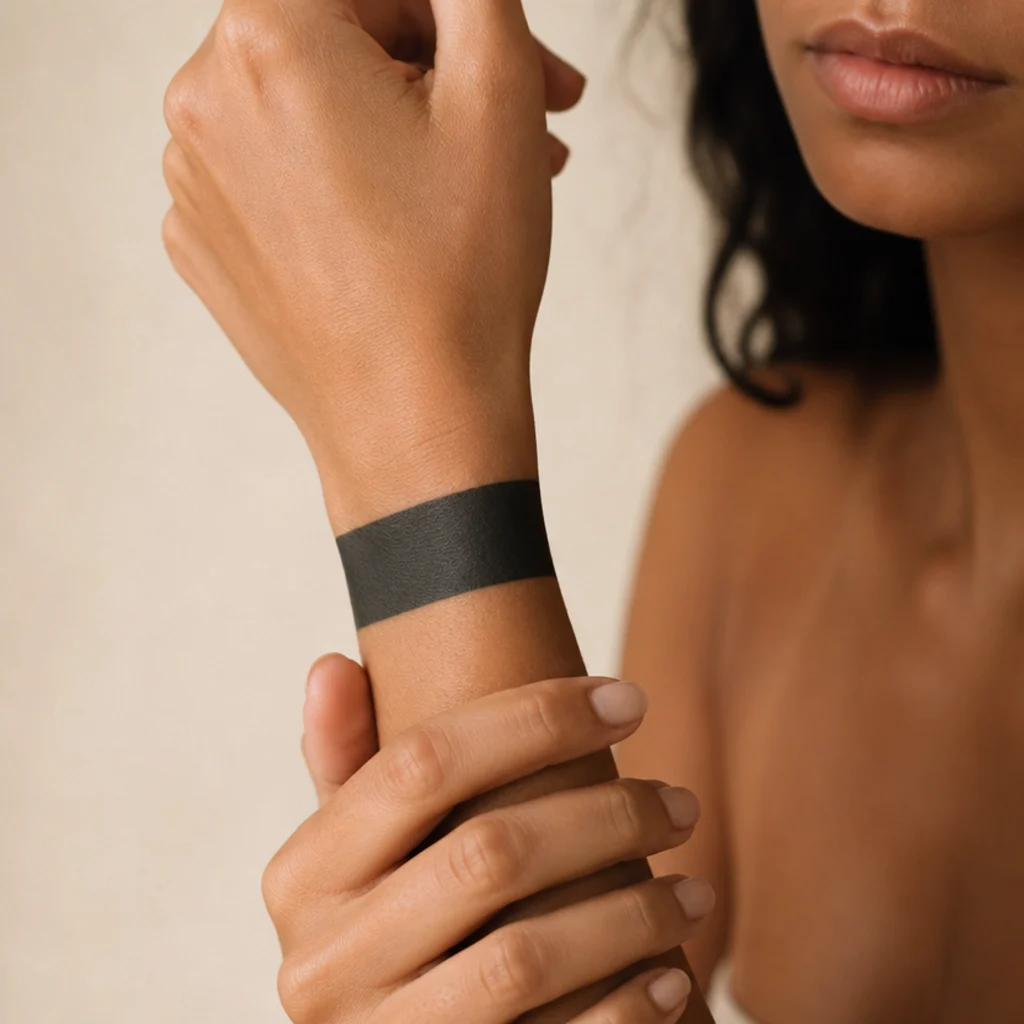
When an old tattoo circles the wrist or ankle, a solid blackout band is the most reliable cover there is, and it doubles as a striking minimalist statement — solid black over anything is the surest coverage in tattooing. It suits stubborn dark originals, old bracelet-style script, or tribal work that softer styles can't hide. Go in clear-eyed, though: this is a serious commitment. Blackout ink is difficult and slow to remove or rework later, and large solid fields demand an artist with proven even-packing technique so you don't heal with patchy or "holiday" gaps. It suits anyone who loves clean, graphic minimalism, and it reads well across all skin tones. Sizing should fully enclose the ring of old ink with a small margin above and below. Upkeep is low once healed, but the band does best with regular moisturizing and diligent SPF to keep the black dense and stop it cooling to grey-blue. Pro tip: ask to see healed blackout photos, not fresh ones, since even saturation only proves itself after healing. Ask your artist for "a solid blackout band sized to fully cover this ring of ink, with even healed saturation."
12Koi and Water Motion
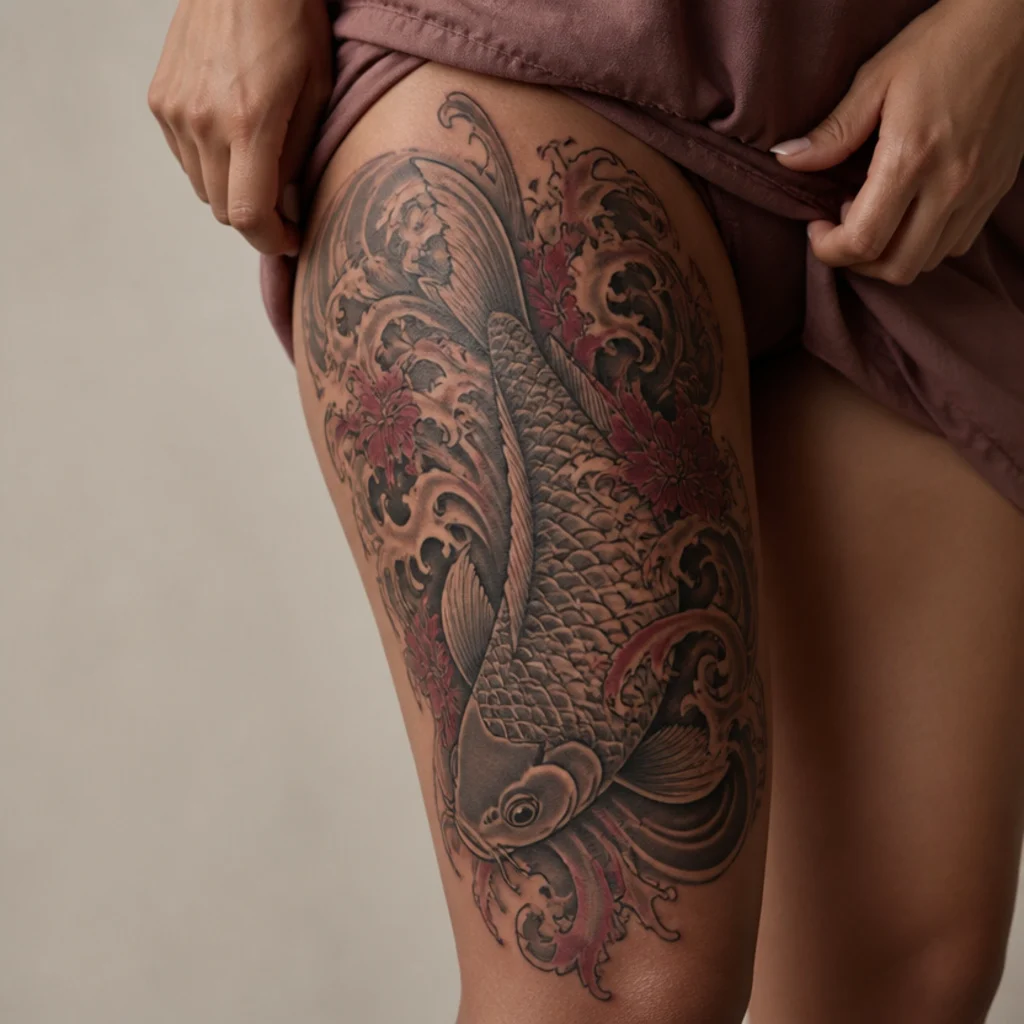
A koi with flowing water is a classic large-scale cover-up. The fish's body plus swirling water, finger waves, and splash droplets create a big, busy field that hides substantial original work without looking like it's hiding anything. The water is the real weapon here: its dark troughs and negative-space crests can be routed anywhere, so the artist steers heavy value straight over the worst of the old piece and lets the light spray fall over clean skin. It suits the outer thigh, calf, or upper arm and flatters anyone comfortable with a larger, dynamic composition that follows the limb's movement. This is advanced, multi-session work, so the coverage payoff is high, but so is the time and cost. Maintenance is moderate; the strong contrast between koi and water ages well with routine SPF. Pro tip: ask the artist to draw the water first as your coverage map, then place the koi — not the other way around. Ask your artist for "a koi and water composition designed to cover, using the water to disguise the darkest sections."
13Lace and Filigree Panel
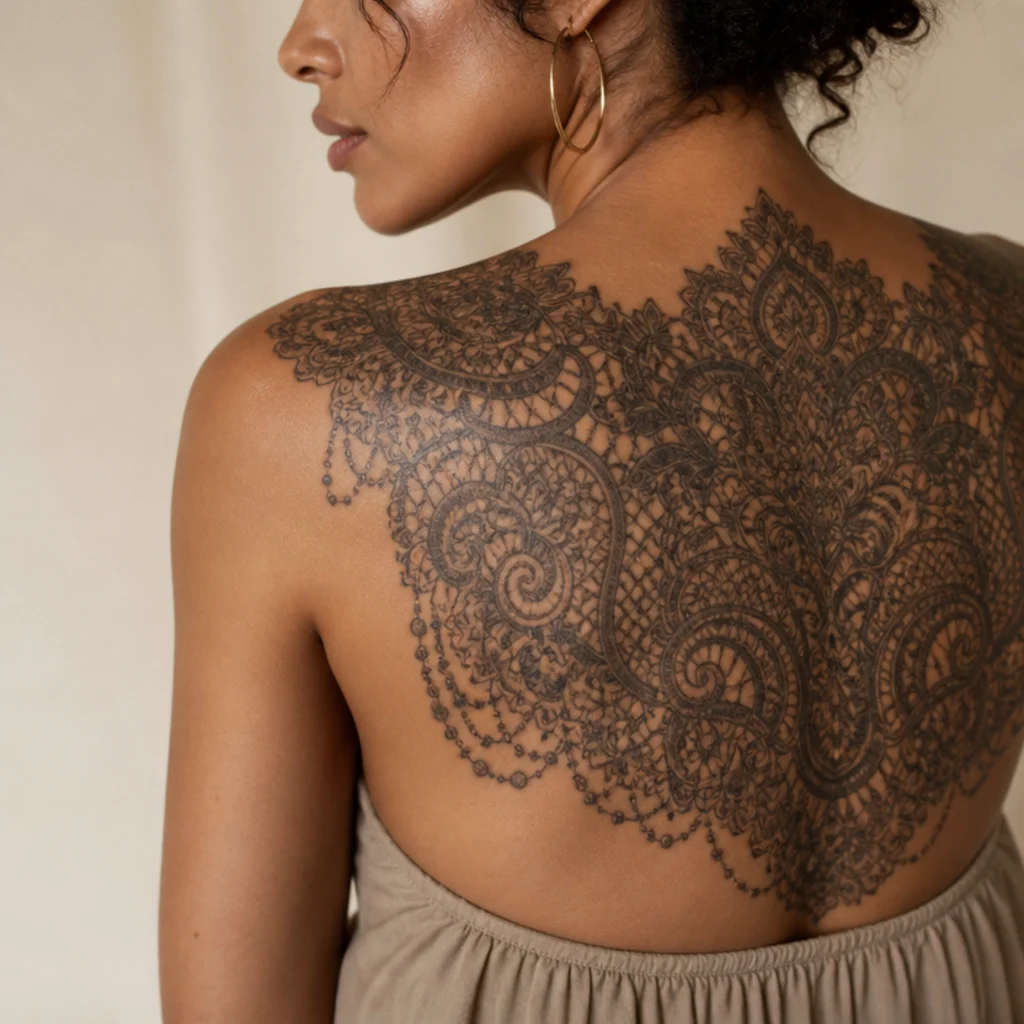
Ornamental lace mimics fabric. Its repeating loops, scallops, and beaded detail form a semi-dense field that can absorb a light-to-mid-tone original well while reading elegant and soft-feminine. Because lace is built from many small connected shapes, an artist can concentrate heavier elements — thicker beading, denser scallops — over the parts of your old tattoo that need the most coverage, then let airier lattice fall across clean skin so the whole thing breathes. It suits the shoulder blade, upper back, hip, or thigh, and drapes especially well over a curved or sloping placement, echoing real fabric. Know its limit: lace has moderate, not maximum, coverage power, so a very dark original may need laser-lightening first or a denser style instead. Difficulty is moderate to high, since symmetry and consistent line weight are exposing. Upkeep is moderate, since very fine filigree softens over the years and rewards a periodic touch-up. Pro tip: ask for a beaded border to trace the exact edge of your old piece. Ask your artist for "an ornamental lace panel arranged to cover, with denser detail over the darkest areas."
14Dotwork Lunar Phases
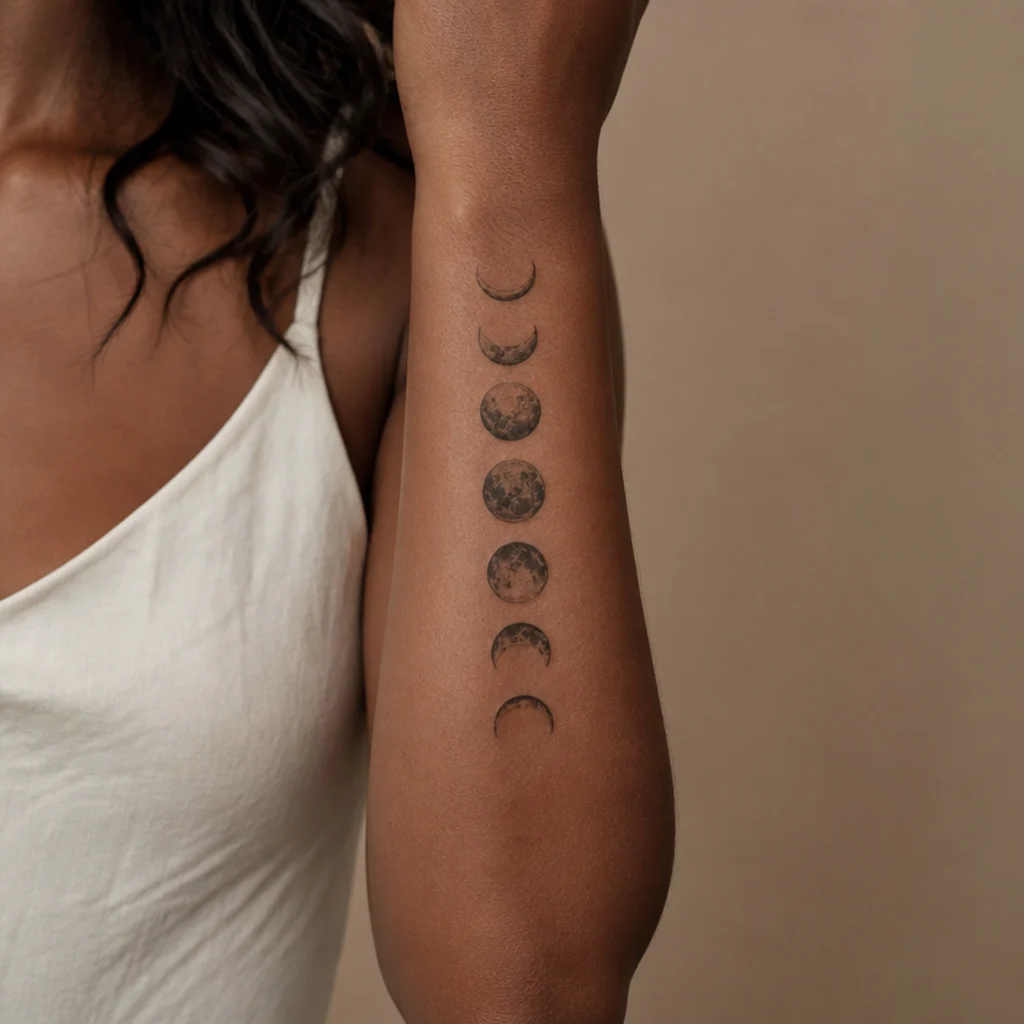
A vertical line of moon phases rendered in dotwork makes a smart cover for a small, linear original — old script, a thin symbol, a single fine-line shape — because you can align the filled and shaded moons directly along the line and drop focused density exactly where the old ink runs. The waxing-to-waning sequence keeps the composition meaningful and understated, while the stippled full moons do the real covering. It suits the inner forearm, spine, back of the arm, or calf, and flatters minimalists who still want some symbolism. Dotwork builds slowly, dot by dot, so bring patience to the session; expect it to take longer than the size suggests. Coverage is moderate and works best over light-to-medium originals — a solid dark line may need a fuller, blacked-in moon instead. Maintenance is moderate, since stippling can lighten and merge over time, so SPF and an occasional touch-up keep the grain defined. Pro tip: place the fullest, densest moon over the darkest segment of the old line. Ask your artist for "dotwork lunar phases positioned along this line of ink, densest phase over the heaviest section."
15Trailing Ivy Around the Wrist
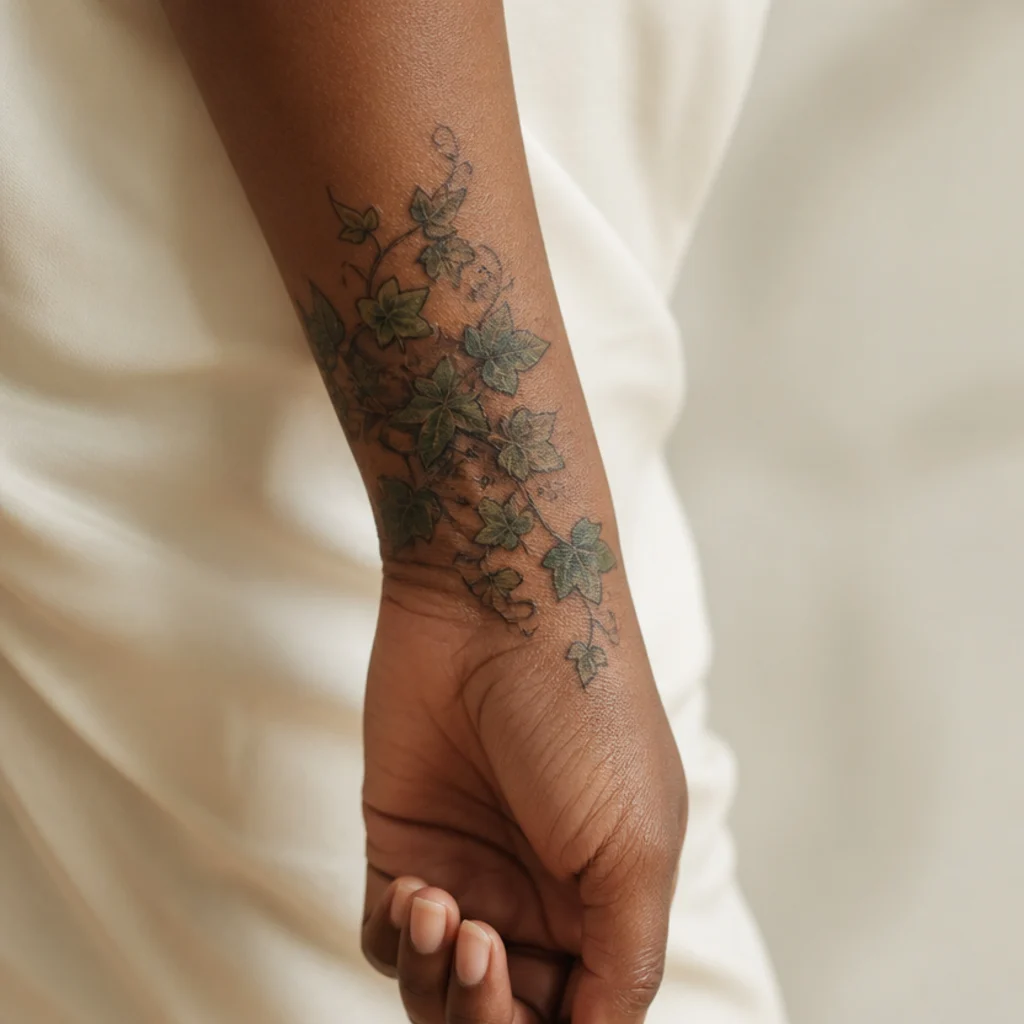
Ivy is one of the more graceful wrist cover up tattoos for women, since its leaves and vines wrap naturally around a curved, three-dimensional surface. The artist can cluster fuller foliage over the parts of an old piece that need hiding while letting the vine thin out across clean skin. Its broader leaf shapes give it better coverage power than most delicate wrist options, which makes it a good middle ground when you want something pretty that still does real work. It suits slim wrists, layers well with bracelets and a watch, and reads elegant in a muted sage-and-charcoal palette that stays flattering across skin tones. Wrists get constant sun, friction, and wear, so this placement fades faster than most — diligent SPF and gentle care keep the greens and darks true. Coverage is moderate, so a very dark original may still need laser first. Pro tip: ask for a tight leaf cluster, not a thin vine, over the densest old ink. Ask your artist for "a trailing ivy wrap with leaves concentrated over the old ink and the vine thinning over clean skin."
Save this to Pinterest so your consultation notes stay organized.
16Bold Butterfly Redraw
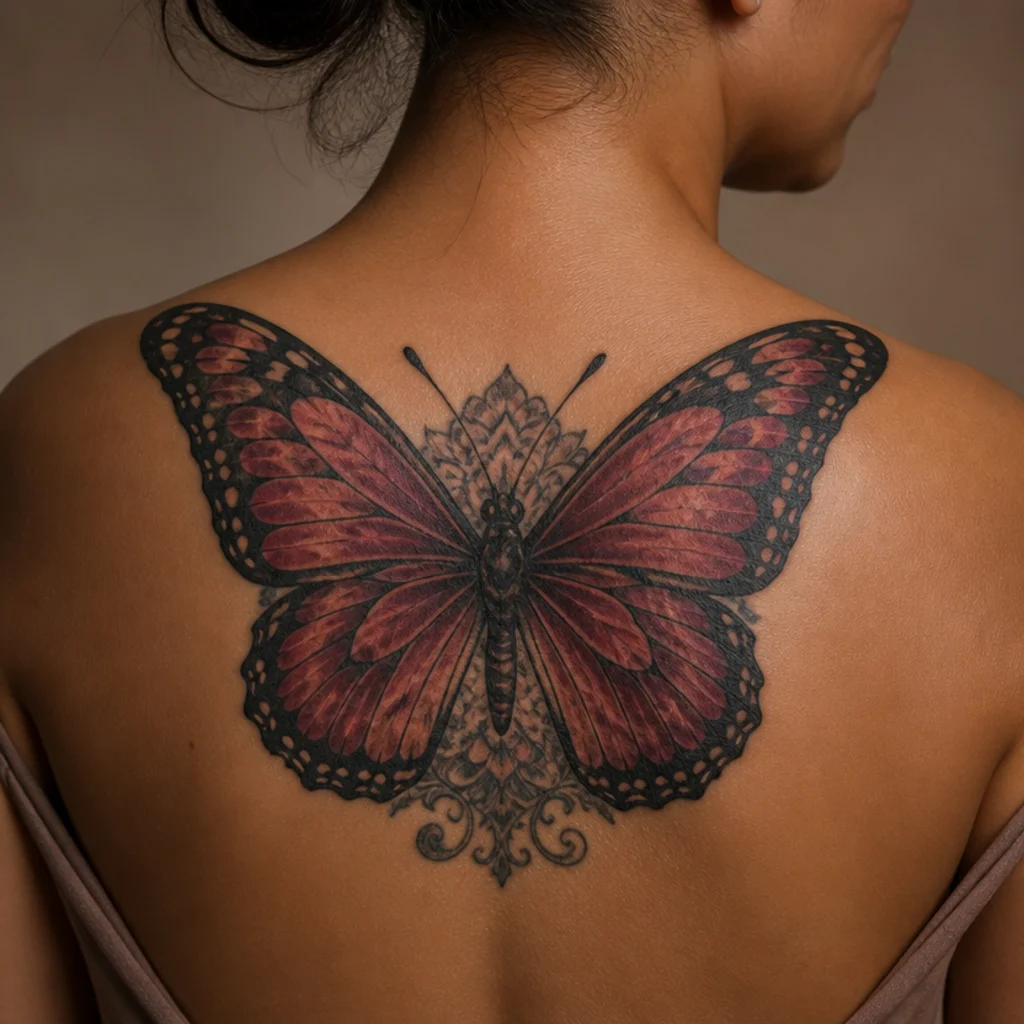
A butterfly is a cover-up staple, but the trick is scaling up and saturating rather than staying dainty. Larger wings with rich, packed color and strong border markings cover far more than a delicate outline, and the natural symmetry lets you center the body and wing mass right over the old piece so it disappears underneath. It suits the upper back, shoulder blade, hip, or outer thigh, and flatters anyone who wants a recognizable, feminine motif with real coverage power. The palette can flex to your taste and skin — deep jewel tones and dark borders cover better and pop on deeper skin, while a warmer muted range keeps it soft on fair skin. Sizing generously is the whole game here; a butterfly that just barely fits the old shape will let it peek at the wing edges. Difficulty is moderate. Maintenance is moderate; vivid wing color stays richest with consistent SPF and maybe a touch-up down the line. Pro tip: put the dark forewing borders over your heaviest ink, since that's where the design is densest. Ask your artist for "a bold, high-saturation butterfly sized up to fully cover the existing tattoo."
17Abstract Brushstroke Blackwork
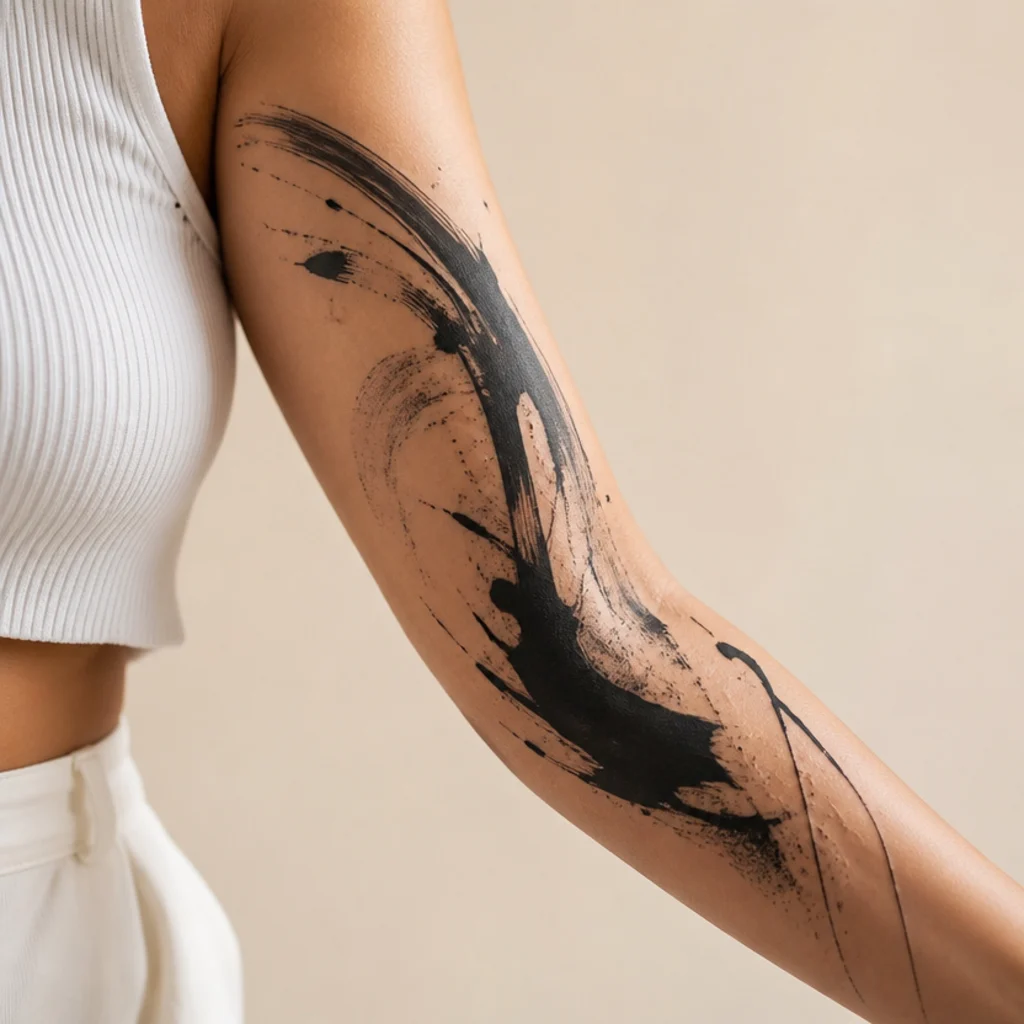
For a modern, art-forward cover-up, abstract brushstroke blackwork uses gestural sweeps, dry-brush texture, and splatter to bury an old design under something that looks deliberately contemporary rather than corrective. Because it's built from solid and textured black, it ranks among the most reliable black cover up tattoos for women for stubborn dark originals. The loose, non-representational language means there's no "correct" shape the old ink can distort — the artist routes solid black over the heaviest areas and lets textured, sparser strokes fall over clean skin. It suits an artsy, minimalist-meets-editorial taste and works on the forearm, calf, shoulder, or upper arm. Coverage power is high, though a great outcome leans entirely on the artist's compositional eye, so choose someone with abstract blackwork healed in their portfolio, not just clean linework. Upkeep is low, and solid black stays darkest when moisturized and protected from sun. Pro tip: ask for solid, opaque strokes only over the old ink, and keep dry-brush texture on bare skin. Ask your artist for "abstract blackwork brushstrokes composed to cover, solid black over the old ink."
18Name Into a Ribbon Banner
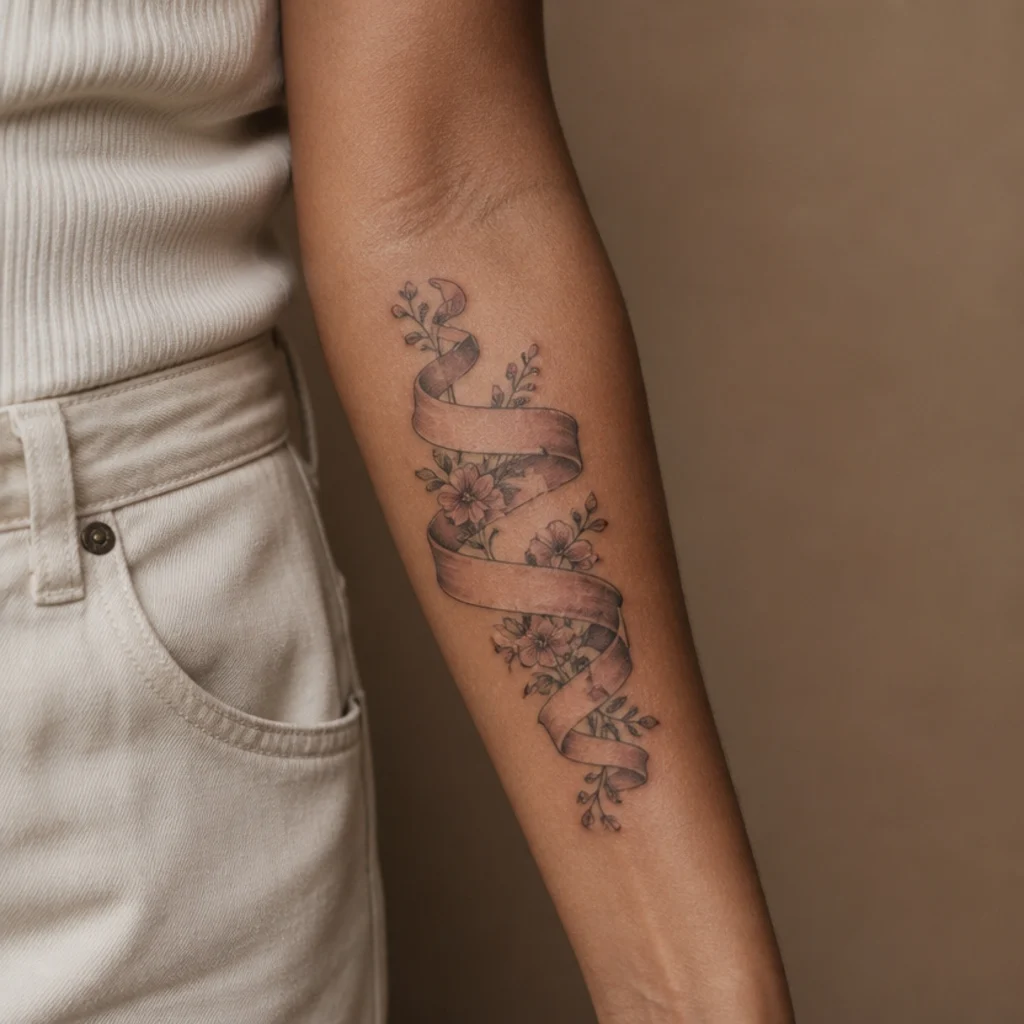
Turning an unwanted name into a ribbon or banner is a clever redirect. The flowing fabric shape naturally sits over horizontal lettering, and the folds and shaded underside of the ribbon add the density that buries the old script. You can leave the banner blank for a clean graphic look, add a new word or date, or fill it with small blooms and leaves for softness. Among name cover up tattoos for women, this one keeps things classic and legible rather than heavy, and it suits the forearm, collarbone, calf, or ankle. Be explicit that you want the existing name fully covered and replaced, not reworked letter by letter, so the artist designs the ribbon's shaded folds to land over the old ascenders and descenders. Difficulty is moderate. Upkeep is moderate; if you add fresh script, that fine lettering benefits from SPF to stay sharp and readable over time. Pro tip: position a fold or ribbon twist over the tallest letters of the old name, where coverage is hardest. Ask your artist to "cover this name entirely with a shaded ribbon banner and reuse none of the letters."
19Hummingbird and Trumpet Flowers
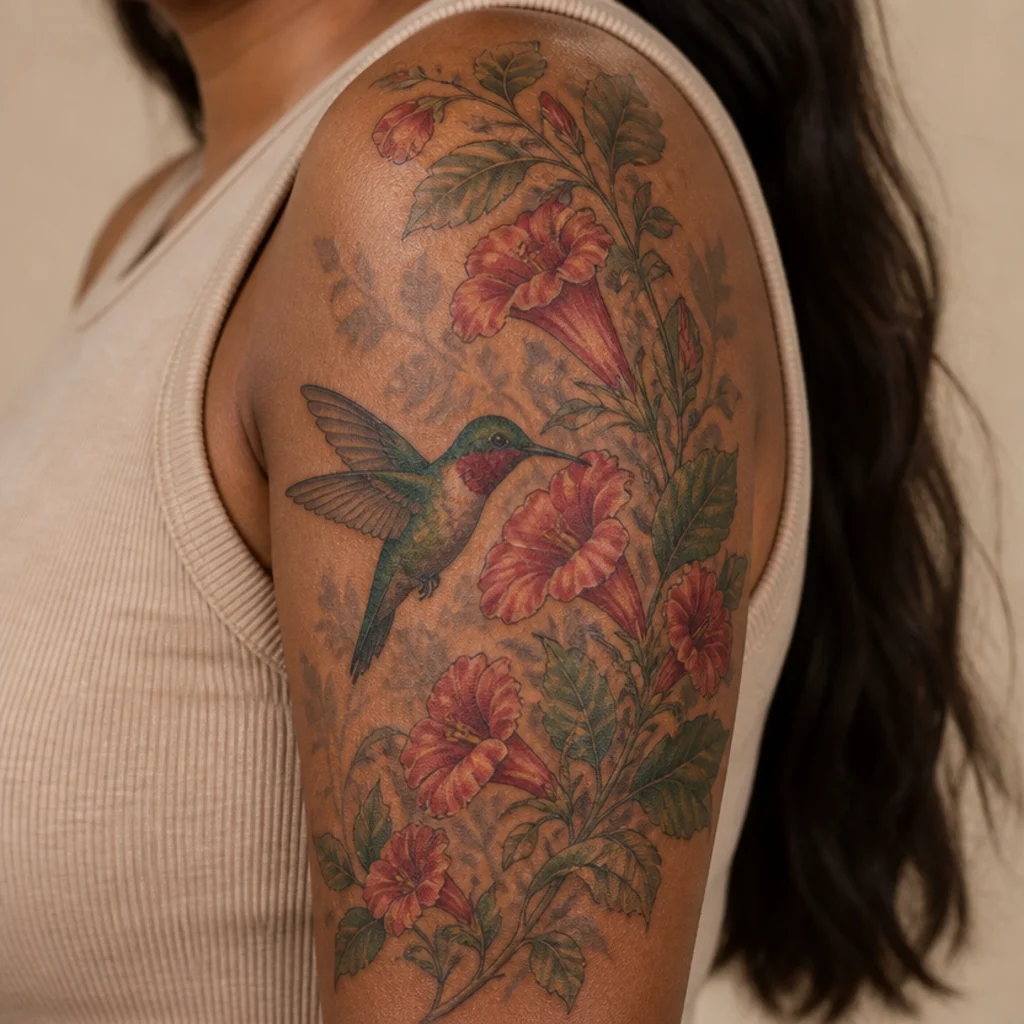
A hummingbird paired with trumpet flowers gives you movement and coverage in one composition. The bird's body and outstretched wings, plus the flared, deep-throated blooms, occupy a generous area, and the whole scene can be shaped around the outline of your old tattoo. The flowers do the real covering — their dark trumpet throats and layered petals absorb heavy ink — while the hummingbird adds life and draws the eye upward and away. It suits the outer upper arm, shoulder, or thigh, and flatters anyone who wants color and energy without committing to a full sleeve. The palette flexes to your skin: warm corals, magentas, and greens read vividly across tones, and can be muted down for a softer look. Difficulty runs moderate to high for realistic feather barbs and petal shading. Maintenance is moderate, and the brighter hues hold longest with attentive SPF. Pro tip: cluster the flower heads, not the bird, over your densest old ink, since petals cover better than fine feathers. Ask your artist for "a hummingbird and trumpet flowers arranged to cover, blooms over the heaviest ink."
20Full Forearm Garden Wrap
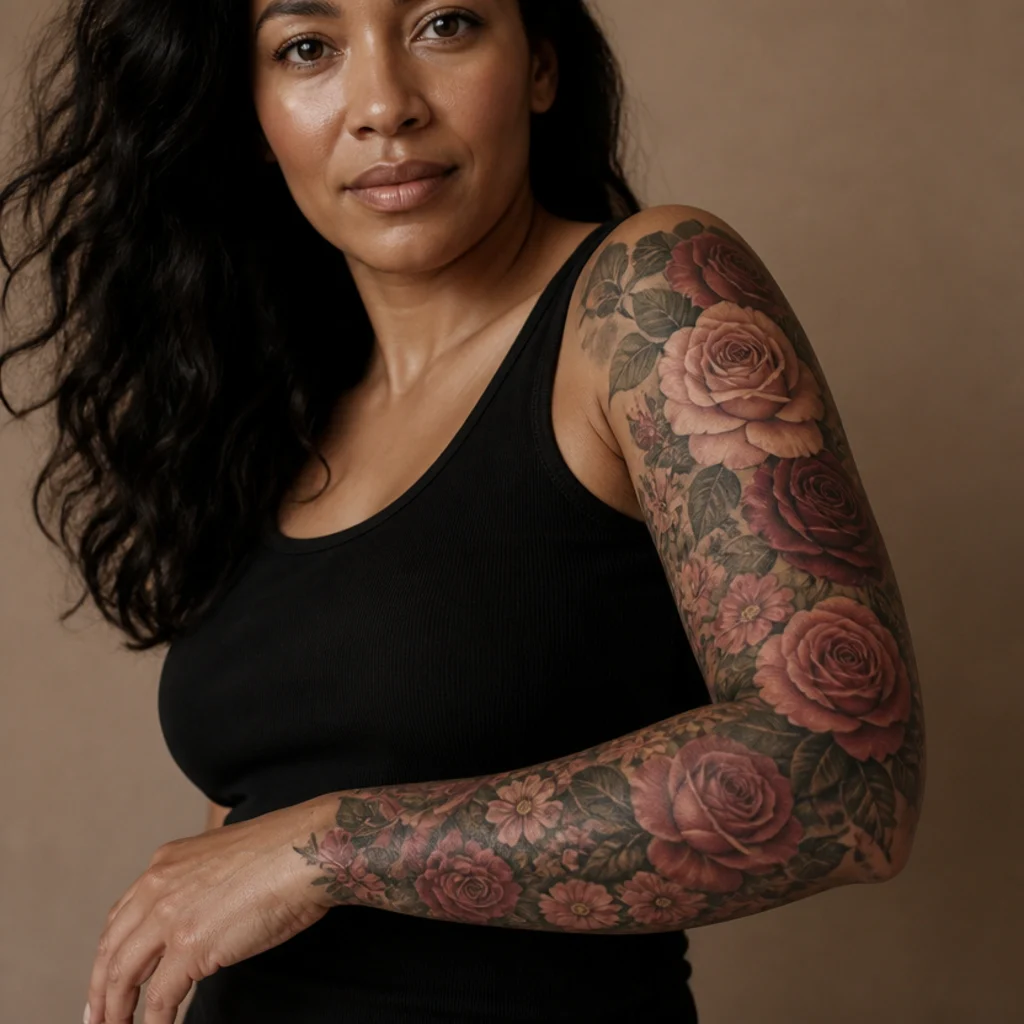
When an old tattoo is large, or you've got several scattered pieces down the arm, a full garden wrap — roses, buds, leaves, and filler flowers flowing continuously around the forearm — is the most complete solution there is. The sheer density and variety let the artist cover everything while composing one cohesive, flowing piece instead of a patchwork of fixes, and mixed bloom sizes mean there's always a large, dark-cored flower to place over any stubborn spot. This is the most ambitious of these forearm cover up tattoos for women, built over several sessions, and it suits anyone ready for a statement piece who's willing to invest the time and budget. A muted rose-and-berry palette with deep green foliage covers reliably and ages gracefully across skin tones. Because it wraps a high-movement, sun-exposed area, upkeep runs moderate to higher, with SPF and eventual touch-ups keeping the garden vivid. Pro tip: have the artist plan the whole wrap as one master design first, even if it's tattooed in stages, so the composition flows instead of colliding. Ask your artist for "a full forearm floral wrap designed to cover multiple old tattoos in one cohesive composition."
Pro Tips from the Editor
- Photograph the original in three lights. Bring daylight, indoor, and flash photos to your consultation. Artists judge coverage by the darkest value they can see, and lighting hides or exaggerates it.
- Ask about laser as a tool, not a failure. Two or three lightening sessions can be the difference between the heavy blackout you didn't want and the soft floral you did — it's a means, not a last resort.
- Vet for healed cover-ups specifically. Fresh photos look great on anyone. Ask to see healed before-and-after cover-ups, since that's the only proof old ink stayed buried.
- Bigger and darker is a feature. Fighting the "I want it small and delicate" instinct is often the whole job; the design that fully hides your original is usually a size up and a shade deeper than your first idea.
- Route heavy values deliberately. The best cover-ups place a petal fold, coil, wing body, or solid stroke over each dark spot. Ask your artist to walk you through their coverage map before the stencil goes on.
- Budget for the touch-up now. Cover-ups are packed hard and often need one healing touch-up. Assume it, schedule it, and price it in rather than treating it as a surprise.
- Protect the investment with SPF. Sun is the top enemy of saturation and crisp detail — a healed cover-up that lives under sunscreen stays sharp years longer.
How to Choose / Get the Look
Choose by what you're covering, not just by what you like. Match the new shape to the old one. Long, linear originals like names and script suit snakes, banners, vines, and lunar phases; round or centered emblems suit mandalas and butterflies; wide, boxy pieces suit moths and koi; scattered multiples across a limb call for a garden wrap. Then match density to darkness: the darker your original, the more you should lean toward blackwork, layered florals with deep cores, or a blackout, and away from fine-line, pastel watercolor, and airy lace.
| Direction | Coverage power | Difficulty | Best for |
|---|---|---|---|
| Blackwork / blackout band | Highest | Moderate to high | Very dark, dense, or stubborn originals |
| Layered florals / garden wrap | High | High | Medium to dark ink; larger canvases |
| Neo-traditional snake / koi | High | Advanced | Long or large originals; bold taste |
| Mandala / lace / moth | Moderate to high | Moderate to high | Round, wide, or mid-tone originals |
| Fine-line / watercolor / constellation | Low | Moderate | Very faint or already laser-faded ink only |
Prep and expectations. Photograph the original in good light, save two or three directions from this guide, and book a consultation rather than a same-day appointment for anything but the faintest cover-up. Ask directly what the artist can fully hide as-is versus what would benefit from laser first, and prioritize artists whose portfolios show real, healed cover-up before-and-afters, not just fresh work.
Longevity and when to see a pro. Plan for something larger and darker than the original, expect at least one healing touch-up, and protect the result with diligent SPF and moisturizing for solid-black areas. Above all, confirm design, sizing, placement, coverage feasibility, and healing in person with a licensed tattoo artist. No design can be promised to fully hide an existing tattoo or scar sight unseen, and scarred skin in particular must be fully healed, flat, and assessed by a professional before any work begins.
Frequently Asked Questions
Can any old tattoo be covered?
Most can, but the darker and denser your original, the more it limits your options — and the larger and darker your new design has to be. Very heavy, saturated, or blown-out pieces may need laser-lightening first to open up softer styles. An in-person consultation is the only reliable way to know what yours will allow; photos and general rules can't replace an artist assessing your specific skin and ink.
Do cover up tattoos fully hide the old tattoo?
A well-executed cover-up disguises the original so it's not visible to a casual eye, but it doesn't remove or erase it — the old pigment is still in your skin under the new work. In some lights, or as pigment settles over years, faint ghosting can occasionally surface, which is why density, saturation, and an experienced artist matter so much. No one should promise complete, permanent invisibility sight unseen.
Are cover-up tattoos more expensive than regular tattoos?
Usually, yes. They tend to run larger, need heavier saturation, and often take multiple sessions, all of which add chair time and cost. If laser-lightening gets recommended first, factor that in as a separate expense over several months. Costs vary widely by artist, region, and size, so ask for a full estimate at your consultation rather than expecting a fixed rate.
Do I need laser removal before a cover-up?
Not always. Many cover-ups work over the original as-is, especially bold blackwork and dense florals. But a few laser sessions can lighten a dark piece enough to allow softer colors, fine-line work, or a smaller design than a straight cover-up would need. Your artist can tell you whether the extra time and cost is worth it for the look you actually want.
What styles cover old ink best?
Dense, high-contrast, high-saturation designs cover most reliably: solid blackwork, blackout bands, layered florals with deep-value cores, mandalas, and bold neo-traditional pieces. Fine-line, pastel watercolor, and scattered constellation styles cover the least and generally suit only very faint or already laser-faded originals. When in doubt, go darker and denser than feels intuitive.
How do I cover up a name tattoo?
Names are linear and low-density, so they're among the more coverable originals. Shapes that sit over lettering work best: a songbird with a trailing branch, a ribbon or banner, a snake, or a vine, with the design's densest areas placed over the tallest letters. Be explicit that you want the name fully covered and replaced, not incorporated, so no letter resurfaces as your eye adjusts.
Can a scar be tattooed over?
Sometimes, but only once the scar is fully healed, flat, and stable — often a year or more after it formed — and only after a licensed artist who works on scars assesses it in person. Scar tissue takes ink unpredictably and can heal differently across its length, and raised, shiny, or still-changing scars may not be suitable at all. A tattoo can disguise a scar's texture but won't erase it; always confirm feasibility, design, and healing with a professional first.
How long do cover-up tattoos take to heal, and when can I get a touch-up?
Healing is similar to any tattoo — roughly two to four weeks on the surface, longer for deeper settling — but because cover-ups are packed harder, they can feel more tender and may scab a bit more. Most artists want the piece fully healed, commonly six to eight weeks, before assessing whether a touch-up is needed to even out saturation. Follow your artist's specific aftercare closely; consistent healing is what keeps the old ink buried.
Will a cover-up fade back to reveal the old tattoo?
A properly saturated cover-up by an experienced artist should stay covered, but sun exposure is the main thing that erodes coverage over time, fading the new pigment faster than the old. Diligent SPF, moisturizing, and an occasional touch-up protect the result. If you notice any ghosting years later, see your artist — a quick reinforcement session usually restores full coverage.