15 Best Cover Up Tattoo Ideas for Women
Old ink you have outgrown doesn't have to be the end of the story. These 15 cover up tattoo ideas show how the right value, density and negative space turn a faded name or a blurry outline into a piece you're proud to show off, with editor notes on what each design can and can't hide.
 Edited by Lena Rose · Published July 11, 2026 · 26 min read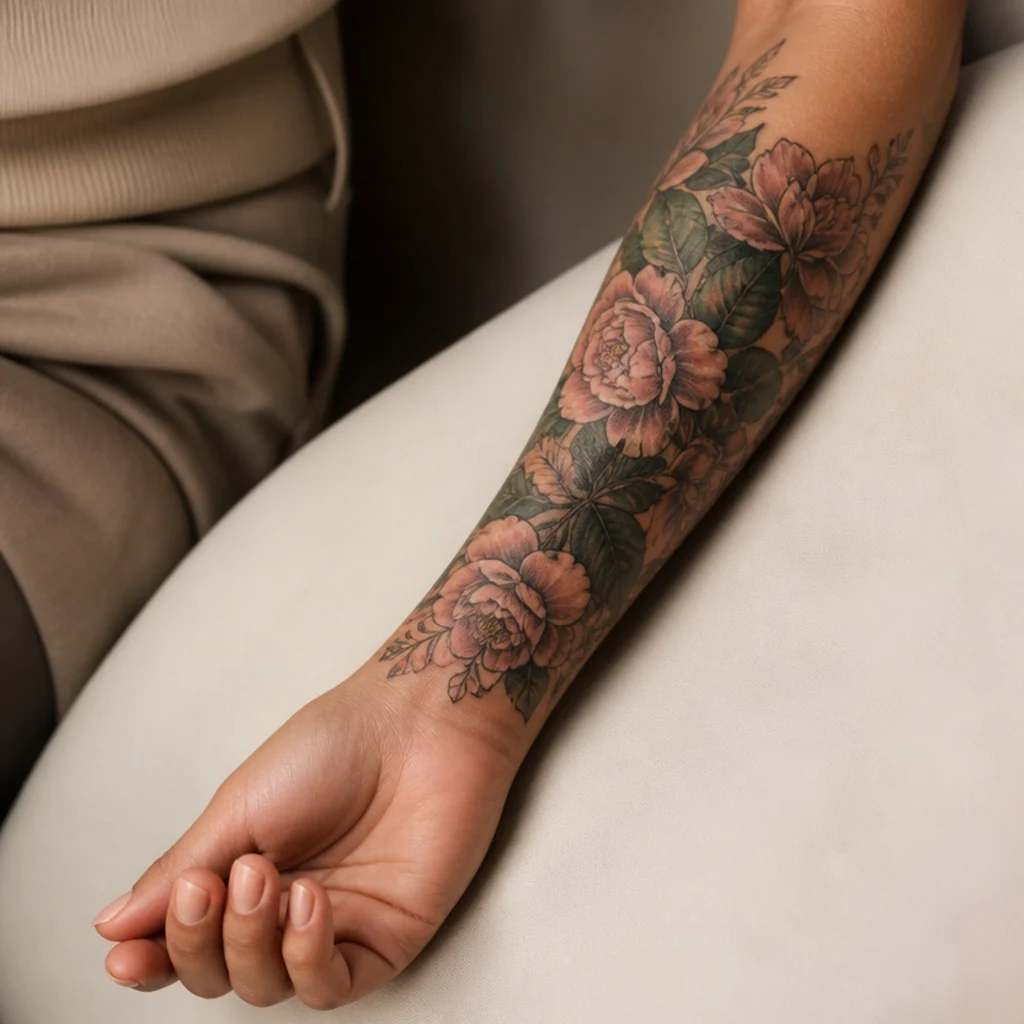
Quick Answer
- Best for: Concealing faded, blurry, dark or outdated tattoos, including old names, small line work and patchy black shading.
- Who might skip it: Anyone whose original is very small and already light, who may prefer a few laser sessions and a fresh clean design instead of a larger cover.
- Maintenance: Cover ups run larger and darker than the original, so aftercare matters; expect a healing touch up around week six to eight and refresh work every three to five years on high-flex spots.
- Difficulty: Advanced. Results depend heavily on your artist's value mapping and shading skill, not just the drawing on top.
- Cost: Variable. Budget more than you would for a same-size original since the piece is bigger and slower to do; many studios quote by the hour with a session minimum.
- Wear time / longevity: A well-saturated cover holds for years; watercolor and fine-line styles fade faster than dense black and grey.
- Standout variation: A dense floral or mandala panel that folds the old shape inside overlapping petals and dark leaf shadow.
- How to ask your tattoo artist: Bring a lit photo of the original and ask for "a cover up with enough dark value and negative space to fully absorb the existing shape."
In This Guide
- Watercolor Floral Bouquet
- Botanical Wrist Wrap
- Blackwork Mandala Forearm Piece
- Name Cover Up Into Script Redesign
- Moth and Moon Silhouette
- Rose and Peony Cluster
- Fine Line Snake and Stems
- Ocean Wave Watercolor Band
- Ornamental Lace Cuff
- Songbird and Branch
- Abstract Brushstroke Cover
- Wildflower Field Forearm Sleeve Start
- Dark Butterfly Transformation
- Geometric Blackout Accent
- Sun and Celestial Motif
Intro
Choosing the best cover up tattoo is a problem of strategy, not decoration. Every old tattoo sits at a certain value, meaning how dark and saturated it reads on skin, and a cover only works when the new piece lands at that value or darker across the areas that matter. That single rule is why cover ups almost always come out larger, bolder and more shadow-heavy than the original, and why an artist thinks in dark mass and negative space long before they think in flowers. Those constraints, oddly, are what push out some of the most sophisticated tattoos being made. Florals, mandalas, moths, waves and script redesigns all excel at cover work because their organic geometry swallows straight lines, blown-out edges and blurred shading. This guide walks through 15 of the best cover up tattoos for women, spanning wrist cover up tattoos, forearm cover up tattoos and name cover up tattoos, with honest notes on the original density each design can realistically handle, who it flatters, the upkeep to expect, and the exact language to use so you and your artist leave the consultation on the same page. Treat it as a shortlist to react to, not a prescription.
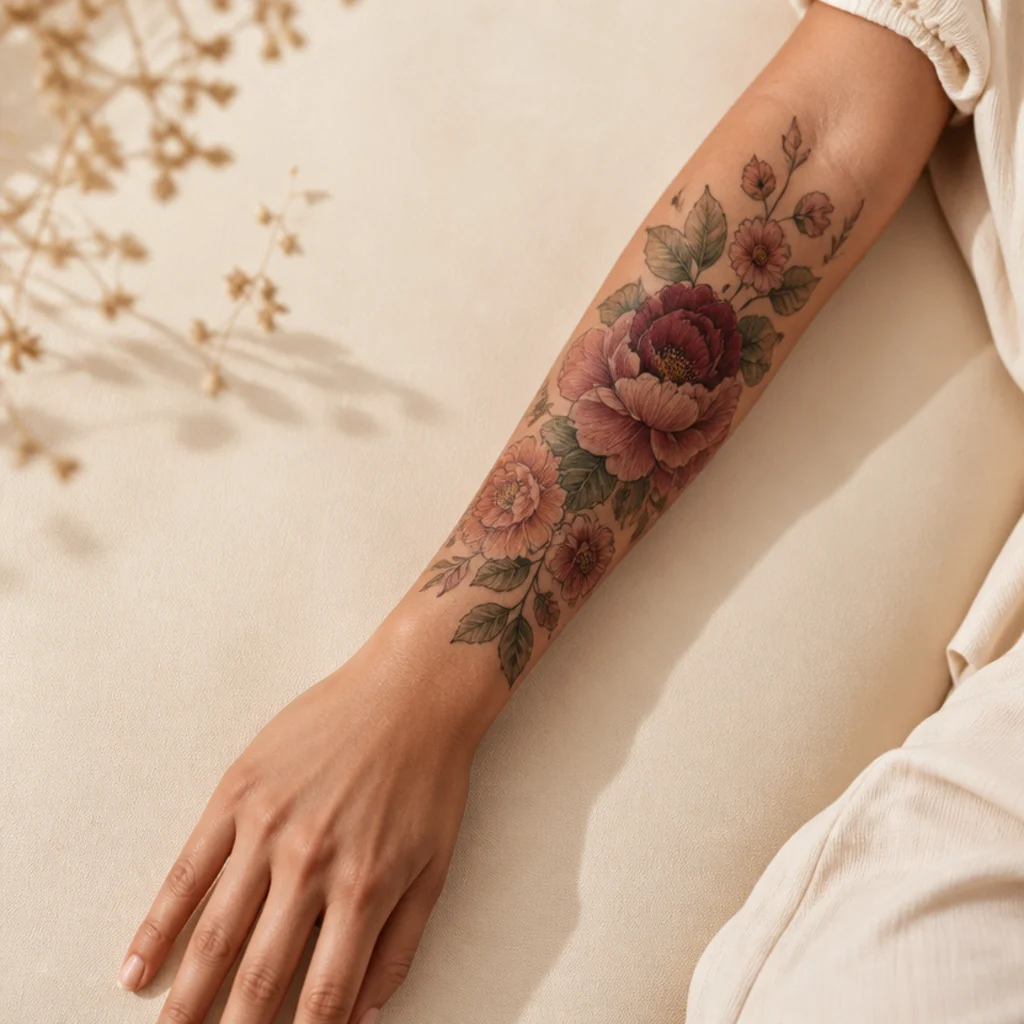
01Watercolor Floral Bouquet
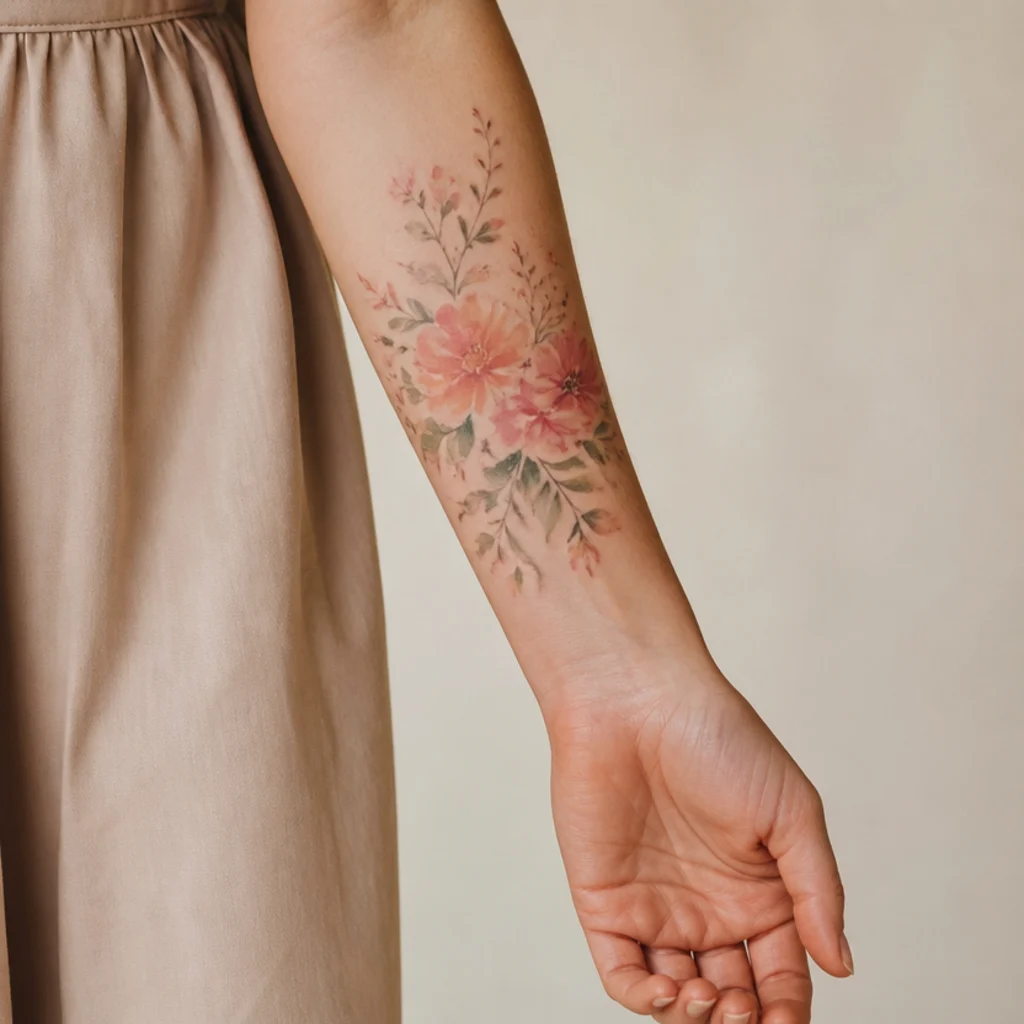
A loose watercolor bouquet is the softest, most feminine route to disguising older ink, but it's also the most demanding to place well. Watercolor relies on translucent, layered washes rather than opaque fill, so it only covers lighter, faded originals; ask it to hide dense black and the old shape will ghost through. A skilled artist's fix is a faint line-work skeleton of stems and petal edges, giving the eye structure to follow while blended blush, coral and sage bleed over the trouble spots. The inner or outer forearm suits it best, since there's room for color to breathe, and cool to neutral undertones let the pastel washes stay clean. Expect touch ups sooner than average, roughly every two to three years, since watercolor pigment sits shallow and lightens faster. Pro tip: request one or two anchoring dark leaves tucked behind the blooms so the composition still holds its shape as the washes soften. Ask your tattoo artist for a "layered watercolor floral with a subtle line-work skeleton and a couple of dark anchor leaves for longevity."
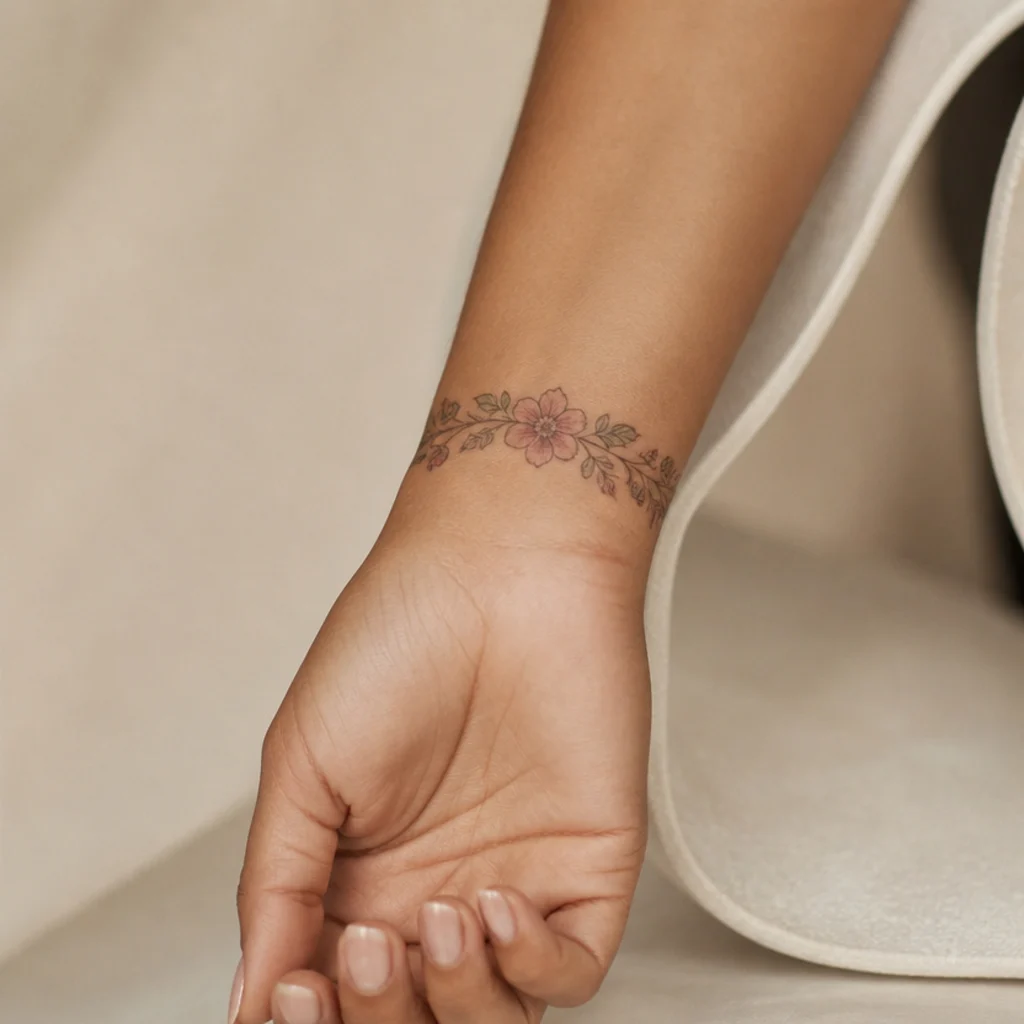
02Botanical Wrist Wrap
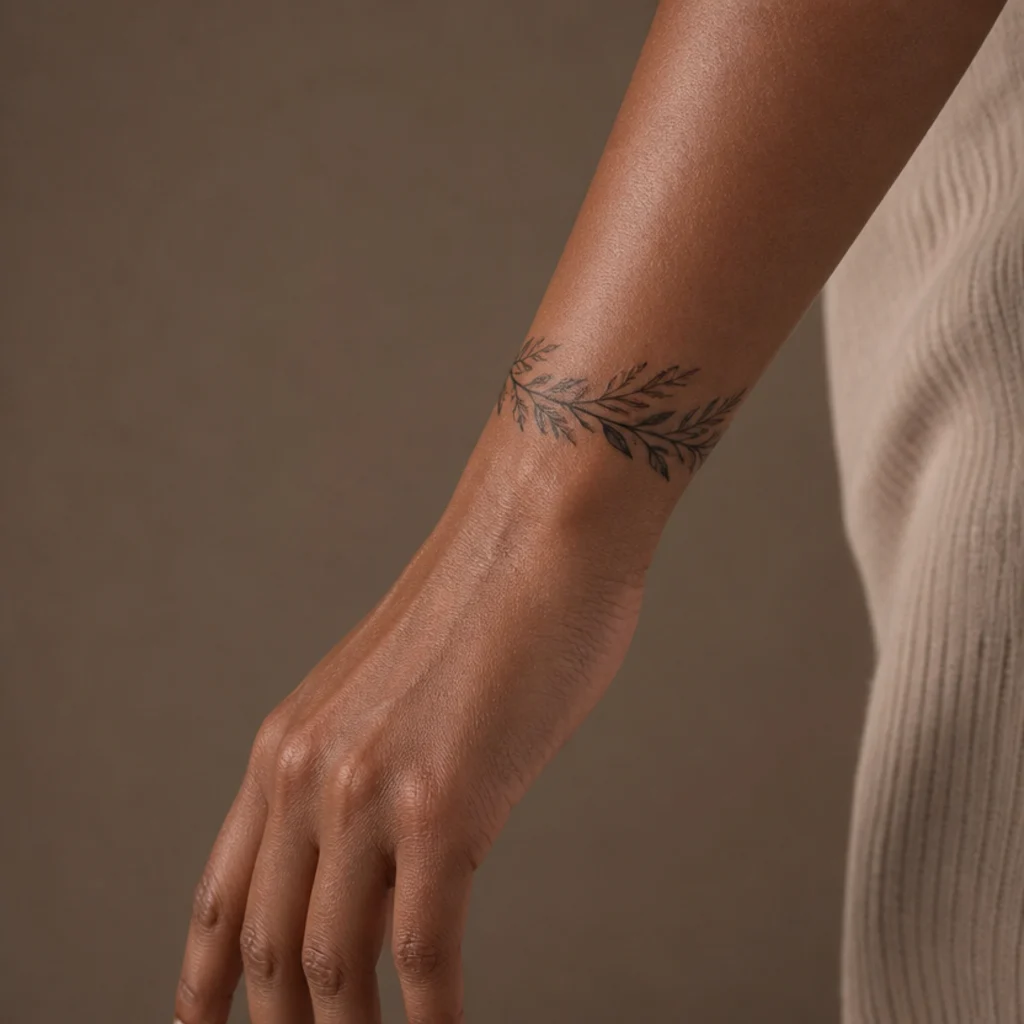
Wrist cover up tattoos are genuinely hard: the space is narrow, the skin is thin and mobile, and the tendons underneath make saturation tough to hold. A wrapping botanical vine is one of the smartest answers, since it lets the artist vary leaf density along the band, stacking darker, overlapping eucalyptus or olive leaves precisely where the old ink sits while keeping the rest airy and jewelry-like. Small, faded names, initials or single symbols work well here rather than large dark blocks, and the wrap flatters slim and average wrists alike because it reads as proportional to the limb. Because it hugs a high-flex, bony area, plan on a refresh on the inner-wrist underside every three to four years, where lines soften first. Pro tip: ask for the darkest cluster of the vine to land directly over the densest part of the original, not centered for symmetry, so coverage follows the problem. Ask your tattoo artist for a "wrap-around botanical band with variable leaf density concentrated over the existing mark."
03Blackwork Mandala Forearm Piece
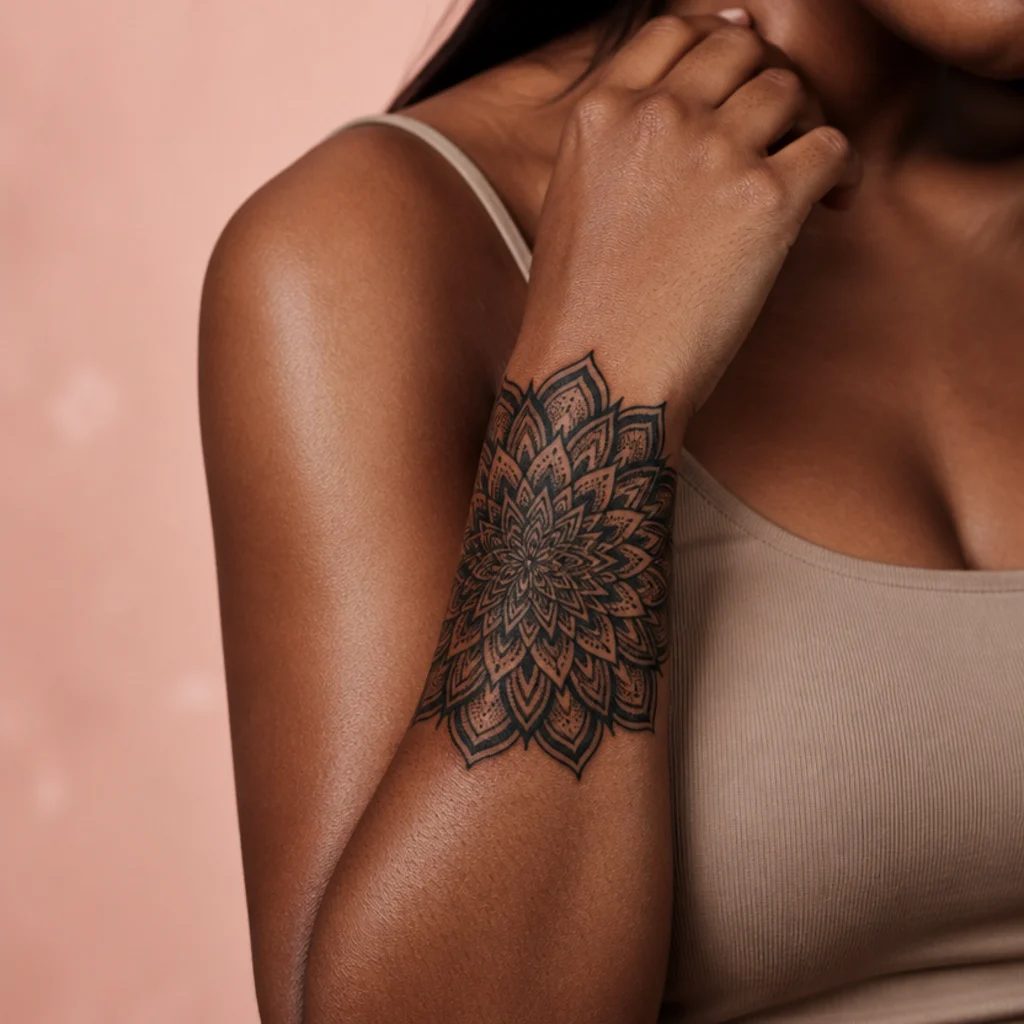
When the original is dark, stubborn and irregular, a blackwork mandala is the most reliable fix on this list. Dense dotwork, solid petals and repeating radial geometry give the artist maximum opaque coverage, and the strict symmetry lets an odd blob or old outline disappear completely inside the pattern instead of just being shaded over. Forearm cover up tattoos in this style read as deliberate statement pieces, never repairs, and that's part of the appeal. Anyone comfortable with a graphic, high-contrast, fully committed black-and-grey look will suit this, and it sits beautifully on the fuller mid-forearm, where the circular geometry has room to stay round rather than stretch. Upkeep is low once healed because saturated black ages slowly; a light touch up every four to five years keeps dotwork crisp. Pro tip: have the artist center the mandala's densest ring over the darkest zone of the original so coverage and the design's center point line up. Ask your tattoo artist for a "geometric mandala with heavy dotwork shading sized to fully enclose the existing tattoo."
04Name Cover Up Into Script Redesign
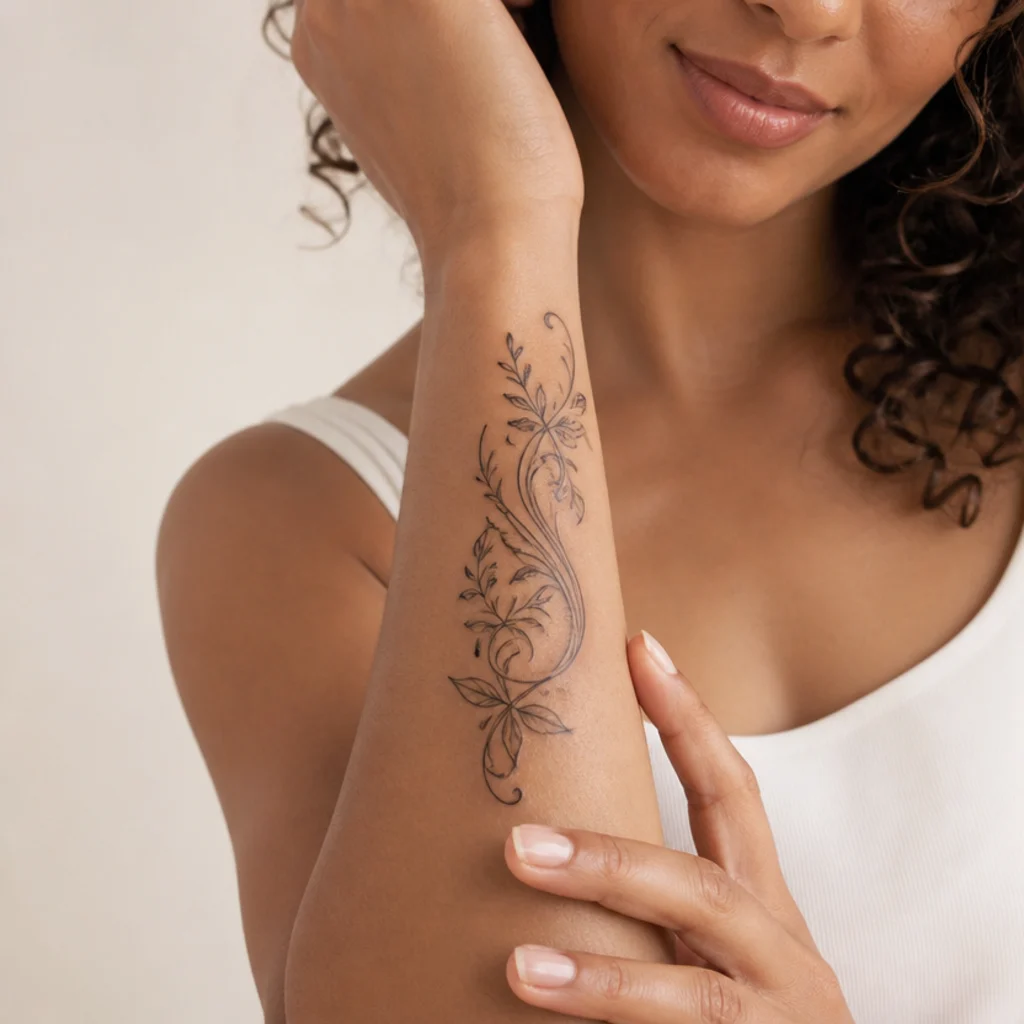
Name cover up tattoos are among the most common requests, and the cleverest fix is rarely another name. Old lettering is built from straight vertical stems and hard baselines, so artists fold those forms into a flowing new word, a meaningful date, or decorative script paired with a floral flourish whose curling serifs and leaves break up the old geometry. The looser and more cursive the new script, the more forgiving it is over rigid block letters underneath. It works well for faded to medium-density names on the inner forearm or wrist, and it suits anyone who wants something legible and personal rather than pictorial. Expect the redesign to run clearly larger than the original, often by half again, so letters have room to overlap the old stems. Pro tip: ask the artist to trace the old letterforms first and design the new descenders and flourishes to cross them at angles, since diagonals hide verticals better than parallel lines do. Ask your tattoo artist for a "decorative script redesign with botanical flourishes engineered to cross and absorb the existing lettering."
05Moth and Moon Silhouette
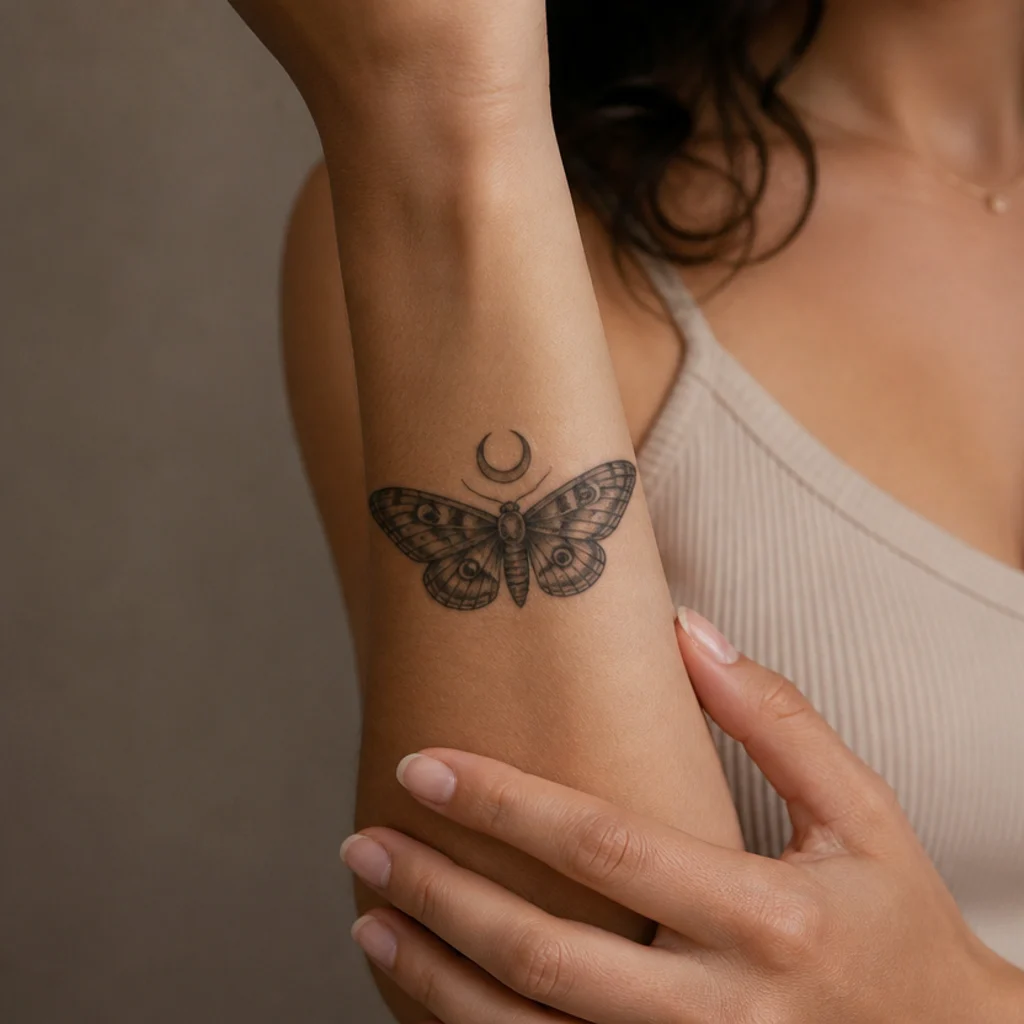
A moth paired with a crescent moon is a moody, symmetrical option whose broad filled wings are almost purpose-built for coverage. The bilateral symmetry lets an artist center the body over the old ink and fan graduated dark wing detail outward in both directions, while the moon sits off to the side and pulls the eye up and away from any softened edges. Medium to fairly dark originals are within reach here, thanks to the density available in the wings, and the forearm or upper arm flatters it best, since the wingspan has room to spread without cramping. Maintenance is moderate; the solid wing mass holds well, though the finest antenna and moon-halo linework may want a refresh every three to four years. Pro tip: choose a luna or Atlas moth over a slimmer species, since wider wings mean more coverable surface area for the same placement. Ask your tattoo artist for a "detailed moth with filled, graduated wings and a crescent moon accent scaled to cover the full area."
Save this to Pinterest to compare floral, blackwork and moth cover styles side by side.
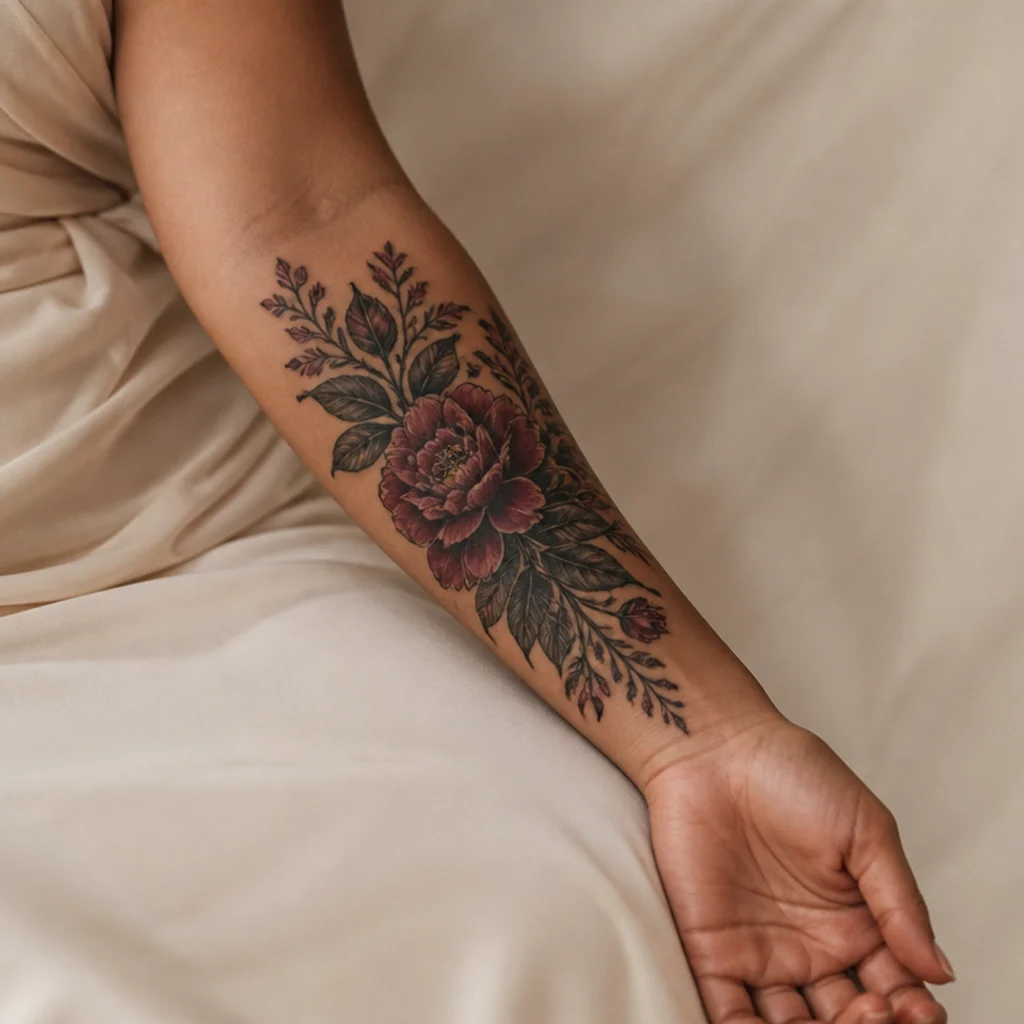
06Rose and Peony Cluster
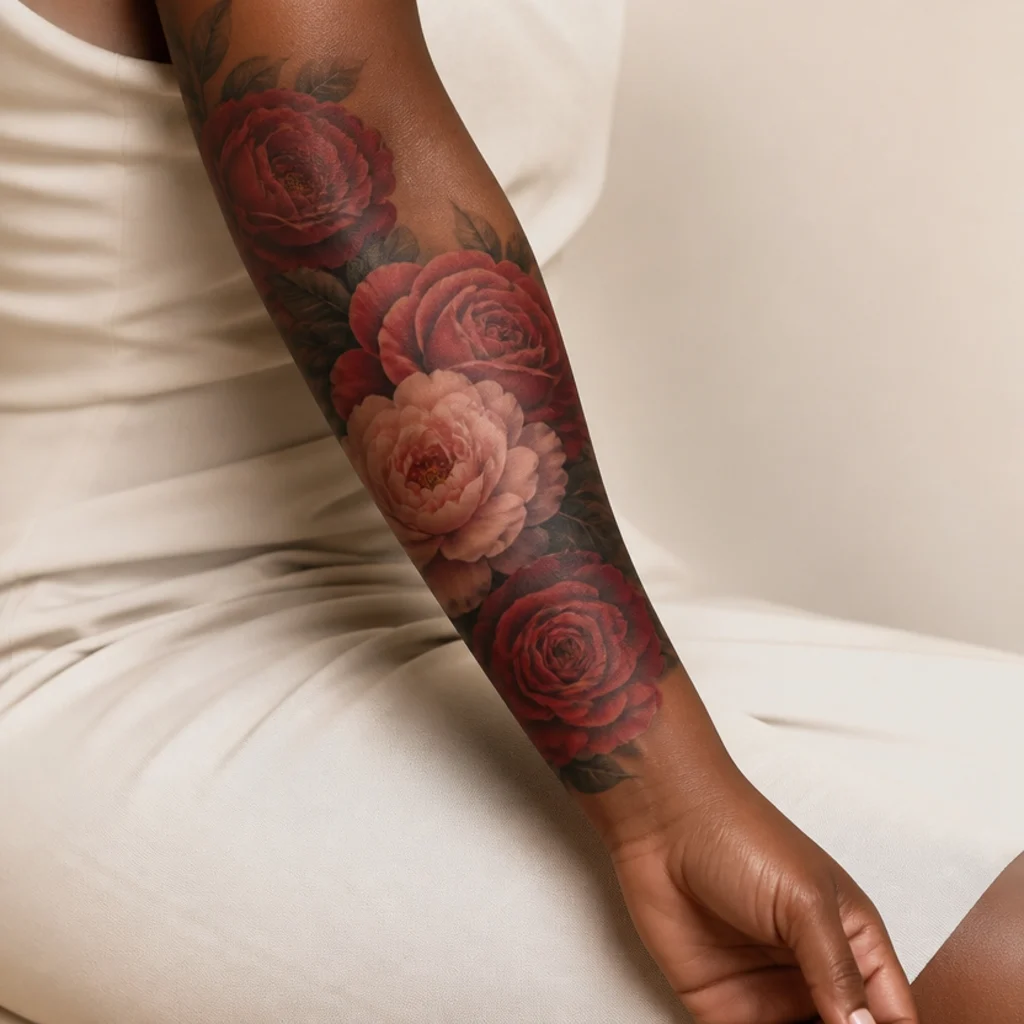
Full, layered blooms are the workhorses of cover up work, and a rose-and-peony cluster is the classic for good reason. Overlapping petals create natural deep shadows between flowers, and the dark leaf work threaded through the gaps is what actually does the covering, letting the artist place heavy value exactly over the worst of the old tattoo while the reds and shaded pinks add life on top. Medium to fairly dark originals work here, and it suits anyone drawn to a romantic, classic palette; warm and neutral undertones carry the deep reds especially well. Larger blooms mean longer sessions, often split across two sittings, but the payoff is strong long-term hold from all that saturation. Pro tip: ask for peonies rather than tight rosebuds over the densest spots, since their wide ruffled petals cover more surface per flower. Ask your tattoo artist for a "layered rose and peony cluster with saturated shadow work and dark leaves placed to maximize coverage."
07Fine Line Snake and Stems
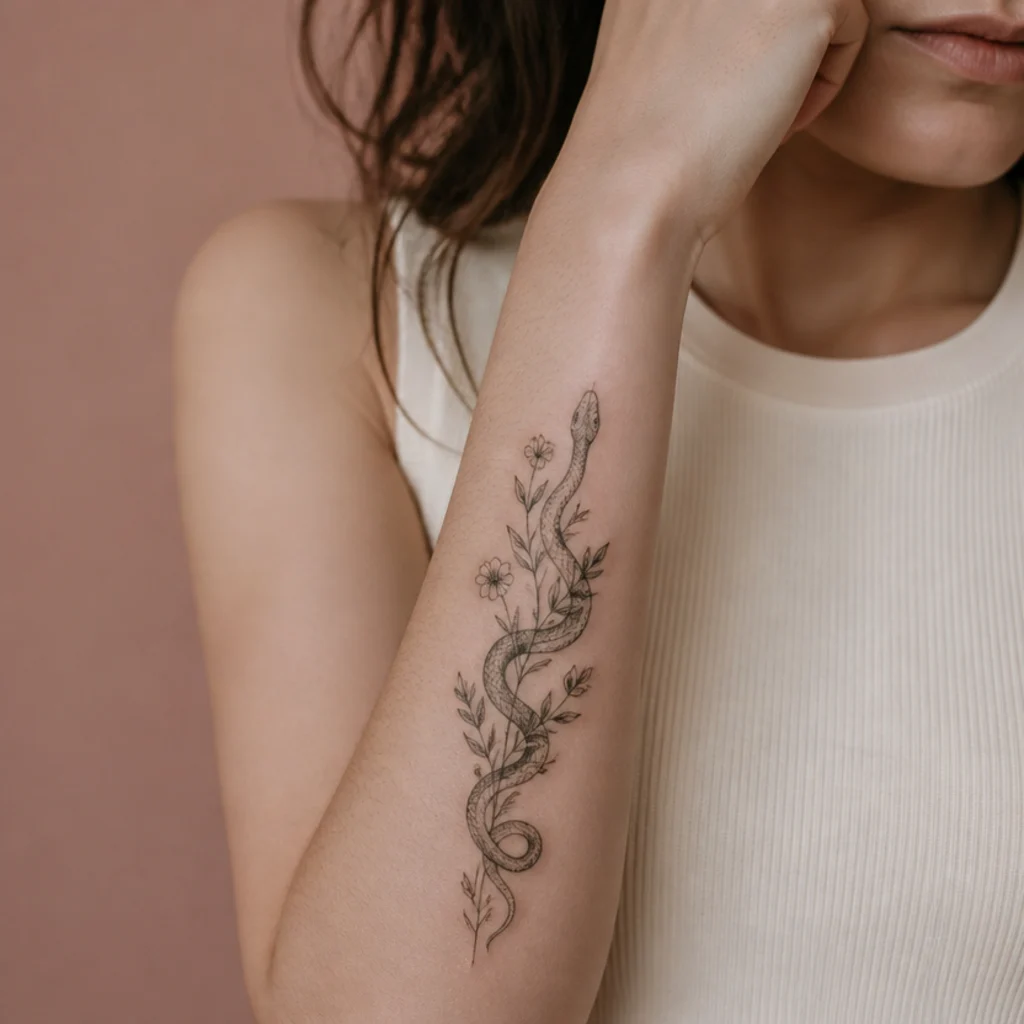
For a modern, illustrative feel, a snake winding through slender stems makes a long vertical composition that can travel over an awkwardly placed or oddly shaped original. The snake's continuous body offers a ribbon of dark coverage you can route directly along the old ink, while the surrounding stems soften the graphic edge. Be realistic about the limits, though: because this leans fine line, it only suits lighter, faded originals, since delicate work can't out-saturate dense black underneath. The outer forearm flatters it best, where the vertical shape lengthens the limb, and it reads well on those who prefer negative space to heavy fill. Fine lines fade faster on the outer arm's sun-exposed skin, so plan a touch up around year two to three and use daily SPF once healed. Pro tip: ask for the snake's body to widen slightly where it crosses the old ink, buying extra coverage without breaking the illustrative style. Ask your tattoo artist for an "illustrative snake threaded through botanical stems, thickened where it crosses the existing tattoo."
08Ocean Wave Watercolor Band
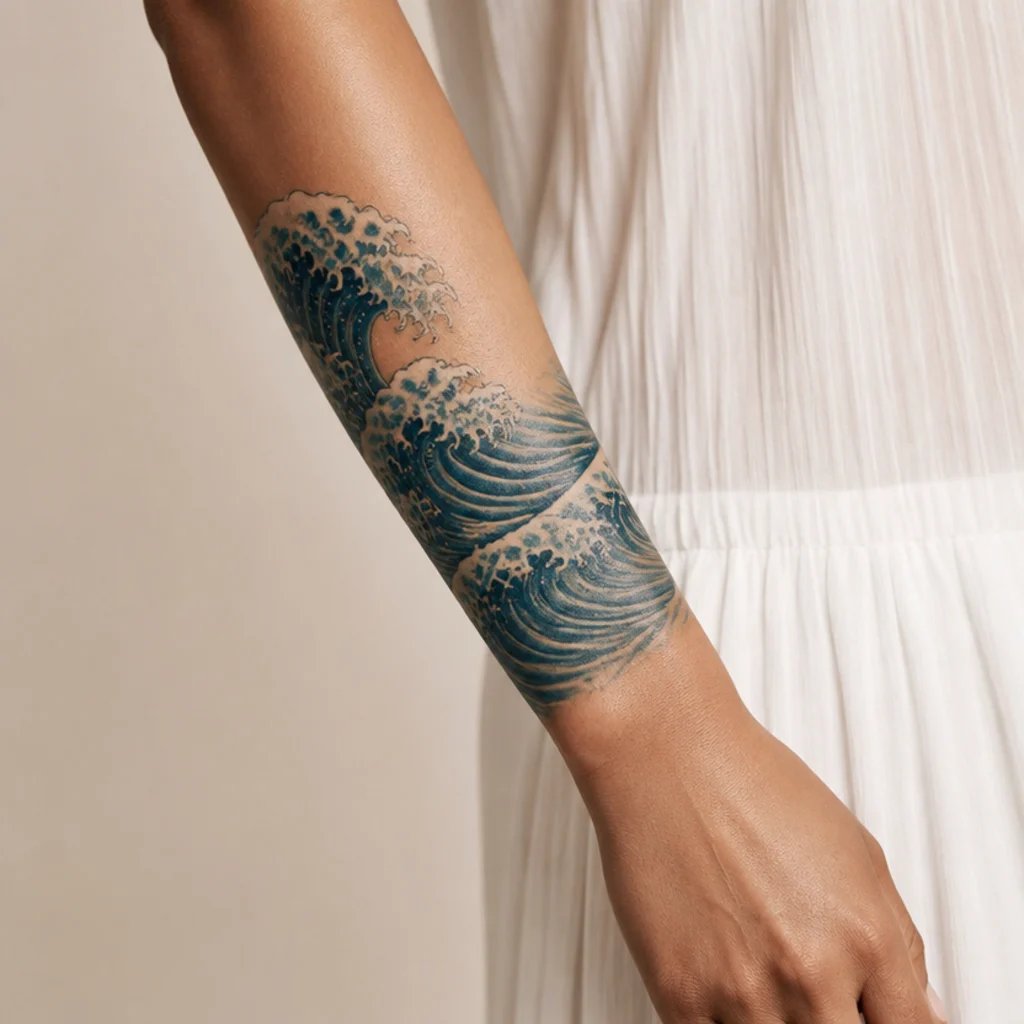
A stylized wave in teal and indigo is a striking, less floral option that still supplies plenty of movement and dark value to disguise old ink. The curling foam and layered blues build depth, and the deep troughs of the wave are where the artist buries the original, keeping the crest and foam light for contrast. Faded to medium tattoos work here, and it suits anyone drawn to coastal or nature themes; cool and neutral undertones keep the blues from reading dull. Wrapping it as a full band around the forearm makes the composition feel intentional rather than like a floating patch. Blue and teal pigments can shift slightly warmer over years, so schedule a color-check touch up around year three. Pro tip: request a Japanese-inspired wave with a defined dark trough rather than a pale seafoam sketch, because you need real dark mass, not just pretty color, to cover. Ask your tattoo artist for a "Japanese-inspired wave band in blended blues with a deep dark trough placed over the old tattoo."
09Ornamental Lace Cuff
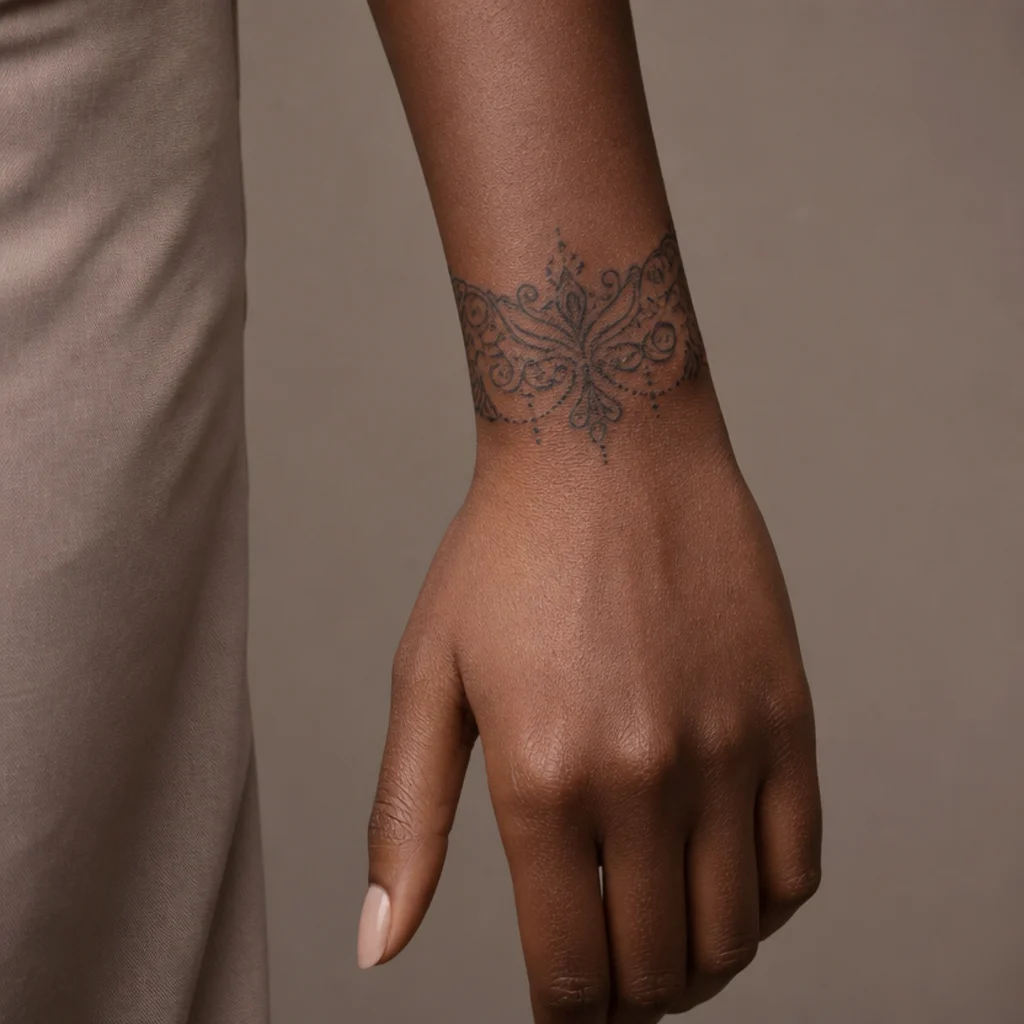
An ornamental lace cuff reframes a wrist cover up as a piece of permanent jewelry. Filigree swirls, teardrop shapes and small dotted accents wrap the wrist, and the intricate black detailing hides small dark originals while reading as an intentional adornment rather than a fix. People who want something decorative and symmetrical instead of pictorial tend to gravitate here, and it flatters slim to average wrists especially, where the cuff proportion looks tailored. Because it sits on a high-flex, thin-skinned area, the inner-wrist underside will likely need refreshing every three to four years, where movement softens the finest filigree first. Pro tip: keep the densest band of filigree on top of the wrist, over the old ink, and let it thin toward the underside, which both improves coverage and reduces the fastest-fading section. Ask your tattoo artist for an "ornamental lace or filigree cuff sized to circle the wrist with its densest detailing over the existing mark."
10Songbird and Branch
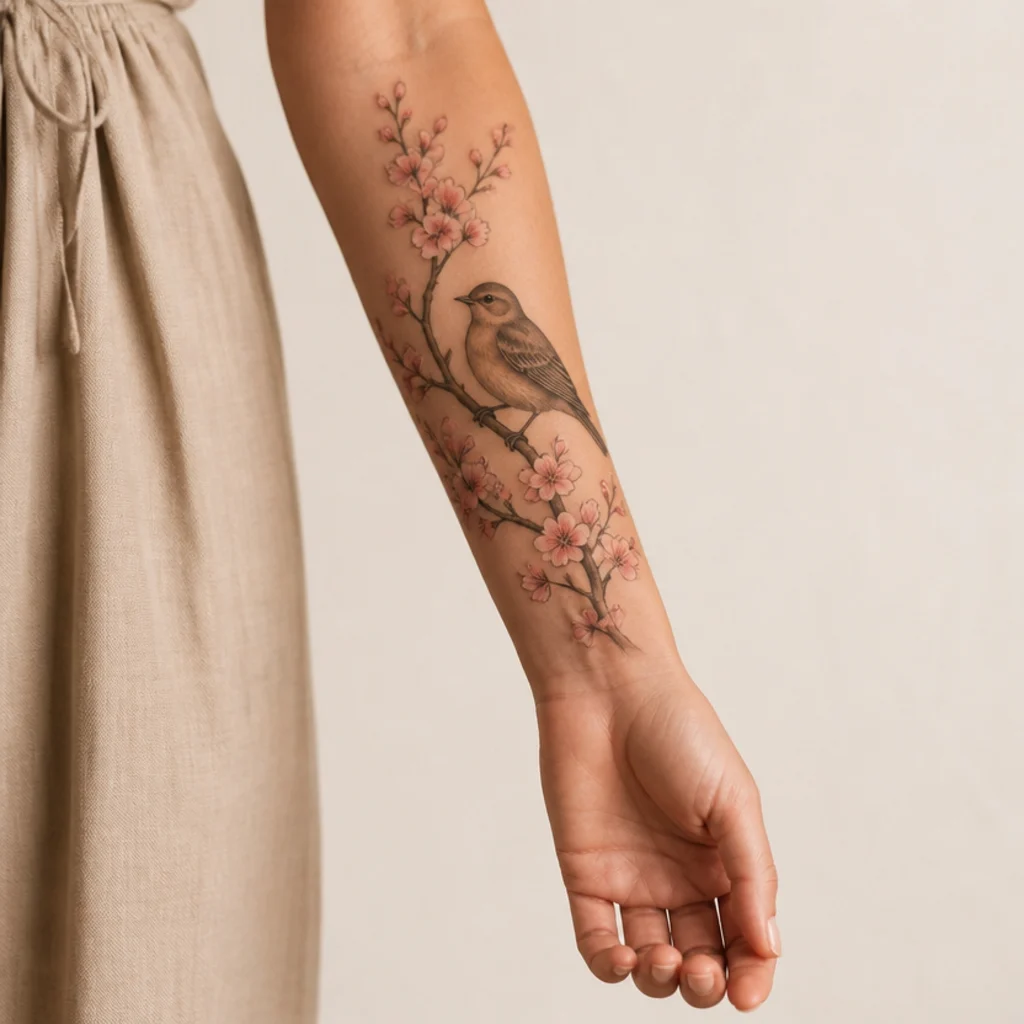
A songbird resting on a blossoming branch is a gentle, storytelling option that pairs one solid focal subject with scattered blossoms for flexible, buildable coverage. The bird's heavily shaded body is the coverage anchor, set over the densest part of the old ink, while the branch and flowers extend outward to break up whatever outline remains. Medium originals work well here, and anyone who prefers a naturalistic scene over abstract shapes will like it; warm undertones carry the browns and soft pinks especially well. Maintenance is moderate thanks to the mix of solid body and delicate petals, with the fine branch tips most likely to want a light refresh over time. Pro tip: ask for the bird to face inward toward the arm rather than off the edge, so its mass and the branch both stay over skin you actually need covered. Ask your tattoo artist for a "perched songbird on a blossom branch with the shaded body anchored over the existing tattoo."
11Abstract Brushstroke Cover
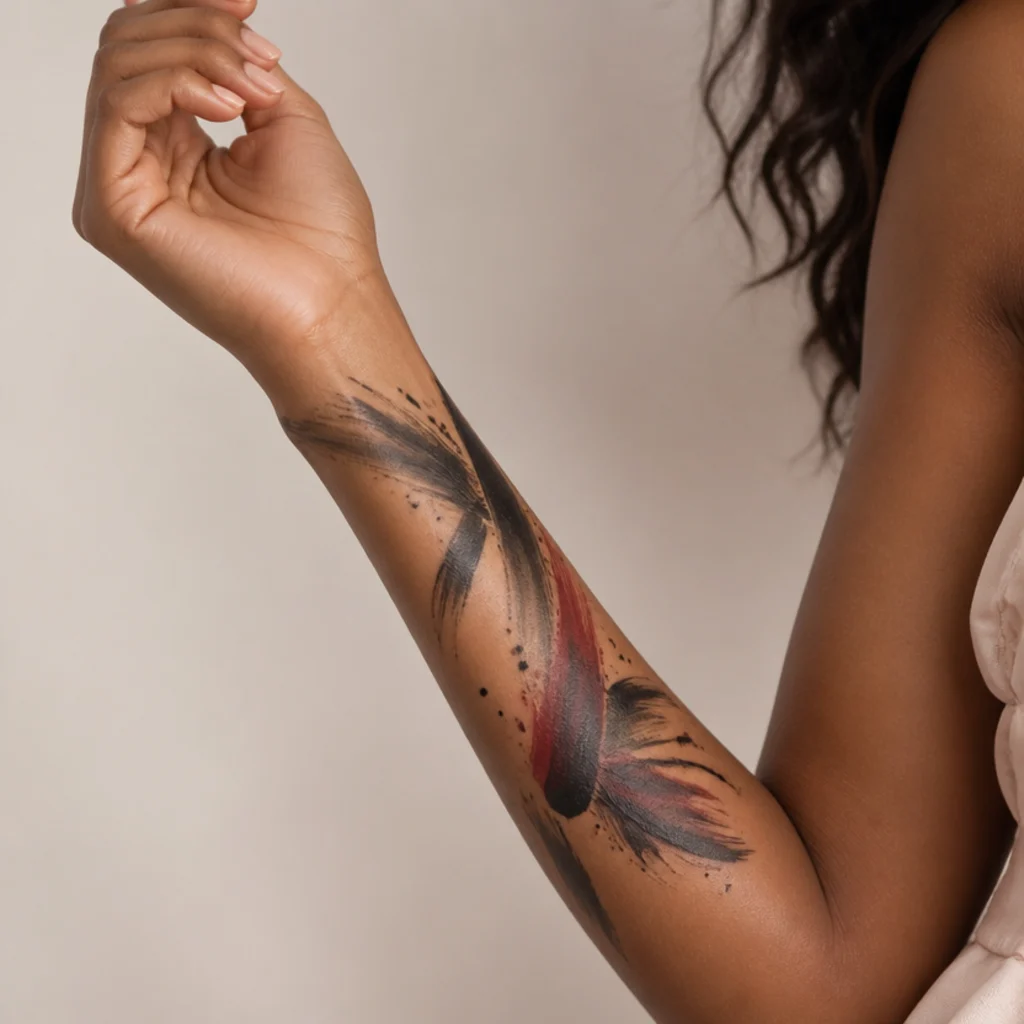
If you want something contemporary and art-forward, sweeping abstract brushstrokes turn out to be one of the most effective cover styles, since they carry no "correct" shape to distort. Bold gestural strokes in black and burgundy, plus a few splatter accents, give the artist total freedom to drop dark mass exactly where the old ink demands and leave the rest open, which is why cover specialists reach for this style on irregular blowouts. Anyone who loves modern, gallery-adjacent tattoos and is comfortable with an unstructured, one-of-a-kind result will suit this well. Because it leans on strong saturation, it holds up over time, with the thinnest splatter flecks the only likely refresh. Pro tip: bring a reference image of the brushstroke energy you like, but let the artist design the actual stroke placement around a tracing of your old ink rather than copying a composition that won't sit over your shape. Ask your tattoo artist for an "abstract brushstroke composition with placed dark mass mapped to the existing tattoo."
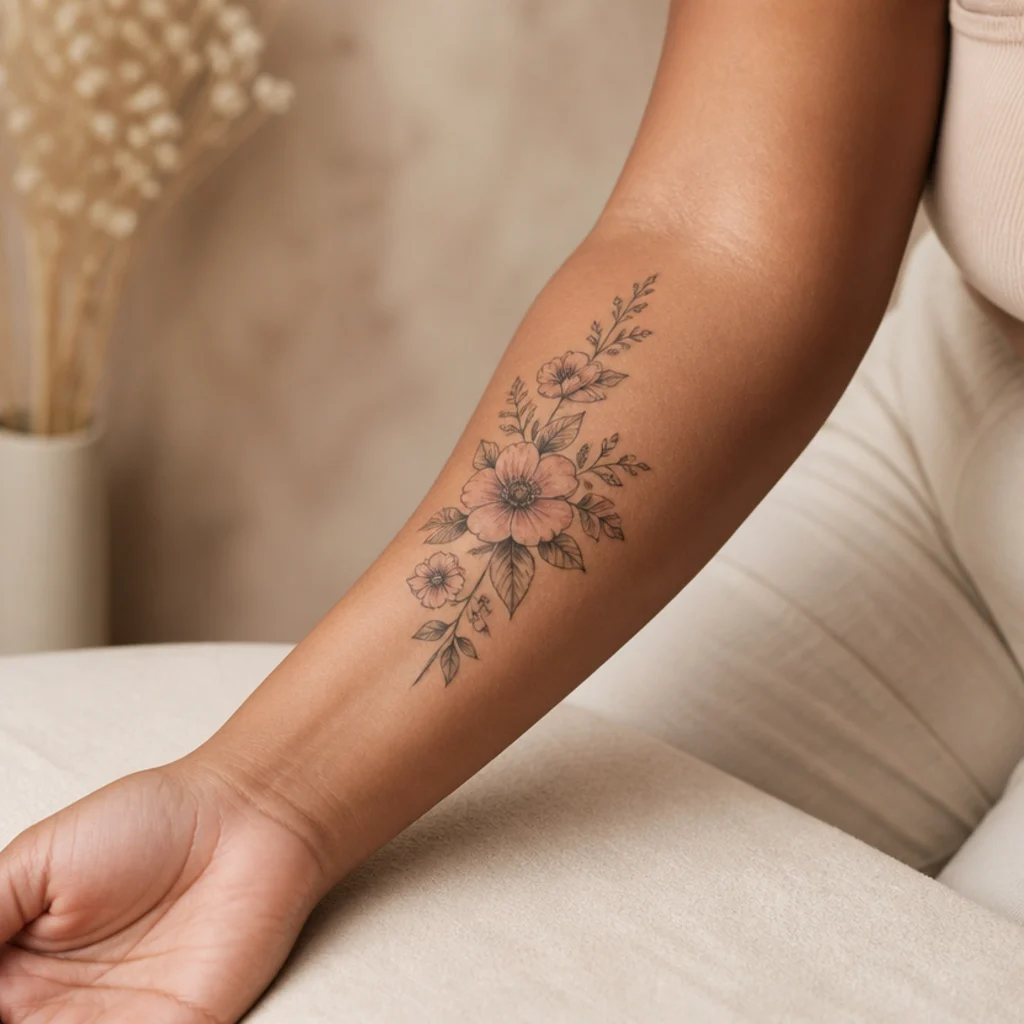
12Wildflower Field Forearm Sleeve Start
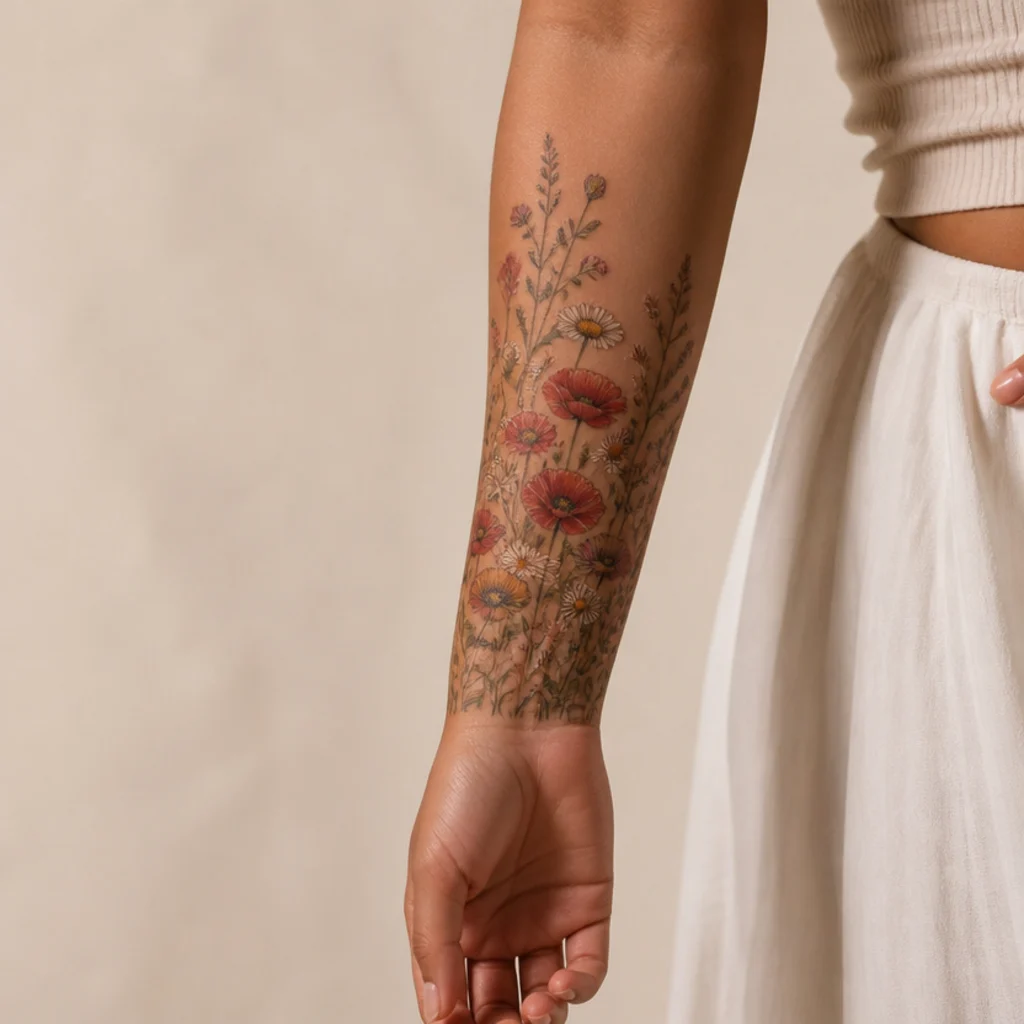
When one cover up could grow into more, a wildflower field is a smart, expandable foundation. Poppies, daisies and grasses run vertically up the forearm, and the varied flower sizes let the artist concentrate dense coverage low, over the current tattoo, then taper the composition upward with room to extend into a half sleeve later. Medium originals work well here, and it suits anyone open to building their ink over time rather than committing to a full sleeve at once. It's a bigger commitment, with a longer session and usually a healing touch up, but planning it as a base saves awkward blending later. Pro tip: ask the artist to map the whole potential sleeve on paper before the first session, even if you only tattoo the lower third now, so the covered area flows naturally into future work. Ask your tattoo artist for a "vertical wildflower field designed as the base of a future forearm sleeve, densest over the current tattoo."
13Dark Butterfly Transformation
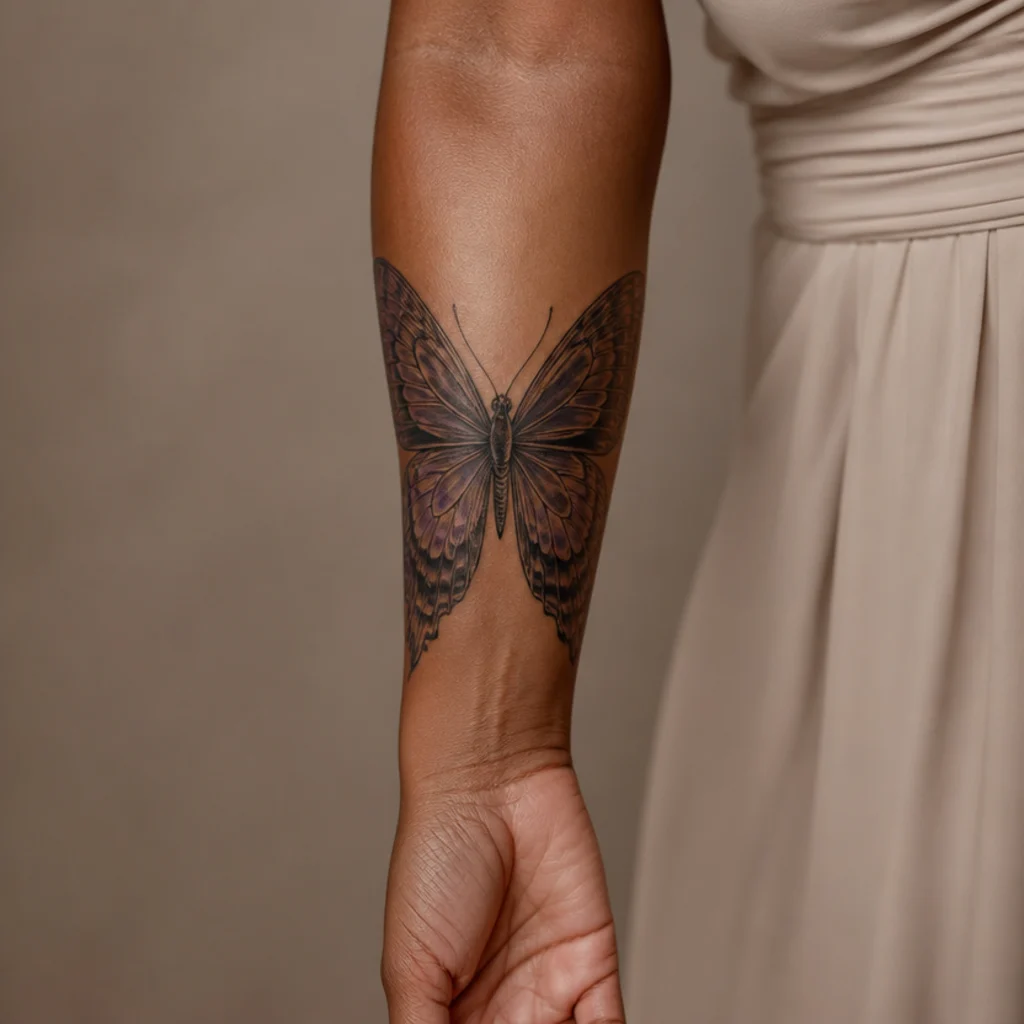
The butterfly is a cover up classic because its broad, symmetrical wings are practically built for hiding things, and a larger, moodier interpretation keeps it from feeling like a cliche. Heavily shaded charcoal wings with hints of deep violet deliver dense coverage while still reading as considered rather than heavy-handed, and the strict symmetry lets the artist center the body over the old ink and fan detail outward evenly. This is one of the strongest choices on the list for dark, stubborn originals, since the wings can hold as much black as the cover requires. The forearm or upper arm flatters it best, where the wingspan can open fully, and upkeep is low once healed thanks to all that saturation. Pro tip: size the body to sit directly over the darkest core of the old tattoo and let the wings absorb the fainter edges, rather than floating the butterfly for looks. Ask your tattoo artist for a "large butterfly with saturated charcoal wing shading and subtle color, scaled to fully cover the area."
14Geometric Blackout Accent
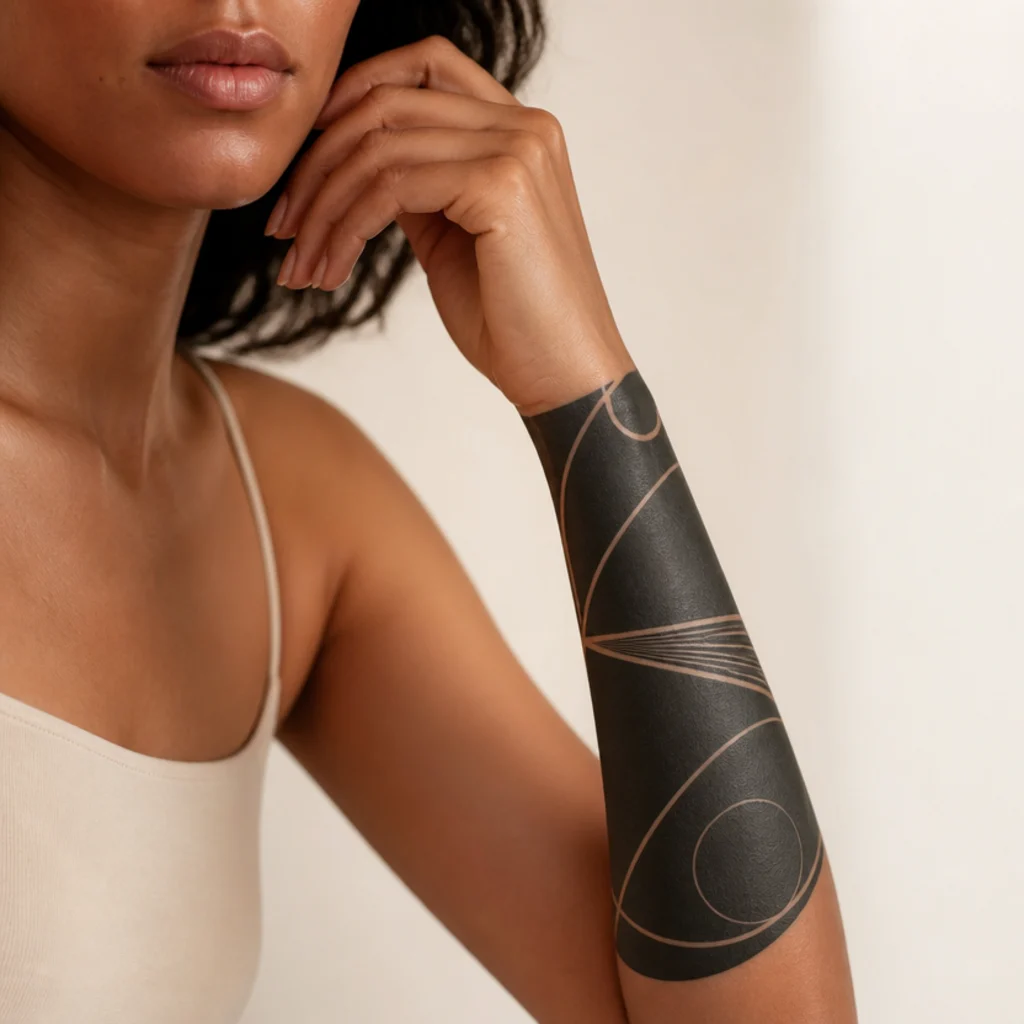
For the most difficult, oldest or darkest tattoos, a partial blackout offers the surest near-total coverage available. A solid black band or shape absorbs the original entirely, and contemporary artists soften the boldness with fine white or negative-space geometric lines so the result reads as a designed panel rather than a redaction. People who love minimalist, high-contrast ink and want the most dependable cover suit this best, and it flatters the forearm as a clean band. This is the most committed option here and the hardest to reverse or re-cover later, so discuss it carefully and look at healed examples first. Solid blackout holds up exceptionally well, though any white-ink accents will fade and need refreshing every few years. Pro tip: ask whether a graduated or textured blackout, softening at the edges into dotwork, will blend more naturally with your skin than a hard-edged block. Ask your tattoo artist for a "geometric blackout panel with negative-space linework and softened edges over the existing tattoo."
15Sun and Celestial Motif
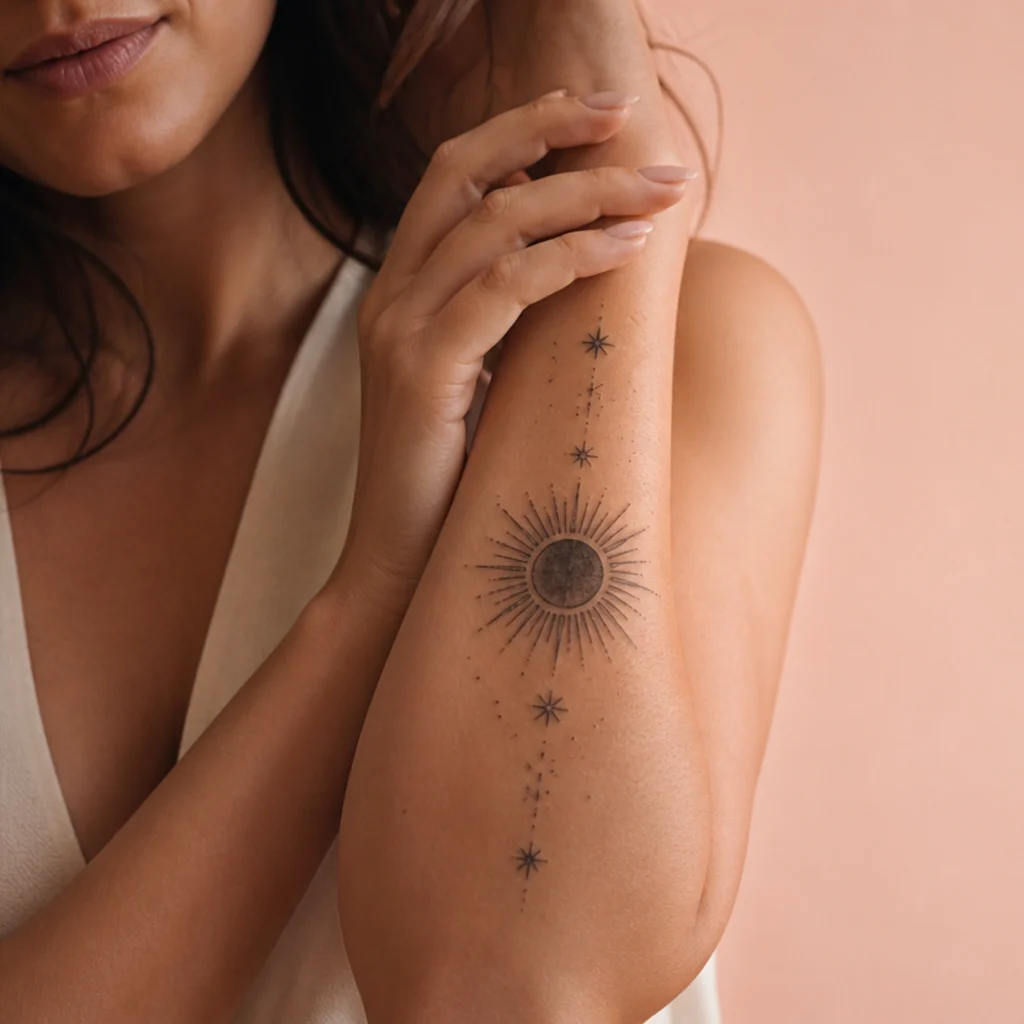
A radiant sun surrounded by stars and fine dotwork rays is a warm, symbolic way to close the list, and it balances solid coverage with delicate extension. The sun's filled center provides strong dark value over the core of the old ink, while the rays and scattered stars carry the design outward and pull attention from any lingering edges of the original. Medium originals suit it, along with anyone drawn to celestial or symbolic imagery; it also scales up or down more easily than most designs here, which helps when the old tattoo is an awkward size. It works on the forearm or upper arm, and maintenance is moderate thanks to the mix of solid fill and fine dotwork, with the outermost rays the first to want refreshing. Pro tip: request a solid or heavily shaded sun face rather than an open line-only sun, since you need real dark mass at the center to cover, not just outline. Ask your tattoo artist for a "radiant sun with a filled center and celestial dotwork rays and stars covering the existing tattoo."
Pro Tips from the Editor
- Think in value, not subject. Ask your artist to photograph your old tattoo in black and white; whatever still reads as dark grey or black is what the new piece has to match or beat, and that map matters more than which flower you pick.
- Consider laser lightening first. Two to four sessions of laser fading rarely erase a tattoo fully, but they can drop its value enough to open up lighter, more colorful, smaller cover options you'd otherwise be denied.
- Diagonals hide verticals. Old lettering, straight tribal lines and geometric edges disappear fastest under designs that cross them at an angle, so favor curving stems, fanned wings and diagonal strokes over parallel motifs.
- Route the darkest element over the darkest problem. The single most useful instruction you can give is to place the design's heaviest mass, whether a peony, a snake's belly or a mandala's core, directly over the densest part of the original, not centered for symmetry.
- Budget for two sittings and a healing touch up. Large covers are often split to protect the skin and let saturation settle; assuming one session with no follow-up is the most common way people end up disappointed by cost and crispness.
- Vet the portfolio for healed covers, not fresh ones. Fresh tattoos always look opaque; ask specifically to see cover ups photographed months after healing, when any ghosting of the original would have reappeared.
- Protect the result. Daily SPF on the healed piece and diligent moisturizing slow fading in a real way, especially on sun-exposed outer forearms and fine-line or watercolor styles.
Cover Up Style Comparison
| Design style | Handles how dark an original | Best placement | Relative upkeep |
|---|---|---|---|
| Watercolor floral / wave | Faded to light-medium only | Inner or outer forearm | Higher (fades faster) |
| Layered florals (rose, peony, wildflower) | Medium to fairly dark | Forearm | Moderate |
| Blackwork mandala / dark butterfly / moth | Medium to very dark | Forearm, upper arm | Low once healed |
| Fine line snake / botanical wrist wrap | Faded to light only | Outer forearm, wrist | Higher on high-flex areas |
| Lace cuff | Small dark marks | Wrist | Moderate to higher |
| Geometric blackout | The darkest, most stubborn ink | Forearm band | Low (solid black); white accents fade |
How to Choose / Get the Look
Start with an honest read of your original, because everything downstream depends on it. Here's the decision order to work through. First, assess value: photograph the tattoo in bright, even light and again in black and white, and note how dark it actually reads, since the darker and more saturated it is, the darker and larger your cover must be. A tiny faded name has nearly every option on this list open to it; a solid black tribal piece narrows you down to blackwork, dark florals, butterflies, moths or blackout. Second, decide on laser: ask your artist directly whether two to four lightening sessions would expand your choices, since even partial fading widens the field a lot and can be the difference between a delicate design and a mandatory blackout. Third, match design to placement: florals and script suit the inner forearm, wrapping vines and lace flatter the wrist, and larger mandalas, moths and butterflies want the forearm or upper arm where they can open fully. Fourth, plan color and value together: warm reds, greens and blues add life, but heavy black shading almost always does the real covering, so don't rely on color alone. Fifth, budget realistically for a larger piece, a longer or split session, and a healing touch up. Above all, choose an artist who specializes in cover ups and can show you healed, not just fresh, examples. Final design, sizing, placement, coverage feasibility and healing must always be confirmed in person with your licensed tattoo artist, who can assess your specific skin, undertone and existing ink; no design can be promised to fully hide an existing tattoo or scar until a professional evaluates it directly.
Frequently Asked Questions
Can any tattoo be covered up?
Most can be, but very dark, solid or heavily saturated tattoos are the hardest, and sometimes can't be fully hidden without a blackout or prior laser fading. A licensed artist has to assess your specific ink in person; a few laser lightening sessions beforehand often turn a difficult cover into an easy one and open up far more design options.
Are cover up tattoos always bigger than the original?
Almost always. To absorb the old shape an artist needs extra room for dark shading, negative space and detail, so plan for a piece noticeably larger than the tattoo you're covering, often half again to double the footprint depending on how dark the original is.
What are the best designs for covering an old name?
Flowing script redesigns, layered florals and organic shapes with lots of curves work best for name cover up tattoos, since their loops, leaves and diagonals cross and break up the straight vertical stems of old lettering. Turning the old name into a new word, date or decorative flourish usually hides letters better than stacking another name on top of it.
Do wrist cover up tattoos fade faster?
Often, yes. The wrist is thin, bony and high-movement, so lines there can soften sooner than on the fuller forearm, especially on the inner-wrist underside. Wrapping botanical bands and lace cuffs age more gracefully and are easy to refresh; expect a light touch up every three to four years on that area.
How much do cover up tattoos cost?
Expect to pay more than for a same-size original, since cover ups are larger, slower and more technically demanding, and are often split across two sittings. Most studios price by the hour with a session minimum, so pricing varies widely by artist, size and detail; confirm the full estimate, including any touch up, during your consultation.
Can I cover a tattoo with a lighter or colorful design?
Only if your original is already light. Light and pastel inks are translucent and can't out-saturate dark ink beneath them, so a colorful or watercolor cover works over faded pieces but ghosts over dense black. If you want a lighter design over a dark tattoo, laser lightening first is usually the realistic path.
How long should I wait before covering an existing tattoo?
Wait until the original is fully healed, typically a minimum of a few weeks to a couple of months, and confirm timing with your artist. Covering has to be done on settled skin, and if you're also lasering first, you'll need healing time between each laser session and the eventual cover.
Will a cover up completely hide my old tattoo?
Not guaranteed. A skilled cover can make the original invisible to most eyes, but some ghosting can reappear as the new piece heals and settles, particularly over very dark ink. No artist can honestly promise total concealment of a tattoo or scar until they evaluate your skin in person, which is why healed portfolio examples and a candid consultation matter so much.
Does the placement of the old tattoo limit my options?
Yes. High-movement, thin-skinned areas like the wrist and inner elbow hold saturation less predictably and favor certain shapes, while the fuller forearm and upper arm can take larger, denser designs. Bring the exact location to your consultation so your artist can recommend styles that both cover well and age gracefully on that specific spot.