15 Large Cover Up Tattoos for Women That Wow
Old ink you've outgrown doesn't have to be the end of the story. A well-planned large cover-up turns a faded name, a saturated black blob, or a scar-adjacent piece into a composition built on shadow, flow, and intention — one you'll actually want to show.
 Edited by Lena Rose · Published July 11, 2026 · 27 min read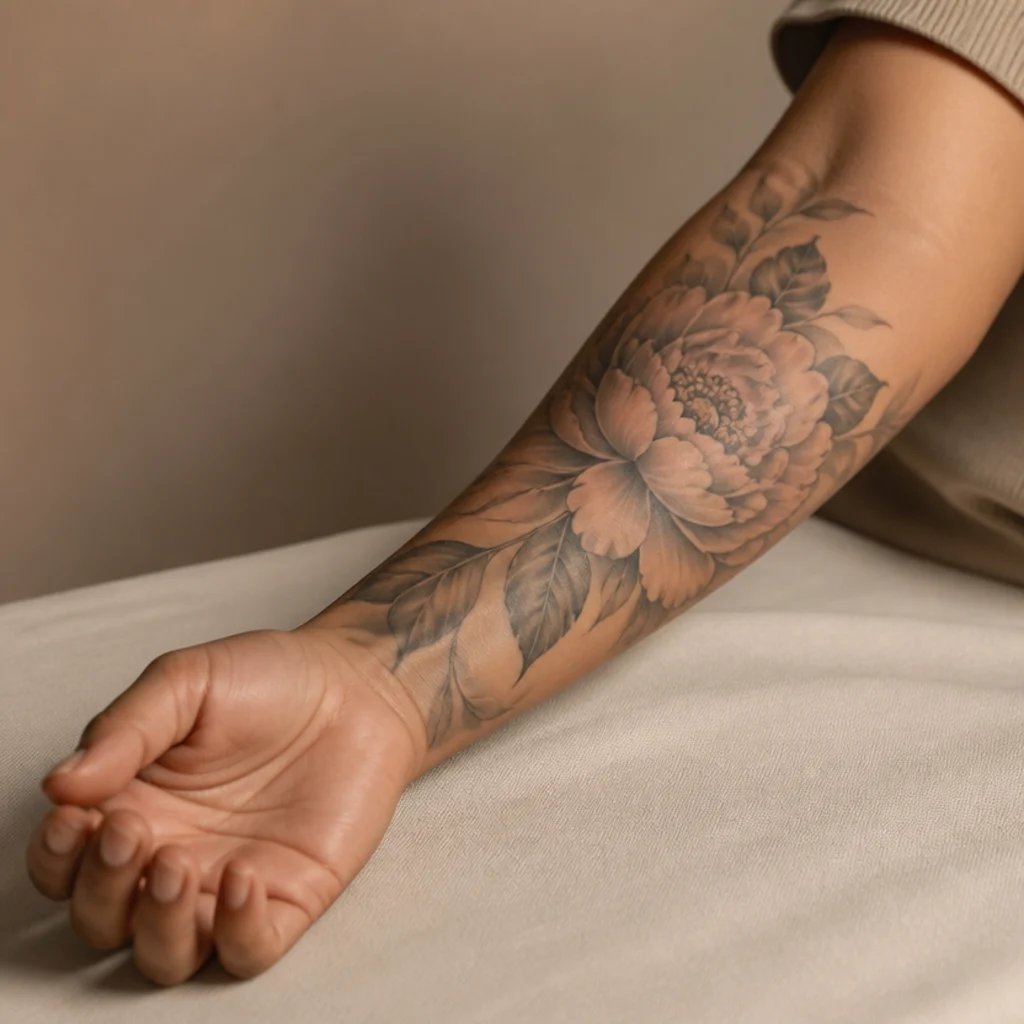
Quick Answer
- Best for: Turning old, dark, or unwanted ink, from small cover up tattoos to full sleeves, into a design with enough shape and value to redirect the eye.
- Who might skip it: Anyone whose original is very light and small enough for laser removal in one to three sessions, or who wants a delicate, minimal tattoo that a cover-up rarely allows.
- Maintenance: Moderate overall; fine shading and thin linework may need a touch-up every three to five years, while solid blackwork holds far longer.
- Difficulty: High. Cover-ups need an artist who reads existing pigment and designs around it — being a strong drawer alone isn't enough.
- Cost: Variable; large custom cover-ups typically run at the higher end of a studio's day-rate or hourly range and often span multiple sessions.
- Wear time / longevity: Permanent, with the best value retention in bold-outline and blackwork styles; soft watercolor washes fade fastest.
- Standout variation: Layered botanical pieces that use petal shadows and leaves to break up old linework without going fully black.
- How to ask your tattoo artist: Share clear photos, name the exact motif and value range you want, and ask how much of the original it can realistically disguise before booking.
In This Guide
- Bold Peony Bloom Cover-Up
- Blackwork Mandala Shield
- Trailing Wildflower Half-Sleeve
- Watercolor Phoenix Rework
- Dark Rose and Thorn Wrap
- Ornamental Lace Shoulder Piece
- Koi and Water Ripple Flow
- Moth and Moon Back Piece
- Name-Over Botanical Script Swap
- Scar-Softening Fern Spread
- Neo-Traditional Songbird Panel
- Geometric Blackout Band
- Dotwork Lunar Landscape
- Vintage Fan and Peacock Feather
- Layered Dahlia and Foliage Thigh Piece
Choosing a large cover-up is a different project than booking fresh ink, and it starts with honesty about what's already on your skin. A cover design can't just sit on top of the old one; it has to out-value it, meaning every dark area of the original needs an even darker or busier element placed over it so the eye reads the new shape first. That's why so many rewrites size up into blooms, blackwork, or flowing panels — the artist needs real estate for shadow, texture, and misdirection. Even people hoping for small cover up tattoos often get steered larger, because a compact motif rarely carries enough contrast to bury saturated pigment. The fifteen ideas below span florals, animals, ornamental work, blackout, and scar-adjacent pieces, each with notes on who it flatters, where it works on the body, the upkeep to expect, and the exact language to bring to a consultation. Cover-up work these days tends toward organic, illustrative styles and considered negative space rather than the muddy patch-jobs of a decade ago, though this is a visual starting point, not a promise. Confirm every plan with a licensed tattoo artist who can assess your existing tattoo or scar in person.
01Bold Peony Bloom Cover-Up
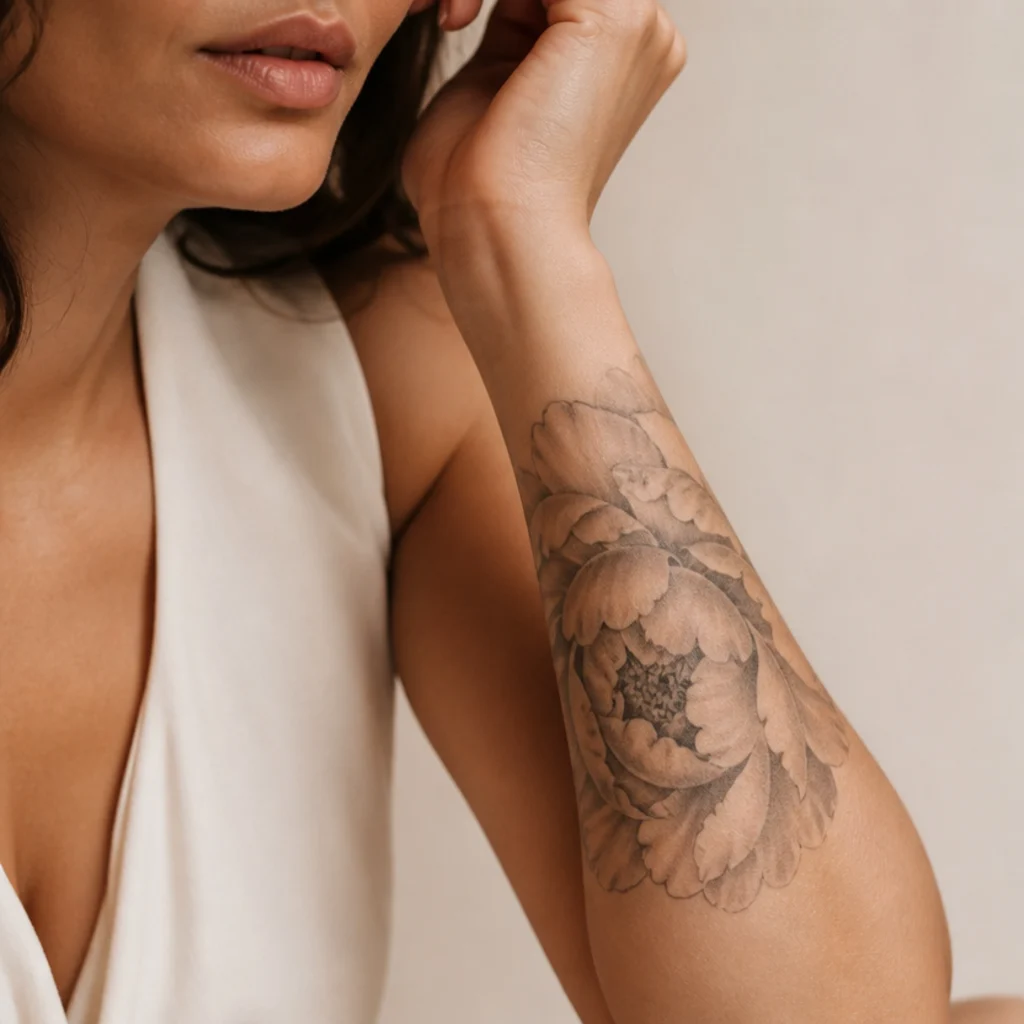
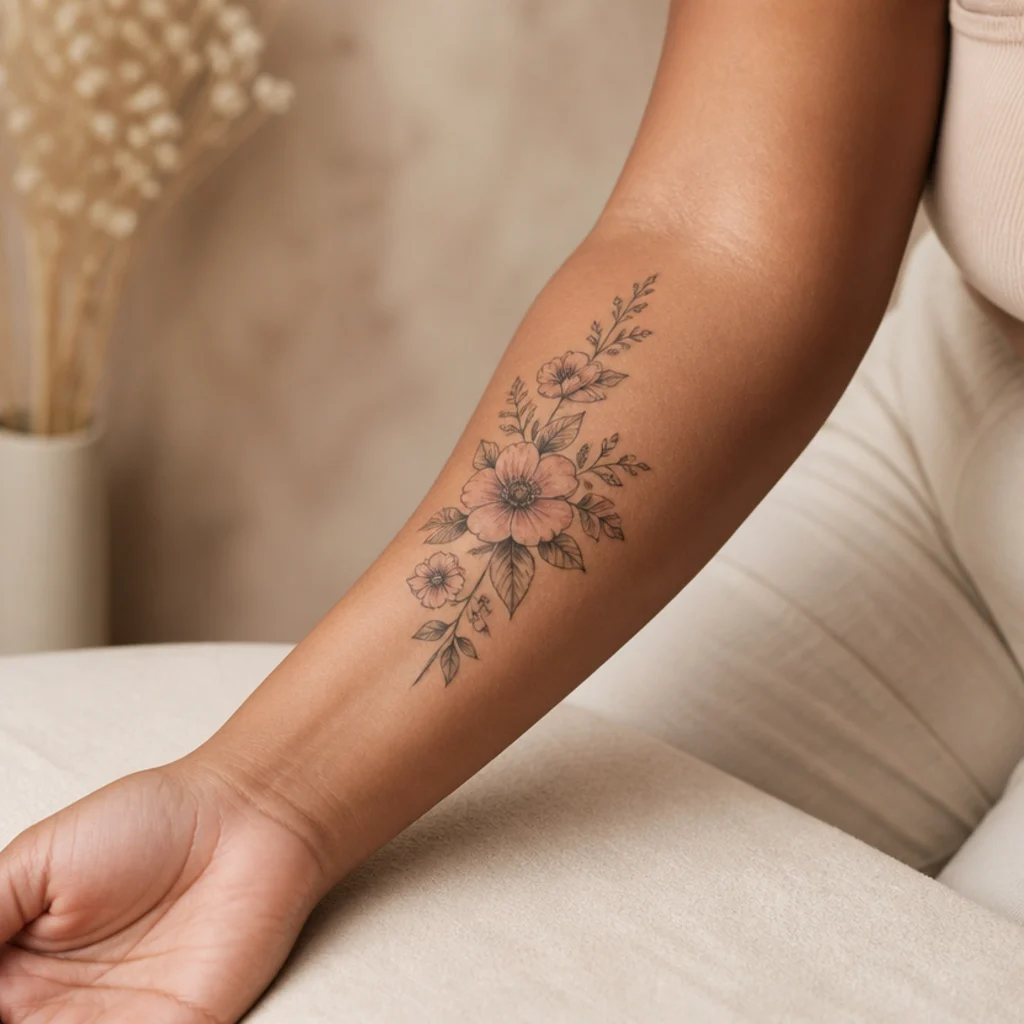
A single oversized peony is one of the most reliable ways to reinvent old ink, thanks to its structure. The tightly ruffled center gives an artist a natural pocket of deep charcoal or blush-black shadow to park the darkest remnant of the original, while the outer petals fan out in lighter blush, dusty rose, or soft grey to dissolve the border. That built-in value range, from near-black core to feathered edge, is exactly what a cover needs. The inner forearm, deltoid, and outer thigh all work well, and it reads on a broad span of skin tones because the shading can be tuned warm for golden and deep complexions or cooler for fair skin. Upkeep runs moderate: the finest transitional shading tends to soften first and can use a touch-up every few years. Ask for the bloom to be rotated so its densest petal cluster falls directly over the heaviest old pigment, rather than centered for symmetry's sake. If you're graduating from small cover up tattoos, ask your artist for a peony scaled at least a third larger than the original footprint so the petals have room to work.
02Blackwork Mandala Shield
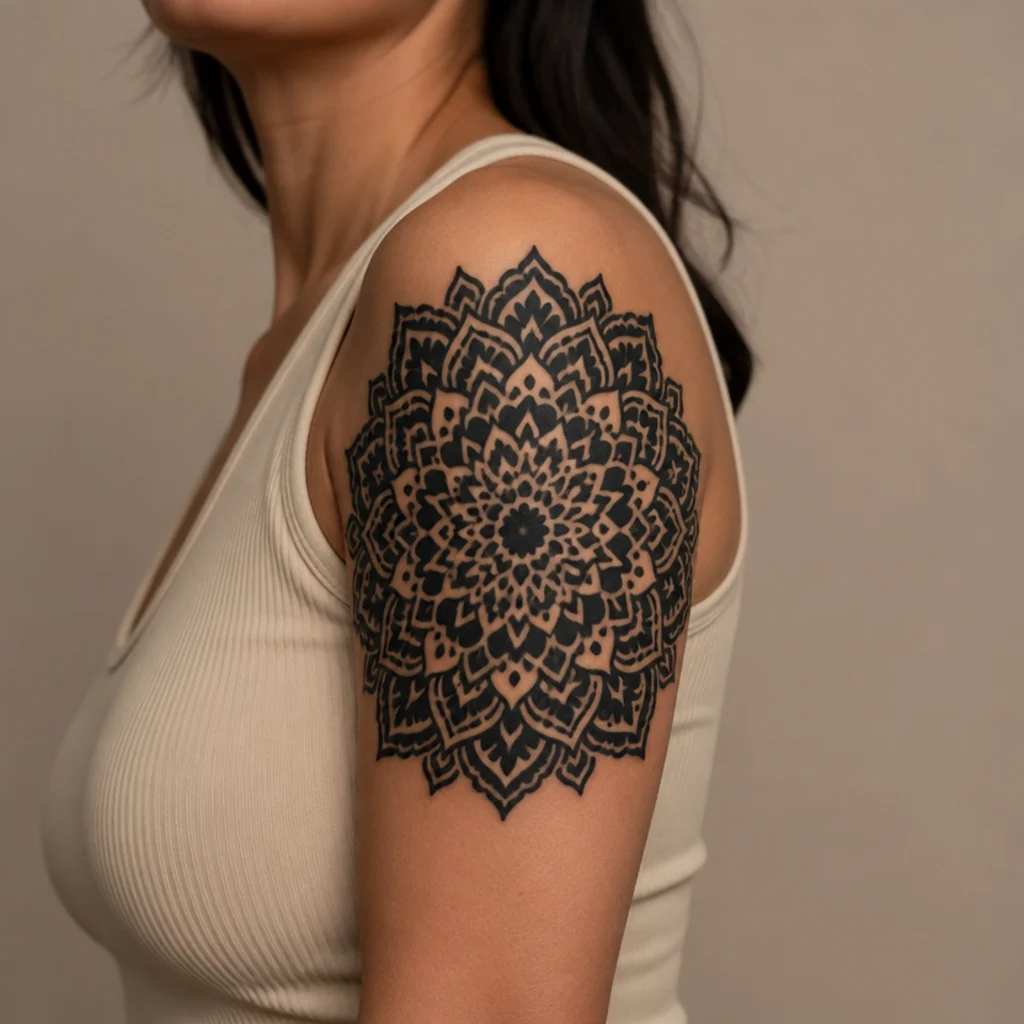
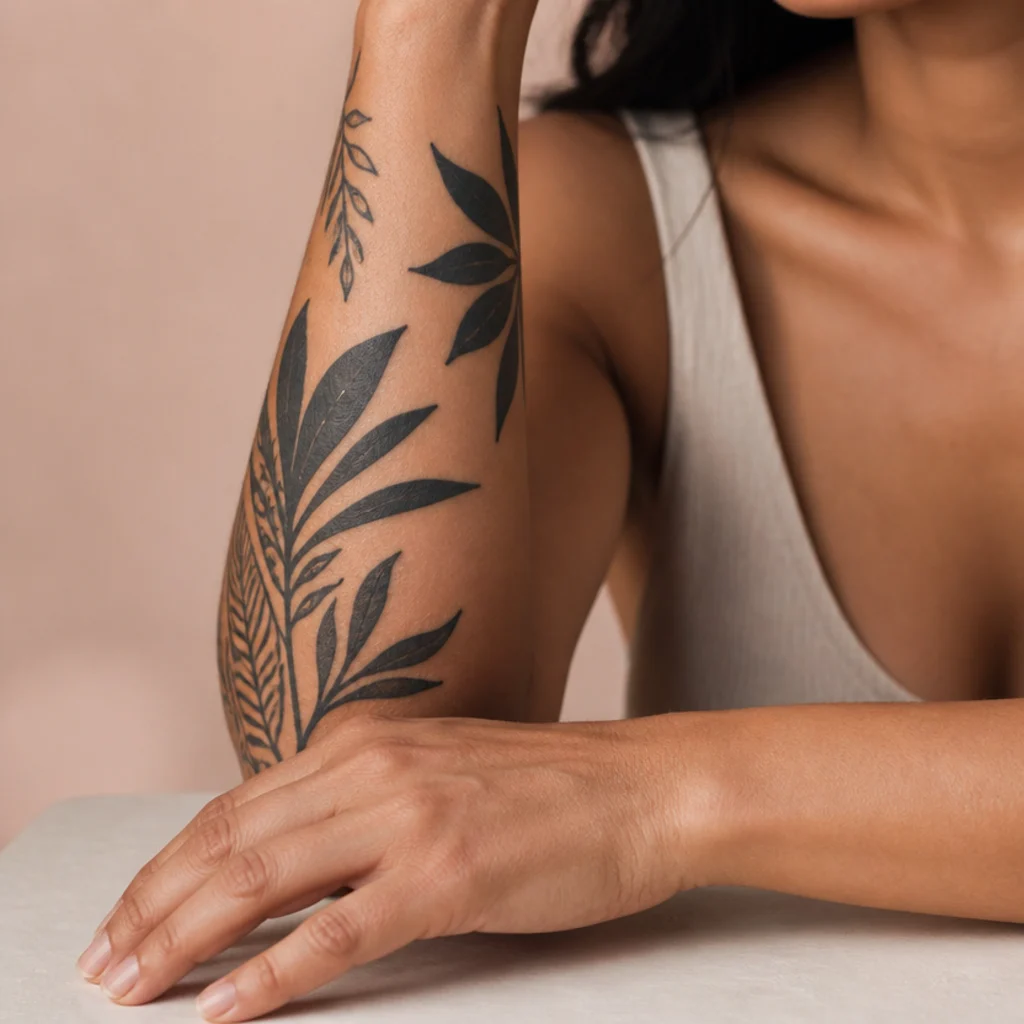
When the original is very dark or heavily saturated, black cover up tattoos are often the most honest solution, and a mandala is the most structured version of that approach. Instead of fighting old pigment, dense radial geometry and solid fill absorb it, using repeating rings of dotwork, linework, and blackout petals to turn stray shapes into deliberate pattern. The strict symmetry pulls the eye to a single center point, which reads as calm and intentional even over a chaotic base. The outer upper arm, shoulder blade, and outer thigh suit it best, where a true circle has room to sit without wrapping awkwardly. Upkeep is low once healed, since there's little delicate detail to fade, though large solid areas can occasionally need re-saturation. Difficulty runs high, so vet the portfolio specifically for clean, even black packing rather than general blackwork. Ask to place the mandala's center off the densest part of the old tattoo so the surrounding rings, not the vulnerable middle, do the heaviest covering, and ask your artist whether your existing piece needs a solid backing layer before the pattern goes on.
03Trailing Wildflower Half-Sleeve
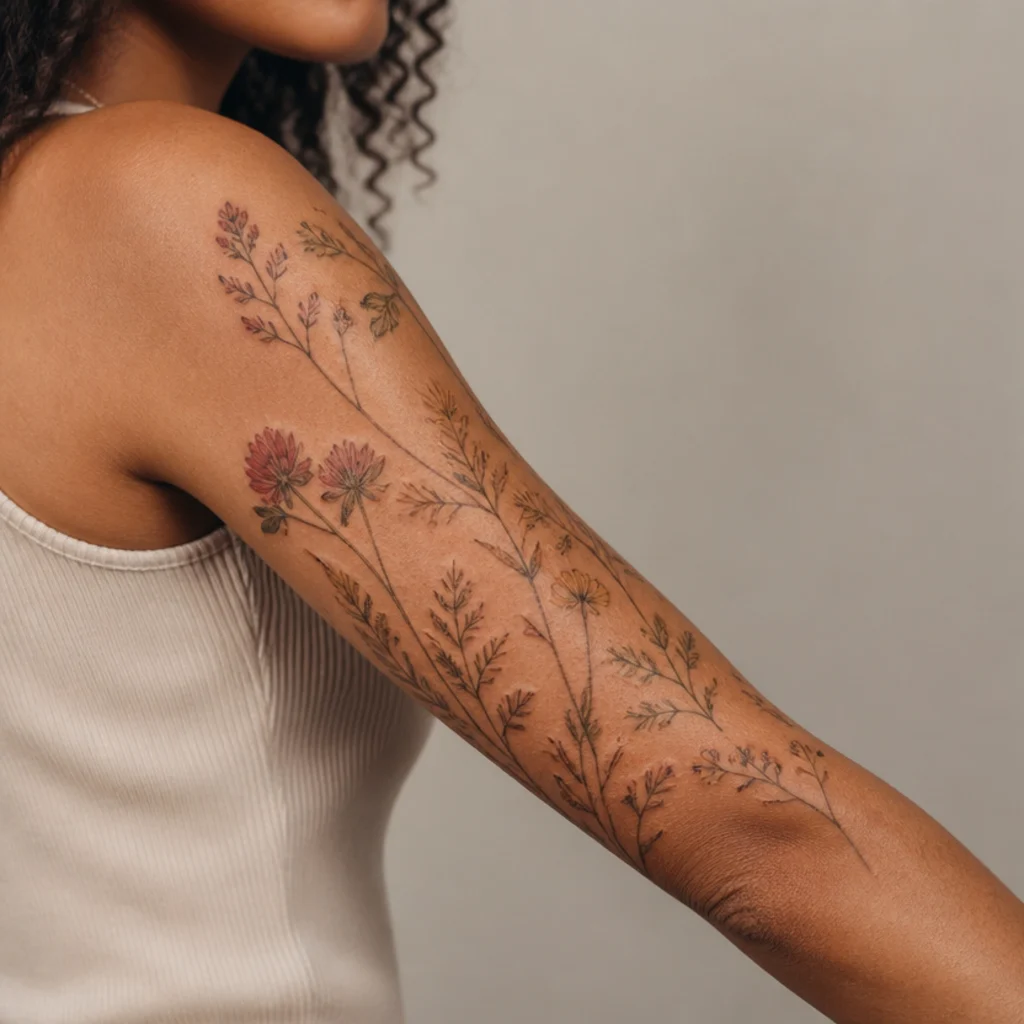
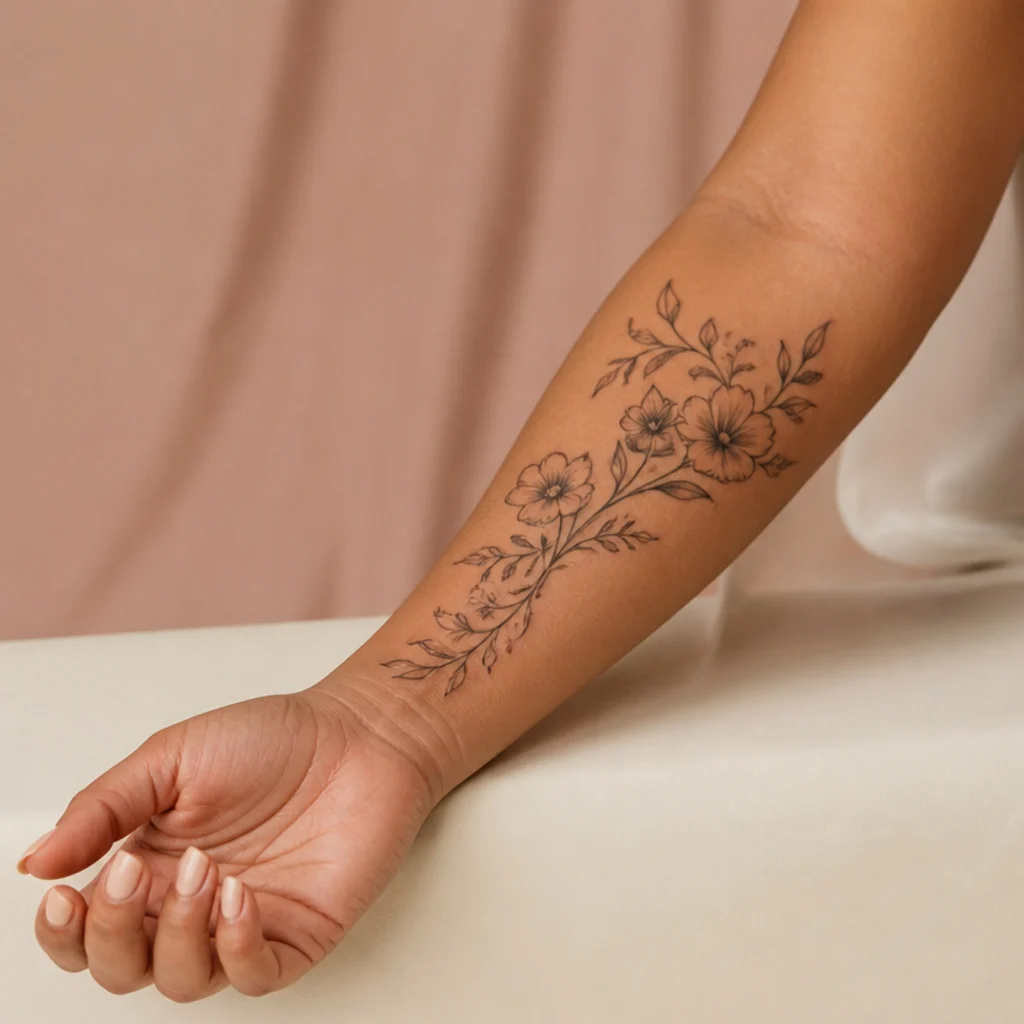
A trailing arrangement of wildflowers, buds, and thin stems works well when the old ink is scattered rather than one solid block. Instead of one large mass, this style threads several small points of interest, poppies, cosmos, forget-me-nots, along a meandering vine, so the artist can route heavier blooms directly over problem spots while negative space carries the eye between them. That flexibility makes it forgiving for irregular, patchy originals. Slimmer forearms and calves suit it especially well, since the vertical flow lengthens the limb, and it adapts across skin tones through adjustable line weight and either color or black-and-grey fill. It mixes fine linework with soft petal shading, so upkeep runs moderate; the thinnest stems and lightest tips fade first, usually within a few years. The composition also grows well over time, so you can extend it toward a full sleeve in a later session. Ask for the largest bloom to be positioned over the single most stubborn area, for buds rather than bare stems to cross any remaining dark lines, and have your artist plan the vine's flow around your existing piece before drawing the stencil.
04Watercolor Phoenix Rework
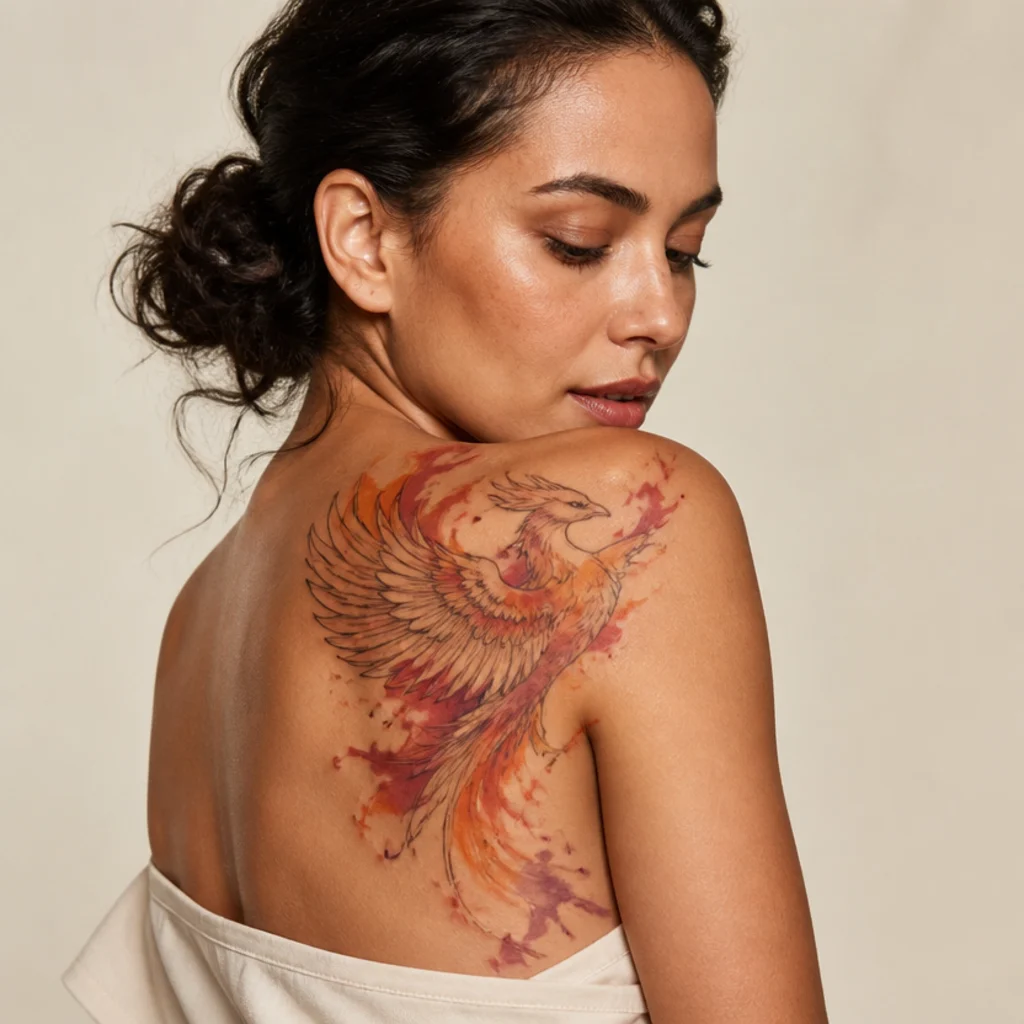
A phoenix suits a rewrite well, and watercolor styling adds movement that helps disguise older lines beneath painterly washes. Here's the catch: pure watercolor can't cover dark ink on its own. The loose orange, coral, and violet washes need a committed black or deep-sepia line structure underneath to carry the actual coverage. Done well, that inked skeleton redraws the wings and tail while the washes soften and update the surface. The shoulder cap, upper back, and outer thigh give the wings room to sweep. Watercolor needs more upkeep than bold traditional work, since soft, low-saturation washes lighten faster, so budget for a refresh within a few years. It's a strong pick for anyone who wants color and energy rather than a blackout or a dense floral. Request that the wing outlines and feather tips carry the strongest black, so the piece keeps its structure as the washes inevitably fade, and ask your artist exactly how much underlying line work they'll add, since that hidden framework is what determines whether the cover holds.
05Dark Rose and Thorn Wrap
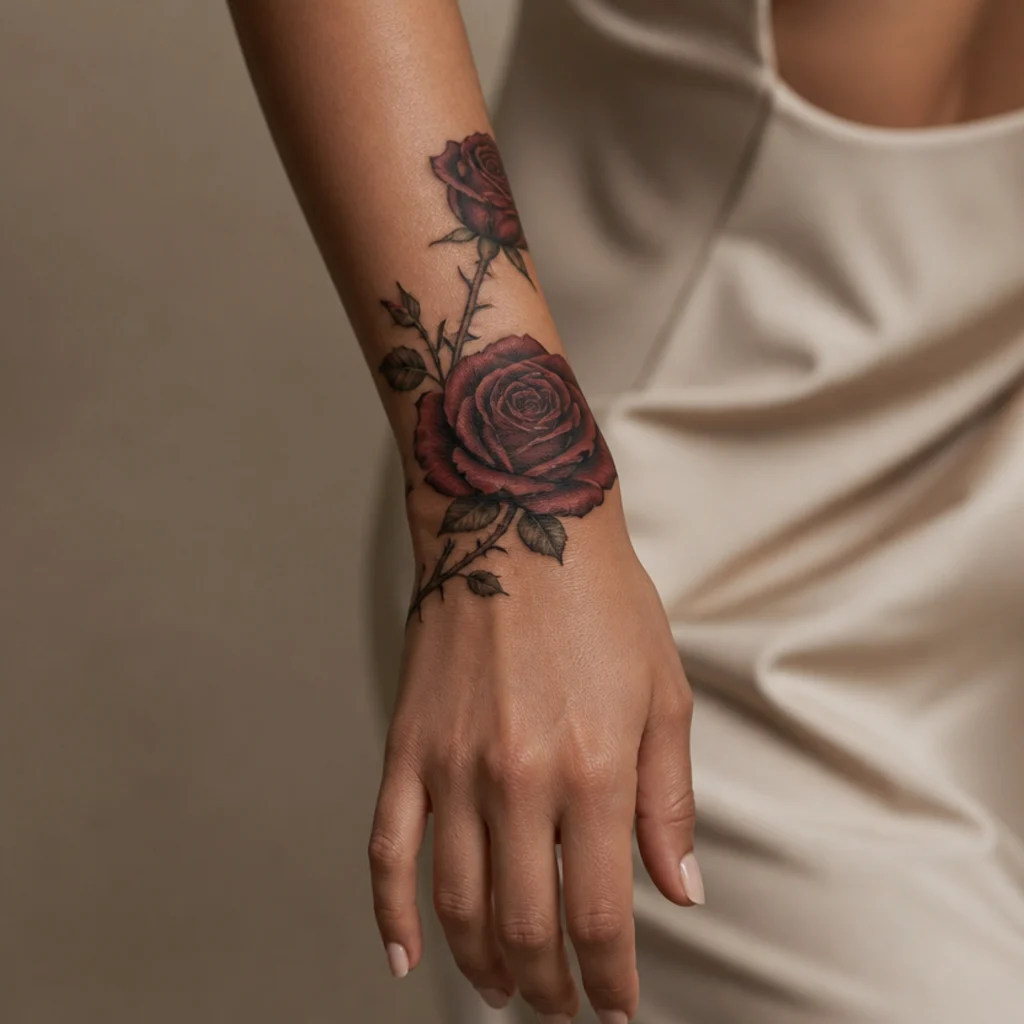
Roses are a cover-up classic for good reason, and a wrapping cluster with a winding thorn stem plays to the wrist and forearm's natural curve. The dense bud centers give an artist deep burgundy, wine, and near-black pockets to bury the worst of an old design, while the thorned stem provides a continuous line to travel between blooms and connect coverage all the way around the limb. That depth of shadow makes it one of the more forgiving black cover up tattoos for stubborn pigment without committing to a full blackout. It works across most skin tones and looks polished on both petite and fuller arms, since the scale of each rose can be tuned to the limb. Upkeep sits at moderate, focused on keeping the shadowed centers rich as the surrounding mid-tones settle, and the design extends well if you later want the vine to climb higher. Ask for at least one fully rendered, near-black rose to sit squarely over the densest original ink, with half-open buds handling the lighter edges, and have your artist map the wrap directly on your skin so the blooms land over the heaviest areas.
Save this to Pinterest so you can compare floral and blackwork options side by side.
06Ornamental Lace Shoulder Piece
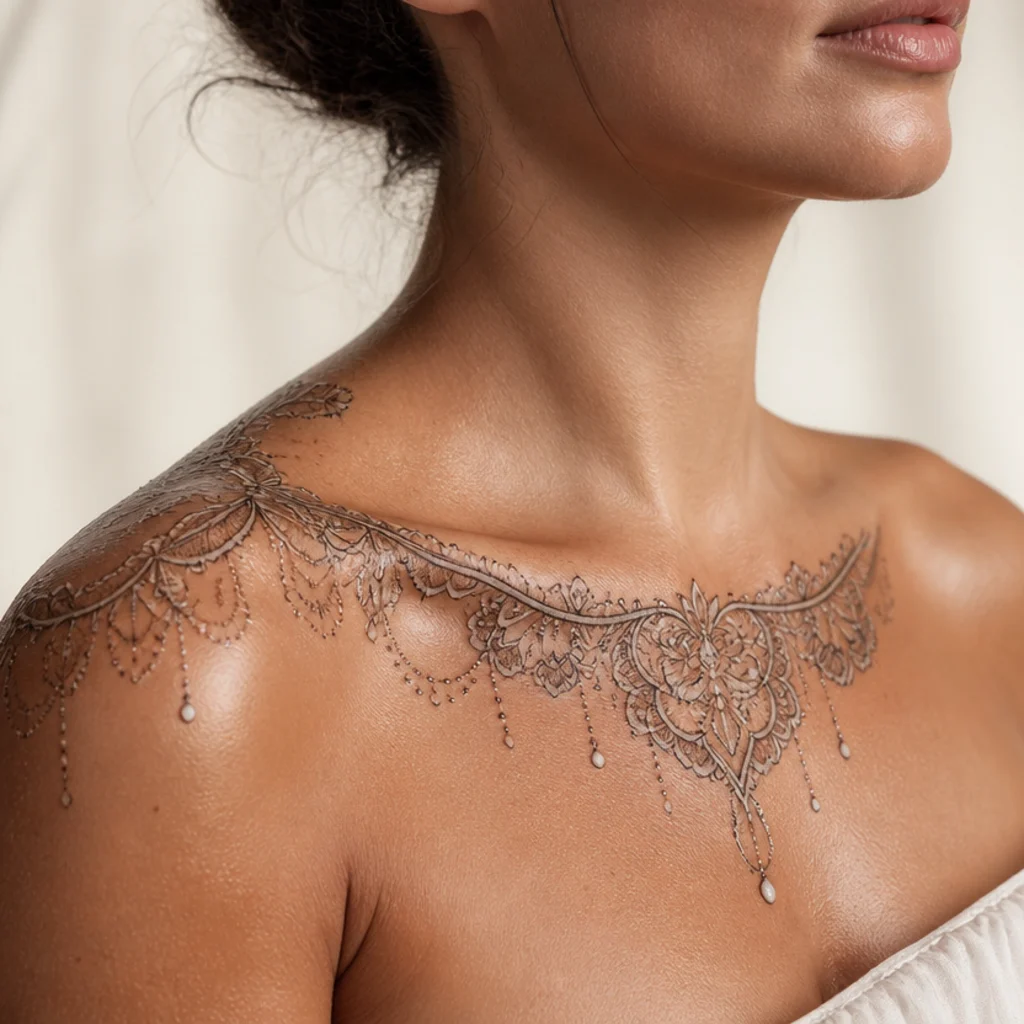
Ornamental lace uses filigree, dotwork, and delicate pearl-like accents to create a decorative drape across the shoulder and collarbone. Its power for cover-ups is misdirection: the repeating, rhythmic pattern gives the eye a clear path to follow, reading as the subject rather than something hiding old lines. Strands of beading and swag can also be routed to trace and interrupt the original's contours. This works well for anyone who wants something feminine and structured instead of a single bold image, and it flatters the rounded curve of the shoulder and the top of the back especially well. Because it leans on fine detail, upkeep runs moderate to high; crisp filigree and the finest dots can soften within a few years and need periodic touch-ups. Ask for a few heavier anchor motifs, a solid teardrop pearl or a filled medallion, placed over the darkest old spots, since airy lace alone won't fully hide saturated ink, and check with your artist how dense the pattern needs to be to cover your specific piece before finalizing the drape.
07Koi and Water Ripple Flow
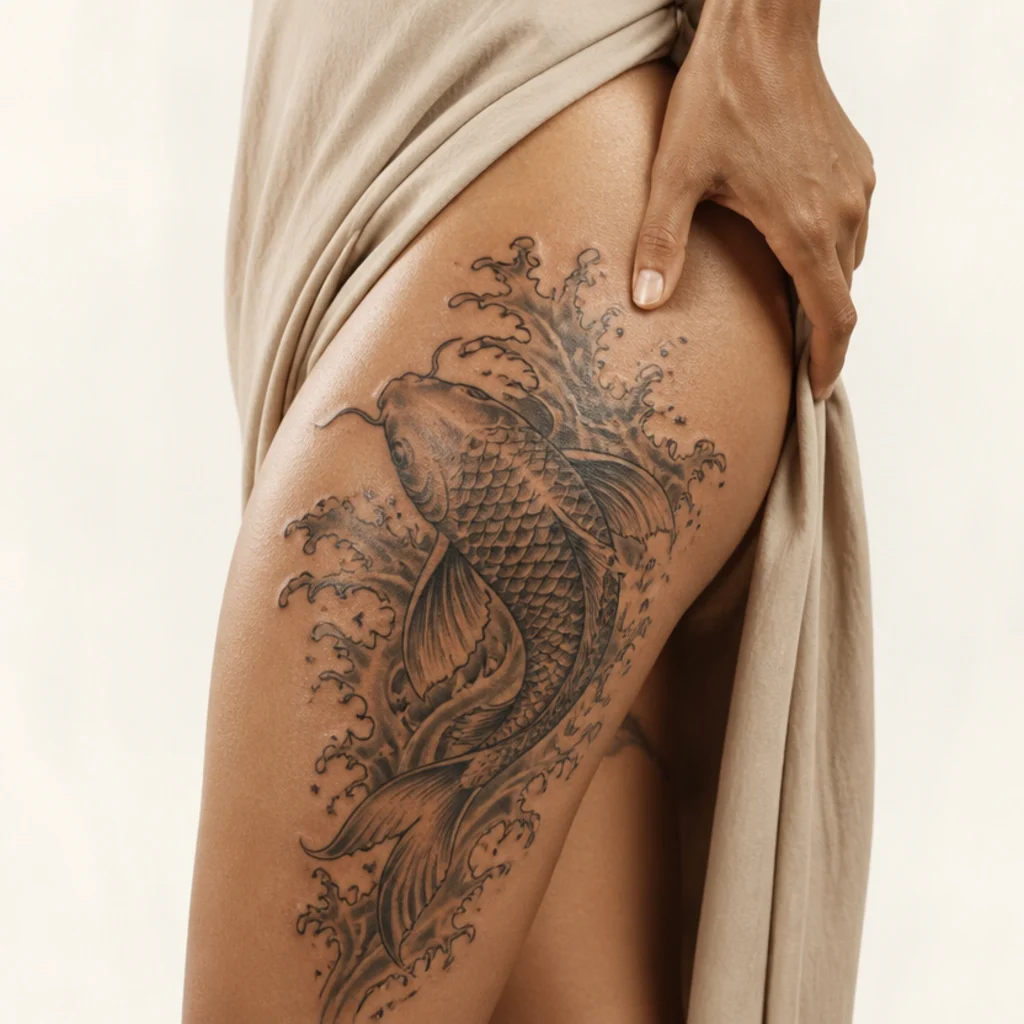
A koi swimming through stylized water is a large-format favorite, because the surrounding ripples, splashes, and current give an artist near-endless texture to work with. Those swirling elements, finger-wave water lines, foam, and spray, are ideal for breaking up and absorbing an irregular old tattoo, since they justify dark, busy passages anywhere coverage is needed. The koi becomes a strong shape to anchor the eye, while the water does the quiet work around it. The outer thigh, calf, and upper arm give the design room to flow in one direction along the limb. Both full color and black-and-grey work, so it adapts to your palette and skin tone. Upkeep is moderate, concentrated in the fine ripple lines that thin over time, though the sense of motion keeps the piece feeling alive rather than static or patched. Ask for the densest whitewater and wave crests to be routed directly over the old ink, letting the fish sit in cleaner skin so it stays crisp, and confirm the swim direction and sizing with your artist so the current naturally covers the areas you want gone.
08Moth and Moon Back Piece
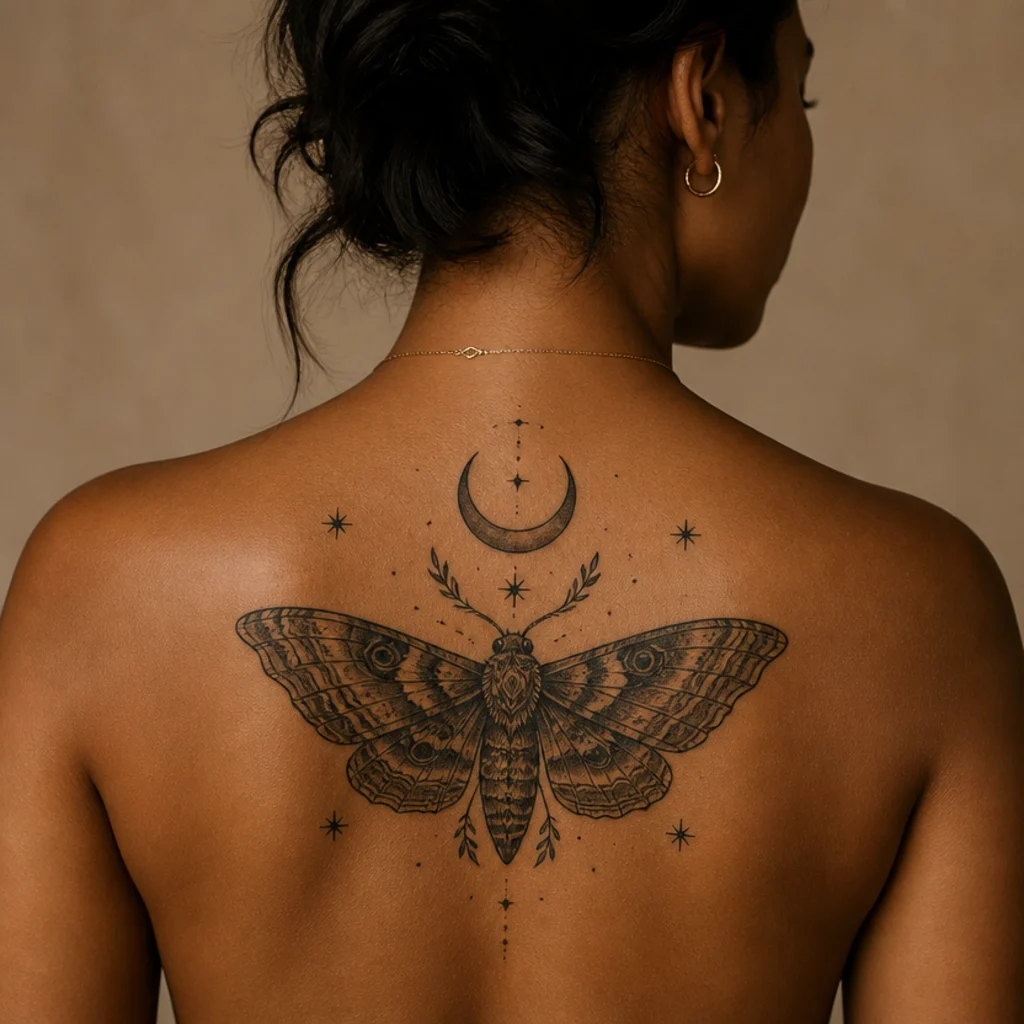
A large moth with detailed wings, paired with a crescent moon and scattered stars, makes a striking centerpiece for the upper back. The wings' bilateral symmetry mirrors the body's own, which reads as balanced and deliberate, and their patterned fill, eyespots, veining, and gradient dusting, works well for hiding old ink inside the design. Broad placements like the space between the shoulders, along the spine, or the sternum suit anyone wanting something bolder and more central. Upkeep sits at moderate on the fine wing detail and the softest gradients. The motif reads as quiet and celestial rather than loud, which suits anyone covering an old piece they'd rather not draw attention to. Ask for the heaviest wing patterning and the darkest body to be positioned over the original, using the lighter wing edges to fade into clean skin. Back pieces are a real investment of time, so ask your artist for a full stencil fitting so the moth sits squarely over the existing tattoo before any needle touches skin.
09Name-Over Botanical Script Swap
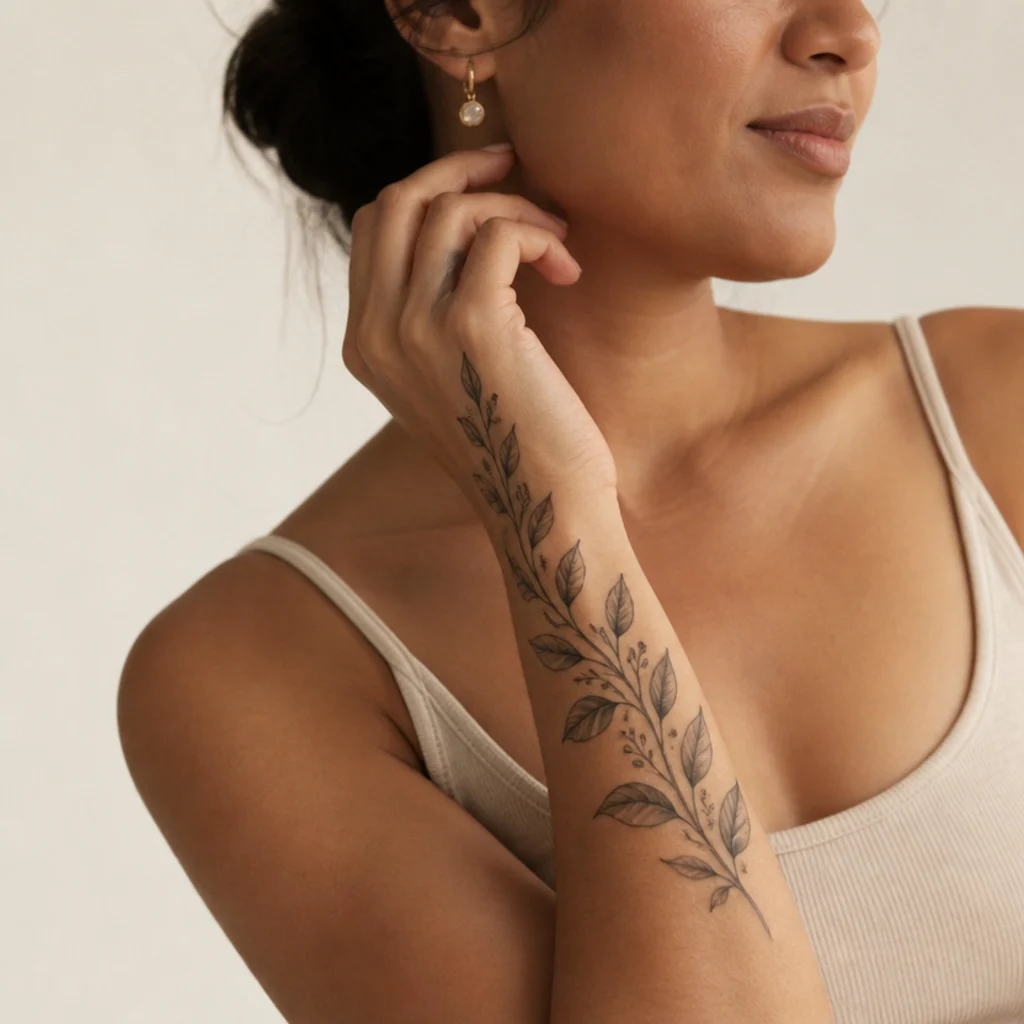
Old lettering is one of the most common reasons people book a rewrite, and name cover up tattoos almost always work best when the words are replaced with organic shapes rather than more text. Script is uniquely hard to hide, because the brain recognizes letterforms even faintly, so the strategy is disruption: a band of leaves, small buds, and a flowing branch routed directly across the baseline and x-height of the old letters, with foliage crossing every vertical stroke to break up the recognizable pattern. This lives well on the inner forearm, wrist, and ribs, where script most often sits. Upkeep is moderate, mainly on thin stems and fine leaf tips. Handled well, it lets you move on from a name without the result announcing that a cover-up happened at all. Ask for the darkest leaves or a solid bud to sit over the ascenders and descenders, the tall loops and tails that are hardest to bury, and ask your artist how tall the botanical band needs to be, since letters with long descenders can need extra height for full coverage.
10Scar-Softening Fern Spread
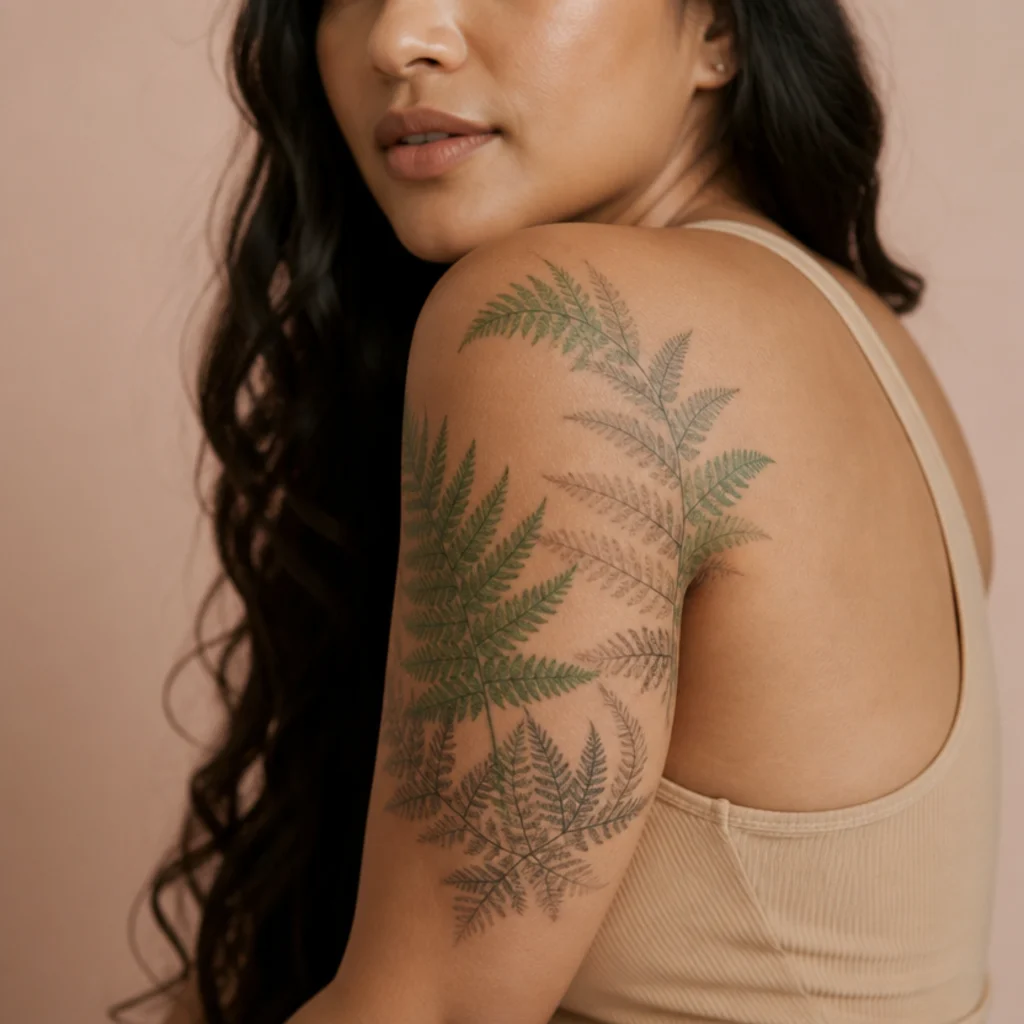
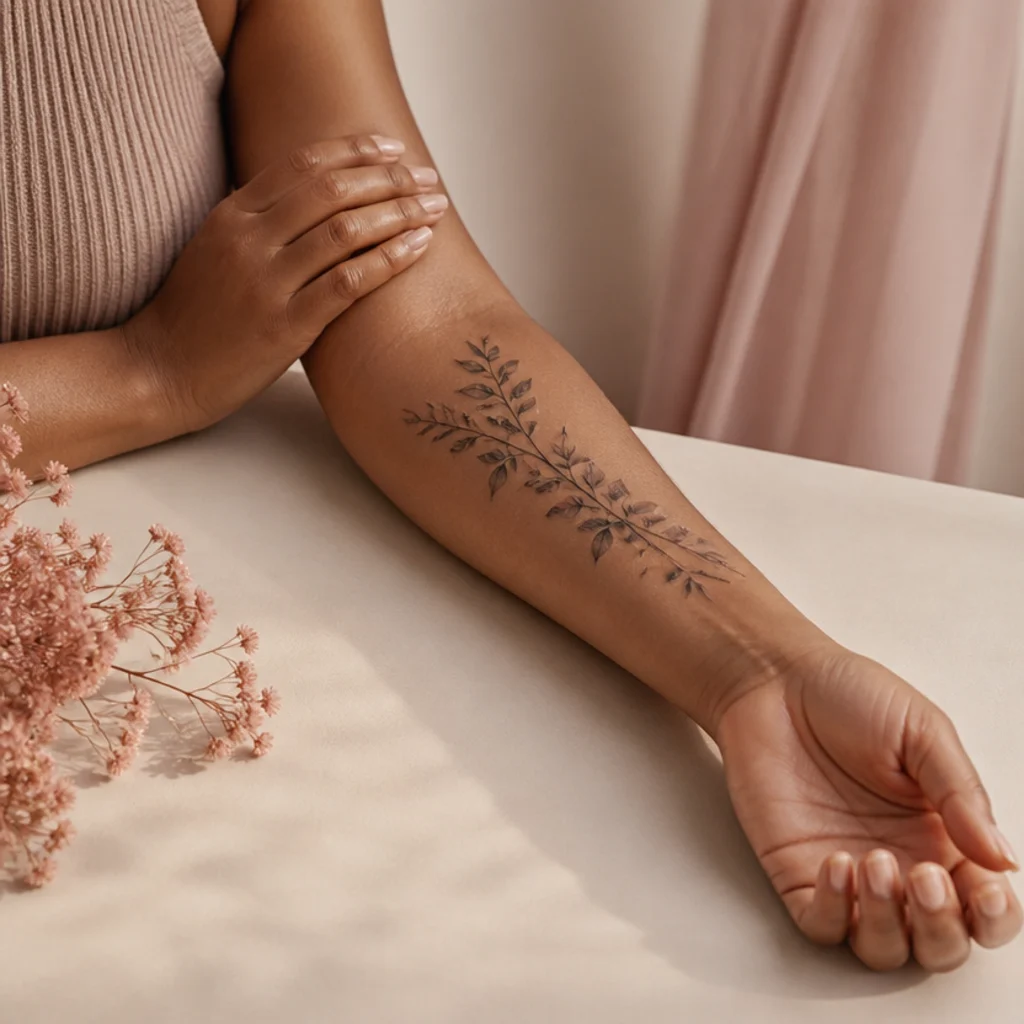
For textured skin, scar cover up tattoos call for extra care and a design that works with the surface rather than against it. A spreading fern with soft, feathery fronds distracts from uneven texture by adding gentle, organic movement, and its irregular, naturally varied form forgives a surface that won't take ink perfectly evenly. Ferns suit the shoulder, upper arm, and forearm and adapt to almost any skin tone through adjustable green or black-and-grey tones. Scarred skin heals and holds pigment differently, so upkeep is unpredictable and touch-ups are common, sometimes built into the original plan rather than added later. This is the design on the list that most rewards planning slowly. Ask about a small test spot or a patch session so your artist can see how that specific scar tissue takes ink before committing to the full spread. A licensed tattoo artist has to assess the scar in person to judge maturity, texture, and placement, and mature scars, generally well past a year of healing, tend to respond better. Don't assume a tattoo will fully hide a scar; the realistic goal is to soften and distract.
Save this to Pinterest so your artist can see your favorite coverage styles at a glance.
11Neo-Traditional Songbird Panel
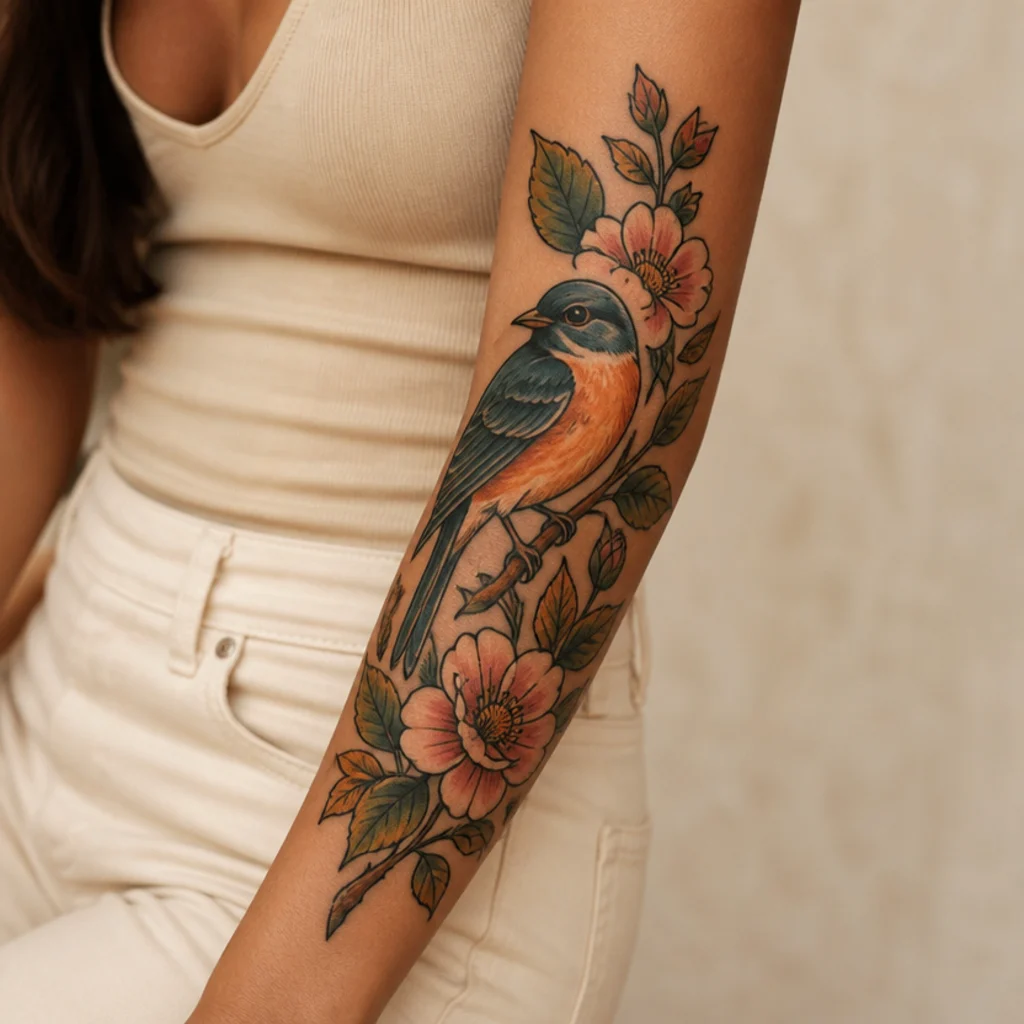
Neo-traditional style pairs bold black outlines with rich, saturated color, which makes it a genuine workhorse for covering older ink. The confident linework physically redraws the space, giving the eye strong new structure to lock onto, so a songbird perched among blossoms overwrites the original rather than layering weakly on top of it. Saturated jewel tones, deep teal, oxblood, mustard, then fill and update the surface. The forearm, calf, and thigh all suit it, and it holds up well on deeper and lighter skin tones alike, since those defined outlines carry the design even where color reads differently. Upkeep runs relatively low, since bold outlines age well and resist the blurring that plagues fine work. This is a solid middle ground between soft florals and heavy blackwork for anyone who wants color without a blackout. Ask for the bird's body and the darkest wing feathers to fall over the heaviest old pigment, since a solid, saturated mass covers far more effectively than open color, and ask your artist which specific tones cover your existing ink best — warm, dense colors outperform pastels.
12Geometric Blackout Band
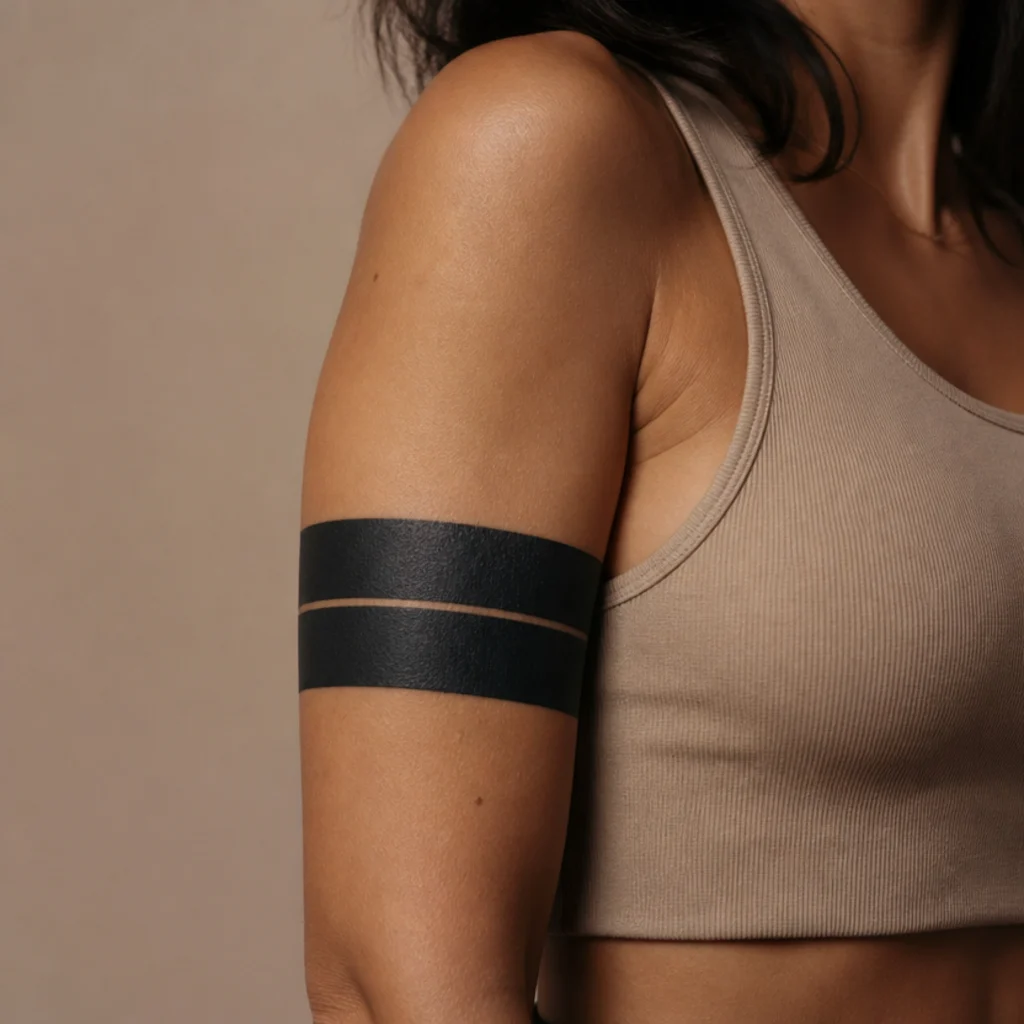
Sometimes the cleanest solution is a modern blackout band. Solid black ink wraps the arm or leg in a bold, even stripe that fully absorbs whatever was there before, no motif required. Contemporary versions add a thin negative-space line, a small geometric window, or a subtle textured border so the piece reads as designed rather than just erased. This is the most decisive of the black cover up tattoos and suits anyone drawn to minimal, graphic, high-contrast looks. Upkeep is low once fully healed, though large solid fields can occasionally need re-saturation where the body absorbs pigment unevenly, and it typically takes more than one pass to lay down fully opaque black. The upper arm, wrist, and calf work well, where a clean band circles the limb. Plan the band's width to fully clear the top and bottom edges of the old tattoo, since ink peeking past a blackout is far more obvious than the original ever was, and because blackout demands dense, even coverage, confirm with your artist that your existing ink and skin are good candidates before booking — heavily scarred or previously lasered skin can take solid black poorly.
13Dotwork Lunar Landscape
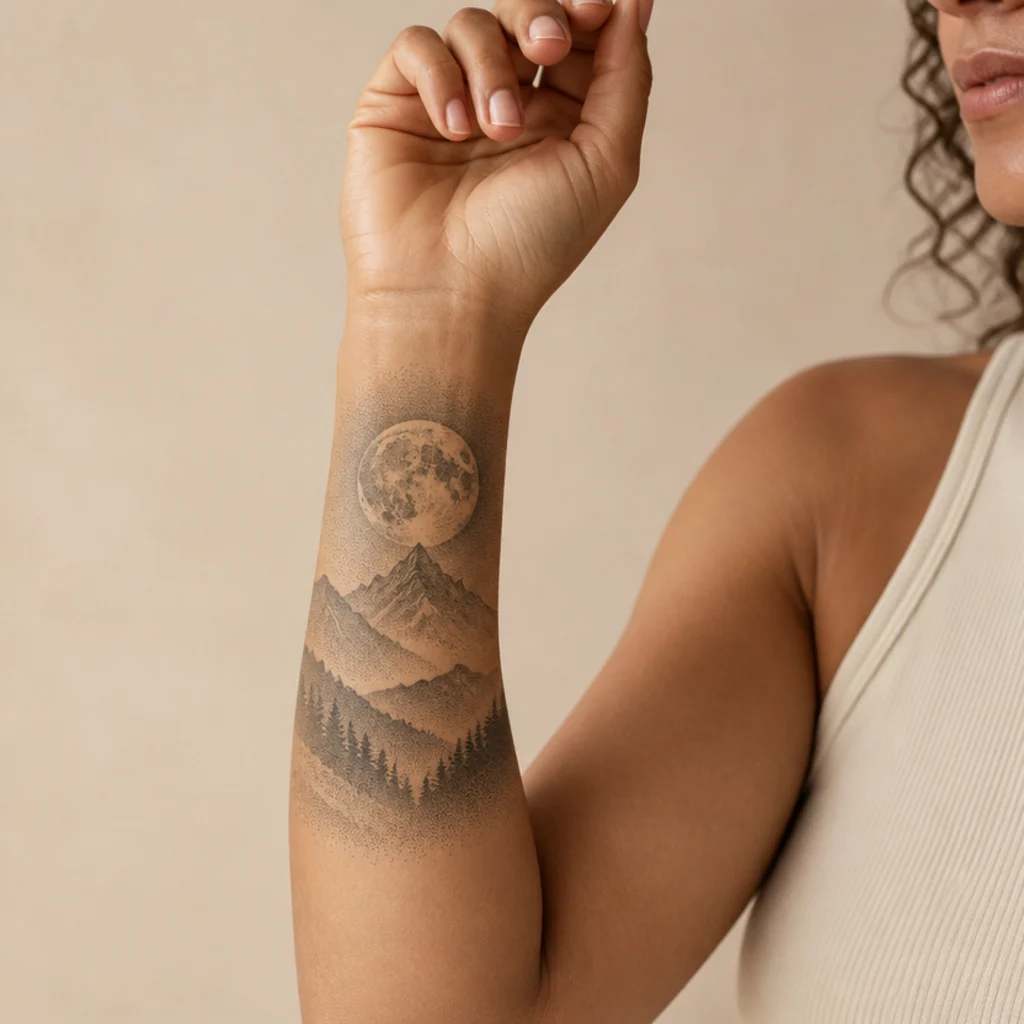
A dotwork scene of a full moon over layered mountains uses thousands of tiny stippled points to build shading and depth. That granular texture works quietly well for cover-ups, since it blends gradually into surrounding skin with no hard border to give away a patch, softening old edges as the density fades outward. The inner forearm, thigh, and upper back suit it, and it looks especially elegant in soft, cool grey. The trade-off is time and coverage strength: dotwork is slow to apply, and light stippling alone can't hide saturated ink, so the darkest passages have to be packed dense enough to overpower the original. Plan for moderate upkeep, since the lightest points are the first to drop out over a few years. The finished piece feels calm and illustrative rather than heavy or graphic. Ask for the moon's shadowed craters and the mountains' darkest faces to be positioned over the old ink, using those naturally dense areas to carry the coverage, and ask your artist how dark the densest zones need to go to cover your original, since airy dotwork on its own may not fully hide it.
14Vintage Fan and Peacock Feather
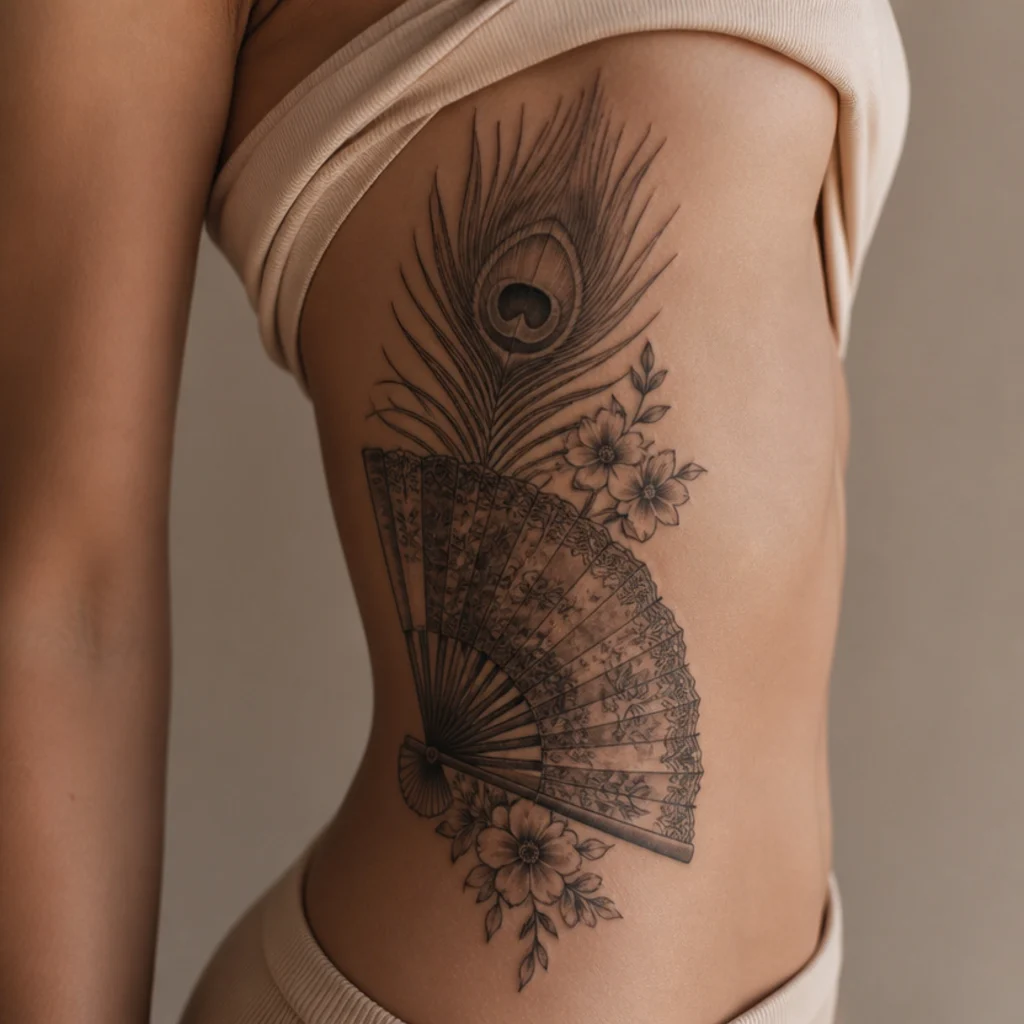
An open vintage fan paired with a peacock feather creates a long, elegant vertical shape suited to the ribs, spine, or outer thigh. The feather's iridescent eye and the fan's pleated ribs offer built-in pattern and dense shading, so disguising old ink becomes part of the ornament rather than a fight against it. It works for anyone who wants something ornate and elongated rather than a round centerpiece, and the vertical form flatters the side of the body naturally. Color versions lean glamorous with teal and gold, while black-and-grey feels classic and reads more subtle. Upkeep is moderate, concentrated along the fine feather barbs and the thinnest fan lines. Ask for the feather's dark eye and the fan's most heavily shaded folds to sit over the worst of the original, letting the delicate barbs trail off into clean skin. Ribs are among the more sensitive placements and can need longer sittings, so ask your artist to plan session length and sizing so the coverage stays comfortable and complete rather than rushed.
15Layered Dahlia and Foliage Thigh Piece
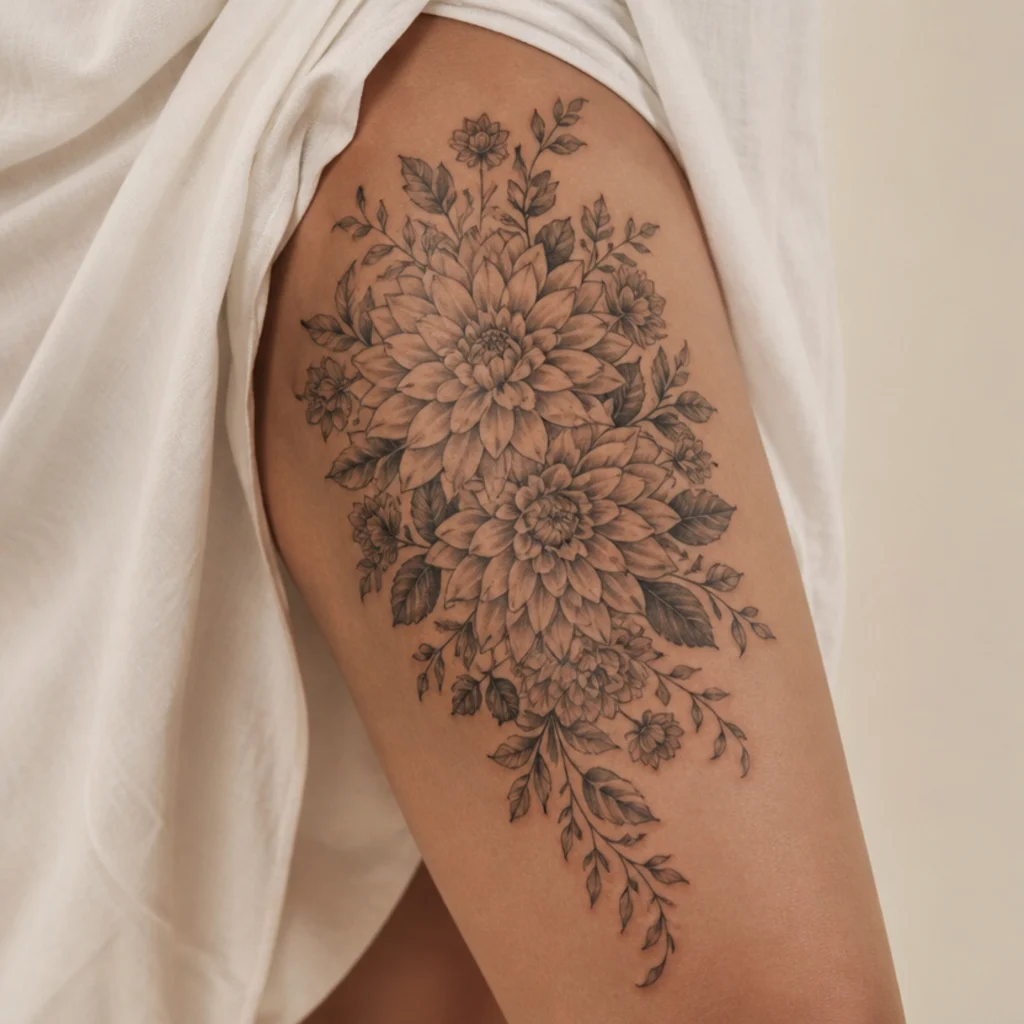
For maximum coverage, a cluster of layered dahlias surrounded by trailing foliage fills the thigh with real dimension. The dahlia's tightly stacked, geometric petals create dozens of small natural shadow pockets, so the design can swallow even dark, stubborn ink across a large area, while leaves and buds extend outward to soften the border into clean skin. The thigh, hip, and back of the calf all work, and it holds up across skin tones with tunable shading, warm and blush for a softer read or deep and cool for more drama. This is a bigger commitment, usually across multiple sessions, so plan for moderate upkeep on the finer botanical detail once it's finished. It's a solid pick for anyone ready to fully reimagine an old piece rather than just patch it. Ask for the two densest dahlia centers to be placed over the darkest regions of the original, and for foliage rather than empty background to bridge any gaps between blooms. Ask your artist to confirm how many sessions your specific coverage will realistically need before you schedule.
Pro Tips from the Editor
- Bring the actual piece, not just photos. An artist needs to judge true pigment depth, any raised scar tissue, and how the old ink sits under different light before committing to a design.
- Ask for value maps, not just pretty references. A good cover-up brief specifies where the darkest elements must land, since coverage comes down to contrast placement, not motif choice.
- Favor busy, high-texture styles over flat or minimal ones. Layered florals, blackwork, koi water, and dotwork carry the shadow a cover needs; single fine-line images almost never do.
- Consider one to two laser lightening sessions first if the original is very dark. Even partial fading dramatically widens your design options and can mean a smaller, less black cover.
- Always review healed cover-up work in a portfolio, not fresh photos. Color settles, contrast drops, and old ink can ghost back over months, so healed results tell the real story.
- Match placement to longevity. Bold outlines and solid blackwork on the outer arm age slowest; fine shading on high-friction spots like the inner wrist or hands fades soonest.
- Budget for a touch-up from the start. A settling appointment a few months after healing is normal for large covers and is often included, so ask before you book.
| Cover-up style | Best over | Coverage strength | Upkeep | Suits placement |
|---|---|---|---|---|
| Bold peony / dahlia floral | Medium-dark, irregular ink | High | Moderate | Forearm, thigh, shoulder |
| Blackwork mandala / blackout | Very dark, saturated ink | Very high | Low | Upper arm, thigh, calf |
| Neo-traditional color | Medium old pigment | High | Low to moderate | Forearm, calf, thigh |
| Watercolor (inked base) | Light to medium ink | Moderate | High | Shoulder, upper back |
| Dotwork / fine ornamental | Light to medium ink | Moderate | Moderate to high | Inner forearm, shoulder |
| Fern / botanical over scar | Textured or scarred skin | Variable | Unpredictable | Shoulder, upper arm |
How to Choose / Get the Look
Start by being realistic about your existing ink, because the original dictates the options, not the other way around. Bring clear, well-lit photos and the actual piece to your consultation so a licensed tattoo artist can gauge how dark, faded, or textured it is, then work outward from there. First, assess darkness: very saturated black or heavy old color usually points you toward blackwork, blackout, or deep-toned florals, while lighter, faded pieces open the door to color, watercolor over an inked base, or dotwork. Second, decide how much you want to hide the fact that this is a cover-up at all; organic florals and botanicals hide the seam best, while a blackout band openly reads as a bold new statement. Third, match the motif to the shape of the problem — flowing half-sleeves and vines for scattered ink, a single large bloom or mandala for one concentrated mass. Cover-ups typically run larger and darker than the original, so even people hoping for small cover up tattoos may end up with a bigger design for full coverage, and one or two laser lightening sessions beforehand can meaningfully shrink what the cover has to hide. Ask to see healed cover-up work in the portfolio, not just fresh photos, since color settles and contrast drops over time. Discuss placement, sizing, session count, and touch-up expectations up front, and for scar-adjacent pieces ask specifically about texture, healing maturity, and how the skin may take ink. Don't expect any design to fully erase an existing tattoo or scar; the goal is to change and disguise it, and your artist is the only person who can confirm what's achievable on your skin.
Frequently Asked Questions
Do cover-up tattoos have to be bigger than the original?
Usually, yes. An artist needs extra room to place darker or busier elements over every dark area of the old design, which almost always means expanding the footprint. Even small cover up tattoos tend to grow during planning so there's enough contrast and texture to achieve full, convincing coverage rather than a faint ghost of the original showing through.
Can a tattoo completely hide old ink?
Not always. A skilled artist can disguise a great deal, but very dark, saturated, or previously touched-up pieces may still show faintly, especially as the new work heals and settles. One to two laser lightening sessions beforehand dramatically improve results on stubborn ink. A licensed tattoo artist can tell you what's realistic for your specific tattoo when they see it in person.
What styles work best for covering dark tattoos?
Dense blackwork, blackout bands, and deep-toned florals like peonies and dark roses are among the most effective black cover up tattoos because they use solid, saturated ink to absorb old pigment rather than compete with it. High-texture styles such as koi with water or packed dotwork also work, since their busy shadow areas can be routed directly over the heaviest original ink.
Are cover-ups a good option over scars?
Sometimes, with care. Scarred skin heals and holds ink differently, so scar cover up tattoos require an in-person assessment and often a small test spot first. Artists generally prefer scars that are mature, typically well past a year of healing and no longer raised or discolored. Your artist will judge texture, maturity, and how the skin takes pigment before recommending a soft, forgiving design, never a promise of full concealment.
How do I cover up an old name tattoo?
Replacing letters with organic shapes works best. Foliage, blooms, or a flowing branch routed across the baseline, with leaves crossing every vertical stroke, interrupts the letterforms your eye would otherwise still recognize, which is why name cover up tattoos so often become botanical bands. Letters with tall ascenders or long descenders may need extra height so the design can bury those distinctive loops and tails completely.
How long does a large cover-up take to complete?
Plan for more than one session. Large covers frequently need two to four appointments spaced weeks apart to lay down dense coverage, allow healing between passes, and refine detail, and blackout or heavily packed pieces often require an extra saturation pass. Your artist will estimate session count and spacing at the consultation once they've assessed the original and the size of the new design.
Will laser removal make my cover-up easier?
Often, yes. Even partial laser lightening reduces how much old pigment the cover must overpower, which can mean a smaller, less black, or more colorful design than would otherwise be possible. Many people do one to three laser sessions, then cover the faded remainder. Ask both your tattoo artist and a reputable laser provider whether pre-lightening is worthwhile for your specific piece.
Do cover-up tattoos fade faster than regular tattoos?
The cover itself ages like any tattoo, but style matters. Bold outlines and solid blackwork hold longest, while fine shading and soft watercolor washes lighten sooner and may need a touch-up every few years. The bigger risk is old ink ghosting back as the new work settles, so choosing a durable, high-contrast style and following aftercare closely helps the cover stay convincing.
How much do large cover-up tattoos cost?
Costs vary widely by region, artist experience, size, and session count, so treat any figure as a range rather than a quote. Large custom cover-ups usually sit at the higher end of a studio's hourly or day rate because they demand more design time and denser work than fresh ink. Ask for a written estimate covering the full project, including any planned touch-up, at your consultation.