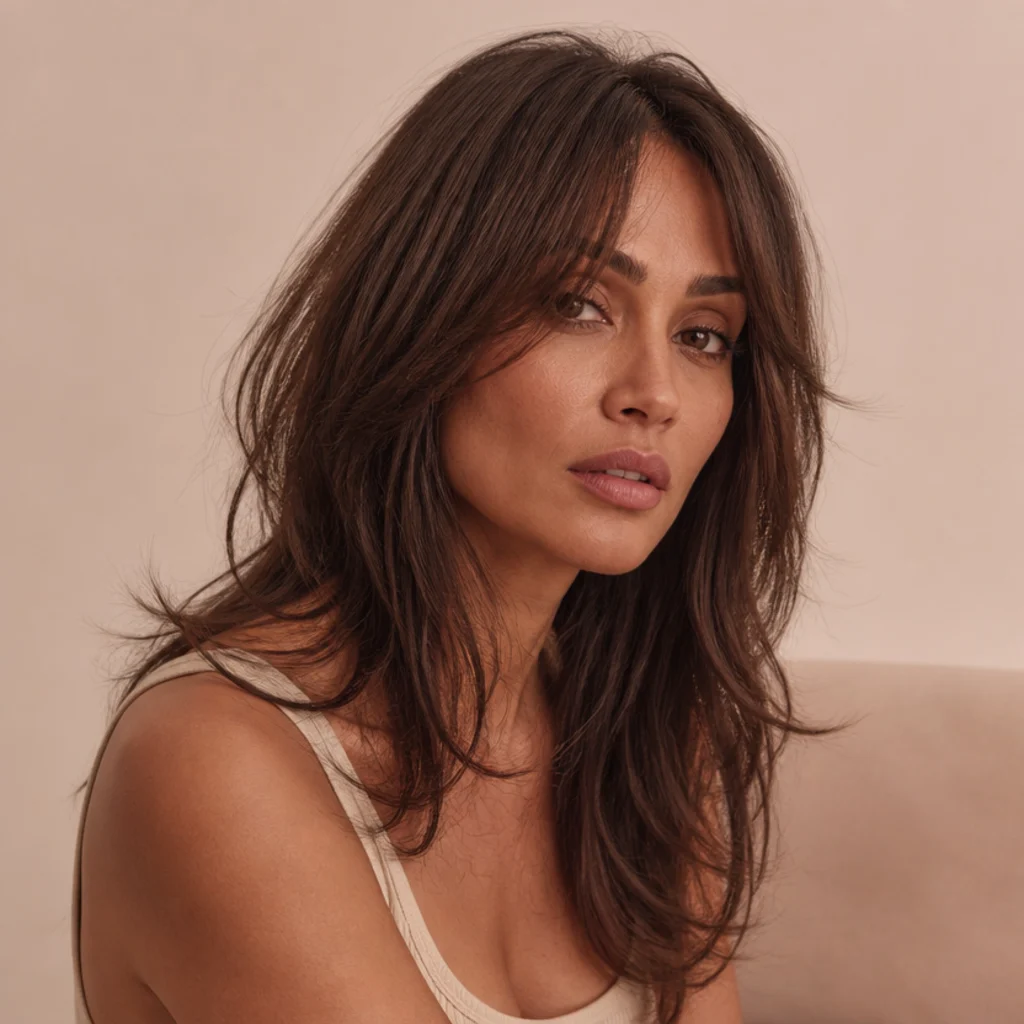
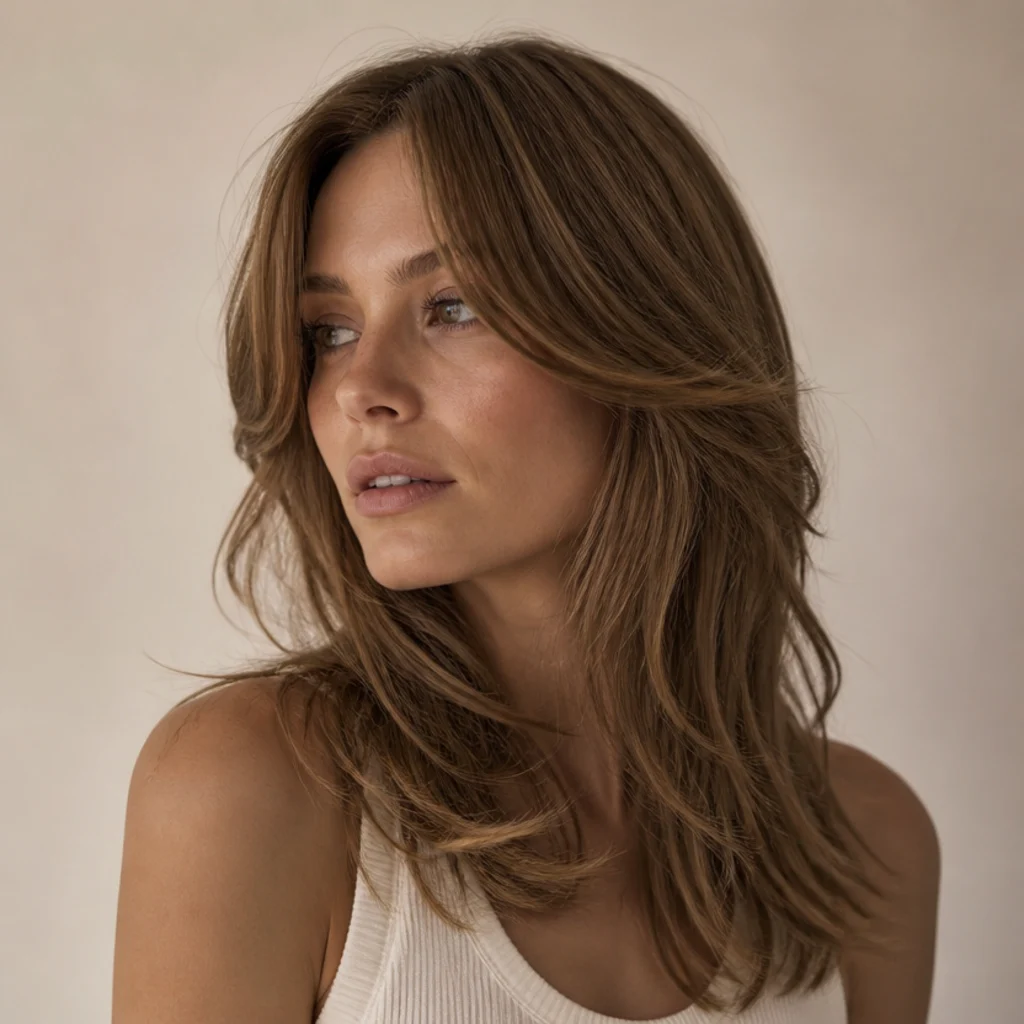
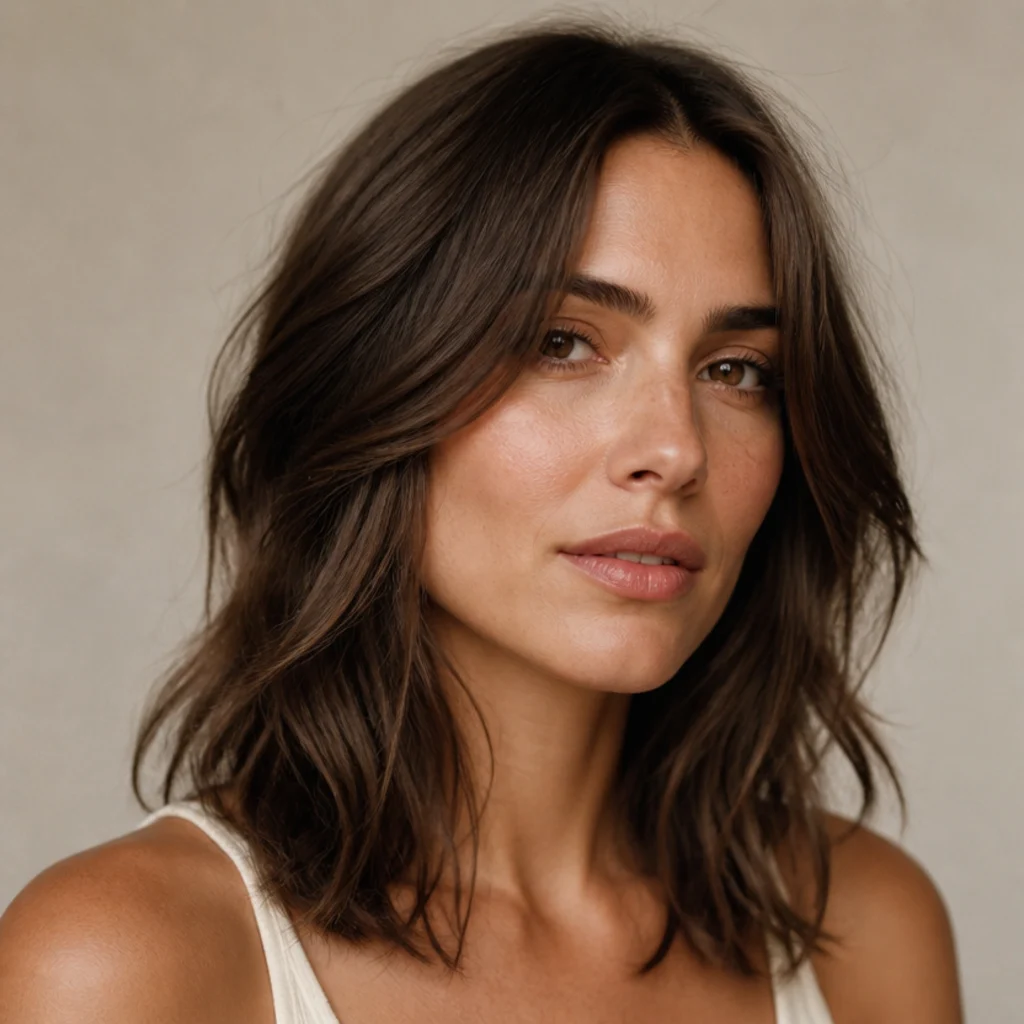
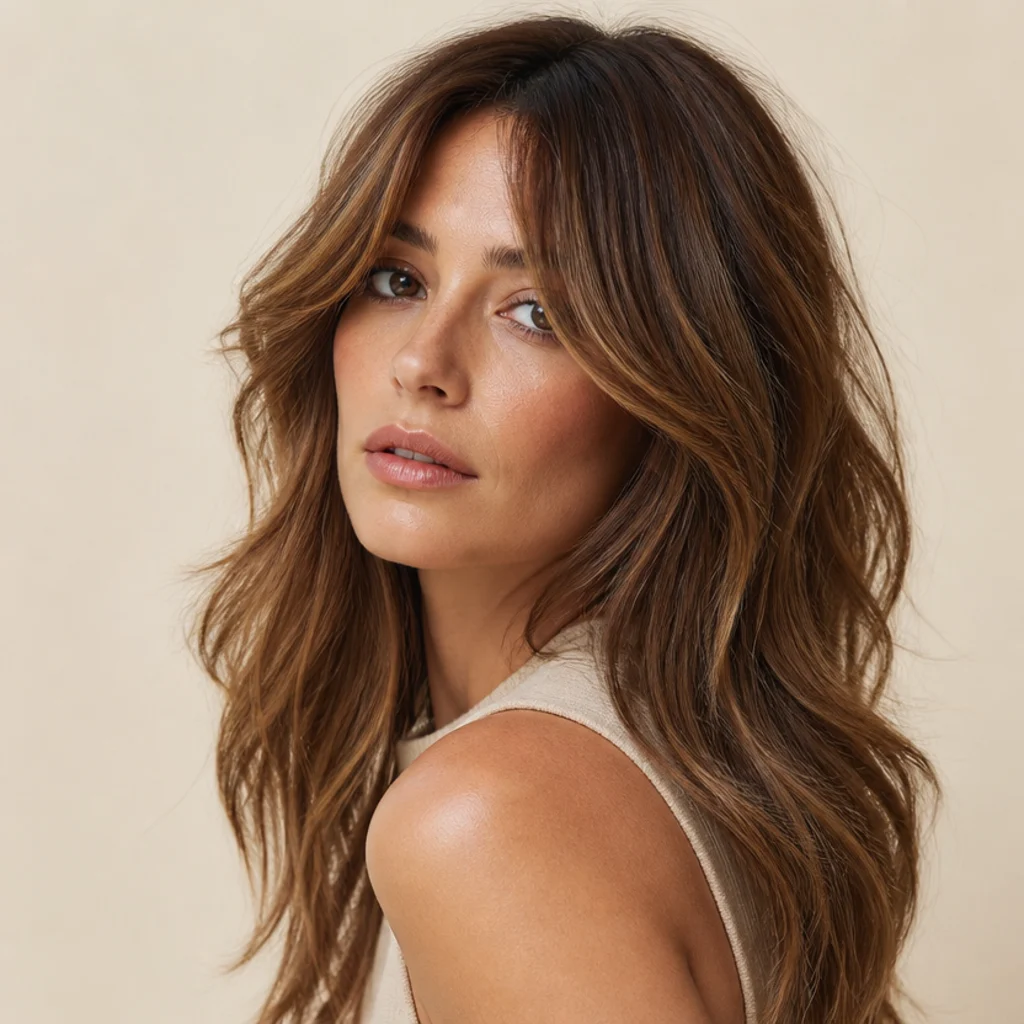
25 Gorgeous Long Wavy Shag Haircuts
The long wavy shag is the rare cut engineered to look accidental. Below are 25 versions worth saving, each mapped to a hair texture, face shape, and color routine so you know exactly which one is yours before you sit in the chair.
 Edited by Lena Rose · Published July 11, 2026 · 40 min read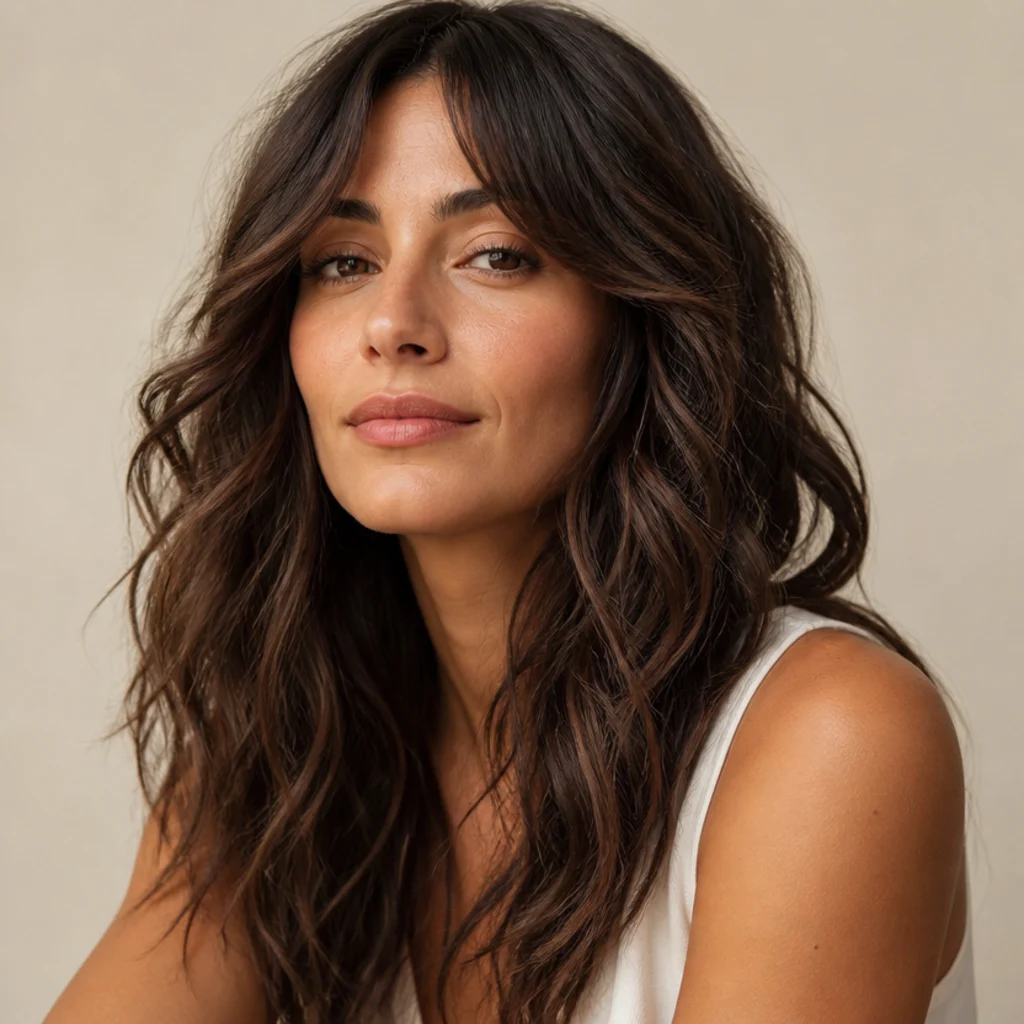
Quick Answer
- Best for: Fine-to-thick wavy or straight hair that wants shape, swing, and face-framing movement without sacrificing length; a graceful grow-out cut.
- Who might skip it: Anyone who wants a sleek, blunt, one-length look, or who never air-dries and wants zero visible layering. Very short hair can't carry the graduated interior.
- Maintenance: Moderate. Shape trims every 8-12 weeks; bang dustings every 4-6 weeks. Wavy texture forgives grow-out better than almost any other long cut.
- Difficulty: Easy once cut. Most versions live on air-drying, a diffuser, and texture spray rather than hot tools.
- Cost: Cut typically runs mid-range at a texture-trained salon; add balayage or vivid color and the color service usually exceeds the cut. Dry curl cuts sit at the higher end.
- Wear time / longevity: The cut holds its intended shape roughly 10-12 weeks before layers read heavy; lived-in color can stretch 3-4 months between full appointments.
- Standout variation: Long shag with curtain bangs, the most universally flattering and the reference point the other 24 build from.
- How to ask your stylist: "A long shag with connected face-framing layers, a shattered perimeter, and a soft fringe. Keep length below the collarbone and layer the interior for movement, not choppiness."
In This Guide
- Classic Long Shag With Curtain Bangs
- Soft Layered Shag for Fine Hair
- Beachy Sun-Kissed Shag
- 70s-Inspired Feathered Shag
- Cool-Toned Ash Brunette Shag
- Copper Wavy Shag
- Curtain Bangs on Straight-to-Wavy Hair
- Voluminous Shag for Thick Hair
- Wavy Shag on Natural Curls
- Balayage Wavy Shag
- Wispy Bottleneck Bangs Shag
- Jet Black Glossy Shag
- Money-Piece Face-Framing Shag
- Wavy Shag With Side Bangs
- Honey Blonde Textured Shag
- Low-Maintenance Grown-Out Shag
- Rooty Bronde Shag
- Wavy Shag for Coarse Hair
- Choppy Rock-and-Roll Shag
- Auburn Wavy Shag
- Wavy Shag With Blunt Ends
- Silver and Gray Wavy Shag
- Middle-Part Curtain Shag
- Wavy Shag for Round Faces
- Undone Effortless Everyday Shag
The long wavy shag has stayed in rotation because it solves something flat-ironing and product can't: it gives limp, one-length, or triangle-heavy hair real shape and swing without making you cut off the inches you love. The architecture is specific. Graduated internal layers start high around the cheekbone, the perimeter is shattered rather than blunt so the ends taper into feathered points, and a fringe (curtain, bottleneck, or side-swept) connects the front to the interior so nothing reads as a separate add-on. That's why the long wavy shag haircut works across such a wide range of textures, from pin-straight hair coaxed into a bend to loose 3b curls left to spring on their own. Each idea below is tied to a texture, a face shape, a realistic upkeep timeline, and the exact phrasing to bring to your stylist. Whether you want a polished long shag with curtain bangs for the office, a long shag for fine hair that fakes density, or a lived-in color that buys you months between appointments, there's a version worth pinning here, and a way to ask for it that gets you the cut you pictured.
01Classic Long Shag With Curtain Bangs
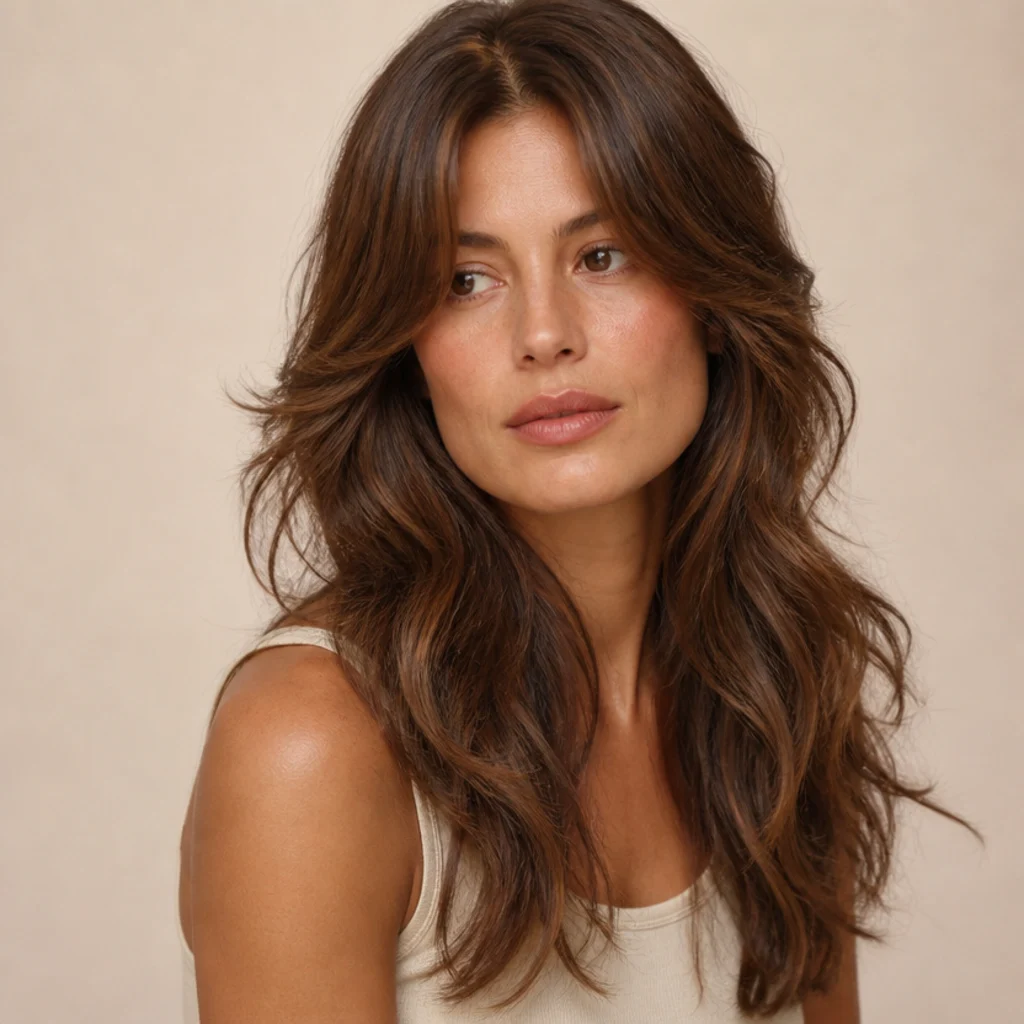
Every other version on this list borrows from the long shag with curtain bangs, and it earns that reference-point status by flattering almost any face shape. Interior layers start at the cheekbone and graduate down through a shattered perimeter, while the curtain bangs split off a center part and sweep back toward the temples, framing the eyes and softening a heavy jaw or wide forehead. The trick is in the connection: the shortest curtain piece needs to blend into the first face-framing layer so the fringe reads as one continuous sweep rather than a shelf sitting on top. Because the parted fringe adds height up top and draws length through the center, it works on nearly every face shape. It's best for medium-density hair with a natural half-inch of bend; poker-straight hair will need a wave coaxed in first. To style it, dry the bangs split down the middle with a round brush, flicking each side away from the face. Ask your stylist for "connected curtain bangs that melt into longer face-framing layers, cut to hit at the cheekbone." Upkeep sits at moderate, with a bang dusting every four to six weeks to keep the frame looking intentional.
02Soft Layered Shag for Fine Hair
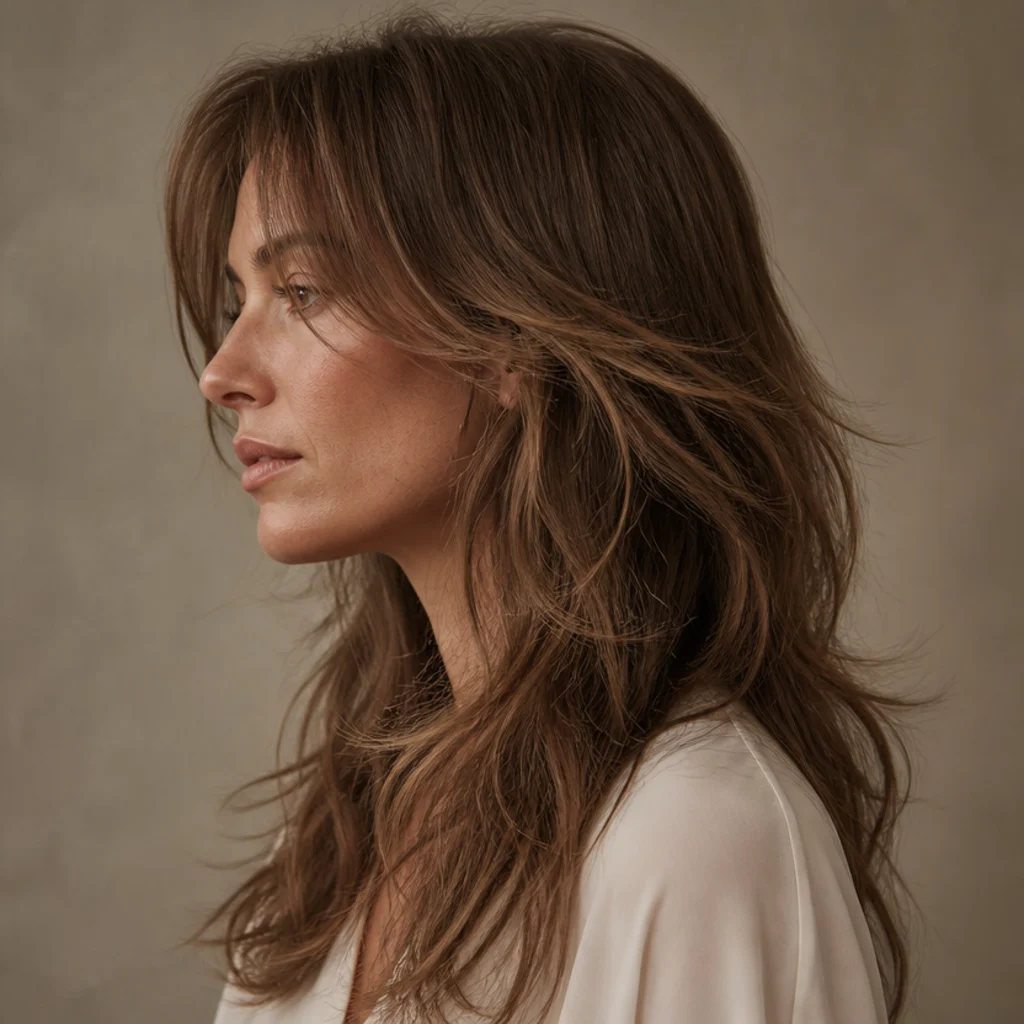
Fine hair needs a different kind of layering than everything else on this list. A long shag for fine hair works because strategic layers manufacture the fullness a blunt, one-length cut flattens out, but it takes restraint: over-layer fine hair and the ends thin to stringy wisps that expose scalp. The goal is lift at the crown with a perimeter left intentionally denser. Ask for "long, soft layers concentrated through the crown and mid-lengths for lift, with the ends kept blunt-ish and full, point-cut rather than razored." A razor or heavy thinning shears are the enemy here; they remove interior weight fine hair can't spare. This one's best for fine, straight-to-wavy hair (roughly 2a-2b) that goes flat by afternoon. Work a root-lifting mousse into damp roots, rough-dry upside down, then diffuse on medium heat; a texture powder at the crown locks in the volume. Skip oils and rich creams, since they collapse the airy movement you just built. Pro tip: mist a lightweight sea salt spray only through the mid-lengths, never the roots, so lift stays at the base while the ends get separation. Maintenance stays low and grow-out is graceful, since the layers are subtle to begin with.
03Beachy Sun-Kissed Shag
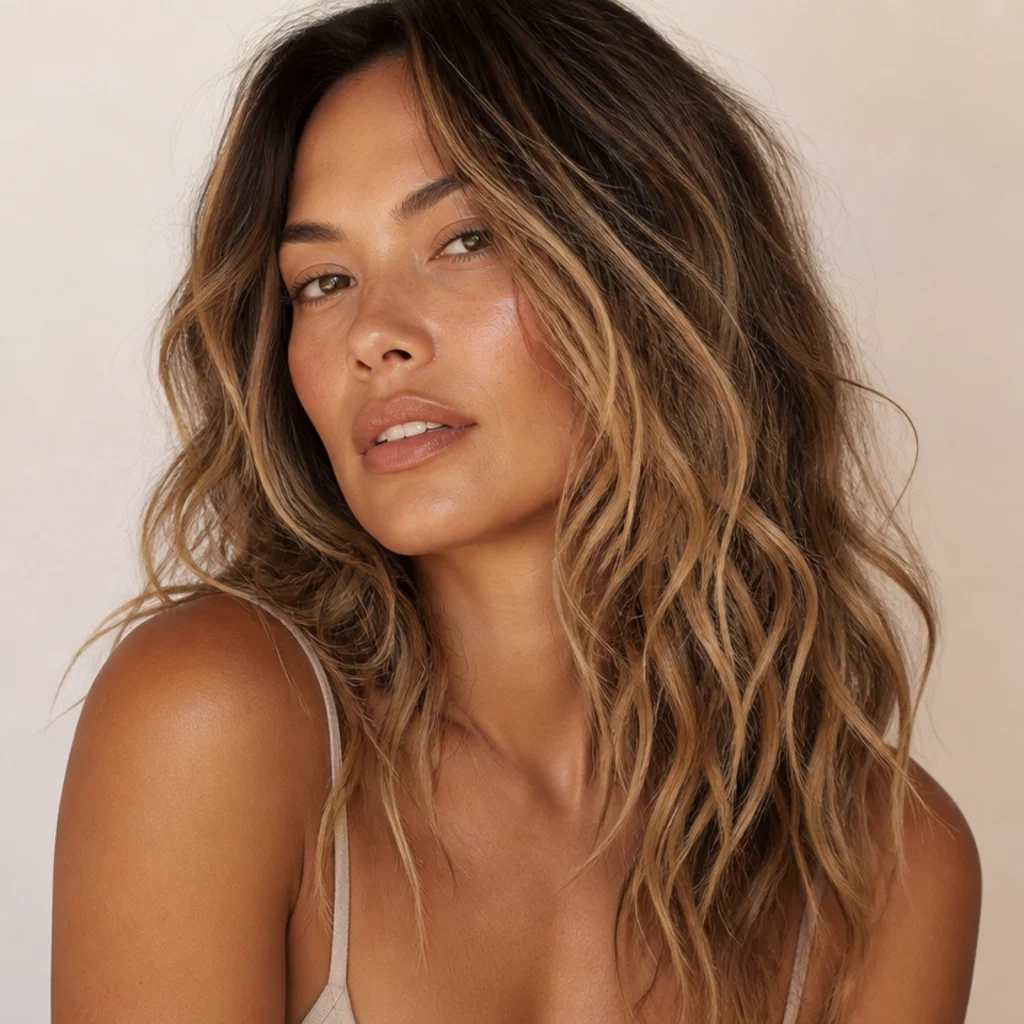
This version leans all the way into undone, salt-spray texture, with soft golden ends that look like a summer spent by the water. The cut keeps generous length while the layers add piece-y, separated wave, and the color does the rest: a soft, freehand balayage that brightens the mid-lengths and tips a level or two, with no hard demarcation line at the root. Warm to golden-beige tones suit warm and neutral undertones best; keep the blonde buttery rather than icy to preserve the sun-kissed effect. It works on naturally wavy hair (2b-2c) that already has some grit to it. Scrunch a salt or texture spray into damp hair, then either air-dry or diffuse with a scrunch-and-pump motion, breaking the waves apart with your fingers once dry. Ask your colorist for "a lived-in, sun-kissed balayage that brightens the ends of a long layered shag, no hard root line." Pro tip: mist waves with a flexible-hold spray and gently crunch to revive second-day texture instead of restyling from scratch. Maintenance is easy, since the melt grows out softly.
0470s-Inspired Feathered Shag
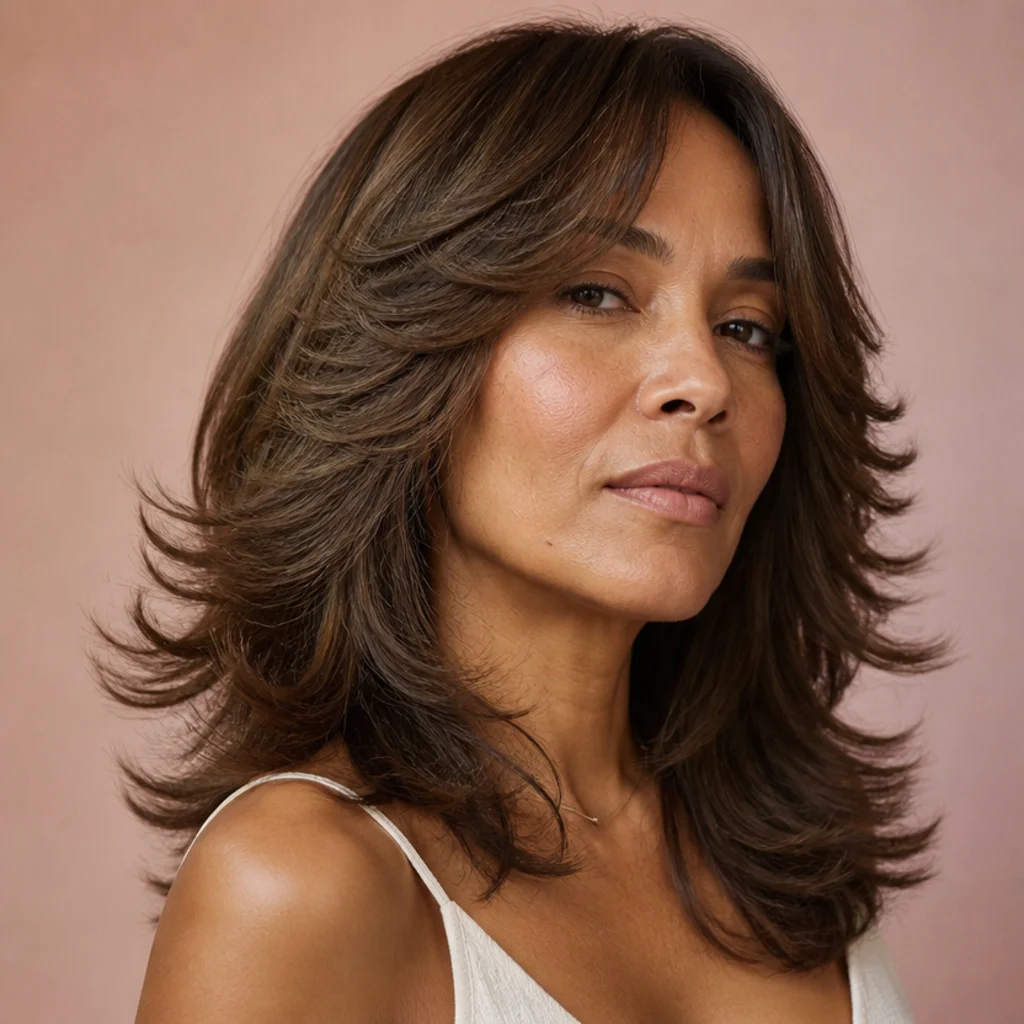
Feathered layers flicked decisively away from the face give this shag its unmistakably retro attitude, the Farrah-adjacent silhouette that keeps cycling back into every trend forecast. The shape is fuller and rounder at the crown, lighter through the lengths, and each face-framing layer curves outward like a soft wing. Oval and heart-shaped faces get the most out of it, since the outward flick balances a narrower chin and pulls attention up and out. Ask for "feathered, flicked layers with height through the crown and face-framing pieces cut to bend away from the face." Style it with a large round brush, over-directing the front sections back and rolling the ends out, or set the flick with a large-barrel iron and immediately brush the curl loose so it reads soft rather than curled. This one's best for fine-to-medium hair that holds a set. Pro tip: mist each section with a light flexible hairspray before the round brush so the outward wing lasts through the day. Maintenance sits at moderate. The winged shape depends on crisp layers staying defined, so plan on a trim roughly every eight weeks.
05Cool-Toned Ash Brunette Shag
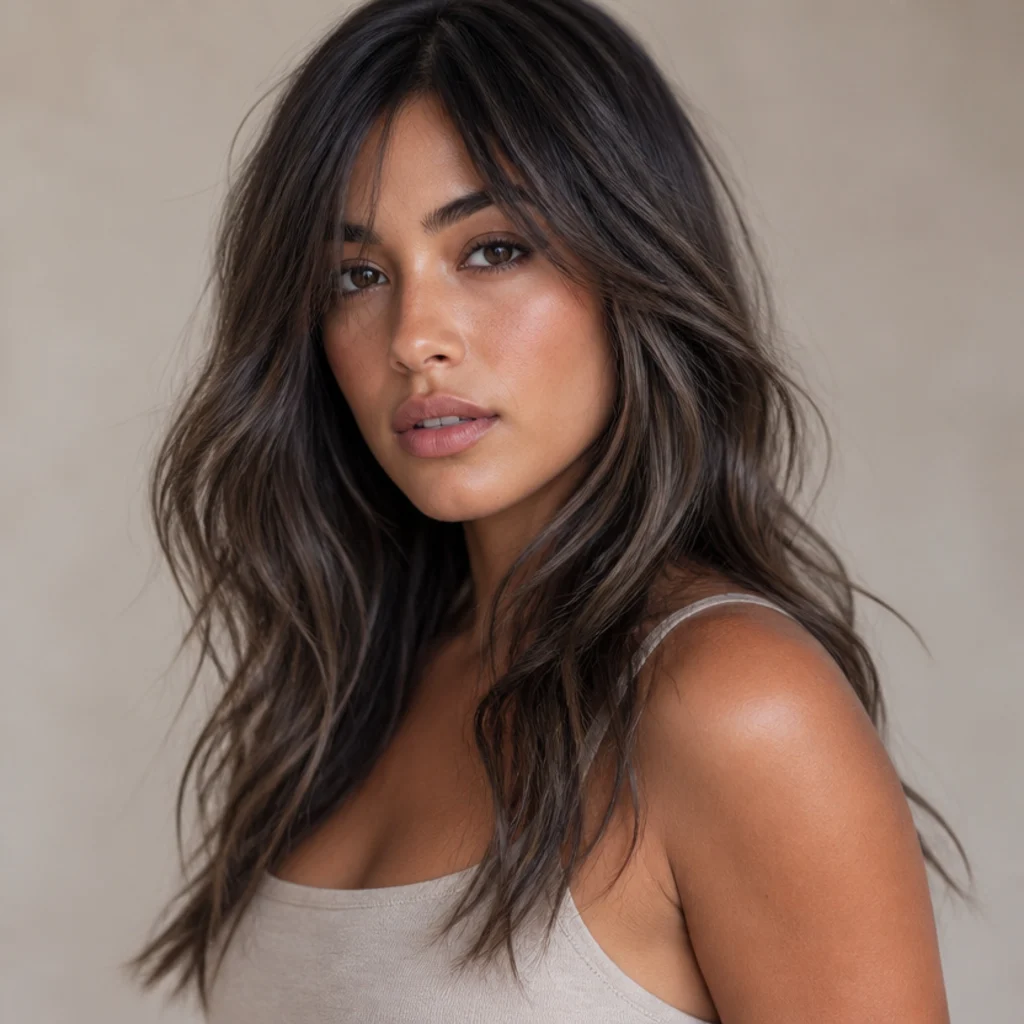
For anyone who wants depth without a whisper of warmth, a cool ash brunette shag delivers a smoky, expensive-looking finish that photographs rich. The layered wavy cut catches light along each wave, showing off the quiet dimension between a deep root and mid-lengths lifted just a half-shade, so the color reads as movement instead of a flat block. Ash brunette suits cool and neutral undertones and looks just as sharp on fair, olive, and deep skin, as long as the tone stays neutral-to-cool rather than drifting warm. Ask your colorist for "a soft ashy brunette with low-contrast cool dimension and no gold or red reflect." The main upkeep is tonal: brunettes with lift pull warm as they oxidize, so a blue-based toning shampoo used once a week keeps brassiness at bay, and a demi gloss every six to eight weeks refreshes the ash. Pro tip: over-toning with blue shampoo can leave a muddy cast on lighter mids, so alternate with a clarifying wash. Root regrowth is forgiving here since the base stays deep, which makes this a lower-lift option than a blonde.
Save this to Pinterest to build your color-and-cut mood board.
06Copper Wavy Shag

Copper turns a long wavy shag into a statement, full stop. The warm, saturated tone glows along every wave, and the shag's layers keep the color from flattening into one solid sheet, letting it shift between deeper and brighter as the light moves. It suits warm, golden, and olive undertones and looks striking on deep skin; if your undertone runs cool, ask for a copper-brown or "copper penny" that leans muted rather than neon. The catch, and it's a real one, is fade: copper and red molecules are the largest and sit closest to the cuticle surface, so they wash out faster than any other color family. Treat it as higher-maintenance and protect the investment with a copper-depositing conditioner every second or third wash, sulfate-free shampoo, and cooler water. Ask your colorist for "a bright, glossy copper on a long layered shag with connected face-framing pieces." Pro tip: apply the color-depositing mask to damp, towel-dried hair and leave it on for the full recommended time; on soaking-wet hair the pigment dilutes and grabs unevenly. Style with a curl cream to keep the waves defined and the tone mirror-glossy.
07Curtain Bangs on Straight-to-Wavy Hair
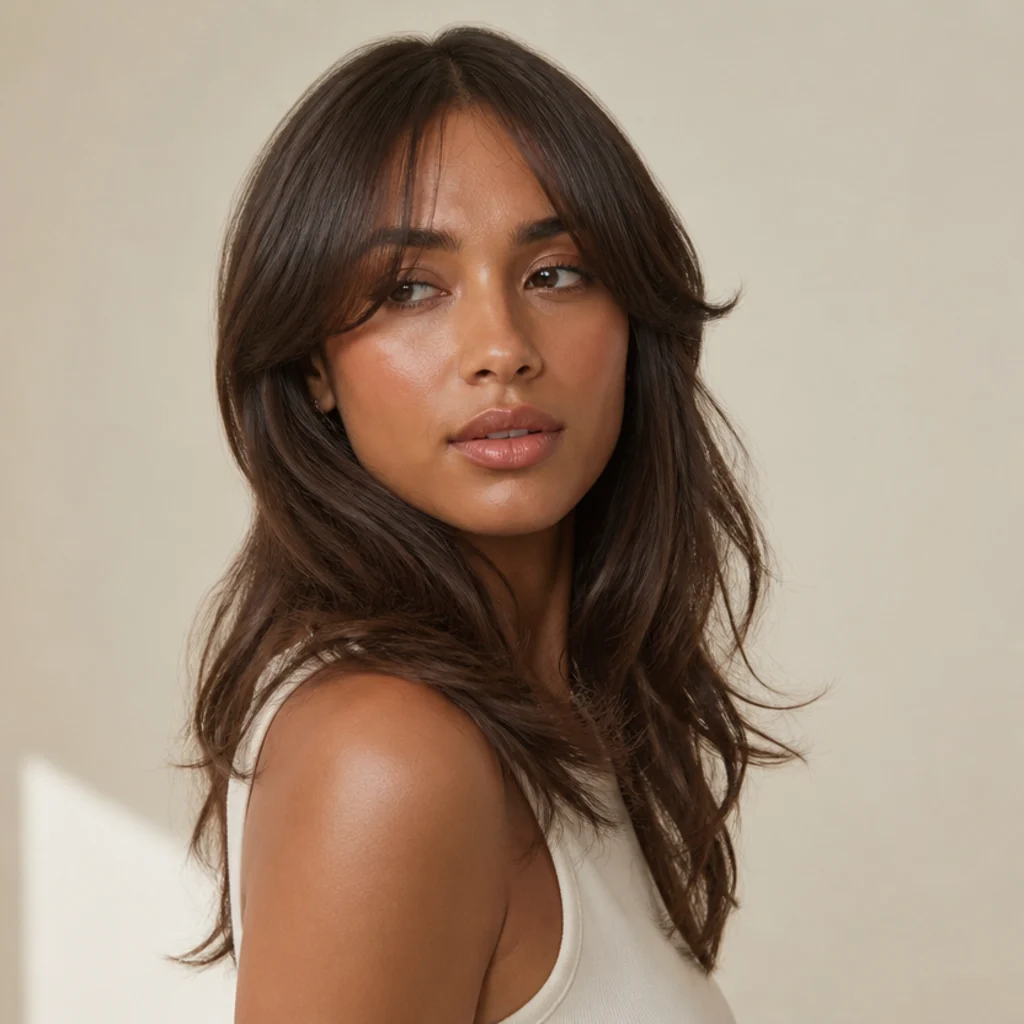
If your hair is mostly straight with a loose, unreliable bend, a long shag with bangs plays up that texture instead of fighting it. Curtain bangs bring movement to the front, where straighter lengths tend to fall flat, and the shag's shattered perimeter gives the ends somewhere to flick. It's one of the most maintenance-friendly curtain-bang variations, since straighter hair holds a cut's shape cleanly and shows off the layering crisply. Ask for "curtain bangs and long connected layers cut to enhance a subtle natural wave, with a slightly textured perimeter so the ends move." This is best for fine-to-medium straight hair (1c-2a) that wants shape without a perm or daily curling. Flat-iron the ends with an outward flick and bend the curtain bangs back with the iron or a round brush; on humid days, a light sea-salt mist coaxes out extra bend at the mid-lengths. Pro tip: rough-dry the fringe first with your fingers before it fully air-dries, so it sets with body instead of drying stick-straight against the forehead.
08Voluminous Shag for Thick Hair
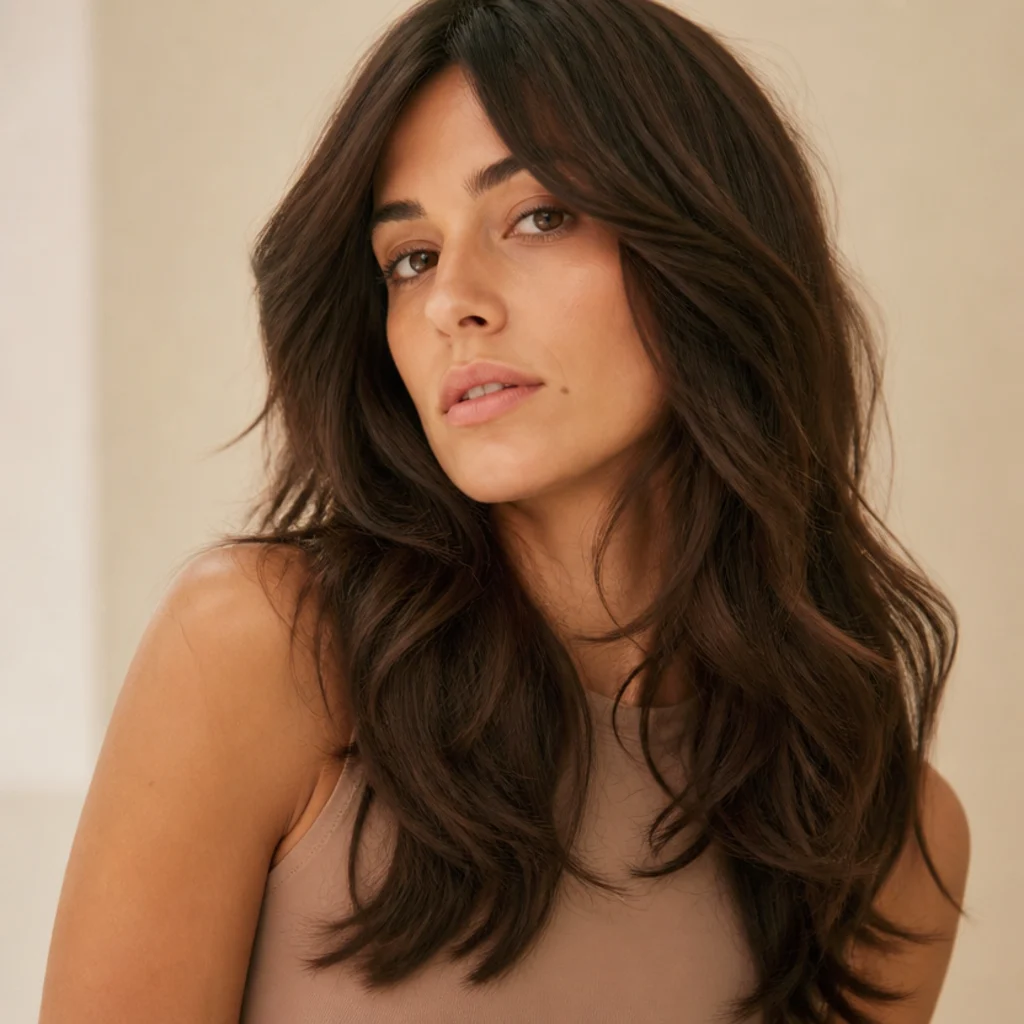
Thick hair is where the shag earns its keep. Smart layering converts raw density into bounce instead of letting it stack into a heavy triangle that sits wide at the ends and flat at the roots. The strategy is internal: remove interior weight so the waves can form and swing, while keeping the perimeter strong enough that the ends don't look scraggly. Ask for "internal layering and controlled interior texturizing to remove bulk while keeping length, with a textured but substantial perimeter." Avoid surface thinning near the crown, which produces frizzy flyaways that ruin a thick wave. Best for coarse or dense hair, any wave pattern, that feels leaden at one length. A lightweight leave-in raked through the mid-lengths, then diffused or air-dried, works well; a wave-defining cream holds the shape without crunch. Pro tip: ask your stylist to remove weight in vertical, not horizontal, sections so the density thins evenly and the wave forms from root to tip. Upkeep runs moderate to high, since thick hair grows fast and the interior layers need refreshing roughly every eight weeks to keep the triangle from coming back.
09Wavy Shag on Natural Curls
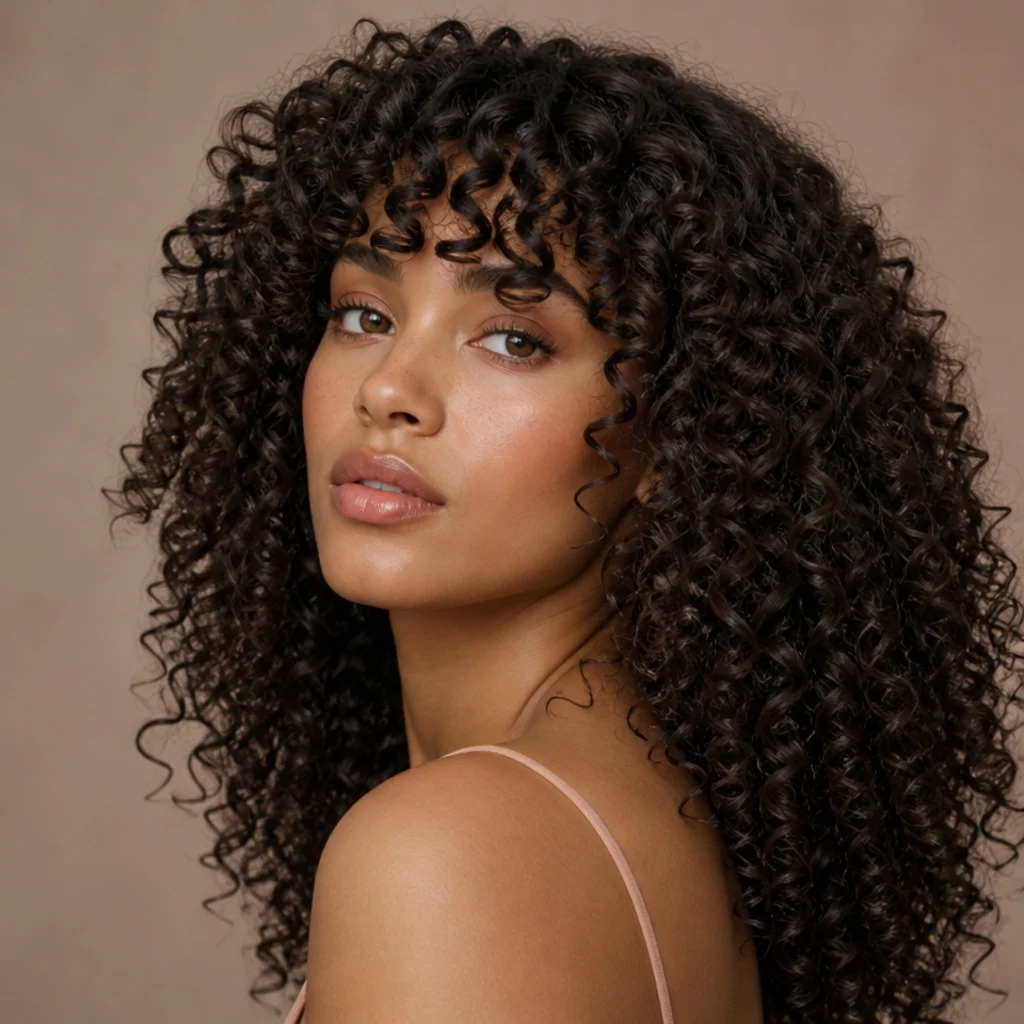
The shag might as well have been invented for curls. Its layers give each curl room to spring and stack instead of piling into a pyramid. On loose-to-medium curls, a long shag builds that coveted rounded, voluminous shape, with shorter pieces at the crown adding lift and longer curls framing the face. The non-negotiable part is technique: this needs to be cut dry, curl by curl, by a curl specialist who can see how each spiral falls and where the weight sits. A wet cut on curly hair shrinks unpredictably once it dries. Ask a curl-trained stylist for "a curly shag cut dry, with layers shaped to my curl pattern and a curtain-style fringe cut into the curl, not straight across." It works on 2b through 3b textures. For styling, go with a wash-and-go: apply gel or a curl custard to soaking-wet hair, scrunch, diffuse on low or air-dry, then scrunch out the cast. Pro tip: cut the fringe a touch longer than you think, since curl spring will lift it up to an inch shorter once dry. Day-to-day styling upkeep is low; the precision of the dry cut is what does the real work.
10Balayage Wavy Shag
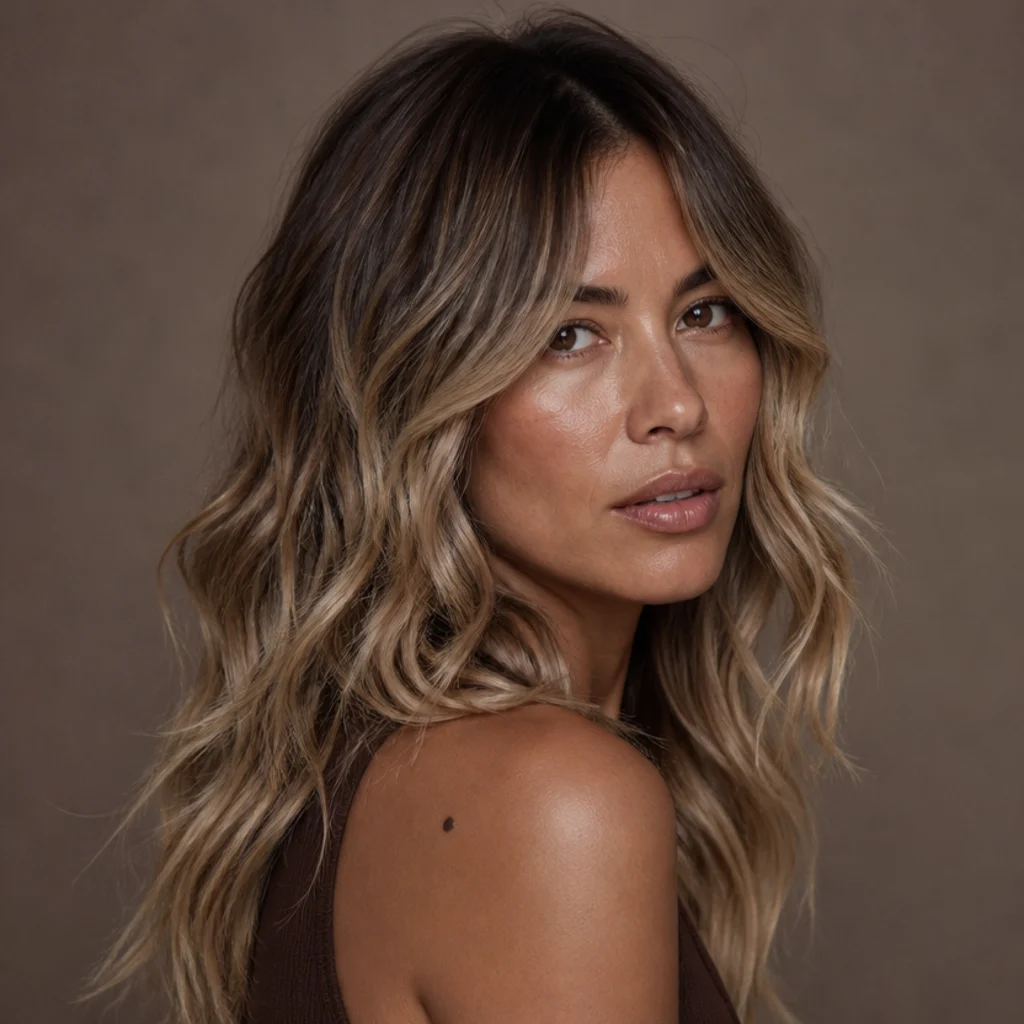
Balayage and the wavy shag are natural collaborators: hand-painted lightness follows the interior layers and pools at the tapered ends, so the color amplifies exactly the movement the cut creates. A soft brunette-to-bronde melt keeps the root deliberately deep and low-maintenance while the mid-lengths and ends brighten, especially around the face, where the money-piece effect lifts the complexion. It suits most undertones, since the blonde can be toned warm (honey, beige) or cool (ash, sand) to match. Ask your colorist for "a seamless, root-shadowed balayage that brightens the ends of a long layered shag, painted to follow the face-framing layers." Best for medium-density wavy hair, where the painted pieces catch on the waves. The real payoff is grow-out: with no hard regrowth line, you can stretch full appointments to every three to four months, refreshing tone with a gloss in between. Pro tip: book the gloss as a separate mid-cycle visit instead of waiting for full regrowth; it revives brightness and keeps the ends from going brassy for a fraction of the cost.
Save this to Pinterest before your next color consultation.
11Wispy Bottleneck Bangs Shag
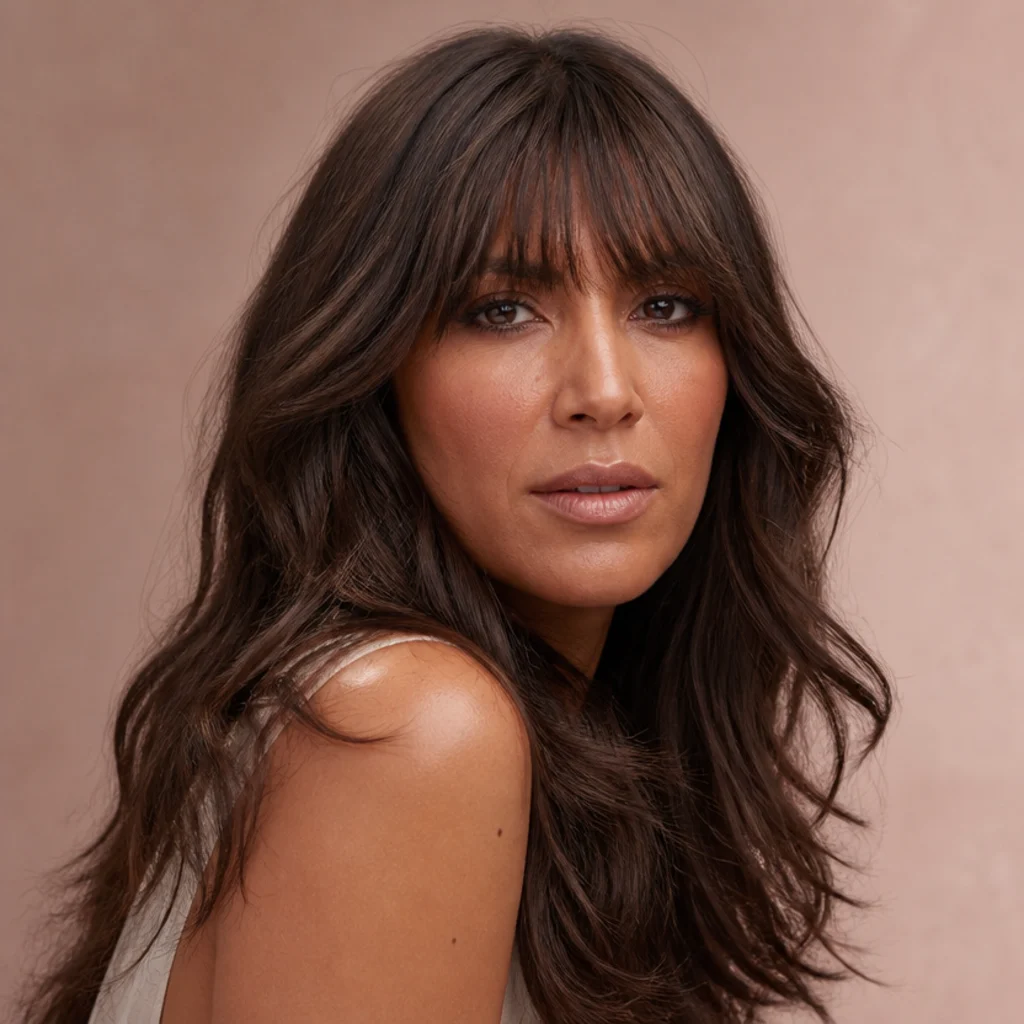
Bottleneck bangs are the curtain bang's more tailored cousin, narrower and closed at the inner corners near the center, then flaring outward toward the cheekbones like the neck of a bottle. On a long wavy shag, they create a soft, feathered frame that suits rounder and fuller faces by drawing a vertical line down the center and revealing the outer face. Ask for "wispy bottleneck bangs, closed at the inner corners and widening to the cheekbones, blended into long face-framing layers." This works best on fine-to-medium hair, since the wispiness depends on lightness rather than density; a very thick fringe reads solid instead of feathered. Rough-dry the fringe forward with a round brush to build a slight bevel, then split it open at the center and let the sides fall toward the cheeks. Pro tip: point-cut the very ends yourself between salon visits with sharp shears, taking off only a hair's width vertically, to keep the wispy tips soft rather than blunt. Bang upkeep runs every four to five weeks, though the feathered edges hide grow-out longer than a blunt fringe would.
12Jet Black Glossy Shag
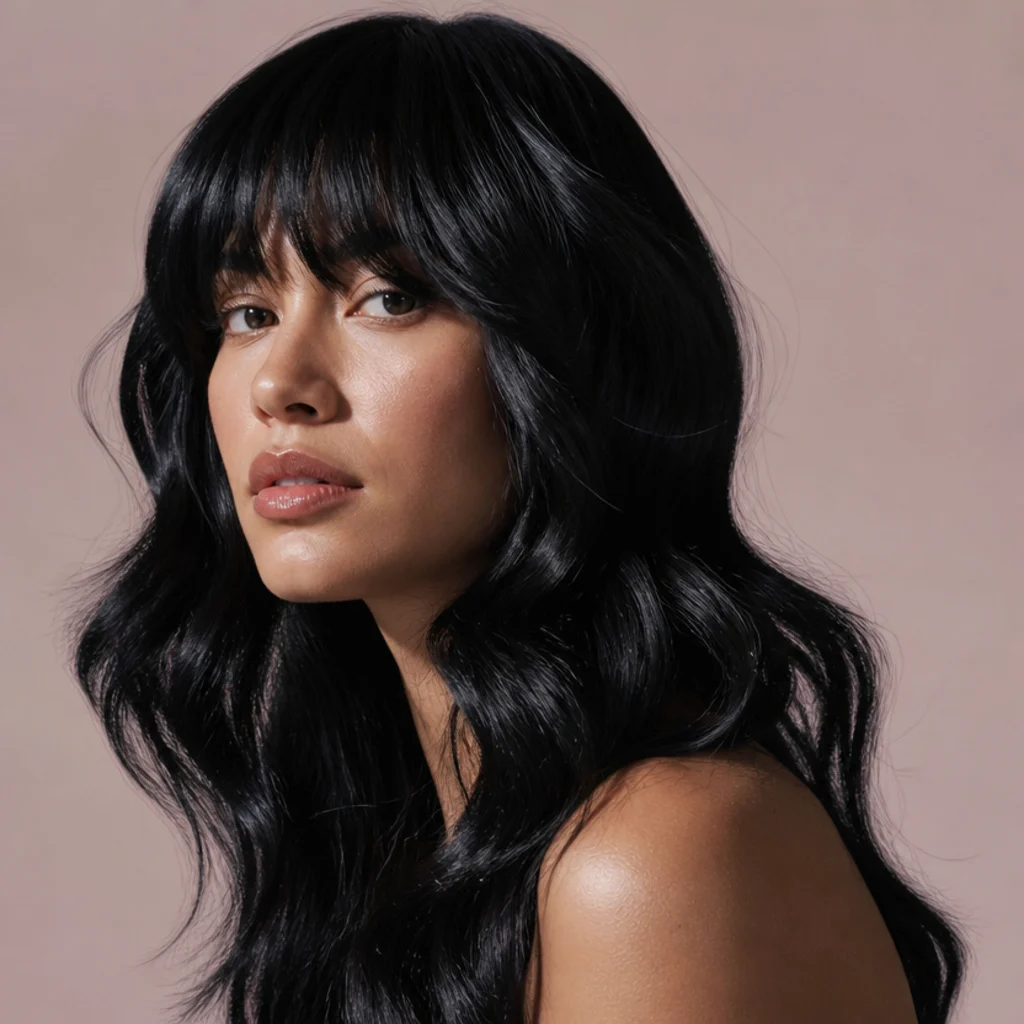
There's nothing understated about a jet black wavy shag, and that's the point. Deep, high-shine black makes the layers and waves read as sculptural, catching light in glossy ribbons that flat, matte black never achieves. It suits cool and neutral undertones best and looks especially sharp paired with a defined curtain or blunt fringe that frames the face in a clean line. The trade-off is commitment: true black is one of the hardest colors to lift back out, so treat it as a decision to make deliberately, and know it can dull to a flat, greenish cast over time without care. Ask your colorist for "a glossy true-black with a hint of cool reflect on a long layered wavy shag." Refresh with a clear or black-tinted gloss every couple of months to hold the mirror finish, and seal each style with a lightweight shine serum on the mid-lengths and ends. Pro tip: rinse with cool water to keep the cuticle flat, since shine on black hair comes down almost entirely to how smoothly the surface reflects light. Best for medium-to-thick hair, where more surface area means more shine.
13Money-Piece Face-Framing Shag
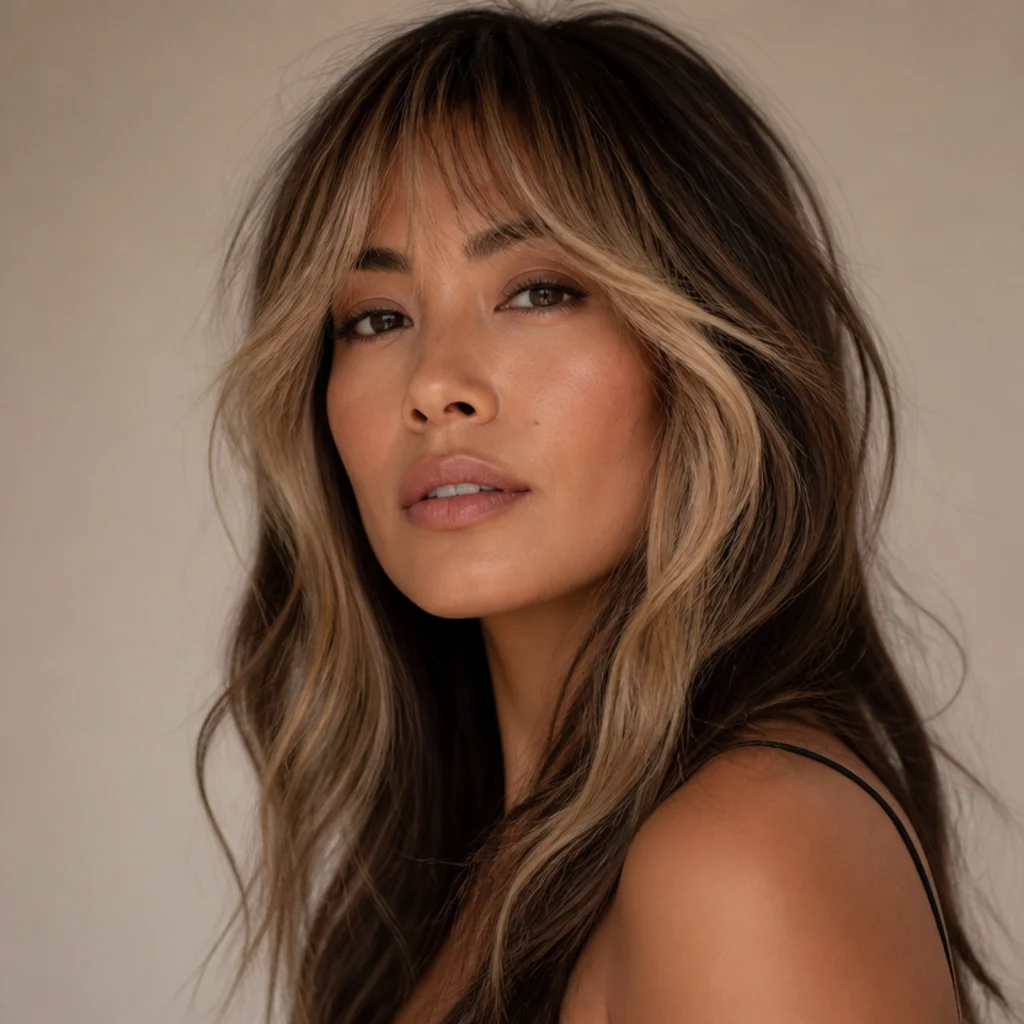
The money piece brightens the two front sections that frame your face, and on a wavy shag those lightened pieces trace the curtain bangs and first layers for a modern, high-contrast frame that lifts the complexion. Depending on the tone, it can warm sallow skin (honey, gold) or cool and brighten it (beige, champagne), which makes it one of the most flattering low-commitment color moves out there. Ask your colorist for "a money-piece around the face on a long layered shag, blended into the curtain bangs so it starts high and follows the fringe." It's a good fit for anyone who wants a visible pop of dimension without a full head of foils or the upkeep of all-over lightening. Best for medium-density wavy hair. Upkeep scales with contrast: a bold, high-lift money piece against dark hair needs toning every six weeks to avoid brass, while a soft, low-contrast version grows out gently. Pro tip: ask for the brightest pieces to start slightly below the root rather than right at the scalp, so regrowth reads as a soft shadow instead of a stark line.
14Wavy Shag With Side Bangs
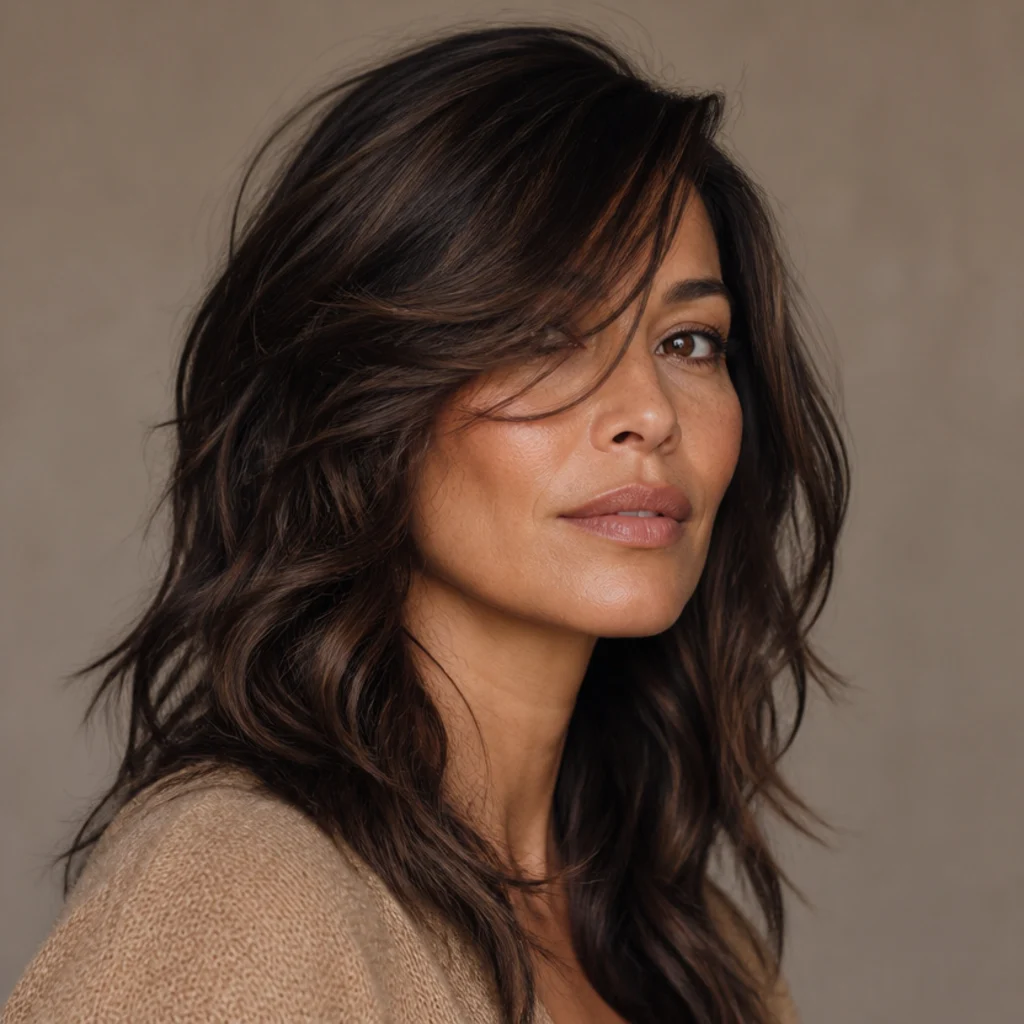
Not everyone wants a center part. Side-swept bangs give the long shag an easy, asymmetric edge that reads a little more polished and a little less bohemian. A deep side part with a long, sweeping fringe that grazes the cheekbone suits square and round faces by breaking up horizontal symmetry and softening a strong jaw. This variation is forgiving on off days, too, since the sweep tucks neatly behind the ear when you want it out of the way. Ask for "long, side-swept bangs cut on a deep part and blended into the face-framing layers of a shag, long enough to reach the cheekbone." It's best for medium hair with a bit of natural wave to carry the sweep, and enough length that the fringe doesn't spring up. Dry the fringe with a round brush across the forehead in the direction of the sweep to set the bend. Pro tip: establish your deep part while the hair is soaking wet and dry the fringe in that direction from the start, so it trains to fall correctly instead of splitting back to center. Maintenance is moderate; the longer the fringe, the less often it needs a trim.
15Honey Blonde Textured Shag
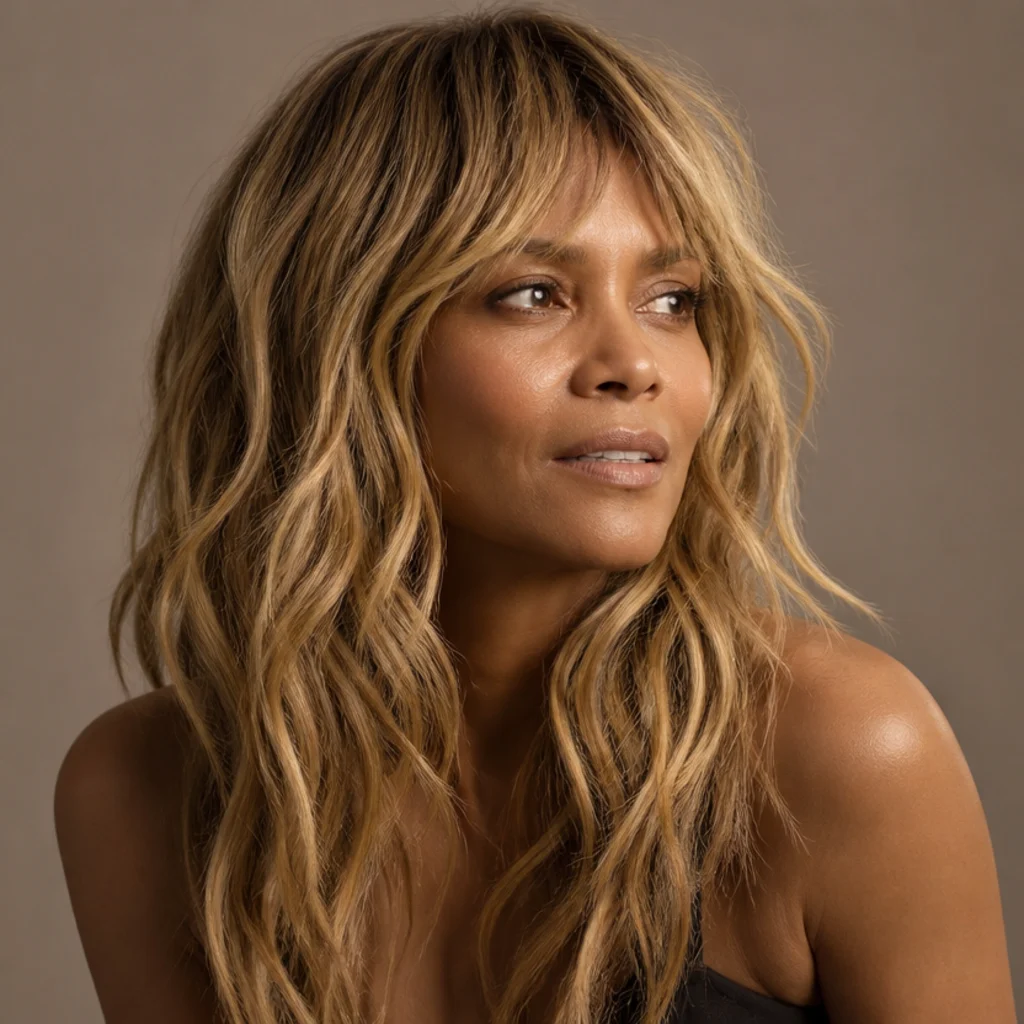
Honey blonde brings warmth and a lit-from-within glow to the shag's textured layers, reading golden and dimensional instead of flat or brassy. The tone suits warm and neutral undertones and pairs well with light-to-medium skin; on cooler complexions, ask for a "honey-beige" that tempers the gold. On a long wavy shag, the piece-y layers let the honey shade shift between deeper roots and brighter tips as the waves catch light, which keeps it from looking like one solid swatch. Ask your colorist for "a warm honey blonde with soft, low-lit dimension on a textured long shag, kept out of brass." This is best for anyone already in a blonde or bronde family, since lifting from dark to honey takes multiple sessions and careful toning. Upkeep runs moderate: a warm-toned gloss every six to eight weeks keeps the shade from turning muddy or ashy, and purple shampoo used sparingly (once every week or two) controls yellow without dulling the warmth. Pro tip: over-using purple shampoo on honey blonde flattens the golden glow, so save it for brass emergencies. Texture spray brings out the separated, lived-in wave.
Save this to Pinterest and tag the tones you love most.
16Low-Maintenance Grown-Out Shag
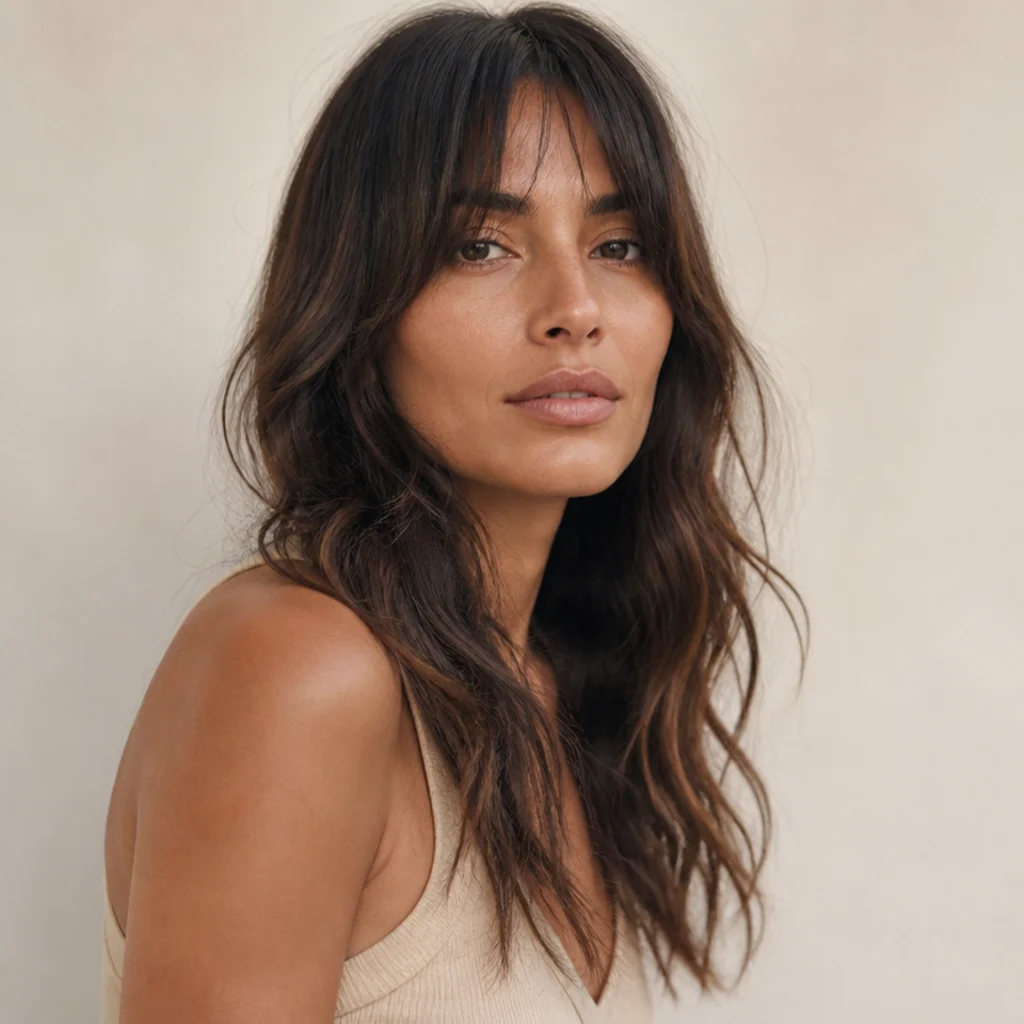
Some of the best shags are the ones a few months past their last trim, once the crisp layers have relaxed into a softer, lived-in shape. This grown-out version is cut on purpose to age well: only soft, long layers and a barely-there fringe, so the silhouette holds even as it loosens instead of collapsing into shapeless length. It's a good match if you rarely make it to the salon, you're in a grow-out phase, or you just don't want to deal with styling. Ask for "long, soft, connected layers and a grow-out-friendly fringe, nothing choppy or short that will look awkward as it grows." Best for anyone with natural wave (2a-2c) who wants real wash-and-go ease. Scrunch a leave-in into damp hair and air-dry, nothing more; a texture spray revives it on day two or three. Pro tip: even a low-maintenance shag benefits from a quick dusting of just the perimeter every twelve to sixteen weeks, which keeps the ends healthy without touching the shape you're growing out. The natural, undone color keeps the whole look relaxed instead of fussy.
17Rooty Bronde Shag
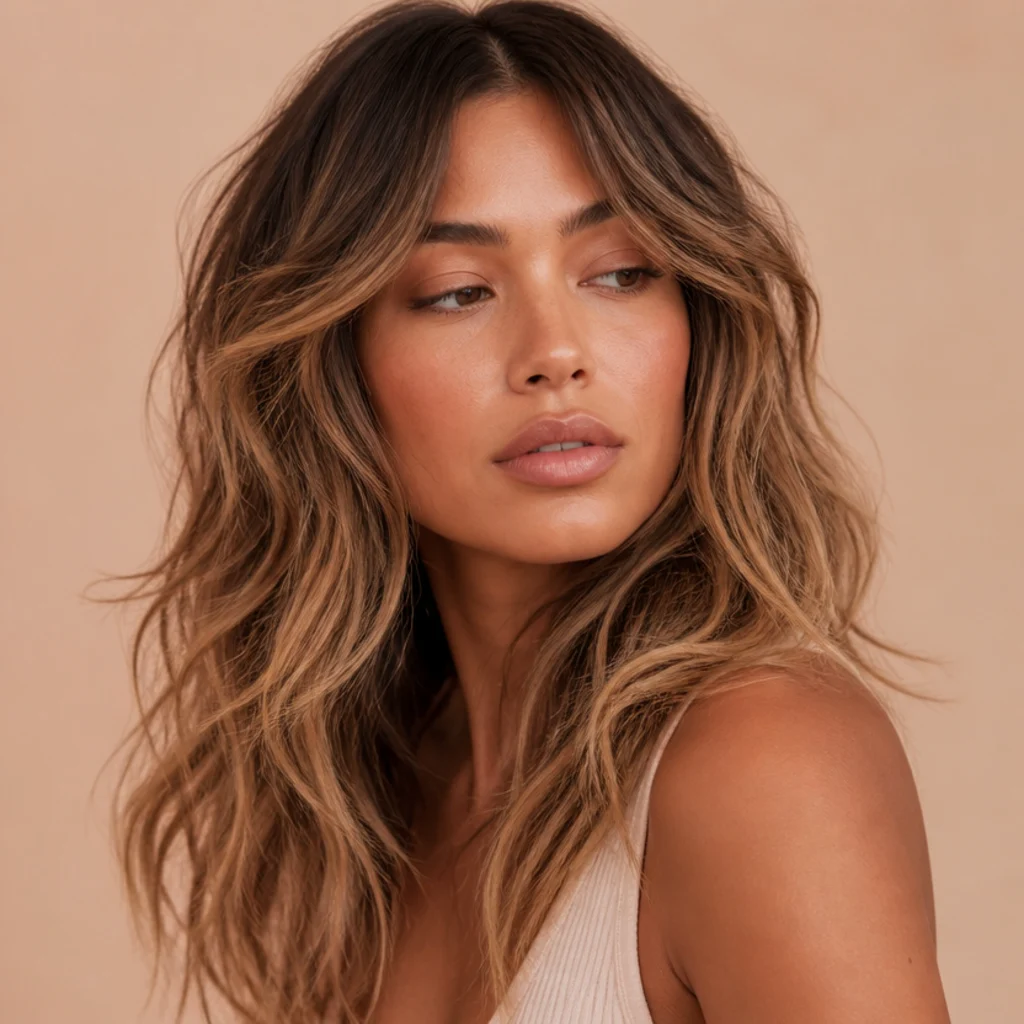
Bronde, the balanced in-between of brown and blonde, keeps a lived-in depth at the root and brightens gradually through the lengths, landing on a shade that suits almost everyone across warm and cool undertones. A deliberately shadowed or "smudged" root is the practical secret: because regrowth blends into a base that's already deep, the line of demarcation barely shows even after months. The shag's interior layers carry that melt from dark at the crown to lighter at the tapered tips, so the color transition follows the movement of the cut. Ask your colorist for "a rooty bronde melt with a soft root shadow and low-contrast dimension on a long shag." Best for medium hair and anyone chasing maximum grow-out time between appointments. Upkeep stays low, with a gloss every couple of months to refresh tone and knock back any brass at the ends. Pro tip: request the root shadow be melted at least an inch and a half down from the scalp, so several weeks of regrowth just extend the shadow instead of creating a stripe. The waves keep the transition looking organic.
18Wavy Shag for Coarse Hair
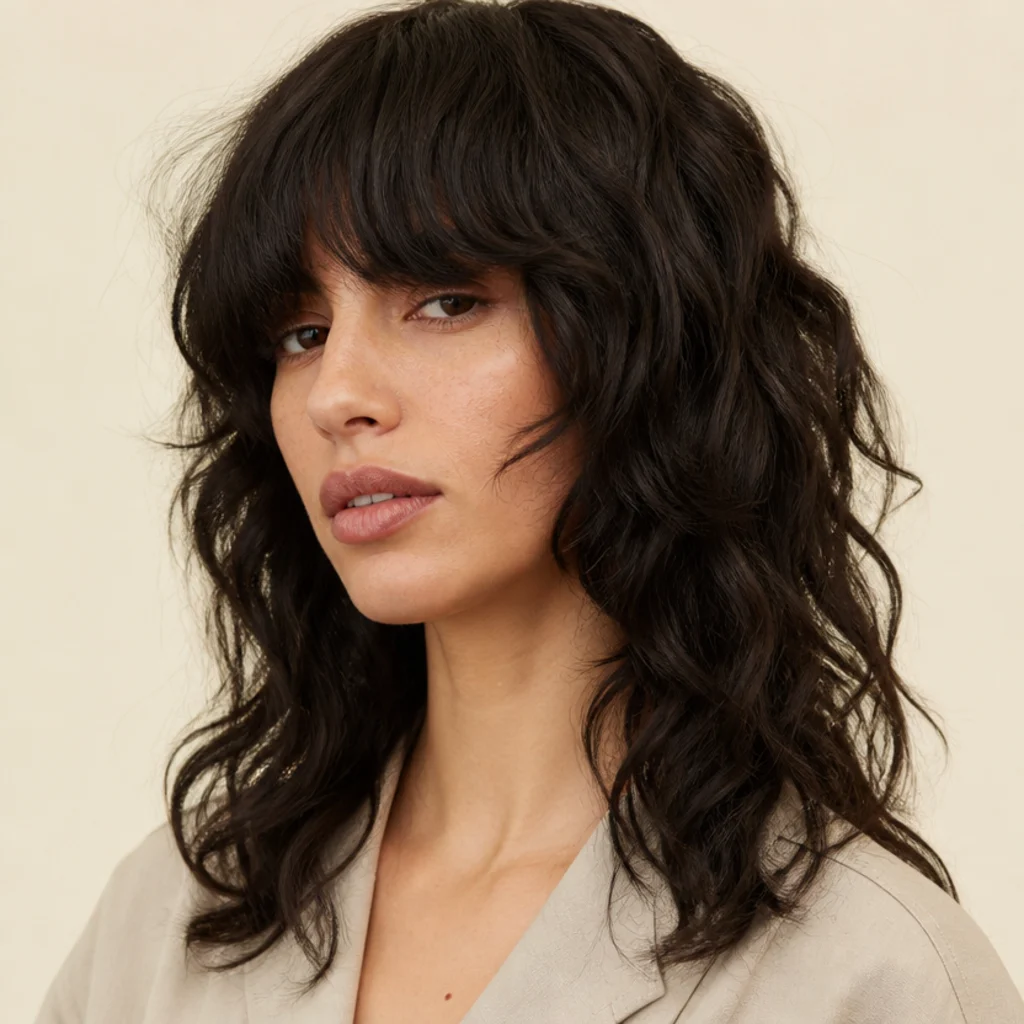
Coarse hair carries a shag with real presence, but it needs layering that works with its density instead of fighting it. The goal is to remove interior weight so the waves can form and fall, rather than expand sideways into unmanageable width; done wrong, thinning the surface produces a halo of frizz. Ask for "internal texturizing for coarse hair to release weight, keeping the perimeter strong and the fringe substantial enough to balance the fullness." A heavier curtain or blunt-ish fringe anchors the shape and stops the front from puffing out. This works best on coarse, dense textures that feel like too much hair at one length. Use a rich leave-in and a wave cream on soaking-wet hair, then diffuse on low heat with a hover-and-cup motion; low heat matters because coarse hair frizzes when blasted. Pro tip: a weekly deep-conditioning mask keeps coarse waves smooth and defined, and applying styling product to hair that's dripping wet, not towel-dried, locks in far more moisture and wave definition. Maintenance runs moderate, with a shape refresh every eight to ten weeks.
19Choppy Rock-and-Roll Shag
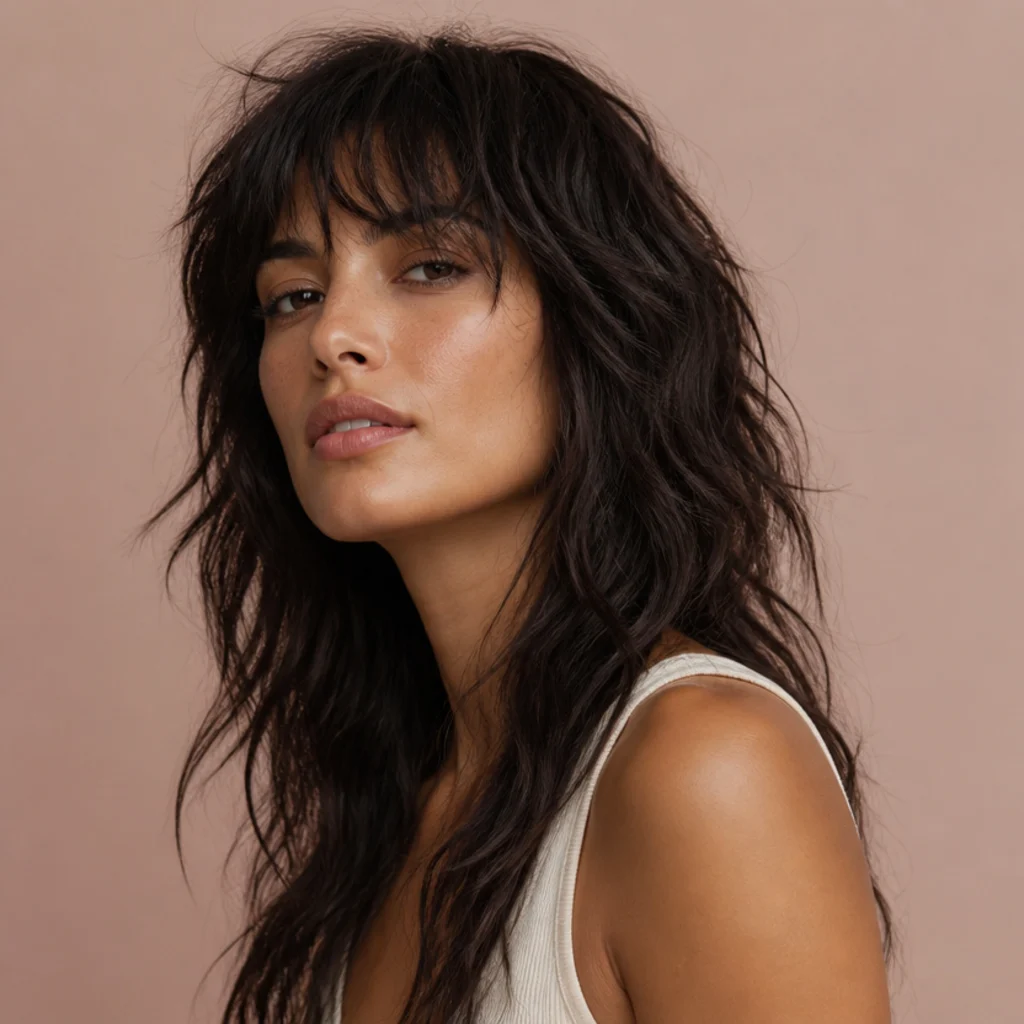
For a bolder, edgier attitude, the choppy shag leans hard into shattered, uneven layers and a piece-y, deliberately undone finish, the concert-hair silhouette that looks slept-in on purpose. The layers are shorter and more aggressive at the crown, the perimeter is heavily point-cut into separated spikes, and the fringe is textured rather than smooth. It suits anyone who wants real edge and works best on fine-to-medium hair that holds grit and separation; very fine hair can look sparse, and very thick hair can read bulky unless it's internally thinned. Ask for "a choppy, shattered shag with heavily textured ends, plenty of separation, and a lived-in, piece-y fringe." Style with a dry texture spray or a matte clay or paste emulsified between your palms and raked through the mid-lengths and ends to define the pieces. Pro tip: apply matte paste to dry, styled hair as the very last step, not to damp hair, so it grabs the surface and creates separation instead of disappearing into it. The choppiness hides grow-out well; skip smoothing serums, which flatten the roughness you're going for.
20Auburn Wavy Shag
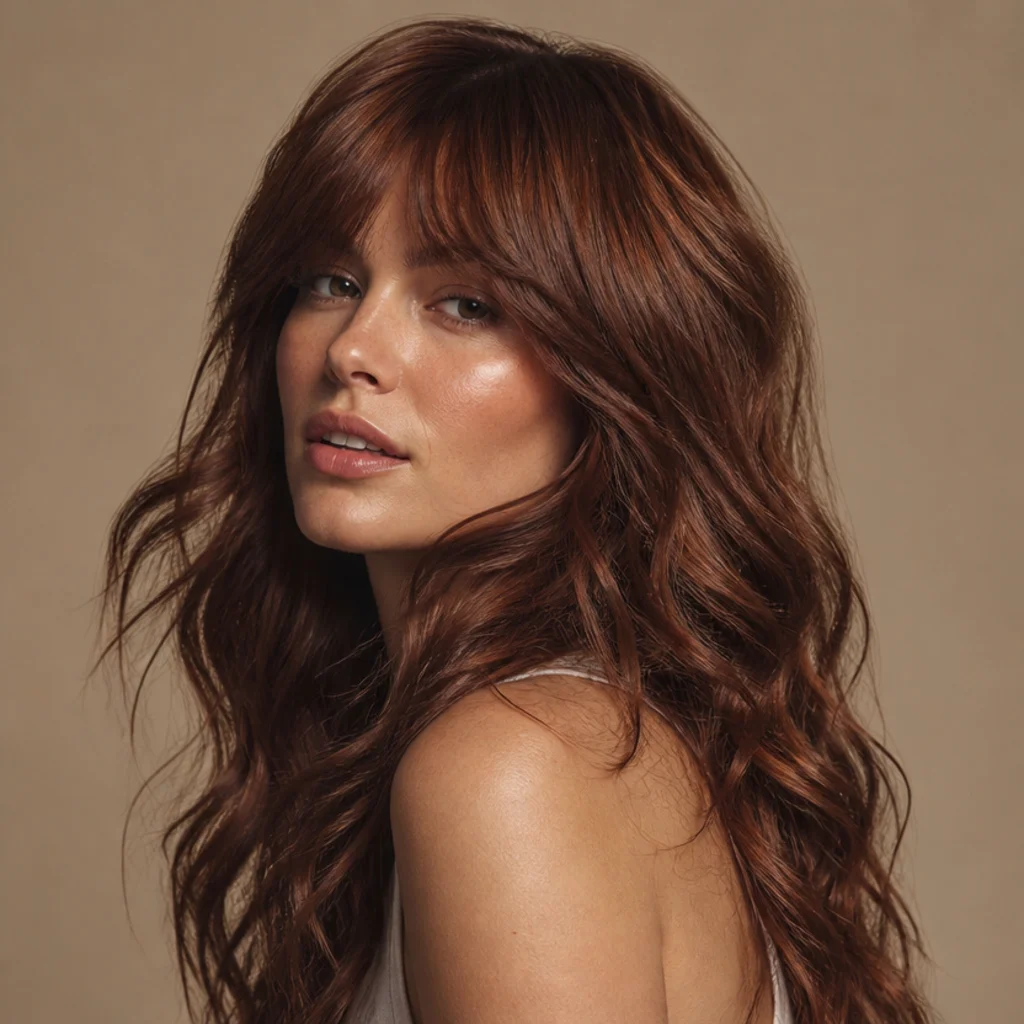
Auburn sits at the intersection of red and brown, giving the wavy shag a rich, dimensional warmth that suits warm and neutral undertones without the neon intensity or the punishing fade of a bright copper. The red-brown depth glows along each wave for instant vibrancy, and since it holds more brown pigment than a pure red, it lasts noticeably longer between appointments. Paired with curtain bangs, auburn frames the face in a warm halo. Ask your colorist for "a rich auburn with subtle red-brown dimension on a long wavy shag, kept glossy rather than matte." Best for medium-density hair that shows off the tone's depth as it moves. Upkeep is moderate: even brown-heavy reds fade over time, so a red or auburn color-depositing conditioner every few washes extends vibrancy and keeps the tone from dulling to flat brown. Pro tip: wash with cool water and sulfate-free shampoo, and stretch time between washes, since heat and detergent strip red molecules fastest. The waves keep the auburn reading as glossy, dimensional movement instead of a solid block.
Save this to Pinterest so your stylist sees the exact tone.
21Wavy Shag With Blunt Ends
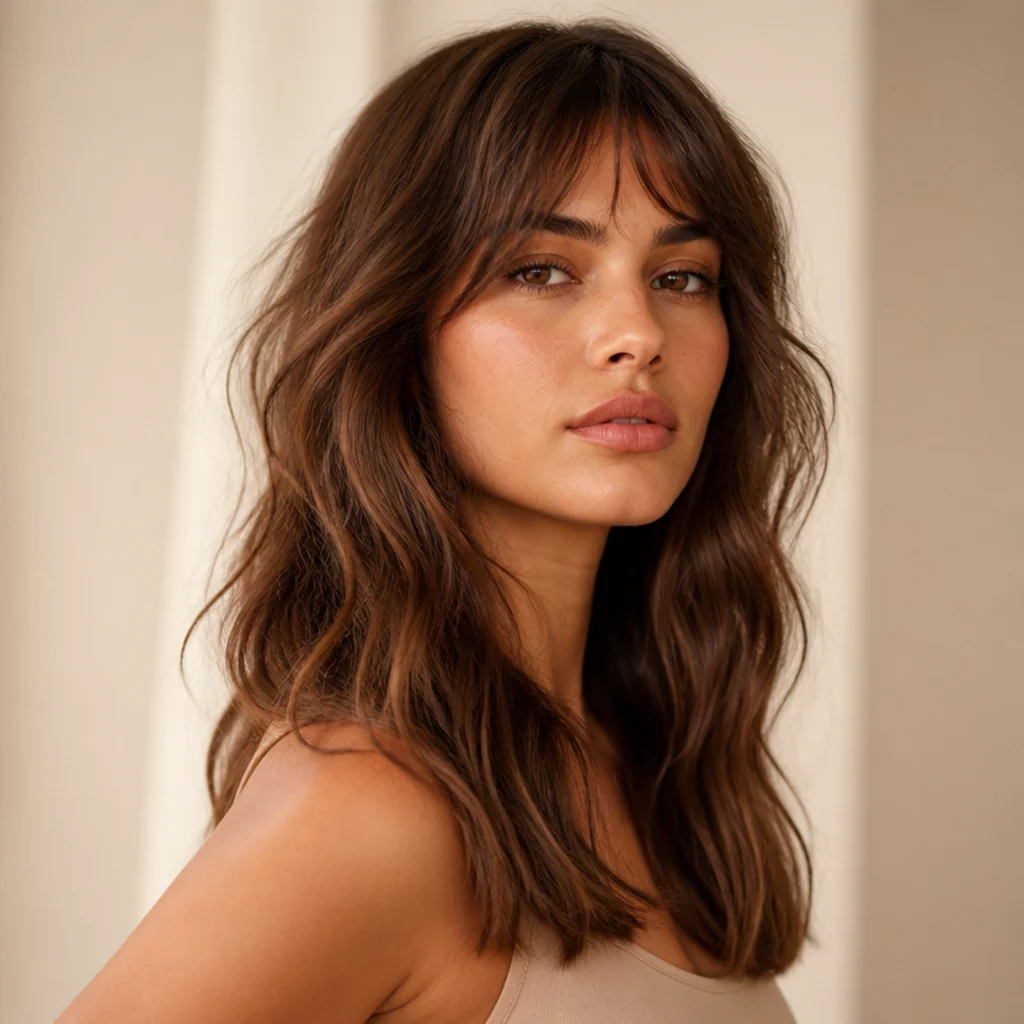
Most shags finish in wispy, tapered points, but a blunt-ended version keeps a strong, dense perimeter while still layering the interior for movement, a combination that solves a specific problem. Fine hair that thins to sparse tips looks visibly fuller with a blunt hemline, since the weight concentrated at the bottom reads as density the hair doesn't actually have. That tension between a layered, moving interior and a solid, blunt hemline looks modern and deliberate rather than grown-out. Ask for "interior layers for movement with a blunt, strong perimeter, no point-cutting or thinning at the very ends." Best for fine-to-medium hair (2a-2b) chasing the illusion of fullness. Dry the ends under with a round brush, or use a light flat-iron bevel, so the blunt line curves gently inward. Pro tip: blunt ends show split ends and uneven growth faster than a shattered perimeter would hide them, so book a hemline dusting every eight weeks to keep the bottom line crisp and dense-looking. This is one of the few shag variations where the perimeter, not the interior, is the star of the cut.
22Silver and Gray Wavy Shag
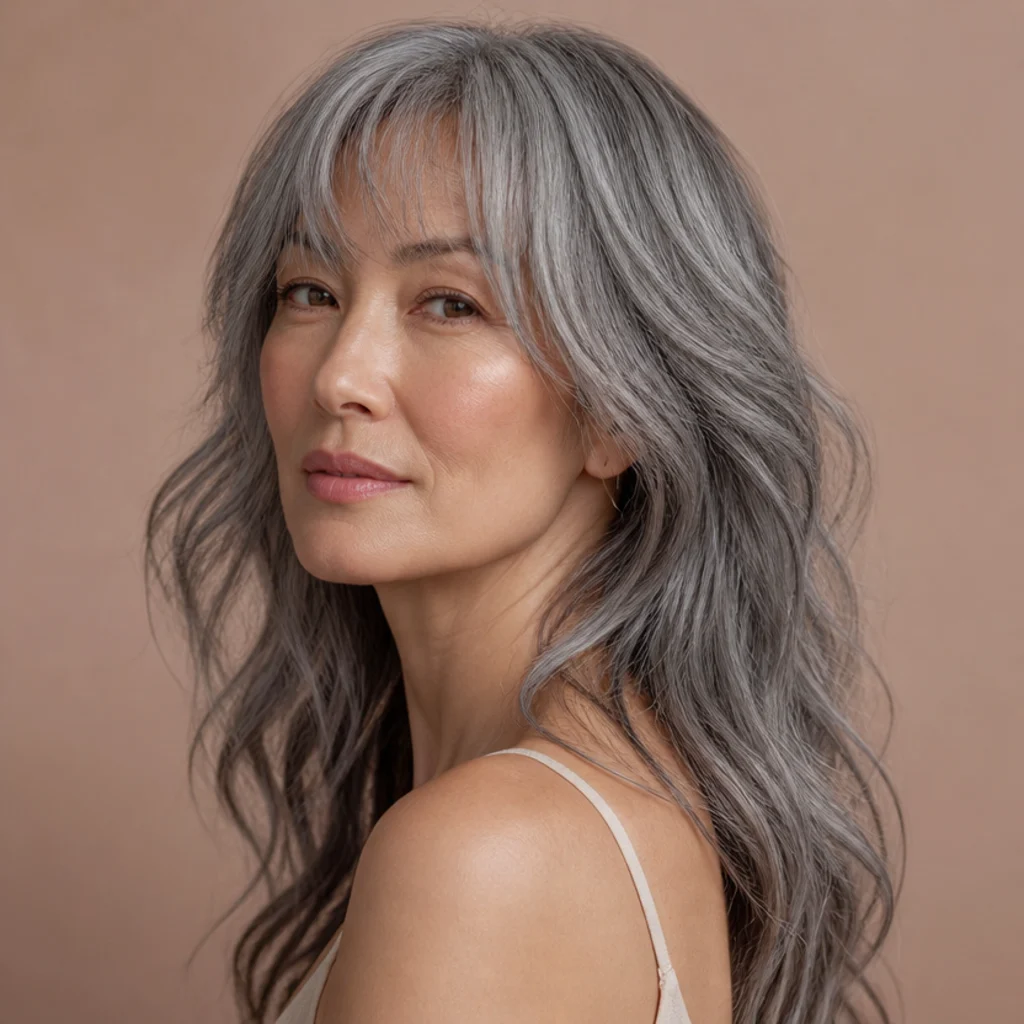
Embracing natural gray or going silver by choice looks striking on a long wavy shag, where the interior layers add the dimension that keeps an otherwise uniform shade from reading flat or aging. Cool silver tones suit cool and neutral undertones and pair well with a soft, face-framing fringe that keeps the look current rather than severe. Whether your gray is natural or lifted and toned into silver, the shag's movement keeps the color lively and dimensional. Ask your stylist for "a dimensional silver toning on a long layered shag," or for natural gray, "a shag cut to add shape and movement to my grow-out." Best for medium hair. The core upkeep is tonal: a purple or silver toning shampoo used once or twice a week neutralizes the yellow cast that both natural gray and lifted silver tend to drift toward. Pro tip: gray and silver hair is often coarser and drier, so pair the toning shampoo with a weekly hydrating mask, and use a heat protectant, since silver is prone to heat-yellowing. A shine serum keeps the cool tone from looking chalky.
23Middle-Part Curtain Shag
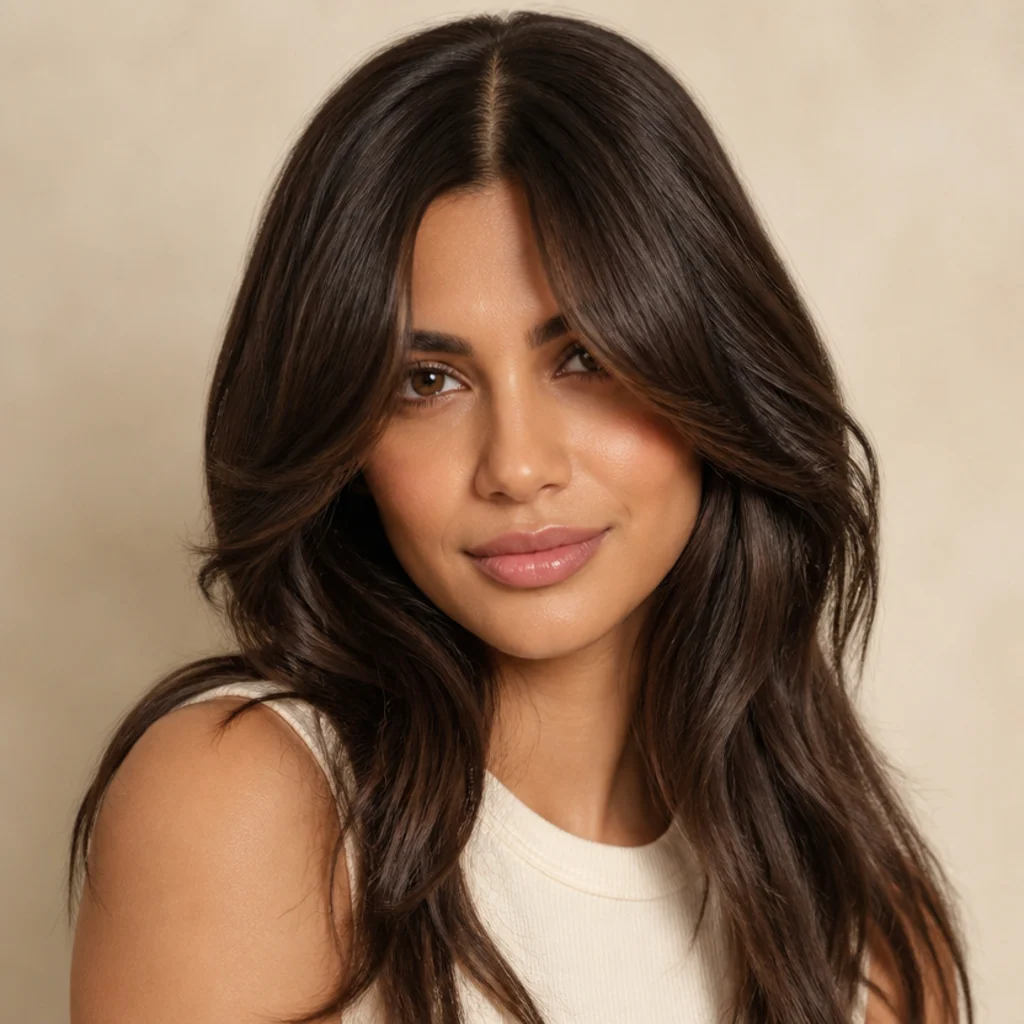
A clean center part paired with curtain bangs gives the shag a symmetrical, balanced frame that reads polished and distinctly current, the version you'd wear to work or a big meeting. The bangs sweep evenly to each side, echoing the layers as they fall, and the vertical line of the middle part elongates the face, which suits rounder and heart-shaped faces by adding perceived length. It's a more refined, intentional take on the long shag with curtain bangs, less tousled than the beachy versions. Ask your stylist for "a center part with even, symmetrical curtain bangs blended into long connected layers." Best for medium-density hair with natural wave. Dry the bangs split precisely down the middle, flick each side back with a round brush, and set the part with a light hairspray. Pro tip: if your hair naturally cowlicks away from a center part, blow-dry the roots at the part flat against the head in alternating directions first to break the cowlick, then set the part; this stops the front from splitting unevenly. Bang trims every four to six weeks keep the symmetry sharp.
24Wavy Shag for Round Faces

A round face pairs best with a shag built to add length and vertical angles rather than width at the cheeks. That means layers kept longer and lower so they fall past the jaw, a fringe that opens up and lengthens the center of the face, and volume concentrated high at the crown instead of out at the sides. The waves add movement without ballooning the silhouette outward, as long as the pieces around the cheekbones stay sleeker. Ask your stylist for "long, face-lengthening layers with a center-parted or long side-swept fringe, keeping width off the jaw and volume at the crown." Best for round and fuller faces of any hair density. Build lift at the crown roots with a round brush or volumizing mousse, while smoothing the sections that fall at the cheeks so the eye travels vertically. Pro tip: avoid a short, rounded curtain bang that stops at the cheekbone; it echoes and emphasizes the round shape. A longer fringe grazing past the cheekbone lengthens instead. Maintenance is moderate, with a shape trim every eight to ten weeks.
25Undone Effortless Everyday Shag
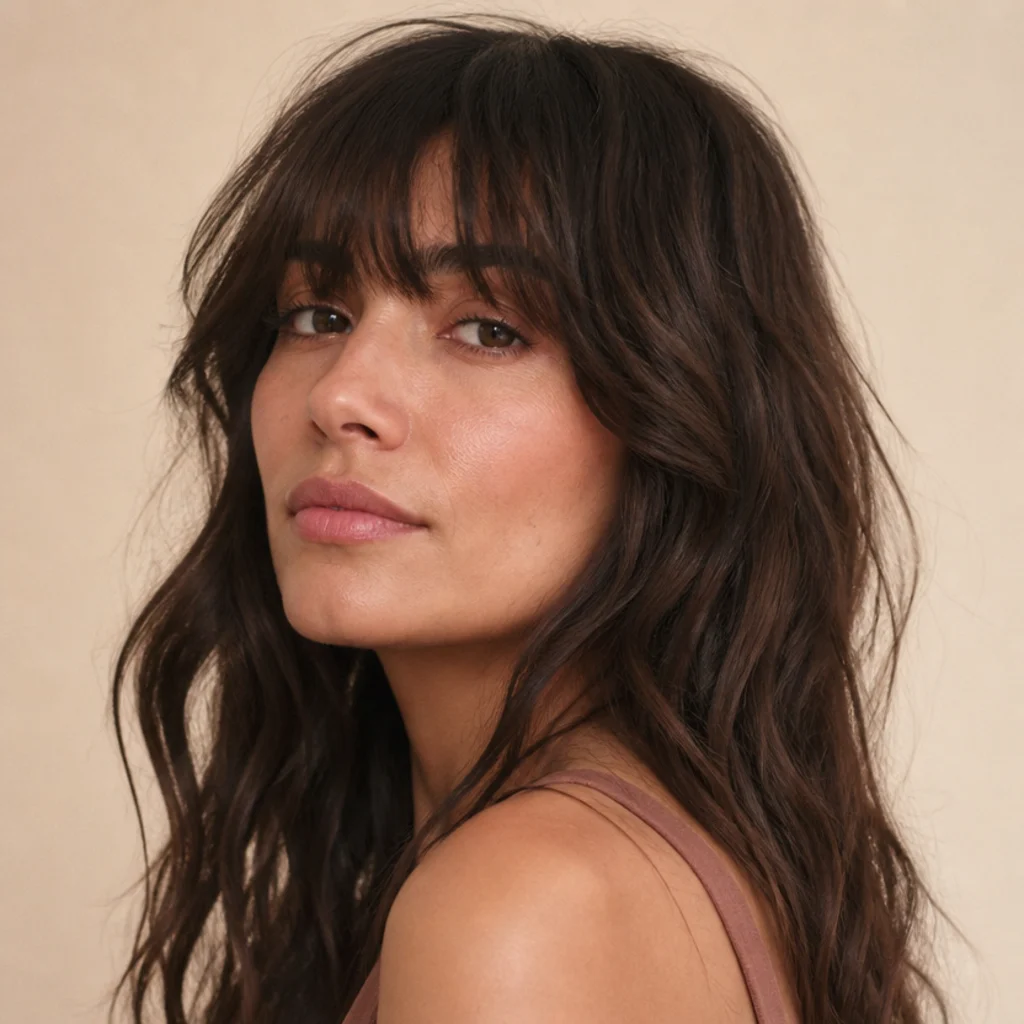
The everyday shag is the one you'll actually wear on repeat: relaxed connected layers, a soft grow-out-friendly fringe, and waves that look like you slept on a loose braid and woke up this way by accident. It's built for minimal effort, thriving on second- and third-day texture and nothing more than a quick scrunch of spray. This version suits anyone who wants the shape and movement of a shag without a daily styling routine or hot tools. Ask your stylist for "a soft, low-fuss long shag with connected layers and a fringe that air-dries well without needing a round brush." Best for naturally wavy hair (2a-2c) of any density. Scrunch a leave-in and a flexible texture spray into damp hair, then either air-dry or diffuse briefly and leave it alone. Pro tip: braid damp hair loosely before bed and unravel it in the morning for uniform waves with zero heat. Maintenance is low, with a trim every ten to twelve weeks, and proof that a gorgeous long wavy shag haircut can be wearable every day, not just for the camera.
Pro Tips from the Editor
- Bring the cut and the color as two separate asks. Name the fringe, the layer placement, and the perimeter first; then, in a fresh sentence, describe the color's root depth, brightness, and warmth. Stylists interpret a single run-on request unevenly.
- Texture-train your stylist, not just your request. If your hair is wavy or curly, seek someone who cuts it dry or offers a curl-specific consultation. A wet cut on textured hair shrinks unpredictably and is the number-one reason a shag comes out shorter and choppier than the inspiration photo.
- Weight removal has a direction. Ask for interior thinning in vertical sections, kept away from the crown and hairline. Horizontal thinning near the surface is what produces frizzy flyaways and shelf-like layers.
- Match color chemistry to your patience, honestly. Reds and coppers fade fastest, blondes need the most toning, and rooty bronde or balayage buys you the most time. Pick the upkeep you will actually maintain, not the one you aspire to.
- Product order decides definition. On wet hair, layer leave-in then wave cream or gel; on dry hair, finish with texture spray or matte paste. Matte products belong on dry hair only, or they vanish.
- Air-dry with intention. Scrunch product in, then stop touching it. Handling waves as they dry is what causes frizz; a diffuser on low or a loose overnight braid gives more consistent results than a mid-dry restyle.
- Photograph the back and the movement. Bring reference images that show the perimeter and how the layers fall in motion, not just a static front-on face shot, so your stylist can match the shape rather than guess it.
How to Choose / Get the Look
Start with texture, because the shag is built to work with what you already have. If your hair is fine (2a-2b), prioritize soft layers concentrated at the crown for lift, a blunt-ish or point-cut perimeter for density, and lightweight products only. If it's thick or coarse, focus on internal, vertically-sectioned layering to release weight so waves form instead of expanding into width, and anchor the front with a substantial fringe. If you're curly (2c-3b), the single most important decision is your stylist: book a dry curl cut and a specialist who shapes to your pattern.
Then factor in face shape and fringe. Center parts and curtain bangs lengthen rounder and heart-shaped faces; side-swept fringe softens square and angular jaws; longer, lower layers keep balance and avoid width at the cheeks. Round faces should steer away from short, rounded bangs that stop at the cheekbone.
Use this quick reference to align texture, priority, and fringe before you book:
| Hair type | Prioritize | Best fringe | Trim cadence |
|---|---|---|---|
| Fine (2a-2b) | Crown lift, blunt-ish perimeter, light product | Wispy bottleneck or curtain | 8 wks + bang dust |
| Medium wavy (2b-2c) | Connected layers, balayage-friendly movement | Curtain or side-swept | 8-10 wks |
| Thick / coarse | Internal weight removal, strong perimeter | Substantial curtain | 8 wks |
| Curly (2c-3b) | Dry cut, pattern-shaped layers | Curtain cut into curl | 10-12 wks |
| Straight (1c-2a) | Textured ends, enhanced natural bend | Curtain or side-swept | 8-10 wks |
Finally, match color upkeep to your real routine. Rooty bronde, soft balayage, and grown-out natural shades stretch appointments to three or four months; vivid coppers, true black, honey blonde, and cool silver demand toning or depositing care every six to eight weeks. When you book, bring two or three saved images that show the perimeter and movement, name the fringe style precisely, say choppy or soft for the layers, and state exactly how much length you're willing to lose. Ask your stylist to keep the interior layered but the perimeter strong if you want shape without sacrificing density.
Frequently Asked Questions
Is a long shag good for fine hair?
Yes, and it's one of the smarter cuts for fine hair when it's done right. A long shag for fine hair fakes volume through soft, crown-concentrated layers, while a stronger, point-cut perimeter keeps the ends from looking sparse. The key is what to avoid: razoring, heavy thinning shears, and rich oils, all of which strip or weigh down density fine hair can't spare. Ask specifically for lift at the crown and a fuller hemline.
What is the difference between a shag and regular long layers?
A shag uses more aggressive, graduated interior layering, a shattered or textured perimeter, and almost always a fringe, so the overall effect reads as movement, separation, and shape. Standard long layers are subtler and blended, keeping a more uniform, connected silhouette with no deliberate fringe or piece-y ends. The shag is a defined shape; long layers are a softening of one length.
Do long shags with curtain bangs suit all face shapes?
Very nearly. A long shag with curtain bangs is among the most universally flattering combinations because the parted fringe is endlessly adjustable, cut longer and sweeping to lengthen round and heart faces, or slightly more closed and cheekbone-grazing to soften wider ones. The one caveat: round faces should avoid a short, rounded bang that stops at the cheekbone, since it echoes the face shape; go longer instead.
How often should I trim a long wavy shag?
Plan on every eight to twelve weeks to maintain the overall shape and stop the interior layers from reading heavy, and every four to six weeks if you want a fringe to stay crisp. Wavy texture disguises grow-out well, so many people comfortably stretch full shape trims toward the twelve-week end, doing only a quick perimeter dusting in between.
Can I get a wavy shag if my hair is straight?
Yes. A shag is cut to enhance a subtle natural bend, and curtain or side-swept bangs add movement at the front where straight lengths fall flat. Ask for a lightly textured perimeter so the ends flick. To wear it wavy, a sea-salt spray, a large-barrel iron with the curl brushed loose, or an overnight braid all give straight hair the tousled shag effect without a perm.
How much length will I actually lose with a shag?
Less than people fear, because the length lives in the perimeter, not the layers. A well-cut shag keeps your overall length nearly intact while adding graduated interior layers and a fringe, so the change is in shape and movement, not inches off the bottom. Tell your stylist the exact length you want to keep at the back and ask them to build the layers upward from there.
What products does a wavy shag need to style?
Fewer than most cuts. The everyday routine is a leave-in and a wave cream or light gel on wet hair, then a flexible texture spray on dry hair to revive separation. Fine hair should add a root-lifting mousse and skip oils; coarse and curly hair should add a richer leave-in or curl custard applied to soaking-wet hair. Matte pastes and clays belong on dry hair only.
Will a wavy shag work as my hair grows out?
Very well, which is a large part of its appeal. Because the layers are connected and the perimeter is textured rather than blunt, a shag relaxes into a softer version of itself instead of developing an awkward line as it grows. Ask for a grow-out-friendly fringe and connected, non-choppy layers, and the cut can look intentional for months past its last trim.
Is a long shag high or low maintenance overall?
The cut itself runs low-to-moderate maintenance: minimal styling, forgiving grow-out, and trims spaced eight to twelve weeks apart. What raises the maintenance is the color you pair with it. A natural or rooty bronde shag is low-effort, while a vivid copper, honey blonde, true black, or cool silver adds regular toning or depositing care. Choose the color tier that matches the routine you'll actually keep.