15 Easy Long Shag Haircuts With Bangs
The long shag earns its comeback by solving two problems at once: it keeps length you can still tie back while stacking short internal layers that make fine, flat, or heavy hair move. Match those layers to the right fringe and an ordinary grow-out reads like a deliberate, editorial signature you barely have to style.
 Edited by Lena Rose · Published July 11, 2026 · 35 min read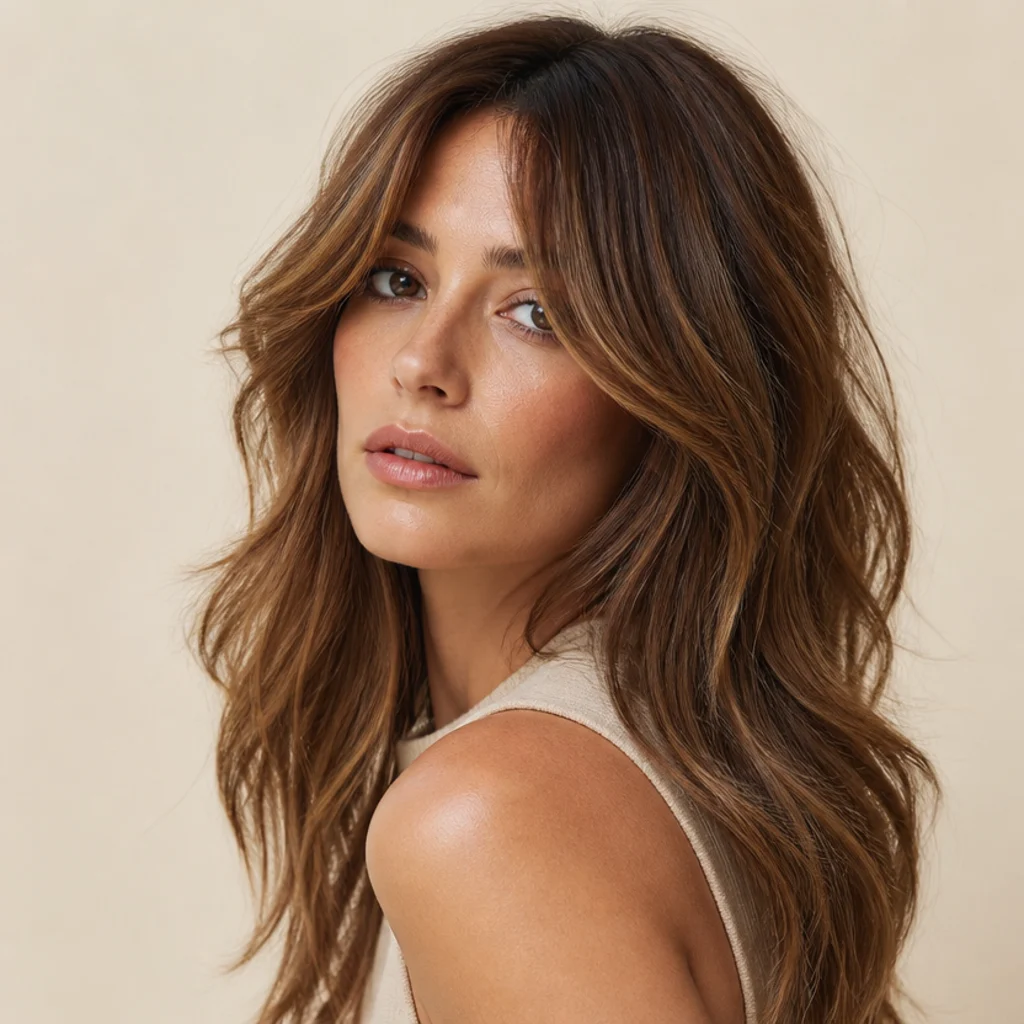
Quick Answer
- Best for: Anyone wanting collarbone-or-longer length with built-in movement; delivers on straight, wavy, curly, and coily hair from 2A through 4C, and rescues fine, flat, or heavy hair that falls in a single lifeless curtain.
- Who might skip it: Anyone growing out a one-length blunt cut who wants a solid, glassy perimeter; anyone unwilling to touch product, since raw layers can look thin without texture or mousse; and very fine hair prone to breakage that a razor could fray.
- Maintenance: Moderate. Shape trim every 8-12 weeks; bang trims range from every 2-3 weeks (baby, blunt) to every few months (curtain, grown-out).
- Difficulty: Easy to style at home in 10-15 minutes once you learn one root-lift move; the cut itself, especially the disconnected layers and fringe, belongs in a stylist's hands.
- Cost: Variable. Expect a layered-cut price plus a fringe add-on in your area, typically a mid-to-upper salon range; a specialist dry-curl cut or added money-piece color pushes it higher.
- Wear time / longevity: The silhouette holds 10-14 weeks before layers blur into one length; color add-ons need toning every 6-8 weeks.
- Standout variation: A soft long shag with curtain bangs, which flatters the widest range of face shapes and grows out with no awkward stage.
- How to ask your stylist: Bring two photos, name the texture and layer depth you want ("lived-in, not choppy"), state your true styling minutes, and ask them to cut the fringe last, dry, and to your real routine.
In This Guide
- Soft Long Shag With Curtain Bangs
- Long Curly Shag Haircut With Fringe
- Long Shag With Choppy Layers and Wispy Bangs
- Long Shag on Straight Hair With Blunt Bangs
- Long Layered Shag With Face-Framing Bangs
- 70s-Inspired Long Shag With Feathered Bangs
- Long Wavy Shag With Side-Swept Bangs
- Textured Long Shag With Baby Bangs
- Long Shag for Fine Hair With Airy Bangs
- Long Shag for Thick Hair With Heavy Bangs
- Coily Long Shag With Rounded Fringe
- Long Shag With Money-Piece Bangs
- Beachy Long Shag With Grown-Out Bangs
- Long Shag Mullet Hybrid With Curtain Bangs
- Sleek Long Shag With Micro-Layered Bangs
The long shag has become the most flexible cut in the salon book, and bangs are what push it from "nice layers" into a look people stop to ask about. The mechanics matter: a true shag keeps your perimeter long, usually collarbone to mid-back, while carving stacked internal layers that start high, often around the cheekbone or ear, cut at a steep elevation so weight lifts away from the roots and hair falls in visible sections instead of one solid curtain. Bangs give that movement something to build toward and pull the eye up to your face.
What makes the cut so wearable is how forgiving it is. Layers disguise grow-out, a soft fringe softens a strong jaw or high forehead, and the shape works with your natural pattern instead of fighting it with heat every morning. The disconnection also catches light well, so it reads as dimension even before you add color. Below are 15 versions, each built around a specific bang style, layer depth, and texture, from a long curly shag haircut to long shag choppy layers to a polished long layered shag haircut. For each you'll find who it flatters, the cutting logic behind it, a realistic upkeep timeline, styling and color pairings, and the exact words to use in the chair so you leave with the cut you saved.
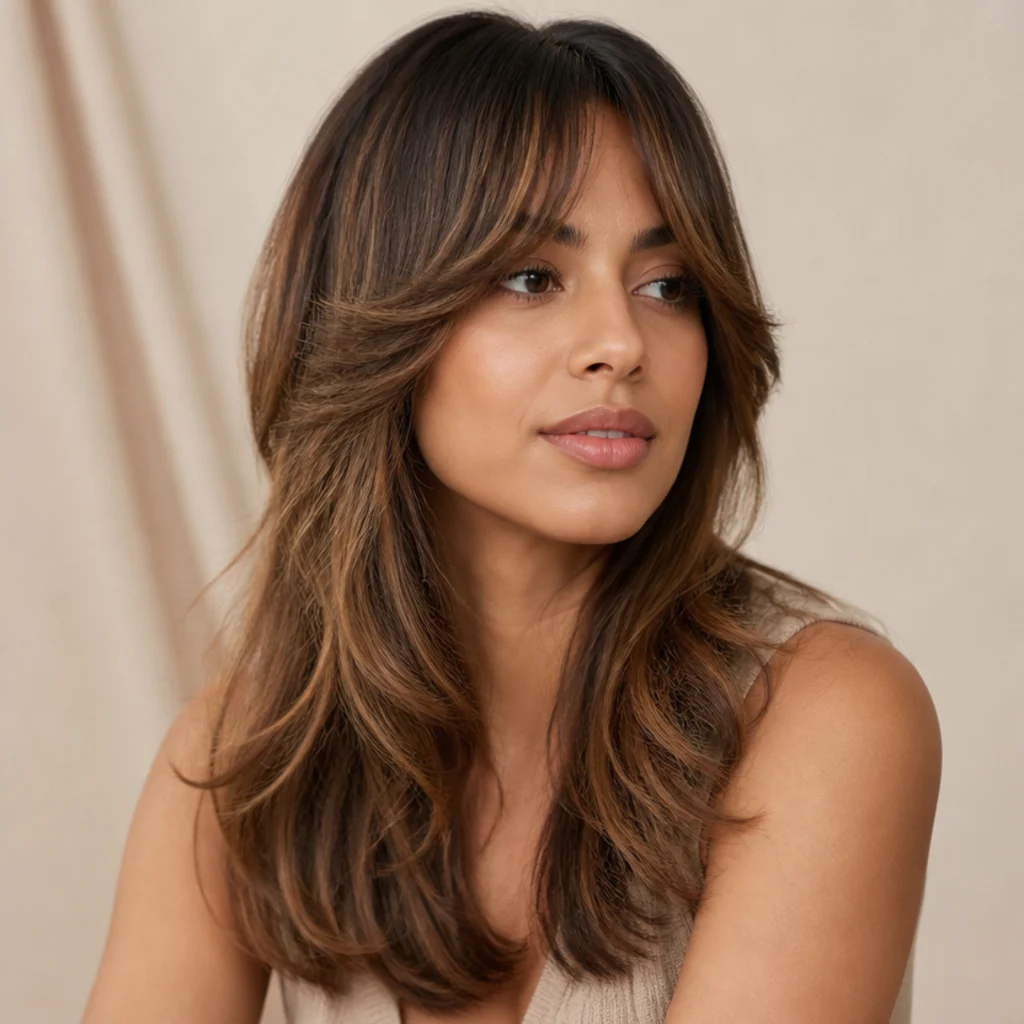
01Soft Long Shag With Curtain Bangs
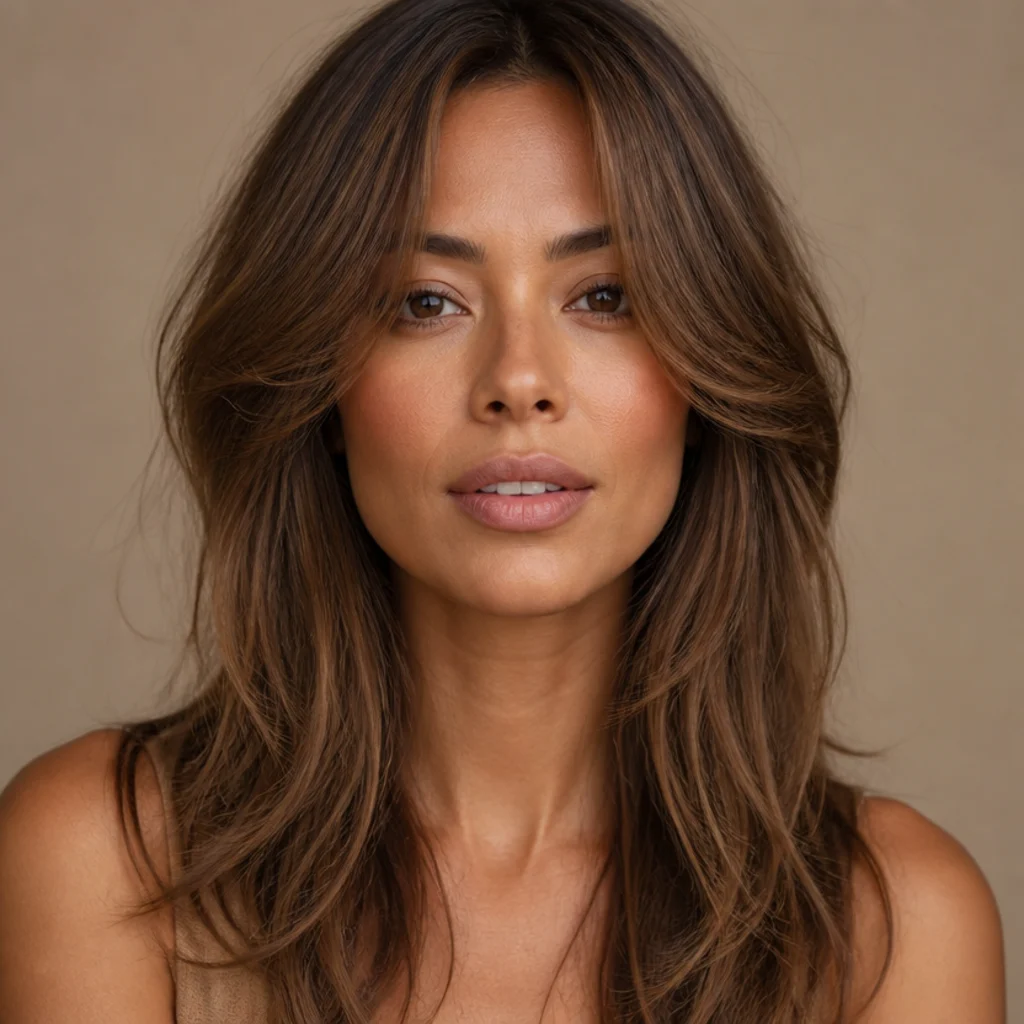
This is the version most people picture first, and it's the safest place to start. A soft long shag pairs gently disconnected layers with curtain bangs that split at the center and arc back toward the cheekbones, so the fringe reads as one continuous sweep with the face-framing pieces instead of a separate block. The shortest curtain length usually lands at the cheekbone, the longest blends into layers at the jaw, and a good stylist over-directs the sections forward to build that soft concave bend. Nearly every face shape wears it well: the parted opening adds width at the temples and lengthens a round or square face through the middle, oval and heart shapes take to it easily, and deep-set or close-set eyes both benefit from the way the sweep opens the center. Fine to medium hair benefits most, since the internal layering fakes fullness without bulk, though thicker or coarser hair works once a stylist removes weight underneath. Warm caramel, honey, and lived-in brunette with soft golden undertones flatter the softness. Upkeep is low: as the bangs grow they melt into face-framing layers with no blunt line to babysit, so you can stretch to a 10-12 week trim. To style, round-brush the damp fringe away from center with a nozzle dryer and a cool shot to set the bend, then break it with a pea of cream. Ask your colorist for a subtle face-framing brightening if you want the sweep to catch more light, and ask your stylist for "soft, blended curtain bangs and lived-in layers, nothing too choppy."
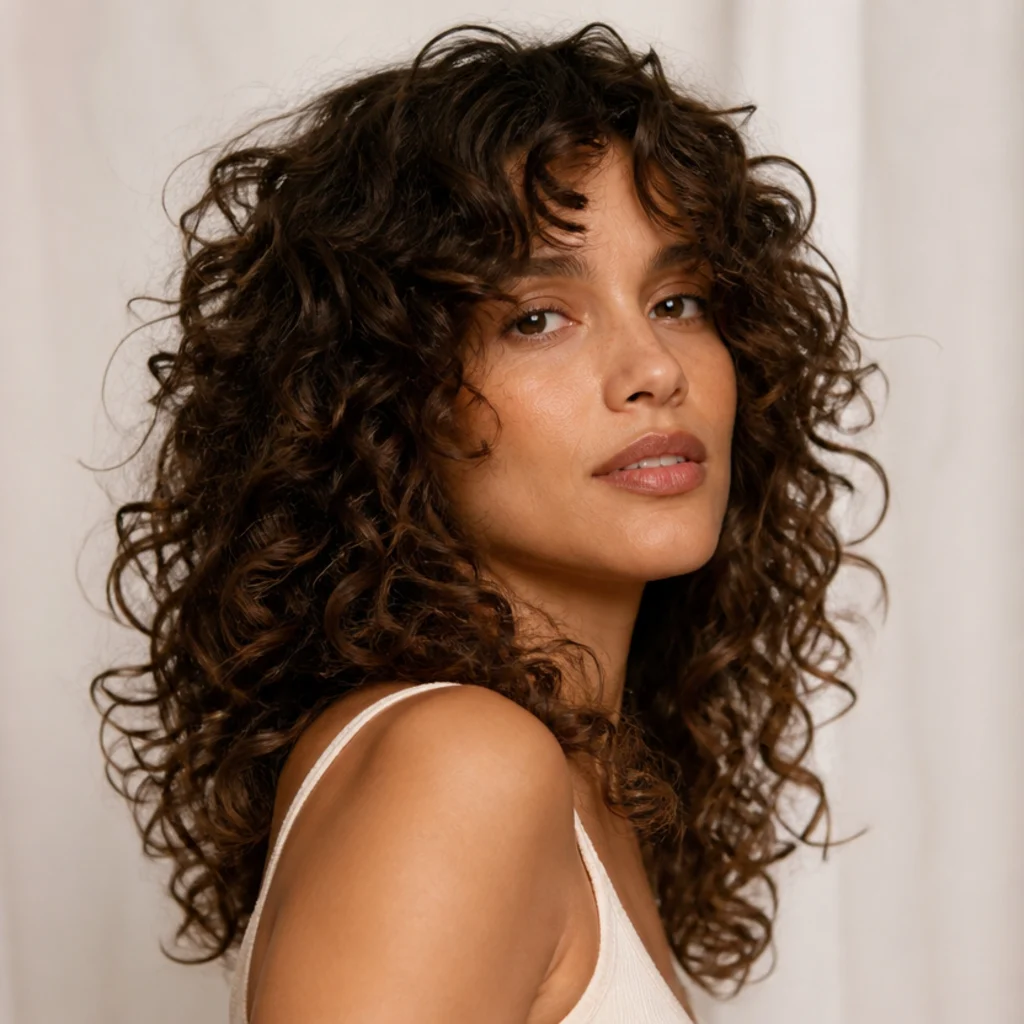
02Long Curly Shag Haircut With Fringe
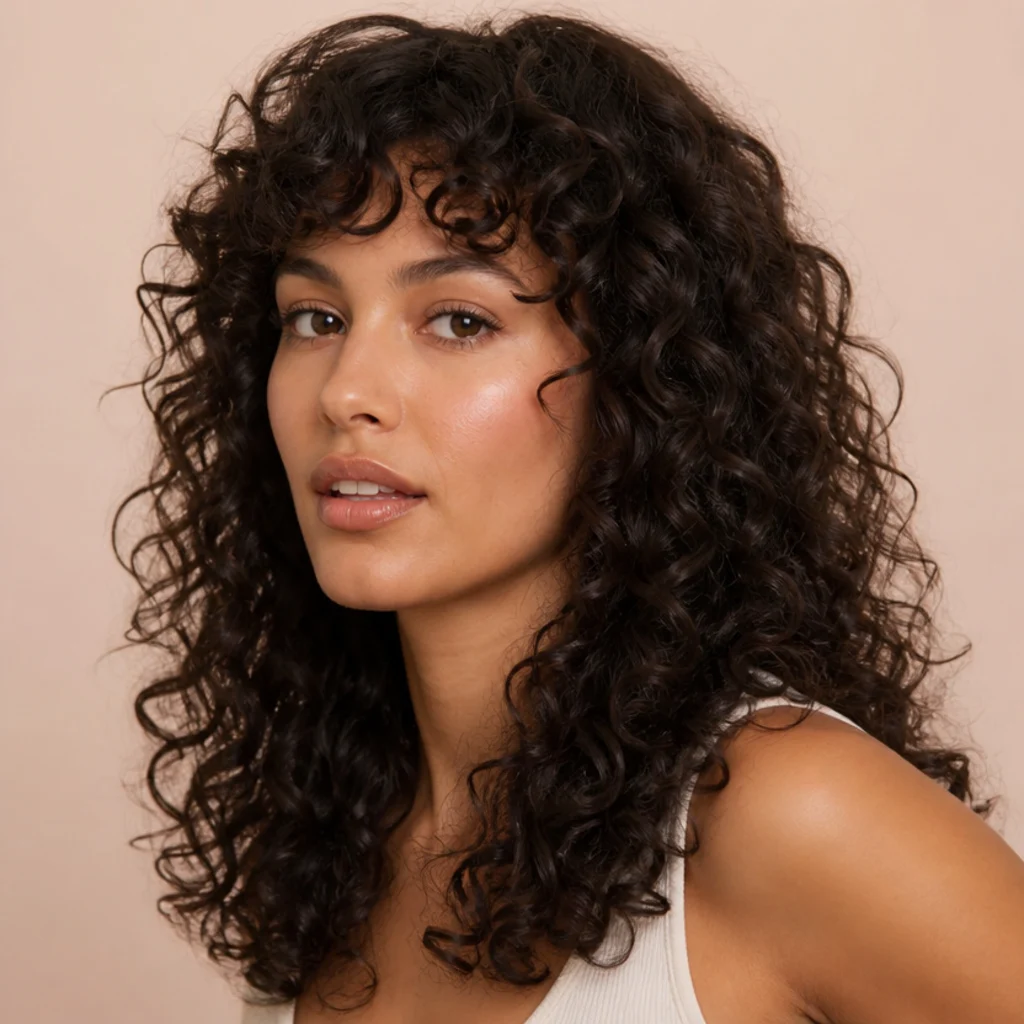
A long curly shag haircut leans into what curls already do, using layers to redistribute volume so the silhouette doesn't collapse into a triangle at the perimeter. The critical detail is that the fringe is cut on the curl: shaped while dry so each coil springs back to the intended length once it dries, rather than shrinking up short and blunt. Curls can draw up 30 to 50 percent from wet, which is exactly why a wet-cut fringe so often lands too high. The look suits 2C to 3B textures that want a defined shape without sacrificing length, framing a rounded face rather than building a mushroom top, and it reads best on medium-density curls that hold an internal layer. Deep espresso, cool brunette, and dimensional balayage read especially rich against the pattern's shadows, and cooler undertones keep multi-directional curls from looking brassy. Maintenance is about hydration more than scissors: a leave-in plus a curl cream on soaking-wet hair, then a diffuser on low heat and low speed with hair cupped toward the scalp to set root volume. A silk pillowcase or overnight pineapple protects the fringe shape between washes, so you may only need a trim every 10-12 weeks. Have your stylist dry-cut the curls individually so each layer lands where it naturally falls, and ask them to test and set the fringe length while your hair is fully dry and in its natural pattern, never wet and stretched.
03Long Shag With Choppy Layers and Wispy Bangs
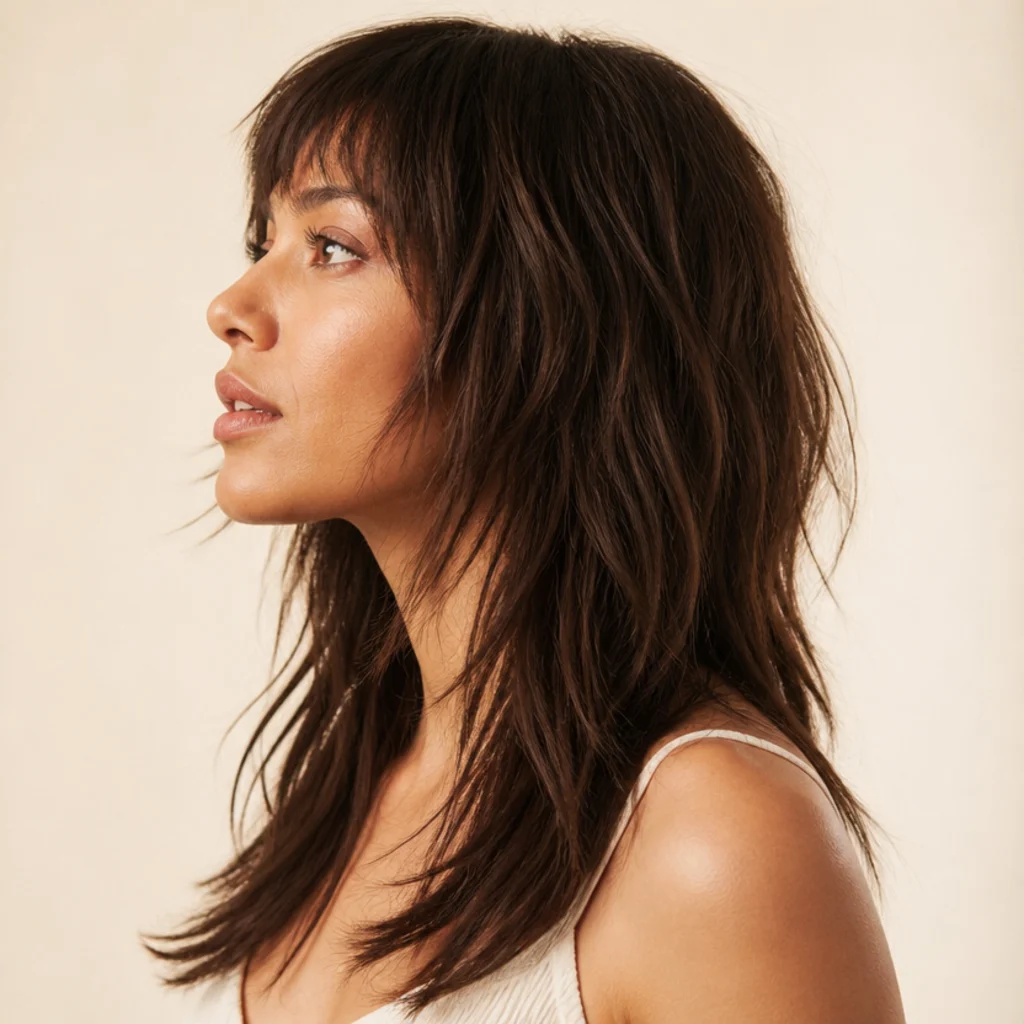
When you want texture you can actually see, long shag choppy layers deliver it. This version uses deliberate, uneven layering through the mid-lengths and ends, often razor- or deep-point-cut at a high elevation, paired with wispy bangs that are notched so they break into soft, separated pieces across the brow. The effect is undone and a little rock-and-roll, with grit that flat, fine-to-medium straight and wavy hair rarely holds on its own. It's less friendly to very fine or fragile hair, where a razor can invite frizz and split ends, so point-cutting is the safer route there; coarse hair, by contrast, can take the razor's full bite. Chestnut, cool ash brown, and smoky brunette suit the piecey separation, and matte, low-shine tones make the choppiness read more than a glassy finish would. Be realistic about upkeep: this is one of the higher-maintenance looks here, wanting a trim roughly every 8 weeks so the choppy ends stay intentional instead of stringy. Style it with a texturizing spray or a matte clay-paste worked through dry ends, scrunching upward for lift. A pro tip: mist dry shampoo at the roots before you even feel oily, since the added grip helps the choppiness stand up and hold. Ask for "razor or point-cut choppy layers with piecey, wispy bangs," and tell your stylist exactly how much forehead you want the fringe to cover.
04Long Shag on Straight Hair With Blunt Bangs
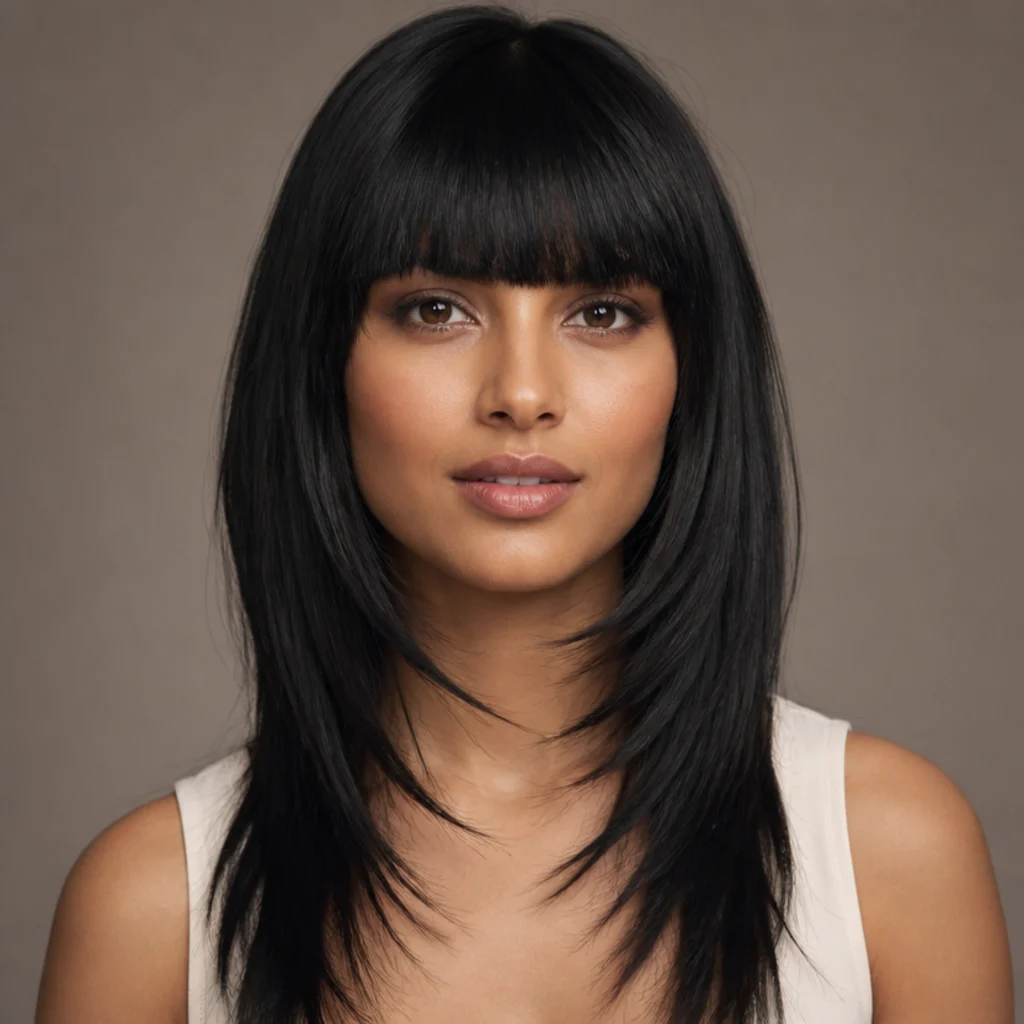
A long shag on straight hair proves the cut isn't reserved for texture. Here the layers are softer and more graduated, giving pin-straight hair the movement it can't produce on its own, while a blunt fringe cut straight across the brow adds a graphic, modern edge. The contrast between airy, feathered lengths and a solid, dense bang line is what makes it look designed rather than accidental. Medium to thick straight hair suits this cut best, since fine hair can leave a blunt fringe looking see-through and sparse; if your hair is fine, ask for a soft-blunt version with a little internal thinning behind the front row so the line still reads full. A blunt fringe also balances a longer face and can shorten a very small one, so keep it a touch airier if your forehead is short. Jet-black, espresso, and glossy single-process shades show the clean line most crisply. Plan on bang trims every 3-4 weeks to keep that edge sharp, plus a shape trim every 8-10 weeks. Style with a flat paddle brush and a smoothing cream, drying the fringe first, downward and side to side, before it sets in a cowlick. A pro tip: a drop of lightweight oil on the very ends keeps blunt bangs from looking dry under the graphic line. Tell your stylist you want "diffused long layers with a full blunt fringe," and have them check the bang density against your hairline before committing.
05Long Layered Shag With Face-Framing Bangs
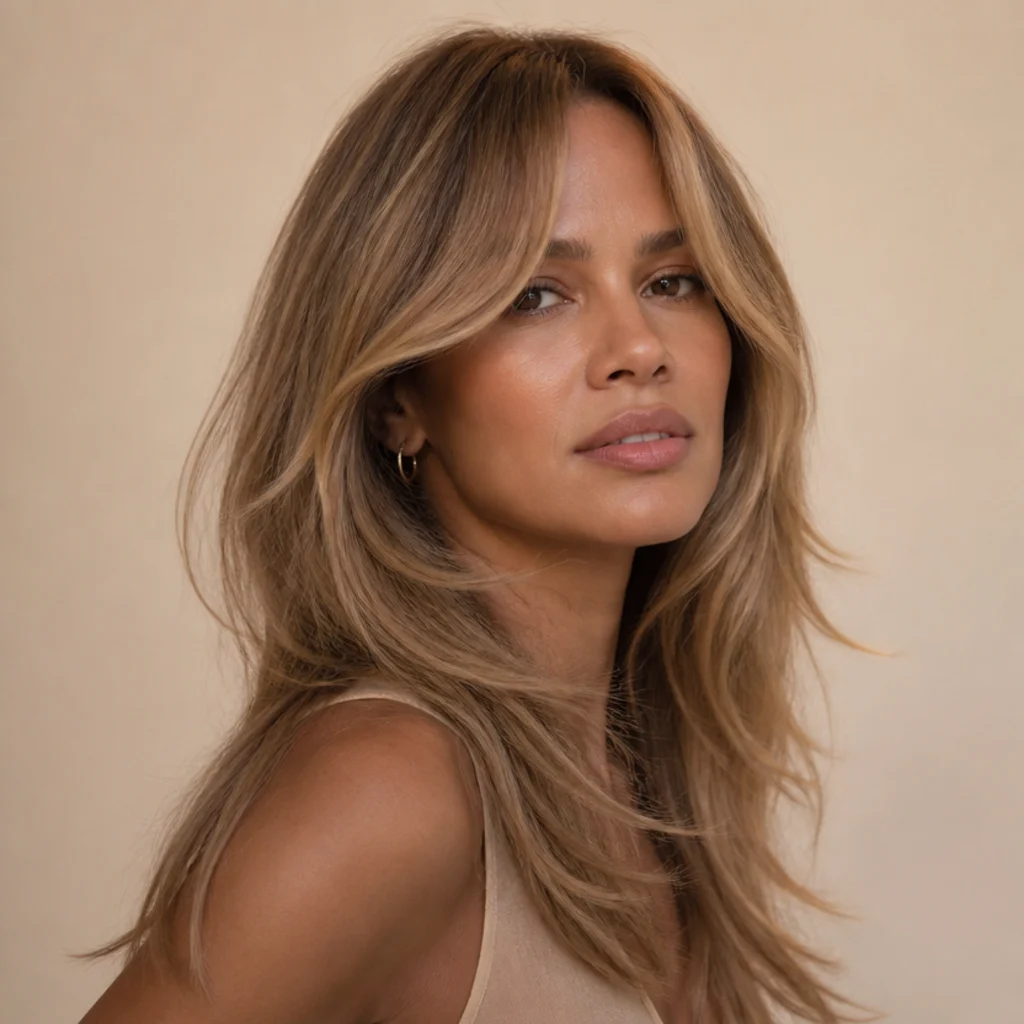
A long layered shag haircut with face-framing bangs is the low-commitment on-ramp if a heavy fringe intimidates you. Instead of a true bang, the shortest pieces begin around the cheekbone or jaw and cascade into longer layers, framing the face like a soft parenthesis you can tuck or leave loose. It's endlessly adaptable because you dictate where the framing starts: higher near the eye for drama, lower toward the jaw for subtlety, and a stylist sets that with the length of the first guide piece. This works across every texture and is especially kind to anyone growing out old bangs, since the front pieces give grow-out somewhere to blend. A soft vertical line flatters wider faces and narrows a round or square jaw. Honey-blonde, bronde, and warm brunette make the framing catch light and read expensive, which is why it pairs so naturally with a face-framing highlight or money-piece. Upkeep is minimal, with no blunt line to maintain, so a trim every 10-12 weeks holds it. Style by wrapping the front pieces around a large round brush or curling them a half-turn away from the face for a lived-in bend. A pro tip: part the shortest piece slightly off-center so it falls forward instead of splitting flat against your cheek. Ask for "connected face-framing layers that blend into a long shag," and point to the exact spot where you want the shortest piece to fall.
Save this to Pinterest to compare the bang styles side by side.
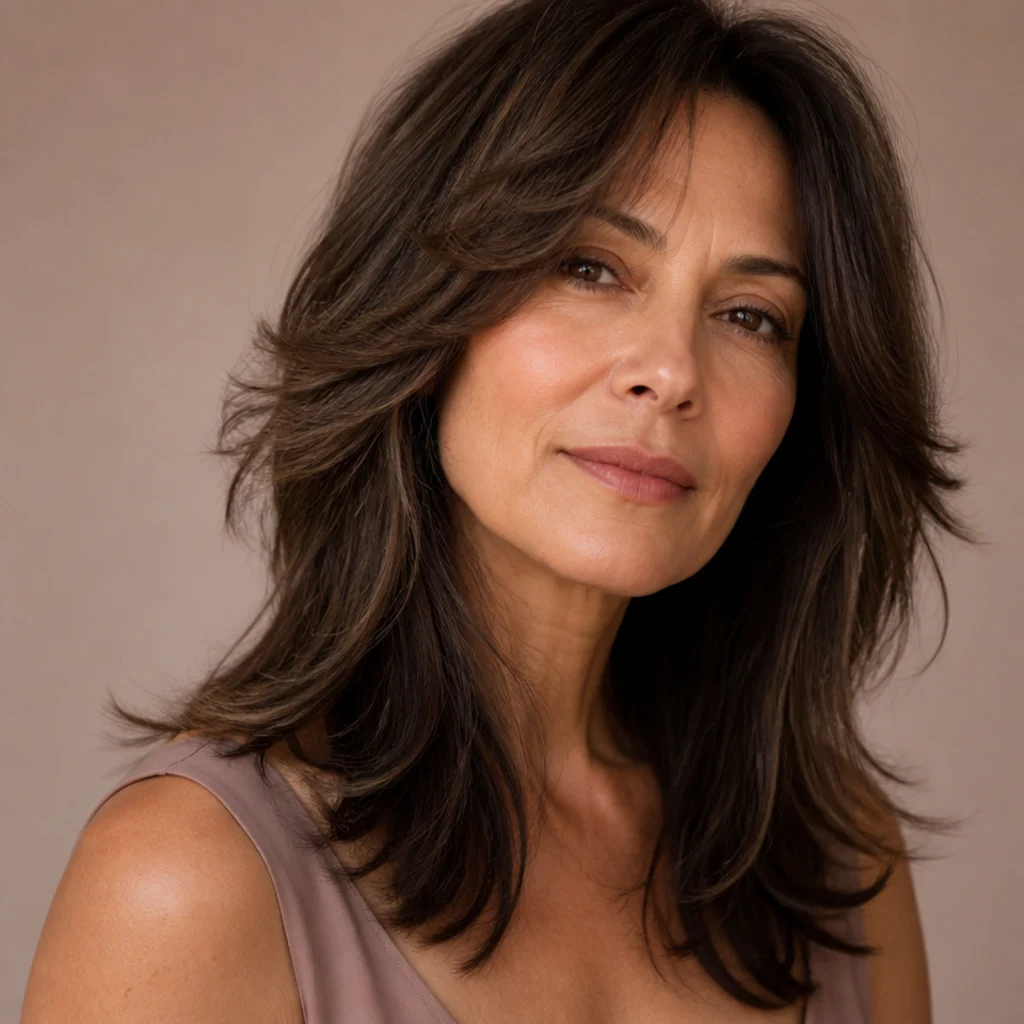
0670s-Inspired Long Shag With Feathered Bangs
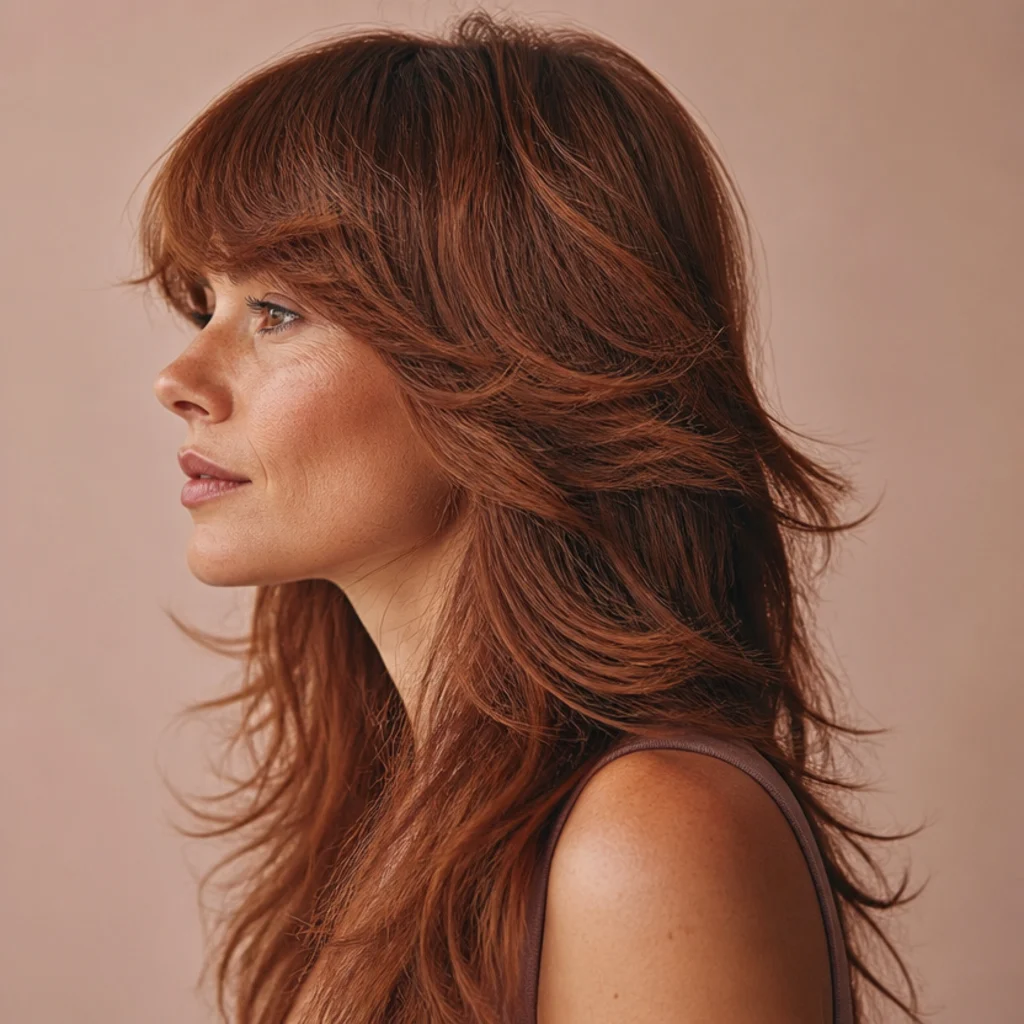
This is the shag at its most nostalgic and, styled right, its most flattering. A 70s-inspired long shag stacks feathered layers throughout the crown and lengths, then pairs them with bangs that flick back at the sides in the Farrah tradition, echoing the era's rock-and-roll ease. The feathering, cut with a razor or steep point-cut so the ends taper, keeps everything soft and winged rather than stiff or helmet-like. Medium to thick hair that holds a bend suits this best, and a little natural body helps; poker-straight fine hair may need a light setting or velcro rollers to keep the wings from dropping by midday. Warm auburn, copper, and golden brunette are the era-authentic shades that make the layers glow, and warm undertones amplify the sunlit feathering. Maintenance is moderate: the feathered shape relies on trims every 8-10 weeks so the layers stay distinct instead of blurring into one length. Style with a large round brush, over-directing the front sections away from the face and hitting them with a cool shot to lock the flick. A pro tip: mist a flexible-hold hairspray onto the brush, not the hair, then roll it through for movement that lasts without crunch. Ask your stylist for "feathered 70s shag layers with bangs that wing back," and mention you want the fringe to connect smoothly into the side pieces rather than sitting as a separate block.
07Long Wavy Shag With Side-Swept Bangs
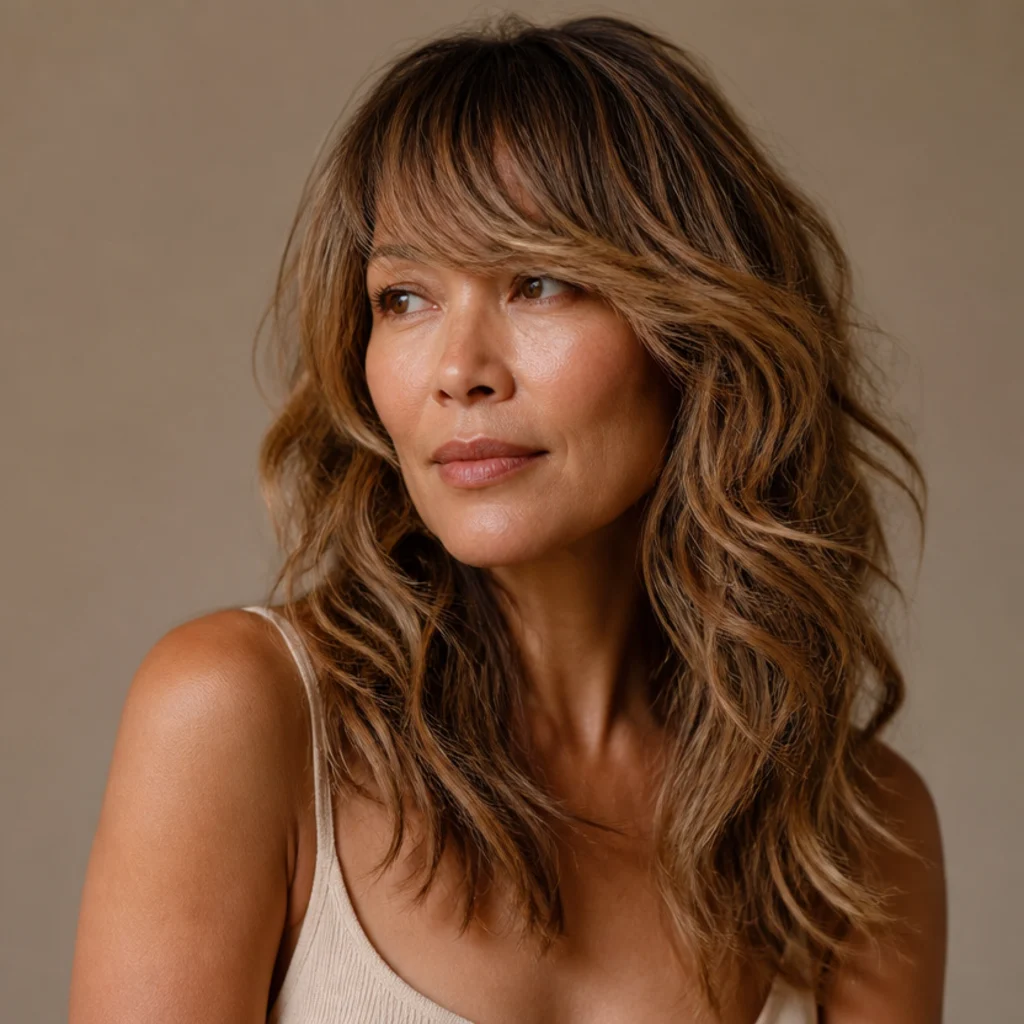
If a center fringe feels too committal, side-swept bangs give you all the shag's movement with a gentler entry point. This version is cut to your natural wave, layering the length so the S-bends stack and the bangs sweep to one side to graze the brow. It's forgiving for growing-out fringe and flatters round and heart shapes by casting a diagonal line across the forehead that offsets width and draws the eye down and across. Wavy and loosely curly 2A to 3A hair suits it best, since the bend carries the sweep without heat; straighter hair can wear it but may need a wand to hold the diagonal. Bronde, sun-lit brunette, and soft balayage play into the beachy movement, and warm-to-neutral undertones keep the waves looking sunlit rather than flat. Upkeep is gentle: side bangs blend as they grow, so you can stretch shape trims to 10-12 weeks. Style by rough-drying with your fingers to build wave, then defining a few pieces with a curling wand a full turn away from the face, and sweeping the fringe across with a light texture spray. A pro tip: dry the bangs first, directing them across your forehead before the rest sets, so they train to your chosen side and stop splitting back to center. Ask for "long shag layers cut to my wave pattern with soft side-swept bangs," and have your stylist check which side your hair naturally parts toward before they cut the sweep.
08Textured Long Shag With Baby Bangs
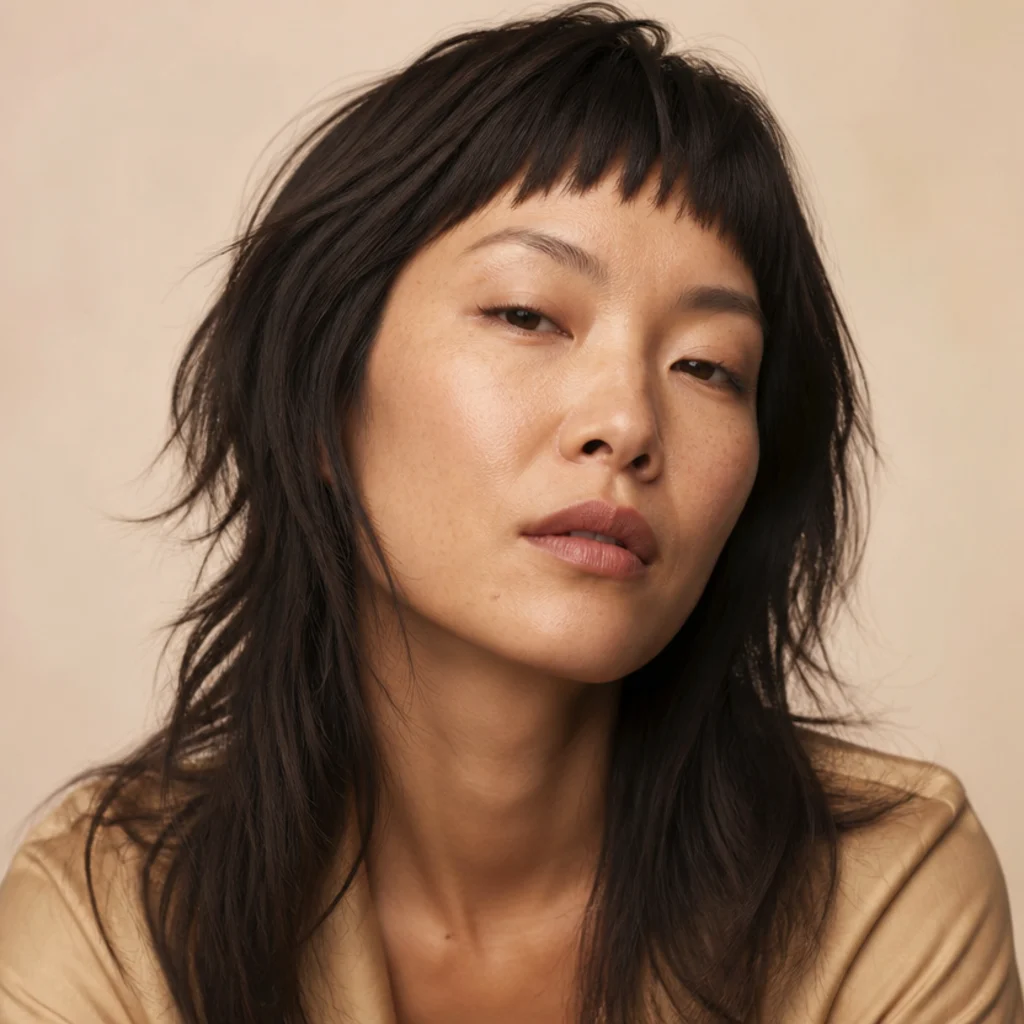
For a bolder statement, baby bangs sit high on the forehead, well above the brow, against a heavily textured long shag. The contrast between a very short, blunt-or-piecey micro fringe and long, ropey layers is fashion-forward and undeniably editorial. This one asks for confidence and suits oval and long face shapes that can carry the raised fringe line without foreshortening; if your forehead is short or your hairline low, keep the fringe a touch lower to avoid a cropped, top-heavy look. Straight to slightly wavy hair shows the shape most clearly, since coils can shrink a micro fringe unpredictably and demand a longer starting length. Cool dark brown, espresso, and inky near-black give the graphic contrast its edge, and cool undertones sharpen the fashion-forward feel. Be honest about the commitment: baby bangs need trimming every 2-3 weeks to hold their height, making this the highest-upkeep fringe here. Style them dry with a small round brush or a mini flat iron, then break the line with a fingertip of pomade so it looks intentional, not severe. A pro tip: a swipe of clear brow gel through the fringe tames the flyaways a micro length inevitably exposes. Ask for "micro baby bangs with a piecey, textured long shag," and discuss your forehead height and hairline shape so the fringe lands in a balanced, deliberate spot rather than a cropped one.
09Long Shag for Fine Hair With Airy Bangs
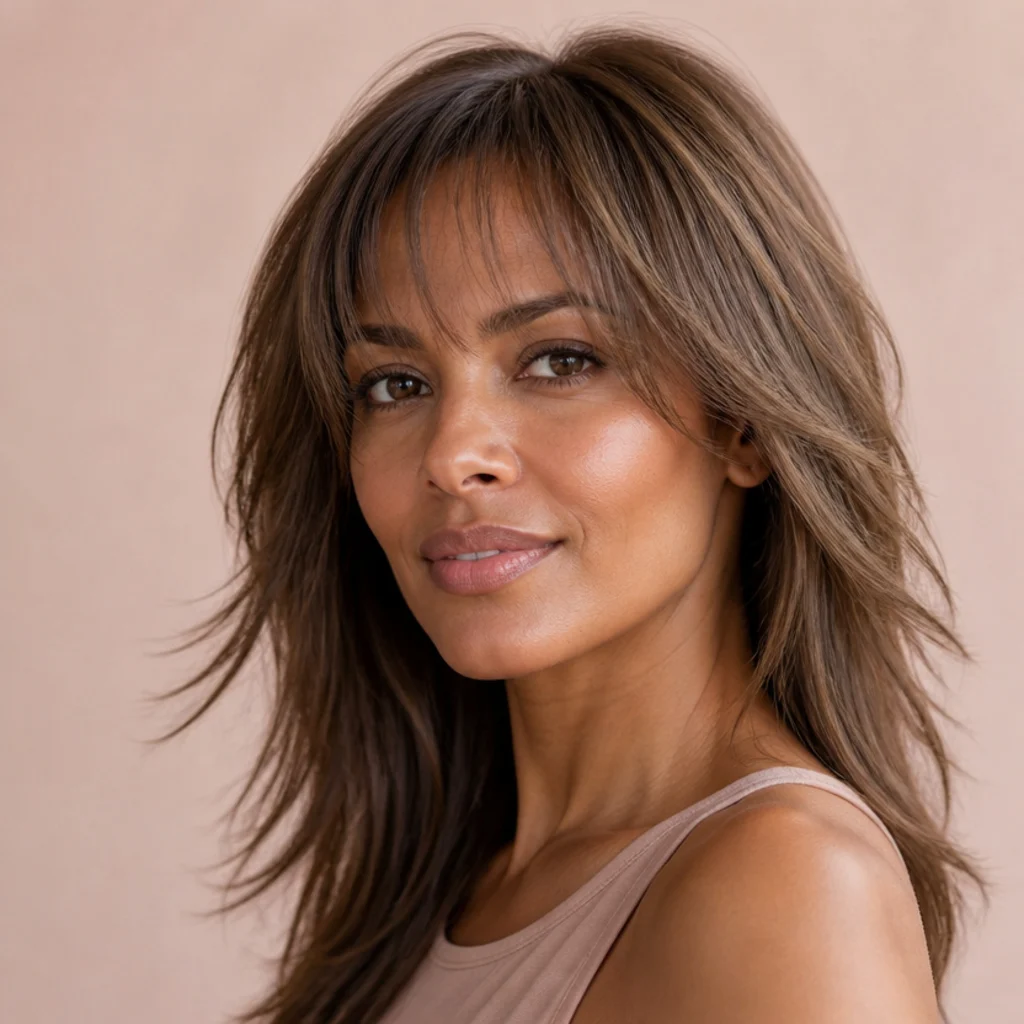
Fine hair and the shag are natural partners, because strategic layers manufacture the illusion of density where there isn't much. This version keeps the shortest layers closer to the crown for root lift and pairs them with airy, see-through bangs that frame the forehead with wisps rather than a solid weight that would flatten the front. The result reads full and lived-in, not thin. Fine straight or slightly wavy hair that goes limp by midday suits this best; very thick or coarse hair is a poor match, since it would swallow the delicate fringe and undo the point of the wisps. Light ash brown, soft bronde, and dimensional cool tones add the visual depth that tricks the eye into reading fine hair as denser, since contrast implies volume. Upkeep is moderate, with a light fringe trim every few weeks and a shape trim every 8-10 weeks. Style with a volumizing mousse on damp roots, blow-dry with a round brush lifting up and back at the crown, and finish with a dry texture spray for grip. A pro tip: skip heavy oils and rich creams near the roots, which collapse fine hair; keep conditioner from mid-length down and clarify monthly so product buildup doesn't weigh the lift away. Ask your stylist for "volume-building crown layers and soft, wispy see-through bangs," and specifically ask them to avoid over-thinning, which can leave fine hair looking sparse and stringy.
10Long Shag for Thick Hair With Heavy Bangs
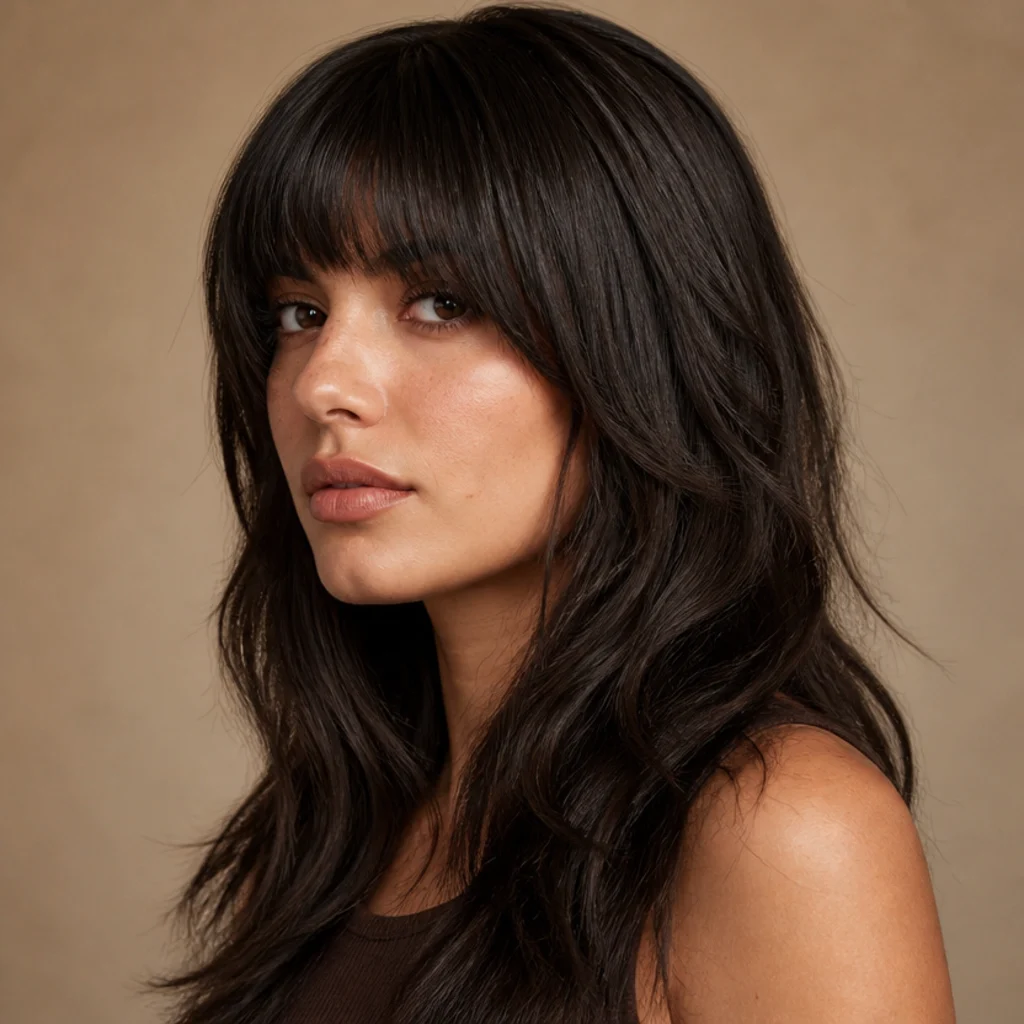
Thick hair gets the opposite prescription: here the internal layers exist to remove weight so the shag moves and breathes instead of sitting like a heavy block. A full, dense fringe suits that abundance, giving the front a clean, deliberate frame while the de-bulked lengths swing freely. Thick straight to wavy hair suits it well, and the layering helps tame the pyramid of bulk that thick or coarse hair builds around the face and jaw. Rich espresso, dark chocolate, and dimensional brunette keep the density looking glossy rather than flat, and a subtle low-light through the mid-lengths can add the illusion of separation. The trade-off is styling time: a heavy fringe needs blow-drying to lie flat, and the lengths may want a rough-dry to prevent puffiness in humidity. Upkeep runs moderate to high, with weight-removal trims every 6-8 weeks before the layers grow dense again. Style the fringe first with a round brush and downward tension, then smooth the lengths with a paddle brush and a drop of anti-frizz serum through the ends only. A pro tip: have your stylist point-cut or slide-cut the internal layers rather than using thinning shears too aggressively, which can create frizzy short regrowth that sticks straight up in a few weeks. Ask for "weight-removing internal layers and a full fringe," and mention any cowlick so the stylist can plan the bang's direction around it instead of fighting it.
Save this to Pinterest and note which texture matches your own hair.
11Coily Long Shag With Rounded Fringe
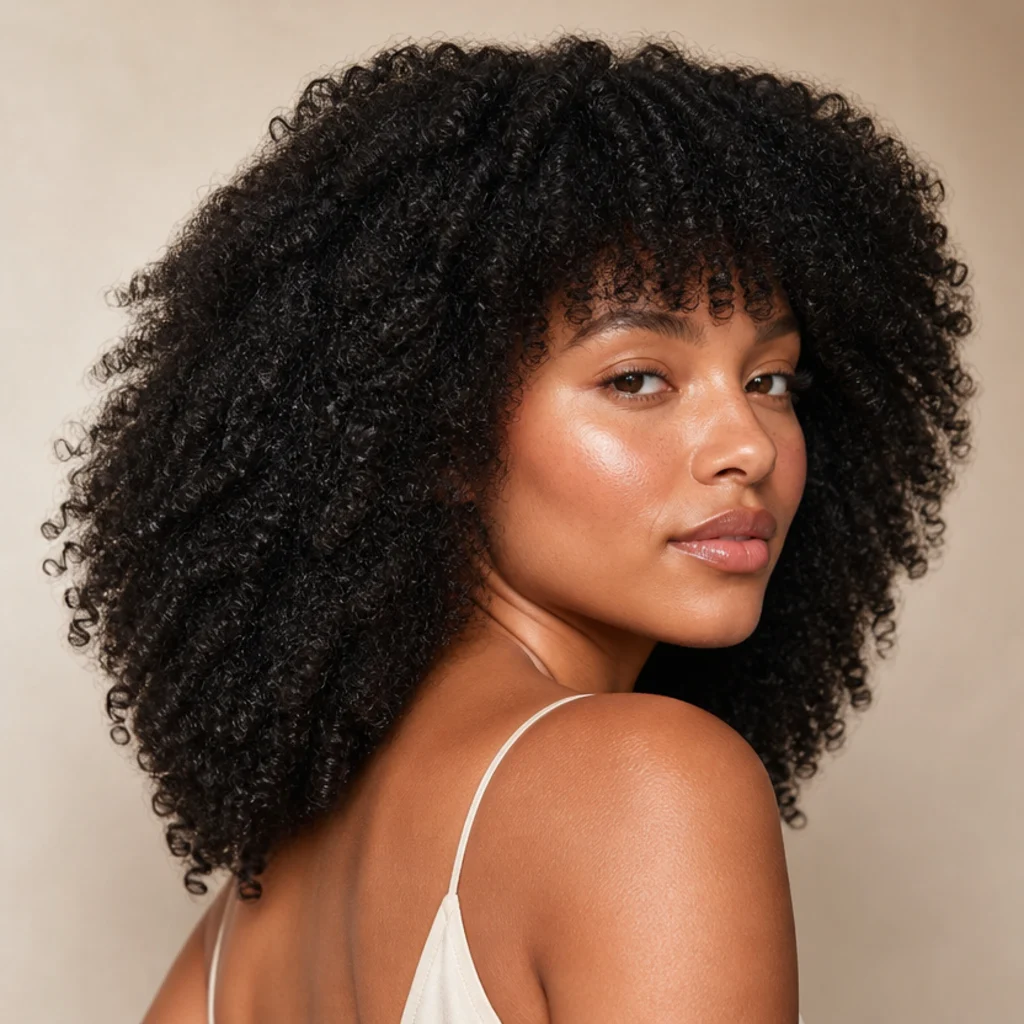
Coily 4A to 4C textures wear the long shag with a soft, rounded fringe that follows the crown's natural curve, and the results can be remarkable when the cut respects shrinkage. Layers are shaped to encourage an even, cloud-like silhouette rather than a flat perimeter, and the fringe is cut generously long so it arcs across the forehead without rising too high once it draws up, since 4C hair can shrink well past half its stretched length. This works well on coily hair that wants a defined, framed face while keeping real length underneath; it needs enough density to sustain the rounded shape. Natural black, cool dark brown, and dimensional deep tones keep the coils looking hydrated and glossy, and richer, deeper shades read most luminous against tight patterns. Maintenance centers on moisture and protective styling between wash days far more than frequent trims: a rich leave-in, a curl custard or gel for hold, and a bonnet or satin scarf at night to preserve the fringe shape. A wash-and-go can hold a week or more, so shape trims every 10-12 weeks are plenty. A pro tip: refresh the fringe mid-week with a water-and-leave-in spritz and a quick diffuse rather than restyling the whole head. Have your stylist dry-cut on stretched or natural coils, and ask them to shape the fringe with shrinkage explicitly in mind so it lands where you expect once it fully dries and springs up.
12Long Shag With Money-Piece Bangs
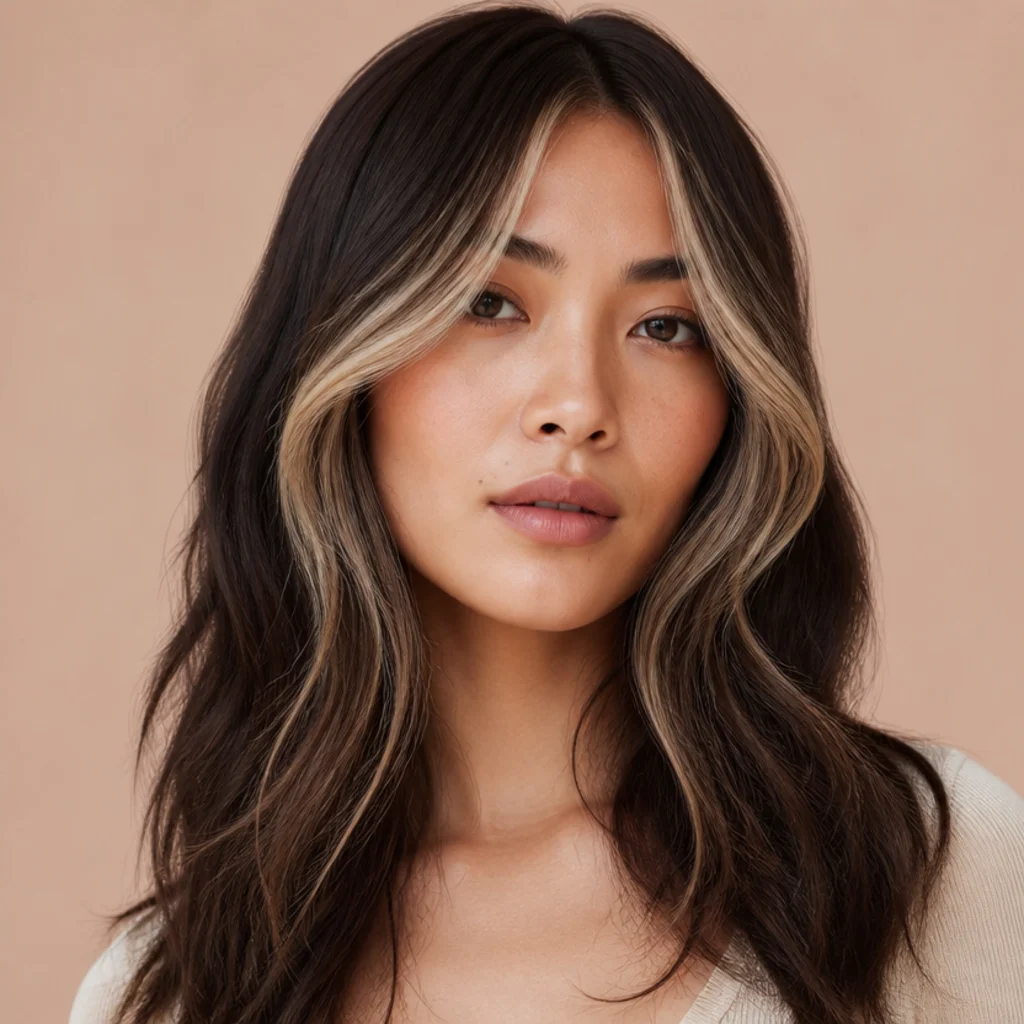
Here the bangs do double duty with color instead of a separate fringe cut. Money-piece bangs are the two face-framing front sections, lifted several shades brighter than the base so they draw the eye straight to your face and add dimension to the long shag. The cut stays soft and layered, but the brightened frame gives it a modern, expensive-looking finish that photographs beautifully against darker lengths. Anyone curious about color placement without committing to a full head of highlights will like this option, and it works across every texture because it's about placement, not shape. High-contrast pairings, like a rich brunette base with a caramel or honey money-piece, or dark hair with a warm bronze frame, read most intentional; keep it within two to three levels for a softer, more office-friendly effect, or push four-plus for drama. Match warmth to your skin's undertone so the brightness flatters rather than fights it. Upkeep is dual: shape trims every 8-10 weeks plus toning every 6-8 weeks to keep the bright pieces from going brassy. Style by curling the money-piece away from the face so the brightness catches light along the sweep. A pro tip: use a purple or blue toning mask on just those front pieces for two to five minutes to control warmth between salon visits. Ask for "face-framing money-piece color on a soft long shag," and bring a photo showing exactly how bright and how wide you want the contrast.
13Beachy Long Shag With Grown-Out Bangs
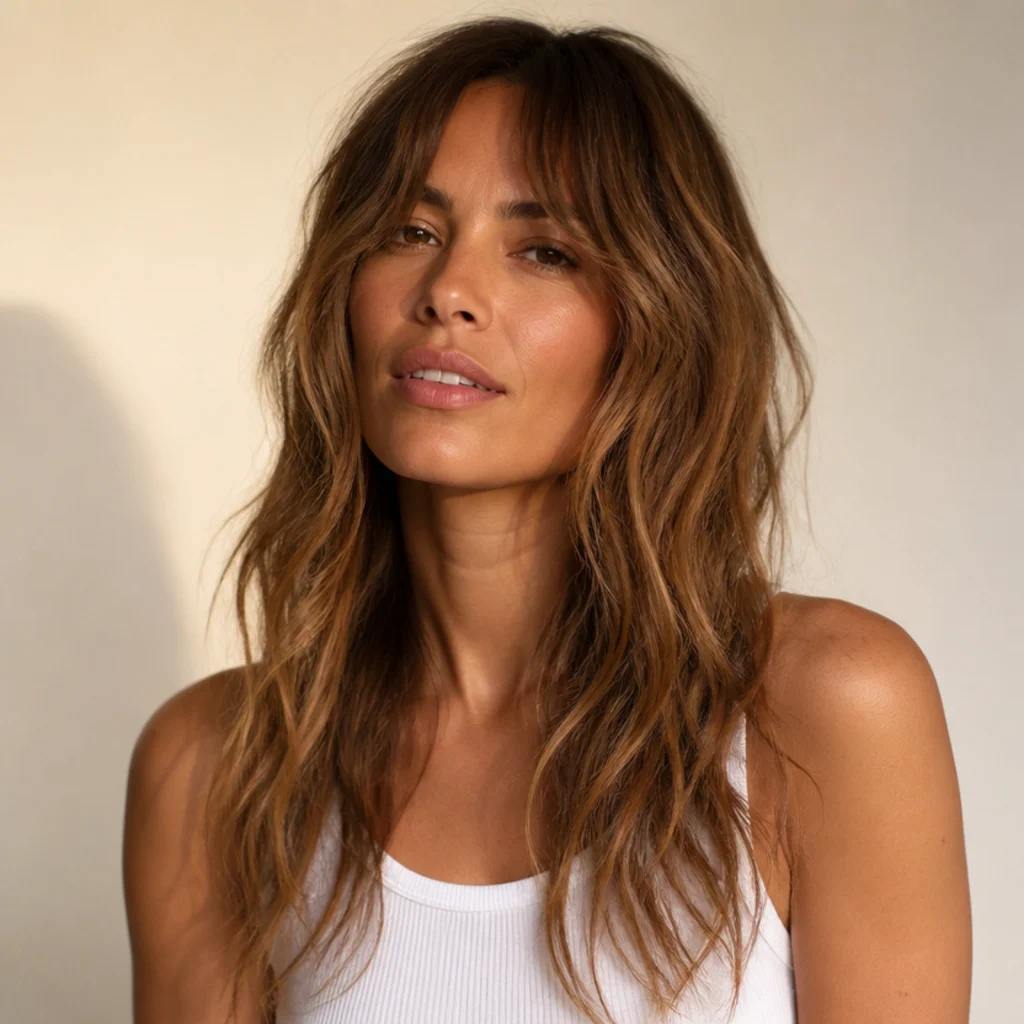
This is the shag for people who love the idea of bangs but not the trimming schedule. Grown-out bangs sit longer, blending into the face-framing layers with a piecey, undone finish, while the length is styled beachy with loose, tousled bends. It's the most low-maintenance option here, because there's no short fringe to trim on a clock; the fringe keeps getting more versatile as it lengthens, moving from cheekbone to jaw to a full curtain. Wavy 2A to 2C hair suits it especially well, and it flatters most face shapes thanks to the soft, center-or-off-center parted frame that adds width where you want it. Sun-kissed light brown, beige-bronde, and lived-in balayage lean into the coastal mood, and warm, sunlit undertones sell the just-back-from-the-beach effect. Styling is quick: mist a salt or texture spray on damp hair, scrunch and rough-dry, or air-dry and bend a few pieces with a wand. Shape trims every 10-14 weeks are all it asks. A pro tip: if the grown-out fringe falls in your eyes on off days, a quick twist-and-pin at the temple turns it into a face-framing accent rather than a nuisance. Ask for "long, grown-out bangs blended into a lived-in beachy shag," and tell your stylist plainly that you want minimal upkeep and a fringe that stays useful as it grows.
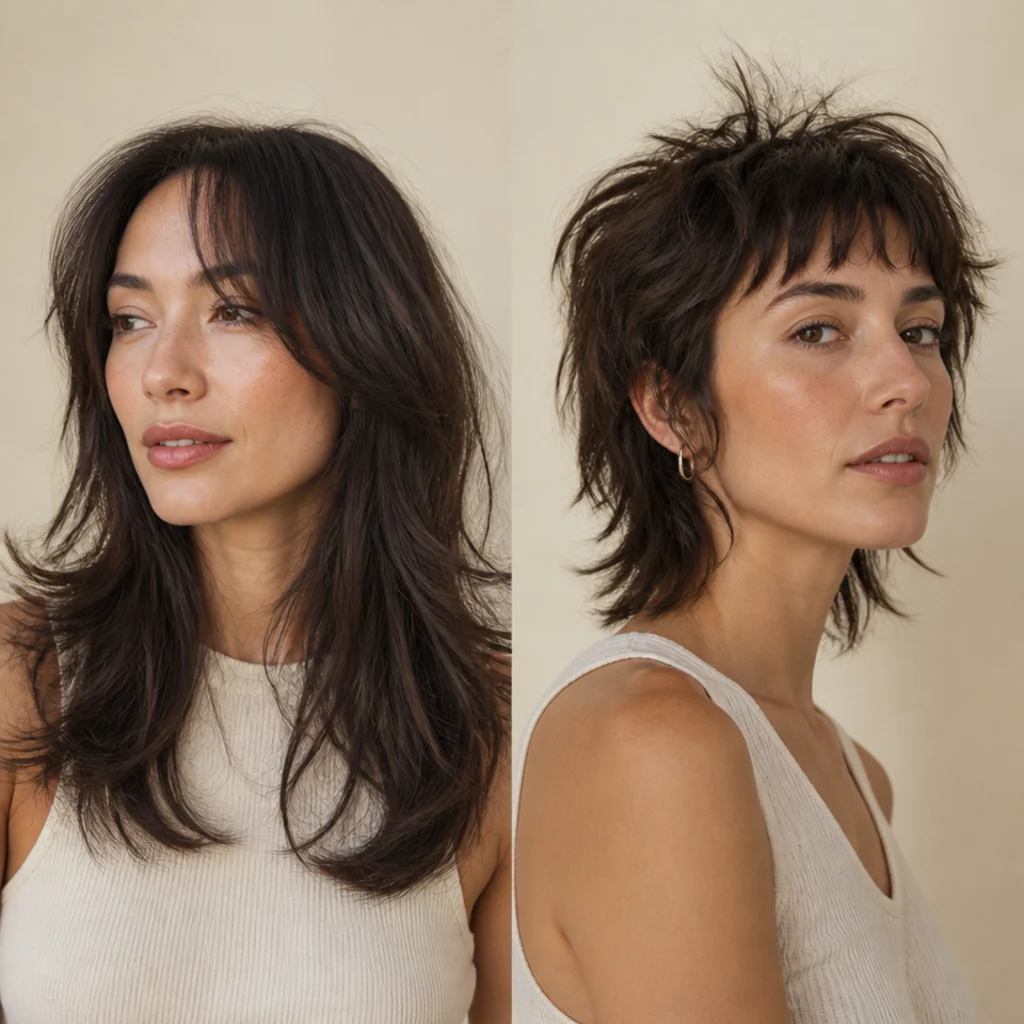
14Long Shag Mullet Hybrid With Curtain Bangs
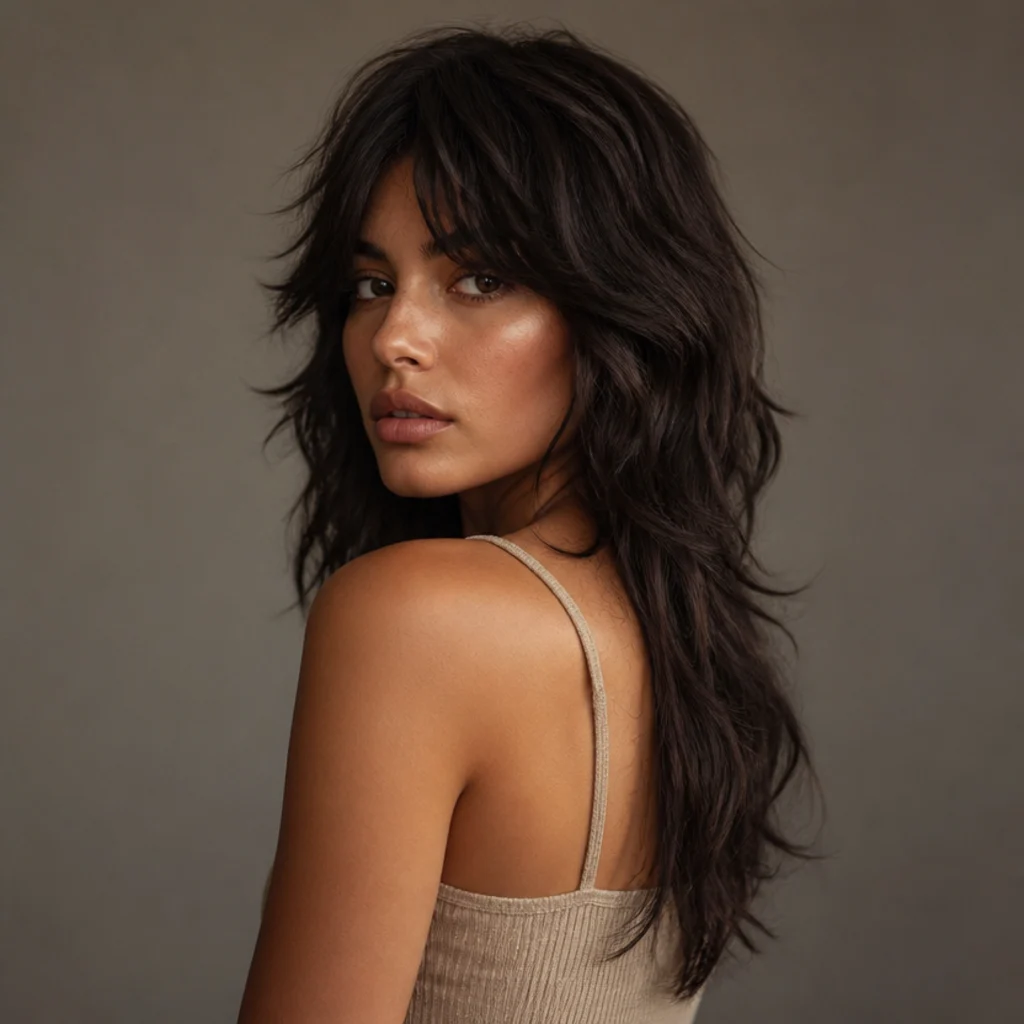
For the edgiest take here, the shag-mullet hybrid keeps long length in the back while shortening the crown and top layers more aggressively, then softens the front with curtain bangs to balance the drama. The disconnection between short crown and long perimeter is what gives it attitude, and the curtain fringe is the counterweight that keeps the face framed and wearable rather than costume-y. Straight to wavy hair suits it, along with anyone comfortable with a statement cut; the more disconnection you allow, the bolder it reads, so oval and longer faces carry the extremes most easily. Dark brunette, cool black, and smoky dimensional shades suit its modern grunge energy, and matte, low-shine finishes lean further into the mood. Upkeep runs moderate to high because the crown layers need shaping every 6-8 weeks to hold the silhouette before they grow into the length and lose the contrast. Style by rough-drying the crown for lift and diffusing or wanding the lengths for movement, then piecing the top with a matte paste. A pro tip: ask for a "soft" or "subtle" mullet on the first appointment; you can always take more length off the crown next visit, but you can't add it back once it's gone. Ask for "a subtle shag-mullet with shorter crown layers, long back length, and curtain bangs," and be explicit about how much disconnection you're comfortable with.
15Sleek Long Shag With Micro-Layered Bangs
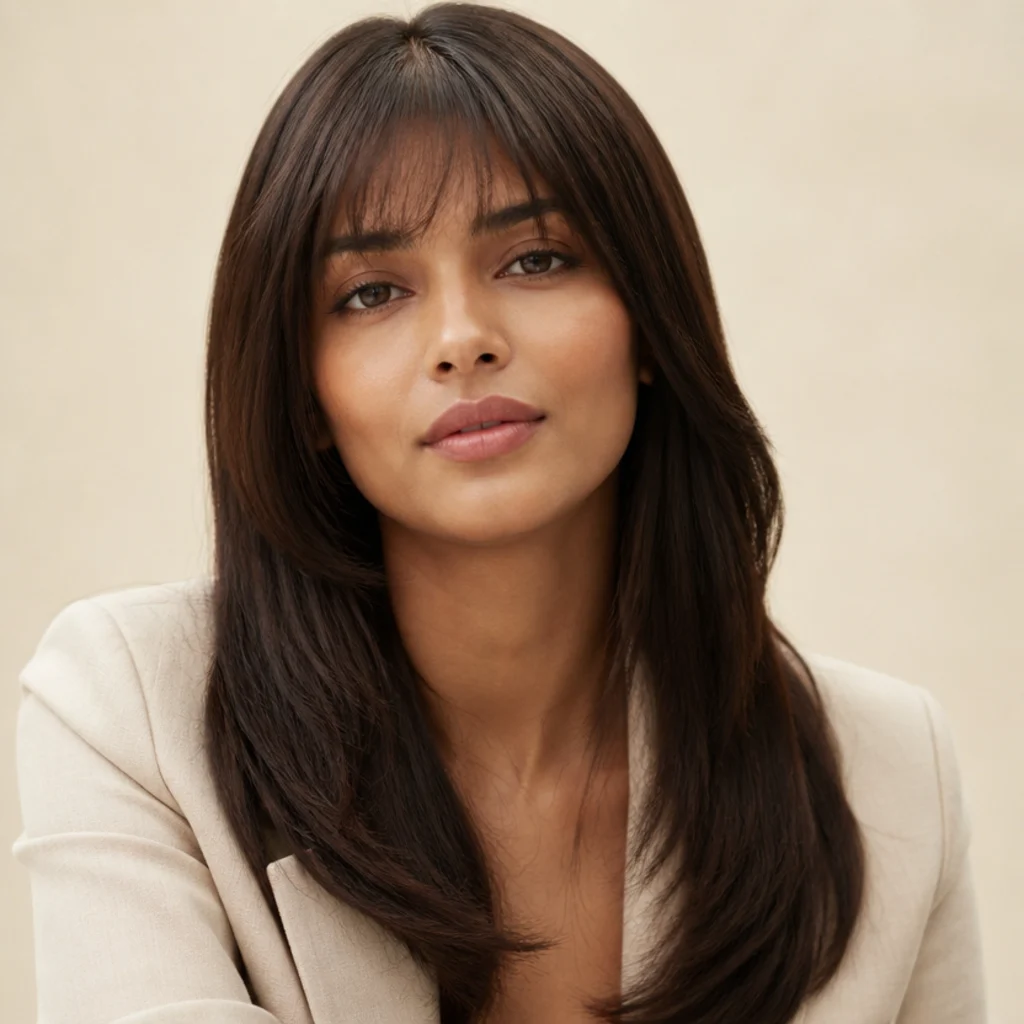
The shag can look polished, too, and this is the version that translates to an office or an event. It keeps the layers fine and closely graduated so the shape stays smooth and continuous rather than choppy, and the bangs are micro-layered, subtly stacked in fine increments so they sit softly against the brow without heavy bulk or a hard line. Blow-dried smooth, it reads refined and grown-up while still carrying visible movement. Straight to loosely wavy hair suits it best, for anyone who wants shag flow in a dressier register; very coarse or tightly curly hair will fight the sleekness without a lot of heat styling, so this works best on naturally smoother textures, and a longer forehead carries the soft fringe most gracefully. Glossy dark brown, espresso, and single-process rich tones amplify the shine that makes this look expensive, and a clear gloss deepens it further. Upkeep is moderate, with trims every 8-10 weeks to preserve the fine, clean layering, plus regular gloss treatments for shine. Style with a smoothing cream, a round-brush blow-dry directing the fringe down and slightly under, and a finishing serum or shine spray on the mid-lengths. A pro tip: a boar-bristle brush after drying distributes scalp oils down the strand and adds the polished sheen this look depends on. Ask for "fine, blended micro-layers with a soft, smooth fringe," and specify you want a sleek finish rather than a piecey, undone one.
Pro Tips from the Editor
- Insist the fringe is cut last, dry, and after your lengths are styled the way you actually wear them. Wet hair sits lower and longer, so a fringe cut wet almost always dries too short; this one rule prevents most bang regret, and it matters even more on curly and coily textures that shrink dramatically.
- Match your fringe to your hairline, not the inspiration photo. A double crown, a cowlick at the part, or a widow's peak changes how any bang falls, so ask your stylist to work with those swirls rather than against them, and to dry-check the fringe direction before the final cut.
- Learn one root-lift move and the shag styles itself. Rough-dry the crown upside down, or lift damp roots with a round brush and a cool shot; the internal layers are engineered to hold that volume once you set it, which is why a shag that fell flat at home usually just wasn't dried at the root.
- Buy the texture, not the cut. A salt spray, a matte paste, or a dry texture spray is what makes a shag look like the reference; raw layers with no product can read flat or thin, especially on fine hair. Curly and coily textures should reach for a leave-in and a hold product instead of dry texture spray.
- Stretch color, not shape. Toning your money-piece or face-framing brightening at home every couple of weeks keeps warmth in check, but never chase the fringe length yourself if you're unsure; a botched home bang trim costs weeks of grow-out.
- Book the trim before you need it. The silhouette blurs around week 10-12 as layers grow into one length; a standing shape appointment keeps the disconnection crisp and the cut looking intentional instead of shapeless.
- Photograph your fresh cut from the front and side on day one. It's the clearest reference to hand your stylist next time, and it shows you the styling target to recreate at home when the blow-dry won't cooperate.
- Clarify monthly if you use texture or dry-styling products daily. Buildup weighs down the very root lift the shag depends on, and a clarifying wash restores the bounce faster than any volumizer.
How to Choose / Get the Look
Work through four decisions in order and the right version becomes obvious.
1. Start with texture, because it dictates how any shag falls. Straight hair shows layers and blunt or micro fringe most crisply and needs graduated internal layers to move. Wavy hair loves side-swept and grown-out bangs cut to its bend. Curly and coily hair does best with a fringe cut on the curl and layers placed to control, not remove, volume. Use the styling map below to match your texture to the finishing products and tools that actually deliver the look.
| Texture | Layer strategy | Best-match fringe | Styling tools & products |
|---|---|---|---|
| Fine straight | High crown layers, minimal thinning | Airy see-through, soft blunt | Volumizing mousse, round brush, dry texture spray |
| Medium-thick straight | Graduated internal layers | Blunt, micro-layered, baby | Paddle brush, smoothing cream, lightweight oil |
| Wavy 2A-2C | Layers cut to the S-bend | Side-swept, grown-out, curtain | Salt spray, curling wand, flexible hairspray |
| Curly 2C-3B | Dry-cut, volume-controlling layers | Fringe cut on the curl, rounded | Leave-in, curl cream, diffuser, silk pillowcase |
| Coily 4A-4C | Cloud-shaped layers for shrinkage | Long rounded fringe | Rich leave-in, curl custard/gel, satin bonnet |
2. Factor in face shape. Center-parted curtain and face-framing bangs suit almost everyone. High baby bangs flatter longer and oval faces; side-swept fringe softens round and square ones; a heavy blunt fringe balances a longer face but can shorten a small one. Consider eye placement too: a curtain sweep opens close-set eyes, while wispy fringe softens a high or wide forehead.
3. Be honest about upkeep before you commit. Use the table below to match your real schedule to a fringe.
| Bang style | Best texture | Face shapes it flatters | Fringe trim cadence |
|---|---|---|---|
| Curtain | All textures | Round, square, oval, heart | Every 10-12 weeks |
| Face-framing | All textures | All | Every 10-12 weeks |
| Blunt | Medium-thick straight | Oval, heart, round | Every 3-4 weeks |
| Baby / micro | Straight to slightly wavy | Oval, long | Every 2-3 weeks |
| Side-swept | Wavy, loose curly | Round, heart, square | Every 8-10 weeks |
| Grown-out | Wavy | All | Every 10-14 weeks |
| Money-piece | All textures | All | Trim 8-10 wks; tone 6-8 wks |
4. Communicate in the chair. Bring one or two saved photos, describe your true styling routine and how many minutes you'll spend, and name the layer depth in plain terms ("lived-in, not choppy" versus "piecey and undone"). Point to where you want the shortest face-framing piece to fall, flag any cowlick or double crown, and ask your stylist to cut the fringe last and dry, checking it against your hairline before finishing. That single sequence keeps your soft long shag looking the way you imagined instead of a compromise you discover at home.
Frequently Asked Questions
What is a soft long shag?
A soft long shag is a layered cut that keeps length below the shoulders while adding gently blended, disconnected internal layers for movement. "Soft" signals the layers are diffused and connected rather than heavily choppy or razored, so the finish is lived-in and low-effort. The perimeter stays long, usually collarbone to mid-back, while the shortest layers start high near the cheekbone or ear to lift weight off the roots. It differs from a wolf cut or shixie mainly in restraint: less aggressive disconnection, softer fringe, and a more grown-up, wearable finish.
Do long shag haircuts work on straight hair?
Yes, and they're one of the best ways to give straight hair movement it can't make on its own. A long shag on straight hair uses graduated internal layers to add swing and body, and it pairs cleanly with blunt or micro-layered bangs for a polished, modern contrast. Medium to thick straight hair shows the shape most clearly; very fine straight hair should ask for softer, connected layers and a see-through fringe so it doesn't look sparse. Set the movement with a round-brush blow-dry, since straight hair won't hold a bend from air-drying alone.
Which bangs suit a long curly shag haircut?
A fringe cut on the curl, meaning it's shaped and length-tested while your hair is fully dry, works best so each coil springs to the intended length instead of shrinking up too short. Rounded and soft curly fringes complement the natural volume without looking cropped. Ask for a dry cut on your natural pattern, and avoid stretching or straightening the fringe before it's cut, which is the single most common cause of a curly bang landing far shorter than planned. Because curls can shrink 30 to 50 percent, a good rule is to cut the fringe longer than feels right and let it draw up.
How often do I need to trim a long shag with bangs?
The cut's silhouette needs a shape trim every 8-12 weeks before the layers blur into one length. Bangs vary widely: blunt and baby bangs need shaping every 2-4 weeks to hold their line, side-swept and feathered fringe stretch to 8-10 weeks, and curtain and grown-out styles can go 10-14 weeks. If you add money-piece or face-framing color, budget a tone every 6-8 weeks on top of the trims. Many salons offer free or low-cost fringe trims between full cuts, so ask when you book.
Are long shag choppy layers high maintenance?
Day-to-day styling is easy, usually a texturizing spray and a quick scrunch. The layers themselves want a trim roughly every 8 weeks so the choppy ends stay intentional rather than growing stringy and blunt-tipped. Choppy layers are also better suited to medium-to-thick straight and wavy hair; very fine or fragile hair should ask for point-cutting instead of a razor to avoid frizz and split ends. The upkeep is mostly about the ends, not the styling, so if you can commit to the trim cadence, the look stays low-effort.
Will a long shag with bangs make thin or fine hair look fuller?
It can, when it's cut for density. Layers concentrated near the crown plus airy, see-through bangs create the illusion of volume without the heavy weight that flattens fine hair. Ask your stylist to avoid aggressive thinning, keep conditioner and oils off the roots, and use a volumizing mousse and a root-lift blow-dry. Dimensional cool-toned color also helps, since contrast reads as depth and makes fine hair look denser. The goal is a full, lived-in shape, not thinned-out ends that read even sparser.
Can I get a long shag with bangs if I want to grow out my current fringe?
Yes; it's one of the easiest cuts to grow bangs into. Face-framing and grown-out versions give a lengthening fringe somewhere to blend, so the awkward chin-length stage looks intentional rather than stranded. Ask for connected face-framing layers that start where your current bangs fall, and pin or tuck the front pieces on off days until they reach your cheekbone or jaw. A little curl away from the face on the grow-out pieces also disguises the length gap while it fills in.
How do I style a long shag with bangs at home?
Style the fringe first, before it sets in a cowlick: blow-dry it down and side to side with a round brush and a cool shot to lock the shape. Then build movement in the lengths by rough-drying the crown for lift and bending a few pieces with a wand or diffuser to your natural pattern. Finish with a texture or salt spray for grip, or a smoothing serum if you want the sleek version. The whole routine takes about 10-15 minutes once you learn your one root-lift move.
What face shape suits a long shag with bangs best?
Almost every face shape has a flattering version. Curtain and face-framing bangs are the near-universal choices. Longer and oval faces can carry high baby bangs and blunt fringe; round and square faces are softened by side-swept bangs and the width a curtain part adds at the temples; heart shapes suit soft, wispy fringe that balances a narrower chin. The layering itself flatters every shape by adding movement around the face, and where you place the shortest face-framing piece lets you fine-tune the balance further.