30 Hair Tinsel Ideas for Every Hair Color
Hair tinsel is the low-commitment sparkle upgrade — festival-ready or quietly editorial, depending on strand color, density, and where you seat the knots. These 30 ideas map shimmer strands across every base shade and undertone, so you know how tinsel will behave on your color before you clip a single piece.
 Edited by Lena Rose · Published July 11, 2026 · 43 min read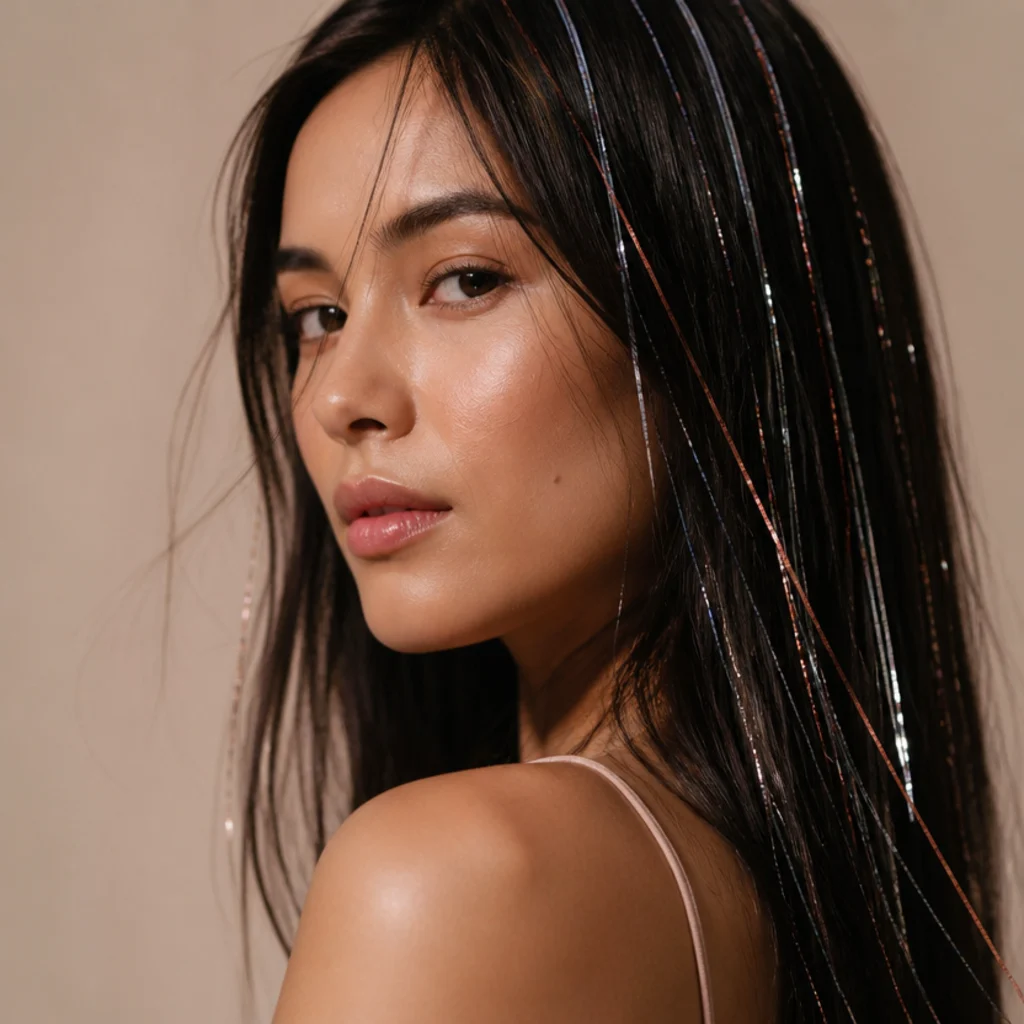
Quick Answer
- Best for: Anyone wanting temporary, damage-light sparkle, from jet-black and blue-black bases to honey blonde, natural red, and grown-out gray or white hair.
- Who might skip it: Anyone with very short or heavily layered hair under about four inches (strands need length to sit and swing), and anyone who flat-irons or curls daily right where the strands would sit.
- Maintenance: Tie-in strands last 4-6 weeks and shed out with natural growth; heat-bonded (keratin) and clip-in styles are shorter-term. Keep direct flat-iron and wand heat off the strands, and switch to a low-pull, wide-tooth detangle at the root.
- Difficulty: Beginner-friendly for six to twelve face-framing strands; intermediate for a full scattered canopy; pro-level for dense full-glam.
- Cost: Roughly $10-$25 for a DIY tie-in pack; salon application commonly runs about $1-$3 per strand or a $40-$150+ flat rate depending on density and region (confirm at booking).
- Wear time / longevity: 4-6 weeks for tie-ins; 1-2 washes to a few days for clip-in and some heat-bond kits.
- Standout variation: Silver tinsel on jet-black hair for maximum contrast and that glassy, light-catching finish.
- How to ask your stylist: Bring a photo, name the exact strand tone (e.g., "cool silver, not gold"), and specify placement, density, and method: "About 20 tie-in strands, scattered canopy, face-framing weighted toward the part."
In This Guide
- Silver Tinsel on Jet-Black Hair
- Rose-Gold Strands for Soft Black
- Iridescent Tinsel on Curly Black Hair
- Holographic Tinsel on Deep Brown
- Copper Tinsel on Warm Brunette
- Champagne Tinsel on Ash Brown
- Gold Tinsel on Chocolate Waves
- Bubblegum Pink Tinsel on Black Hair
- Pastel Pink Tinsel on Blonde
- Hot Pink Tinsel on Dark Brown
- Platinum Tinsel on Icy Blonde
- Gold Tinsel on Honey Blonde
- Peach Tinsel on Strawberry Blonde
- Silver Tinsel on Gray and Silver Hair
- Pearl Tinsel on Soft White Hair
- Ruby Tinsel on Auburn
- Copper Tinsel on Natural Red
- Turquoise Tinsel on Black Hair
- Emerald Tinsel on Dark Brown
- Sapphire Tinsel on Deep Blue-Black
- Lavender Tinsel on Cool Blonde
- Multicolor Rainbow Tinsel
- Face-Framing Tinsel Strands
- Tinsel in a Braid
- Tinsel in a Slick Ponytail
- Tinsel on Curly Textured Updo
- Subtle Scattered Tinsel Canopy
- Money-Piece Tinsel
- Tinsel-Wrapped Space Buns
- Full-Glam Dense Tinsel
Hair tinsel is thin, reflective mylar or holographic film, usually 0.3 to 0.5 millimeters wide, that you anchor at the root so the shimmer moves with your hair instead of sitting on top of it like glitter. It flatters every base, but three variables actually decide how it looks: strand tone against your base, density, and where on the strand you seat the knot. Cool metallics (silver, platinum, pearl) read glassy; warm metallics (gold, copper, champagne) read like amplified highlights; saturated colors (pink, turquoise, emerald) read as dye-free color. On hair tinsel black hair looks especially high-contrast: silver and iridescent shades practically glow against a dark canopy, while warm and jewel tones settle softer. Lighter and grayer bases turn tinsel into a tonal accent rather than a spotlight. Below you'll find 30 combinations organized by base color and by style, from bubblegum pink tinsel and curly hair tinsel to subtle champagne canopies, plus placement blueprints for braids, ponytails, updos, and money-piece framing. Each entry names the undertones it suits, the density to aim for, a realistic maintenance window, and one pro tip, so you can walk into the chair knowing exactly what to ask for.
01Silver Tinsel on Jet-Black Hair
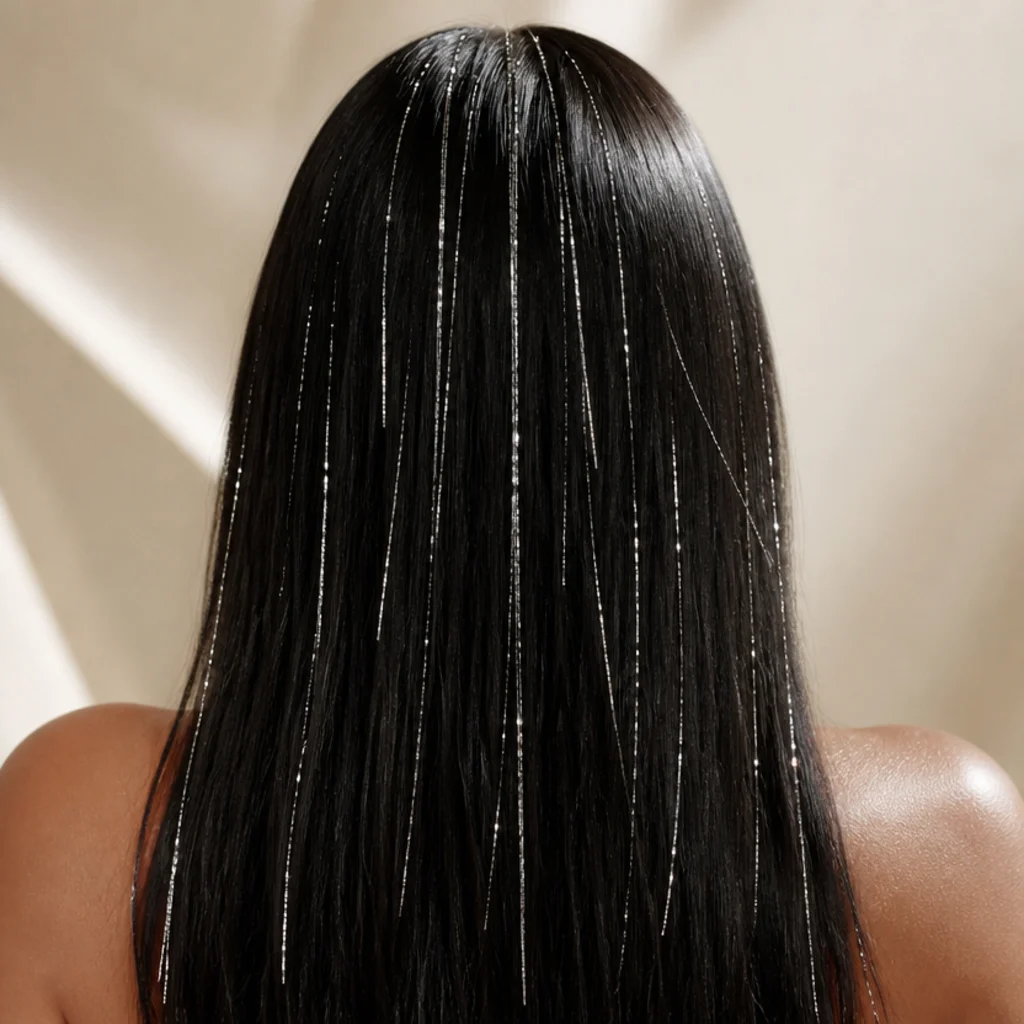
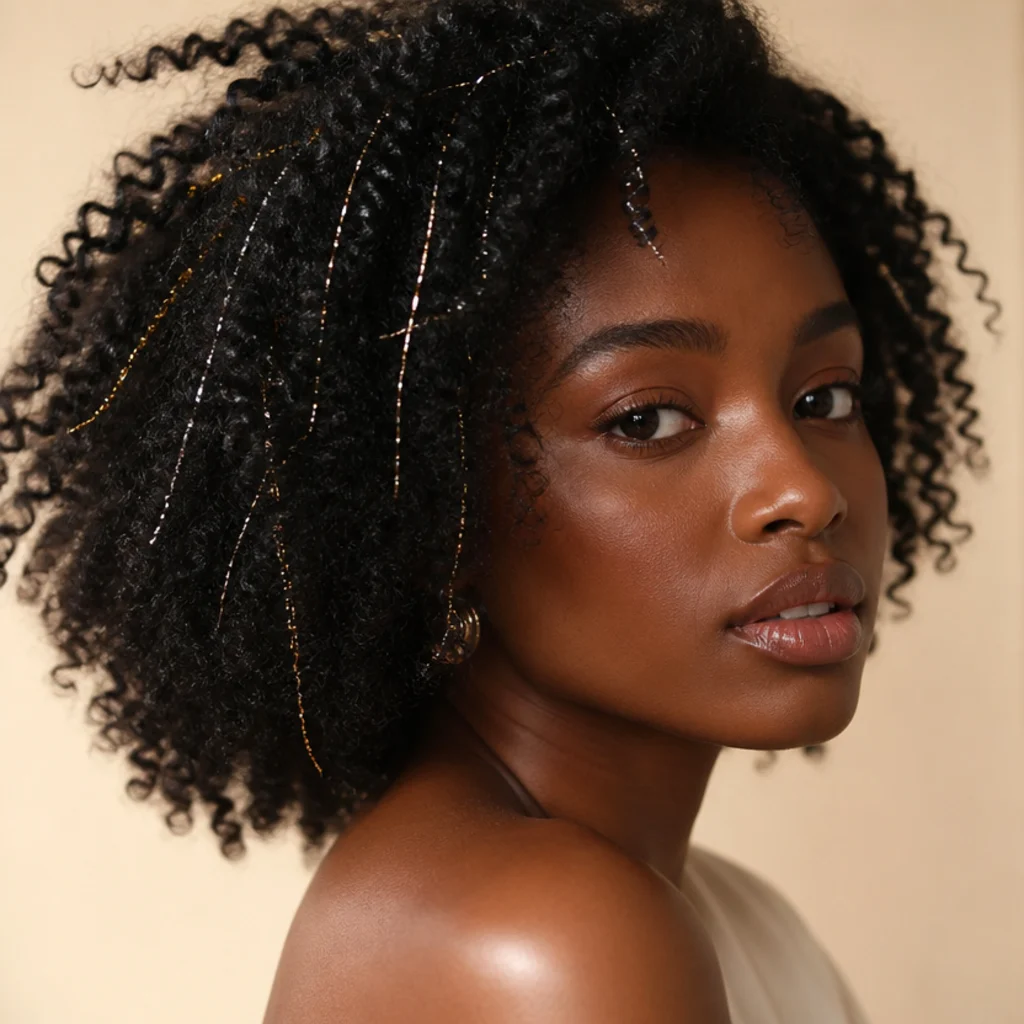
This is the highest-contrast pairing in the tinsel world, which is why hair tinsel black hair searches so often land on silver. Against a level-1 jet base, cool silver mylar catches overhead light from a single point instead of diffusing it, almost like starlight. It suits glossy blacks with blue or neutral undertones best; on warm-black or off-black hair, silver looks faintly cool but still works. Aim for a scattered density of roughly 20 to 30 strands seated at the root through the crown and mid-lengths, staggering their start height so movement reveals them at different depths. Tie-in strands hold 4-6 weeks and shed out with growth. The contrast here is unforgiving, so seat each double knot flush to the scalp so no loop shows. Pro tip: choose a true cool silver rather than a warm pewter, and skip silicone shine sprays directly on the strands — they dull the reflectivity. Ask your stylist for a scattered crown canopy weighted slightly toward your part line.
02Rose-Gold Strands for Soft Black
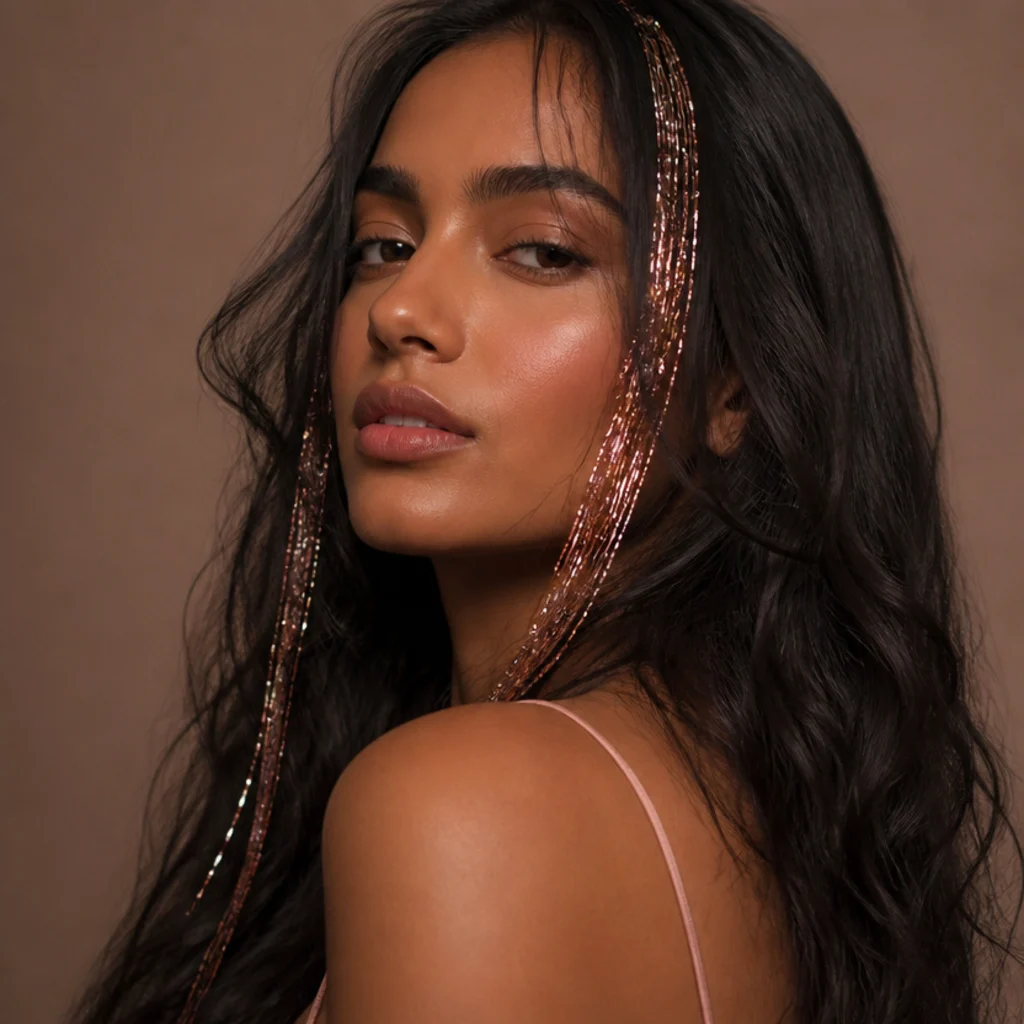
If pure silver feels too icy, rose-gold tinsel warms the same dark base into something more romantic. The blush-metallic tone — a pink-copper hybrid — bridges soft-black hair and warm or olive skin, and it suits medium to deep complexions with golden or peachy undertones especially well. Rose gold shows up as a diffused glow rather than a hard point of light, so it works equally well at dinner or in daylight. Concentrate 12 to 18 strands around the front and part where they catch on your features, keeping the back cleaner so the framing stays the focus. Upkeep matches standard tie-ins: 4-6 weeks. This is a strong beginner look, since the warm tone hides slightly uneven placement far better than stark silver does. Pro tip: pair rose gold with a single champagne strand every fifth placement to add a cooler light point that keeps the finish from going too monochrome-pink. Ask your stylist for a face-framing weighting rather than an even all-over scatter.
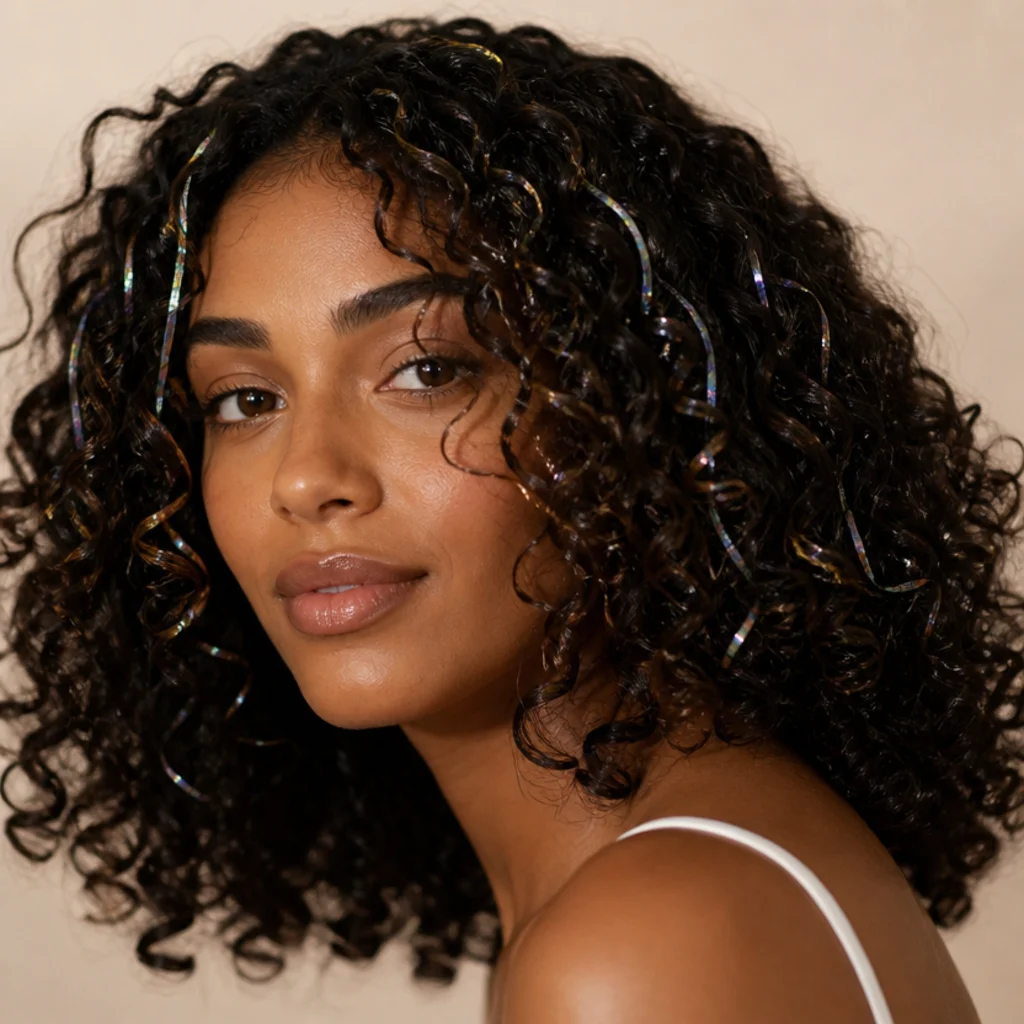
03Iridescent Tinsel on Curly Black Hair
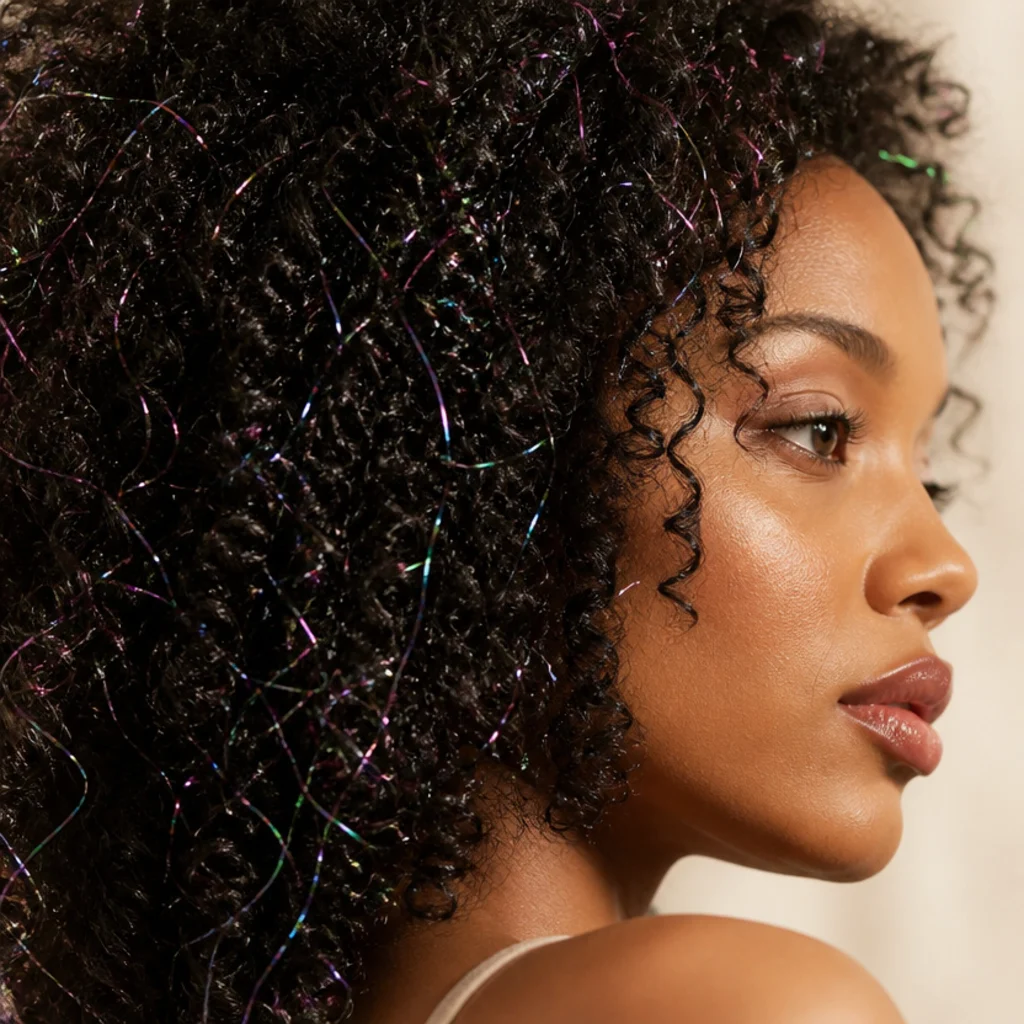
Curly hair tinsel behaves differently from straight styles: strands nestle into the coil pattern and peek out as curls shift, giving a scattered, twinkling effect rather than long visible lines. Iridescent tinsel, which flashes pink, green, and blue as it moves, is built for this, since tightly coiled black hair catches its color-shift from many angles at once. Anchor each tie-in at the root and let the strand follow one curl clump so it doesn't fight the pattern or disrupt definition. This works across curl types 3A through 4C; on tighter coils, the strand practically disappears until light hits it. Curls hide the knots, so placement is forgiving and wear holds through 4-6 weeks. On wash day, cleanse in the shower with your fingers or a low-tension brush, and skip dragging a fine-tooth comb over the bonded strands. Pro tip: place on second-day, stretched or defined curls so you're not sealing a strand into a shape that will change once you refresh. Ask your stylist to work with your natural clumping, not against it.
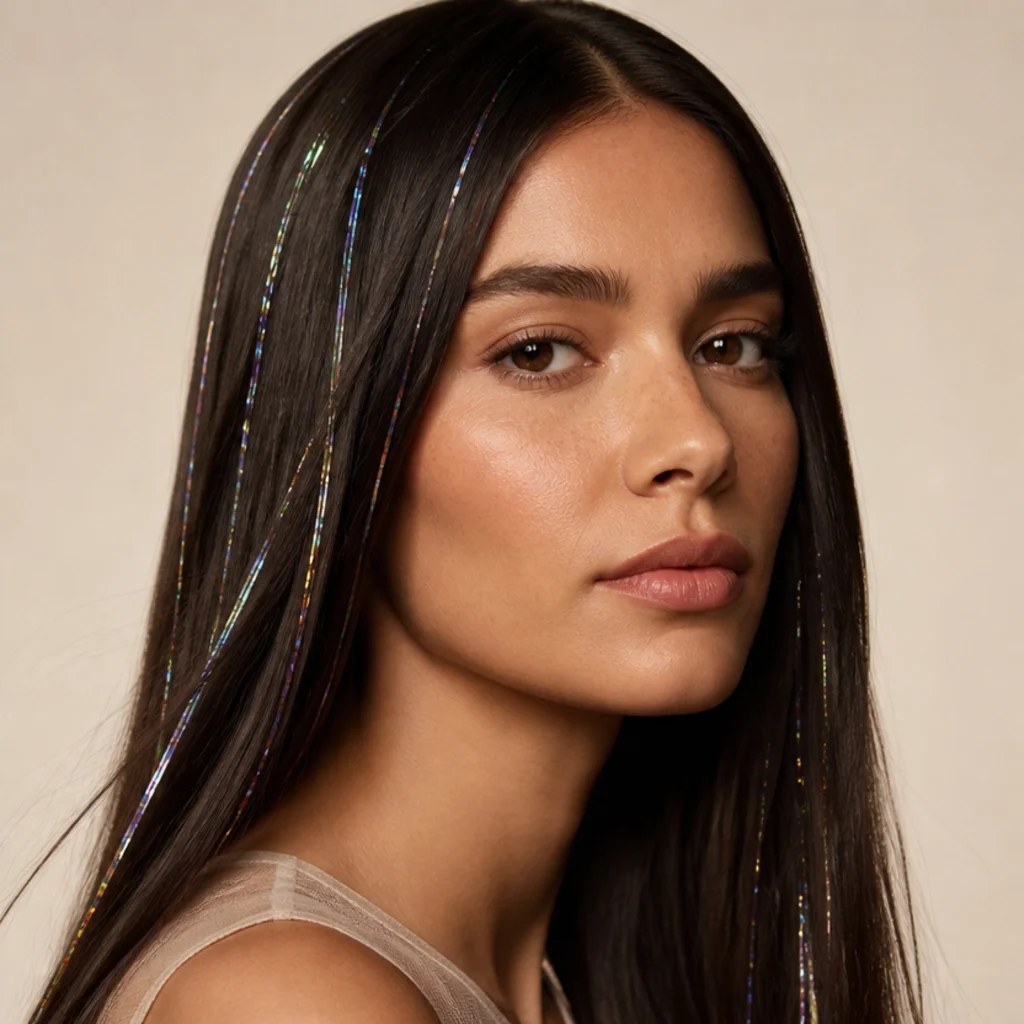
04Holographic Tinsel on Deep Brown
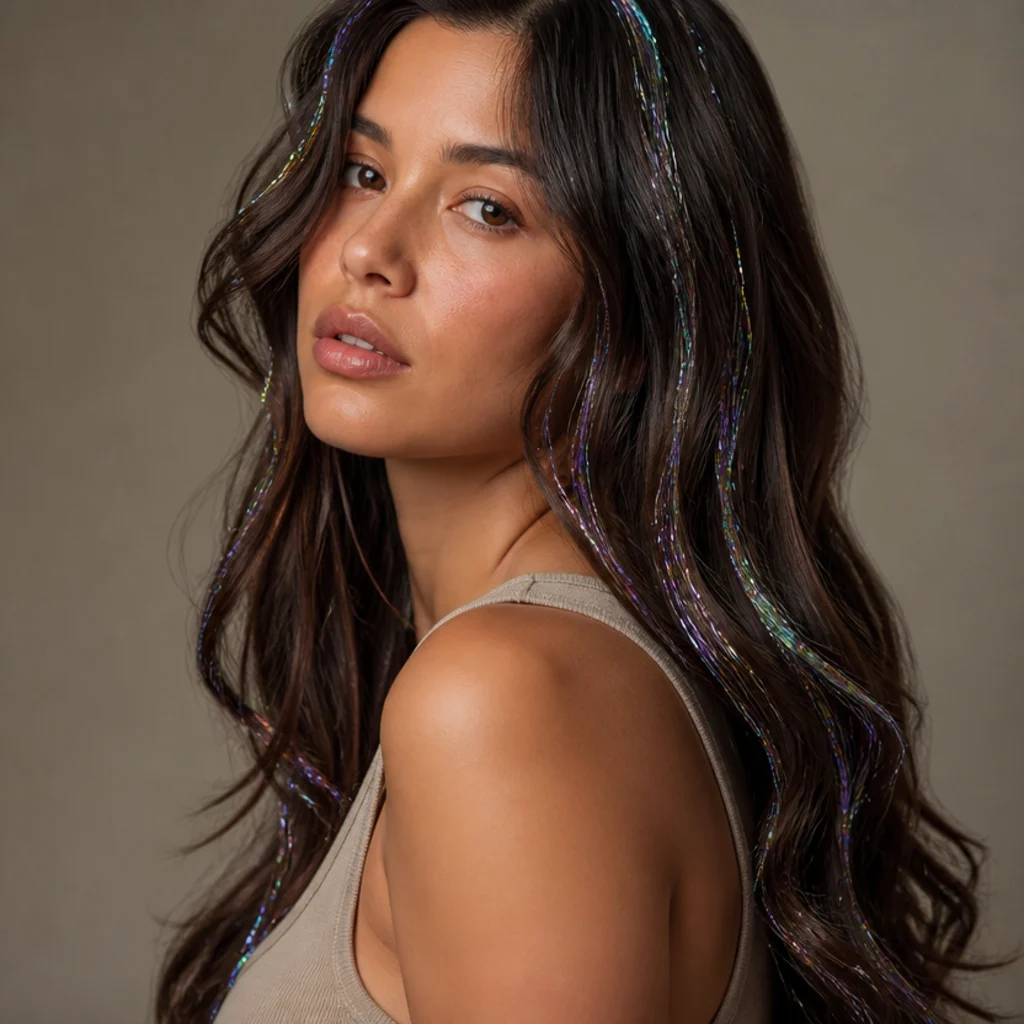
Deep brown is one of the most versatile canvases, and holographic tinsel gives it a futuristic, rainbow-flecked finish without the hard contrast of silver on black. The multi-tone film reflects whatever color you're wearing, so the look feels custom day to day and reads as a modern hair tinsel aesthetic that still passes at work. Run 15 to 25 strands through the mid-section and ends where waves fan them out — holographic film rewards movement more than a static, flat placement. Maintenance is standard for tie-ins at 4-6 weeks, and difficulty scales with density. The strand's cast shifts with your base: on cool espresso brown it leans silver-violet, while warm chestnut or caramel-highlighted brown pulls the holographic film toward gold and pink. Pro tip: check the strands under both warm indoor light and daylight before committing to density — holographic film can look busier under LED than in the sun. Ask your colorist to place strands just below your existing highlight pattern so the sparkle traces your natural dimension.
05Copper Tinsel on Warm Brunette
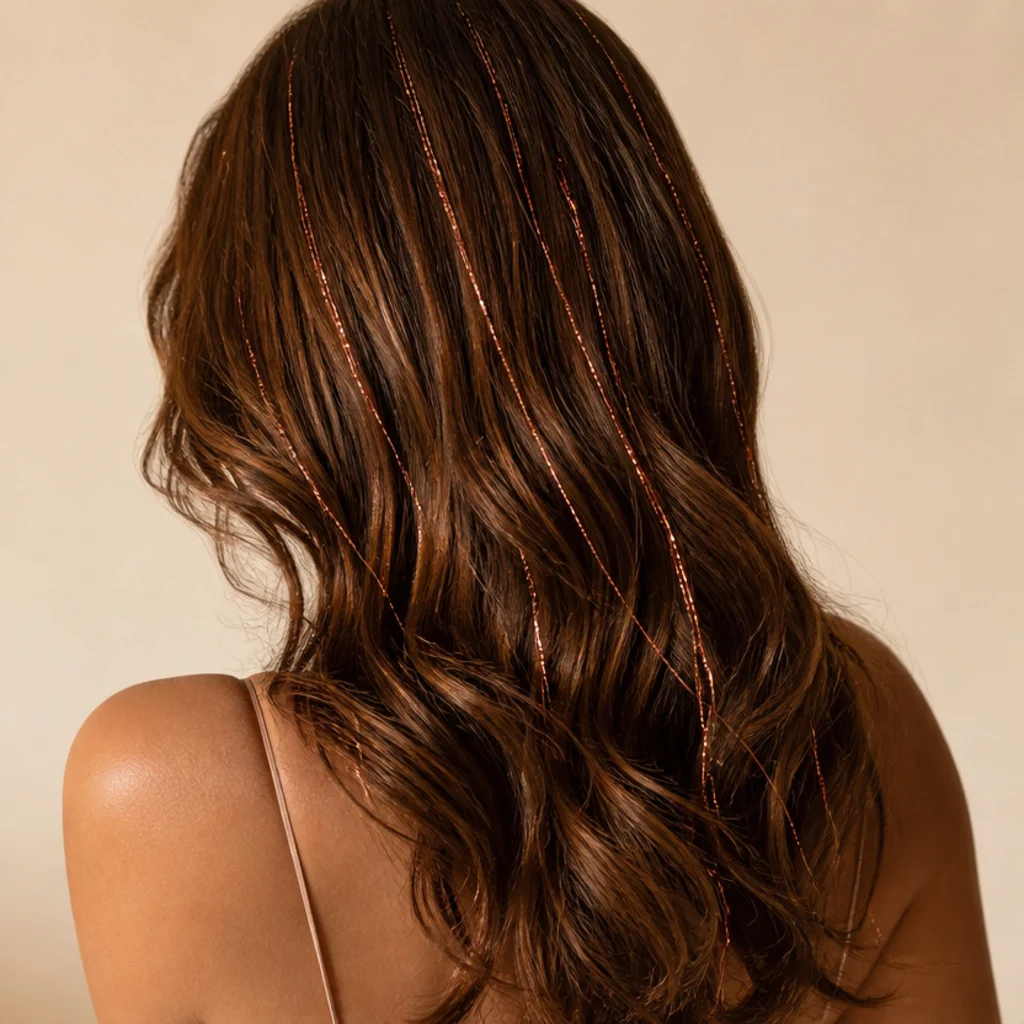
Copper tinsel is the tone-on-tone choice for warm brunettes who want shine without an obvious color pop. Metallic copper sits close to natural warm-brown highlights, so it reads as an amplified glow rather than a separate accent — a good pick if you're nervous about tinsel looking costume-like. It suits warm and golden skin undertones and looks richest on level-4 to level-6 brown with existing caramel or auburn dimension. Weave 12 to 20 strands through the crown and face sections that already catch light, following the crest of your wave so the copper flashes on the high points. Wear holds the standard 4-6 weeks, and the blended tone hides any strand that sits slightly off, which makes this forgiving for first-timers. Pro tip: for controlled drama, drop in one gold strand for every three copper strands to lift the overall warmth a notch without adding a visible second color. Ask your stylist for placement concentrated on the sun-facing side of your part, where the metallic catches most.
Save this to Pinterest to compare warm and cool tinsel tones side by side.
06Champagne Tinsel on Ash Brown
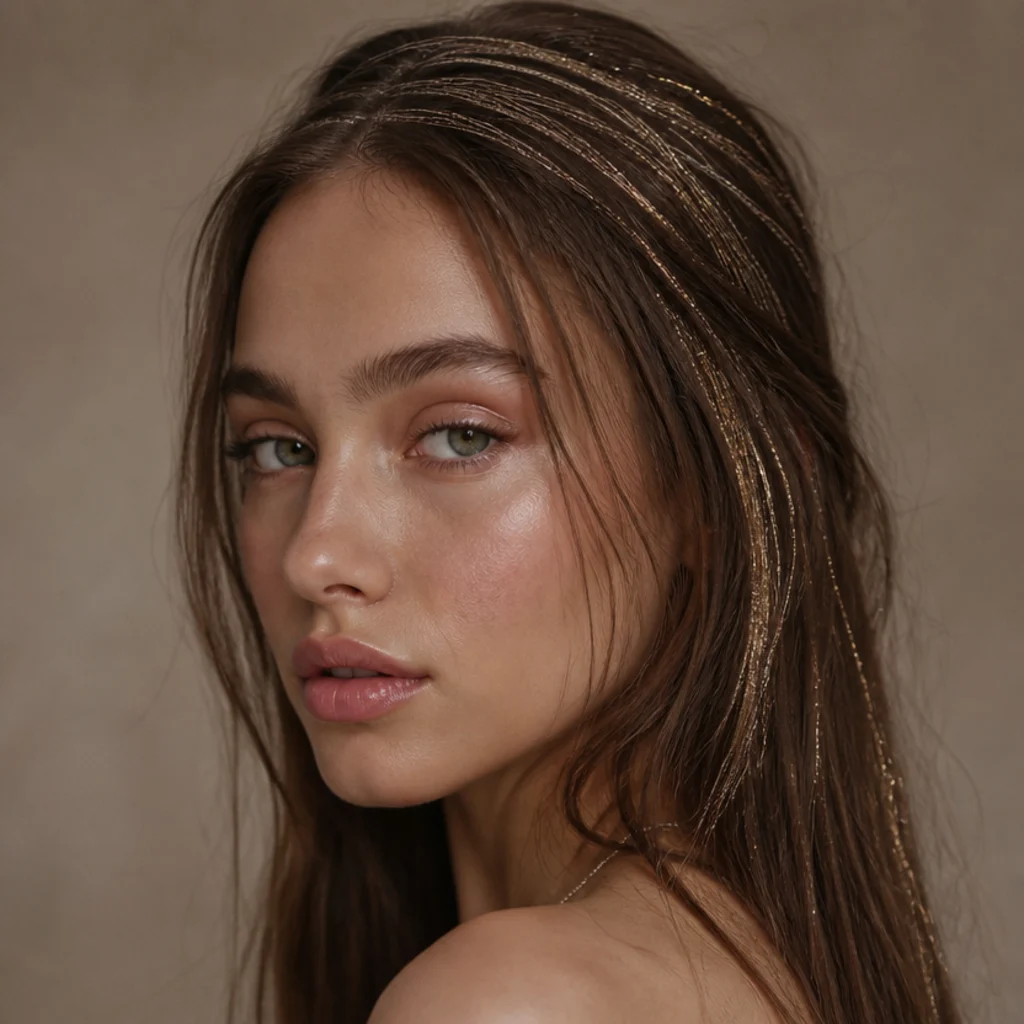
Ash brown has cool, muted undertones that can flatten under office and evening lighting, and champagne tinsel is a quiet fix. The pale neutral-gold strand adds warmth and light without tipping the color brassy, so it corrects dullness rather than changing your shade. This is one of the most workplace-appropriate tinsel looks, since the effect stays invisible from across a room and only sparkles up close. Scatter a light density of 10 to 18 strands through the crown and part, keeping it diffuse rather than clustered. Expect standard tie-in longevity: 4-6 weeks. Champagne also works as a transitional tone if you're growing out balayage, since it bridges cool roots and warmer lengths without a hard demarcation line. Pro tip: champagne is a low-contrast neutral, so go for a smooth blowout or polished waves — frizz scatters the strand's reflection and cancels the subtle glow. Ask your stylist for a soft, even crown scatter rather than a defined accent so it reads as natural luminosity.
07Gold Tinsel on Chocolate Waves
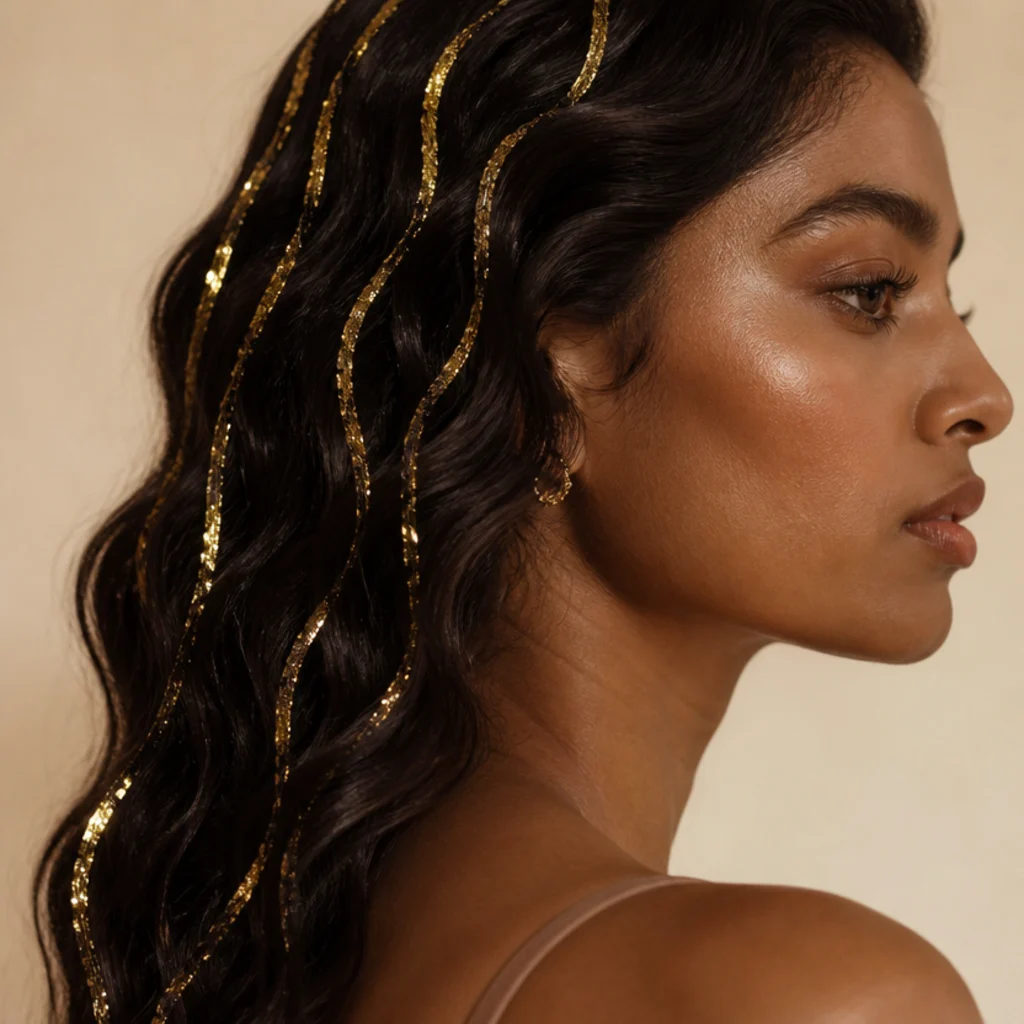
Rich yellow-gold tinsel against chocolate-brown waves is a warm, luxe pairing that suits medium to deep skin with golden or olive undertones. Gold has far more punch than champagne, so a little goes a long way — a dozen well-placed strands read as deliberate evening glamour rather than everyday shimmer. Position each piece where your wave crests so the shine follows the curve and catches on the S-bend. This look photographs warm and rich under tungsten and candlelight, and it's a favorite for weddings and holiday parties. Maintenance runs the standard 4-6 weeks, but gold film can look tarnished when product builds up, so keep heavy oils and thick creams off the strands. Gold is easy to overdo, so start with 10 to 12 pieces and add more only if you want it bolder. Pro tip: place gold strands slightly deeper in the section, not right at the surface, so the wave partially covers and reveals them for a more expensive, dimensional flash. Ask your stylist for event-weighted placement around the face and part.
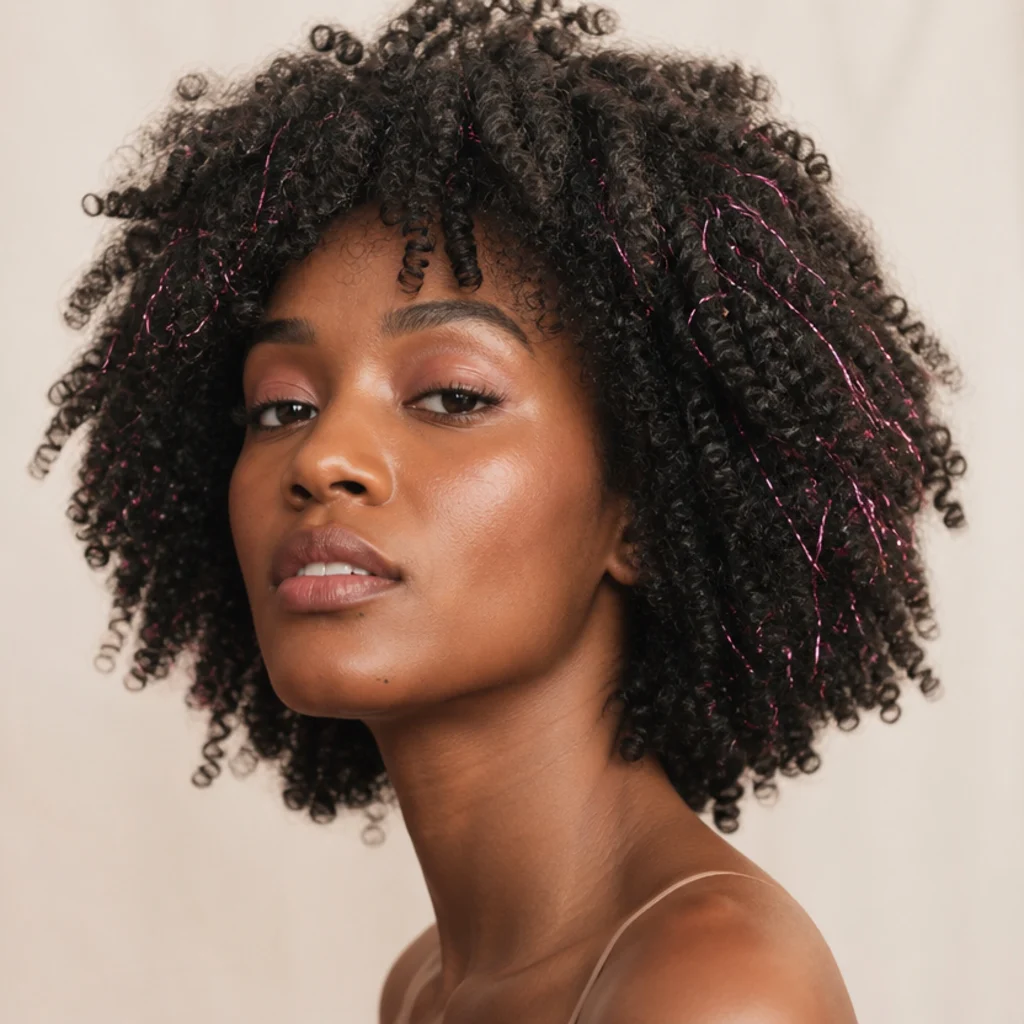
08Bubblegum Pink Tinsel on Black Hair
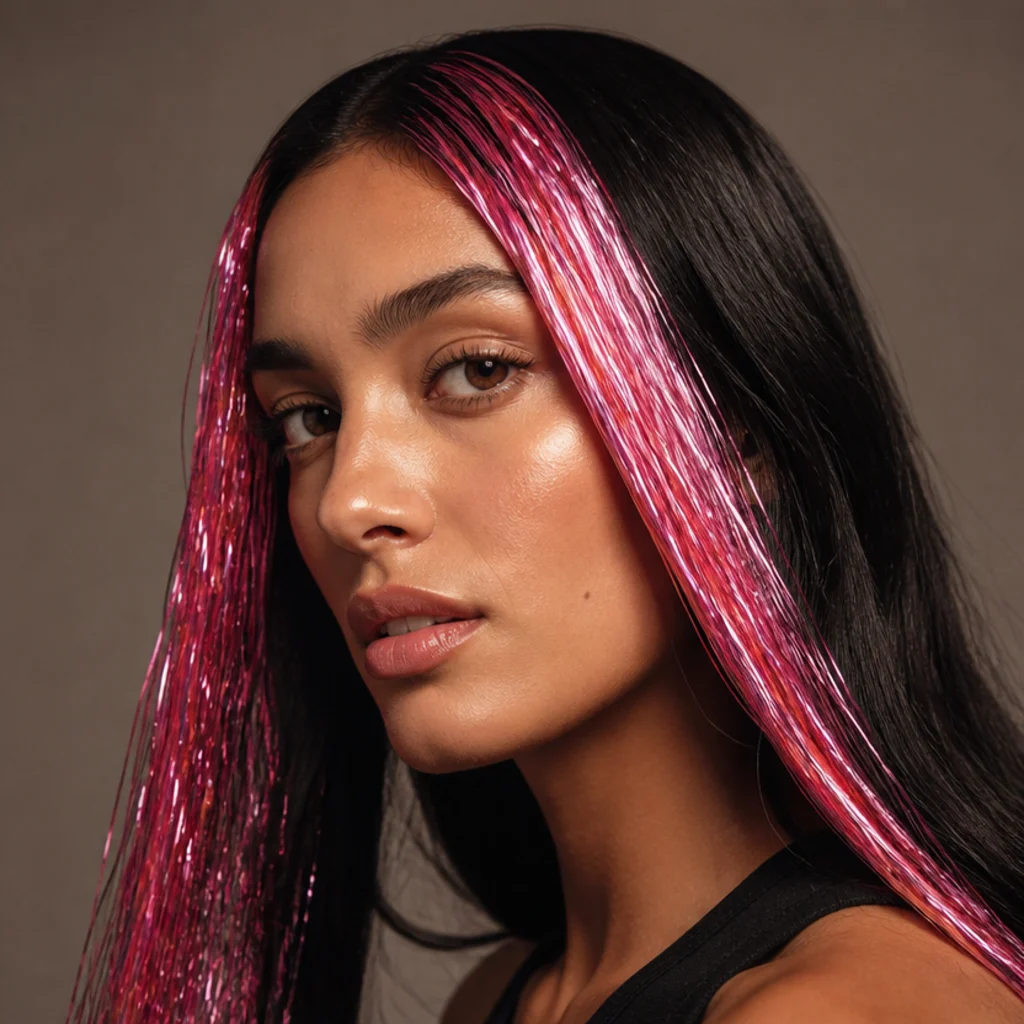
Pink hair tinsel on a black base is a bold, playful statement that delivers color with zero dye commitment or lightening. Bubblegum pink pops hard against a dark canopy, so it's built for festivals, birthdays, and anyone road-testing a pink phase risk-free. For the strongest effect, cluster 15 to 20 strands as a face-framing money-piece down both sides of the part; for something softer, scatter 10 to 12 through the crown for pinpricks of color. The contrast is high here, so uneven placement shows — take your time seating each knot flush to the scalp. Standard tie-in wear of 4-6 weeks applies. It's also a useful preview: living with pink tinsel for a few weeks tells you whether committing to real pink dye, which would require pre-lightening dark hair, is worth it. Pro tip: choose a warm bubblegum rather than a cool fuchsia, since warm pink reads friendlier against blue-black and photographs less harshly under flash. Ask your stylist to mirror the strand count on each side so the money-piece stays balanced.
09Pastel Pink Tinsel on Blonde
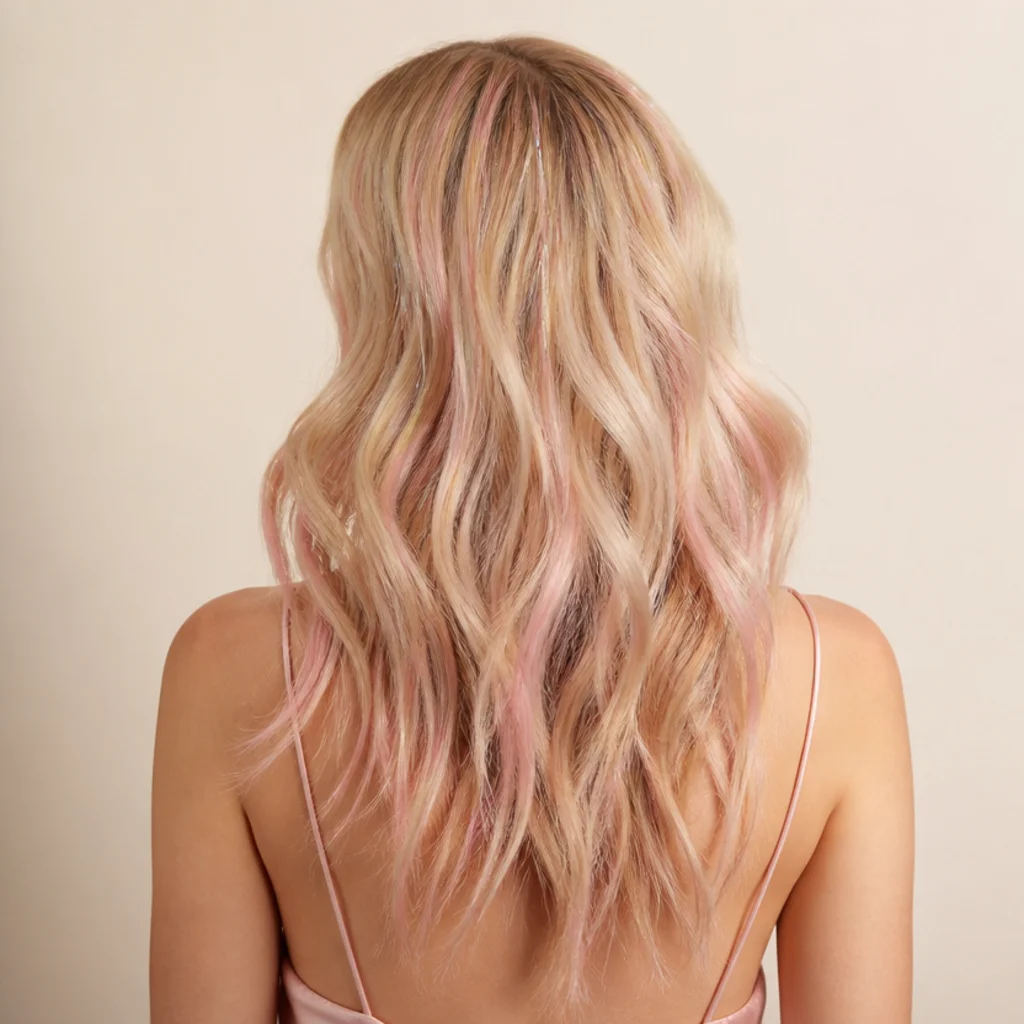
On blonde, pastel pink tinsel melts into the base for a cotton-candy wash of color rather than a sharp contrast. This is the gentle end of the pink hair tinsel spectrum — a romantic, barely-there tint that reads tonal instead of statement. Blonde and pastel pink sit close in value, so the effect stays diffused and dreamy, flattering cool and neutral skin undertones especially well; it also plays beautifully on level-8 to level-10 blondes. Distribute 18 to 25 strands evenly through the mid-lengths and ends for an all-over glow rather than a defined stripe. Longevity is the standard 4-6 weeks. This look is beginner-friendly, since low contrast hides imperfect placement almost entirely. Pair it with loose, brushed-out waves so the pastel strands drift through the hair like ribbon and catch light on the wave crests. Pro tip: on very cool or ashy blonde, choose a pink with a hint of warmth so it doesn't read gray under indoor light. Ask your stylist for an even, low-density scatter concentrated below the ear.
10Hot Pink Tinsel on Dark Brown
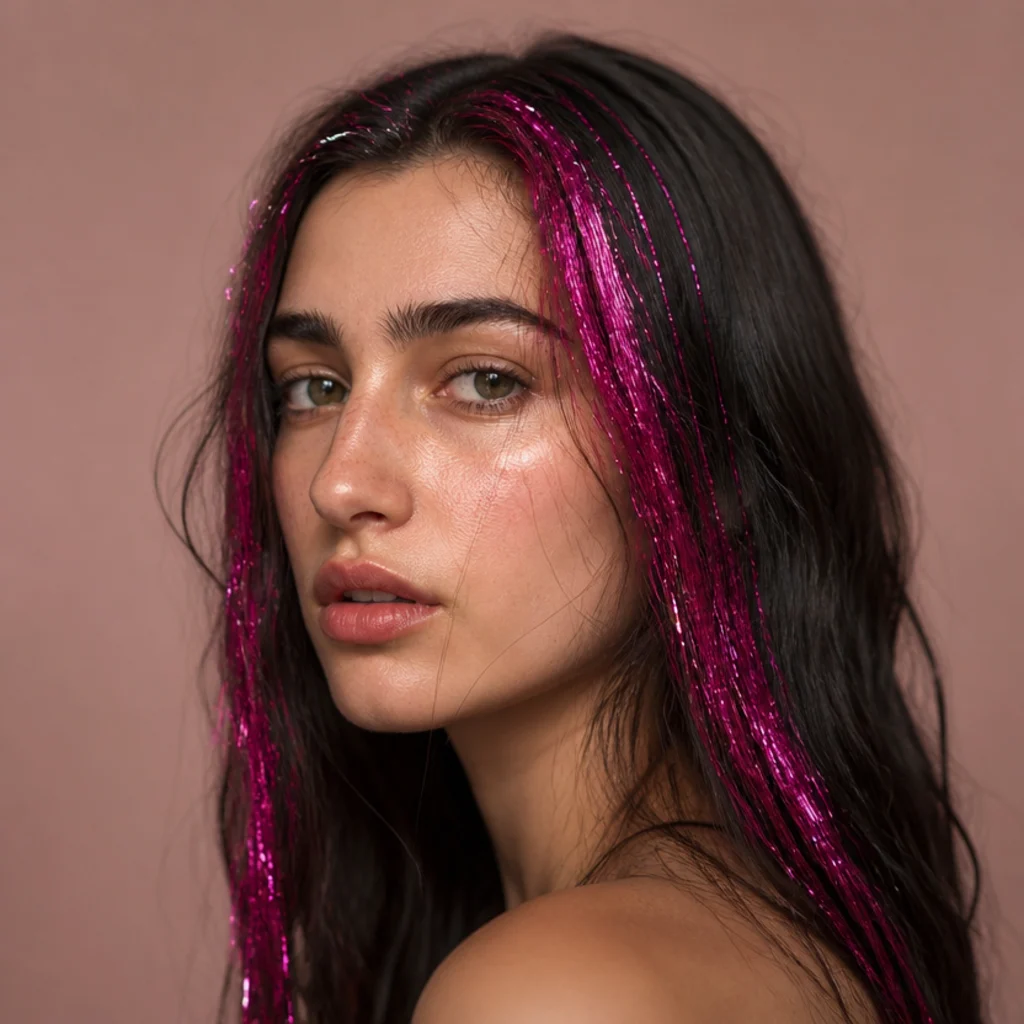
Hot pink tinsel on dark brown lands between the drama of pink-on-black and the softness of pastel-on-blonde. The vivid magenta still contrasts strongly, but the brown base warms it, so it reads punchy rather than neon-harsh — a good fit for warm and neutral skin undertones. This is for anyone who wants an unmistakable color statement with a touch more depth than a black base gives. Concentrate 12 to 18 strands in the front third for a bold face-frame, or run them through a single braid to trap the color in a defined, graphic line. Standard 4-6 week maintenance applies. Hot pink is highly saturated, so keep density moderate to stay chic rather than overwhelming the natural brown underneath. Pro tip: hot pink and warm brown share red undertones, so this combination is more forgiving than it looks — place a couple of strands slightly deeper for a layered, glowing effect rather than a flat surface line. Ask your stylist for a weighted front-section frame with the back left clean for contrast.
Save this to Pinterest if you're deciding between pastel and vivid pink.
11Platinum Tinsel on Icy Blonde
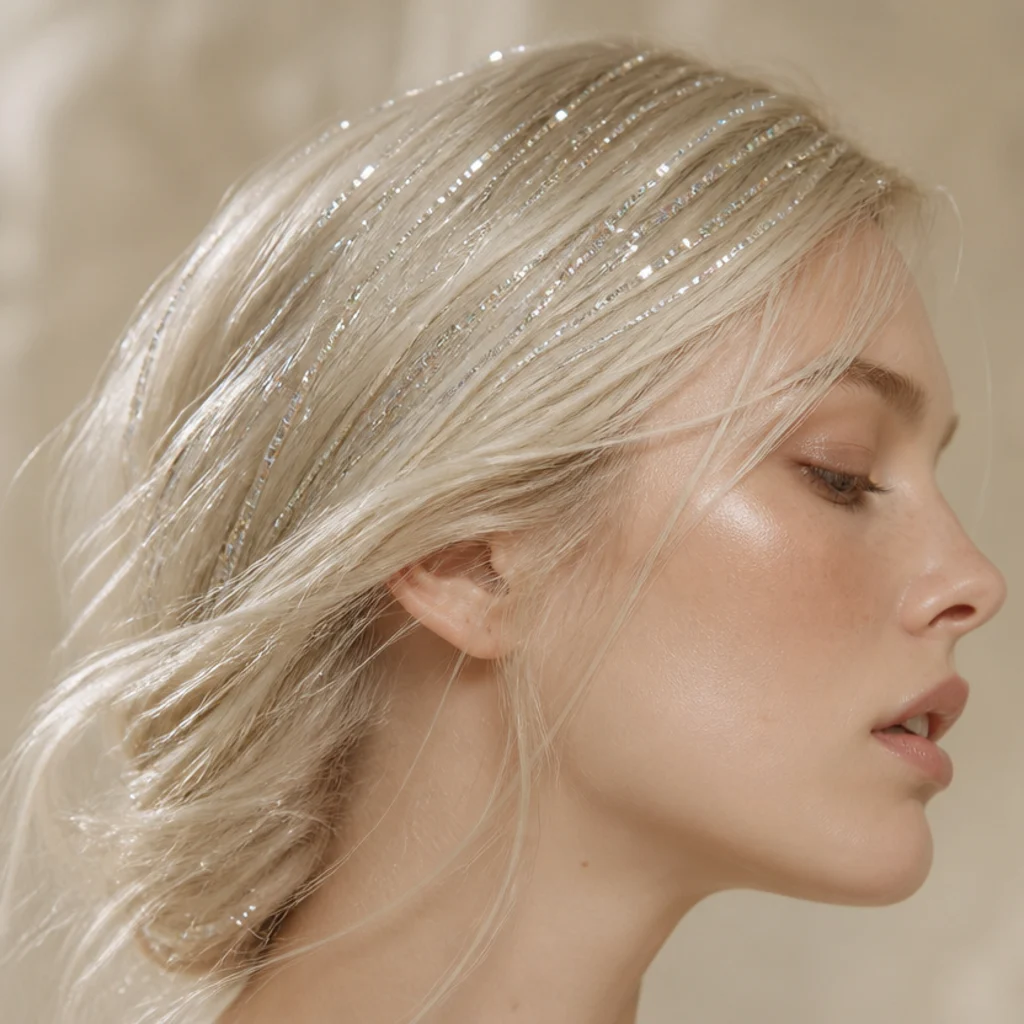
Platinum tinsel on icy blonde is the smoothest, highest-shine look on this list. Strand and base share the same cool, near-white value, so the tinsel disappears into the hair until light hits it, then the entire canopy glints like polished glass. It suits cool-toned platinum, silver-blonde, and level-10 bases on pale to medium skin with pink or neutral undertones. Scatter generously — 25 to 35 strands through the crown and lengths — since the low contrast means you can use high density without it ever looking busy or costume-like. Standard 4-6 week wear applies, and this tone-on-tone approach is the easiest of all to keep looking polished as it grows out, since there's no visible color line traveling down. Pro tip: keep purple toning shampoo off the strands where possible, as repeated cool-violet deposit can slightly dull platinum film's mirror finish over several washes. Ask your stylist for a dense, even canopy — platinum-on-platinum is the rare look that actually benefits from more strands rather than fewer.
12Gold Tinsel on Honey Blonde
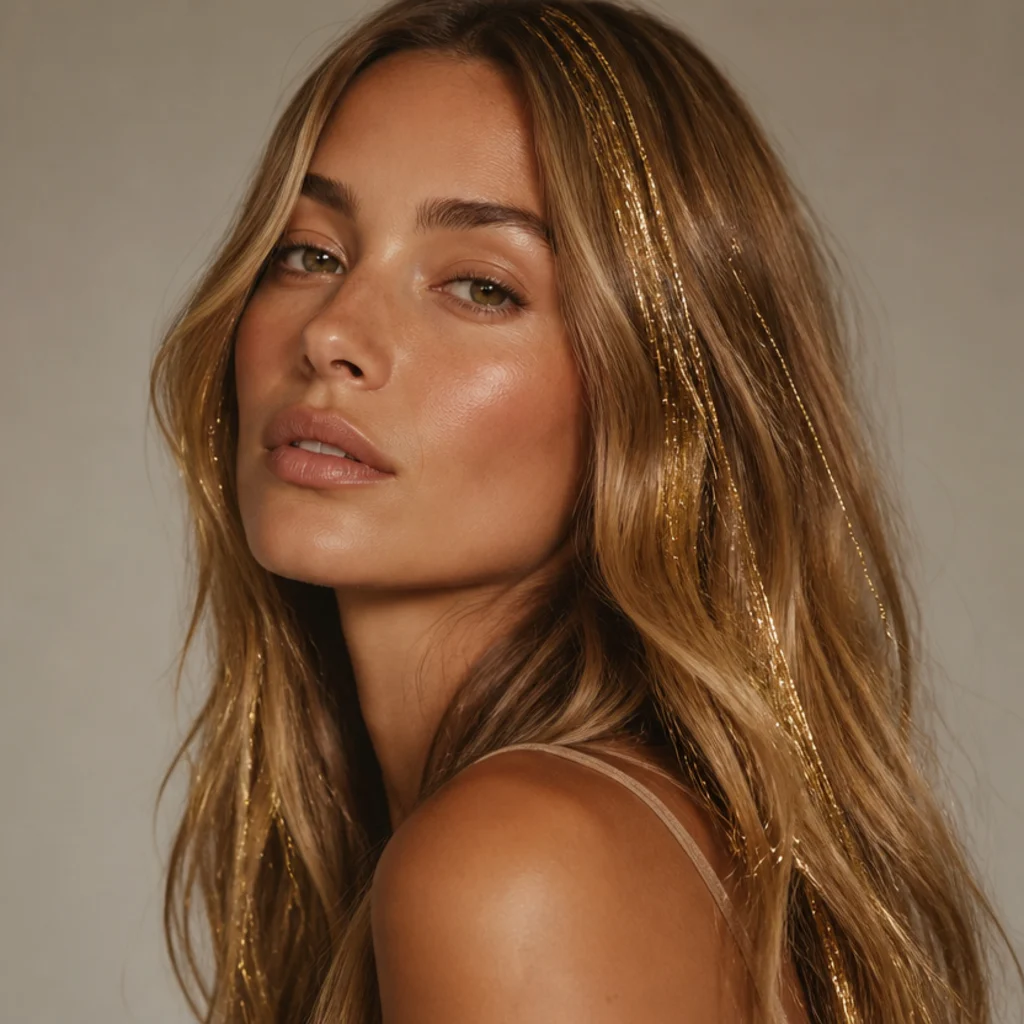
Honey blonde already carries warm golden depth, and gold tinsel dials that glow up a notch without adding a new color. The strands read as concentrated highlights, giving sun-kissed dimension that looks entirely natural outdoors — a low-drama, everyday pick for warm and neutral skin undertones. Place 15 to 20 strands along the sections that already catch light, following your existing highlight map so the effect feels organic rather than applied. Maintenance is the standard 4-6 weeks; keep heavy oils off the film to preserve its shine. Difficulty is low, and the tonal blend hides slightly uneven placement. For an event, layer three or four champagne strands among the gold to add cooler light points that keep the look from going too matchy and monochrome. Pro tip: gold reads warmest in daylight and can look brassy under yellow indoor bulbs, so if your evenings are tungsten-lit, mix in champagne to balance the temperature. Ask your colorist to trace your balayage pattern with the strands for smooth, even dimension.
13Peach Tinsel on Strawberry Blonde
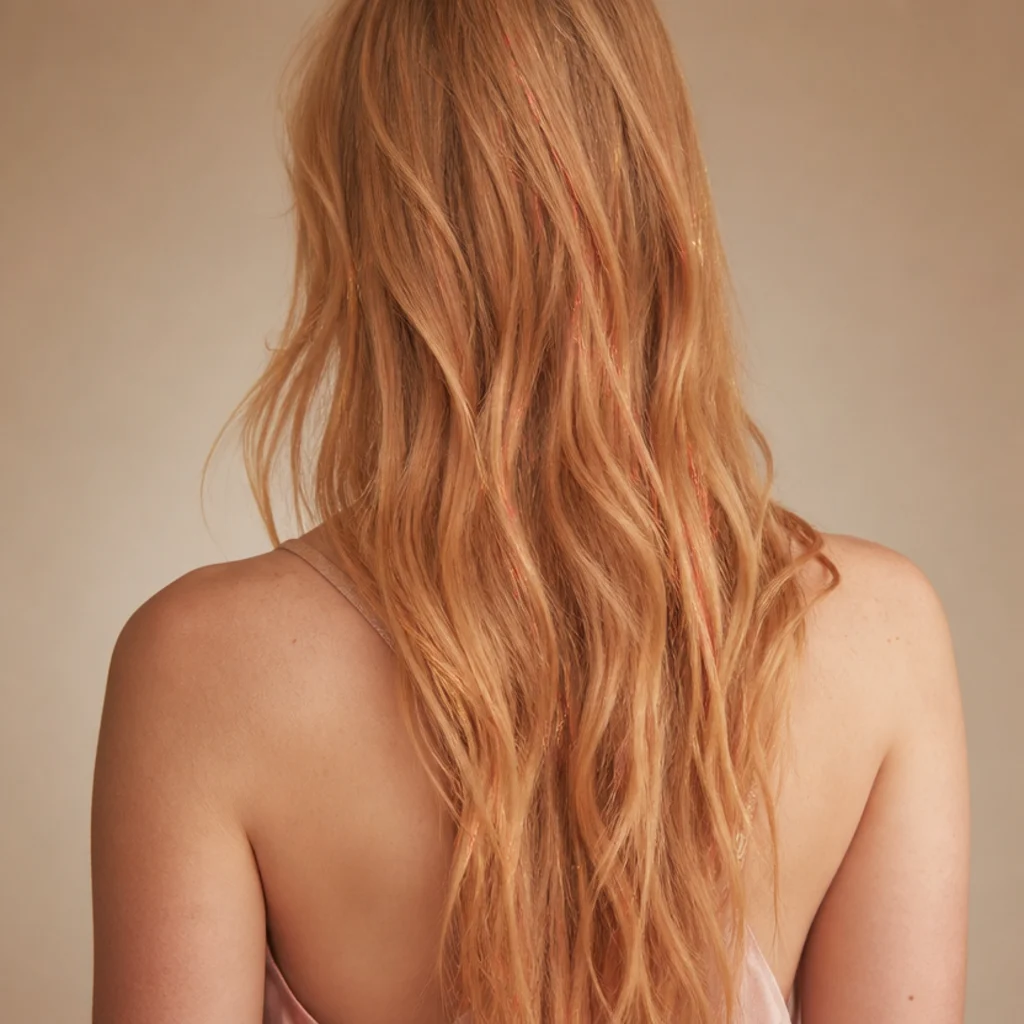
Strawberry blonde sits between warm blonde and soft red, and peach tinsel is its precise tonal match. The warm coral-gold strand blends into the base for a glowing, romantic finish that never competes with the natural color, and it suits warm, peachy, and freckled complexions. Distribute 18 to 24 strands evenly for all-over shimmer, or cluster 12 near the face for a soft, lit-from-within highlight effect. Standard 4-6 week longevity applies, and the low contrast makes it beginner-friendly. Peach also works well for a bride or bridesmaid, since it photographs warm and soft rather than flashy and adds light without pulling focus from an updo or veil. Pro tip: peach can read too orange against very cool skin, so if your undertone leans pink, shift toward a rose-peach or add a few pearl strands to cool the overall cast. Ask your stylist for a soft, diffuse scatter that follows the lengths rather than a concentrated block, so the peach stays a glow rather than a stripe.
14Silver Tinsel on Gray and Silver Hair
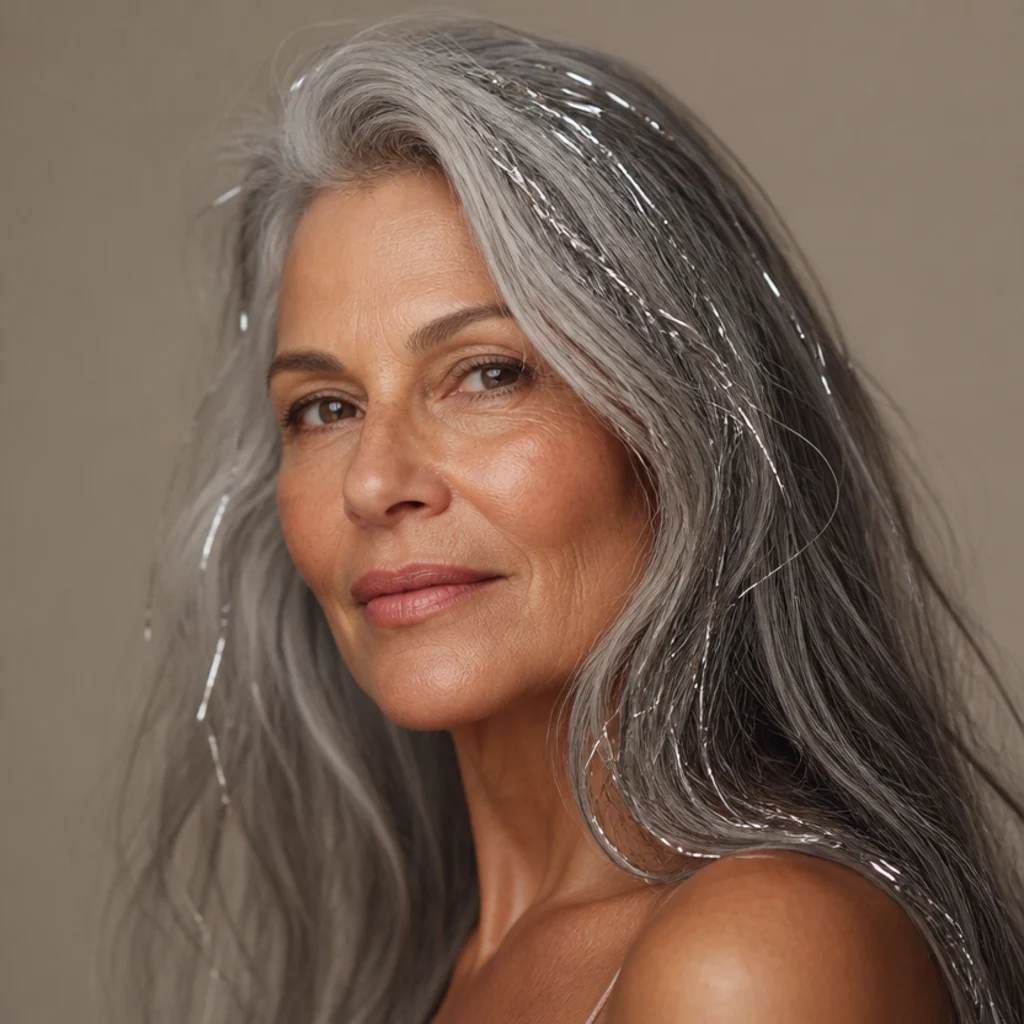
Natural gray and silver hair is a flattering canvas for silver tinsel, and the pairing celebrates the color rather than hiding it. The metallic strands echo the cool tones already in gray hair, adding a polished, intentional sparkle that makes the whole head look deliberately styled instead of just grown out. This suits anyone embracing their silver who wants a little glamour, across every skin undertone. Scatter 25 to 35 strands generously through the crown and lengths, since the tonal match lets you go dense without it ever reading costume-like. Standard 4-6 week wear applies, and the low contrast keeps regrowth looking smooth as the strands travel down. It's an age-inclusive, modern way to enjoy the trend. Pro tip: if your gray carries a warm or yellowed cast, choose a soft pewter-silver rather than a bright chrome so the strand blends in instead of exposing the warmth by contrast. Ask your stylist for an even canopy with a touch more density around the crown, where gray tends to show most.
15Pearl Tinsel on Soft White Hair
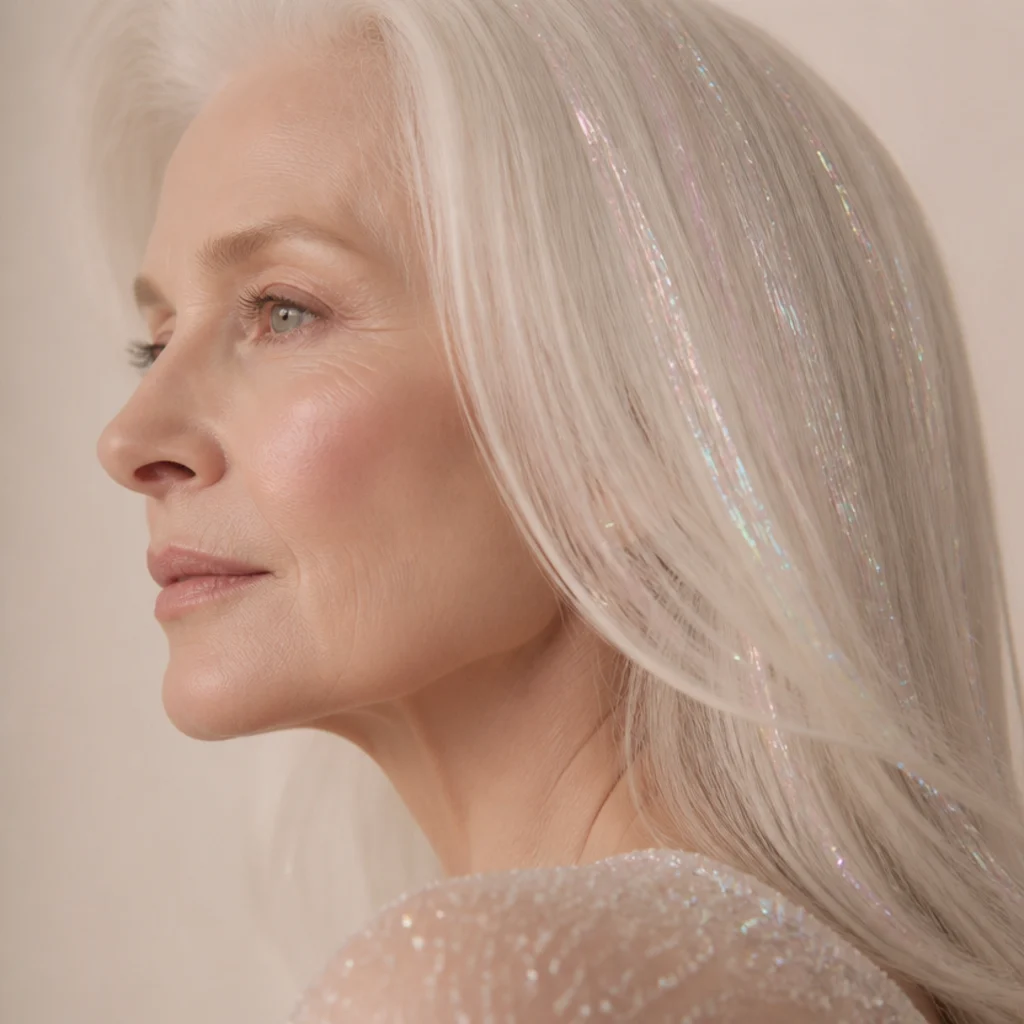
Pearl tinsel brings a soft, opalescent sheen to white and pale-silver hair. Unlike bright chrome silver, pearl film has a milky iridescence that flashes faint pink and blue as it moves, giving an ethereal finish that reads refined rather than sharp. This is a sophisticated choice for true-white or platinum bases on cool and neutral skin undertones. Distribute 20 to 28 strands evenly for a diffused, all-over glow rather than any concentrated point. Maintenance runs the standard 4-6 weeks. The gentle color-shift adds quiet interest without hard contrast, so it works at any age and in any setting. Pair it with a smooth blowout or soft waves to let the opalescent quality shift as the light changes across the surface. Pro tip: pearl's subtlety depends on a clean, glossy hair surface, so a clarifying wash before application and a lightweight shine serum on the hair (not the strands) will make the opalescence read more clearly. Ask your stylist for a diffuse, even placement rather than a face-frame.
Save this to Pinterest to see how tinsel flatters gray and white hair.
16Ruby Tinsel on Auburn
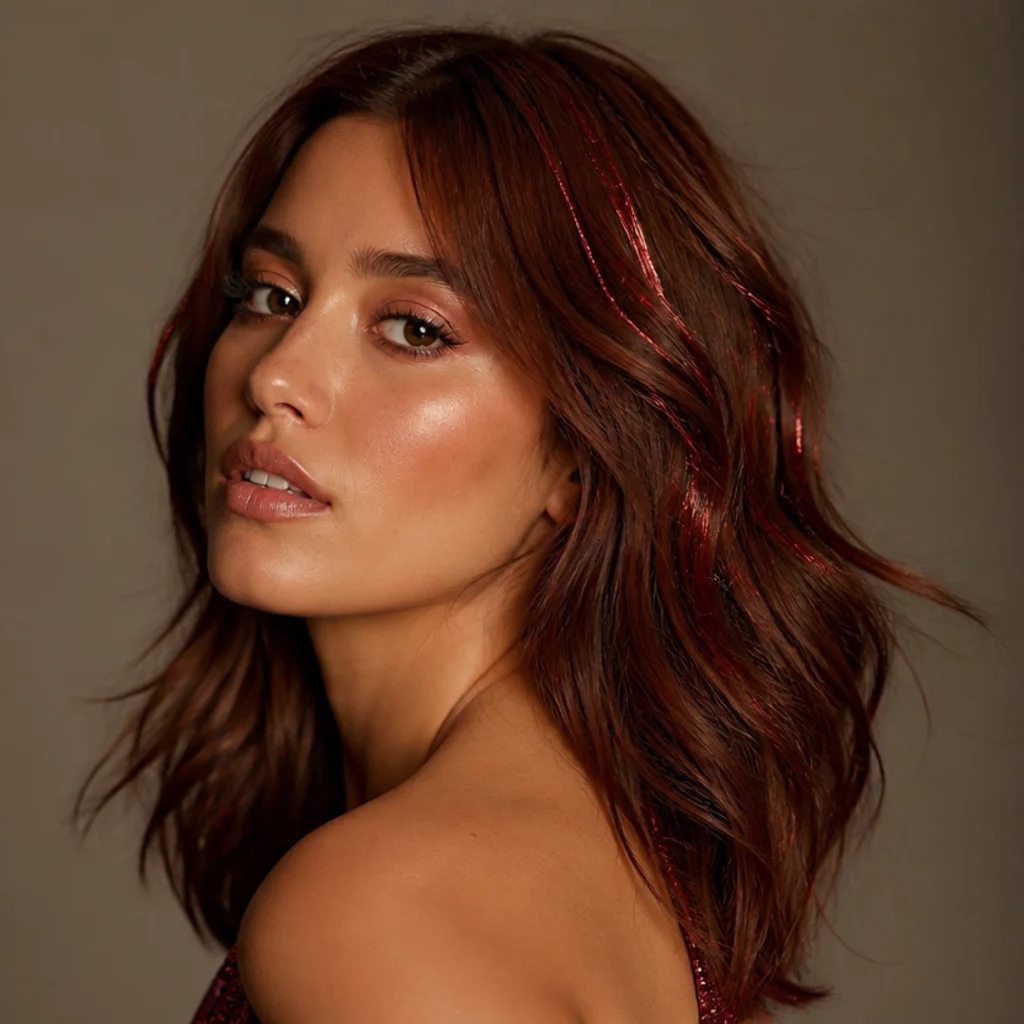
Auburn hair carries a rich red-brown depth, and ruby tinsel intensifies it with jewel-toned sparkle. The deep red strand blends with auburn while adding glassy shine, so the effect is a heightened, saturated version of the natural color rather than a contrasting streak. It suits warm, olive, and golden skin undertones and looks especially rich in low autumn and evening light. Weave 15 to 20 strands through the crown and mid-lengths where the red already glows, following your natural dimension. Standard 4-6 week maintenance applies. Ruby sits close to the base value, so placement is forgiving — a comfortable choice for first-timers who want color-matched drama without an obvious accent line. Pro tip: ruby film reads deepest against true auburn but can look almost brown on lighter copper-auburn, so if your base is on the brighter side, lift the effect with a few scattered copper strands for contrast. Ask your colorist to concentrate strands where your auburn is darkest so the ruby amplifies existing depth rather than fighting it.
17Copper Tinsel on Natural Red
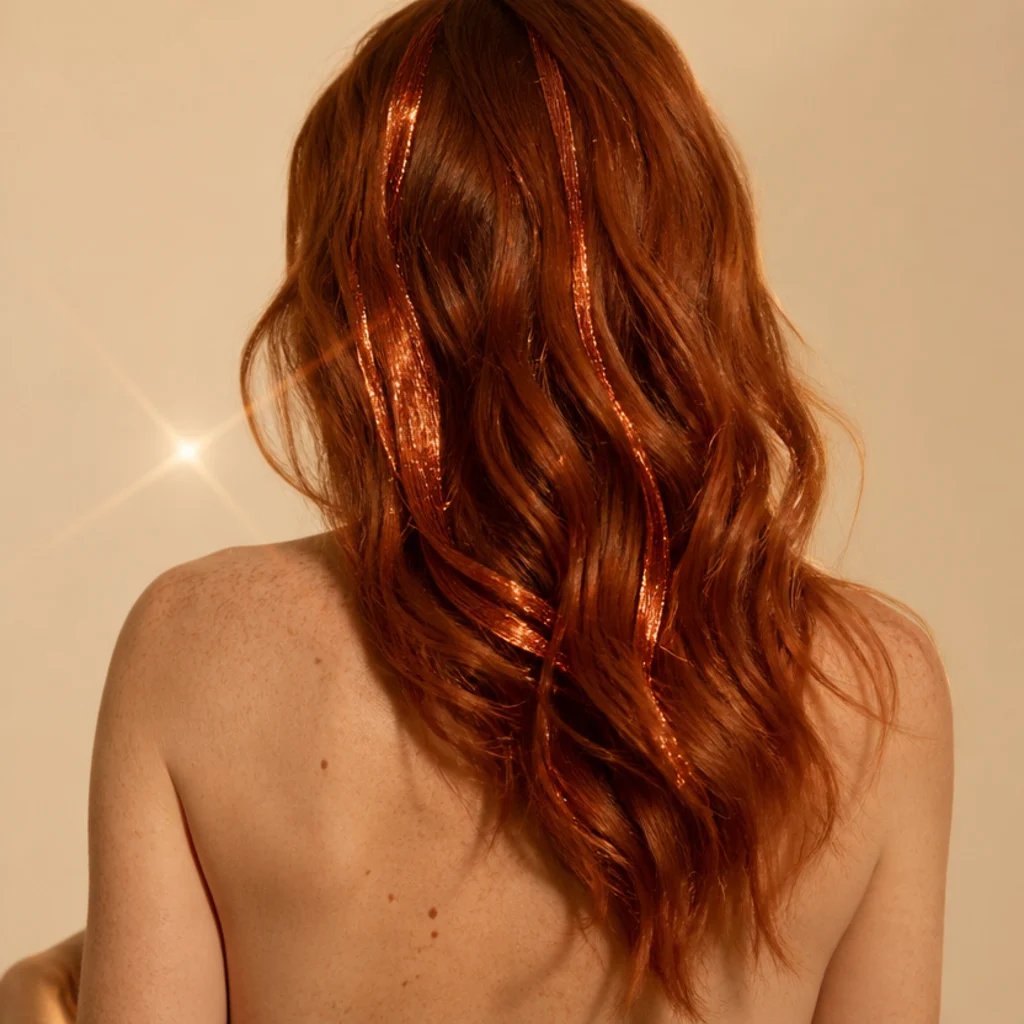
Natural red hair and copper tinsel are a near-perfect tonal match, amplifying the fiery highlights redheads already have. The metallic copper strand catches light like a concentrated sun-glint, adding depth and shine without any foreign color, so the look stays unmistakably yours. This suits fair, freckled, and warm complexions that pair naturally with red hair. Place 15 to 22 strands through the sections that crest in waves so the copper flashes as you move. Maintenance is the standard 4-6 weeks, and the tonal blend hides uneven knots, so it's low-stress to apply. It's a subtle way for redheads to join the tinsel trend while keeping the effect natural-looking. Pro tip: natural red hair reflects a lot of warmth on its own, so keep density moderate — too many copper strands can tip the look orange under bright light. A restrained 15-strand scatter reads more expensive than a dense one. Ask your stylist to weight placement toward the front and crown where sunlight hits first.
18Turquoise Tinsel on Black Hair
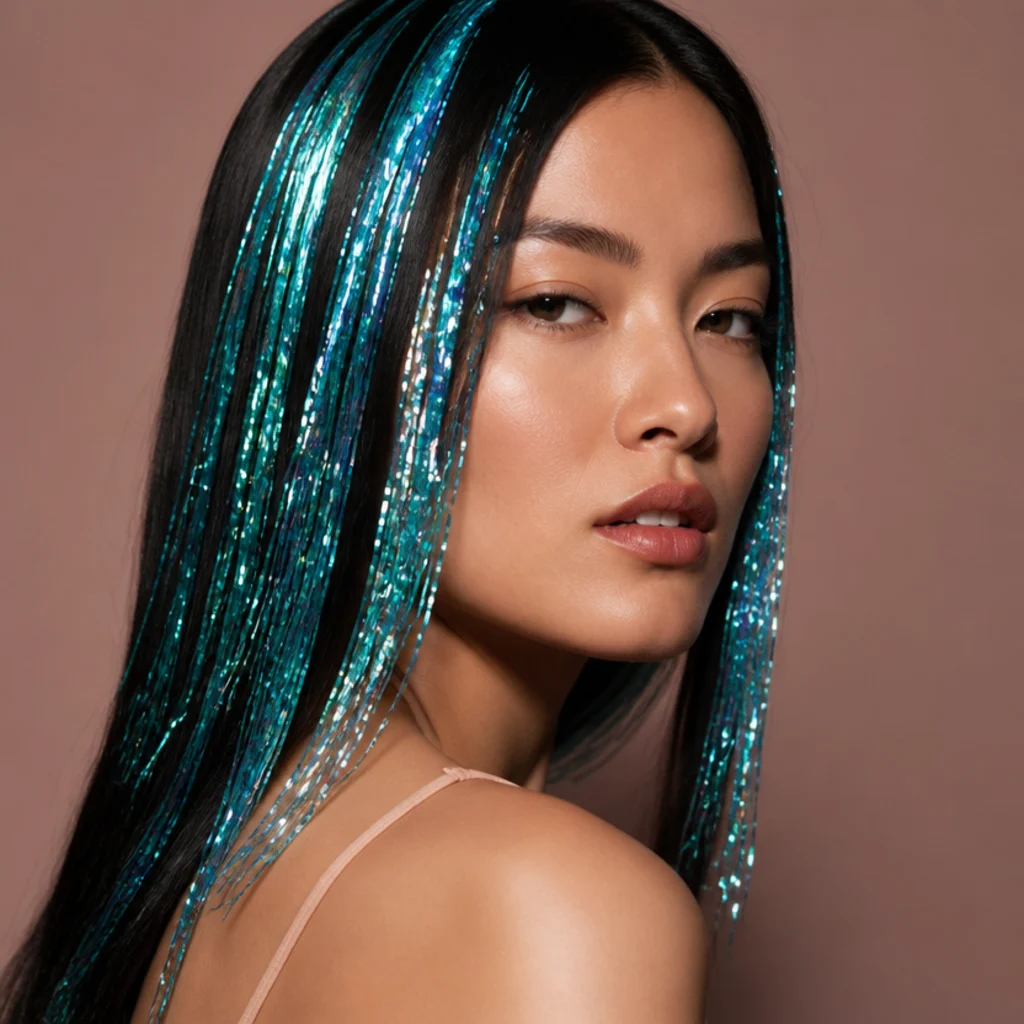
Turquoise tinsel on a black base is a striking, mermaid-inspired look. The cool blue-green pops vividly against dark hair, delivering bold jewel color with zero dye or lightening — another strong hair tinsel black hair option for anyone drawn to aquatic tones but wanting them temporary. Cluster 15 to 20 strands as a face-frame for maximum impact, or scatter 10 to 12 for flashes of sea-glass color through the crown. Contrast is high here, so seat each knot carefully to keep placement clean and intentional. Standard 4-6 week wear applies. Turquoise pairs well with a few silver strands mixed in, which cool the palette further and give an icy, faceted, aquatic finish that photographs vividly under any light. Pro tip: on blue-black hair specifically, turquoise blends with the base undertone for a more sophisticated look; on true neutral-black it reads more punchy and graphic, so choose your placement drama accordingly. Ask your stylist for a face-frame weighted toward the part with a couple of silver accents worked in.
19Emerald Tinsel on Dark Brown
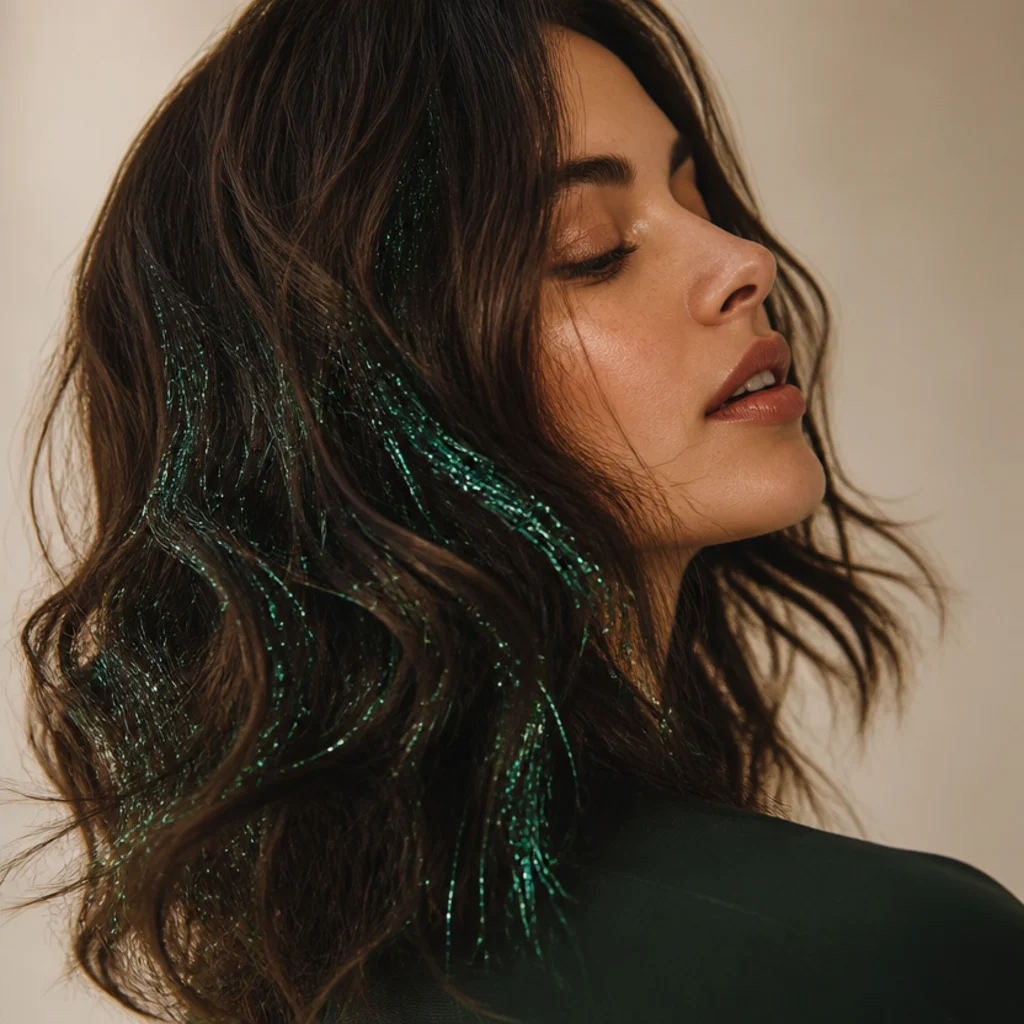
Emerald tinsel on dark brown is a moody, sophisticated take on colored sparkle. The deep green reads jewel-rich against brown rather than neon, so it feels luxe and wearable rather than costume-like. This suits anyone who wants colored tinsel with restraint, and it works well with warm, olive, and neutral skin undertones. Run 15 to 20 strands through the mid-lengths and ends where waves reveal the green in motion, keeping the surface cleaner near the crown. Standard 4-6 week maintenance applies. Emerald is a natural winter-holiday choice; pair it with a few gold strands for a festive but refined palette that never tips gaudy. Keep density moderate so the green stays an accent that deepens the brown rather than overtaking it. Pro tip: emerald reads richest against level-3 to level-5 brown; on lighter brown it can look more olive, so drop the effect deeper into the section and add gold to warm it back up. Ask your stylist for a mid-length placement that lets your waves partially cover and reveal the strands.
20Sapphire Tinsel on Deep Blue-Black
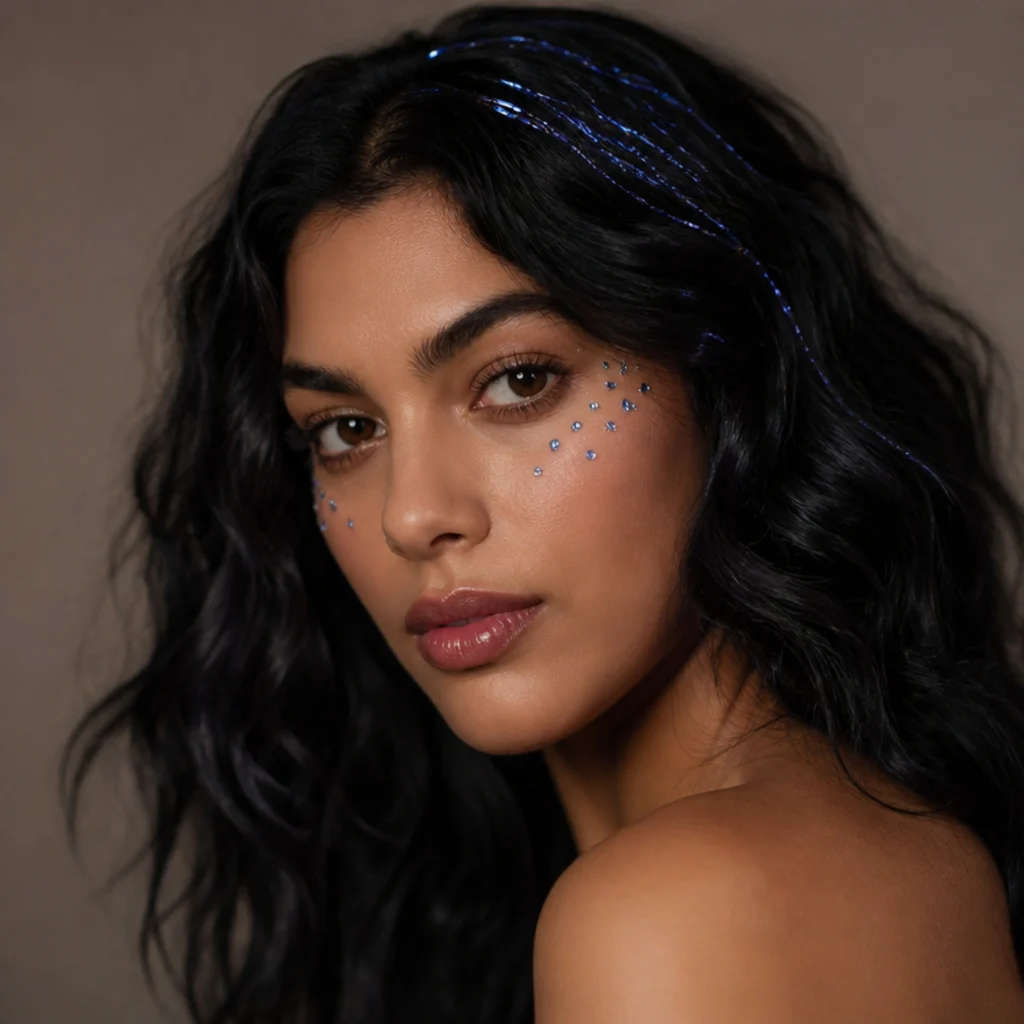
Deep blue-black hair carries a cool sheen, and sapphire tinsel leans into it with rich blue sparkle. The strand tone echoes the blue undertone already in the base, so the effect is a deepened, gemstone-like glow rather than a clashing pop — intentional, not costume-like. This suits cool-toned deep bases and looks most dramatic under evening and flash-heavy light. Scatter 18 to 25 strands through the crown so the blue catches from multiple angles as you move. Standard 4-6 week wear applies. Sapphire harmonizes with the base, so you can go slightly denser than you could with a contrasting color without it reading loud. Mix in a few silver strands for cool highlights that make the blue look even more faceted against the dark canopy. Pro tip: photograph the look in daylight before an event — sapphire can go nearly invisible in dim rooms, so if it's for low light, weight density higher and add silver accents that stay visible. Ask your stylist for a crown-focused scatter with silver worked through.
Save this to Pinterest for jewel-tone tinsel inspiration.
21Lavender Tinsel on Cool Blonde
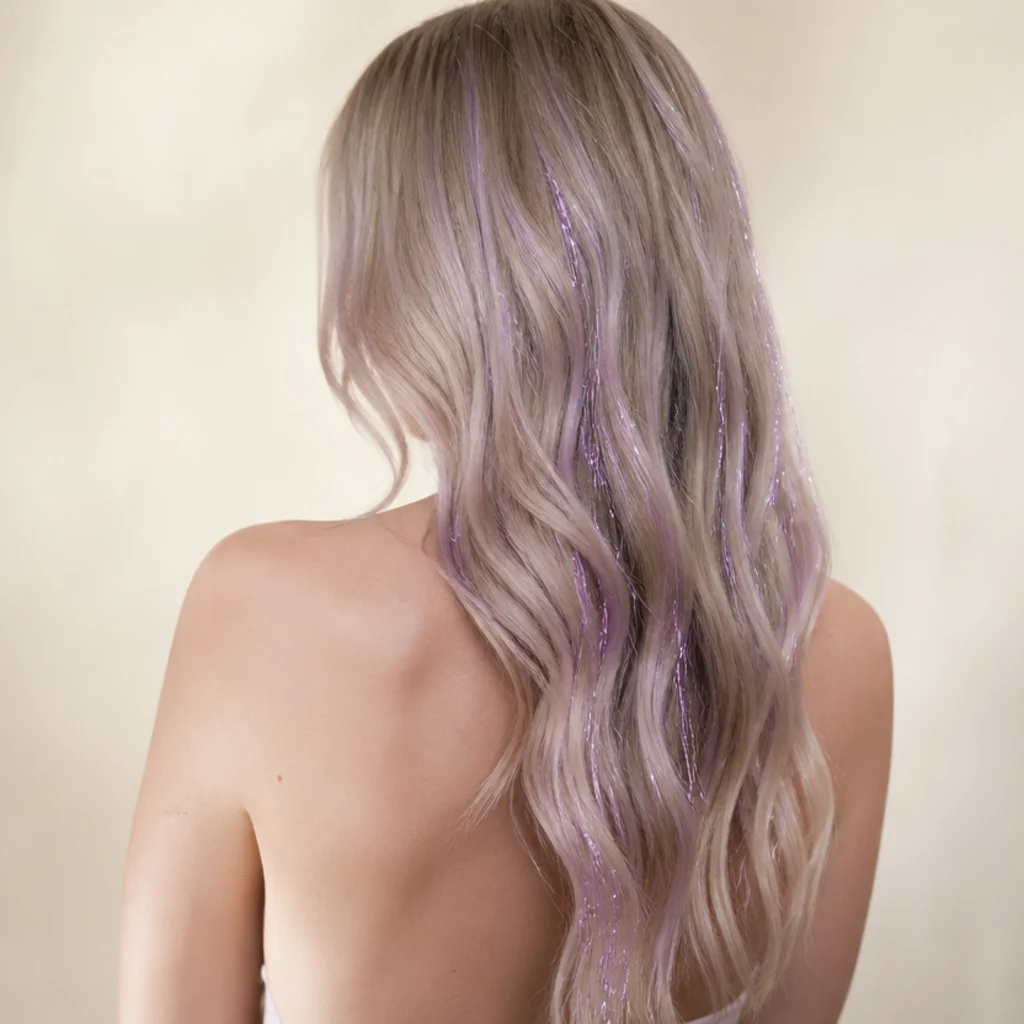
Lavender tinsel on cool blonde gives a soft violet wash that also counters brassiness. The pale purple strand blends into ashy blonde for a dreamy, pastel-toned shimmer that suits cool and fair skin undertones. This is a gentle, low-contrast look with a distinctly modern hair tinsel aesthetic, and it plays especially well on level-9 to level-10 cool blondes and silver-blonde bases. Distribute 18 to 25 strands evenly through the lengths for an all-over lilac glow rather than a concentrated accent. Standard 4-6 week maintenance applies, and the low contrast keeps placement forgiving. Lavender pairs nicely with pearl or silver strands for a cool, multi-tone finish that reads iridescent in motion. It's an easy, romantic option for anyone who loves the pastel-hair look without committing to toner or dye. Pro tip: lavender and violet toning shampoos share a purpose, so this look actually complements a cool-blonde care routine — just keep the toning product off the strands themselves. Ask your stylist for an even, low-density scatter through the mid-lengths.
22Multicolor Rainbow Tinsel
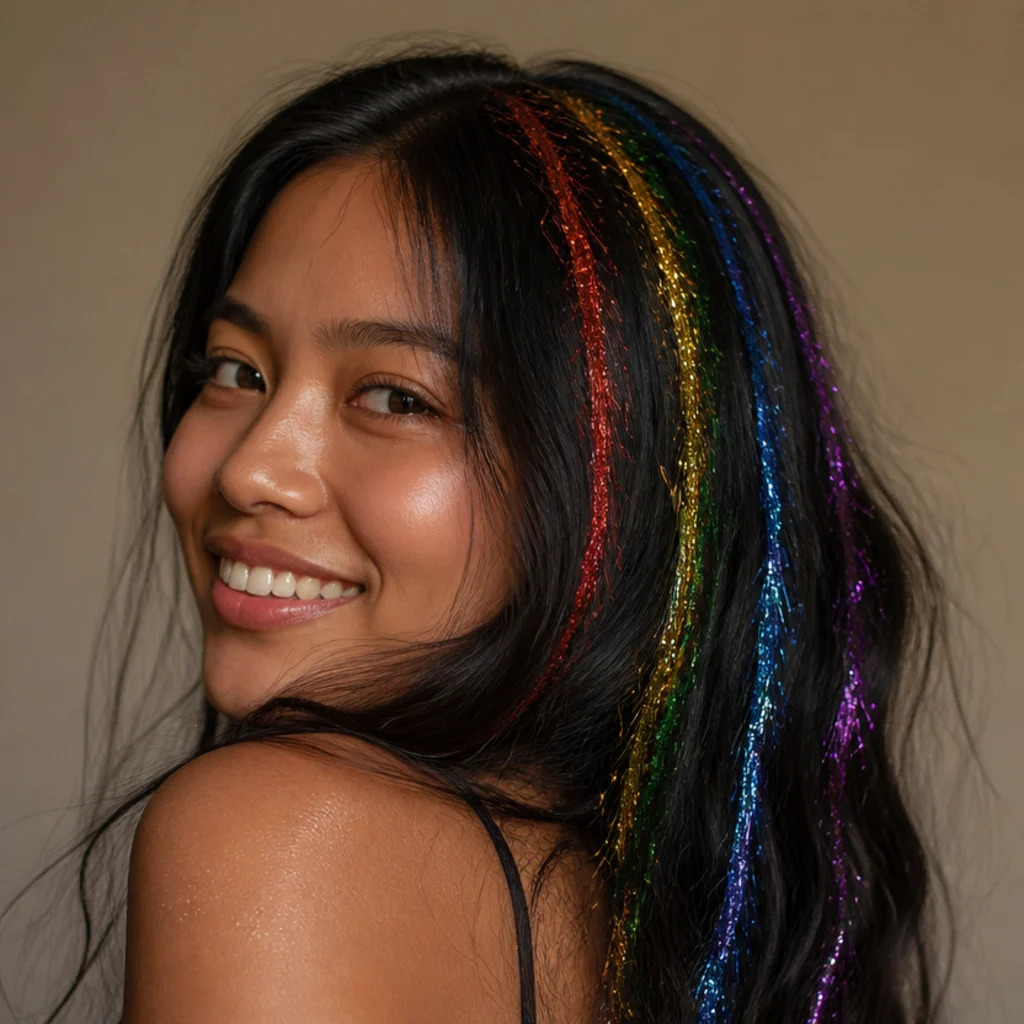
Rainbow tinsel mixes several strand colors through one head for a joyful, festival-ready finish. On a dark base each hue stays distinct and graphic; on lighter hair the colors blend more softly into a watercolor effect. This is the most playful look on the list and a favorite for parties, Pride, and celebrations — it works across every base color. Scatter the colors so no single hue clusters, or arrange them in a deliberate warm-to-cool gradient across the crown for a more editorial result. Standard 4-6 week wear applies. The effect is meant to be busy and bright, so placement is forgiving — a low-stress DIY project. Keep the palette to four or five colors so it reads intentional rather than chaotic; more than that and the individual hues muddy together at a distance. Pro tip: distribute by color temperature as well as position, alternating a warm strand and a cool strand so no zone of the head skews entirely pink or entirely blue. Ask your stylist for a balanced, evenly spaced multi-color scatter rather than color-blocked sections.
23Face-Framing Tinsel Strands
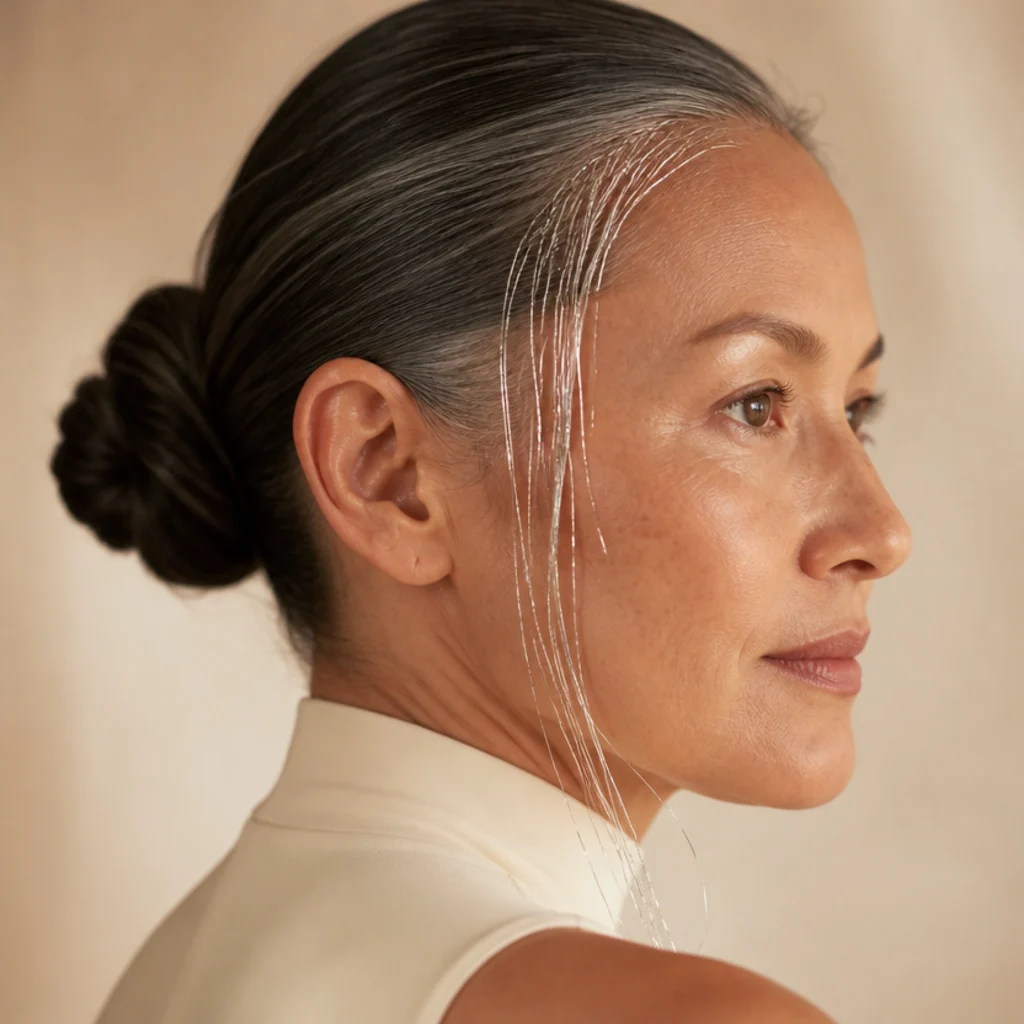
If you want the smallest, most flattering dose of tinsel, place a handful of strands along the front hairline to frame the face. This works on any base color and any strand tone, and it puts the sparkle exactly where it catches light around your cheekbones, jaw, and eyes. It's the easiest entry point to the trend, needing only six to ten strands, and it suits every face shape since you can weight it to balance your proportions: place higher near the temples to lengthen a round face, or lower along the jaw to soften a longer one. Difficulty is low and upkeep is minimal, since fewer strands mean less to maintain over the standard 4-6 weeks. Choose a strand color that contrasts your base for visibility or matches it for subtlety. This is also the most workplace-friendly placement — easy to tuck behind an ear when you want it understated. Pro tip: part your hair the way you actually wear it before placing, so the framing strands fall exactly where your everyday part sends them. Ask your stylist to mirror the count on both sides of your part.
24Tinsel in a Braid
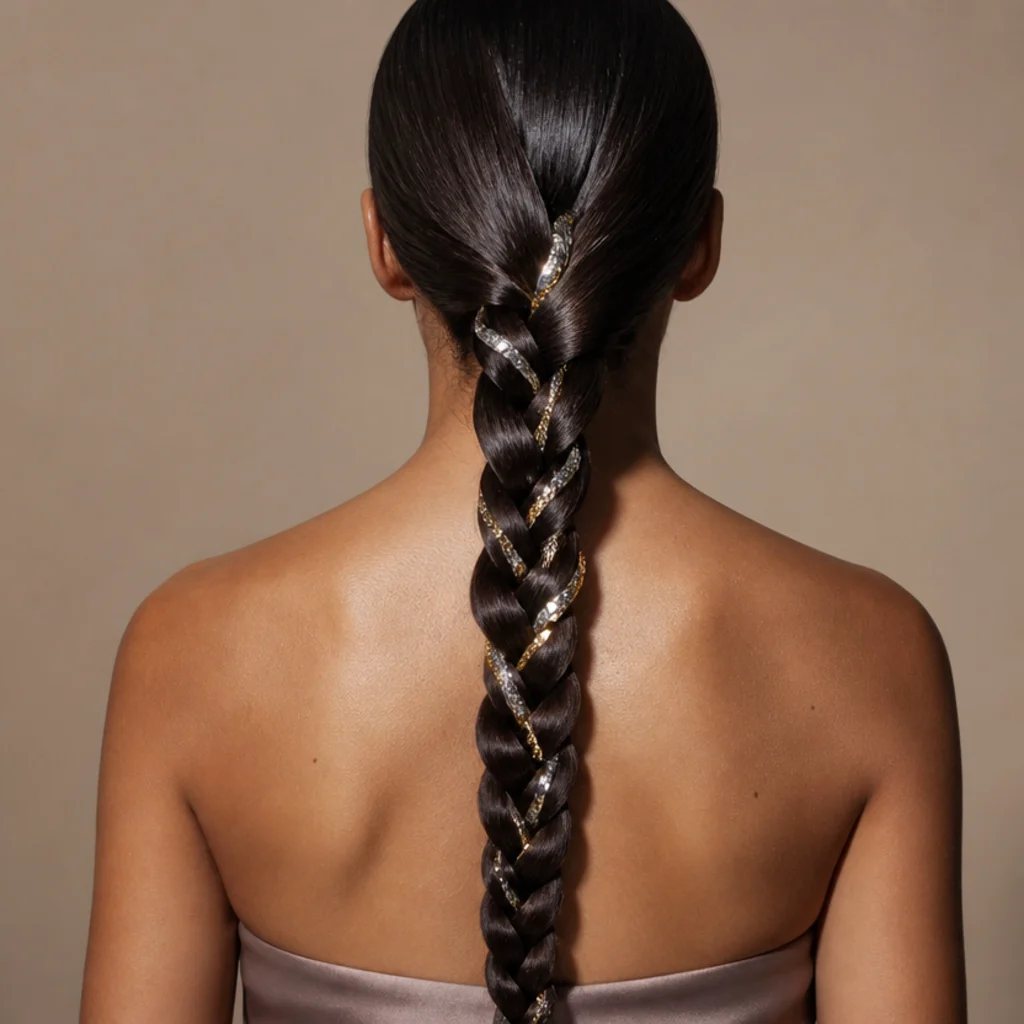
Weaving tinsel into a braid traps the shimmer along a defined line, so the sparkle follows the plait's pattern for a structured, eye-catching effect that reads more intentional than a loose scatter. This works on every hair type and length past the shoulders, and it's especially good for showing off longer hair and thick, dense textures that hold a braid crisply. Attach the strands at the root before you braid, then fold them into the sections as you cross so they run the full length of the braid rather than surfacing in one spot. Any strand color works: silver and gold read classic, while pink or turquoise make the braid pop. Standard 4-6 week wear applies, and braided placement actually protects the strands from tangling, so it can extend how neat the look stays between wash days. Pro tip: a slightly loosened, gently pancaked braid reveals far more tinsel than a tight one, since opening the sections exposes the trapped strands to light. Ask your stylist to seat the strands before braiding so none sit loose at the surface.
25Tinsel in a Slick Ponytail
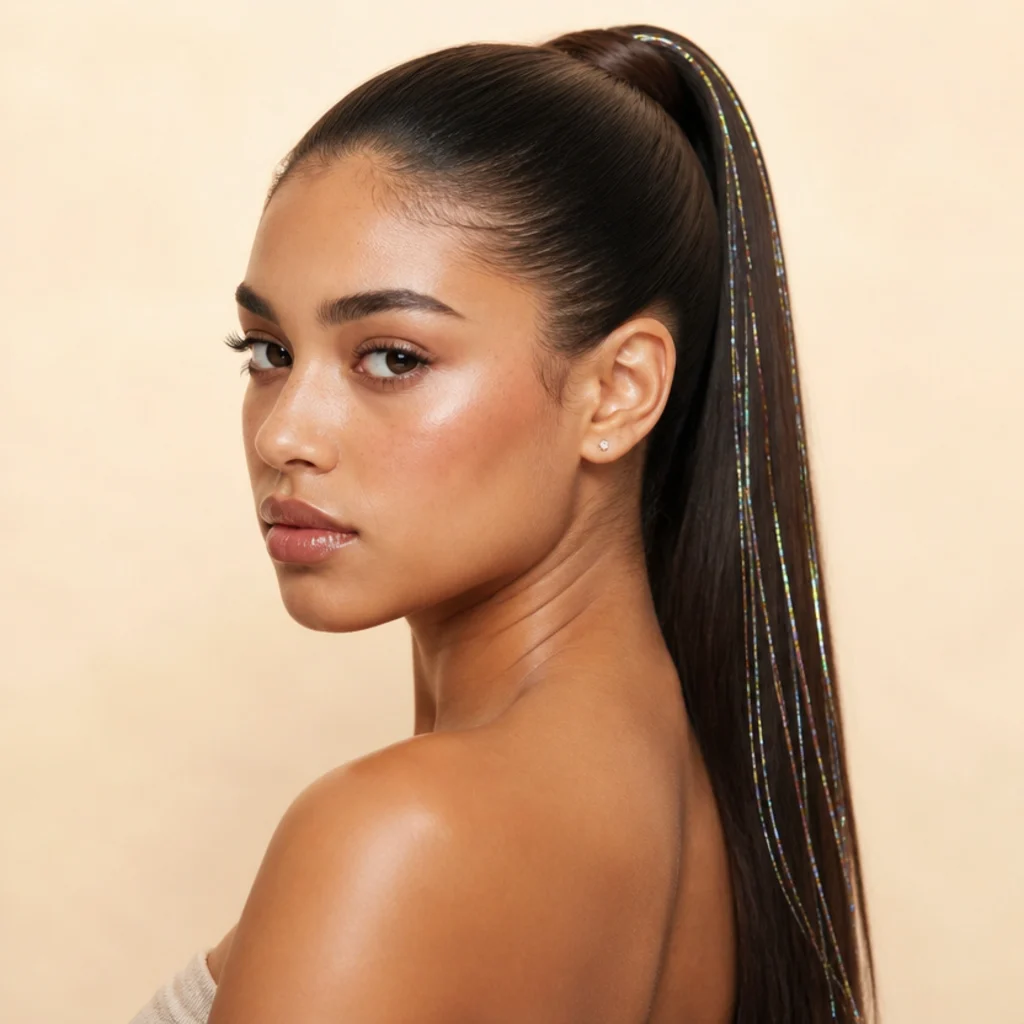
A slick, high ponytail with tinsel is a clean, modern way to show sparkle without loose strands drifting around your face. Gathering the hair concentrates the shimmer into one glossy tail that catches light as it swings, giving a sharp, editorial finish. This suits every base color and works best on medium to long lengths; pick a strand tone that contrasts for drama or matches for polish. Place the tinsel through the length of the tail rather than the slicked-back sections, so the knots stay hidden inside the elastic at the base and nothing shows across the smoothed crown. Standard 4-6 week wear applies. The tight, smoothed style keeps strands aligned, photographs well, and carries from office to evening with minimal fuss. Pro tip: seat the tinsel after you've gathered and secured the ponytail, not before, so brushing the hair up into the elastic doesn't drag on the knots; a drop of styling gel along the tail keeps flyaways from competing with the strands. Ask your stylist to place strands only from the elastic down.
Save this to Pinterest for tinsel styling and placement ideas.
26Tinsel on Curly Textured Updo
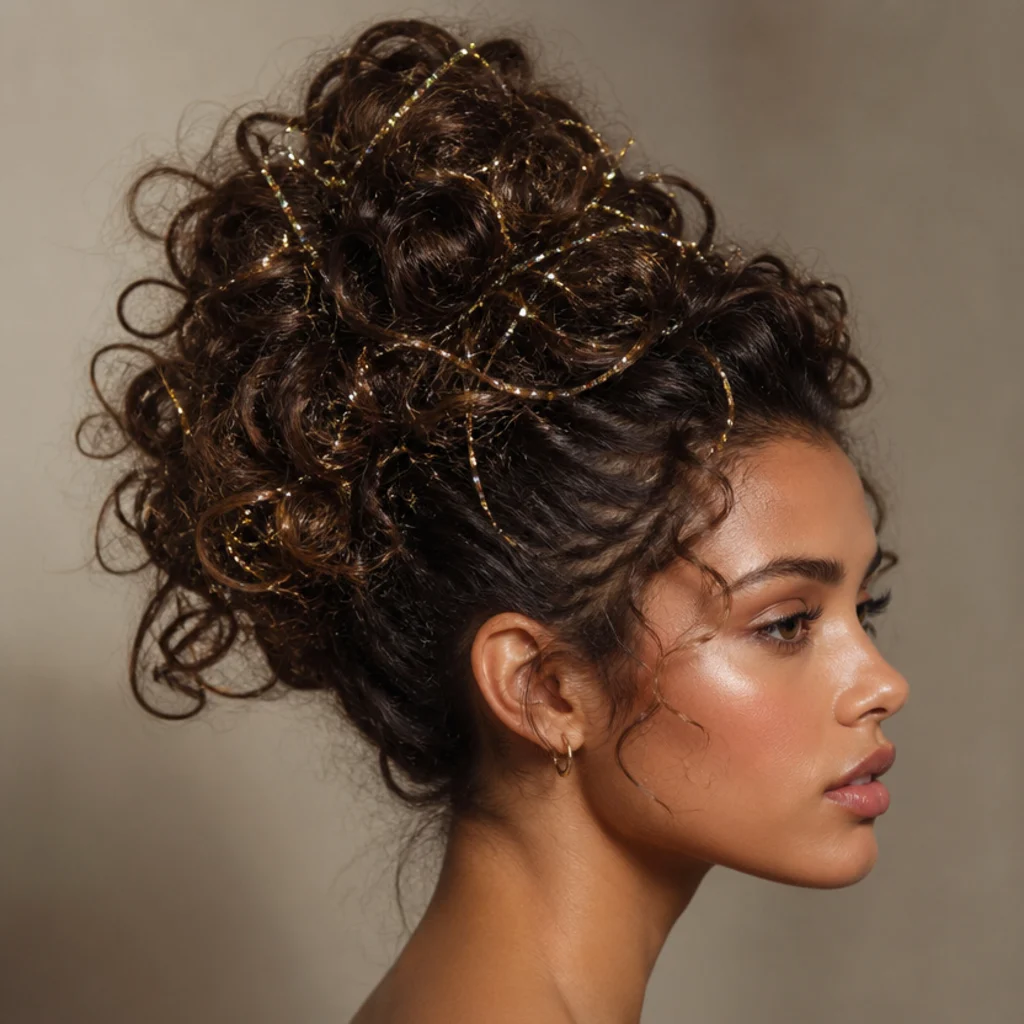
A curly textured updo gives tinsel a natural home, with strands peeking through the volume as the light shifts. The texture is dimensional, so the sparkle appears and disappears across the shape, producing a soft, twinkling effect rather than long visible lines — a good match for curly and coily hair worn up for events. Anchor tie-ins at the root before you pin the updo so the strands sit within the texture rather than on top of it. Curls hide the knots, so placement stays forgiving and 4-6 week wear holds. Choose iridescent or gold strands for warmth against deeper bases, or silver for cool, high-contrast flash. Keep bobby pins and elastics clear of the bonded strands so nothing tugs when you take the style down. Pro tip: place the strands where the updo's peaks and loops sit highest, since those are the surfaces that catch event lighting; buried strands in the interior are wasted. Ask your stylist to work tinsel in during the shaping stage, not after the updo is fully pinned.
27Subtle Scattered Tinsel Canopy
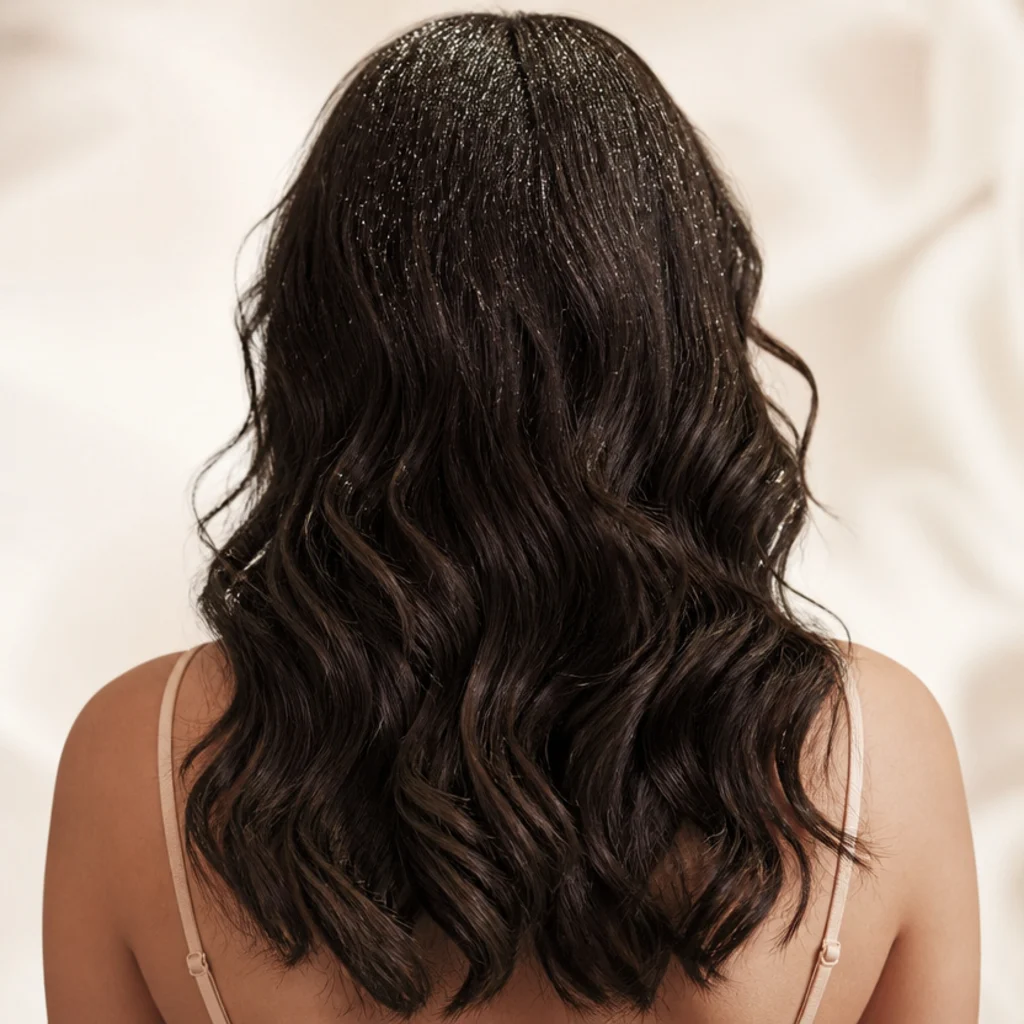
A subtle scattered canopy spreads a light, even distribution of fine tinsel across the crown so the whole head shimmers faintly in motion. Unlike clustered placements, this reads as an all-over glow rather than a defined accent — the most natural, wearable version of the trend. It suits every base, and low density keeps it office-appropriate. Aim for roughly one strand every two to three inches across the top and upper mid-lengths, 15 to 20 strands total, so the effect stays diffused rather than patchy. Standard 4-6 week wear applies, and the light density is quick to apply and maintain. This is the tinsel look most people can wear daily without it reading as costume; the sparkle stays a quiet, expensive-looking detail. Pro tip: place the strands slightly below the very top surface of the crown, so they catch light as your hair moves but don't sit in an obvious flat row along the part. Ask your stylist for a low-density, evenly gridded scatter rather than any concentrated cluster.
28Money-Piece Tinsel
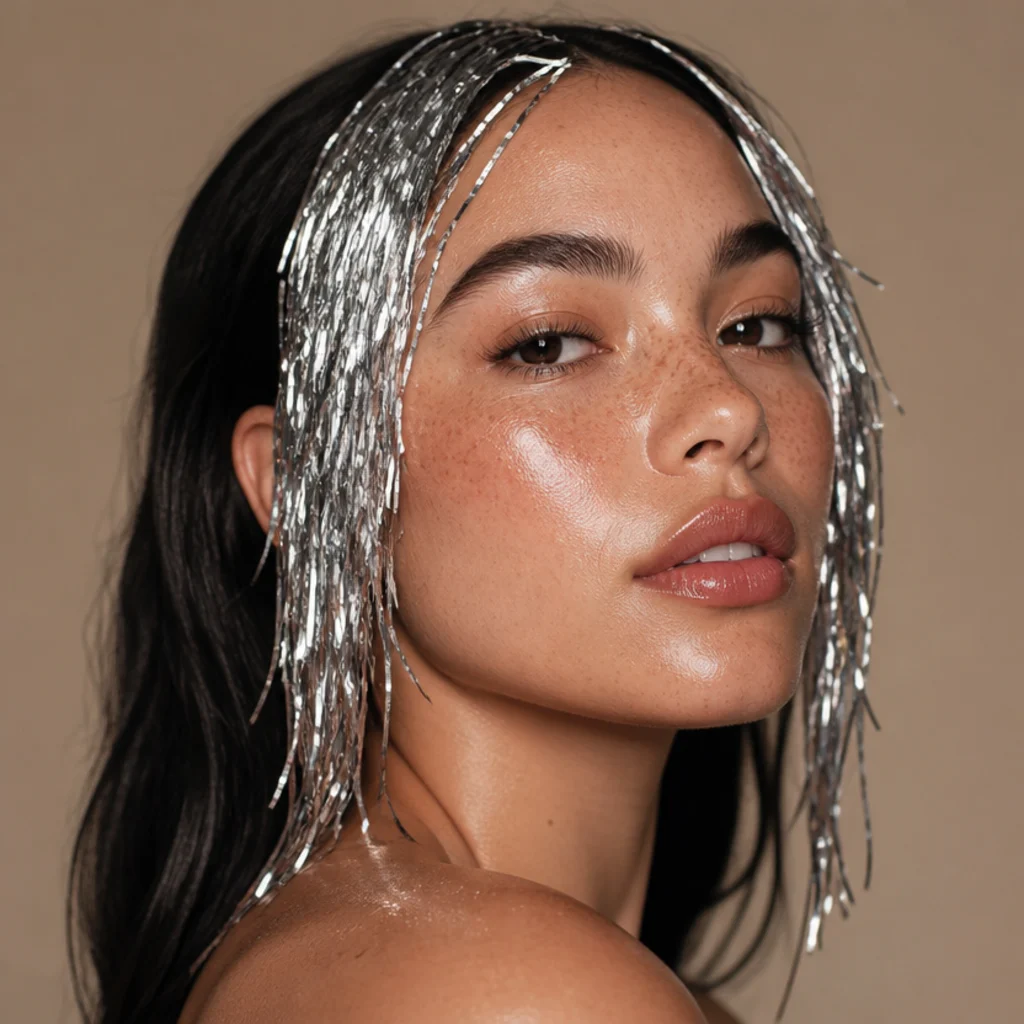
Money-piece tinsel concentrates the strands into two bold clusters that frame the face, echoing the popular money-piece highlight but in sparkle form. This puts maximum shine right around your features, so it flatters the face directly and photographs well in close-ups. It works on any base; high-contrast strand colors like silver on black or hot pink on brown make the frame pop, while tonal choices keep it subtle. Build density with 12 to 18 strands split across the front two sections and keep the rest of the hair clean for contrast, so the eye reads the frame as deliberate. Standard 4-6 week wear applies. The clusters are concentrated and highly visible, so seat the knots evenly to keep both sides mirrored; asymmetry shows far more here than in a scatter. Pro tip: start the cluster a couple of inches below the part rather than right at the hairline, so the strands read as a lit frame around the face rather than a sparkly root line. Ask your stylist for matched strand counts and start-heights on each side.
29Tinsel-Wrapped Space Buns
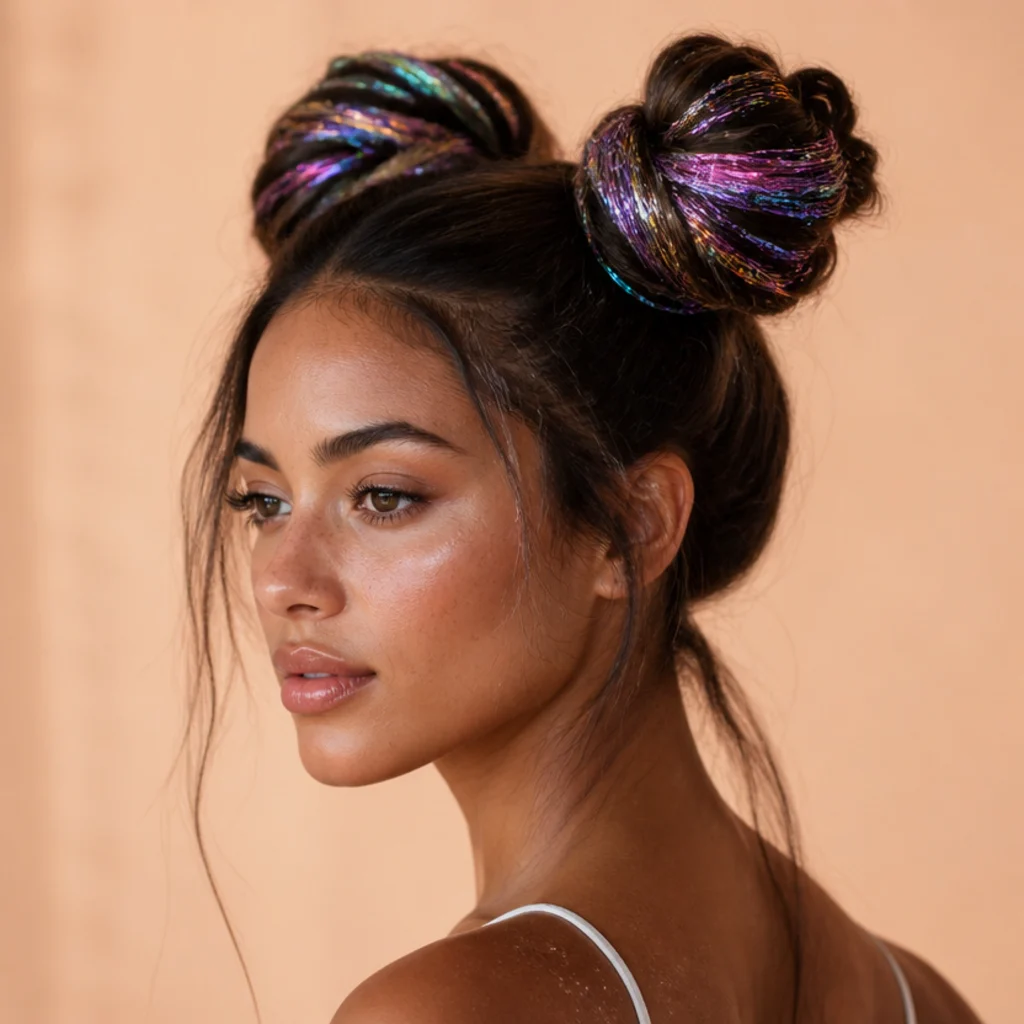
Space buns wrapped with tinsel are a playful, festival-favorite look that concentrates sparkle into two structured shapes. Winding the strands around and through each bun turns them into shimmering highlights, ideal for concerts, parties, and photo-heavy events where you want unmistakable, high-energy color. This suits medium to long hair on any base; bright strand colors amplify the fun, festival mood, while metallics keep it a touch more polished. Secure the tinsel at the root before building the buns, then wrap the loose strands around each finished shape and tuck the ends. Standard 4-6 week wear applies, though this style is often built for a single event and taken down after. The contained buns keep strands from tangling, so it's a tidy way to wear dense, colorful tinsel without daily upkeep. Pro tip: wrap the strands in the same direction you twisted the bun, so they lie flat against the shape and catch light as one surface instead of sticking out. Ask your stylist, or a steady-handed friend, to anchor the base strands before you twist.
30Full-Glam Dense Tinsel
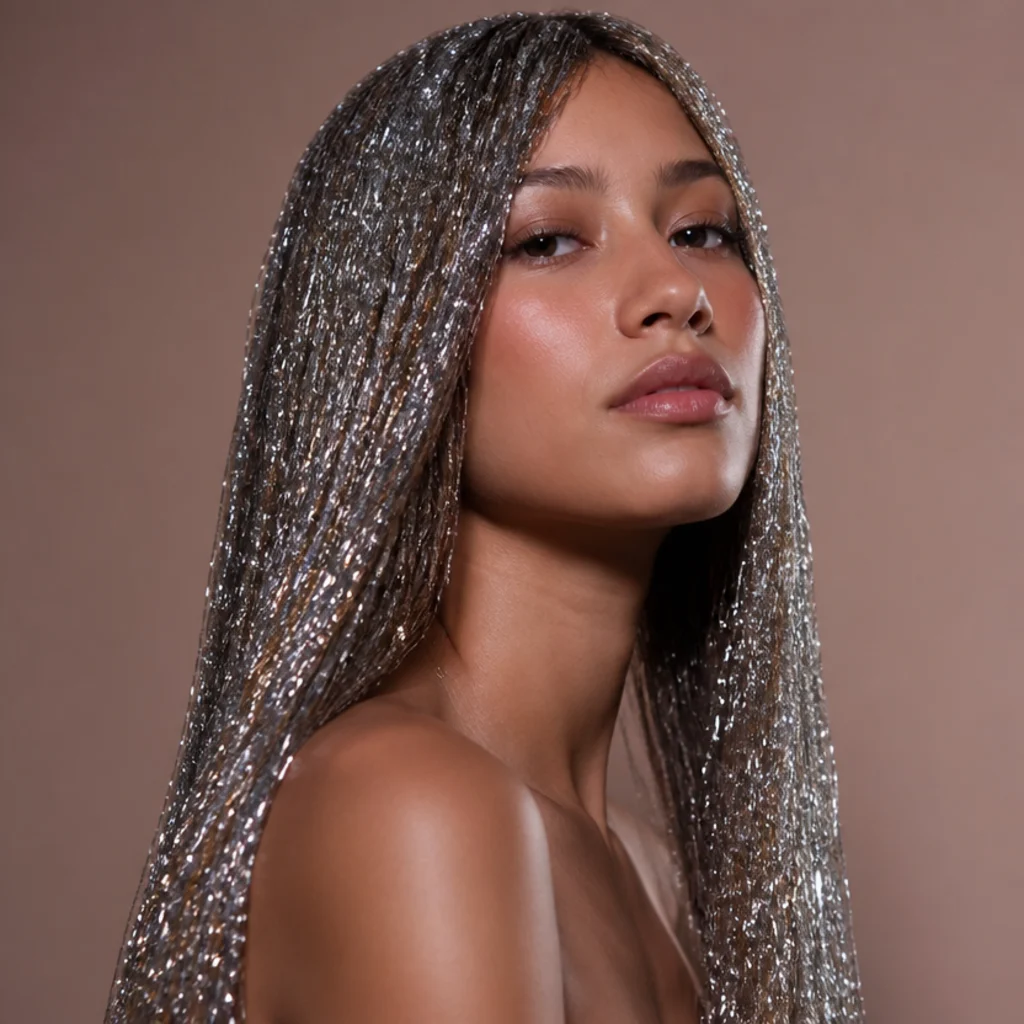
Full-glam dense tinsel goes all in, packing strands generously throughout the hair for maximum, head-turning shine. This is the showpiece version, built for stages, editorial shoots, and bold celebrations rather than everyday wear. It works on every base, though high-contrast strand colors deliver the most dramatic payoff and tonal ones give a subtler wall of shimmer. Plan for 50 to 100-plus strands distributed evenly from crown to ends, so the density reads intentional rather than clumped in zones. You're adding so many strands that this is the most time-intensive look to apply and remove, often an hour or more, so budget accordingly or book a professional who can seat the knots evenly and quickly. Standard 4-6 week tie-in wear applies, but plan gentle washing and low-tension detangling to keep dense placement neat across its whole life. Pro tip: for dense placement, mix two closely related tones (say silver and platinum, or gold and champagne) rather than one — the slight variation stops the mass of strands from looking like a flat, single sheet. Ask your stylist to work in sections and check density in the mirror as they go.
Pro Tips from the Editor
- Match undertone, not color family. A cool silver on warm-black hair or a warm gold under cool indoor light can fight your base. Decide your undertone first, then pick a strand within it (pewter vs. chrome silver, rose gold vs. yellow gold).
- Seat knots flush and double-knot. The single most common reason tinsel looks cheap or falls out early is a loose loop showing at the root. Tie close to the scalp, double the knot, and trim any tail.
- Place with your everyday part. Part and style your hair the way you normally wear it before seating strands, so the sparkle lands where light actually hits your finished look, not a temporary center part.
- Keep heat and heavy product off the film. Direct flat-iron and wand contact warps mylar; silicone shine sprays, thick oils, and dry-shampoo buildup dull it. Style first, place second, and apply product to hair, not strands.
- Stagger strand start-heights. Beginning every strand at the exact same depth creates a visible flat line. Vary where each strand starts along the section so the shimmer reads dimensional in motion.
- Density is a dial, not a switch. Start lighter than you think you want, live with it in daylight and indoor light, then add. Removing strands is fiddlier than adding a few more.
- Remove by sliding, not pulling. At the end of its life, gently unpick or slide each knot down and out rather than yanking it — pulling risks breaking the anchor strand.
How to Choose / Get the Look
Start with two decisions: contrast level and undertone. High-contrast strands, like silver or turquoise on hair tinsel black hair, deliver bold, graphic sparkle, while tone-on-tone choices, such as champagne on ash brown, copper on natural red, or platinum on icy blonde, read as amplified natural shine. Then match undertone within that choice: cool bases and skin take silver, platinum, pearl, and sapphire; warm bases and skin take gold, copper, rose gold, and peach; jewel colors (ruby, emerald, turquoise) work as accents on either when kept moderate. For subtlety, match strand to base and keep density light; for a statement, contrast the strand and cluster it as a money-piece or face-frame.
Next, choose your attachment method, which decides both longevity and cost:
| Method | Wear time | Approx. cost | Difficulty | Best for |
|---|---|---|---|---|
| Tie-in (double-knot) | 4-6 weeks | ~$10-$25 DIY / $1-$3 per strand salon | Low-moderate | Longest, most natural wear; everyday looks |
| Heat-bond (keratin) | Days to ~2 weeks | Kit ~$15-$30 | Moderate | Firmer hold for events; needs a bonding tool |
| Micro-bead / loop | 2-4 weeks | Salon add-on | Moderate | Reusable strands, secure hold, thicker hair |
| Clip-in | Single wear | ~$8-$20 | Very low | Try-before-you-commit, one-night styling |
On how to put tinsel in hair, the tie-in is the most durable and lowest-impact method: loop the strand around a small section at the root and secure it with a double knot so it moves with your hair for four to six weeks and sheds out with growth. Heat-bonded and clip-in versions are faster but shorter-lived. Whichever you pick, keep flat irons and wands off the strands themselves — direct heat can warp or scorch the film.
For curly and coily textures, anchor each strand to a single curl clump at the root so it follows the pattern instead of disrupting definition, and place on stretched or second-day hair. If you want dense or full-glam placement, a professional can seat the knots evenly and halve your time. To ask for it in the chair, bring a photo, name the exact strand tone and finish (metallic, iridescent, or jewel), and specify method, density, and placement, whether face-framing, scattered canopy, money-piece, or a defined braid.
Frequently Asked Questions
How long does hair tinsel last?
Tie-in tinsel, knotted at the root, typically lasts four to six weeks and moves down gradually as your hair grows before shedding out. Heat-bonded strands last days to about two weeks, and clip-in styles are single-wear. Gentle washing, low-tension detangling, and keeping direct heat off the strands all extend how long a look stays neat.
Does hair tinsel damage your hair?
Tie-in tinsel is generally low-impact, since it attaches to a single small section at the root without chemicals, bleach, or heat. The main risk is mechanical tension: pulling, rough detangling, or yanking strands out can stress the anchor hair. Handle knots gently, skip dragging a fine-tooth comb over them, and remove by sliding each knot down and out rather than pulling.
What tinsel color looks best on black hair?
Silver gives the highest contrast and glassiest shine on black hair, while iridescent and turquoise strands add color-shift and jewel drama. For a warmer, softer effect, rose gold and copper suit deep bases without the icy pop of pure silver. On blue-black specifically, sapphire and turquoise blend with the base undertone for a more sophisticated, gemstone-like finish.
How do you put tinsel in hair yourself?
Section a few strands at the root, fold a length of tinsel in half around them, and tie a secure double knot close to the scalp, then trim the tail. Start with six to ten face-framing strands to practice seating the knot flush before attempting a fuller scattered canopy. Stagger the start-heights so the finished effect looks dimensional rather than a flat row.
Can you use heat tools with hair tinsel?
Keep flat irons and curling wands off the tinsel strands directly, since heat warps and can scorch the mylar film. The reliable order is to heat-style your hair first, then place the strands afterward; if you must style around existing tinsel, work carefully and keep the hot plates clear of the strands themselves.
How much does hair tinsel cost?
A DIY tie-in pack of a few hundred strands usually runs about $10 to $25, enough for many applications. In a salon, tinsel is commonly priced around $1 to $3 per strand or as a flat add-on of roughly $40 to $150-plus depending on density and your region. A subtle face-frame costs little; full-glam dense placement is the priciest, both in strands and chair time. Confirm pricing when you book.
Does hair tinsel work on curly or coily hair?
Yes. Curly and coily hair actually hides the knots well and gives a soft, twinkling scatter as coils shift. Anchor each strand to a single curl clump at the root so it follows the pattern, place on stretched or second-day hair, and cleanse gently with your fingers on wash day. Iridescent, gold, and silver all read well; the texture makes placement forgiving.
How many tinsel strands do I need?
For a face-framing accent, six to twelve strands is plenty. A subtle all-over canopy takes roughly 15 to 25, a money-piece 12 to 18 concentrated in front, and full-glam dense placement 50 to 100-plus. Start on the lighter side, assess in both daylight and indoor light, then add, since removing excess strands is more tedious than seating a few more.
Can you wash and swim with hair tinsel in?
You can wash normally with tie-in tinsel; use gentle, sulfate-light products, skip vigorous scrubbing at the roots, and let strands air-dry when possible. Chlorine and salt water won't usually destroy the strands, but they can dull metallic film and loosen knots over time, so rinse with fresh water afterward and save dense, event-focused looks for after your swim.