15 Pink Hair Tinsel Ideas to Try
Pink hair tinsel is the lowest-commitment way to add real dimension and light-play to your hair: no bleach, no color line to grow out, no salon regret. From three whisper-quiet candy strands to a full rose-gold cascade, here are 15 editor-approved placements mapped to your exact texture, length and patience level.
 Edited by Lena Rose · Published July 11, 2026 · 28 min read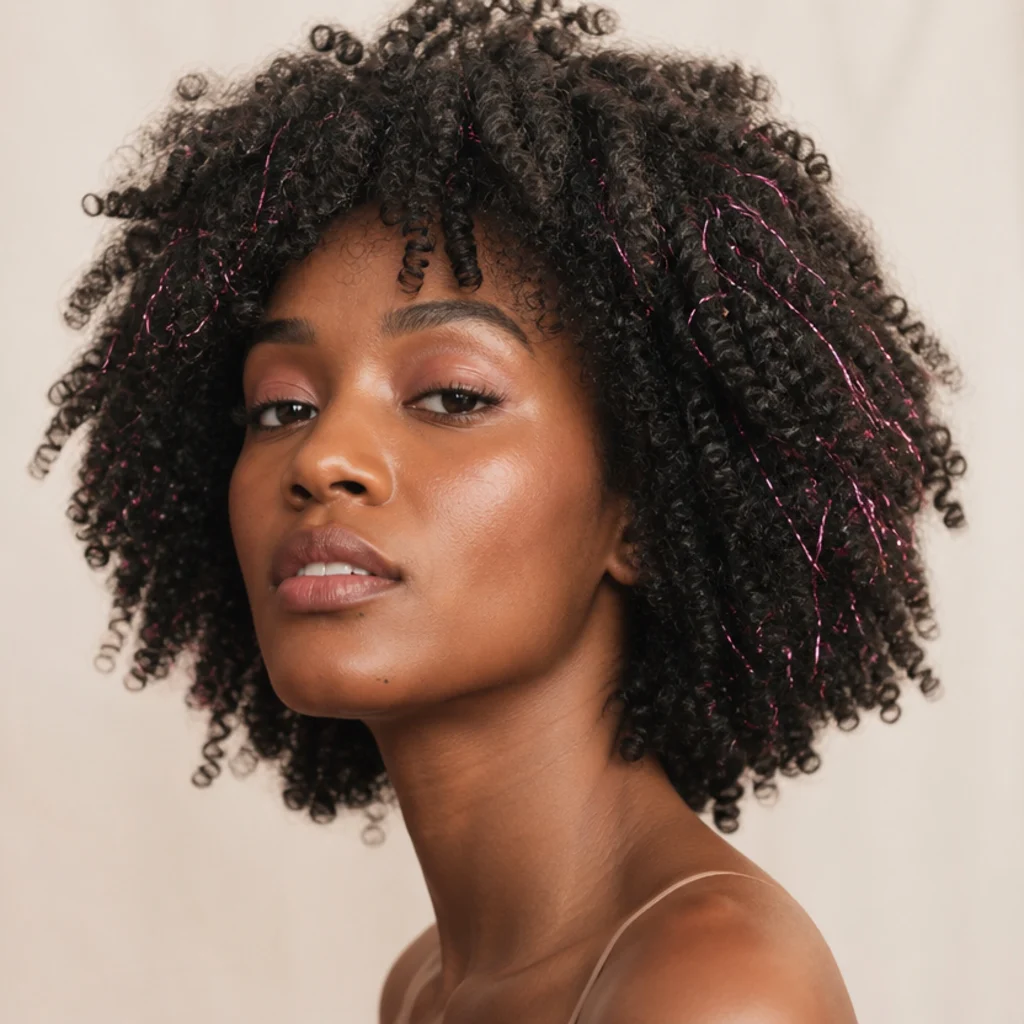
Quick Answer
- Best for: Anyone wanting temporary, dye-free sparkle and color-play across straight, wavy, curly, and coily textures; especially flattering on deep, dark bases where pink filament catches light hardest.
- Who might skip it: Very fine or actively shedding hair (tie-in knots can feel heavy or slip), anyone mid-chemical-treatment, or people who flat-iron daily on high heat, which dulls and melts synthetic strands.
- Maintenance: Low to moderate. Tie-ins live in low-manipulation zones and get brushed around, not through.
- Difficulty: Beginner-friendly for clip-ins; a short learning curve for slip-knot tie-ins; braid-in is best left to a braider.
- Cost: Roughly $6-$20 for a DIY multi-strand tinsel kit; salon add-on service often lands in the $30-$120 range depending on strand count and region.
- Wear time / longevity: Clip-ins are same-day; tie-ins hold 4-8 weeks with the shed cycle; braided-in tinsel lasts as long as the braids.
- Standout variation: Rose-gold tinsel woven through a curly ponytail so it flashes in and out of the coils as they move.
- How to ask your stylist: Bring a saved photo, name the pink (baby, bubblegum, rosy, magenta, rose-gold), state your texture, and say how many weeks it needs to last so they pick tie-in vs braid-in.
In This Guide
- Candy Pink Tie-In Strands on Black Hair
- Rose-Gold Shimmer for Curly Hair
- Baby-Pink Money-Piece Sparkle
- Hot-Pink Tinsel on a Sleek Ponytail
- Pastel Pink Peekaboo Layers
- Bubblegum Tinsel in Box Braids
- Blush Pink Tinsel on Silver Hair
- Magenta Streaks for Coily Afro Texture
- Pink Tinsel in a Half-Up Space Bun
- Rosy Tinsel Along a Deep Side Part
- Cotton-Candy Ombre Tinsel
- Pink Tinsel Threaded Through a Fishtail Braid
- Subtle Pink Tinsel for Short Pixie Hair
- Glitter-Pink Tinsel for Wedding and Festival Looks
- Clip-In Pink Tinsel Extensions for Quick Wear
Hair tinsel, sometimes sold as fairy hair or tinsel extensions, is a hair-thin filament of reflective polyester or heat-resistant mylar that gets knotted, braided, or clipped in for temporary shimmer. Pink is the shade that keeps the effect sweet and wearable rather than heavy-metal or holiday-tree. It answers two different briefs at once: the color-cautious person quietly testing whether they like a pop before committing to dye, and the maximalist who just wants more light bouncing off their hair at an event. The reason hair tinsel on black hair looks so striking comes down to contrast and specular highlight. Pink filament reflects light in a hard, bright pinpoint against deep strands, so it practically glows, while on silver, gray or blonde it diffuses into a soft opalescent wash. Texture changes the read, too: straight hair shows tinsel as clean vertical lines, curls scatter it like glitter, and coils reveal and hide it with every movement. Across the 15 ideas below you'll find placement, shade, strand count, and upkeep notes for every texture and length, plus a real how-to so you can match a look to your patience level and your calendar.
01Candy Pink Tie-In Strands on Black Hair
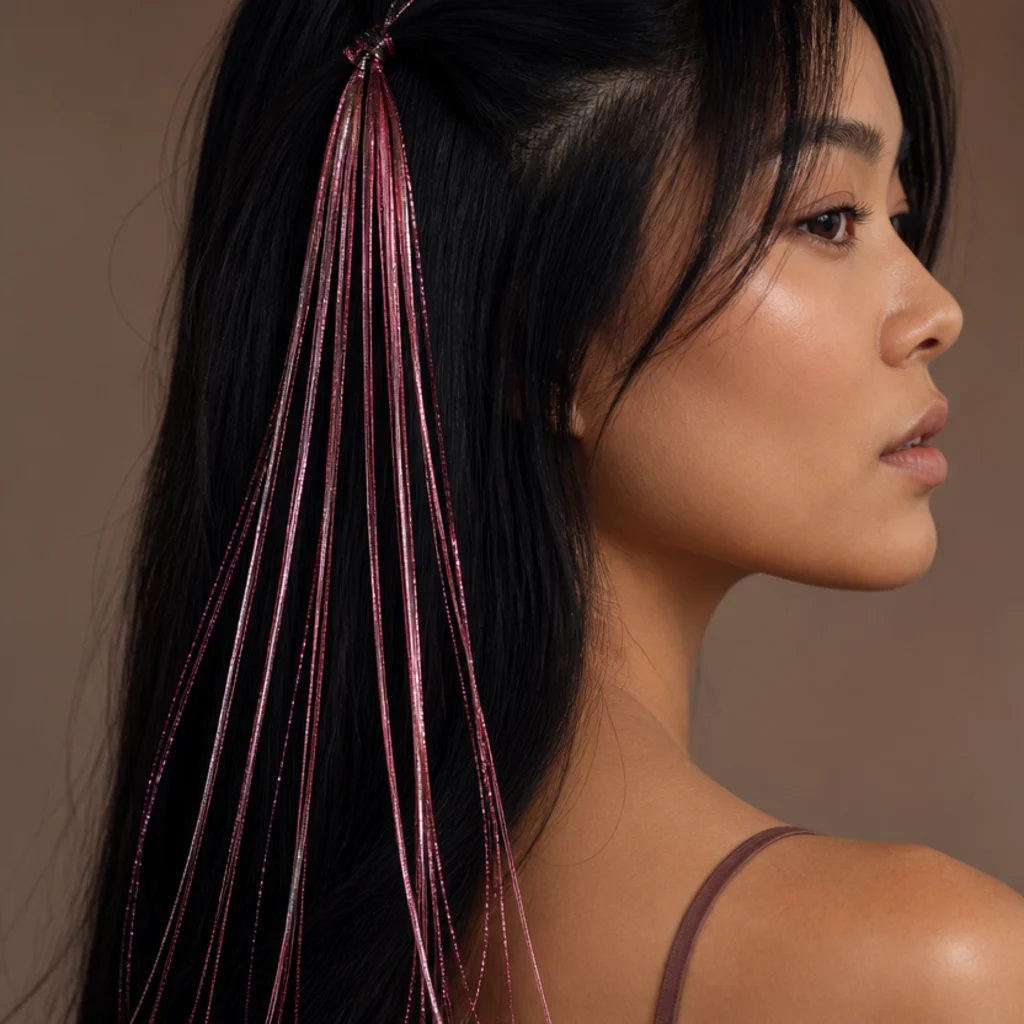
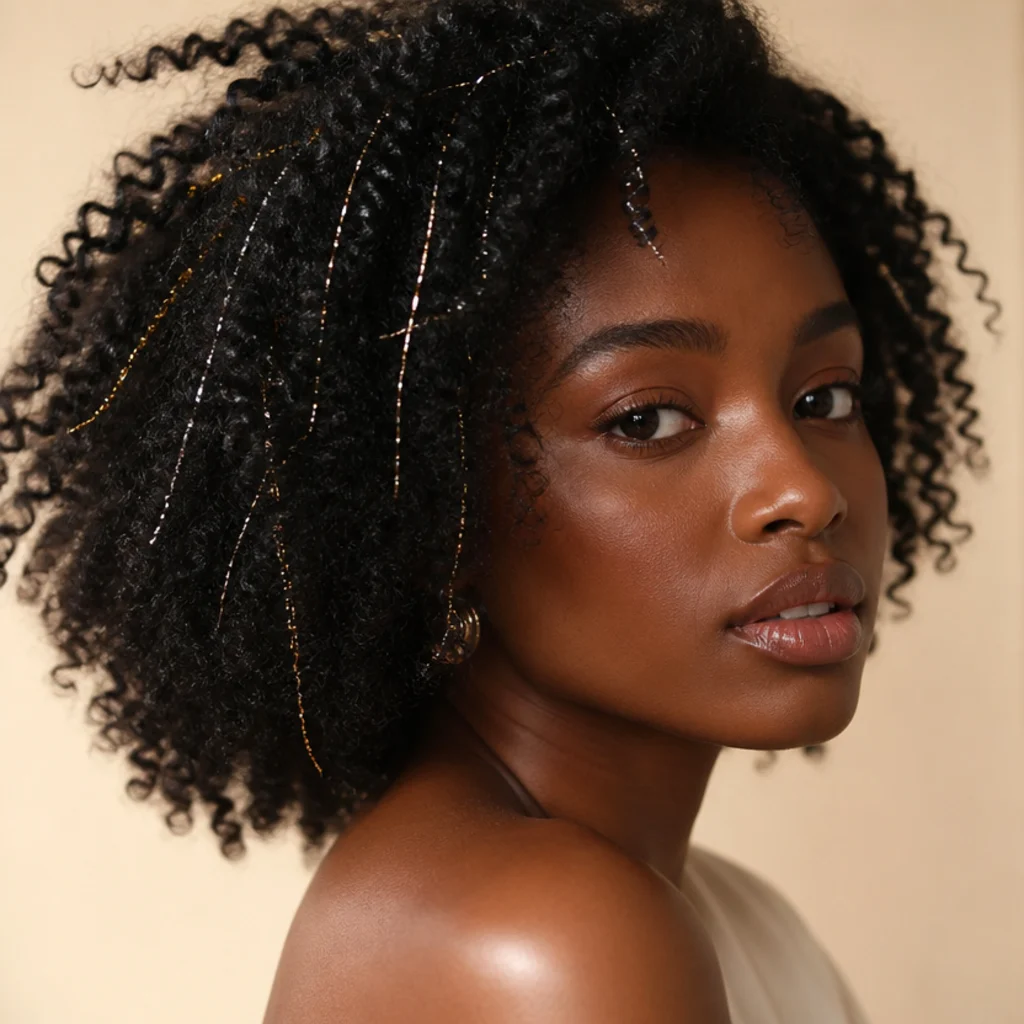
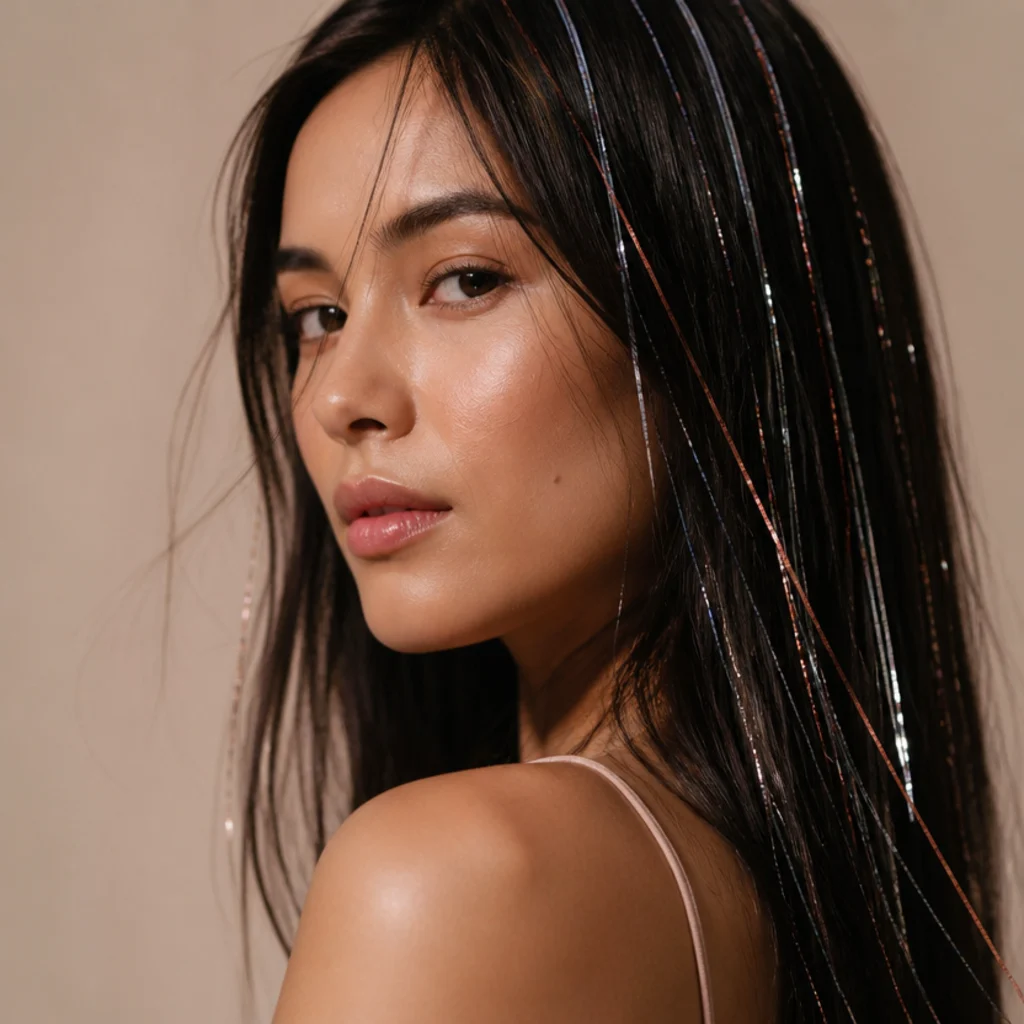
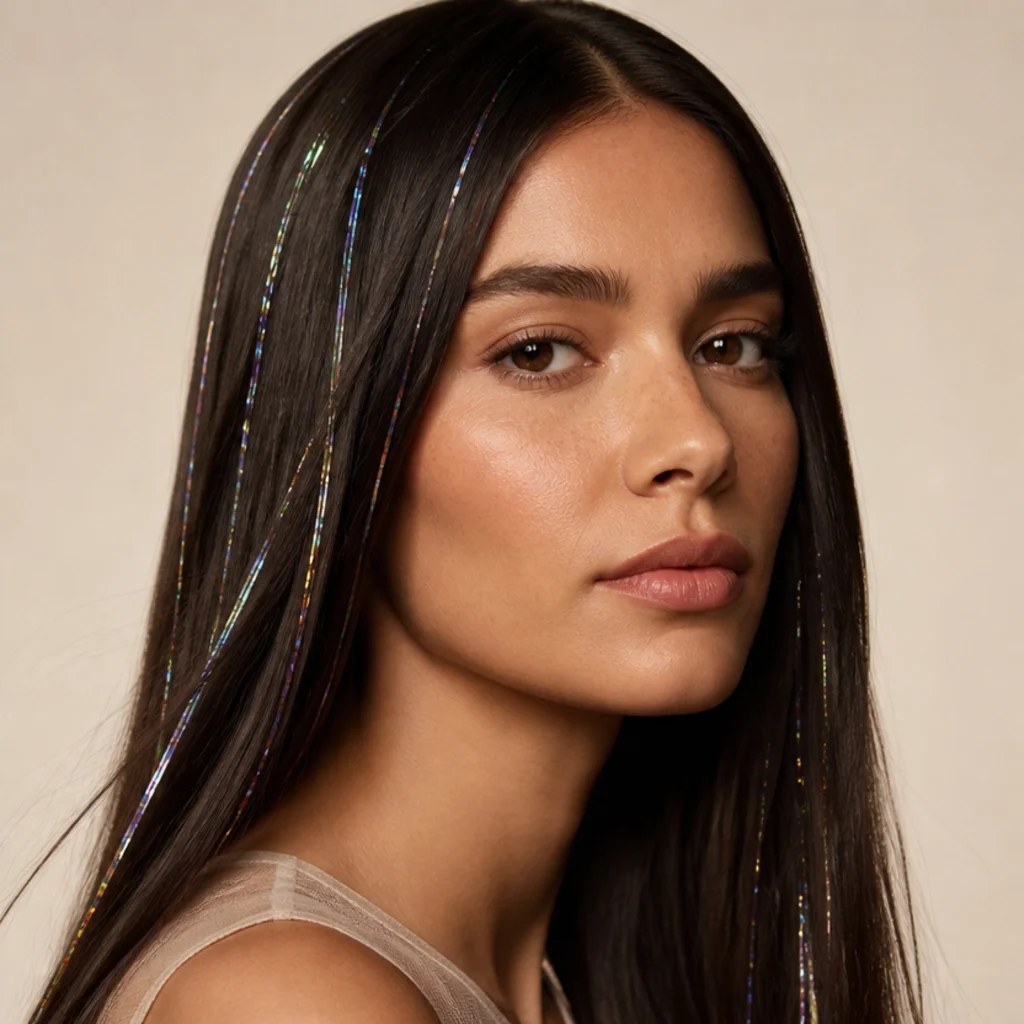
Tie-in strands are the classic entry point, and cool-leaning candy pink against a true blue-black base gives the highest specular payoff of any combination here. The method: isolate a few strands of your own hair near the root, fold a filament in half over them, and secure a slip knot within a centimeter of the scalp so it hangs the full length and moves with your natural shed cycle. Keep the count low, 10 to 20 strands, for a daylight sparkle that still reads editor-polished at a desk rather than costume. Concentrate placement along the crown and the two inches on either side of your part, where the head naturally catches overhead light. Suitability is broad, but this shines on straight to loosely-wavy hair where the strand hangs uninterrupted; on very fine hair, drop the count so the knots don't telegraph. Expect a realistic four-to-eight-week life as knots migrate down with growth. Place them in a zig-zag rather than a straight row so regrowth spacing stays invisible, and if you shampoo more than three times a week, ask your stylist for a double slip-knot.
02Rose-Gold Shimmer for Curly Hair
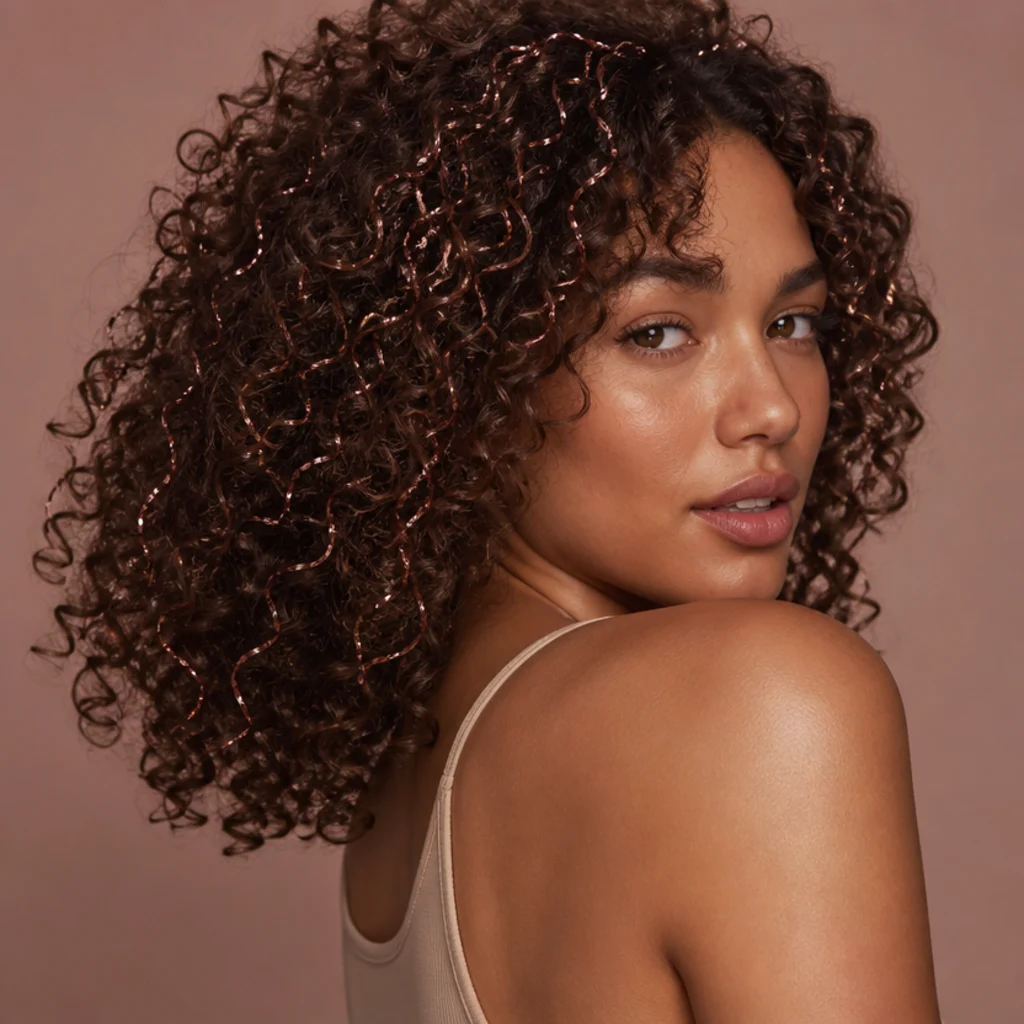
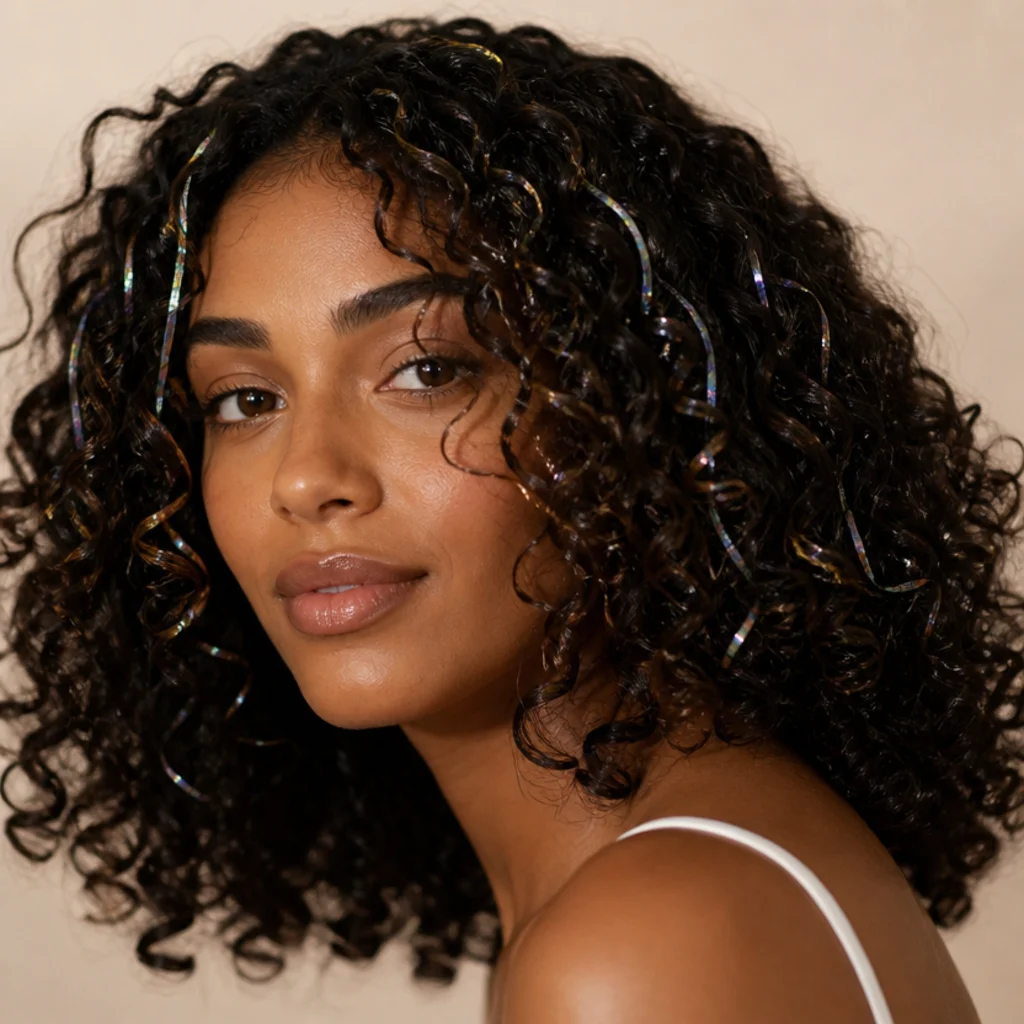
Curly hair tinsel behaves nothing like the straight-hair version. The filament follows the spring of the curl, peeking in and out instead of hanging in a clean line, so the effect reads as scattered glitter caught mid-movement. Rose-gold is the most forgiving pink for curls because its warm, muted, slightly metallic tone sits comfortably beside brown, auburn, and chestnut, without the jarring line a cool bubblegum would draw. Tie strands at the root inside a defined curl clump and let them spiral out naturally — don't comb them in, since that fractures your curl pattern and frizzes the section. Because the coils constantly hide and reveal the tinsel, you can run a higher count, 25 to 40 strands, on 2C-through-3C textures without it looking crowded. Maintenance follows your wash-day rhythm: refresh curl cream and gel around the filaments with your fingers rather than raking through them, or they'll tangle into the knot. Plan on four to six weeks before slippage, realistically. Dilute your leave-in and apply it with a spray bottle so product never coats the reflective surface, and ask your stylist to place strands on the canopy layer where curls catch the most light.
03Baby-Pink Money-Piece Sparkle
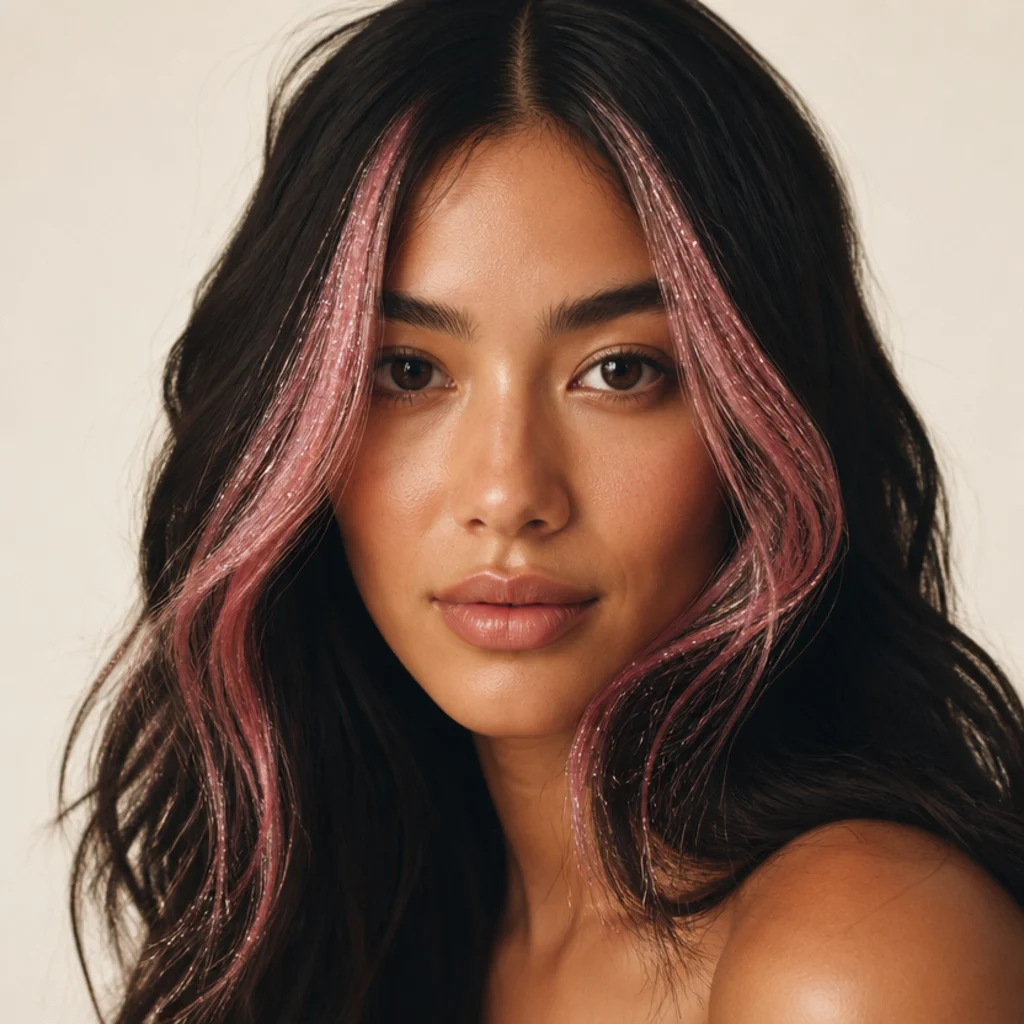
Borrow the money-piece logic from color trends and concentrate soft baby-pink tinsel in the two face-framing sections at the front of your part. Those strands sit exactly where light lands during conversation and selfies, so you get maximum sparkle from a small filament count, often just 8 to 12 per side. This placement flatters nearly every face shape and is especially good for round and heart shapes, where the vertical face-framing lines add a subtle lengthening effect. Baby pink stays gentle enough for daytime and cool-to-neutral skin undertones, reading as a lit-from-within highlight rather than a statement stripe. The practical bonus: it tucks behind an ear in one motion when you want it invisible for a meeting. Longevity matches standard tie-ins at four to eight weeks, though front strands take more brushing friction, so a firmer knot helps. Tie these a little deeper from the hairline, about half an inch back, so the knots never peek at your part on windy days, and if your base is very dark, ask your stylist for a warm-leaning baby pink so it doesn't read grayish.
04Hot-Pink Tinsel on a Sleek Ponytail
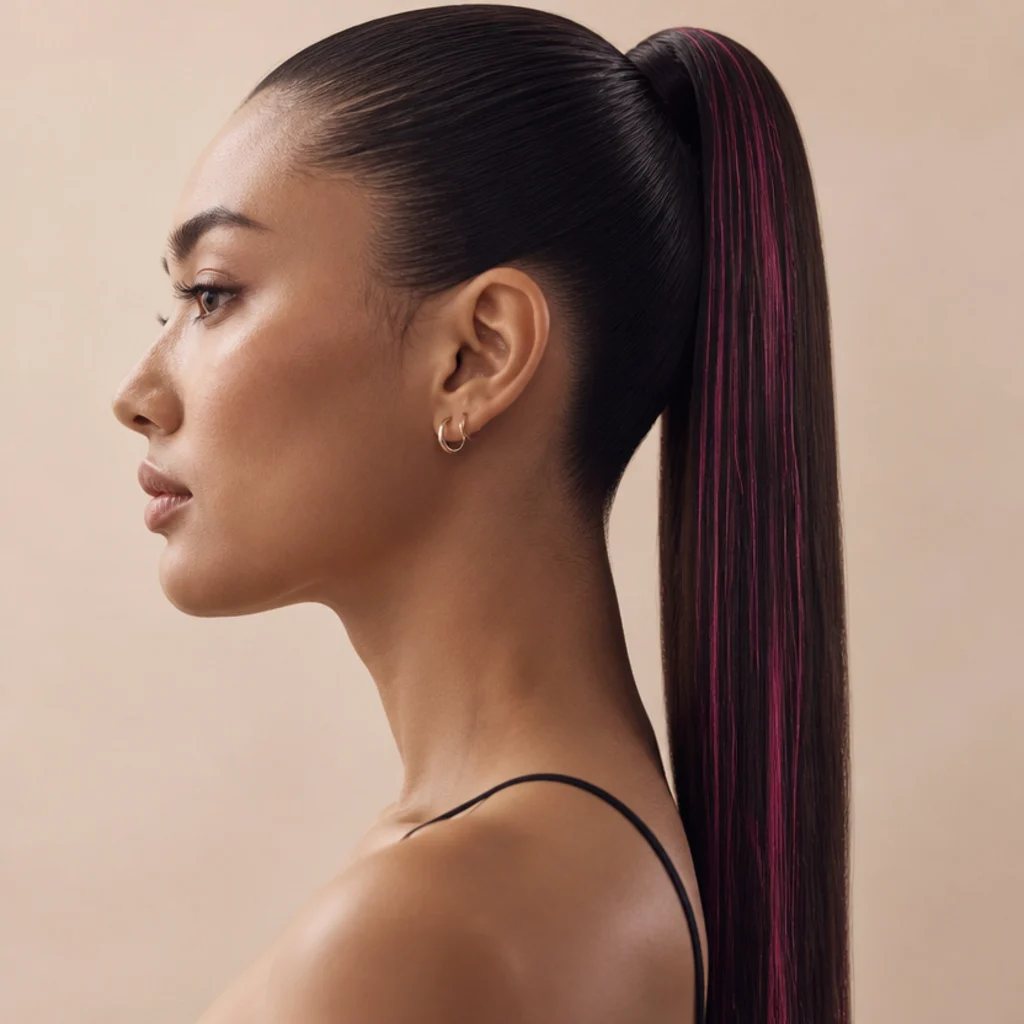
A gelled, glass-smooth ponytail is the cleanest possible canvas, and saturated hot-pink tinsel streaming down the tail turns a simple style into a graphic statement. Because the hair is pulled taut, every filament reads as an uninterrupted vertical line, so you need remarkably few strands, 15 to 20, for full impact. Sequence matters: tie the tinsel into the gathered sections before you slick and secure the pony, so the knots disappear inside the base rather than bristling at the hairline. This is the placement that dominates the hair tinsel aesthetic boards — high shine, bold color, clean geometry. Hot pink carries the most visual energy of the pinks and photographs vividly under daylight and flash against a dark base, though it can veer costume in volume, so restraint reads more expensive. The ponytail itself does the work for longevity: fresh tie-ins underneath will still last weeks between styles. Smooth flyaways with a soft boar-bristle brush and a pea of oil, working around the knots so you never snag them loose, and ask your stylist to set the knots an inch below the elastic so they stay hidden even in a high, tight pony.
05Pastel Pink Peekaboo Layers
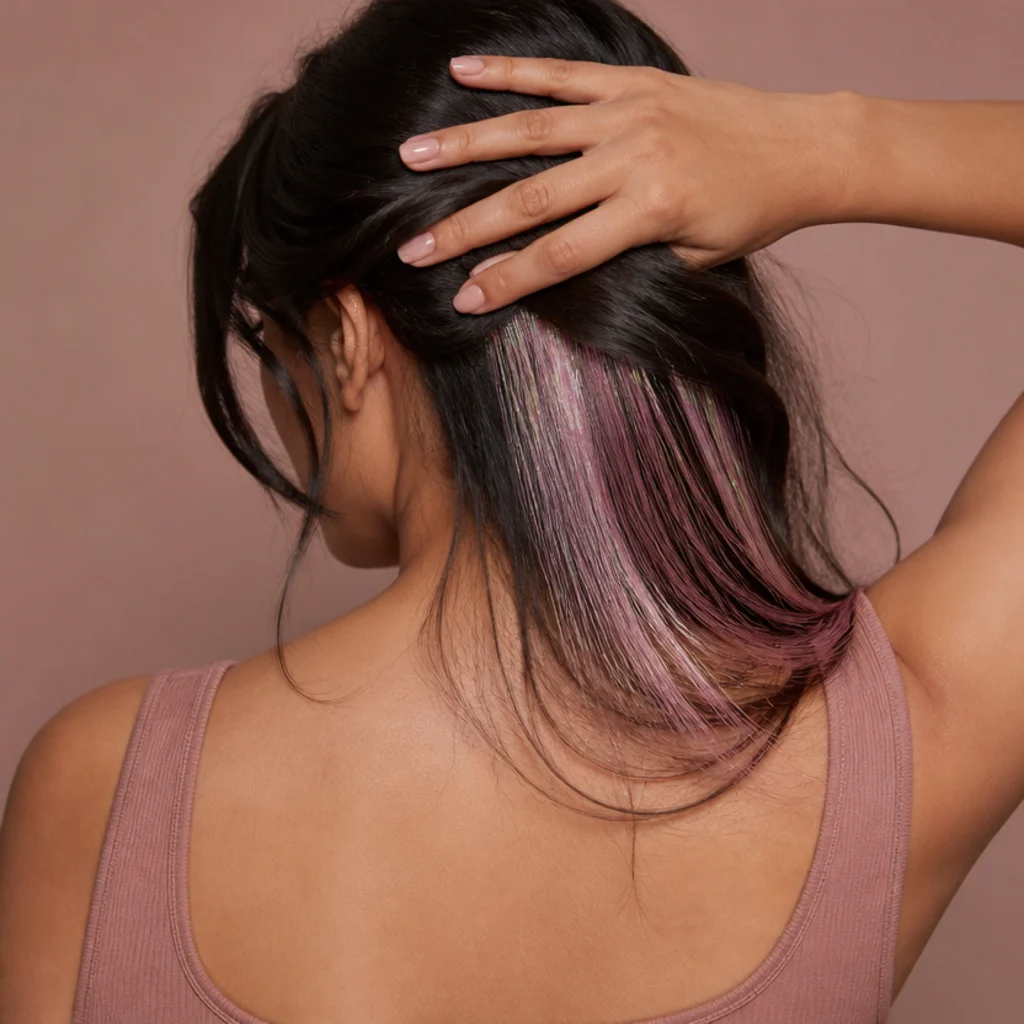
Peekaboo placement hides pastel-pink tinsel in your under-layers so it only flashes when you move, flip, lift, or wear your hair half-up — the stealth option for a strict dress code that still lets you carry a secret. Because the filaments live beneath the top canopy, they're shielded from daily brushing and UV, which buys you the longest wear of any tie-in placement here, often past the eight-week mark. Technique: take a clean horizontal parting from ear to ear, clip the top away, tie the tinsel along the lower nape and occipital sections, then drop the canopy back down to conceal it completely. Pastel pink keeps the reveal soft and romantic rather than loud, and it suits every skin tone because it's glimpsed rather than displayed. This works on any texture and any length past the shoulders. Add a few extra strands at the very nape, the spot that shows most in an updo or when hair gets tossed over one shoulder, and ask your stylist to concentrate the tinsel in the mid-lengths rather than the ends, so it flashes as a band of light instead of sparse tips.
Save this to Pinterest to remember the peekaboo placement trick.
06Bubblegum Tinsel in Box Braids
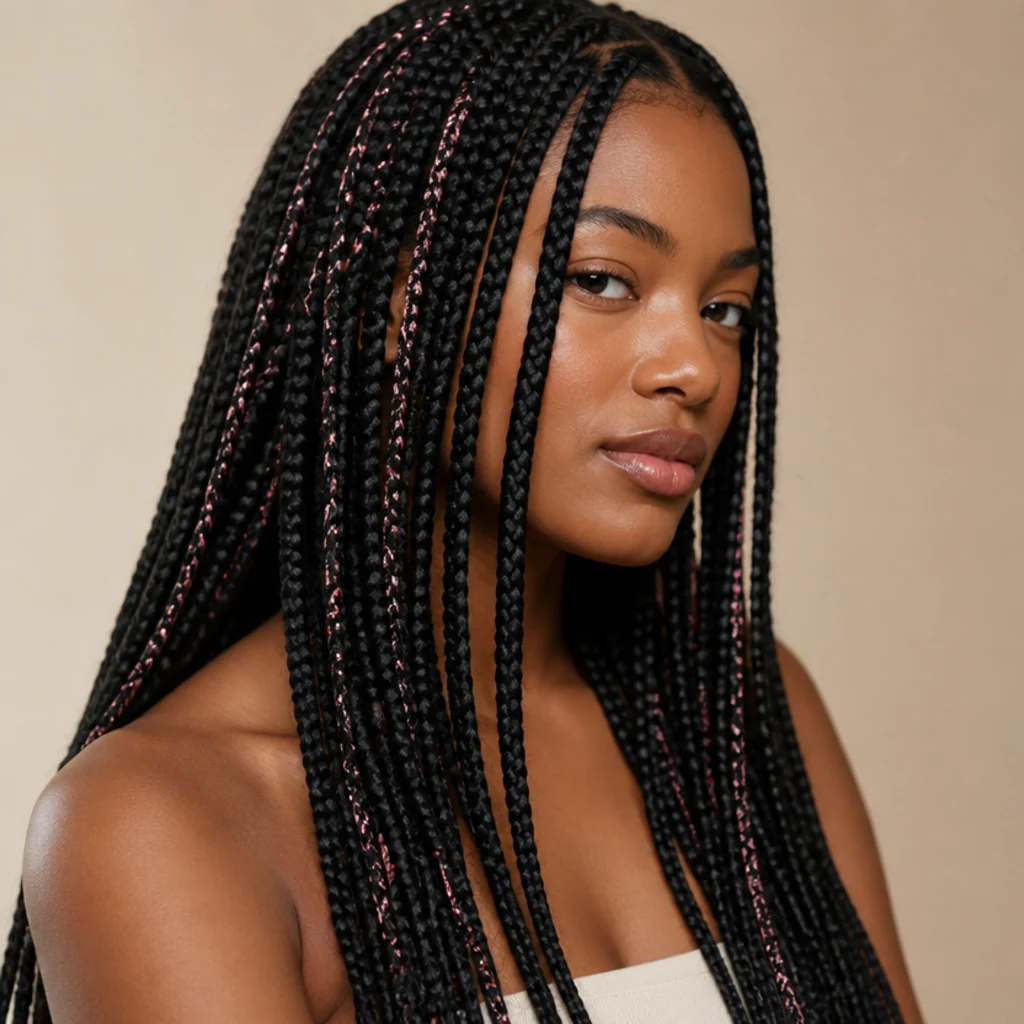
Braids and tinsel are a durable pairing: bubblegum-pink filament braided directly into the plait, rather than knotted on, locks in and moves as one with the braid for the full life of the style. Because it's woven from the root, it survives washing, swimming, dancing, and weeks of wear far better than any tie-in, which makes it the go-to for festivals, cruises, and vacations. Distribution is the styling lever: scatter tinsel through 8 to 15 braids for a balanced all-over shimmer, or load a single front section for a deliberate color-blocked panel. Bubblegum's cool, candy brightness holds its own against dense black hair, where a muted pink would vanish, for standout high-contrast shine. The one caveat is removal — it comes out only when the braids do, so commit to the shade at install. Mix two strand thicknesses in the same braid, a fine and a wider mylar, so the light catches at two different scales, and ask your braider to feed the tinsel in as they plait each braid rather than laying it on top afterward, so it sits flush and doesn't slip to the ends.
07Blush Pink Tinsel on Silver Hair

On silver or natural gray hair, blush-pink tinsel trades hard contrast for a soft, luminous wash, picking up the cool tones in the silver for an almost opalescent rose-quartz effect. It's a dye-free way to add warmth and a gentle pop of color for anyone growing out or embracing their gray, and it flatters cool and neutral skin undertones especially well. Because the contrast is low by design, you can run a higher strand count here, 30 to 50 distributed across the crown and lengths, to build an all-over glow that still reads elegant rather than sparse. Placement wants to be even and diffuse, not concentrated, so scatter rather than cluster. One care note matters most: keep purple and blue toning shampoos off the tinsel itself, since those pigments can film onto the reflective surface and dull or discolor the pink over a few washes. Longevity tracks standard tie-ins at four to eight weeks. Rinse toning products with your head tipped back so the lather never sits on the strands, and ask your stylist for a neutral-to-cool blush rather than a warm one so it harmonizes with silver instead of reading yellow.
08Magenta Streaks for Coily Afro Texture
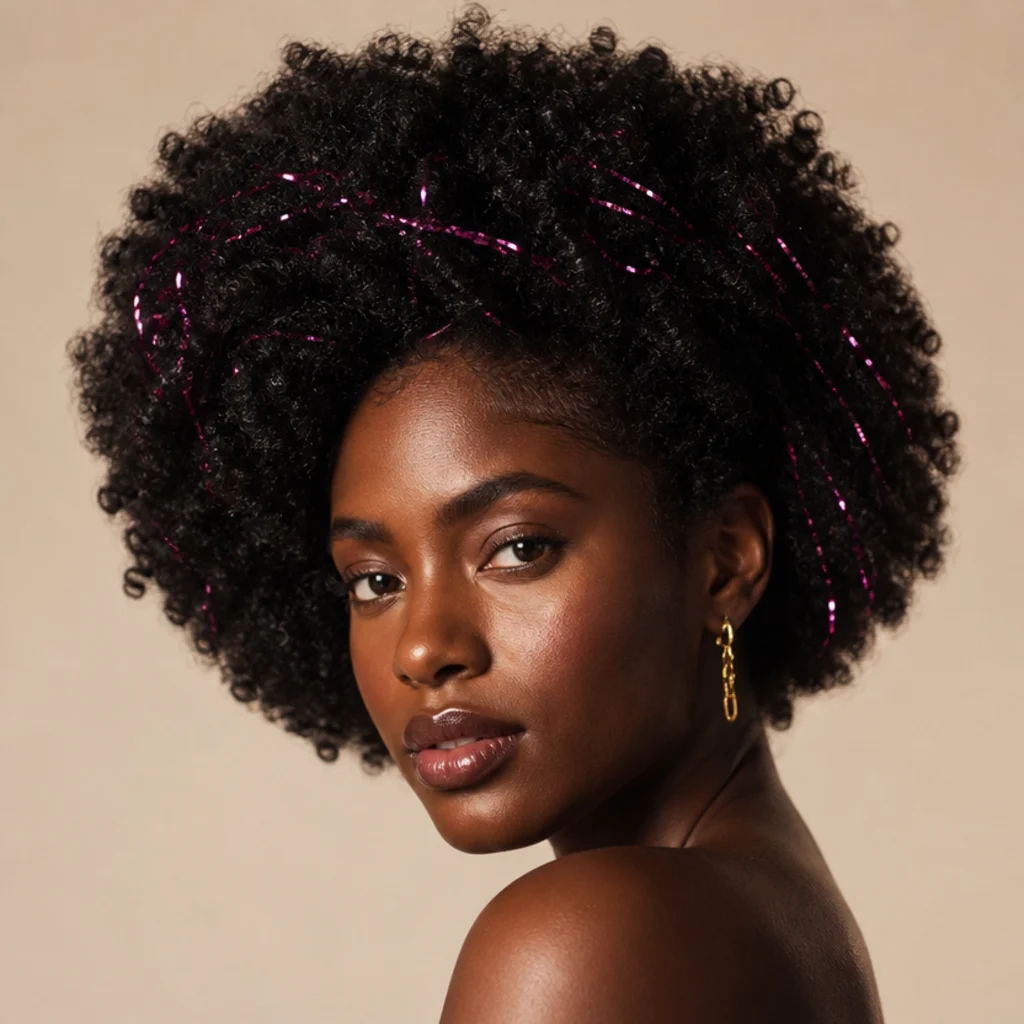
On a full, rounded afro, deep magenta tinsel reads as bright streaks scattered across the surface, catching light wherever the coils sit highest. Saturation is the whole game on 4A-through-4C texture: a pale or dusty pink disappears into dense, dark, light-absorbing coils, while true magenta has the pigment depth to register. Tie strands at the root throughout the crown and the sides, where the silhouette is most visible and most photographed. Because coily hair has so much surface area and constant movement, the tinsel appears and vanishes as the shape shifts, producing a dynamic, glittering effect no straight texture can replicate. Handle it like you handle the hair: fluff and shape with a pick around the strands, never raked straight through them, or you'll loosen the knots and disturb the pattern. Realistic wear is four to six weeks given how much manipulation an afro gets. It's one of the boldest ways to wear hair tinsel on black hair. Cluster a few strands slightly denser at the crown so the light hits the highest point first, and ask your stylist to knot on stretched, not shrunken, hair so the strand hangs at the length you expect once the coil springs back.
09Pink Tinsel in a Half-Up Space Bun
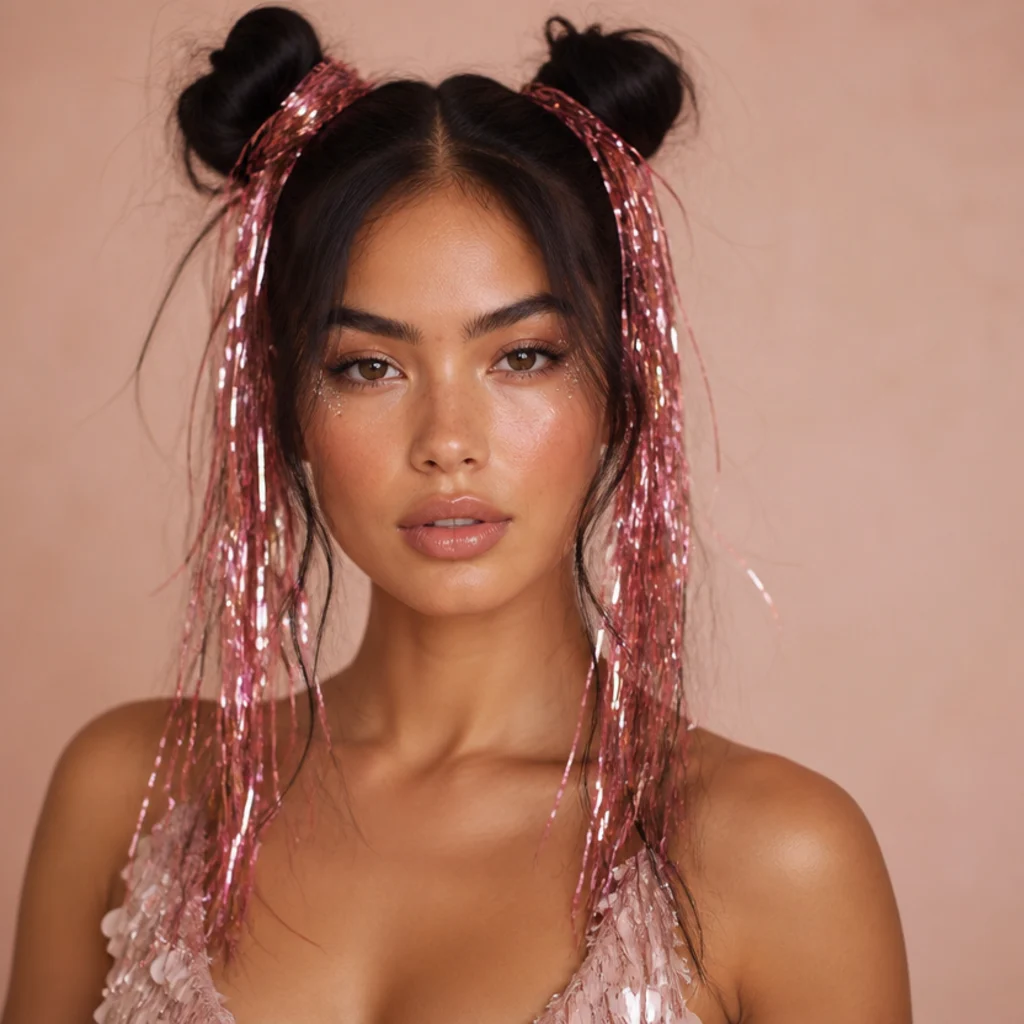
Space buns are playful by design, and pink tinsel streaming from each one adds to the fun for almost no extra effort. Tie or clip the tinsel into the two top sections before you twist them up, so the strands cascade cleanly from the base of each bun rather than getting buried in the coil. This is a festival and concert staple because it photographs well head-on and in profile, and because the high gather leaves the tinsel hanging free and fully visible. Play with dimension by running two pink shades, say bubblegum on one bun and rose-gold on the other, for a subtle asymmetry that reads intentional. The style suits medium to long hair best; shorter lengths can do mini half-buns with a few strands each and get the same energy on a smaller scale. Since this is a style-day look, clip-ins are the smart, no-commitment route. Mist the loose tinsel tails with a whisper of flexible-hold spray from a distance so they stay put through a set without stiffening, and ask your stylist or a festival-hair booth to anchor the clip base at the underside of each bun so it stays completely hidden.
10Rosy Tinsel Along a Deep Side Part
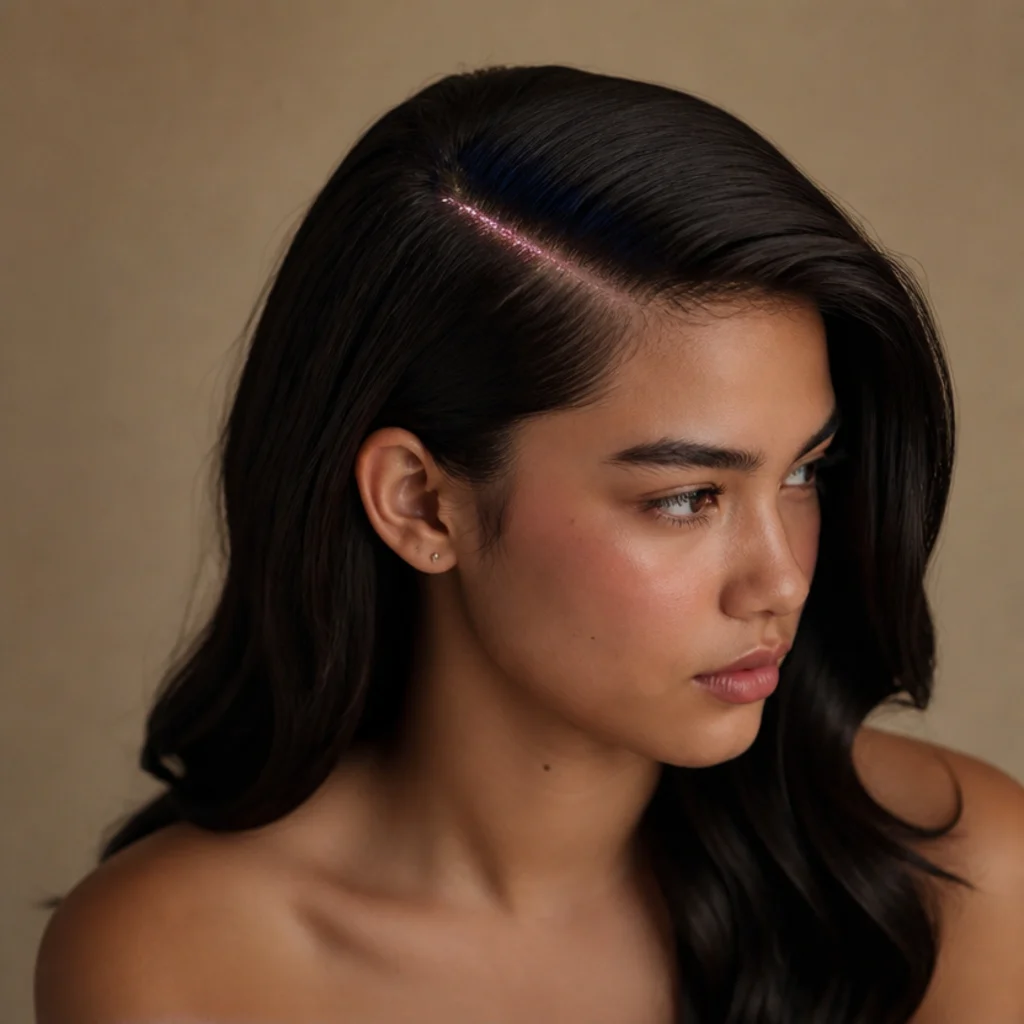
A deep side part draws a strong diagonal line across the head, and rosy-pink tinsel laid right along that seam turns it into a glowing edge. Because the eye already travels the part, concentrating tinsel there produces a deliberate, styled effect from relatively few strands — 12 to 18 does it. This performs best on straight, blown-out, or silk-pressed hair, where the part stays crisp and the line reads clean. Rosy pink is a true mid-tone, warm enough to flatter a wide span of skin undertones and polished enough to carry through a work event or dinner. Tie the strands close to the parted roots so they lie flat and sweep in the same direction as the hair rather than sticking up. Longevity is standard tie-in territory, four to eight weeks, though a heavily-manipulated part may loosen sooner. Finish with a light shine spray across the surrounding hair so the tinsel dissolves into an overall gleam instead of reading as a separate stripe. Switch the part to the opposite side for a day when you want to rest the knotted roots and hide regrowth, and ask your stylist to follow the natural fall of your part rather than forcing a deeper one, so the tinsel line looks effortless.
Save this to Pinterest to try the side-part sparkle placement.
11Cotton-Candy Ombre Tinsel
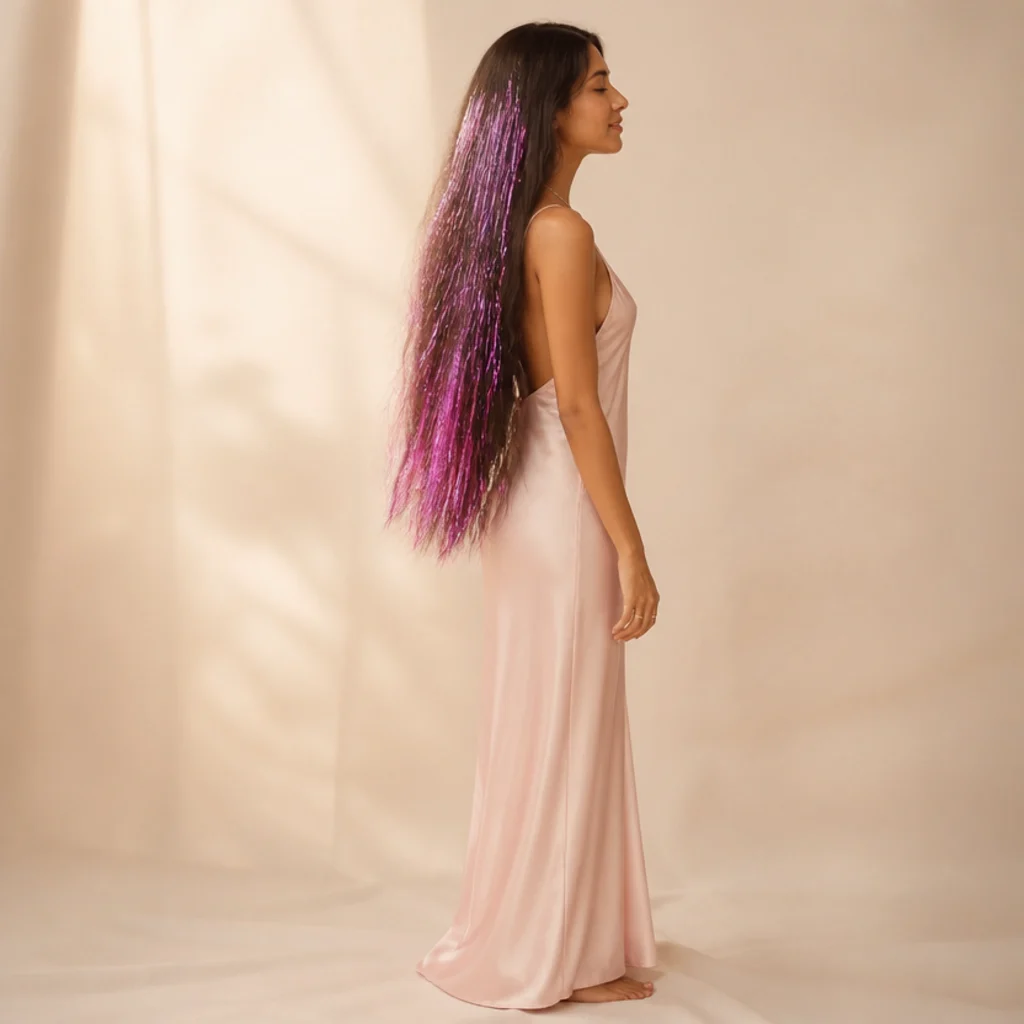
For a gradient effect, layer two or three pink shades from light at the roots to deep at the ends, mimicking a cotton-candy ombre entirely with filament instead of dye. Map it in three zones: pale blush near the crown, a mid rose through the mid-lengths, and magenta or hot pink concentrated at the tips, so the eye reads a smooth color melt. You're stacking tones instead of lightening the hair, so the whole ombre is fully temporary and disappears the moment the tinsel comes out — no grow-out, no brass. On long, dark hair the transition reads soft and dreamy, squarely on the hair tinsel aesthetic that trends on Pinterest. Be realistic about scope: this one wants 40-plus strands and careful vertical mapping, so it earns its place as an event, editorial, or photoshoot look rather than a Tuesday. Wear time is standard, but the visual only holds while every zone stays intact, so plan it close to the occasion. Keep the darkest strands slightly denser at the very ends so the gradient looks weighted and deliberate, the way a painted ombre would, and ask your stylist to plan the color map and strand density per zone before a single knot goes in.
12Pink Tinsel Threaded Through a Fishtail Braid
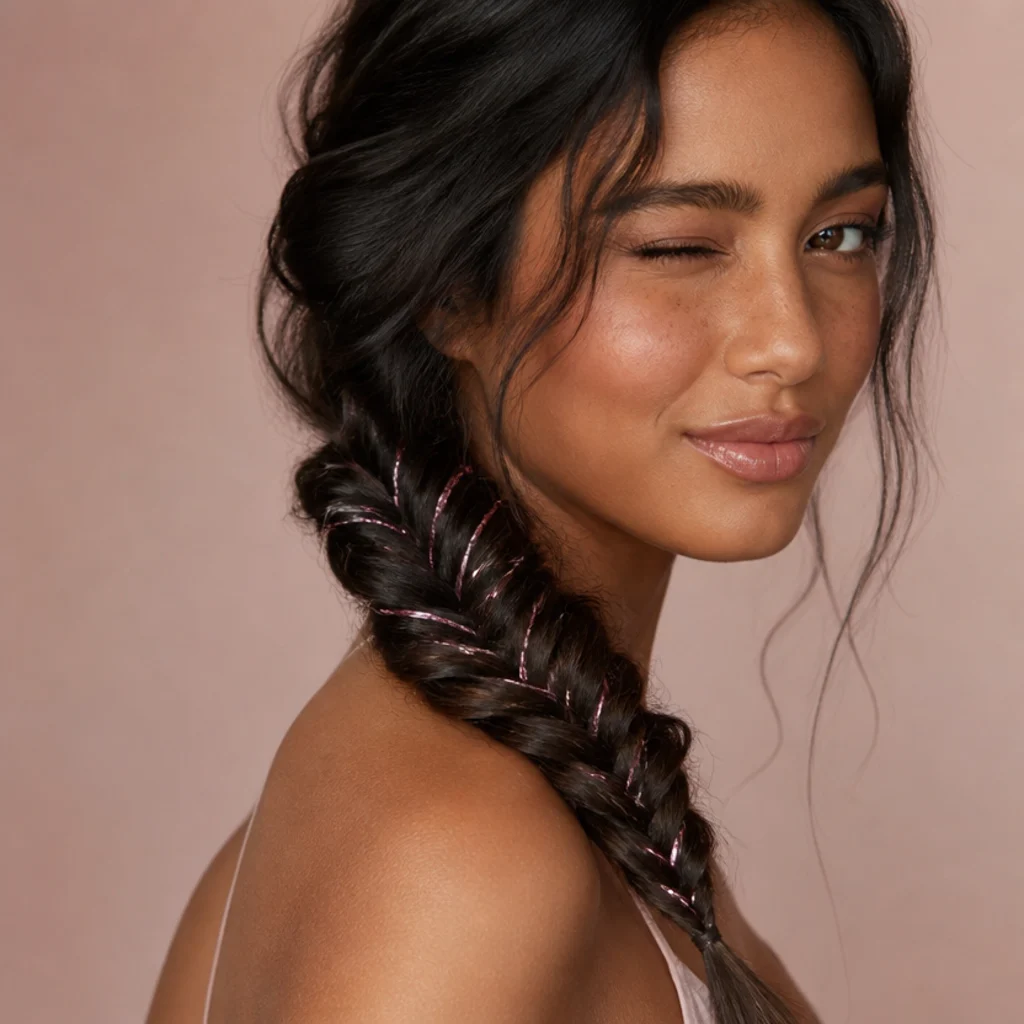
A fishtail braid has a fine, basket-woven texture, and threading pink tinsel through it makes the strands wink out at every crossover point along the length. Because the weave is intricate and the braid sits loose, the tinsel catches light at dozens of tiny facets rather than in one continuous line, for a romantic, whimsical result. Technique matters: split the tinsel evenly between the two working sections and braid it in as you go, so it distributes through the whole plait instead of bunching. This suits medium to long, straight-to-wavy hair and holds beautifully through a full day of wear. Once you tie off, gently pull the edges of the braid apart, or pancake it, to loosen the weave and reveal more of the pink tucked inside. It's a pretty, low-effort choice for weddings, bridal showers, garden parties, and outdoor events. Since it's style-day, clip or loose strands work fine — no permanent tie-in required. Braid it a little tighter than feels natural, since pancaking will loosen it right back to soft, and ask your stylist to leave a two-inch tail of tinsel past the elastic so a few strands sparkle at the very tip.
13Subtle Pink Tinsel for Short Pixie Hair
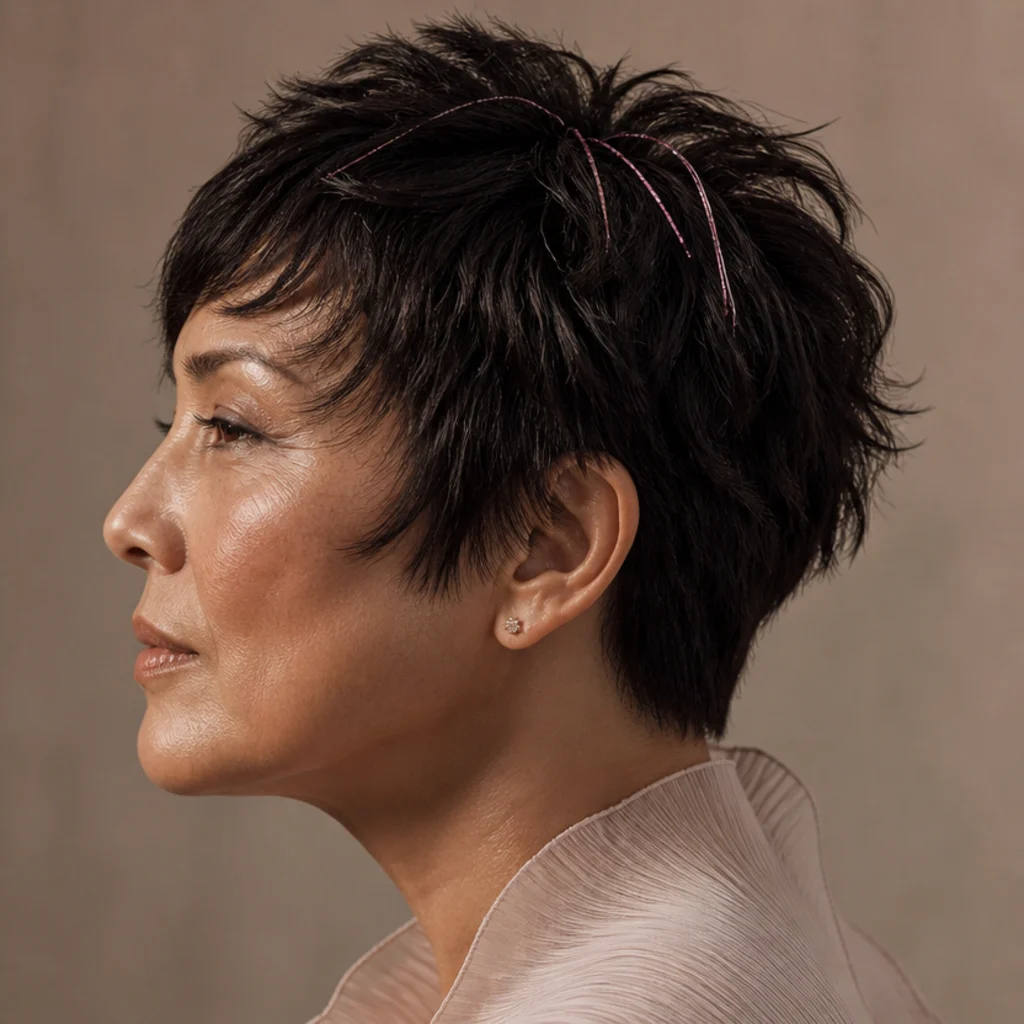
Short hair can carry tinsel just fine; the whole discipline is restraint. A handful of pink strands tied near the crown of a textured pixie adds a delicate glint that accents the cut instead of competing with it. Because a pixie lives on shape, movement, and piecey texture, keep the count under 10 and set strands where the hair naturally falls forward, along the fringe and the crown, so they move with the style. On short lengths the filament won't hang far, so it reads as tiny points of sparkle rather than streamers — which is exactly the charm, and why less works better here. Choose a soft-to-mid pink, something like a rosy or warm baby pink, since it sits close to your face and needs to flatter at conversation distance. Wear time runs a little shorter than on long hair, three to six weeks, because short crown hair gets styled and touched constantly. Trim any strand that hangs past your longest layer with sharp scissors for a clean, intentional finish rather than a stray-whisker look, and ask your stylist to place a strand or two in your styling direction so they catch light every time you texturize with product.
14Glitter-Pink Tinsel for Wedding and Festival Looks
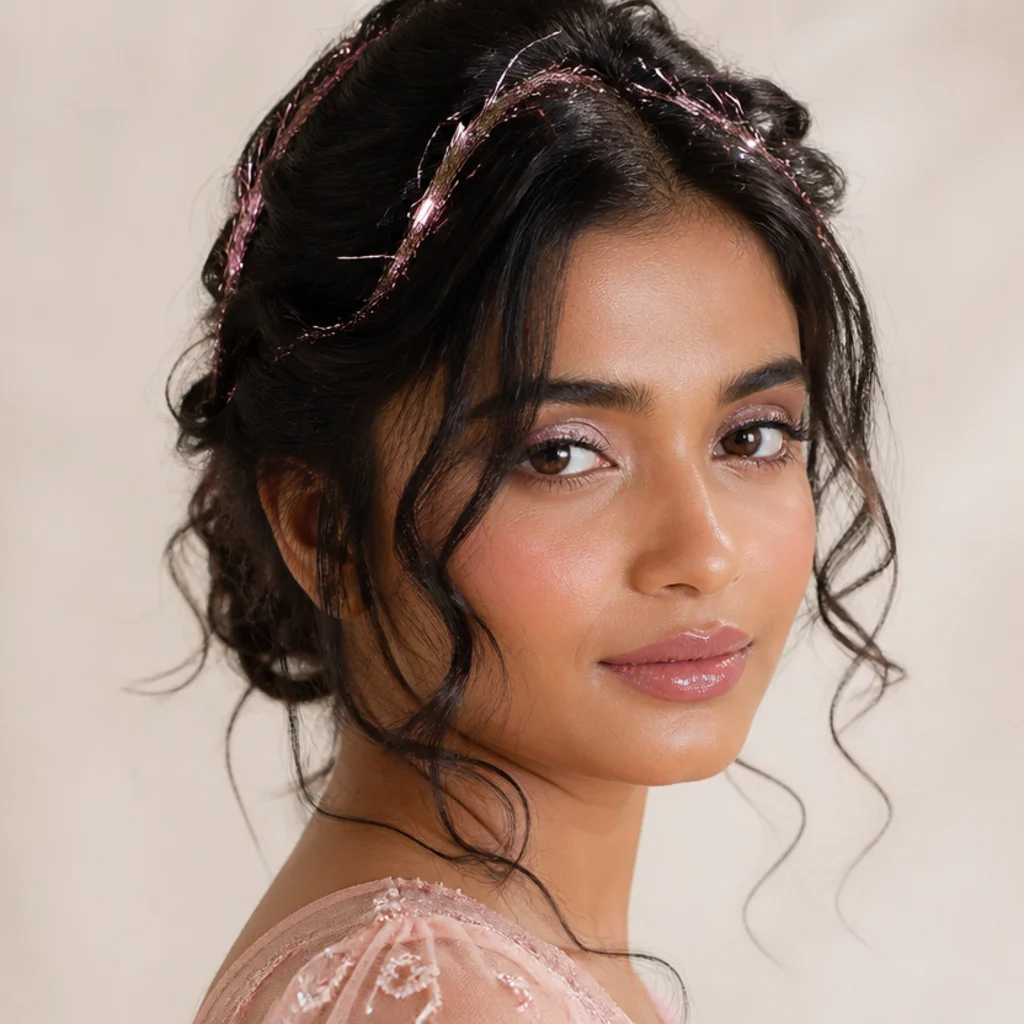
For a milestone occasion, this is the moment to go generous: an updo or a soft-wave set dressed with abundant glitter-pink tinsel reads celebratory and photographs beautifully under flash, where the filament flares into bright pinpoints. Use far more strands than your everyday count, 40 to 60, and concentrate them where light and the camera land — the crown, the face-framing pieces, and the front of an updo. Event styling is built with pins, product, and structure, so the tinsel gets locked in and holds steady through a full night of dancing. Pull the whole look together by echoing the pink elsewhere, a soft rosy lip or a dewy, luminous skin finish, so the sparkle reads intentional rather than random. For a wedding, coordinate the exact pink to the palette, whether that's a blush-neutral or a punchier fuchsia. Timing is the smart move: apply a day or two ahead so nothing shifts and the strands settle into the set. Photograph a test in both daylight and phone flash before the event, since tinsel that looks subtle in a mirror can flare much brighter on camera, and ask your stylist to build the tinsel into the structure of the updo, not lay it on the finished surface, so it survives hugs and hours.
15Clip-In Pink Tinsel Extensions for Quick Wear
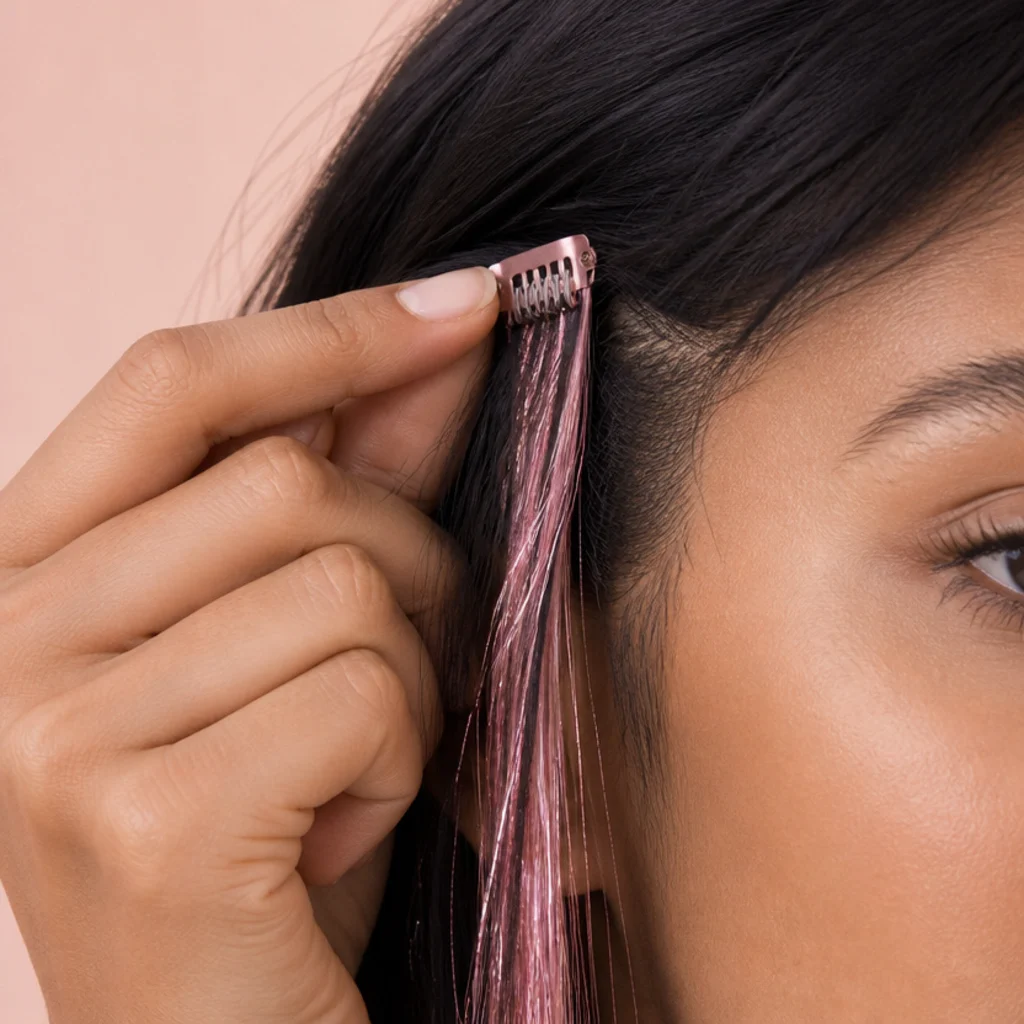
If you want zero commitment, clip-in tinsel extensions give instant sparkle you can remove in seconds. Small wefts of pink filament attach to tiny pressure clips that snap in wherever you want shine and pop right out at the end of the night — no knot, no braid, no grow-out, no waiting. This is the smartest way to trial a pink shade before you tie anything semi-permanent, and it's ideal for a single event, a costume, or anyone whose workplace only allows sparkle off the clock. Placement is flexible: clip a weft under the top canopy for a hidden peekaboo flash, or right along the part for open, visible shine. Because the clips carry a little weight, medium-to-thick hair holds them most securely; very fine hair may need a smaller weft or a backcombed anchor. The trade-off is that they're style-day only and won't survive a workout or a windy commute the way a tie-in does. Store each weft flat or lightly rolled in tissue between wears so the fine strands don't knot into a tangle, and ask your stylist or retailer for a single-clip micro-weft rather than a wide track if your hair is fine, so the base never shows.
Pro Tips from the Editor
- Match the pink to your base, not your mood. On blue-black hair, cool bubblegum and hot pink deliver the hardest specular pop; on warm brown or auburn, rose-gold blends without a jarring line; on silver, a neutral blush avoids reading yellow.
- Zig-zag your knot placement. Setting tie-ins in an offset pattern rather than a straight row keeps regrowth spacing invisible for weeks longer than a rigid line.
- Protect the reflective surface. Toning shampoos, heavy oils, and dry shampoo can film onto filament and dull the shine, so apply product around the strands and rinse with your head tipped back.
- Respect the heat ceiling. Most synthetic tinsel tolerates only low, brief heat; keep flat irons and curling wands off the strands entirely and turn tools down a setting in the surrounding hair.
- Remove by cutting, never pulling. Snip the knot itself with fine scissors and slide the strand out, which protects your own hair from the tug-out breakage that pulling causes.
- Count up, not down. Start with a modest strand count for any new placement; it is far easier to add ten more strands next week than to explain a too-busy head to yourself in photos.
- Time bold looks to the calendar. Ombre, event, and festival placements peak the day they go in, so schedule the heavy-strand versions close to the occasion rather than weeks ahead.
How to Choose / Get the Look
Work the decision in three moves: shade, method, then strand count. First, choose your pink by base and contrast goal. On dark hair, brighter cool pinks (hot pink, magenta, bubblegum) pop hardest, while blush and rose-gold give a softer blended glow; on silver, gray, or blonde, even pale pink registers clearly, so lean neutral to avoid brassiness. Second, choose the application method by commitment level using the table below. Third, set your strand count to your nerve: 10 to 20 for a first-timer, 25 to 40 for curly and coily textures that hide and reveal, and 40-plus only for events.
| Method | How it attaches | Realistic wear time | Difficulty | Best for |
|---|---|---|---|---|
| Clip-in weft | Pressure clips snap onto a section | Same day, removable in seconds | Beginner | Trialing a shade, single events, strict dress codes |
| Tie-in strand | Slip knot at the root, moves with growth | 4-8 weeks | Some practice | Everyday sparkle, money-piece, side-part placements |
| Braided-in | Woven into the plait from the root | Life of the braid | Best done by a braider | Box braids, festivals, swimming, active wear |
Wondering how to put tinsel in hair yourself? Separate a small section near the root, fold one strand in half over it, and tie a snug knot within a centimeter of the scalp so both ends hang the full length; add a second knot if you wash more than three times a week. Keep the count modest at first and build once you know you like it. When you book a stylist, bring a saved photo, name the exact pink, state your texture and length, and say how many weeks it needs to last so they choose tie-in versus braid-in correctly. Then protect the investment: no direct high heat on the filament, brush gently around knots rather than through them, and air-dry when you can to preserve the shine.
Frequently Asked Questions
Does pink hair tinsel show up on black hair?
Yes, and dark hair is arguably the best backdrop for it. Pink filament reflects light in a bright, hard pinpoint against deep strands, so even 10 to 15 tie-ins read clearly. Cool, saturated pinks like hot pink, magenta, and bubblegum show the most contrast; muted blush and rose-gold give a softer glow that can disappear if you place too few.
How do you put tinsel in hair at home?
Section a small piece of hair near the root, fold a tinsel strand in half over it, and tie a snug slip knot within a centimeter of the scalp so both ends hang down. Repeat wherever you want sparkle, staggering the knots in a zig-zag so regrowth stays invisible. A second knot adds hold if you shampoo frequently or have slippery, fine hair.
How long does hair tinsel last?
Tie-in strands typically last four to eight weeks, riding your natural shed cycle down until the knot works loose. Braided-in tinsel lasts as long as the braids hold, often six to eight weeks. Clip-ins are fully temporary and come out the same day. Heavily-styled zones like a part or a crown loosen a little faster than protected under-layers.
Will hair tinsel damage my hair?
Tied-in and clipped tinsel sits on top of the hair rather than treating it chemically, so it is generally gentle when installed and removed correctly. The risk is mechanical, not chemical: always cut the knot to remove a strand rather than yanking it, and brush around the knots rather than dragging a brush straight through them, which is where breakage happens.
Can curly and coily hair wear tinsel?
Yes, and it often looks more dynamic than on straight hair. On curly textures the filament weaves through the coils for a scattered-glitter effect, and on coily afro hair, saturated shades like magenta show up best because pale pinks vanish into dense strands. Tie at the root, place on the canopy where light hits, and shape with a pick or fingers rather than combing straight through.
Can you wash and swim with hair tinsel in?
You can, with care. Tie-ins tolerate normal washing if you shampoo gently around the knots and avoid vigorous scrubbing at the roots. Braided-in tinsel is the most swim- and sweat-proof option because it is locked into the plait. Chlorine and salt water will not ruin the filament, but rinse afterward and let the hair air-dry to protect the reflective finish.
Does hair tinsel work on fine or thin hair?
Yes, with a lighter hand. Fine hair can carry tie-ins beautifully, but drop the strand count and keep knots small so they do not telegraph or feel heavy. Skip wide clip-in wefts, which can slip or show their base, and choose a single micro-weft or a backcombed anchor instead. A softer pink also reads more natural against fine, light-catching hair.
Can you use heat tools with hair tinsel in?
Keep heat away from the filament itself. Most synthetic and mylar tinsel tolerates only low, brief heat before it dulls, warps, or melts, so never run a flat iron or curling wand directly over the strands. Style your hair first, add the tinsel after, and if you must touch up, lower your tool a setting and work only the hair around the strands.
How do you remove hair tinsel without breakage?
Locate the knot, snip it with fine scissors, and gently slide the freed strand out of your hair. Never pull a tinsel strand out by the length, because the knot drags against your own hair and can snap it. If a filament resists, cut closer to the knot rather than tugging, and finish with a wide-tooth comb through any section that felt tangled.