20 Hair Tinsel Looks for Black Hair
Hair tinsel lays a slim ribbon of reflective film over dark strands, adding deliberate shine without bleach, dye, or heat damage to your natural texture. These 20 looks show exactly how sparkle reads on coils, braids, locs, and sleek styles, which colors flatter deep bases, and how many weeks of upkeep each one actually costs.
 Edited by Lena Rose · Published July 11, 2026 · 32 min read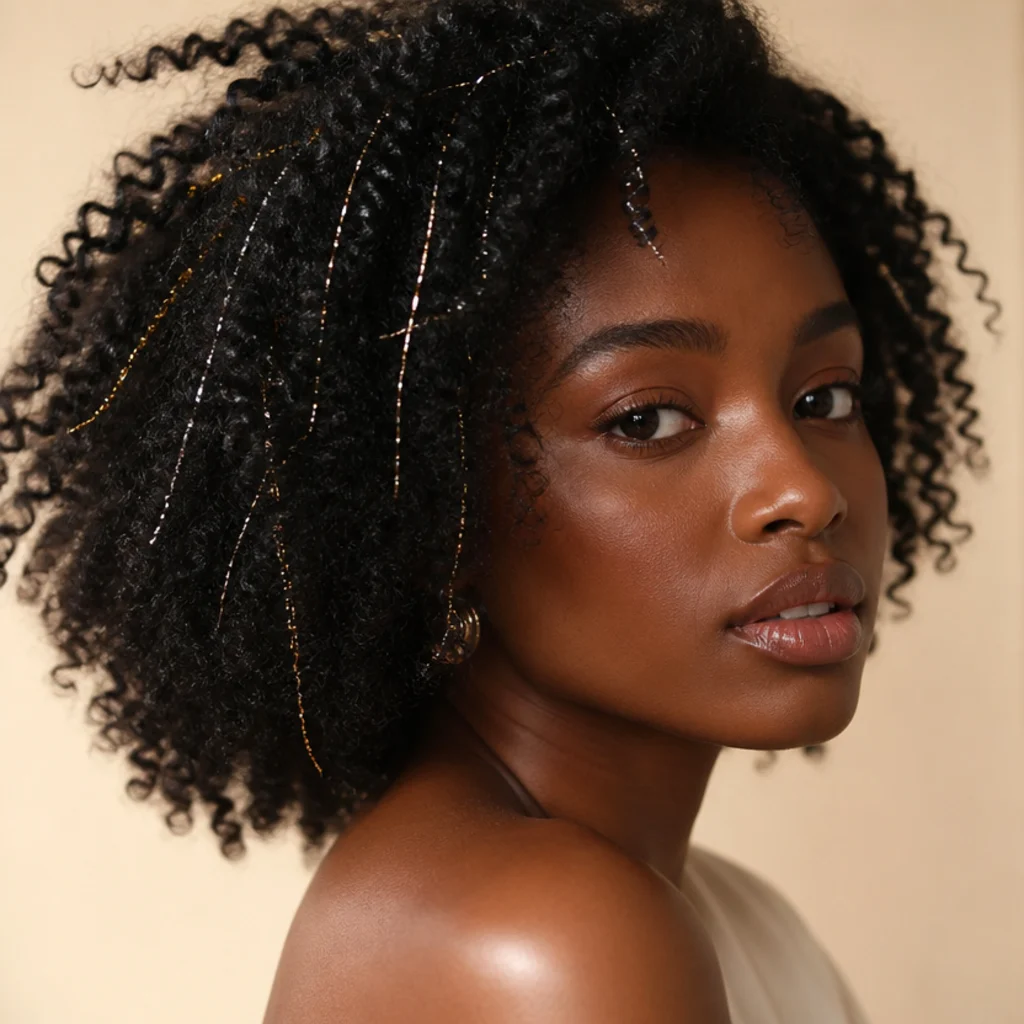
Quick Answer
- Best for: Anyone with dark hair who wants low-commitment, reversible shine that skips lightener and permanent color. Reads well on coily, curly, wavy, straight, silk-pressed, braided, and loc'd textures.
- Who might skip it: Anyone who cannot commit to a satin bonnet at night, works in a strict no-jewelry-visible dress code, or wants zero shedding on furniture, since a few strands always migrate.
- Maintenance: Tie-in strands last 4 to 8 weeks through normal wash days when double-knotted at the root; tinsel braided into box braids, cornrows, or locs lasts the life of the style. Heat-bonded strands release soonest.
- Difficulty: Beginner-friendly for a scattered tie-in accent at home; medium once you want clean part lines, sleek placement, or short-hair precision, where a stylist earns their fee.
- Cost: Roughly the price of a DIY strand pack for a handful of home strands, up to a mid-range add-on fee when a stylist installs a full head or braids it into a protective style. Salon pricing varies by region and strand count.
- Wear time / longevity: A single install commonly holds shape for 4 to 8 weeks; braided-in versions ride out the full 6 to 8 week protective-style window.
- Standout variation: Rose-gold and pink hair tinsel, which glows warm against jet-black and espresso bases without a drop of dye.
- How to ask your stylist: Lead with placement and density ("lightly scattered through the mid-lengths" vs. "dense all-over"), name the finish (metallic, iridescent, jewel-tone), and bring a saved photo so the tone matches what you picture.
In This Guide
- Silver Sparkle on Loose Coils
- Rose-Gold Pink Hair Tinsel Accents
- Iridescent Rainbow Strands
- Tinsel Along a Center Part
- Gold Tinsel Through Box Braids
- Curly Hair Tinsel on Defined Ringlets
- Tinsel-Wrapped Knotless Braids
- Sparkle Strands on Faux Locs
- Half-Up Puff with Tinsel Face Frame
- Emerald and Teal Cool-Tone Tinsel
- Tinsel in a Sleek Low Bun
- Copper Tinsel on a Tapered Cut
- Holographic Tinsel Ponytail
- Tinsel Threaded Through Cornrows
- Subtle Champagne Tinsel for Work
- Pink Tinsel on a Wash-and-Go
- Tinsel Accents on Bantu Knots
- Full-Sparkle Festival Tinsel
- Tinsel on a Tapered TWA
- Tinsel-Edged Space Buns
Introduction
Hair tinsel black hair looks come down to one bit of optics: a strand of thin mylar or heat-resistant film reflects light more sharply than a hair fiber does, so a few well-placed ribbons read as intentional shine, not a color change. The sparkle sits on top of your strands instead of inside them, so your natural depth stays intact whether the base is jet-black, espresso, or a soft off-black. Bright film against a matte dark canvas is high contrast, which is exactly why tinsel photographs so well on textured hair and why it's everywhere in the hair tinsel aesthetic on Pinterest and in the salon chair.
Tinsel comes in three attachment methods, and the method matters more than the color. Tie-in strands loop and double-knot at the root and are the most forgiving for coils and wash-and-gos. Braided-in strands get plaited directly into box braids, cornrows, or locs for weeks of hold. Heat-bond strands clamp with a micro-bead and release the fastest. The 20 looks below are sorted so you can match placement, density, and finish to your texture, your styling routine, and your patience. Whether you want one quiet champagne ribbon for the office or a full festival shimmer, this guide covers how to wear hair tinsel on black hair and how to ask for it precisely in the chair.
01Silver Sparkle on Loose Coils
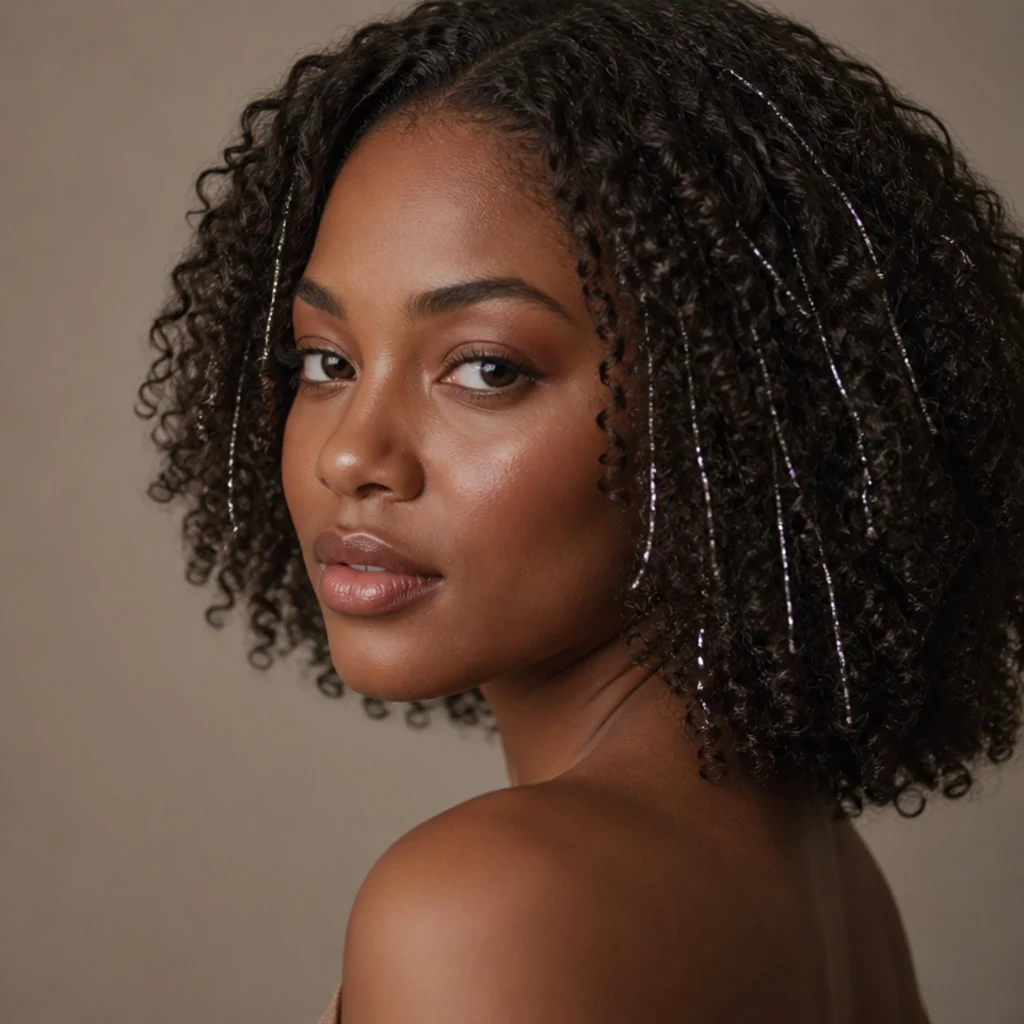
Silver is the purest starting point because it reflects as near-white light against a dark base, which gives you maximum contrast with zero color cast. Scatter roughly 15 to 25 tie-in strands through loose 3B to 4A coils, spacing them a few curl clumps apart so the shine peeks out as the hair moves instead of forming one dense stripe. It works best on medium to long coily lengths, where the ribbon has room to trail down the curl and stay visible through shrinkage.
Silver tie-in strands survive co-washing if you double-knot at the root, and you shouldn't drag a brush straight through them. Finger-detangle around each knot instead. Expect the install to look its best for 4 to 6 weeks, with a strand or two shedding per week. Difficulty is low, so this is the smartest first tinsel to try at home. To ask a pro, request "lightly scattered silver tie-in tinsel through the mid-lengths, nothing concentrated at the crown," so the placement stays organic rather than clustered.
02Rose-Gold Pink Hair Tinsel Accents
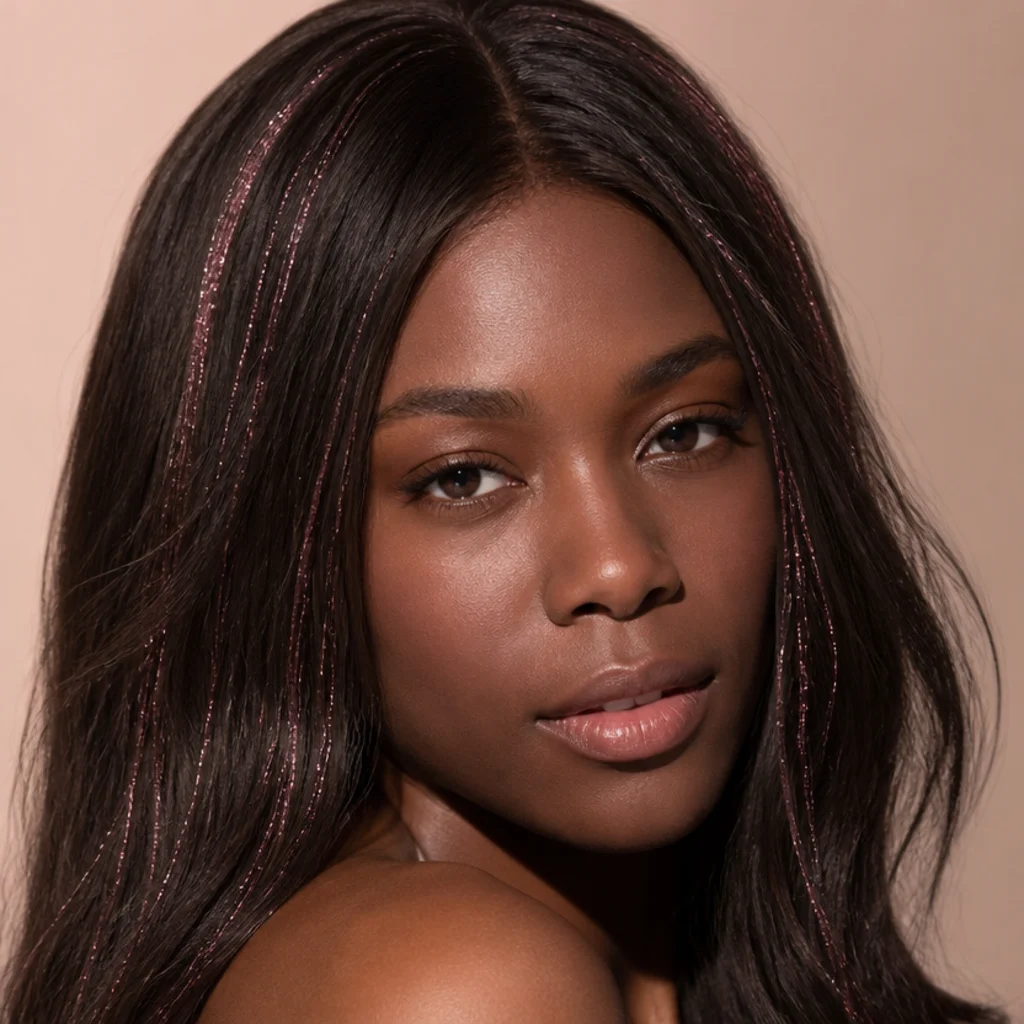
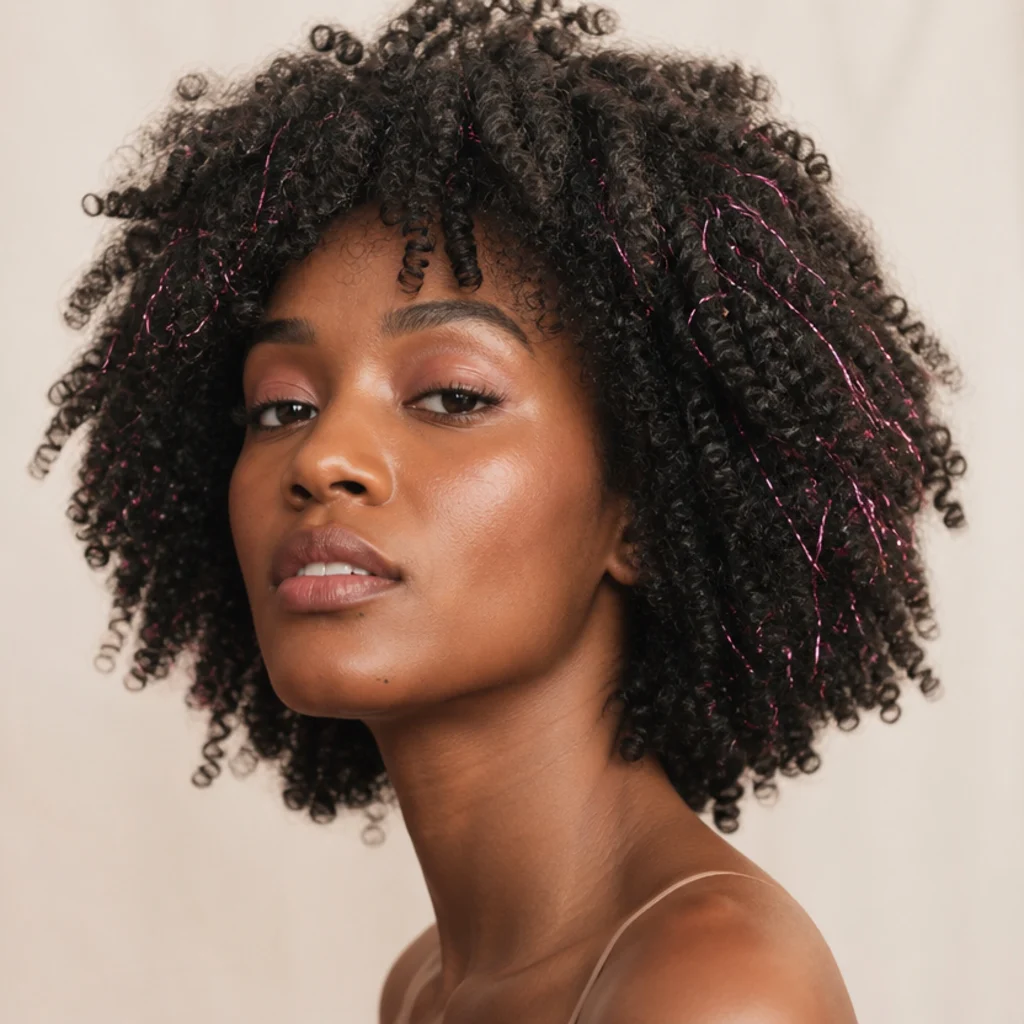
Pink hair tinsel is the warmest option for deep bases, and rose-gold splits the difference between pink and metallic for a glow that lifts the complexion. Concentrate 10 to 20 strands near the face and along the front of the part, where warm reflected light flatters rich brown and jet-black hair without any actual pink dye or a lightening step. It's the face-framing placement that makes this look feel styled rather than random.
Rose-gold film is thinner and more prone to creasing than silver, so handle it gently on wash day and keep flat irons and blow-dryer nozzles off the strands directly. Plan on 4 to 6 weeks of wear, with the warm tone fading a bit faster under repeated heat. Difficulty runs low to medium depending on how precise you want the face frame. Ask your stylist for "warm rose-gold pink tinsel, face-framing only," and bring a photo so the undertone matches the pink you actually picture.
03Iridescent Rainbow Strands
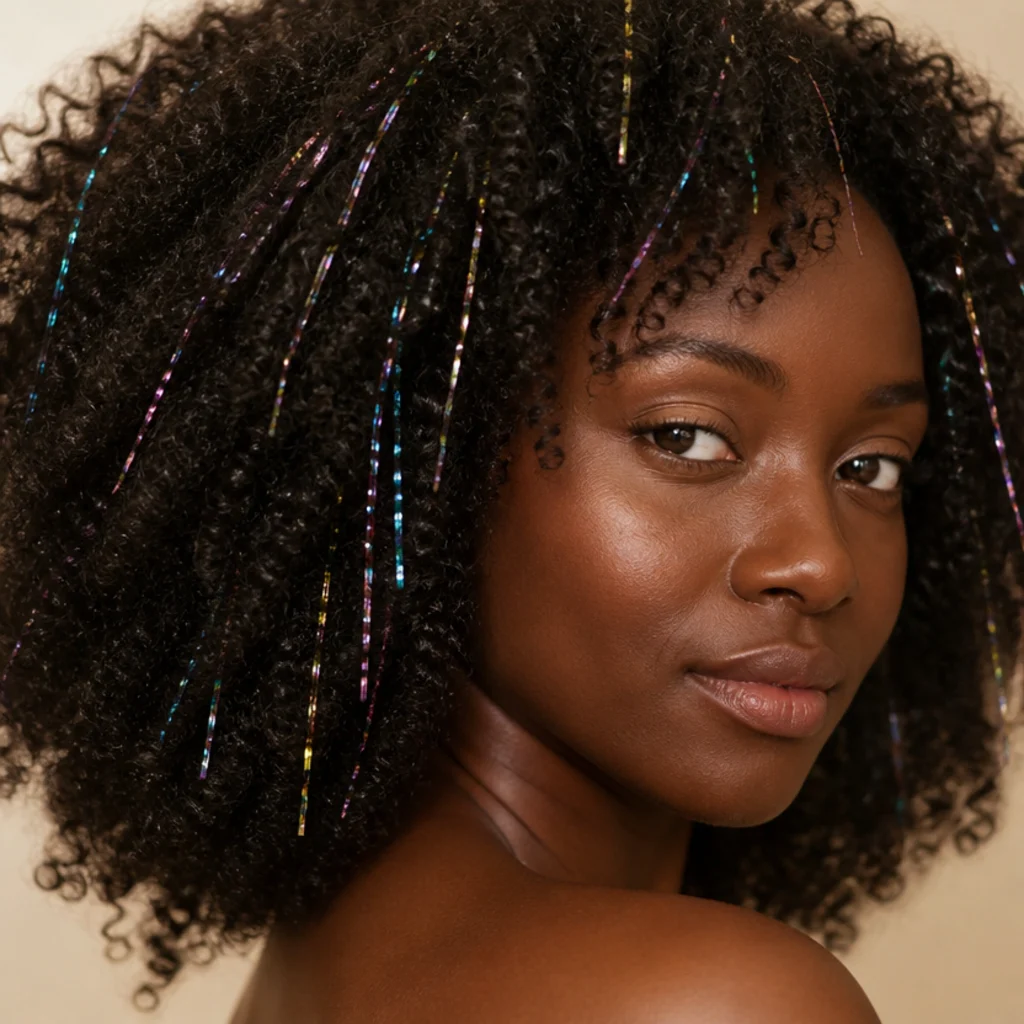
Iridescent tinsel is coated so it shifts hue with the viewing angle, flashing pink, blue, and gold from a single strand. On black hair that color shift is amplified, since the dark base gives each flash a clean backdrop with nothing to mute it. Use a lighter hand here, about 10 to 20 strands — the multi-tone effect does most of the visual work, and a heavy install can tip into busy.
It's the strongest pick if you want a hair tinsel aesthetic that leans playful and editorial, and it pairs especially well with defined curls that let the film catch light from several angles at once. Maintenance matches other tie-in strands, but iridescent film creases if you sleep on it hard, so a satin bonnet or silk pillowcase can push its life out to 4 to 6 weeks. Difficulty is low. Tell a pro you want "oil-slick or iridescent tinsel, lightly placed," so you get the color-shifting version rather than flat metallic strands.
04Tinsel Along a Center Part
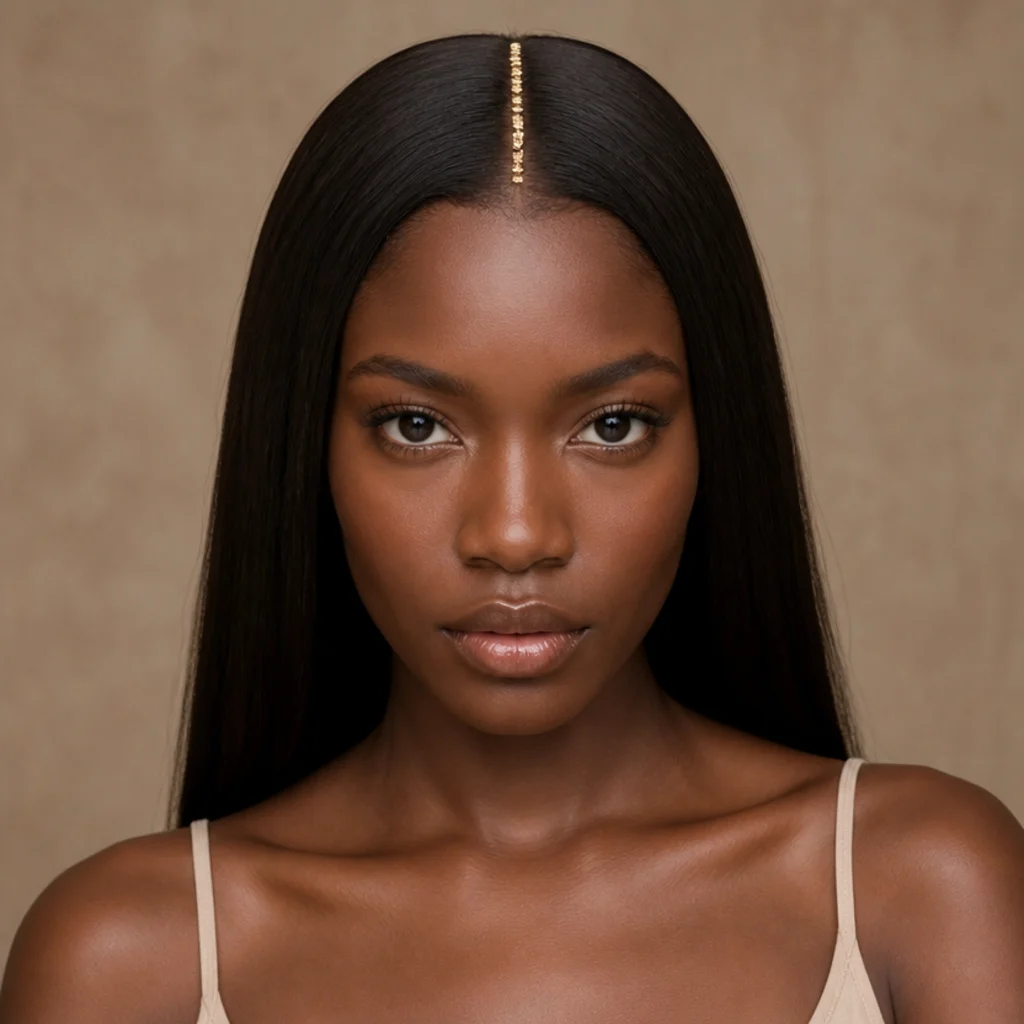
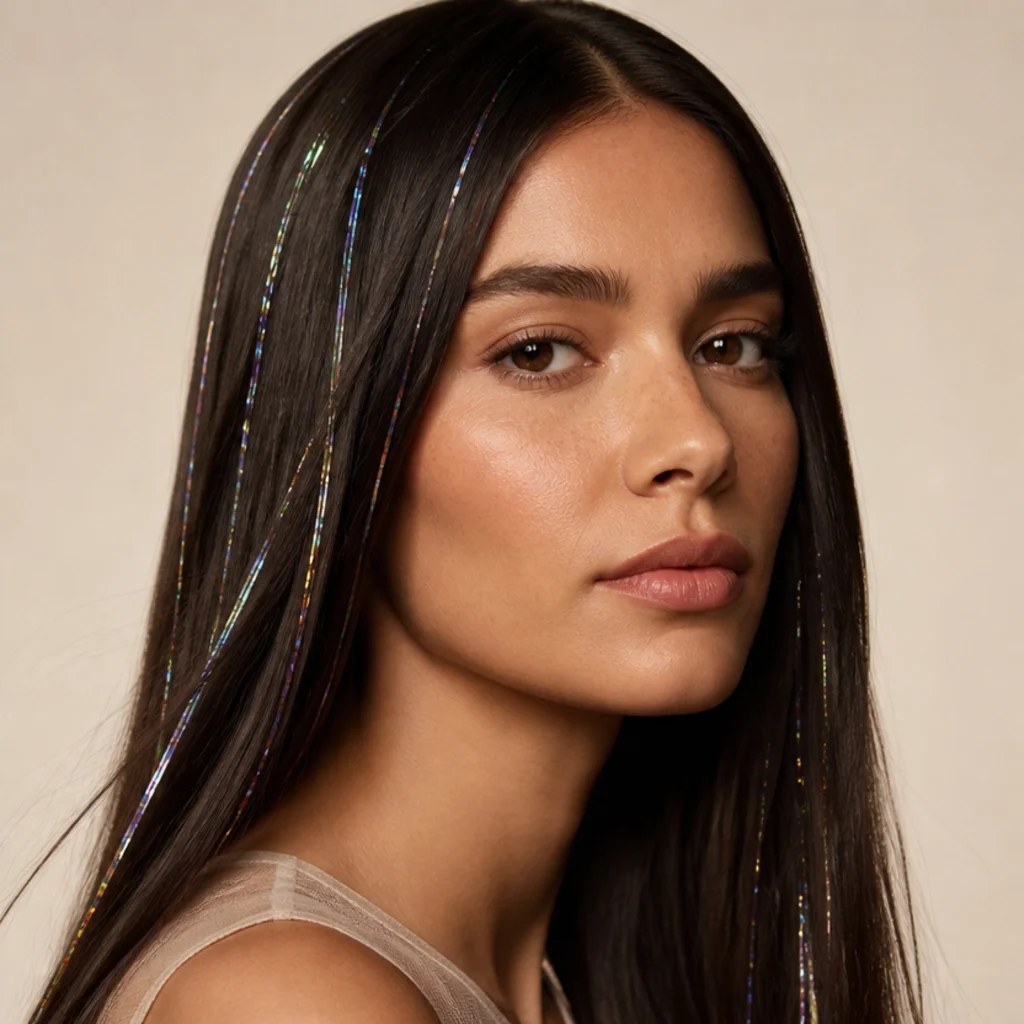
Lining a center part turns tinsel into an architectural detail. A single row of fine strands set right along the parting glints every time you tilt your head and frames the face symmetrically. That's why it works best on oval, heart, and square face shapes that suit a strong central line, and it shines on silk-pressed or blown-out hair where the part stays crisp and the strands lie flat.
Don't drag a rat-tail comb over the part once the tinsel is in; lift and reset it with your fingers instead. Upkeep is moderate on pressed hair, since you're protecting both the press and the film from humidity, which usually means 2 to 4 weeks before a touch-up if you want to avoid reversion. Difficulty is medium for clean placement. Ask for "a fine tinsel line following the center part, root-knotted so it stays put," and confirm the strand count so the line looks precise rather than sparse.
05Gold Tinsel Through Box Braids
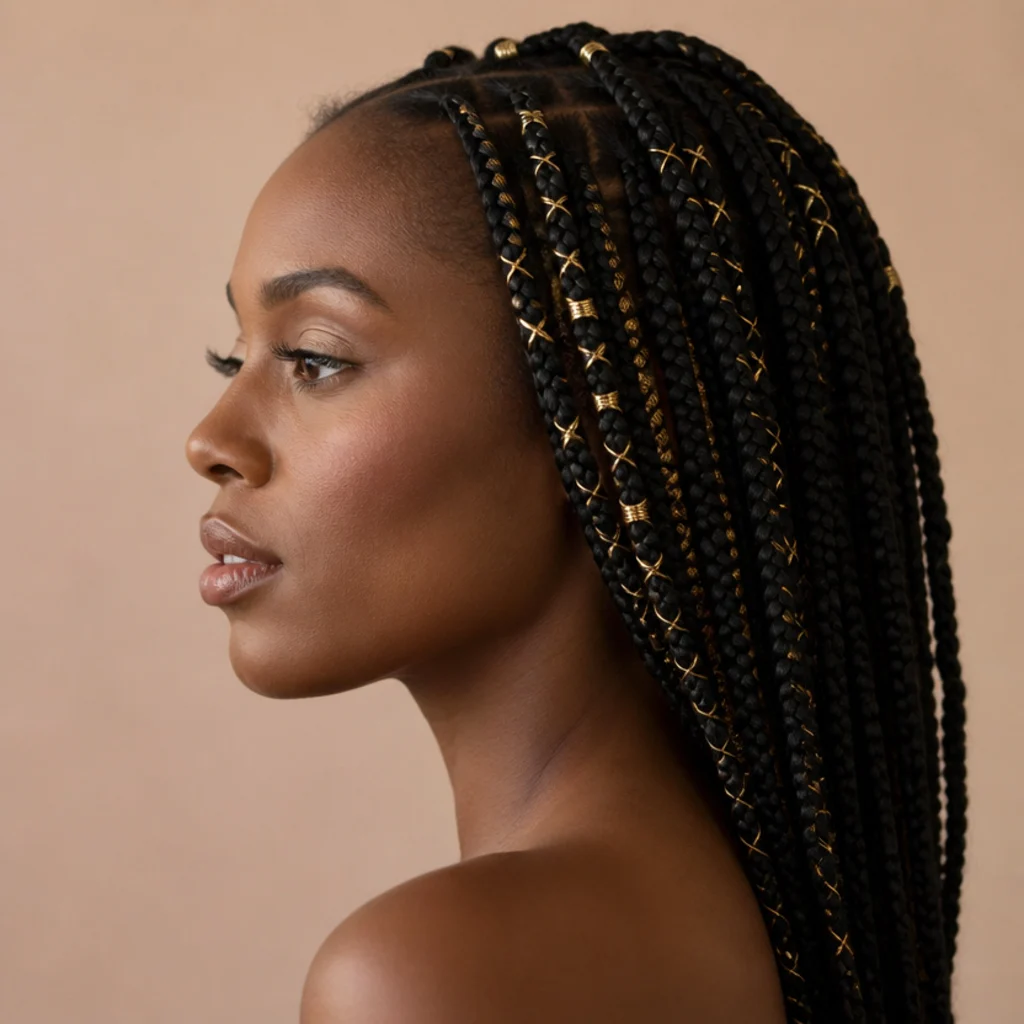
Box braids are one of the most durable homes for tinsel, because the strand gets plaited directly into the braid and locked in for the life of the style. Gold reads rich and warm against dark braiding hair and holds its finish through weeks of wear. Spread the tinsel across roughly a dozen braids around the head rather than every plait, so the shine stays intentional and catches light as the braids swing.
Low-maintenance is the whole appeal here: once braided in, the tinsel stays until take-down, usually the full 6 to 8 week protective-style window. The only real care is keeping the scalp and length clean and wrapping at night. Difficulty is low, but it has to be done as the braider works, strand by strand. Request "gold tinsel braided into about a dozen braids, spread around the head, not clustered," and point out your part or face-framing braids if you want the shine to read from the front.
Save this to Pinterest to build a mood board of your favorite tinsel-and-braid combinations.
06Curly Hair Tinsel on Defined Ringlets
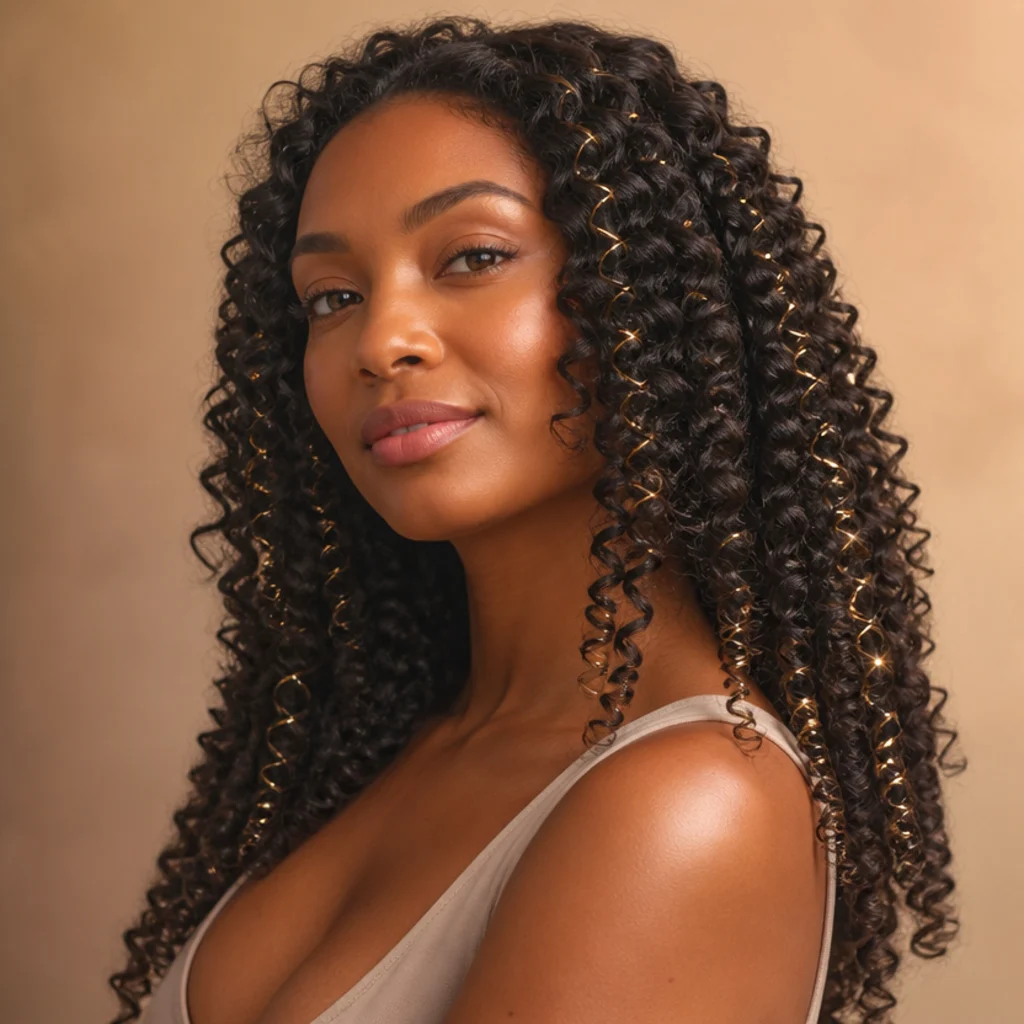
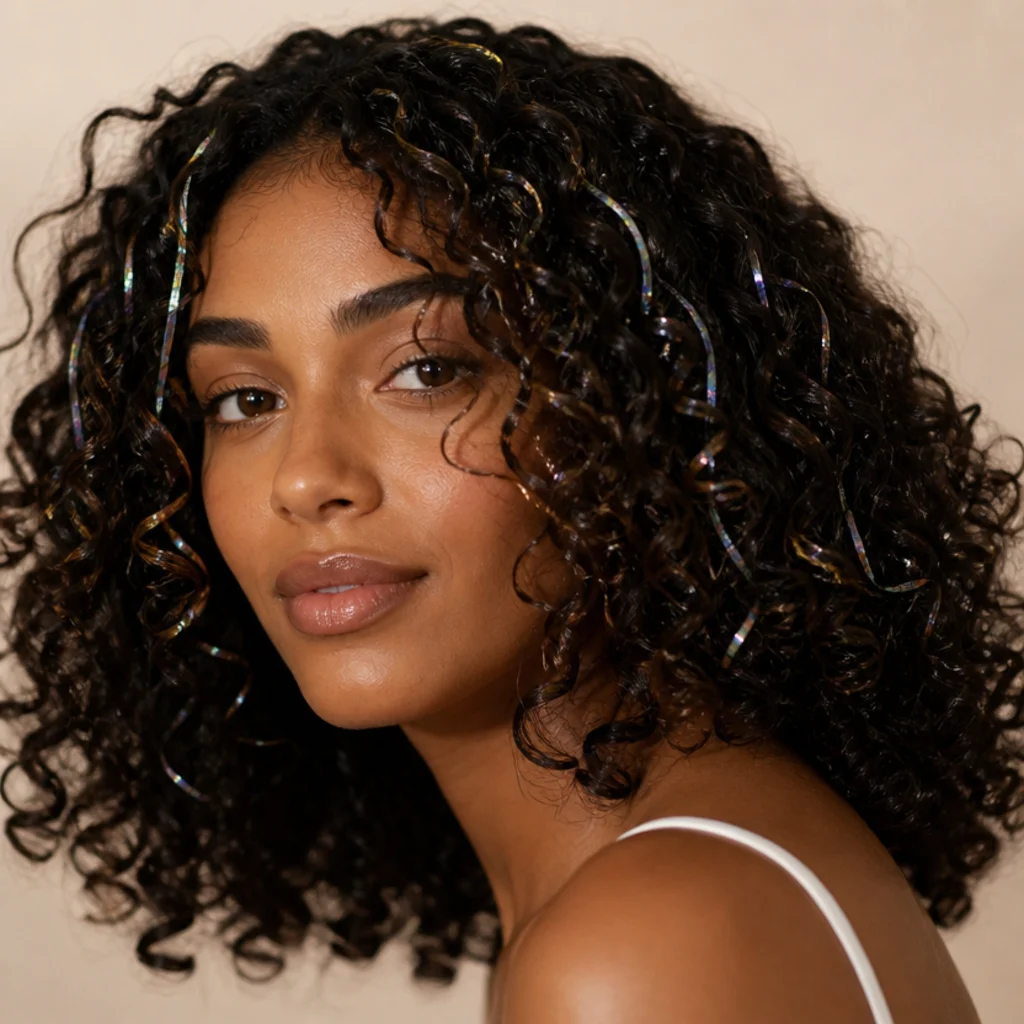
Curly hair tinsel works with the curl pattern instead of fighting it. On springy, elongated ringlets, thread strands so they coil alongside the hair and spiral down each curl, letting the sparkle travel the full length. Defined 3A to 3C ringlets show tinsel best, since there's enough length and separation for the ribbon to catch light without disappearing into the clump.
The trick is placement: set each strand where a curl clumps naturally so it moves as one piece and doesn't split your definition. On wash day, that means gentle handling: finger-detangle and scrunch around the knots rather than raking through, which keeps both curls and film intact for 4 to 6 weeks. Difficulty is low. To ask a pro, say "tie-in tinsel placed to follow my curl clumps, not straightened over," so your stylist threads with the ringlet pattern rather than stretching it out. A curl refresher spray helps the strand re-coil after sleep.
07Tinsel-Wrapped Knotless Braids
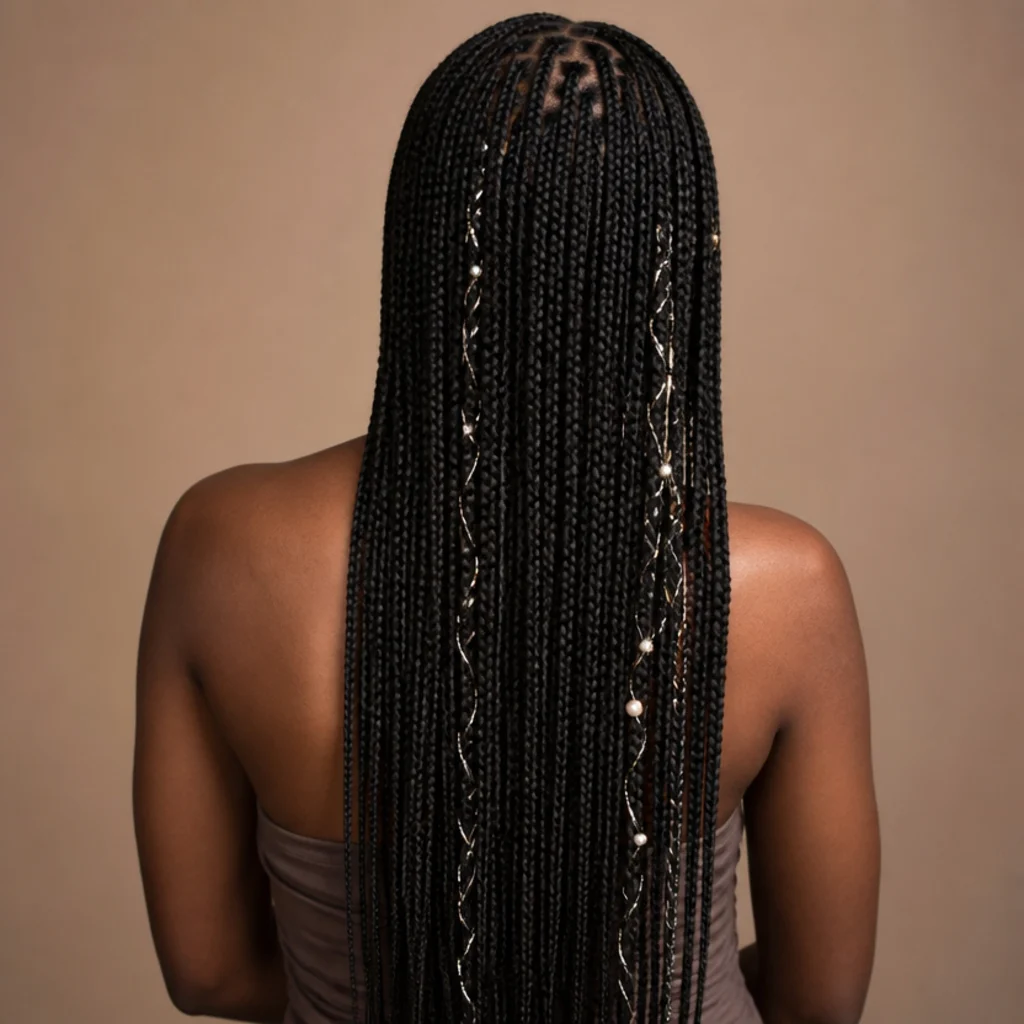
Knotless braids feed in gradually for a smooth, tension-friendly root, and tinsel wrapped along the length adds movement without extra weight at the scalp — that matters if your edges are fine or prone to strain. Fine silver or pearl strands trail the braid and flicker as it swings, and because knotless braids hang so freely, the sparkle catches light along the entire length instead of just at the crown.
Upkeep tracks with the braids themselves: keep the scalp clean, moisturize the length, and the tinsel lasts the whole set, usually 6 to 8 weeks. Difficulty is low once the braids are in, since strands can be wrapped and knotted on afterward without redoing the plait. Ask your braider for "a few strands of silver tinsel wrapped down select knotless braids," and point out which sections you want highlighted so the placement suits how you part and style them.
08Sparkle Strands on Faux Locs
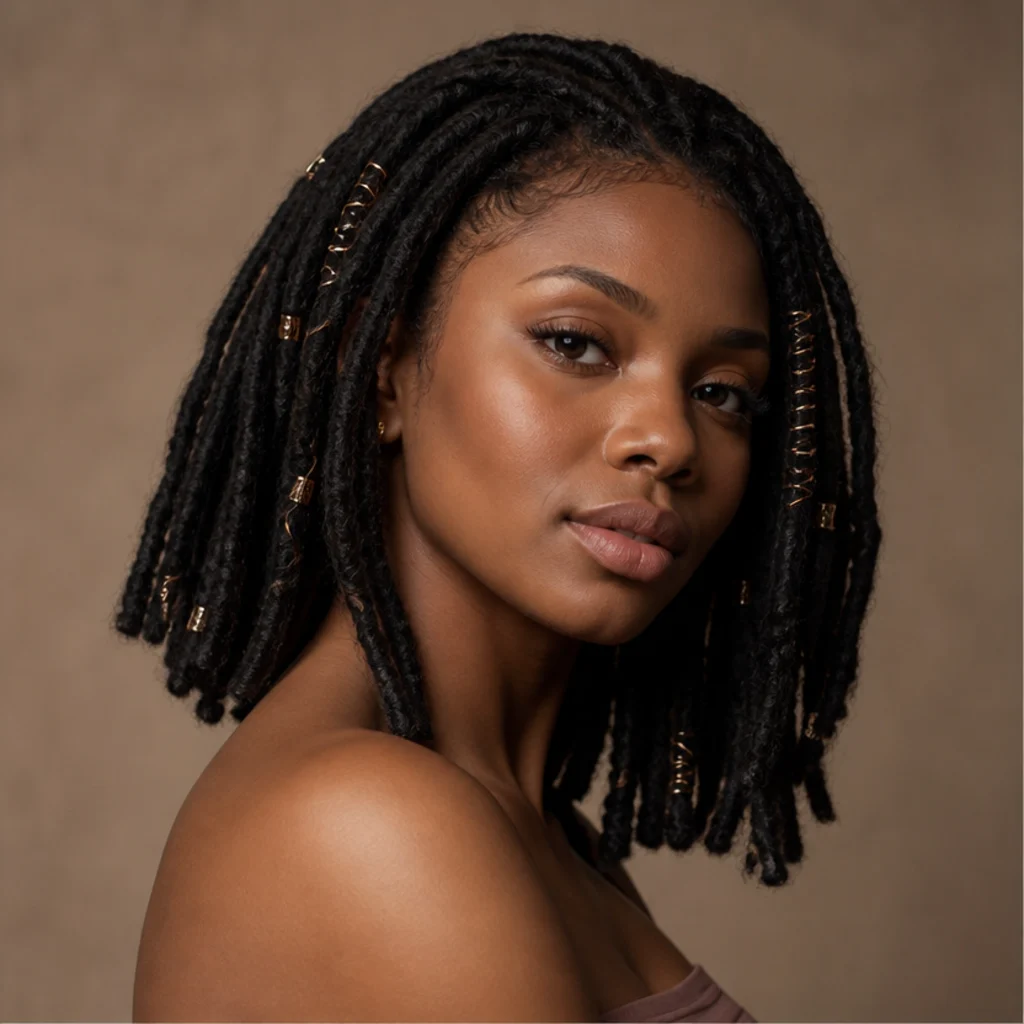
Faux locs give tinsel a matte, textured backdrop, and that contrast makes even a few strands read as high shine. Wrap or tuck tinsel into a scattering of locs so the sparkle surfaces at irregular intervals as you move; it looks far more natural than an even row. Copper and gold flatter the warm brown tones common in loc extensions and blend rather than clash.
This is one of the most durable, low-fuss options, since the strand is anchored inside the loc wrap and protected from daily friction. Maintenance is minimal beyond your usual loc care and a nightly wrap, and strands hold for the full life of the style, often 6 to 8 weeks. Difficulty is low whether it's added during or after installation. Tell your stylist you want "copper tinsel tucked into random faux locs for an uneven, natural scatter" rather than a uniform line, and mention if you want a couple of face-framing locs highlighted.
09Half-Up Puff with Tinsel Face Frame
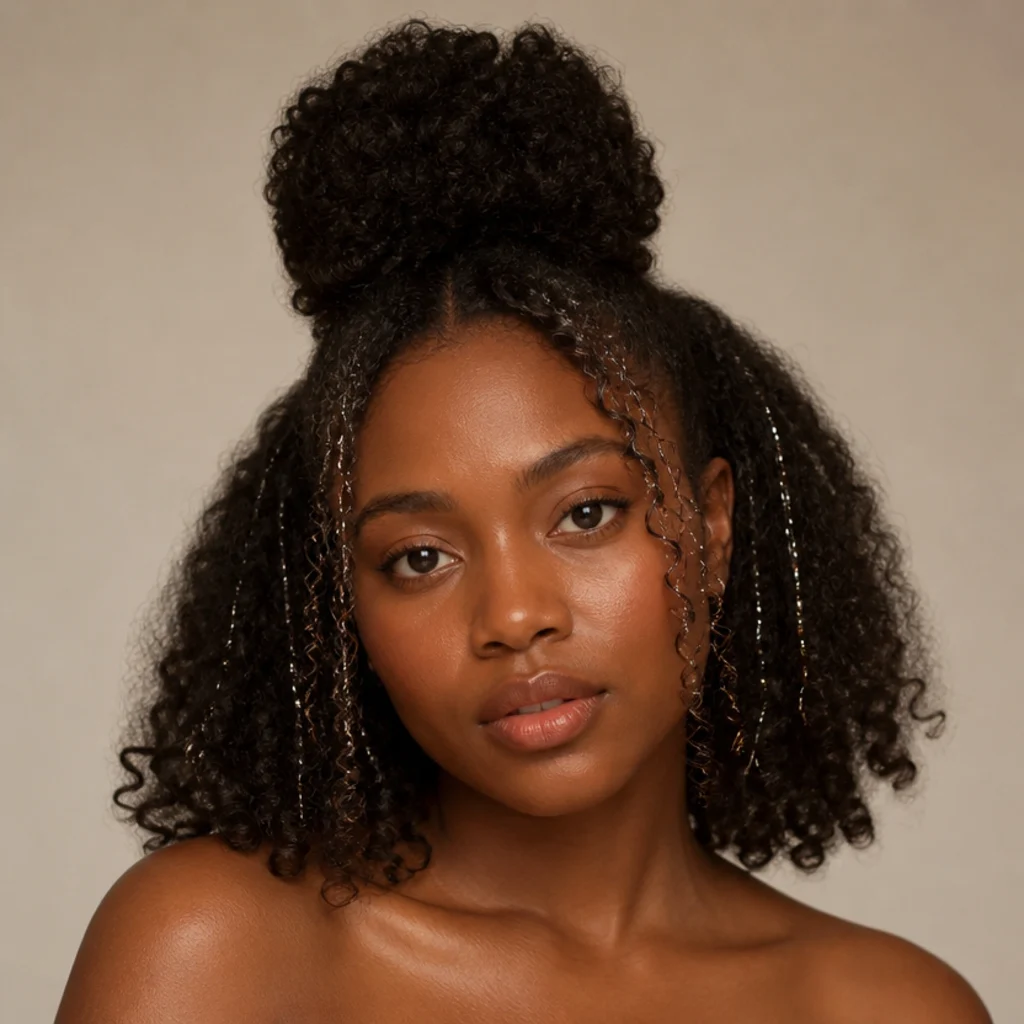
A half-up puff pulls the crown up while leaving length down, which creates two placement zones. Keep the sparkle in the face-framing pieces at the front so it stays visible whether the puff is up or the hair is later worn loose — that's what makes this install so versatile. It suits medium-length coily or curly hair that gathers into a soft crown puff without excess tension on the edges.
Those front pieces get handled every time you restyle, so double-knot them well at the root to survive daily re-puffing. Upkeep is moderate given how often the style changes, but well-anchored strands still hold 4 to 6 weeks. Difficulty is low. Ask for "tinsel concentrated in the face-framing sections so it shows when I wear a half-up puff," and mention that you restyle often so your stylist knots for durability rather than a single wear.
10Emerald and Teal Cool-Tone Tinsel
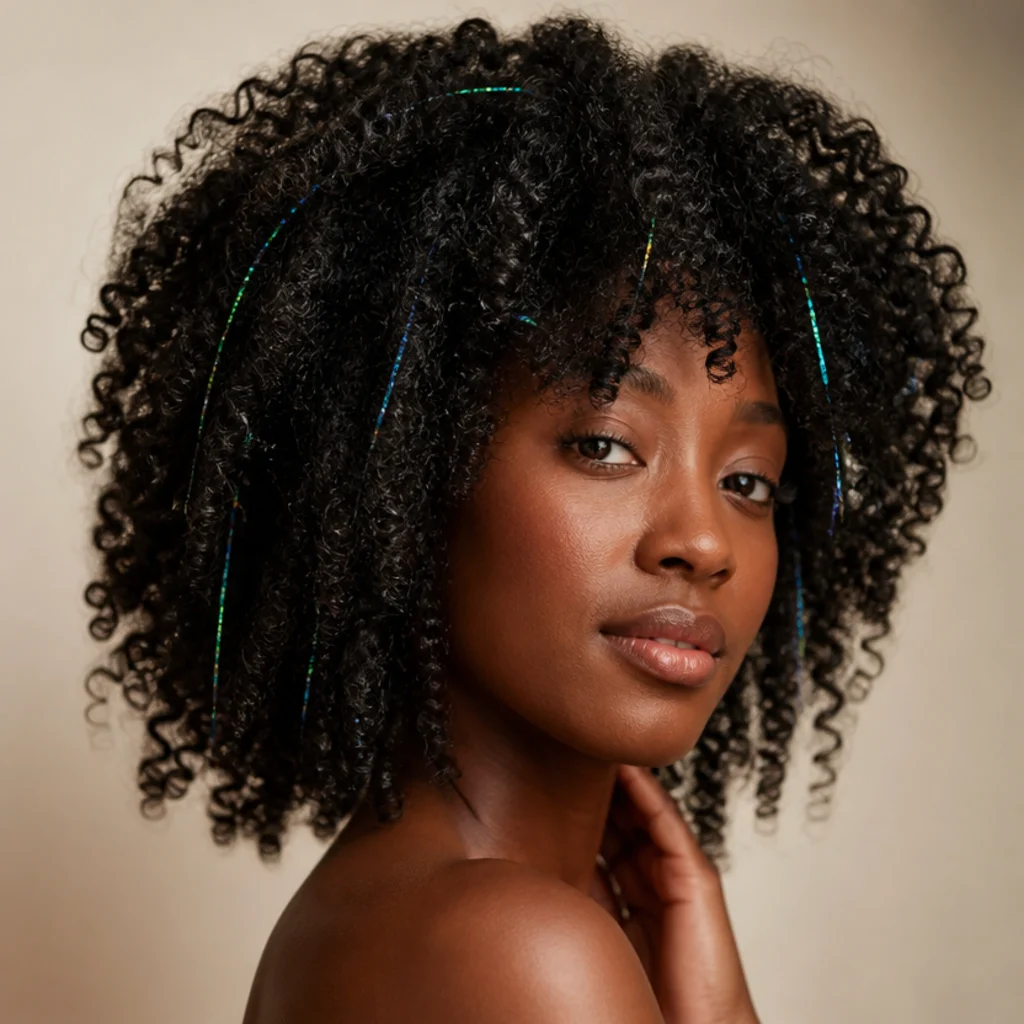
Cool jewel tones are underused on dark hair and worth trying. Emerald and teal tinsel add a colored shimmer that stays subtle because the strands are so fine: you get a hint of green-blue light rather than a bold streak, good for anyone who wants color that isn't pink or gold. The tint reads richest against a true jet-black base, where the cool light has the most contrast.
Jewel-tone film can be slightly stiffer than metallics, so smooth each strand down after washing to keep it from kinking. Maintenance otherwise matches standard tie-in strands, with a comfortable 4 to 6 week window. Difficulty is low. To ask a pro, request "cool-tone tinsel in emerald and teal, lightly scattered," and clarify you want the tinted-metallic version, not a dyed color streak, so no one reaches for actual color product. Pair it with a cool-toned makeup look to tie the shimmer together.
Save this to Pinterest and pin the color pairings that catch your eye for later reference.
11Tinsel in a Sleek Low Bun
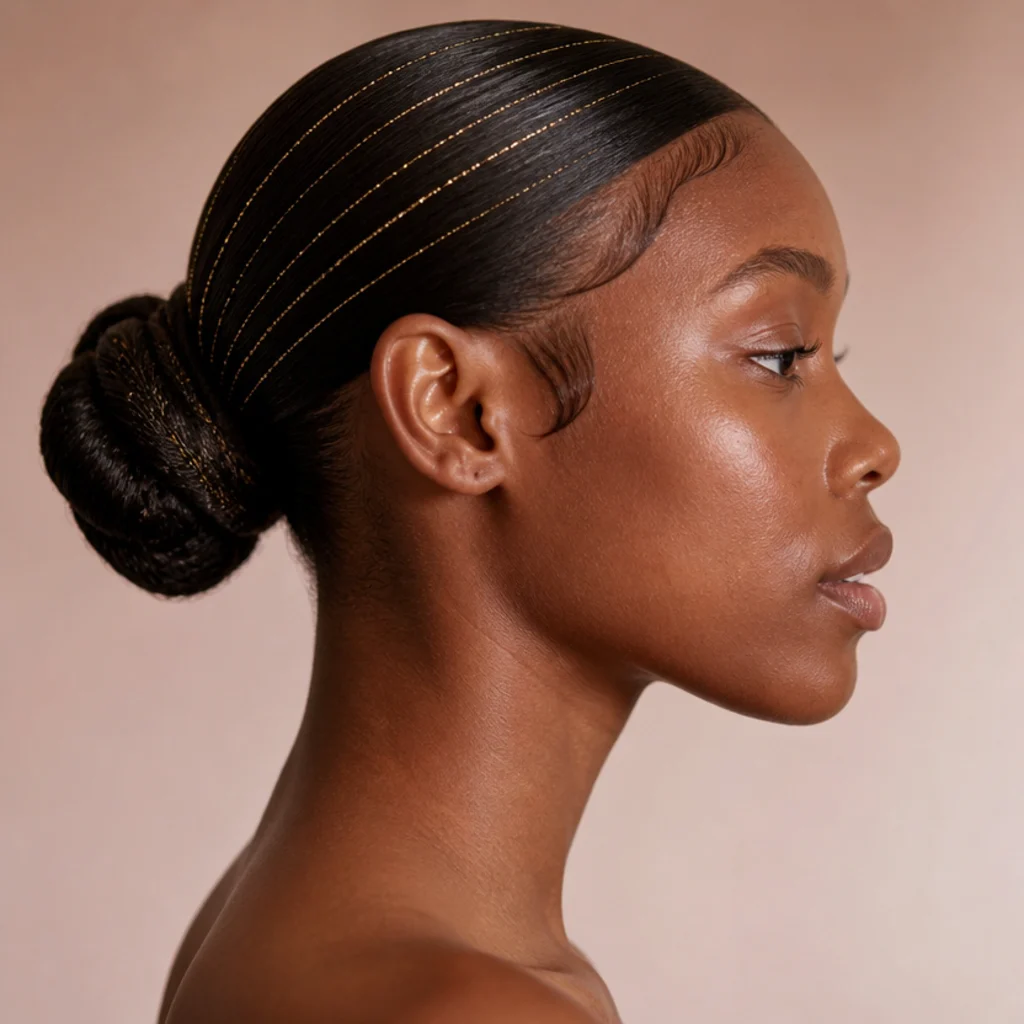
A sleek low bun makes tinsel look polished and grown-up. Weave fine strands into the smoothed-back sections so they run in clean lines from the hairline to the nape, following the direction of the slick-back. Against gelled, glossy hair the tinsel nearly disappears until the light hits, then flashes — that reads elegant and controlled rather than crafty, and it's a strong pick for events and offices alike.
The whole look depends on smoothness, so trim any strands long enough to poke out of the bun. Upkeep is moderate since you're maintaining laid edges and shine together; expect a 2 to 4 week window before the slick needs a full redo. Difficulty is medium for tidy placement. Ask for "fine tinsel worked into a slicked-back low bun, following the direction of the hair," so it reads sleek and directional rather than loose or scattered.
12Copper Tinsel on a Tapered Cut
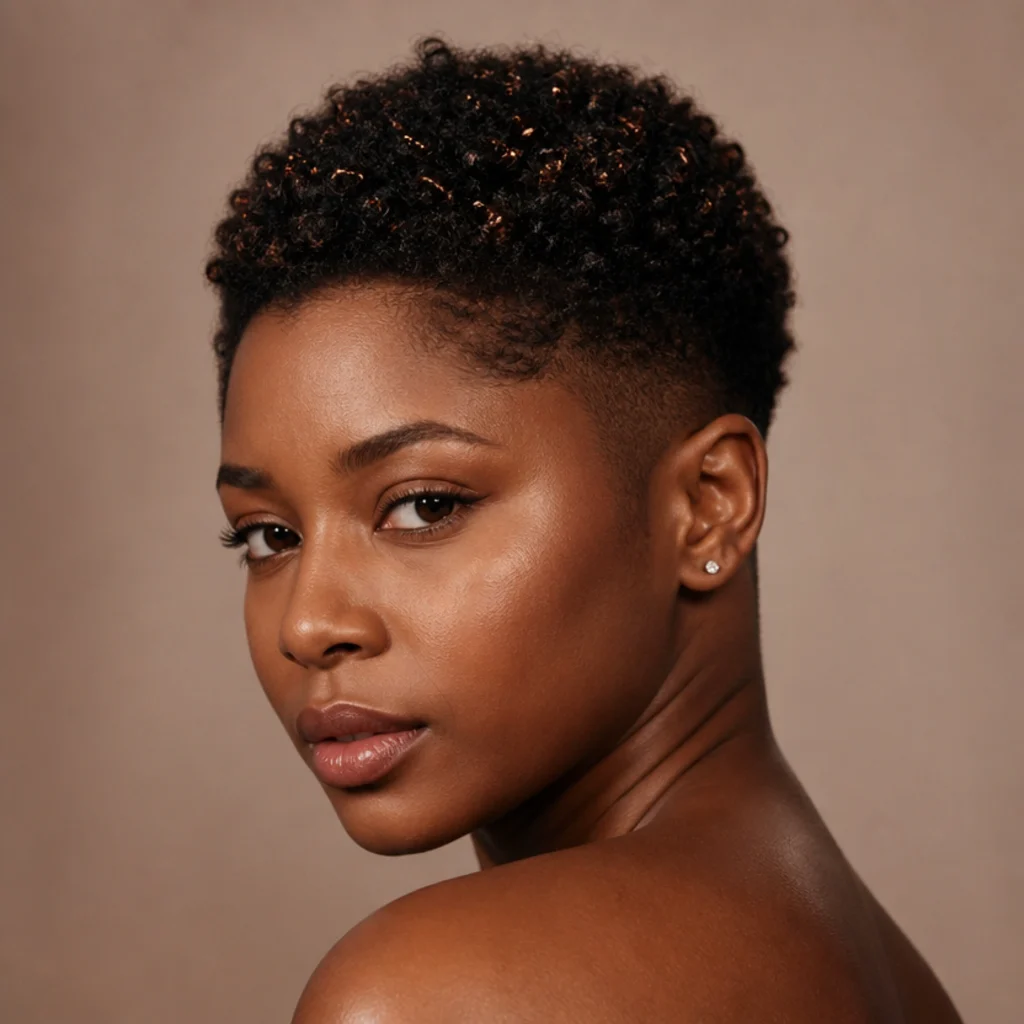
Short hair takes tinsel well when you concentrate it where there's length, usually the coily crown of a tapered cut. Copper strands warm the top and draw the eye upward, complementing clean faded sides and adding dimension a solid dark crop can lack. You don't need long hair for the trend to land, and it suits round and oval faces where volume up top balances the shape.
Short strands have less hair to grip, so knot carefully at the root and expect a slightly shorter lifespan than long lengths get, roughly 3 to 5 weeks. Maintenance is otherwise easy given the small area. Difficulty is medium because precision matters on short hair. Tell your barber or stylist you want "copper tinsel in the longer crown section of my taper, kept off the faded sides," so the shine stays where the hair can actually hold it.
13Holographic Tinsel Ponytail
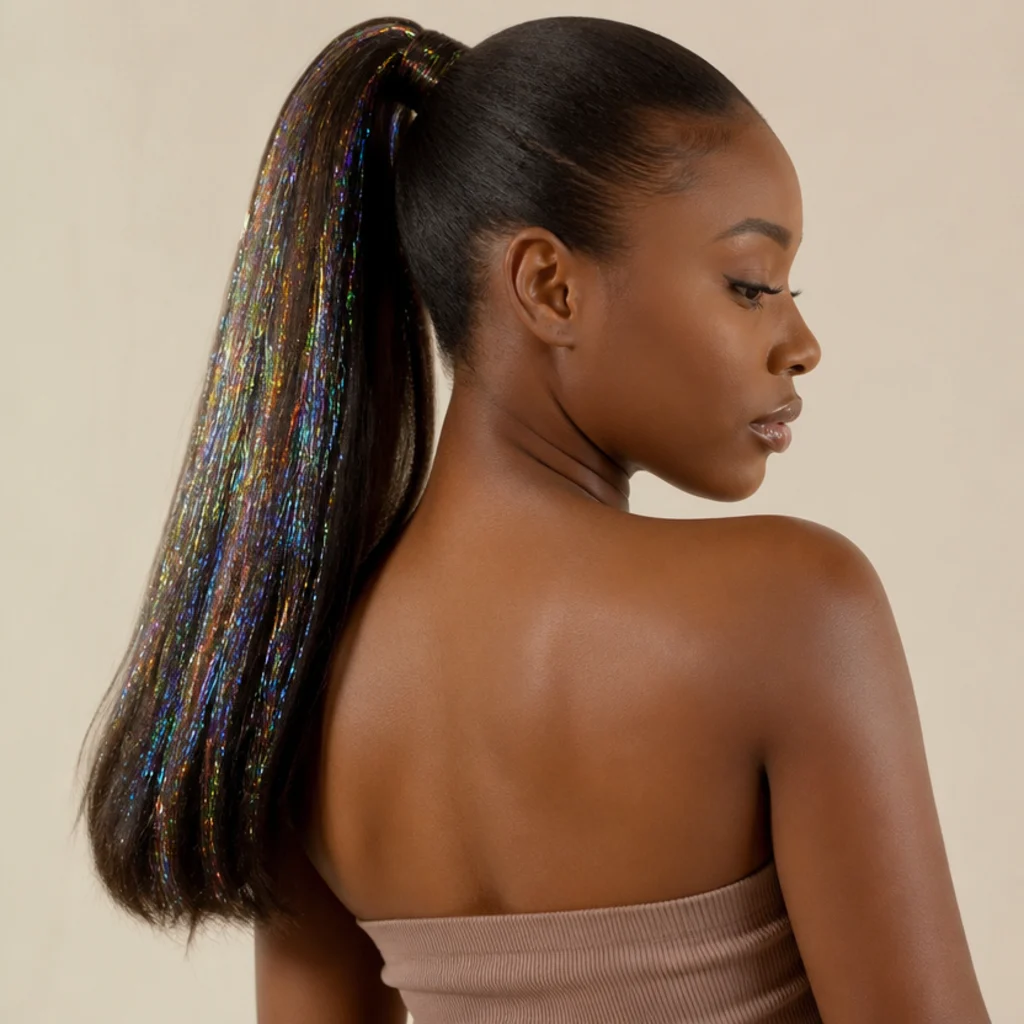
A high ponytail puts every strand of tinsel on display as the length swings, so it's one of the best places to show off reflective film. Holographic strands throw a full spectrum, turning a slick pony into moving sparkle under stage or event lighting. It works on your natural length or with an added ponytail wrap or extension when you want extra drama and drop.
Ponytails create real tension at the base, so keep the tinsel roots knotted below the elastic where they won't get yanked each time you tie up. Upkeep is moderate, mostly protecting the strands from the band when you restyle, and knotted strands hold 4 to 6 weeks. Difficulty is low. Ask for "holographic tinsel through the ponytail length," and say whether you're using your own hair or a wrap so placement is planned around where the extension attaches rather than fighting it.
14Tinsel Threaded Through Cornrows
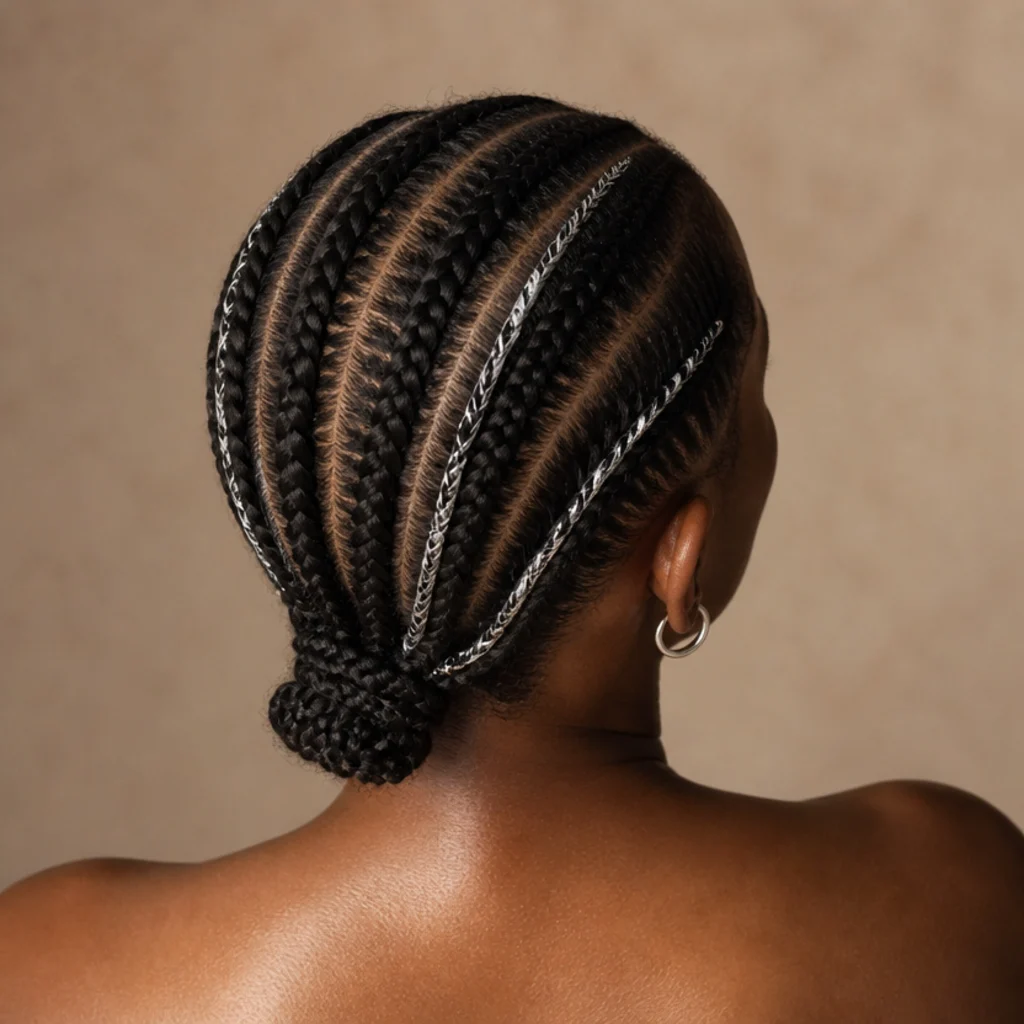
Cornrows create crisp, graphic lines, and tinsel threaded along a few of them turns those lines into ribbons of light. Cornrows sit flat to the scalp, so the strands lie smooth and follow the braid pattern exactly, and that's what gives this look its clean, geometric read. Straight-back rows and more intricate geometric parts both carry it well, and the placement highlights the parting design itself.
This one is durable and low-maintenance, since the tinsel is braided in and protected against the scalp. It rides out the full 6 to 8 week style with only nightly wrapping. Difficulty is low, but it has to be added during braiding, plait by plait. Ask your braider to "run silver tinsel along two or three of the cornrows so it follows the parting," and decide together which rows get the shine so the balance suits how you wear your part and which side faces out most.
15Subtle Champagne Tinsel for Work
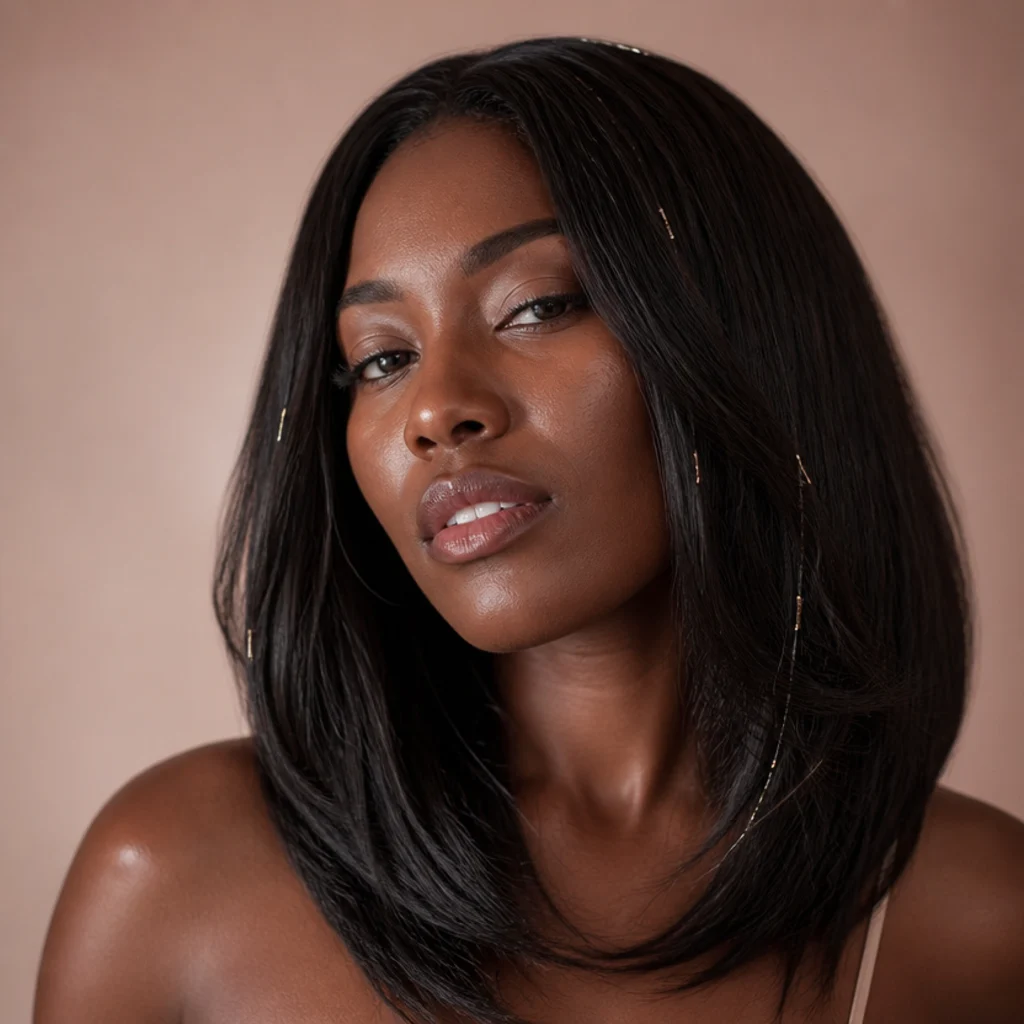
Not every tinsel look has to shout. Champagne and soft-gold strands used sparingly give a barely-there glimmer that suits conservative workplaces, since the tone is warm and neutral rather than bright. Ten or fewer strands tucked into the mid-lengths add warmth you notice only in direct light, keeping the effect refined and office-appropriate while still delivering that hair tinsel aesthetic.
Maintenance is minimal because there are so few strands to track, and a light install like this can quietly last 6 weeks. Difficulty is low, making it an easy first attempt at home. To ask a pro, request "just a few champagne tinsel strands, very subtle, nothing bright," and say up front that you want it understated so no one over-installs. Pick this version when you want a quiet, grown-up finish that reads as healthy shine rather than obvious sparkle.
16Pink Tinsel on a Wash-and-Go
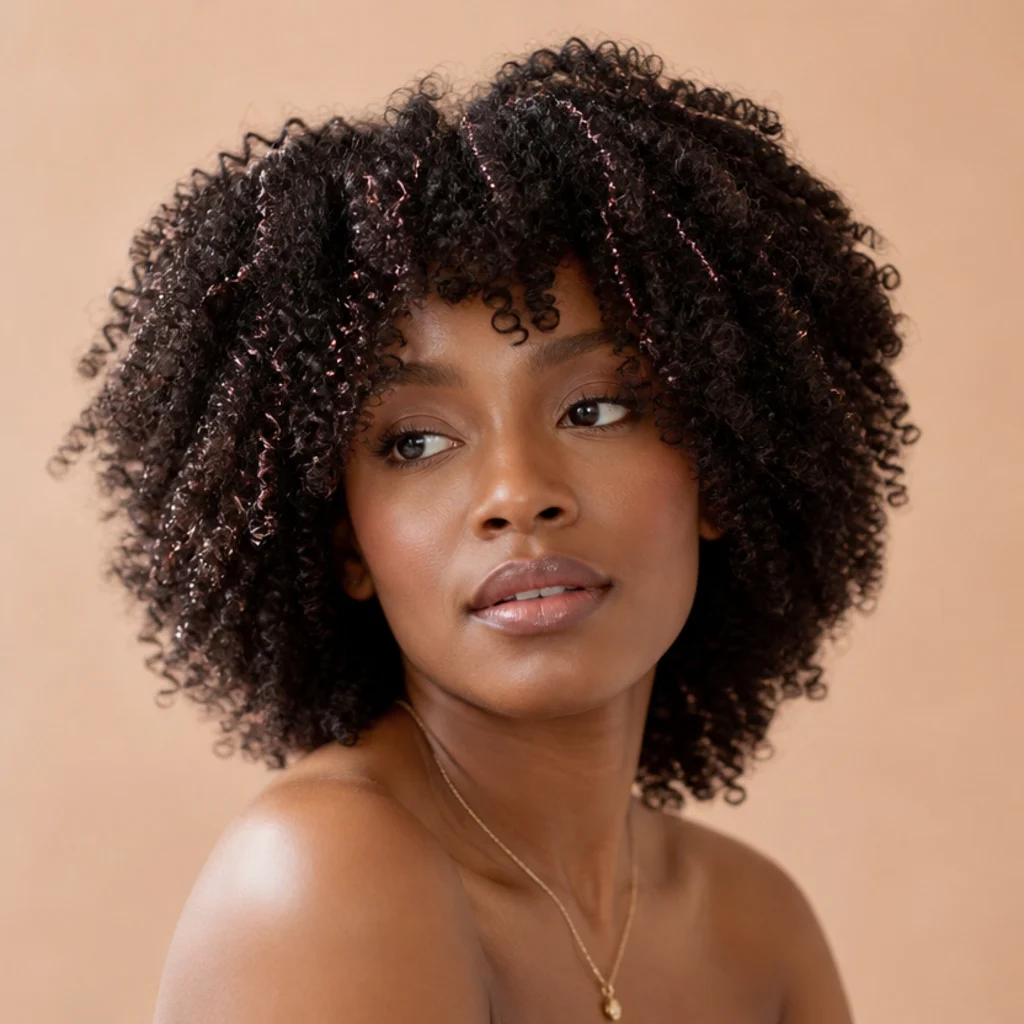
A wash-and-go celebrates natural texture, and pink hair tinsel scattered through it adds playful color without the stiffness of a gel-set streak. Place strands loosely so they move with your coils rather than weighing any section down, and let the soft pink glow against dark, defined 4A to 4C curls. The base is dark and matte, so even a warm, soft pink reads clearly.
Wash-and-gos get re-wet often, so tie-in strands double-knotted at the root are essential; anything less secure slides loose in the routine. Maintenance means gentle detangling around each knot and a nightly bonnet, with a realistic 4 to 6 week life through frequent washes. Difficulty is low. Ask a stylist for "pink tie-in tinsel scattered through a wash-and-go, placed so it does not disturb my curl clumps," so your natural pattern stays intact and the strands re-coil with the hair.
17Tinsel Accents on Bantu Knots
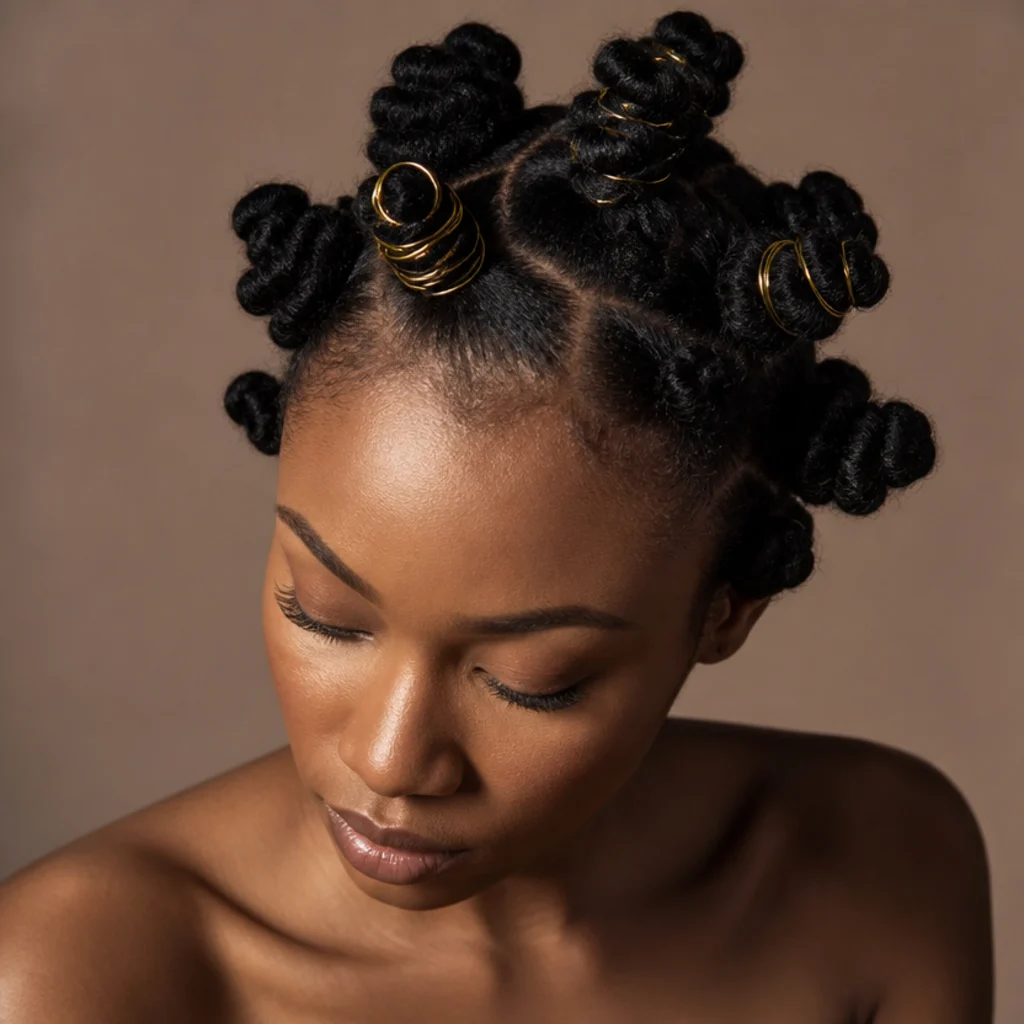
Bantu knots are sculptural on their own, and a wrap of tinsel around a few of them plays up the geometry instead of competing with it. Let the strands spiral around the base of select knots so the sparkle traces the shape and draws the eye to the pattern. It suits medium-length hair that coils into tidy, defined knots, and it photographs well from above, where the knot grid reads clearly.
Upkeep depends entirely on how long you keep the knots in. The tinsel stays put while they do, and the strands can carry straight into the curl-out when you take them down. Difficulty is low to medium for neat wrapping. Ask your stylist to "wrap gold tinsel around a few of the bantu knots, not all of them," so the accent stays intentional and the sparkle doesn't flatten into the style. Save the wrapped knots for the ones most visible when you wear the style up.
18Full-Sparkle Festival Tinsel
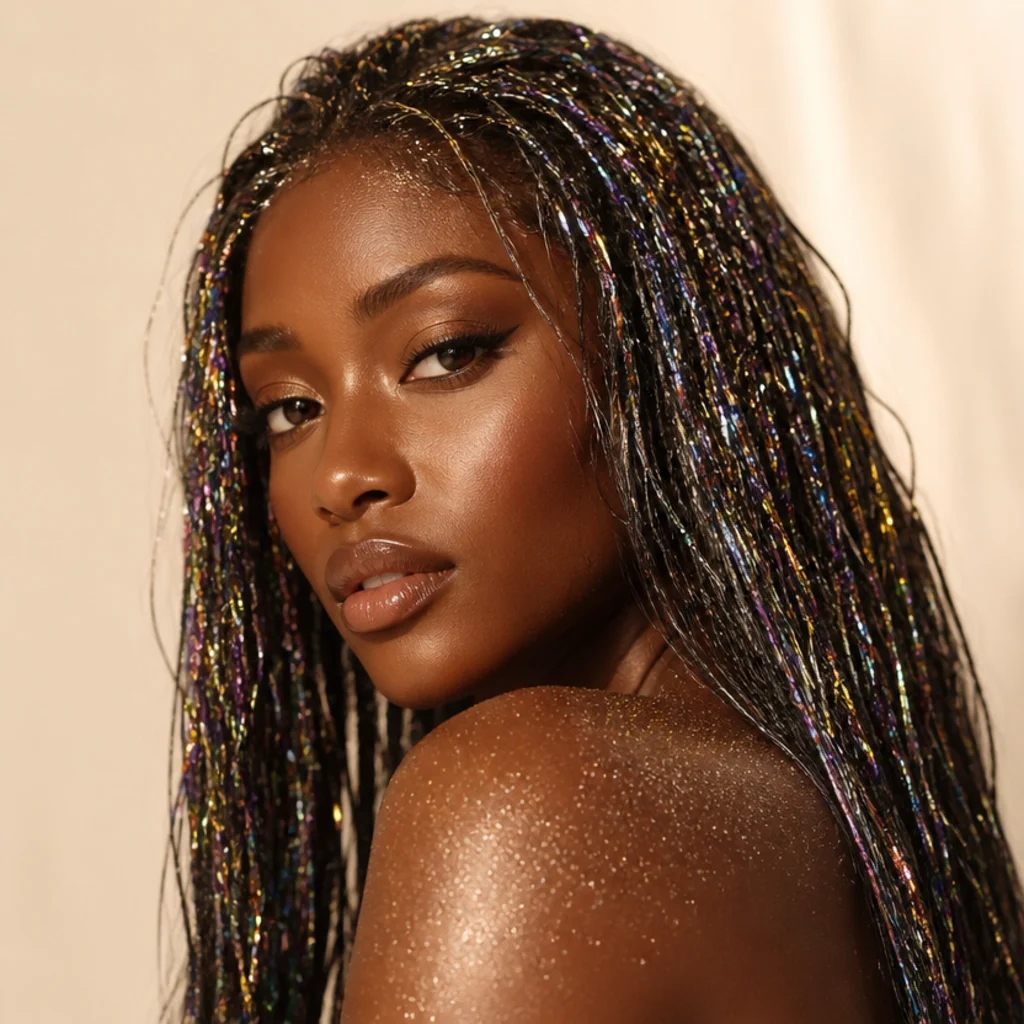
Sometimes maximum shine is the point. A festival install loads 50 or more strands across the whole head, mixing silver, gold, and colored tinsel for all-over glimmer that reads bold on camera and under lights. On black hair the density still looks lightweight, since tinsel weighs almost nothing, so you get drama without the heaviness of a full color service.
This is the higher-maintenance end of the spectrum, because there's more film to protect and more strands to shed over time — plan on a shorter clean-looking window of 3 to 5 weeks. Difficulty is low per strand but time-consuming given the volume, so budget real chair time. Tell a pro you want "a full, dense tinsel install, mixed metallics and colors, all over," and set aside the appointment length. A satin bonnet every night is non-negotiable here if you want to keep the most strands intact.
19Tinsel on a Tapered TWA
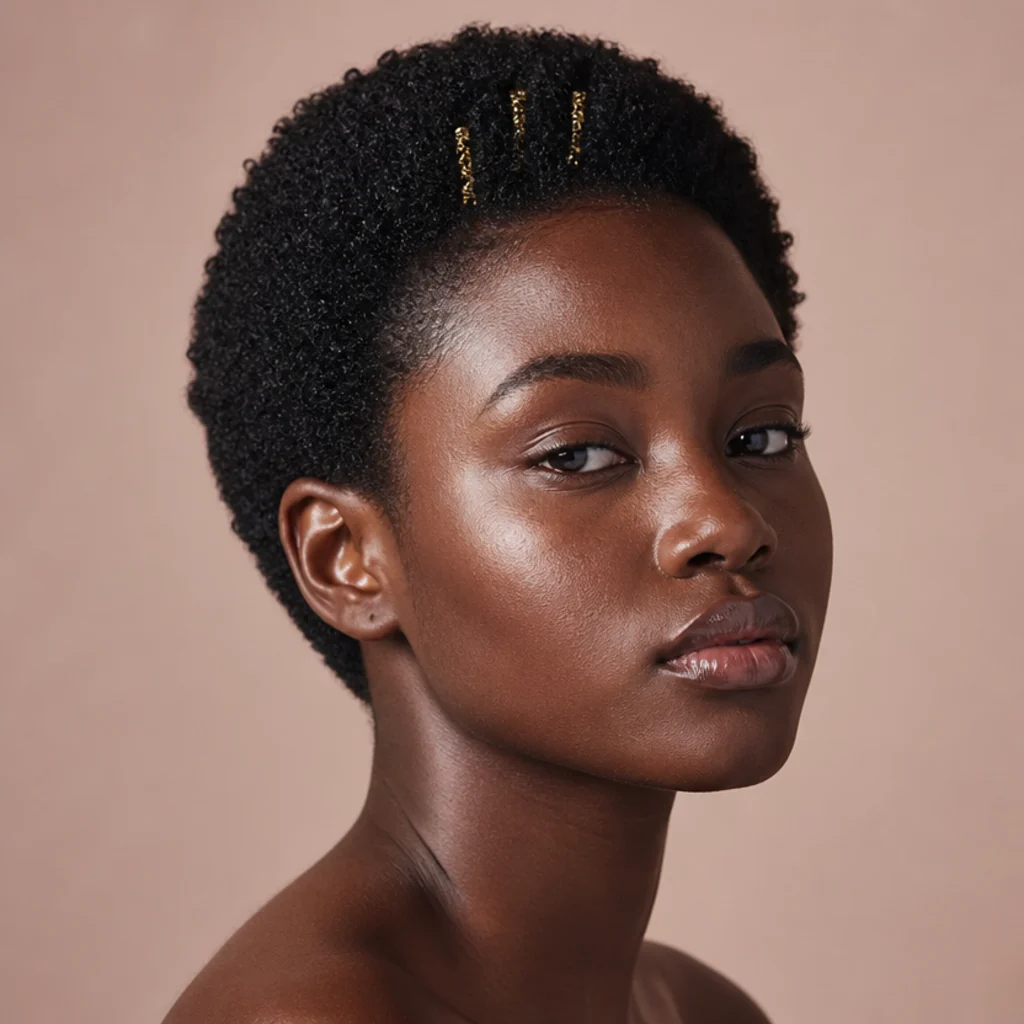
A teeny weeny afro seems too short for tinsel, but a few well-placed strands at the crown add unexpected shine and prove the trend isn't length-dependent. A TWA is dense and dark, so even three or four sparkles stand out clearly, which means restraint is the whole strategy. Focus them at the top where the hair is fullest and daylight reaches, and it also draws the eye upward and elongates the shape.
Short coils grip a strand less than long hair does, so knot securely at the very base and expect to replace strands sooner, roughly a 2 to 4 week window. Maintenance is easy given the low count. Difficulty is medium because the short length demands precise, tight knotting. Ask your stylist for "a few gold tinsel strands at the crown of my TWA, knotted tightly so they hold," and keep the count deliberately small so it reads like a natural glint rather than an obvious add-on.
20Tinsel-Edged Space Buns
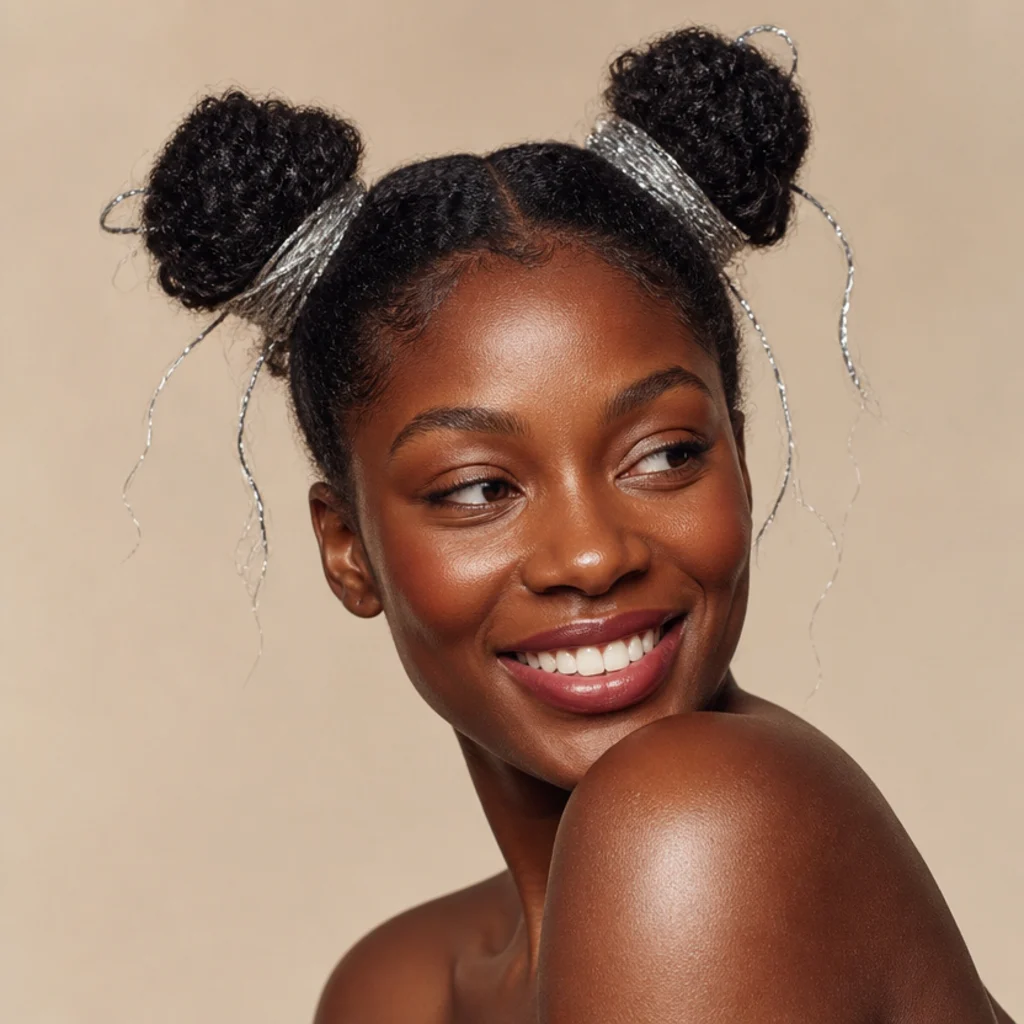
Space buns are playful, and tinsel wrapped around each bun pushes the fun a step further. Coil the strands around the base of both buns so the sparkle rings them evenly and mirrors side to side, keeping the look balanced and photo-ready. It suits medium-length coily or curly hair that gathers into two clean crown buns without straining the edges.
The buns get rebuilt every time you wear them, so plan to re-tuck or re-wrap the strands at each restyle. That makes upkeep moderate even though the strands themselves last 4 to 6 weeks. Difficulty is low. Ask for "silver tinsel wrapped around each space bun so it circles the base," and say whether you want the strands to trail out of the buns for extra movement or stay tucked for a cleaner, sculpted shape — that single choice changes the whole vibe.
Pro Tips from the Editor
- Double-knot, then tug-test. A single knot slides. A small double knot at the root is what carries tie-in tinsel through 4 to 8 weeks. After tying, give each strand a gentle downward tug before you move on, so any loose ones fail on the spot instead of on your pillow.
- Match the finish to your base, not just the trend. Silver and holographic give the most contrast on the darkest hair, gold and copper flatter warm undertones, and jewel tones need a true jet-black backdrop to register — a soft off-black mutes cool film.
- Keep direct heat off the film. Most tinsel is mylar and can warp, curl, or melt under a flat iron or a close blow-dryer nozzle. Press or blow-dry the hair first, then install the strands, and work around them on future heat days.
- Braided-in beats tie-in if you're rough on your hair. If you sleep without a bonnet or restyle constantly, plait the tinsel into box braids, cornrows, or locs so it's physically locked in rather than relying on a knot.
- Plan placement around how you actually wear your hair. Strands hidden in a section you always tuck away are wasted. Point out your everyday part, your face-framing pieces, and the side that faces out in photos before the stylist starts.
- Budget for shedding and keep spares. Losing a strand or two a week is normal, not a defect. Ask for a few extra strands at your appointment, or keep a DIY pack, so you can replace a face-framing piece without rebooking.
- A satin bonnet or silk pillowcase is the single biggest longevity upgrade. Friction is what creases iridescent film and loosens knots. Cutting it down at night can add weeks to any install.
Tinsel Methods at a Glance
| Method | How it attaches | Typical wear time | Best for | Watch-outs |
|---|---|---|---|---|
| Tie-in | Looped and double-knotted at the root | 4 to 8 weeks | Coils, curls, wash-and-gos, most DIY | Needs secure knots; detangle gently around them |
| Braided-in | Plaited into braids, cornrows, or locs | 6 to 8 weeks (life of style) | Protective styles, low upkeep, rough handling | Must be added during install, not after |
| Heat-bond / micro-bead | Clamped with a small bead | 2 to 4 weeks | Quick add-ons, sleek pressed styles | Releases soonest; avoid direct flat-iron heat |
How to Choose / Get the Look
Start with placement and density, not color — that single decision drives everything else. Choose a quiet accent (5 to 15 strands near the face or part) for healthy-looking shine that reads subtle in daylight, or full sparkle (30-plus scattered all over) when you want the look to carry a photo or an event. Write the number down before your appointment so you and your stylist are aligned, since "a little tinsel" means very different things to different people.
Next, match the method to your texture and habits. On coily and curly hair and any wash-and-go, tie-in strands placed along your natural curl clumps or braid lines let the tinsel move with the hair instead of splitting your definition. On sleek, pressed, or bun styles, keep strands flat and root-knotted so they lie clean. If you restyle daily, sleep without a bonnet, or just want to forget about it for two months, go with a braided-in install in box braids, cornrows, or locs so the strand is locked in rather than depending on a knot.
Then pick color by undertone. Silver and holographic read as pure light and give the sharpest contrast on the darkest bases. Gold and copper add warmth that flatters brown undertones. Pink, rose-gold, emerald, or teal deliver soft color with no dye and no lightening. Warm tones like rose-gold pink hair tinsel tend to flatter deep bases especially well.
If you're wondering how to put tinsel in hair yourself, the tie-in method is the most forgiving: separate a small section at the root, fold a strand around it, and secure it with a tiny double knot close to the scalp. Braided and loc styles are best installed by a pro during the service. Whatever you choose, protect the strands with a satin bonnet at night, keep direct flat-iron heat off the film, detangle gently around the knots, and expect to shed a few strands weekly. That's normal.
Frequently Asked Questions
How long does hair tinsel last in black hair?
Tie-in tinsel typically holds its look for 4 to 8 weeks and rides through wash days if it's double-knotted securely at the root. Tinsel braided into box braids, cornrows, or locs lasts as long as the protective style itself, usually 6 to 8 weeks. Heat-bonded or micro-bead strands release soonest, closer to 2 to 4 weeks. Across every method, expect to naturally shed a strand or two each week.
Does hair tinsel damage natural or coily hair?
Tie-in tinsel is low-risk because it loops around a small section and comes out by cutting the knot, never by pulling the strand out. The two things to watch are tension and heat: detangle gently around each knot so you don't create a pull point, and keep flat irons off the strands, since high heat can warp or melt the film and stress the hair around it in the process. Braided-in tinsel carries the same tension considerations as any braid, so avoid installs that feel tight at the scalp.
What color tinsel looks best on black hair?
Silver and holographic give the brightest, most light-catching contrast on the darkest bases, since there's nothing to mute the reflection. Gold and copper add warmth that flatters brown undertones, and soft colors like pink hair tinsel, rose-gold, emerald, and teal read beautifully against dark hair with no dye at all. The right pick comes down to whether you want cool, mirror-like shine or a warm, soft glow — jewel tones register most clearly on a true jet-black base.
Can I put tinsel in curly hair or a wash-and-go?
Yes — curly hair tinsel is one of the most flattering ways to wear it. Place each strand to follow your curl clumps rather than combing it straight through, so the film coils with the hair and preserves your definition. On a wash-and-go, use tie-in strands double-knotted at the root so they survive frequent re-wetting, and finger-detangle around the knots on wash day to keep both the curl pattern and the strands intact.
How do you put tinsel in hair at home?
The tie-in method is easiest for beginners: separate a small section at the root, fold a tinsel strand in half around it, and secure it with a small double knot close to the scalp. Space the strands a few sections apart for a scattered look, and tug-test each one so any loose knots fail before you leave the mirror. Braided and loc styles are best left to a stylist during installation, since the strand has to go in as the style is built.
How many tinsel strands should I use?
Match the count to the effect you want. For a subtle, office-friendly glimmer, 5 to 15 strands tucked into the mid-lengths or face frame is plenty. For a noticeable accent, 15 to 25 scattered strands read clearly without taking over. A full festival or all-over sparkle look runs 30 to 50 or more. On short hair like a TWA or tapered crown, fewer strands go a long way, since the dense, dark base makes each one stand out.
Can you wash and heat-style hair with tinsel in it?
You can wash normally: shampoo and condition gently, avoid raking a brush straight through the strands, and detangle around the knots with your fingers or a wide-tooth comb. Heat is the real limit. Most tinsel is heat-sensitive film, so keep flat irons and hot blow-dryer nozzles off the strands directly. If you press or blow-dry, do it before installing the tinsel, then work around the strands on future styling days.
Will hair tinsel damage or slip out of fine edges or thin hair?
Tinsel itself weighs almost nothing, so the strand isn't the risk — tension is. Avoid heat-bond beads and tight braided installs near fragile edges, and choose tie-in strands placed in the mid-lengths rather than right at a delicate hairline. Knotless braids with lightly wrapped tinsel are a gentle option, since they feed in without pulling at the root. Take the style down or loosen it if anything feels tight.
How do you take hair tinsel out without breakage?
For tie-in strands, slide a fine-tooth comb or your fingers down to the knot, snip only the knot with small scissors, and the strand releases without pulling any hair. Never yank a strand out from the length — that drags on the attached hair. Braided-in tinsel just comes out when you take the braids or locs down. Working over a light surface makes it easy to spot and collect the tiny strands as they release.