15 Hair Tinsel Ideas for Curly Hair
Sparkle strands read as scattered light on curls, not a flat metallic line. These 15 tinsel ideas are engineered for coils, ringlets, and kinks, with strand counts, undertone matches, placement maps, and realistic upkeep for every texture.
 Edited by Lena Rose · Published July 11, 2026 · 27 min read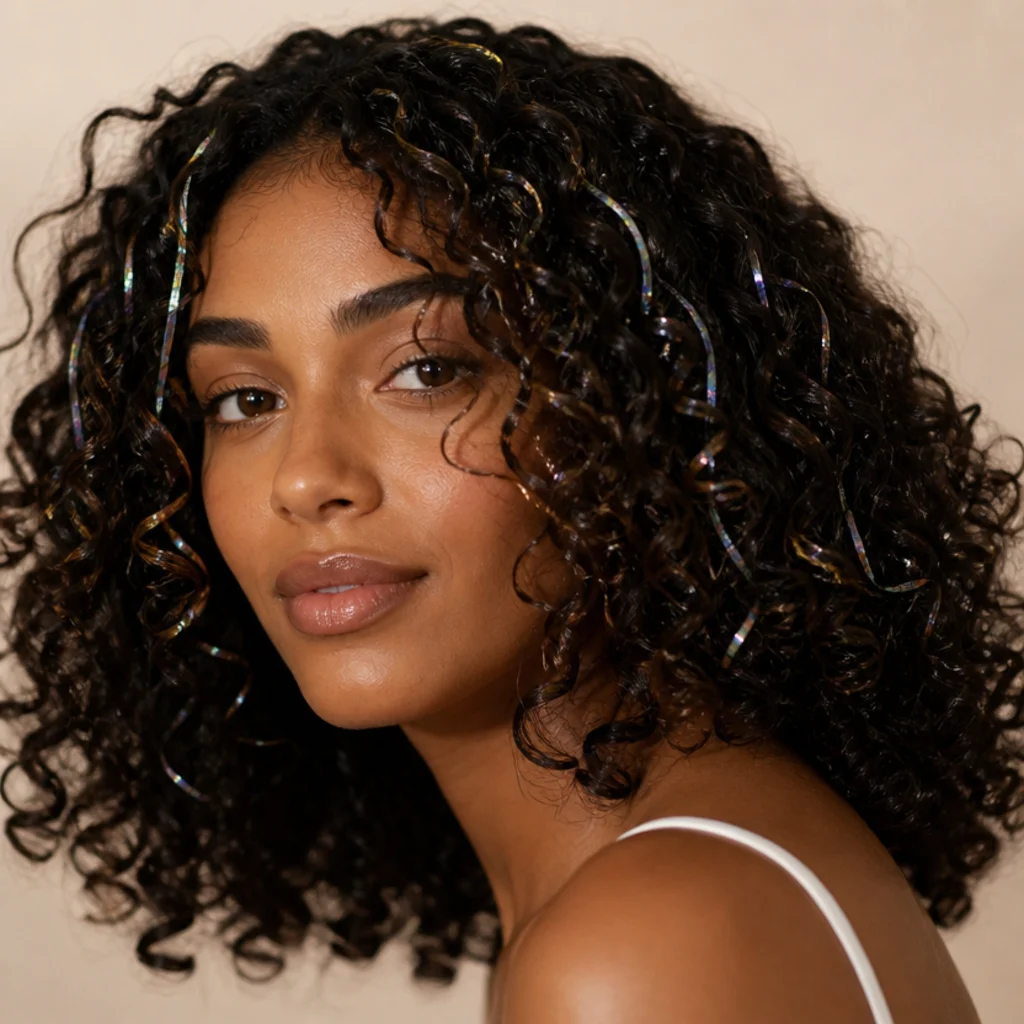
Quick Answer
- Best for: Curly, coily, and textured hair that wants heat-free, dye-free shimmer without touching your actual color
- Who might skip it: Anyone mid-transition with very fragile strands, or people who re-wet and restyle daily and won't want to re-check knots
- Maintenance: Tie each strand individually with a double knot so it survives cleansing; loosely finger-check knots on wash day
- Difficulty: Beginner for 8-15 strands you place yourself; intermediate for full-head or graphic side-part work
- Cost: DIY kits typically run low (roughly a drugstore-to-mid range for a multi-strand pack); a salon install is usually charged per strand or as a set add-on and climbs with density
- Wear time / longevity: About 3-6 weeks; metallics outlast colored film, wash-and-go styles shed a touch sooner
- Standout variation: Iridescent tinsel scattered through freshly gelled coils for a lit-from-within, color-shifting effect
- How to ask your stylist: Request "tie-in hair tinsel" and specify color, density (subtle, editorial, or festival), and placement zone, with a saved reference photo
In This Guide
- Iridescent Silver on Defined Coils
- Hair Tinsel on Black Hair for High Contrast
- Pink Hair Tinsel Through Loose Ringlets
- Rose Gold Tinsel on a Curly Half-Up
- Rainbow Tinsel Confetti on Type 4 Coils
- Gold Tinsel Framing the Face
- Tinsel Woven Into a Curly Ponytail
- Holographic Tinsel on a Wash-and-Go
- Tinsel Tucked Into Two-Strand Twists
- Purple Tinsel on Deep Espresso Curls
- Copper Tinsel for Warm Brunette Curls
- Tinsel Along a Curly Side Part
- Blue Tinsel on a Curly Updo
- Minimal Tinsel for a Subtle Everyday Shimmer
- Full-Sparkle Tinsel for a Festival Curly Look
Hair tinsel is heat-free, dye-free shimmer: thin strands of reflective mylar film that knot onto individual pieces of your own hair and hang the full length of the strand. On curly and coily textures it behaves nothing like it does on straight hair. Every bend in a curl catches the film and then hides it again, so a modest amount reads as scattered, moving light rather than a solid vertical stripe. The strand also travels with your pattern instead of hanging pin-straight against it, which is exactly why curly hair tinsel photographs with that lit-from-within depth. The trade-off is that placement is less predictable, so where you concentrate strands matters more than raw count. This guide covers all of it across 15 ideas: color theory for your undertone and base depth, strand-count ranges from barely-there to festival, and placement maps for crown, face-frame, part line, and gathered styles. You'll find dedicated notes on hair tinsel black hair contrast, soft pink hair tinsel, protective-style-friendly twists, and low-key everyday shimmer, plus who each look flatters, how much upkeep it actually needs, and the exact phrasing to hand your stylist. Pick the version that fits your texture, your undertone, and your patience.
01Iridescent Silver on Defined Coils
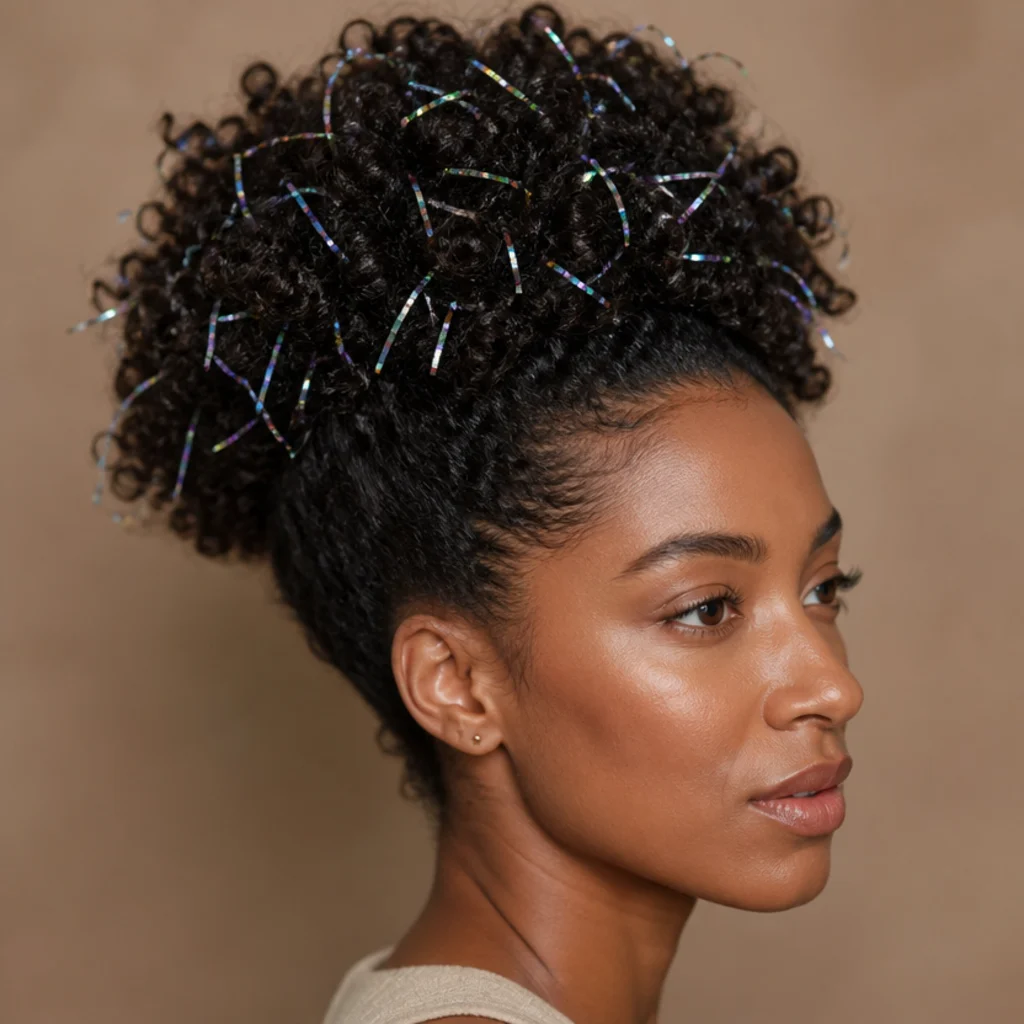
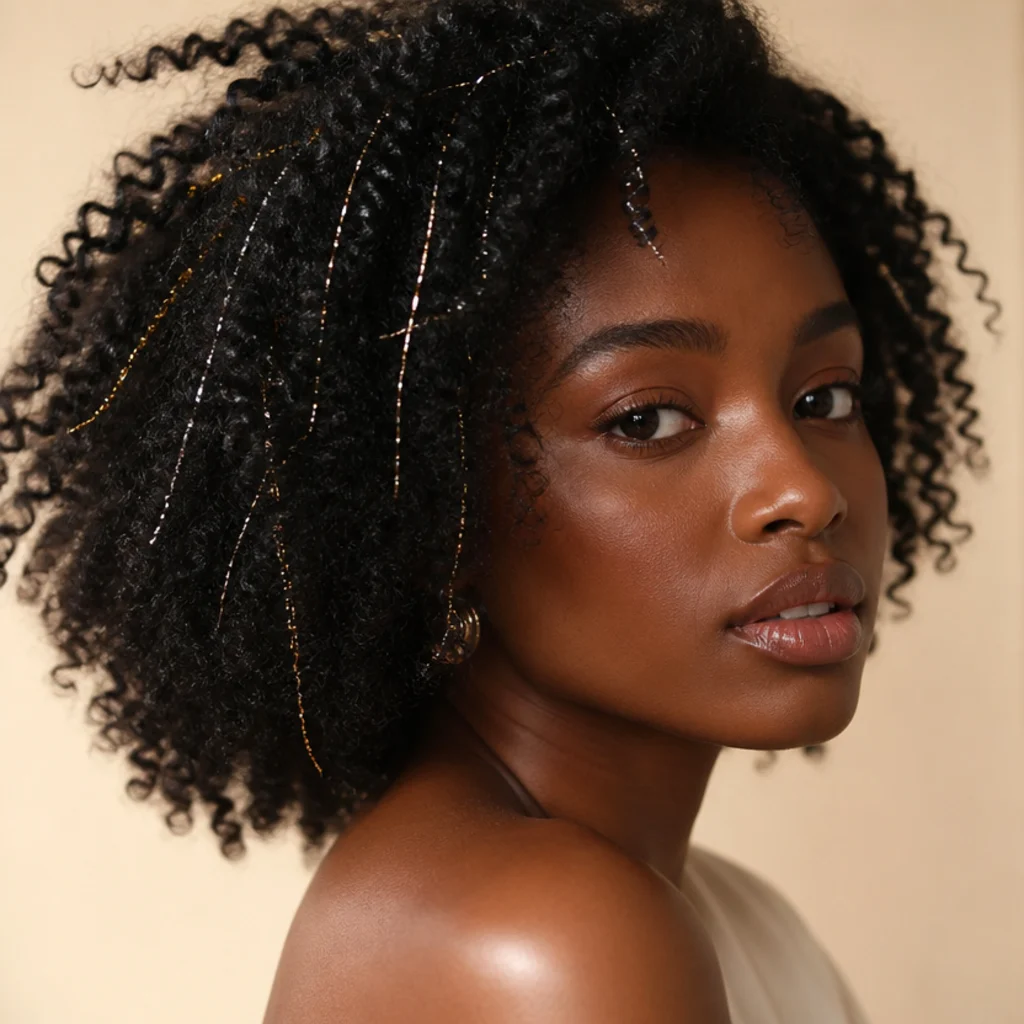
Iridescent silver is the smartest starting point because the film shifts through cool blues, lilacs, and pale greens as your coils move, so it never flattens into one hard metallic streak. It flatters every skin undertone, cool, neutral, and warm alike, and works on any curl pattern, but it peaks on freshly gelled, well-defined coils where each strand has a clean, glossy surface to bounce light off. Scatter 20 to 40 strands through the top and crown, the zone people's eyes land on first, and leave the nape sparse so the effect stays weighted upward. Because the finish is reflective rather than colored, it won't fade, so your real timeline is knot security: expect three to six weeks before strands naturally shed. Pro tip: set your coils with a firm-hold gel before installing so the surface stays defined and mirror-smooth around each knot; a frizzy halo scatters the reflection and dulls the shimmer. Ask your stylist for "scattered iridescent tinsel, weighted to crown and face-frame," and bring a photo.
02Hair Tinsel on Black Hair for High Contrast
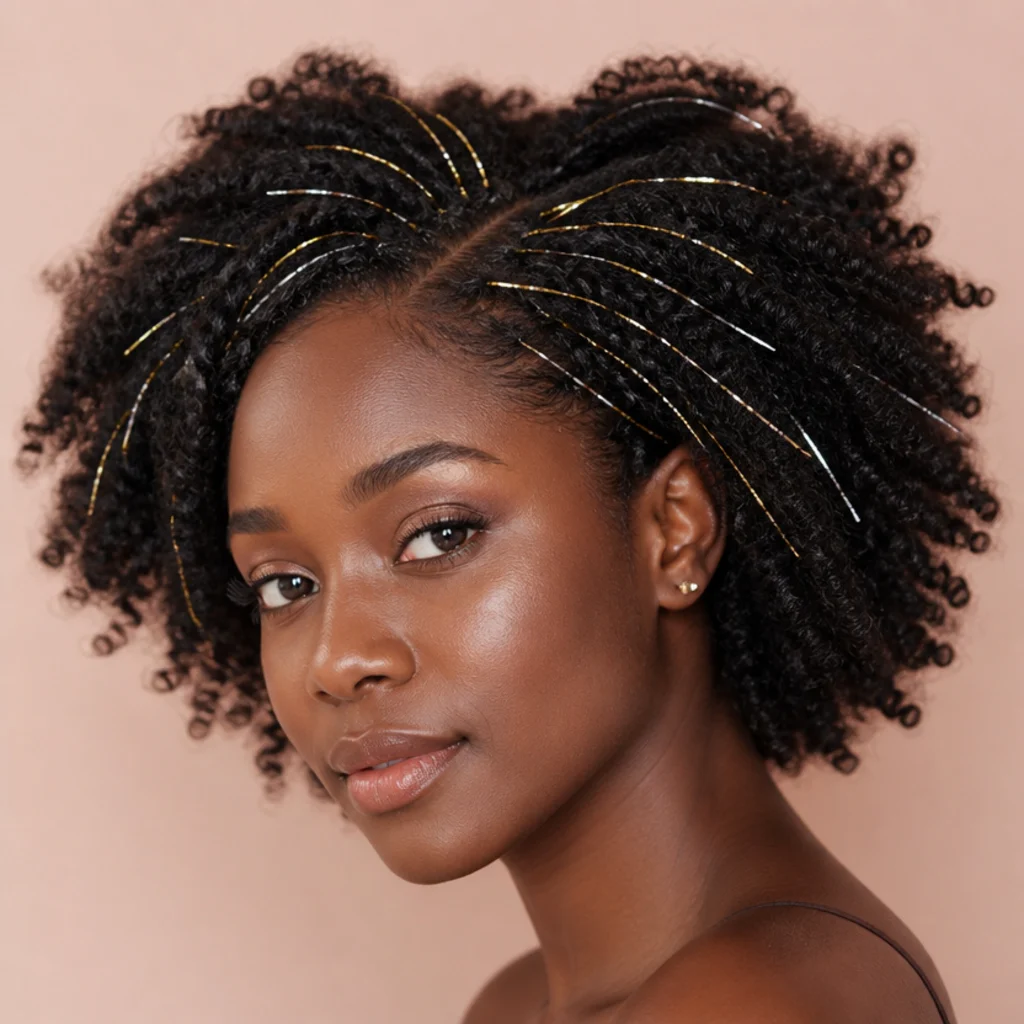
On deep black hair, tinsel earns its impact through contrast rather than volume. Bright metallics, cool silver, warm gold, and prismatic holographic film, read almost like fiber-optic threads against the dark base, so you need far fewer strands to look intentional. This hair tinsel black hair approach suits anyone who wants shimmer without color-committing, and it flatters dense type 4 coils especially because the matte-dark base makes each reflective strand snap. Concentrate placement near the part and crown, where overhead light lands most directly, and keep the perimeter clean so the contrast stays editorial instead of speckled. Fifteen to 25 strands usually reads deliberate and high-fashion; push past 40 only if you want maximum sparkle. Pro tip: keep heavy butters and oils off the film itself, since a coated surface goes cloudy and kills the mirror finish within days, apply your leave-ins to the strand mid-shaft and ends, working around the tinsel. Ask your stylist for "high-contrast metallic tinsel, concentrated at the part."
03Pink Hair Tinsel Through Loose Ringlets
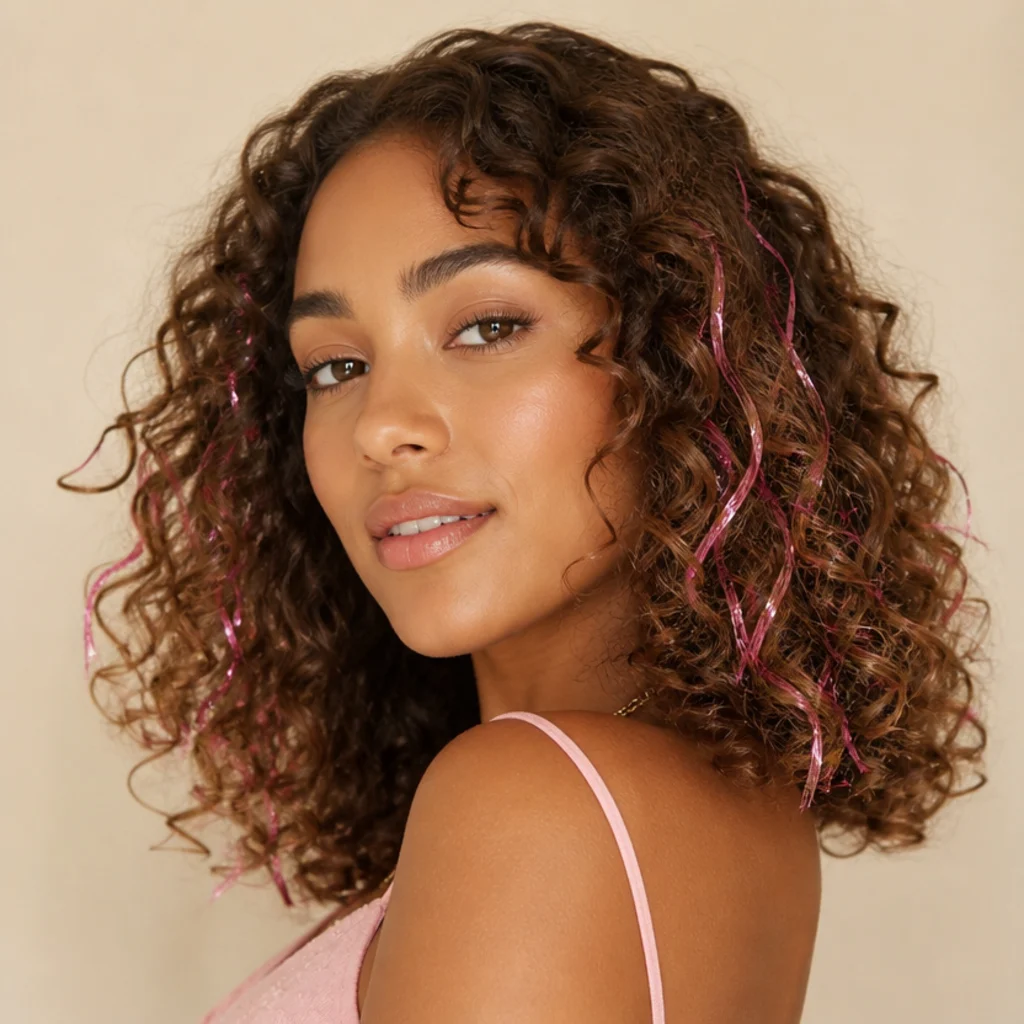
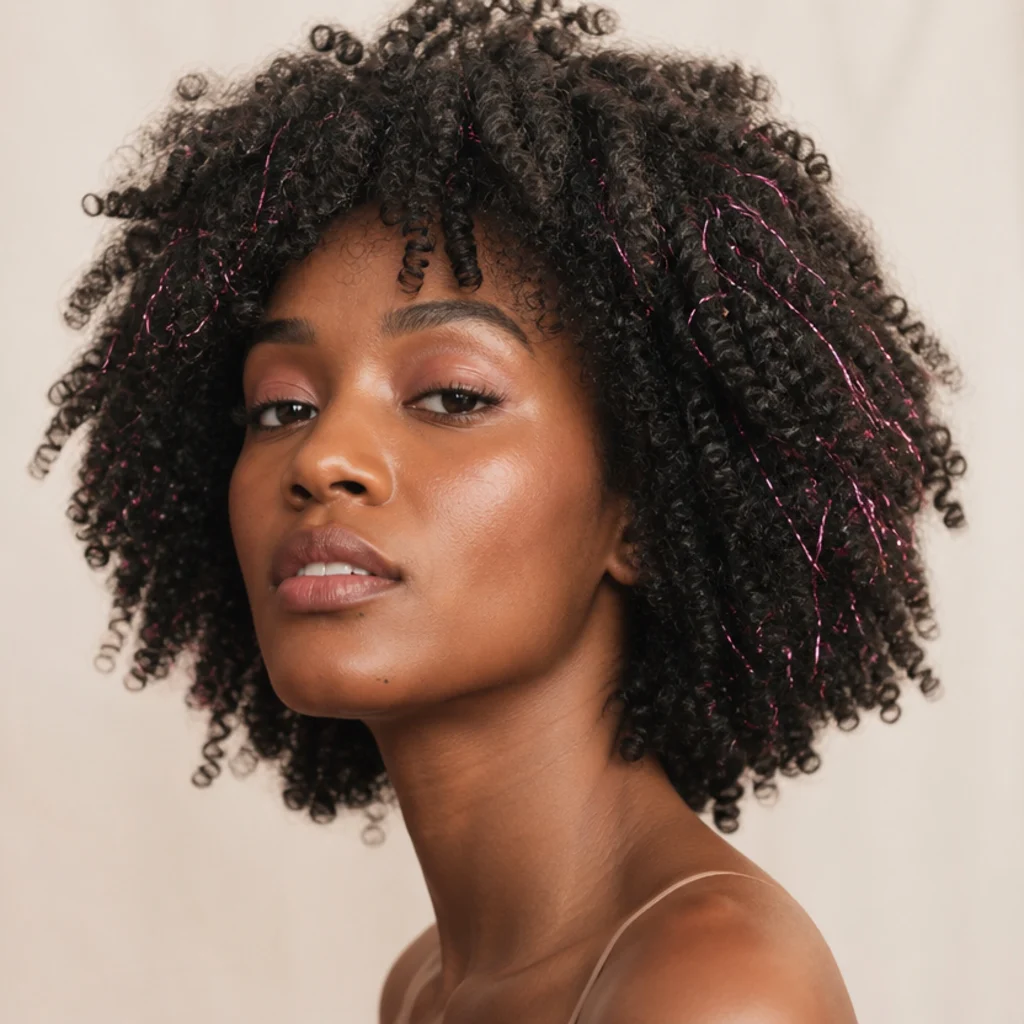
Pink hair tinsel is the gentlest way to introduce color without a single drop of dye. On loose, springy 3a to 3b ringlets, the pink threads flash at each curl bend and vanish as the hair swings, giving a playful wink of color instead of a committed stripe. Both warm and cool complexions can wear it. Reach for bubblegum pink for a bold candy-pop moment, or a muted rose-tinted film that mimics a soft natural highlight. Cluster the strands loosely through the mid-lengths and ends, where ringlets are most visible and most in motion, rather than at the root where they'd disappear. Colored mylar fades faster than metallic under repeated cleansing and UV, so plan to refresh every three to four weeks and wash with cool water to slow it. Pro tip: mix two pink tones, one saturated and one blush, so the color still reads dimensional as the brightest strands soften. Ask your stylist for "pink tinsel through the curl ends, medium density, mixed tones."
04Rose Gold Tinsel on a Curly Half-Up
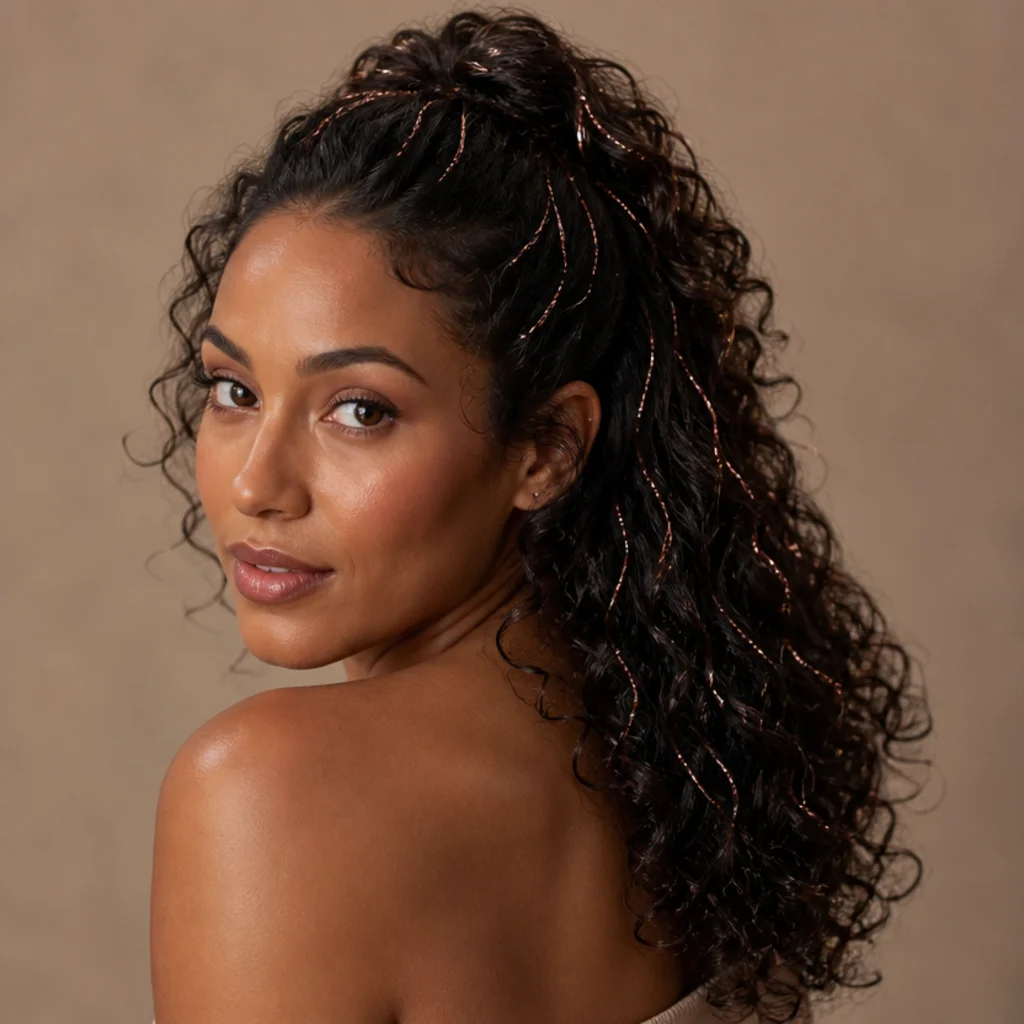
A curly half-up pulls the crown up and away from the face, building a natural stage where tinsel can catch overhead light head-on. Rose gold sits in the middle: warmer than silver, softer and less brassy than yellow gold, and kind to medium-to-deep skin tones and neutral-to-warm undertones. Place strands along the gathered crown section and through the curls that spill from the tie so sparkle frames the hairline and the loose length in one sweep. This is a beginner-friendly install because the half-up naturally conceals the tie-off knots at the gathered base, no neat scalp knots required. Upkeep runs easy too: the pulled-back section shields those strands from pillow and collar friction, so they routinely outlast tinsel worn in fully loose hair. Pro tip: gather the half-up loosely and secure with a coil-safe spiral tie so you're not compressing the knots against your scalp all day. Ask your stylist for "rose gold tinsel set for a half-up, framing the hairline."
05Rainbow Tinsel Confetti on Type 4 Coils
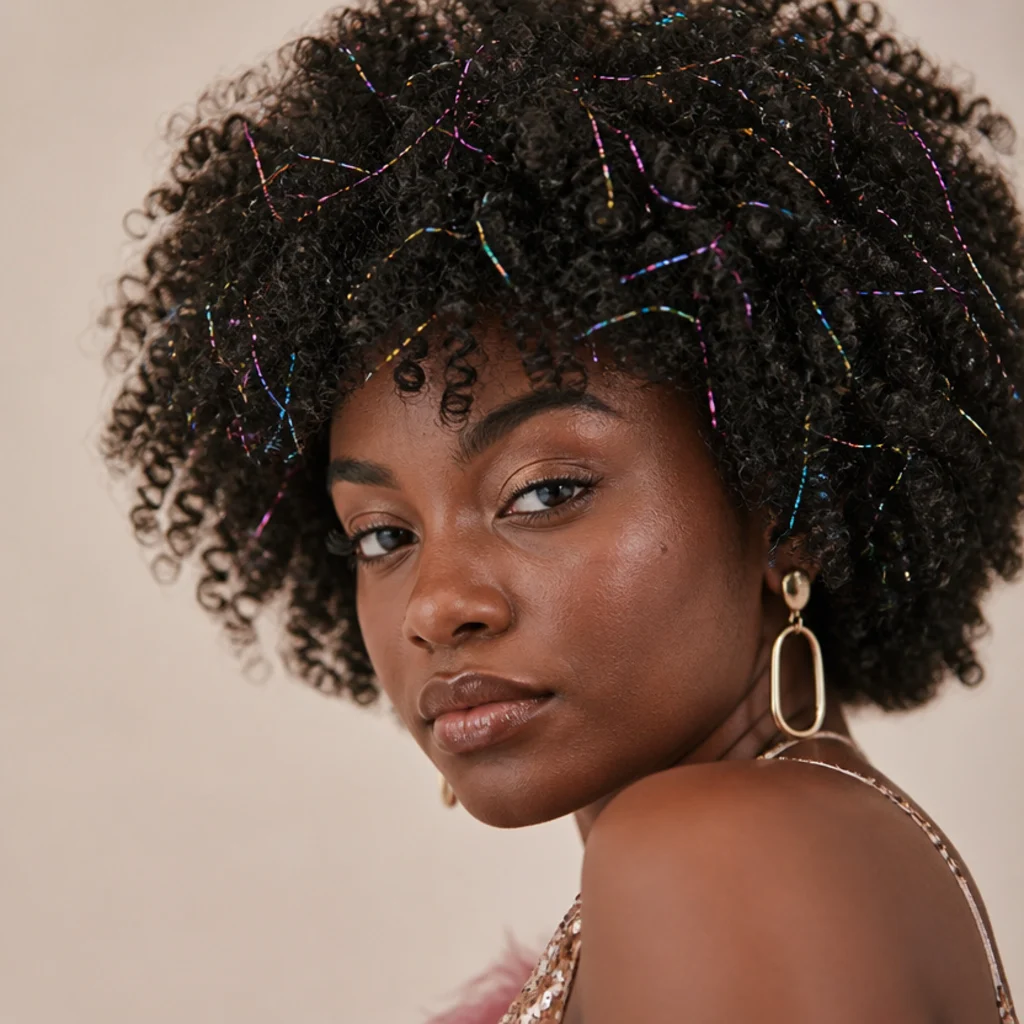
Scatter a deliberate mix, pink, blue, green, and gold, so the tinsel reads like confetti caught mid-fall in your coils. Dense type 4 hair is the ideal canvas: the tight pattern grips each strand, spaces the colors apart on its own, and keeps any single hue from pooling, so the effect looks styled rather than chaotic. Anyone drawn to a joyful, festival-leaning hair tinsel aesthetic will love it, and it photographs well under both daylight and stage light. Distribute 30 to 50 mixed strands evenly across the whole head instead of clustering by color, and pre-sort your strands into rough color groups so you can eyeball the balance as you go. Upkeep mirrors other styles, individual double knots, but with a higher count, budget a few extra minutes on wash day to finger-check that none have crept loose near the ends. Pro tip: cap any one bright color at roughly a third of the total so the palette stays "confetti," not "clashing." Ask your stylist for "evenly scattered multicolor tinsel, balanced palette."
Save this to Pinterest if you're planning a festival or birthday look.
06Gold Tinsel Framing the Face
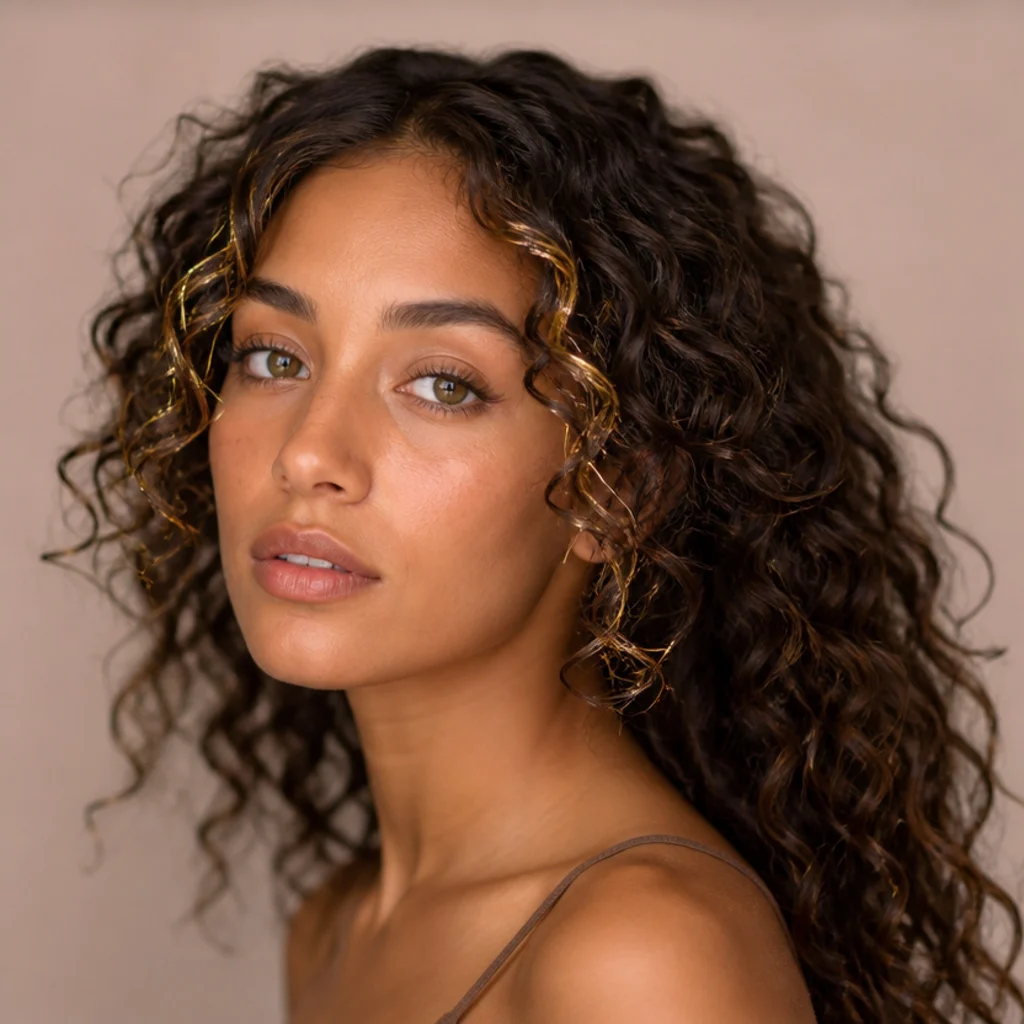
Concentrating warm gold tinsel around the hairline and the face-framing curls is a quietly strategic move: the reflected light draws the eye upward toward your cheekbones and eyes, the same logic colorists use when they place a money-piece highlight. Yellow gold flatters warm and olive undertones best and looks especially rich against brunette, auburn, and black curls. Keep it to the front sections only, roughly 15 to 20 strands framing the parting and temples, so the finish stays like soft candlelight rather than an all-over glitter wash. This is the placement to choose if you want tinsel that reads photogenic up close but still passes as office-appropriate from across a room. Because the strands sit right at the hairline, knot them small and flat so they don't catch on glasses or scarves. Pro tip: curl the face-framing pieces slightly forward after installing so the gold sits on the outward-facing curve of each ringlet, where it reflects toward the camera. Ask your stylist for "gold tinsel, face-framing only, rest of the curls left clean."
07Tinsel Woven Into a Curly Ponytail
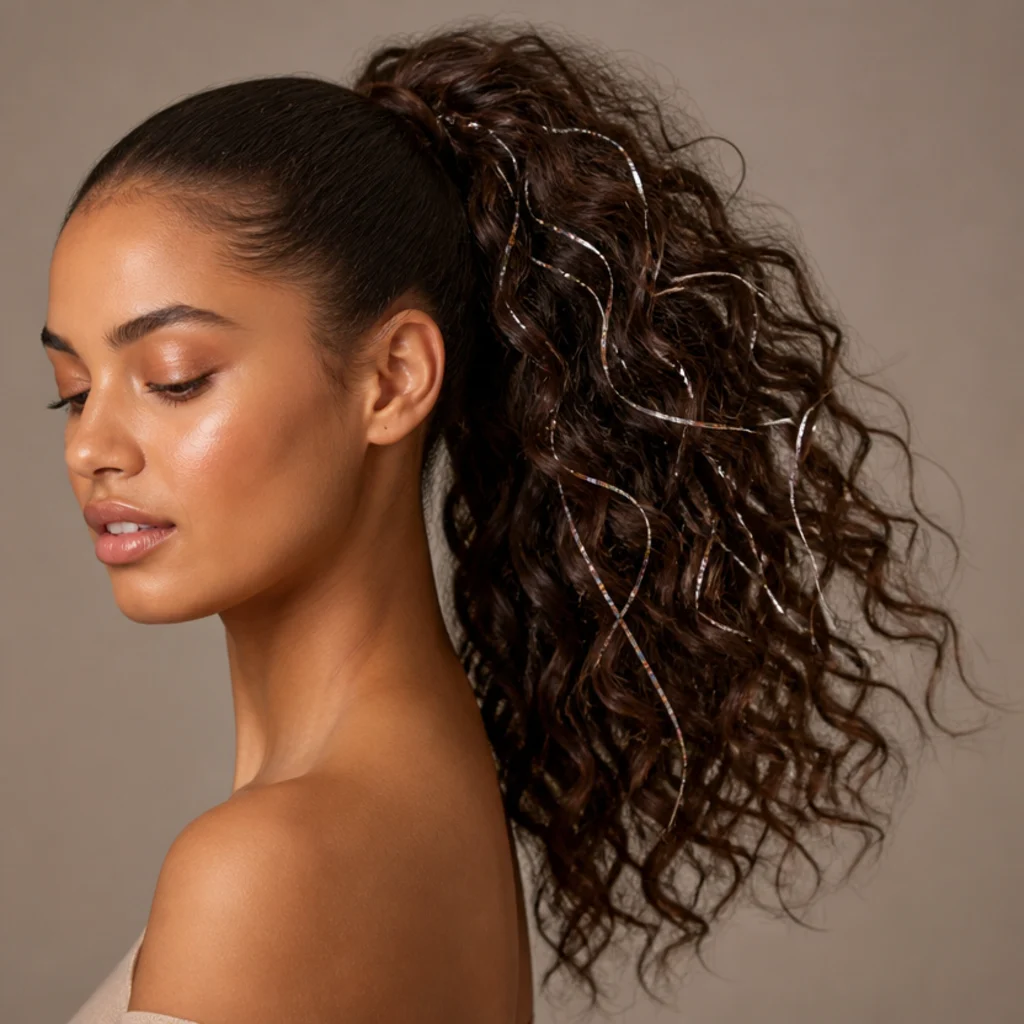
A high or mid curly ponytail gathers all your texture into one bouncy column, and tinsel woven through it flashes light every single time the tail swings. Because the strands sit concentrated in the gathered length rather than spread thin across the head, you get a lot of visible sparkle from a modest count, 25 to 35 strands looks generous here. Longer curls suit this best, along with anyone wanting an updo-adjacent moment without committing to full pinning. Install the tinsel before you gather the tail so the tie-off knots hide cleanly under the elastic, and reach for metallic shades, which photograph brightest against the movement. Repeated tight ponytails in the exact same spot can stress both your edges and the strands, so vary your parting slightly day to day and keep the base tension gentle. Pro tip: wrap a small curl around the elastic to conceal it and let the tinsel start just below, so the sparkle reads as part of the tail, not the tie. Ask your stylist for "metallic tinsel set to sit inside a ponytail."
08Holographic Tinsel on a Wash-and-Go
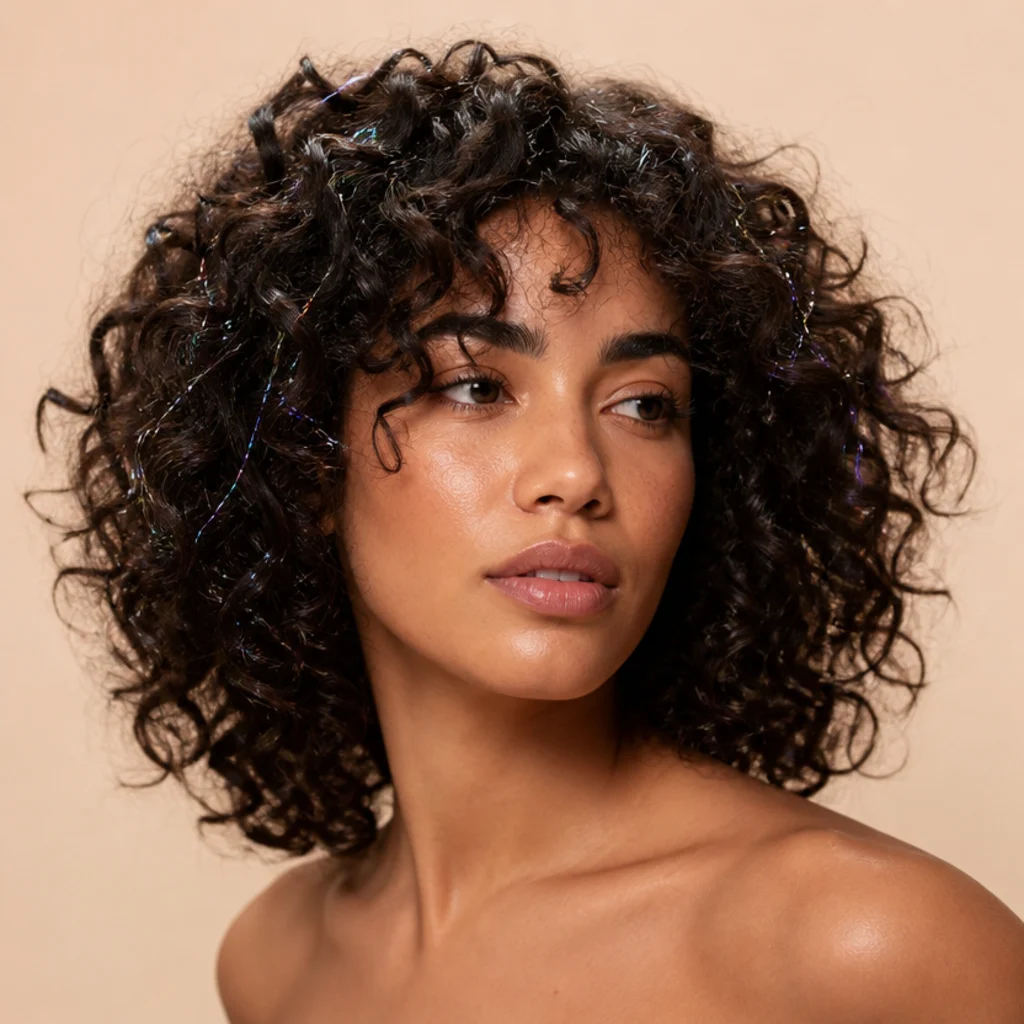
Holographic tinsel throws tiny prismatic rainbows as it turns, and a wash-and-go's loose, uncontrolled curl pattern hands it endless angles to reflect from, so the color seems to appear and disappear with every head turn. This is the lowest-effort option on the list because it leans entirely on your natural texture, no special styling required beyond your usual leave-in and gel routine. Every curl type and undertone can wear it, since the holographic finish reads neutral-cool overall. Scatter the strands lightly through only the top two layers so they ride the surface where light actually lands; buried strands are wasted. Because a wash-and-go gets re-wet and refreshed often, choose water-resistant film and lock each strand with a secure double knot. Expect a slightly shorter lifespan, around three weeks, given the frequent soaking. Pro tip: install on freshly styled, fully dry curls, not wet ones, so you can see the true surface layer and place strands where they'll stay visible after shrinkage. Ask your stylist for "light holographic tinsel on the top layers only."
09Tinsel Tucked Into Two-Strand Twists
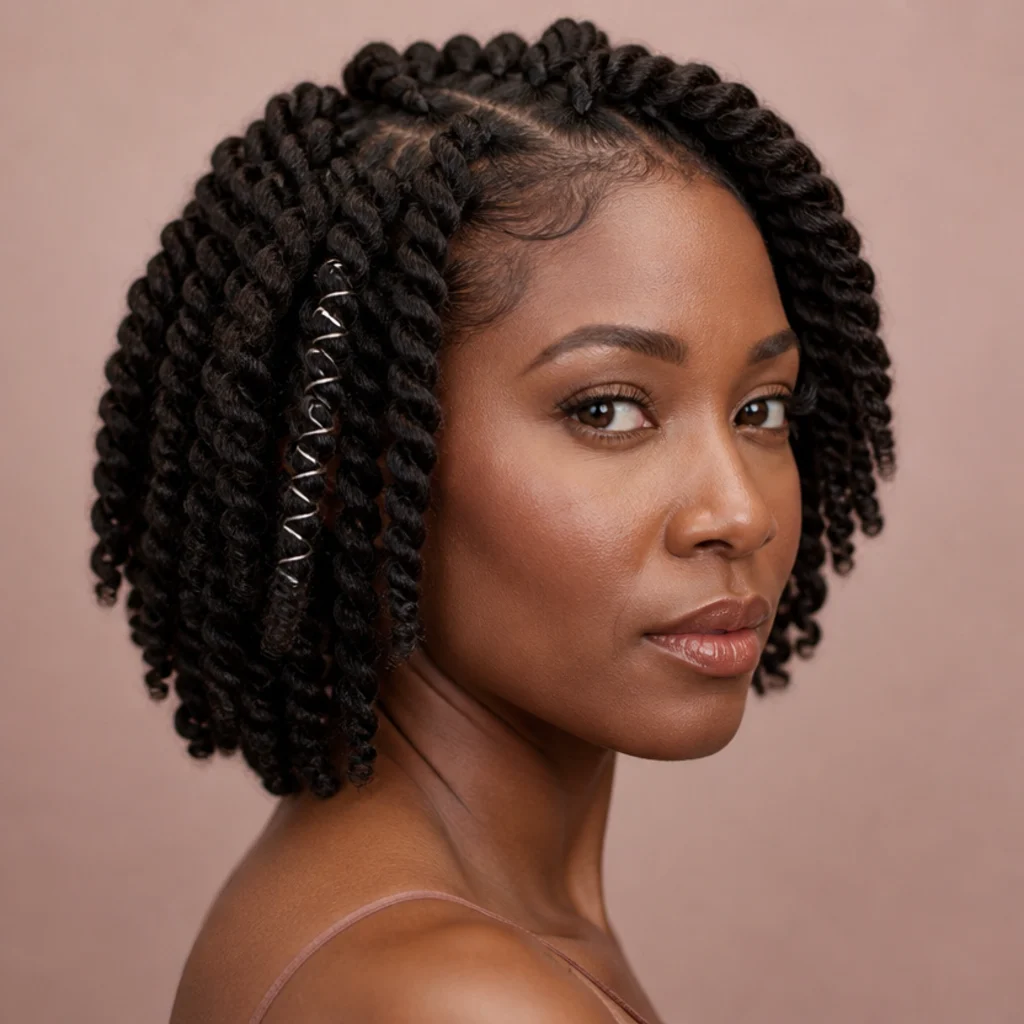
If you wear two-strand twists, you can lay tinsel into the twist itself so a thread of shimmer spirals cleanly down each one. This is the most protective-style-friendly way to enjoy sparkle, and it suits coily and kinky textures that hold twists well, whether on natural hair or added length. Lay one or two strands flat against the hair before you begin, then twist as usual so the film wraps into the spiral pattern and locks inside. Because the tinsel is sealed within the twist, it lasts exactly as long as the style does and resists the daily snagging that loose strands face on collars and pillowcases. Keep the count restrained, one strand per twist at most and only on select twists, so the shimmer stays refined rather than busy. Pro tip: choose twists that fall along your part and crown for the tinsel so the shimmer shows where light hits, and leave interior twists plain. Ask your loctician or stylist to "incorporate a tinsel thread into select twists, crown and part."
10Purple Tinsel on Deep Espresso Curls
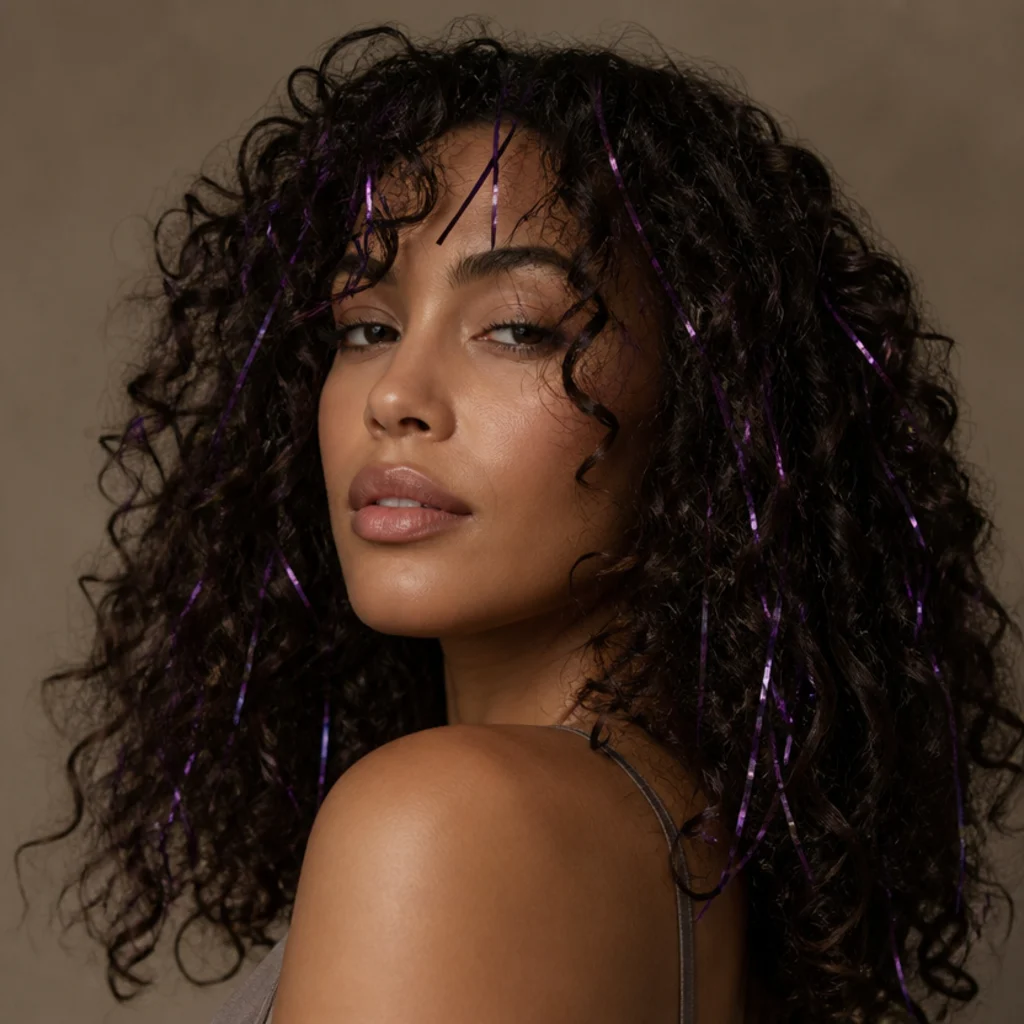
Purple tinsel against deep espresso or black-brown curls is moody and jewel-rich, a cooler, more grown-up alternative to the usual bright metallics. Violet-toned film suits cool and neutral undertones and adds a rich depth that reads grown-up rather than playful. Concentrate the strands through the mid-lengths and let a few fall around the face, where they'll flash in profile. On dark curls the purple stays quiet in shade and only ignites into true violet in direct light, which makes it the ideal pick if you want color that isn't obviously "dyed." A density of 20 to 30 strands hits the sweet spot between subtle and visible. As with all colored film, wash gently with cool water and skip clarifying shampoos near the strands so the violet doesn't dull before the tinsel naturally sheds. Pro tip: pair purple with a couple of silver strands so the cool tones amplify each other and the violet flash reads more intentional. Ask your stylist for "purple tinsel through the mid-lengths, a few around the face."
Save this to Pinterest for your fall and winter hair mood board.
11Copper Tinsel for Warm Brunette Curls
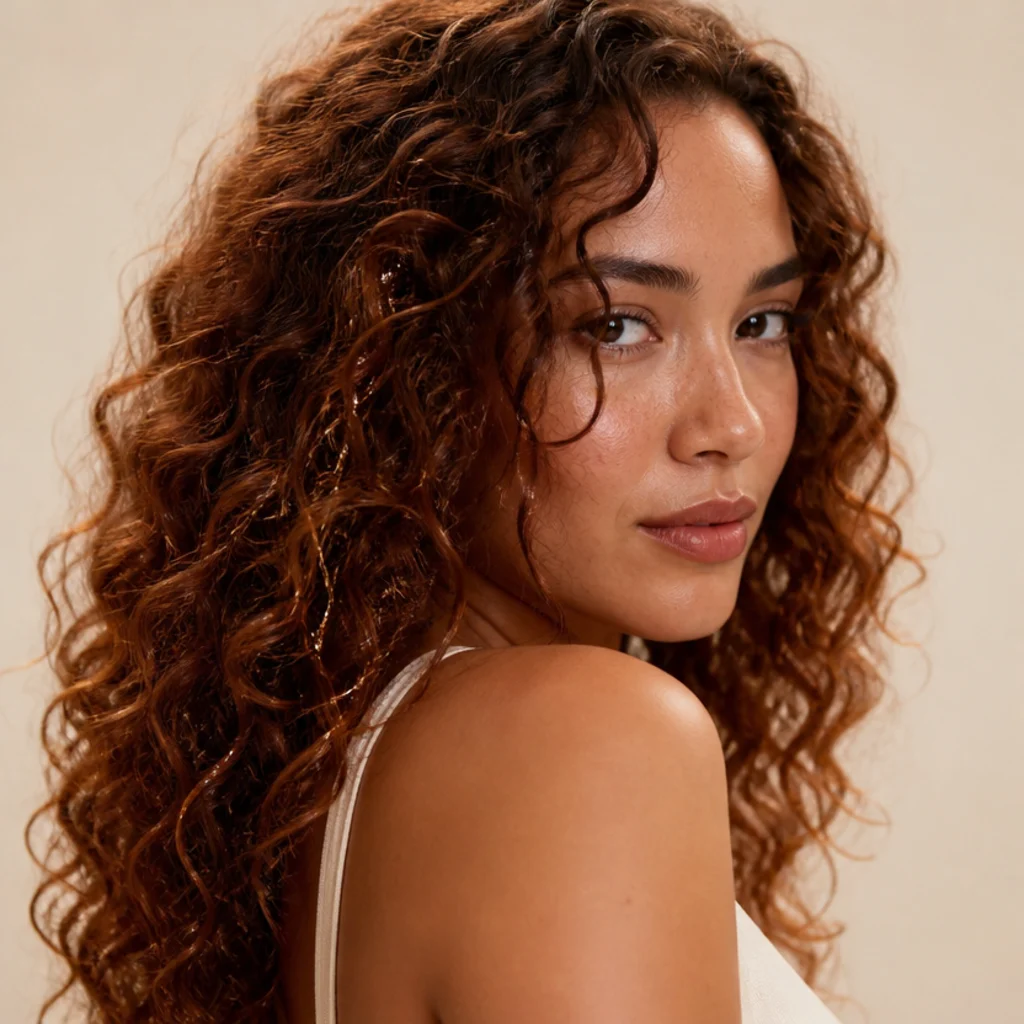
Copper tinsel melts into warm brunette and auburn curls, so instead of contrast you get a glowing, sun-caught effect that mimics natural highlights rather than announcing itself. It works best on warm and golden undertones, and reads most convincingly against reddish, chestnut, and golden-brown curls. Because copper blends rather than pops, use a higher strand count than you would for contrast looks, 30 to 40 strands, and spread it through the mid-lengths and ends where real sunlight would naturally strike a curl. This is a wearable everyday option for curly-haired people who want dimension and warmth without booking a salon color appointment or committing to root upkeep. Keep placement on the outward-facing curve of each curl so the copper catches light the way a balayage would. Pro tip: if your base has cooler ashy tones, choose a rose-copper film over a bright penny-copper so it still melts instead of clashing. Ask your stylist for "copper tinsel blended for a natural-highlight effect, low contrast, not high shine."
12Tinsel Along a Curly Side Part
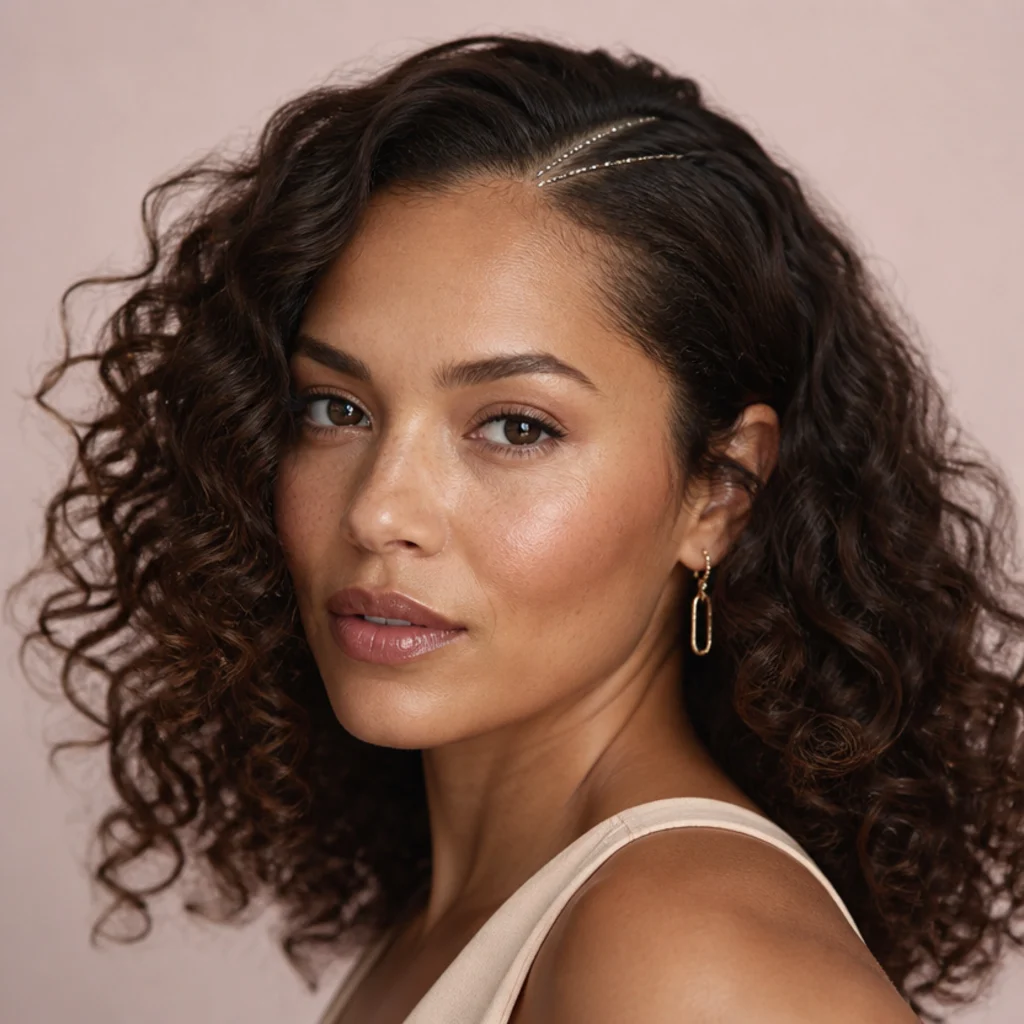
Placing tinsel in a clean line along a deep side part gives curly hair a defined, editorial line, useful if your curls tend to read as one soft, borderless cloud with no obvious structure. The strands trace the exposed part and then dissolve into the curl pattern on either side, so the eye reads a crisp graphic line up top and scattered shimmer below. This suits anyone who wants intentional, architectural placement rather than random sparkle, and it works across every curl type. Keep the line tight and continuous right along the part, roughly 15 strands, so the effect stays sharp instead of fuzzy. It's one of the easiest looks to request. The one caveat: an exposed part means the tie-off knots sit in plain sight, so knot them small, flat, and tone-matched to your scalp or hair. Pro tip: deepen the part a touch beyond your everyday placement so the fresh scalp line reads deliberate and the tinsel gets a cleaner track to follow. Ask your stylist for "tinsel tracing my side part in a continuous line."
13Blue Tinsel on a Curly Updo
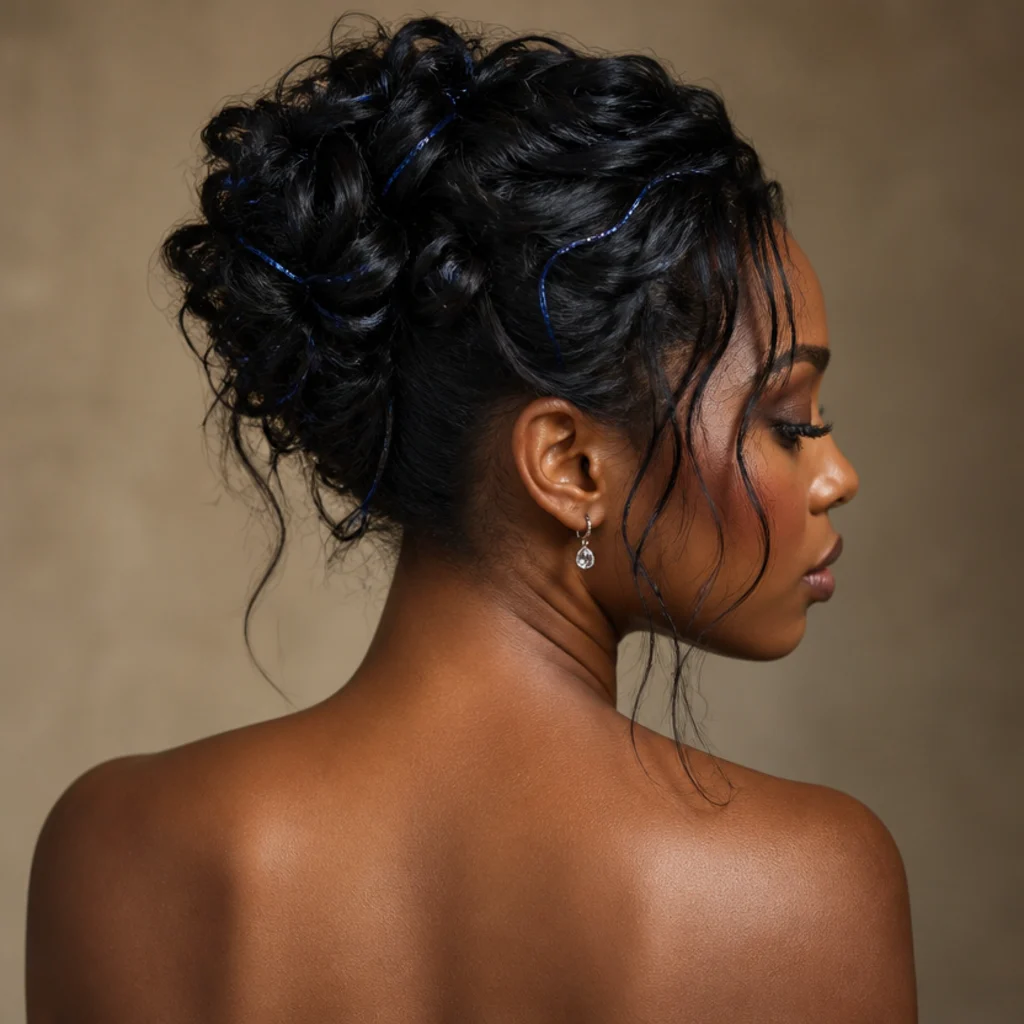
A curly updo, a pinned puff, a curly bun, or a gathered pineapple, builds dimension and shadow, and blue tinsel woven through it drops cool sparks of color into the folds. Blue film flatters cool and deep skin tones and looks striking against black and dark brown curls, where it flashes electric in direct light. Because an updo presents so many surfaces and angles at once, tinsel placed throughout reflects from multiple directions simultaneously, which is why it reads so full on camera. Add the strands to loose curls before you pin so you can tuck every tie-off into an interior fold and out of sight. This is a strong event, wedding-guest, or gala option that survives a long night. Density is forgiving here; even 15 to 20 strands looks packed once the hair is gathered and pinned tight. Pro tip: use bobby pins in a matte dark finish, not shiny metal, so the eye reads only the tinsel's sparkle and not the hardware. Ask your stylist for "blue tinsel worked through a pinned curly updo."
14Minimal Tinsel for a Subtle Everyday Shimmer
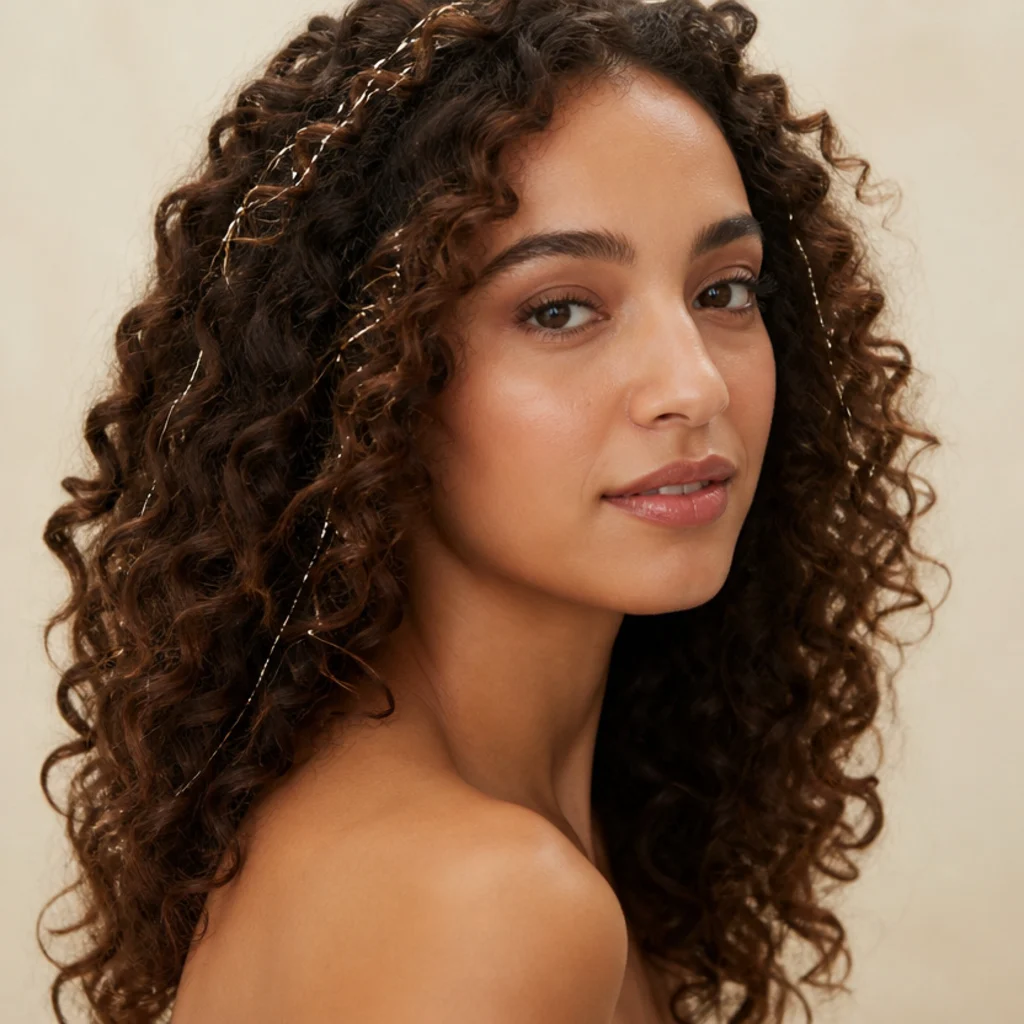
Not every tinsel look has to announce itself from across the room. A minimal approach, just 8 to 12 tone-matched or soft champagne strands, gives curly hair a barely-there shimmer that only surfaces when the light hits at the right angle. This works well for anyone testing tinsel for the very first time, anyone with a conservative workplace, or anyone who wants the option to forget it's even in. Because the strand count is so low, this is by far the easiest version to install yourself in a mirror, and upkeep is nearly nothing, a handful of strands takes seconds to finger-check and re-tie on wash day. Place them near the crown where light lands and add one or two around the face for a whisper of brightness. Champagne and pale-gold films read most natural on lighter brunette and dark-blonde curls; on deep bases, a soft pewter tone stays equally subtle. Pro tip: match the film as closely as you can to your lightest natural highlight so it reads as glow, not glitter. This is the ideal on-ramp if you love the hair tinsel aesthetic but aren't ready for full sparkle. Ask your stylist for "a few tone-matched strands, crown and face, very subtle."
15Full-Sparkle Tinsel for a Festival Curly Look
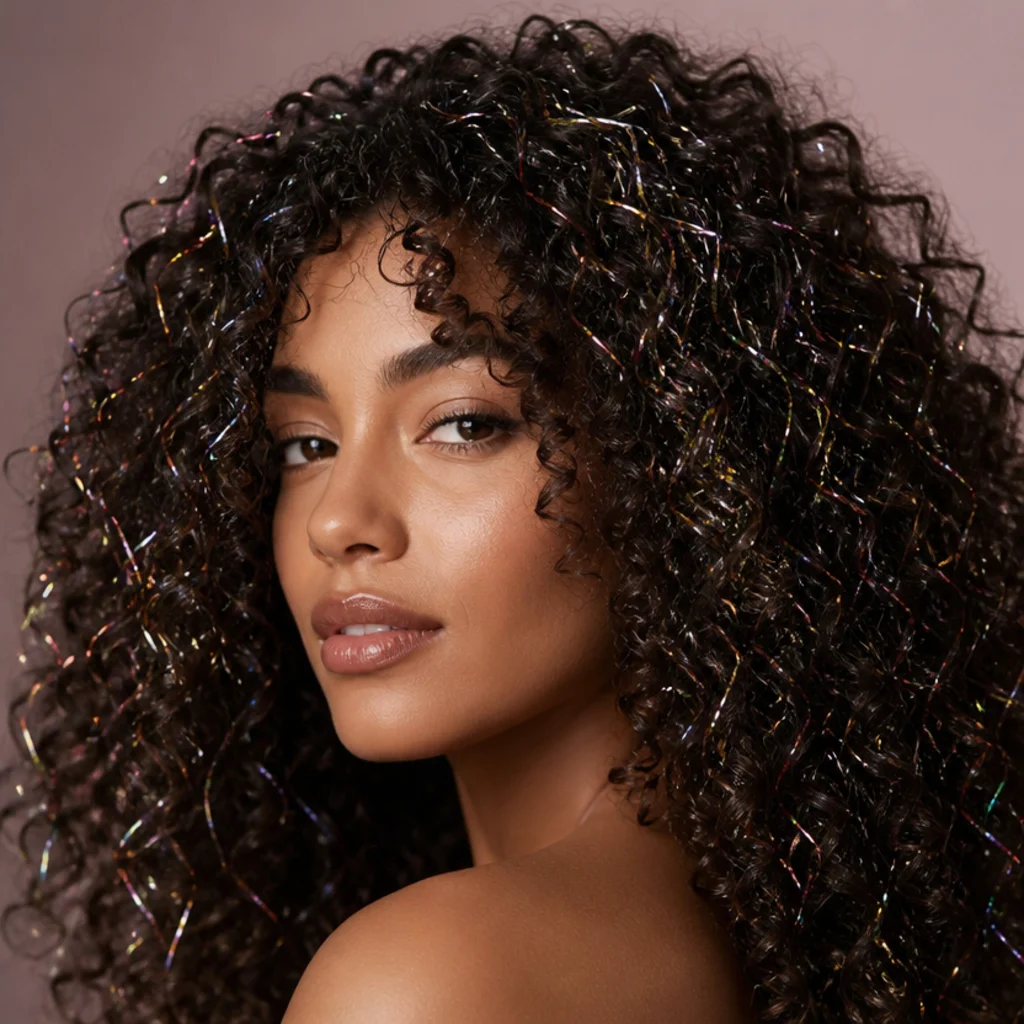
At the opposite end of the spectrum, go all in: 60 or more strands packed densely through the whole head for a full-sparkle festival moment. Curly hair is uniquely suited to this because the sheer volume of the texture supports a high strand count without ever looking stringy, the curls space the strands apart and keep them from clumping into a solid sheet the way straight hair would. Mix bright metallics with a few saturated color pops for maximum, camera-ready impact under stage and string lights. This suits festivals, concerts, costume events, and any photo-forward occasion where more is the point. Be honest with yourself about the time: a full head takes a real while to install strand by strand and to check on wash day, so if you want it fast, flawlessly even, and secure enough to last a multi-day weekend, book it professionally. Pro tip: install the day before, not the morning of, so any strands that were going to slip loose reveal themselves in time for a quick re-tie before the event. Ask your stylist for "full-density festival tinsel, mixed metallic and color."
Pro Tips from the Editor
- Tie, never clip or glue. Fold the strand around a small section near the root and finish with a double knot. Clips slip out of curls within hours and glue can snag the curl pattern on removal, tie-ins are the only method that survives wash day and reaches three-to-six-week wear.
- Match density to intent, not to enthusiasm. Roughly 8-15 strands reads subtle and everyday, 20-40 reads styled and editorial, and 50-plus reads festival. When unsure, install fewer, you can always add more, but pulling strands you regret means cutting knots.
- Keep oils and butters off the film. A coated mylar surface goes cloudy fast. Apply leave-ins and sealants around the tinsel, on the mid-shaft and ends, not directly over the reflective strand.
- Colored film is a consumable, metallics are durable. Pink, blue, purple, and green fade under UV and repeated washing in three to four weeks; silver, gold, and holographic hold their finish until they naturally shed. Plan refresh timing accordingly.
- Install on dry, fully styled curls in strong light. Shrinkage changes where a strand lands, so placing tinsel on set curls, not wet ones, is the only way to predict the finished look and keep the top surface layer visible.
- Remove by cutting the knot, never yanking. Snip the tiny knot flush and slide the strand free. Pulling a tied-in strand out drags on the attached hair and is the main way people cause breakage with tinsel.
- Protect it overnight. A satin bonnet or pillowcase cuts the friction that loosens knots and dulls film, and it keeps strands from tangling into the curl pattern while you sleep.
Comparison: Match the Tinsel to Your Base and Goal
| Tinsel color | Best base / undertone | Effect | Strand count | Refresh window |
|---|---|---|---|---|
| Iridescent silver | Any base, any undertone | Color-shifting, lit-from-within | 20-40 | Until shed (does not fade) |
| Bright gold | Black, brunette, warm/olive | High contrast, candlelit | 15-25 | Until shed |
| Rose gold | Medium-deep, neutral-warm | Soft, flattering metallic | 20-35 | Until shed |
| Holographic | Any base | Prismatic mini-rainbows | 20-40 | Until shed |
| Copper | Auburn, chestnut, warm brunette | Blended natural-highlight | 30-40 | Until shed |
| Champagne / pewter | Dark blonde to deep, tone-matched | Barely-there shimmer | 8-12 | Until shed |
| Pink / blue / purple | Dark bases flash best | Playful color, jewel flash | 20-30 | 3-4 weeks (fades) |
How to Choose / Get the Look
Work through four decisions in order. First, contrast. Bright metallics, silver, gold, holographic, pop hardest against dark and black curls, so you need fewer strands and can lean editorial; blended shades like copper and champagne dissolve into lighter brunette curls for a natural-highlight effect that needs a higher count to register. Second, undertone. Cool and neutral complexions carry silver, holographic, purple, and blue; warm and olive undertones glow under gold, rose gold, and copper. Match the film to your undertone the same way you'd match a foundation or a jewelry metal.
Third, density and placement. Decide the message: 8-15 strands for subtle everyday, 20-40 for styled and editorial, 50-plus for festival. Then map placement to that goal, face-framing draws the eye up and reads photogenic, crown placement catches the most overhead light, a side-part line looks graphic and intentional, and gathered styles (ponytail, updo, twists) concentrate sparkle for high payoff from a modest count. Fourth, longevity and logistics. The single biggest factor is the knot: tie each strand onto a small section of your own hair with a secure double knot rather than clipping or gluing, so it survives washing and lasts three to six weeks. Colored film fades faster than metallic, so wash gently with cool water and keep heavy oils off the strands. Doing it yourself? Work on dry, styled curls in good light and start with a low count. For a full head or an event, book ahead, ask a stylist to "install tie-in hair tinsel," and bring a saved photo of your target color, density, and placement zone.
Frequently Asked Questions
How do you put tinsel in curly hair?
Section off a small piece of hair, fold a single tinsel strand in half around it near the root, and tie a secure double knot so the strand hangs down and moves with your curl. Always work on dry, defined curls in strong light so you can see the true surface layer after shrinkage. For how to put tinsel in hair that actually lasts, tie every strand individually rather than clipping or gluing, and keep the knot small and flat against the root.
Does hair tinsel damage curly hair?
Tied-in tinsel is generally gentle because it attaches to a small section of hair with no heat and no chemicals. To keep curls healthy, tie each knot onto a modest amount of hair (too few strands concentrates tension), avoid knotting tightly right at the scalp, and always remove strands by carefully cutting the tiny knot rather than pulling them free. The main risk with tinsel isn't the film, it's yanking it out, so removal technique matters more than wear.
How long does hair tinsel last in curly hair?
Most tied-in tinsel lasts three to six weeks. Metallic films, silver, gold, holographic, hold their finish until the strand naturally sheds, while colored films like pink, blue, and purple fade sooner under UV and repeated washing, often needing a refresh at three to four weeks. Frequently re-wet styles such as wash-and-gos may shed strands slightly faster. Tie each strand individually so they survive wash day one at a time.
What color tinsel looks best on black hair?
Bright metallics create the most striking contrast on black hair, silver, gold, and holographic film read almost like light itself against the dark base, so even 15 to 25 strands look intentional and editorial. Jewel tones like purple and blue also flash beautifully, staying quiet in shade and igniting only in direct light. Concentrate placement at the part and crown where overhead light lands for the strongest hair tinsel black hair effect.
Can you wash and style curly hair with tinsel in?
Yes. Wash and condition gently with cool water, keep heavy oils and butters off the reflective film, and style with your usual routine, tinsel can even be curled and refreshed right alongside your natural curls. Because each strand is tied to your own hair, it moves, dries, and refreshes with your pattern. Finger-check the knots on wash day and re-tie any that have loosened near the ends.
How much does hair tinsel cost for curly hair?
DIY strand packs are inexpensive, typically drugstore-to-mid range for a multi-strand kit that covers several looks. Salon installs are usually priced per strand or as a set add-on to a styling appointment, so cost scales directly with density, a subtle 10-strand face-frame is minor, while a 60-plus-strand festival head is a longer, pricier sit. Colored film that needs refreshing every few weeks adds up faster than durable metallics over a season.
Can you put hair tinsel in a protective style?
Yes, and it's one of the best ways to wear it. Lay a tinsel strand against the hair before you begin a two-strand twist or braid so the film wraps and locks inside the pattern; sealed this way it lasts as long as the style and resists daily snagging. Keep it to one strand per twist or braid and place it on the crown and part sections where light hits, so the shimmer stays refined rather than busy.
What's the difference between tie-in tinsel and clip-in or heat-fused tinsel?
Tie-in tinsel knots directly onto a small section of your own hair and is the most curl-friendly, heat-free, and long-wearing method, lasting three to six weeks. Clip-in tinsel is fast to add and remove but slips out of curly textures quickly and reads as temporary. Heat-fused (bonded) tinsel uses a tool and adhesive bead; it's durable but adds heat and a removal step, which most curly-haired people skip in favor of the gentler tie-in approach.
How many strands of tinsel do I need for curly hair?
It depends entirely on the effect. Use 8 to 15 strands for a subtle, everyday shimmer, 20 to 40 for a styled, editorial look, and 50-plus for full festival sparkle. Dark curls need fewer because contrast does the work, while blended shades like copper on brunette curls need more to register. Start on the lower end, curly texture makes a modest count look fuller than it would on straight hair, and add more if you want it.