20 Dreamy Hair Tinsel Aesthetic Looks
Hair tinsel is the rare sparkle that costs no bleach, no heat, and no regret: it ties in over a weekend and slides out before Monday. Below are 20 directions, scaled from a single glinting face-frame strand to a full fairy halo, each one mapped to the base color, texture, and undertone it flatters, the weeks of wear you can expect, and the exact words to hand your stylist.
 Edited by Lena Rose · Published July 11, 2026 · 33 min read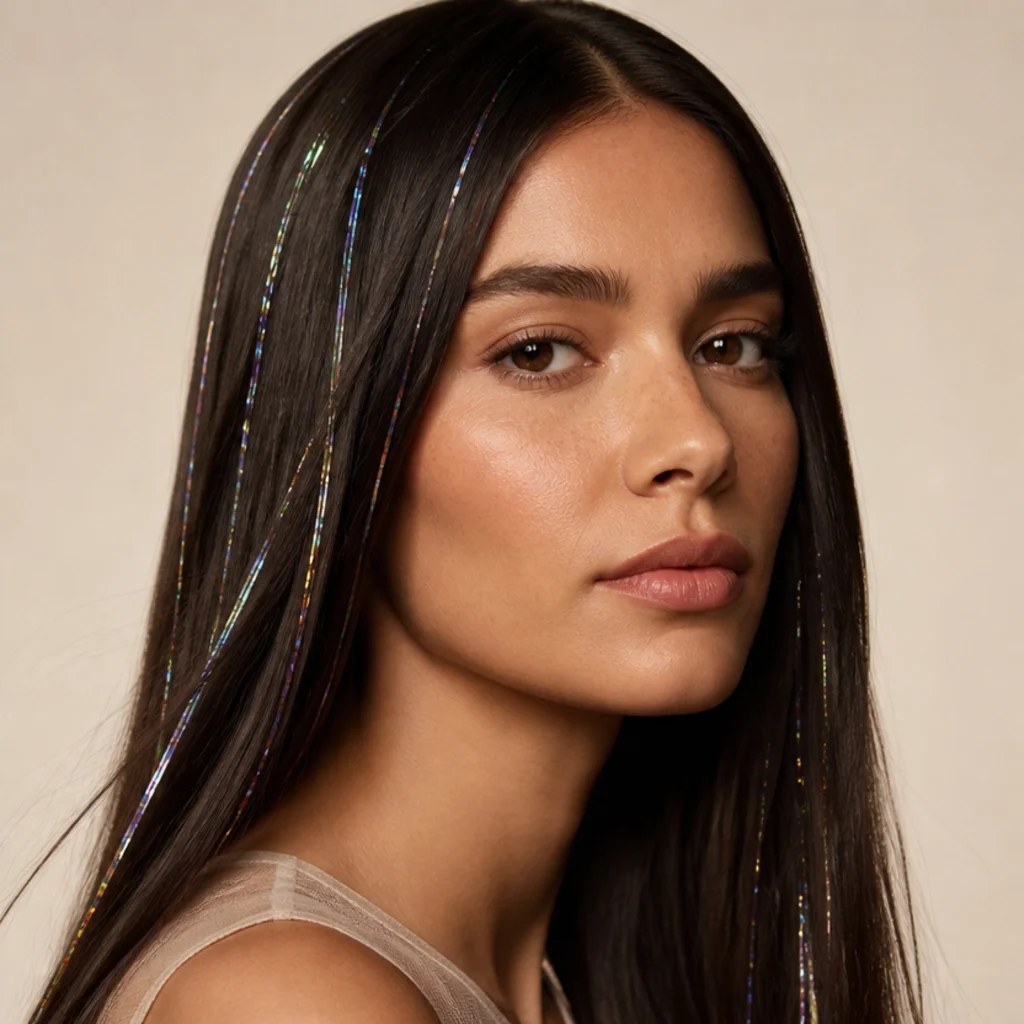
Quick Answer
- Best for: Anyone who wants reversible, dye-free, heat-free sparkle that works across every base color, texture, and length, and photographs far brighter than it reads in person.
- Who might skip it: Anyone with very fine, fragile, or actively shedding hair who dislikes feeling knots at the scalp, and anyone who flat-irons daily above 300°F, since budget Mylar tinsel can melt.
- Maintenance: Low to moderate. Hand-tied strands stay put three to six weeks and grow down with your hair; clip-in versions go in and out the same day.
- Difficulty: Beginner-friendly for glue-free tie-in knots and clip-ins; dense full-head and multi-tone blends read cleaner done by a stylist.
- Cost: Roughly the price of a movie ticket for a DIY tinsel pack of 100-plus strands; a salon add-on typically runs from a low to a mid two-figure fee depending on density and region.
- Wear time / longevity: Three to six weeks for tied strands (hidden under-layers last longest, styled fringe pieces shortest); one evening for clip-ins.
- Standout variation: Iridescent silver on black hair, which refracts white-to-lilac against deep strands like a prism.
- How to ask your stylist: Name the color and finish, the density (light scatter versus full head), and the zones (face-frame, crown, under-layer), and ask for a glue-free tie-in so removal is damage-free.
In This Guide
- Iridescent Silver on Black Hair
- Rose Gold Fairy Strands
- Pink Tinsel on Cool Blonde
- Curly Coils with Holographic Shimmer
- Face-Framing Sparkle Pieces
- Half-Up Space Buns with Tinsel
- Peekaboo Under-Layer Glimmer
- Braided Tinsel Accents
- Money-Piece Gold Streaks
- Pastel Rainbow Blend
- Icy Blue Winter Shimmer
- Copper Tinsel on Auburn Hair
- Full-Head Festival Sparkle
- Subtle Bronde Everyday Shimmer
- Sleek High Ponytail with Tinsel
- Tinsel on Locs and Protective Styles
- Mermaid Waves with Blue-Green Strands
- Clip-In Tinsel for Zero Commitment
- Lavender Dream Shimmer
- Tinsel Bangs and Fringe Sparkle
Hair tinsel is a thin, reflective filament, usually a fine Mylar or silk-thread strand, tied or clipped into small sections of hair to add light without dye, bleach, or heat. It reads playful or polished purely by dose and placement: a dozen strands at the part whisper, while a hundred scattered through the lengths shout festival. The look keeps cycling back because it's fully reversible: pull it before a meeting, tie it back in for the weekend, and it suits commitment-shy hair and strict workplaces equally well. In this guide you'll find 20 aesthetic directions across every base. Hair tinsel black hair pairings earn their own moment, since dark strands absorb light and throw metallic and iridescent tones back as near-holographic color. You'll also see where texture changes the math (curly hair tinsel needs far fewer strands than straight) and how to put tinsel in hair yourself versus when it's worth booking a pro. Whether you want a single glinting face-frame piece or a full shimmer halo, there's a version scaled to your texture, undertone, and upkeep tolerance. Each entry below covers who it flatters, how long it lasts, and the exact language to hand a stylist.
01Iridescent Silver on Black Hair
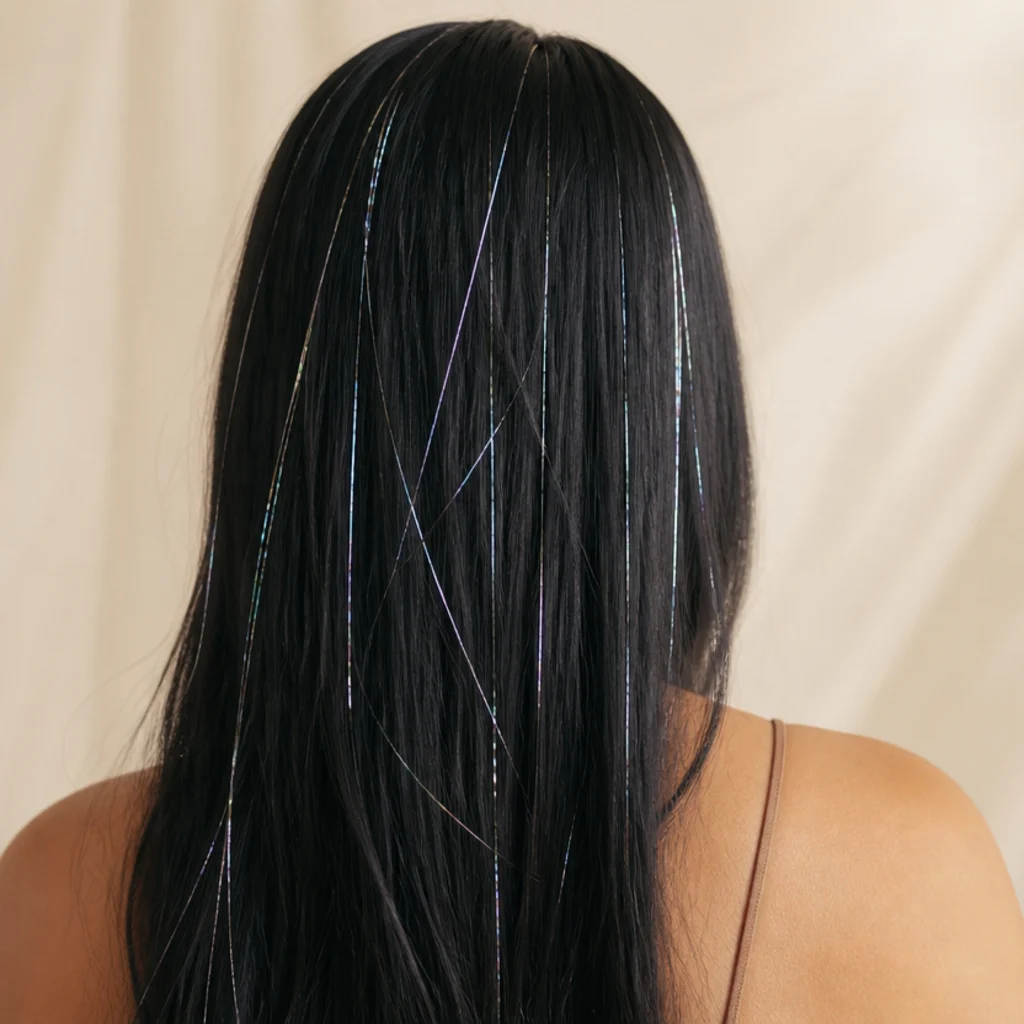
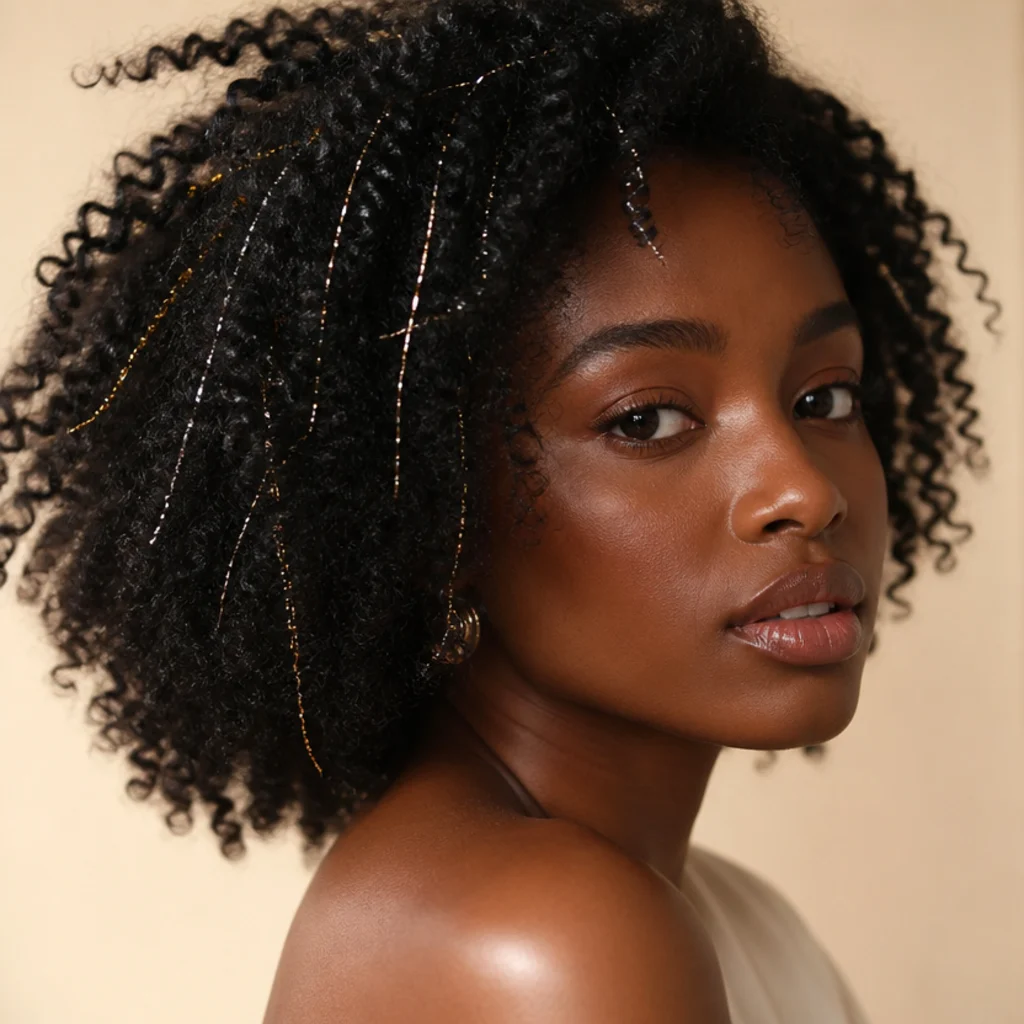
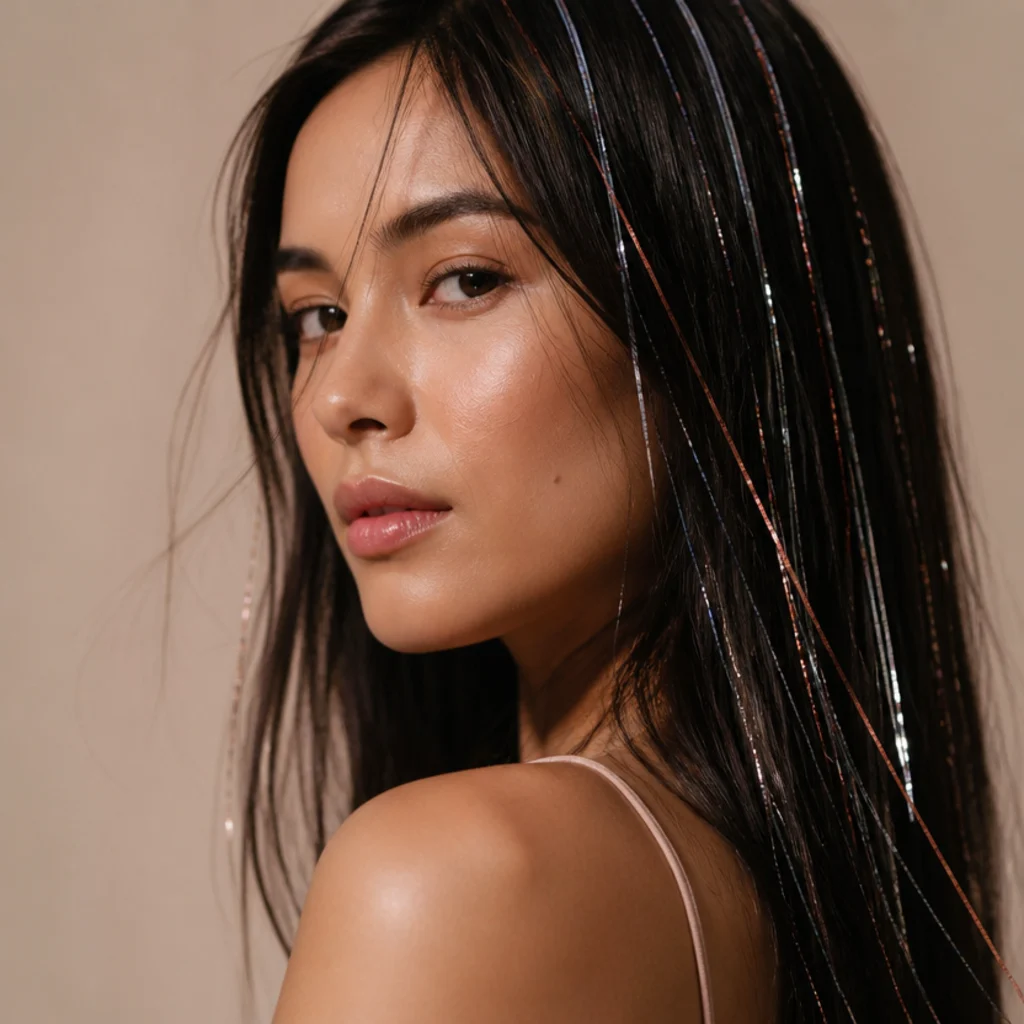
This is the pairing that pushed the trend viral, and it earns the reputation. On true black, blue-black, or espresso hair, iridescent silver tinsel refracts rather than reflects, shifting white to pale blue to lilac as your head moves, because the dark base absorbs ambient light while the Mylar throws it straight back. Contrast does all the work here. Scatter roughly 20 to 40 strands through the crown and mid-lengths in an irregular confetti pattern so the shimmer reads organic instead of striped; clustering is what turns a chic effect into a costume. Every skin tone can wear it, and it works on straight, wavy, and coily textures too, though coils need fewer strands. Hand-tied knots last three to six weeks and grow down invisibly at the root. Pro tip: photograph it in daylight before your event, since iridescent tinsel reads two to three times brighter on camera than in a mirror. Ask your stylist for "iridescent or rainbow silver, lightly scattered through the crown, not clustered."
02Rose Gold Fairy Strands
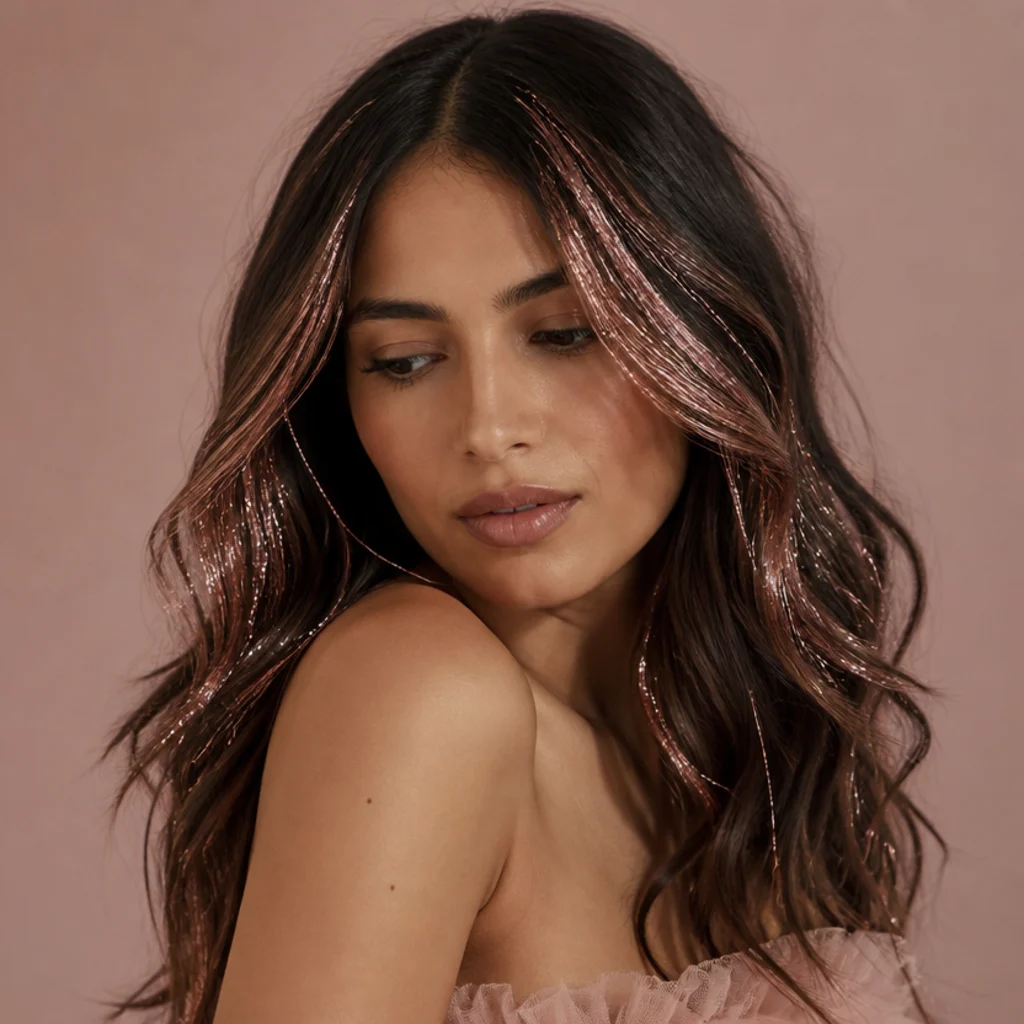
Rose gold tinsel gives you the warmth that pure silver can lack, which makes it the softest choice for brunettes, warm and honey blondes, and anyone with golden, peach, or olive undertones. The tone sits between pink and copper, so it flatters at the cheekbone without reading as a bold fashion color. Concentrate strands around the front sections and the mid-lengths where waves bend and turn; a curved strand catches and releases light twice, doubling the glint. This look leans romantic and fairy-tale rather than festival, so keep the count modest, around 25 to 30 pieces, and let the waves do the diffusing. It's an easy DIY: the glue-free tie-in works at home once you've practiced the double knot on a hidden strand first. Expect three to five weeks of wear. Pro tip: seat each knot about a centimeter below the scalp, not flush against it, so it disappears under the top layer yet never tugs. Ask your colorist for "rose gold tinsel, face-framing, blended into the wave."
03Pink Tinsel on Cool Blonde
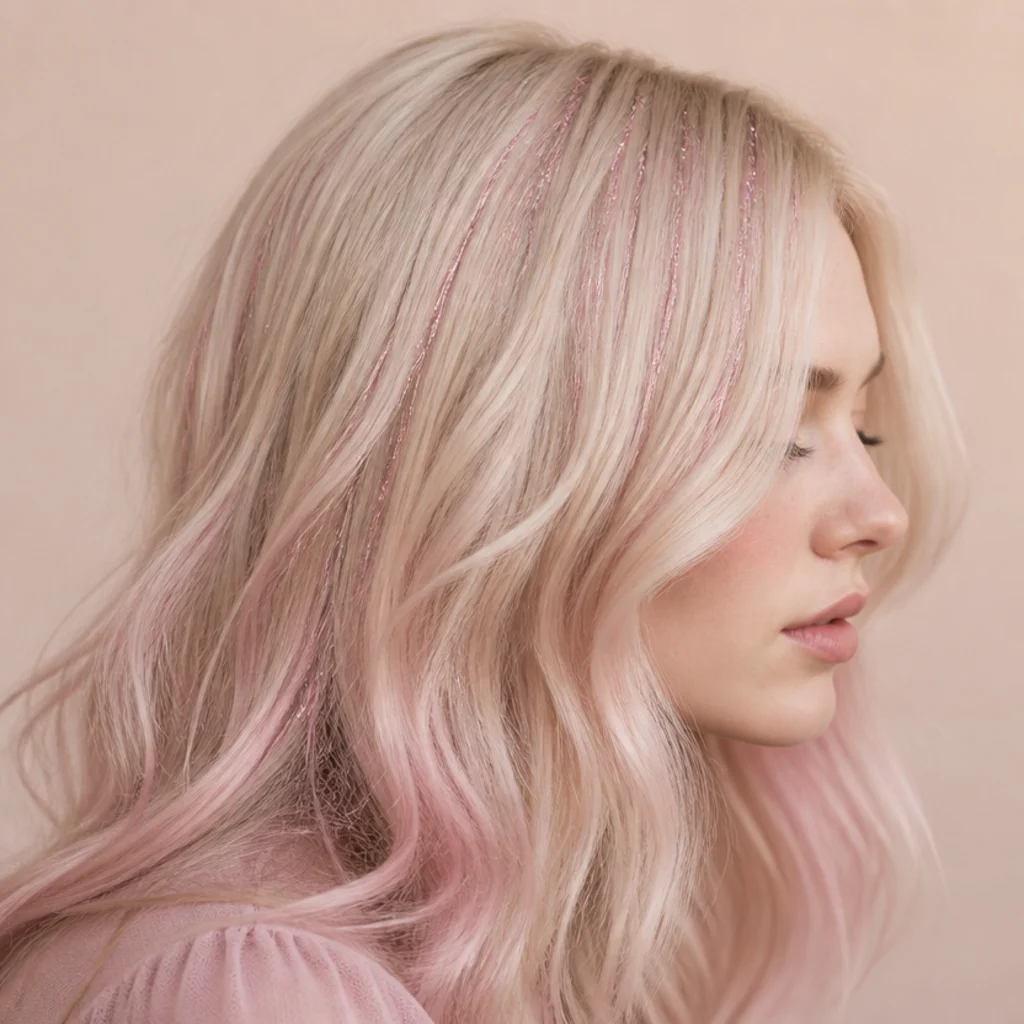
Pink hair tinsel on cool blonde is pure confection, all cotton-candy diffusion and light. A platinum or ash base already reflects, so the pink strands melt into a pastel wash rather than a hard contrast line, which is the trick if you want playful without loud. Fair to medium skin with cool or neutral undertones wears it especially well, and nearly every blonde shade, from beige to icy, carries it without a fight. Scatter the pink through the top and second layers so it surfaces in a half-up style or a loose fishtail; buried too deep on light hair, it vanishes. This is a beginner-friendly look in clip-in or tie-in form. Plan on three to four weeks for tied strands, a bit less than metallics hold, since dyed color filaments dull faster with repeated washing. Pro tip: choose a cool-leaning bubblegum pink over a warm coral so it stays true against ash tones instead of muddying. Ask your stylist for "cool-toned pink tinsel scattered through the top layers for a pastel wash."
04Curly Coils with Holographic Shimmer
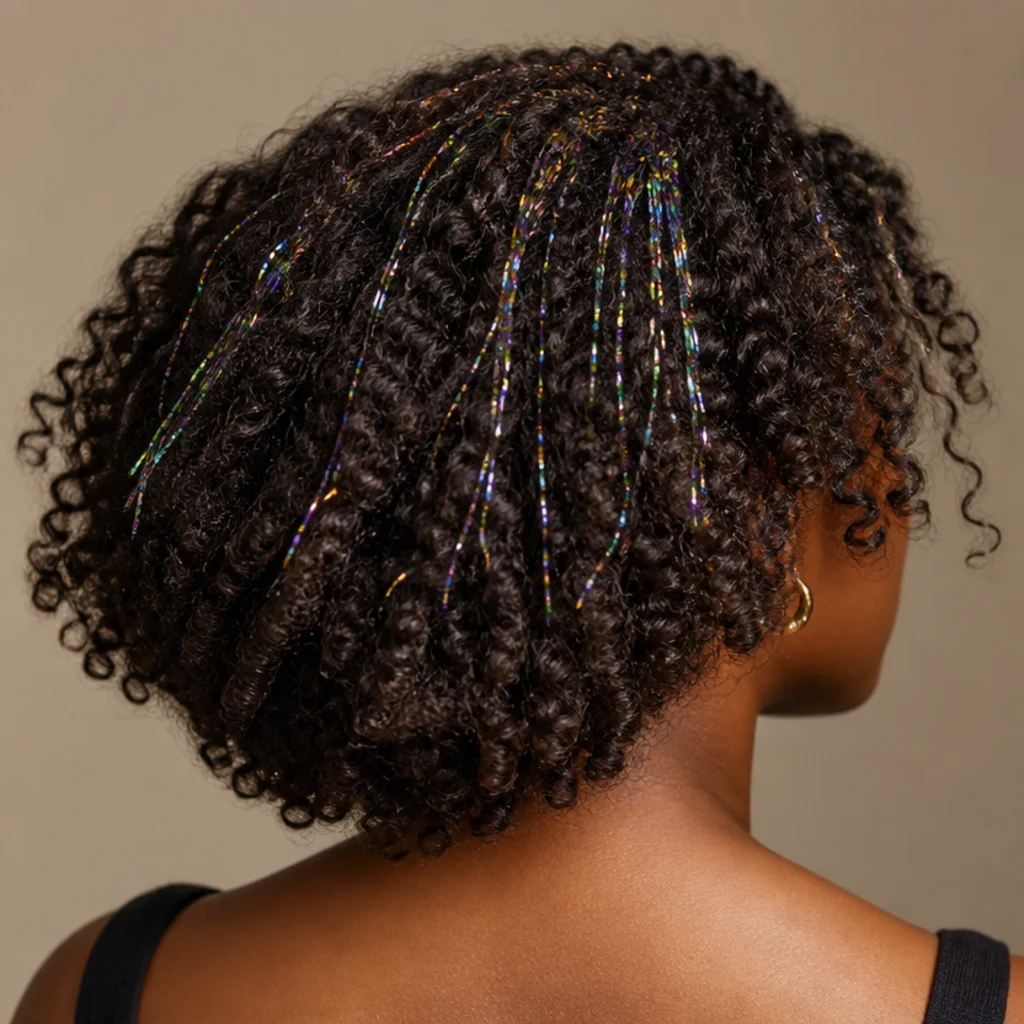
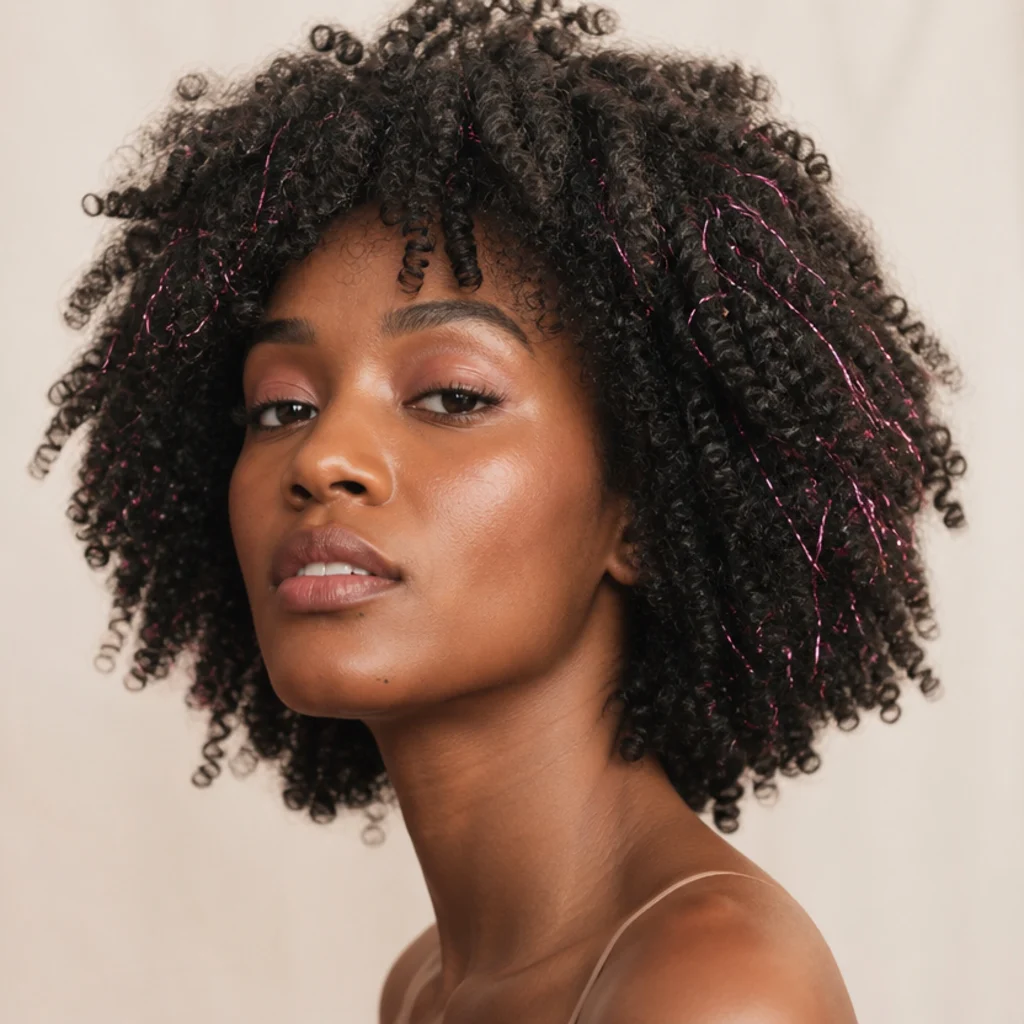
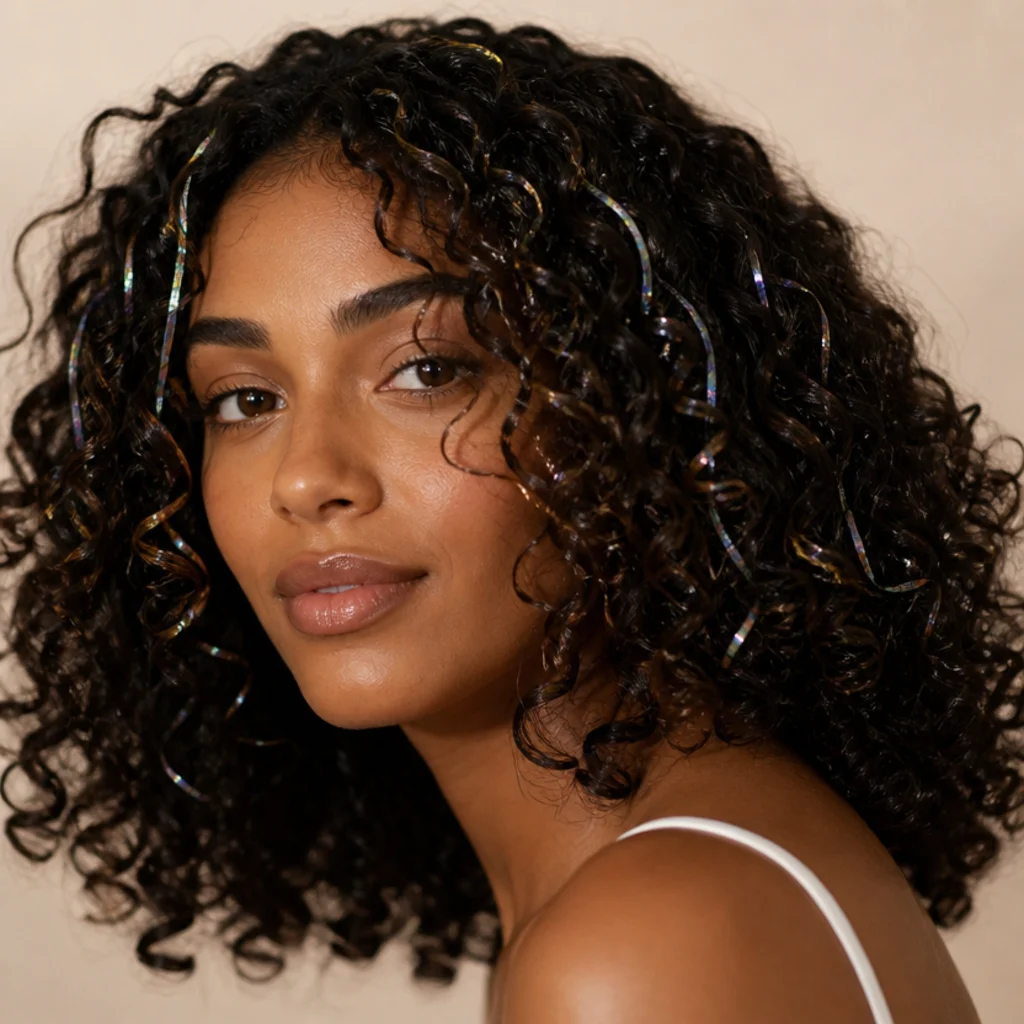
Curly hair tinsel obeys different math than straight hair, and that works entirely in your favor. Coils wrap and overlap, so the tinsel peeks and hides as the pattern moves, and a fraction of the strand count reads as a full effect: think 15 to 25 pieces where straight hair would want 40. Tie strands at the root of well-defined curls through the crown and sides, then let your natural pattern reveal and conceal them. Holographic or multi-tone tinsel is the smart pick for curly and coily textures, since it echoes the dimension curls already have instead of flattening it into one metallic note. Every skin tone can wear it, and it looks especially lush on tight 4-type coils. Keep wash day gentle, section around the knots with your fingers rather than a dense brush, and refresh with a spray bottle instead of full re-wetting to protect the ties. Tied strands typically hold three to five weeks on textured hair. Pro tip: place tinsel on a defined, product-set curl, never on frizz, so it lies along the coil instead of springing out. Ask your stylist for "holographic tinsel set into defined crown curls."
05Face-Framing Sparkle Pieces
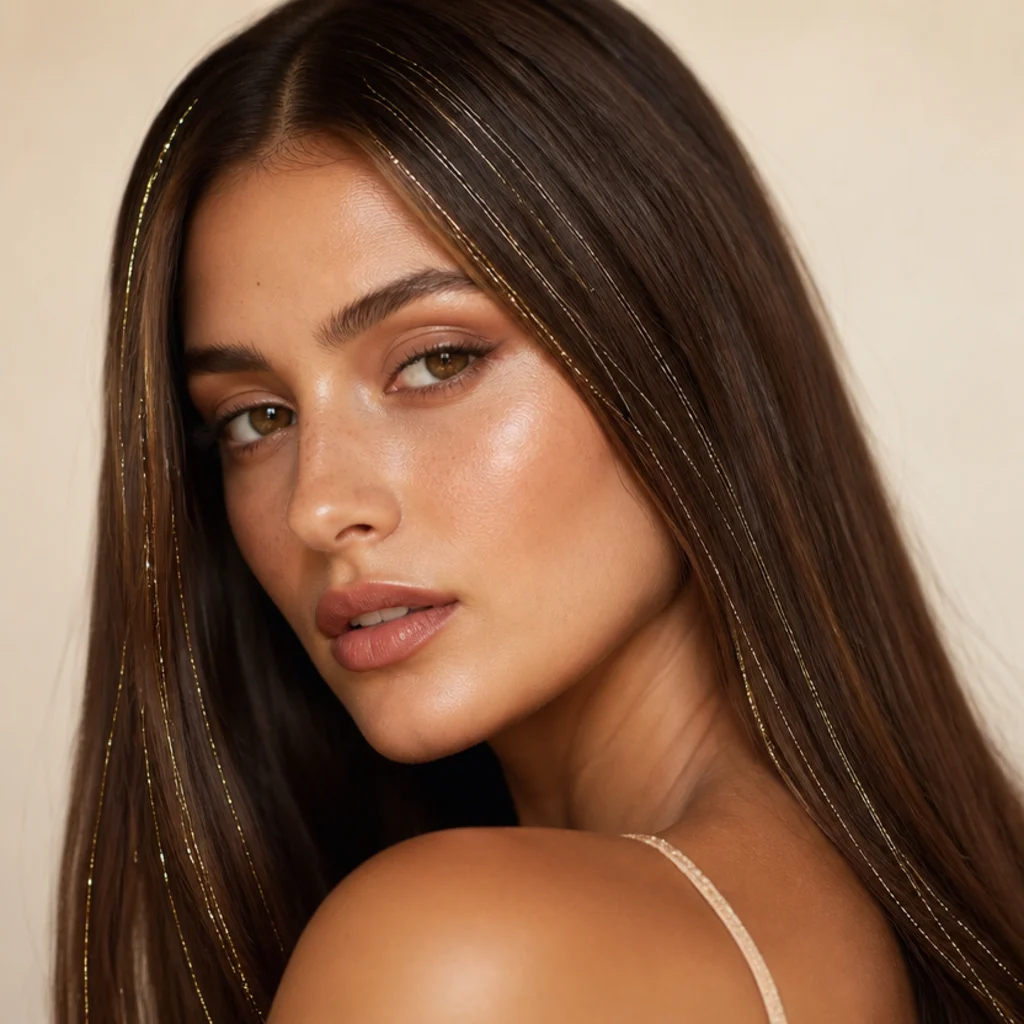
For the smallest possible commitment with the biggest camera payoff, place a handful of strands at the face-framing sections only. Ten to 15 pieces along your part and the panels that fall by your cheekbones catch light in every selfie without touching the rest of your head. This is the cleanest entry point to the hair tinsel aesthetic, and it works with any color, texture, or length, since you choose the metallic that flatters your undertone rather than committing to a whole-head palette. That's also why it suits every skin tone. It takes minutes, and removal takes seconds, which makes it a good trial run before a denser look. Tied strands last a few weeks; clip versions come out nightly. Pro tip: mirror the placement, an equal count on each side of the part, so the light reads balanced in a straight-on photo instead of lopsided. Ask your stylist for "a few face-framing strands at the part in a metallic that suits my undertone."
Save this to Pinterest to keep your top five looks in one place.
06Half-Up Space Buns with Tinsel
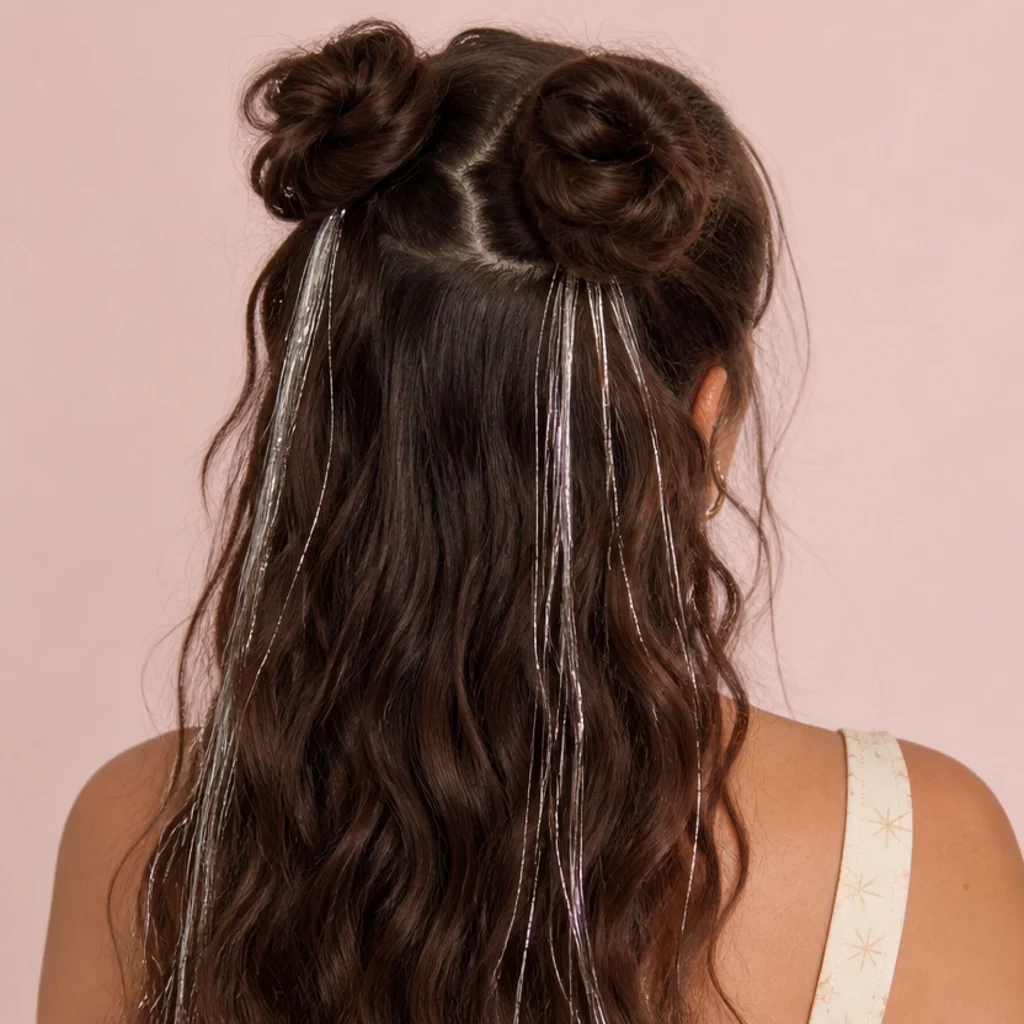
Space buns give tinsel a stage. Gather the top sections into two buns, and every tied strand trails from the twist, swinging with movement so the sparkle becomes choreography rather than a static detail. The look leans youthful and festival-ready, and it needs medium to long hair, enough length to bun cleanly without the tail slipping loose. Silver, pink, and rainbow all work; pick by your base color and the mood you want: cool metallics for polish, rainbow for play. Place strands specifically in the sections you'll gather so they concentrate at and below the buns instead of scattering where the style hides them. The styling itself takes some skill, but that's the buns talking, not the tinsel. Tied strands survive repeated updos noticeably better than clips, which can catch and pull free during the twist. Pro tip: leave a few strands loose to trail past the bun rather than tucking them all in, so movement reads as shimmer in motion. Ask your stylist to "load the crown sections with tinsel so it trails from half-up buns."
07Peekaboo Under-Layer Glimmer
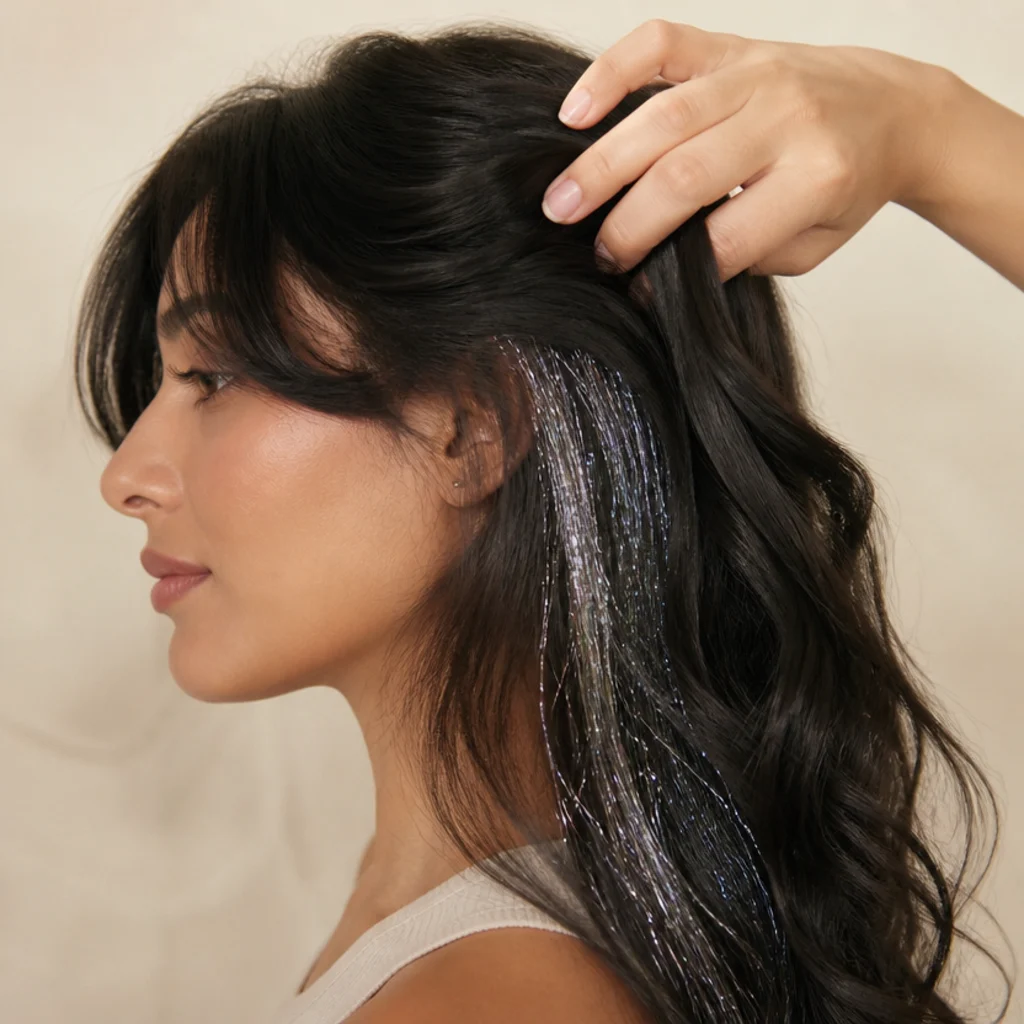
For a grown-up, office-safe take, bury the tinsel in your under-layers so it flashes only when your hair moves or you flip it up. This peekaboo placement keeps things boardroom-appropriate while still delivering a surprise glint on the commute home. It's tailor-made for hair tinsel black hair setups, since hidden iridescent strands glow from beneath the dark top layer like something you weren't meant to see. Straight to wavy hair, where layers separate cleanly, wears this best, and it works on every skin tone. Ask your stylist to concentrate strands in the mid and lower back sections and the nape, never the crown, so the top stays plain. Once the map is planned, it's easy to execute. These strands see the least brushing and heat of any placement, so they routinely last toward the long end: five to six weeks. Pro tip: this is the one placement where you can go denser without looking costume-y, since the top layer edits how much shows at any moment. Ask your stylist for "iridescent tinsel hidden in the under-layer and nape only."
08Braided Tinsel Accents
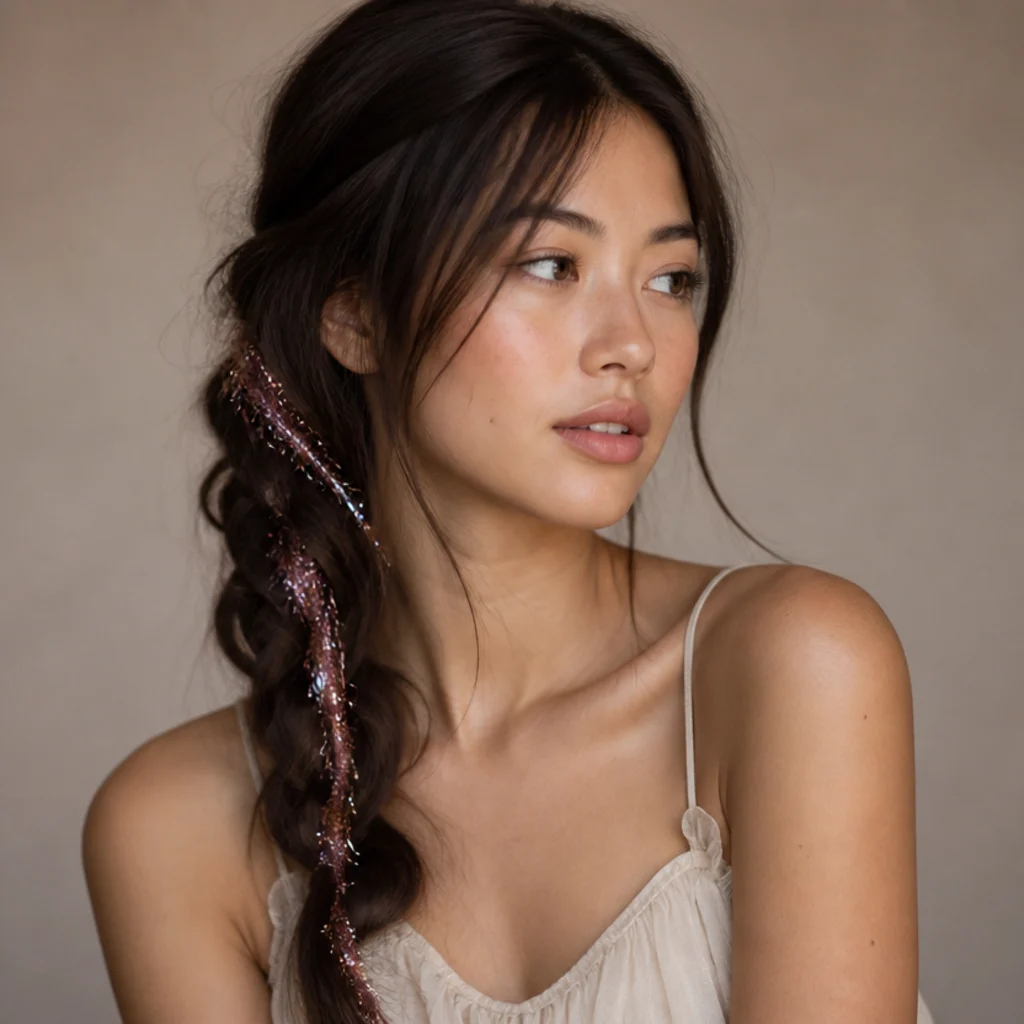
Braids and tinsel are a natural pairing: a plait traps the strands along its length, disciplining the shimmer into an orderly ribbon of light rather than a scatter. Tie a few strands into the sections before you braid, or feed in clip-in tinsel as you cross for a fully no-commitment version. It works on medium to long hair and every texture, and it's at its prettiest in a loose side braid, a Dutch crown, or a halo braid where the raised strands sit proud of the plait. Mixing pink and silver reads whimsical; a single tone reads refined and editorial. Difficulty here tracks your braiding skill, not the tinsel. The braid physically shelters each strand from brushing and friction, so tied tinsel holds unusually well between washes. Pro tip: add the tinsel a beat before you cross each section rather than braiding it in from the root, so it surfaces on the outer face of the plait where light hits, not buried inside. Ask your stylist for "tinsel woven along a loose braid, sitting on the outside of the plait."
09Money-Piece Gold Streaks
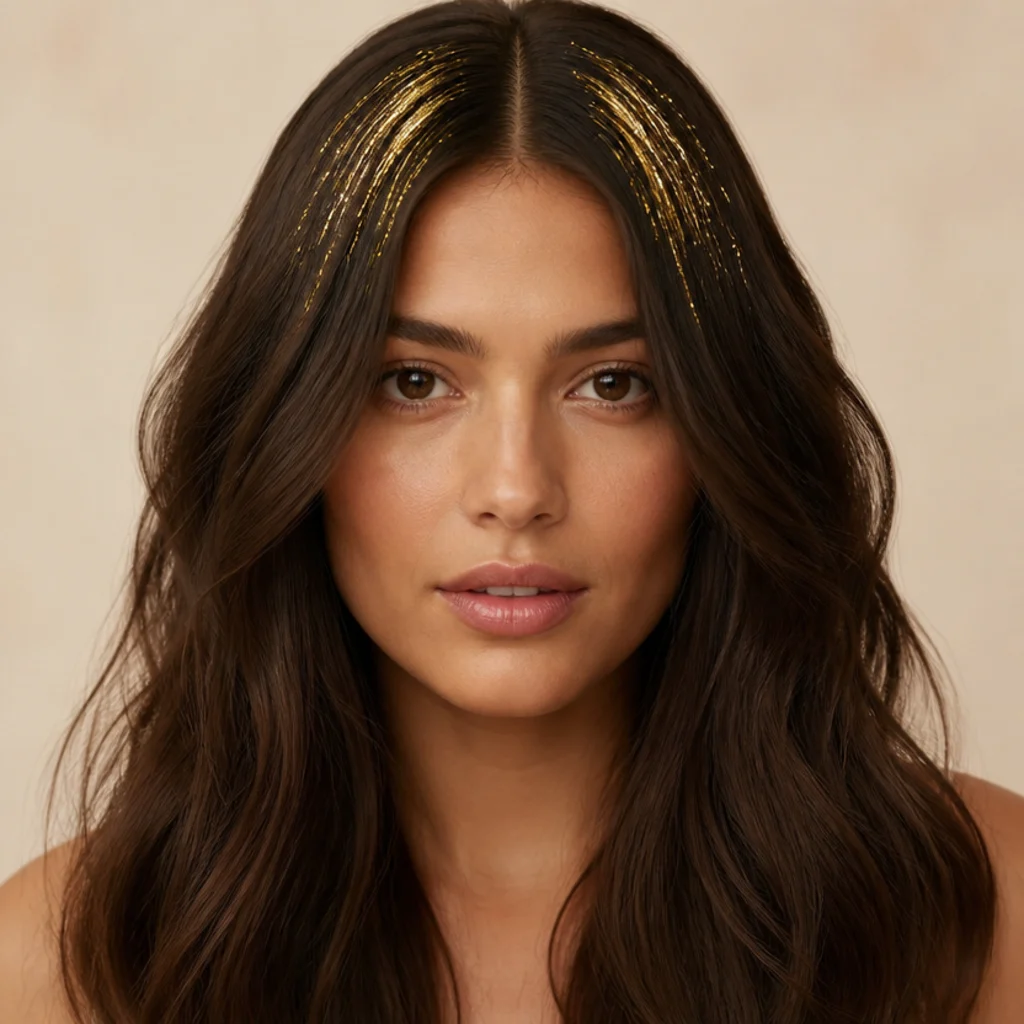
Borrowing directly from the money-piece coloring trend, this look clusters warm gold tinsel at the two front panels that frame your face and part, mimicking a bright highlight with zero bleach and zero grow-out line. The effect lands brightness exactly where a camera looks first. Gold flatters warm and neutral undertones and reads richest on brunette, auburn, and deep bases, where the metal has contrast to work against. Keep the rest of the head tinsel-free so the front reads intentional and graphic rather than accidental. It's a low-difficulty, high-impact placement you can manage at home with 12 to 20 strands per side. Tied strands last three to five weeks, and as they grow they just drift lower within the money-piece zone instead of looking patchy. Pro tip: keep the two sides symmetrical in both count and start height, since the money-piece framing lives or dies on the mirror-image balance. Ask your colorist for "gold tinsel packed into the money-piece sections, symmetrical on both sides."
10Pastel Rainbow Blend
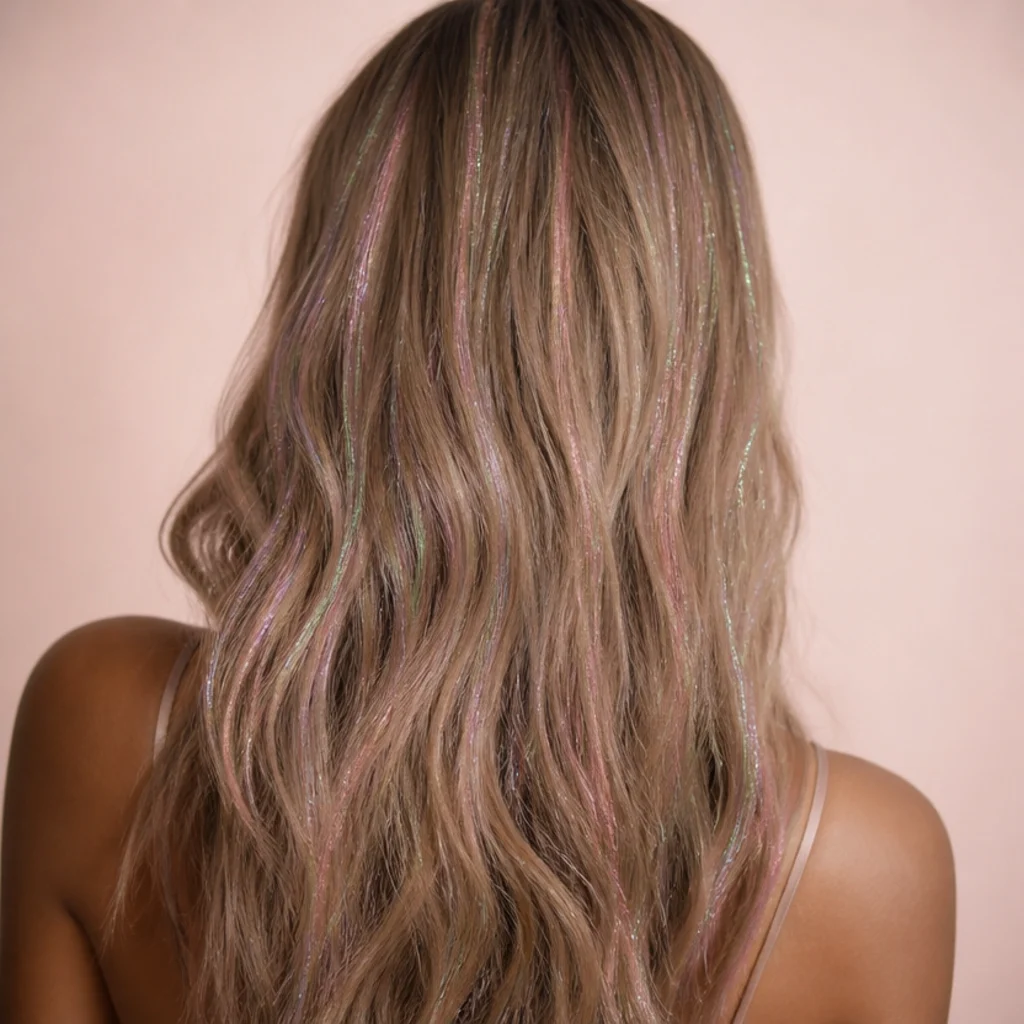
For maximum dreamy-aesthetic energy, blend several pastel tones at once: soft pink, lilac, mint, and pale gold, scattered evenly through the length. The multi-tone approach reads like a watercolor wash rather than distinct candy stripes, which is what lets it stay soft even at a higher strand count. Lighter and mid bases, from beige blonde to light brown, show pastels best; on very dark hair the same tones mute to faint glints. Every skin tone can wear it because the mix, not any single color, does the flattering. Aim for 40 to 60 strands spread in an even confetti for a full but airy effect. Each strand is easy to place, but the volume takes time, so budget an hour solo or book a stylist for evenness. Expect three to four weeks, since dyed pastel filaments soften with washing faster than metallics. Pro tip: keep no two same-color strands touching; alternate tones as you place so the eye blends them instead of spotting clusters. Ask your stylist for "an even pastel-multi tinsel scatter, tones alternated, not grouped."
Save this to Pinterest before you plan your next color-free refresh.
11Icy Blue Winter Shimmer
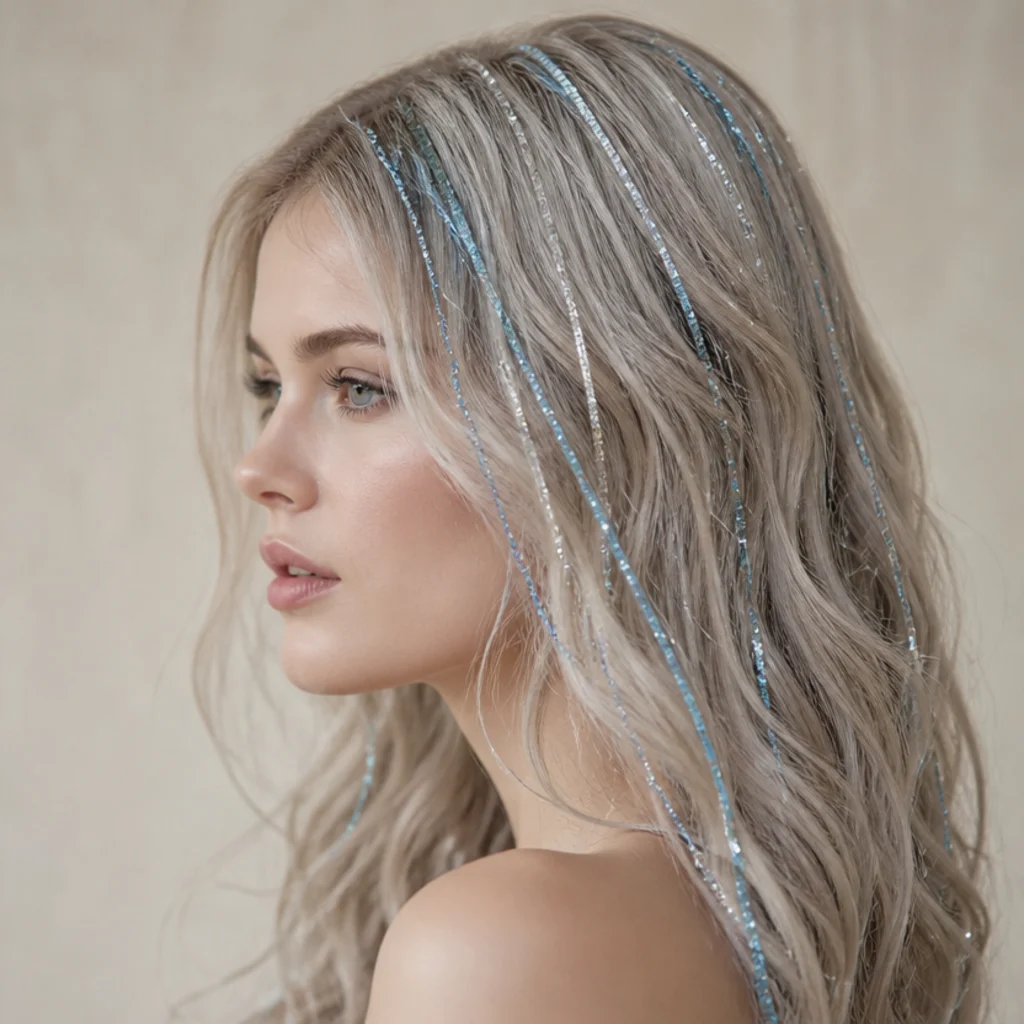
Icy blue and silver tinsel delivers a frosted, winter-queen effect that suits cool-toned hair the way a scarf suits a coat. On ash blonde, silver, or natural gray, the blue reads crisp and glacial, like frost caught mid-strand; on darker bases it drops to a subtle cool glint. Cool and neutral skin undertones carry it best, while very warm complexions may find it drains them slightly. Scatter the blue with a little silver so it never looks like one dyed streak, concentrating through the top and mid sections where overhead light lands. It's a seasonal favorite that photographs beautifully in bright, cool, blue-hour light. Tie-in or clip strands make this an easy one to DIY. Tied tinsel holds three to five weeks, comfortably spanning a holiday-party stretch. Pro tip: pair it with a cool-toned gloss or purple shampoo week so any brassy warmth in the base doesn't fight the icy palette. Ask your stylist for "an icy blue and silver mix scattered through the top sections for a frosted finish."
12Copper Tinsel on Auburn Hair
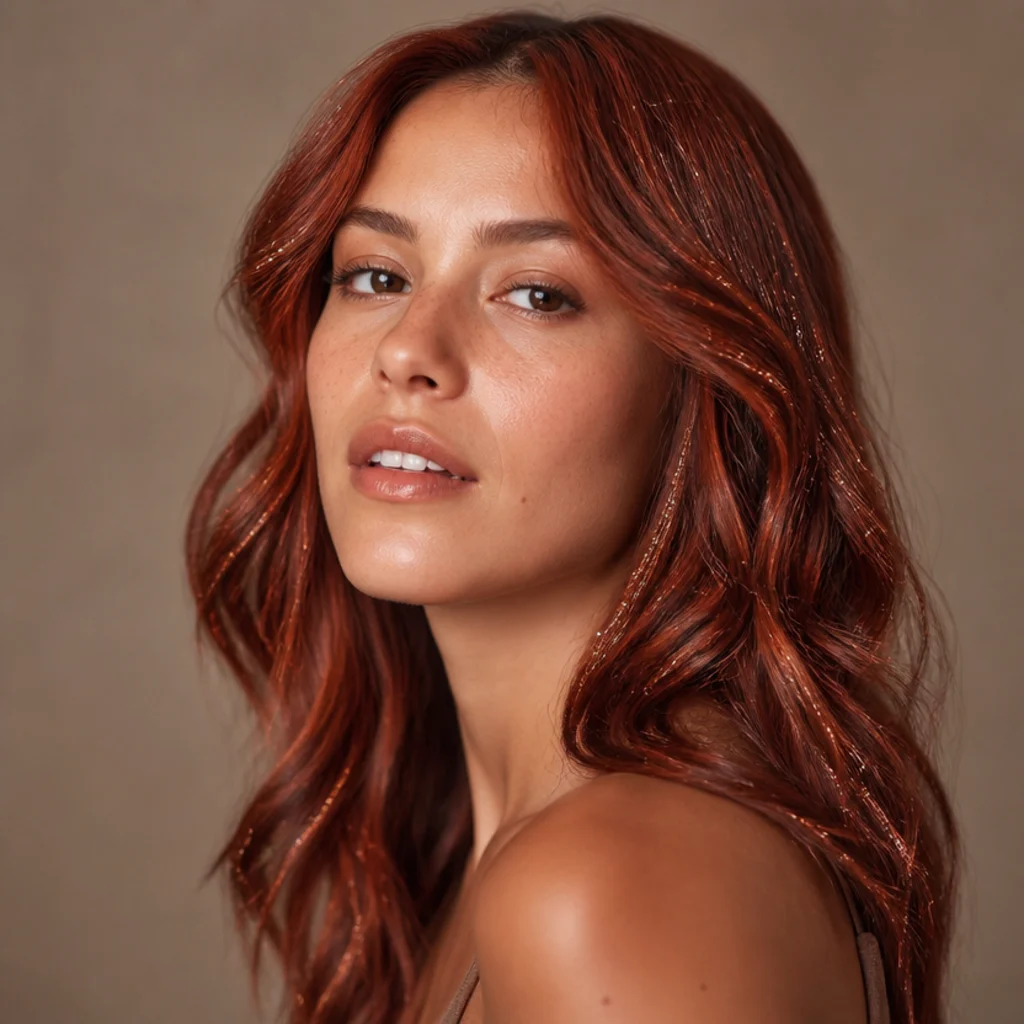
Copper and bronze tinsel on auburn or red hair creates a tonal, invisible-until-it-catches-light effect, so instead of contrast you get depth, as if the hair itself carries flecks of struck metal. Warm, golden, and peach skin undertones wear it best, and it reads sophisticated rather than novelty, one of the few looks that passes at the office and at a wedding equally. The tones sit so close to the base that you can run a higher strand count, 30 to 45, without it looking busy. Place strands through the mid-lengths where waves turn and reflect, and add a few at the crown to catch overhead light. It works on straight and wavy auburn hair of medium-to-long length, and it's a simple one to place yourself. Tied strands last three to five weeks and grow out with unusual grace, since the color blends into your base instead of fighting it. Pro tip: mix two adjacent metals, warm copper plus antique bronze, rather than a single copper, so the effect gains the dimension real red hair already has. Ask your colorist for "a copper-and-bronze tinsel blend worked tonally through the mid-lengths."
13Full-Head Festival Sparkle
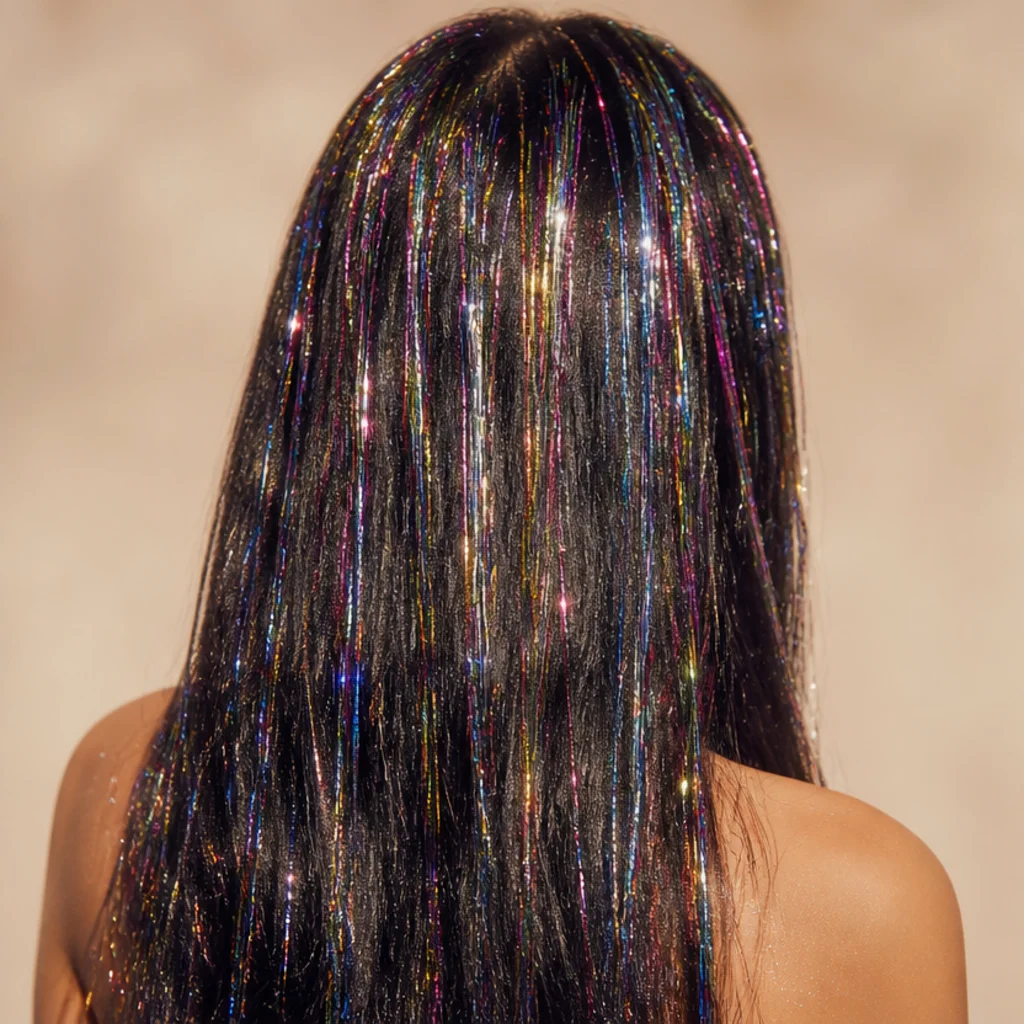
When the occasion demands maximum shine, go full-head. A dense scatter of 80 to 150 strands in rainbow and silver turns the whole head into a shimmer field, purpose-built for festivals, concerts, raves, and costume moments. On dark hair the effect is high-drama and prismatic; on light hair it softens into an all-over glow. Every texture can carry it, though longer hair shows off the density best. This is the highest-maintenance version on the list purely by volume: there's just more to track, brush around, and eventually remove, so many people book a stylist and set aside real chair time. Tied strands still last three to five weeks if you resist the urge to brush aggressively. Pro tip: work in mapped rows, section by section, rather than placing at random, so the density stays even and you don't end up with a bald patch of shimmer at the back you can't see. Detangle with a wide-tooth comb, never a bristle brush, to spare the knots. Ask your stylist for "a full-head rainbow-and-silver scatter placed in even rows."
14Subtle Bronde Everyday Shimmer
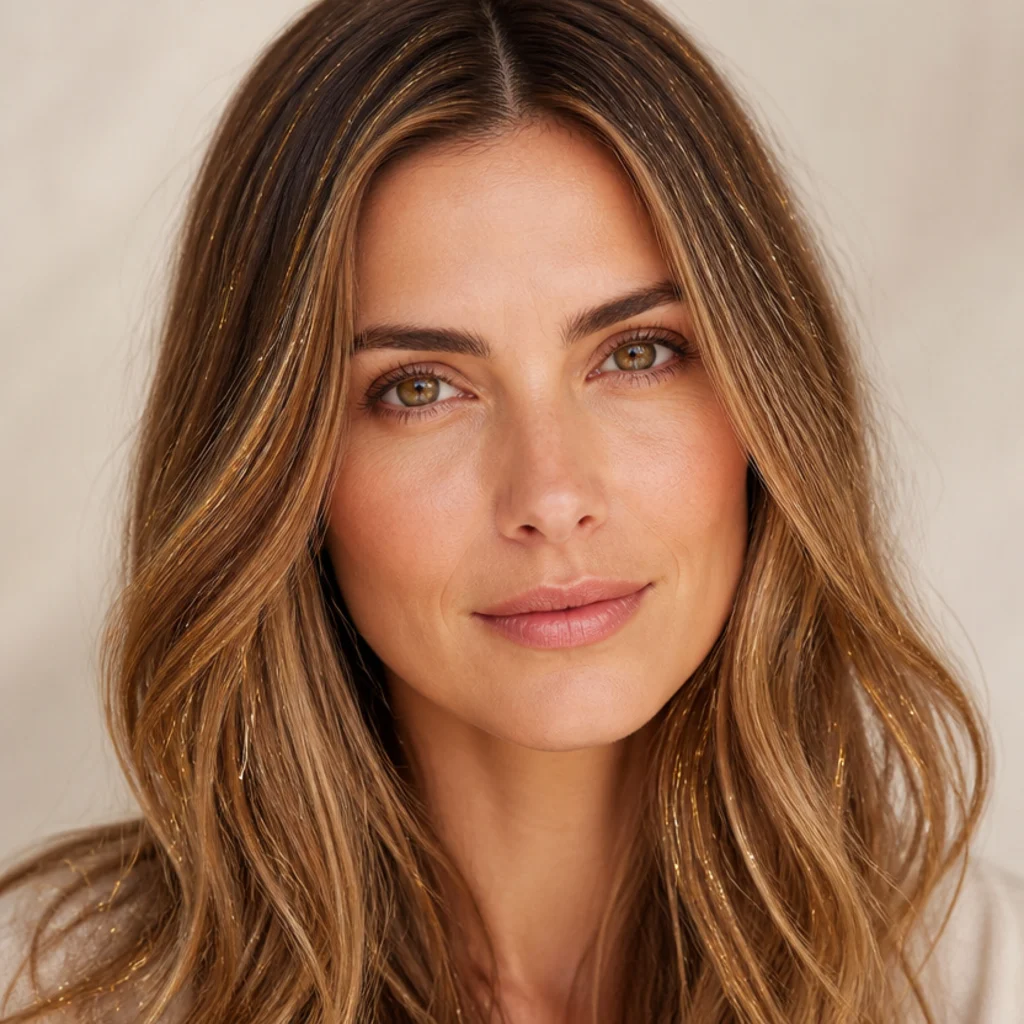
Not every tinsel look needs to announce itself. For everyday wear, a light scatter of champagne or soft gold tinsel through bronde hair adds a lit-from-within quality that reads as glossy, healthy hair more than obvious sparkle, the kind of finish people compliment without clocking why. This is the version that survives fluorescent office light and flat midday daylight without tipping into costume. Neutral to warm undertones and any texture wear it well, and it sits especially naturally on that brown-to-blonde bronde zone where champagne disappears into the highlight. Keep the count low, 15 to 25 strands, and spread them evenly rather than clustering, since a subtle look punishes a visible clump more than a bold one does. It's easy to do yourself in about ten minutes. The effect is quiet enough that uneven grow-out is barely perceptible, so it ages gracefully across its three-to-four-week life. Pro tip: match the tinsel to your brightest highlight, not your base, so it amplifies dimension you already have. Ask your stylist for "a light champagne tinsel scatter matched to my highlights."
15Sleek High Ponytail with Tinsel
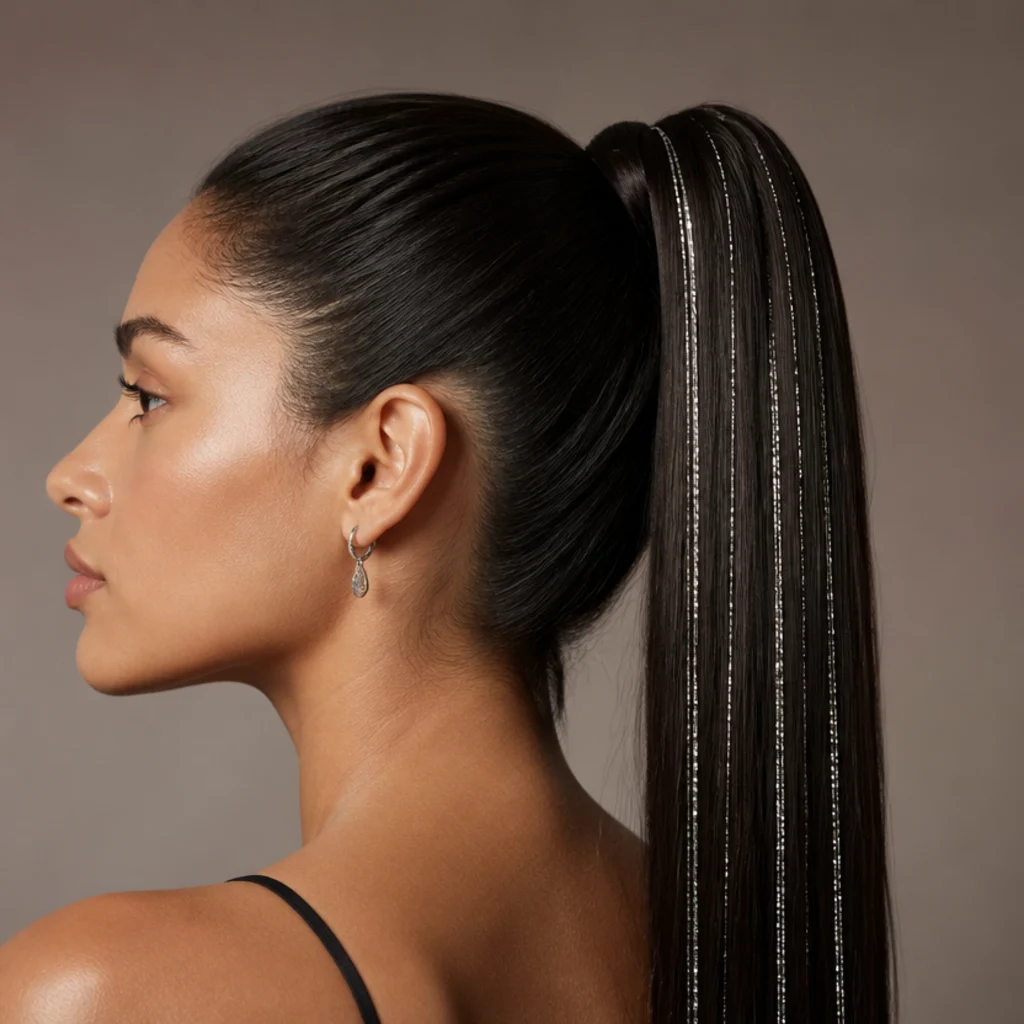
A sleek, high ponytail turns tinsel into a clean vertical line of light. When the hair is pulled tight and smoothed flat, tied strands run straight down the length and read polished and architectural rather than playful, which makes this the tinsel look for a gala, a launch, or any event where you want shine with structure. Medium to long hair of any texture that can be smoothed into a ponytail works, and silver and gold both look expensive here. Place strands specifically in the sections that will finish on top of the ponytail, the outer, visible face, so they show instead of hiding inside the gathered mass. The challenge here is the sleek finish, not the tinsel. Tied strands handle high, tight styles better than clips, which can slip under tension. Pro tip: smooth a flat-iron pass and a shine serum over the finished ponytail, but keep the iron below 300°F near the tinsel so budget Mylar strands don't warp. Ask your stylist for "silver tinsel placed on the top sections so it runs the length of a sleek high pony."
Save this to Pinterest so your event-hair inspiration is ready when you need it.
16Tinsel on Locs and Protective Styles
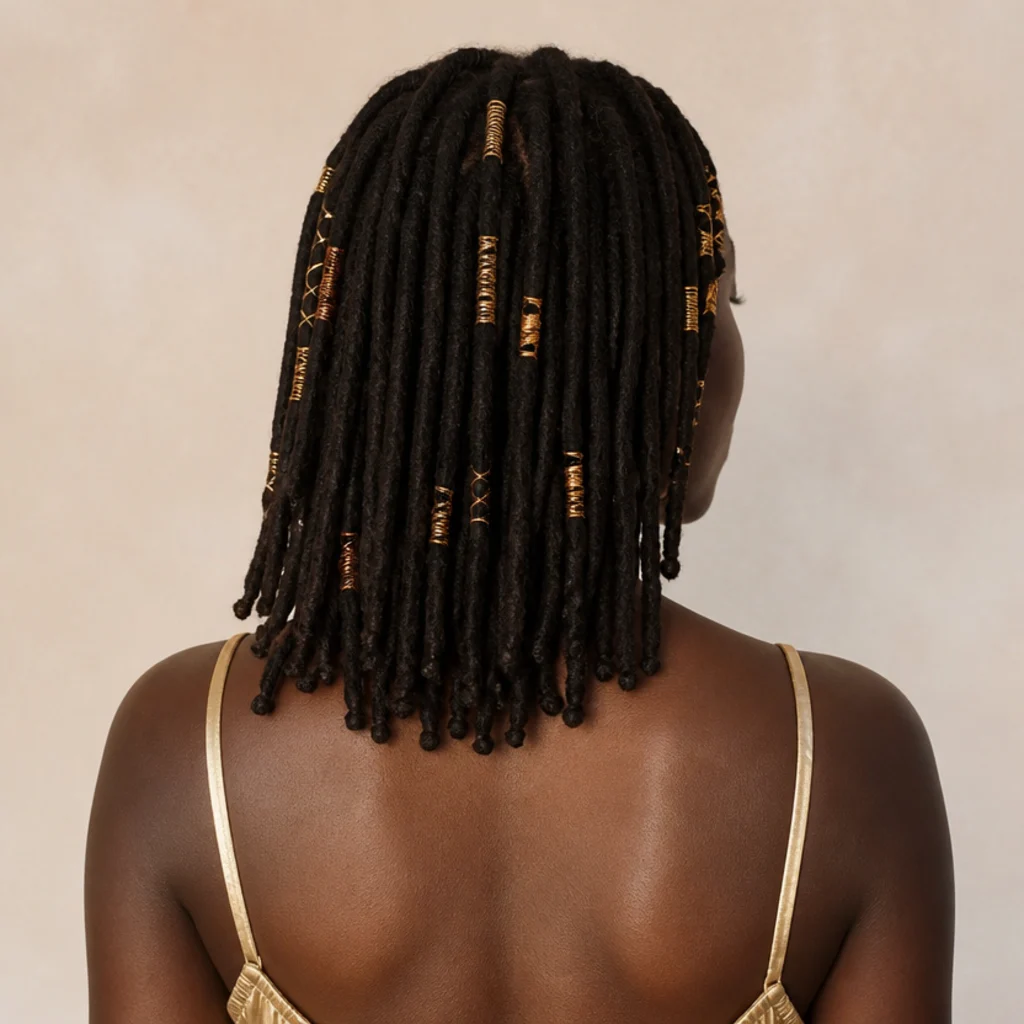
Tinsel adapts well to locs, box braids, and twists, where you wrap or tie strands around individual sections for a jewelry-like, adorned effect rather than a scatter. Protective styles already have discrete, defined pieces, so the tinsel gets a firm anchor and stays put noticeably longer than it can on loose hair, often as long as the style lives. Gold and copper read especially rich against dark locs, echoing the metal cuffs and beads that already belong to the tradition, while iridescent adds a cooler, more modern shimmer. Any length of locs or braided style works, on any skin tone. Wrap strands around a chosen handful near the face and crown, not every loc, so the effect reads intentional rather than tinseled-over. It's a low-effort addition to an existing style. Pro tip: wrap and tuck the tail back into the loc rather than knotting at the surface, so it won't snag on fabric or unravel. Ask your stylist for "gold and copper tinsel wrapped around a few front and crown locs, tucked, not knotted."
17Mermaid Waves with Blue-Green Strands
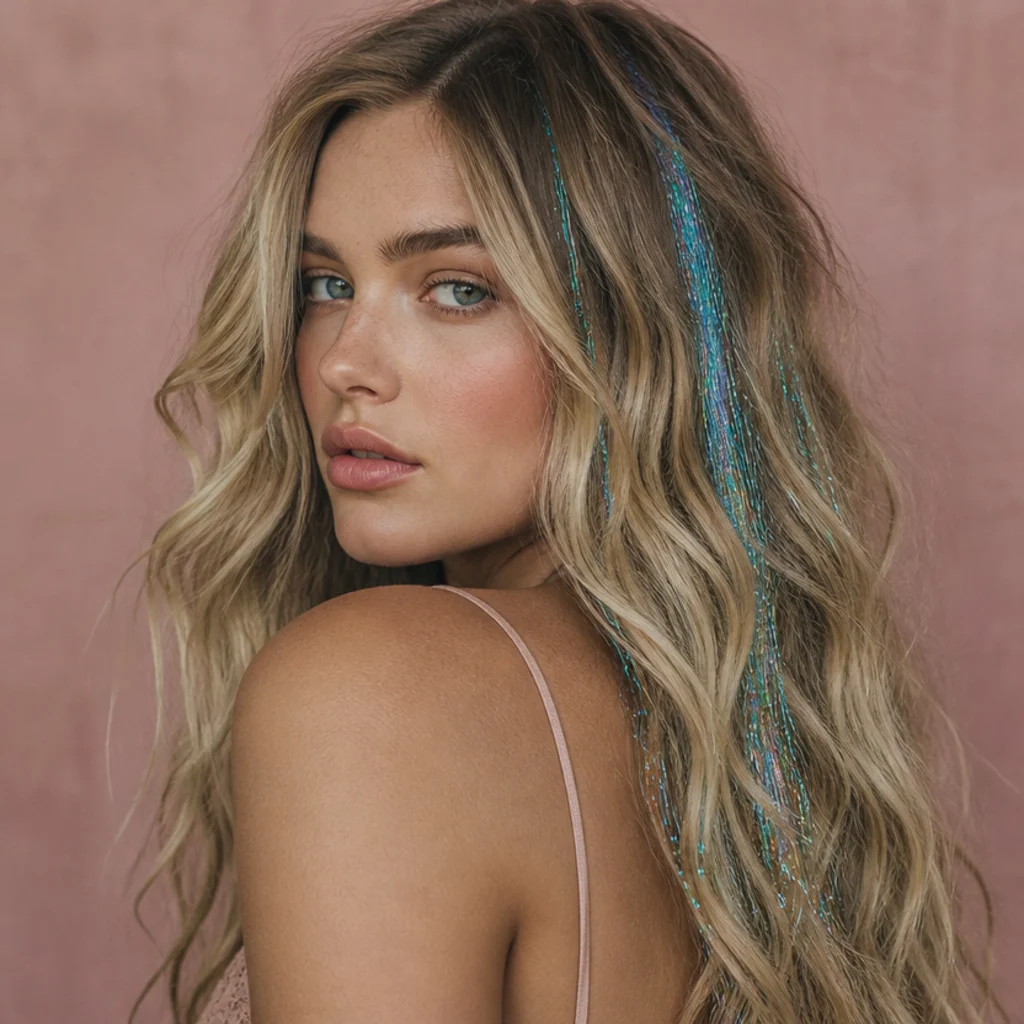
Lean fully into the aquatic aesthetic with teal, seafoam, and blue-green tinsel scattered through loose, undone beachy waves. The S-bend of a wave breaks up each strand so it shimmers like sun on moving water, and the cool blue-green palette conjures the mermaid feeling with no semi-permanent dye and no grow-out. Medium to long hair that holds a wave suits this best and flatters cool and neutral undertones most; warm complexions can pull it toward the blue end to keep it fresh. Scatter the tones together through the mid-lengths and ends where waves are most defined, since tinsel at the root disappears under a bendy top layer. The tinsel itself is easy; the waves set the entire mood, so a good salt spray or a curling-wand bend does the heavy lifting. Tied strands last three to five weeks, and the multi-tone blend camouflages grow-out as strands shift down. Pro tip: build the waves first, then place tinsel along the crest of each bend where it will glint, rather than tying before you style. Ask your stylist for "a teal and seafoam tinsel scatter set into the mid-lengths of beachy waves."
18Clip-In Tinsel for Zero Commitment
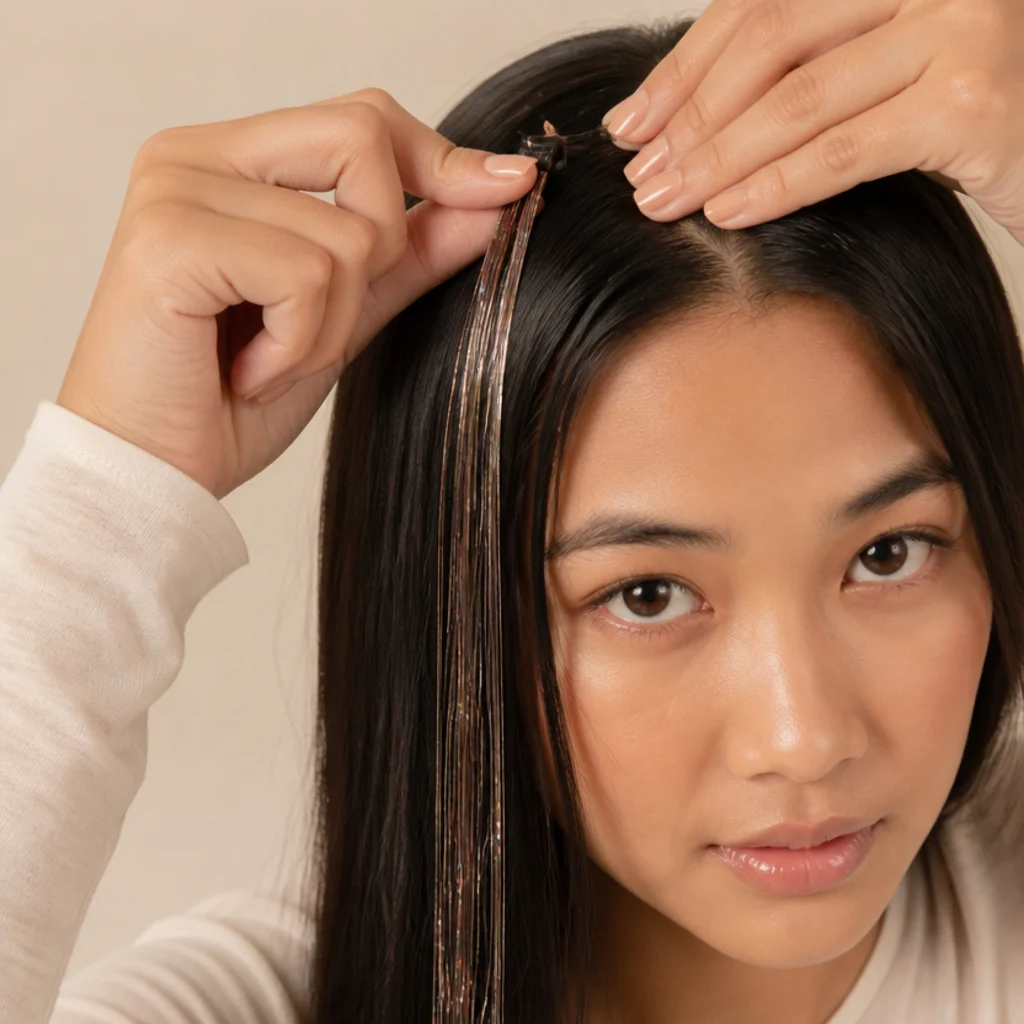
Clip-in tinsel is the answer for anyone who wants sparkle strictly on their own schedule. These pre-made pieces snap in near the crown or part in seconds and pull out just as fast, so you can wear tinsel to dinner and remove it before bed with zero residue. It's the most beginner-friendly option on the list and the gentlest on hair, since nothing is knotted, bonded, or glued, which makes it the right call for fine, fragile, or reactive hair. Clip-ins work with every color and texture, though they anchor most securely on hair with a little grip or a light backcomb at the clip base. Choose a tone that flatters both your base and your skin undertone. There's essentially no learning curve. The trade-off is honesty: a clip is slightly more visible up close than an invisible tied knot, so place it where the top layer sweeps over the comb. Pro tip: mist a little dry shampoo or texture spray at the clip site first, so slick, freshly washed hair gives the comb something to hold. Ask your stylist for "a clip-in tinsel piece and a quick lesson on seating the comb."
19Lavender Dream Shimmer
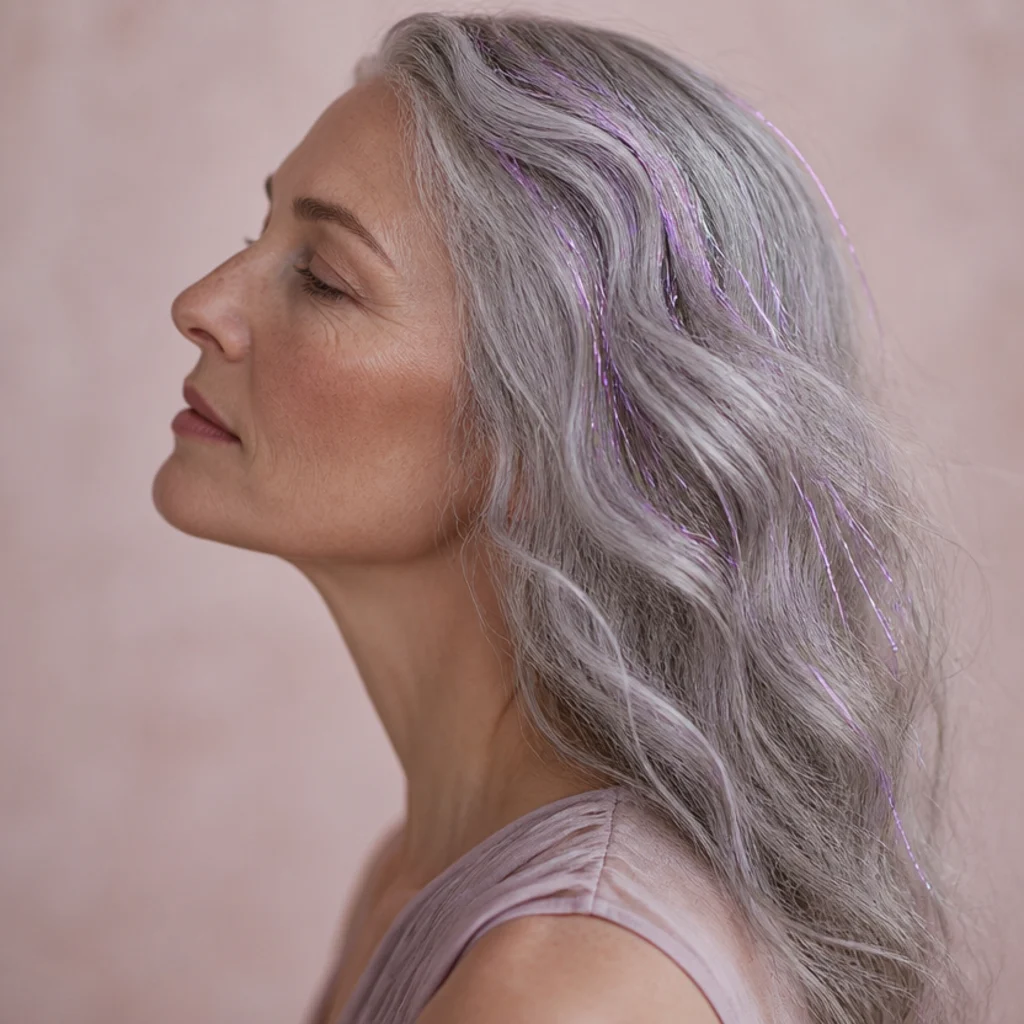
Lavender and soft violet tinsel is the dreamiest of the pastels, and it looks otherworldly on silver, natural gray, and cool-blonde hair, where the tone stays true and luminous. On darker bases it drops to a subtle purple flash that surfaces only in direct light. Cool and neutral undertones suit it best, and it pairs naturally with soft, romantic styling: loose waves, a low undone bun, a half-up twist. Scatter lavender through the top and mid sections so it reads in soft, diffused light rather than getting lost underneath. It's an easy look to add at home in one sitting. Pastel tones are quieter than metallics, so the effect is gentle and grows out softly across its three-to-four-week wear, with no harsh line as strands drift down. Pro tip: on gray or silver hair, lavender doubles as a flattering cool-toning trick, the violet cancels any yellowing right where it sits. Ask your stylist for "soft lavender and violet tinsel scattered through the top layers of my grays."
20Tinsel Bangs and Fringe Sparkle
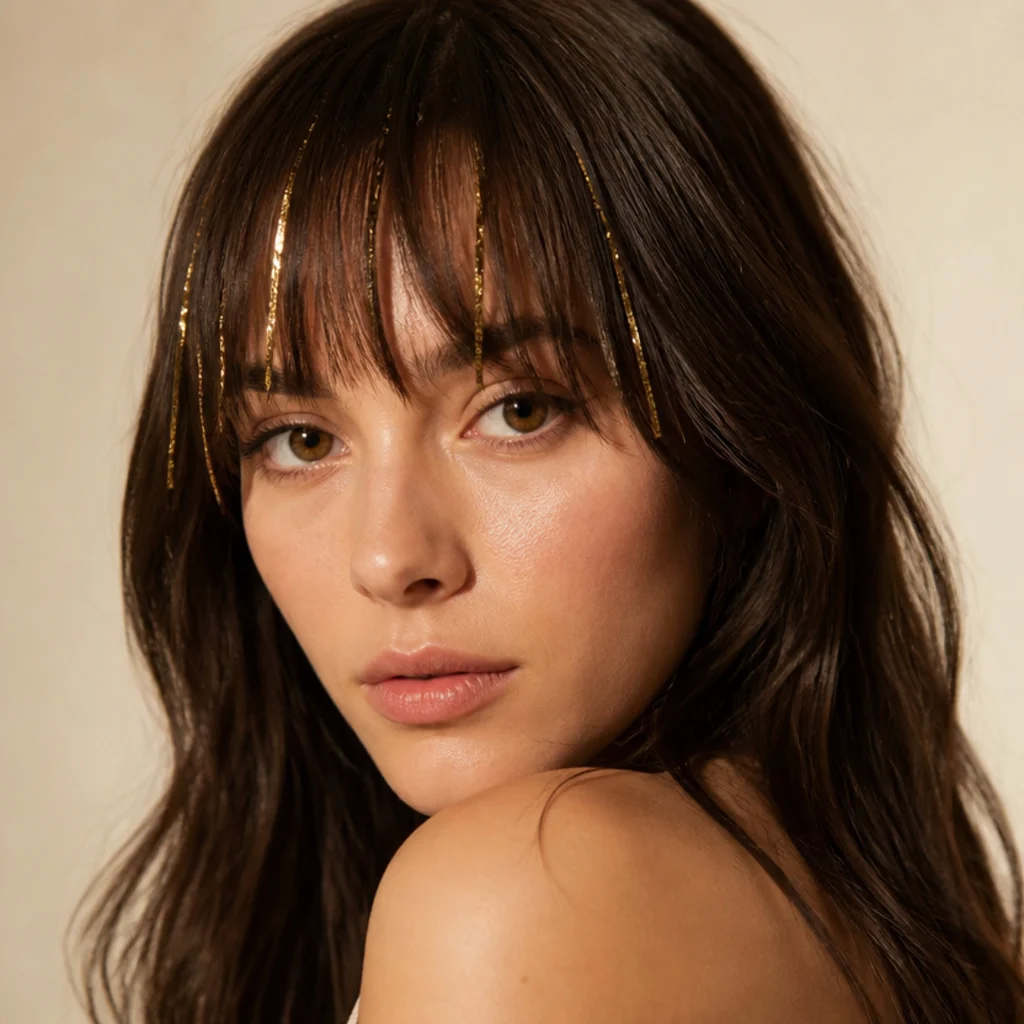
Placing a few strands in your bangs or fringe puts the sparkle at eye level, front and center. Whether you wear curtain bangs, a blunt fringe, or wispy face pieces, five to ten tied strands worked into the fringe catch light every time you blink, so the effect is intimate and hard to miss in a close-up. It's a tiny commitment with an outsized payoff, and it suits any base color and skin tone. It works best on fringe long enough to hold a knot without the tinsel jutting out awkwardly, so curtain and grown-out shapes beat a very short micro-fringe. It's simple to place. The one honest caveat: fringe gets styled, touched, and pushed aside constantly, so these particular strands loosen sooner than the rest, often within two to three weeks. Pro tip: knot fringe strands a little lower down the hair shaft than usual so daily finger-combing doesn't work them loose at the root. Ask your stylist for "a few gold strands worked into my curtain bangs, knotted low so they hold."
Pro Tips from the Editor
- Place tinsel on set, styled hair, never on frizz or a fresh wash. A defined curl, a smoothed section, or a set wave gives the strand a surface to lie along; slick clean hair sheds knots and clips alike, so mist a little texture or dry shampoo first.
- Count in tens and go lower than you think. Ten to 15 strands read on camera; density above 60 tips into festival territory. Curly and coily textures need roughly half the count straight hair does, because coils reveal and hide each strand as they move.
- Match metal to undertone, color to contrast. Warm golds, copper, and rose gold for warm skin; cool silver, icy blue, and lavender for cool skin. Then let your base set the drama, dark hair maximizes iridescent shift, light hair softens everything into a wash.
- Keep the flat iron under 300°F anywhere near the strands. Silk-thread tinsel is heat-tolerant, but inexpensive Mylar can warp or melt; check the pack, and when in doubt, style first and place tinsel after.
- Remove by sliding down and out, never yanking from the root. For tied strands, ease the knot down the hair shaft to the end; this is what keeps the method damage-free.
- Detangle with a wide-tooth comb or fingers, not a dense bristle brush. Bristles catch knots and drag strands loose, which is the single biggest reason tinsel fails early.
- Photograph your look in daylight before the event. Iridescent and metallic tinsel reads far brighter on camera than in a bathroom mirror, so a daylight test tells you the true payoff before you commit to more.
How to Choose / Get the Look
Work through four decisions in order. First, commitment: to test the trend, choose clip-in tinsel or a small face-framing placement you can remove in seconds; to live with it, hand-tied strands stay put three to six weeks and read invisible at the root. Second, tone by contrast: on hair tinsel black hair and other dark bases, iridescent silver and jewel metallics pop hardest while pastels stay whisper-subtle; on blonde, pink and lavender glow softly; on auburn, copper blends tonally into depth. Third, metal by undertone: warm golds, copper, and rose gold flatter warm skin, while cool silvers, icy blue, and lavender flatter cool skin. Fourth, placement and density: scattered strands read organic, clusters read graphic, and texture changes the count, curly hair needs far fewer strands than straight to reach the same effect. Use the table below to match method to how long you need it to last and how invisible you want it.
| Method | Best for | Wear time | Visibility up close | DIY difficulty |
|---|---|---|---|---|
| Clip-in | Testing, one-night events, fine or fragile hair | One evening | Slightly visible comb | Very easy |
| Glue-free tie-in | Weeks of reversible wear, invisible root | 3–6 weeks | Nearly invisible | Easy with practice |
| Micro-bead / loop | Maximum security, dense full-head looks | 4–6 weeks | Small bead at root | Best done by a pro |
| Heat-bond | Longest hold on straight hair | 4–6 weeks | Sealed root point | Salon only |
When booking a stylist, bring a photo and use specific language: name the color and finish, the density (light scatter versus full head), and the exact zones (face-frame, crown, under-layer). Ask how the strands are secured, request a glue-free tie-in for damage-free removal, and ask how to brush around the knots. To take tied strands out yourself, slide each one down and off the end rather than pulling from the root.
Frequently Asked Questions
How do you put tinsel in hair at home?
The most common method is the glue-free tie-in. Fold a single strand over a small section of hair a centimeter or so below the root, then tie a double or triple overhand knot to lock it, and trim the tail even with your hair length. Work near a mirror in bright light, place strands one at a time, and keep them scattered rather than clustered. For a no-tie route, clip-in tinsel pieces snap in near the part in seconds. Both are gentle, since neither one uses glue or heat.
Does hair tinsel damage your hair?
Glue-free tied strands and clip-ins are generally gentle because they add nothing chemical and use no heat or bleach. The main risk is mechanical, not chemical: tugging. Brush carefully around the knots with a wide-tooth comb, and remove strands by sliding them down and off the end rather than pulling from the root. Heat-bonded and glued methods carry more risk to the hair shaft, which is why many people, and most stylists, prefer the tie-in approach.
How long does hair tinsel last?
Hand-tied strands typically last three to six weeks, loosening gradually and growing down as your hair does. Placement drives the range: hidden under-layer strands that see little brushing last longest, toward six weeks, while fringe and face-frame pieces that get styled and touched daily can loosen within two to three. Clip-in tinsel is not meant to last at all, you put it in and take it out the same day.
Can you wash and style hair with tinsel in it?
Yes. Most tied tinsel is heat-safe, but check the packaging, since inexpensive synthetic Mylar has a lower heat tolerance and can warp or melt under a hot iron. Keep flat irons and wands below roughly 300°F near the strands. Wash as normal, being gentle around the knots, use a wide-tooth comb to detangle, and air dry when you can. Clip-ins should come out before washing.
What is the best tinsel color for dark hair?
Iridescent or rainbow silver is the standout for dark and black hair, because the contrast makes it shift color and refract like a prism. Jewel tones, cool blues, and rich copper or gold also read beautifully against deep strands. Pastels such as pink and lavender show up more subtly on dark bases, appearing as soft glints rather than obvious color, so choose metallics or iridescents if you want maximum payoff.
How much tinsel do I need for a full look?
It depends on both the effect and your texture. A face-frame accent needs 10 to 15 strands; an everyday scatter, 15 to 30; a noticeable all-over shimmer, 40 to 60; and a dense full-head festival look, 80 to 150. Curly and coily hair needs roughly half the count of straight hair for the same visible effect, because the coils reveal and conceal each strand as they move. When in doubt, start low, you can always add more.
Can you sleep in hair tinsel?
Tied strands are made to stay in around the clock for weeks, so yes, you sleep in them; a loose braid or a silk pillowcase reduces friction and helps them last. Clip-in tinsel is the exception and should come out before bed, since the comb can catch, pull, or bend as you move. If you feel a knot pressing against your scalp, it was likely tied too close to the root and can be eased down.
Does hair tinsel work on short hair or fine hair?
Short hair works as long as the sections are long enough to hold a knot, usually a couple of inches, so a pixie is tricky but a bob is fine; concentrate strands at the crown and face where they show. Fine hair works too, but favor clip-ins or a light tie-in count so you never feel weight or see knots through sparse sections. Place strands where the top layer sweeps over them so they blend in cleanly.
What is the difference between hair tinsel and glitter roots or hair jewels?
Hair tinsel is a thin, semi-permanent reflective filament tied or clipped into the hair for weeks of reversible sparkle. Glitter roots are a temporary makeup-style application of loose glitter and gel at the part that washes out in one shampoo, and hair jewels or gems are adhesive stones stuck to the surface for a single wear. Tinsel is the most durable and the most natural-looking of the three, since it moves and catches light like your own hair.