25 Stunning Hair Tinsel Ideas to Save
Hair tinsel is the low-commitment sparkle trick that reads editorial in photos and playful in person — no dye, bleach, or heat damage required. These 25 ideas span metallics, jewel tones, pastels, placements, and braided styles, so you can pin the exact look you want. Each one covers who it flatters, how long it lasts, what it tends to cost, and the exact words to say at the chair.
 Edited by Lena Rose · Published July 11, 2026 · 39 min read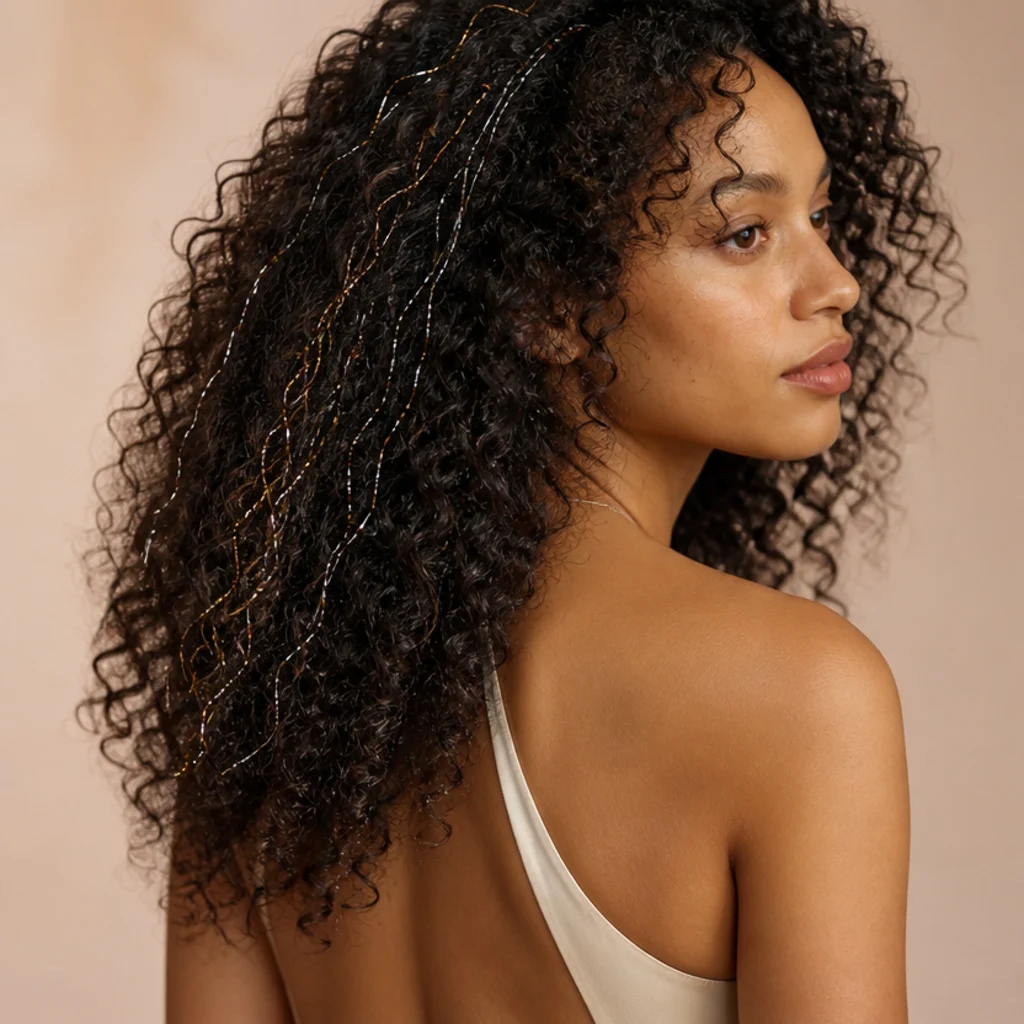
Quick Answer
- Best for: Anyone wanting reversible, damage-light shine, from sleek jet-black and deep brunette to loose curls, silver-gray, platinum, and pastel color.
- Who might skip it: Very fine or fragile hair prone to breakage at the root, anyone who heat-styles daily and won't work around the filament, and workplaces with strict no-embellishment dress codes (choose a hidden peek-a-boo panel instead).
- Maintenance: Strands last roughly one to six weeks depending on the tie-in method and placement. Brush gently from the ends up, keep flat irons and curling wands off the filament, and skip heavy oils where it sits.
- Difficulty: Easy to moderate. Clip-in and dazzle strands are beginner-friendly and same-day; knotted tie-ins and braided placements are best set by a stylist or a patient friend.
- Cost: Wide range. DIY clip-in kits run low; a handful of salon tie-in strands sits in the low-to-mid range, while full-head glass-hair placement is the priciest because of strand count and chair time. Always confirm whether pricing is per strand or per session.
- Wear time / longevity: Protected placements (under-layer peek-a-boo, braids, locs) hold longest; exposed face-framing and glass-hair looks loosen faster with washing and brushing.
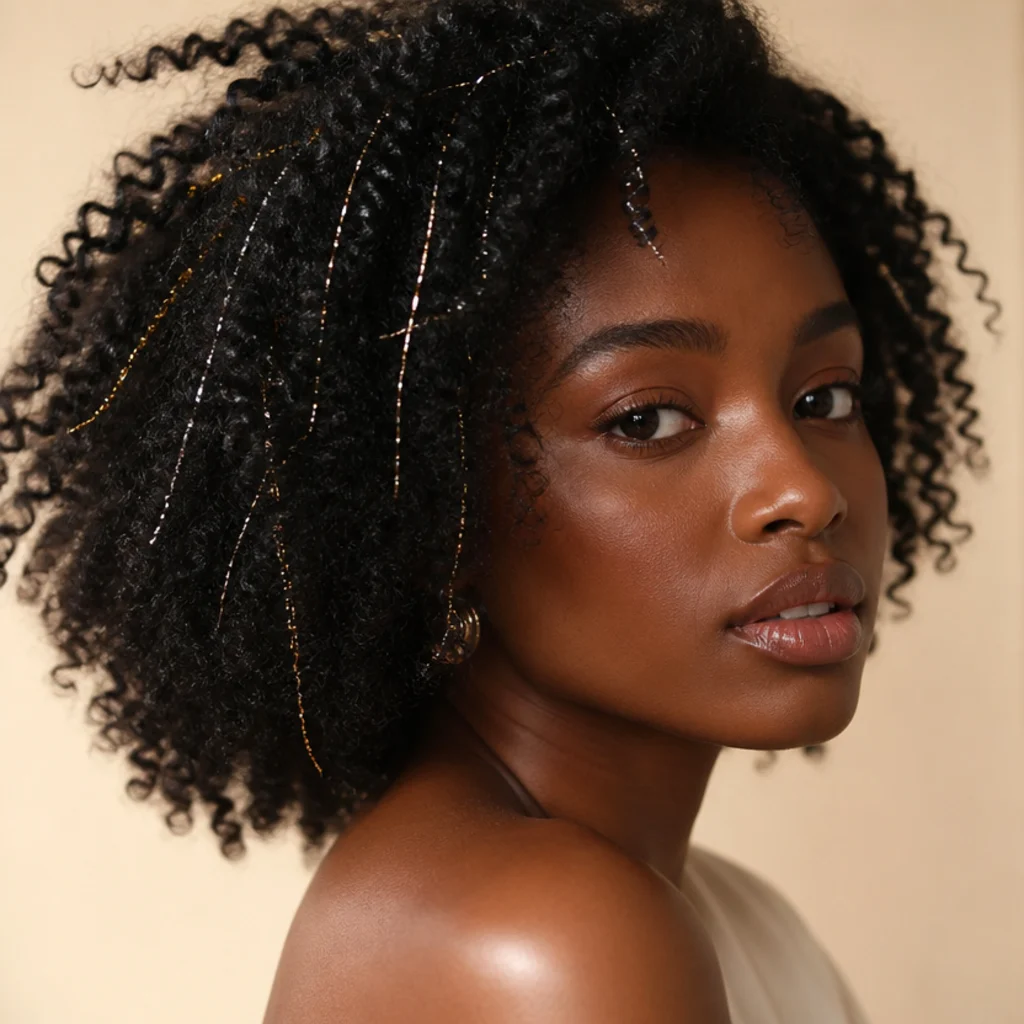
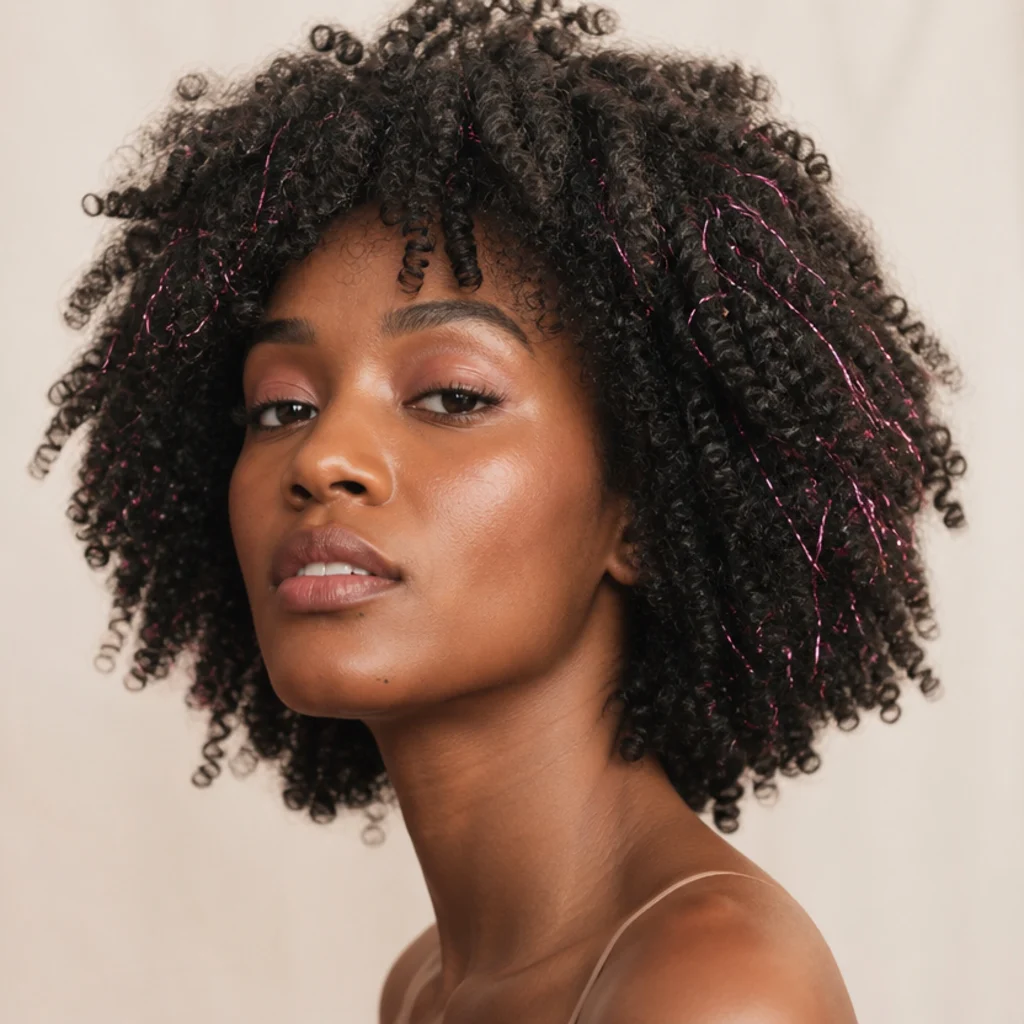
- Standout variation: Rose-gold tinsel scattered through dark curls — it catches light without fighting your natural color.
- How to ask your stylist: Name the finish, color, placement zone, and strand count, e.g. "fine silver tinsel, scattered, concentrated at the crown and part, around 20 strands." Bring a reference photo for density.
In This Guide
- Silver Tinsel on Jet-Black Hair
- Rose-Gold Strands for Warm Skin Tones
- Bubblegum Pink Tinsel Accent
- Curly Hair Tinsel Scatter
- Iridescent Rainbow Face-Framing Pieces
- Holographic Tinsel Ponytail
- Tinsel Through a Fishtail Braid
- Golden Tinsel on Deep Brunette
- Icy Blue Strands for Cool Blondes
- Subtle Single-Color Peek-a-Boo
- Tinsel Money-Piece Highlight
- Copper Tinsel on Red Hair
- Tinsel-Wrapped Space Buns
- Purple Tinsel on Silver-Gray Hair
- Tinsel in a Half-Up Top Knot
- Emerald Tinsel Holiday Look
- Tinsel Along a Deep Side Part
- Pastel Multi-Color Tinsel Blend
- Tinsel Through Boho Beach Waves
- Tinsel on Short Pixie and Bob Cuts
- Tinsel-Threaded Dutch Braids
- Champagne Tinsel for Bridal Hair
- Neon Tinsel Festival Style
- Tinsel on Locs and Protective Styles
- Full-Head Glass-Hair Tinsel Aesthetic
Hair tinsel is thin, reflective filament — usually a heat-tolerant polyester or a glossy Mylar-style thread — tied or clipped into your strands for flashes of shine that dye can't mimic. It's stuck around because it works on every texture and shade, from a single sparkle piece at the part to a full shimmer wash, and it comes out clean without touching your natural color. If you've been searching hair tinsel black hair looks, you already know how the metallic strands pop against deep, cool color, almost like fiber-optic light. The trend works just as well for pastel wearers chasing the soft hair tinsel aesthetic, curly-haired folks who want scatter that moves with the coil, blondes reaching for an icy glass finish, and anyone who wants party-ready hair without a salon color commitment. Below are 25 directions, each with the skin undertones, hair textures, and lengths it flatters, plus realistic upkeep, difficulty, and cost so you know what you're signing up for. Save the ideas that match your base and commitment level, then use the styling notes to place them yourself or brief your stylist with real precision.
01Silver Tinsel on Jet-Black Hair
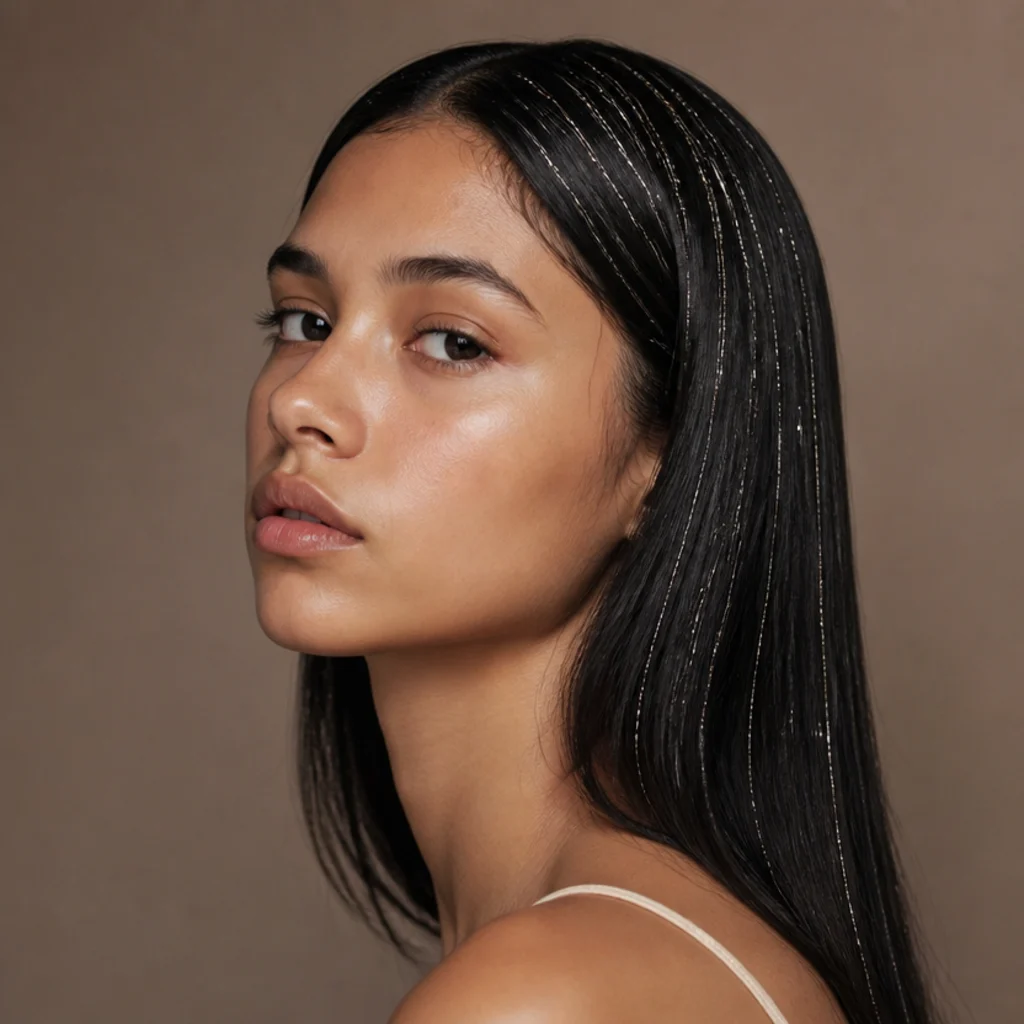
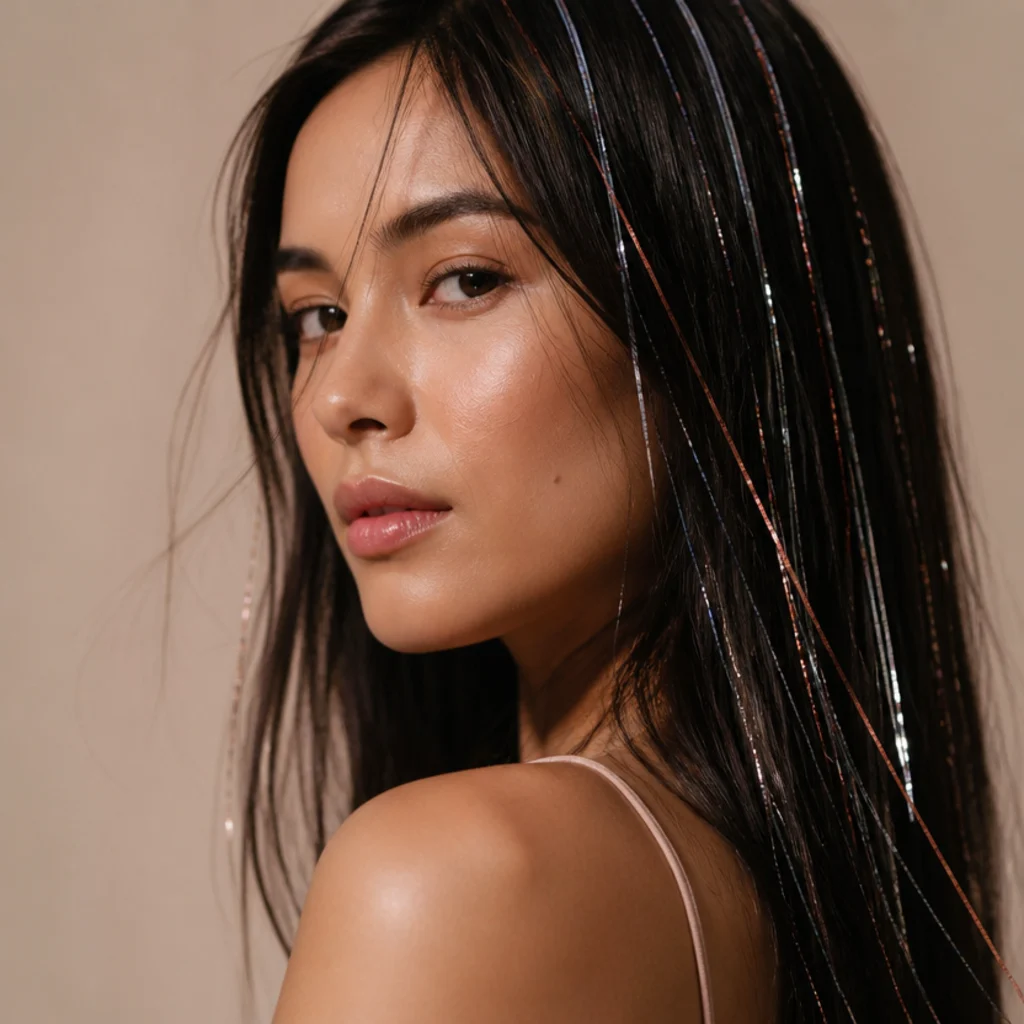
Silver against jet-black is the highest-contrast pairing in the whole trend, which is why hair tinsel black hair searches so often land here. Cool-toned silver reads like moonlight skating across dark strands, so even a modest count of 15 to 25 pieces looks deliberate rather than sparse. Silver is a true neutral, so it flatters cool, neutral, and even warm complexions, though it's most electric on deep cool-toned bases with a glossy, healthy cuticle. Placement is everything here: concentrate strands at the crown and along the part so they flash when the hair shifts and light hits the top plane. Choose fine-gauge filament so it disappears at the root and only glints in motion. On a knotted tie-in, plan for four to six weeks, brushing from the ends up and keeping flat irons off the strand. Pro tip: mist a lightweight shine spray on the surrounding hair, never the tinsel, so the silver reads even brighter by contrast. Ask your stylist for "fine silver tinsel, scattered placement, concentrated at the crown and part."
02Rose-Gold Strands for Warm Skin Tones
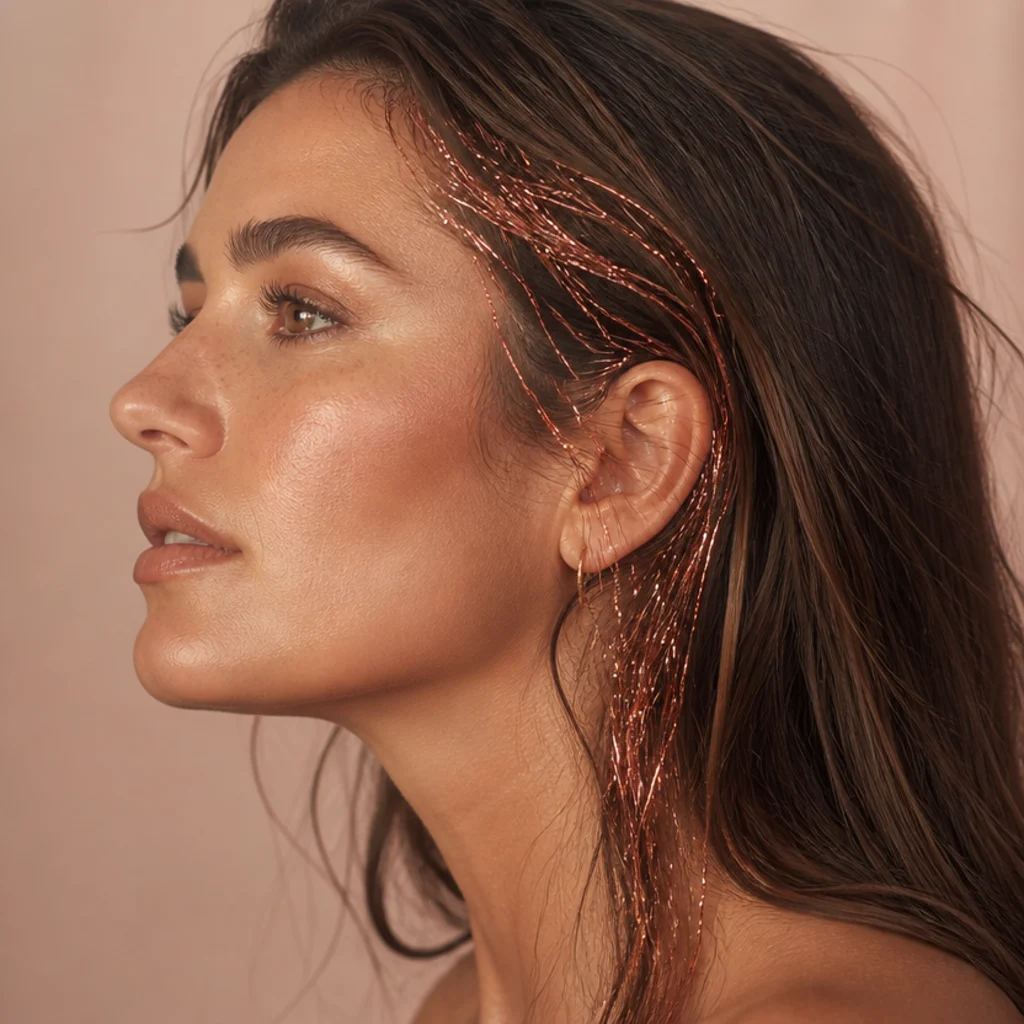
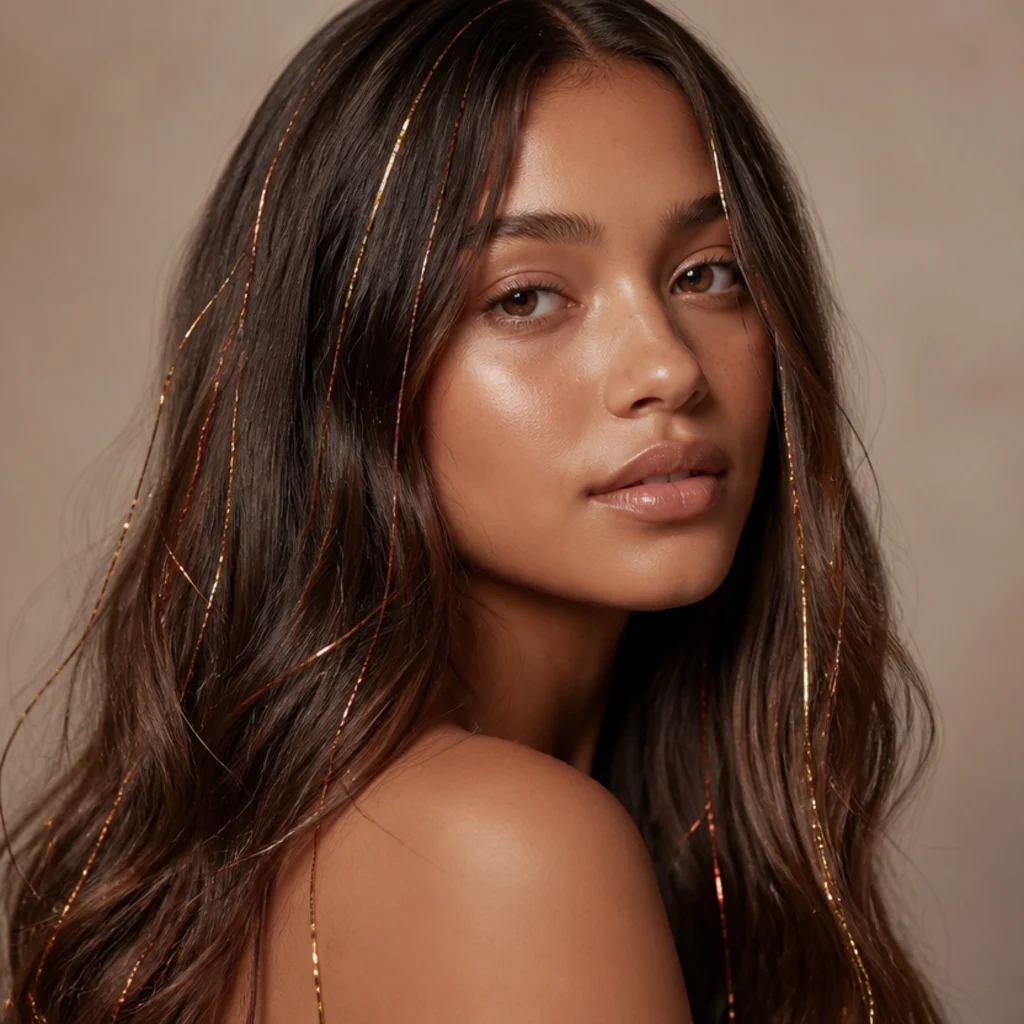
Rose-gold tinsel sits in the flattering middle ground between cool silver and yellow-gold, and it glows against warm, olive, golden, and deep complexions because the tone sits so close to skin undertones. That closeness is what makes it read "lit from within" instead of costume, and it's the everyday, works-with-anything choice on this list. It layers well over brunette, auburn, chestnut, and dark-brown hair, adding warmth and dimension without a full color change. To land the effect, weight the strands toward the face and temples so the reflection bounces near your skin and eyes — a face-framing bias does more with fewer pieces. Keep the count under 20 for subtle, closer to 30 for a visible ribbon of warmth. Upkeep runs three to five weeks on a tie-in, slightly less if the front pieces get brushed daily. Small trick: rose-gold photographs warmer than it looks in the mirror, so under phone flash it can skew coppery — worth testing before an event. Tell your colorist you want "rose-gold tinsel, face-framing bias, around 20 strands."
03Bubblegum Pink Tinsel Accent
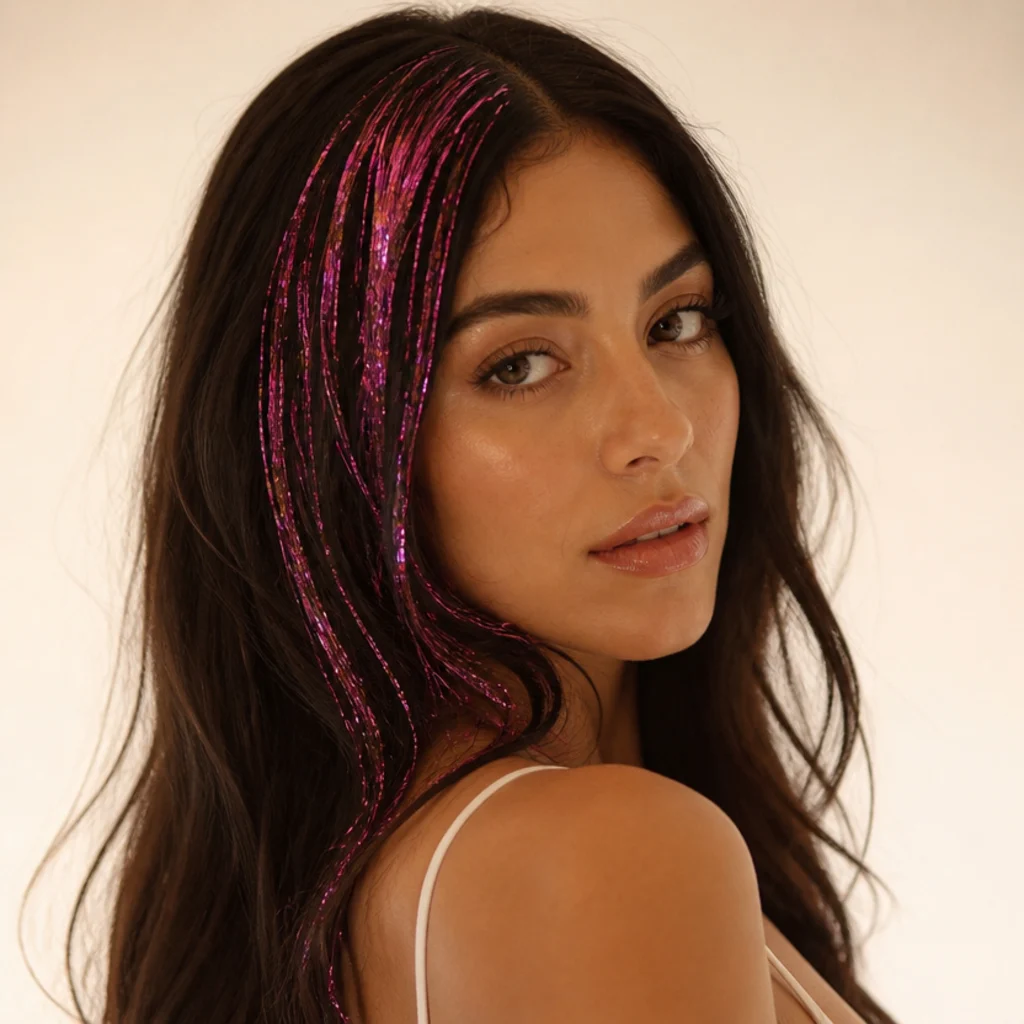
If you've typed pink hair tinsel into a search bar, a bubblegum accent is the joyful, low-risk entry point. The candy tone pops hardest against dark bases, where the saturation has room to sing, but it also layers over blonde for a softer, cotton-candy wash. Clustering is what keeps it chic: place the pink in one face-framing panel on your part side rather than scattering it, so it reads as a deliberate color moment instead of confetti. It's a fit for playful, expressive styling and photographs vividly under both daylight and warm indoor light. Colored filament reads bolder than metallics, so start with 15 to 20 strands, live with it, and add more later if you want more punch. Upkeep mirrors other tie-ins at roughly three to five weeks. One thing worth knowing: matte-finish pink filament looks more like a color streak, while glitter-pink throws literal sparkle, so name the finish you want. Ask for "bubblegum pink tinsel, single-panel placement on my part side," and specify matte versus glitter.
04Curly Hair Tinsel Scatter
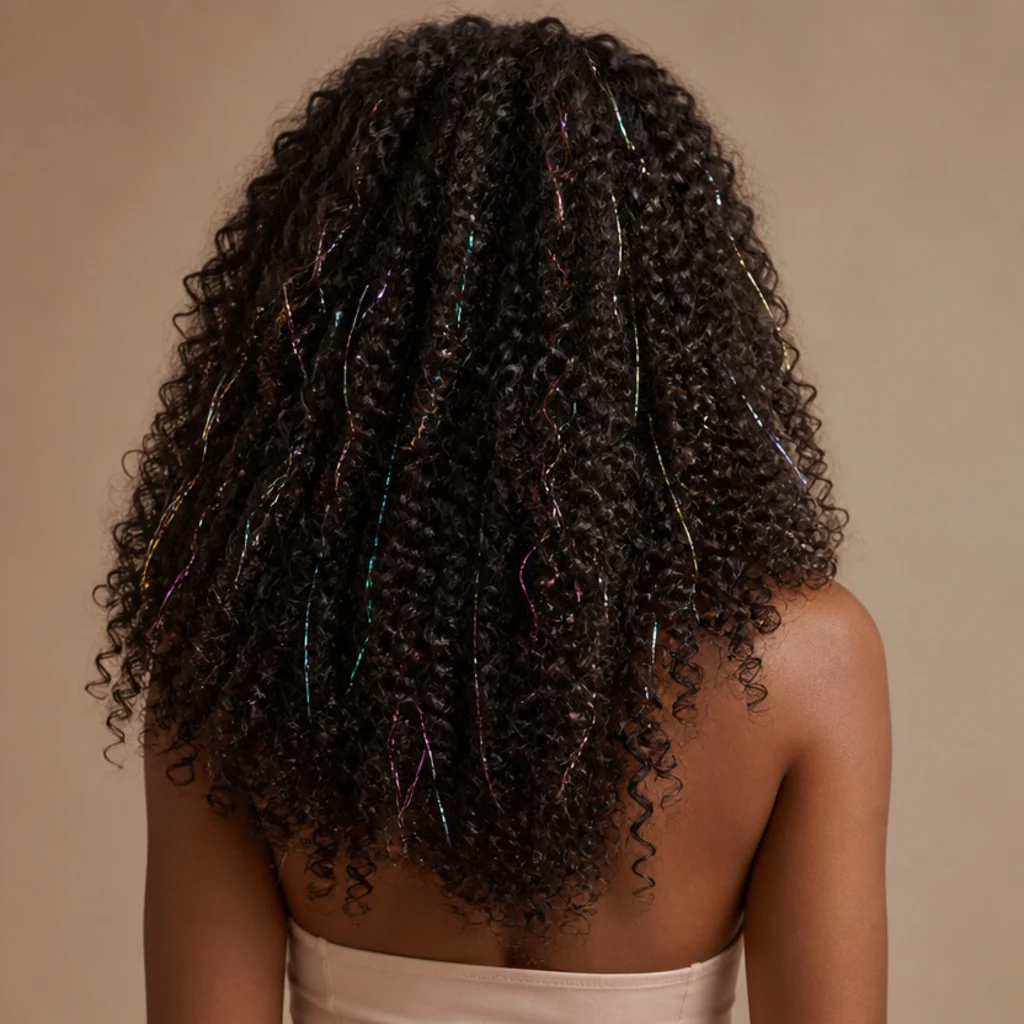
Curly hair tinsel behaves differently from straight-hair placement, and that works in your favor. Coils and curls hide the tie-in knots naturally and let the reflective strands peek out between spirals, giving a scattered, twinkling effect no straight style can replicate. The key spec is length: choose slightly longer filament so it curls or waves along with your texture instead of hanging straight and stiff against the pattern. It flatters every curl type, from loose 2C waves through springy 3C to tight 4C coils, and the denser the curl, the better it hides the tie-in. Distribute strands throughout rather than in rows so movement reveals shine from every angle. Upkeep is forgiving because the knots stay tucked deep in the curl; expect four to six weeks with gentle handling. Tip: refresh curls with a spray bottle and your fingers rather than a denser brush, which can snag the filament and drag a knot loose. Ask for "tinsel scattered through my curls, longer strands, no tension on the coil."
05Iridescent Rainbow Face-Framing Pieces
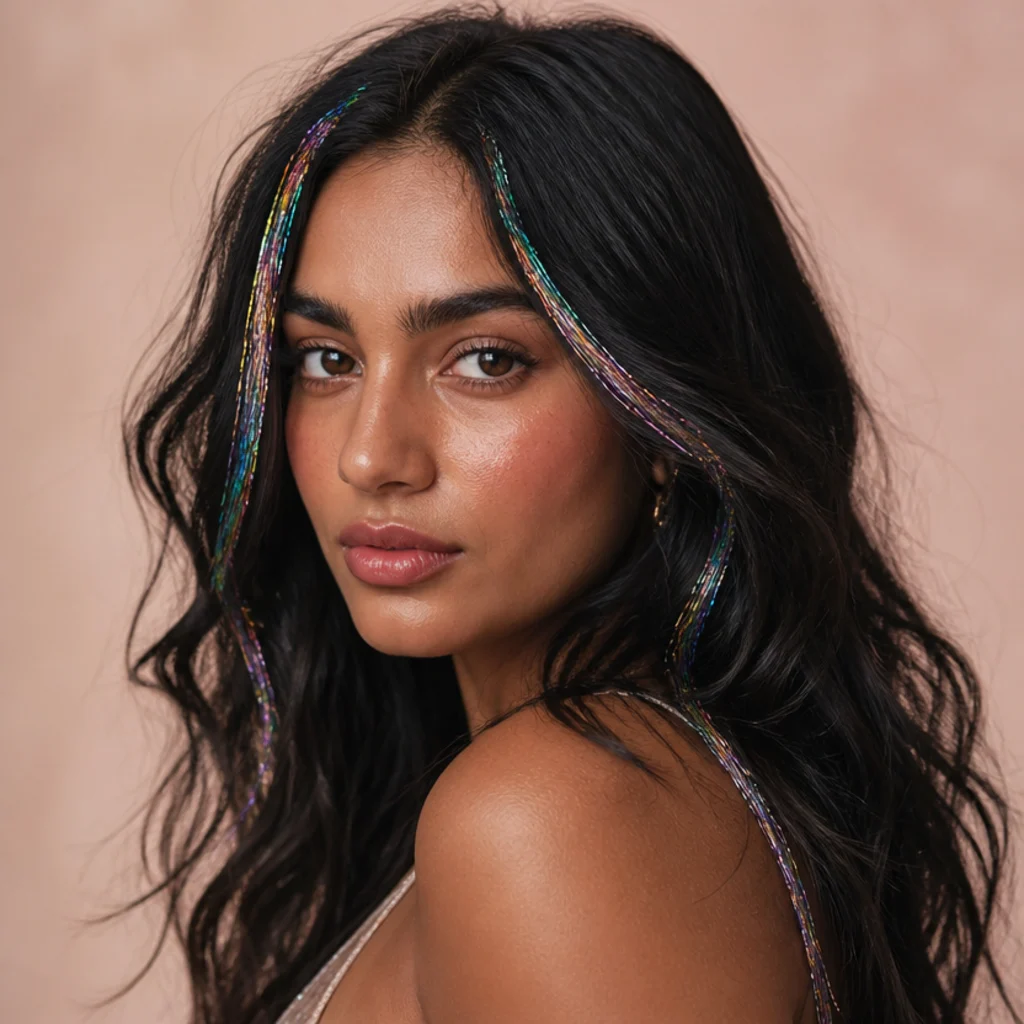
Iridescent rainbow tinsel shifts hue as light moves across it, so a small amount does a lot of work. Framing the face with these pieces draws the eye upward and adds a prism-like flicker right at the cheekbones, where it flatters most features. It's a fit for anyone who wants color without committing to a single hue, and since the shimmer cycles through cool and warm tones, it plays nicely with a wide range of skin undertones. Discipline keeps it refined: hold the placement to the front two sections so the effect stays like jewelry rather than a full costume. Difficulty is low, and clip-in versions make this a same-day, try-before-you-tie option. On a knotted tie-in, plan for three to five weeks since front pieces get handled often. Worth knowing: iridescent filament looks flat under dull, overcast light and comes alive under directional or point light, so it earns its keep at events and in photos more than on gray commutes. Ask for "iridescent tinsel, face-framing only," and bring a reference for density.
Save this to Pinterest to build your tinsel color mood board.
06Holographic Tinsel Ponytail
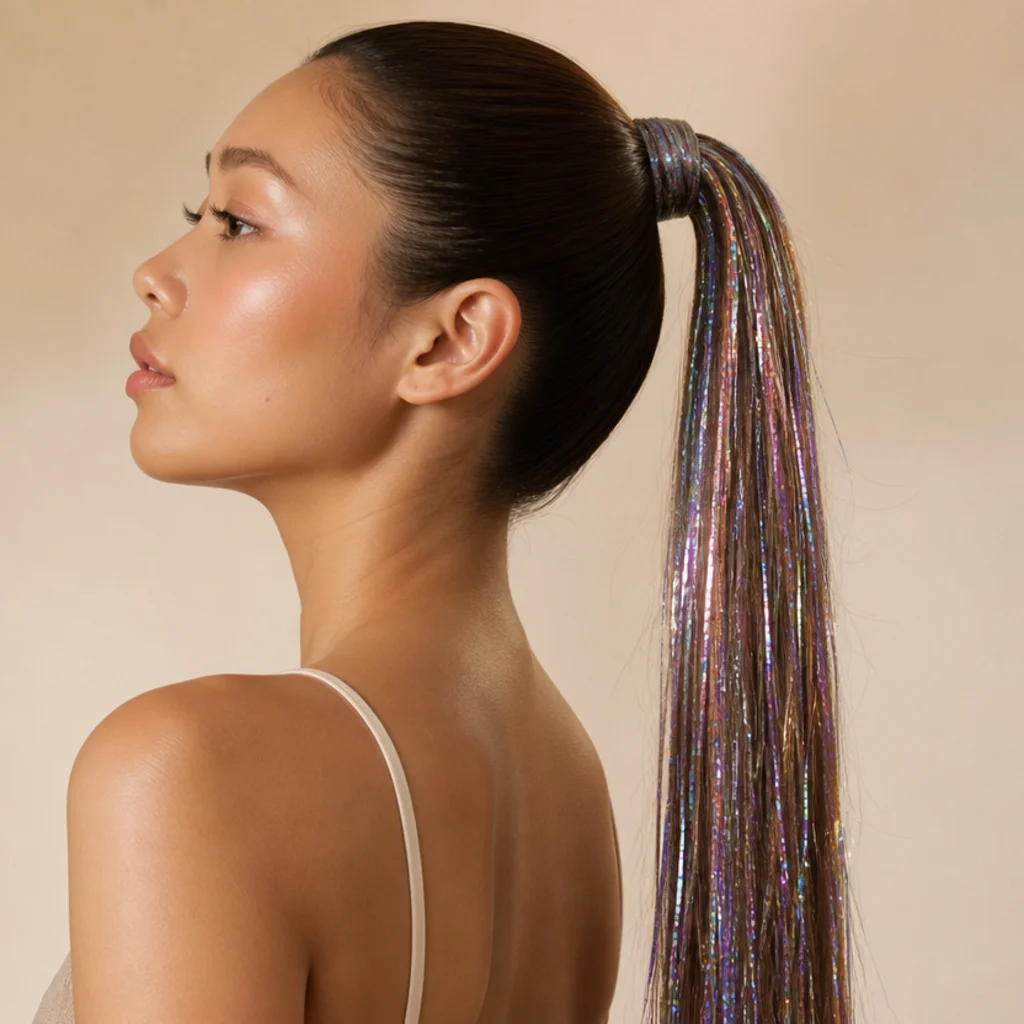
A sleek ponytail is the ideal stage for holographic tinsel, because pulling the hair back gathers every strand into one concentrated, shining sweep. As the tail swings, the holographic filament throws pink, blue, and silver flashes in sequence, so the shine reads as motion. This one suits medium to long hair and lands polished enough for events yet fun enough for a night out. The technique: distribute the tinsel through the mid-lengths first, then smooth the base with a boar-bristle brush and secure the ponytail so the strands collect and fall with the length. Because the filament sits gathered and protected inside the tail during wear, it holds well — around four weeks on a tie-in. Here's a trick: a high, tight ponytail can put tension on tie-in knots near the hairline, so if you wear ponytails daily, ask for the strands to start an inch or two below the crown to spare the roots. Ask for "holographic tinsel distributed through the mid-lengths so it collects in a ponytail."
07Tinsel Through a Fishtail Braid
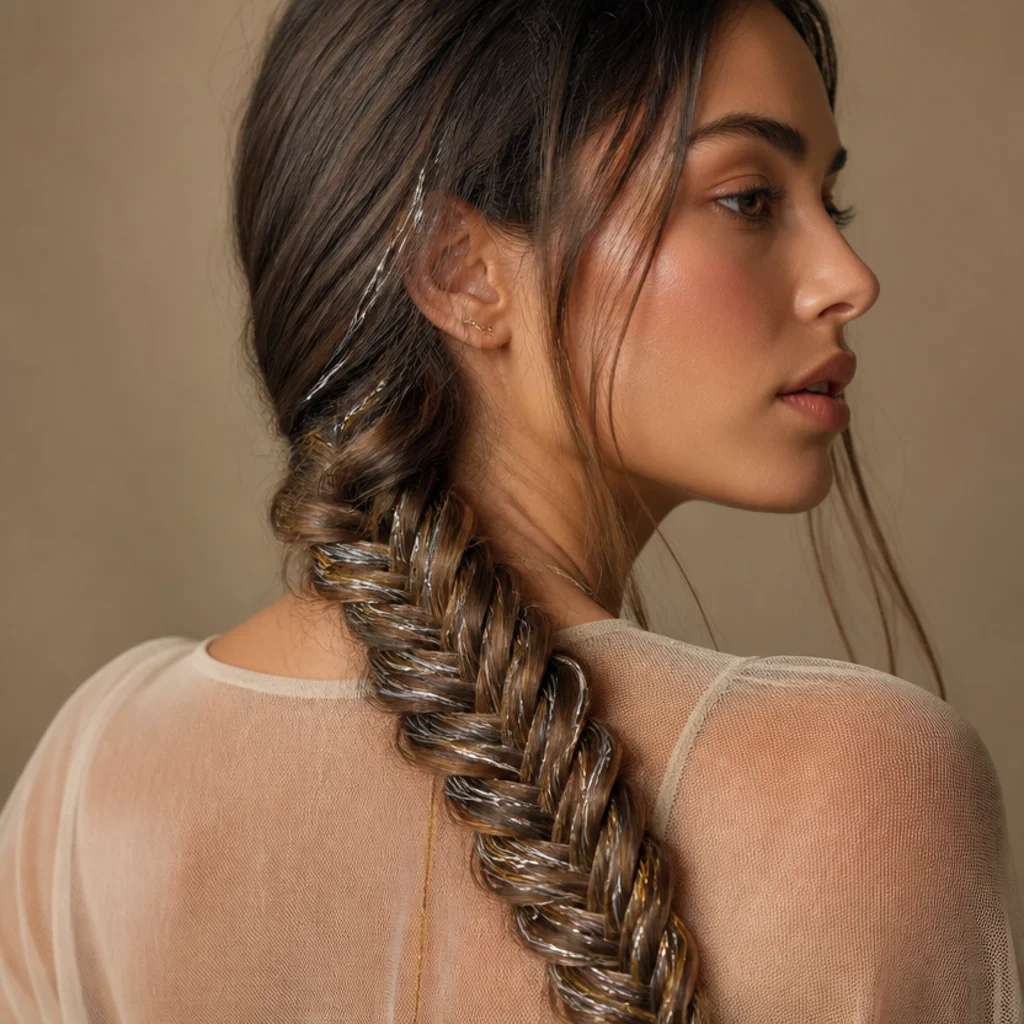
Braids trap tinsel beautifully, and a fishtail's tight, overlapping sections hold the strands in neat, glinting lines that trace the plait. Mixing silver and gold filament through one braid gives a two-tone shimmer that follows the pattern and catches light from both cool and warm angles. This one suits longer hair and anyone who likes structured, detailed styling that reads intricate in photos, especially from behind. The sequence matters: pre-place the tinsel through the hair before you braid so it distributes evenly, then fishtail as usual, keeping tension light where the filament sits so knots don't migrate. It photographs well and hides the tie-in points inside the weave. Upkeep depends on how often you re-braid, though the underlying tinsel lasts weeks. Handy trick: a fishtail on second-day hair grips both the strand and the tinsel better than freshly washed, slippery hair, so skip the wash the morning of. Ask a stylist to "pre-place mixed silver-gold tinsel, then fishtail so the strands read along the braid."
08Golden Tinsel on Deep Brunette
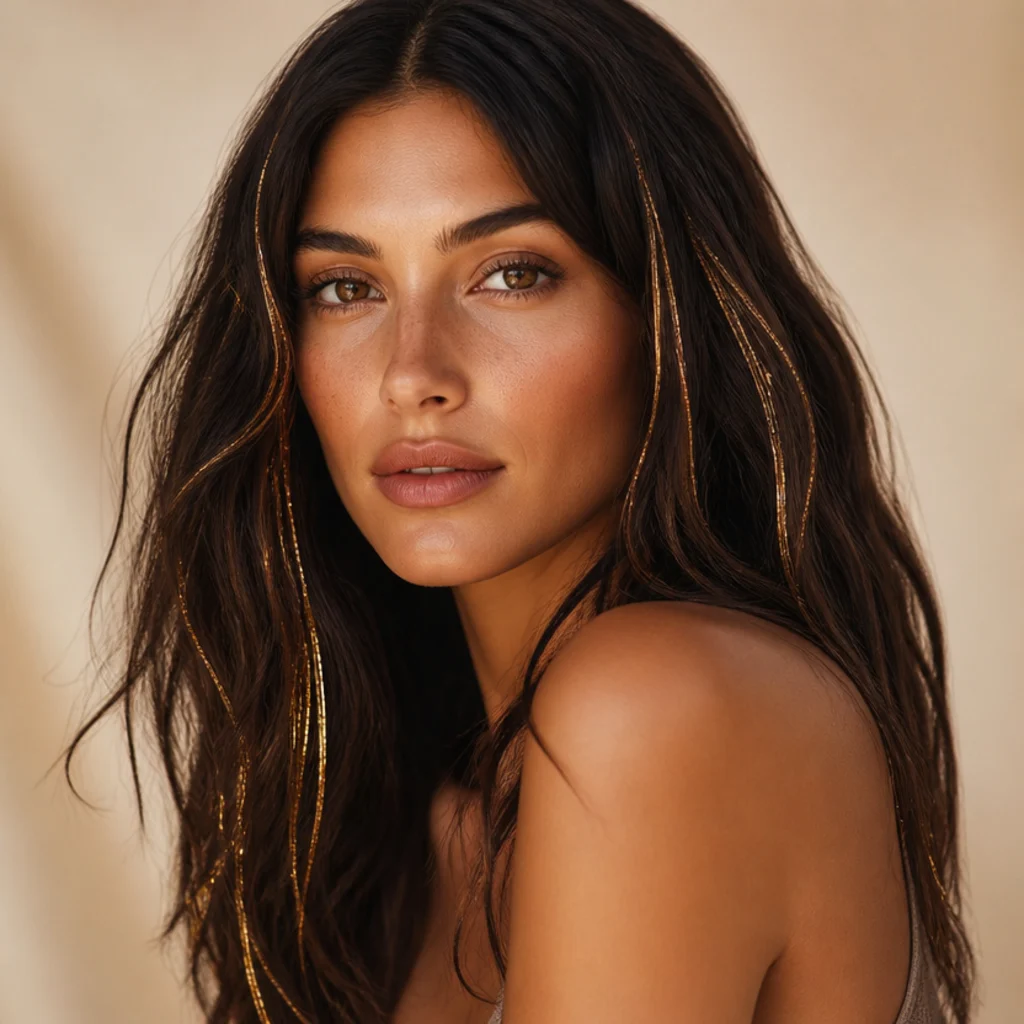
Warm gold tinsel on deep brunette is a rich, autumnal pairing that mimics sun-caught highlights without lifting or lightening a single strand. The gold picks up the latent warmth in brown tones and adds dimension, especially through the mid-lengths and ends where hair moves and folds most. It flatters warm and neutral skin tones and reads equally at home on a casual day or dressed up for dinner. The placement trick is an ends-weighted bias: distribute strands so the shine follows your layers and pools toward the bottom, which reads more natural than crown-heavy sparkle on brunettes. Keep the count subtle, around 20 strands, for a sunlit finish, or push higher for obvious glamour. Maintenance is standard at four to six weeks on a knotted tie-in. Worth knowing: true yellow-gold can skew brassy on cool-toned brunettes, so if your brown has ashy undertones, look at rose-gold or champagne first. Ask your colorist for "warm gold tinsel, ends-weighted placement, subtle count for a sunlit finish."
09Icy Blue Strands for Cool Blondes
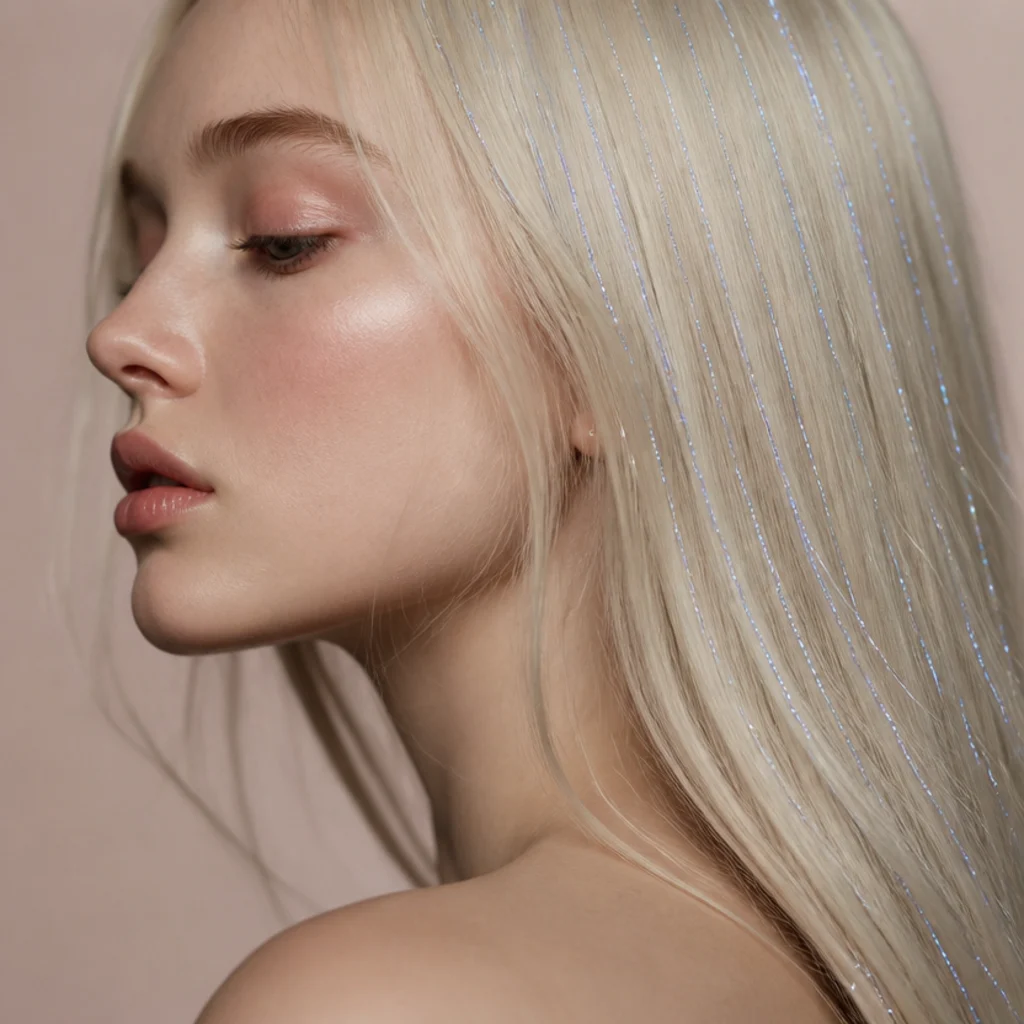
Icy blue tinsel disappears just enough into platinum and cool blonde to read as a frosted, glassy sheen rather than a separate color. The subtle blue amplifies the cool undertones blondes chase and quietly counters brassiness in photos, acting almost like a wearable toner. It works on ashy, silver, and platinum bases and pairs best with fair to medium cool-toned skin. Scatter the strands evenly across the whole head so the effect is an all-over frost instead of a stripe, and choose the thinnest gauge available, since fine filament blends most naturally on light hair where thick strands would stand out. Upkeep runs three to five weeks. One thing to know: on very pale blonde, a truly tonal blue can read almost invisible in person but photograph beautifully, so if you want it seen day to day, bump one shade cooler or add a few silver strands for definition. Ask for "icy blue tinsel, even scatter, fine strands," and note that you want it tonal rather than contrasting.
10Subtle Single-Color Peek-a-Boo
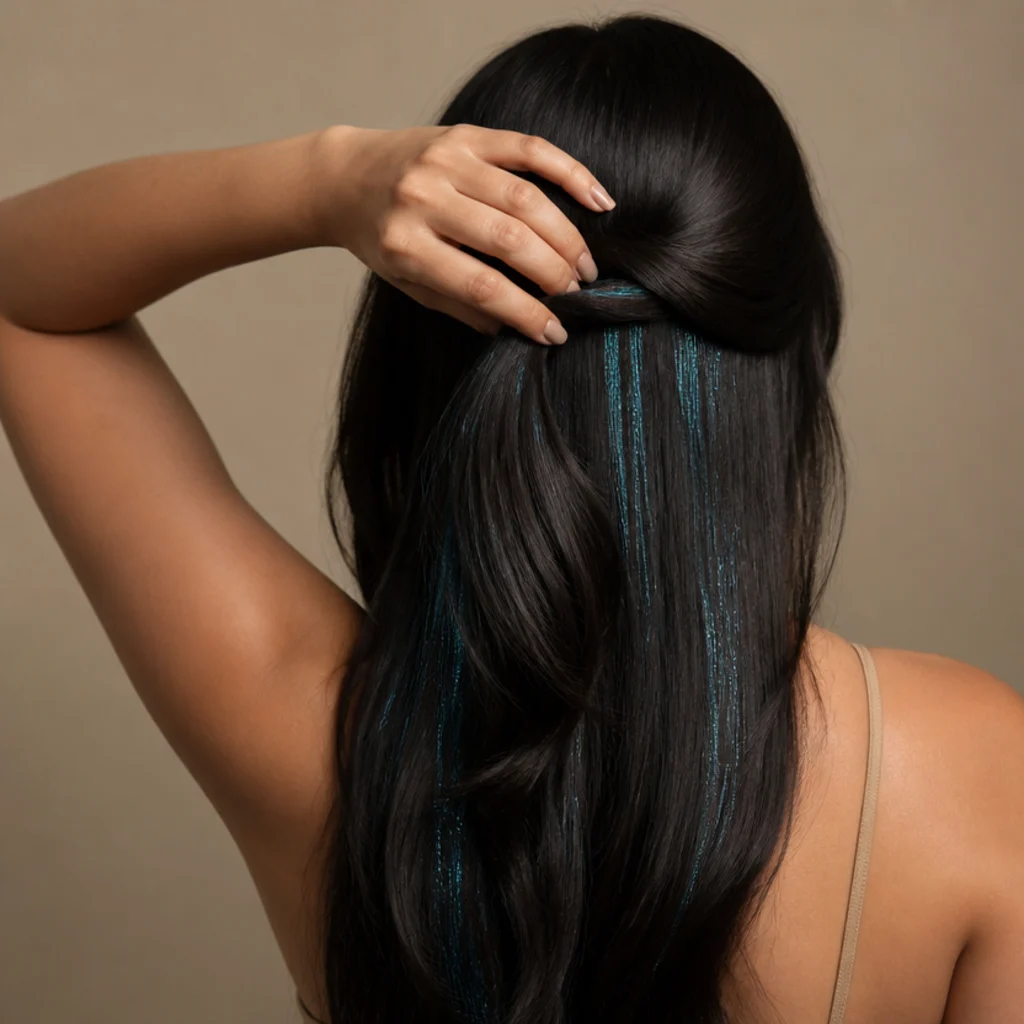
A peek-a-boo placement hides tinsel under the top layer, so it only shows when you lift, flip, or move your hair — a surprise flash of color that stays discreet the rest of the time. It's the smartest pick for anyone with a strict dress code, a client-facing job, or plain uncertainty about visible sparkle. Any single color works, though teal and violet are perennial favorites because they read clearly against dark hair without needing many strands. Because the filament sits beneath the canopy of the top section, it's shielded from brushing and daily friction, so it lasts longer than exposed placements, often five to six weeks. This is the ideal starter zone: low risk, low count, easy to remove. Pro tip: ask for the panel to sit at the occipital bone, roughly where a half-up section would gather, so it reveals cleanly when you tie your hair back or toss it. Ask for "single-color tinsel, peek-a-boo panel under the top section," and choose your hidden hue.
Save this to Pinterest and note which placement fits your routine.
11Tinsel Money-Piece Highlight
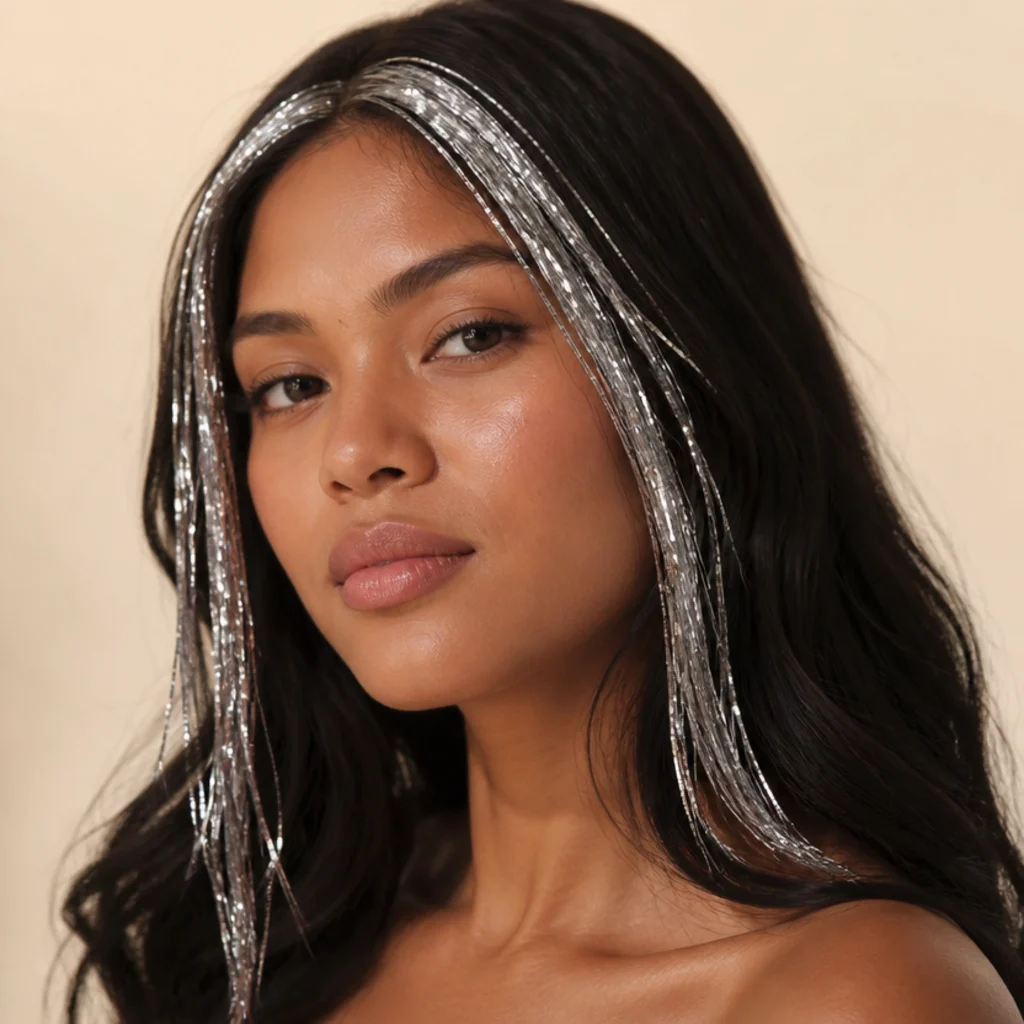
The money piece — those two brightened sections that frame the face — translates perfectly to tinsel and might be the most efficient look here. Concentrating shine at the front frames your features and delivers a styled, intentional effect with the lowest strand count of any visible placement, which makes it the most budget-friendly salon option too. It works on every length that has front pieces to work with and flatters all skin tones, since you're just matching the metallic or color to your coloring. To make it read, style the front sections slightly forward so the tinsel sits where light naturally hits the face. Upkeep is easy at three to five weeks, though front pieces get brushed most, so handle them gently. One thing that helps: split the count evenly between both sides, then check symmetry in a mirror with your part set the way you actually wear it, since an uneven money piece is the most noticeable thing in photos. Ask for "tinsel money piece, front two panels only," and specify silver, gold, or a color.
12Copper Tinsel on Red Hair
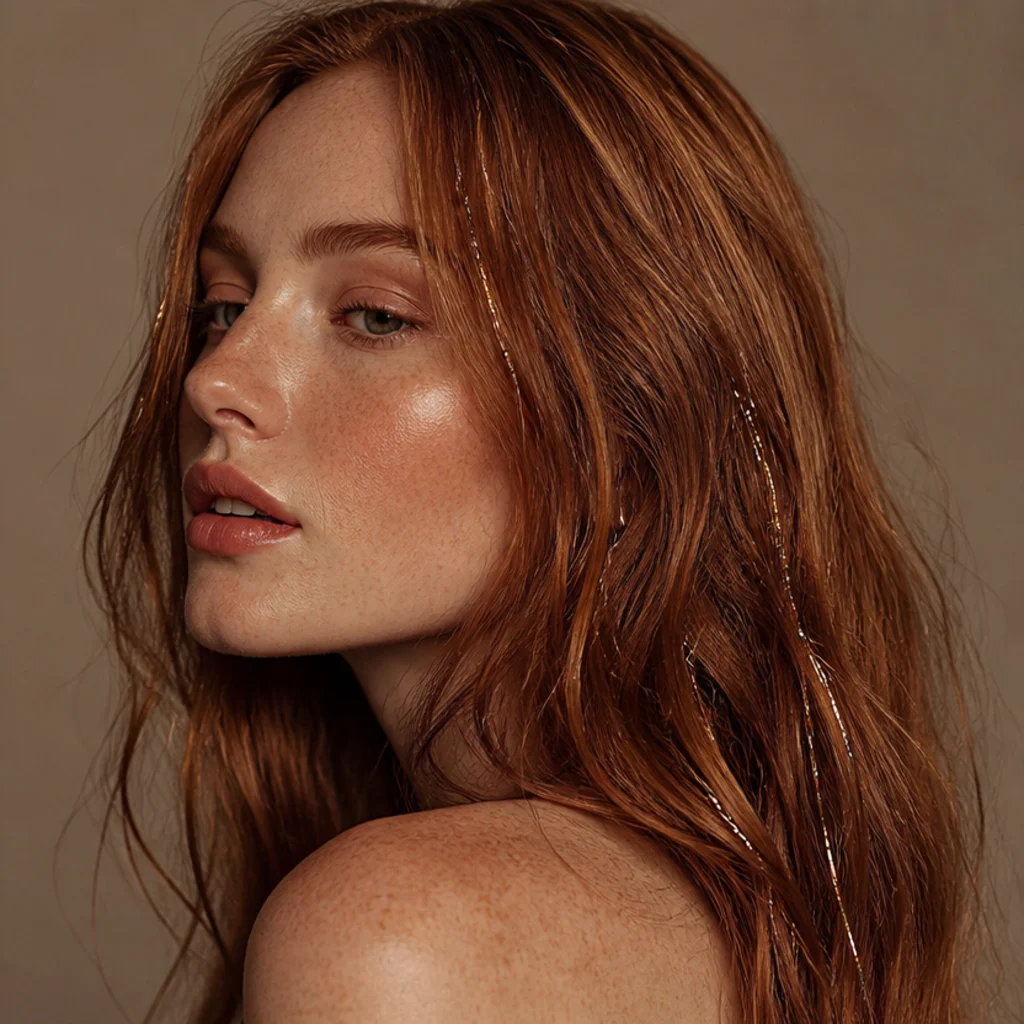
Copper tinsel on red hair is a tonal match that intensifies the hair's own fire rather than fighting it. Instead of contrast, the copper filament amplifies the coppery glow, layering in a metallic sheen that looks like light off polished autumn leaves. It flatters natural redheads, auburn, strawberry, and warm copper-dyed hair, and pairs especially well with warm, freckled, and peachy skin. You have two placement choices: distribute strands evenly for an all-over molten glow, or weight them toward the crown for a lit-from-above halo effect, the more striking of the two in daylight. Maintenance is standard at four to six weeks. Worth knowing: because copper is a tonal match, resist a low strand count — red hair can swallow subtle sparkle, so lean toward 25 to 30 strands so the metallic actually registers against the vivid base. Ask for "copper tinsel, tonal match to my red, even distribution," and mention whether you want a brighter or a deeper copper.
13Tinsel-Wrapped Space Buns
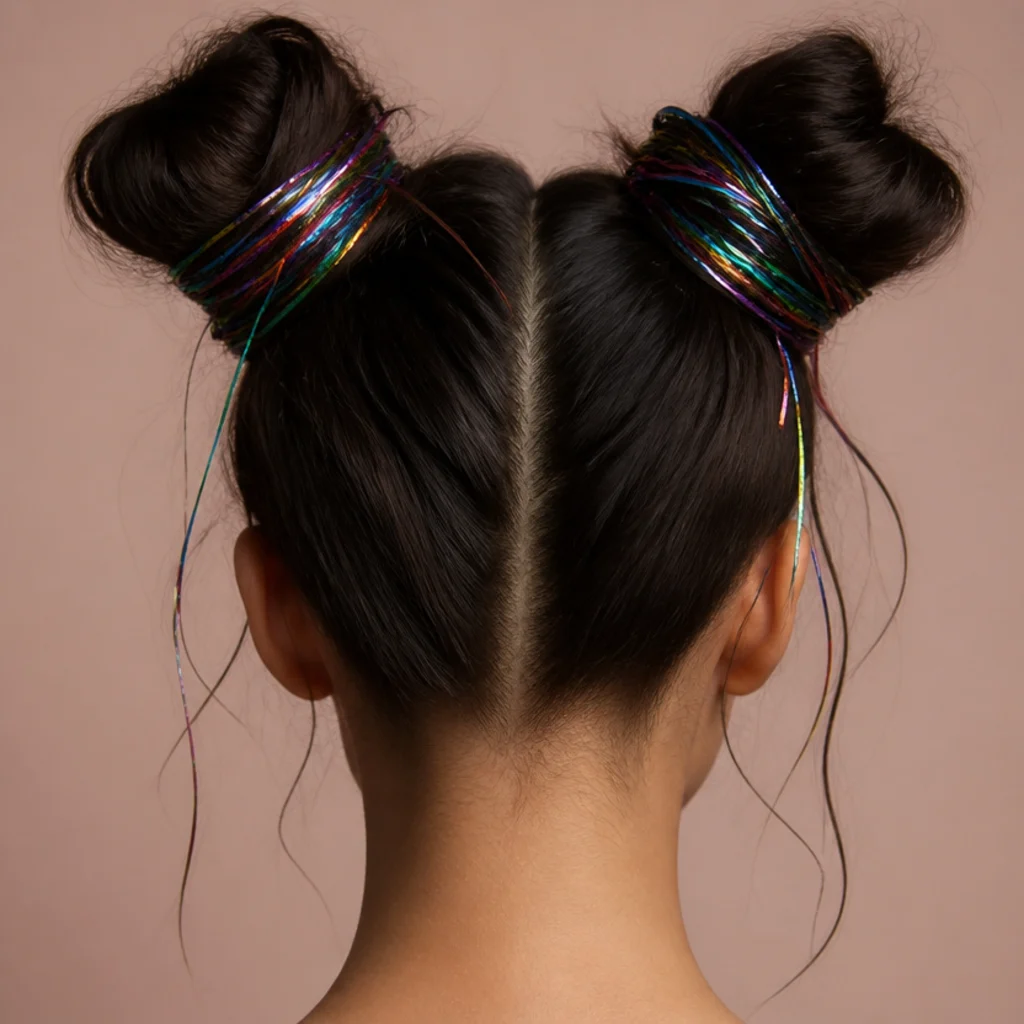
Space buns are already playful and photo-ready, and wrapping tinsel around each one turns them into a festival-grade statement. Trailing a few loose strands from the buns adds movement and keeps the look from reading too tidy. This one suits medium to long hair with enough length to twist and secure, and it's made for anyone who loves bold, expressive styling. Build the buns first, then wrap and tuck the tinsel around each base so it frames the bun like a metallic ribbon. Rainbow and holographic filament read best here because the buns concentrate and multiply the shine in a small area. Since the style itself is temporary, upkeep is per-wear, though the tie-in tinsel underneath can last weeks between styles. Pro tip: anchor the wrapped tinsel with one small bobby pin per bun so it survives dancing and wind without unspooling. Ask for "space buns with tinsel wrapped at the base and a few trailing strands."
14Purple Tinsel on Silver-Gray Hair
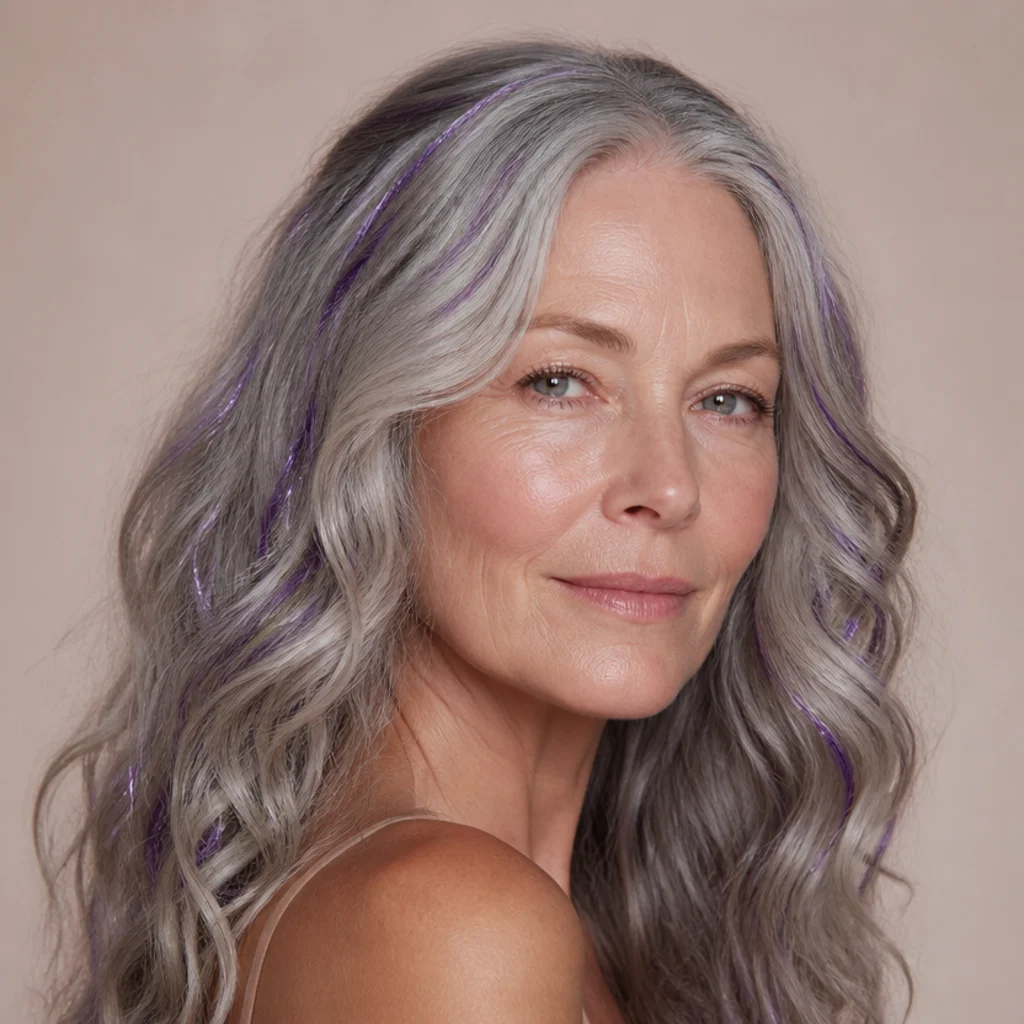
Silver-gray hair is a striking canvas for jewel-toned tinsel, and violet-purple is the most flattering choice because it enhances the cool sheen of gray while adding a soft, sophisticated pop. This look celebrates natural gray or silver hair rather than hiding it, and it suits cool and neutral skin tones especially well. You can scatter the purple evenly for an all-over shimmer or cluster it at the front for a subtler, more controlled statement. The contrast is elegant rather than loud, which is why it appeals to wearers who want modern sparkle without stepping into pastel territory. Maintenance runs three to five weeks. One thing to know: violet's cool tone reinforces the same undertones that a silver toner or purple shampoo maintains, so it visually reads cleaner on freshly toned gray — worth timing your placement for the week after a toning treatment. Ask for "violet tinsel over my natural silver, even scatter," and specify strand count for intensity: higher for drama, lower for a whisper of color.
15Tinsel in a Half-Up Top Knot
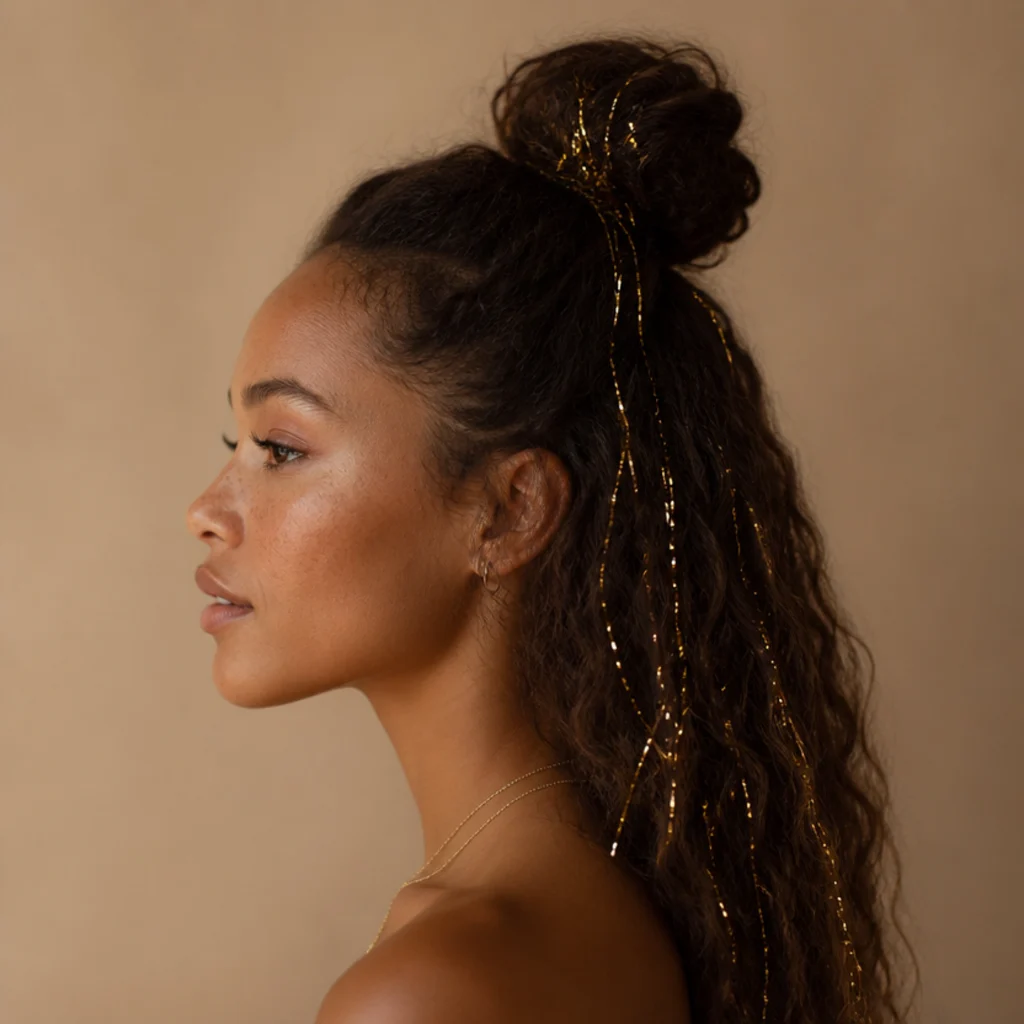
A half-up top knot shows tinsel two ways at once — gathered and glinting in the knot, and falling loose through the lengths below — which is why it flatters and photographs so well. Gold or champagne filament gives a soft, celebratory feel that suits weddings, birthdays, and dressier days without tipping into costume. It works on medium to long hair across textures. The method: section the top cleanly, secure the knot, and let the tinsel-laden lower half hang free so shine appears both up top and through the flow of the down hair. Because half the hair stays down, the loose strands move and catch light with every turn. Upkeep is standard at around four weeks. Small trick: place slightly more of your tinsel through the crown and top section than the lengths, since the knot compresses and hides some strands, and you want the visible half to still sparkle. Ask for "tinsel placed so it shows in a half-up knot and the length below."
Save this to Pinterest and pair it with your next event outfit.
16Emerald Tinsel Holiday Look
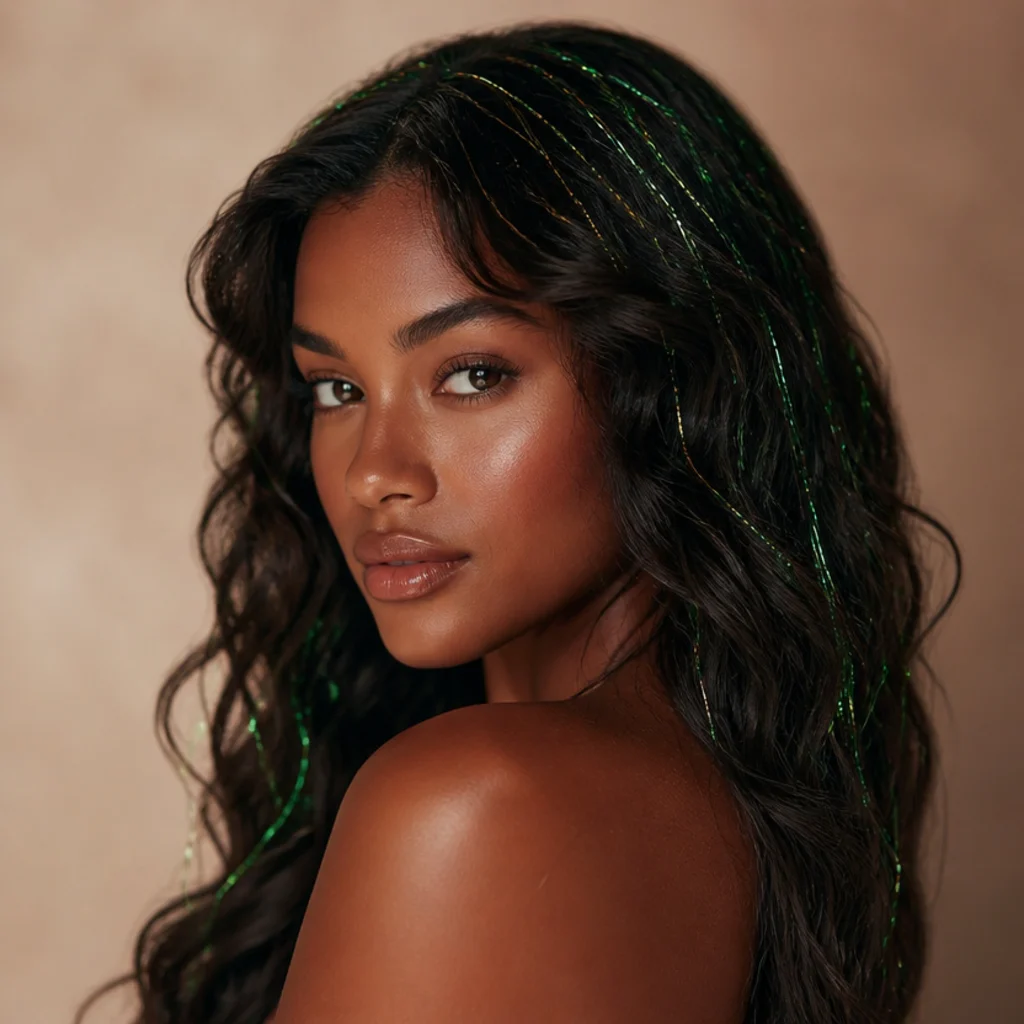
Emerald green tinsel is a deep, jewel-toned pick that feels made for holiday parties and winter events. Against dark hair it reads luxe and intentional rather than novelty, as long as you keep the count moderate, roughly 20 to 25 strands, so it stays sophisticated. It flatters deep and warm skin tones and pairs well with gold jewelry, dark waves, and rich evening colors. Concentrate the emerald where it will actually show against styled waves, along the crown and through the top of the wave pattern, and consider threading in a few gold strands for a decorative, wreath-like effect. Because the look is often seasonal, many wear it short-term, though a tie-in still holds for weeks if you keep it. Worth knowing: emerald deepens to near-black under low restaurant and party lighting, so if you want it read as green, add a handful of lighter kelly-green or gold strands to keep the color legible after dark. Ask for "emerald tinsel, moderate density, optional gold accent strands."
17Tinsel Along a Deep Side Part
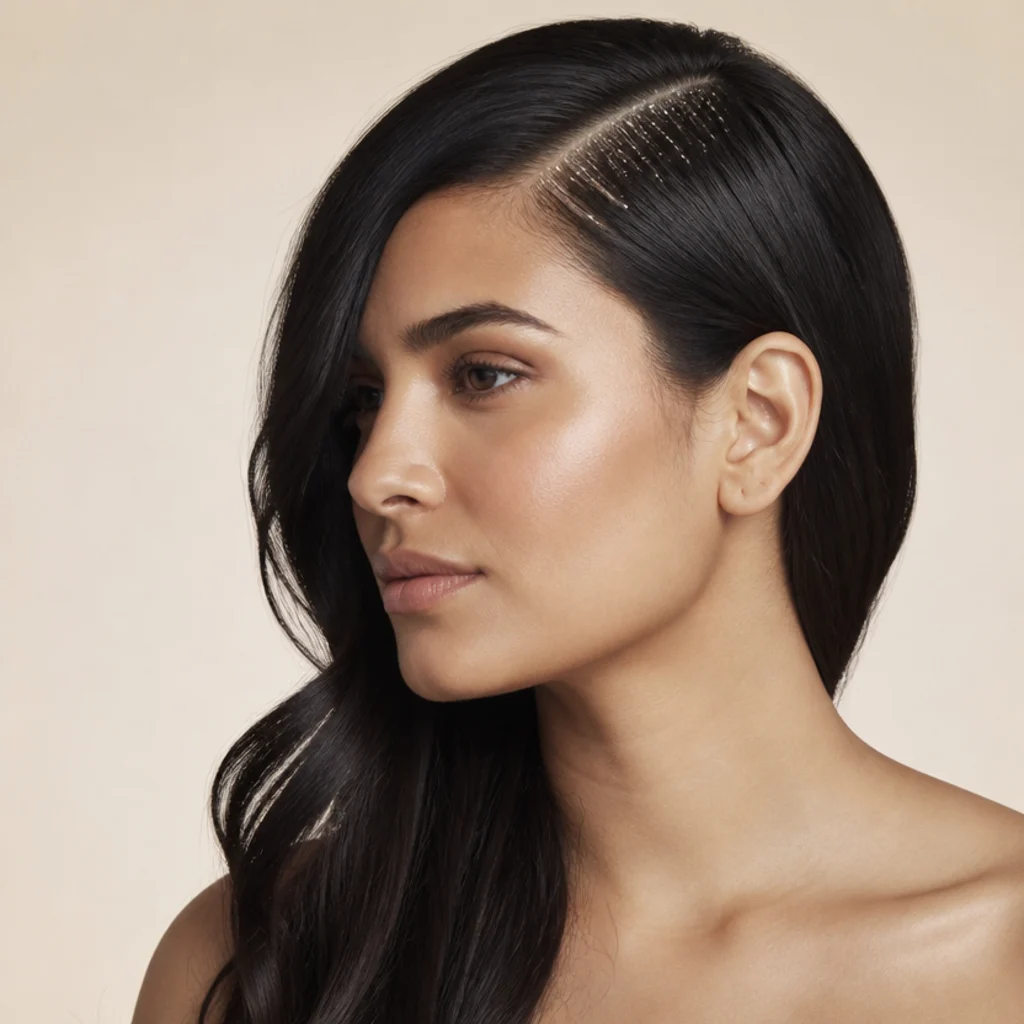
Lining a deep side part with tinsel draws a glowing line exactly where the eye naturally travels first. The sweep of hair over a deep part builds volume, and the tinsel tucked along and just under the part flashes as the heavier side falls. This one suits straight and lightly waved hair where the part stays crisp and defined, and the asymmetry flatters nearly every face shape, softening round and squaring off long. Both silver and gold work, so choose based on your warmth: cool complexions to silver, warm to gold. Concentrate the strands along the heavier, fuller side of the part, where more hair means more coverage and more movement. Upkeep is easy at four to five weeks. Tip: set the deep part with a bit of hold before placement is finalized, so the tinsel is positioned for the part you actually wear, not a temporary one that shifts back to center by afternoon. Ask for "tinsel following my deep side part, weighted to the fuller side."
18Pastel Multi-Color Tinsel Blend
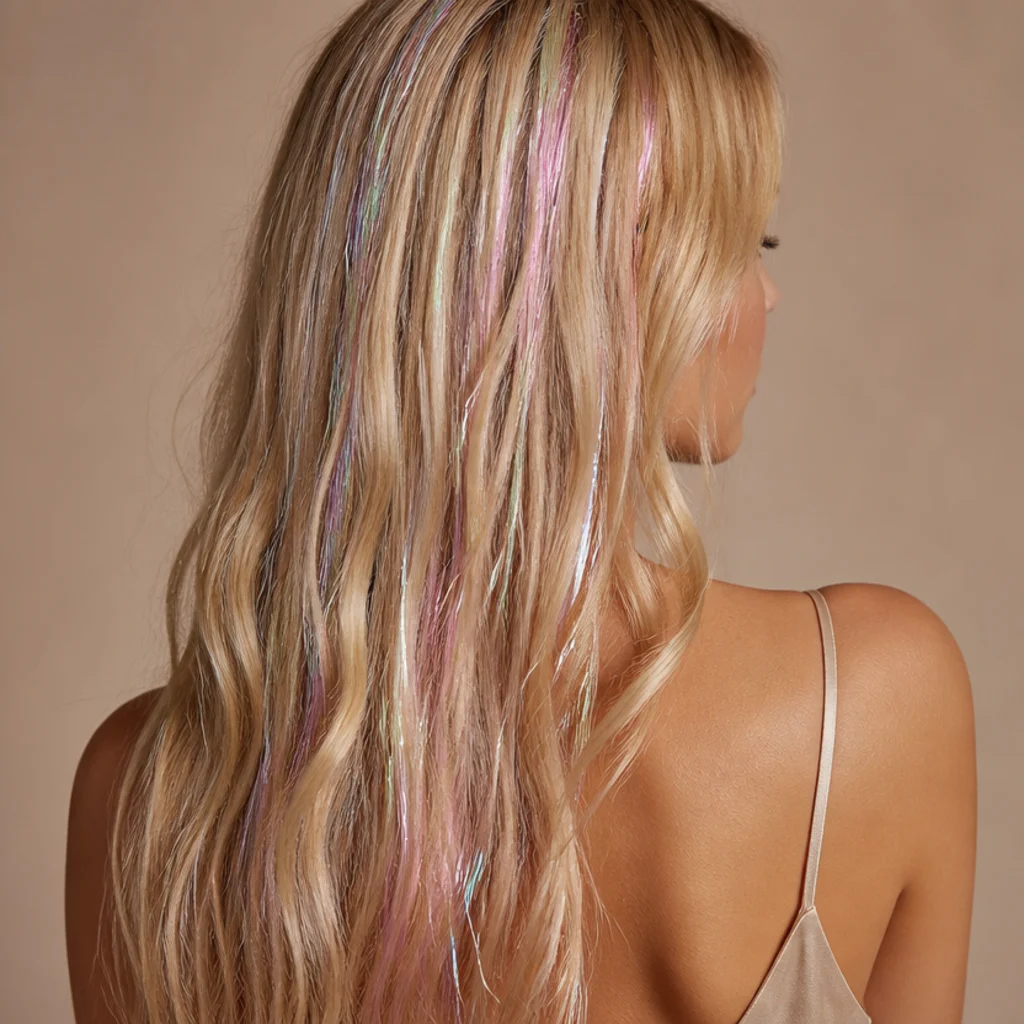
A pastel blend of pink, lavender, and mint tinsel gives a dreamy, cotton-candy shimmer that leans fully into the soft side of the hair tinsel aesthetic. It shows most clearly on blonde and light bases, where the pale tones stay visible and delicate instead of vanishing. This one suits anyone drawn to a gentle, whimsical palette and reads best on cool to neutral skin. The technique is balance: distribute the three colors evenly so no single shade dominates, creating a watercolor effect that blends through the lengths. Because pastels are inherently subtle, you can be generous with strand count — 30 or more — without the look turning garish. Maintenance runs three to five weeks. One thing to watch: pastel filament can pick up and hold the tone of purple shampoo or heavy toning products, so rinse those thoroughly off the strands to keep the colors true and clean. Ask for "a pastel tinsel blend, pink, lavender, and mint, evenly mixed through the lengths."
19Tinsel Through Boho Beach Waves
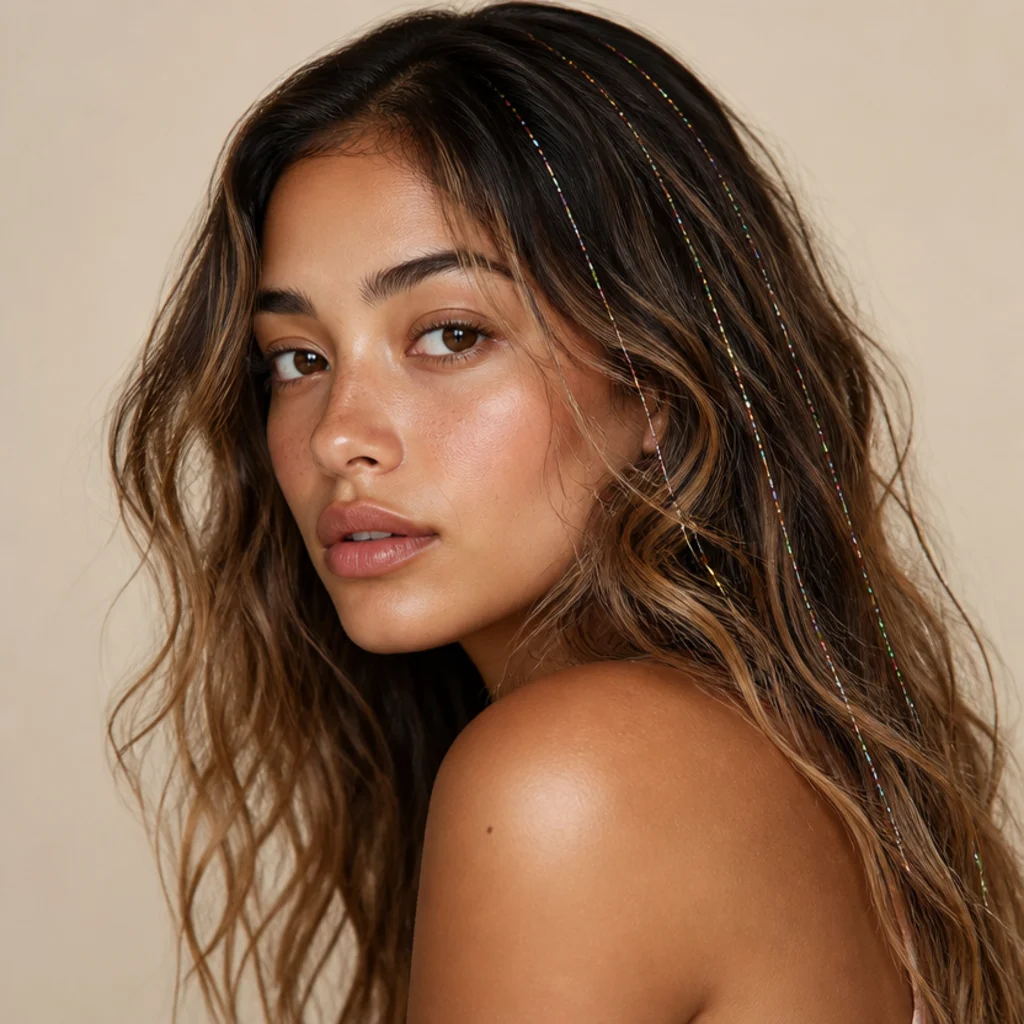
Beach waves and tinsel are a relaxed pairing that reads more festival-boho than red-carpet glam. Loose, tousled texture lets the strands weave in and out of the waves and catch light unpredictably, for a carefree glow that never looks fussy. Gold and iridescent filament suit the sun-kissed mood best. This works on medium to long hair of any texture that holds a wave, and it complements warm and neutral skin. Scatter the tinsel throughout so it reads organic and lived-in rather than placed in rows, and style with a light hand, avoiding heavy creams or oils where the filament sits, since product buildup dulls the shine. Upkeep is easy at four to five weeks. Pro tip: create the waves with a curling wand before the tinsel goes in, or work around the strands carefully afterward, because direct wand heat on the filament can warp or melt it. Ask for "tinsel scattered naturally so it lives inside my beach waves."
20Tinsel on Short Pixie and Bob Cuts
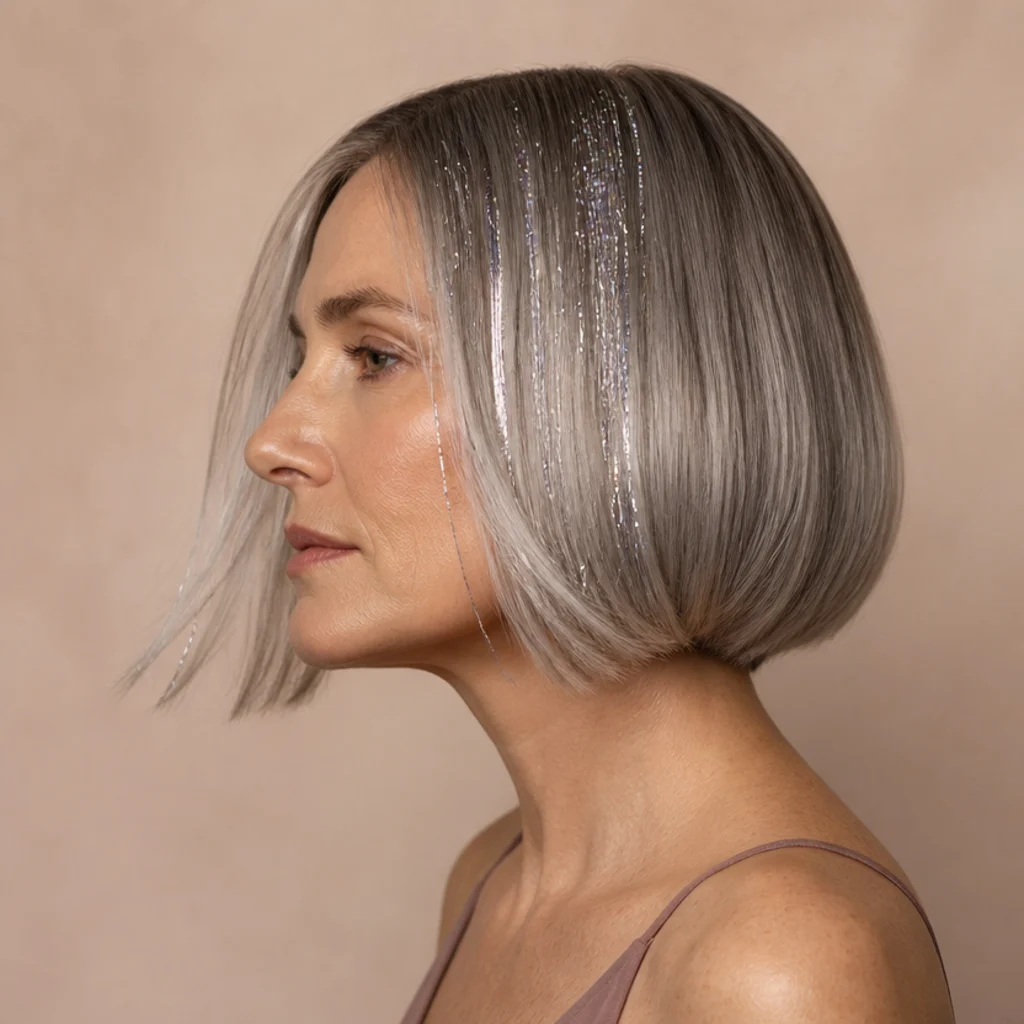
Tinsel isn't only for long hair — short cuts make a surprisingly strong case for it. On a pixie or bob, a few well-placed strands make an outsized impact, since a short cut puts every detail on display with nowhere to hide. Concentrate the tinsel near the crown and the pieces that frame the face, where the shine catches the most light and flatters the jawline. This works on all textures and looks especially sharp on blunt, modern, geometric cuts. Choose fine-gauge strands so they don't overwhelm the shorter length or look bulky. There's less surrounding hair to conceal the tie-in, so precise placement matters more here, and a stylist's hand pays off more than it would on long hair. Upkeep runs four to five weeks. Small trick: on a very short pixie, keep tie-in knots slightly further from the scalp than usual so they don't become visible as the cut grows out over two to three weeks. Ask for "fine tinsel at the crown and face-framing pieces suited to my short cut."
Save this to Pinterest if you are working with a shorter cut.
21Tinsel-Threaded Dutch Braids
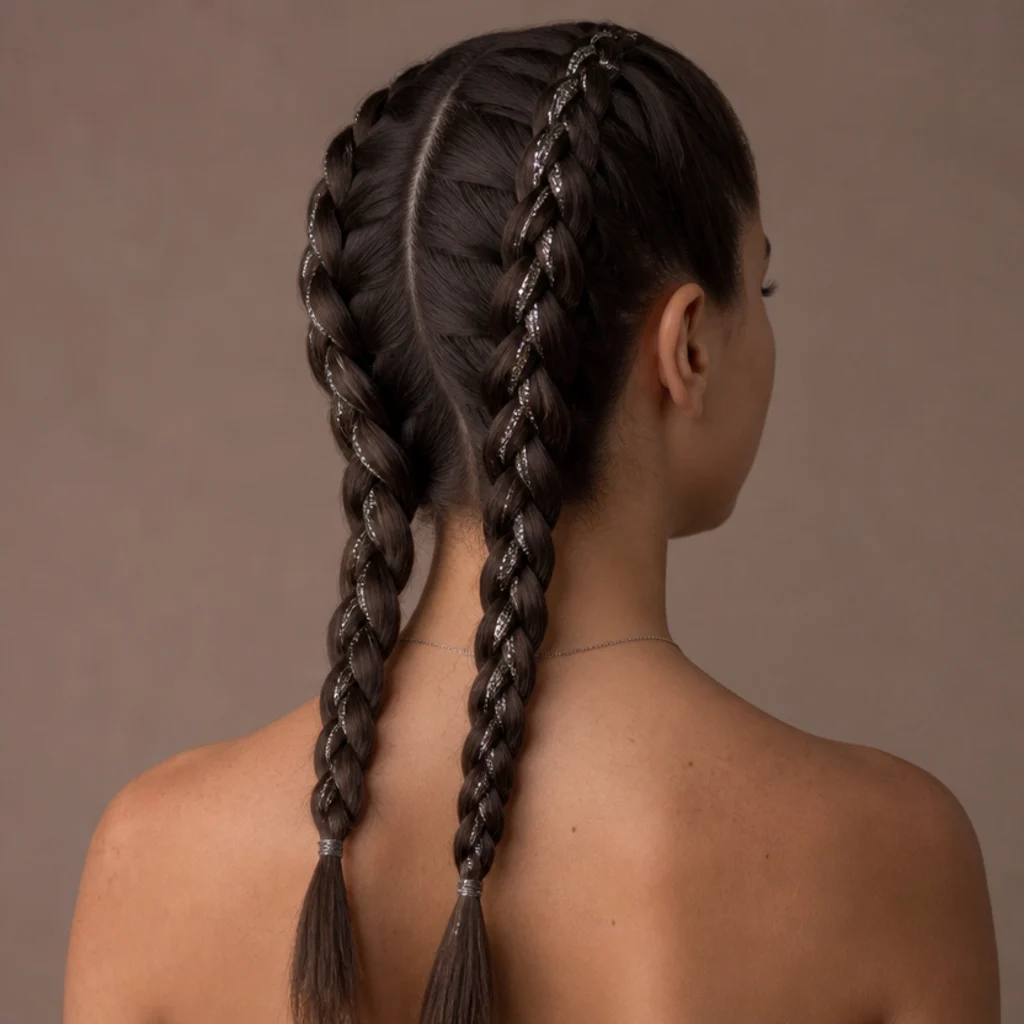
Dutch braids sit raised off the scalp, so threading tinsel through them lifts the shine into a defined, sculptural line that catches light along the entire ridge. Double Dutch braids with silver tinsel are a sporty, statement-making choice that holds up through active, high-movement days. This works on medium to long hair and any texture that braids cleanly and grips. The technique: add the tinsel as you cross each section under, so it rides along the raised outer ridge of the braid rather than getting buried inside it. It's a perennial favorite for festivals, game days, and gym-to-street looks because braids lock the strands in place. Since the plait protects the filament, the tinsel lasts well between re-braids. Difficulty is moderate because it takes braiding skill. Handy trick: braid on day-two hair with a little texture spray so the sections grip both the hair and the slick tinsel, then set with a flexible-hold spray to keep the ridge crisp all day. Ask for "tinsel threaded into Dutch braids so it sits on the raised ridge."
22Champagne Tinsel for Bridal Hair
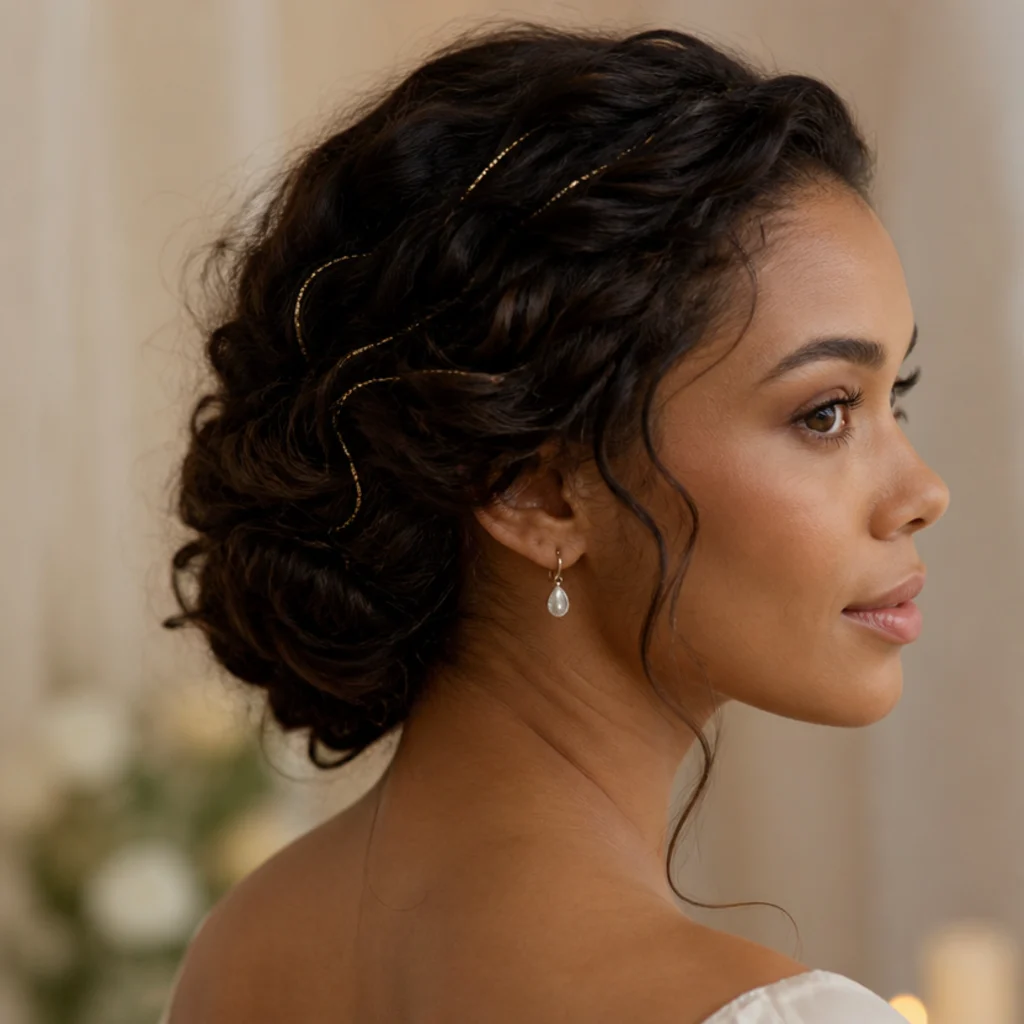
Champagne tinsel is the most understated metallic, which is exactly what makes it ideal for bridal and formal styling. Woven through a soft updo, it adds the faintest shimmer that photographs like candlelight rather than glitter, subtle enough to survive close-up portraits and to age well in an album. Its neutral warm tone flatters every skin tone, which is why it's such a safe, becoming bridal choice. Place the strands lightly among pinned waves and twists so the shine peeks through the structure rather than coating it, and keep the count modest for a refined finish. Since updos shield the strands from friction, the tinsel holds beautifully through a long event day. Worth doing: place tinsel before the updo is pinned but after the base is prepped, and always do a trial run at your hair rehearsal, so you and your stylist can dial the exact density that reads well under your venue's lighting and on camera. Ask your stylist for "delicate champagne tinsel woven subtly through the updo, low strand count."
23Neon Tinsel Festival Style
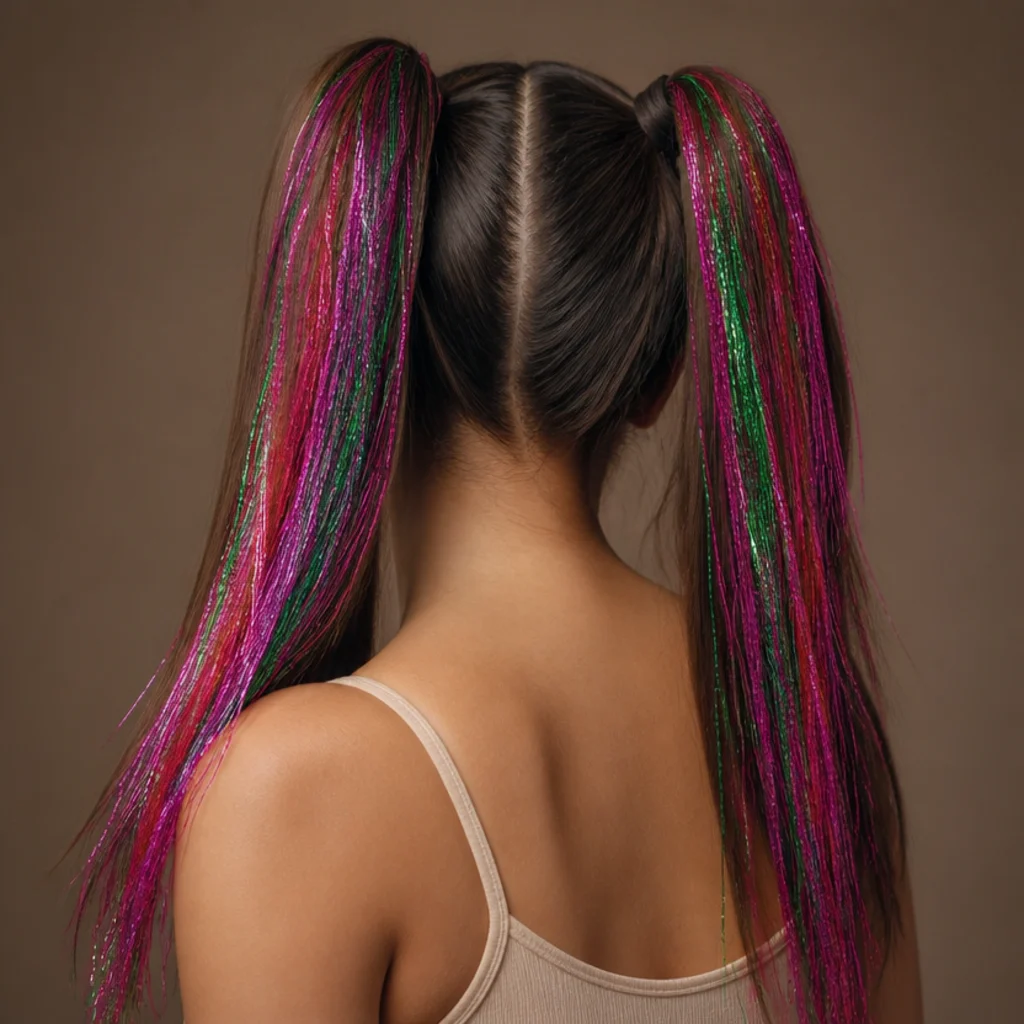
When the goal is maximum impact, neon tinsel delivers without hesitation. Bright pink, green, and orange filament threaded through pigtails or loose lengths makes a bold, high-energy statement built for festivals, raves, and themed events. This one suits anyone who wants their hair to be the whole outfit, and it reads striking on both dark and light bases because the neons are saturated enough to hold their own on either. Go heavy on strand count and mix multiple neons for a fully saturated, can't-miss effect. Because it's usually a single-event look, many treat it as short-term, though the tie-ins still hold for weeks if you keep them in. One thing worth knowing: many neon filaments are UV-reactive and glow under blacklight, so if you're heading somewhere with stage or blacklight lighting, ask specifically for UV-reactive strands for a second nighttime effect. Ask for "high-density neon tinsel, mixed brights, placed for a bold festival look."
24Tinsel on Locs and Protective Styles
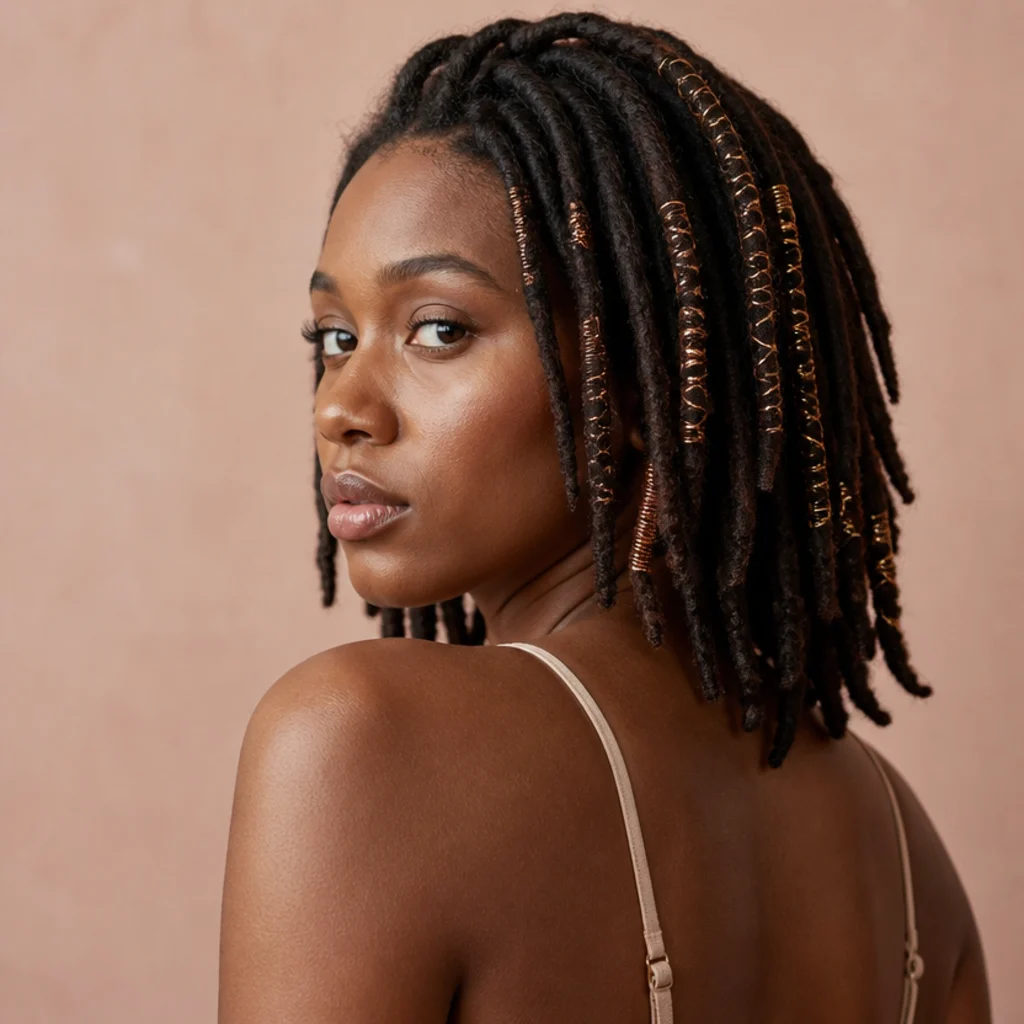
Locs, box braids, and twists are a natural home for tinsel, because the strands can be wrapped along individual locs or braids for controlled, decorative shine you place exactly where you want it. Gold and copper look especially rich spiraled down the length of select locs, letting you choose precisely how much sparkle shows and where. This works across all protective styles and lengths and flatters deep and warm skin tones beautifully. Because the tinsel is wrapped around the loc rather than knotted into loose hair, it's secure and long-lasting, riding along through the full life of the style. Pro tip: wrap the filament in an open spiral with a little spacing rather than a tight solid coil, so it flexes with the loc and catches light along its whole length instead of flattening into a stiff band. It's a damage-free way to accessorize a protective style for an event and remove cleanly afterward. Ask your loctician or braider to "wrap gold-copper tinsel down a chosen number of locs for accent shine."
25Full-Head Glass-Hair Tinsel Aesthetic
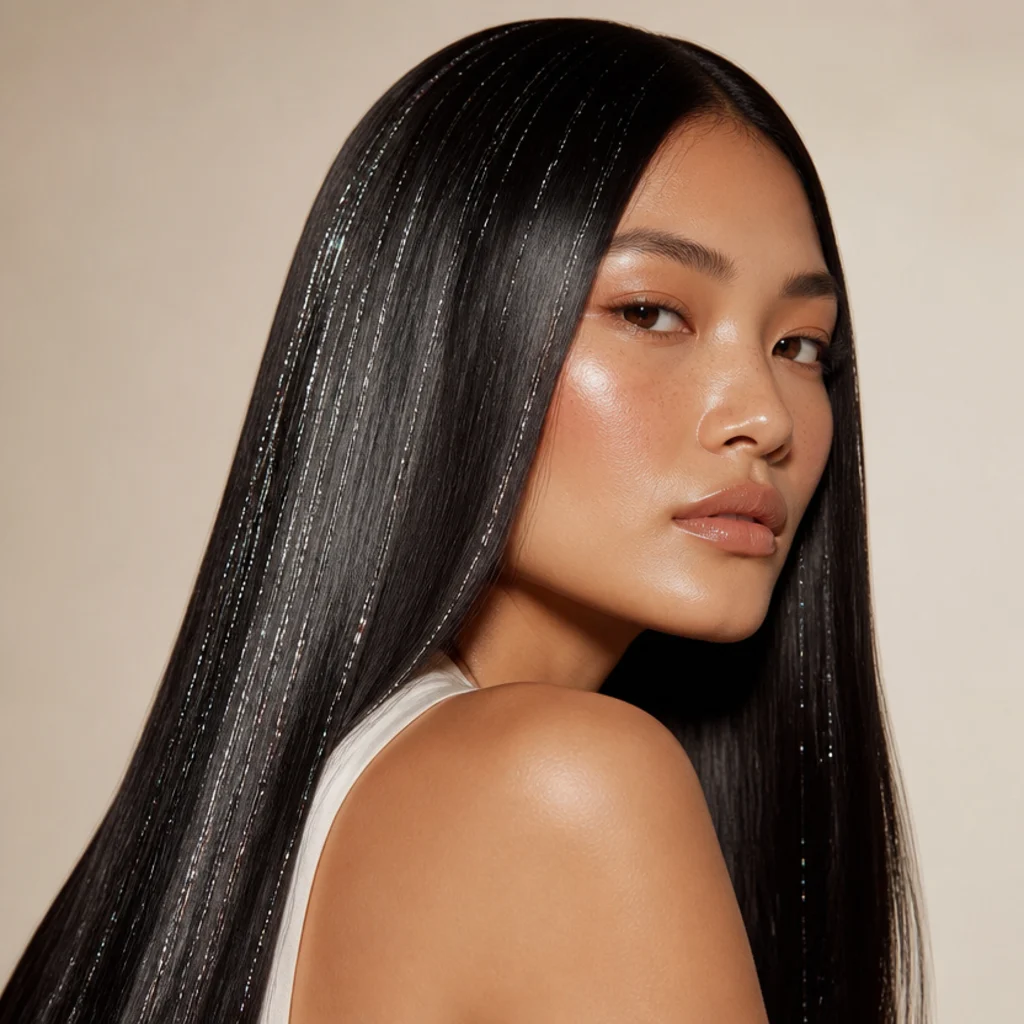
The full-head "glass hair" look leans all the way into the hair tinsel aesthetic: dense, evenly distributed metallic strands over sleek, poker-straight hair for an all-over liquid, mirror-like shine. Silver reads coolest and most editorial, while gold warms the effect toward molten. It suits smooth, straightened hair where light travels uninterrupted across the surface, and it flatters any skin tone depending on the metallic you choose. This is the biggest commitment on the list, using the highest strand count of any look here, which means the most chair time and the highest cost, so budget and book accordingly. The finish lives or dies on smoothness: keep the hair glossy, frizz-free, and freshly straightened to sell the glass effect, since any flyaway breaks the illusion. Upkeep runs four to six weeks. One thing to know: you can't run a flat iron over placed tinsel, so straighten thoroughly before the strands go in, then maintain the sleekness afterward with a cool shine spray and a smoothing brush rather than heat. Ask for "dense, even tinsel for an all-over glass-hair finish."
Pro Tips from the Editor
- Match the metallic to your undertone first, color second. Cool complexions and ashy bases read cleanest with silver, icy blue, and violet; warm and golden skin glows with gold, copper, rose-gold, and champagne. Get the metal right and almost any placement flatters.
- Never let a heat tool touch the filament. Most tinsel is heat-sensitive and can warp, kink, or melt under a flat iron or wand. Straighten or curl the hair fully before placement, then work around the strands afterward with cool-air styling.
- Ask for more strands than you think you need, then build up. It's far easier to add sparkle than to notice a placement is too sparse after the fact. Start conservative on visible looks, live with it a day, and layer in more.
- Protect it at night. A loose braid plus a silk or satin pillowcase or bonnet cuts tangling and friction dramatically, which is the main reason strands loosen early. This alone can add a week or two of wear.
- Wash at the scalp, not the strand. Massage shampoo into the roots and let the suds rinse down the length; scrubbing lather directly through the tinsel roughs up knots and shortens its life. Skip heavy oils and silicone serums where the filament sits, since buildup dulls the shine.
- Remove by loosening, never yanking. For tie-ins, gently work the knot open with your fingers or a fine tool and slide the strand out; pulling it free can take real hair with it. When in doubt, have your stylist remove them.
- Test the color under real light before an event. Rose-gold can flash coppery under phone flash, emerald reads near-black in dim rooms, and tonal pastels can vanish in person while photographing beautifully. Check your look in the actual lighting you'll be in.
Placement, Method, Wear Time, and Cost at a Glance
| Method | How it attaches | Typical wear time | DIY difficulty | Cost tier | Best for |
|---|---|---|---|---|---|
| Clip-in | Tiny clip snaps onto a section | Same day, removed nightly | Very easy | Low | Trial runs, single events, the commitment-shy |
| Dazzle-style | Loops a strand, secured with a bead or knot | 1 to 3 weeks | Easy to moderate | Low to mid | A handful of accent strands at home |
| Tie-in (knotted) | Folded at the root and double-knotted | 3 to 6 weeks | Moderate, stylist recommended | Mid | Smooth, longer-lasting all-over or scattered looks |
| Braided / wrapped | Woven or spiraled into braids or locs | Life of the style | Moderate | Mid | Curls, braids, locs, and protective styles |
How to Choose / Get the Look
Work through four decisions in order and you'll land on the right look with no guesswork.
1. Start with your base color and undertone. This decides which tinsel reads best. Cool and dark hair loves silver, icy blue, and jewel tones; warm brunettes and redheads glow with gold and copper; blondes and grays carry pastels, icy shades, and violet. When a metallic matches your undertone, even a low strand count looks intentional.
2. Pick a commitment level. Clip-in and dazzle-style tinsel is same-day and fully reversible, ideal for a trial run, a single event, or testing a color before you invest. Knotted tie-ins last one to six weeks and blend right in, but they're best placed by a stylist or a steady-handed friend so the knots sit flat and hold without stressing your hair. Braided and wrapped placements last the life of the style and suit textured, braided, and loc'd hair.
3. Choose a placement zone and strand count. Face-framing, money-piece, and peek-a-boo styles use fewer strands for a styled, efficient effect and the lowest cost. All-over and glass-hair looks need a high count, more chair time, and the biggest budget. Scattered and braided placements sit in between. Decide this before you book so your stylist can quote accurately, and confirm whether pricing is per strand or per session.
4. Adapt to your texture and length. For curly and coily hair, request longer strands so the tinsel moves with your pattern and the knots stay hidden. On short cuts, ask for fine strands at the crown and hairline with knots set slightly off the scalp so they don't show as the cut grows. On protective styles, ask for wrapped rather than knotted placement.
Whatever you choose, protect the investment: avoid direct heat on the filament, brush gently from the ends up, wash at the scalp, sleep on silk, and skip heavy oils where the tinsel sits.
Frequently Asked Questions
How do you put tinsel in hair?
There are three common methods. Clip-in tinsel attaches with a tiny clip and comes out the same day, making it the easiest entry point. Dazzle-style tinsel loops around a strand and is secured with a small bead or a knot in the hair itself. Traditional tie-in tinsel is folded over a small section near the root and locked with a double knot for a smooth, longer-lasting result. For visible, all-over looks, most people have tie-ins placed by a stylist, though patient DIYers can manage a handful of accent strands at home with a partner's help and a fine-tooth tool.
Does hair tinsel damage your hair?
Tinsel is one of the lower-damage ways to add color and shine because it introduces no bleach, dye, chemicals, or heat. The real risks come from mechanical stress: knots tied too tightly can tug at the root, and yanking strands out can take real hair with them. Keep tension gentle at placement, keep flat irons and wands off the filament, and remove strands by loosening the knot rather than pulling. Very fine or fragile hair should keep the strand count modest and knots loose.
How long does hair tinsel last?
It depends on the method and your care. Tie-in strands typically stay in one to six weeks, and placement matters as much as time: strands tucked under the top layer or wrapped into braids and locs last longest because they're shielded from friction, while exposed face-framing and glass-hair strands loosen faster from daily brushing and washing. Clip-in versions last only as long as you wear them, which is what makes them the flexible same-day option.
Can you use hair tinsel on curly or black hair?
Yes, and both are among the best-suited textures for it. Curly and coily textures hide the tie-in knots naturally and let the strands peek out between coils for a scattered sparkle; longer tinsel lengths move best with the curl pattern. On dark and black hair, cool metallics like silver create the highest-contrast, most striking effect, while jewel and candy tones like emerald and pink read boldly. For locs, braids, and twists, wrapping tinsel along individual sections is a secure, long-lasting, damage-free way to accessorize.
How do you wash and sleep with hair tinsel?
Wash gently by working shampoo through the scalp and letting the suds rinse down the length rather than scrubbing the tinsel directly, which roughs up the knots. Air-dry when you can and keep heat tools off the strands. At night, a loose braid plus a silk or satin pillowcase or bonnet reduces tangling and friction, keeping the strands smooth and extending wear, often by a week or more.
How much does hair tinsel cost?
Cost varies widely by method, strand count, and whether you go DIY or salon. Clip-in and DIY dazzle kits are the most affordable and reusable. Salon tie-ins are often priced per strand or as a flat session fee, so a small money-piece or face-framing placement costs far less than a dense, full-head glass-hair look, which uses the highest strand count and the most chair time. Always ask up front whether the price is per strand or per session, and whether removal is included.
Can you reuse hair tinsel?
Clip-in and some dazzle-style strands are designed to be removed and reworn, so those are reusable as long as they stay smooth and unbent. Traditional tie-in filament is inexpensive and usually treated as single-use, since removing a knotted strand tends to crimp or damage it. If reusability matters to you, choose clip-ins or ask your stylist about removable dazzle-style options rather than permanent tie-ins.
Will hair tinsel work on fine or thin hair?
Yes, with a few adjustments. Fine hair actually shows tinsel readily because there's less bulk to bury it, so you need fewer strands for impact. Keep the strand count modest, choose the finest gauge filament so it doesn't overwhelm delicate hair, and ask for loose, gentle knots to avoid stressing thin strands at the root. Peek-a-boo and money-piece placements are especially flattering on fine hair because they concentrate shine without weight.
How do you remove hair tinsel at home?
For clip-ins, simply unclip and lift them out. For tie-in strands, locate the knot near the root, gently work it loose with your fingers or a fine-tooth comb or the tip of a tail comb, and slide the strand free — never pull straight down against the knot. Take your time and do a few at a sitting. If a knot won't release easily or sits close to the scalp, leave it for your stylist rather than risk breaking your own hair.