20 Hair Tinsel Before and After Looks
Hair tinsel is the rare finish that adds shine with zero color, cutting, or commitment, and you can remove it on a Monday like it was never there. These 20 looks are illustrative progressions, not real client photos, mapped from a single barely-there strand to full glass-shine coverage so you can pinpoint exactly where your sparkle level, your event, and your patience for upkeep meet.
 Edited by Lena Rose · Published July 11, 2026 · 30 min read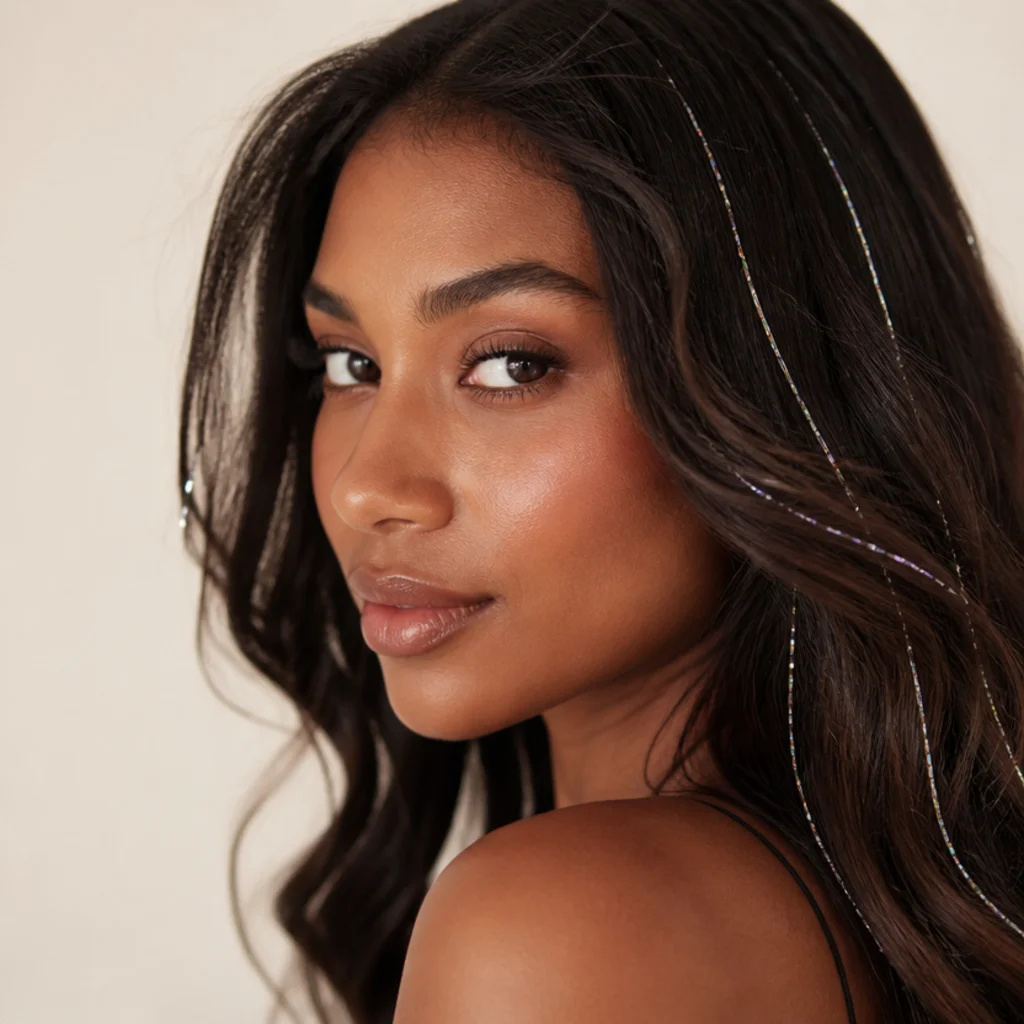
Quick Answer
- Best for: Anyone wanting temporary shine without dye, including hair tinsel black hair, blonde, gray, and every texture from pin-straight to type 4 coils.
- Who might skip it: People who brush aggressively or blow-dry on high daily, and anyone who hates the idea of tiny knots seated near the scalp.
- Maintenance: Low. Tie-in strands last three to six weeks and shed with your natural hair; bead or micro-link strands can be repositioned and worn longer.
- Difficulty: Beginner-friendly for five to ten strands; moderate to advanced for dense, even, all-over placement.
- Cost: Variable. DIY tie-in kits are budget-level for dozens of strands; salon or fairy-hair-bar placement is typically priced per strand or per small bundle, so density drives the total.
- Wear time / longevity: Roughly three to six weeks for tie-ins; single strands often outlast dense sets because there is less to snag.
- Standout variation: Curly hair tinsel that scatters light along each coil and looks fuller than the actual strand count.
- How to ask your stylist: Name three things, tone (silver, gold, rose-gold, pink), density (a few strands versus full coverage), and placement zone (face-framing, crown, hidden under-layer).
In This Guide
- Single Face-Framing Strand
- Five-Strand Starter Set
- Hidden Underlayer Shine
- Silver Sparkle on Black Hair
- Rose-Gold Warm Glow
- Soft Pink Hair Tinsel
- Curly Hair Tinsel Halo
- Tinsel Through a Half-Up Style
- Braid-Wrapped Sparkle
- Money-Piece Shine
- Iridescent Opal Blend
- Holographic Rainbow Mix
- Gold Tinsel on Deep Brunette
- Icy Blonde Frost
- Tinsel in a High Ponytail
- Coily Crown Sparkle
- Peekaboo Purple Tinsel
- Festival Full-Coverage Shine
- Mermaid Blue-Green Strands
- Bold All-Over Glass Shine
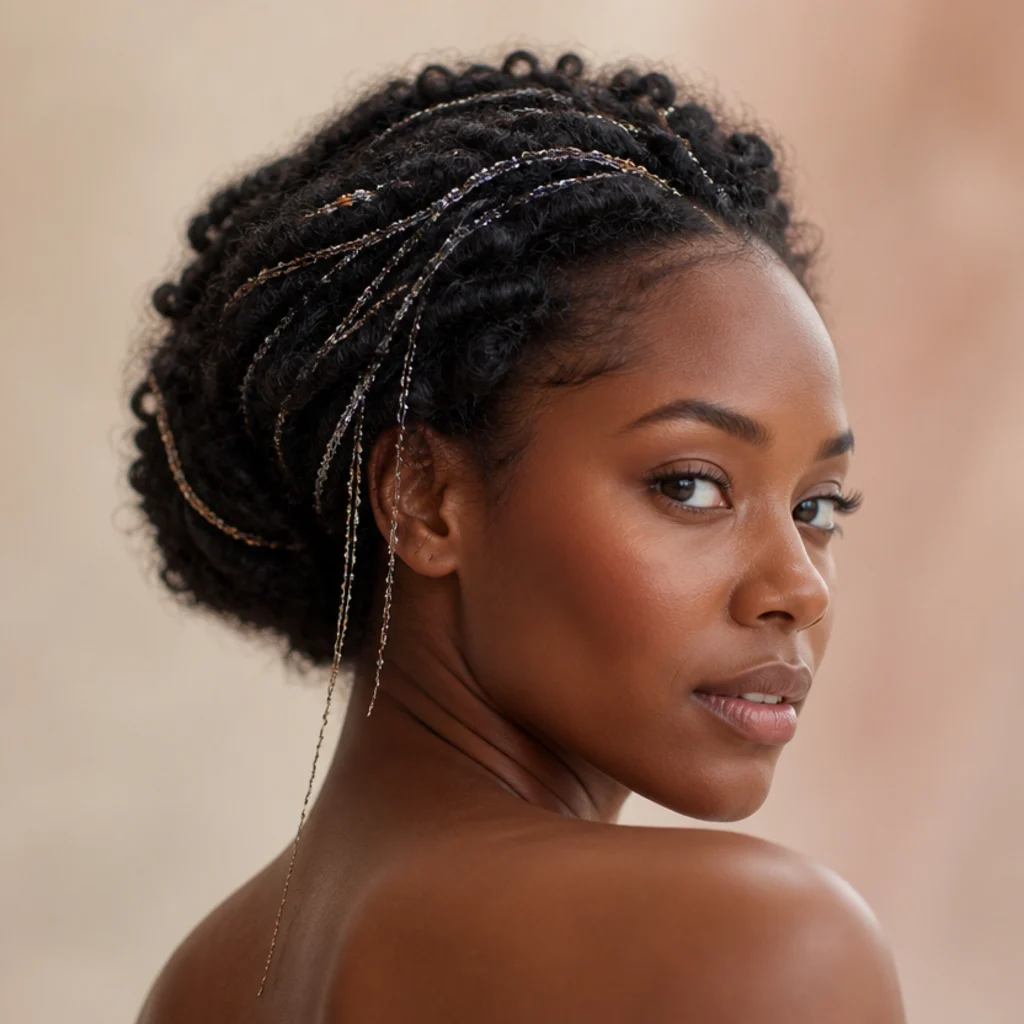
Hair tinsel, also called fairy hair or sparkle strands, is a fine reflective filament that's tied, beaded, or heat-fused onto a few of your own hairs so it swings and catches light like a natural piece of your hair. It's an accessory, not a pigment, so it layers over any base without lifting or depositing color. That's exactly why hair tinsel black hair looks so striking: a dark base absorbs the light around it, so each metallic thread shows up as a sharp point of shine instead of blending in. What started as a 2000s novelty has turned into a real styling option people reach for at weddings, festivals, holiday parties, and photo shoots when they want movement and shimmer without touching their color. It works on any face shape or skin tone because you control the tone and density yourself, and it looks just as good on relaxed coils as it does on straight blonde. This guide runs from a single barely-there strand to full glass-shine coverage, breaking down how placement, color, and density change the effect, plus what to tell a stylist or how to place a few strands yourself. Start low if you're unsure; the look rewards restraint as much as drama.
01Single Face-Framing Strand
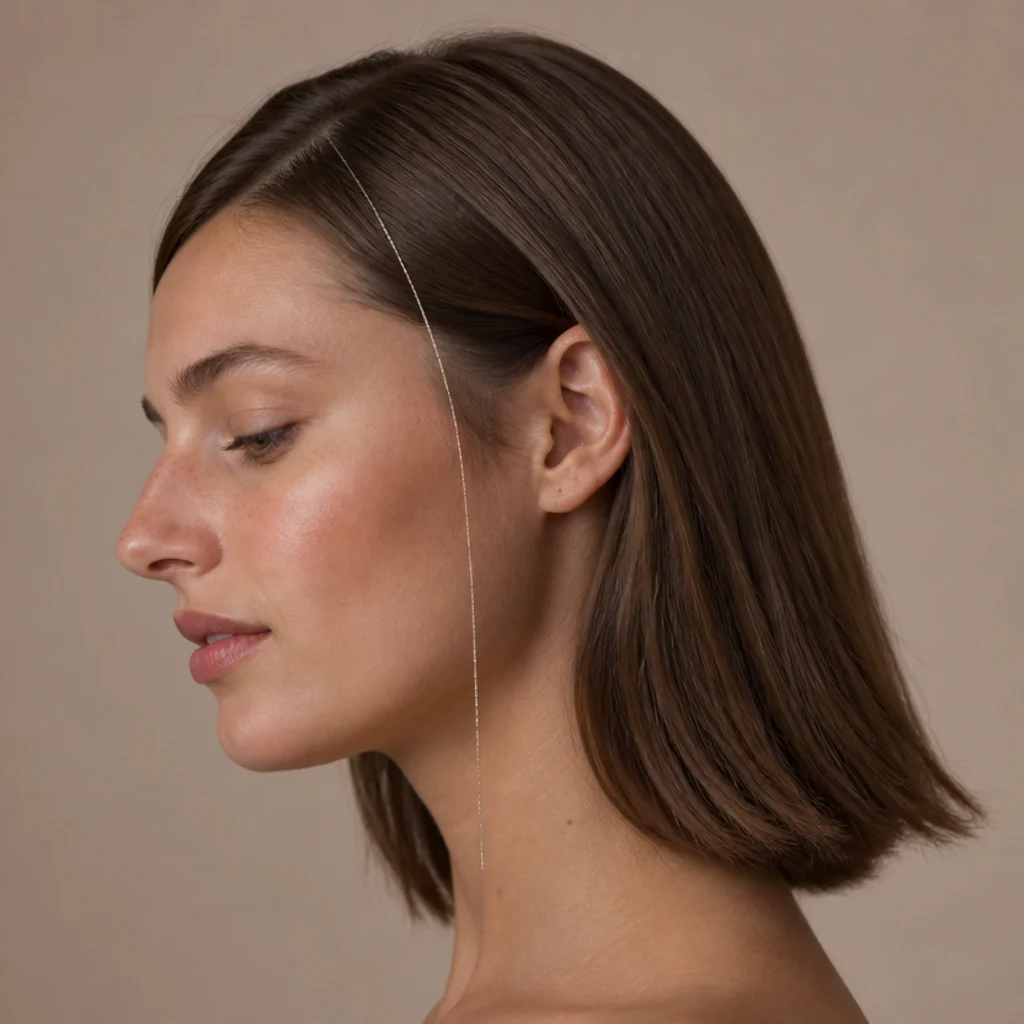
This is the gentlest way in: one strand tied at the part so it falls beside the cheekbone and only flashes when you turn your head. Go one shade lighter than your base, champagne on brunette, platinum on black, so it reads as a stray highlight instead of a novelty thread. Because it's a single vertical line of light, it elongates and slims the face much like a face-framing balayage piece would, which makes it flattering on any face shape. It suits the tinsel-curious in conservative workplaces, though if you want shine visible from across a room, this won't do it. A single tie-in is also the most durable option of all; with almost nothing to snag, it can outlast dense sets and hold for four to six weeks. Pro tip: seat the knot about a centimeter below the parting so it hides once your part shifts. Ask your stylist for "one neutral face-framing fairy strand at the part."
02Five-Strand Starter Set
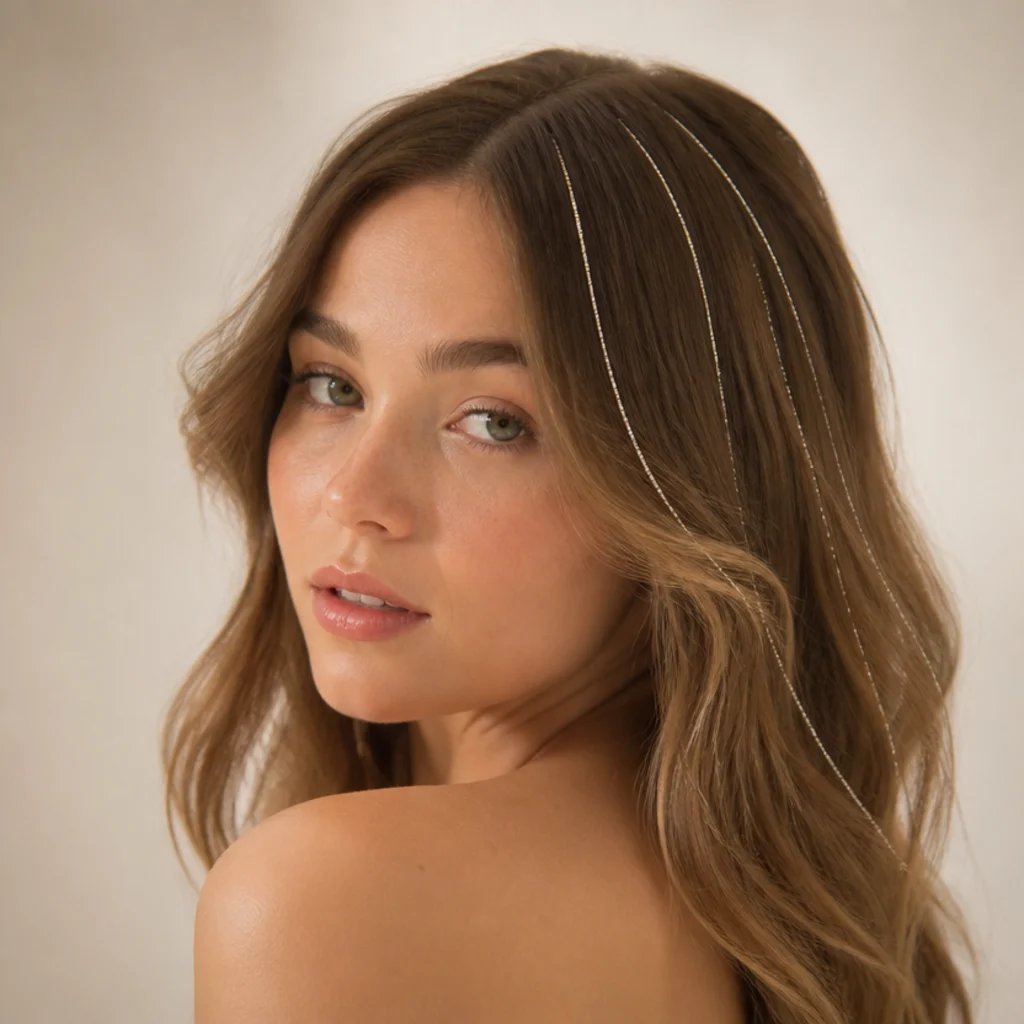
Five strands scattered across the crown give you noticeable shimmer that still looks happily accidental, and that's why it's the most-requested starter density. The trick is uneven spacing: cluster two, leave a gap, drop three more, so the shine looks organic instead of striped like a highlight foil pattern. It works best on mid-length and longer hair, where waves give the strands room to travel and catch light from more than one angle. First-timers who want sparkle in daylight and mirror selfies are the target here, and the difficulty is low enough that anyone can do it themselves. Tie-in strands at this count hold three to six weeks as your hair grows out; maintenance is just gentle brushing around the knots and keeping flat irons off the filament, which will scorch and dull it. Pro tip: place strands slightly back from the hairline so they peek through the top layer instead of sticking straight up at the part. Ask your stylist for "about five neutral-tone tie-in strands through the crown, unevenly spaced."
04Silver Sparkle on Black Hair
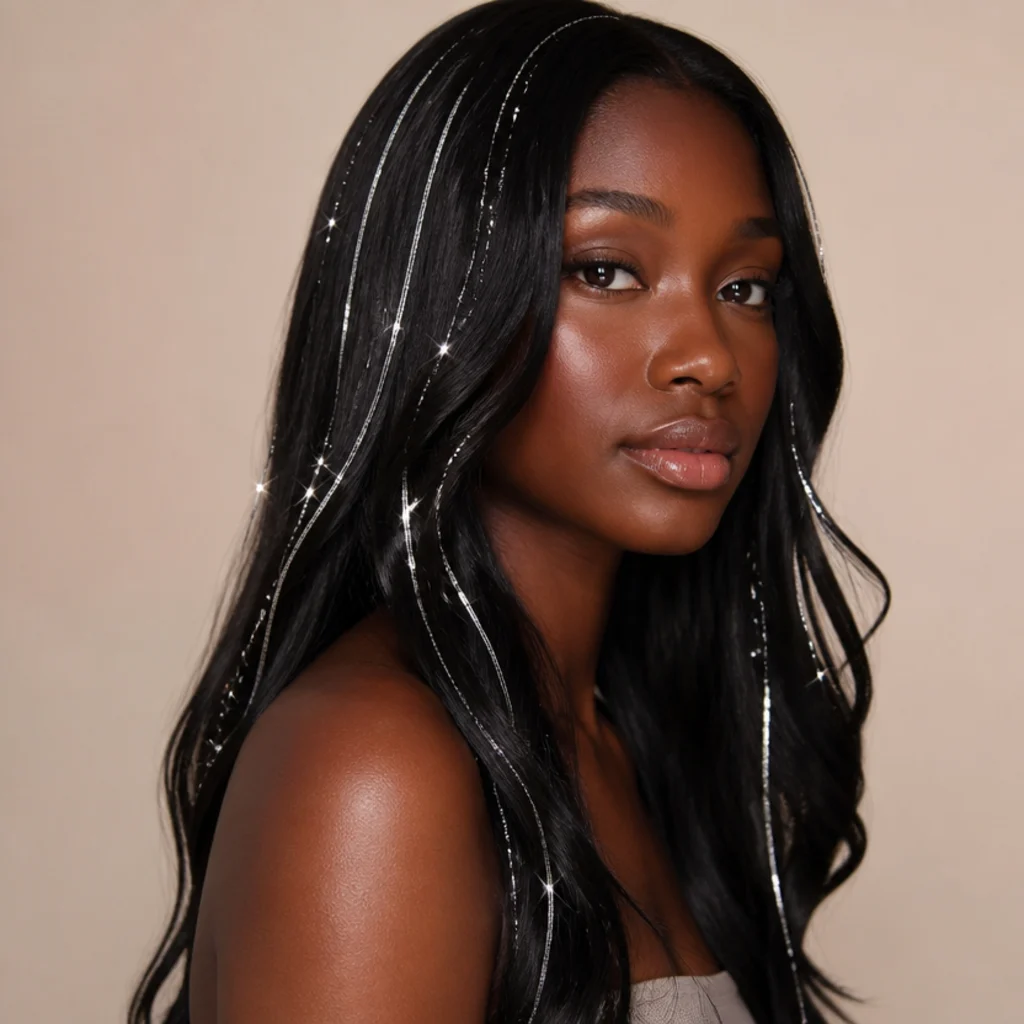
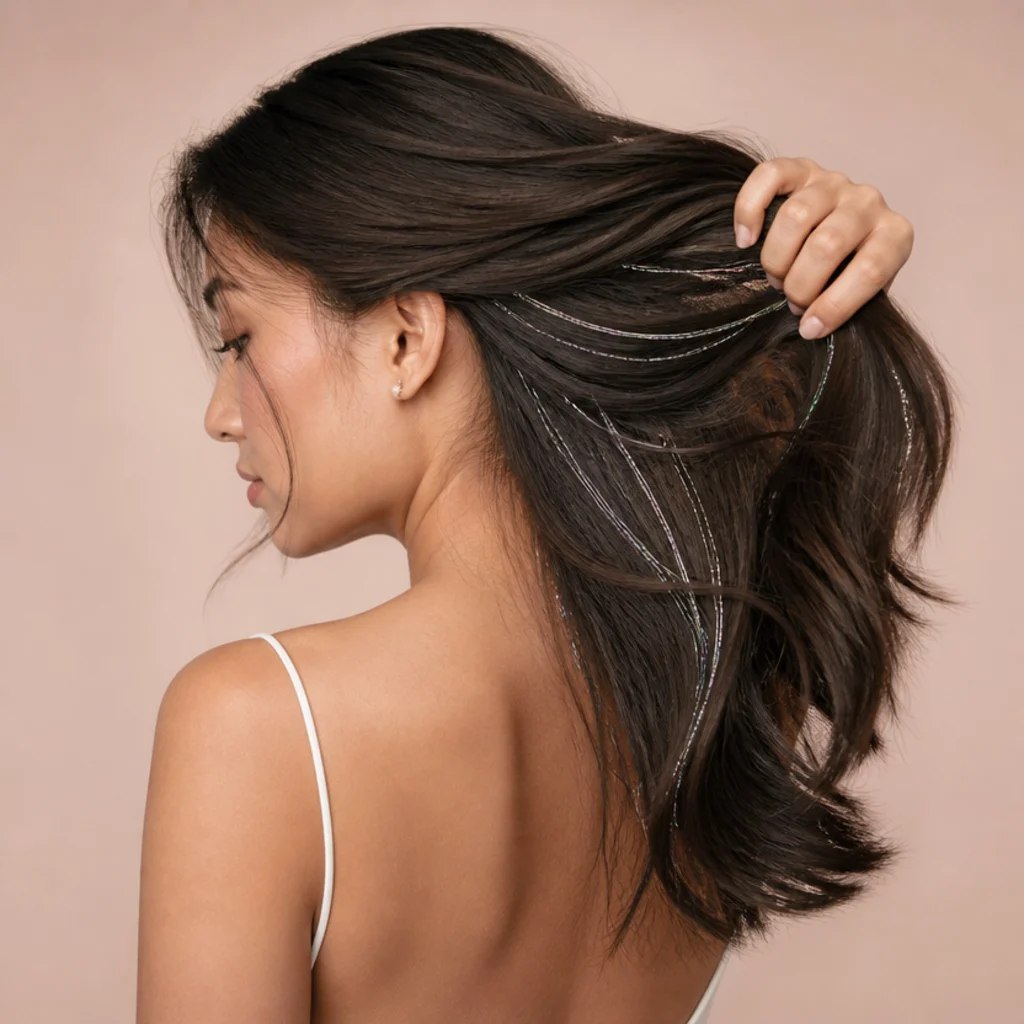
This is where contrast does all the work. On a jet or blue-black base, silver tinsel behaves like scattered starlight, with each thread reading as pure reflected light against the dark. Hair tinsel black hair rewards cool metallics, silver, platinum, pearl, far more than warm golds, which muddy against a cool base and lose their crispness. Naturally dark or color-treated black hair gets the most visible payoff from a modest count here; even ten to fifteen strands look generous, so you get real impact without a dense, time-consuming application. Difficulty stays low, and standard tie-in care applies: three to six weeks of wear with gentle handling. Pro tip: skip warm-yellow gold on true black hair, a cool platinum or a hint of iridescent silver keeps the contrast clean and expensive-looking. Ask your stylist for "silver or platinum tinsel, medium density, placed for high contrast on dark hair."
Save this to Pinterest to compare silver against warmer tones later.
05Rose-Gold Warm Glow
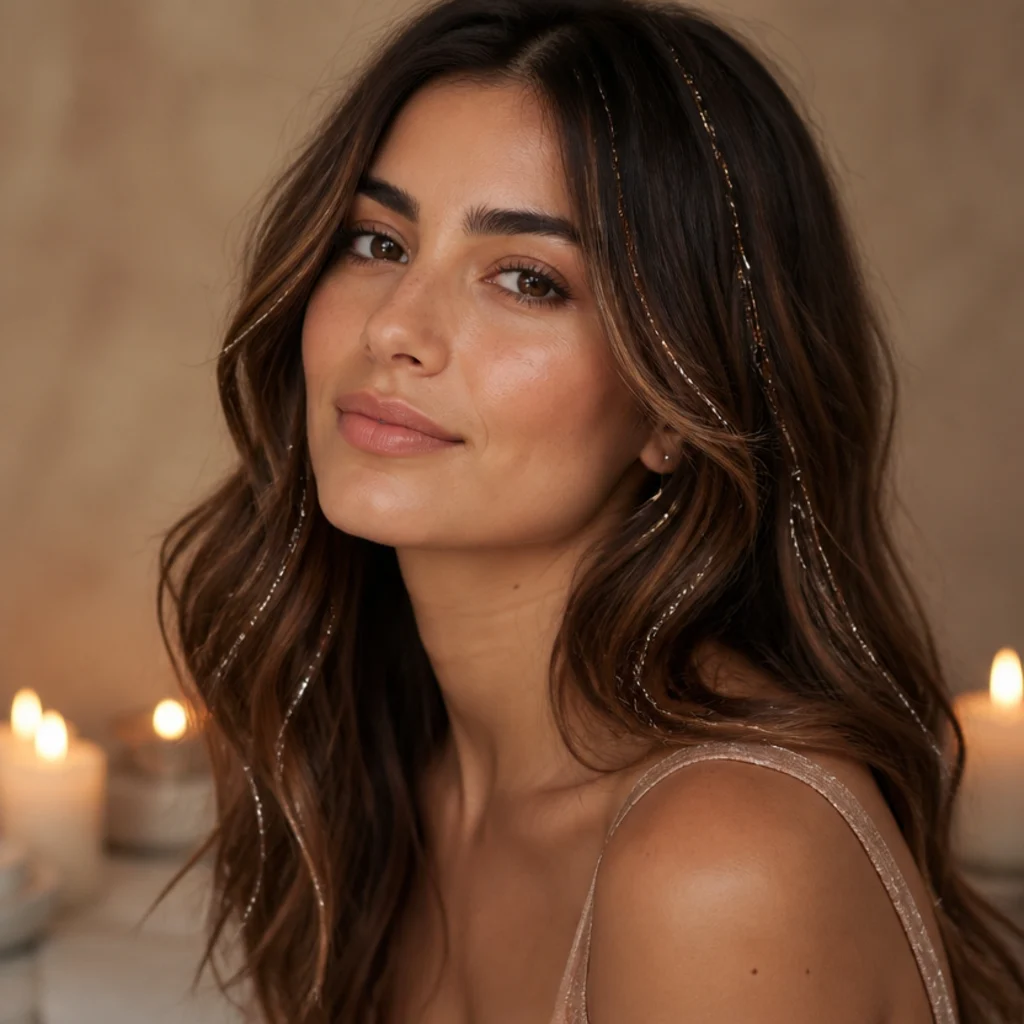
Rose-gold tinsel brings a flattering warmth that suits olive, golden, and deep skin undertones especially well, echoing the peachy metals people already reach for in jewelry. Against brown and black hair it reads more like candlelight caught in the strands than an obvious metallic, a softer effect than pure silver. It works well for warm and neutral undertones who find cool platinum draining; very cool-toned complexions might want to skip it, since rose-gold can lean sallow there. Wear matches other tie-ins at three to six weeks with gentle handling, and the romantic, low-drama finish keeps it a repeat favorite for weddings and date nights. Pro tip: concentrate the warmest strands where light hits your face, along the cheekbone-level mid-lengths, so the glow flatters your skin directly. Ask your stylist for "rose-gold tinsel, light to medium density, through the mid-lengths where it frames the face."
06Soft Pink Hair Tinsel
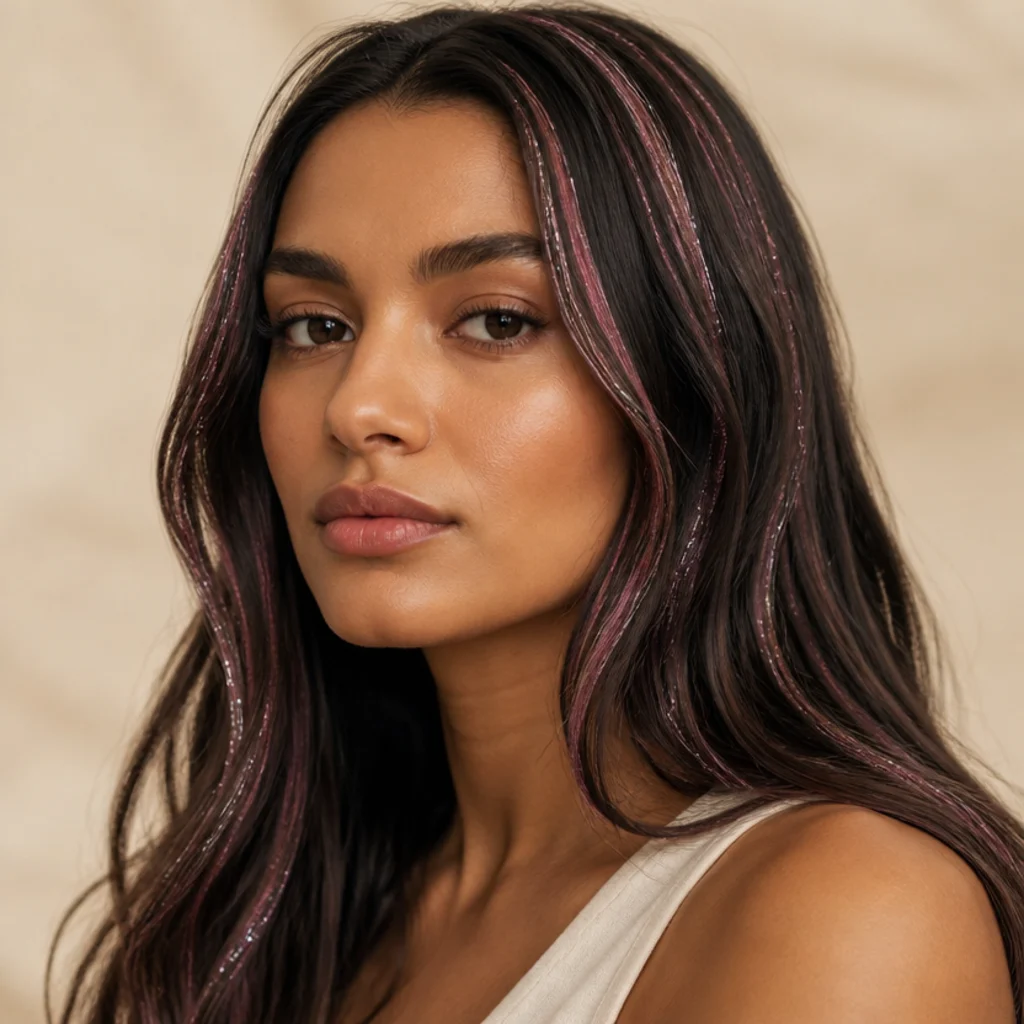
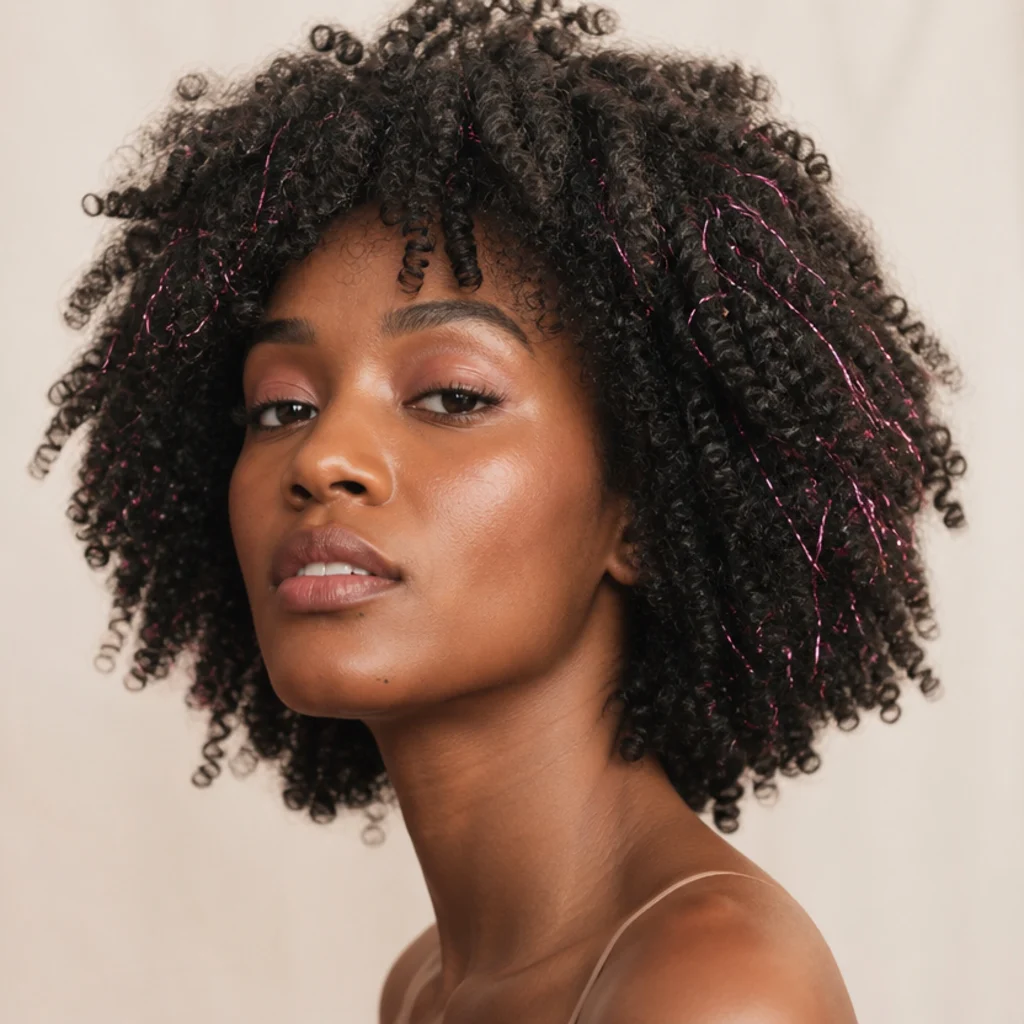
Pink hair tinsel is the friendliest way to test color without touching your natural shade, and it rinses out the moment you slide the strands free. A scatter of blush strands gives a playful, youthful finish; on dark hair the pink stays subtle and jewel-like, while on blonde it glows brighter and more candy-toned, so match saturation to your base. It's a good fit for anyone flirting with pink hair but not ready for a bleach-and-tone commitment. Difficulty is low and it's fully reversible, so you can go pink Friday and neutral by Monday. Maintenance is the same gentle tie-in care, three to six weeks of wear. Pro tip: pair soft pink with one or two silver strands so the color reads intentional and styled, not like leftover party tinsel. Ask your colorist for "soft blush-pink tinsel scattered through the crown plus a couple of face-framing pieces."
07Curly Hair Tinsel Halo
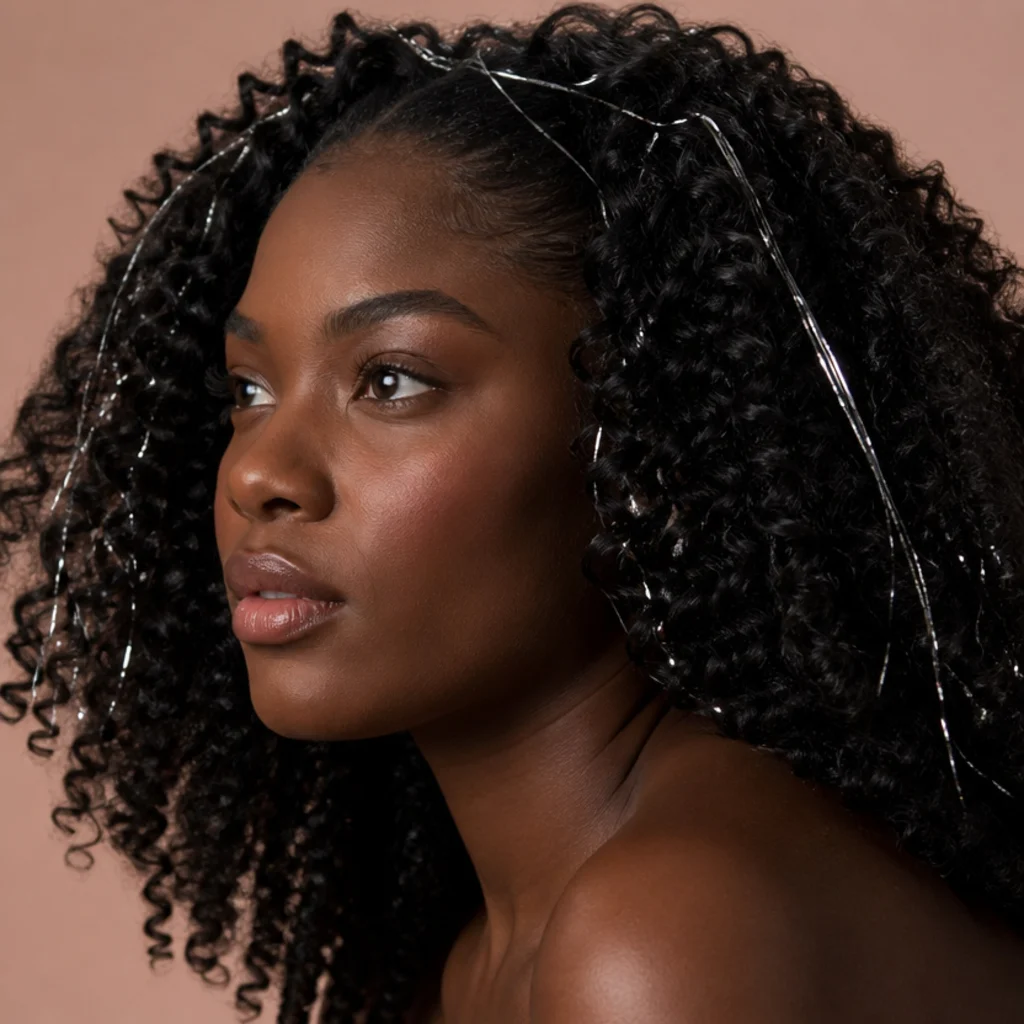
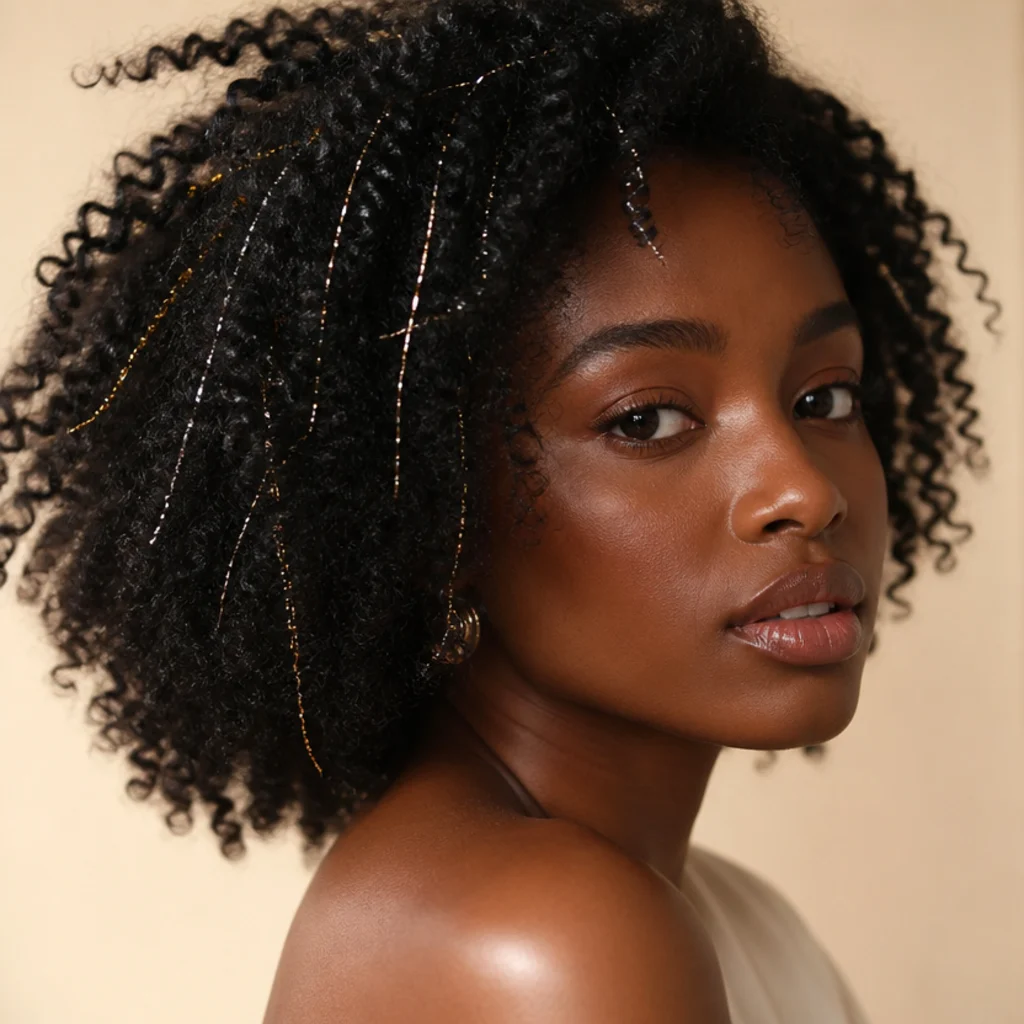
Curly hair tinsel is quietly one of the strongest applications. Coils and waves scatter light along the entire strand instead of only at the tip, so a handful of strands looks like far more once it spirals through the pattern, leaving a shimmering halo that traces the shape of your curls. It's a great option for wavy through curly textures (types 2 to 3C) that want a lot of shine from a low strand count, just place strands at the root so each one travels the full length of the curl. Upkeep means finger-detangling around the knots and scrunching rather than rubbing on wash days, which protects both the shine and your curl clumps. Pro tip: refresh with a light gel or mousse, not a heavy brush, so the tinsel stays wound through the coil instead of frizzing loose. Ask your stylist for "tie-in tinsel placed at the root so it follows the curl pattern, medium density."
08Tinsel Through a Half-Up Style
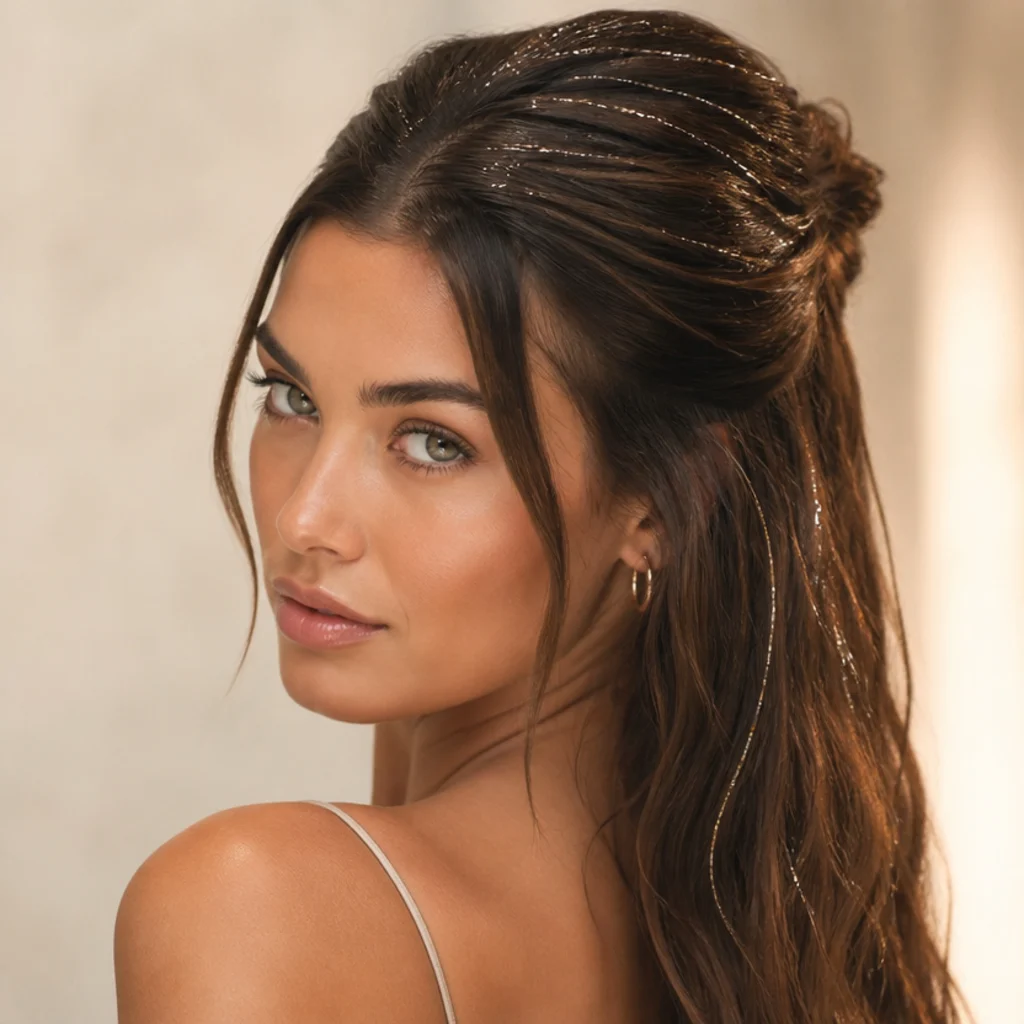
Pulling hair into a half-up style gathers scattered tinsel toward the crown, concentrating the shine right where cameras and overhead lighting find it. This isn't a new placement so much as a way to restyle strands you already have so they read bolder for an event. It's ideal if you've already placed a starter set and want it to pop for a night out, and the difficulty is close to zero since it's pure styling. The gathered strands catch warm indoor and evening light well, which makes this a smart move for receptions and dinners. Pro tip: secure the half-up with a claw clip or loose elastic rather than a tight snap band, so nothing tugs the knots down the shaft or pulls strands loose. To recreate it, section a half-up portion that captures most of your tinsel and fasten it loosely at the crown.
09Braid-Wrapped Sparkle
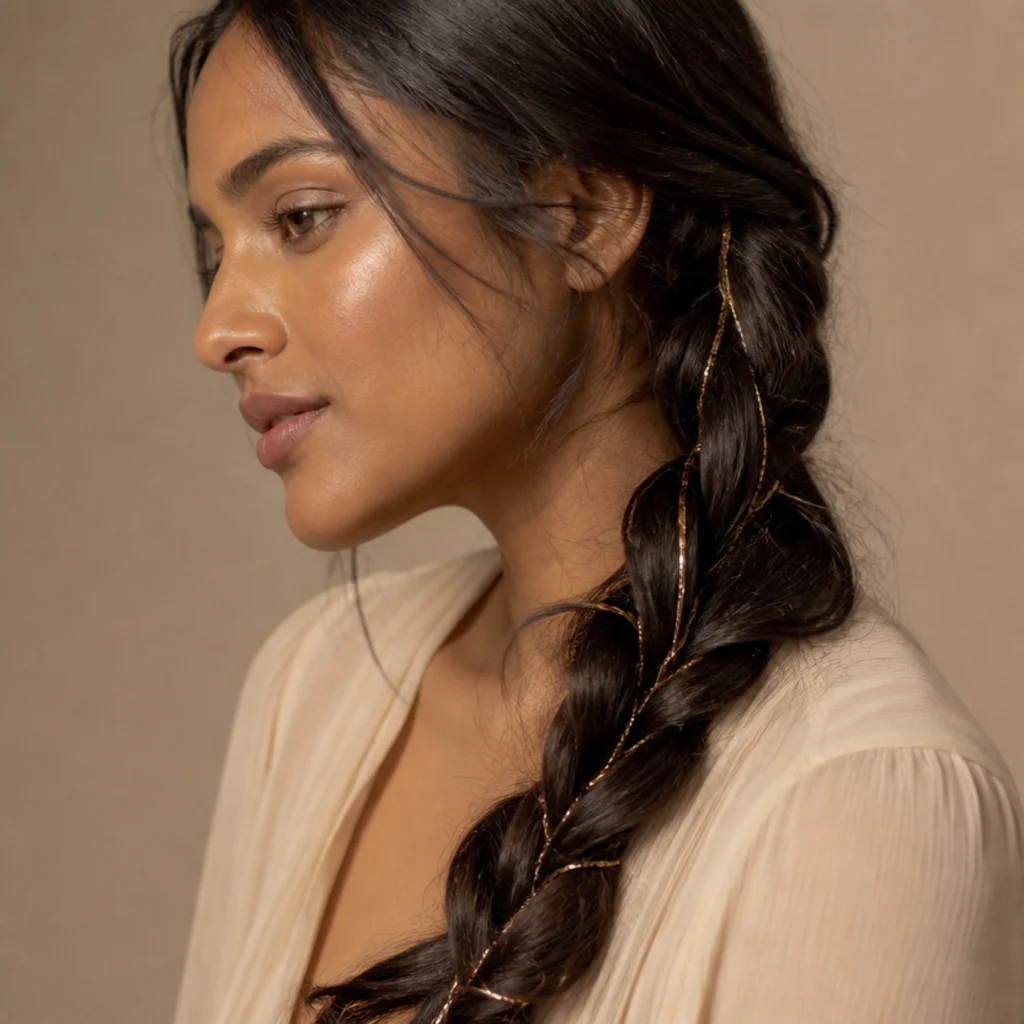
Weaving tinsel into a braid traps the shine between sections so it winks out along the plait, a structured, deliberate glimmer rather than free-floating sparkle. A loose side braid or a single accent braid gets you the effect without full-head placement, which makes it efficient for festival and boho styling. Braid-lovers wanting extra dimension are the obvious fit; difficulty runs moderate, since you fold the strands in as you cross sections and need to keep tension even so knots don't slip toward the ends. Wear depends on how long you keep the braid in, and a few days is comfortable before frizz sets in. Pro tip: place the tie-in strands first, then braid over them, instead of trying to catch loose filament mid-plait, which tangles fast. Ask your stylist to "add tinsel into a loose accent braid," or seat the strands yourself and plait over them at home.
10Money-Piece Shine
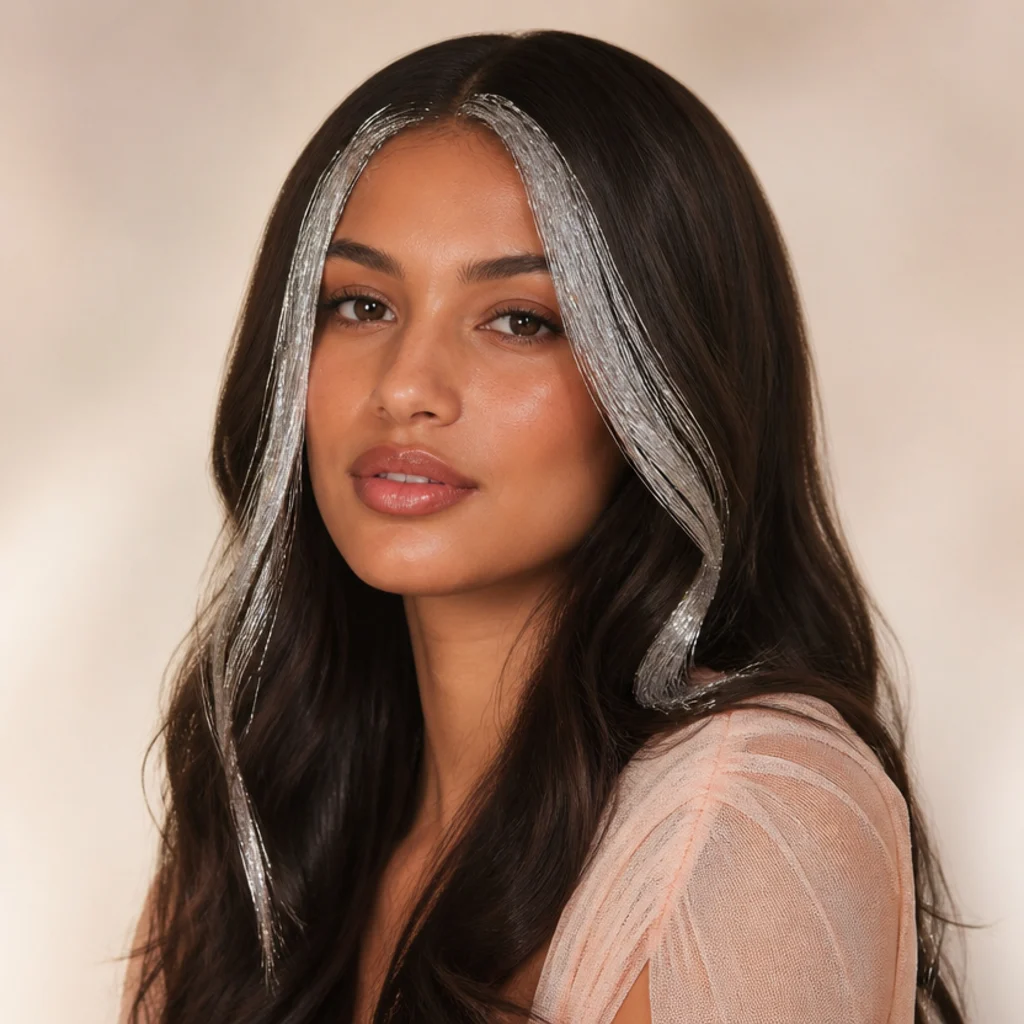
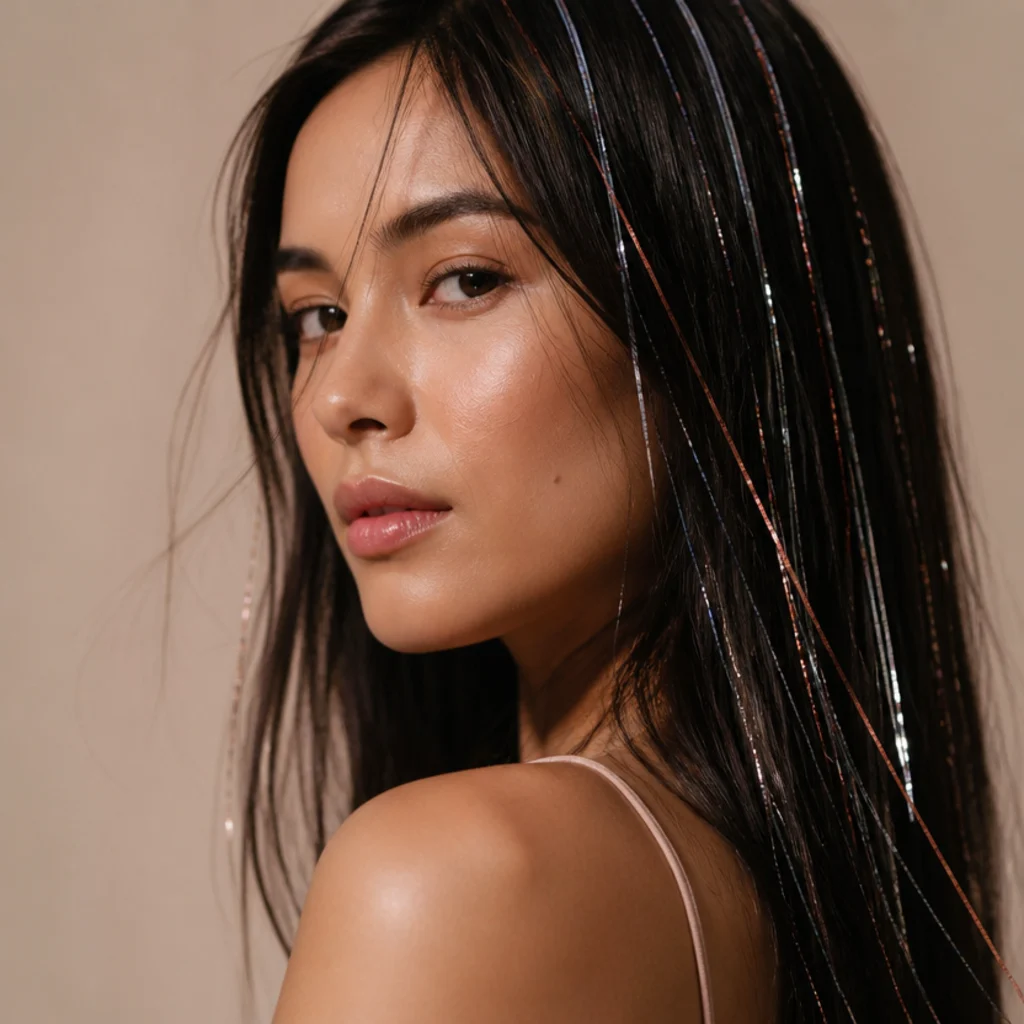
Borrowing straight from color trends, this concentrates tinsel on the two front money-piece sections that bracket your face, so the brightest shine lands right where it draws the eye, no bleach required. It suits anyone who wants one clear spot of shine rather than a diffuse scatter, and it particularly flatters longer face shapes, since the vertical brightness at the temples adds width and softness. On dark hair a silver money-piece mimics a face-framing highlight; lighter bases take a warmer champagne or gold. Difficulty is low since the placement sits in two visible spots you can manage yourself, and maintenance is easy for the same reason, three to six weeks with gentle care. Pro tip: keep the two sides symmetrical in count so the frame looks balanced in photos. Ask your colorist for "denser tinsel on the front face-framing sections, lighter or none everywhere else."
Save this to Pinterest if you are torn between scattered and concentrated placement.
11Iridescent Opal Blend
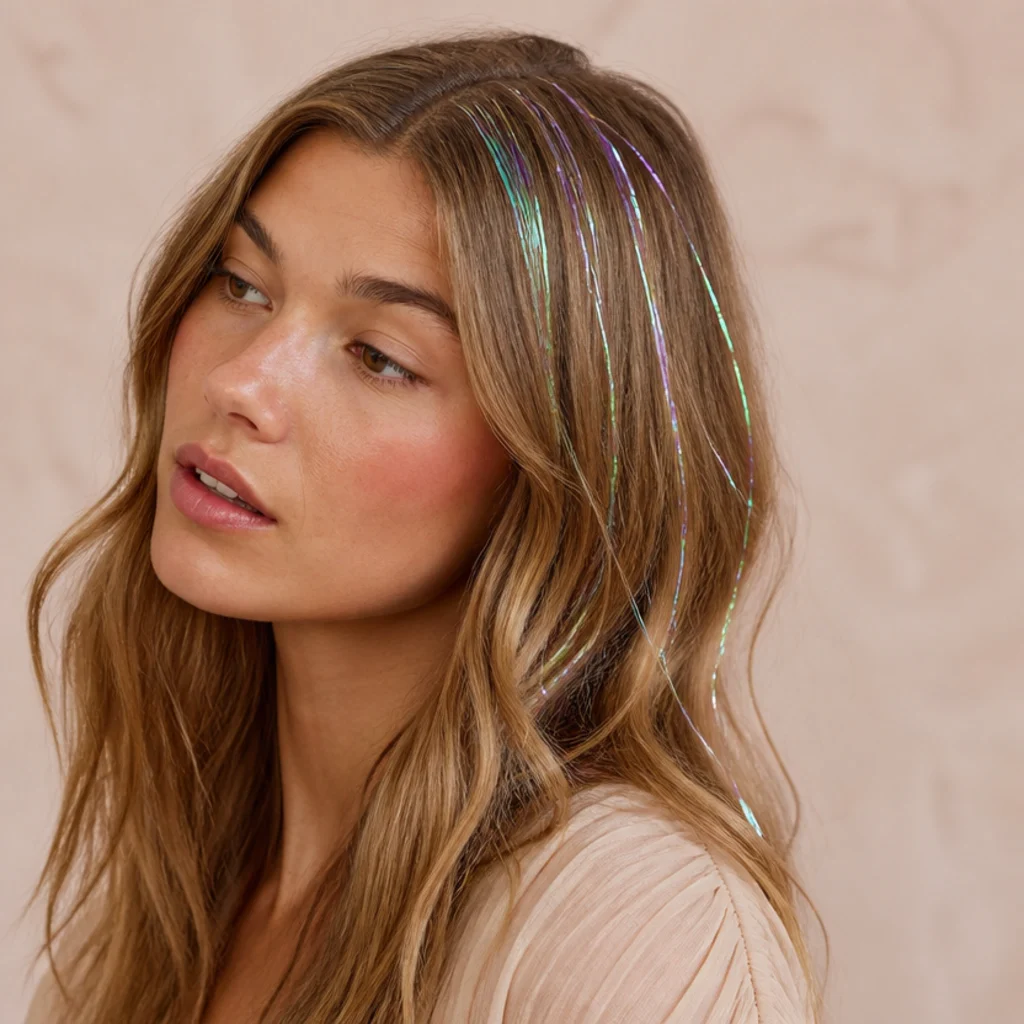
An opal blend mixes several muted iridescent tones, pale pink, lilac, mint, and silver, so the tinsel shifts color as light and movement change the angle. It feels dreamier than a single metallic yet stays subtle, since each shade is soft and low-saturation. Pastel-lovers who want multi-tonal shine without a full-rainbow commitment will like this one, and it looks best on lighter and medium bases in natural daylight, where the color shift actually shows. Difficulty is low, since the interest lives in the strand itself rather than the placement, so a simple crown scatter is enough. Upkeep is standard tie-in care with gentle finger-detangling. Pro tip: photograph this one near a window instead of under warm indoor bulbs, which flatten the iridescence to a single tone. Ask your stylist for "an opal or iridescent tinsel mix at medium density through the crown, soft color shift rather than bright blocks."
12Holographic Rainbow Mix
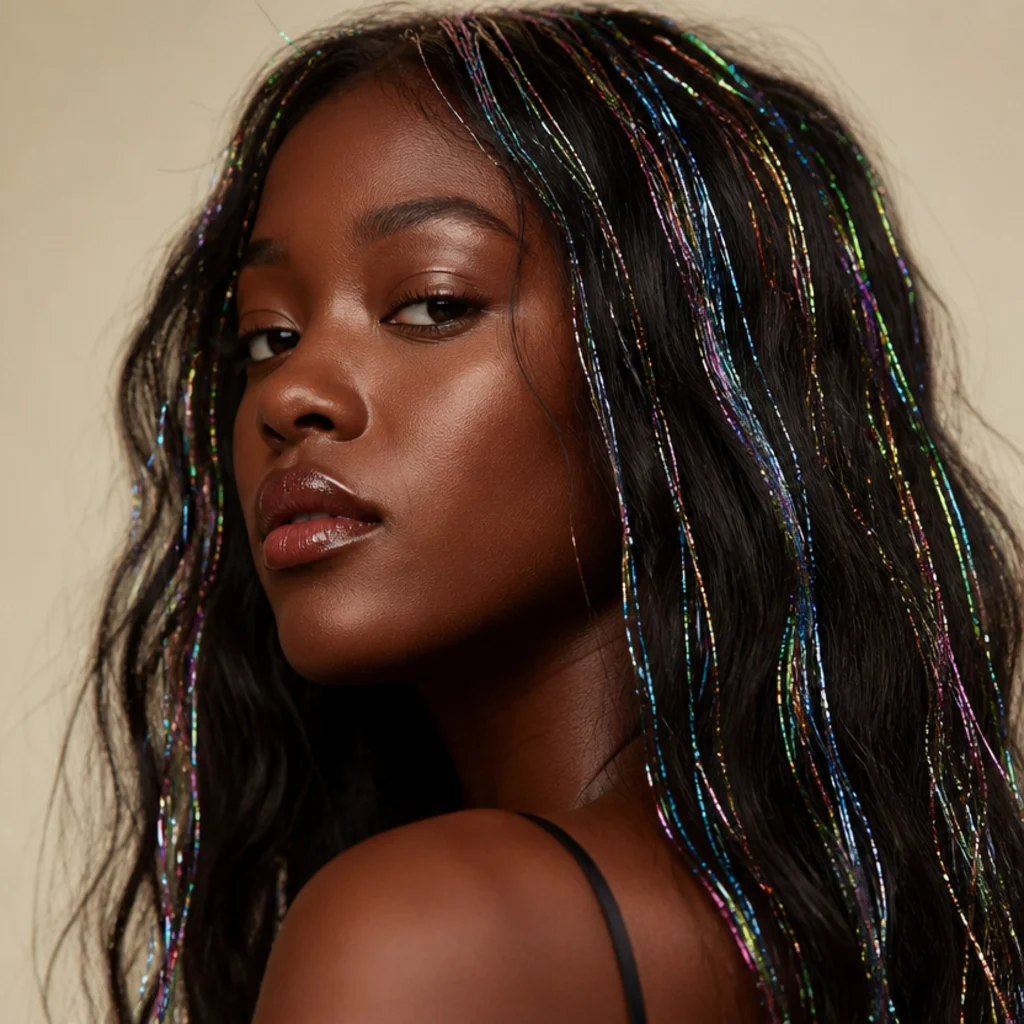
Turning the color all the way up, a holographic rainbow mix scatters multiple bright tones for a bold, unmistakable finish. This is festival and party territory, where fun and photos beat subtlety. It's for anyone who wants maximum color impact and doesn't mind being noticed, skip it if you need the look to pass at a conservative office. On black hair the bright strands pop with high contrast and read almost neon; on blonde they melt into a softer, diffused prism. Difficulty stays low even though the effect is loud, because it's still just tie-in strands. Maintenance is short-term by nature, since most people wear this for a single event and remove it after. Pro tip: keep the base hair simple, sleek waves or a clean pony, so the rainbow does the talking without competing texture. Ask your stylist for "a bright multicolor holographic tinsel mix at medium to high density."
13Gold Tinsel on Deep Brunette
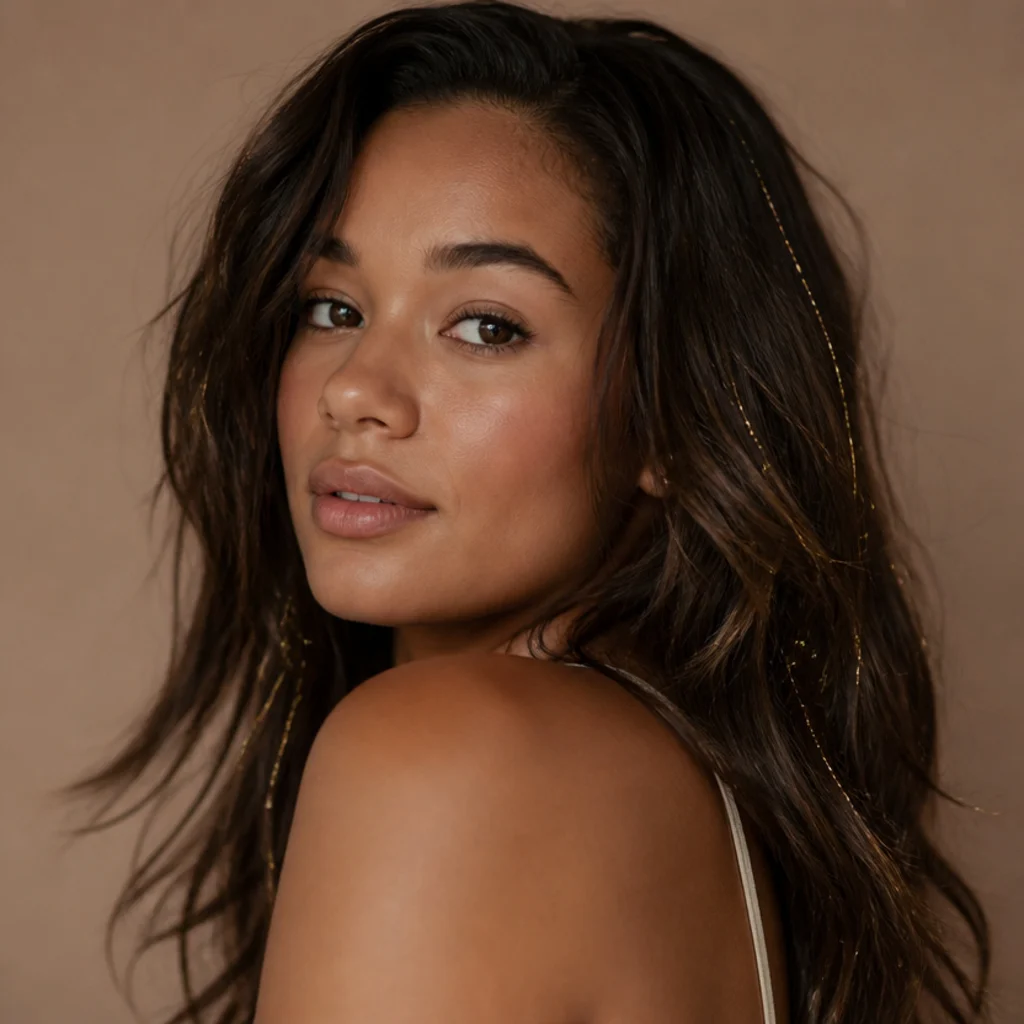
Warm gold tinsel through deep brunette hair reads like late sun catching the strands, elegant and rich rather than costume-y. Gold flatters warm and neutral skin tones and layers dimension into a dark base without the stark cool contrast of silver, so it feels understated rather than flashy. Brunettes wanting holiday or event shimmer that still looks grown-up should place strands through the mid-lengths and ends, where movement shows them off best. Difficulty is low, and the warm finish photographs well in candlelight and evening settings, which is why it suits winter parties. Upkeep is standard: three to six weeks from tie-in strands. Pro tip: specify true gold over champagne if you want visible saturation, since champagne can disappear into medium-to-light brunette. Ask your stylist for "warm gold tinsel through the mid-lengths and ends, medium density, gold rather than champagne."
14Icy Blonde Frost
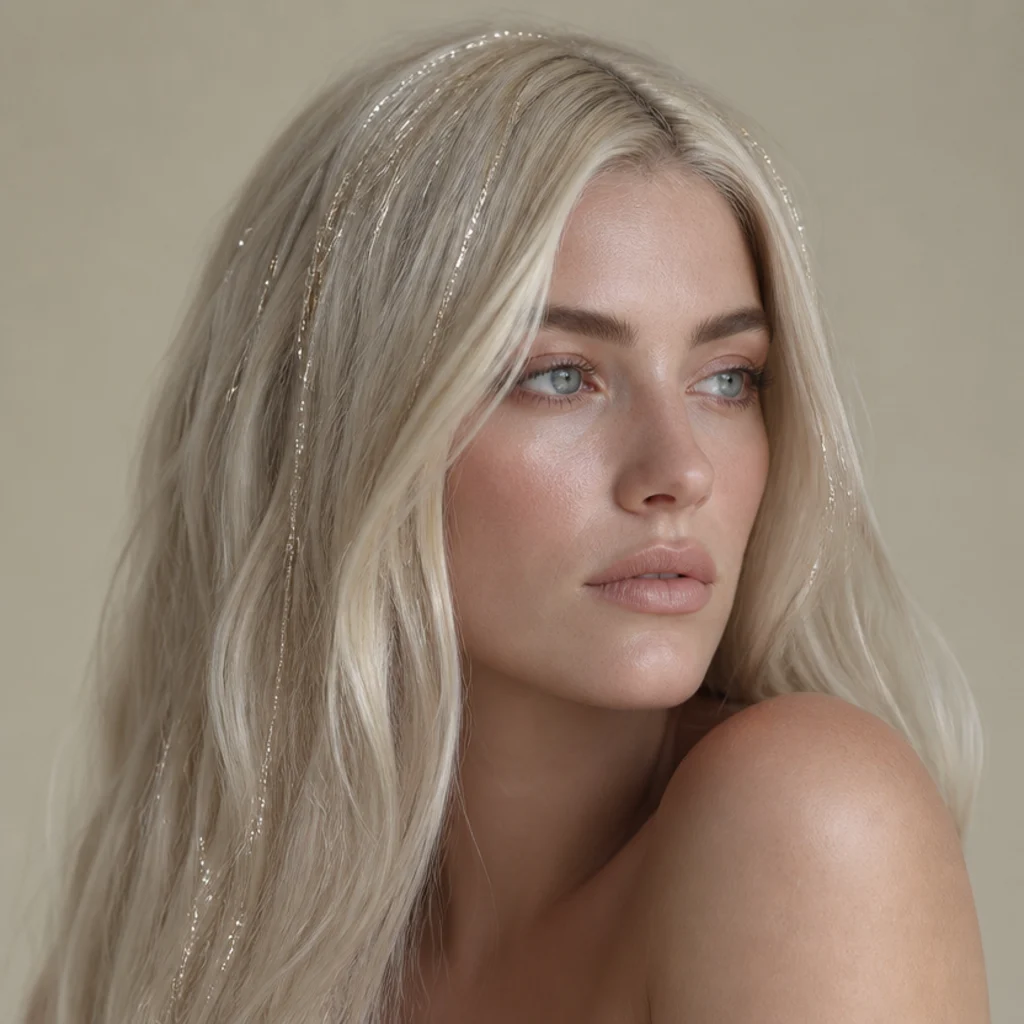
On blonde hair, silver and pearl tinsel create an icy, frosted effect that looks like the hair itself is glinting, because the tones sit so close to the base that shine reads as texture and light rather than separate strands. It works well for cool-toned and platinum blondes who want polished, everyday-wearable sparkle; warm or golden blondes might want to skip it, since cool pearl can look mismatched against a yellow base. Difficulty is low, and the subtlety comes entirely from matching tinsel to your exact level and tone. One caveat: blonde shows the seated knots more than dark hair does, so tidy, root-close placement matters more here. Pro tip: ask for a pearl-and-silver mix rather than pure bright silver, which can read cold and metallic against soft blonde. Ask your stylist for "pearl and silver tinsel matched to a cool blonde base, evenly scattered and seated close to the root."
15Tinsel in a High Ponytail
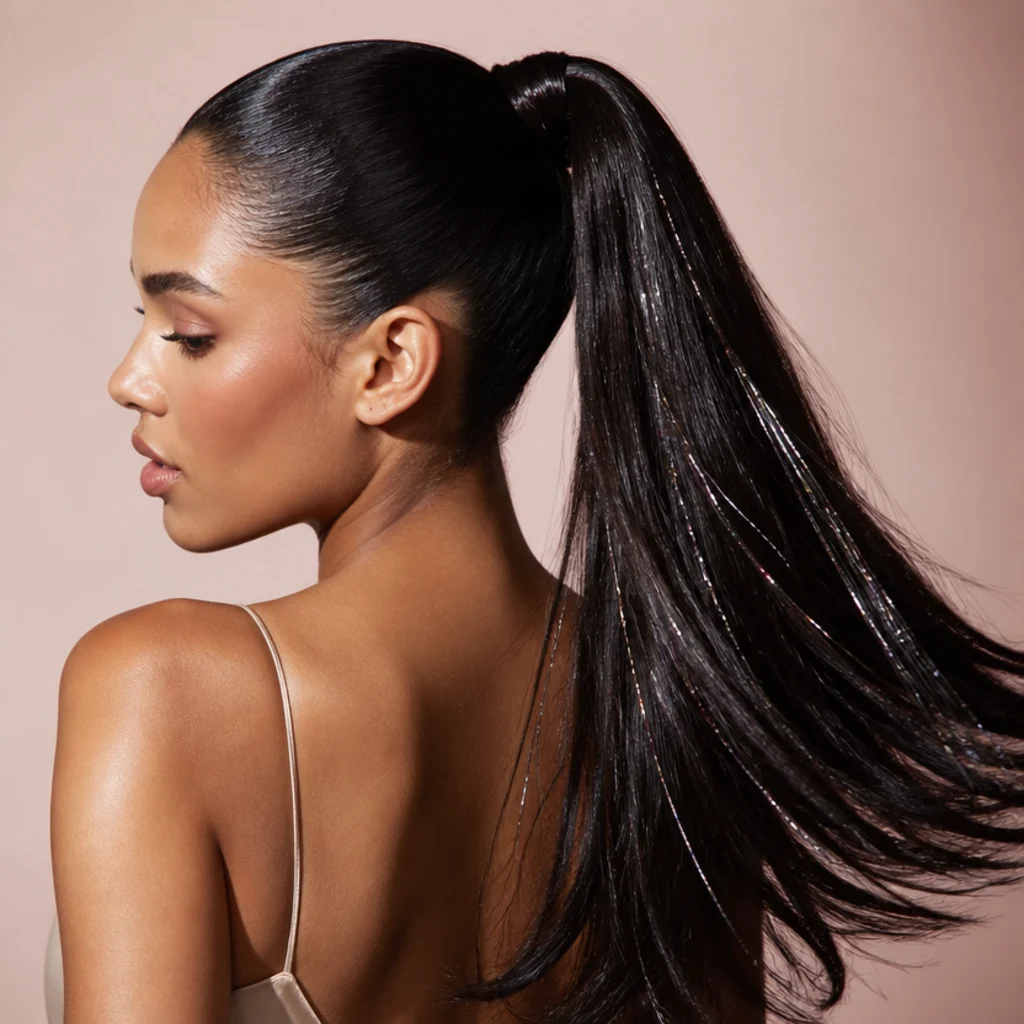
Sweeping everything into a high ponytail gathers scattered tinsel into a single shining tail that swishes with every movement. Like the half-up, this is a styling move that makes existing strands read bolder and more dynamic without adding any new ones. It's for anyone active, dancing, or performing, where sparkle in motion is the whole point, and difficulty is minimal beyond tying the pony loosely enough to protect the knots. The concentrated strands catch light dramatically as the tail swings, which suits stages, parties, and dance floors. Pro tip: smooth the ponytail with a soft brush or your fingers in the direction of the tail so the tinsel aligns and lies flat instead of fighting the gathered hair and kinking at the base. To recreate it, gather hair high, secure with a fabric-wrapped elastic to reduce snag, and finger-smooth the length.
Save this to Pinterest for easy event-styling ideas.
16Coily Crown Sparkle
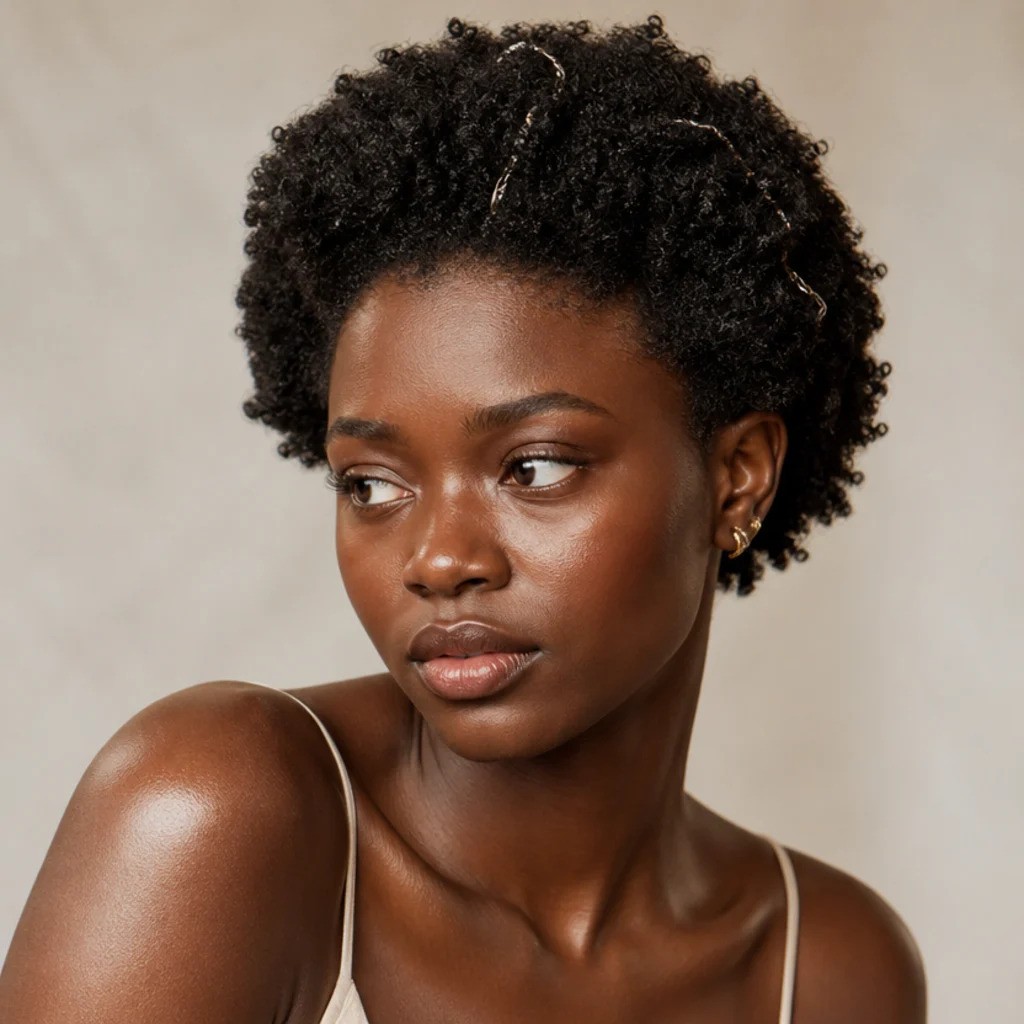
On tightly coiled hair, tinsel placed through the crown creates a shimmering, crown-like halo that sits within the natural volume instead of flattening it. Coily textures grip the strands securely and show the shine as bright glinting points scattered through the shape, so even a modest count reads full. Type 4 textures wanting sparkle that works with the hair, not against it, are the target here; place strands at the root and let them live inside the coils where they'll stay put. Difficulty ranges from low to moderate depending on density. Upkeep means finger-detangling and keeping heavy tension off the knots, plus refreshing with a spray bottle rather than a brush. Pro tip: place tinsel on freshly moisturized, defined coils rather than dry, shrunken hair, so the strands settle into the pattern instead of sitting on top. Ask your stylist for "tinsel woven through the crown, root-placed to sit within the curl pattern."
17Peekaboo Purple Tinsel
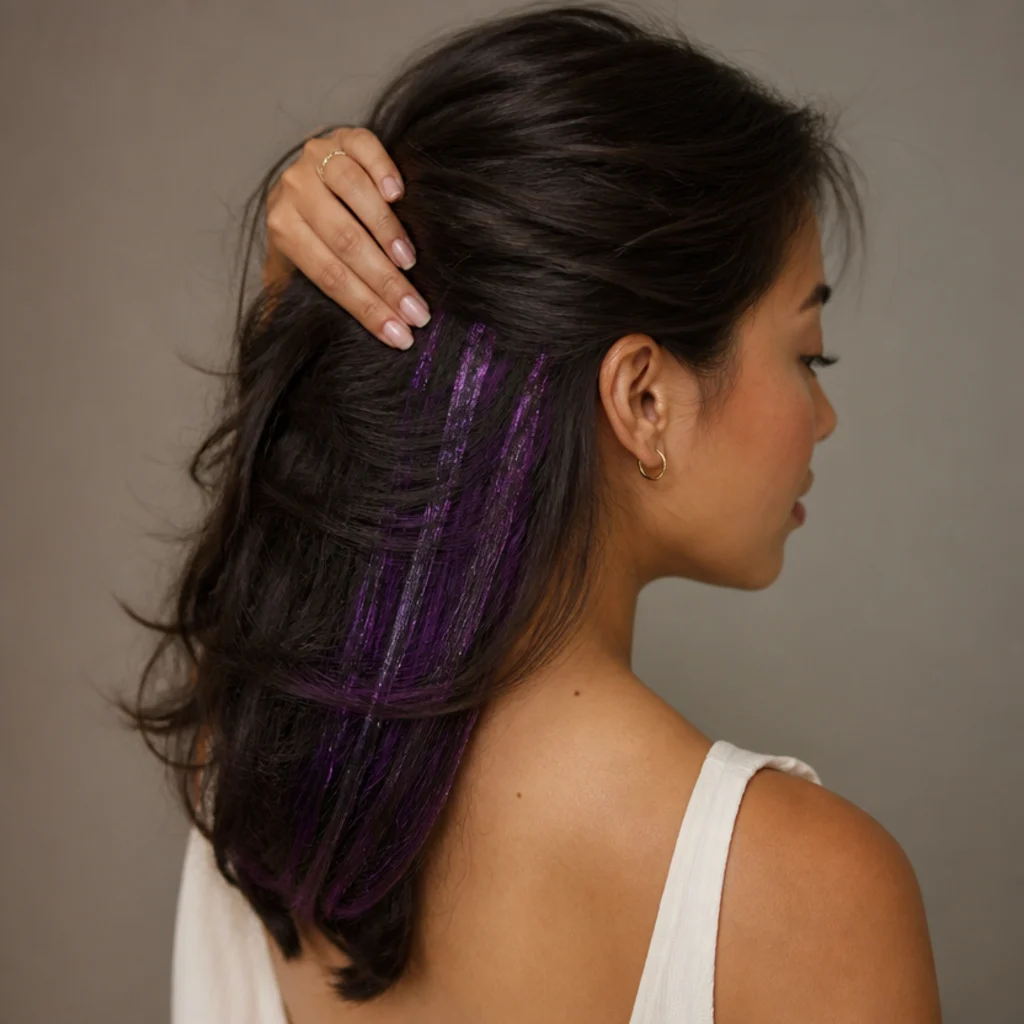
Purple tinsel tucked into the under-layers gives a peekaboo pop that surfaces only when your hair moves or lifts, pairing the discretion of hidden placement with a jewel-toned color for a daring but controllable effect. It suits anyone who wants a hint of color that stays hidden at work and reveals itself at play; skip it if your hair is too fine or short to keep the under-layer covered. On dark hair the purple glows deep and rich; on blonde it reads brighter and more vivid, so adjust the shade to your base. Difficulty is low, and maintenance is easy because the top layer protects the strands. Pro tip: choose a violet with a cool blue lean for dark hair, since red-violet can vanish against brunette. Ask your stylist for "purple tinsel in the lower layers as a peekaboo," and tell them how visible you want it when your hair is down.
18Festival Full-Coverage Shine
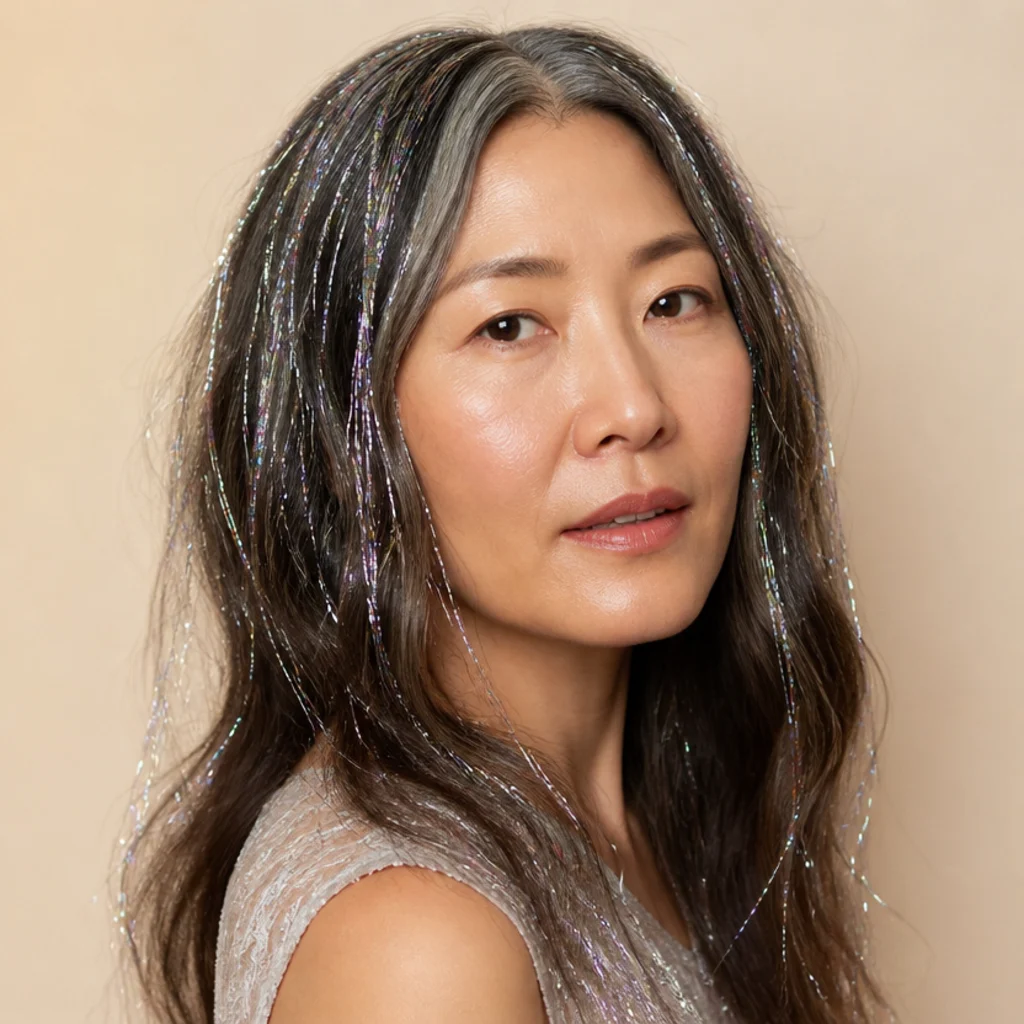
This is the leap into bold: tinsel scattered densely across the whole head so the hair shimmers from every angle and becomes the whole look. It's built for festivals, concerts, and photo-heavy days where more is exactly the point. This suits anyone wanting unmistakable, all-over sparkle for a specific occasion; skip it if you want the look to stay subtle or last for weeks. Difficulty climbs with density, and a stylist or fairy-hair bar will place this faster and far more evenly than you can alone, sometimes seating a hundred or more strands. Maintenance is short-term by design, most people wear full coverage once and remove the strands afterward. Pro tip: book enough time and show up with clean, detangled, product-light hair so the artist can section quickly. Ask your stylist for "high-density tinsel scattered all over for full-coverage festival shine."
19Mermaid Blue-Green Strands
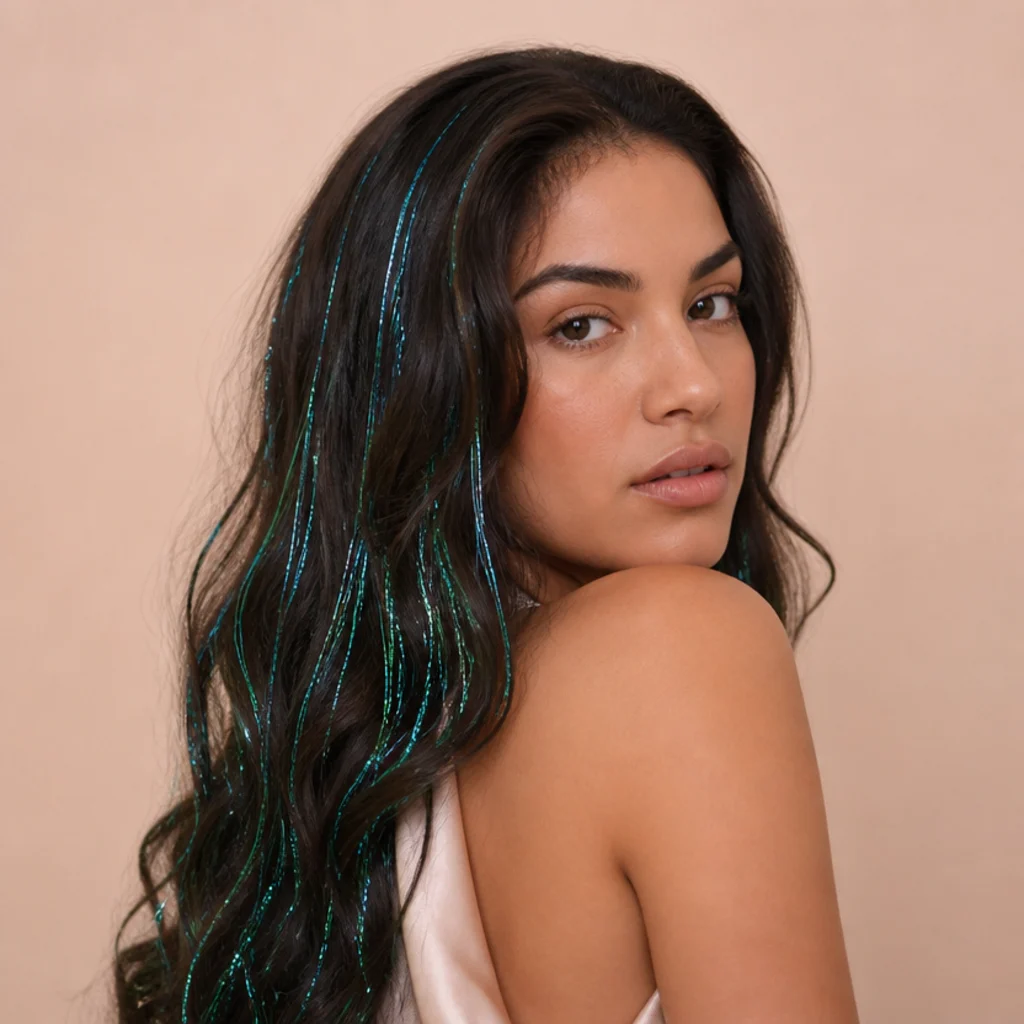
Cool blue and green tinsel mixed together gives a mermaid, oceanic finish that shifts between teal and aqua as light moves across it. It's bold and color-forward yet cohesive, since the tones sit side by side on the spectrum and blend rather than clash. Anyone drawn to cool colors and a fantasy aesthetic will like this; on black hair the blues and greens read deep and jewel-like, while on lighter hair they turn brighter and more playful. Difficulty stays low despite the drama, since it's standard tie-in placement. Maintenance is typically short-term, best suited to themed events and photo shoots. Pro tip: concentrate the strands toward the ends for a dip-dyed, ombre-style wash of color, or spread them evenly for shimmer all over, and decide before placement since it changes the whole read. Ask your stylist for "a blue-green mermaid tinsel mix at medium to high density, concentrated at the ends."
20Bold All-Over Glass Shine
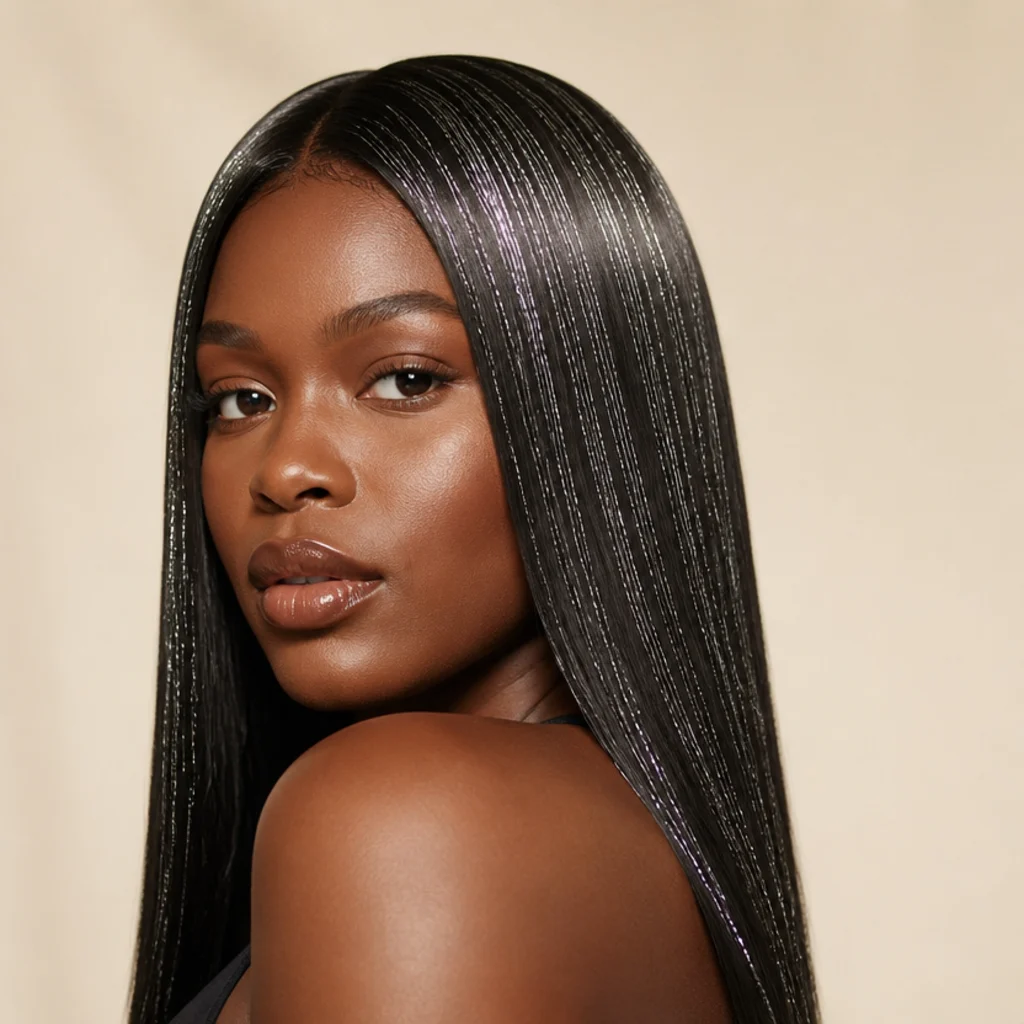
The boldest end of the progression: dense, tonal tinsel placed for maximum glass-like shine, so the hair looks lit from within. Unlike the rainbow festival version, this sticks to one or two coordinated metallics for a polished, high-impact editorial finish rather than a playful one. It's for anyone wanting drama that still reads refined, ideal for shoots, stage, or a statement night; skip it if you're after everyday wearability. Difficulty is high, because dense, perfectly even placement is what separates glass shine from patchy sparkle, a professional earns their fee here. Maintenance is short-term; this is a moment, not a routine. Pro tip: choose silver on cool dark bases and gold on warm ones, and keep the hair itself sleek and glossy, since frizz breaks the glass effect instantly. Ask your stylist for "dense single-tone tinsel for an all-over glass-shine finish."
Pro Tips from the Editor
- Seat every knot close to the root, roughly a centimeter down, and never at mid-shaft; a knot that starts to slide toward the ends is your cue to remove that strand before it tangles.
- Keep flat irons and curling wands off the filament itself. Most tinsel is heat-sensitive and will scorch, kink, or dull; style your hair first, then add or work around the strands.
- Match tone to contrast, not to preference alone: cool silver and platinum maximize visibility on dark and black hair, while warm gold and rose-gold flatter warm skin and lighter bases.
- On wash days, let sulfate-free shampoo run down the strands rather than scrubbing at the roots, and blot instead of wringing, so knots stay put and strands stay bright.
- Detangle from the ends up with a wide-tooth comb or your fingers, working around each knot; brushing straight down through a seated strand is the fastest way to lose it.
- Buy more strands than you think you'll need. Coverage looks are strand-hungry, and having spares means you can replace any that shed without a patchy gap.
- Remove tie-ins by gently sliding or untying the knot down and off, never by cutting; cutting near the scalp risks snipping your own hair.
Placement and Method at a Glance
| Method | How it attaches | Typical wear | Best for | Reusable |
|---|---|---|---|---|
| Tie-in (knot) | Looped and knotted around a few of your own hairs | 3-6 weeks | Beginners, subtle to medium looks | No, remove and discard |
| Micro-bead / link | Clamped in a small bead with your hair | Several weeks, repositionable | Repeat wearers wanting adjustable placement | Often yes |
| Heat-fused / bonded | Keratin or bonded tip fused to a strand | Longer, salon-set | Dense, long-wear festival or editorial looks | Sometimes |
| Clip-in tinsel piece | Small clip or comb accessory | Same day | Zero-commitment, on and off in minutes | Yes |
How to Choose / Get the Look
Work through four decisions in order. First, density: decide how much sparkle you actually want in ordinary daylight, since that's where you'll live with it. A single strand or a five-strand set suits work and quiet shine; a money-piece or crown scatter reads as intentional styling; full coverage is an event-only commitment. Second, color by contrast and undertone: silver and platinum give the most visible shine on hair tinsel black hair and dark bases, gold and rose-gold flatter warm skin, pearl matches cool blondes, and pink hair tinsel or opal blends add color without any dye. Third, placement zone: face-framing and money-piece draw the eye forward, under-layer and peekaboo keep it discreet, and for curly or coily hair ask for root placement so each strand follows the curl and reads fuller. Fourth, method: for how to put tinsel in hair at home, tie-ins are the most beginner-friendly, separate a few of your own hairs, fold the filament over them near the root, and secure with a small double knot so it lies flat and moves naturally. Clip-in pieces are even easier for a one-night test. Then keep the care simple: brush around the knots, keep direct heat off the strands, wash gently, and expect three to six weeks as your hair grows out. When booking a pro, bring a photo and name your density, tone, and placement so you're both picturing the same result.
Frequently Asked Questions
Does hair tinsel damage your hair?
Tie-in tinsel is generally gentle, since it loops around just a few strands and comes out by sliding the knot down and off, taking none of your own hair with it. The real damage risk comes from three habits: direct high heat on the filament, brushing straight through a seated knot, and leaving strands in long past six weeks so they migrate down the shaft and tangle. Avoid those three and the method stays low-risk for most hair types.
How do you put tinsel in hair at home?
Part off a small section, isolate three or four of your own hairs near the root, fold a tinsel strand in half over them, and tie a small double knot so it sits flat and swings with your hair. Start with five to ten strands until you find your rhythm and spacing, and place them slightly back from the hairline so they blend into the top layer instead of sticking up at the part.
What tinsel color looks best on black hair?
Cool metallics, silver, platinum, and pearl, give the highest contrast and the most visible shine on black hair, reading almost like starlight against the dark base. Warm golds soften into a subtle glow and can look muddy on true blue-black, so choose them only if your black has warm undertones. Jewel colors like purple, teal, and blush add a controllable pop without competing with the base.
How long does hair tinsel last?
Tie-in strands typically last three to six weeks, shedding gradually as your hair grows out. Single strands and hidden under-layer placements often last longest since there's less to snag, while dense all-over sets shed faster with everyday friction. Micro-bead and heat-fused methods can last longer and sometimes be repositioned, and any strand can be removed early by untying or sliding the knot.
Can you use tinsel on curly or coily hair?
Yes, and it often looks fuller than on straight hair because curls and coils scatter light along the whole strand rather than only at the tip. Place strands at the root so they follow the curl pattern for the full length, finger-detangle instead of brushing, and refresh with a spray bottle or light product rather than heat. On type 4 hair, seat strands in freshly moisturized, defined coils so they settle into the pattern.
How much does hair tinsel cost?
Cost is variable and driven mostly by density and method. DIY tie-in kits are budget-friendly and hold enough filament for dozens of strands, making the per-strand cost very low. Salon and fairy-hair-bar placement is usually priced per strand or per small bundle, so a few face-framing pieces stay affordable while full-coverage festival looks add up quickly. Ask for per-strand pricing before booking a dense look.
Can you wash and heat-style hair with tinsel in it?
You can wash normally with a few adjustments: use gentle, preferably sulfate-free shampoo, let it run down the strands rather than scrubbing at the roots, and blot instead of wringing. For heat, style your hair before adding tinsel and keep flat irons, curling wands, and high blow-dryer heat off the filament itself, since most tinsel scorches and dulls under direct heat. Air-dry or use low, cool settings around the strands.
How do I remove hair tinsel without damaging my hair?
Find the knot near the root, then gently slide or untie it downward and off the length; it should release without pulling your own hair. Never cut near the scalp to remove a strand, since you risk snipping your natural hair and leaving a short piece. If a strand has migrated down the shaft and tangled, detangle around it with a wide-tooth comb first, then slide it free.
Will hair tinsel work on fine or thin hair?
Yes, and it can even add the illusion of more movement and light, but keep the count modest and the placement thoughtful. On fine hair the seated knots are more visible, so place strands close to the root and slightly back from the hairline, and lean toward tonal colors that blend with your base rather than high-contrast brights that spotlight each knot. Hidden under-layer placement works well when the top layer is fine.