15 Hair Tinsel vs Fairy Hair Compared
Two glittery trends, one real decision: mirror-bright metallic strands that read across a room, or a fine satin glow that only wakes up in the light. This side-by-side breaks down 15 comparison points, from finish and anchor method to density math and grow-out, so you can match the sparkle to your exact texture, base color, and patience level.
 Edited by Lena Rose · Published July 11, 2026 · 27 min read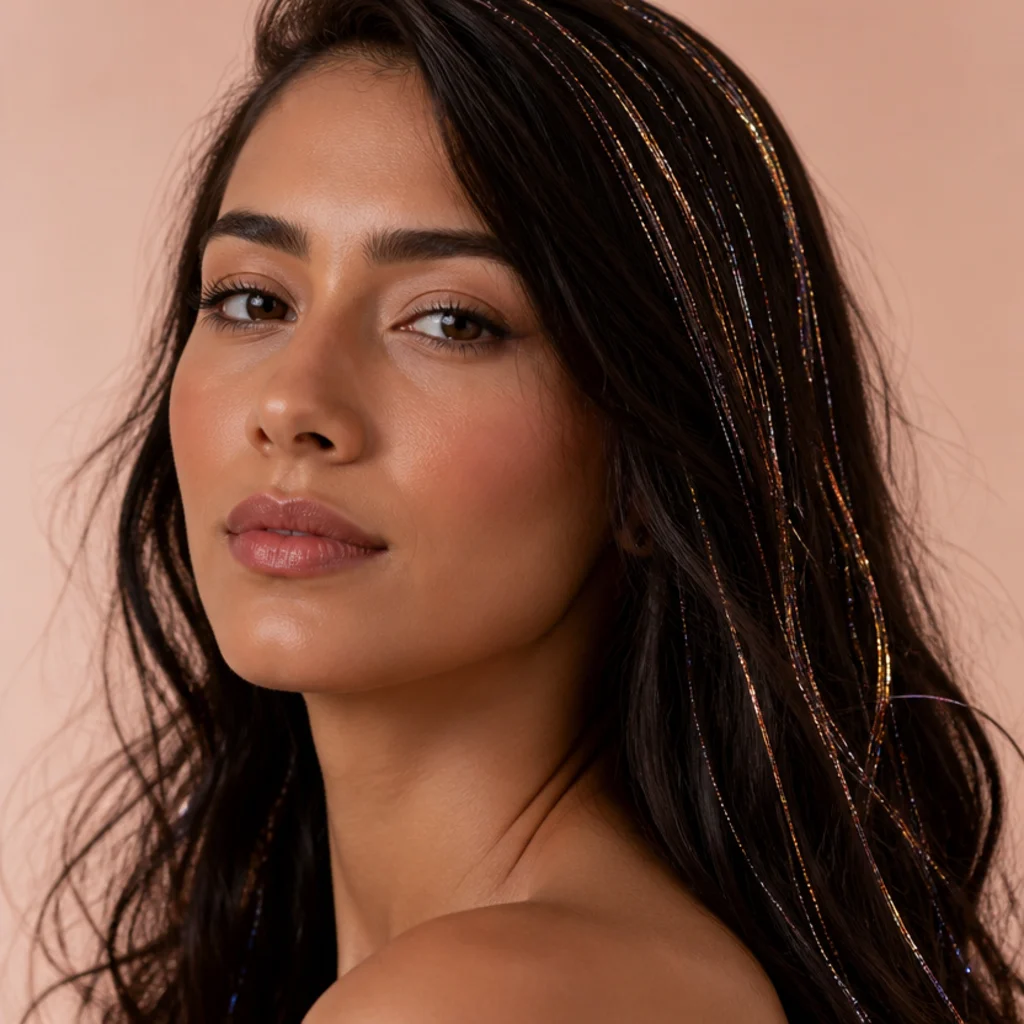
Quick Answer
- Best for: Anyone who wants dye-free, heat-free shimmer they can add to any base color or texture and remove without chemical processing.
- Who might skip it: Very fine or actively shedding hair where added strands read sparse, anyone who wants weeks of zero maintenance, or scalps sensitive to any root-level anchor.
- Maintenance: Low but not zero. Expect to lose a few strands per wash and to top up before events; tied strands hold longest, heat-bonded and micro-bead strands loosen faster with frequent washing.
- Difficulty: Beginner-friendly for a light DIY tie-in scatter; intermediate for even, dense, full-head placement, which reads cleaner from a stylist.
- Cost: Variable. At-home strand packs sit at the low end and cover several looks; salon add-ons run roughly a light lunch to a full mani depending on strand count and region. Always price by strand count, not a flat guess.
- Wear time / longevity: Tied strands often last several weeks as the knot grows out; bonded and beaded strands typically fade sooner. Plan a touch-up window rather than expecting permanence.
- Standout variation: Curly hair tinsel, where each strand follows the coil and glints at several points instead of one straight line.
- How to ask your stylist: Describe the effect first ("fine and blended" vs "bold and metallic"), then give a strand count, your natural texture, and any color treatment so they anchor safely.
In This Guide
- What Each Term Actually Means
- Shine and Reflectivity
- Hair Tinsel on Black Hair
- Pink Hair Tinsel and Color Play
- Curly Hair Tinsel
- Straight and Sleek Placement
- The Tie-In Method
- The Bonded or Bead Method
- Longevity and Shedding
- Density: Subtle vs Statement
- Hair Tinsel Aesthetic Moods
- Upkeep and Washing
- Cost and Where to Get It
- Removal and Hair Health
- Which One Should You Pick
Fairy hair and hair tinsel both promise the same small magic: fine, glinting filaments woven into your own hair for a flash of light no dye can replicate. The confusion is real, because the two names get used interchangeably when the actual difference is finish and placement, not two separate products. If you searched hair tinsel black hair and landed on fairy hair photos, you're not imagining the overlap. What changes how the look wears is the filament's reflectivity, the anchor method, the strand count, and how each behaves on straight, wavy, curly, or coily hair. Bonded and micro-bead placements sit and shed differently than a tied knot; a holographic strand that flashes on jet-black hair can vanish on light blonde. This guide compares the two across fifteen choices that decide the outcome, so you can shop by effect instead of by label. You'll see where hair tinsel black hair reads sharpest, why curly strands scatter light, how the tie-in and bead methods differ in feel and longevity, and how to brief a stylist so the shimmer lands where you want it. By the end you should know what to ask for and what to skip.
01What Each Term Actually Means
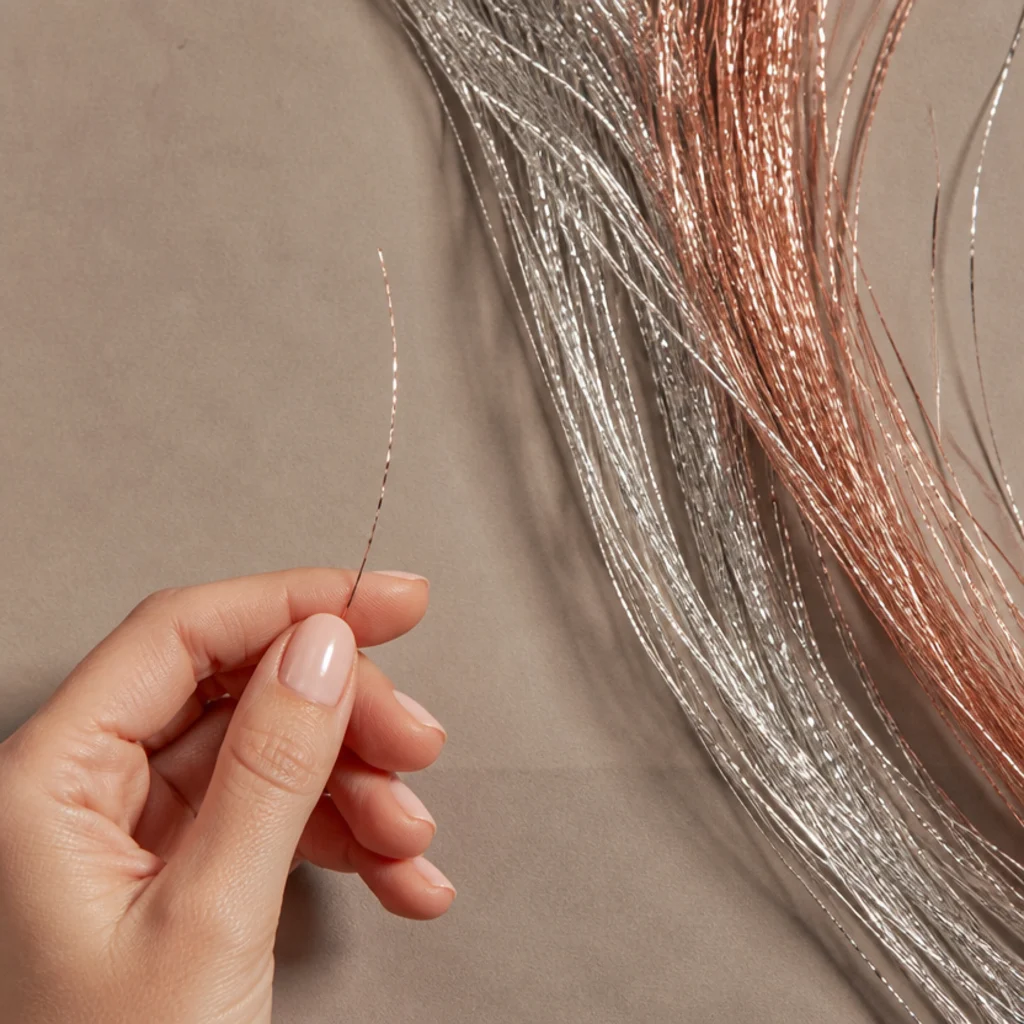
Start here, because the naming trips nearly everyone. "Hair tinsel" and "fairy hair" usually point to the same category: a thin, reflective polyester or Mylar-type filament, often flat rather than round, tied or bonded near the root. In common use, tinsel signals the bolder, mirror-bright, holographic strand you can see clearly from a distance, while fairy hair describes the whisper-fine, blended placement that glints only when light catches it. Several brands trademark one term or the other, which is why the same product ships under different names and adds to the mix-up. Practically, you're choosing a finish (metallic versus satin) and a density (scatter versus full) — nothing more complicated than that. That reframing helps: it lets you brief by result rather than by marketing word. When you shop, read the strand description, not just the pack name, and check whether the finish is holographic, iridescent, or matte-satin. Ask your stylist to show you a physical strand against your base before they commit to a count, since the same filament photographs differently on every head.
02Shine and Reflectivity
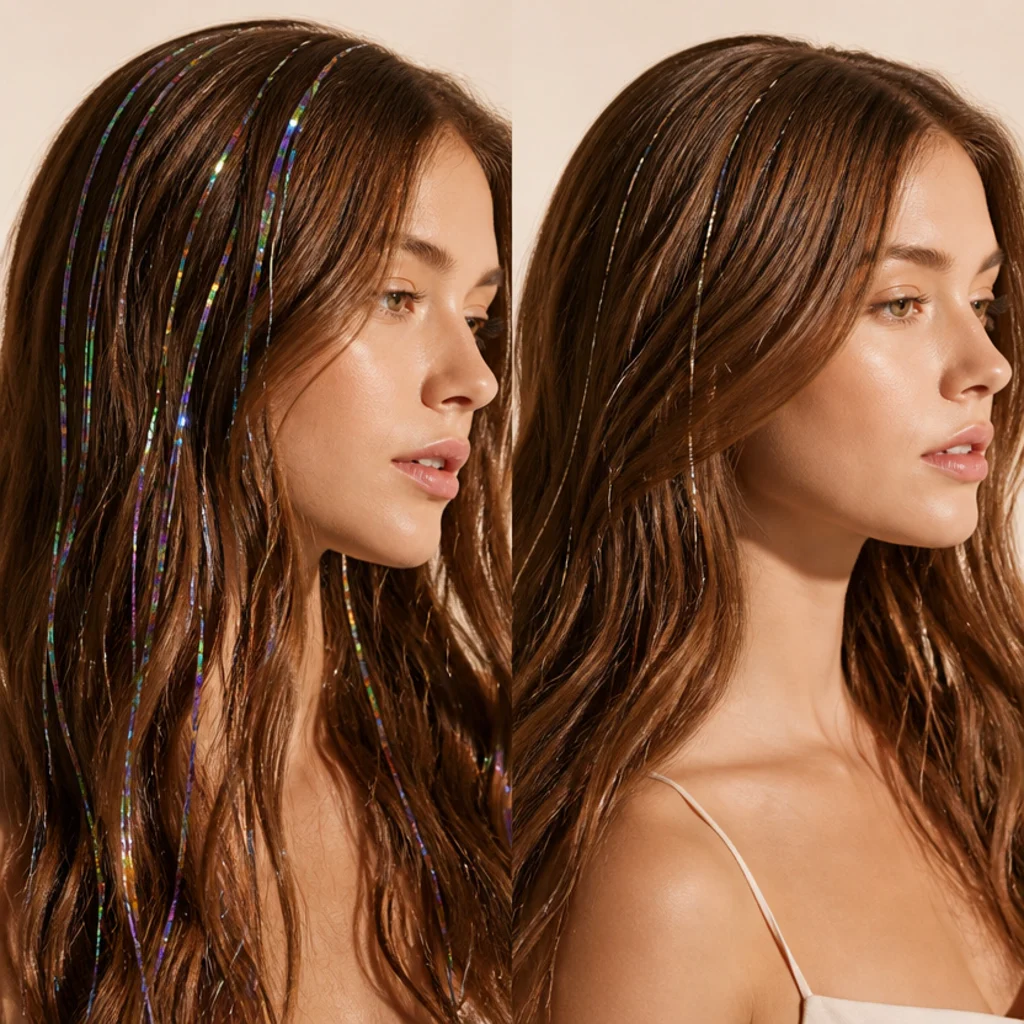
The clearest split is how the strands throw light. Holographic and metallic tinsel filaments carry a mirror-bright, prism-like quality that flashes even in dim rooms and under warm indoor bulbs, because the surface refracts across a spectrum rather than reflecting a single tone. Satin fairy strands read quieter: they wake up in direct sun and camera flash, then melt into the hair under flat light. Reflectivity isn't fixed to the strand alone — it's the contrast between strand color and your base that decides how loud the effect reads. A silver holographic strand screams on jet-black hair and nearly disappears on platinum, while a pearl satin strand does the reverse. Angle matters too, since flat filaments catch light most on the side facing a window. Want sparkle people notice mid-conversation? Choose metallic or holographic at medium density. Want a private glow instead? Stay satin and sparse. Ask your colorist to hold two finishes at your part in natural window light before you pick, because that single test predicts the result better than any pack photo.
03Hair Tinsel on Black Hair
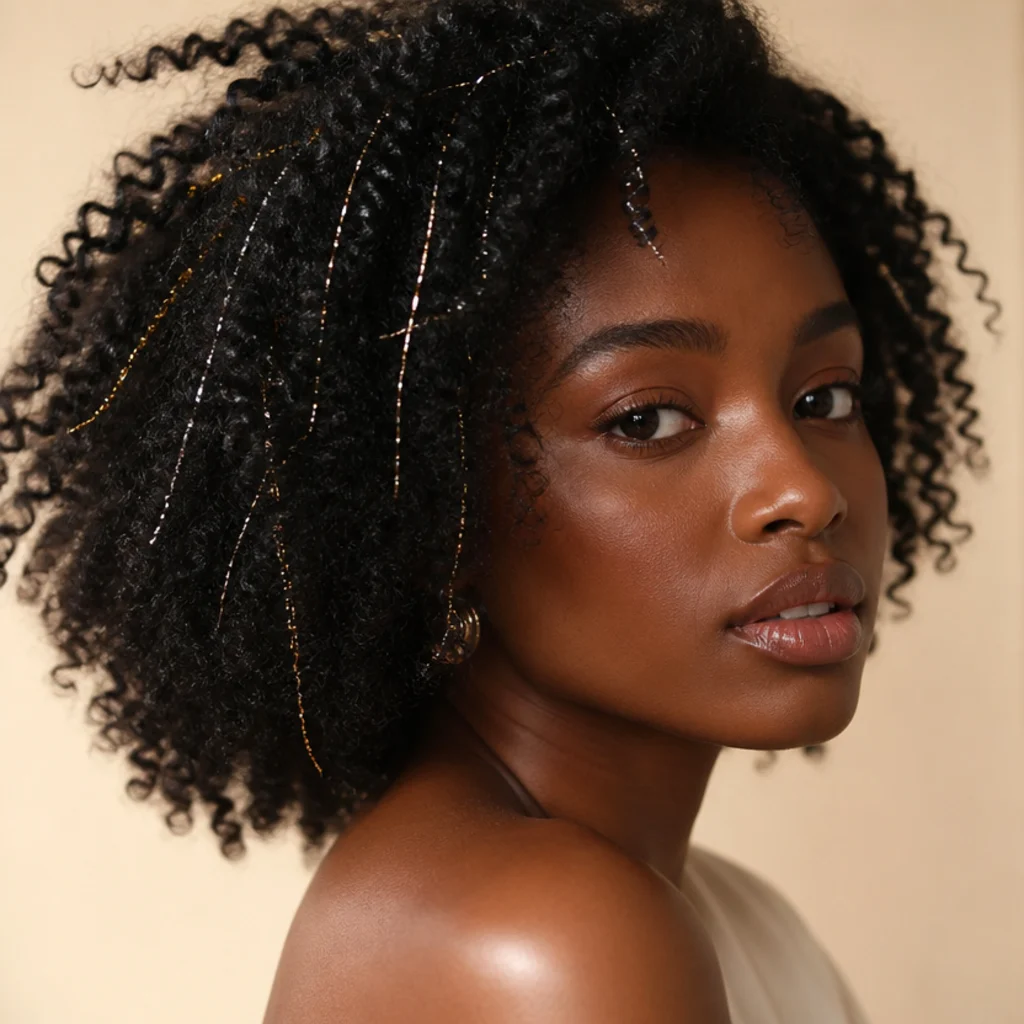
Hair tinsel black hair is where contrast does the heavy lifting, and it's arguably the most striking use of the whole trend. Against a true black or blue-black base, cool silver, iridescent, and holographic strands read crisp and high-impact, like fine jewelry threaded through the hair, because the dark field makes every reflection pop. Icy silver and blue-toned strands deliver the sharpest edge; rainbow and oil-slick multipacks add playful dimension; warm gold and copper give a softer, more molten glow that flatters deep and olive skin. Dark hair carries so much natural depth that even a light scatter of 15 to 25 strands looks intentional rather than lost. Placement is everything on a deep base: strands set along the part line and around the crown catch the eye first and frame the face, while a few threaded into the lengths add movement. If your hair is relaxed, natural, or in a protective style, flag it so strands anchor where they won't stress fragile roots or edges. Ask your stylist for a cool-toned holographic accent concentrated at the part for the cleanest hair tinsel black hair result.
04Pink Hair Tinsel and Color Play
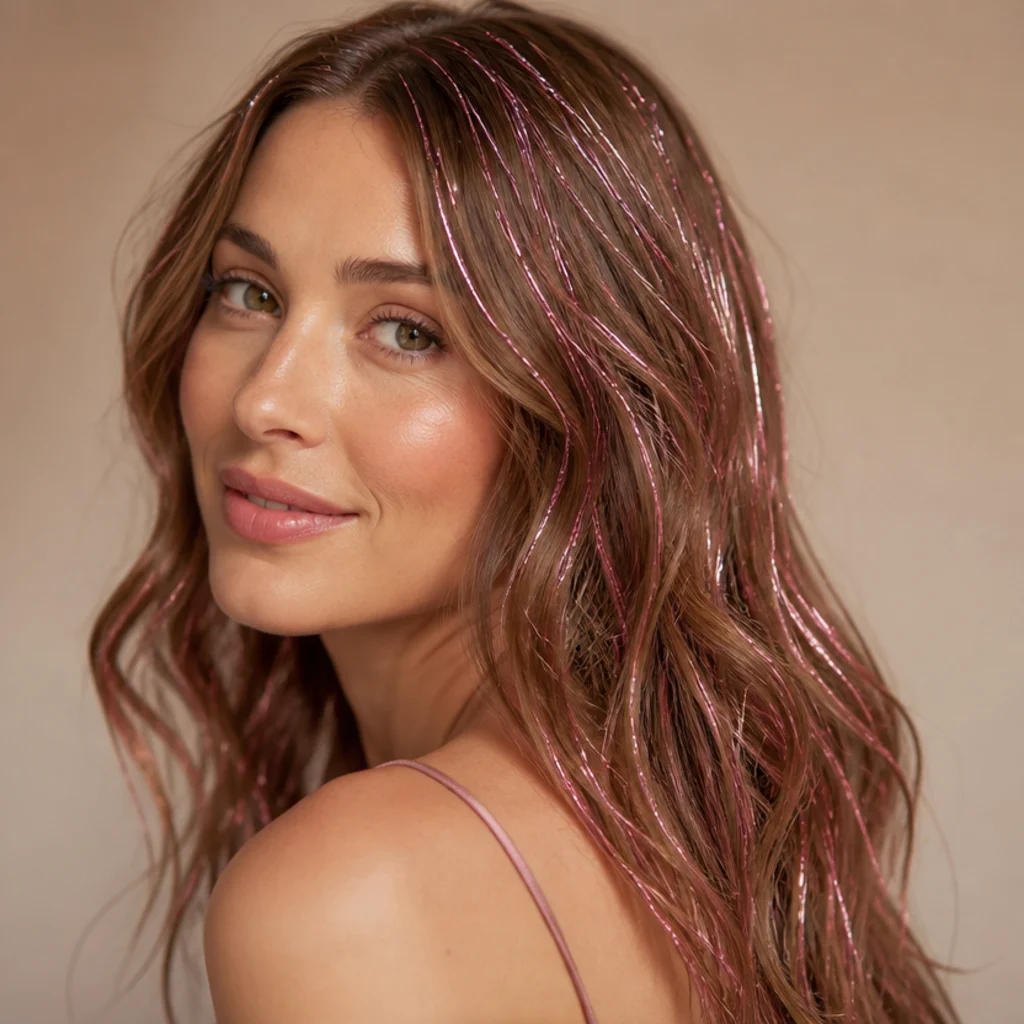
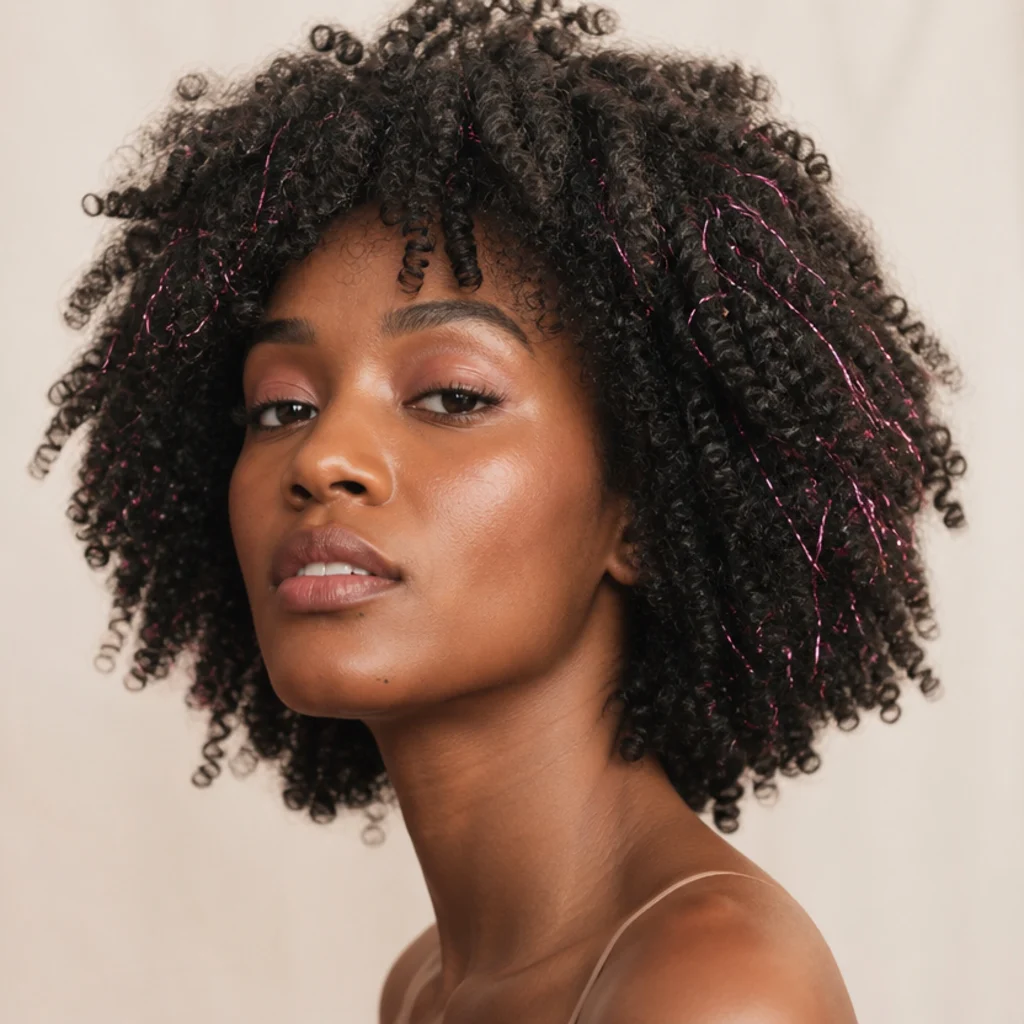
Pink hair tinsel is the gateway for anyone who wants a color mood without touching bleach. Because the strands sit on top of your own hair rather than penetrating it, you get a wash of rosy shimmer that rinses out the moment you remove them, with zero commitment and zero regrowth line. Pink flatters a wide range of bases: it turns candy-bright on platinum and light blonde, reads warm and romantic on light brown and honey, and glows like a hidden ember on deep brunette and black. For a blended, believable effect, mix true pink with rose gold and pearl so the color reads as dimension rather than a single flat stripe; for a statement, go all-pink at medium density around the face. It's the smartest low-stakes way to audition a pink phase before booking a semi-permanent gloss or a full dye job, and it photographs well under warm light, which is a big part of why pink hair tinsel spreads on Pinterest. Ask your stylist to blend two or three pink-family tones rather than a single strand color for a softer, more expensive-looking finish.
05Curly Hair Tinsel
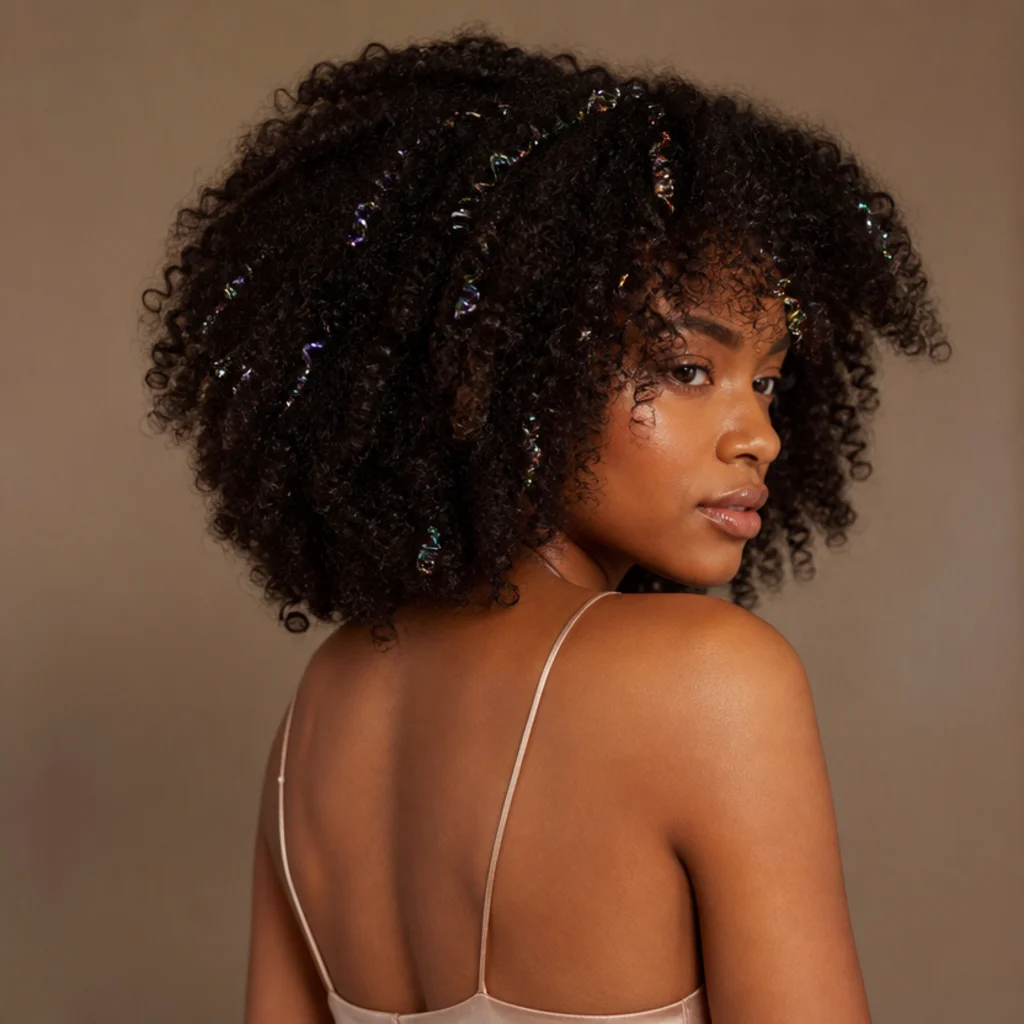
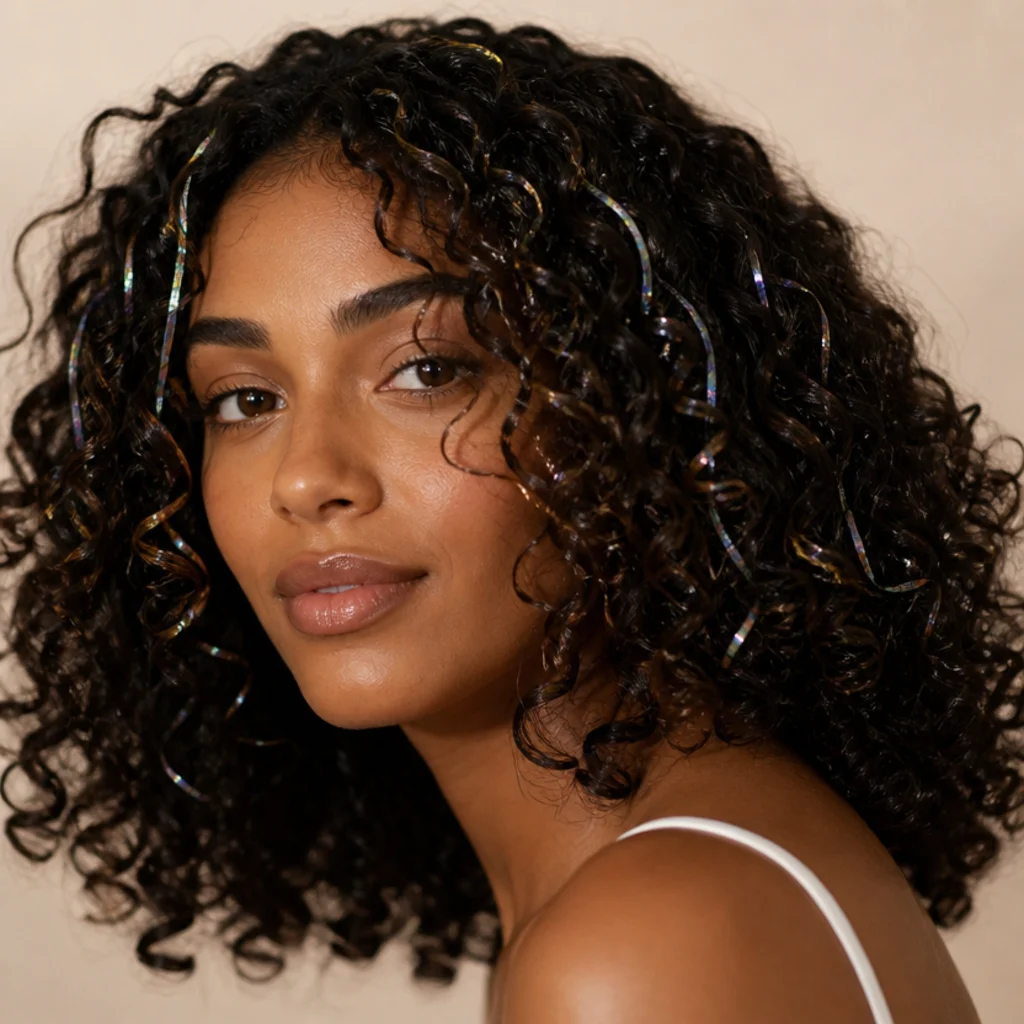
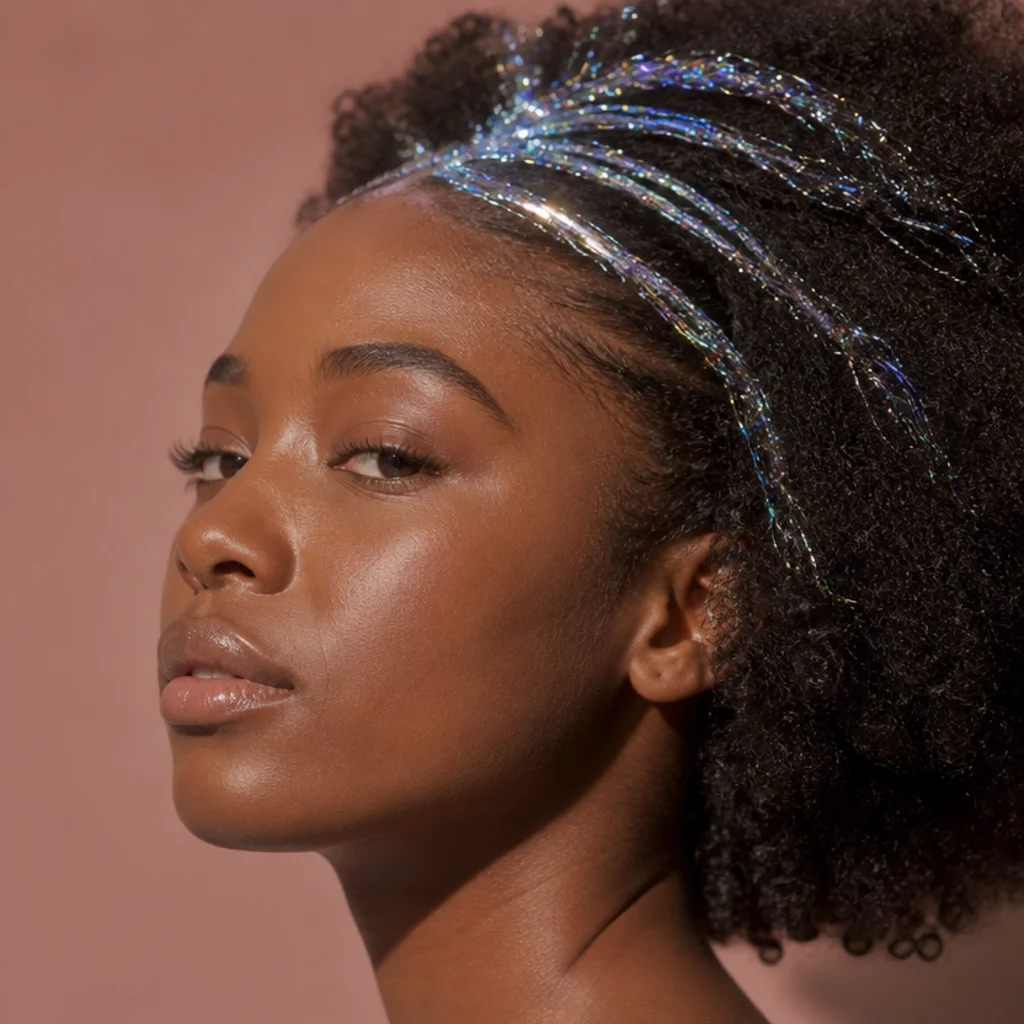
Curly hair tinsel behaves differently, and mostly in your favor. On waves, curls, and coils, each strand wraps and follows the pattern, so light glints at several points along a single ringlet instead of in one straight vertical line. That produces a scattered, three-dimensional sparkle sleek hair can't make, and it's why textured hair usually needs fewer strands to register, often 10 to 20 for a clear effect. The trade-offs are real, though: strands need to be tied securely so they travel with the curl and survive a wash-and-go, and they should sit on defined mid-shaft sections rather than fragile new growth. Denser installs can look busy on an already high-interest curl pattern, so restraint reads more elegant. For 3C to 4C textures, cool iridescent and pearl finishes tend to catch the most light along the coil. If you refresh curls daily with water or product, the tie-in method is non-negotiable for staying power, since beads and bonds loosen faster with repeated wetting. Ask your stylist to place strands on your most defined curl clumps so the shimmer moves as one with the pattern.
Save this to Pinterest and note which method suits your texture.
06Straight and Sleek Placement
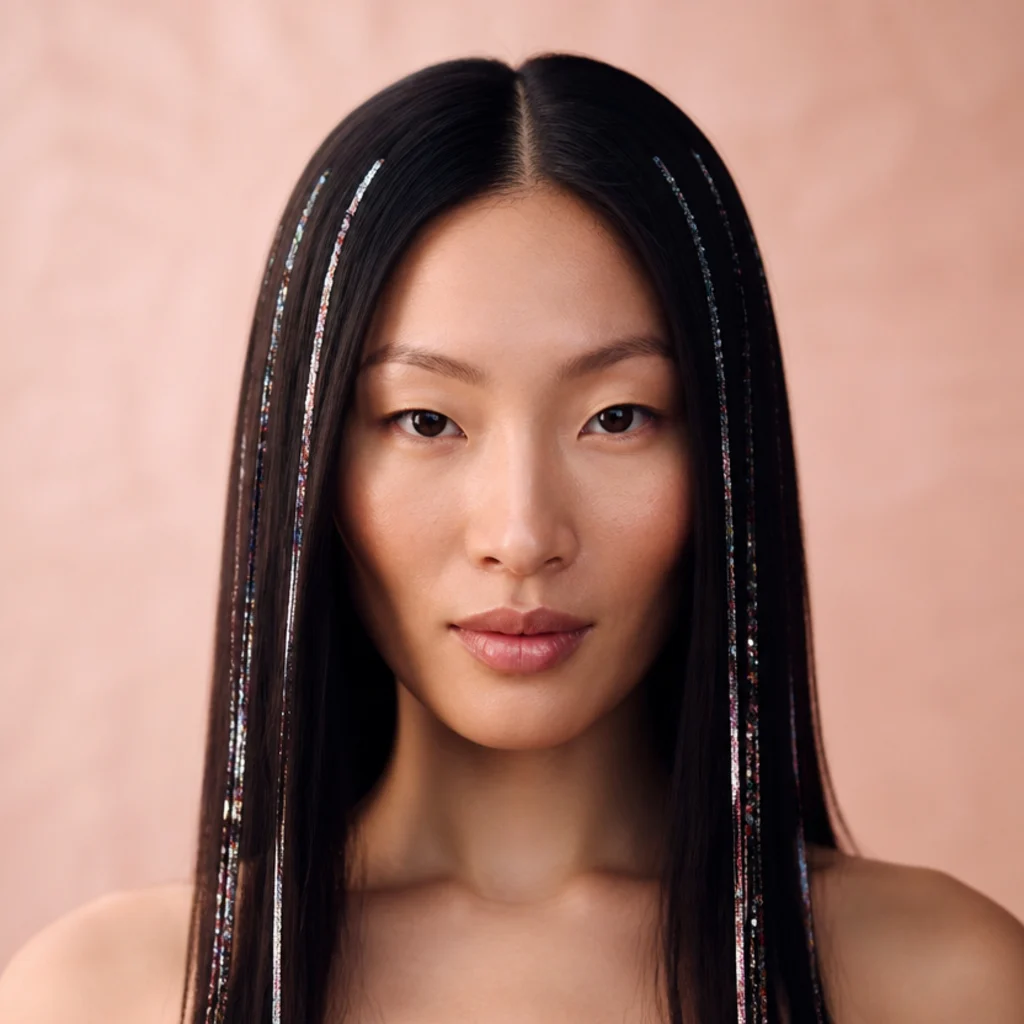
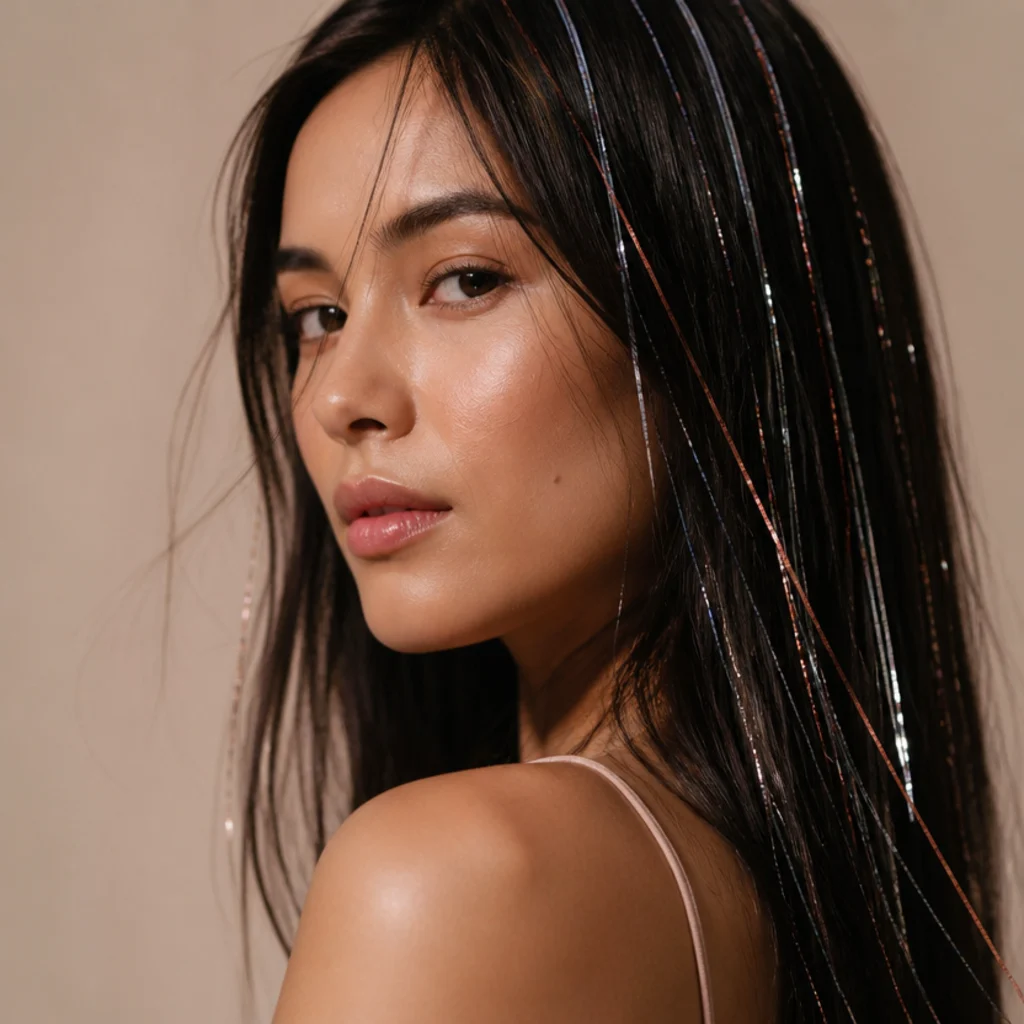
On straight, sleek hair the effect turns linear and graphic, which is both its strength and its risk. Strands hang in clean vertical lines, so any unevenness in spacing or length shows far more than it would on curls. Matched strand length and deliberate distribution matter here. Sleek hair also lets a metallic or holographic finish read at its brightest, because nothing breaks up the reflection, which is why the most editorial versions of the trend live on blowouts and pin-straight bobs. Distribute strands around the part and crown so the shimmer frames the face rather than clustering at the back where you won't see it. Fine and thin straight hair should stay on the lighter side, 20 to 40 strands, so the install doesn't look like it's adding visible bulk. Straight hair also shows the anchor line clearly, so grow-out is more obvious here — plan a touch-up window at three to four weeks. Ask your stylist for evenly spaced, length-matched strands set slightly back from the hairline so the anchors stay hidden as hair falls.
07The Tie-In Method
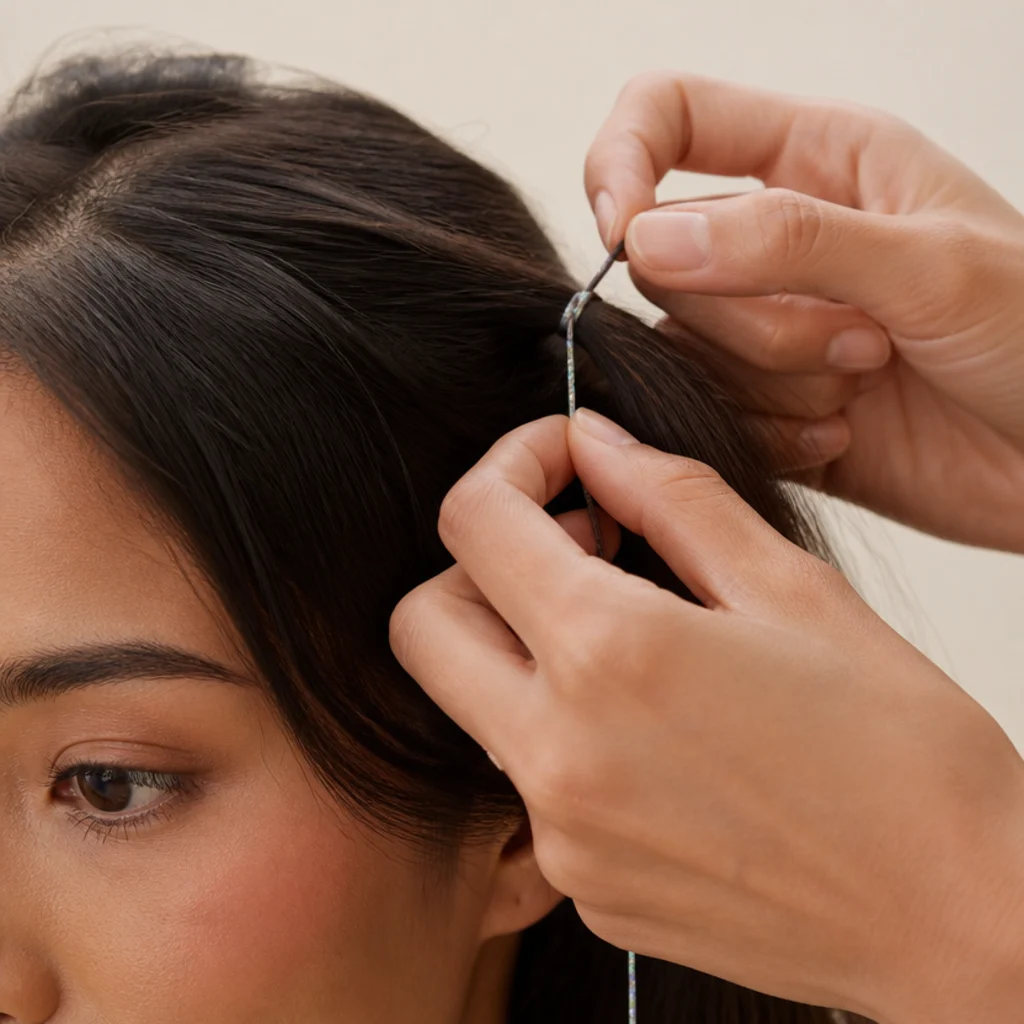
The tie-in method loops a folded strand around a few of your own hairs and secures it with a small double knot near the root. It uses no heat, no glue, and no beads, which makes it the gentlest option and the one most people can do at home. If you're wondering how to put tinsel in hair yourself, this is the beginner route: part a tiny section no thicker than a few hairs, fold the strand in half to create a loop, pass the loop around the section, thread the tails through, and tie a snug double knot about a quarter inch from the scalp, then trim the ends even. Because the knot travels with your hair as it grows, tie-ins routinely outlast every other method, often several weeks to a couple of months. The whole skill is in the knot: too loose and it slips within a day, too high and it tugs the root. Keep the section tiny so the strand hides its own anchor. Ask your stylist, or a patient friend, to place the first few near your part so you can watch the technique before you try the rest yourself.
08The Bonded or Bead Method
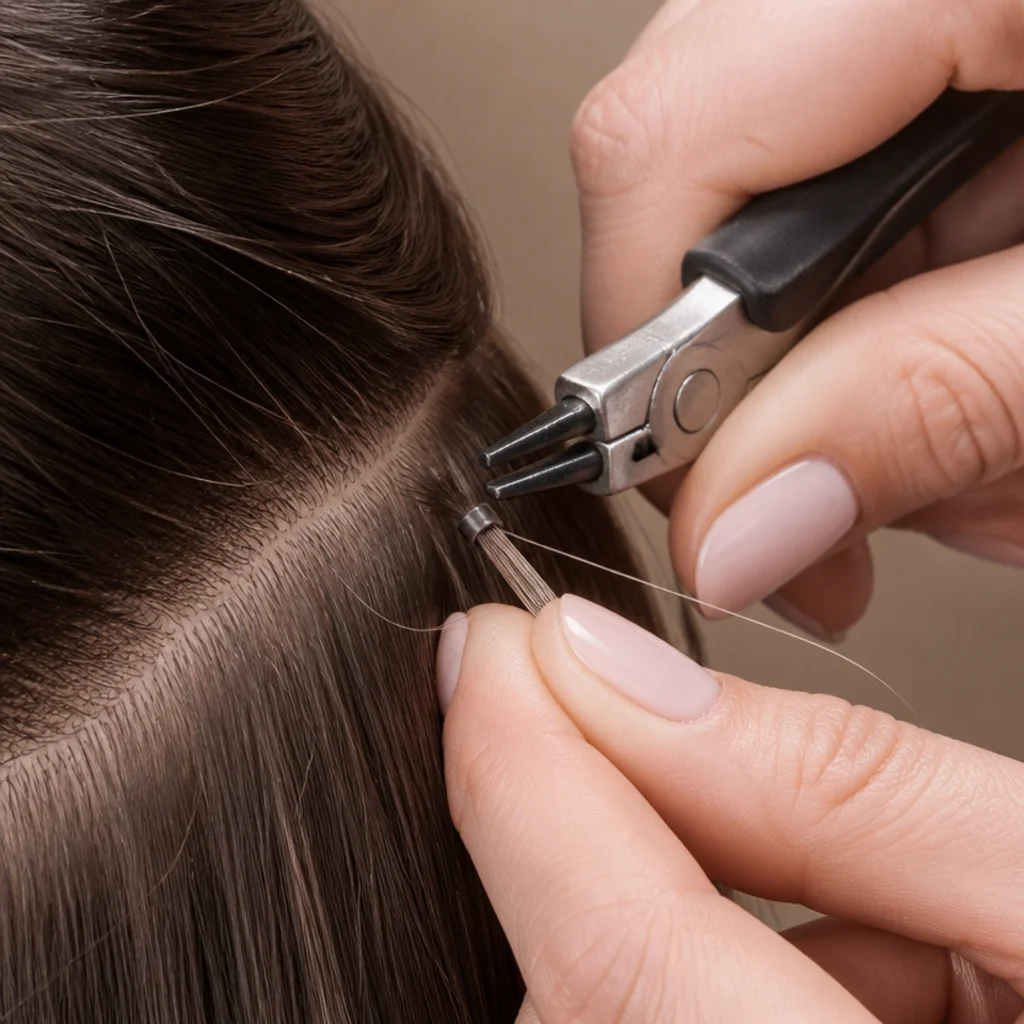
Bonded and micro-bead methods attach strands with a tiny silicone-lined bead crimped shut, or with a small heat bond, and are usually done in a salon with a threading tool. Their advantage is speed and grip: a stylist can place many strands quickly and hold them firmly, which suits dense, uniform, full-head installs where consistency matters. There are trade-offs, too. A bead adds a small, felt point of tension at the root and can be sensed when you lie down or brush; heat bonds hold well but demand careful, tool-based removal so you don't snap the hair. For most people wanting a handful of accent strands, tie-ins are gentler and cheaper; for a heavy, editorial, evenly spaced install, a pro using beads often delivers a cleaner line. The anchor should feel secure but never sharp or sore, and no bead should pull the root tight enough to sting. Ask your stylist to size the bead to your strand diameter and to place it a few millimeters off the scalp so it holds without dragging on the root.
09Longevity and Shedding
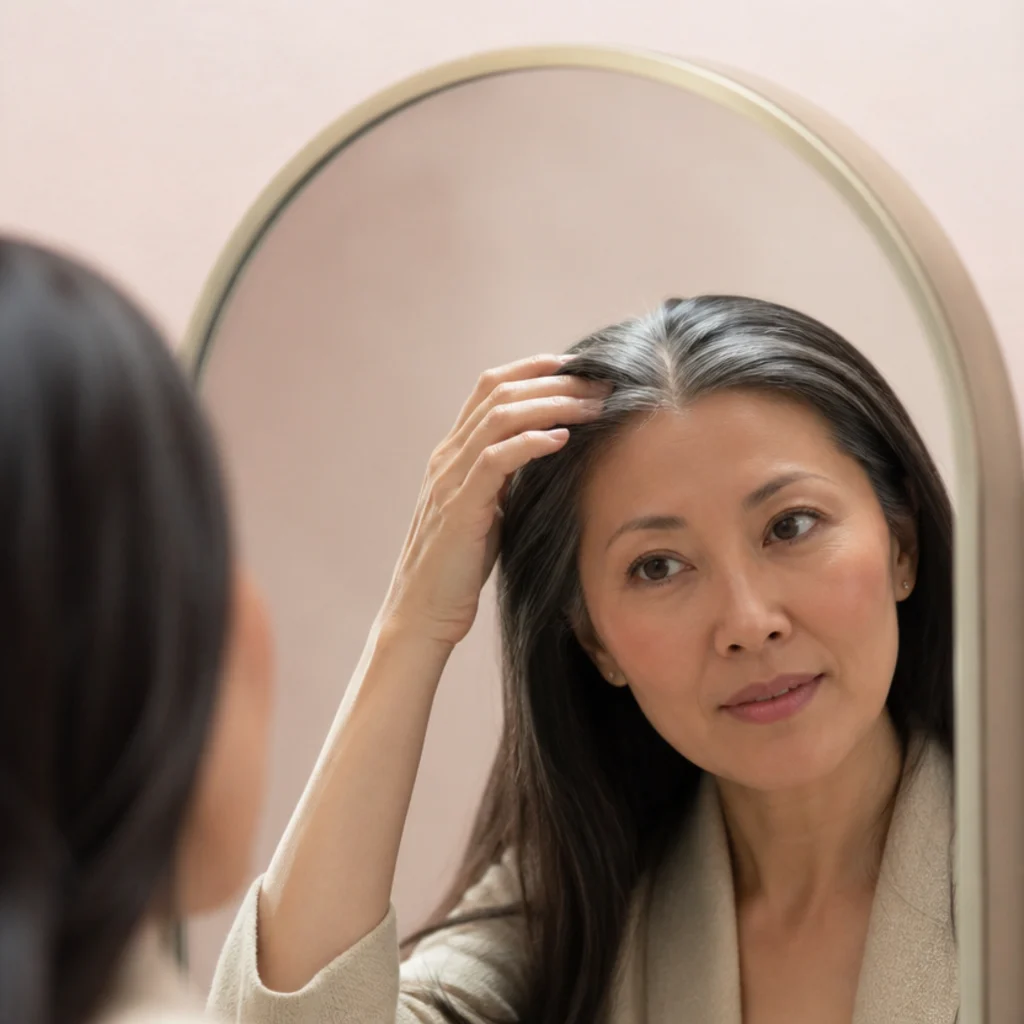
How long the look lasts depends on method, wash frequency, and habits. Tied strands often hold for several weeks to two months because the knot grows out with your hair, sliding down the shaft rather than releasing. Bonded and beaded strands tend to shed sooner, especially with frequent washing, vigorous brushing, or heavy oils and creams that lubricate the anchor loose. Fine strands also work free on their own over time — that's normal wear, not a failure. Expect to shed a few strands each week and to see the survivors sit progressively lower as new growth pushes them down; on straight and sleek hair this migration is more visible than on curls. If you need the look at peak sharpness for a wedding, festival, or shoot, install within a few days of the date rather than weeks ahead. For everyday wear, accept a gentle fade and top up thinning areas rather than chasing a permanent finish. Ask your stylist how many spare strands to keep on hand so you can refresh the part line between full appointments.
10Density: Subtle vs Statement
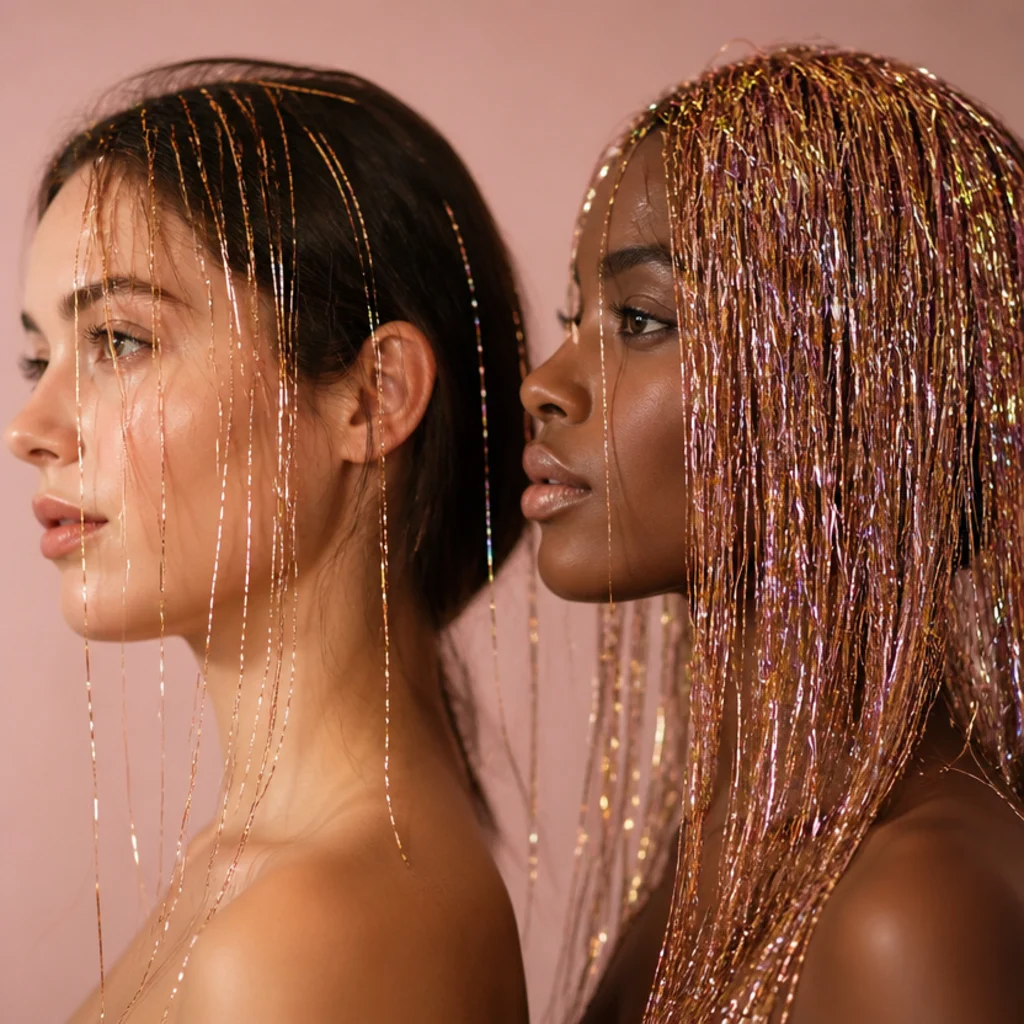
Density changes the entire read of the look, and it's the lever most people underuse. A light scatter of roughly 10 to 30 strands gives a catch-the-light glow that passes at the office and reads squarely as fairy hair. Bump it to 40 to 80 strands and the shimmer becomes obvious in motion without tipping into costume. Go to a hundred-plus and it turns into a full statement, photographing like intentional festival styling. Texture shifts the math: curly and coily hair registers with fewer strands because the pattern already scatters light, while sleek straight hair can carry more before it looks crowded. Base color matters too, since high-contrast strands on dark hair look denser than the same count of tonal strands on light hair. Match density to venue: a festival invites a heavy build, daily life usually suits restraint. And remember, you can always add but only awkwardly subtract. Ask your stylist to start you 20 percent under your target count, then add at the mirror once you see it move.
| Density level | Strand count | Reads as | Best for |
|---|---|---|---|
| Subtle | 10-30 | Fairy hair glow | Office, textured hair, first-timers |
| Medium | 40-80 | Visible shimmer in motion | Nights out, photos, most bases |
| Statement | 100+ | Full sparkle build | Festivals, shoots, sleek or dark hair |
Save this to Pinterest to compare subtle and statement density.
11Hair Tinsel Aesthetic Moods
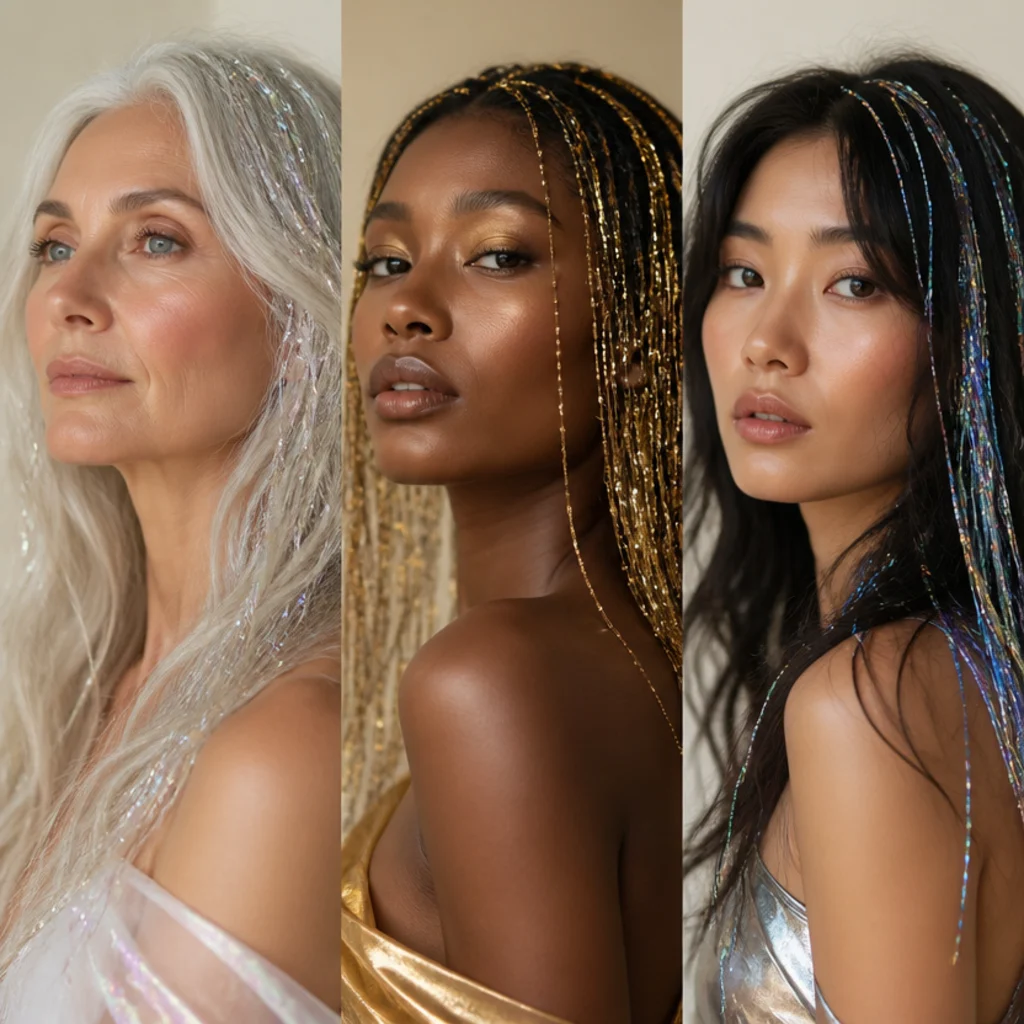
The hair tinsel aesthetic splits into several moods, and naming yours first keeps you from grabbing a random multipack that fights your vibe. Iridescent, pearl, and oil-slick strands lean soft mermaid and fairycore, especially on wavy and light-to-medium bases. Warm gold and copper read like a sun-lit goddess look and flatter deep, olive, and tan skin. Cool silver, chrome, and holographic strands feel futuristic and editorial, hitting hardest on dark or platinum hair where contrast is high. Rainbow and pastel-mix multipacks are pure festival and playful, best at higher density where the color variety can register. The trap is treating strand color as an afterthought when it's the single biggest driver of the mood you end up wearing. Pull three to five reference images you love, note the specific strand colors in each, and match your order to that feeling rather than to whatever pack is cheapest. Ask your stylist to build to a named mood — "cool holographic" or "warm goddess" — so the color story stays coherent instead of turning into a random confetti of tones.
12Upkeep and Washing
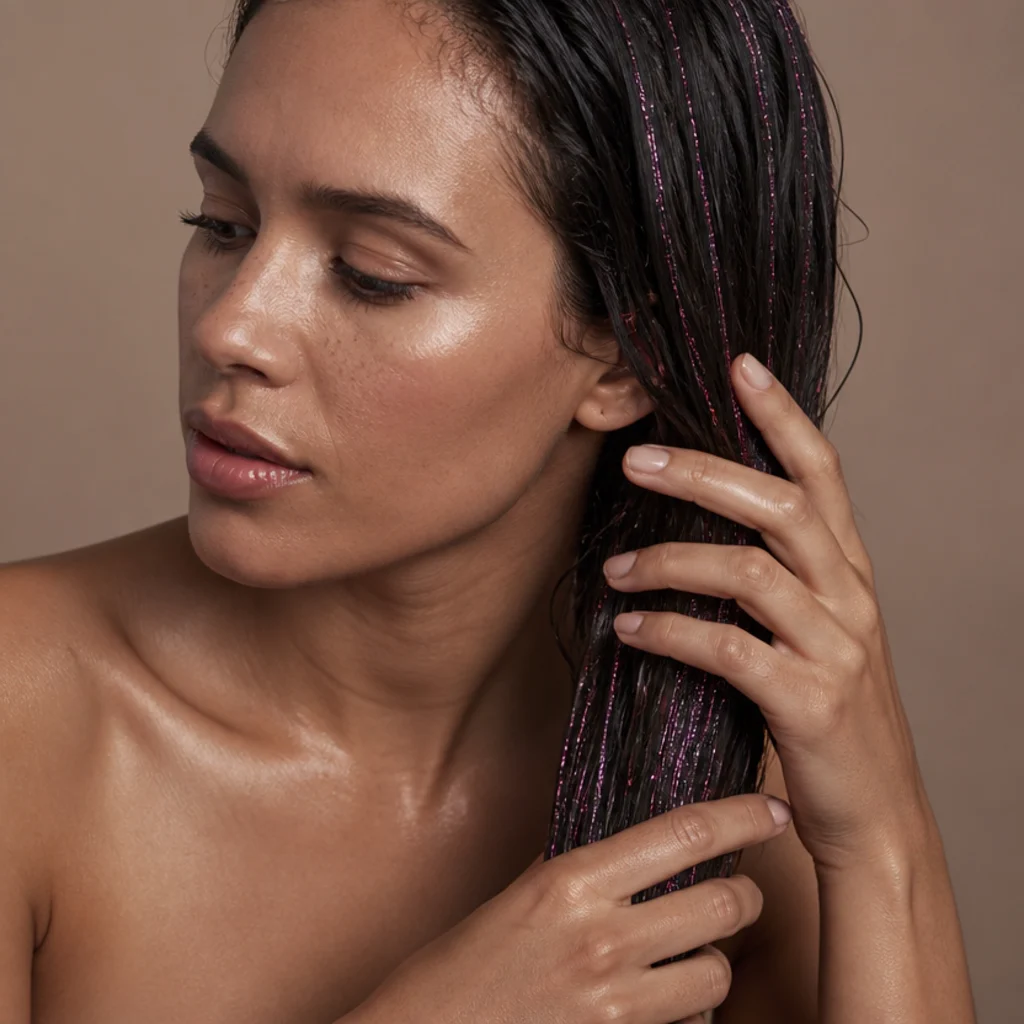
Upkeep is simple, but it follows rules that decide whether strands last weeks or vanish by the third wash. Shampoo and condition as usual, but be gentle around the anchor points and avoid vigorous scrubbing at the roots where knots or beads sit, since friction there is what works strands loose. Detangle with a wide-tooth comb or your fingers, always from the ends up, so you don't drag a snag down through a strand. Heat tools are generally fine on tied tinsel at moderate temperatures, but very high heat can dull some holographic finishes and will damage heat-bonded strands outright, so keep irons off any bond and avoid clamping directly on an anchor. Air-drying is always the safest route. Skip heavy oils and rich leave-ins right at the root, since they lubricate anchors loose faster, and sleep on a satin pillowcase or in a loose braid to cut overnight friction. A little discipline here is the entire difference between strands that ride out the month and strands that quietly slip away. Ask your stylist which of your current products to keep clear of the anchor zone.
13Cost and Where to Get It
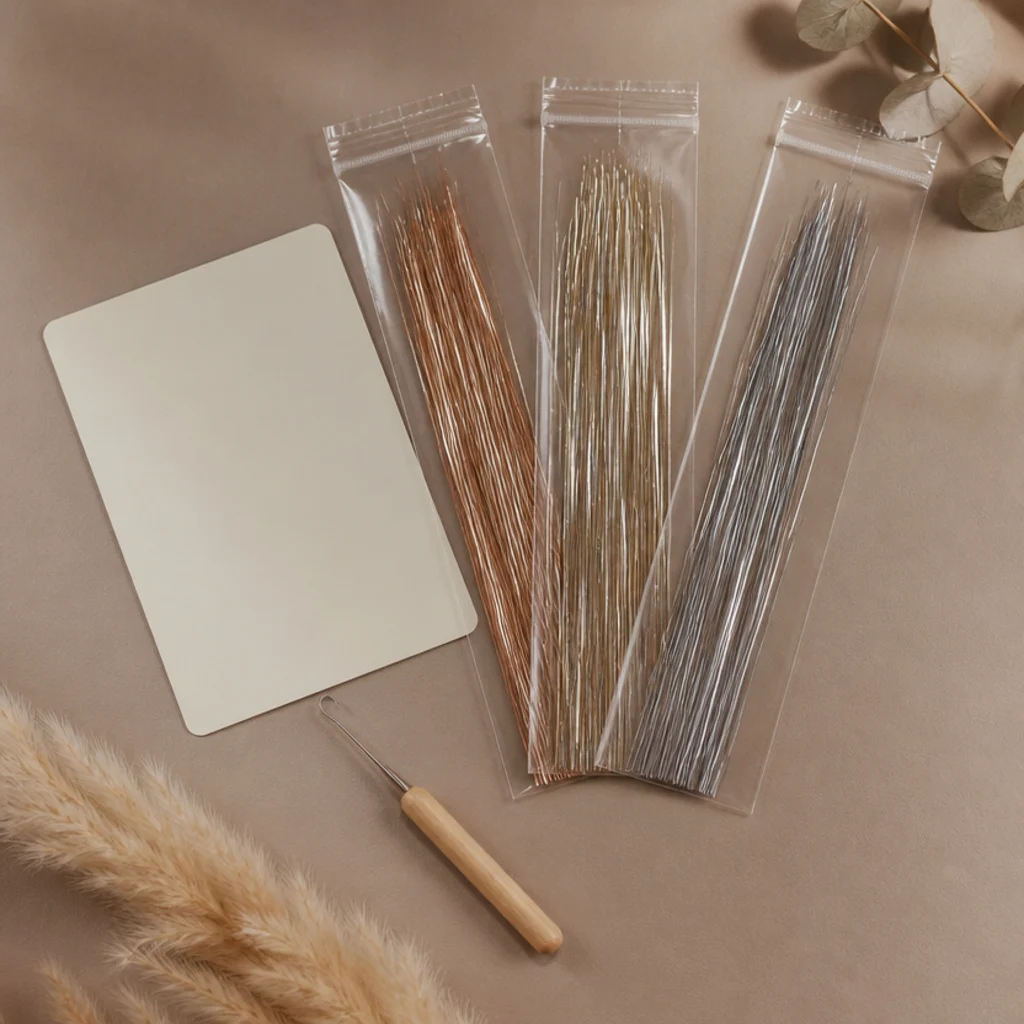
Cost swings widely between DIY and salon, and pricing by strand count is the only way to compare fairly. At-home strand packs sit at the low end and usually include enough filament for several looks, which makes the tie-in method the clear budget path, especially if you're only accenting the part. Salon application costs more because you're paying for placement time, even distribution, and a pro's eye for spacing; dense and full-head installs take significantly longer and price accordingly. Rates vary by region and stylist, so always ask for a quote based on how many strands you want rather than assuming a flat fee, and check whether tinsel is offered as a quick add-on to a regular cut or color, which is often the best value. If you're curious but cautious, buy one small pack, try a dozen tie-ins at home along your part, and live with it a week before deciding whether a full salon build is worth it. Ask your stylist upfront whether the quote covers a set number of strands or an hourly rate, so a dense install doesn't surprise you at checkout.
14Removal and Hair Health
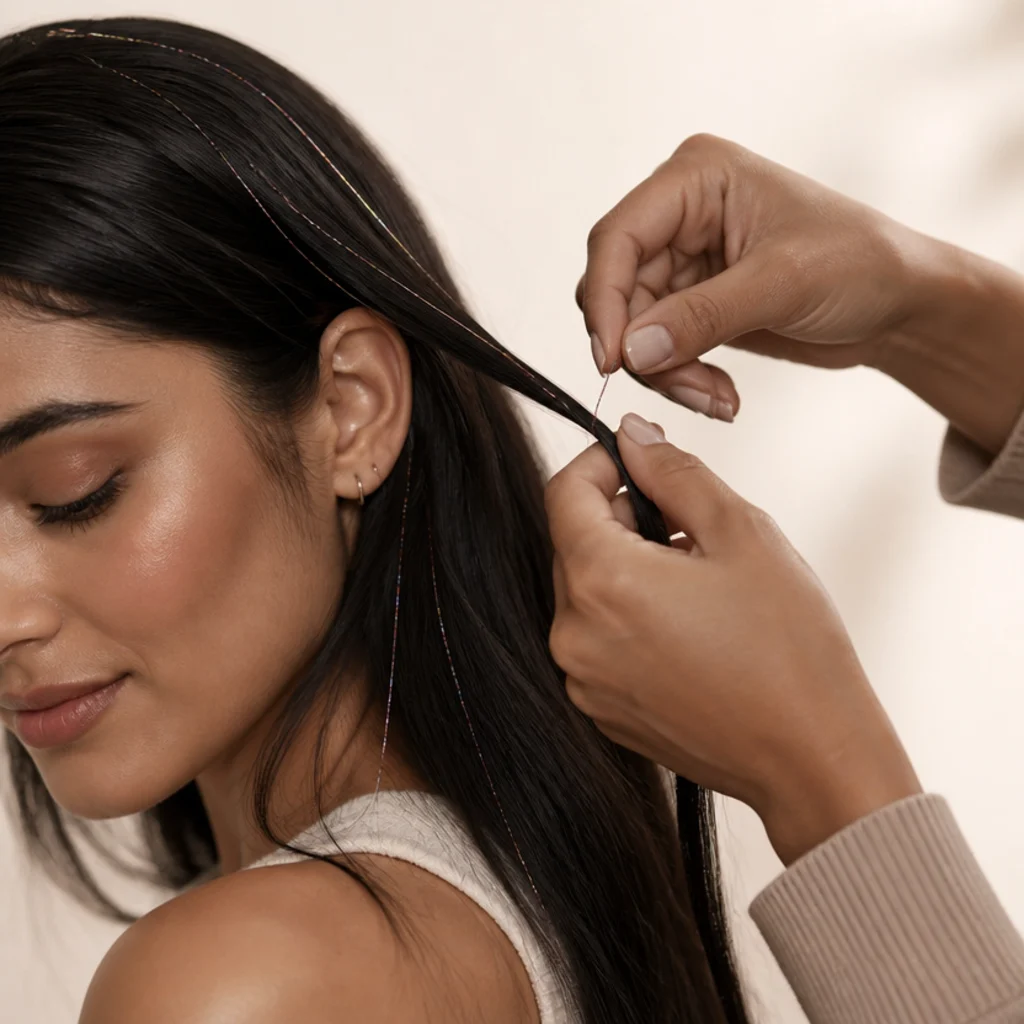
Removal is where the gentle methods earn their reputation. Tied strands come out by loosening the small knot with your fingertips or a fine-tooth comb and sliding the strand free; left alone, they grow out and shed on their own with no intervention at all. Micro-bead strands release when the bead is reopened with the same crimping tool used to place it, which takes seconds per strand in trained hands. None of these methods involve dye, bleach, or peroxide, so they don't chemically alter the hair shaft — which is why the trend appeals to anyone protecting color-treated, relaxed, or high-porosity textured hair. The one real risk is impatience: yanking a strand can take healthy hairs with it, so ease knots loose rather than pulling. If a heat bond was used, leave removal to a stylist with the correct release tool so nothing snaps. Done with a little care, the whole look leaves your natural hair exactly as it was before. Ask your stylist to demonstrate the loosen-and-slide motion on one strand so you can safely remove strays at home.
15Which One Should You Pick
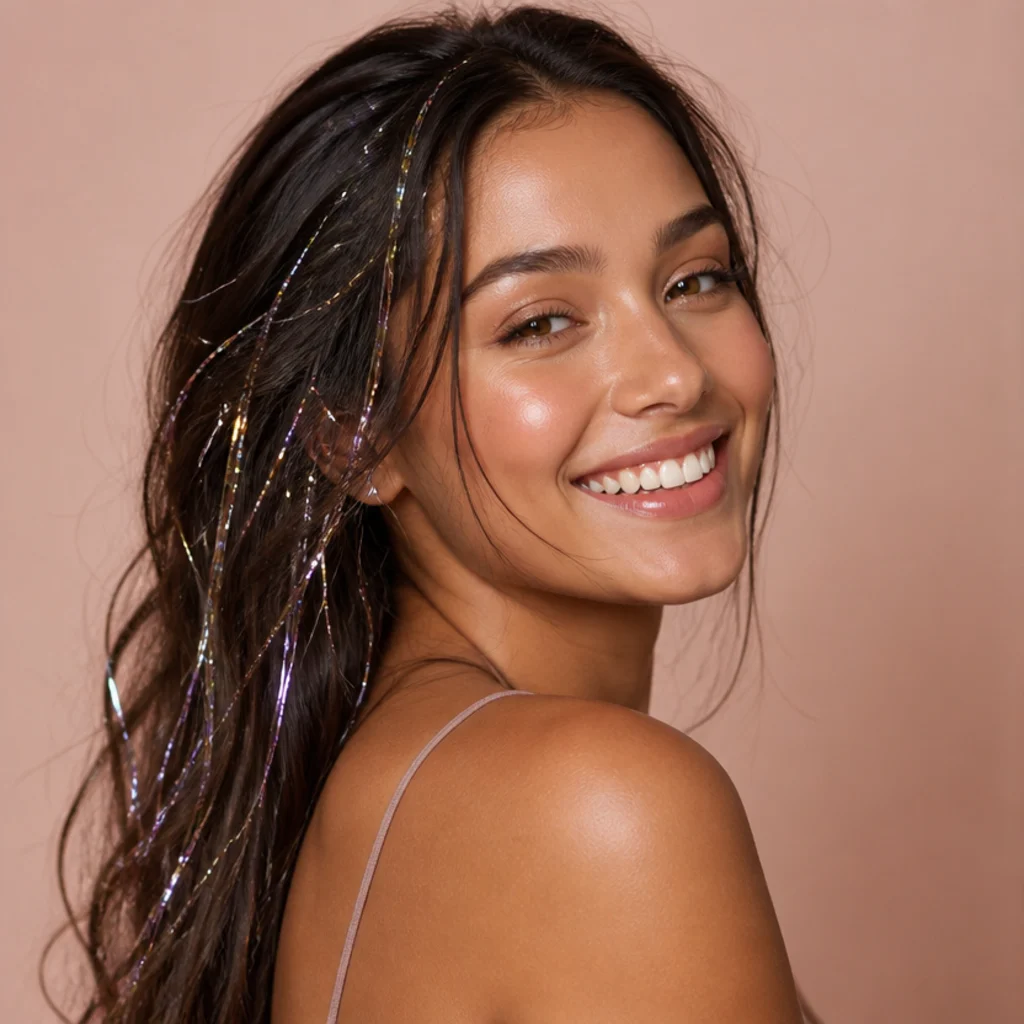
If you want a bold, unmistakable sparkle, lean into tinsel: metallic or holographic strands, medium to statement density, on sleek or dark hair where contrast maxes out. If you want a delicate glow that only whispers in the right light, choose fairy hair: fine, blended strands in low density, in pearl or soft tones that melt into your base. Curly and coily textures do best with fewer, well-tied strands on defined sections, since the pattern is already scattering light for you. Going for hair tinsel black hair? Cool silver, blue, and iridescent finishes read sharpest, concentrated along the part. Chasing pink hair tinsel? Blend two or three pink-family tones so the color reads as dimension. And if you can't decide, start with a small mixed-color tie-in pack at home, place a dozen strands along your part, live with it for a week, and let your own reflection cast the deciding vote. The quiet superpower of this trend is how cheaply and reversibly you can change your mind, so treat your first install as a low-stakes rehearsal rather than a verdict.
Pro Tips from the Editor
- Test the finish against your base in window light before you commit to a count. A holographic strand that dazzles on black hair can read invisible on blonde; five minutes at the mirror predicts the result better than any pack photo.
- Under-order density, then build at the mirror. Start 20 percent below your target strand count. Adding strands takes seconds; removing an overcrowded install feels like undoing your own work.
- Keep the anchor zone product-free. Heavy oils, rich leave-ins, and creamy stylers right at the root lubricate knots and beads loose, which is the number-one reason strands vanish early.
- Match method to how often you get your hair wet. Daily wash-and-go or frequent washing favors tied strands; beads and heat bonds loosen faster with repeated wetting.
- Place for the mirror, not the back of your head. Strands set along the part and crown frame your face and actually get seen; a dense install hidden at the nape is wasted sparkle.
- Install close to your event. For weddings, festivals, and shoots, place strands within a few days so they sit high and sharp before grow-out drops them down the shaft.
- Buy spares in your exact colors. Keep a small stash of matching strands so you can refresh the part line between appointments instead of booking a full redo.
How to Choose / Get the Look
Start by naming the effect in plain words: bold and metallic, or fine and blended. That single choice cascades into color, density, and method, so make it first. Next, match strand color to your base and skin mood: cool silver, blue, and iridescent for high contrast on dark hair; warm gold and copper for a soft glow on deep and olive skin; pink and rose gold for playful color without dye; pearl and satin for a barely-there fairy finish. Then pick a method by lifestyle, not by what a salon upsells: tie-ins for the gentlest, longest-lasting, DIY-friendly, wash-resistant hold, or salon micro-beads for a dense, even, editorial full-head install. Set density to venue, roughly 10 to 30 strands for daily wear, 40 to 80 for nights out and photos, 100-plus for festivals and shoots, and shade lower for curly or fine hair. If you're doing it yourself, work in a bright mirror, part tiny sections, tie small secure double knots a quarter inch from the root, and trim ends even. Start with fewer strands than you think you want, since adding is easy and removing regret is not. When booking a stylist, bring two or three reference photos, state a strand count, and mention your texture and any color treatment so they anchor strands safely off fragile roots and edges. Finally, plan a touch-up window at three to four weeks as strands migrate down and shed naturally, and keep a few matching spares to refresh the part yourself in between.
Frequently Asked Questions
Is hair tinsel the same as fairy hair?
Mostly yes. They usually describe the same category of thin, reflective strand tied or bonded near the root. In everyday use, tinsel signals a bolder, more metallic or holographic look, while fairy hair means the fine, blended, barely-there version of the same idea. Some brands trademark one term, which is why identical products ship under different names. Choose by finish and density rather than by the word on the pack.
How do you put tinsel in hair at home?
Use the tie-in method. Part a tiny section no thicker than a few hairs, fold a strand in half to make a loop, pass the loop around the section, thread the tails through, and tie a snug double knot about a quarter inch from the scalp, then trim the ends even. No heat, glue, or beads needed. Keeping the section tiny is what hides the anchor and stops the strand slipping.
Does hair tinsel damage your hair?
Tied and beaded methods avoid dye, bleach, and usually heat, so they don't chemically alter the hair shaft, which is a big part of the appeal for color-treated and textured hair. The main risk is mechanical: yanking a strand out can take healthy hairs with it. Remove strands by easing the knot loose and sliding them free, or just let them grow out and shed on their own.
What colors look best on black hair?
Cool tones win on dark bases because contrast does the work. Silver, chrome, blue-toned, iridescent, and holographic strands give crisp, high-impact sparkle against black hair, while gold and copper offer a warmer, softer, more molten glow. Concentrate strands along the part and crown for the sharpest hair tinsel black hair effect, and even a light scatter of 15 to 25 strands will read intentional on a deep base.
How long does hair tinsel last?
It varies by method and habits. Tied strands can last several weeks to two months because the knot grows out with your hair rather than releasing. Bonded and beaded strands, and very dense installs, tend to shed sooner with frequent washing, brushing, or heavy product. Expect to lose a few strands each week and to see the survivors sit lower over time as new growth pushes them down.
Can you put tinsel in fine or thin hair?
Yes, but keep it light. Fine and thin hair reads best with a lower strand count, roughly 20 to 40, placed on mid-shaft sections rather than fragile new growth, so the anchors stay hidden and nothing looks like it's adding bulk. Choose satin or pearl finishes for a soft glow, and favor the tie-in method, since a tiny knot distributes tension more gently than a bead on delicate strands.
Does hair tinsel work on curly and coily hair?
It works well, often better than on sleek hair. On curls and coils each strand follows the pattern and glints at several points along a ringlet — a scattered, dimensional sparkle sleek hair can't make — so you need fewer strands, often 10 to 20. Tie strands securely on defined curl clumps so they survive a wash-and-go, and skip beads if you refresh curls with water daily, since repeated wetting loosens them faster than a knot.
Can you use heat tools and swim with hair tinsel in?
Moderate heat is fine on tied strands, but keep irons off any heat bond and avoid clamping directly on an anchor, since high heat can dull holographic finishes and damage bonds. Swimming is okay occasionally; rinse chlorine or salt out gently afterward, avoid scrubbing the roots, and expect chemically treated pool water and frequent immersion to speed shedding, so bonded and beaded strands will loosen sooner than tied ones.
How many strands should I start with?
Start under your target. For a subtle everyday glow, 10 to 30 strands is plenty; for visible shimmer in photos and at night, aim for 40 to 80; save 100-plus for festivals and shoots. Curly, coily, and fine hair should shade toward the lower end since the pattern or delicacy registers strands with less density. You can always add at the mirror, so beginning light is the lower-risk move.