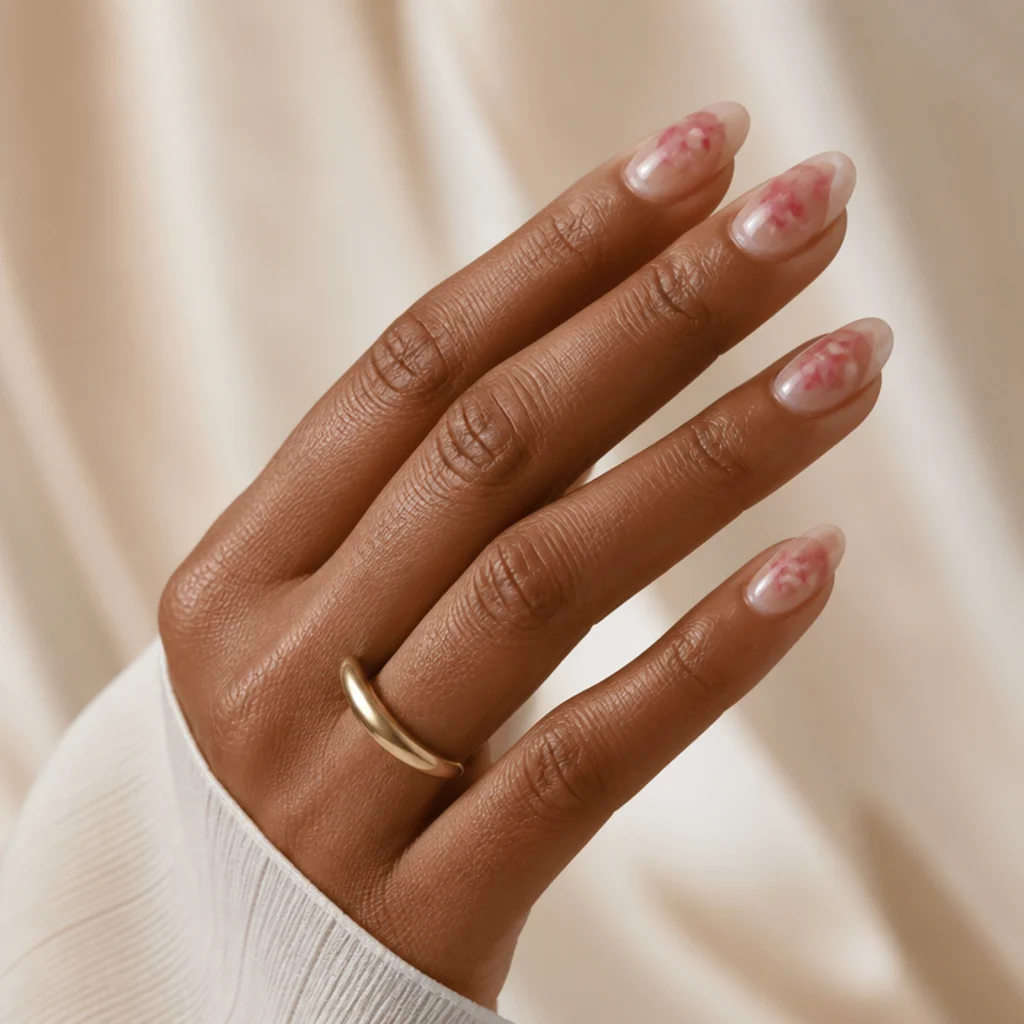
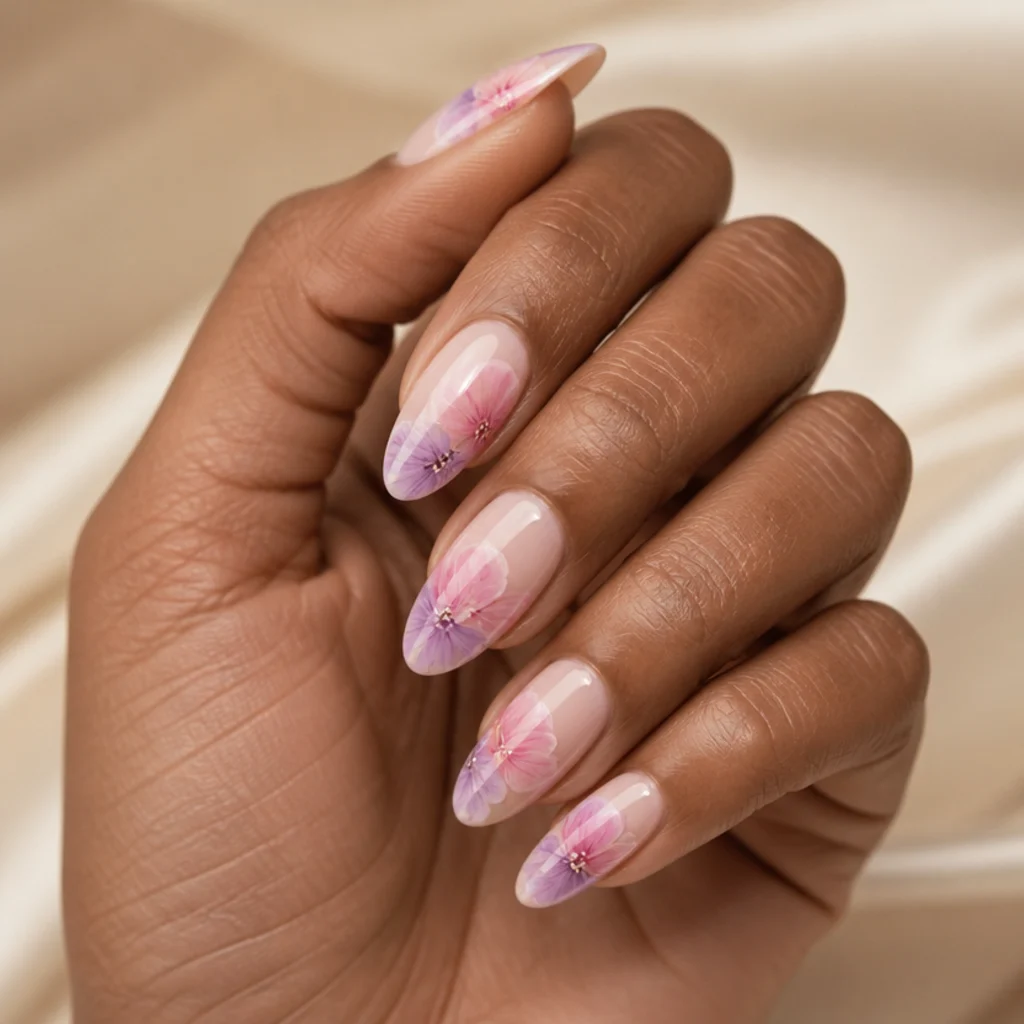
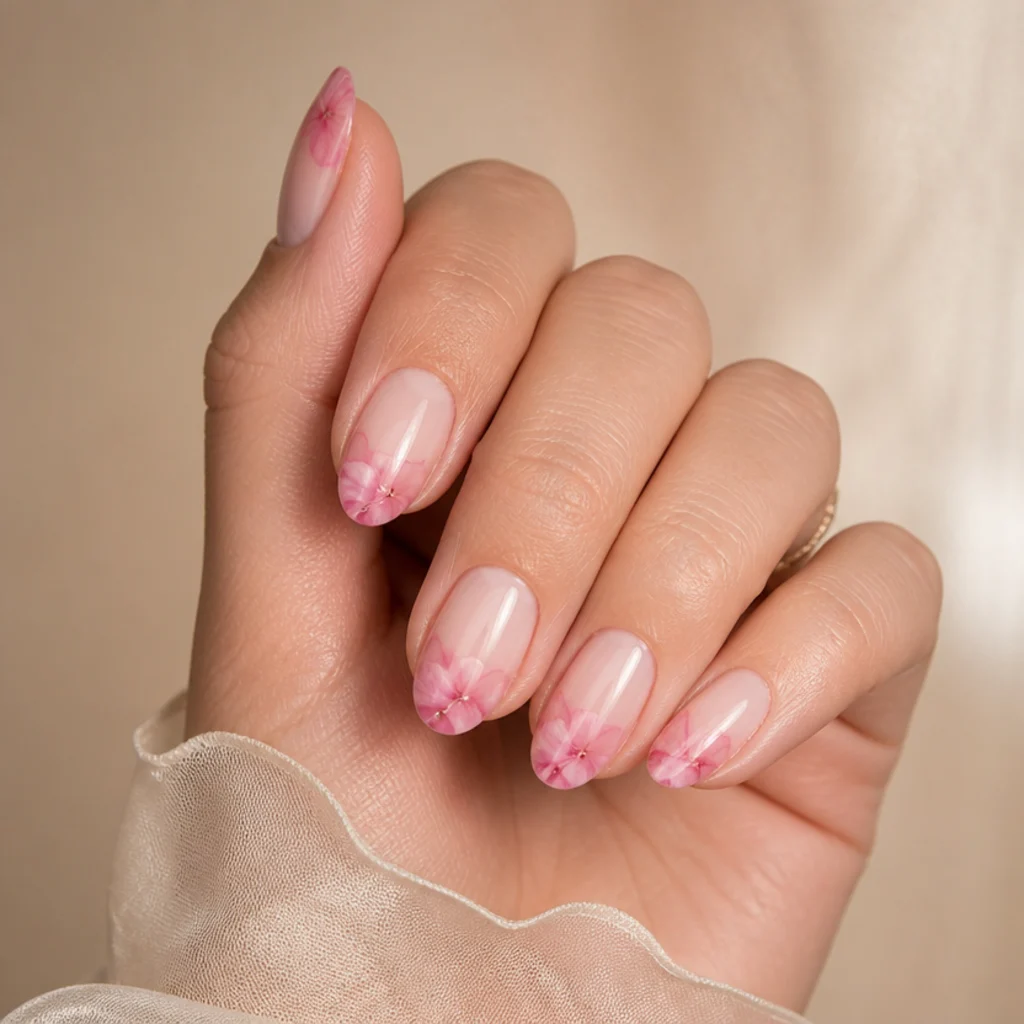
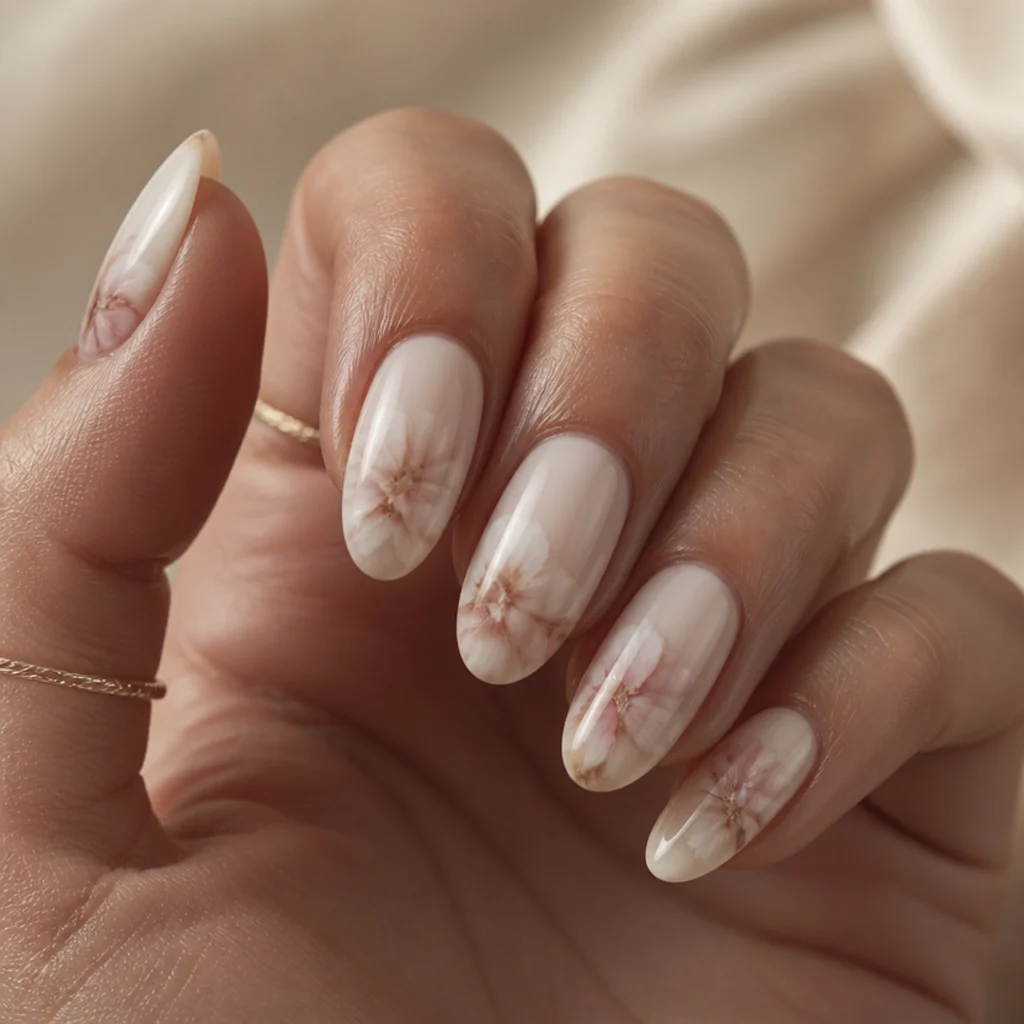
15 Blooming Gel Nail Art for Short Nails
Blooming gel is the clear reactive layer that pulls pigment into soft, watercolor blooms with almost no brushwork, and short nails are the length it flatters most, because a smaller plate is easier to control and grows out cleaner. These 15 looks map the full range, from barely-there tonal washes to graphic agate marble, each with exact shades, undertone logic, a real upkeep timeline, and the salon-ready phrasing to book it.
 Edited by Lena Rose · Published July 11, 2026 · 28 min read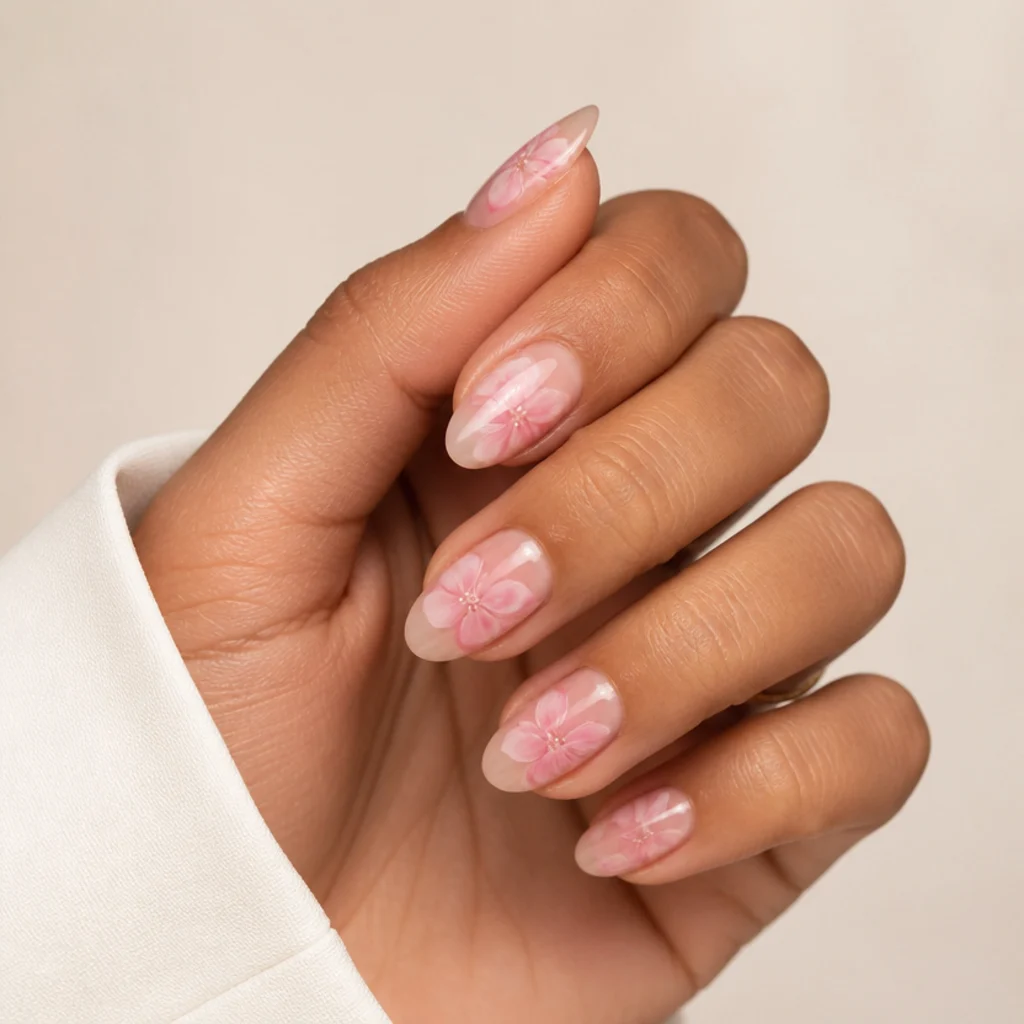
Quick Answer
- Best for: Short natural or gel nails on any skin tone; anyone who wants painterly art without added length, bulky tips, or fussy freehand linework.
- Who might skip it: Nail-biters with almost no free edge, anyone who needs razor-sharp graphic lines or crisp French smile lines, and those who prefer flat, fully opaque color, since blooming gel is engineered to diffuse and soften.
- Maintenance: Roughly 2 to 3 weeks over a hard gel or builder base; wipe a fresh glossy gel top coat over the art at the halfway point to stop pale blooms from going cloudy, and use cuticle oil daily to slow lifting.
- Difficulty: Beginner to advanced depending on the look; the gel spreads pigment for you, so timing and placement matter far more than a steady line.
- Cost: Usually a per-nail or flat art surcharge on top of a standard gel set, climbing with foil, galaxy layering, or florals on every nail; ask for the art fee and per-nail rate up front so there are no surprises.
- Wear time / longevity: 14 to 21 days before lifting or grow-out shows; tonal, negative-space, and dark-base looks stretch longest, pastels and milky bases the shortest.
- Standout variation: Marbled or feathered blooming gel French tip, which reads refined on even the shortest nails and hides regrowth better than a hard smile line.
- How to ask your nail tech: Bring a saved photo, name the finish in plain terms (feathered, watercolor, marbled, ink-wash), state your sheer-versus-opaque preference, and point to exactly where you want the color to sit.
In This Guide
- Soft Blush Bloom
- Milky Base Wildflowers
- Blooming Gel French Tip
- Inky Blue Marble
- Terracotta Sunset Blooms
- Black and White Ink Wash
- Lavender Watercolor Petals
- Gilded Bloom Accent
- Cherry Red Poppy Spread
- Sage Green Leaf Trails
- Sheer Nude Negative Space
- Sunflower Bloom Tips
- Dusty Rose Ombre Bloom
- Midnight Galaxy Bloom
- Pastel Confetti Blooms
Intro
Blooming gel is the not-so-secret engine behind the feathered florals you keep saving, and understanding how it behaves is what separates a clean set from a muddy one. It's a clear, low-viscosity gel painted over a fully cured base; draw gel polish or a compatibly thinned lacquer on top, and the slip and solvents in the blooming layer pull the pigment outward into soft, watercolor edges before you flash it under the lamp. The reaction is time-sensitive and one-directional, which is why short nails make the ideal proving ground. A smaller plate means fewer blooms to choreograph, faster spreading you can actually watch, and art that stays balanced as the nail grows out. Short lengths also keep saturated colors from reading heavy, so a cherry poppy or a navy galaxy looks intentional instead of costumey. This guide covers 15 blooming gel looks built for shorter nails: sheer washes, agate marble, negative space, botanical trails, playful florals. Each entry names the shades and undertone logic, the placement, the flattering nail shapes, a realistic maintenance window, one concrete pro move, and the exact phrasing to hand your tech, so the look on your screen becomes the look on your hands.
01Soft Blush Bloom
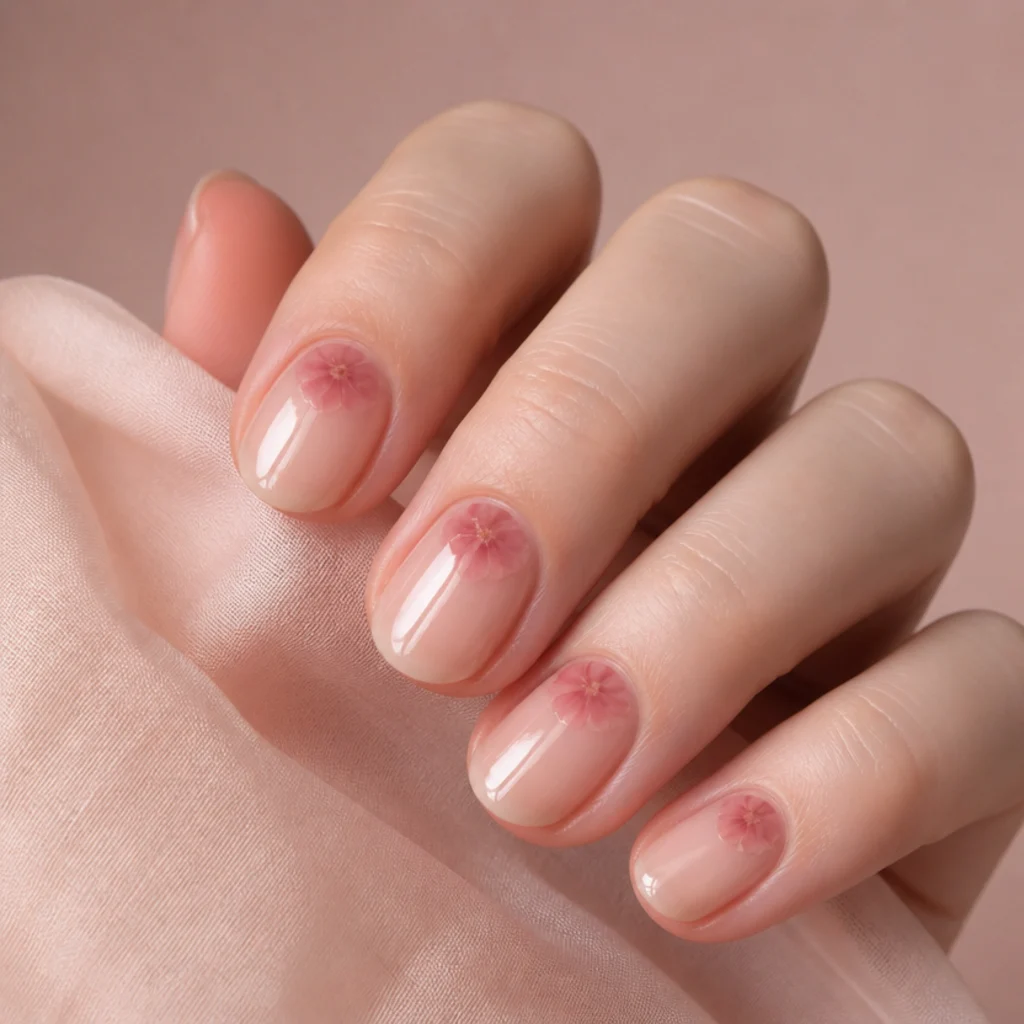
The gentlest entry point, and the one to master first: a sheer neutral-pink or bone gel base carrying a single muted blush bloom set just off the cuticle. Reach for a cool-leaning blush, soft rose or dusty petal rather than warm bubblegum, thinned so it stays translucent instead of chalky. Because the blooming layer feathers the outline, the flower reads hand-painted, never stamped. It flatters fair to light-medium skin with pink or neutral undertones, where the tone-on-tone effect looks quietly expensive; on deeper skin, shift the blush one shade richer so it doesn't disappear. Keep the nail short and round so the lone bloom stays the hero and the free edge looks tidy. Difficulty is low, which makes this a strong first project and a fast salon add-on. Upkeep is easy at two to three weeks, since pale grow-out is forgiving. Pro tip: place the bloom before the base self-levels and touch only the center, letting the gel carry the color out on its own. Ask your nail tech for a sheer nude base with one small, diffused blush blooming-gel floral, kept pale and off-center.
02Milky Base Wildflowers
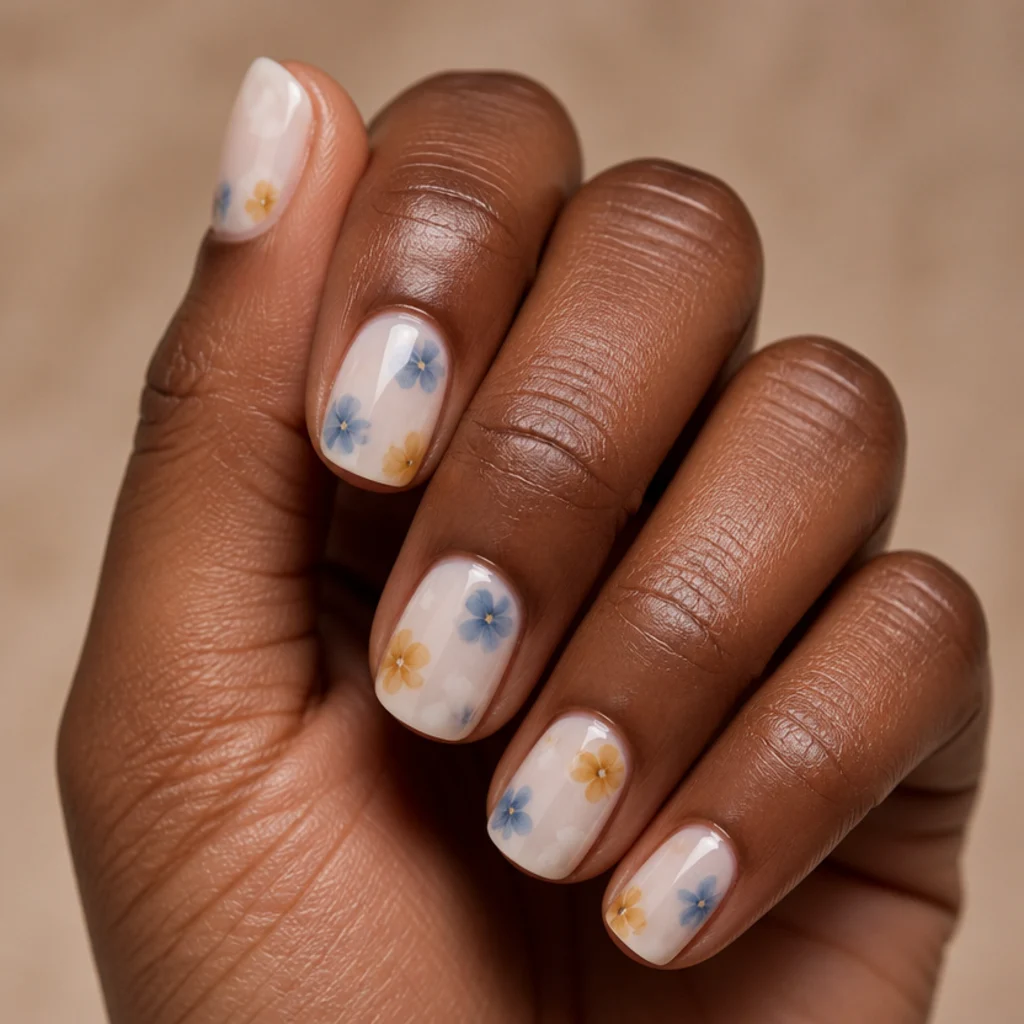
A milky, semi-sheer white base gives tiny wildflowers a fresh, diffused backdrop that photographs beautifully in daylight. Build the milk in two thin coats so it stays translucent rather than flat-opaque, then scatter small cornflower-blue and butter-yellow blooms so no two nails match; deliberate asymmetry is what keeps a set looking picked rather than printed. The wash is forgiving on short squoval nails and reads especially crisp against deep and rich skin tones, where the pale ground adds gentle contrast without dulling the hand. Expect intermediate difficulty, driven by the small, considered placement rather than the blooming itself. Wear runs two to three weeks; refresh the glossy top coat at the halfway mark, because a milky base clouds faster than saturated color. Pair it with thin gold or silver stacking rings for a spring-editorial feel. Pro tip: vary flower scale across the hand, larger on the ring and thumb, smaller on the pinky, to mimic a real meadow, and leave one nail almost bare so the eye has somewhere to rest. Ask your nail tech for a milky sheer base with mixed micro-florals in a scattered blooming-gel wash.
03Blooming Gel French Tip
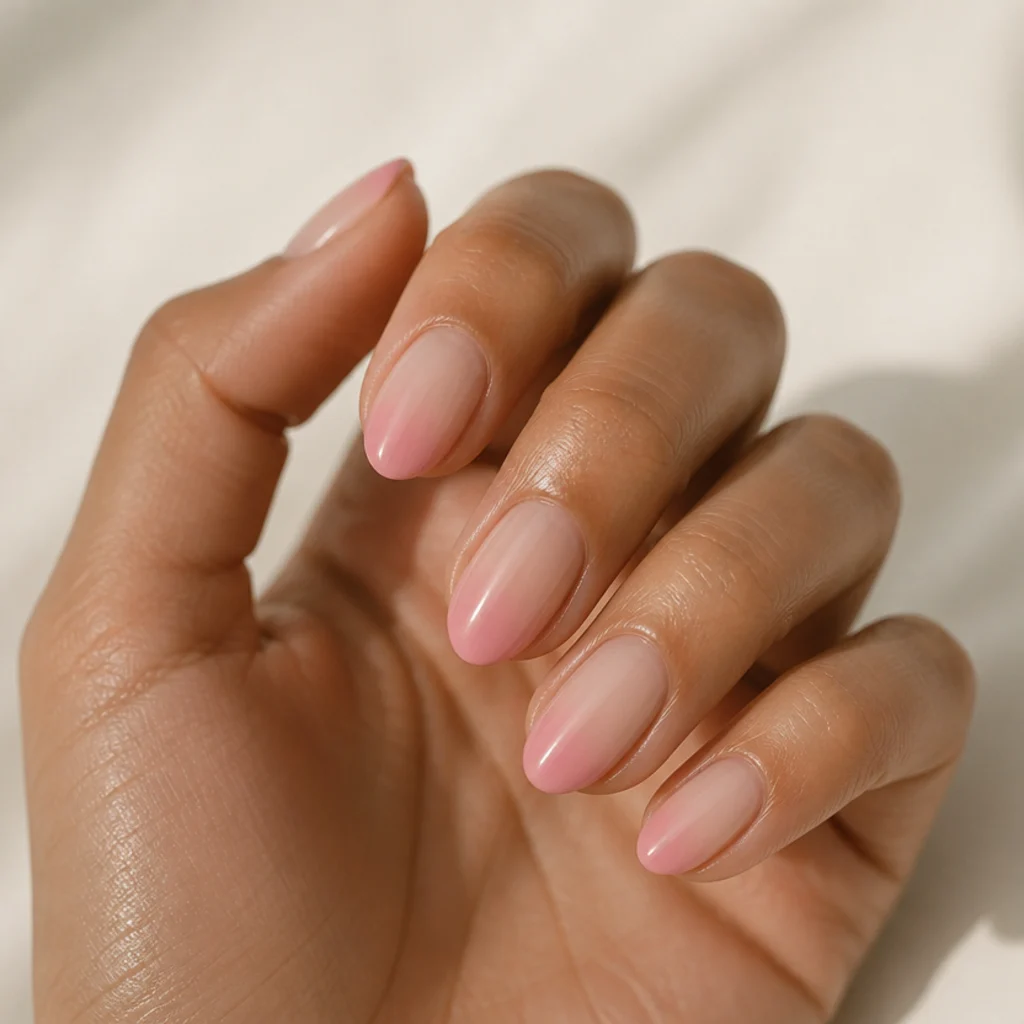
A modern rewrite of the classic: instead of a crisp smile line, the tip is a soft, feathered band that the blooming gel pulls down into the nail. This blooming gel French tip looks refined on short almond nails and stays low-maintenance, because a diffused edge disguises regrowth far better than a hard line ever could. Soft pink, coral, and warm caramel all work; choose a shade two to three tones deeper than your natural bed for a lift that still looks organic. Cool undertones suit rose and mauve tips, warm undertones glow in caramel and peach, and neutral skin can carry either. Difficulty is moderate, since the real skill is controlling where the feathering stops, not painting a clean arc. Wear is a comfortable two to three weeks. Pro tip: keep the band thin and stop your brush higher than feels right, because the color travels tipward as it blooms and an overloaded band turns muddy at the edge. Ask your nail tech for a diffused blooming-gel French tip, feathered down rather than a sharp traditional smile line, in a shade a touch deeper than your nail.
04Inky Blue Marble
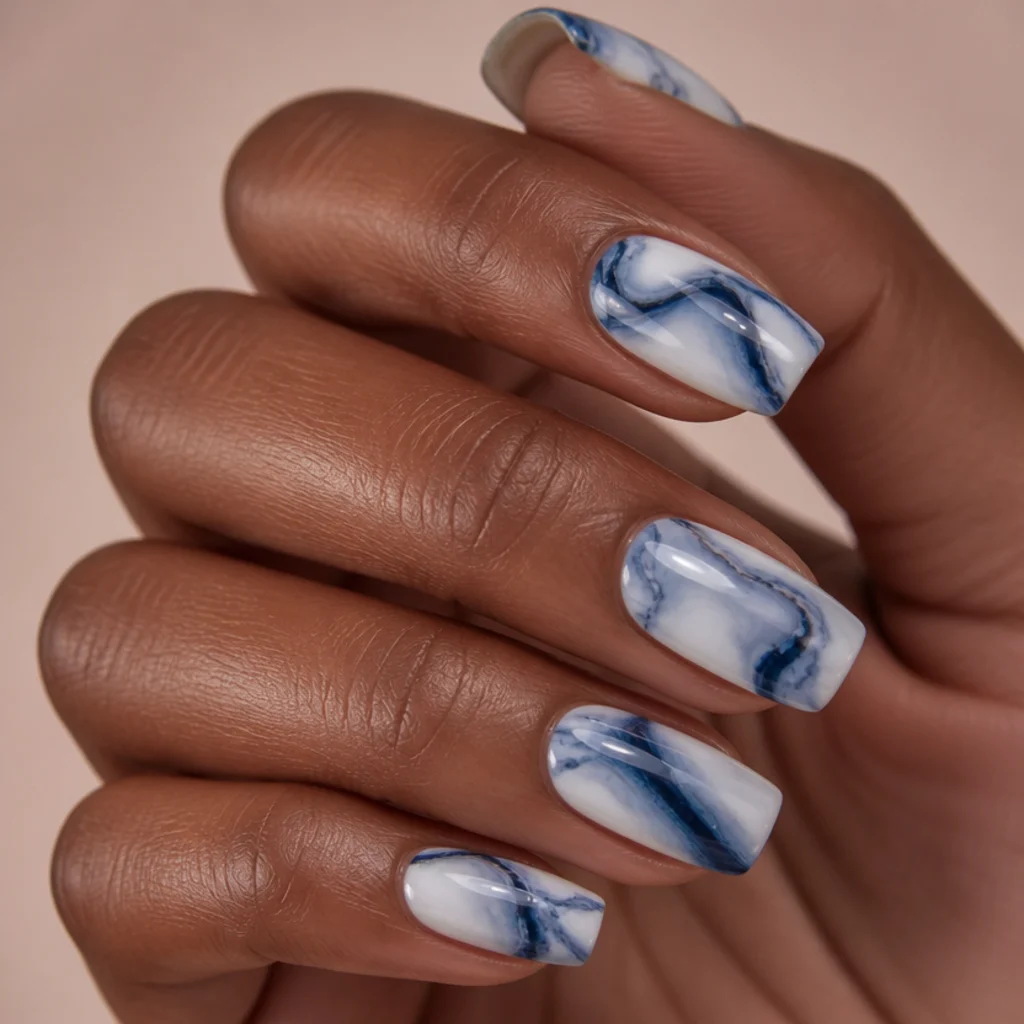
Blooming gel makes marble almost effortless, because the pigment spreads into natural veins without a fine liner brush. Drop inky navy and soft dove-gray onto a clean white base, then let the gel feather them into a stone-like swirl; a single hair-thin gray vein pulled through with an orange stick sells the polished-agate effect. On short coffin nails the pattern stays graphic rather than busy, which is the whole point on a small plate. It suits anyone who wants something artful but not floral, and cool blues flatter neutral to cool undertones especially well against light-to-medium and light brown skin; warm undertones can swap navy for a smoky teal. Difficulty is intermediate, and the discipline is restraint, since too much pigment collapses the veining into a blur. Wear runs a full three weeks, because the white base hides grow-out slowly and evenly. Pro tip: work one nail at a time and flash-cure before the bloom over-spreads, then add the crisp accent vein on top of the cured layer so it stays sharp. Ask your nail tech for a navy-and-gray blooming-gel marble on a white base with one fine pulled vein per nail.
05Terracotta Sunset Blooms
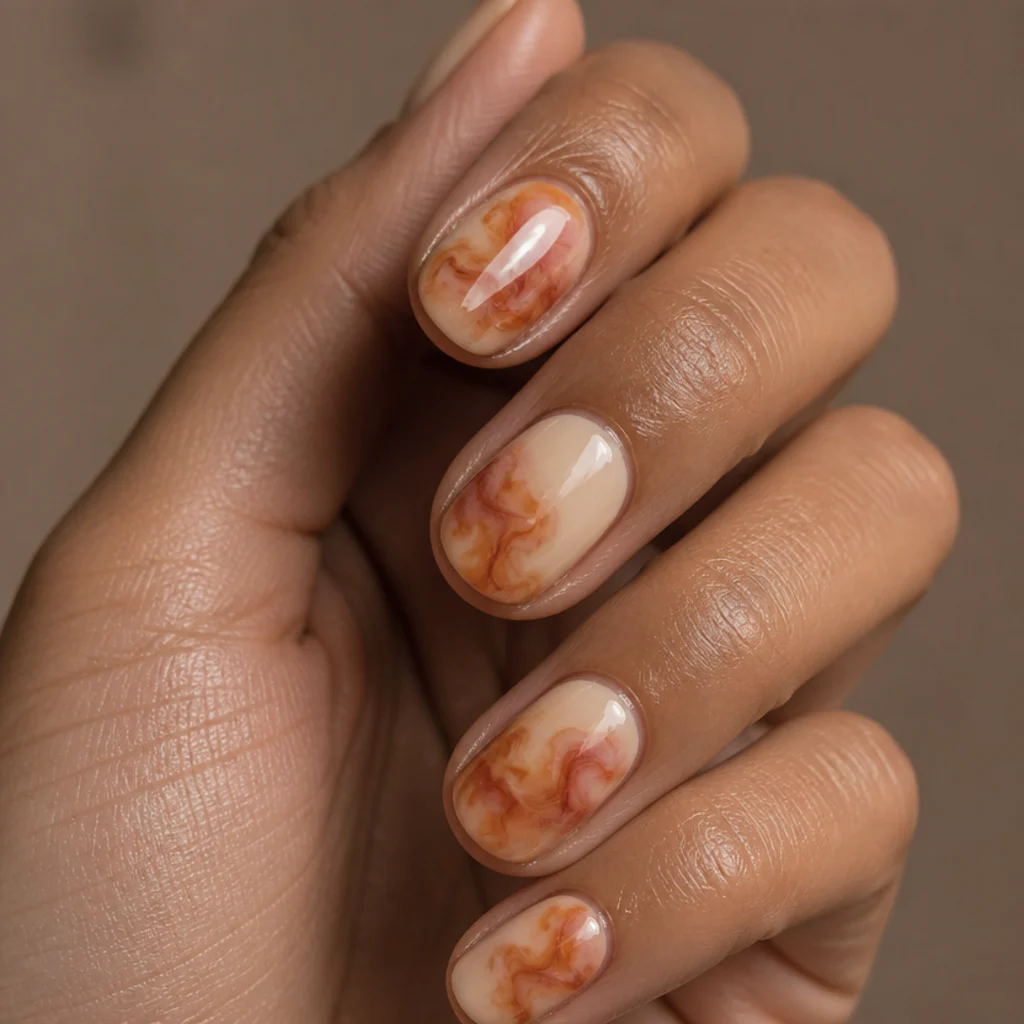
Warm terracotta, amber, and a whisper of dusty coral bleed together for a sunset-inspired set that feels seasonal without being literal. Layered over a warm cream base, the blooms melt into one another so each nail carries a soft gradient of earthy color rather than distinct, outlined flowers. This flatters warm, tan, olive, and golden-deep skin, where the clay tones echo the undertone and warm the whole hand; cooler skin can pull the palette toward brick and rust to avoid looking sallow. Short round nails keep the color cozy and wearable instead of overwhelming. Difficulty sits at intermediate because of the wet-on-wet blending, which has to happen while both shades are still open and uncured. Maintenance is standard gel wear, around three weeks, and the muted palette hides regrowth kindly. Style it with brass jewelry and neutral knits through autumn. Pro tip: lay terracotta first, then feed amber into its still-wet edge and let the gel do the gradient work, rather than stirring the two together with your brush. Ask your nail tech for warm terracotta and amber blooming-gel blooms blended wet-on-wet over a cream base.
Save this to Pinterest to build your fall nail mood board.
06Black and White Ink Wash
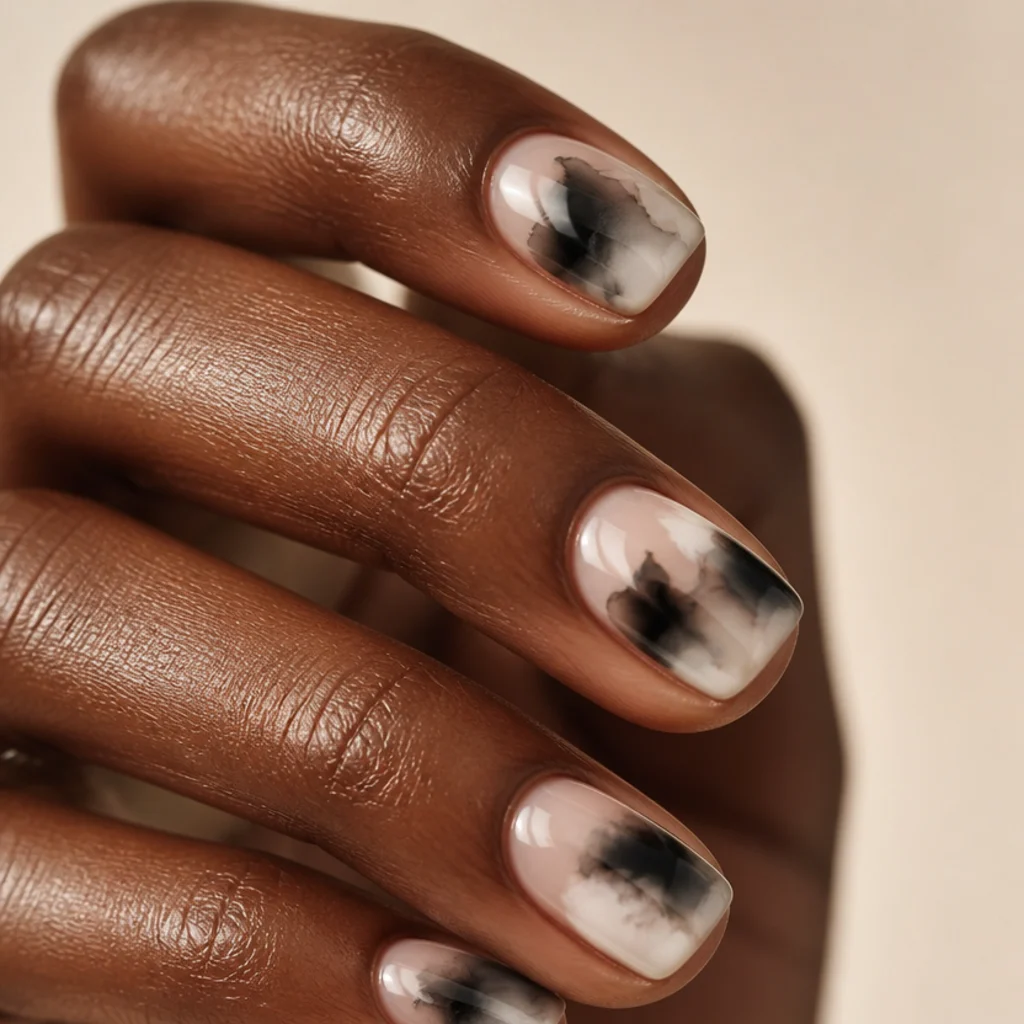
For a gallery-worthy set, blooming gel turns black and white pigment into loose ink-wash strokes reminiscent of sumi-e brush painting. A sheer base lets the strokes float, while the gel softens each edge into a painterly bleed rather than a hard mark. This high-contrast look is striking on deep and rich skin tones, where the clarity of black on a bare nail reads sharp and editorial, and it keeps short squoval nails looking deliberate. It's bold yet minimal, as wearable to the office as to a gallery opening. Difficulty is intermediate to advanced, because composition and negative space carry the design, not fussy detail. Wear is two to three weeks; the sheer base means grow-out is barely visible. Pro tip: commit to one confident stroke per nail, vary its direction across the hand, and leave real empty space around it, since over-filling is what turns an ink wash into a smudge. Ask your nail tech for abstract black-and-white blooming-gel ink strokes on a clear base, one gesture per nail with plenty of negative space.
07Lavender Watercolor Petals
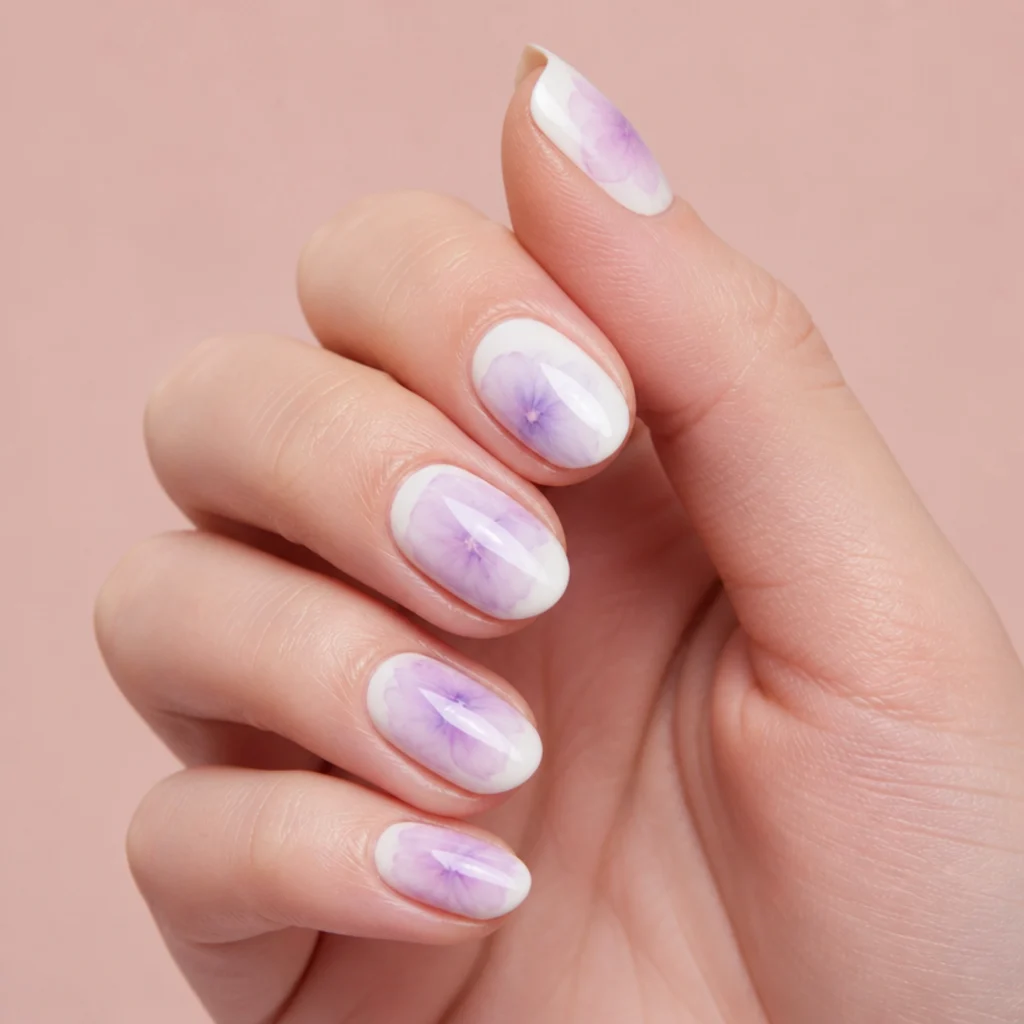
Pale lavender is having a long moment, and blooming gel gives it a dreamy, translucent watercolor quality that flat polish can't match. Painted as loose petals over a soft white base, the color feathers into gentle, layered shapes with visible depth where the petals overlap. It suits fair to light-medium skin with cool or neutral undertones and anyone drawn to soft pastels; on richer skin, deepen toward a dusty periwinkle so the lavender still registers. Short almond nails keep the petals delicate and quietly elongating. Difficulty is beginner-friendly, since precise linework isn't the goal and the gel forgives a loose hand. Upkeep is easy, though pastels reveal grow-out sooner than deep shades, so plan a refresh around two to three weeks. Pair with silver or freshwater-pearl accents for a soft-romantic finish. Pro tip: build lavender in two sheer passes rather than one opaque coat, because the overlap between blooms is what creates that painted-glass translucency and stops the petals looking like solid stickers. Ask your nail tech for translucent lavender blooming-gel watercolor petals, layered in sheer passes over a white base.
08Gilded Bloom Accent
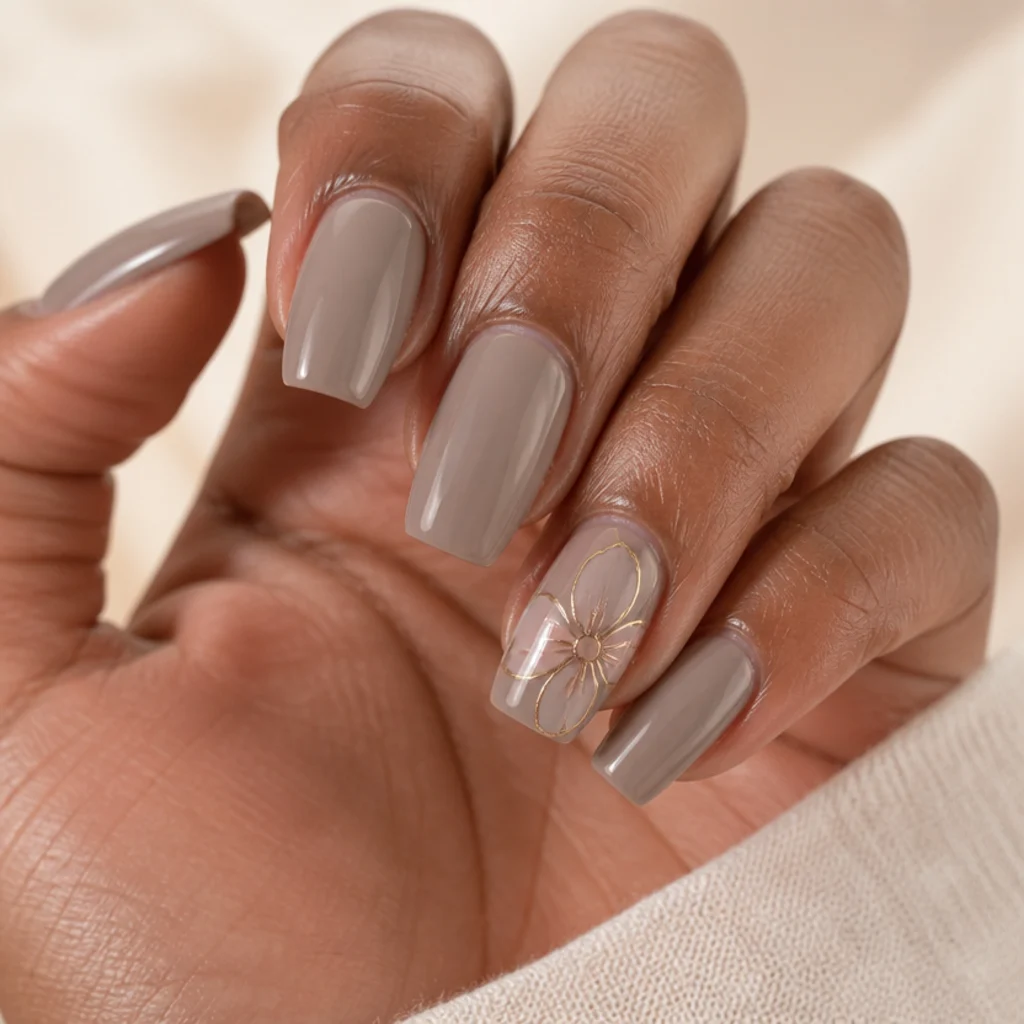
Keep most nails a solid muted taupe, then let one accent nail carry a single blooming gel floral traced with hair-thin gold foil lines. The gold catches light and lifts the whole hand without crowding short coffin nails, and the restraint is what makes it feel polished rather than busy. A greige or mushroom taupe flatters nearly every skin tone, reading especially rich on medium and deep brown hands. This is a smart choice for weddings or events where you want polish with quiet luxury. Difficulty is intermediate, almost entirely for the foil work, which is pressed onto a tacky gel layer and then sealed. The solid nails wear exceptionally well, keeping the manicure sharp for three weeks. Pro tip: apply the foil to the fully cured bloom last, follow only one or two petal edges, and seal immediately, since tracing every line reads costume rather than couture and unsealed foil peels within days. Ask your nail tech for a muted taupe set with one gold-lined blooming-gel accent nail, foil kept minimal.
09Cherry Red Poppy Spread
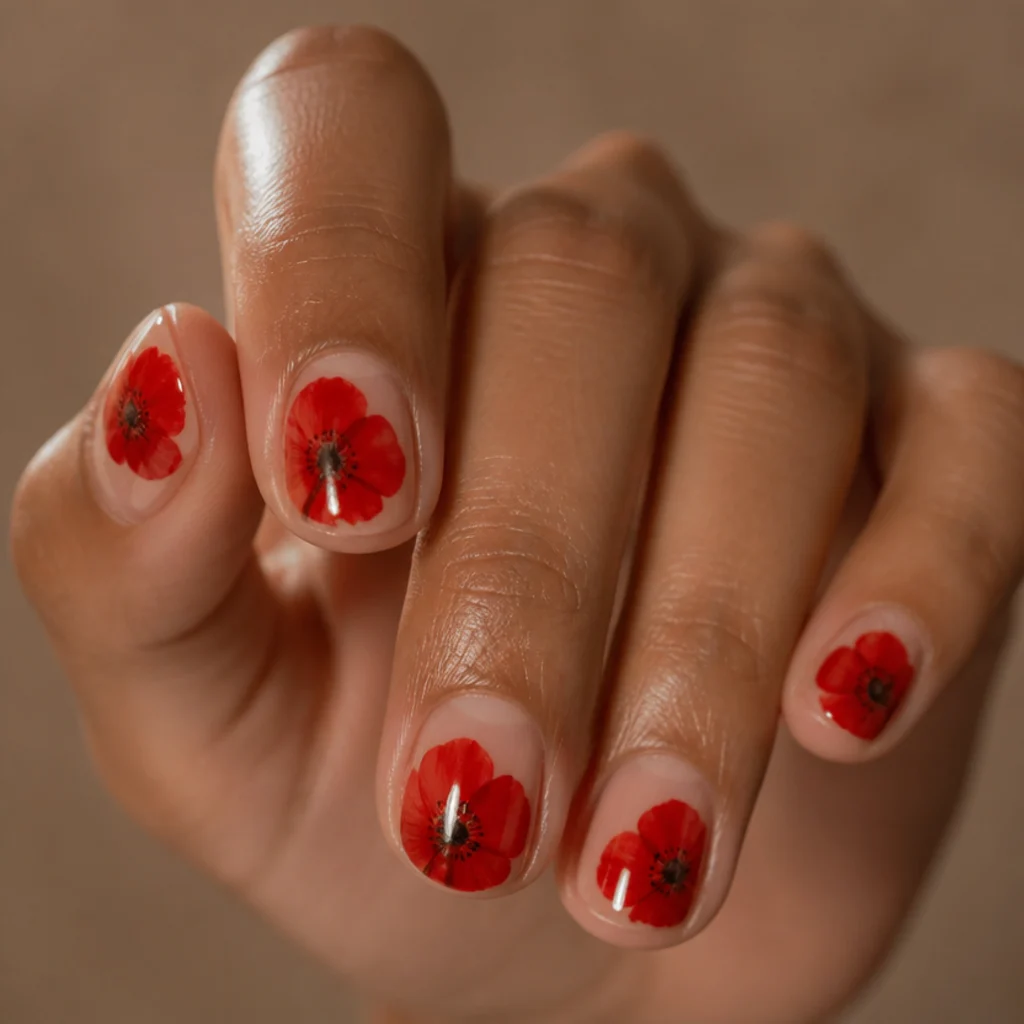
Bold and joyful, cherry-red poppies spread across a sheer base with dark, feathered centers that the blooming gel diffuses into smoky halos. The saturated true-red pigment makes short round nails look confident and deliberate, and the poppy motif keeps a classic red feeling fresh instead of formal. Red is famously universal; a blue-red flatters cool undertones while a warmer scarlet suits golden and tan skin, and either reads clean on a bare, sheer ground. Difficulty is intermediate, and timing is everything, because the dark center must be dropped and allowed to bleed before the surrounding red fully sets. Red gels are long-wearing, so expect a clean three weeks under a glossy top coat. Style with gold hardware and denim for effortless contrast. Pro tip: place the black or deep-maroon center as a single tiny dot into the still-wet red and don't stir it, letting the gel feather it into a natural poppy heart on its own. Ask your nail tech for cherry-red blooming-gel poppies with contrasting dark centers, spread across a sheer base.
10Sage Green Leaf Trails
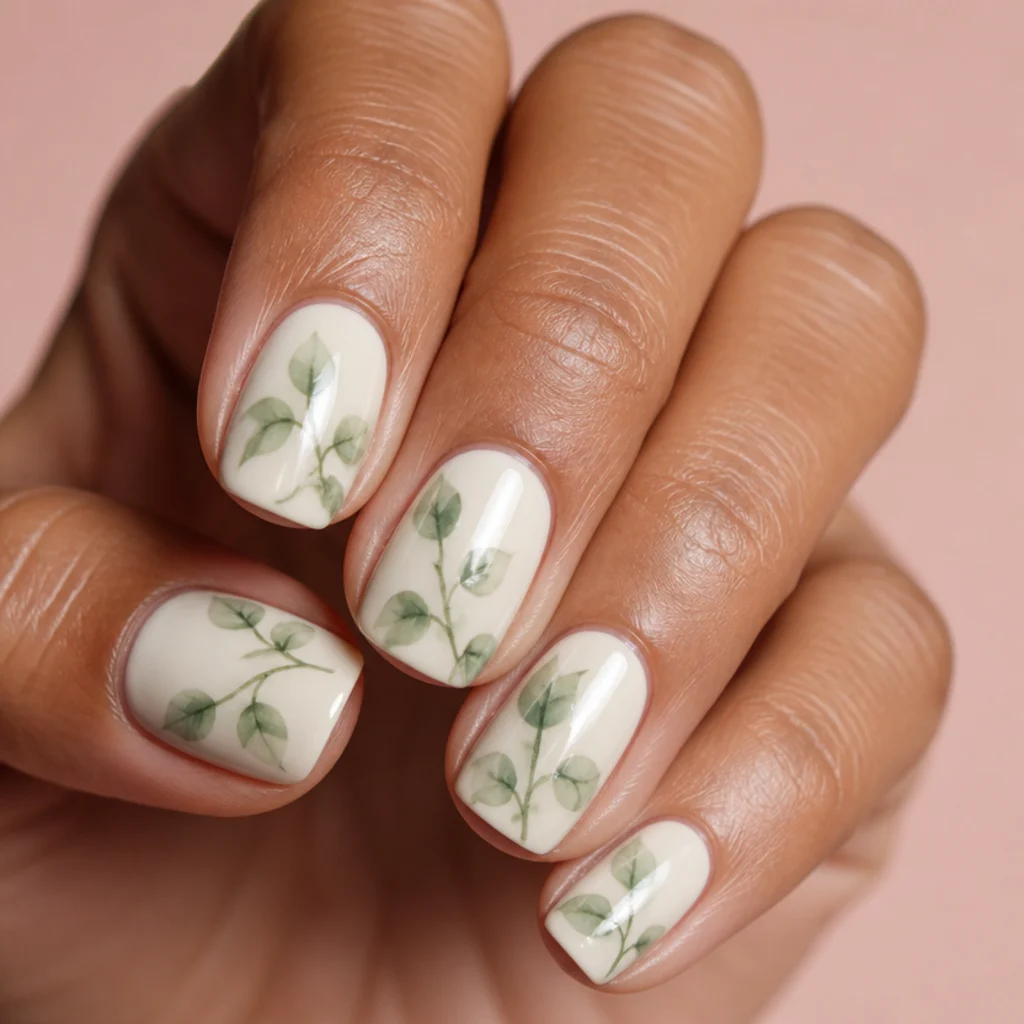
Instead of flowers, this look leans botanical, with soft sage leaves and thin vines trailing diagonally across each nail. Blooming gel softens the greens into a watercolor freshness so they never look flat or stamped, while the vine stays crisp for deliberate contrast. Over a warm cream base the trails feel calm and grounded, and a muted, gray-green sage flatters medium, olive, and light brown skin with neutral to warm undertones; cool skin can lean toward a bluer eucalyptus green. Short squoval nails give the vines room to travel corner to corner without crowding the plate. Difficulty is intermediate, driven by the linear vine work rather than the blooming leaves. Wear is a comfortable two to three weeks, and the earthy tone disguises regrowth. Pair with linen and warm metals for a quiet garden feel. Pro tip: paint the vine line first, let it set slightly, then bloom the leaves off it so the stems stay fine while the foliage goes soft and diffuse. Ask your nail tech for trailing sage-green blooming-gel leaves with fine crisp vines on a cream base.
11Sheer Nude Negative Space
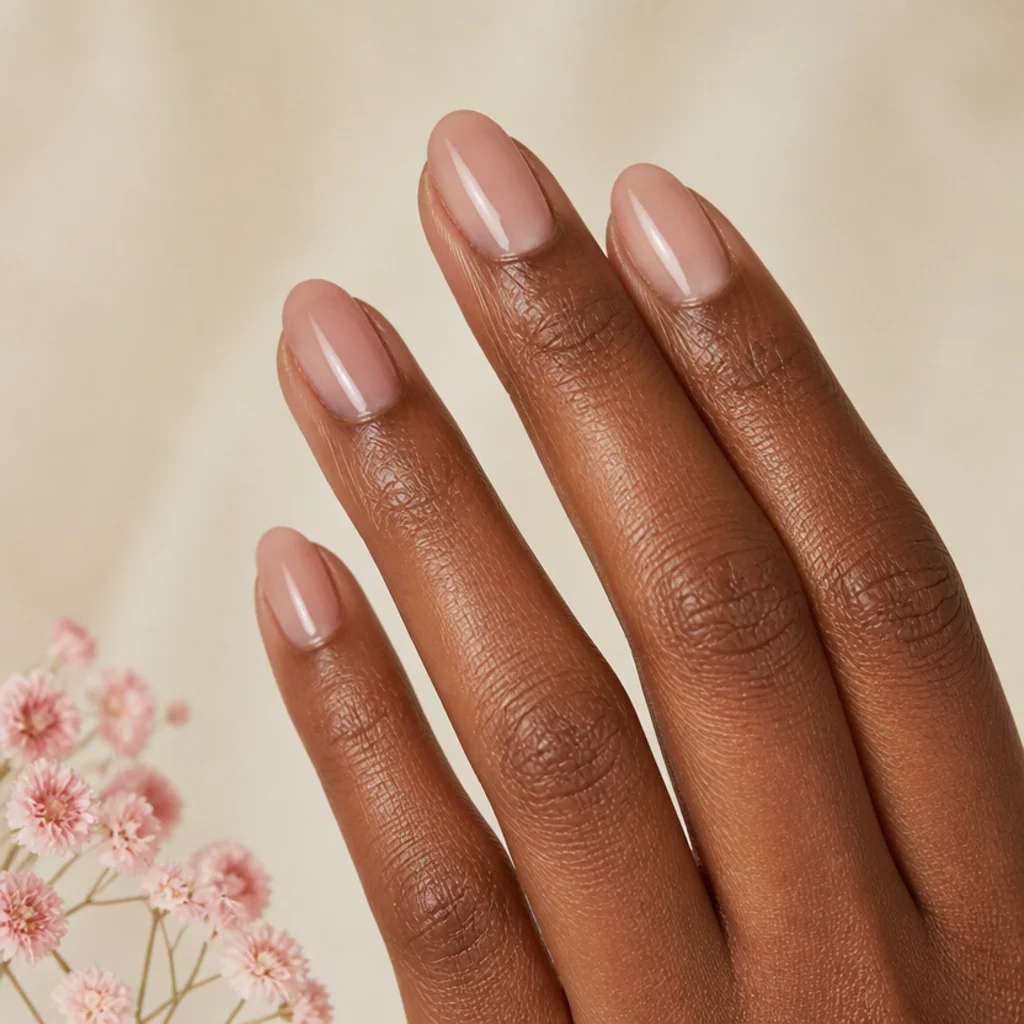
Negative space keeps most of the nail bare while a few small dusty-pink blooms sit off-center, feathered by the blooming gel into soft, weightless shapes. The effect is modern and minimal, letting your natural nail show through for a contemporary, barely-there finish. It flatters deep and rich skin tones especially, where bare space frames the bloom cleanly, and it grows out more gracefully than almost any look here. Short almond nails suit the airy, asymmetric layout. Difficulty is beginner to intermediate, since the challenge is placement and negative-space balance rather than volume of art. Because there's minimal pigment, this is one of the lowest-maintenance options, easily holding three weeks. Style it as an everyday manicure that still looks considered. Pro tip: seal the bare nail with clear gel too, not just the painted zone, so the whole surface wears evenly, the negative space stays glossy, and lifting doesn't start at an unsealed edge. Ask your nail tech for negative-space nails with a few small off-center blooming-gel florals and the bare nail fully sealed.
12Sunflower Bloom Tips
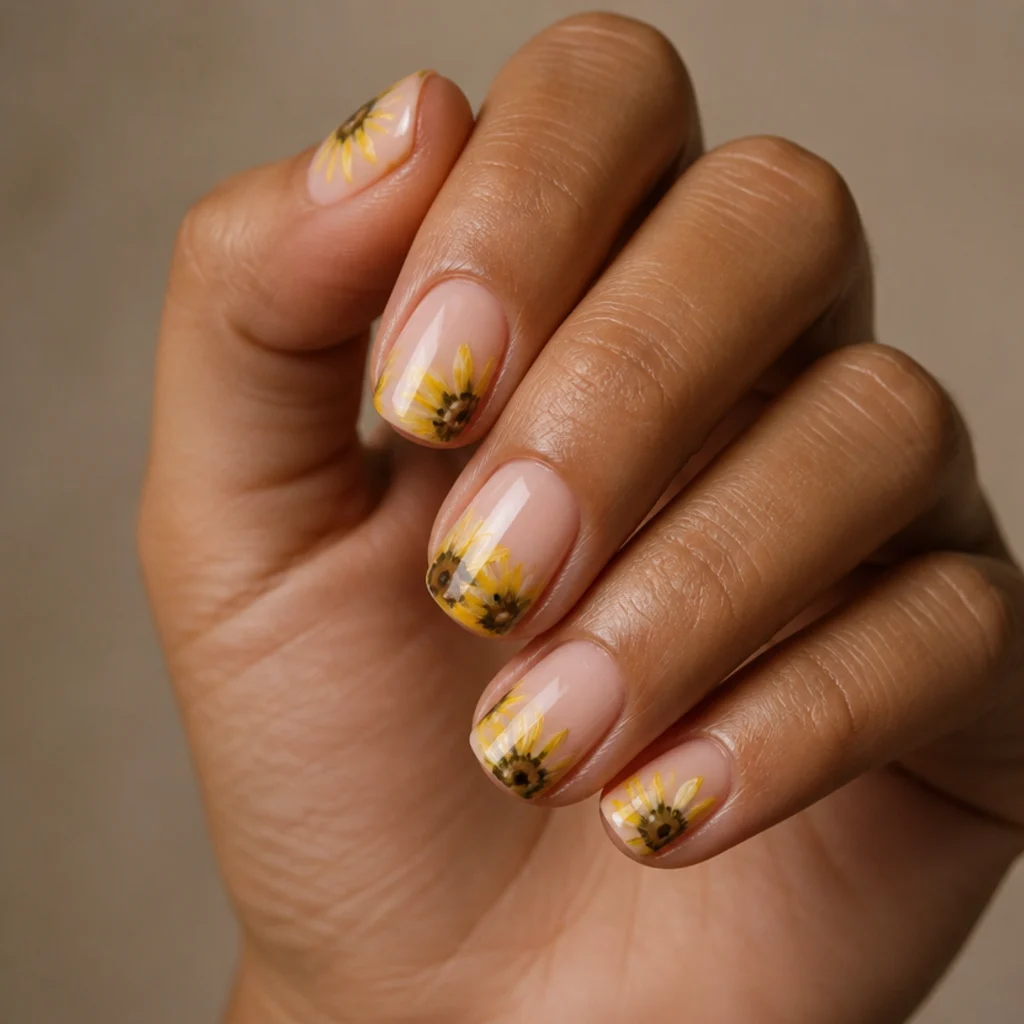
Cheerful sunflowers cluster near the tips while the base of the nail stays sheer, so the design feels light and the eye travels upward. Blooming gel feathers the golden-yellow petals and softens the cocoa-brown centers for a hand-painted, sun-warmed look. Concentrating the flowers at the free edge is a deliberate lengthening trick, making short round nails read longer and less crowded. It's a summery, high-spirited choice that flatters warm, tan, and golden skin; on cooler or deeper skin, a marigold-leaning yellow keeps the petals from turning muddy. Difficulty is intermediate, mostly for the detailed centers, which need texture without becoming a blob. Maintenance is standard gel wear at two to three weeks, and the sheer base keeps grow-out invisible. Pair with white linen and raffia for full-summer energy. Pro tip: dot the brown center with a fine tool, then press a few tiny darker specks into it before curing to fake real sunflower seeds and give the center depth. Ask your nail tech for tip-focused blooming-gel sunflowers over a sheer base, flowers kept near the free edge.
13Dusty Rose Ombre Bloom
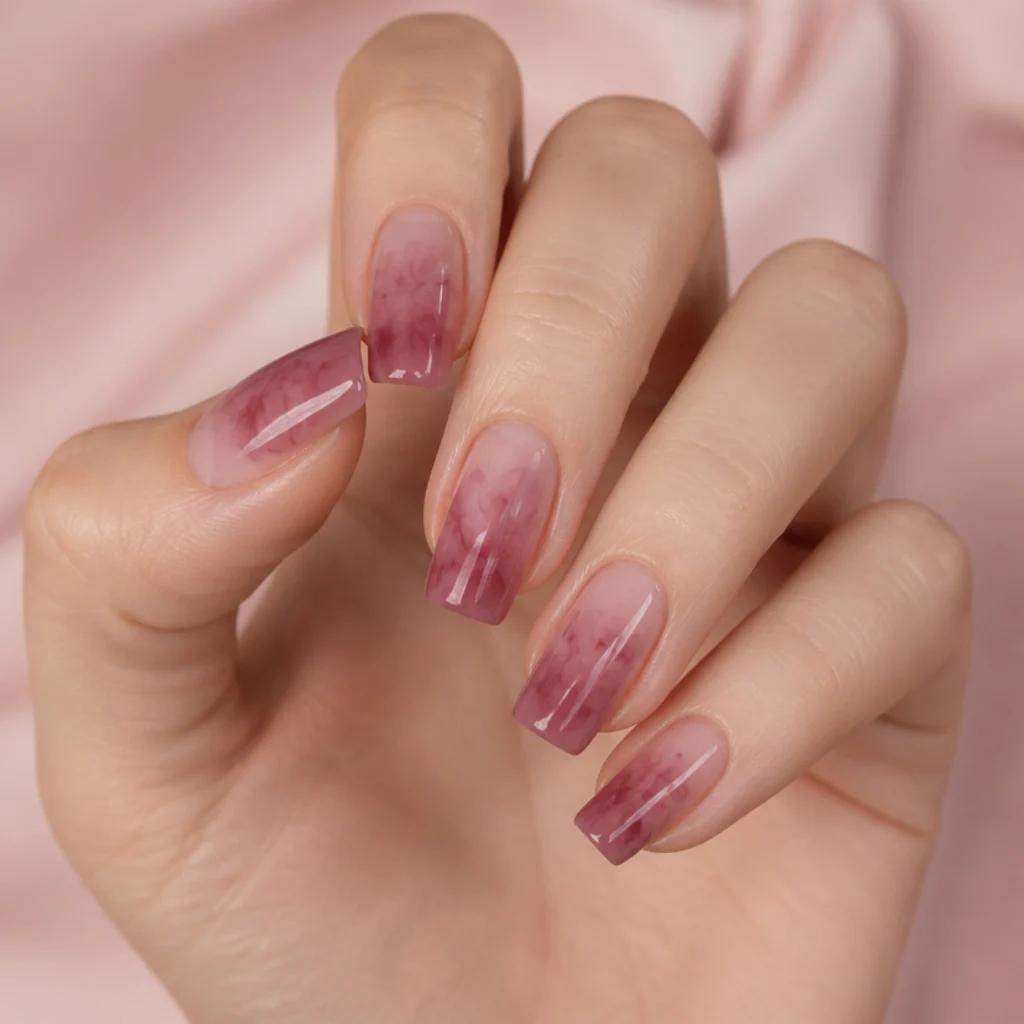
A soft dusty-rose ombre runs from cuticle to tip, and tonal blooms sit within it so the whole nail reads as one gentle gradient. Blooming gel keeps the flowers subtle, almost dissolving into the base, which is what gives this look its expensive, monochromatic calm. The single-family palette is elegant and forgiving, flattering fair to light-medium skin with cool or neutral undertones; deeper skin can shift the whole family toward a richer mauve-rose. Short coffin nails carry the vertical ombre well, visually elongating the hand. Difficulty is intermediate, because the smooth gradient, usually built with a sponge or a soft-blend brush, has to be seamless before the tonal blooms go on top. Upkeep is easy, since tonal grow-out is far less obvious than high-contrast art, comfortably reaching three weeks. Pro tip: use two shades one step apart, not three, and keep the deeper tone at the tip so the gradient looks natural against the cuticle rather than top-heavy. Ask your nail tech for a dusty-rose cuticle-to-tip ombre with tonal blooming-gel blooms melted into it.
14Midnight Galaxy Bloom
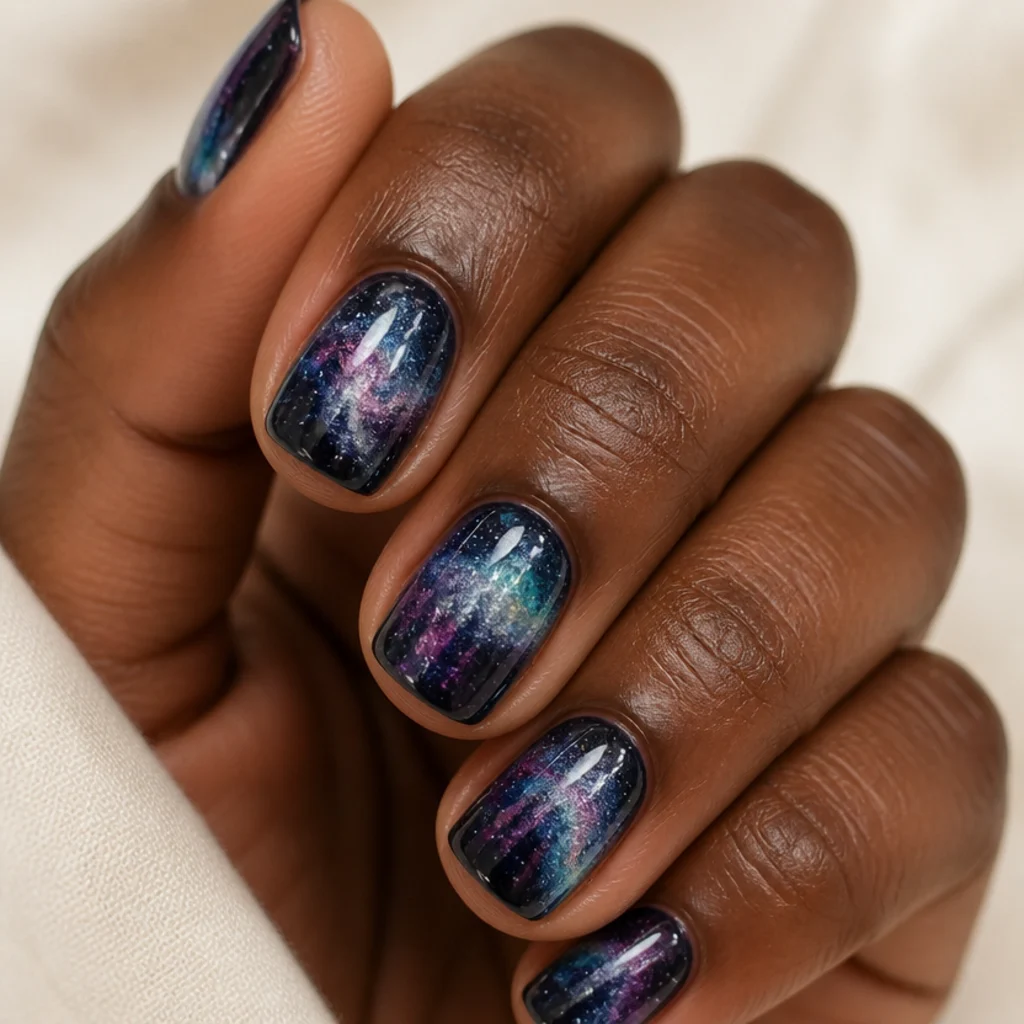
Deep navy meets swirls of violet, teal, and hints of silver for a galaxy effect that blooming gel spreads into soft cosmic clouds. The dark base makes short squoval nails look sleek and dramatic, and tiny white dotted stars scattered across the surface finish the scene. This statement look flatters deep and rich skin tones beautifully, though the drama translates on any skin because the base carries it. It suits anyone who wants maximal art on a minimal length. Difficulty leans advanced, thanks to the layered colors, controlled blooming, and fine highlight work that all have to stay legible on a small plate. Dark gels wear exceptionally well, staying rich and glossy for a full three weeks. Pro tip: build the nebula in two thin cured layers rather than one thick one, keep the brightest violet and teal off-center so it reads like light rather than a stripe, and add the star dots last so they sit crisp on top instead of blooming away. Ask your nail tech for a navy base with violet-and-teal blooming-gel galaxy swirls and fine white star dots on top.
15Pastel Confetti Blooms
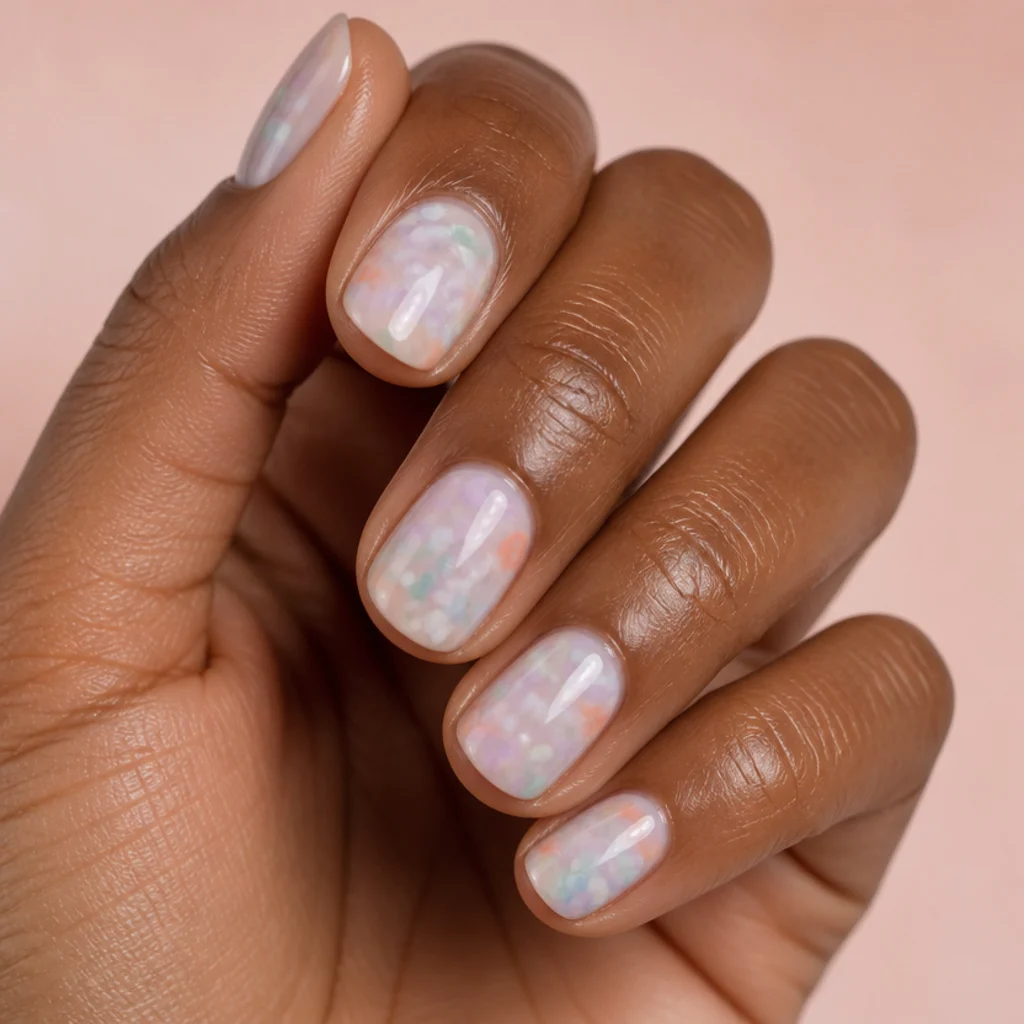
End on something playful: multicolor pastel blooms scattered like confetti across a milky base. Mint, peach, lilac, and baby blue feather into a soft, celebratory finish that suits birthdays and spring alike. The milky ground keeps short round nails looking fresh and clean, and the mixed pastels flatter medium and warm brown skin, where the light base adds a gentle pop; on very fair skin, deepen the milk slightly so the pastels don't vanish. Difficulty is intermediate, purely because of the color variety and keeping each bloom from muddying into its neighbor. Maintenance is standard at two to three weeks, though a top-coat refresh keeps the pastels bright, since pale shades dull faster. Style it with playful gold or beaded jewelry. Pro tip: cure between color families, or at least let one bloom set before dropping the next beside it, so mint and peach stay distinct instead of turning gray where they meet. Ask your nail tech for scattered multicolor pastel blooming-gel confetti florals on a milky base, colors kept from bleeding together.
Pro Tips from the Editor
- Blooming gel isn't a builder or top gel; it's a dedicated reactive layer applied over a cured base, so keep it separate in your kit and never rely on it for structure or strength.
- Thin your color for blooming. A slightly diluted gel polish, or a lacquer thinned with a compatible medium, spreads into soft edges, while a thick, fully opaque coat resists blooming and sits flat.
- Timing beats technique. The pigment keeps traveling until you cure, so watch it move and flash the lamp the moment the shape looks right; curing a hair early stops a soft bloom from turning muddy.
- Work one or two nails at a time. On short nails the reaction is fast, and trying to paint all five before curing almost always over-spreads the last ones.
- Layer sharp details on top of a cured bloom, never into a wet one. Veins, star dots, foil, and flower centers stay crisp only when the diffuse layer beneath them is already set.
- Seal the entire nail, painted and bare zones alike, under a glossy gel top coat and cure fully; this locks the feathered pigment so it won't smear and evens out wear across the plate.
- For longevity, cap the free edge with your top coat and avoid re-filing after the art is sealed, since a re-file breaks the top coat and invites lifting.
- Photograph the look in daylight before booking. Blooming gel colors shift under salon LED and UV lamps, and a natural-light reference helps your tech match saturation and undertone accurately.
How to Choose / Get the Look
Start with your lifestyle and grow-out tolerance. If you want the lowest upkeep, lean toward negative space, soft blush blooms, sage trails, or a tonal dusty-rose ombre, all of which disguise regrowth because there's no hard line to shift. If you want a statement, the galaxy, cherry poppy, or black-and-white ink-wash sets deliver real drama that still fits a short plate. If you are learning at home, begin with a single-bloom or watercolor-petal look before attempting marble or galaxy, since those demand tight timing control.
Next, factor in undertone rather than just skin depth. Cool and neutral undertones glow in lavender, blue marble, and rose French tips; warm and golden undertones come alive in terracotta, sunflower, and caramel. Pale, milky washes read crispest against deep and rich skin, while sheer nudes lean toward fair and light-medium hands. When in doubt, shift a pale palette one shade richer on deeper skin, and one shade softer on very fair skin, so the art neither disappears nor overpowers.
Then match nail shape to intent. Almond and coffin visually lengthen the hand and suit vertical designs like ombre and French tips; round and squoval keep things practical and balanced for scattered florals and marble. Concentrating art near the tips, as in the sunflower set, is a reliable way to make a short round nail read longer.
| Look | Best skin/undertone | Nail shape | Difficulty | Wear |
|---|---|---|---|---|
| Soft Blush Bloom | Fair, cool/neutral | Round | Beginner | 2-3 wks |
| Blooming Gel French Tip | Any, matched undertone | Almond | Moderate | 2-3 wks |
| Inky Blue Marble | Light-medium, cool | Coffin | Intermediate | 3 wks |
| Cherry Red Poppy | Any, undertone-matched red | Round | Intermediate | 3 wks |
| Midnight Galaxy | Deep, rich | Squoval | Advanced | 3 wks |
| Negative Space | Deep, rich | Almond | Beginner-Int | 3 wks |
It also helps to know how blooming gel differs from the other gels in the tray, so you can ask for the right product rather than a substitute that won't react:
| Layer | Role | Cures hard? | Blooms color? |
|---|---|---|---|
| Base gel | Adhesion to the nail | Semi | No |
| Builder / hard gel | Structure and strength | Yes | No |
| Blooming gel | Diffuses pigment outward | Stays workable until cured | Yes |
| Gel top coat | Seal, gloss, protection | Yes | No |
When booking, bring a saved photo and describe the effect in plain terms, feathered, watercolor, marbled, or ink-wash, and state whether you want sheer or opaque coverage. Being specific about placement and saturation is what lets your nail tech translate a screen image onto your natural nails.
Frequently Asked Questions
What is blooming gel and how does it work?
Blooming gel is a clear, low-viscosity gel painted over a cured base coat. When you add gel color or thinned polish on top, the slip and solvents in the blooming layer let the pigment migrate outward into soft, feathered shapes. The color keeps spreading until you cure it under a lamp, so your curing timing, not your brush control, is what decides how diffuse the final art looks.
Does blooming gel nail art work on short nails?
Yes, and short nails are arguably the easiest length to learn on. A smaller plate means one bloom or a small cluster fills the nail without crowding, the reaction is quick and easy to watch from start to cure, and diffused art grows out far more gracefully than sharp graphic lines. Concentrating the design near the tips can also make a short nail read longer.
How long does a blooming gel manicure last?
Sealed under a quality gel top coat and cured properly, most blooming gel looks wear two to three weeks. Tonal, negative-space, and dark-base designs stretch longest because grow-out is subtle, while pale milky and pastel bases may want a glossy top-coat refresh around the halfway point to stay bright and clear.
Can I get a blooming gel french tip on short nails?
Yes, and it's one of the most flattering short-nail options. A blooming gel french tip replaces the crisp smile line with a soft, feathered band, which suits short nails and hides regrowth because the edge is already diffused. Ask for a shade two to three tones deeper than your natural nail for a lift that still looks organic, and request the band kept thin so it doesn't travel muddy.
Is blooming gel nail art beginner-friendly?
Many looks are. Because the gel spreads the pigment for you, single-bloom, watercolor-petal, and negative-space styles are forgiving of a loose hand. Marble, galaxy, and detailed floral sets take more practice, mainly to control timing and keep colors from muddying into one another, so build up to those once you can predict how far a bloom travels before it cures.
Can I do blooming gel with regular nail polish instead of gel color?
Sometimes, but results vary. Thinned regular polish can bloom over the gel layer, though it's less predictable and won't cure as one system, which affects durability. For reliable, long-wearing art, most techs bloom with gel polish or a compatible thinned gel and cure the whole design together so it wears as a single sealed unit.
Why is my blooming gel not spreading or blooming?
The usual culprits are a color coat that is too thick or too opaque, a base that was not fully cured, or an old, gummy blooming layer. Use a thinner, slightly diluted color, cure your base properly first, and apply an even, not heavy, coat of fresh blooming gel so the pigment has room to travel. A blooming layer that is too thin will also refuse to move.
How do I stop blooming gel colors from turning muddy?
Muddiness comes from over-spreading and colors bleeding together before they set. Work one or two nails at a time, cure between clashing color families, keep pigment light, and hit the lamp the moment the shape looks right rather than waiting, since the bloom keeps expanding until it's cured. Layer any sharp accents on top of the cured bloom, not into the wet one.
Does blooming gel damage short natural nails?
Blooming gel itself is just an art layer and is no harsher than standard gel polish. As with any gel manicure, the risk comes from improper removal; soak off gently rather than peeling, avoid over-filing the natural nail, and keep nails and cuticles hydrated with oil between sets to protect short natural nails and slow lifting.