25 Dreamy Olive Green Nail Designs to Save
Olive green is the rare polish that reads earthy and polished at once, moody but easy to wear. From deep army shades to soft sage washes, here's how to pick the exact olive that flatters your undertone, shape and lifestyle, and how to ask for it so you leave the salon with the color you actually pictured.
 Edited by Lena Rose · Published July 11, 2026 · 38 min read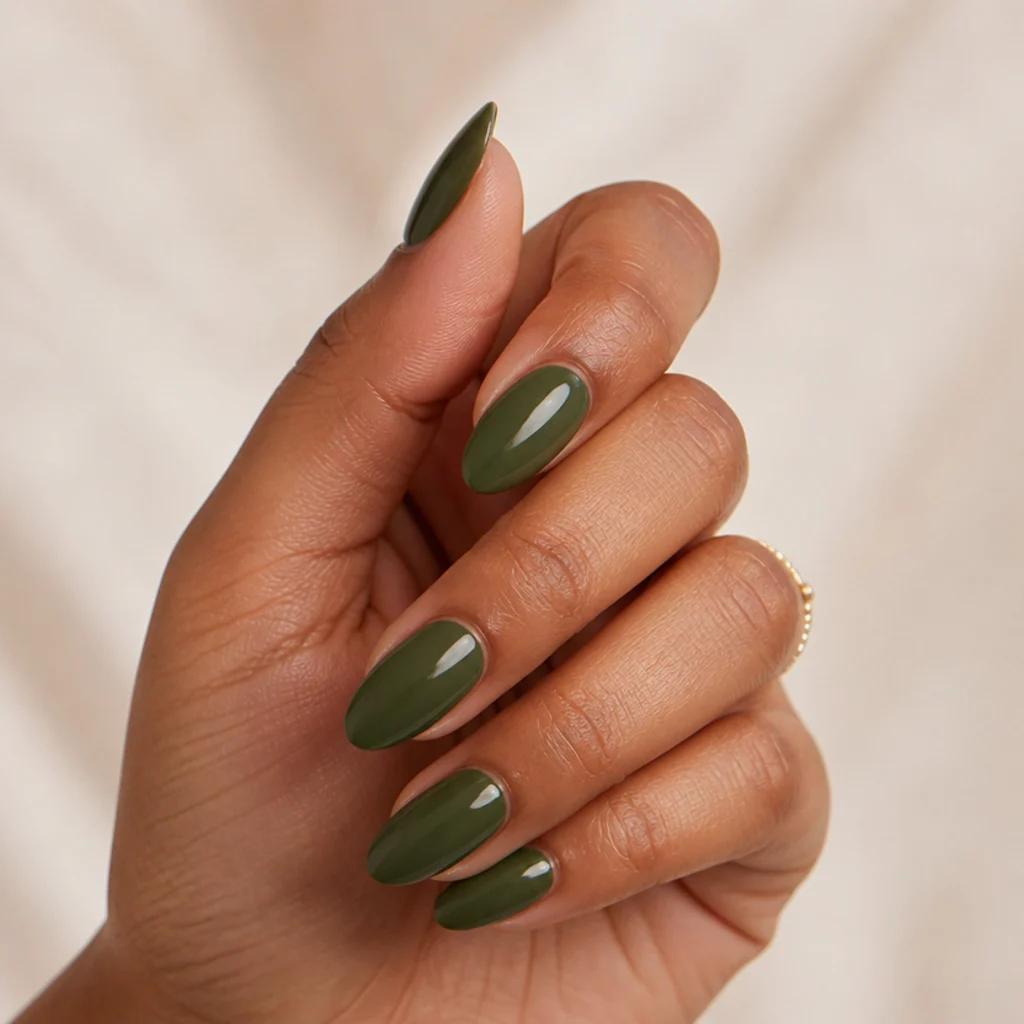
Quick Answer
- Best for: anyone who loves earthy neutrals with more depth than beige; the grey-brown base flatters warm, neutral and cool undertones alike
- Who might skip it: if you want a bright, high-chroma pop or a barely-there natural nail, olive can read heavy or muddy, so lean sheer jelly or milky finishes instead
- Maintenance: olive hides regrowth better than pale shades, so gel sets stretch to roughly three weeks with cuticle oil and tidy sidewalls; acrylic fills every two to three weeks
- Difficulty: solid color, jelly and micro-French are beginner-friendly; chrome, cat-eye, marble, florals and croc print are salon or advanced-DIY
- Cost: builds vary widely by market, from a mid-range gel overlay to a premium acrylic art set with hand-painted detail; embellishment and length push the top of the range
- Wear time / longevity: 7 days as regular polish, 2 to 3 weeks as gel or acrylic; matte and chrome finishes dull first and want a fresh top coat midway
- Standout variation: a grey-tinted dark olive on an almond shape reads polished and lengthening in every season
- How to ask your nail tech: name the depth (deep army, mid olive or dusty sage), the undertone (grey-green, not khaki-brown or fern), and the finish (glass gloss, matte, chrome or pearlescent), and bring a photo, because olive shifts dramatically between brands
In This Guide
- Classic Dark Olive Almond
- Glossy Olive Short Squoval
- Olive Green and White French
- Matte Army Olive Coffin
- Light Olive Sage Wash
- Olive Chrome Mirror Tips
- Olive Acrylic Long Stiletto
- Olive and Gold Foil Accent
- Olive Marble Swirl
- Olive Green Ombre Fade
- Tiny Olive Daisy Florals
- Olive and White Checkerboard
- Deep Olive Velvet Cat-Eye
- Olive Green Almond with Gold Line
- Sheer Olive Jelly Tint
- Olive and Cream Color Block
- Olive Green Aura Glow
- Olive Croc-Print Statement
- Olive Green Micro-French
- Olive Acrylic Square with Rhinestones
- Muted Olive Milky Base
- Olive and Terracotta Abstract
- Olive Green Leaf Line Art
- High-Shine Deep Olive Round
- Olive Green Glazed Donut
Olive green feels new every season without ever tipping into throwaway trend territory, and that staying power comes down to its chemistry as a color. It's essentially a yellow-green muted with grey and brown, which is why it behaves like a neutral while reading far more intentional than a standard nude or greige. Shift the ratio and the whole mood changes: more grey turns it architectural and cool, more yellow-brown warms it toward khaki and desert, and a milky white veil softens it into sage. That range is exactly why dark olive green nails have become a quiet staple for editors, brides and anyone building a wardrobe of earthy tones that photograph as neutral yet never read boring. Because the base is desaturated, olive also sidesteps the biggest problem with bright greens: it rarely clashes with skin, so warm, neutral and cool undertones all have a version that works. This guide walks through 25 distinct directions, from almond and coffin shapes to chrome, marble, florals, aura glow and sheer jelly. For each you'll find who it flatters, the realistic upkeep timeline, one concrete pro tip, and the exact language to hand your nail tech so the shade in your head is the shade on your hands.
01Classic Dark Olive Almond
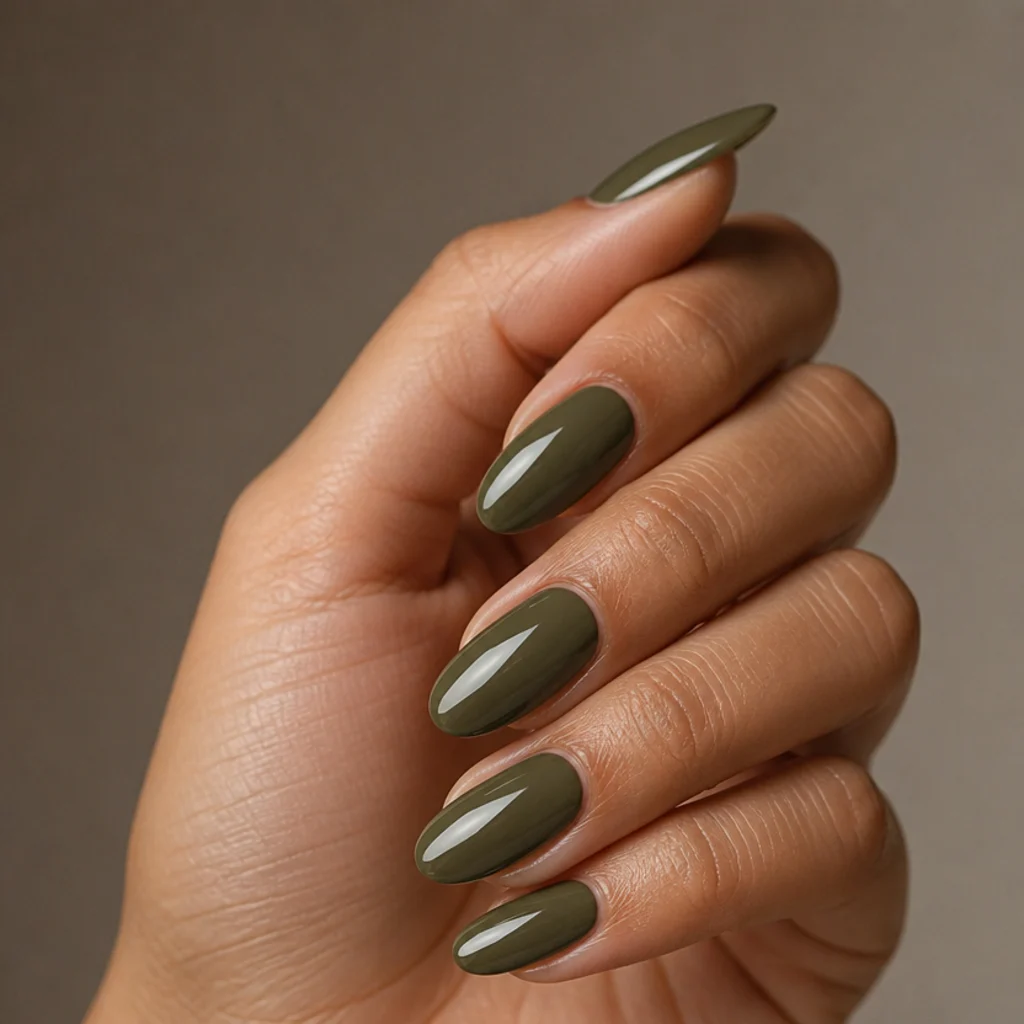
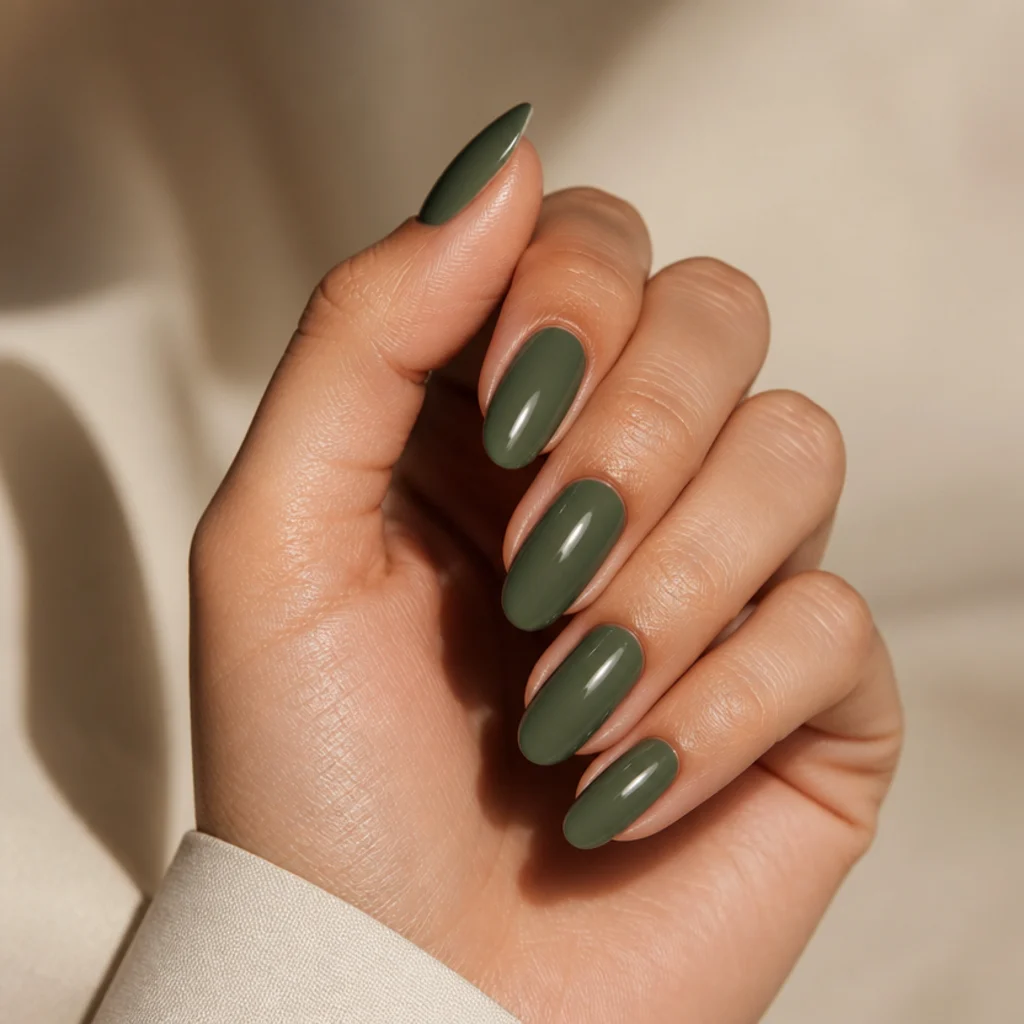
This is the benchmark, and it earns the spot. A saturated olive with a distinct grey undertone (not fern, not khaki-brown) on a medium almond lengthens the fingers and keeps the color grown-up rather than costume-y. It's the single most versatile look here because the grey in the base neutralizes any undertone clash, so it flatters cool, neutral and warm skin equally. The almond shape suits medium to long nail beds; if your beds are very short or wide, a soft almond or squoval keeps the point from looking stubby. Gel or a long-wear lacquer both deliver, and a glass-gloss top coat deepens the pigment until it reads like polished leather. Upkeep is forgiving: the darkness disguises early regrowth, buying close to three weeks before the cuticle gap shows. Pair it with warm gold rings and camel or oxblood knits. Pro tip: apply two thin coats over a pigmented base rather than one thick coat, which streaks and floods the cuticle. Ask your nail tech for a grey-toned true olive at gel depth with a wet-look top.
02Glossy Olive Short Squoval
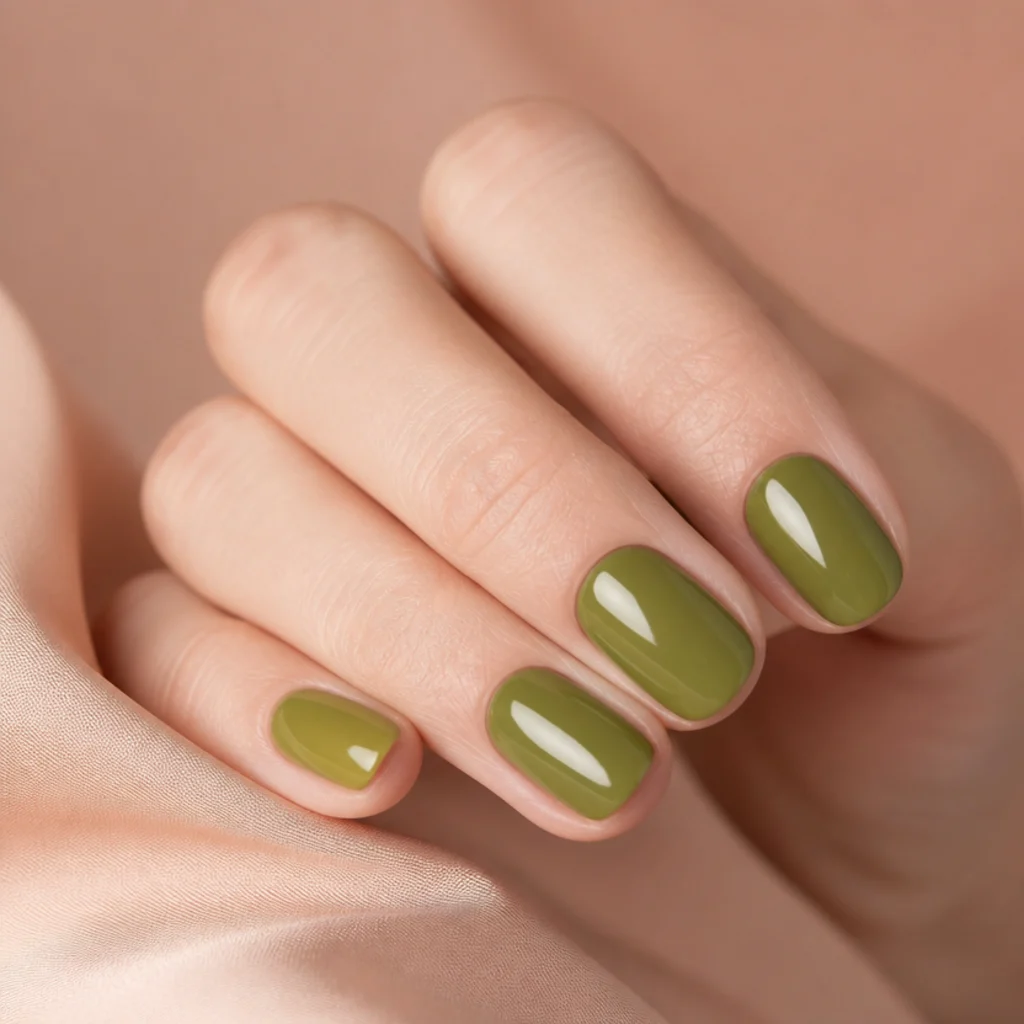
Not everyone wants length, and olive looks just as considered on a short squoval, the soft square with barely rounded corners that reads modern and hard-wearing. The shape is practical for typing, parenting or anyone tough on their hands, and the flat sidewalls resist the snags that catch pointed shapes. On shorter nails a very dark olive can feel heavy, so a mid olive with a touch more yellow-green reads fresher and keeps the hand looking light. This is one of the easiest looks to do well at home: file straight across, round the corners a hair, then one coat of base, two thin coats of color and a generous glossy top. Because the surface area is small, chips read as minor and the manicure comfortably stretches past two weeks. It's the shade to reach for when you want low fuss with a quiet edge. Pro tip: file in one direction only to avoid weakening the free edge. Ask your nail tech for a mid olive squoval kept short, with a high-shine finish.
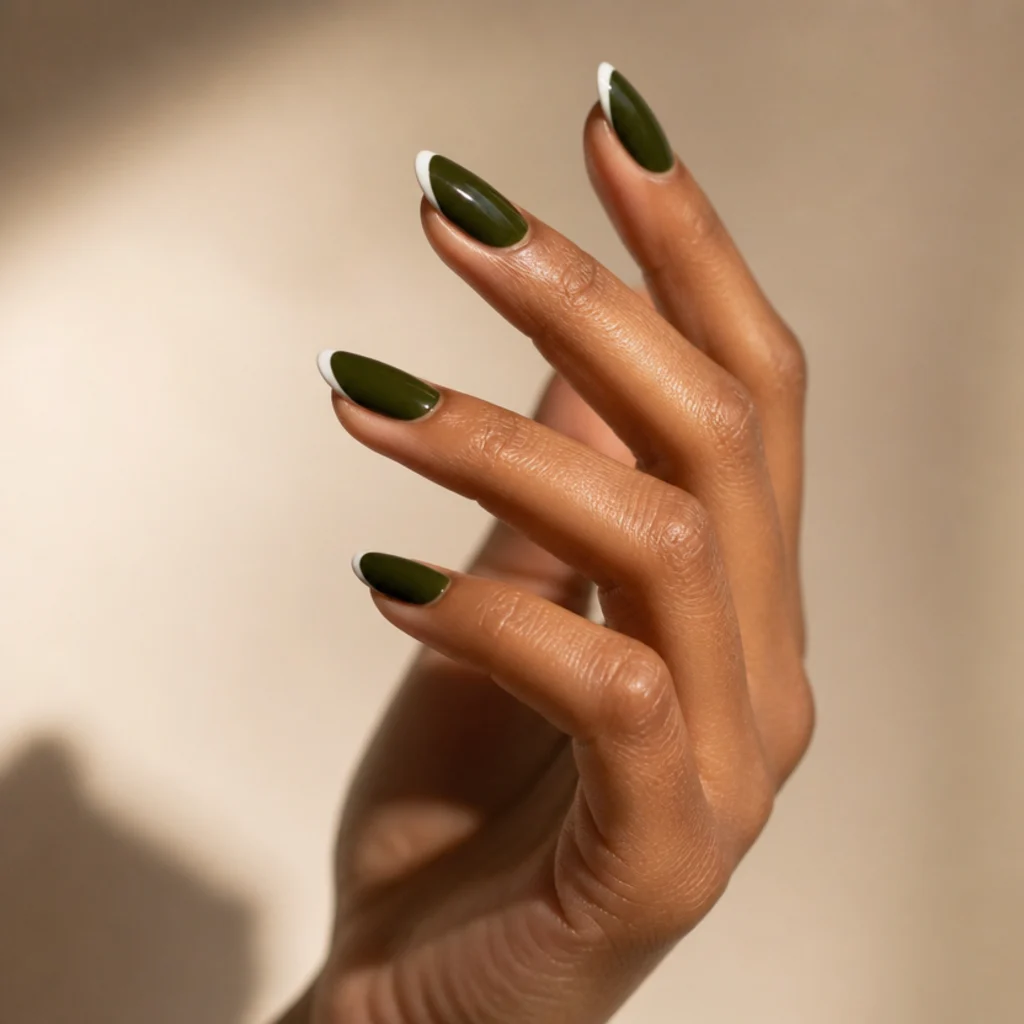
03Olive Green and White French
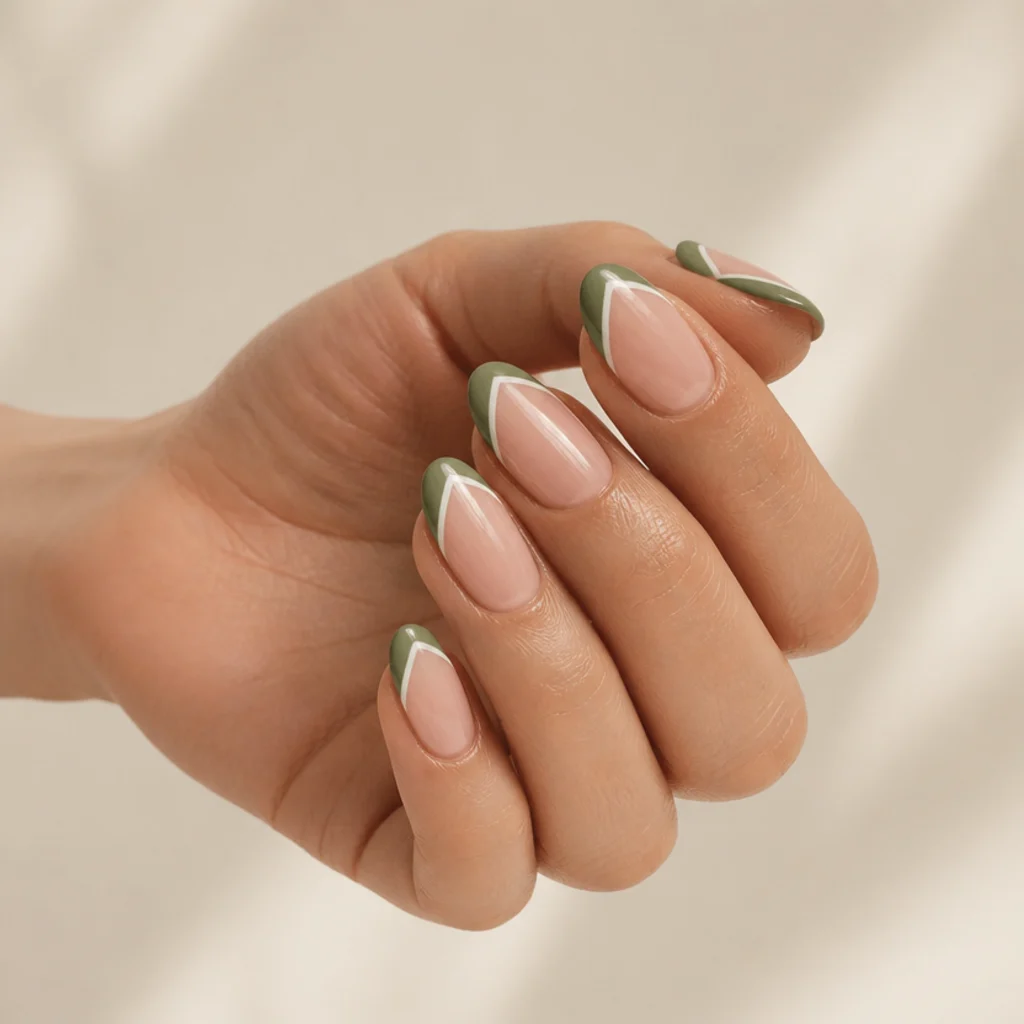
A modern rework of the French that trades the expected pink base for something more unexpected. A crisp white outlines a fine smile line while olive fills the tip, or the two swap so white caps an olive-washed nail. Olive green and white nails feel clean and preppy without being predictable, which is exactly why they photograph so well at weddings and events where you want color that still reads as neutral. The line work is the hard part: a defined micro-French, roughly a third the depth of a chunky retro tip, keeps it elegant and elongating. This suits every length but looks most refined on medium almond or squoval, where the smile line has a graceful curve to follow. Because the base stays neutral, regrowth is nearly invisible, so it wears clean for weeks. Pro tip: use a thin striping brush and paint the smile line first, then fill toward the tip, so any wobble hides under the color. Ask your nail tech for a slim olive tip with a warm-white smile line, not a bright optic white.
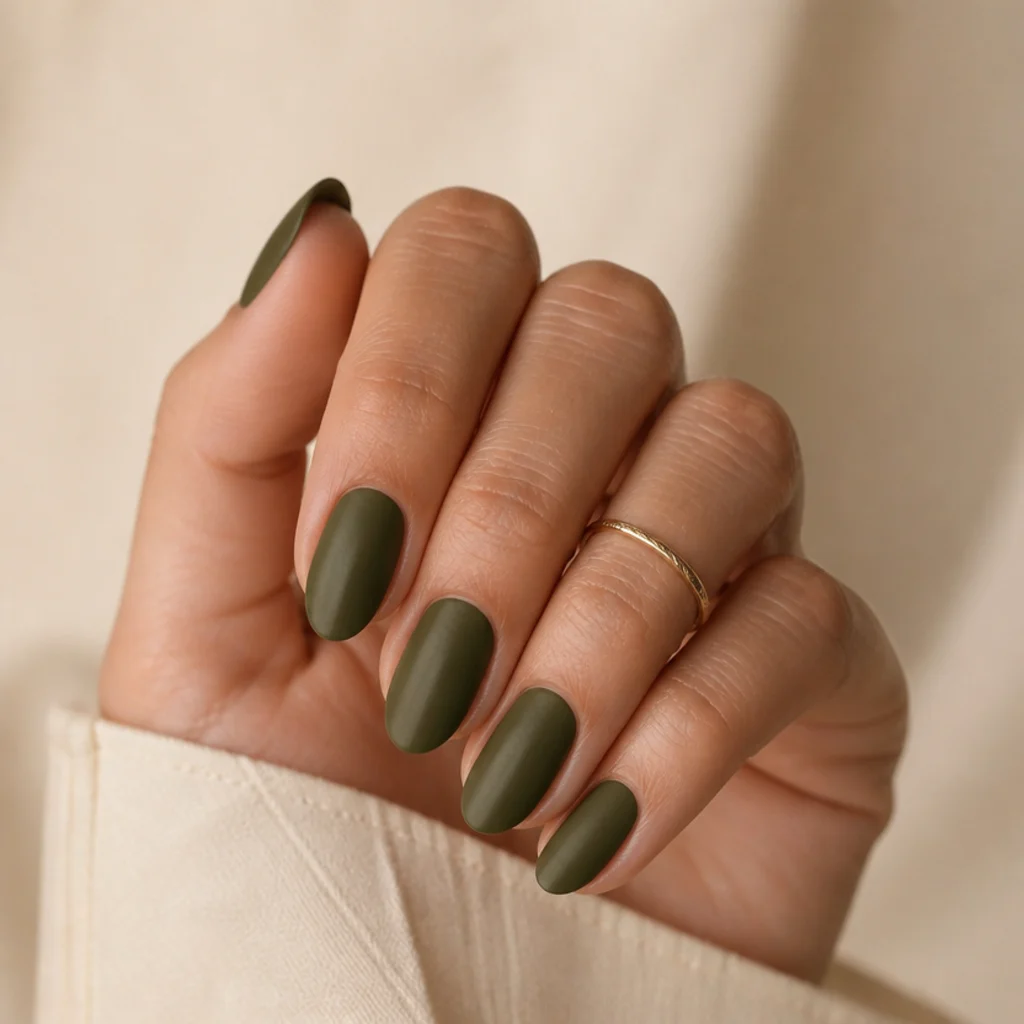
04Matte Army Olive Coffin
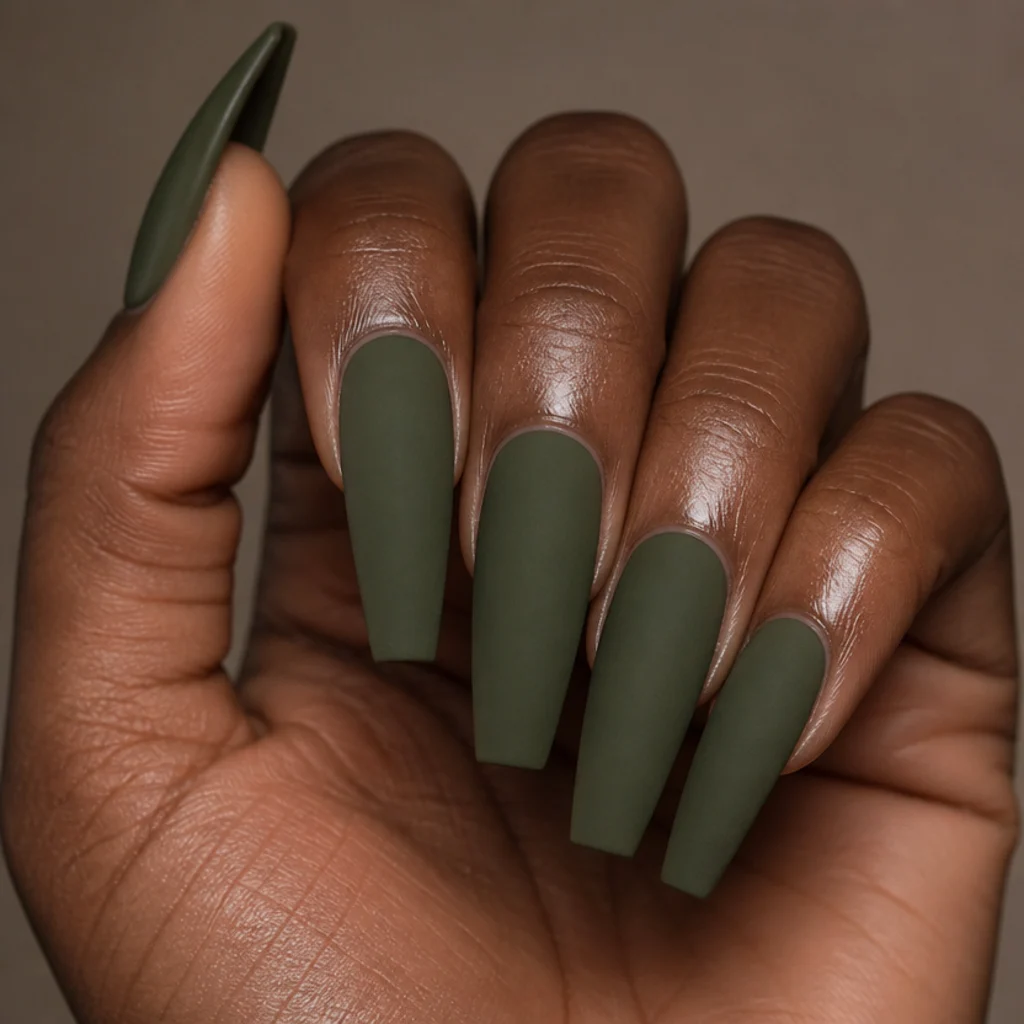
Matte turns olive into something moody and tactile. On a long coffin, a deep army-toned olive under a flat top coat reads almost like suede or brushed felt, and the finish plays up the color's earthy, military roots. This is a statement set for someone who wants their nails to be the main event, and the coffin shape needs a gel or acrylic build for structure, since the tapered tip is otherwise prone to snapping. Matte is higher-maintenance than it looks: it shows dust, fingerprints and oils, so a daily cuticle oil routine keeps the surrounding skin from reading dry against the flat color. Style it with black, olive tailoring or heavy silver jewelry for an editorial edge. Pro tip: apply cuticle oil to the skin, not the plate, and buff it in, because oil on a matte top coat leaves shiny patches. Ask your nail tech for a matte deep-army olive on a coffin build, and bring a photo, since matte shades shift more between brands than any other finish.
05Light Olive Sage Wash
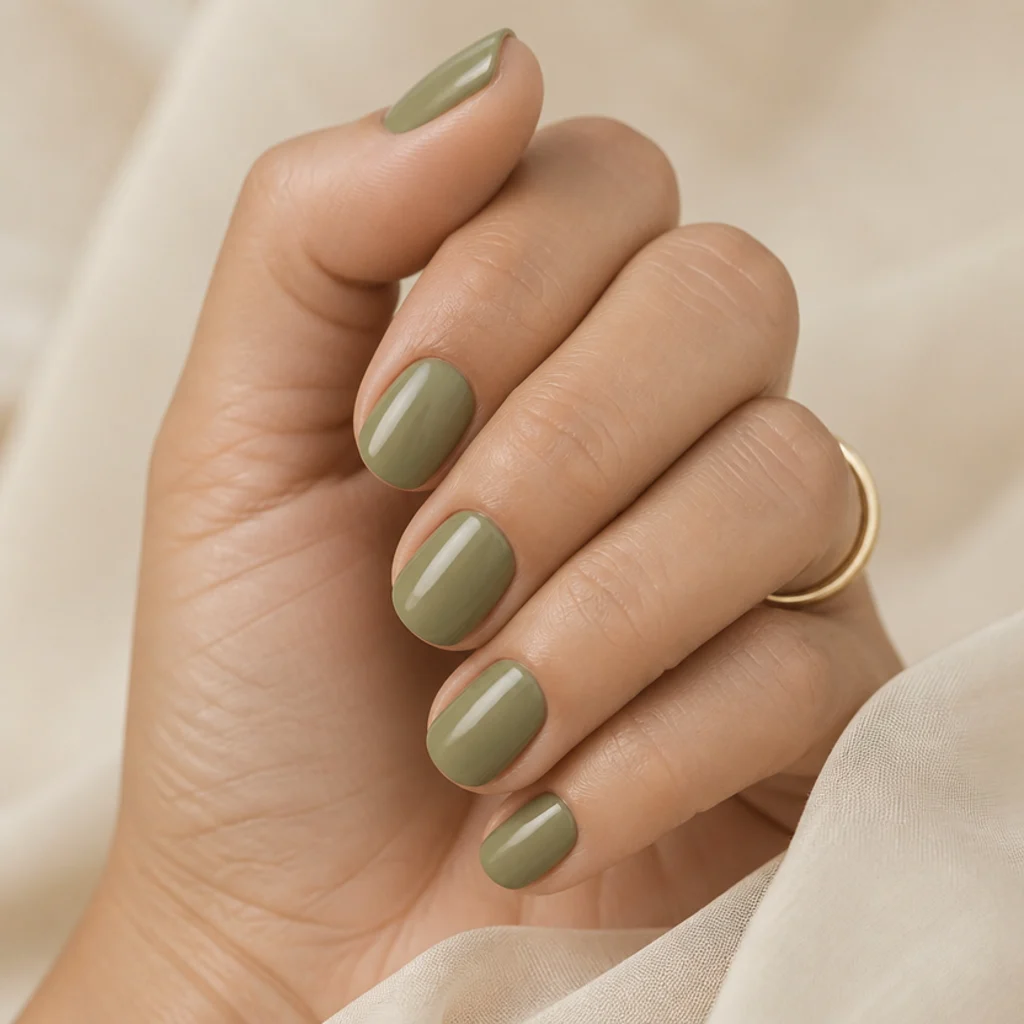
At the palest end of the family, light olive green nails drift toward sage and dusty eucalyptus. This is the softer, more romantic cousin of the deep army shade, and it rescues anyone who finds dark colors overwhelming on shorter nails. The greyed-down green feels spa-like and calm, pairing beautifully with gold jewelry, linen and warm-weather dressing. Coverage is the real challenge here: pale greens are low-pigment, so they often need three thin, patient coats to avoid a patchy, streaky finish, and rushing the layers is the usual culprit behind bald spots at the free edge. It works on any shape but feels most serene on a short round or soft almond. Pro tip: float each coat and let it self-level rather than brushing back over a tacky layer, which drags pigment and causes streaks. Ask your nail tech for a sage or dusty olive, specifically not a bright pistachio, which reads much younger and more playful than this quiet, sophisticated wash.
Save this to Pinterest to keep your five favorite olive tones in one place.
06Olive Chrome Mirror Tips
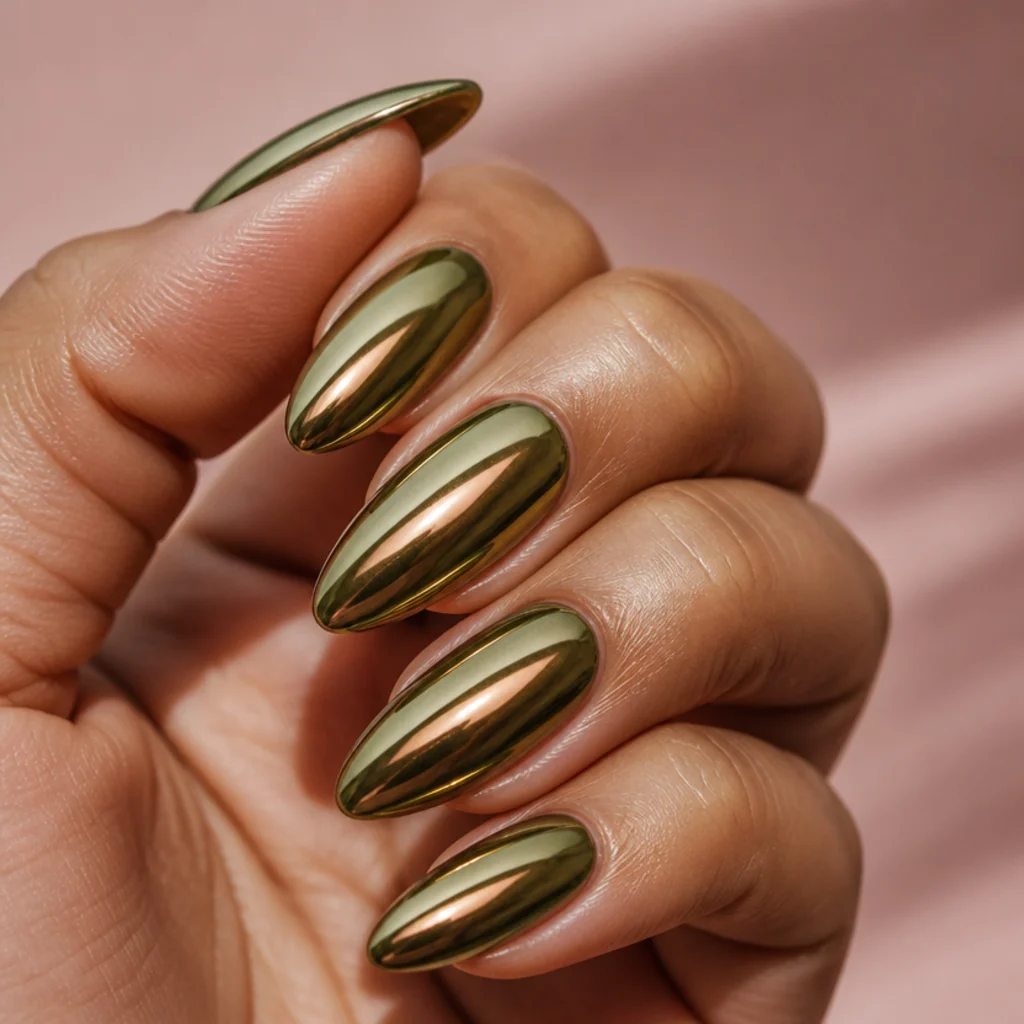
Chrome powder turns olive into a liquid-metal moment. Buffed over a cured olive gel base and sealed with a no-wipe top coat, the mirror finish throws a greenish-bronze shimmer that travels across the nail as your hand moves. It's a high-impact, editorial look for anyone who wants a futuristic edge on an otherwise grounded shade. This is a salon technique in almost every case, because the powder must be rubbed into a fully cured, sticky-free gel and then locked under an even top coat, and any unevenness there dulls the shine or leaves cloudy patches. The finish is also sensitive to harsh cleaners and hot water, which fog the mirror over time. Pro tip: wear gloves for dishes and cleaning to protect the reflective layer, and reserve chrome for a two-week event window rather than expecting a month. Ask your nail tech for a warm or bronze-leaning chrome over olive rather than a silver chrome, which cools the color and mutes its natural warmth.
07Olive Acrylic Long Stiletto
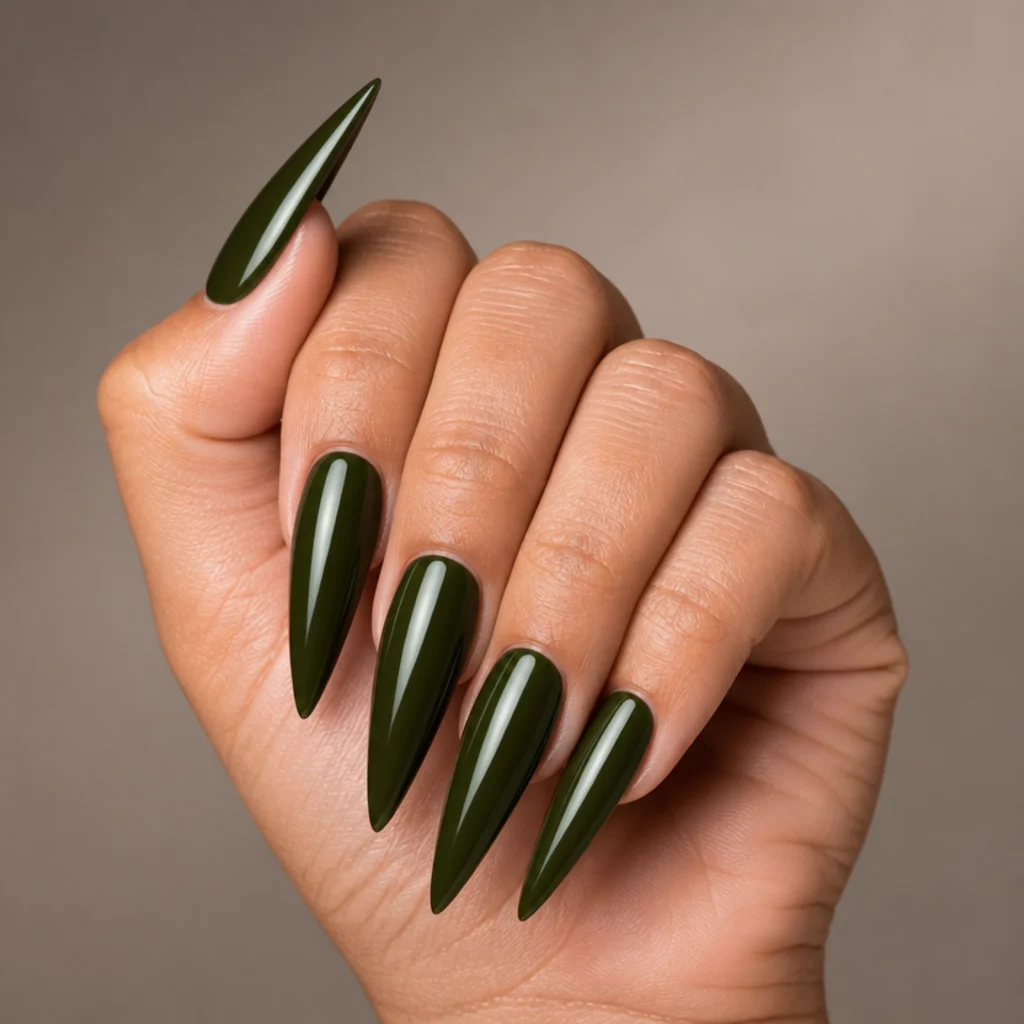
For maximum drama, olive green acrylic nails on a long stiletto deliver sharp, high-fashion lines. The pointed shape elongates dramatically and gives deep olive room to look almost gemstone-like under gloss. Acrylic is the right structure at this length, because it's harder and more shatter-resistant than gel-only builds and can be sculpted with an apex that supports the extreme point. Commit knowingly: everyday tasks get fiddly, the tips catch on hair and fabric, and the fine points are the first thing to snap. Fills every two to three weeks keep the shape clean and the color uninterrupted at the cuticle. Style it with all-black or a single statement ring so the nails stay the story. Pro tip: ask for the apex built slightly thicker and the points reinforced so the tips resist flexing and breaking. Ask your nail tech for a sculpted stiletto in a deep glossy olive, and bring reference for both the length and the exact depth, since brand-to-brand olive varies more than most colors.
08Olive and Gold Foil Accent
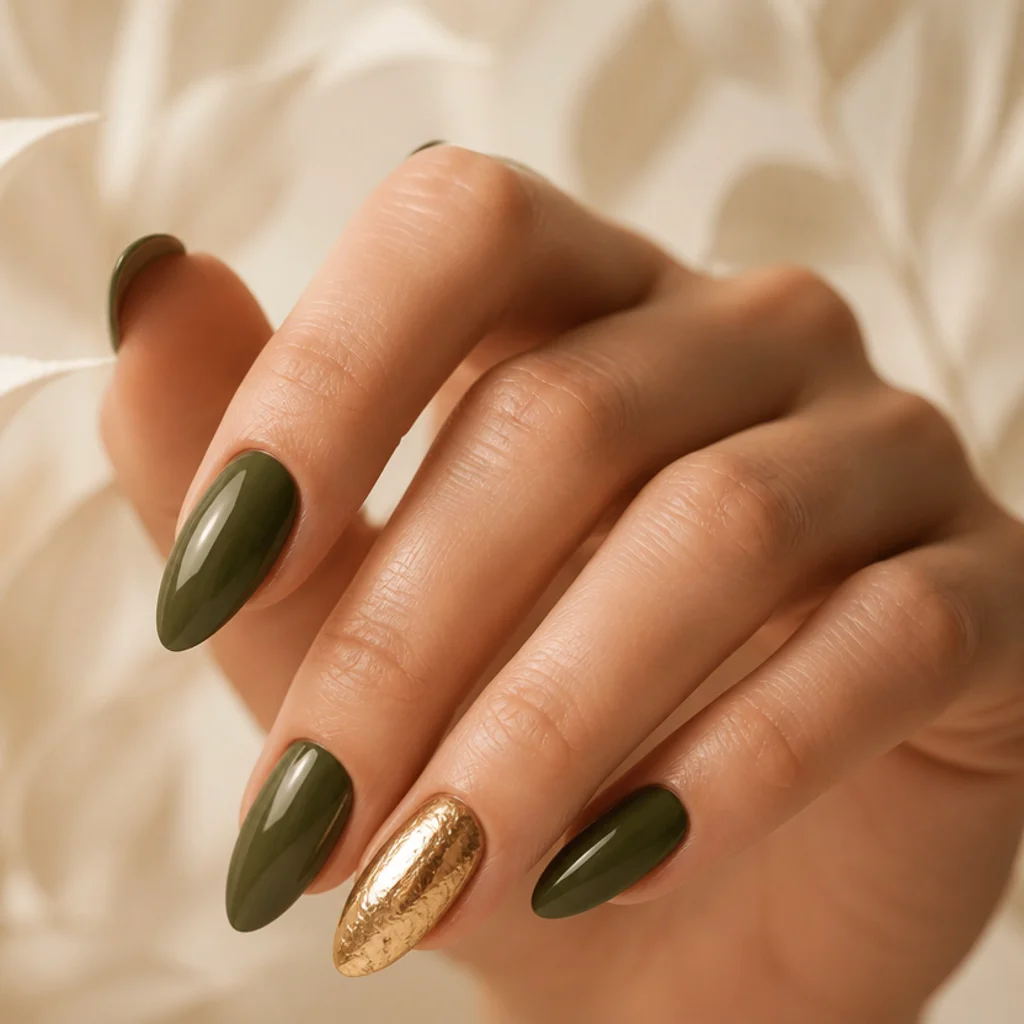
Gold and olive are a natural pairing, the same way brass and sage look right together in a room. Here a base of solid olive is lifted by a single accent nail flecked with hammered gold foil, giving an antique, treasure-like quality. Restraint is what keeps it looking expensive: one foiled nail per hand, not all ten, so the metal reads as a jewel rather than glitter. It suits anyone who wants a touch of glamour without full sparkle, and it photographs beautifully under warm event lighting. Foil is fiddly, since the flakes cling to a tacky gel layer and then need burnishing flat, so this leans salon or confident DIY, and the raised texture wants a thick, self-leveling top coat to seal smoothly and prevent lifting at the edges. Pro tip: press foil down with a silicone tool rather than a fingertip to avoid fingerprinting the metal. Ask your nail tech for warm yellow-gold foil, not rose or silver, over a mid-to-deep olive so the contrast stays crisp.
09Olive Marble Swirl
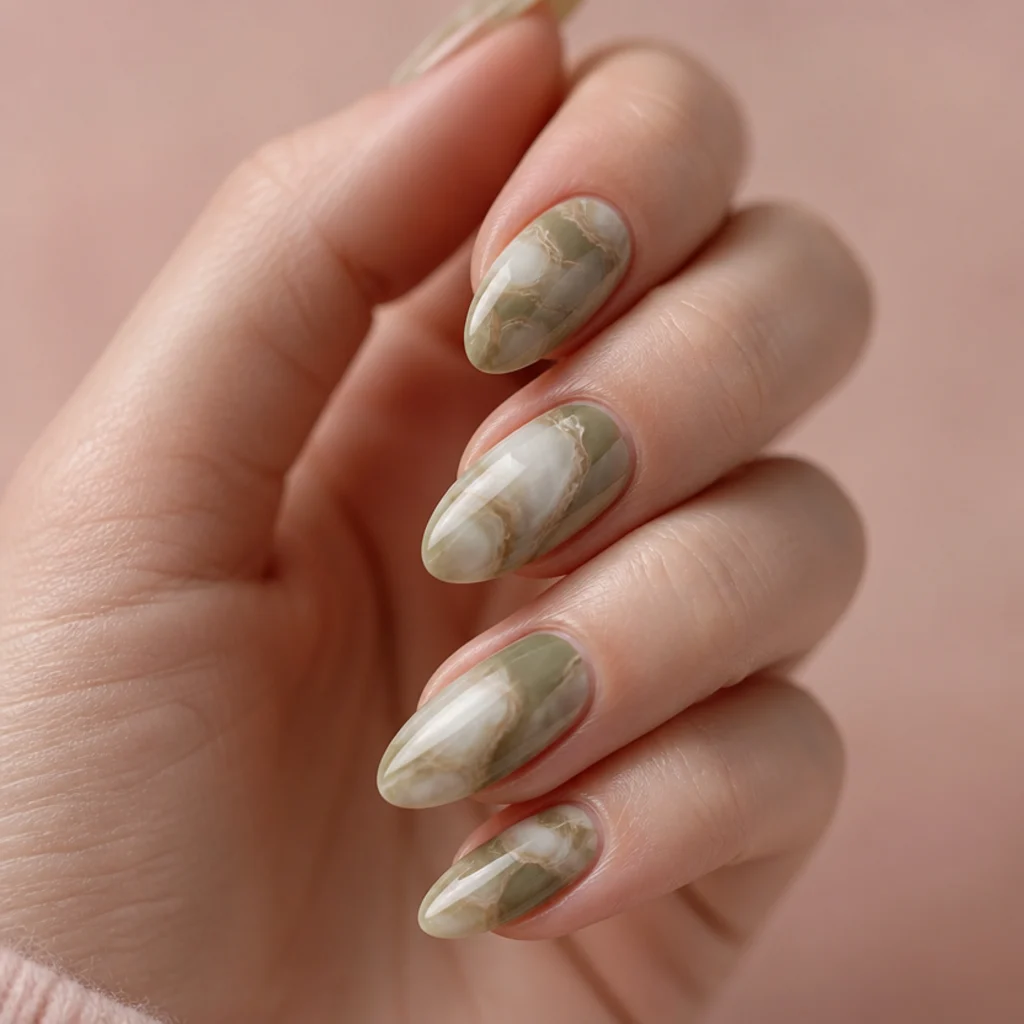
Marbling gives olive an organic, stone-like softness that never repeats twice. Wispy veins of deeper olive and cream drift across a muted green base, mimicking real marble or agate, and the blended pattern conveniently hides small application imperfections. This is a dreamy, artful choice for anyone who loves detail without loud color. Technique-wise, it's advanced: the veins are usually dragged with a fine brush or a needle through a wet top-coat layer, or floated in gel and pulled before curing, so timing and a light hand matter and it belongs with a skilled tech. It reads most balanced on medium almond or squoval, where there is room for the veining to develop without crowding. Pro tip: request low-contrast marble (olive-on-olive with just a whisper of cream) if you want it to stay soft and wearable rather than busy. Ask your nail tech for a subtle stone-marble in olive and cream, and specify the veins fine and sparse, since heavy veining tips the look from agate toward camouflage.
10Olive Green Ombre Fade
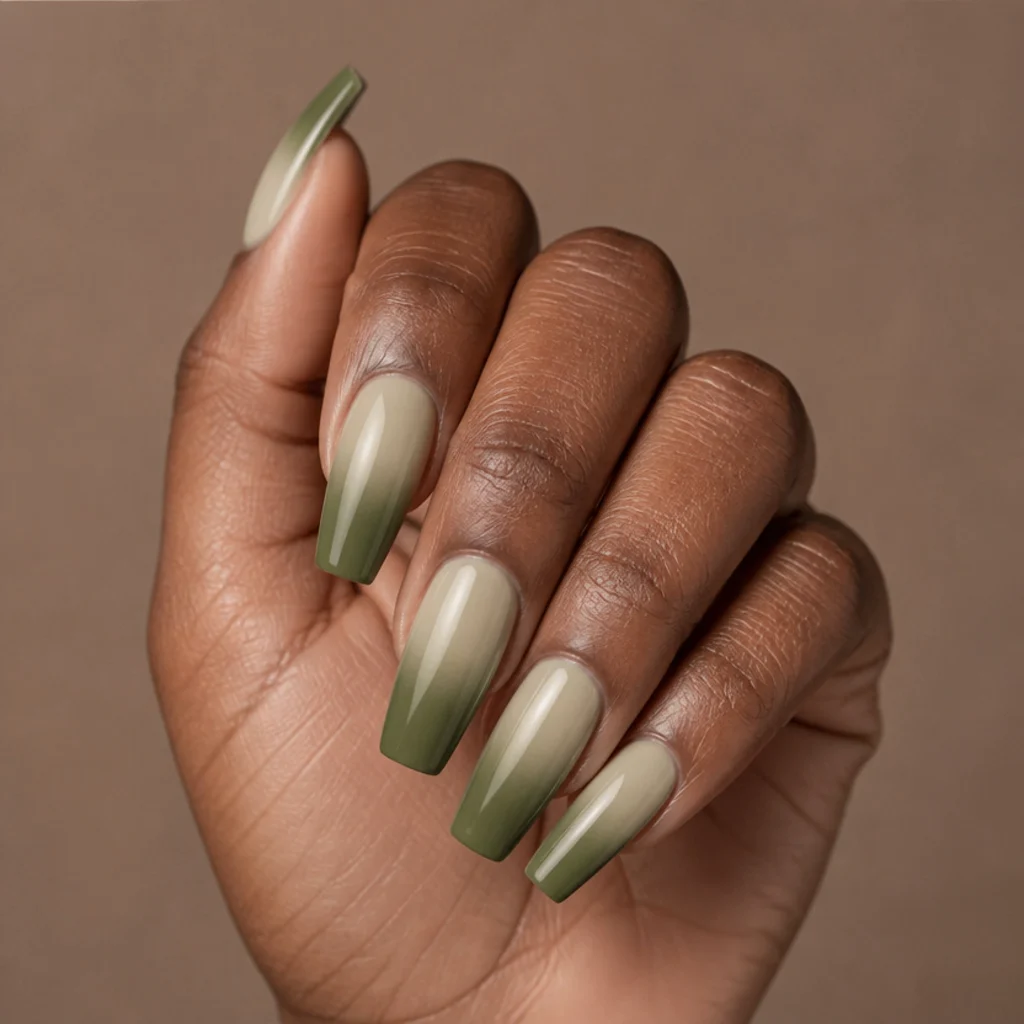
An ombre lets you wear both ends of the olive spectrum on a single nail. A soft cream or pale sage at the cuticle melts into deep olive at the tip, giving dimension flat color can't. The gradient flatters longer shapes like coffin and almond, where the fade has length to develop gradually rather than reading as an abrupt two-tone. Sponged ombre is doable at home with patience, dabbing a makeup sponge and building the blend in layers, though the smoothest results come from a salon airbrush or careful gel work. Maintenance is kind here, because the lighter cuticle area disguises regrowth almost completely, often stretching a set past three weeks. Pro tip: keep the transition zone wide and centered on the nail, and re-sponge two or three passes for a fog-soft blend rather than a hard line. Ask your nail tech for a cuticle-to-tip light-to-dark olive fade with a wide blend zone, and specify the direction, since reversing it puts the drama at the base instead of the tip.
Save this to Pinterest and tag the ombre for your next fill.
11Tiny Olive Daisy Florals
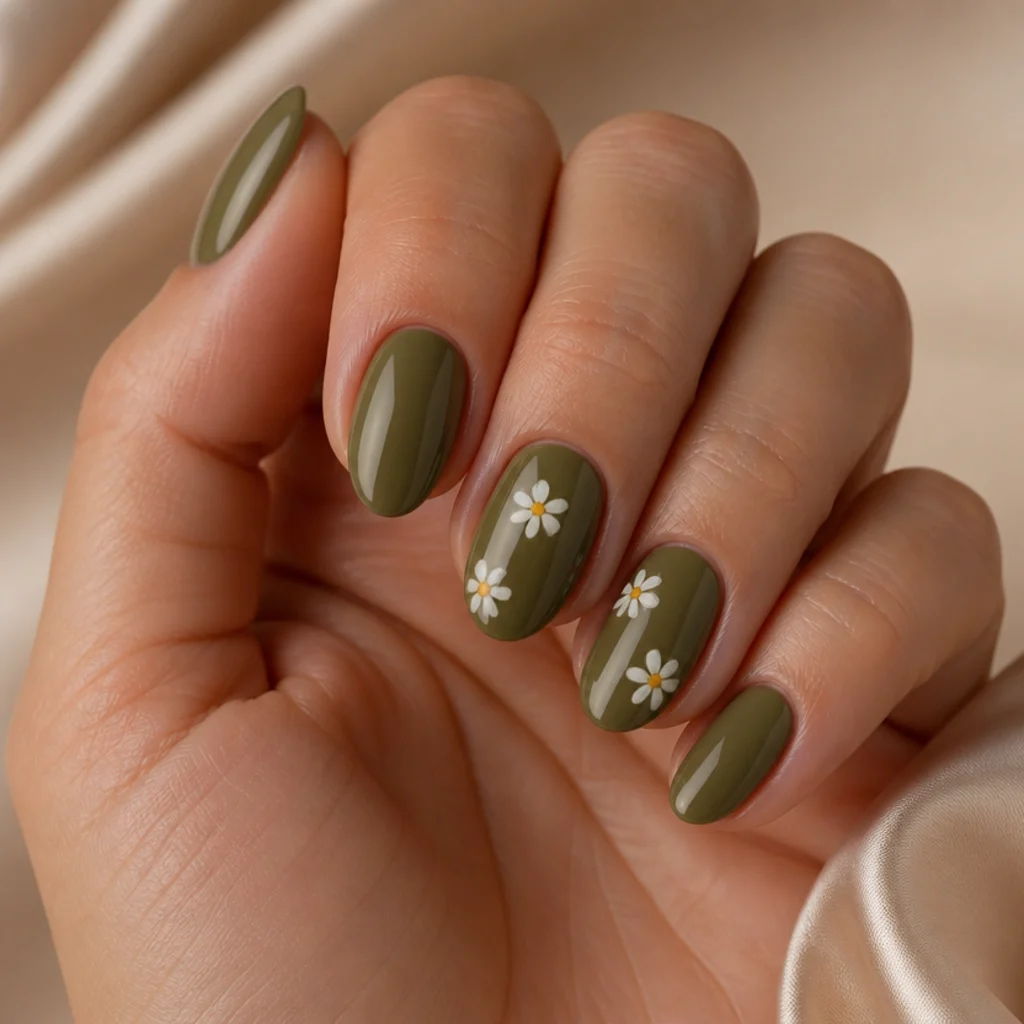
Florals keep olive feeling fresh and garden-inspired rather than heavy. Against a solid olive base, scattered micro-daisies with white petals and a small golden center bring hand-painted, cottage-y charm, and the crisp white on earthy green is what makes the tiny flowers pop. This suits anyone who loves detail and a softer, whimsical mood, and it peaks in spring and summer. Hand-painted florals are a real skill, so unless you're confident with a fine detail brush and a dotting tool, book a tech who shows nail art in their portfolio. Placement is what keeps it elegant: one or two accent nails in florals with the rest solid olive reads intentional, while daisies on all ten quickly looks busy. Pro tip: paint five tiny petal dots around a center dot, then add the golden middle last so it stays clean and un-muddied. Ask your nail tech for micro-daisies on one accent nail per hand, kept small rather than large blooms, to hold the delicate feel.
12Olive and White Checkerboard
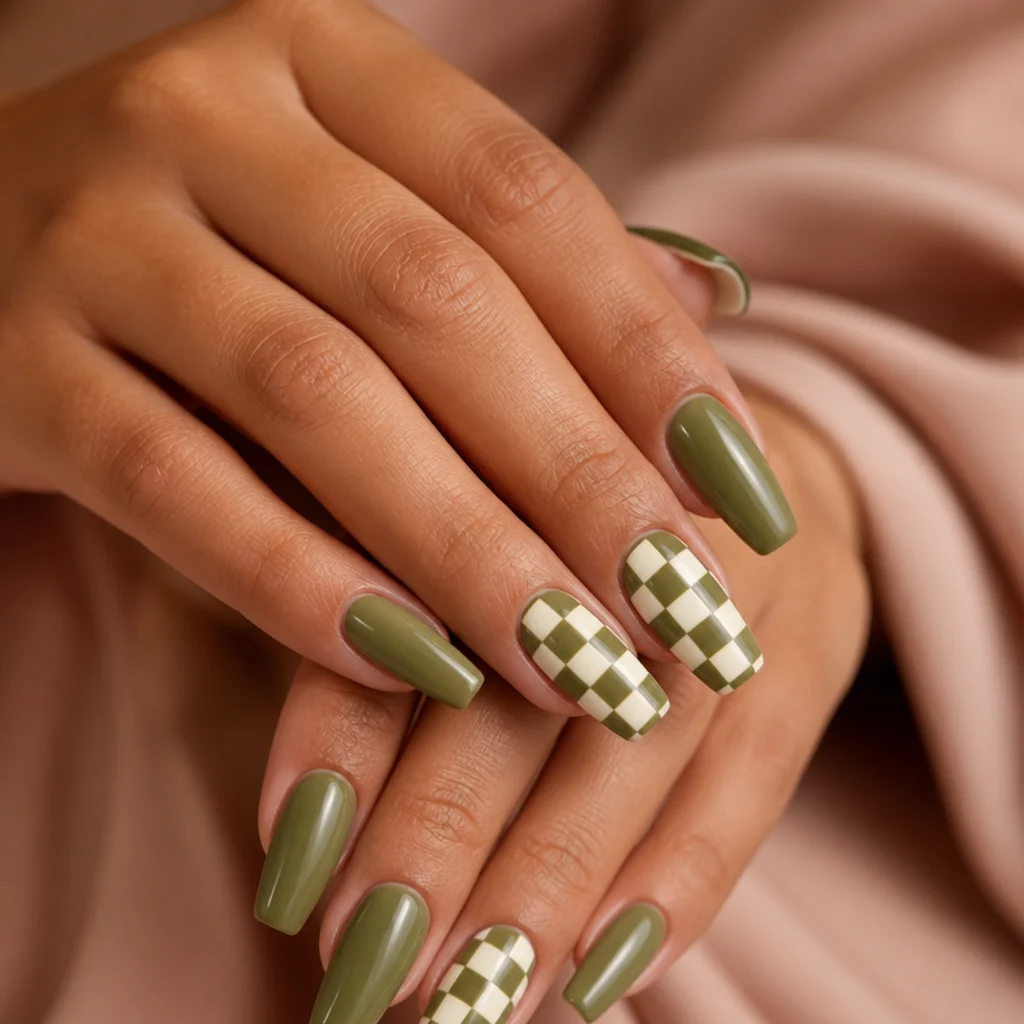
A checkerboard turns olive green and white nails into a graphic, retro-cool statement. The tidy grid feels playful yet controlled, and a deep enough olive gives strong contrast against the white squares. This suits anyone drawn to bold pattern who still wants an earthy, non-neon palette. Precision is everything: the crisp lines usually come from striping tape or a steady detail brush, and freehanding a true right-angle grid is harder than it looks. To keep it from overwhelming the hand, many people wear checkerboard on one or two accent nails and leave the rest solid olive or warm white. Square size changes the whole read, so decide before you book. Pro tip: lay the horizontal lines first and let them fully cure before adding verticals, so the tape does not lift the base color and smear the grid. Ask your nail tech for a fine check on accent nails, since a small grid reads elegant while a large one leans casual and youthful, and finish glossy so the pattern reads smooth, not choppy.
13Deep Olive Velvet Cat-Eye
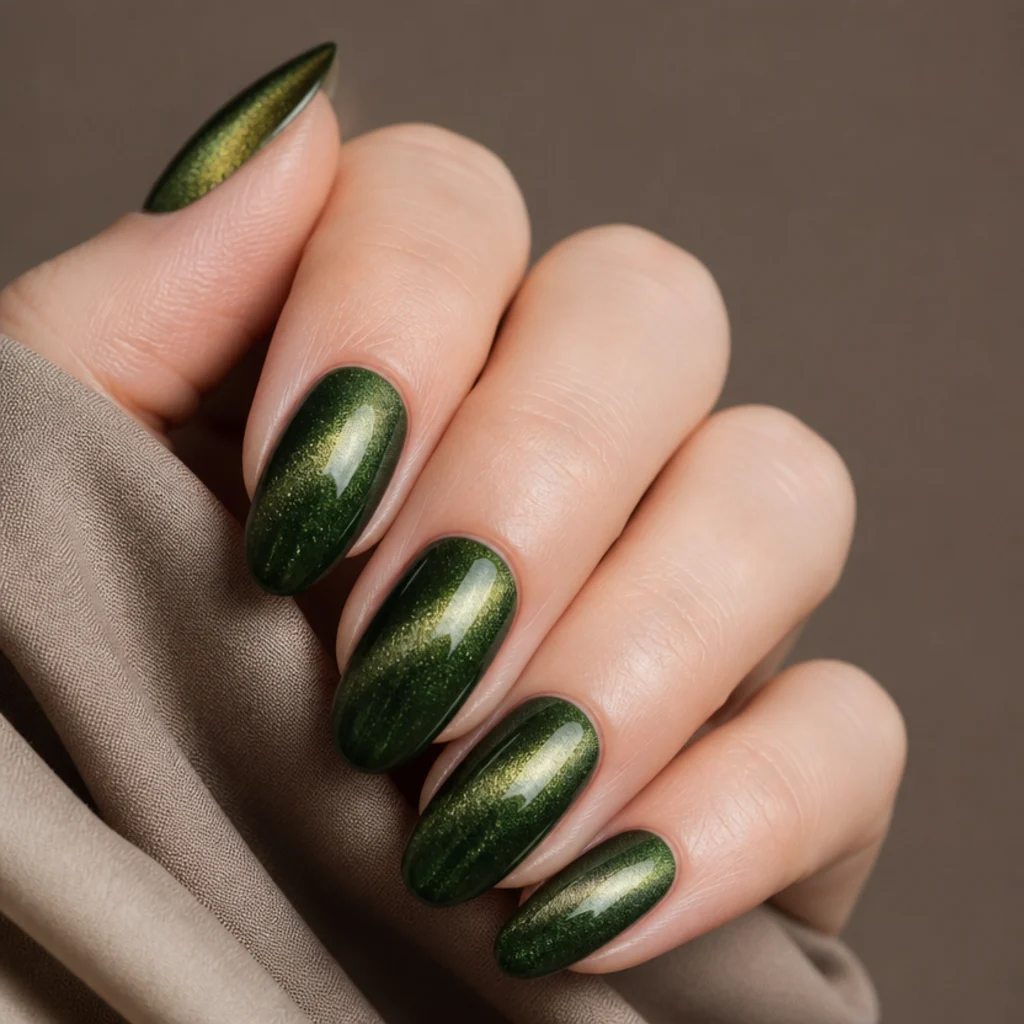
The magnetic cat-eye gives olive a plush, velvety band of light that appears to move. Using a magnetic gel loaded with fine metallic particles, the tech holds a magnet over the wet coat to pull the shimmer into a soft stripe or diagonal, so the nail looks lit from within, almost like tourmaline or cat's-eye chrysoberyl. It's a salon look because it needs the specific magnetic gel and magnet, and the result hangs entirely on where the tech places the light band. It suits anyone who wants dimension and shine without full chrome or glitter, and the effect deepens beautifully on a rich olive. Pro tip: a curved or diagonal light band flatters and lengthens the hand more than a flat horizontal stripe, and placing it slightly off-center reads more natural. Ask your nail tech for a diagonal or curved cat-eye over deep olive with a clean glossy top, and keep the rest of the set simple so the moving shimmer stays the focus.
14Olive Green Almond with Gold Line
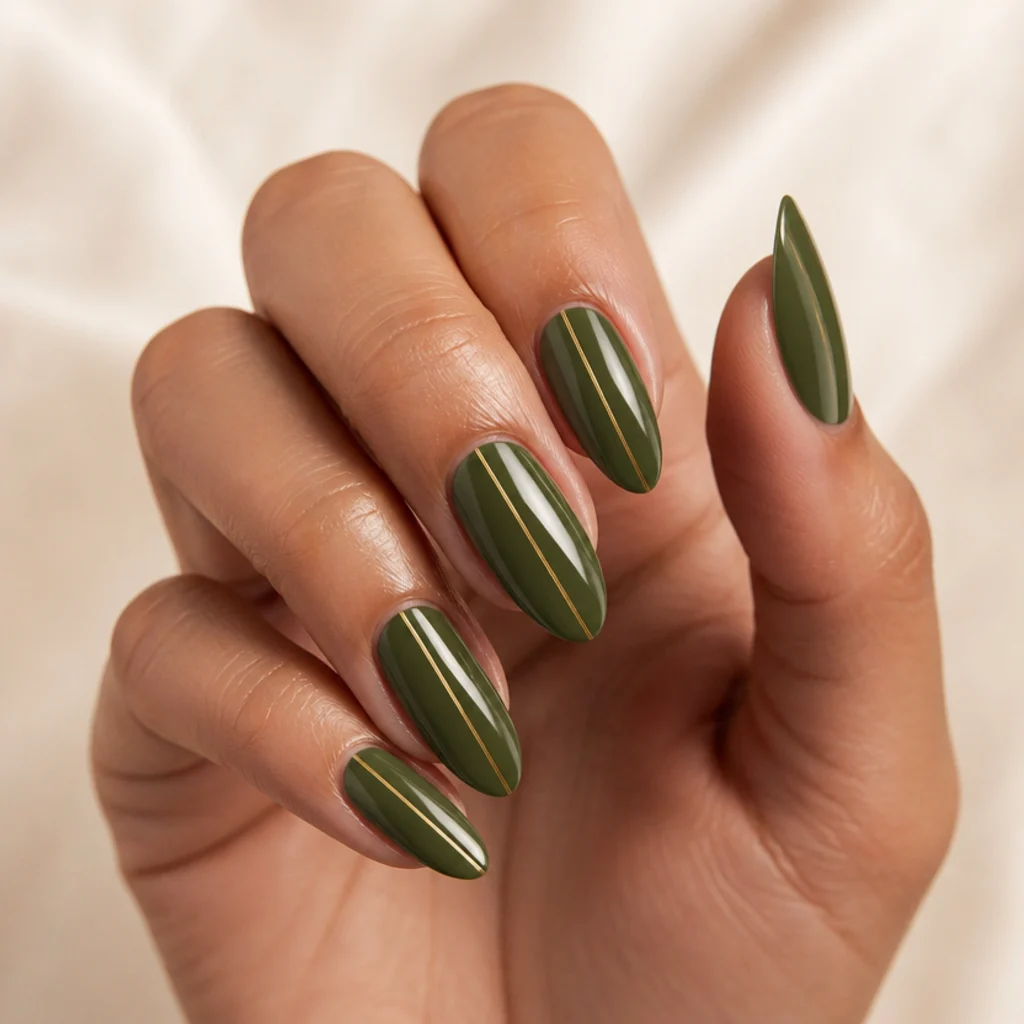
Minimalists, this is your olive. A clean almond in deep olive gets one hairline of gold running vertically down the center or along the cuticle, and that single detail lifts the whole set. Olive green almond nails already read polished, so the thin metallic accent adds just enough interest to feel designed rather than plain, and it stays appropriate at a meeting, a dinner or a wedding. The line is delicate but far more forgiving than florals: a striping brush or a length of thin tape makes it achievable at home with a steady hand. Because the accent is small, regrowth stays quiet and the set wears clean. Pro tip: pull the line in one continuous stroke from cuticle to tip rather than dabbing, and seal it under top coat the same session so the metallic doesn't lift or tarnish. Ask your nail tech for a single warm-gold hairline, not a chunky stripe, on all nails or just the accents, over a deep glossy olive.
15Sheer Olive Jelly Tint
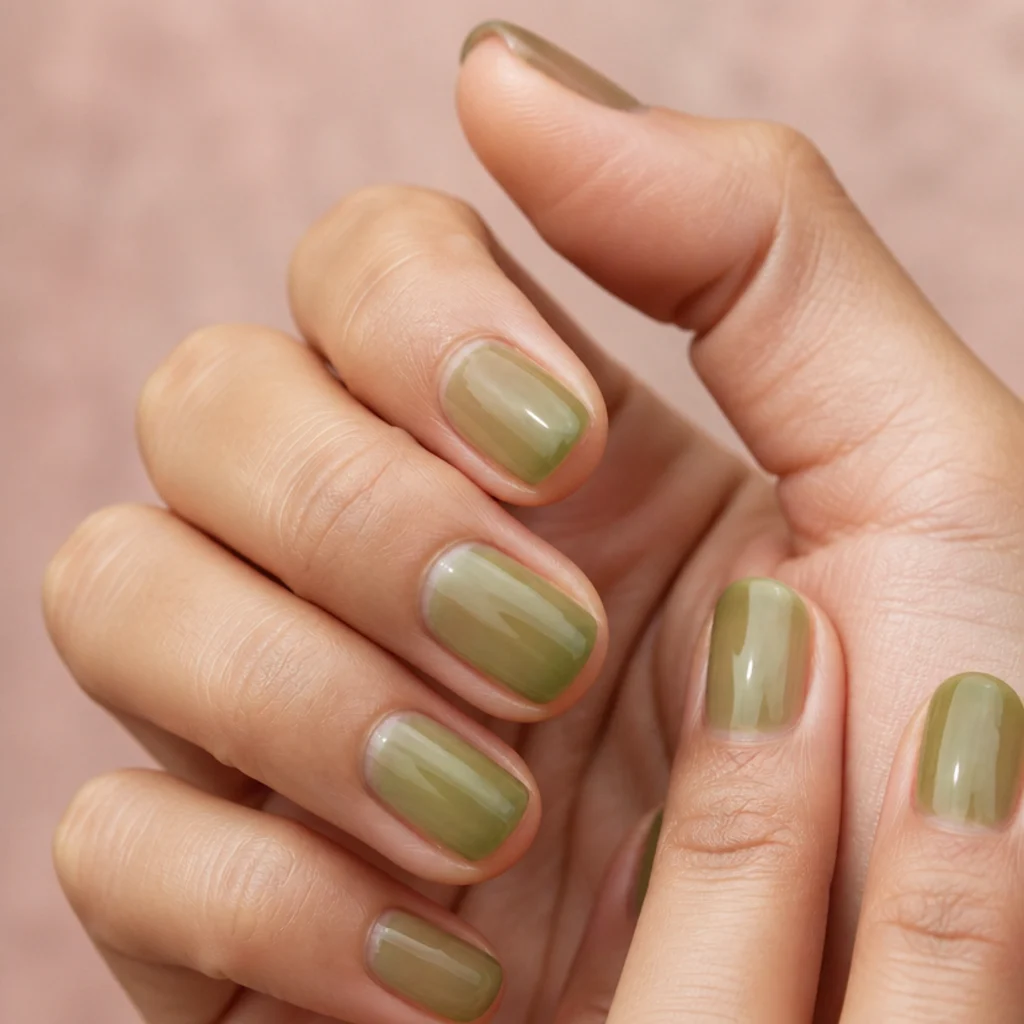
Jelly finishes give olive a translucent, stained-glass quality that feels light and modern. Instead of full opacity, a sheer olive tint lets some of the natural nail read through, creating a fresh, barely-there wash of color that suits anyone who finds solid dark shades too intense. It's also forgiving of regrowth, since the transparency blurs the cuticle line as it grows. Jelly formulas build gradually, so expect two or three sheer coats to reach your preferred depth without tipping opaque, and the look is best on healthy natural nails because the finish reveals whatever is underneath, including ridges or discoloration. Pro tip: buff the natural nail smooth and even first, and skip a white ridge-filler base, which kills the see-through glow that makes jelly special. Ask your nail tech for a jelly or sheer-build olive rather than a standard cream formula, and keep it on short round or squoval nails, where the translucent effect stays delicate and easy to wear day to day.
Save this to Pinterest before you lose track of the jelly formula.
16Olive and Cream Color Block
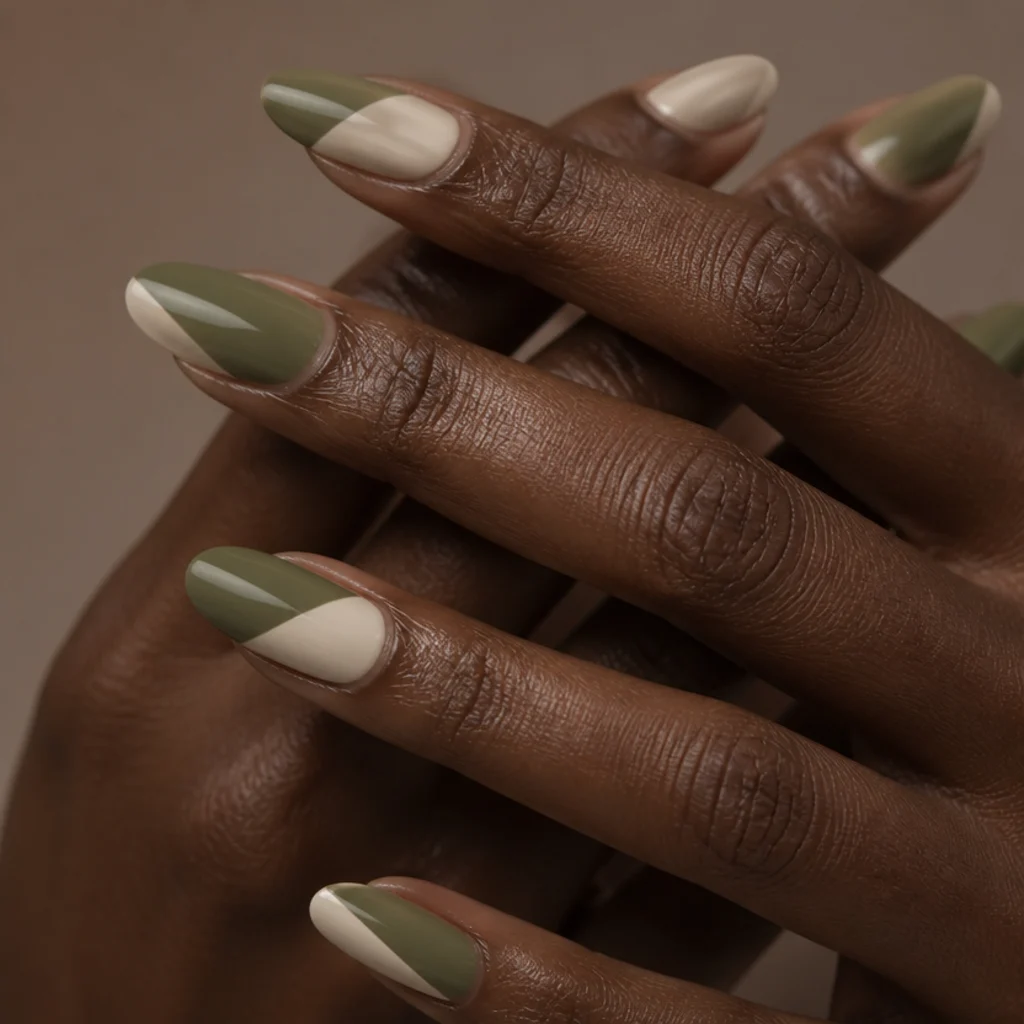
Color blocking pairs olive with soft cream in clean, geometric halves. The tidy division, whether horizontal, diagonal or a curved sweep, feels contemporary and gallery-worthy, and the cream warms olive so the contrast stays gentle rather than stark. That softness is what keeps it wearable for work while still feeling designed. The crisp boundary is the technical part, best cut with tape for a razor-sharp edge, so it lands intermediate to advanced. Varying the block placement across the five nails, some horizontal, some diagonal, keeps the set from looking uniform and adds an editorial touch. Pro tip: press the tape edge down firmly and paint away from it, not toward it, so color doesn't bleed under the line, and peel the tape while the polish is still wet for the sharpest edge. Ask your nail tech for a warm cream rather than stark optic white to complement olive's earthiness, and finish with gloss to smooth any slight ridge where the two colors meet.
17Olive Green Aura Glow
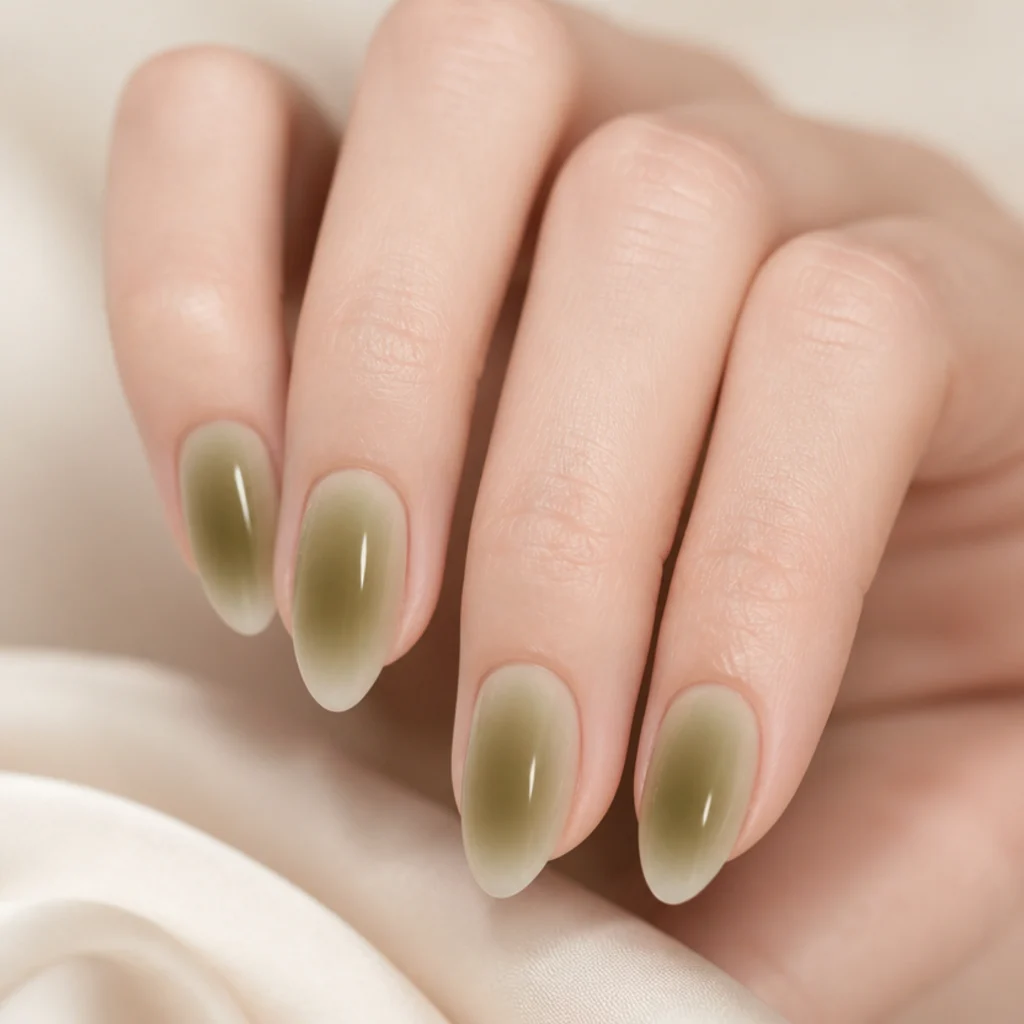
The aura trend gives olive a soft, glowing halo that radiates from the center of the nail outward. A blurred circle of deeper or lighter olive floats on a contrasting base, creating a dreamy, backlit effect that feels more atmospheric than solid color. It suits anyone who loves the airbrushed, ethereal aesthetic. Auras are usually airbrushed or sponged in a salon for that smooth glow, though patient DIYers can approximate it with a small makeup sponge, dabbing the halo and fading the edges. The blurred boundary forgives small mistakes, which is part of the appeal. Pro tip: build the glow in thin, dabbed layers from the center out and stop before it reads as a hard dot, since the magic is in the soft, undefined edge. Ask your nail tech for a tonal aura, deep olive glowing on lighter olive, for a cohesive look, or a whisper of gold at the center for warmth, and finish high-gloss to amplify the lit-from-within quality.
18Olive Croc-Print Statement
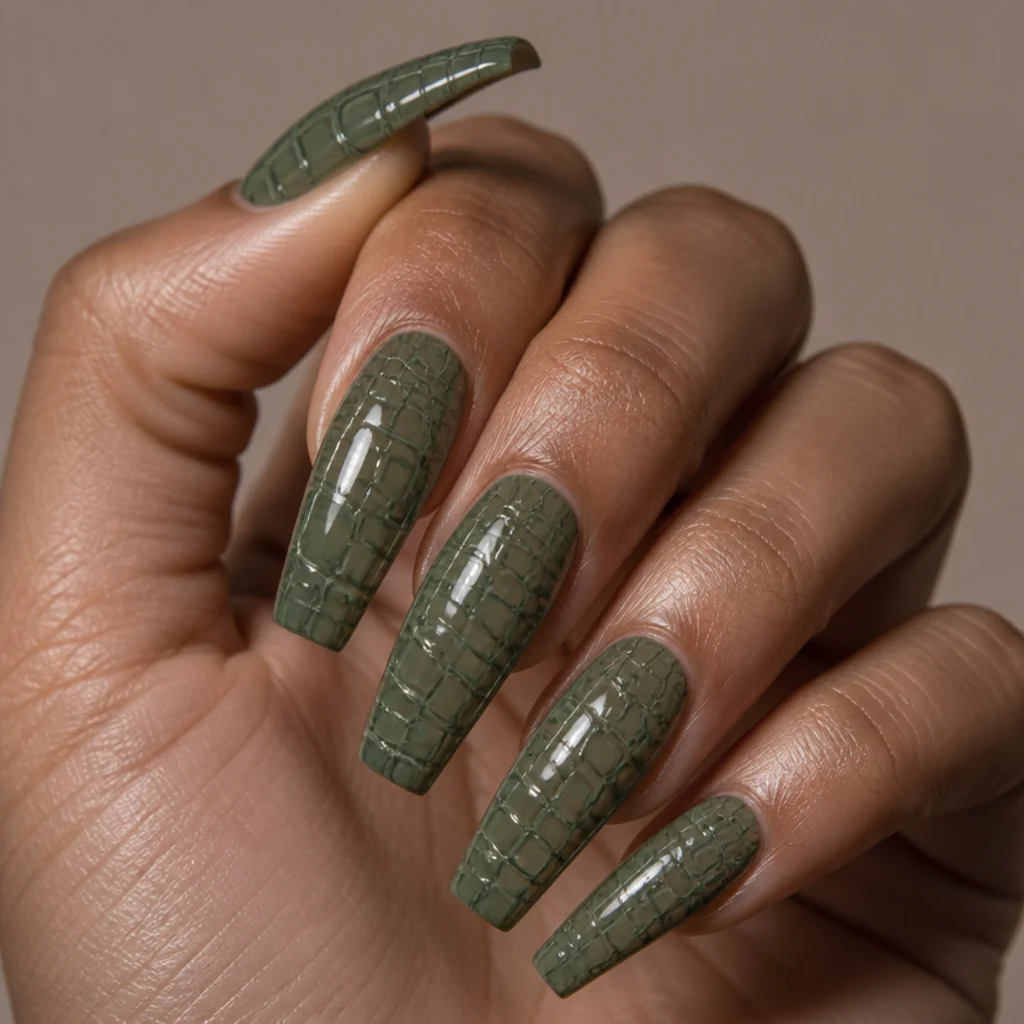
Animal-inspired texture pushes olive into bold, fashion-forward territory. A crocodile or reptile print, built from tonal olive shades and fine detailing, gives the nails a luxe, leather-goods feel for anyone who wants a true statement set. The tone-on-tone approach is what keeps it sophisticated rather than loud, because the pattern reads as texture more than color contrast. This is detailed work, usually created with a stamping plate or careful hand-painting over a base shade, so it belongs in a salon chair. It looks most impactful on longer coffin or square nails, where the print has room to show its scale. Pro tip: keep the croc cells small and irregular, since oversized, uniform cells read cartoonish instead of leather-luxe. Ask your nail tech for a subtle tonal croc in olive shades rather than high-contrast, which keeps it elegant. A glossy top coat heightens the patent-leather effect, while a satin finish leans matte-suede, so name the finish you want when you book.
19Olive Green Micro-French
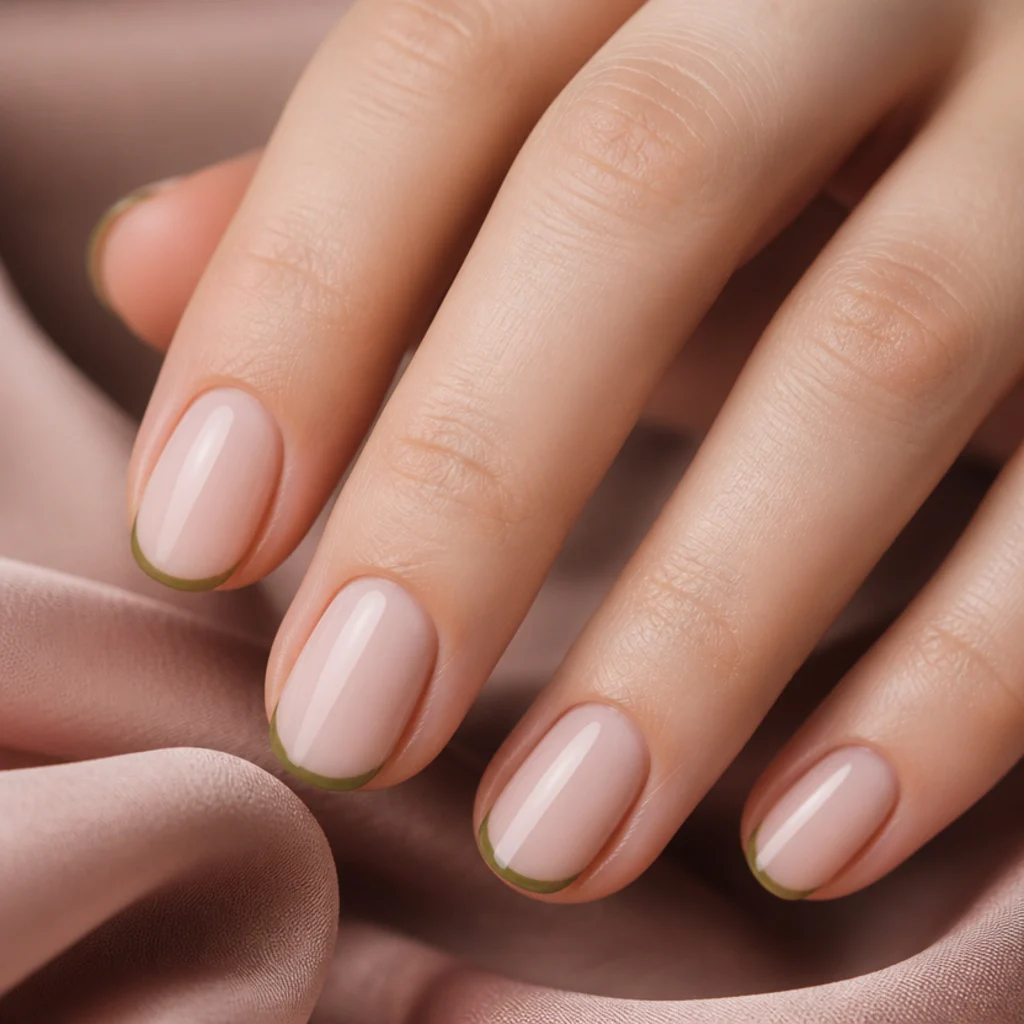
For the quietest nod to olive, a micro-French outlines the very edge of the nail with a whisper-thin olive line over a nude or sheer base. It's understated, office-friendly and elegant, giving structure without going all-in on color, which makes it a favorite for anyone who wants their manicure to read as a subtle finishing touch. The ultra-thin tip demands precision, so it's best done by a tech or with a fine brush and a slow, braced hand. Because most of the nail stays neutral, regrowth is nearly invisible, so it's low maintenance and wears clean for weeks. Pro tip: rest your painting hand on a table and rotate the finger, not the brush, to trace a clean, even tip. Ask your nail tech for a fine olive line, not a thick retro tip, over a sheer nude matched to your skin tone, on short almond or squoval, which keeps the look modern rather than dated.
20Olive Acrylic Square with Rhinestones
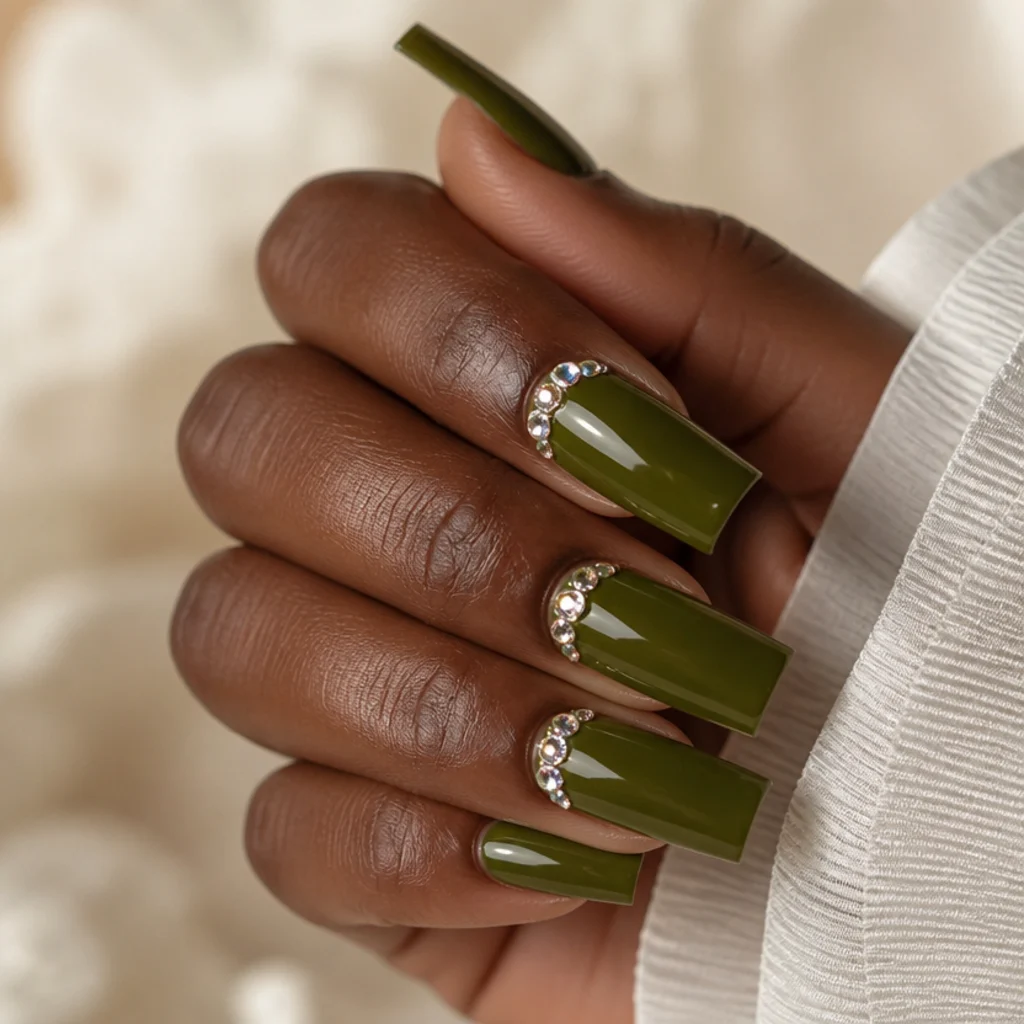
When you want glamour, olive green acrylic nails on a bold square with scattered rhinestones deliver sparkle against an earthy base. The crystals catch light beautifully on a deep, near-matte olive, and the square shape gives a clean, structured canvas that shows off placement. Acrylic supplies the strength to carry both the length and the weight of embellishment, making this a durable party or event set. Rhinestones need aftercare: they catch on knitwear and hair and can pop off, so a strong gel top coat encapsulating the base of each stone is essential to longevity. Pro tip: set stones into a bead of clear gel and cure, then flood a second thin layer of gel around each base and cure again, which locks them far better than glue alone. Ask your nail tech for a few strategically placed crystals near the cuticle rather than full cover, which keeps the olive the star and the sparkle an accent, and be prepared for gentler hands for a couple of weeks.
Save this to Pinterest so your event nails are ready to book.
21Muted Olive Milky Base
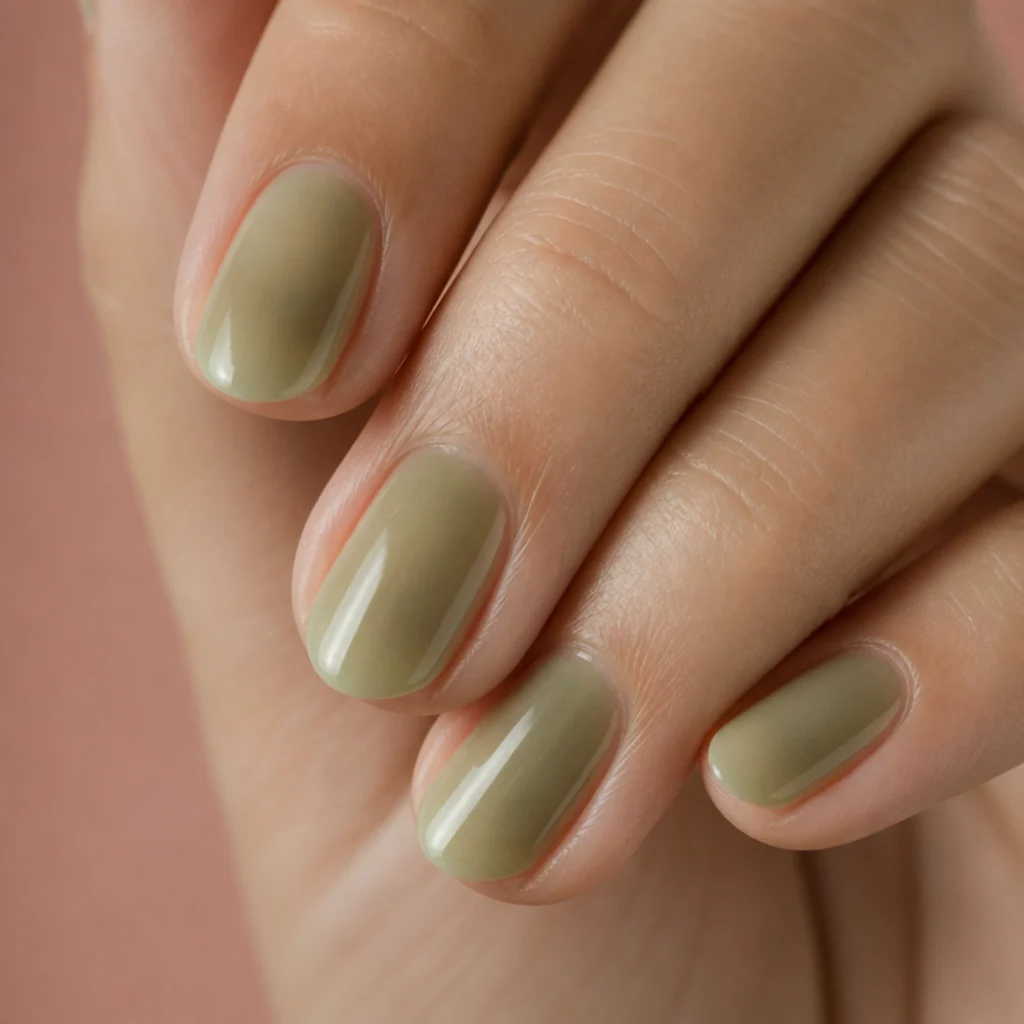
A milky finish gives olive a soft, diffused quality, like sage seen through frosted glass. A semi-sheer white undertone lightens the green and lends a clean, contemporary calm that pairs with almost any wardrobe, from denim to knitwear. This suits anyone drawn to the milky-nail trend who wants a subtle wash of earthy color rather than a bright statement, and it reads especially fresh on short to medium almond, flattering cooler and neutral undertones. Milky formulas build in thin, translucent layers, so a few coats create that smooth, opaque-yet-soft look without streaking; the usual mistake is one thick coat, which floods the cuticle and dries patchy. Because the shade is pale and diffused, it quietly disguises minor natural-nail imperfections while still reading as color. Pro tip: warm the bottle in your hands and roll it before applying, since milky formulas thicken and drag when cold. Ask your nail tech for a milky or muted olive rather than a saturated cream, with a glossy top to bring out the soft, glassy glow.
22Olive and Terracotta Abstract
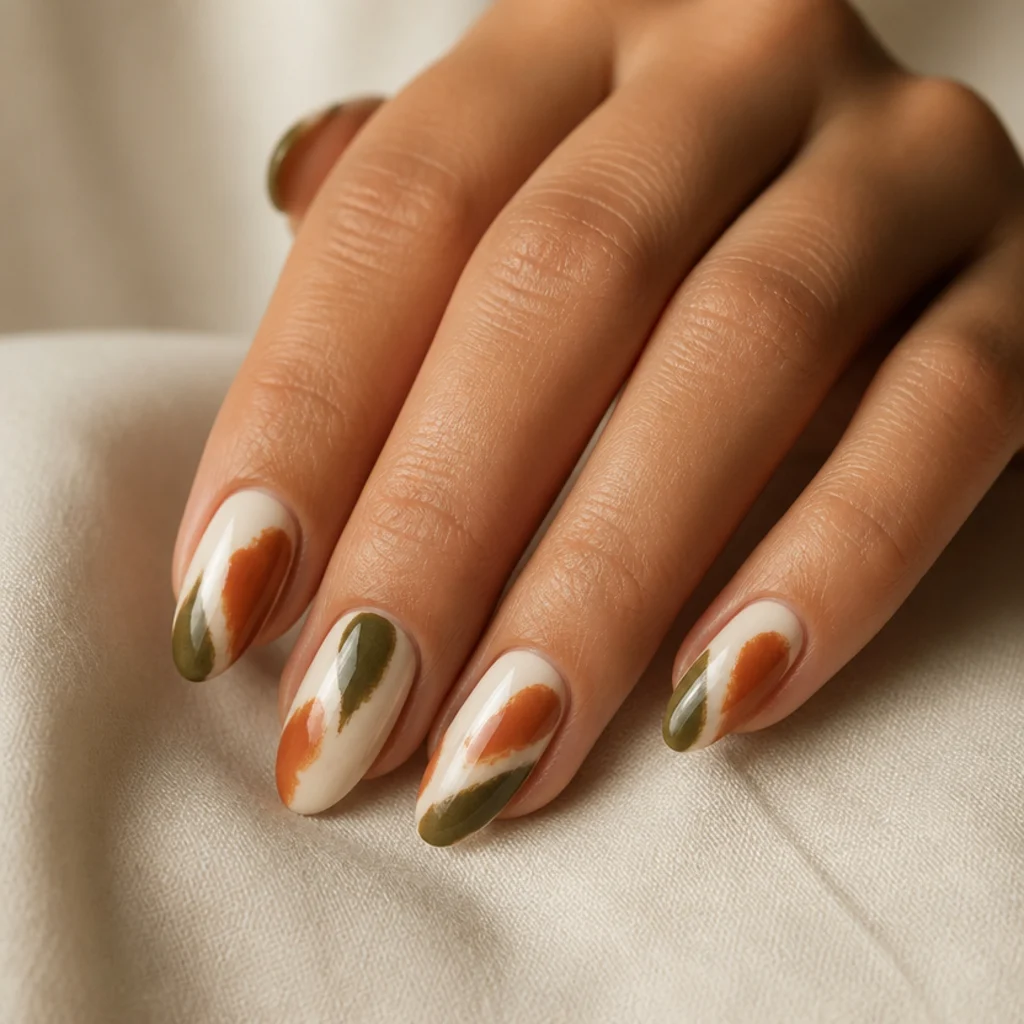
Olive and terracotta are a designer's dream pairing, warm and earthy in the way of desert pottery and dried-flower arrangements. An abstract set layers loose brushstrokes, blocks or squiggles of rust and olive across a cream base for an artful, one-of-a-kind result. It suits creative types who want their nails to feel like a small canvas and who love a lived-in, handmade aesthetic. The freeform nature is actually forgiving, since abstract art doesn't demand symmetry, though color balance and negative space still take an eye, and too many elements quickly reads cluttered. It sits best on medium almond or squoval, where the shapes have room to breathe. Pro tip: limit yourself to three elements per nail and leave real cream negative space between them, which is what separates gallery-abstract from chaotic. Ask your nail tech for an earthy abstract in olive and terracotta over a warm cream base, and let them vary the design across nails so the set reads intentional rather than repeated, sealed with gloss to tie the elements together.
23Olive Green Leaf Line Art
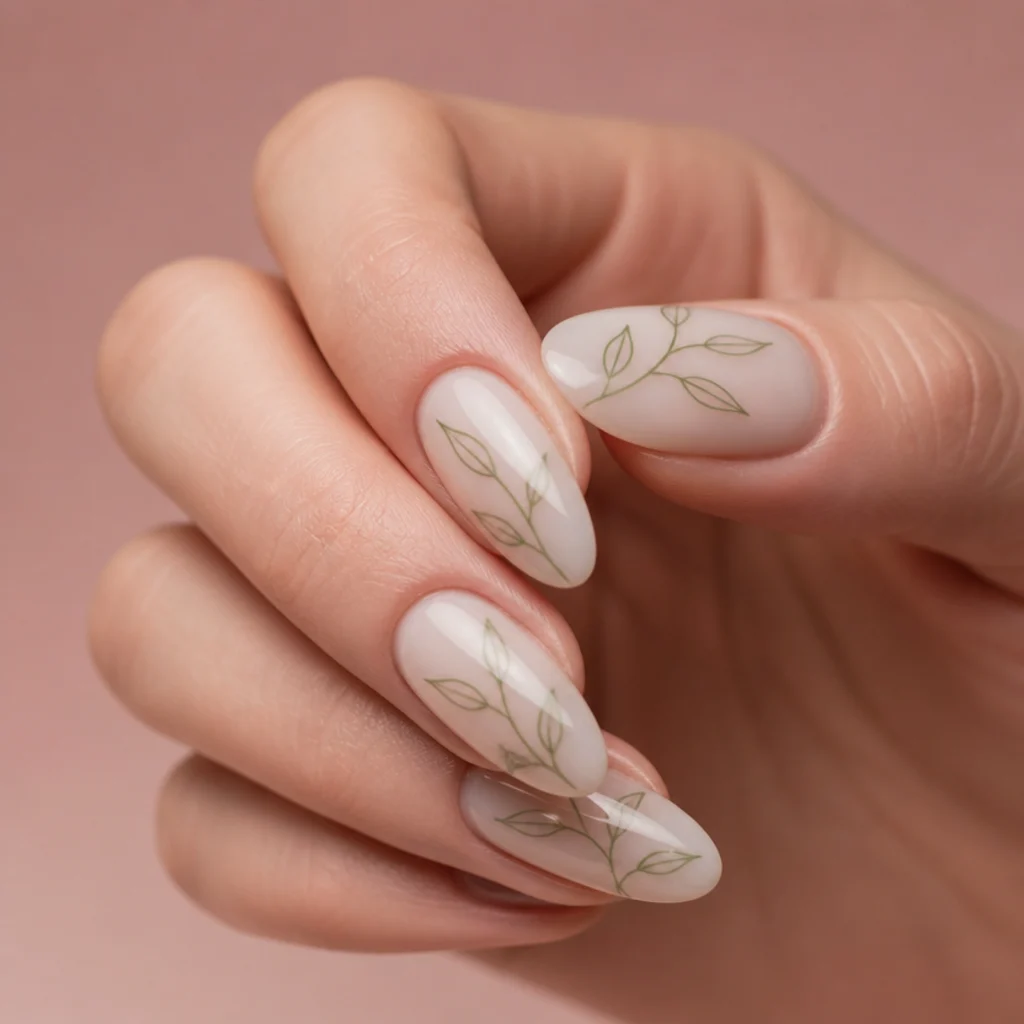
Delicate botanical line art nods to olive's leafy namesake. Fine olive vines and small leaf outlines trail across a sheer nude or milky base, creating something organic, elegant and very of-the-moment. It suits anyone who loves minimalist nail art with a natural theme and wants detail that still reads refined rather than busy. The thin, continuous lines require a steady hand and a fine liner brush, so it is best trusted to a tech skilled in freehand work; the difference between elegant and shaky here is entirely in the line quality. Because the base is neutral, the design stays wearable and regrowth stays subtle, so it holds up visually for weeks. Pro tip: thin your art gel or polish slightly and load only the brush tip, because an overloaded brush blobs the fine vines and loses the airy feel. Ask your nail tech for single-line leaves and vines rather than filled shapes, on medium almond where the vines have room to curve gracefully, over a sheer nude matched to your skin.
24High-Shine Deep Olive Round
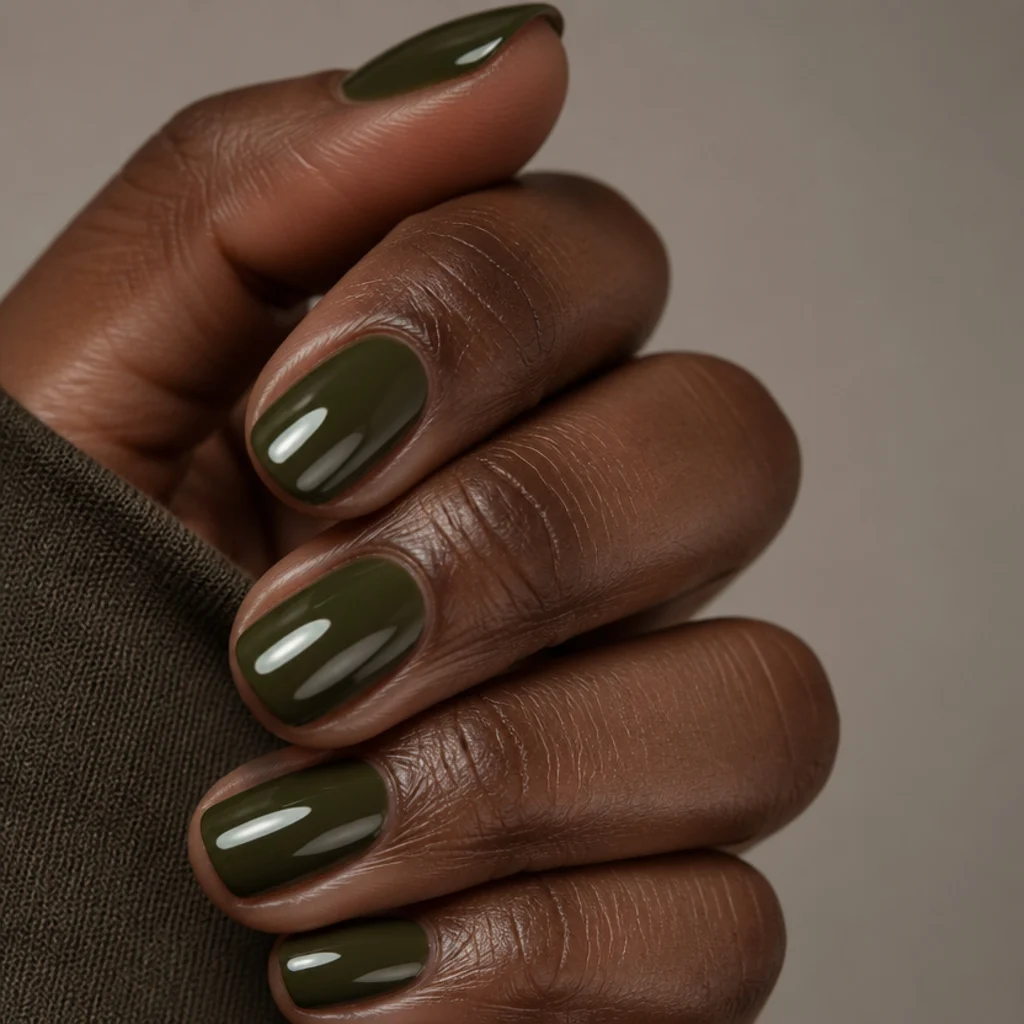
Sometimes the most striking choice is the simplest one done impeccably. A deep olive on a short round with an ultra-glossy, glass-like top coat proves that color and shine need no embellishment. The round shape is the most universally flattering and practical shape there is, echoing the natural curve of the fingertip and resisting snags, and the mirror gloss makes the pigment look wet, rich and expensive. This suits anyone who wants a low-key, no-fuss manicure that still feels considered, and it's easy to do at home. Regrowth hides well thanks to the depth of color, so it rewears cleanly across seasons. Pro tip: cap the free edge by running the brush along the very tip of each nail with every coat, including the top coat, which is the single biggest factor in preventing early tip chips. Ask your nail tech for a deep olive with a glass-gloss finish on a short round, and reapply a high-shine top coat midweek at home to keep that lacquered look going.
25Olive Green Glazed Donut
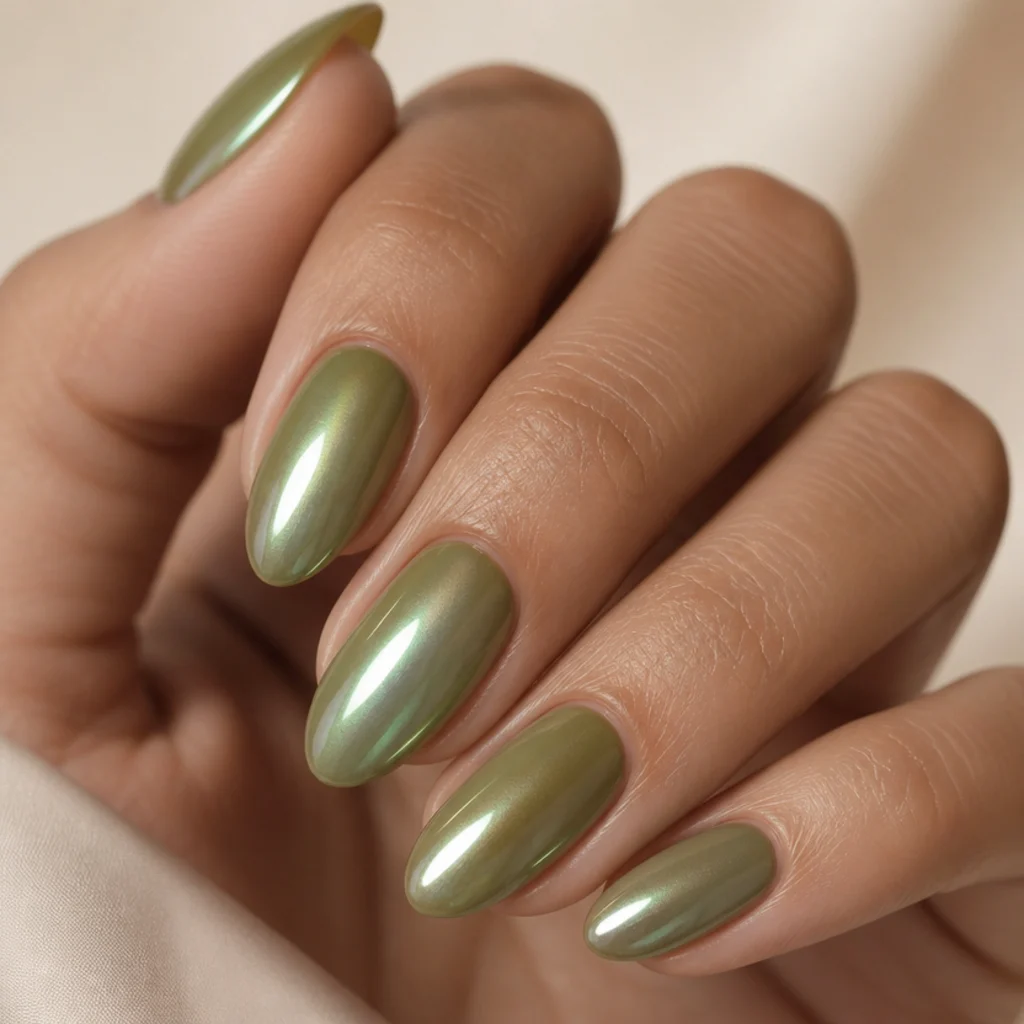
The glazed-donut finish gives olive a soft pearlescent sheen, like light catching on sea glass. A fine iridescent shimmer buffed over an olive base creates a subtle, milky glow that shifts gently without the full intensity of chrome, so it flatters every skin tone because the effect is soft rather than metallic. This suits anyone who loved the glazed trend and wants it in an earthy, unexpected shade. The effect usually comes from a pearl or aurora powder pressed over gel, so it leans salon, though a sheer pearl shimmer top coat offers a decent DIY approximation. Keep the underlying olive light to medium, since the glow reads best over a softer base and can disappear over a very dark shade. Pro tip: buff the shimmer powder in gentle circles until it turns satiny before sealing, and use a no-wipe top coat so the pearl stays luminous rather than cloudy. Ask your nail tech for a pearlescent or glazed finish over a light-to-medium olive on clean almond or squoval, so the finish stays the focus and reads elegant rather than glittery.
Pro Tips from the Editor
- Diagnose the undertone before the depth. Hold the shade against your inner wrist: if it looks muddy and brown, it's a khaki olive; if it looks cool and greyed, it's a grey-olive. Grey-olives flatter the widest range of skin, so they're the safest default when you're unsure.
- Pale olives are low-pigment; plan for three coats. Sage, milky and jelly formulas almost always need an extra thin layer for even coverage. Book a little more time and never rush the middle coat, which is where streaks and bald tips come from.
- Cap the free edge every single coat. Running the brush along the tip of the nail (base, color and top coat) is the highest-leverage habit for beating early chips, and it costs you two seconds per nail.
- Cuticle oil is what makes olive look expensive. Earthy tones read best against healthy, cared-for skin. Oil daily, and for matte sets, work it into the skin only, never the plate, to avoid shiny patches on the finish.
- Match the finish to how long you need it to last. Chrome, cat-eye and foil are two-week showpieces that dull with hot water and cleaners; glass-gloss and jelly are the low-maintenance workhorses that rewear cleanly for three weeks.
- Always bring a photo. Olive shifts more between brands than almost any shade, and the word "olive" alone can land you in fern, khaki or army. A reference image plus a named depth and finish is the difference between your idea and a guess.
- Let embellished and specialty sets breathe. Rhinestones, long stilettos and chrome all reward gentler hands. Wear gloves for cleaning, skip picking and prying, and you'll double the wearable life of the set.
How to Choose / Get the Look
Start with depth, because it drives everything else. If you want maximum versatility and easy upkeep, a grey-tinted dark olive on an almond or round shape is the safest, most flattering pick across skin tones, and it disguises regrowth to stretch gel wear toward three weeks. If dark shades feel heavy on you, or your nails are short, drift toward light olive green nails in sage, milky or jelly finishes, which read softer and more forgiving. Undertone matters less with olive than with brighter greens, because the built-in grey and brown mute any clash, but as a rule warm-gold jewelry universally complements the whole family.
Next, match technique to your commitment level and calendar, using the table below.
| Finish / technique | Difficulty | Realistic wear | Best shapes | DIY-friendly? |
|---|---|---|---|---|
| Solid gloss / round, squoval | Beginner | 2 to 3 weeks | Round, squoval, almond | Yes |
| Jelly, milky, sheer tint | Beginner | 2 weeks | Short round, squoval | Yes |
| Micro-French, single gold line | Easy-intermediate | 2 to 3 weeks | Short almond, squoval | With care |
| Ombre, aura glow, color block | Intermediate | 3+ weeks (hides regrowth) | Coffin, almond | Sponge at home |
| Matte army, marble, florals, leaf art | Advanced | 2 to 3 weeks | Coffin, medium almond | Salon preferred |
| Chrome, cat-eye, croc, foil | Salon | ~2 weeks (dulls first) | Almond, coffin | Salon |
| Acrylic length + rhinestones | Salon | 2 to 3 weeks, fills needed | Stiletto, square, coffin | Salon |
For length and embellishment, olive green acrylic nails give the structural strength that stilettos, long coffins and stone-set designs require; gel-only builds flex and snap at those lengths. When you book, name three things in order: the exact tone (deep army, sage or mid olive), the undertone (grey-green, not khaki or fern), and the finish (gloss, matte, chrome or pearlescent). Bring a photo, keep cuticle oil in your bag, and you'll consistently leave with the olive you actually pictured.
Frequently Asked Questions
What skin tones does olive green suit best?
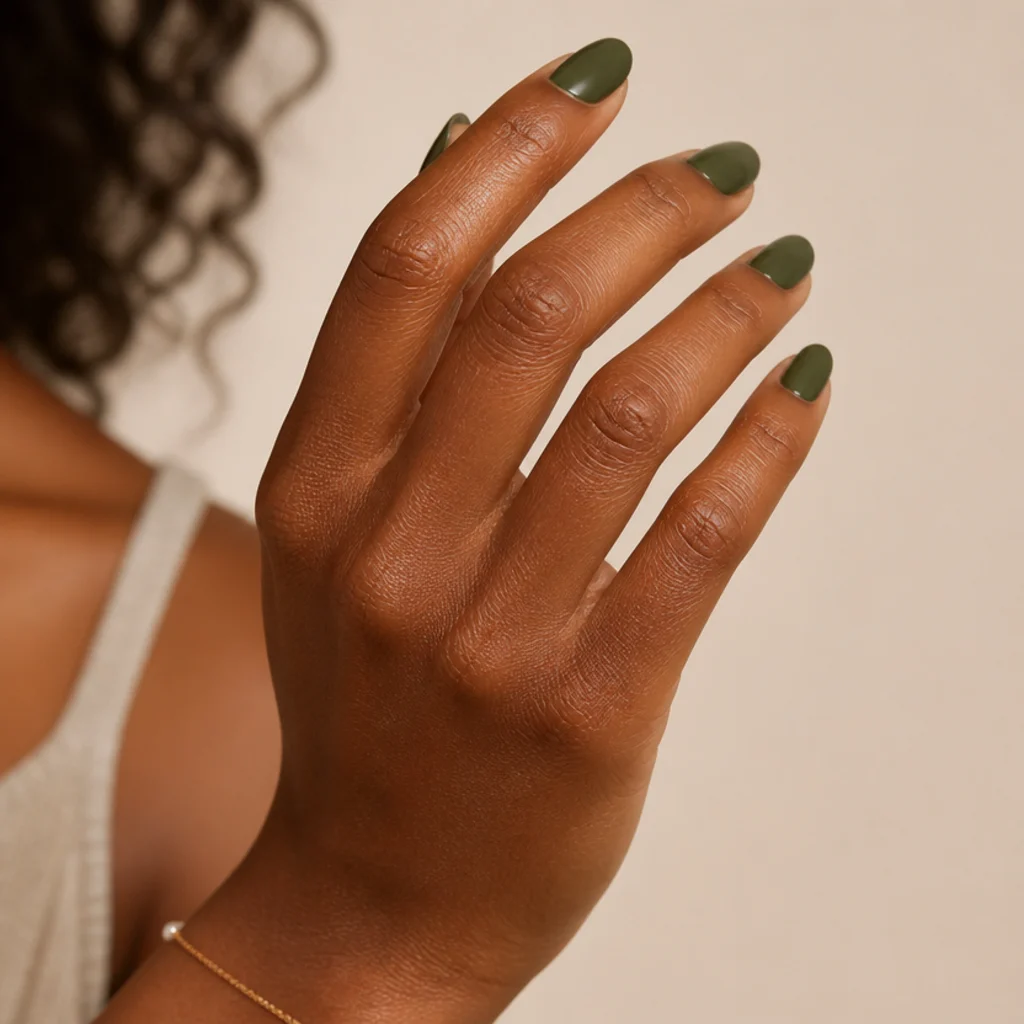
Nearly all of them, which is olive's superpower. The grey and brown woven into the color keep it from clashing the way a bright, high-chroma green can. Deeper army olives look striking on rich, deep skin; soft sage and milky olives flatter fair and neutral tones; and mid, grey-toned olives are the closest thing to universal. If you're unsure, a mid-depth grey-olive with a glossy finish is the most reliable starting point, and warm-gold jewelry pulls the whole look together across every complexion.
How long do olive green nails typically last?
Roughly seven days as regular polish and two to three weeks as gel or acrylic. Darker olives have a real advantage here, because the depth disguises the regrowth gap at the cuticle and extends the window where the manicure still looks intentional. Specialty finishes are the exception: matte, chrome and cat-eye tend to dull first and benefit from a fresh top coat around the one-week mark. Daily cuticle oil, edge-capping and gloves for cleaning meaningfully extend how tidy any olive set stays.
Is olive green better in matte or glossy?
Both work; it comes down to mood and upkeep. Gloss makes olive look rich, wet and jewel-like, ideal for a polished everyday set, and it is the lower-maintenance choice. Matte turns olive earthy and suede-like, leaning moody and editorial, but it shows fingerprints, dust and oils more and can look dry against unkempt cuticles. If you love matte, commit to a daily oil routine on the surrounding skin and re-buff any shiny spots. Undecided? Start glossy, since it is more forgiving and rewears cleaner.
What nail shape looks best with olive green?
Almond is the standout, because it lengthens the fingers and keeps deep olive looking elegant rather than heavy. Short round and squoval are the practical choices, delivering the same rich color with less snag risk, and they flatter shorter or wider nail beds. Coffin and stiletto bring bolder, statement energy and pair naturally with matte, chrome, croc and embellished designs, where the extra surface area shows off detail. Match the shape to your lifestyle first, then layer the finish you want on top.
Can I do olive green nails at home?
Yes, for the simpler looks. Solid gloss, jelly tints, milky bases, micro-French and a single gold line are all achievable with a steady hand, thin coats and patience; lighter olives just need an extra coat for even coverage. Save chrome, magnetic cat-eye, marble, hand-painted florals and croc print for a salon, since those need specialized powders, gels and technique that are hard to replicate cleanly at home. Capping the free edge and not rushing your layers will get you most of the way to a salon finish.
Why does my olive polish look muddy or brown on the nail?
That usually means the shade leans khaki (heavy on yellow-brown) rather than grey-green, and it can amplify against warm or yellow-toned skin. Swatch on a nail wheel or your inner wrist before committing, and choose a grey-tinted olive if you want it to stay crisp and cool. Undertone in your natural nail matters too, so a slightly opaque base or an extra color coat evens out any yellowing coming through from underneath.
What colors and outfits pair best with olive green nails?
Olive is a chameleon neutral, so it plays with far more than you would expect. Warm metals (gold, brass, bronze) are its natural partners, and it sits beautifully with cream, camel, oxblood, rust, chocolate and black. For a tonal, earthy story, pair it with terracotta or dusty pink; for contrast, let it pop against denim or crisp white. Because it photographs as a sophisticated neutral, it is a reliable wedding and event choice when you want color that still reads refined.
How do I keep chrome, cat-eye or foil olive nails from dulling?
Treat these as roughly two-week showpieces and protect the top layer. Hot water, dish soap and harsh cleaners are what fog and dull metallic and mirror finishes, so wear gloves for washing up and cleaning. Make sure the finish was sealed under an even, no-wipe top coat at application, since unevenness there is the usual culprit behind early cloudiness. A fresh swipe of glossy top coat midweek can revive some of the shine between salon visits.
Is olive green a good year-round color or more seasonal?
It works year-round, which is a big part of its appeal. Deep army and matte olives feel autumnal and wintry alongside oxblood and chocolate; mid grey-olives are a versatile transitional neutral; and light sage, jelly and milky olives feel fresh and spring-summer, especially with gold and linen. Shifting the depth and finish lets you carry the same color family through every season without it ever feeling out of step.