15 Easy Olive Green Nail Designs to Try
Olive green reads as a neutral once it's dry, but it still feels like a choice, not a safe default. These 15 ideas cover every finish, shape, and upkeep level, so you can match a look to your nail bed and your calendar, not just your mood.
 Edited by Lena Rose · Published July 11, 2026 · 25 min read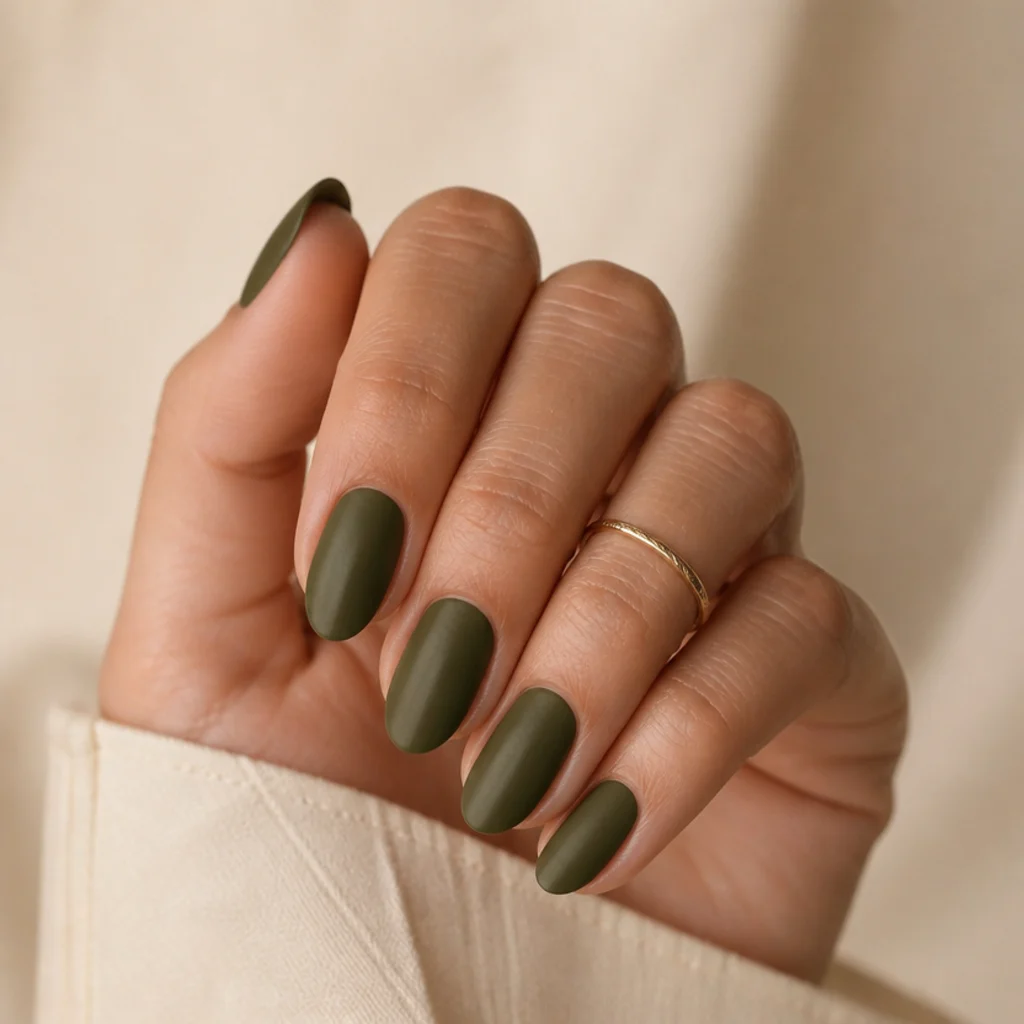
Quick Answer
- Best for: Anyone who wants a neutral with more depth than beige. Warm and cool undertones both find a version that works.
- Who might skip it: If you want maximum brightness or dislike muted, grayed tones, a clearer emerald or sage will suit you better.
- Maintenance: Low to moderate. Solid dark shades hide regrowth for two-plus weeks; pale and white-paired looks show it sooner.
- Difficulty: Easy for solids, sheers, and two-tones; intermediate for ombre, marble, croc, and hand-painted florals.
- Cost: At home, it's roughly a single polish bottle. Salon gel runs low-to-mid range, and acrylic or hard-gel extensions with detailed art cost more per accent.
- Wear time / longevity: Regular polish lasts about 5 to 7 days, gel around 2 to 3 weeks, and acrylic or hard gel until your fill at 2 to 3 weeks.
- Standout variation: Dark olive green almond nails in a mirror-gloss finish.
- How to ask your nail tech: Name the depth (light, medium, or dark olive), the shape and length, and the finish (matte or glossy). Bring a saved photo — olive shifts warmer or cooler between brands.
In This Guide
- Classic Dark Olive Green Almond Nails
- Light Olive Green Sheer Wash
- Olive Green and White Color Block
- Matte Olive Green Acrylic Nails
- Olive Green French Tips
- Olive Green Chrome Shimmer
- Olive Green and Gold Foil Accent
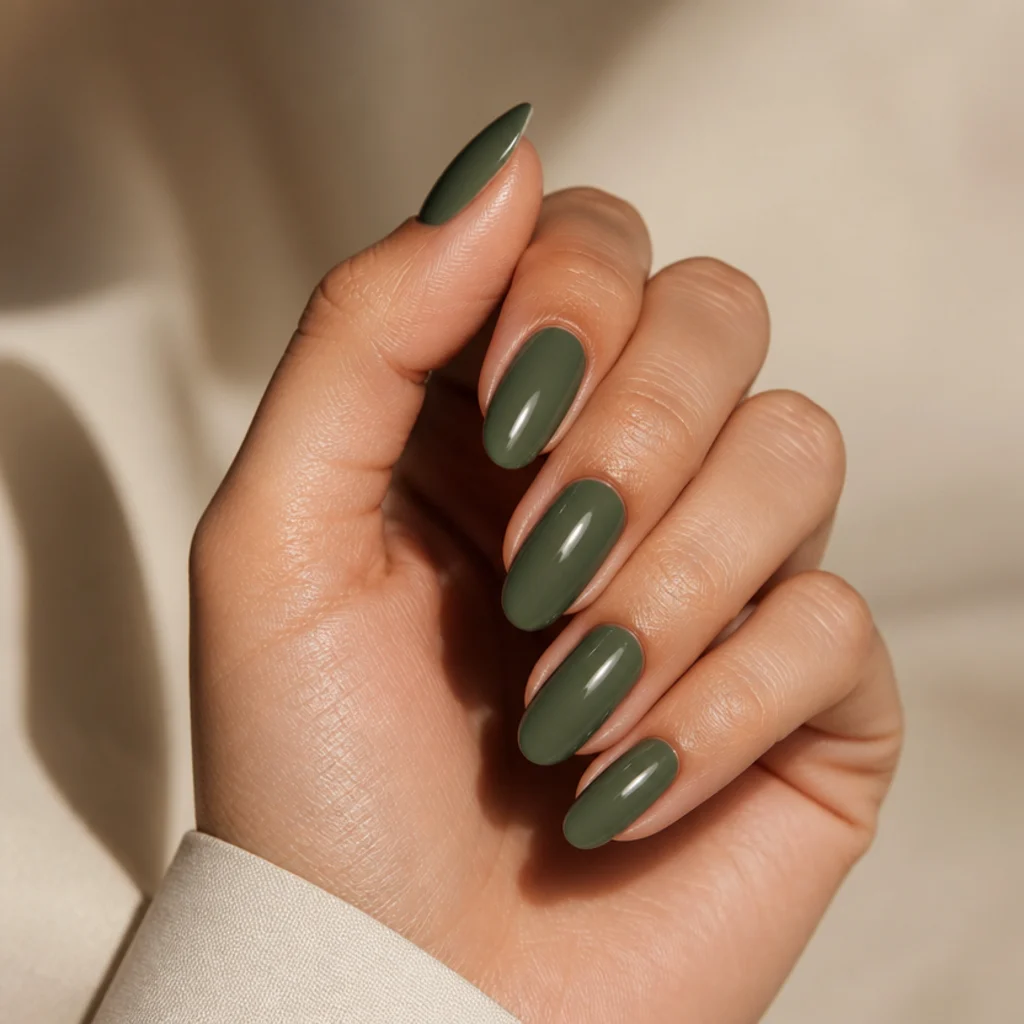
- Short Squoval Olive Green
- Olive Green Ombre Fade
- Olive Green Marble Swirl
- Olive Green and White Daisy Detail
- Glossy Deep Olive Coffin Nails
- Olive Green Negative Space
- Olive Green Croc Print Accent
- Light Olive and Cream Two-Tone
Olive green holds up because it behaves like a neutral on your hands while still carrying more character than the usual nude or gray. The shade sits between yellow-green and brown, softened with a touch of gray, which is why it flatters so broadly — it borrows warmth from the gold family and coolness from sage, so it rarely clashes with a skin tone. Dark olive green nails lean moody and autumnal, reading almost like a soft neutral in low light, while light olive green feels fresh and springy and stays office-appropriate. It's also having a moment, as the earth-tone, quiet-luxury palette pulls manicures away from brights and toward something more grounded. Below are 15 easy interpretations, from a one-coat solid you can do at home to salon acrylic sets with restrained art. Each idea covers who it suits, the exact finish and shade to request, how it wears week to week, and how to ask your nail tech for it. Build a short list before you book.
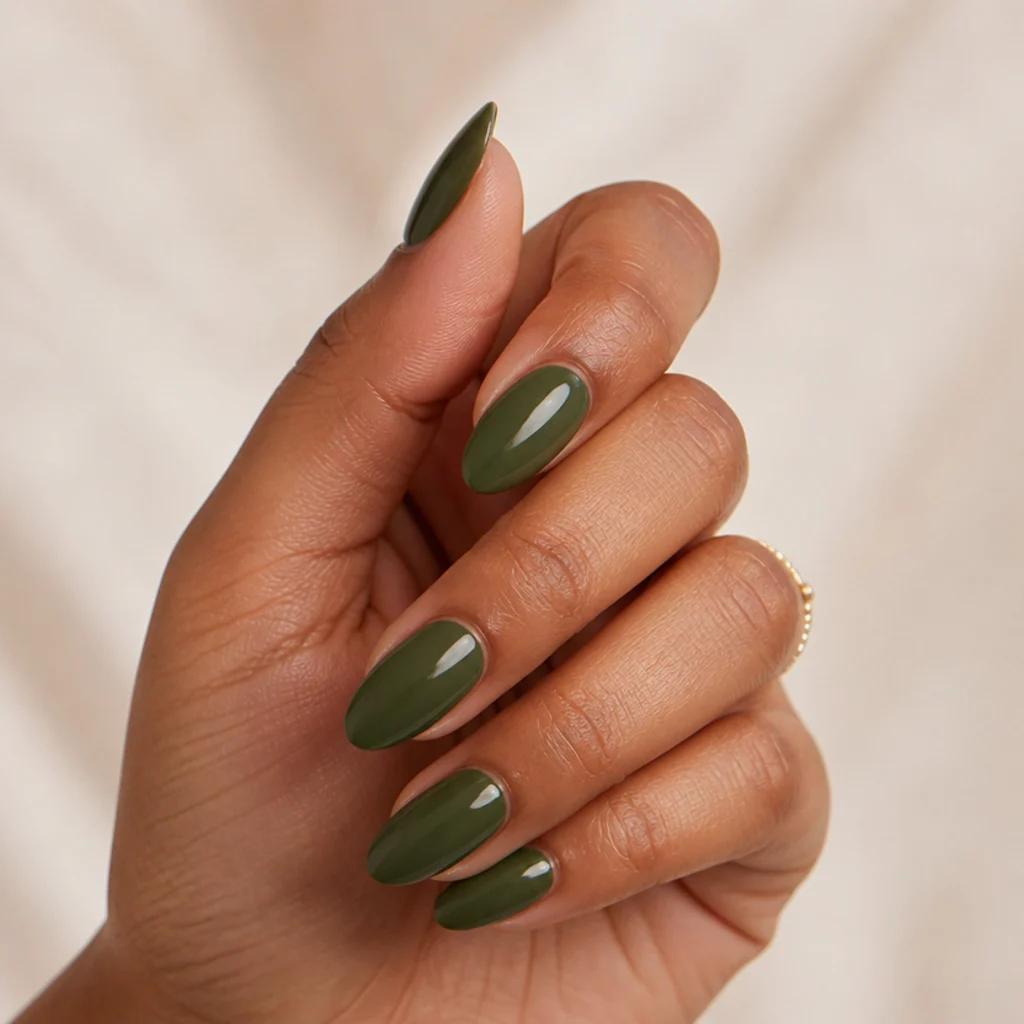
01Classic Dark Olive Green Almond Nails
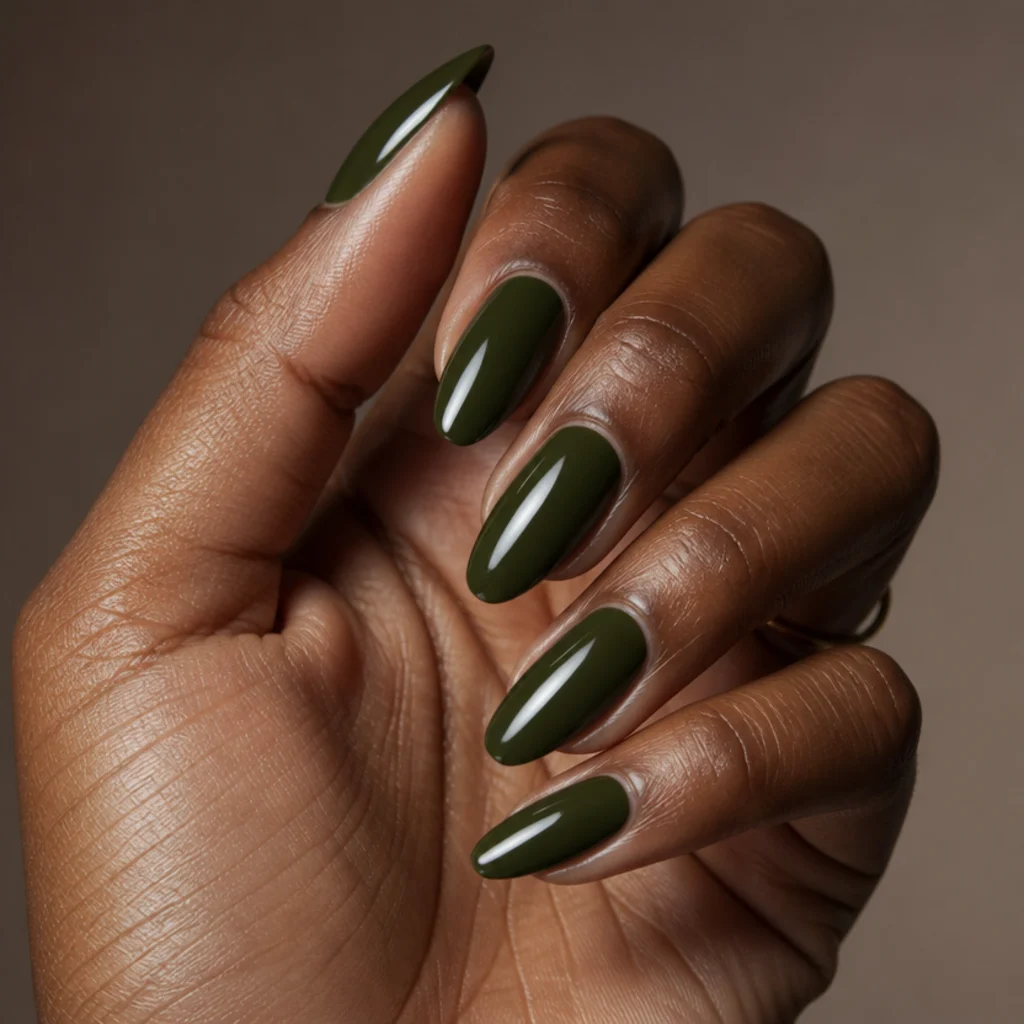
This one opens the list because it sits right at the intersection of dramatic and wearable. Look for a deep, grayed-green pigment with a faint brown undertone rather than a clean forest green — that muted quality is what keeps it sophisticated instead of costume-y. The almond taper lengthens shorter fingers and narrows a wider nail bed, but it needs medium to long length to shape cleanly; a stubby almond can look blunt. A mirror-gloss topcoat gives an editorial, lacquered finish, while a matte sealer turns the same shade suede-soft and earthier. Upkeep is forgiving, since a dark solid hides cuticle regrowth — expect it to look presentable for two to three weeks in gel. Pair it with warm gold jewelry and neutral tailoring so the color reads like a considered accessory. Pro tip: a thin second coat wrapped just under the free edge stops the classic dark-polish chip before it starts. Ask your nail tech for a "deep olive green, almond shape, high-gloss gel," and bring a photo so the undertone matches.
Save this to Pinterest for your next mani inspo board.
02Light Olive Green Sheer Wash
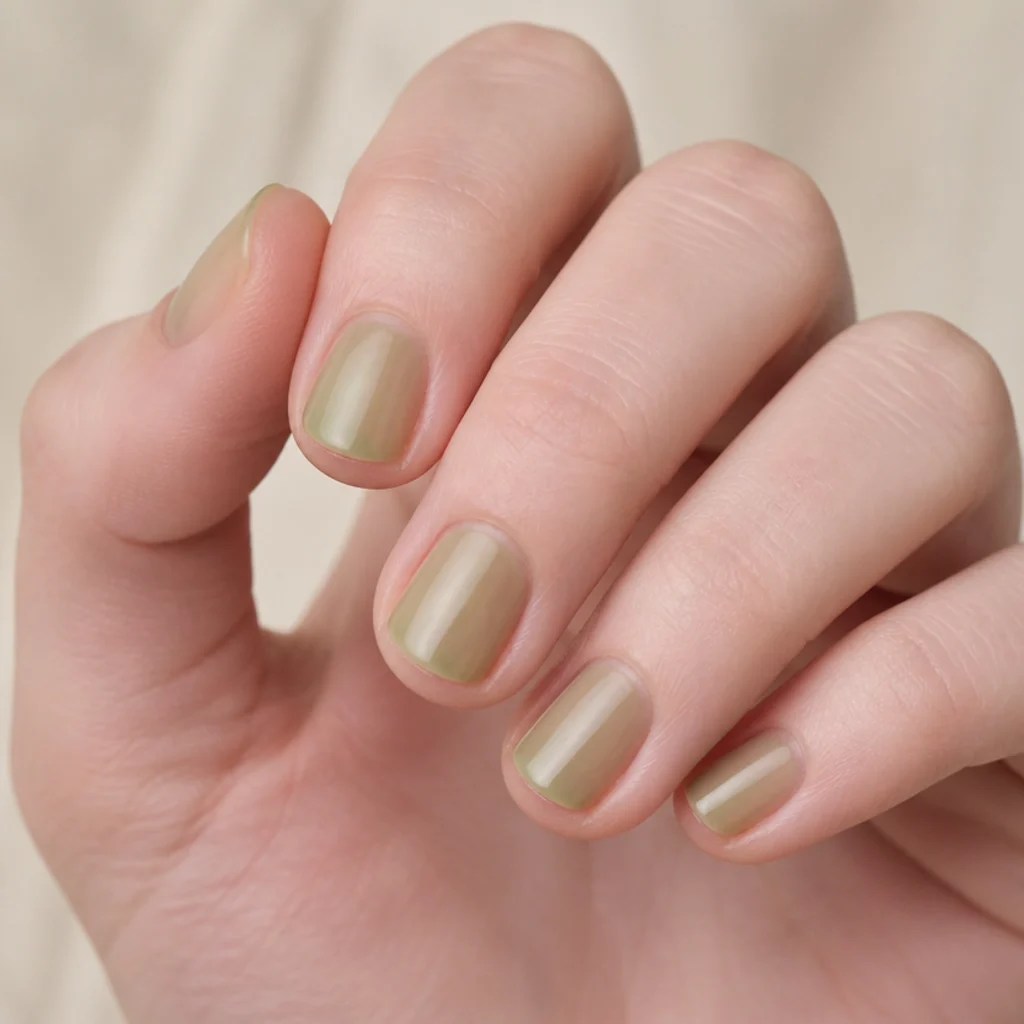
If deep tones feel like too much, a light olive sheer wash is the gentlest way in. Reach for a jelly or milky-translucent formula — one to two coats leave a soft, buildable tint that lets your natural nail show through, for that lived-in, "your nails but tinted" effect. It suits short, natural nails and anyone who wants color that stays office-appropriate. Because the pigment is thin, streaking and bald patches at the tip are the real risks, so float on thin, even coats and don't overwork a half-dry layer. Cool and neutral undertones do well with a muted sage-olive here, while warmer skin can lean toward a slightly gold-green jelly. Maintenance is easy: chips fade into the translucency, and touch-ups blend without a visible seam. Pro tip: buff the nail lightly and swipe on a ridge-filling base so the sheer color sits even, without darker patches over ridges. Ask your nail tech for a "sheer olive green jelly, buildable, one to two coats over a smoothing base."
03Olive Green and White Color Block
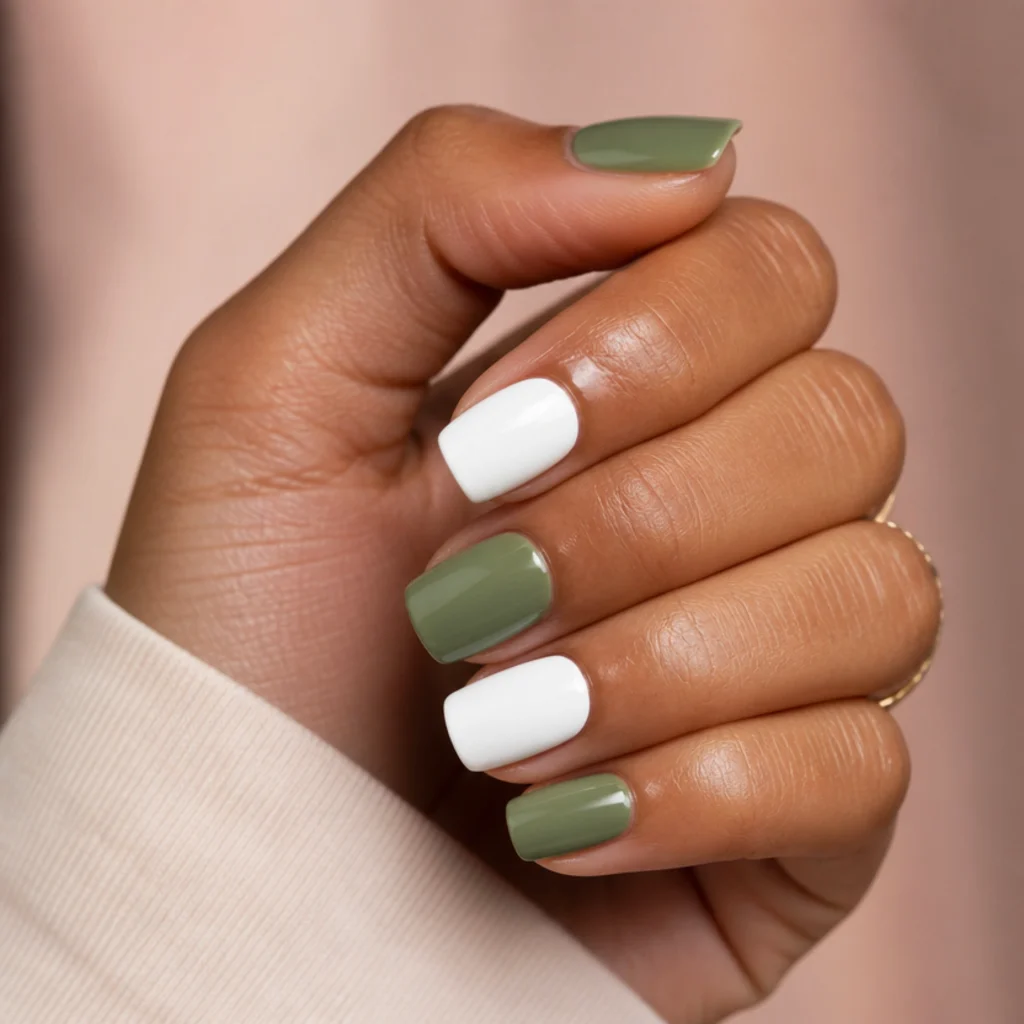
Olive green and white together read crisp, modern, a little architectural, and color blocking is the simplest way to pair them. Alternate full-olive and full-white nails across the hand, or split a single nail down the center with a clean vertical or diagonal line. The contrast lifts the earthy green so it never feels heavy, and the graphic edges photograph well for Pinterest. Squoval and square shapes give the geometry a sharper finish, though any length works. Difficulty stays low if you lay down striping tape for the divide and peel it while the top coat is still tacky. Plan a refresh around two weeks — regrowth and any yellowing show more against crisp white. Style it with silver or mixed-metal rings to echo the cool, clean contrast. Pro tip: paint the white first, let it fully cure, then tape and add olive. Correcting a smudge of dark polish off white is far harder than the reverse. Ask your nail tech for "olive and white color block, clean straight lines, square-off shape."
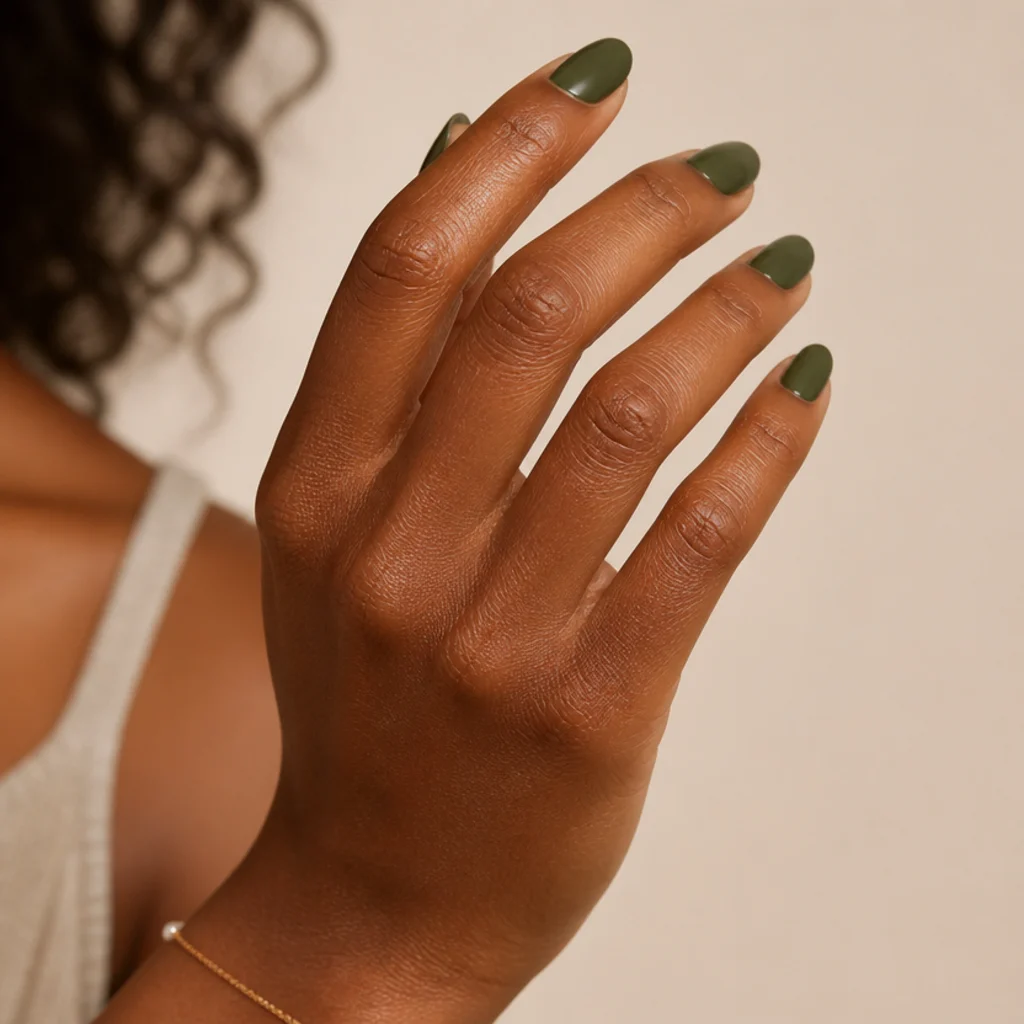
04Matte Olive Green Acrylic Nails
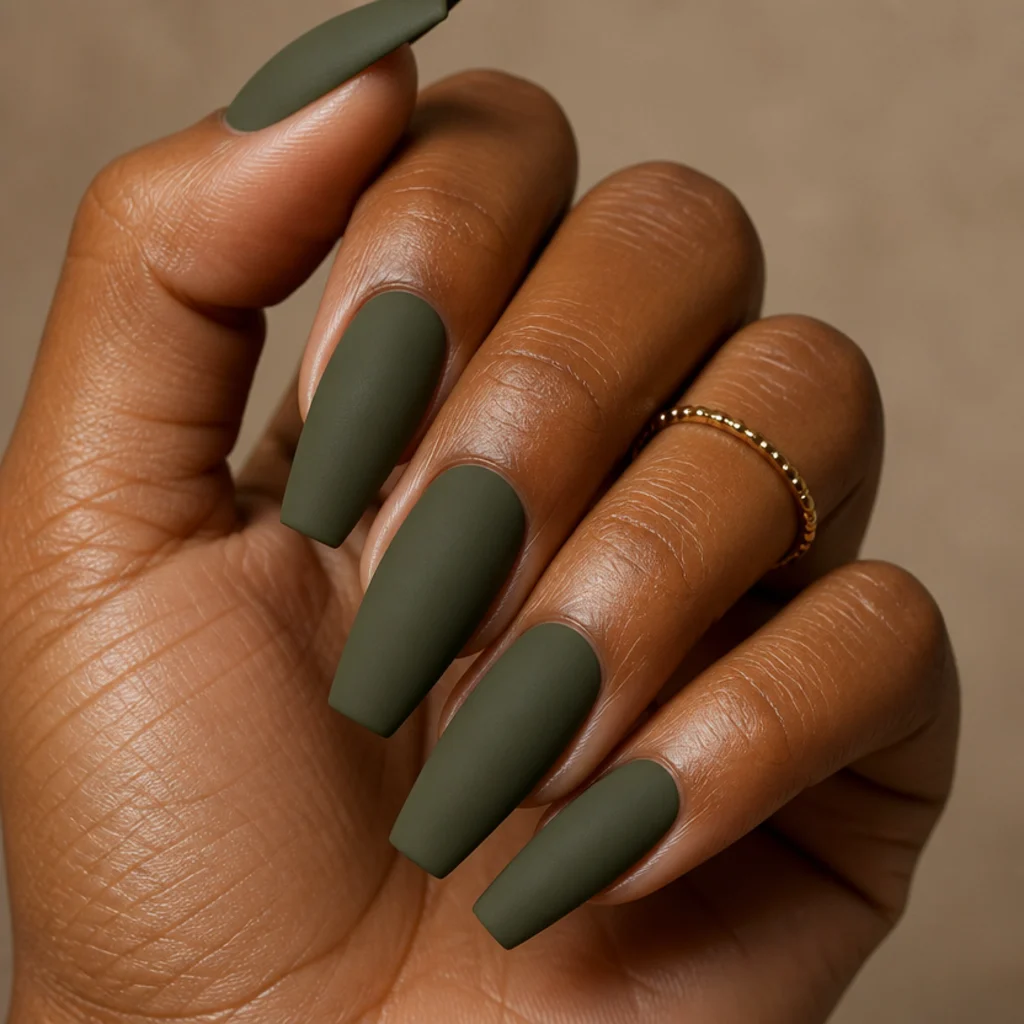
Acrylic gives you length and real durability, and a matte topcoat pushes olive into velvety, almost fabric-like territory that looks expensive against deeper skin. Acrylic is the right call when your natural nails don't grow long or strong on their own — the sculpted structure absorbs daily knocks that would chip regular polish. Matte finishes have a trade-off, though: they hide surface imperfections but show fingerprints, hand cream, and oils, so a quick re-buff with a matte top keeps them looking fresh. Medium to long lengths in almond, coffin, or square work best here, and on brown and deep skin, a warmer gold-olive tends to glow more than a gray one. Budget a fill every two to three weeks to keep the regrowth line and apex clean. Pro tip: keep cuticle oil going daily even on matte acrylic — the flexible bond lasts longer when the surrounding skin isn't bone-dry. Ask your nail tech for "olive green acrylic, matte top, medium length," and settle on shape before they start filing.
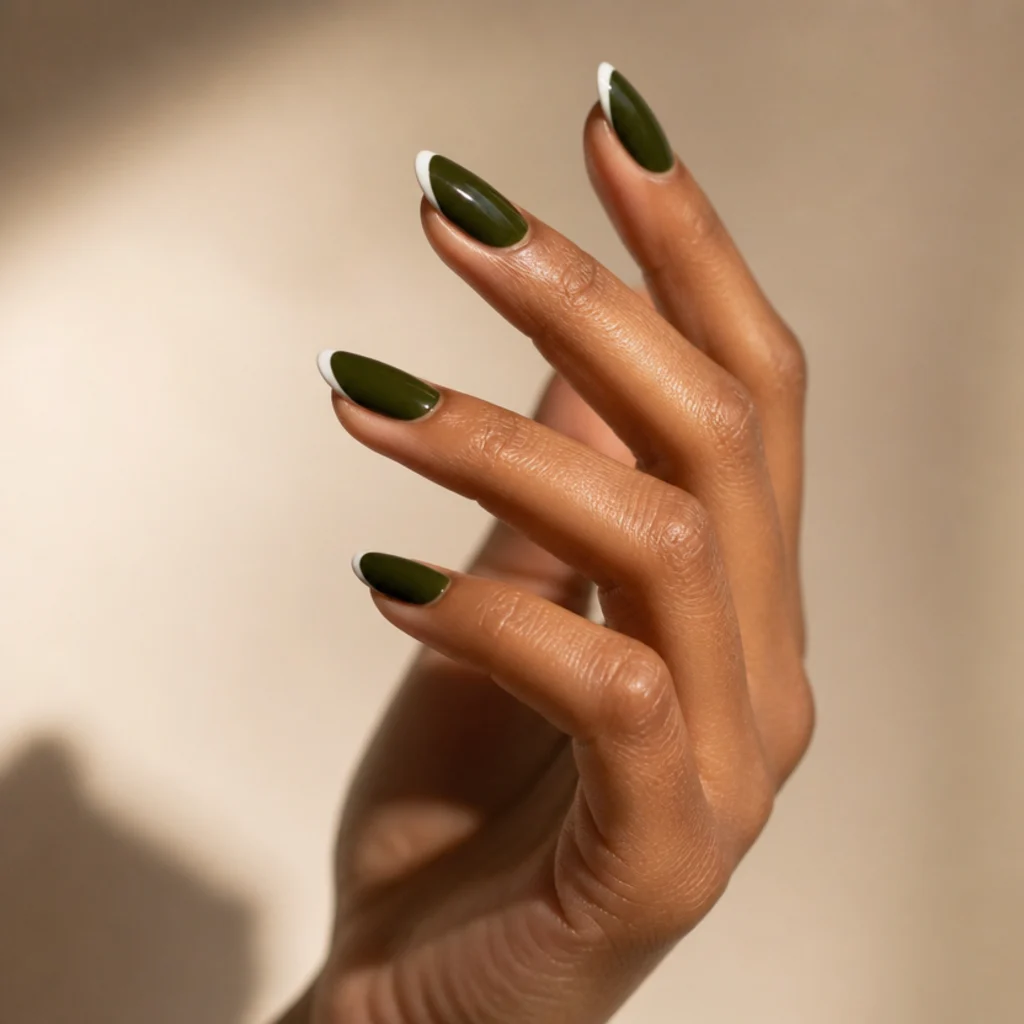
05Olive Green French Tips
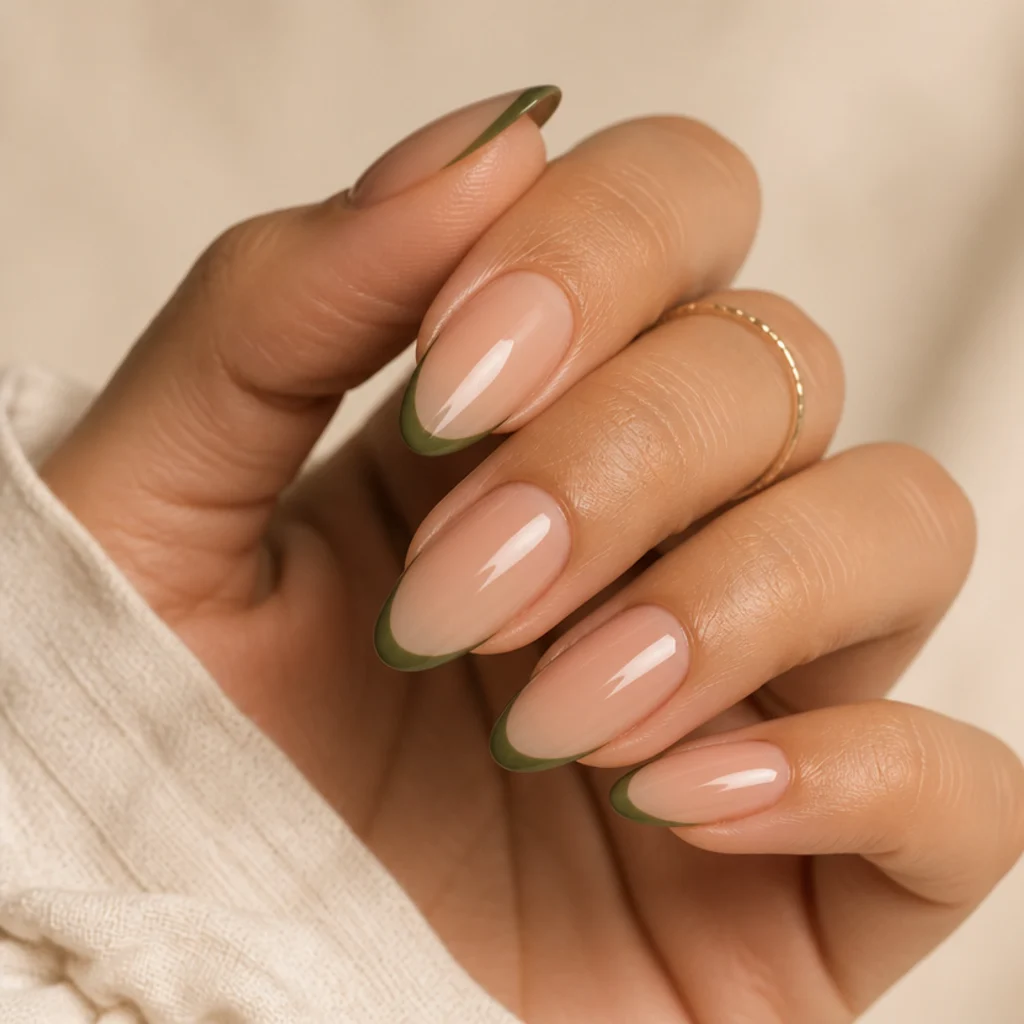
Swap the traditional white smile line for olive and the French manicure feels current again. Keep the base bare, milky, or blush-nude, then paint just the tip in dark olive so the design grows out gracefully with no obvious regrowth gap. It suits anyone who wants color with restraint, and it flatters longer almond or squoval nails where the tip has room to read as a deliberate band rather than a smudge. Difficulty is intermediate — a clean, even smile line takes a steady hand, a fine detail brush, or a guide sticker. Upkeep is low, since the bare base hides growth for three weeks or more, which makes this one of the most appointment-stretching looks here. Vary it with a slightly thicker, higher tip for a modern French, or a micro-thin line for something delicate. Pro tip: map both tips symmetrically before you fill them in, and match the smile-line depth across all ten nails so the set looks balanced. Ask your nail tech for an "olive green French tip on a nude base, thin classic smile line."
Save this to Pinterest and screenshot it for the salon.
06Olive Green Chrome Shimmer
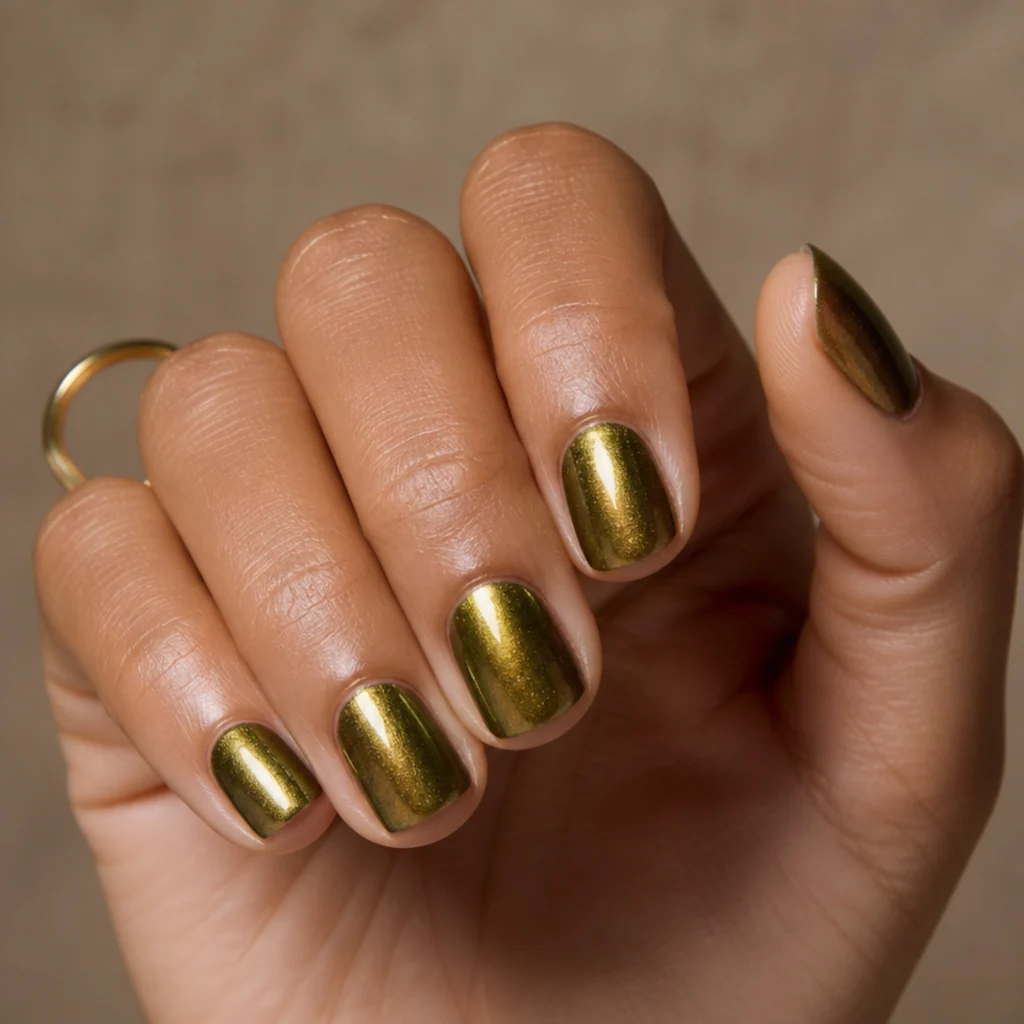
Chrome or pearl powder buffed over an olive base turns the shade metallic and dimensional, shifting between green, bronze, and gold as your hand moves. That kinetic finish keeps a plain solid interesting on its own, which is why it works so well on short nails. Chrome flatters every skin tone, though a warmer olive base reads more bronze, while a grayer base leans antique-gold. It needs a full gel system: a cured colored base, powder burnished on with an applicator, then a no-wipe gloss top to lock it in — this is a salon or at-home gel look, not a regular-polish one. Longevity mirrors any gel set at roughly three weeks, and the mirror effect dulls if the top layer wears thin. Pro tip: rub the powder in fully until it turns glassy before sealing; under-buffed chrome looks patchy and cloudy. Ask your nail tech for "olive green gel with chrome powder, sealed under high-gloss no-wipe top."
07Olive Green and Gold Foil Accent
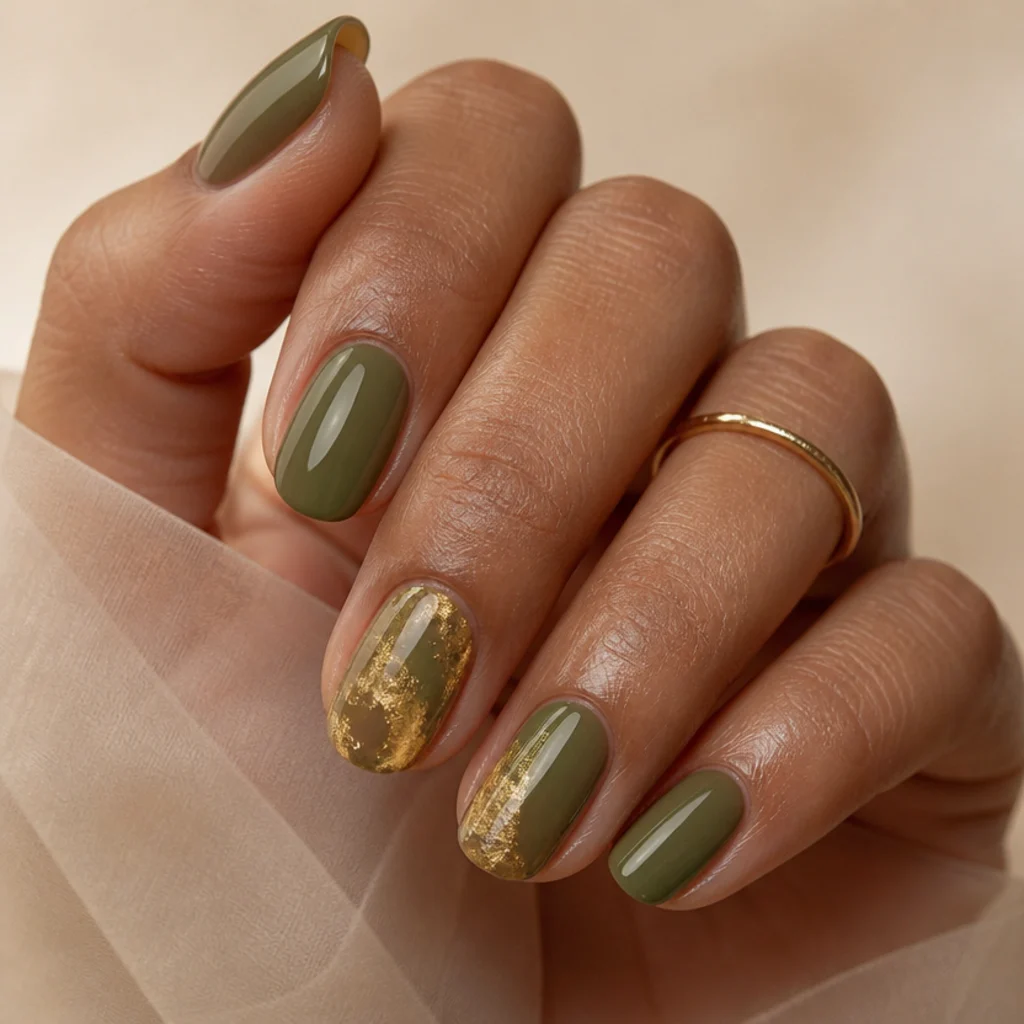
Gold and olive pair naturally, both pulled from the same earth-tone palette, and a few flecks of gold leaf foil on one or two accent nails add texture without committing to full nail art. Keep the remaining eight nails solid olive so the foil reads as an intentional detail rather than clutter. It suits medium to long nails and anyone drawn to a warm, autumnal or holiday-leaning look. Difficulty stays low — foil is pressed onto a tacky topcoat or foil gel and then sealed, and placement is the only real skill involved. The catch is durability: unsealed foil edges lift and catch, so every flake needs to be fully sealed under a generous top layer. Position the accents on the ring fingers, where they photograph best and catch the light in hand shots. Pro tip: apply foil in irregular, uneven shards rather than one solid block — scattered leaf looks more organic and hides small gaps. Ask your nail tech for "solid olive with gold foil accents on the ring fingers, fully sealed."
08Short Squoval Olive Green
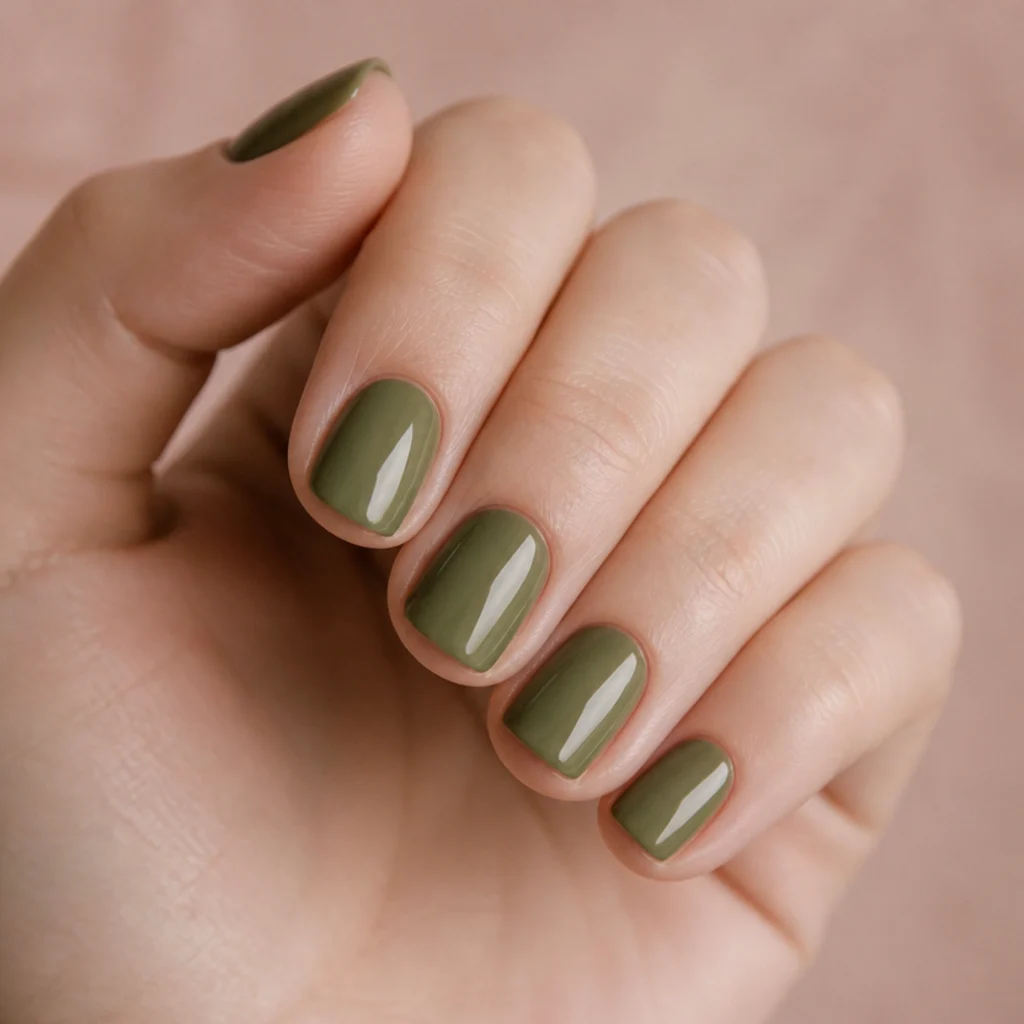
Not every olive look needs length. Short squoval, square with softly rounded corners, keeps the shape practical while still looking deliberate. Solid olive on a short nail is the most everyday-wearable version in this guide — good if you type all day, work with your hands, or just want low fuss. It suits every skin tone, and the rounded corners resist the snags and corner-chips that plague a true square. Because the surface is small, one coat of a pigmented olive often covers fully, which cuts your at-home time and makes touch-ups painless. Regrowth grows out cleanly and chips are quick to patch, so this stretches comfortably to two weeks even in regular polish. Style it with everything — that's the point. Pro tip: file straight across first, then take just a whisper off each corner at a 45-degree angle so the squoval stays symmetrical instead of drifting back toward round. Ask your nail tech for a "short squoval, solid olive green, one to two coats, durability over drama."
09Olive Green Ombre Fade
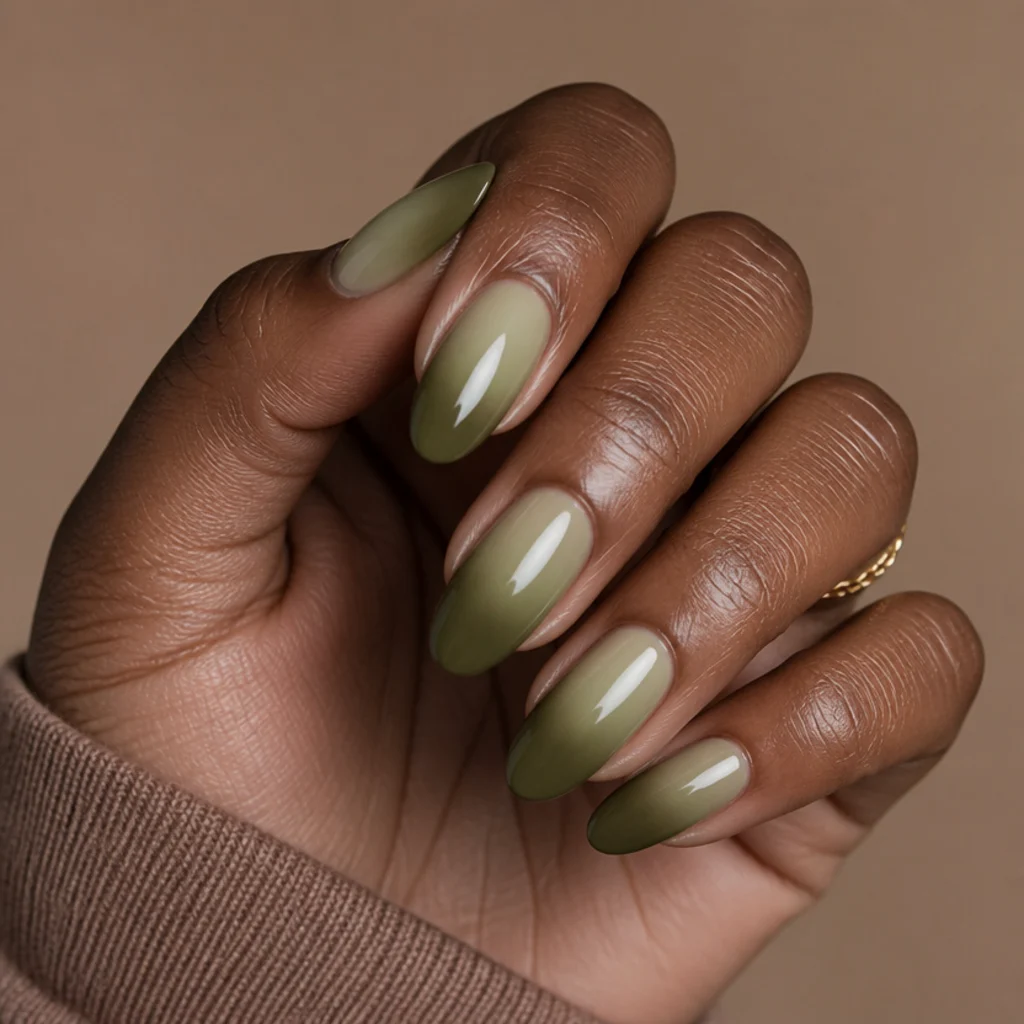
A tonal ombre that melts from light olive at the cuticle to deep olive at the tip adds soft dimension while staying calm and monochromatic. Both shades sit in the same family, so the blend forgives more than a high-contrast gradient would — minor unevenness just reads as intentional softness. Medium to long almond or coffin nails suit this best, since the fade needs room to transition without looking abrupt. It's usually built with a makeup sponge dabbed over a wet layer, or sponged between gel coats and cured, which puts it at intermediate difficulty. Upkeep is moderate: the pale cuticle zone lets a sliver of regrowth show sooner than an all-dark nail would. Reverse the direction for a fresher spring version, light at the tip fading dark at the base. Pro tip: keep a clean damp sponge and stipple the seam repeatedly while the polish is still wet — the more passes you make, the smoother the melt. Ask your nail tech for a "tonal olive ombre, light at the base fading darker toward the tips."
10Olive Green Marble Swirl
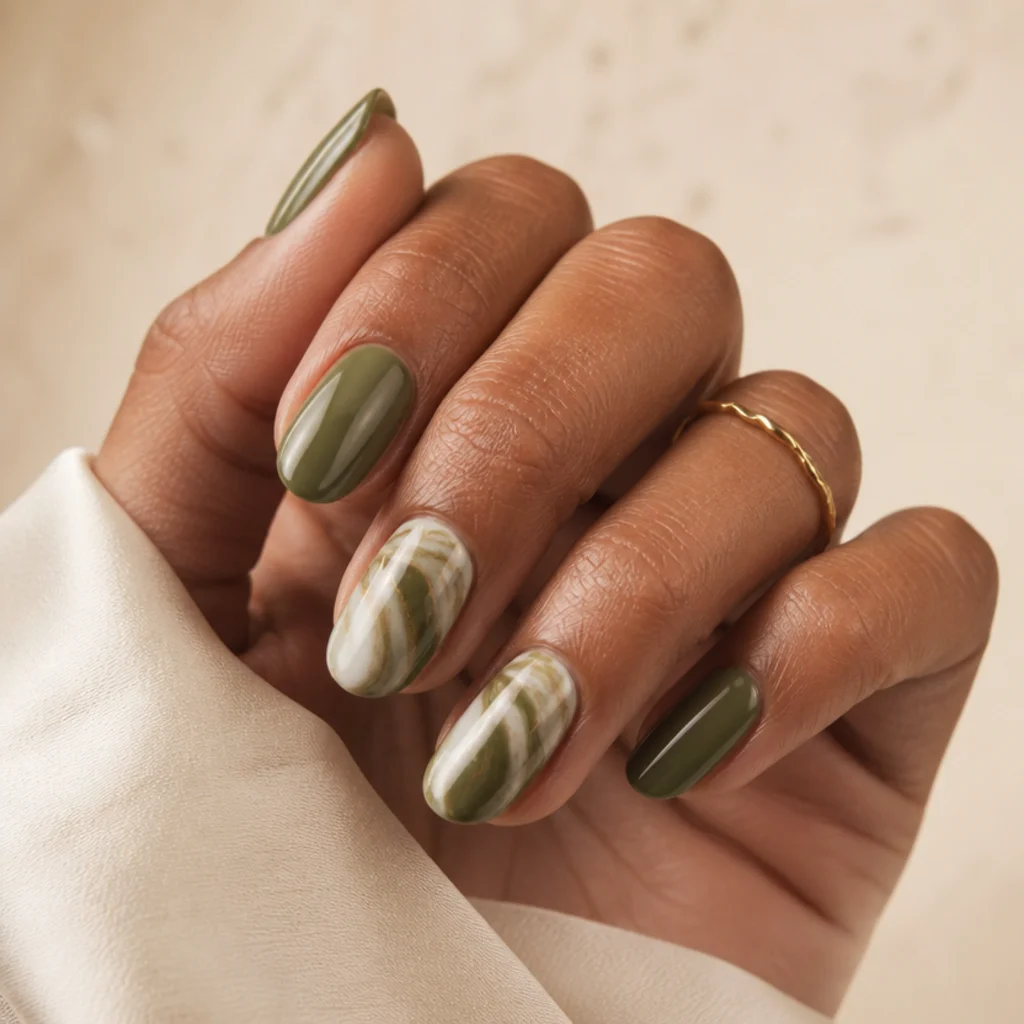
Marble gives olive an artsy, one-of-a-kind quality: thin swirls of white, cream, or gold dragged through a wet olive base create stone-like veining that no two nails repeat. Keep the marble to one or two accent nails and leave the rest solid, so the design has room to breathe instead of turning chaotic. It suits any length, though longer almond or coffin nails offer more canvas for the veins to flow and taper. Difficulty is intermediate because marbling lives and dies on timing — the base has to be wet enough to blend but set enough to hold the line, and you drag with a fine brush, toothpick, or needle in loose, unmatched arcs. Wear matches a standard set. Pair the accent with plain glossy olive and one gold ring to echo the veining. Pro tip: add a single thin gold vein last, off-center — that one metallic line is what takes marble from muddy to luxe. Ask your nail tech for "olive marble accents with soft white and gold veining on two nails."
11Olive Green and White Daisy Detail
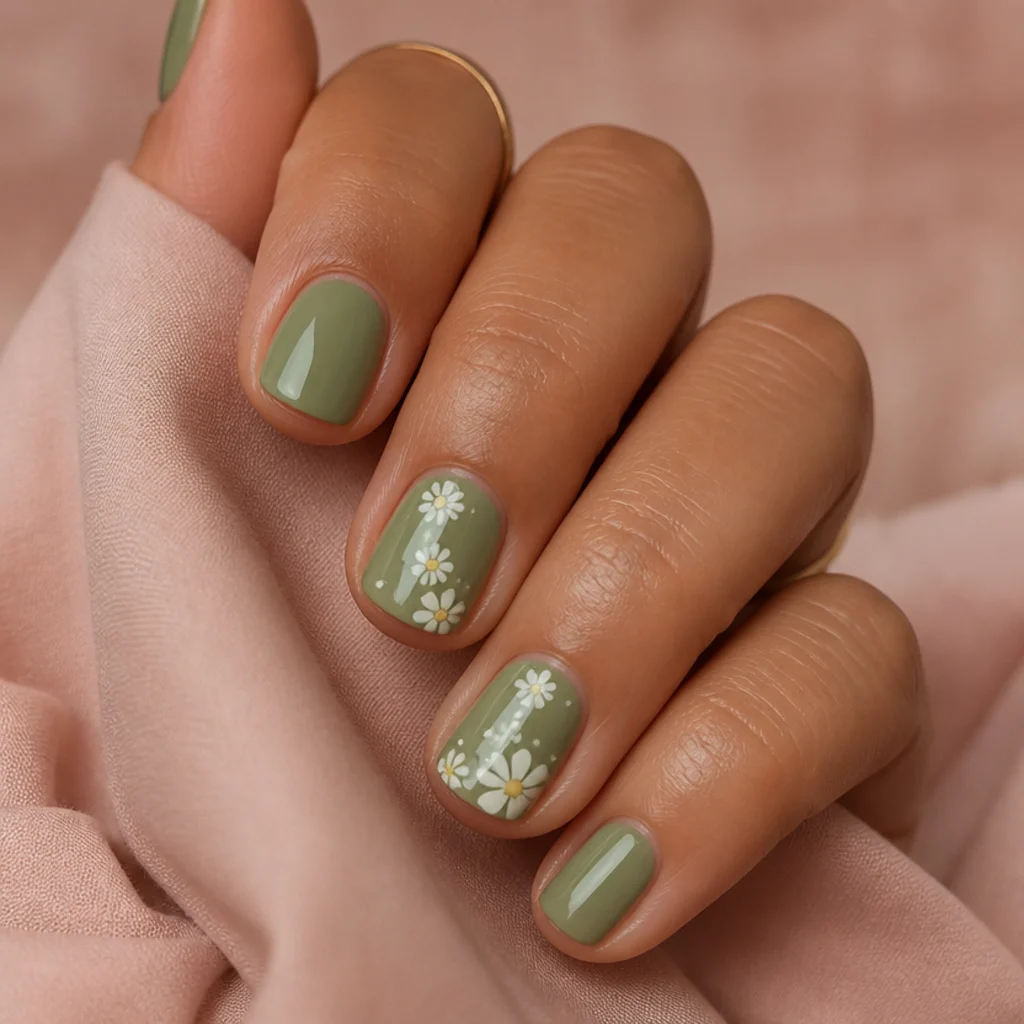
For a spring-leaning take on olive green and white, tiny hand-painted daisies bring garden-party charm without tipping into cute overload. Dot five small white petals with a dotting tool around a soft yellow or cream center, set over an olive or nude base, and keep the flowers to one or two nails so the set stays fresh rather than busy. It suits short and medium nails and anyone who likes delicate, feminine detail that still feels grown-up against the muted green. Difficulty is intermediate, since small florals need patience and a light hand — a proper dotting tool matters more than brush skill here. Upkeep is standard, though hand-painted art wears noticeably longer sealed under a gel topcoat that keeps the petals from abrading. Style it with a milky-white accent nail to tie the palette together. Pro tip: place each petal by touching the dotting tool down and lifting straight up, working around the center like a clock face, so the daisy stays round instead of lopsided. Ask your nail tech for "olive base with small white daisy accents on two nails, gel-sealed."
12Glossy Deep Olive Coffin Nails
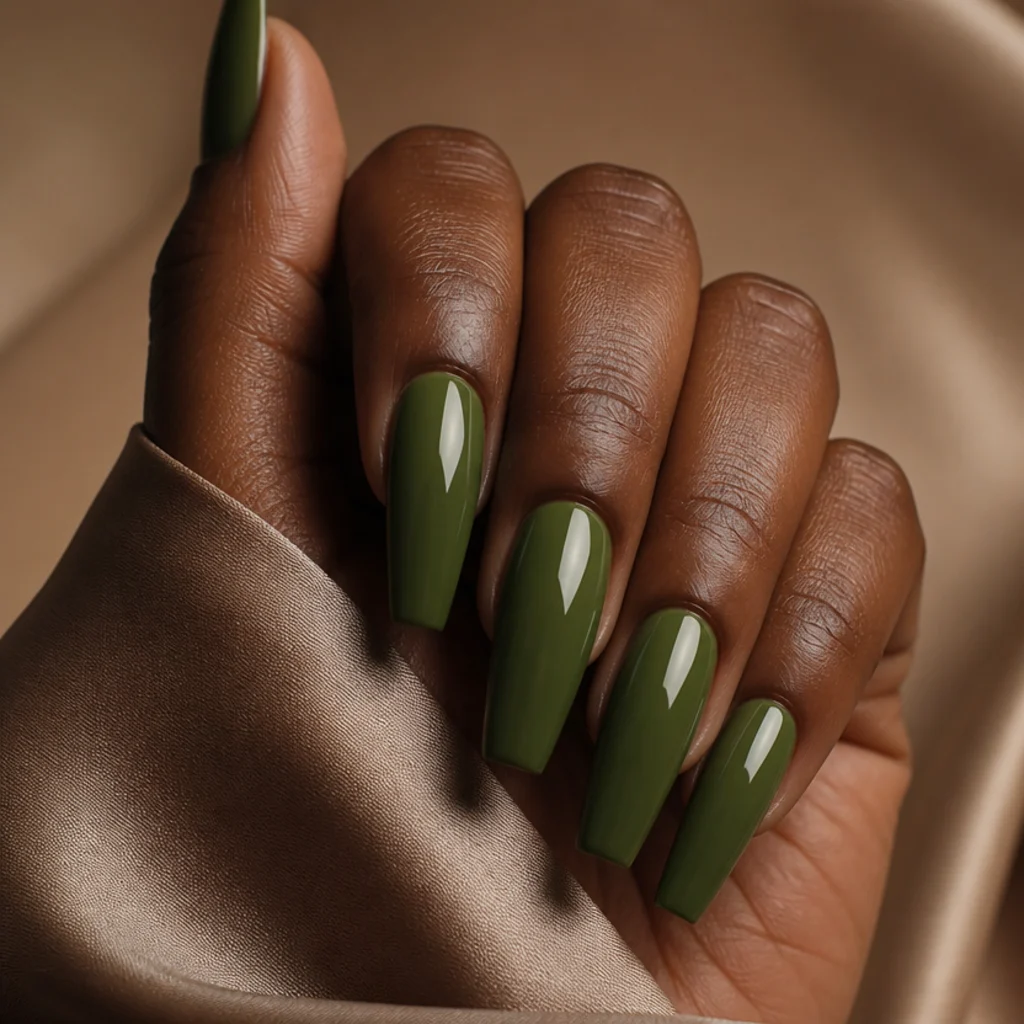
Coffin, or ballerina, nails give olive a bold, statement-ready canvas, and a mirror-gloss topcoat makes the deep shade look almost poured and lacquered. The tapered sides with a flat, squared-off tip need long length and are easiest to maintain in acrylic or hard gel, which gives the extension the strength to resist snapping at the narrowest point. This look leans dramatic and photographs well, so it's an event and holiday favorite. Because the nails are long, fills every two to three weeks keep the shape crisp and the apex balanced. High-gloss finishes show off every bit of shine, so a fresh top coat instantly revives a dull set between fills. Keep the shade a true deep olive rather than near-black so it still reads green in daylight. Pro tip: ask for the taper to start at the cuticle, not halfway up — a coffin that pinches too late looks square, while an early taper gives that clean, elongated silhouette. Ask your nail tech for "deep olive green, coffin shape, long length, extra-glossy top."
13Olive Green Negative Space
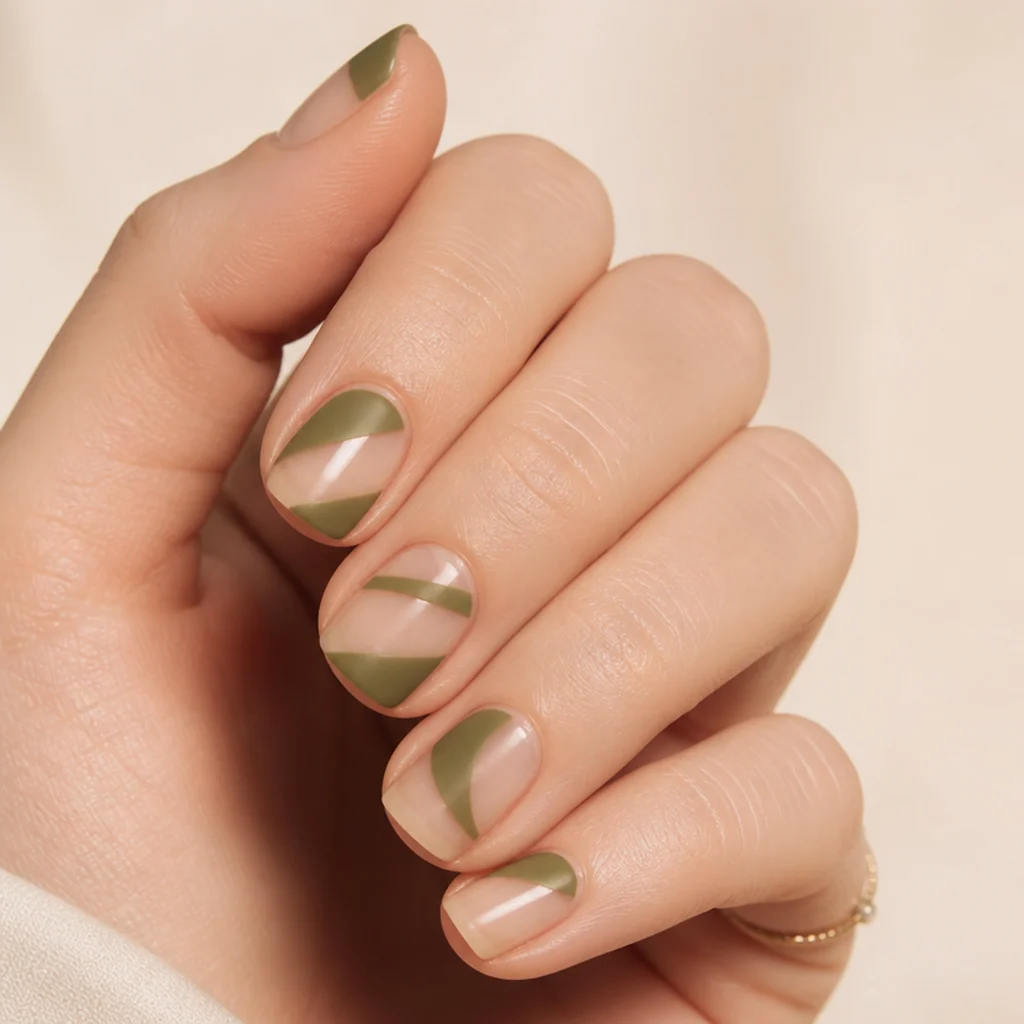
Negative-space designs leave part of the natural nail bare, which keeps olive looking modern, minimalist, and airy. A common version paints an olive shape, a half-moon at the base or a diagonal band across the nail, and leaves the rest clear so the skin tone becomes part of the design. It suits clean, healthy natural nails, since the exposed area is on full display and any ridges or staining will show. It flatters any length and looks especially sharp on squoval and short almond. Difficulty is intermediate, because crisp, opaque edges depend on tape or a very steady detail brush and a well-pigmented polish that covers in one pass. The best part: regrowth just blends into the intentional bare zone, so this stretches well between appointments, often three weeks-plus. Pro tip: cap the free edge with a clear or matching topcoat even over the bare sections, so the whole nail wears evenly and the painted shape doesn't lift at its border. Ask your nail tech for "olive green negative space, diagonal or half-moon, clean opaque edges."
14Olive Green Croc Print Accent
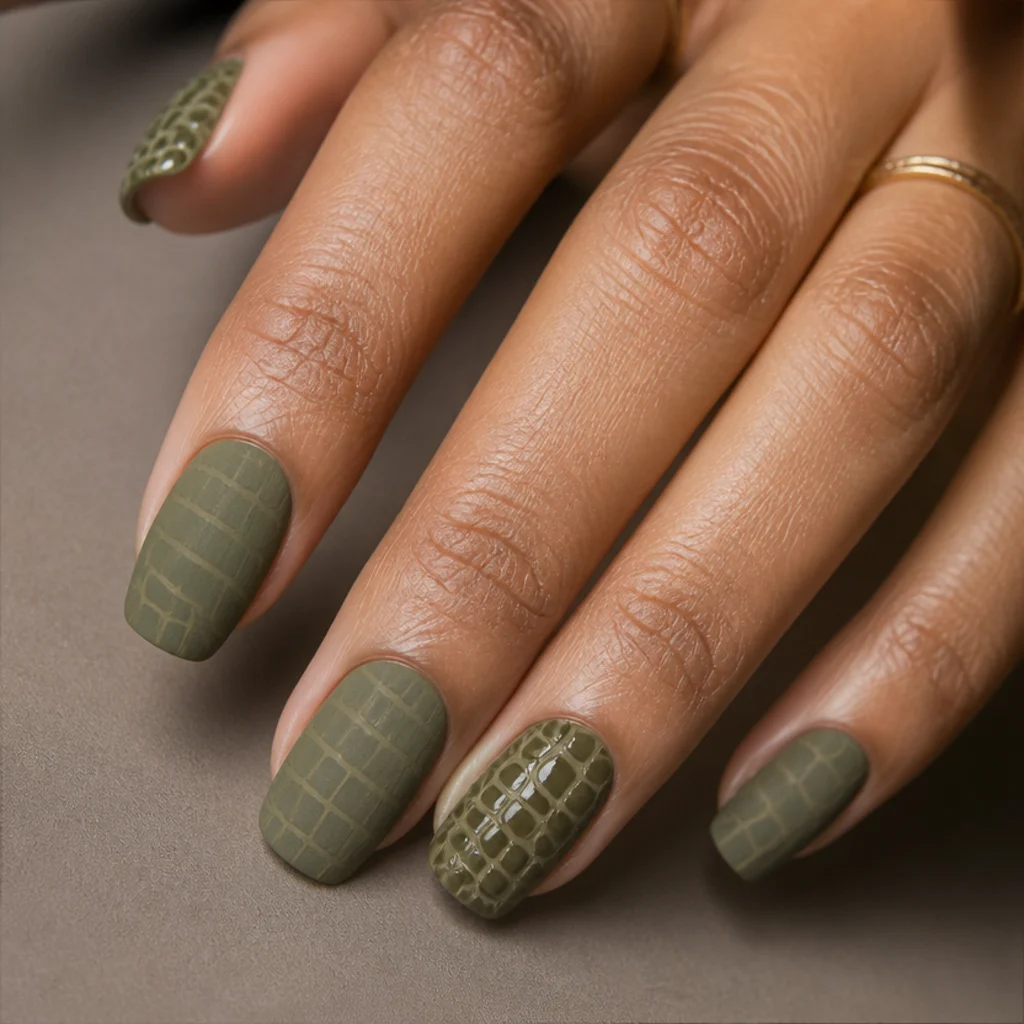
For a subtle animal-print moment, a tone-on-tone croc or reptile texture in olive adds edge without color chaos. The trick is finish contrast, not color contrast: a matte olive base with glossy olive scale-dots on top, or the reverse, so the pattern shows up only as light hits it. Keep it to an accent nail or two and leave the rest solid, since an all-croc hand reads busy fast. It suits medium to long nails and anyone who wants something a little unexpected but still monochrome and wearable to work. Difficulty is intermediate, and it's best built in gel, where you can cure the base, place crisp dots, and cure again for clean, raised scales. Wear matches a normal set. Style it beside plain matte olive so the glossy scales pop by comparison. Pro tip: cluster the dots slightly tighter toward the center and looser at the edges to mimic how real croc scaling flows, rather than a uniform grid. Ask your nail tech for "tonal olive croc print, matte base with glossy scales, on accent nails."
15Light Olive and Cream Two-Tone
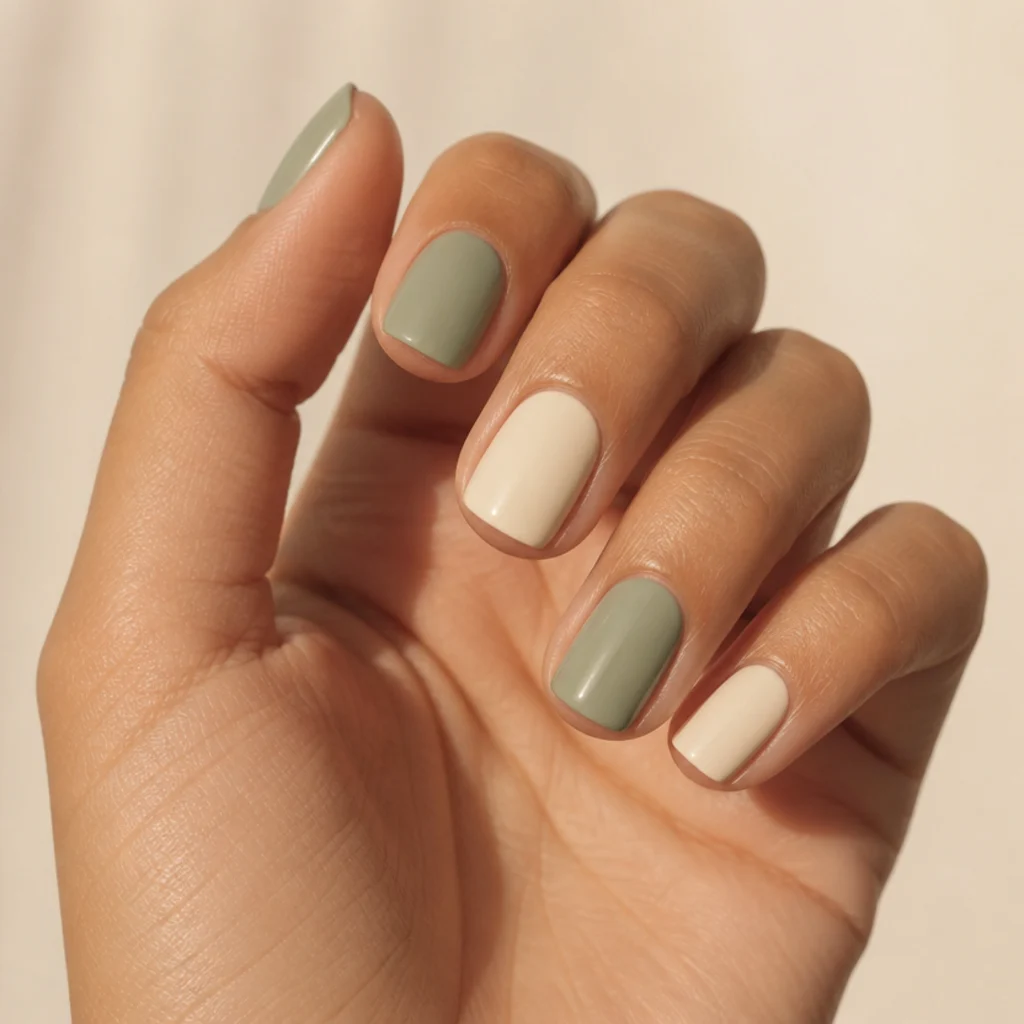
Ending soft: pairing a light olive green with a warm, buttery cream makes a muted, elegant two-tone that suits daytime and holds up year-round. Alternate the two shades across your nails, or use cream as the base with a light-olive tip for a barely-there French variation. Because both tones are pale and low-contrast, the combination stays quiet, refined, and office-appropriate, and it flatters warm and neutral undertones especially, where a cool gray-olive might look ashy. It suits short and medium nails, and since it's just solid blocks of color, it's a low-difficulty at-home project. Regrowth is barely visible on such pale shades, so it stretches to two weeks without looking grown-out. Style it with gold-toned jewelry to warm the whole palette. Pro tip: choose a cream with a yellow rather than pink base so it harmonizes with the olive — a rosy cream can make the pairing look accidental rather than chosen. Ask your nail tech for a "light olive and cream two-tone, alternating nails or a light-olive tip on cream."
Pro Tips from the Editor
- Test olive against your veins, not a white swatch card. Hold the bottle beside your wrist — if the polish disappears into a gray-beige next to blue-green veins, it'll read muddy on you, so nudge toward a warmer gold-olive.
- Undertone beats trendiness. Warm, gold- and brown-leaning olives flatter deep and warm skin; grayed, sage-leaning olives suit fair and cool skin. Get the undertone right and almost any of these 15 looks works.
- Cap the free edge on every look. Running the color and top coat over the very tip of the nail is the single biggest chip-preventer, especially for dark solids and French tips.
- Two thin coats beat one thick one. Olive pigments, especially sheer jellies and pale two-tones, streak and bubble when flooded. Thin layers cure harder and dry more evenly.
- Save detail for one or two accents. Marble, croc, daisies, and foil read as luxe when isolated and cluttered when repeated on all ten nails. Solid olive on the rest lets the art breathe.
- Match your finish to the occasion. Matte reads earthy, casual, and modern; high-gloss reads dressy and event-ready. The same olive shade can swing either way on finish alone.
- Keep cuticle oil in your bag. Olive's muted depth looks richest against healthy, hydrated skin. Dry, flaky cuticles make even a flawless coat look unfinished in close-up photos.
| Design | Difficulty | Best nail length | Typical finish | Approx. wear before refresh |
|---|---|---|---|---|
| Solid short squoval | Easy | Short | Glossy or matte | Regular polish ~1 week; gel ~2–3 weeks |
| Light sheer wash | Easy | Short–medium | Sheer jelly | ~5–7 days polish |
| Olive & white color block | Easy–intermediate | Any (square best) | Glossy | ~2 weeks |
| Matte acrylic | Intermediate | Medium–long | Matte | Fill every 2–3 weeks |
| French tip | Intermediate | Medium–long | Glossy | 3 weeks+ (grows out cleanly) |
| Chrome shimmer | Intermediate (gel) | Short–medium | Metallic gel | ~3 weeks |
| Ombre / marble / croc / daisy | Intermediate | Medium–long | Mixed | ~2–3 weeks (gel-sealed) |
How to Choose / Get the Look
Work through four decisions in order and you'll land much closer to the picture in your head than the word "olive" alone can get you.
1. Start with undertone. Warmer olives that lean gold or brown flatter deep and warm-toned skin; grayed, sage-leaning olives sit more easily on cool and fair complexions. Most olives are forgiving, so this sets the direction, not a hard rule.
2. Match the design to your lifestyle. If you work with your hands or want the lowest fuss, a solid short squoval or a light sheer wash lasts longest, because both hide chips and regrowth. If you want length or your natural nails are weak, move to acrylic or hard gel. Reserve detailed art (daisies, marble, croc, foil) for one or two accent nails so the look stays clean.
3. Choose your finish. Matte reads earthy and modern; high-gloss feels dressier and more editorial; chrome and foil bring shine and dimension. This choice changes the mood of the exact same shade.
4. Set your maintenance budget. Dark solids and French tips stretch to three weeks; pale and white-paired looks want a refresh nearer two. Decide how often you'll realistically re-book before you commit to a high-upkeep set.
When you book, bring a saved photo, name the exact depth (light, medium, or dark olive), state your shape and length, and confirm matte or glossy. Those four details do the heavy lifting.
Frequently Asked Questions
Does olive green go with every skin tone?
For the most part, yes. Olive borrows from both warm and cool color families, so it flatters a wide range of tones. For the best match, choose warmer, gold-leaning olives for deep or warm skin and cooler, sage-leaning olives for fair or cool skin. If a shade looks muddy against your wrist, shift toward a slightly warmer or brighter olive rather than giving up on the color.
Are dark olive green nails hard to keep looking fresh?
Not especially. Solid dark olive shades hide regrowth and minor chips better than pale colors or busy art, so they often look presentable for two-plus weeks. A fresh topcoat every few days revives the shine on glossy finishes, and capping the free edge at application does the most to slow chipping.
What nail shape suits olive green best?
Any shape works. Almond and coffin give dark olive a polished, elongated look on longer nails, while short squoval is the most practical everyday choice and resists corner chips. Pick the shape based on your natural nail length, how much upkeep you want, and whether you need the extra strength of an extension.
Can I do olive green nails at home?
Many of these are beginner-friendly. Solid shades, sheer washes, French tips, and two-tone looks need only polish and a steady hand. Chrome, ombre, marble, croc, and hand-painted florals are far easier with gel supplies, a lamp, and detail tools, or a trip to the salon. Start with a solid short squoval to build confidence.
What colors pair well with olive green nails?
White and cream keep it crisp and fresh, gold adds warmth and a slightly luxe feel, and nude or blush bases let olive tips and accents stand out. Tone-on-tone olive, like a matte-and-glossy croc, is another easy, foolproof pairing. For jewelry, gold and mixed metals suit warm olives, while silver plays nicely with grayer, sage-leaning ones.
Light olive or dark olive: which is more flattering?
It depends on contrast. Light olive and cream two-tones flatter fair and warm skin and read fresh for daytime, while dark, grayed olive gives depth that looks striking on deeper skin and in autumn styling. If you're unsure, a medium olive splits the difference and photographs well across most tones.
How do I keep olive polish from looking muddy or dull?
Two things: undertone and finish. Match the olive's warmth to your skin so it doesn't go gray, and add a high-gloss or chrome top to bounce light back and lift a flat shade. A smoothing base coat underneath also stops the color from settling into ridges and looking uneven.
What's the best olive green nail look for weak or short natural nails?
A solid short squoval or a light sheer wash. Both keep the nail practical, cover in one or two coats, and hide chips as they wear. If you want a touch more length or strength without full extensions, a hard-gel overlay in olive reinforces the natural nail while keeping the shape modest.
How long do olive green nails last?
Regular polish typically holds about 5 to 7 days, gel around 2 to 3 weeks, and acrylic or hard-gel sets until your fill at 2 to 3 weeks. Dark solids and French tips visually last longest because regrowth is less obvious, while pale and white-paired looks tend to want a refresh sooner.