20 Gorgeous Aries Constellation Tattoos
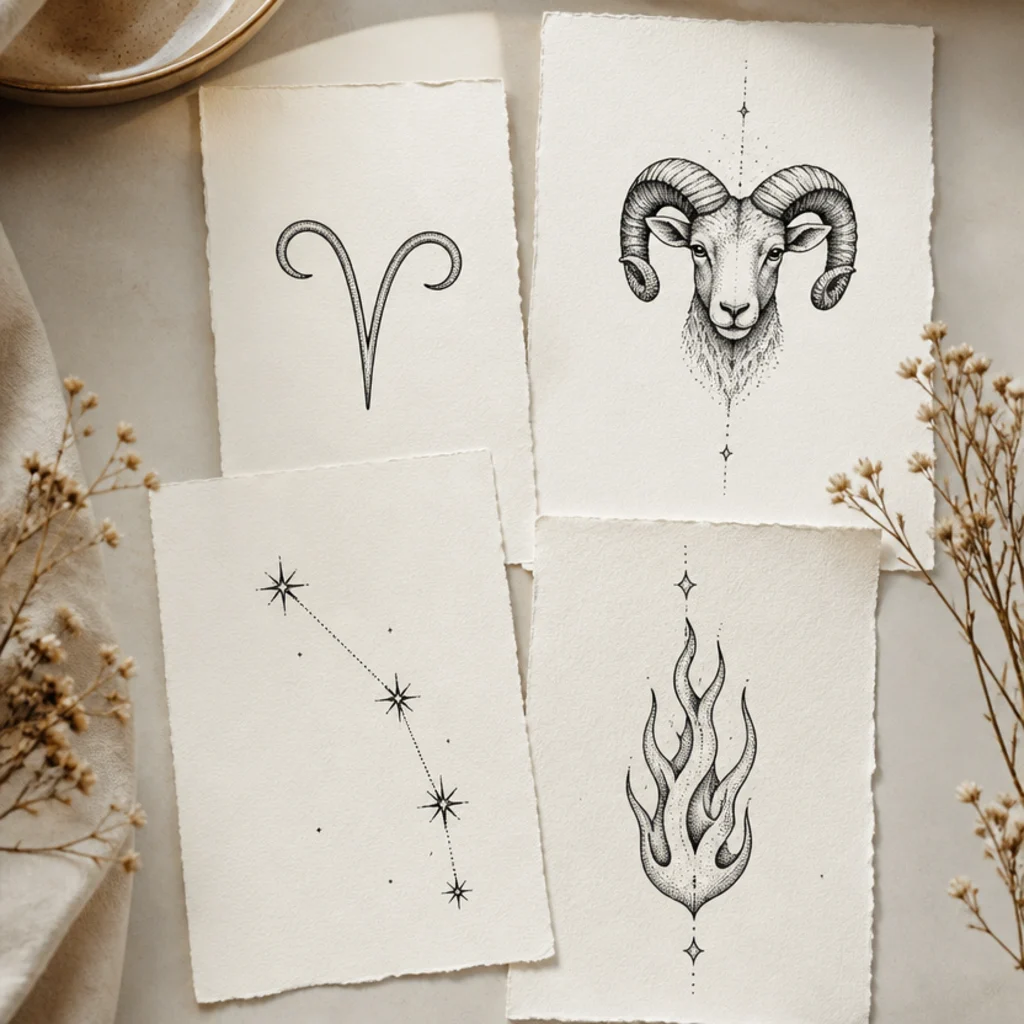
The Aries constellation is a short, confident arc of just a few stars, which makes it one of the easiest zodiac shapes to tattoo well. From a barely-there single-needle wrist tracing to a shaded ram-and-stars centerpiece, here are 20 editor-vetted ways to wear your fire sign, each with the exact placement, sizing, line-weight and healing notes to bring straight to your consultation.
 Edited by Lena Rose · Published July 11, 2026 · 35 min read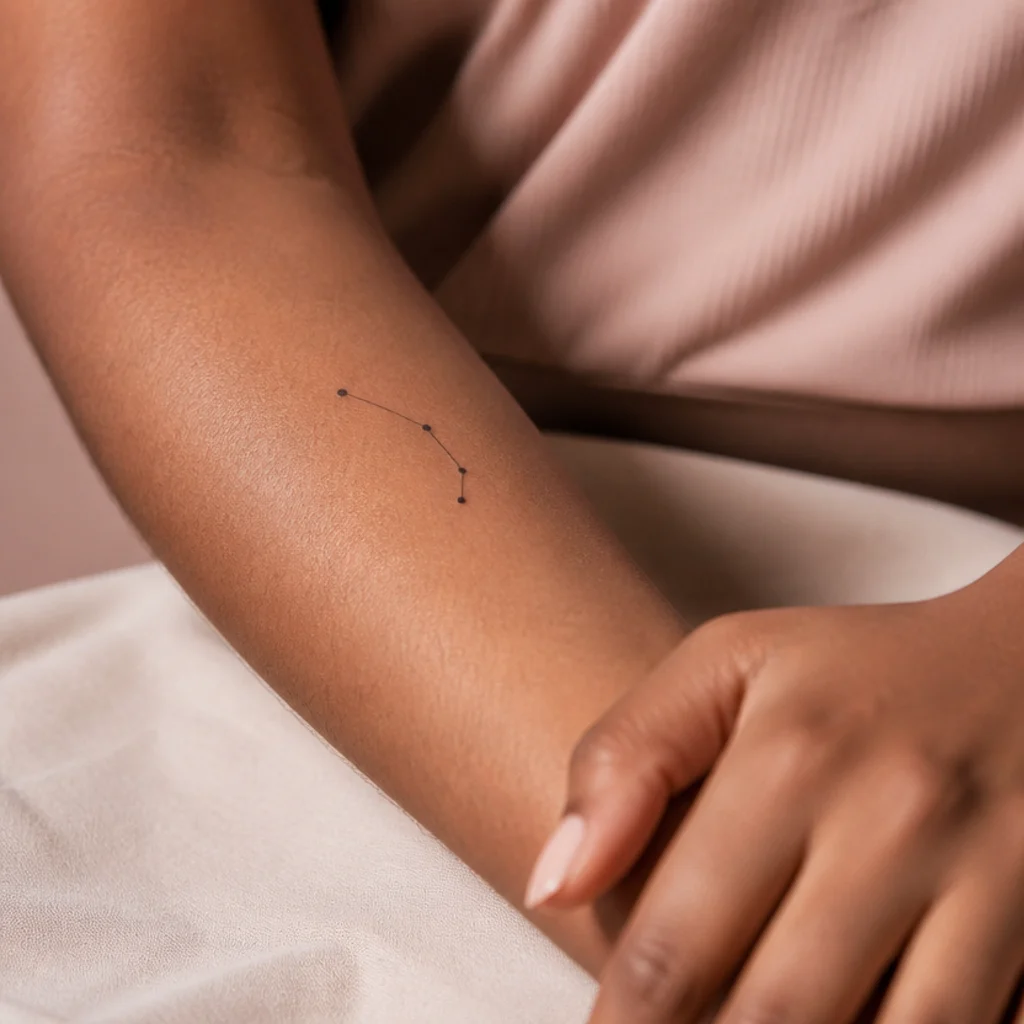
Quick Answer
- Best for: Aries suns (roughly March 21–April 19), Pisces-Aries or Aries-Taurus cusp babies who identify with the fire-sign drive, and anyone drawn to a compact, linear, low-crowd constellation that scales from a fingertip to a full shoulder blade.
- Who might skip it: People wanting dense coverage or saturated color realism from one small piece, anyone with a very active outdoor lifestyle who won't commit to daily SPF, or anyone hoping a thin star line will camouflage an existing tattoo or scar (it won't).
- Maintenance: Fine-line and dotwork read cleanest for 3–5 years, then may want a light refresh; solid blackwork holds crisp edges longest (often 8–10+ years); colored and watercolor work relaxes soonest and demands diligent SPF and a likely touch-up within 2–4 years.
- Difficulty: Beginner-friendly for small minimalist star maps; intermediate for silhouettes, dotwork and botanicals; advanced for shaded ram portraits, sacred-geometry blackwork and watercolor washes.
- Cost: Highly variable by region and artist. Small minimalist pieces usually sit at or near the shop minimum; ram portraits and multi-session illustrative work are billed by the hour and climb accordingly. Never chase the lowest quote, and confirm the full estimate in consultation.
- Wear time / longevity: A well-placed constellation on the forearm, outer bicep or shoulder blade ages best; fingers, feet, inner wrist, ankle and sternum see the most friction, flex and sun, and fade fastest.
- Standout variation: The glyph-plus-constellation combo, pairing the ram-horn symbol with the star line for instant, unmistakable Aries recognition even to non-astrology readers.
- How to ask your tattoo artist: "I'd like a fine-line Aries constellation, roughly [size] on my [placement], with [thin connectors / dotwork / a glyph or ram], Hamal as the anchor star, kept legible and low-maintenance as it ages."
In This Guide
- Minimalist Fine-Line Star Map
- Aries Glyph Meets Constellation
- Dainty Behind-the-Ear Stars
- Watercolor Nebula Aries
- Ram Silhouette With Star Line
- Spine Constellation Column
- Collarbone Star Trail
- Blackwork Geometric Aries
- Delicate Ankle Constellation
- Floral Aries Constellation
- Finger Micro-Constellation
- Bold Ram Head Portrait
- Rib-Cage Star Script
- Moon-and-Aries Pairing
- Sternum Constellation Drop
- Golden-Ochre Dotwork Aries
- Wrist Cuff Constellation
- Couple or Sibling Star Set
- Aries Constellation With Birth Date
- Shoulder Blade Star Sprawl
Intro
The Aries constellation is one of the sky's quietest shapes: a small, bent line of stars led by Hamal (Alpha Arietis, its brightest at roughly magnitude 2), followed by Sheratan (Beta), the fainter double Mesarthim (Gamma), and often 41 Arietis for a fourth point. That economy is exactly what makes gorgeous Aries constellation tattoos so wearable. With only three or four points to place, the design reads clearly at almost any scale and rarely crowds the skin, so it flatters delicate spots (inner wrist, behind the ear, ankle) as easily as broad, stable panels (shoulder blade, thigh, outer bicep). It also layers beautifully, inviting a ram-horn glyph, a silhouette, a crescent moon or a scatter of fine-line florals without ever losing legibility.
The look suits a wide range of people and skin tones because the star map is essentially abstract line and dotwork, so an artist can adjust needle configuration, weight and spacing to how your skin holds ink. For an aries tattoo for women who want subtlety, four connected dots say plenty; for a bolder statement, a shaded ram portrait anchored by the constellation puts the fire-sign symbolism front and center. Below are 20 different takes across fine-line, dotwork, blackwork, watercolor and illustrative styles, each with placement, upkeep and how-to-ask notes. Treat them as a starting point, then co-design the final piece with your artist.
01Minimalist Fine-Line Star Map
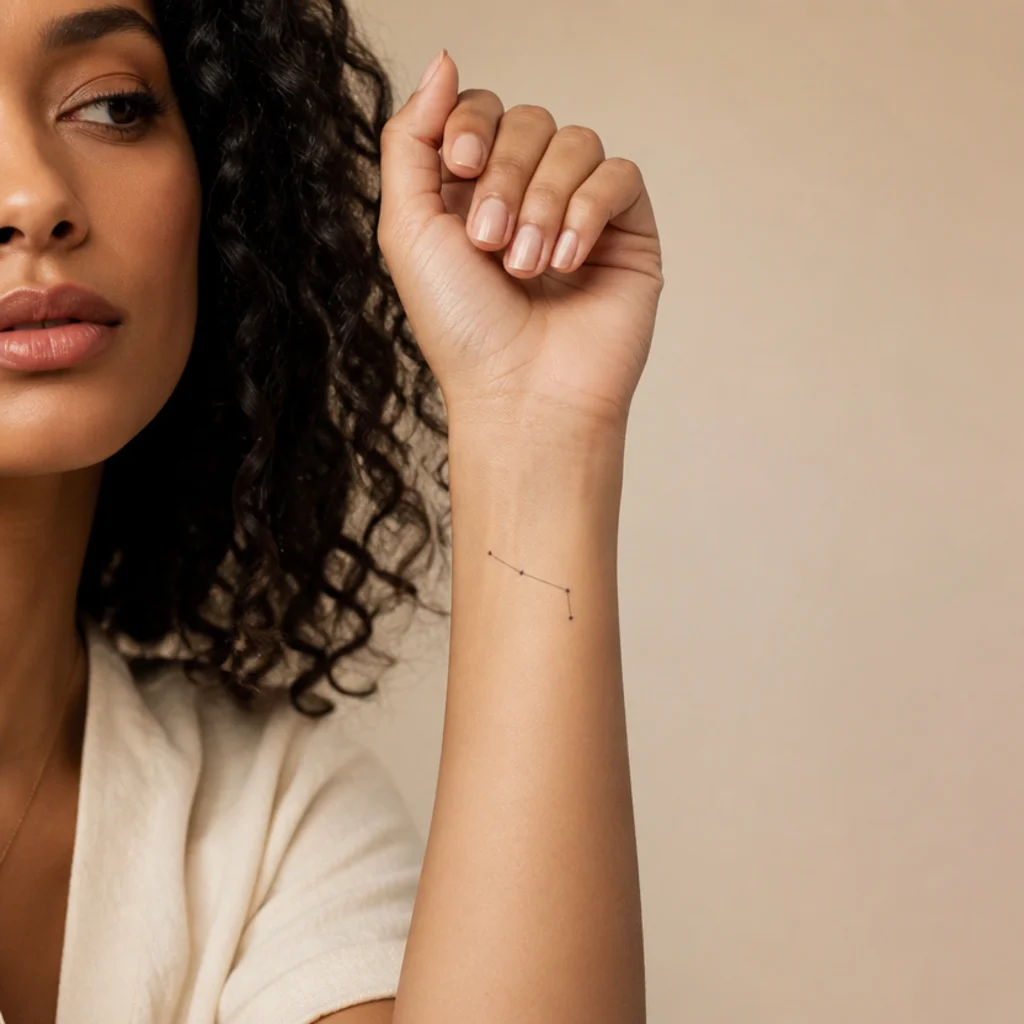
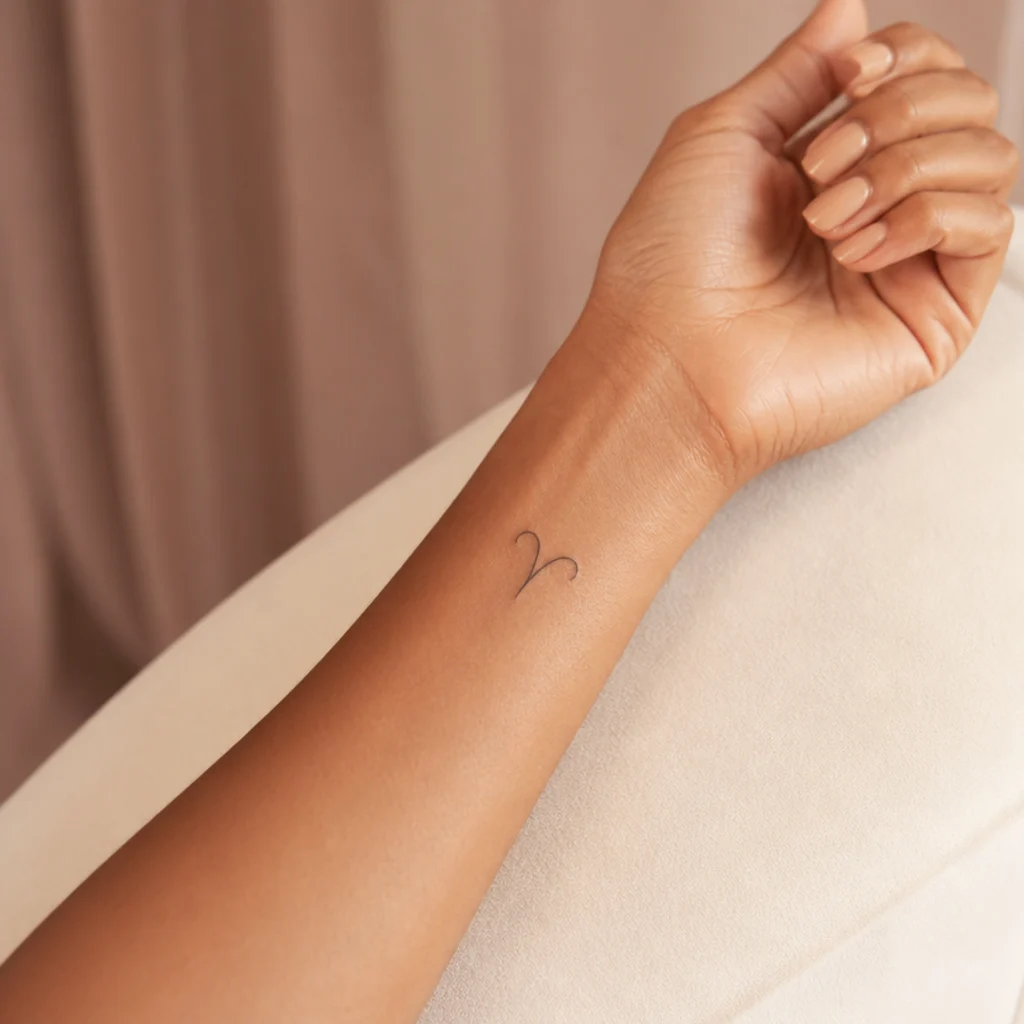
The purest interpretation: a single hairline connecting four graduated dots that trace the true Aries pattern, Hamal, Sheratan, Mesarthim and a fourth star. This aries minimalist tattoo suits first-timers and pared-back aesthetics, and it sits cleanest on the inner forearm, wrist or outer bicep, flat, low-friction zones that keep thin lines from spreading. Because single-needle work is delicate, ask for a 1RL (single round liner) or a tight 3RL and slightly varied dot diameters so Hamal reads as the visual anchor and the points feel astronomical rather than mechanical. Keep it around two to three inches; going smaller compresses the spacing and invites blur as the ink settles into the dermis. Maintenance is low, though expect very fine strokes to soften over roughly four to six years and possibly want a light refresh. Bring an accurate reference, and specify thin connectors, no shading, and dots spaced generously so they stay distinct. Ask your tattoo artist for a "single-needle map with breathing room" rather than the tightest possible miniature, which almost always ages worse.
02Aries Glyph Meets Constellation
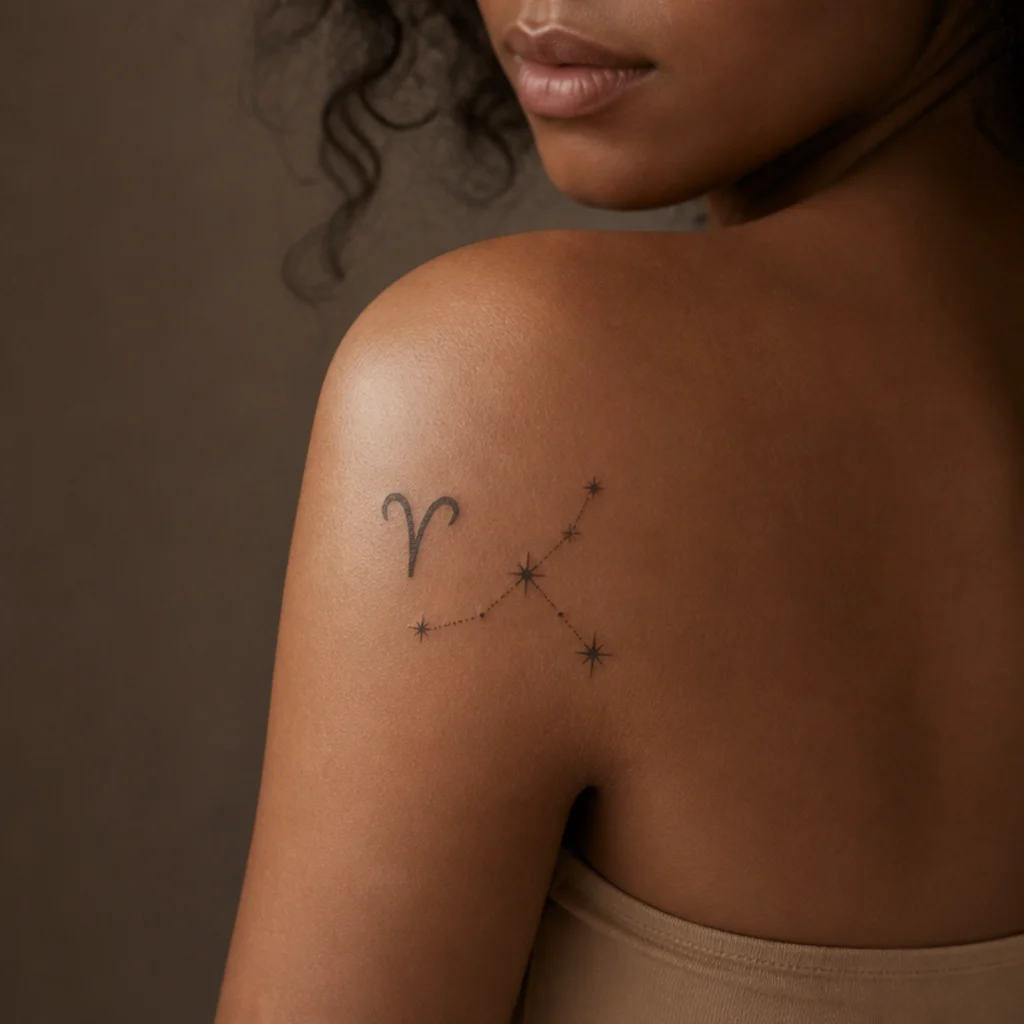
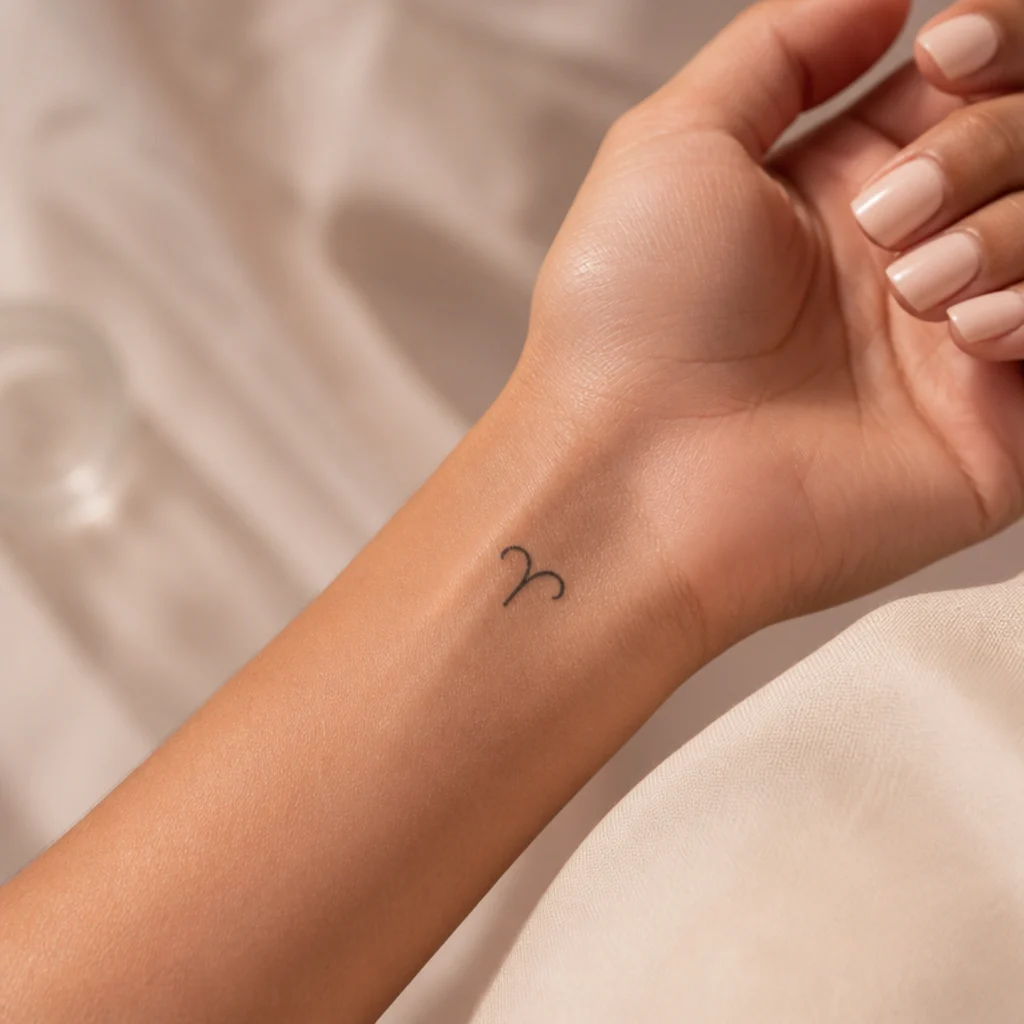
Here the ram-horn glyph (the "V with two curls") sits beside or gently overlaps the constellation, doubling the symbolism so the sign registers instantly, even to people who don't read star maps. It's a smart pick if you love the meaning but worry a bare star line looks generic. The glyph gives the eye a graphic anchor, and it works well as a small-to-medium piece for the outer forearm, deltoid or under the collarbone. The key is hierarchy: ask for the glyph at roughly one-and-a-half times the connector stroke weight so the eye lands on the symbol first and follows the stars second. Vertical along the arm reads bold and architectural; horizontal under the collarbone reads like fine jewelry. Difficulty is low to moderate, and because the glyph carries more ink than the thinnest connectors, it tends to hold its shape a touch longer as the piece matures. A subtle upgrade: have the glyph's curls echo the arc direction of the star line for a unified composition. Ask your tattoo artist for "a bolder glyph paired with fine stars, clear contrast in line weight" so the two elements never compete.
03Dainty Behind-the-Ear Stars

For something you can hide or reveal at will, a micro-constellation behind the ear is quietly magnetic, peeking out only when your hair is up or tucked. Because the stars are tiny, the design leans on placement rather than detail for impact, so it suits people who want a private, personal marker over a showpiece. The skin here is thin, mobile and close to the mastoid bone, which makes the spot more tender and can lengthen healing, so talk pinch points and comfort through with your artist and simplify to a clean three-star version (Hamal, Sheratan, Mesarthim) so the shape stays legible at scale. Keep the piece under an inch, skip fine shading entirely, and prioritize spacing so the dots don't merge into a smudge as they settle. This placement also meets sunscreen, hair product, fragrance and collar friction daily, so a light touch-up down the line is normal, not a fault. Apply product and perfume away from a fresh piece here during healing. Ask your tattoo artist for a "barely-there dotwork constellation sized for behind the ear, with extra spacing built in for longevity."
04Watercolor Nebula Aries
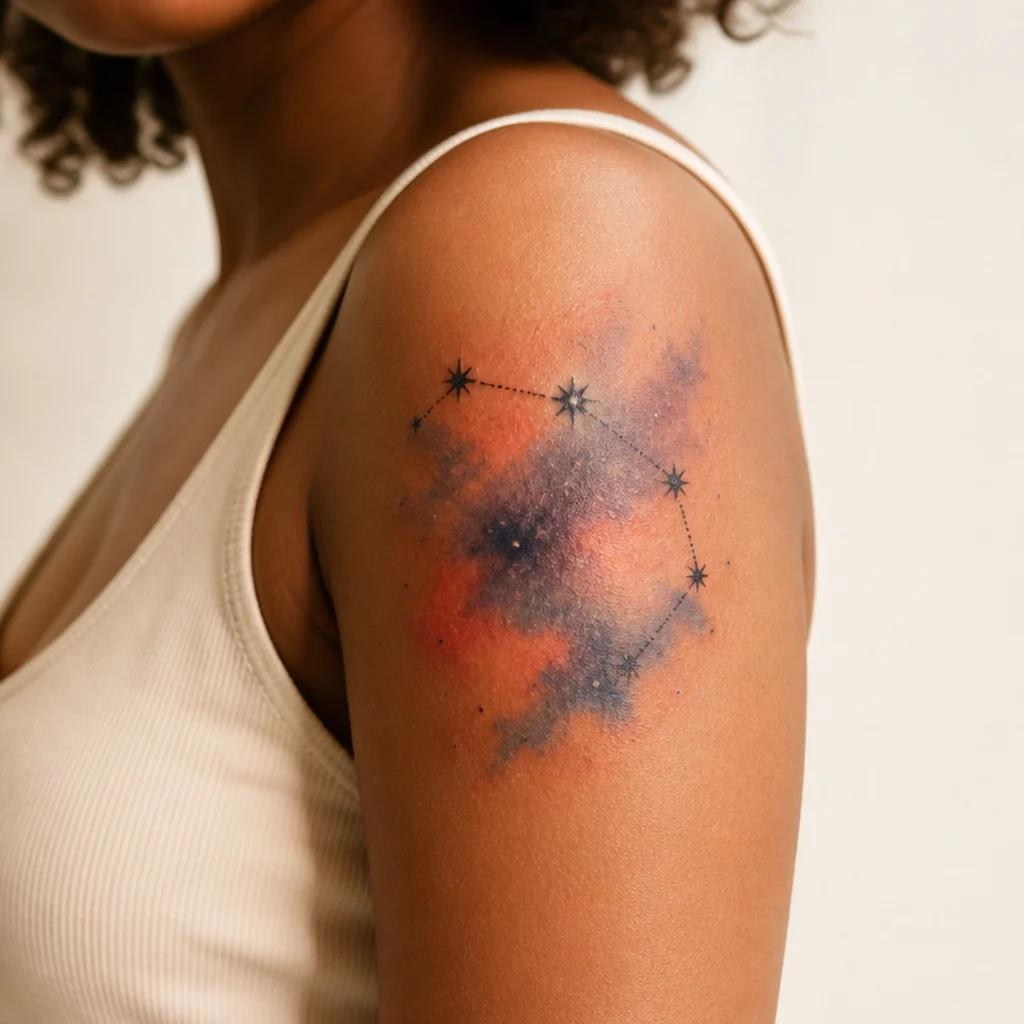
Set the star line against a dreamy wash of coral, violet and deep indigo that mimics a nebula glowing behind the constellation. This aries constellation tattoo trades minimalism for mood and depth, and it wants room to breathe, so the upper arm, deltoid or thigh suits it far better than a tight wrist. Watercolor is a specialty technique built on soft, edgeless gradients and confident pigment saturation, so choose an artist whose healed portfolio (not just fresh, glossy photos) shows the style holding up beyond a year. One honest caveat: color, especially pale pastel washes, fades faster than black linework, so budget for disciplined SPF and a likely touch-up within two to four years. Many artists now add a subtle black or grey "skeleton" of stars over the wash so the constellation stays sharp even as the color relaxes, a technique worth requesting by name. Consider a slightly deeper, more saturated palette, which reads longer than baby pastels on most skin tones. Ask your tattoo artist for "a watercolor nebula with an anchored line-work constellation on top" for the best of both worlds.
05Ram Silhouette With Star Line
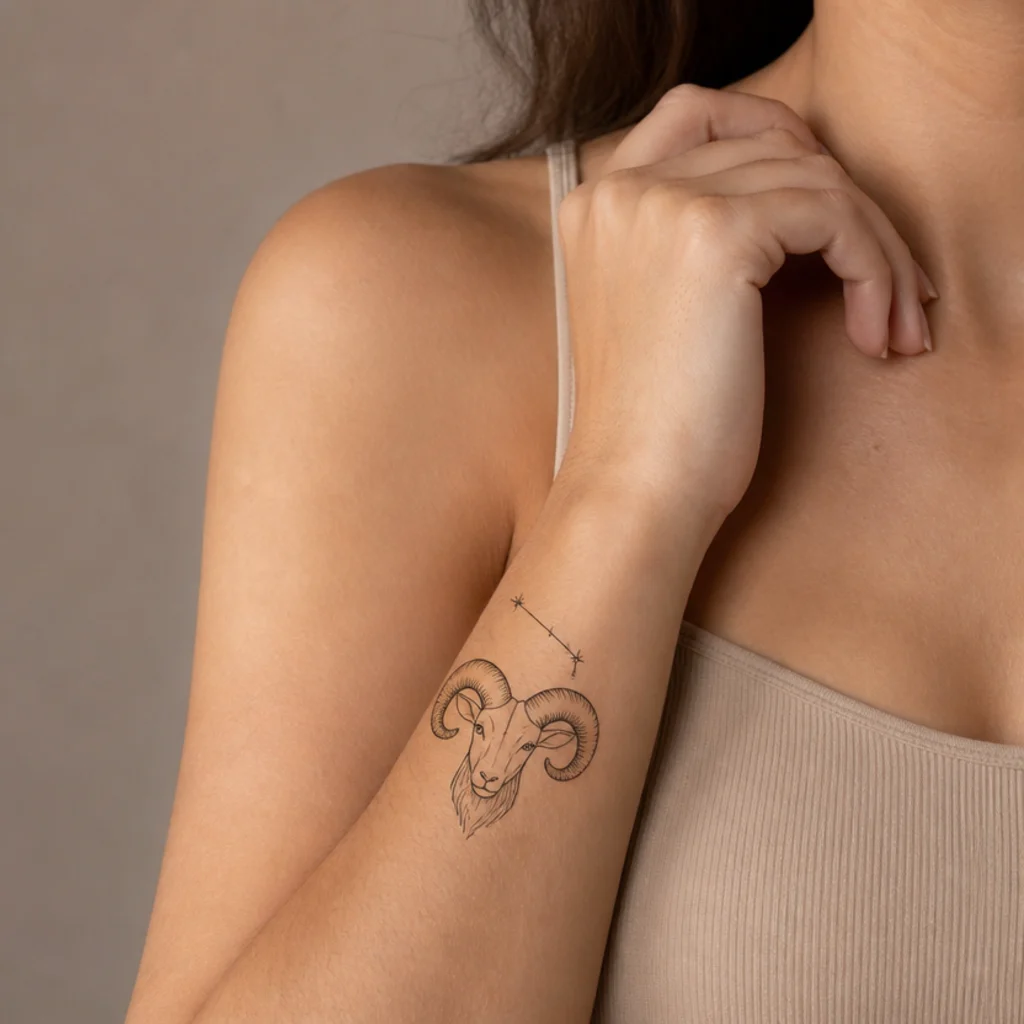
A clean ram silhouette, defined by those signature curled horns, paired with the constellation delivers the full aries ram tattoo story in one compact, modern design. Because it's a silhouette rather than a shaded portrait, it stays graphic and legible at medium size on the forearm, calf or outer bicep, and it reads well from a distance where fine detail would vanish. Decide early between a solid-filled ram (bolder, ages crispest) and an outlined one (lighter, more open, but the interior lines can blur first), and choose whether the star line arcs above the horns, runs behind the body or cradles it. This is one of the most versatile picks here: it works as a standalone statement now and as a natural anchor if you later build a larger cosmic or botanical scene around it. Difficulty is moderate, and a solid silhouette is a durable, low-regret choice with excellent contrast retention. For a contemporary edge, ask for the constellation to sit in negative space carved from the ram's body. Ask your tattoo artist for "a stylized ram silhouette with the constellation integrated, kept graphic rather than realistic" so it scales and heals predictably.
Save this to Pinterest to compare ram-and-constellation layouts.
06Spine Constellation Column
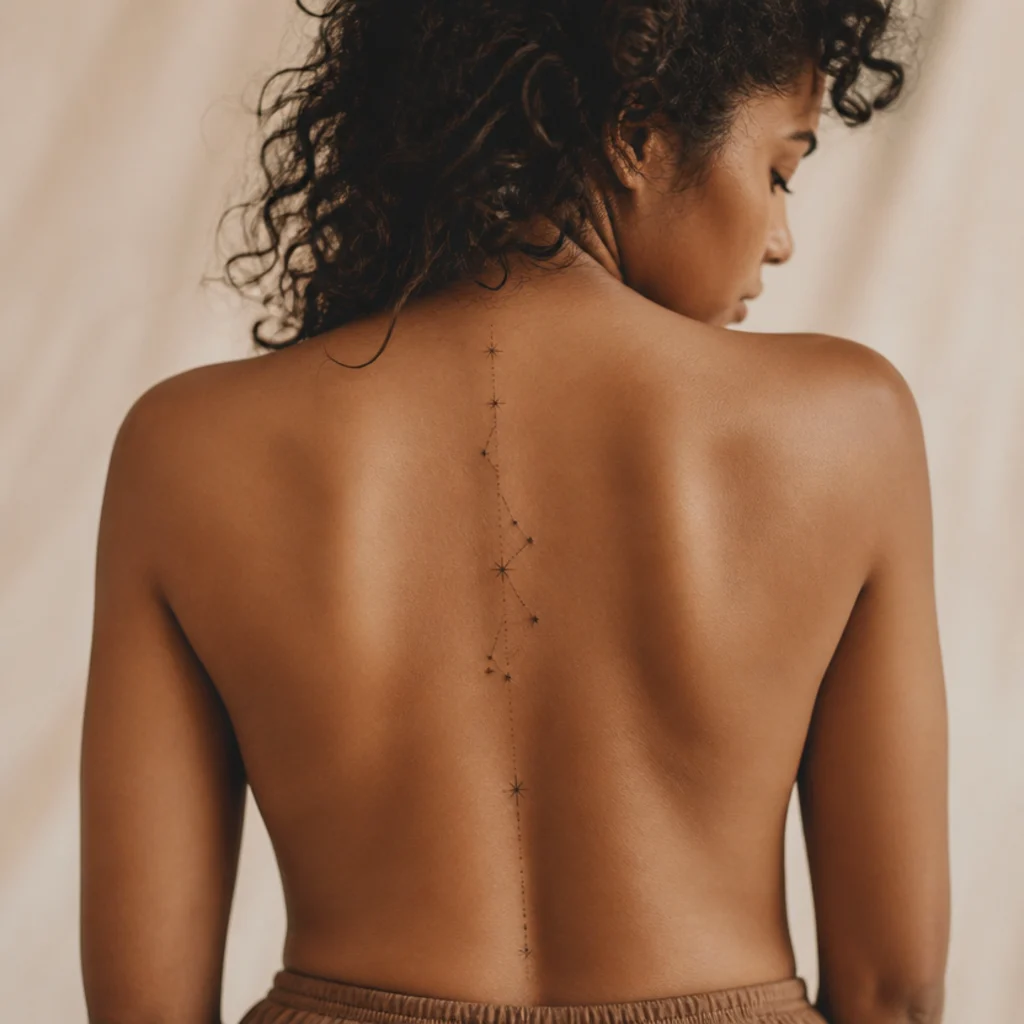
Running the constellation vertically down the spine turns a small star map into an elongated, architectural column, and the natural channel of the back flatters the shape's slight curve. You can stretch the spacing for a drawn-out, editorial effect that follows your vertebrae from nape to mid-back. It suits anyone comfortable with a placement that's striking yet effortless to cover for work or events. Two practical realities: the spine sits over bone and nerve-dense tissue, so it ranks among the more sensitive spots and may need breaks or a split session; and the skin here stretches and shifts as you bend, so ultra-fine connectors can distort if they're crowded. Keep the linework minimal and let generously spaced dots carry the design. Alignment to your true midline is make-or-break, an experienced artist will stencil and re-check it while you stand naturally, not while you're hunched forward. Because the spine flexes, a marginally sturdier connector than you'd use on a flat forearm pays off. Ask your tattoo artist to "map the Aries stars along the spine's midline, elongated to my torso, with subtle dotwork and clear space between points."
07Collarbone Star Trail
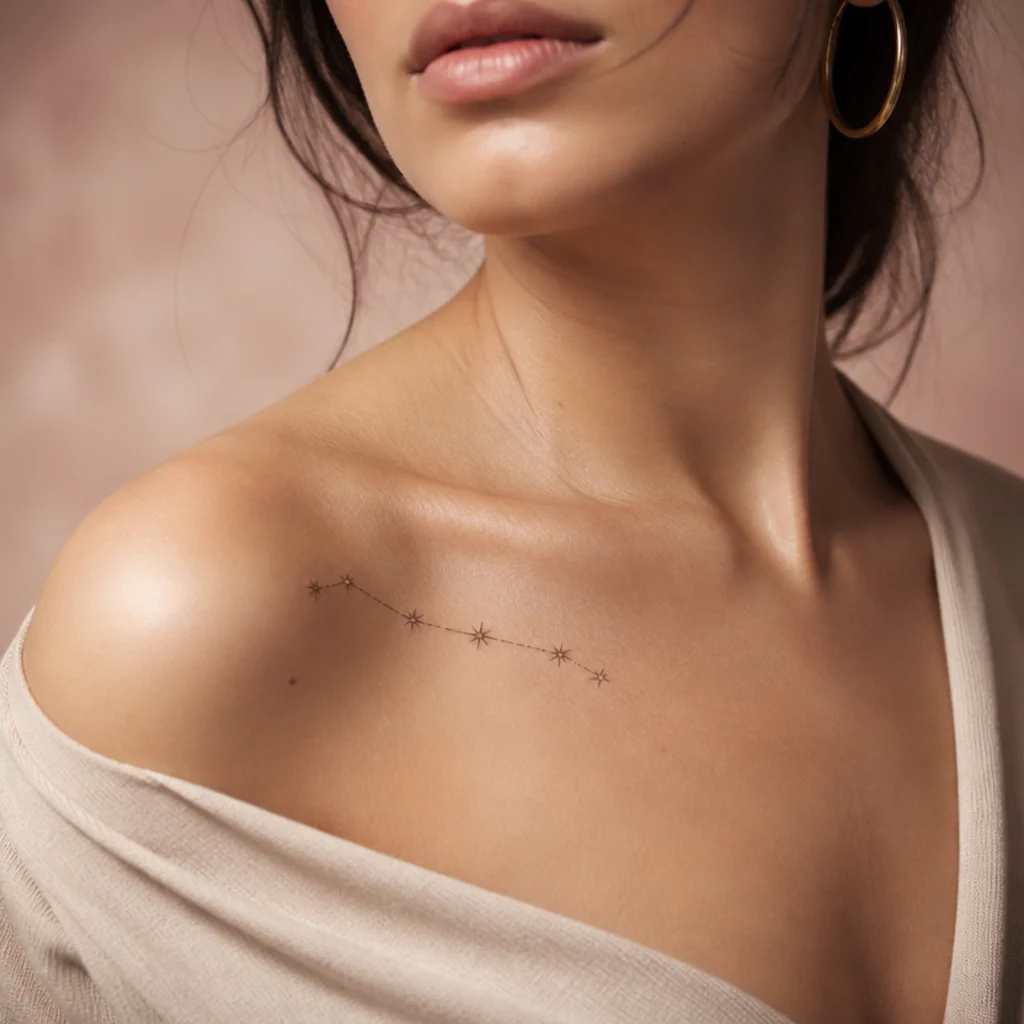
The collarbone offers a ready-made horizontal canvas, and the Aries star line follows its curve as though the two were designed together. This is a flattering aries tattoo for women who want something visible with a scooped or off-shoulder neckline yet refined enough to read as jewelry rather than statement art. Because it's linear and small, it layers elegantly with a tiny date, initial or birthstone dot added later. Ask your artist to follow the bone's actual angle rather than a rigid horizontal, and to place Hamal near the center so the piece balances across the décolletage. Healing over a bony, thin-skinned ridge can feel tender, and ink here sometimes settles slightly lighter, so a fine but not wispy line weight tends to hold best, avoid the very thinnest single-needle. Keep it within about three to four inches so it traces the bone without drifting toward the shoulder joint, where movement increases. Skip heavy shading, which spreads on this thin skin. Ask your tattoo artist for "a constellation that follows my collarbone's natural curve, centered star for balance, jewelry-fine but not fragile."
08Blackwork Geometric Aries
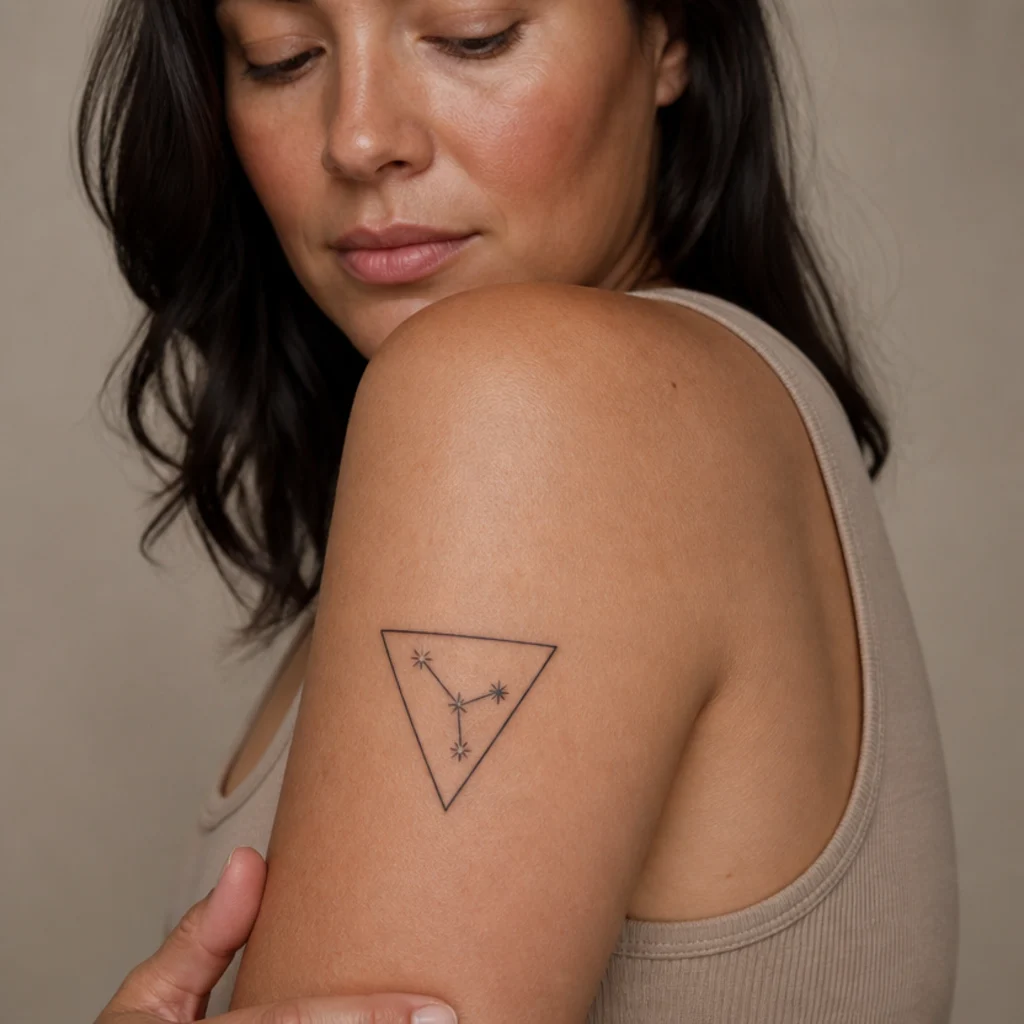
For maximum contrast and staying power, set the constellation inside a bold geometric frame, a triangle, circle or diamond rendered in solid blackwork. The heavy ink gives the delicate stars structure and lets the piece read from across a room, which is why it suits people who love graphic, architectural tattoos that age crisply. Blackwork's density is its longevity advantage: saturated, single-pass black holds its edges far longer than hairlines, so this is one of the most future-proof options here, often looking clean at eight to ten years and beyond. Decide whether the frame is a clean outline, partially filled, or a fine sacred-geometry pattern (mandala rays, dot lattices), and make sure the star line is centered and doesn't touch the border, because contact points blur first as ink migrates. It's a more advanced piece and usually a longer session due to the saturation work, so review healed blackwork in the artist's book for even, patch-free fills rather than fresh-and-shiny examples. Ask your tattoo artist for "crisp geometry with the constellation floated dead-center, solid saturated blackwork, no touching lines" for the cleanest heal.
09Delicate Ankle Constellation
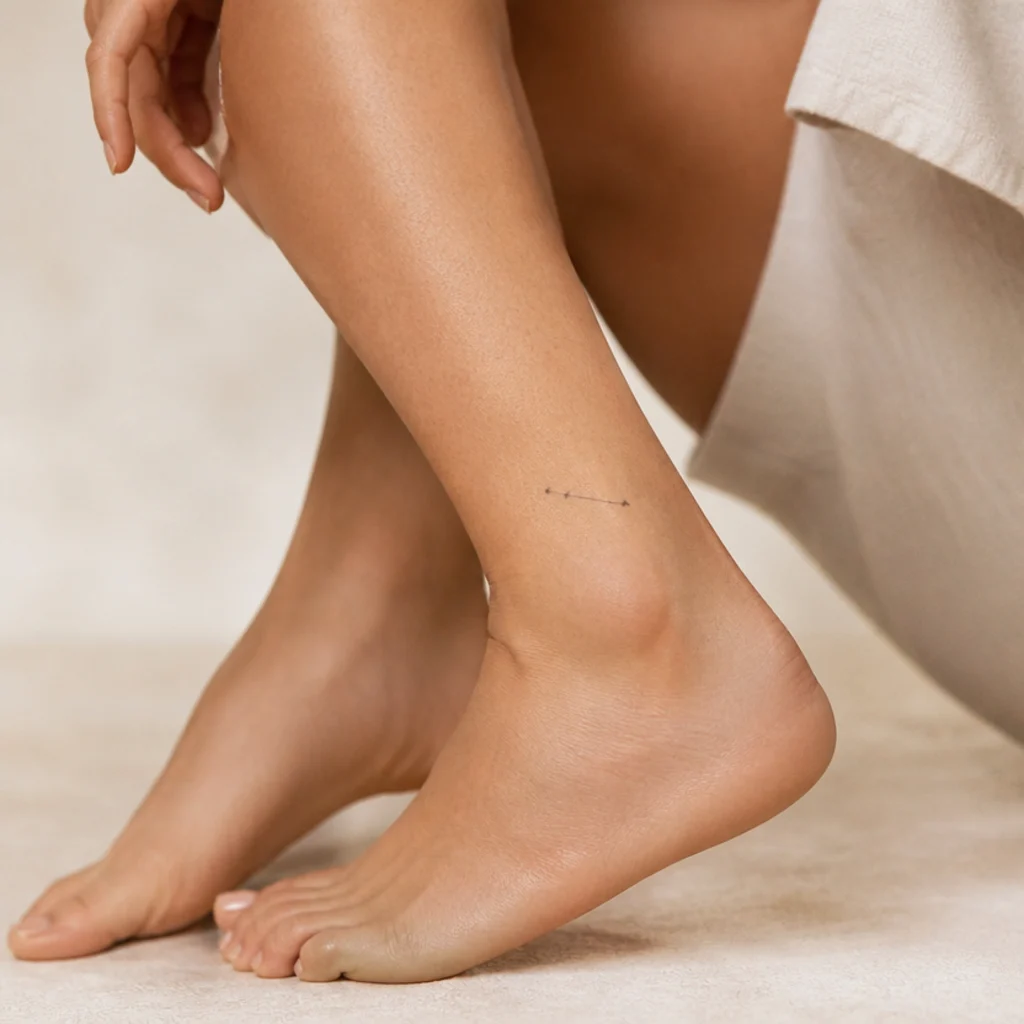
Wrapped around or just above the outer ankle bone, a small Aries constellation feels playful and pairs easily with sandals, sneakers or bare feet. The ankle's gentle curve adds a little dimension, and the spot is a perennial first-tattoo favorite because it's compact and low-commitment in scale. The trade-offs are worth naming plainly: ankles sit close to bone (more sensitive) and the whole foot area meets constant friction from socks and shoes plus slower, more sluggish healing, so foot-adjacent tattoos very commonly need a touch-up as they settle. Keep the star count modest, the dots well-spaced, and favor the outer ankle over the ever-rubbing inner side or the top of the foot, which is the fastest to blur. A single thin connecting line will outlast intricate micro-detail here. Sizing around one to two inches keeps it proportionate to the slim canvas. Elevate the foot and stick to loose, open footwear through healing to protect the fresh ink. Ask your tattoo artist for "a petite constellation following the ankle's contour, clean well-spaced dots and one fine connector for durability," and commit to breathable footwear while it heals.
10Floral Aries Constellation
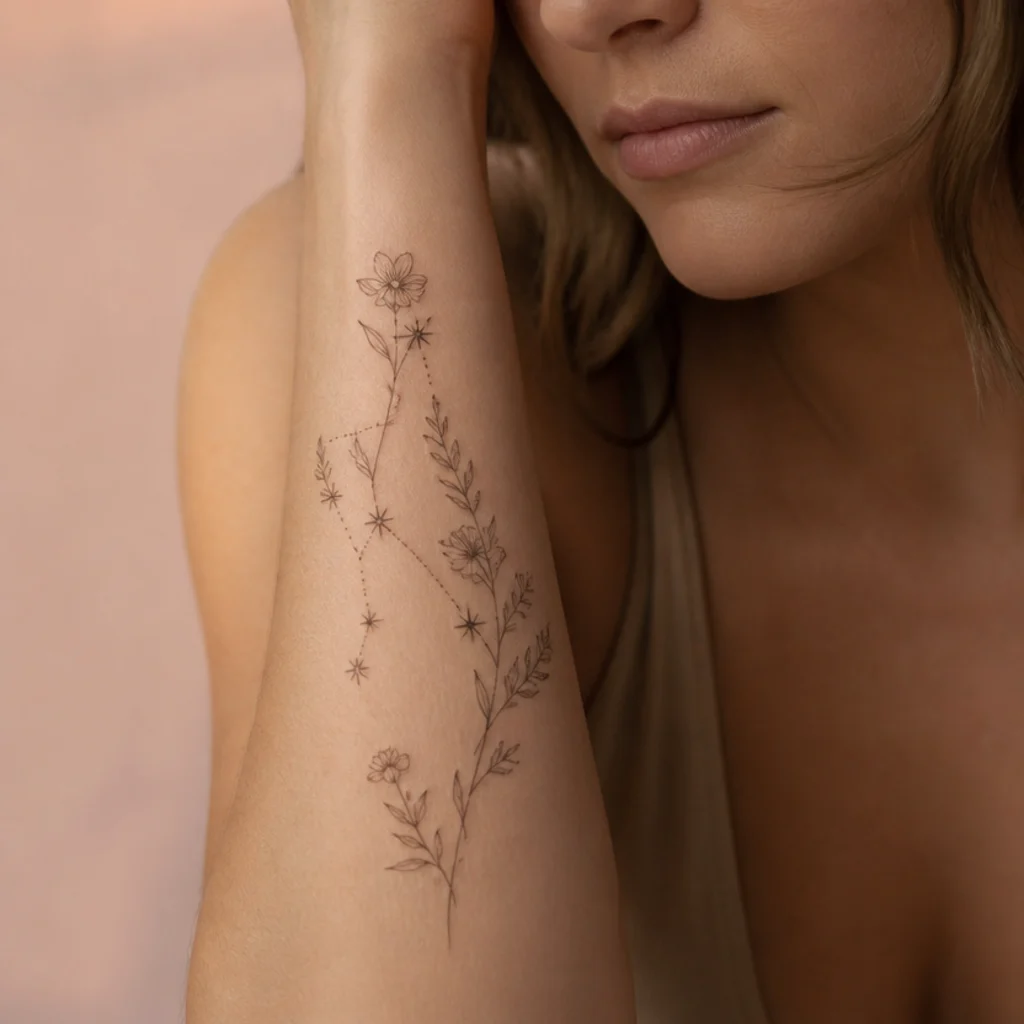
Soften the cosmic geometry by weaving the star line through fine-line florals, wildflowers, a sprig of greenery or a single stem that curves alongside the constellation. Botanical accents warm the sharp star points and make the composition unmistakably personal, especially if you choose your birth-month bloom (April's are the daisy and sweet pea) or a flower with private meaning. The forearm, thigh and upper arm give the stems room to flow without cramping. Compositional balance is everything: ask your artist to keep the florals delicate and secondary so they frame rather than swallow the constellation, and to route stems so negative space still lets each star breathe. Difficulty is moderate and the added linework lengthens the session, but the payoff is a one-of-a-kind piece. Consider black-and-grey botanicals for a cohesive, longer-lasting look, or a single muted color accent (dusty sage, soft terracotta) if you want warmth without the fade risk of full color. Have the artist draw florals and stars as one unified sketch, not two elements stuck together. Ask your tattoo artist for "fine-line florals framing the Aries constellation, delicate and secondary, with clear spacing preserved around the stars."
Save this to Pinterest for floral-plus-constellation inspiration.
11Finger Micro-Constellation

A trio or short line of tiny dots along the side of a finger is about as subtle as constellation ink gets, reading almost like a permanent ring. It's a playful, minimalist nod to your sign, but candor about upkeep matters more here than anywhere else on this list: fingers endure constant washing, gripping, sanitizer and friction over thin, fast-regenerating skin, so they fade, blur and drop out sooner than any other placement and routinely need refreshing within one to two years. Set expectations before you commit. Keep it to a few dots with minimal or no connecting line, since fine detail and tight spacing smear quickly as the ink spreads; the side of the finger holds ink slightly better than the palm-facing surface or over a knuckle, which flex constantly. Avoid over-working the area, which the skin actively resists and can scar. Think of this as a charming piece you accept will need maintenance, not a set-and-forget tattoo. Ask your tattoo artist for "a simplified finger constellation, a few well-spaced dots, minimal linework, sized to allow spread," and ask directly about their touch-up policy and window before you sit down.
12Bold Ram Head Portrait
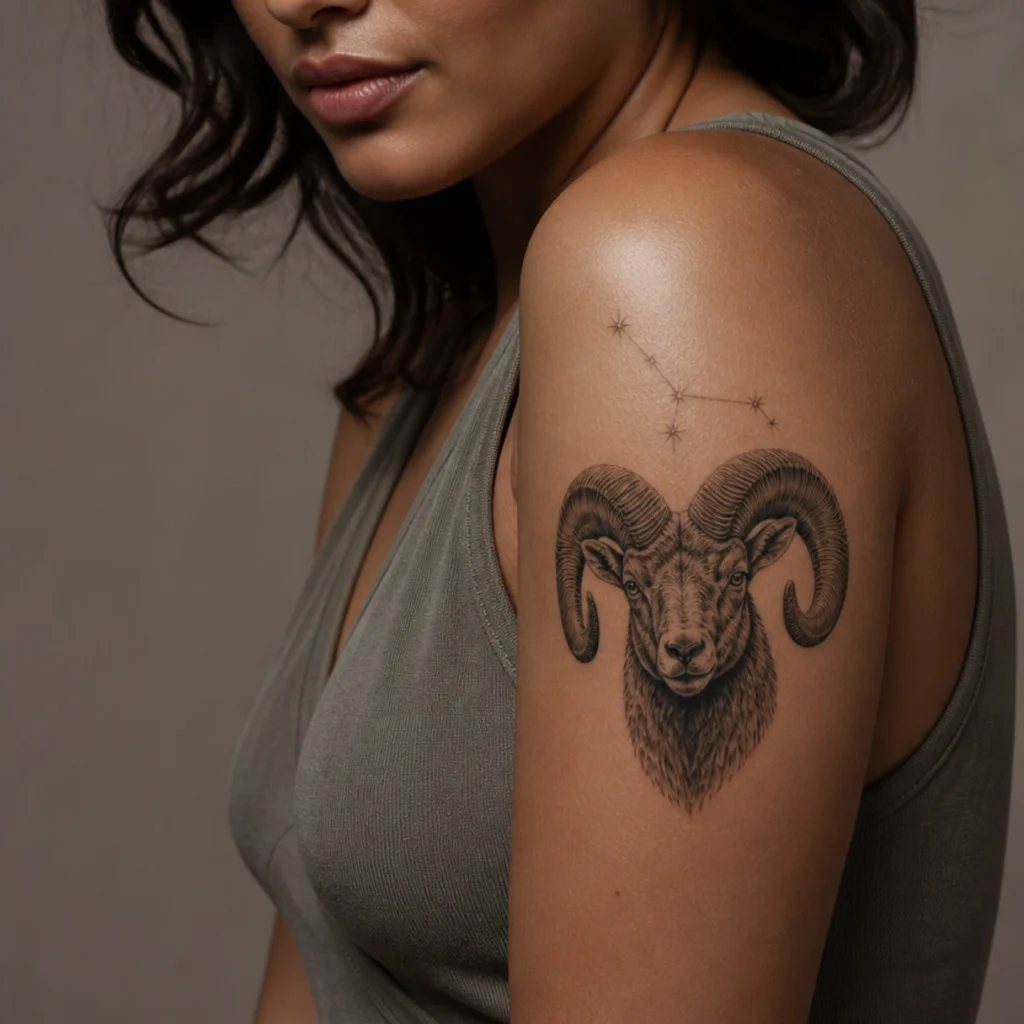
Go full statement with an illustrative ram head, textured fleece, dimensional spiral horns and expressive eyes, anchored by the constellation above or below. This is the boldest aries ram tattoo here and a true centerpiece for the outer bicep, thigh or shoulder, placements with enough flat, stable real estate to hold detail as skin moves. Realism lives or dies on the artist, so scrutinize healed portrait work (not just fresh) for smooth gradients, believable fur texture and clean transitions before booking. Expect multiple sessions for larger or highly detailed versions and a longer, more involved healing window with careful aftercare between sittings. Black-and-grey generally ages more gracefully than color for portraits, holding its dimensional shading as contrast softens, while color adds drama at the cost of faster fade. Position the constellation as a supporting accent so it enriches rather than clutters the focal ram, and budget honestly for the hourly investment a piece like this warrants. Discuss a session map (linework first, shading later) up front. Ask your tattoo artist for "a shaded ram-head portrait as the focal point with the constellation as a subtle accent, black-and-grey for longevity."
13Rib-Cage Star Script
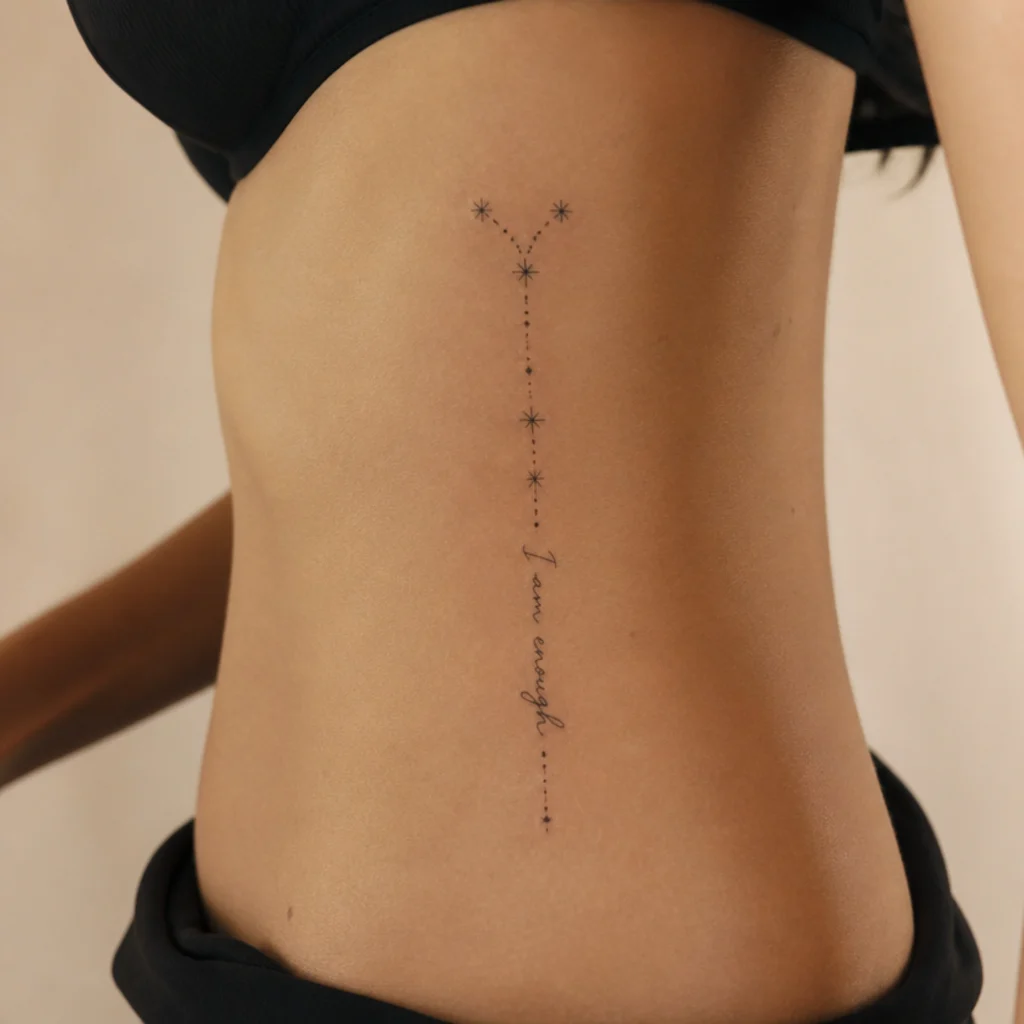
Along the rib cage, pair the constellation with a short word or the name "Aries" in delicate script for a piece that feels intimate and editorial. The ribs offer a long vertical canvas that flatters a flowing, elongated layout and stays easy to keep private under most clothing. Set expectations on comfort honestly: the ribs are among the most sensitive areas on the body, thin skin over bone with little padding and constant movement from breathing, so plan for a tender session with breaks, and know that skin here shifts, which can distort crowded fine detail over the years. Keep the script small and the star line fine so the two elements stay balanced rather than competing, and choose a font weight that stays legible as it softens, very thin, tightly-kerned lettering is the first thing to blur. Align the whole piece to your natural rib contour while you're seated upright and breathing normally, not slouched. Eat beforehand and hydrate, since long tender sessions go better with stable energy. Ask your tattoo artist for "a vertical constellation with minimal cursive lettering, sized to my rib line, in a weight that stays readable as it ages."
14Moon-and-Aries Pairing
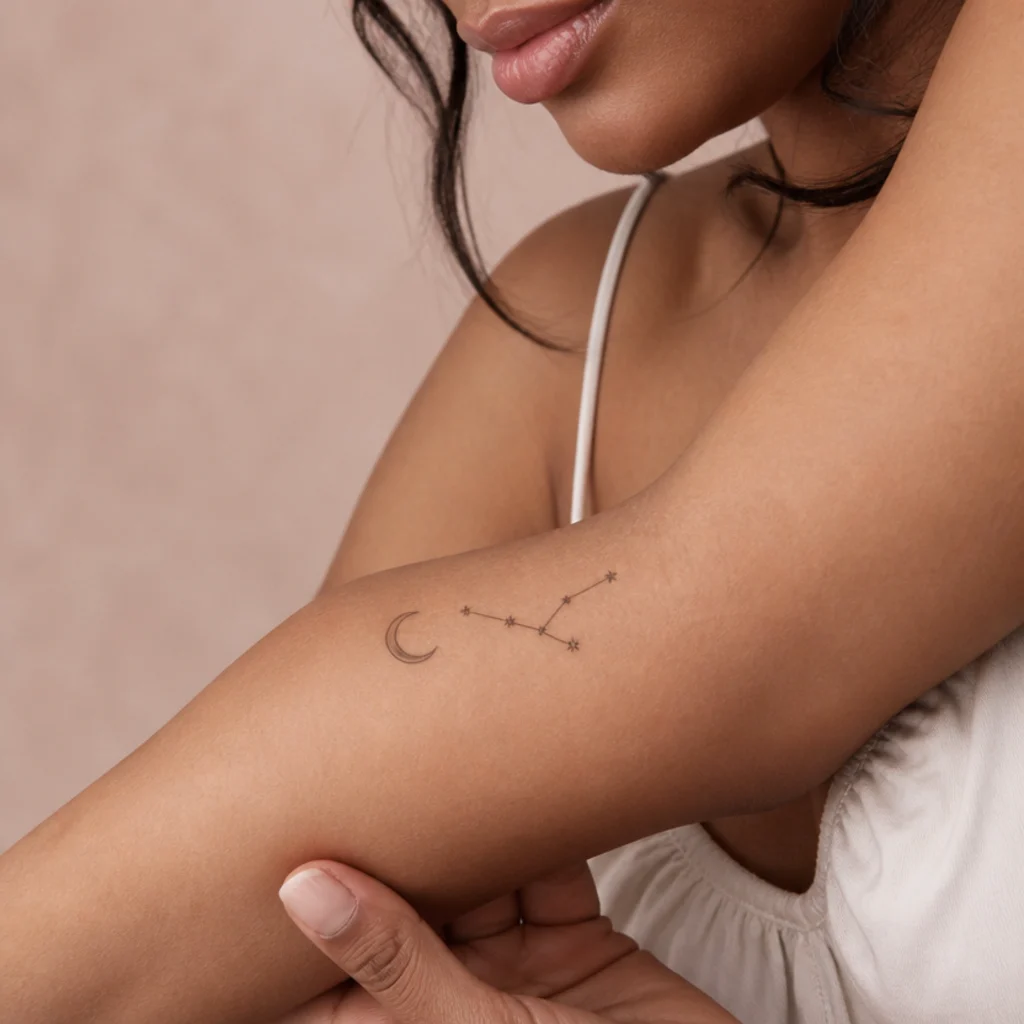
Adding a crescent moon beside the constellation introduces a celestial, mystical layer and balances the angular star line with a soft, curved counterweight. It's a natural choice if you're drawn to broader cosmic and lunar imagery, not only your sun sign, and it opens the door to later additions like a sun, moon phases or a favorite planet, so plan the composition with headroom to grow. The pairing sits comfortably on the inner arm, wrist or behind the shoulder, and the moon can be a clean fine outline, a stippled crescent or a small patch of smooth black fill depending on how much visual weight you want. Scale is the key decision: ask your artist to size the moon so it complements the stars rather than dominating them, roughly matching or slightly exceeding the constellation's visual footprint. This aries minimalist tattoo variation stays elegant and wearable, and it still reads as intentional rather than an afterthought. A softly shaded crescent adds richness but needs an artist comfortable with smooth small-scale gradients, review that specifically. Ask your tattoo artist for "a crescent moon scaled to complement, not overpower, the Aries constellation, with room to add lunar phases later."
15Sternum Constellation Drop
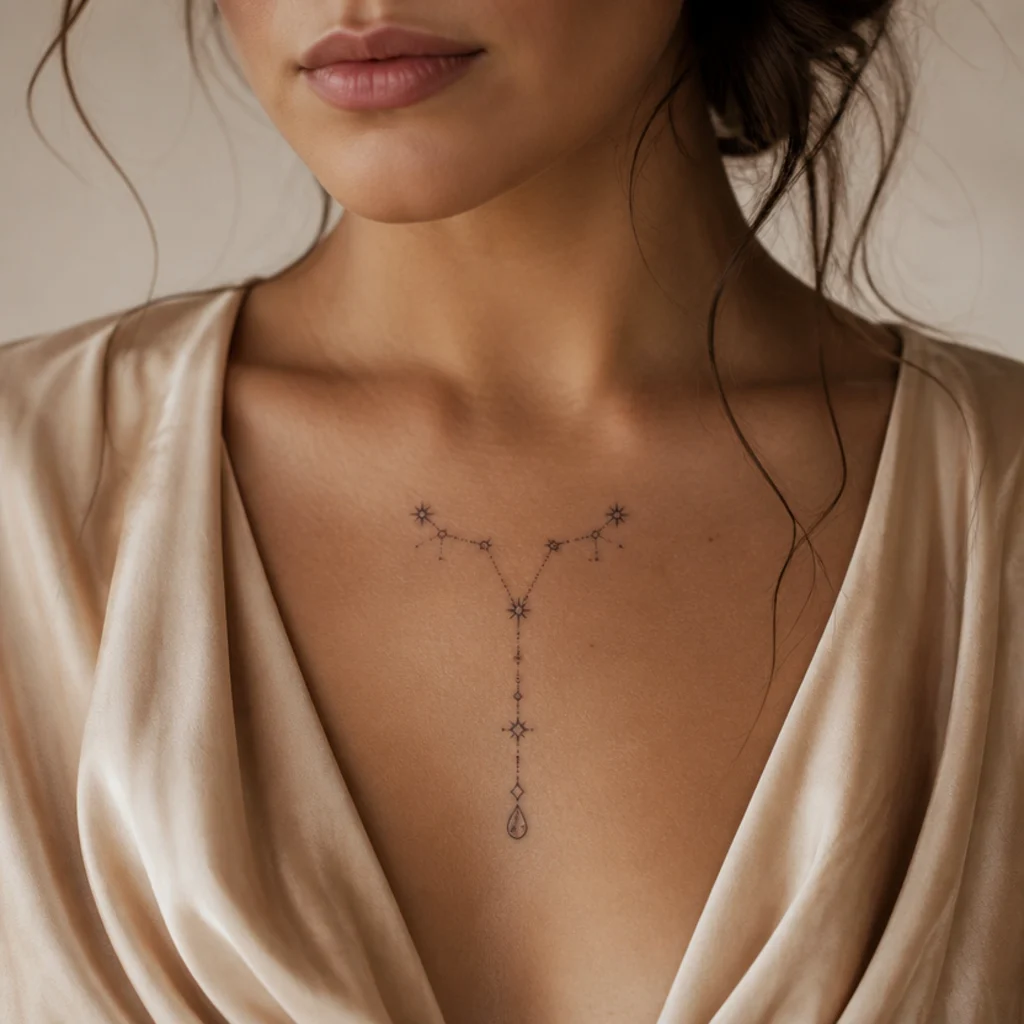
Centered on the sternum, the constellation can hang like a delicate pendant, often finished with a tiny gem, teardrop or ornamental flourish at the base for a jewelry-inspired effect. It's a symmetrical, eye-catching placement for anyone who loves the underbust and décolletage as a canvas. Be realistic about the experience and healing: the sternum is thin-skinned, bony and highly sensitive, so the session can be intense, and the area heals slowly and benefits from patient aftercare and a supportive, non-abrasive bra (or none) during recovery to avoid friction on the fresh ink. Symmetry is the true make-or-break detail, precise midline alignment separates an elegant drop from a crooked one, so expect careful stencil placement while you sit tall and square. Keep the design vertical and fine so it reads ornamental rather than heavy, letting the star line lead the eye down into the decorative element. Avoid dense shading here, which spreads on this delicate skin. Ask your tattoo artist for "a symmetrical Aries constellation aligned to my sternum midline with an optional fine ornamental drop, kept elegant and legible," and plan aftercare around the tender, slow healing.
Save this to Pinterest for placement ideas across the body.
16Golden-Ochre Dotwork Aries

Swap classic black for warm golden-ochre, amber or soft bronze pigment and build the entire constellation from stippled dots. The muted metallic tone feels sun-warmed and unexpected, giving a familiar shape fresh personality without the boldness of full color. Undertone matters enormously here: warm and medium skin tones tend to carry earthy ochres beautifully, while on very fair skin the pigment can read subtler and on deep skin it may shift cooler or sit quieter, so ask your artist how the specific ink will heal on your complexion and request a healed reference on similar skin, not a fresh photo. A frank longevity note: colored and lighter pigments, especially warm earth tones, appear softer once healed and fade sooner than saturated black, so disciplined sun protection is non-negotiable and a touch-up is likely down the road. Stippled dotwork also demands even, patient hand-work to avoid a speckled, uneven look, review the artist's dotwork density up close. Keep exposed placements SPF-protected daily to slow the fade. Ask your tattoo artist for "a full dotwork constellation in a warm earthy ochre, no solid lines, with advice on how the tone will read and heal on my skin."
17Wrist Cuff Constellation
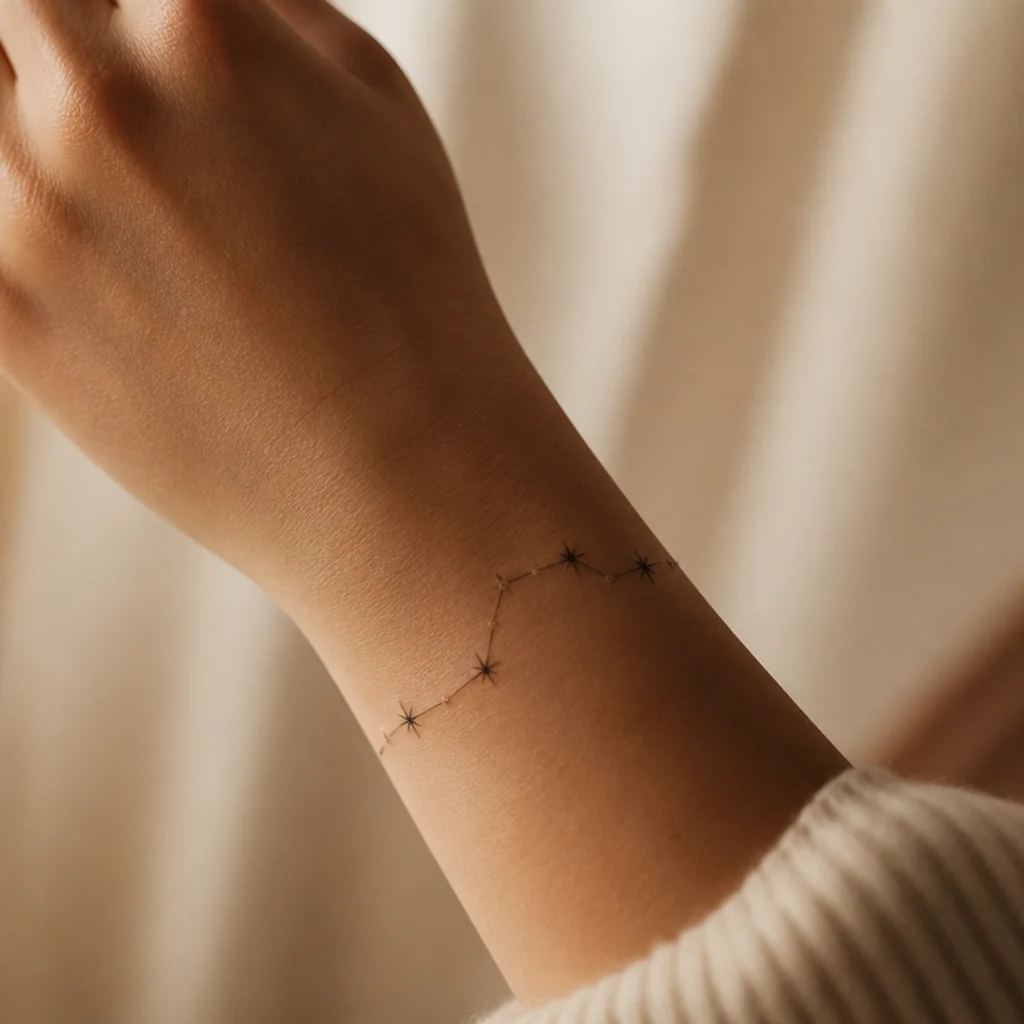
Stretch the star line so it wraps the wrist like a fine bracelet or cuff, turning the constellation into wearable jewelry you never take off. The wrap makes clever use of the wrist's small circumference and keeps the design elegant and unobtrusive under sleeves or alongside real bracelets. Placement nuance matters: the outer and top of the wrist hold ink noticeably better than the tender, high-movement inner wrist, where fine lines see the most flex and friction and may need periodic attention. Ask your artist to plan how the constellation flows around the curve so it looks intentional from every viewing angle rather than only face-on, keeping connectors thin but even and stars regularly spaced so the wrap reads continuous, not like a seam. Because it circles a joint, expect a little more natural softening than on a flat panel, so consider a slightly sturdier line weight for longevity here. It layers easily with existing wrist ink or stacked bangles, coordinate placement so bracelets don't rub the freshest lines while healing. Ask your tattoo artist for "an Aries constellation that wraps my wrist like a cuff, planned to read well from all angles, with a durable-but-fine line weight."
18Couple or Sibling Star Set

For two Aries-born loved ones, or a fire-sign duo, matching constellations make a meaningful shared tattoo. You can keep them identical, mirror them, or split the star map so each person carries half that completes only when your arms are held side by side, a clever, romantic touch for couples, siblings or best friends who share the sign or a birthday window. The design decisions are best made together: agree on style (fine-line versus dotwork), exact line weight and size so the pieces match rather than merely resemble each other, and plan placements that align cleanly when positioned next to each other, matching inner forearms or inner wrists work well. Bringing both people to the consultation lets the artist size and stencil the pair as a genuine set rather than two separate approximations. Keep the shared style consistent even if placements differ slightly. Remember that each person's skin tone, placement and lifestyle may age the ink at different rates, so schedule any future touch-ups together to keep them matched. Ask your tattoo artist for "coordinated Aries constellations designed as a matched set, ideally stenciled together for alignment and identical line weight."
19Aries Constellation With Birth Date

Anchor the constellation with a personal birth date rendered in fine numerals or discreet Roman numerals beneath the stars. It grounds the cosmic shape in a specific, meaningful moment, a birthday, milestone or tribute, and makes the tattoo unmistakably yours. This is a thoughtful aries tattoo for women marking something they want to carry, and the inner forearm, wrist or bicep gives clean, flat space for the star line and small numbers to sit in proportion. Legibility over time is the thing to protect: very small, thin lettering is where fine-line tattoos blur first, so ask for slightly more generous size and spacing than feels necessary, and keep the numerals smaller than the constellation so the stars stay the hero. Roman numerals read elegant but need careful kerning so I, V and X don't merge into a block; plain digits can be more foolproof at tiny sizes. Have the artist mock up the exact date in the intended font and size, then proof it against your ID before the stencil goes on, transposed numbers are permanent. Ask your tattoo artist for "a fine constellation above a small, well-spaced birth date in a weight that stays legible as it ages," and triple-check the numerals in the stencil.
20Shoulder Blade Star Sprawl
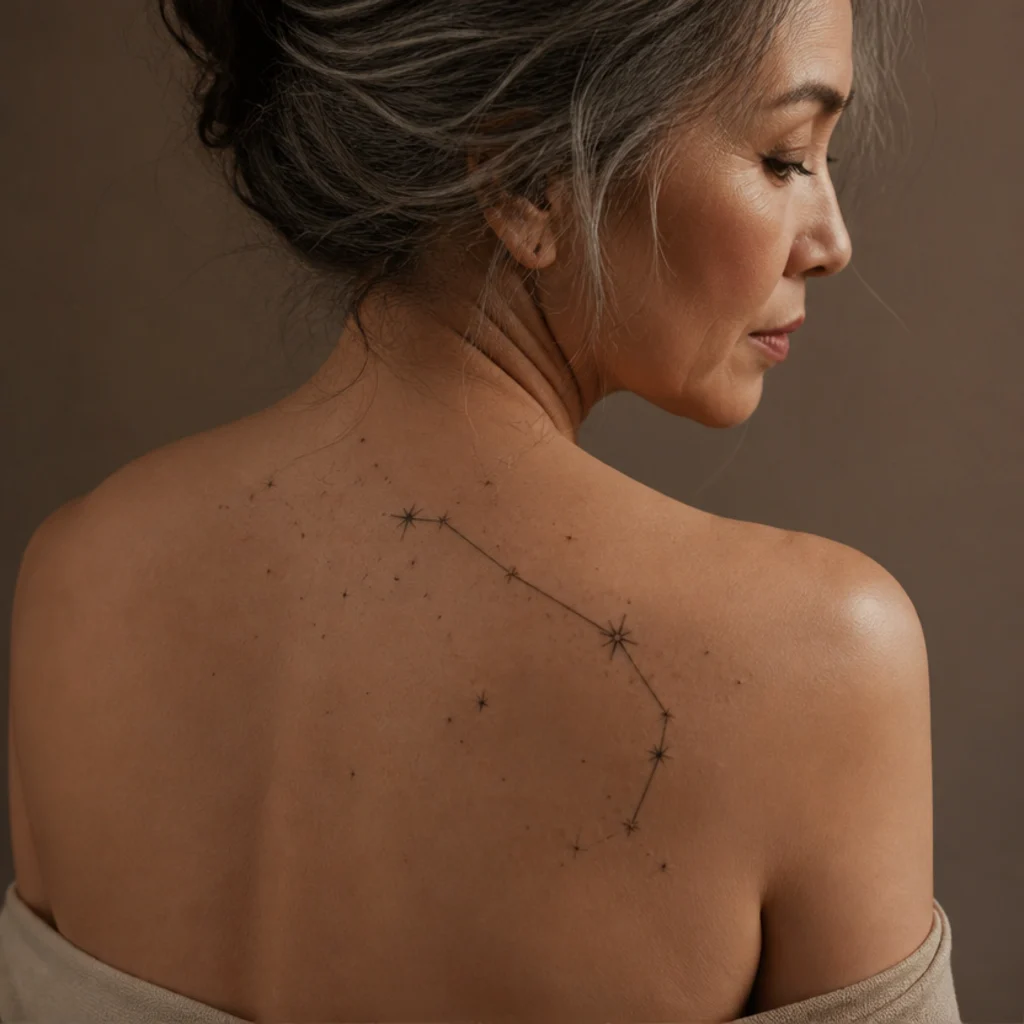
Scale the design up across the shoulder blade with the main constellation surrounded by a faint scatter of background stars, evoking a whole patch of night sky. The extra real estate invites subtle shading, atmospheric depth and receding "distant" stars while the Aries line stays the hero, making this the most artful, immersive option here. The shoulder blade is an excellent large-piece canvas: broad, relatively flat and lower on the pain scale than ribs or sternum, though it does move with the arm, so an experienced artist will account for that flex in the layout. Keep the primary constellation crisp and saturated and let the background stars fade soft and small for genuine dimension, the contrast between the two layers is exactly what sells the depth, so don't let the background compete. Expect a longer session for the shading and stippled background, and protect the investment with attentive aftercare and daily sun care once healed. It's easy to cover under most tops yet gallery-worthy when revealed. Ask your tattoo artist for "a crisp hero constellation with soft receding background stars across my shoulder blade, layered for real depth, with the Aries line kept dominant."
Pro Tips from the Editor
- Anchor the brightest star. The real Aries line is led by Hamal (Alpha Arietis); ask your artist to give that point a slightly larger dot so the piece reads as an accurate, intentional design instead of a row of identical dots.
- Space over size. Shrinking a design tightens the gaps between dots, which is precisely what causes fine-line and dotwork tattoos to blur into a smudge. Keep generous spacing and let the piece run a touch larger, especially on fingers, ankles and behind the ear.
- Match line weight to placement. High-flex, high-friction spots (wrist, fingers, feet, ribs, sternum) want a sturdier fine line or bolder dots; flat, stable panels (forearm, bicep, shoulder blade) can carry the most delicate single-needle work without spreading.
- Vet healed work, not fresh photos. Every tattoo looks crisp on day one. Ask specifically to see healed examples of the exact style you want, watercolor, dotwork, blackwork or portrait, ideally at one year or more, before you book.
- Add a line-work skeleton under color. For watercolor or ochre pieces, a subtle black or grey constellation floated on top of the color keeps the shape legible for years after the soft pigment starts to relax.
- Plan for touch-ups honestly. Color, hands, feet and inner wrists fade fastest; ask about the artist's touch-up policy, window and any fee before committing to those placements, and factor it into the real cost.
- Bring an accurate reference and proof the stencil on skin. Photograph the actual Aries constellation (or use a reliable star chart), and always check spacing, alignment, midline and any lettering or dates in the stencil on your body before the needle starts, this is your last chance to adjust.
Aries Constellation Tattoo Styles at a Glance
| Style | Best placements | Skill level | Longevity | Rough size |
|---|---|---|---|---|
| Minimalist fine-line | Inner forearm, wrist, bicep | Beginner | Good; light refresh at 4–6 yrs | 2–3 in |
| Dotwork / stippled | Spine, ankle, behind ear | Beginner–intermediate | Good; spacing-dependent | 1–3 in |
| Blackwork geometric | Upper arm, forearm | Advanced | Excellent (8–10+ yrs) | 3–5 in |
| Watercolor nebula | Upper arm, shoulder, thigh | Advanced | Fades fastest; needs SPF | 4–7 in |
| Ram silhouette | Forearm, calf, bicep | Intermediate | Very good (solid fill) | 3–5 in |
| Shaded ram portrait | Bicep, thigh, shoulder | Advanced | Good (black-and-grey) | 5 in+ |
Sizes and longevity are general guides; your artist will tailor them to your skin, placement and lifestyle.
How to Choose / Get the Look
Work through four decisions in order, and the right design tends to reveal itself.
1. Scale and intent. Decide whether you want a quiet personal marker or a statement centerpiece. Quiet: fine-line or dotwork on the wrist, ankle, behind the ear or collarbone. Statement: a ram portrait, blackwork frame, watercolor nebula or shoulder-blade sprawl with room for genuine artistry. Be honest about whether you'll want to grow the piece later, and leave compositional headroom if so.
2. Placement versus lifestyle. Match the style to the spot and to your daily wear-and-tear. Bony, high-friction, high-movement areas, fingers, feet, ribs, sternum, inner wrist, want simple, well-spaced designs and will fade sooner; flat, stable panels like the forearm, bicep, thigh and shoulder blade hold detail and shading far better. Also weigh sun exposure (a major fade factor) and how easily you need to cover it for work.
3. Maintenance tolerance. Be honest about upkeep. The thinnest lines and any color (watercolor, ochre) soften or fade soonest and may want touch-ups within a few years; if low maintenance is the priority, lean toward slightly bolder linework or solid blackwork, and reserve delicate color for lower-friction, sun-protected placements.
4. Artist and consultation. Bring accurate references, describe the exact line weight and spacing you want, name your anchor star, and ask to see healed examples in that specific style. Any final decisions about design, sizing, placement, coverage feasibility and healing should be confirmed with a licensed, reputable tattoo artist who can assess your individual skin in person. Note plainly that no small constellation is a reliable way to fully hide or cover an existing tattoo or scar; only a qualified artist can evaluate the size, color, age and skin condition involved and advise honestly on whether a cover-up is realistic for your situation.
Frequently Asked Questions
Where does the Aries constellation tattoo look best?
Linear, minimalist versions shine on flat, low-friction areas: the inner forearm, wrist, collarbone, spine and behind the ear, where fine lines stay crisp. Larger illustrative, watercolor or ram designs suit the shoulder, bicep, thigh or shoulder blade, which offer stable space for shading and detail. Bony, high-movement spots like ribs, sternum, fingers and feet can work well too, but favor simple, well-spaced designs and expect to fade sooner.
Do fine-line Aries constellation tattoos fade quickly?
Very thin lines and tiny dots do soften over the years, most noticeably on high-friction placements like fingers, hands, feet and the inner wrist. Slightly bolder linework, generous spacing, diligent daily sunscreen and careful aftercare all extend their life meaningfully. Many people plan a light refresh at the four-to-six-year mark for the most delicate pieces, which is normal wear rather than a sign of poor work.
Should I add the ram or the glyph to my constellation?
It's optional and purely about recognizability. A ram silhouette or the ram-horn glyph makes the sign read instantly and adds a graphic anchor, which helps if a bare star line feels too generic to you. A plain constellation stays more understated and abstract. If you're torn, the glyph is the lower-commitment addition and heals easily; a full shaded ram portrait is a much bigger, often multi-session undertaking.
How big should an Aries constellation tattoo be?
Minimalist versions read well at roughly one to three inches, though going too small compresses the star spacing and invites blur, so err slightly larger on delicate placements like fingers and behind the ear. Ram portraits, watercolor nebulas and shoulder-blade designs typically need five inches or more to hold detail and shading cleanly as they age. Your artist can advise the minimum size at which your chosen style will still look sharp long term.
Is the Aries constellation a good first tattoo?
Yes. Its short, simple star line reads clearly even when small, the linework is quick (often well under an hour for a minimalist version), and compact placements like the wrist, forearm or ankle make it approachable and meaningful. Choose a flatter, lower-friction spot for an easier heal, keep the design simple with well-spaced dots, and confirm sizing and placement with your artist before you commit.
How much does an Aries constellation tattoo cost?
It varies widely by region, studio and artist experience. Small minimalist star maps often fall in a shop's minimum-charge range, while blackwork frames, watercolor washes and multi-session ram portraits are priced by the artist's hourly rate and can climb significantly. Rather than chasing the lowest quote, prioritize a skilled artist and a properly sized design, and confirm the full estimate, including any touch-up fee, in your consultation.
Does an Aries constellation tattoo hurt?
Pain depends almost entirely on placement. Fleshier, flatter areas like the outer forearm, bicep and thigh are the most tolerable. Bony, thin-skinned spots, ribs, sternum, spine, collarbone, ankle and behind the ear, are more sensitive, and larger shaded pieces mean longer sessions. Because a minimalist constellation is fast, the discomfort is usually brief even in tender areas. Eating beforehand and staying hydrated helps.
Which Aries constellation tattoo ages the best?
Solid blackwork and bold silhouettes age best by a clear margin, saturated black holds its edges for the better part of a decade. Black-and-grey shaded portraits also age gracefully. The fastest to fade are watercolor, warm-toned color and any very fine linework on fingers, feet or the inner wrist. If longevity is your top priority, lean toward a slightly bolder line weight or blackwork on a flat, sun-protected panel like the outer bicep or forearm.
Can an Aries constellation tattoo cover up an old tattoo or scar?
Not reliably. A fine constellation is small and mostly open space, so it cannot fully conceal existing ink or scar tissue, and forcing it larger or denser defeats the delicate look entirely. Whether any cover-up is realistic depends on the size, color, age and darkness of what's underneath and the condition of the skin. Only a licensed, experienced tattoo artist can assess your specific case in person and advise honestly on coverage feasibility and healing, never assume a small star line will hide something.