15 Minimalist Aries Tattoo Ideas
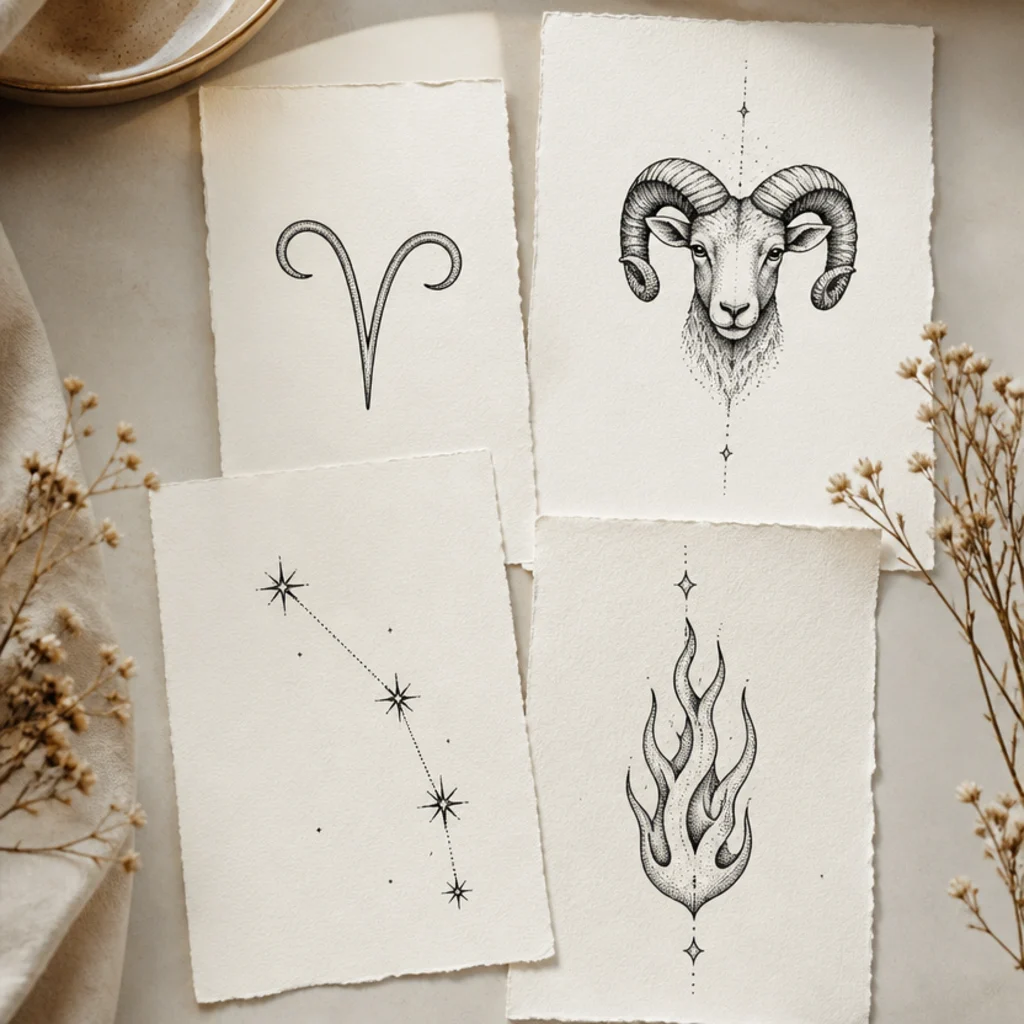
Aries energy runs hot, but the ink can whisper. These pared-back designs lean on the ram glyph, the four-star constellation, and a few clever structural twists to carry real meaning in the fewest possible strokes, engineered to stay legible as they heal, settle, and age. Consider this both a lookbook and a fine-line playbook you can hand your artist.
 Edited by Lena Rose · Published July 11, 2026 · 35 min read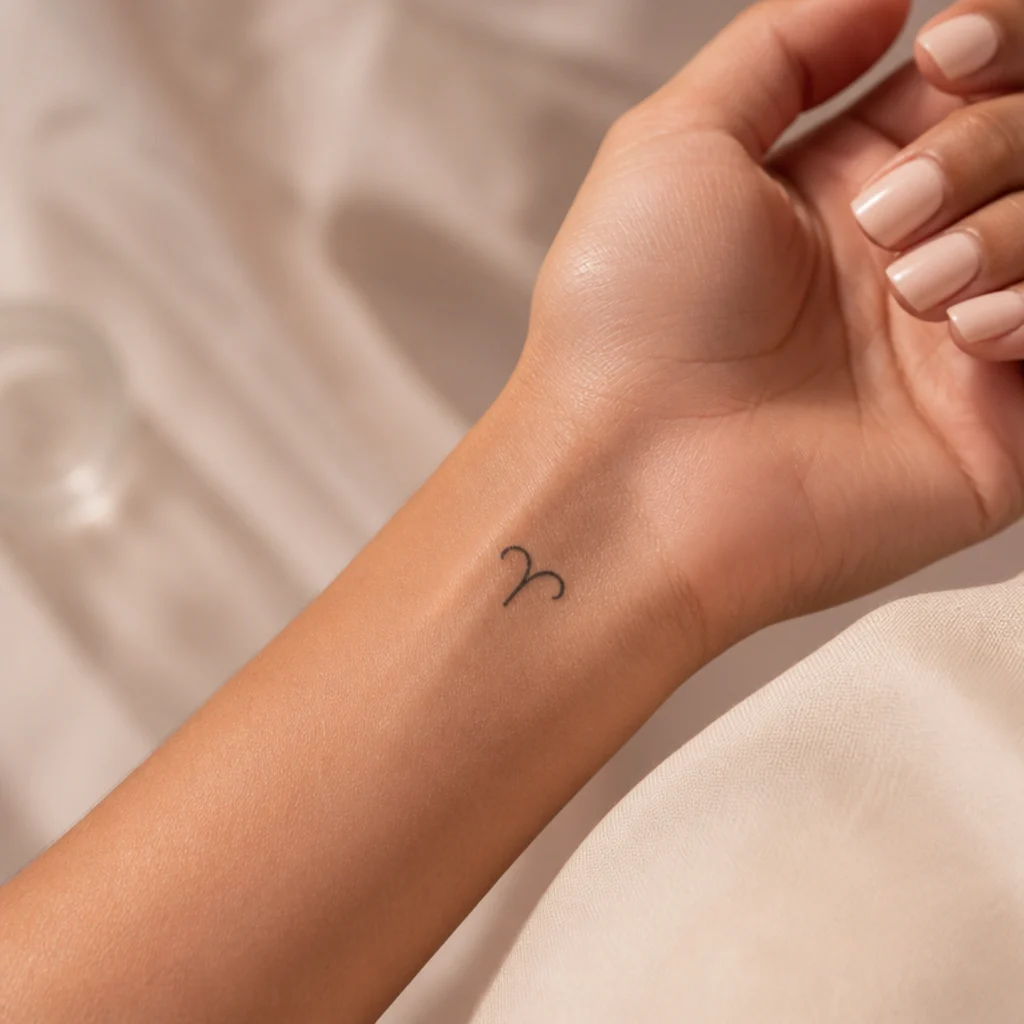
Quick Answer
- Best for: Anyone drawn to fine-line, understated zodiac ink, cardinal-fire meaning rendered in the quietest line, that stays clean and readable at small sizes.
- Who might skip it: Skin that bruises, blurs, or scars easily; anyone chasing a bold, high-contrast statement that survives decades untouched with zero upkeep; and true set-and-forget wearers who never want a touch-up.
- Maintenance: Low day to day; budget a fine-line refresh roughly every 3 to 7 years as single-needle strokes soften, sooner on hands, feet, fingers, and other high-friction spots. Daily SPF is the real maintenance.
- Difficulty: Easy for the wearer; demanding for the artist, since hairline work magnifies every wobble, uneven spacing, and shaky start.
- Cost: Typically a studio minimum for micro pieces, scaling with size, detail, and artist demand; single-needle specialists, watercolor, and negative-space blackwork sit at the higher end. Get a firm in-person quote, and never shop fine-line on price alone.
- Wear time / longevity: Expect crisp results for years on flatter, lower-flex canvases; thin connecting lines, script, and finger placements fade first.
- Difficulty to conceal: Very easy, most designs here hide under a watch, sleeve, or hair.
- Standout variation: The dotwork constellation, which turns Hamal, Sheratan, and Mesarthim into a discreet, almost-abstract star map.
- How to ask your tattoo artist: "A fine-line, single-needle Aries piece, minimal detail, sized so the lines won't merge as it heals; mock it up at actual size on my skin and let me see it move in a mirror first."
In This Guide
- The Simple Ram Glyph
- Single-Needle Constellation
- Tiny Ankle Ram
- Behind-the-Ear Glyph
- Watercolor Blush Wash
- Geometric Ram Outline
- Constellation With Birth Date
- Continuous One-Line Ram
- Spine Constellation
- Matching Micro Rams
- Finger Glyph
- Ram Horns Only
- Constellation and Moon
- Fine-Line Floral Ram
- Negative-Space Glyph
Intro
The appeal of a minimalist aries tattoo is that it holds two contradictory things at once: a cardinal fire sign with a reputation for going big, rendered in the quietest line an artist can lay down. That tension is the whole point. Aries runs from roughly March 21 to April 19, ruled by Mars, and its symbols are unusually design-friendly, which is why the glyph, the constellation, and a stylized set of horns translate so cleanly to small-scale ink. The goal is maximum meaning from minimal marks: a piece that reads clearly from a step back and still feels considered up close.
Minimalism here is a discipline, not just a size. Fine-line and single-needle work uses thinner needle groupings, usually a single tight liner or a three-round liner, and deposits less pigment, so the margin for error is narrow and the aftercare matters more. Placement, scale, line weight, and needle depth decide whether a tiny piece stays sharp or blurs into a smudge over the first years, as ink naturally spreads a hair under healed skin. Below you'll find 15 distinct directions, ordered so you can compare placement, technique, and upkeep at a glance, from barely-there micro rams to dotwork constellations and negative-space glyphs. For every idea you'll get who it flatters, how it tends to age, one concrete pro tip, and the exact language to hand your artist. This is an especially popular lane among aries tattoo for women, but every design here works for anyone.
01The Simple Ram Glyph
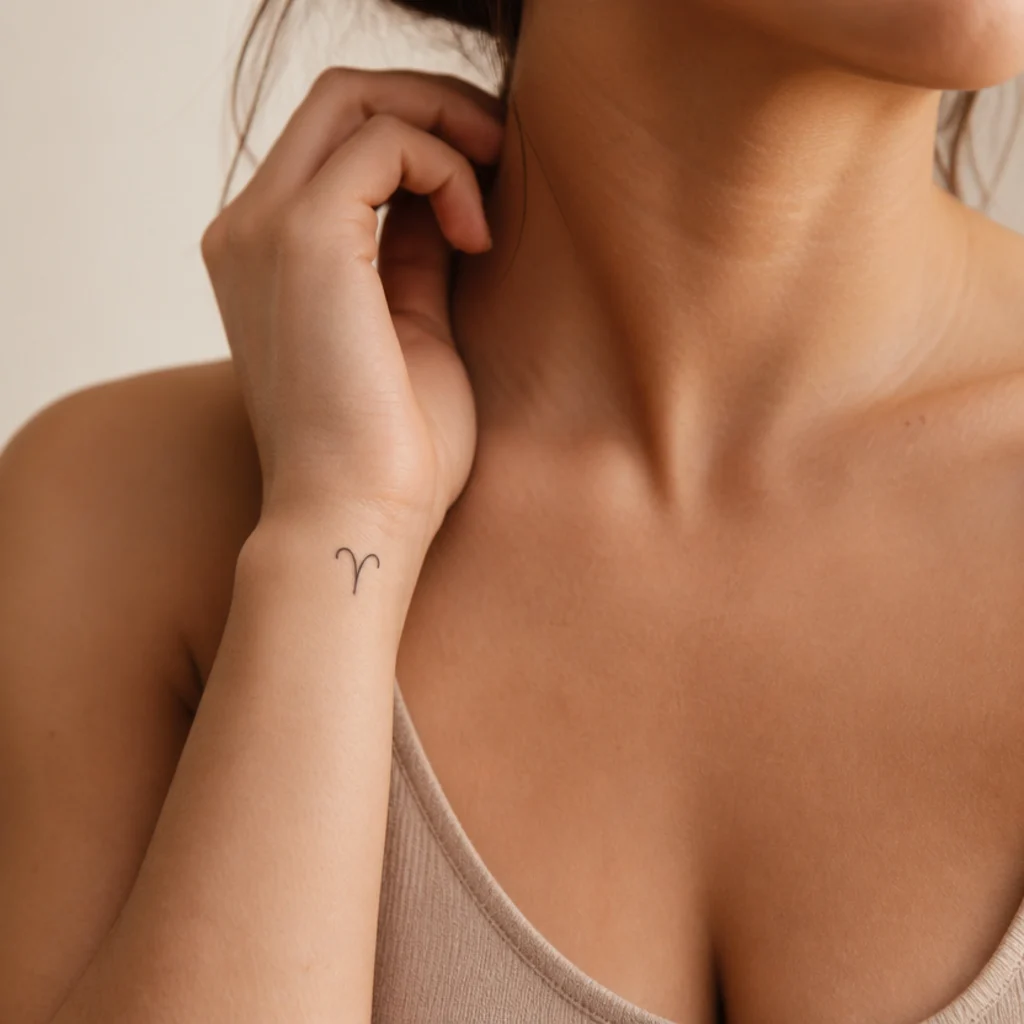
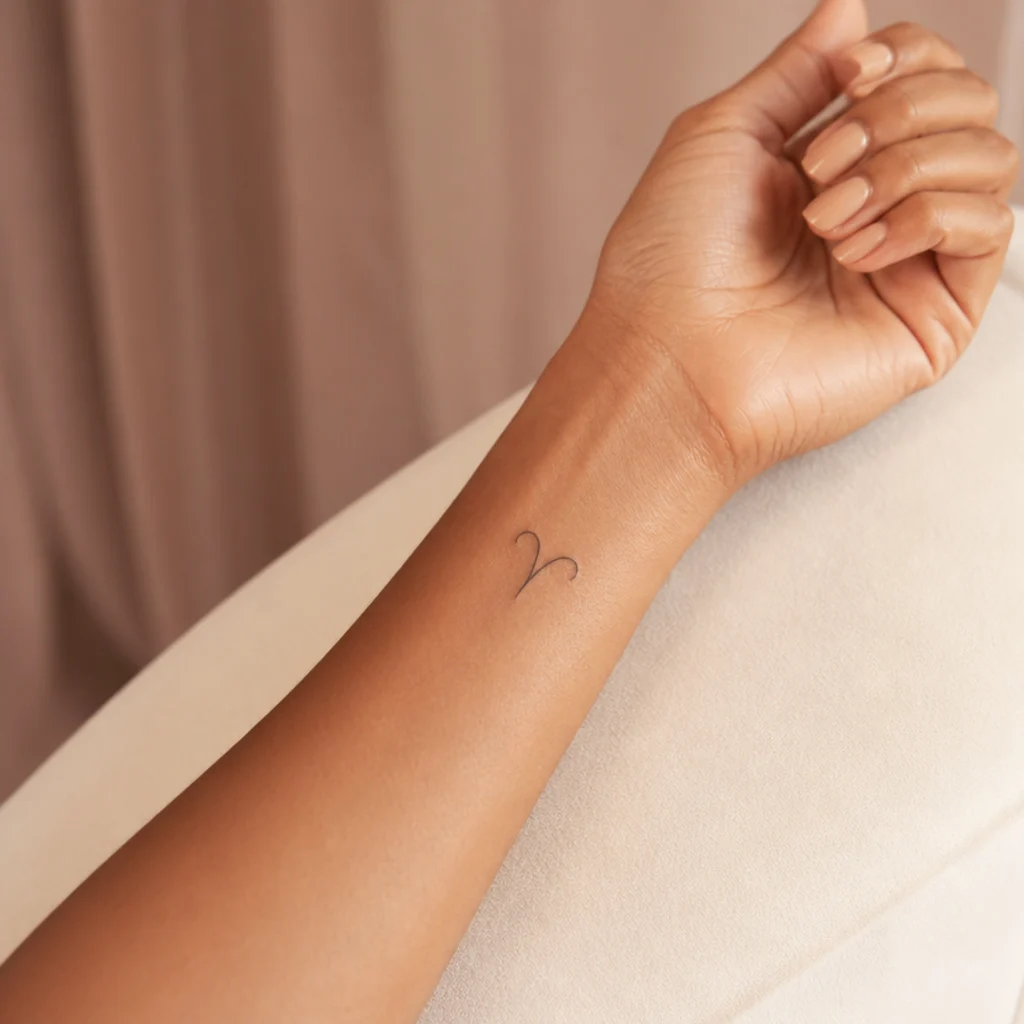
The Aries glyph, that clean upward stem splitting into two symmetric arcs, is the most legible shorthand for the sign, a stylized nod to the ram's horns. Rendered in a single fine-line stroke roughly three-quarters to one inch tall, it works almost anywhere: inner forearm, outer wrist, back of the upper arm, or sternum. This is the entry point for anyone who wants an aries minimalist tattoo without any literal imagery, and it reads cleanly whether you tilt it slightly or run it dead vertical. Because the shape lives or dies on line quality, book an artist whose healed portfolio, ideally six months out, shows dedicated single-needle work, not just glossy fresh photos. Keep the weight even and the two arcs mirror-matched; asymmetry reads instantly at this scale, and a tapered arc that thins to nothing tends to drop out first. Flatter, lower-flex canvases like the outer forearm hold the line crisper than the inner wrist, which creases with movement. Suits nearly every skin undertone since it's pure black line. Expect a 15-to-30-minute sit and simple healing. Pro tip: ask to see it stenciled both vertically and at a slight tilt, since a few degrees changes how balanced the arcs feel on your specific anatomy and how the stem sits against your tendons. Ask your tattoo artist for "a thin, even Aries symbol, about one inch, single needle, consistent weight, no shading."
02Single-Needle Constellation
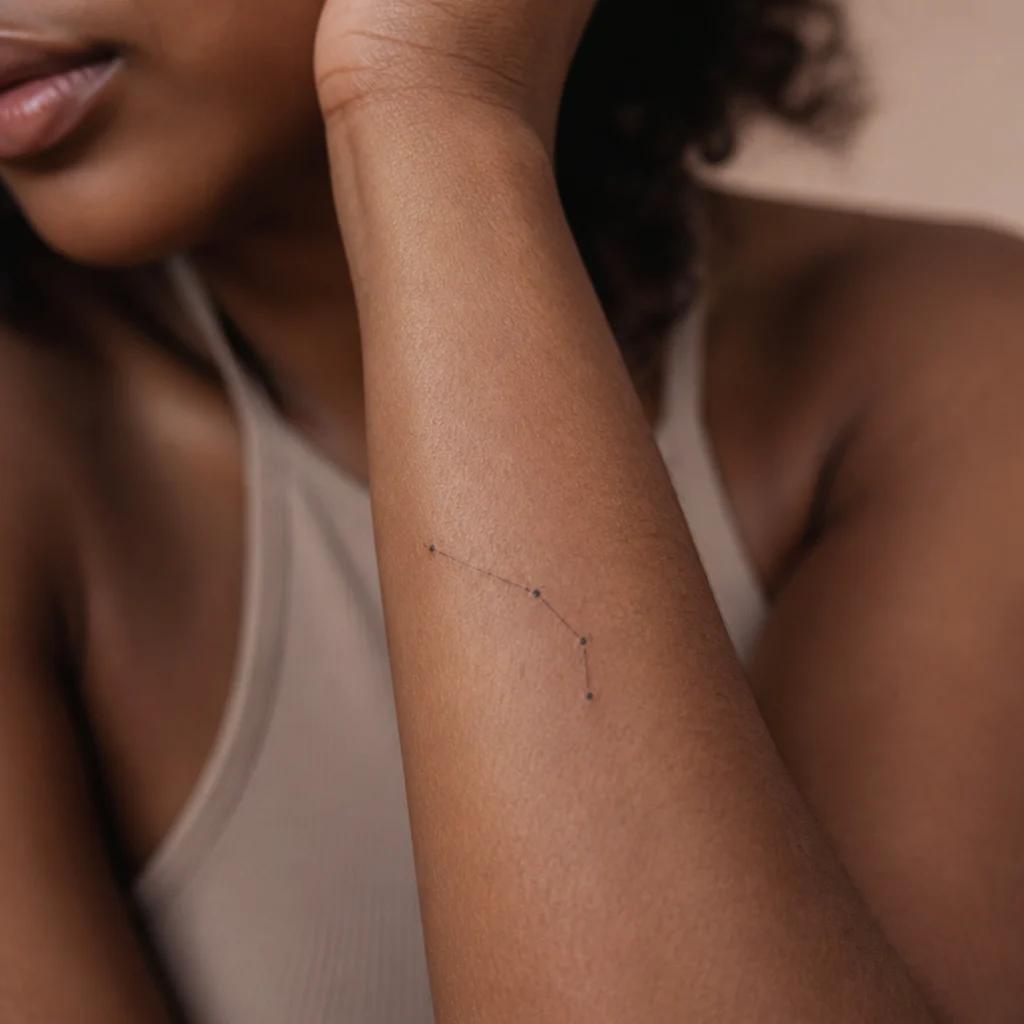
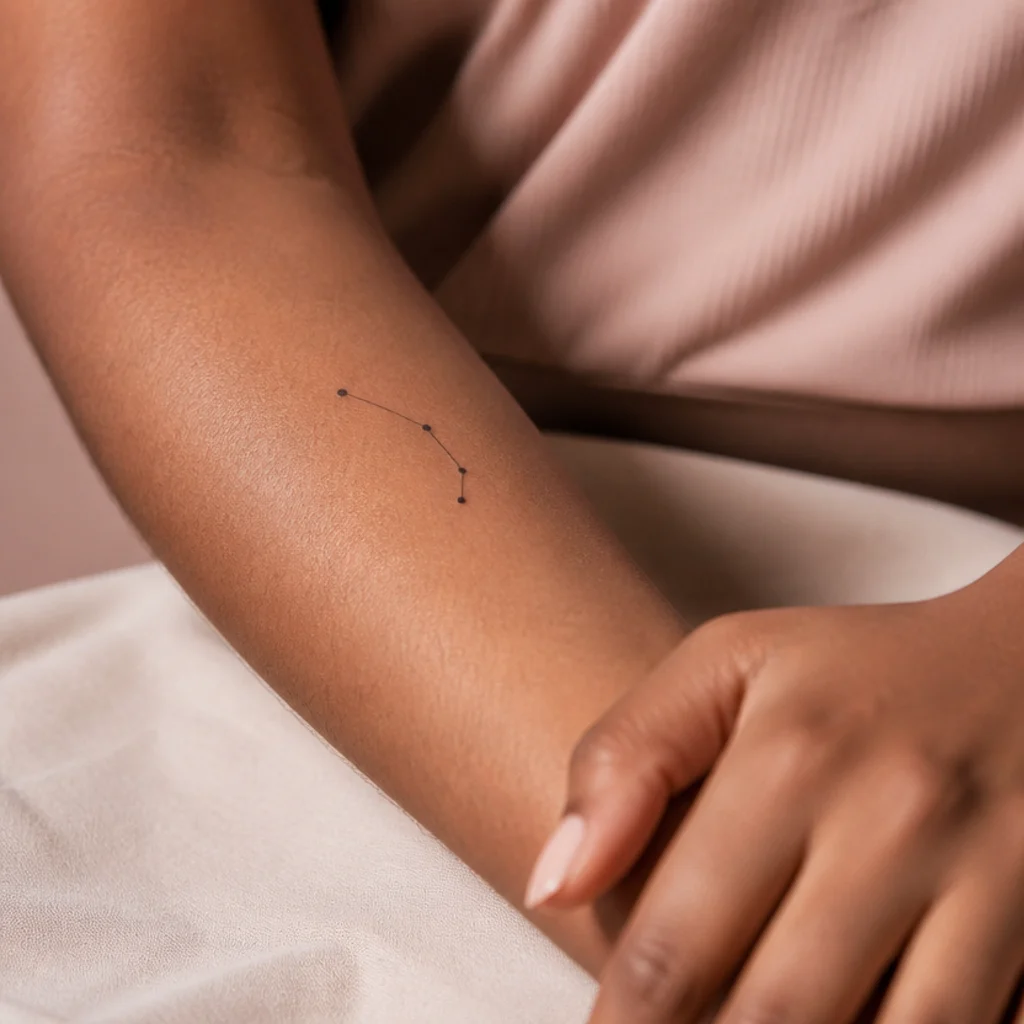
An aries constellation tattoo maps the sign's brightest stars, Hamal, Sheratan, and Mesarthim, into a compact cluster joined by hairline strokes. Done single needle, the stars become tiny dots, optionally weighting Hamal (the brightest, an orange giant) a touch larger, while the connectors stay whisper-thin, so the whole piece reads like a constellation you'd actually trace in the sky rather than a generic dot-and-line motif. Forearm, collarbone, upper back, and outer bicep all suit its narrow footprint, and a slim horizontal span flatters the collarbone especially well. It flatters anyone who wants meaning without an obvious symbol, since to a casual glance it's abstract dotwork. The catch: those hairline connectors are the first thing to soften, so upkeep is low but not zero, and a light refresh every three to five years keeps it sharp. Give the design at least two inches of span so the connectors don't bridge into one another as they heal and spread. Pro tip: bring an accurate star map or a screenshot from a stargazing app rather than trusting a flash sheet, since many templates space the stars wrong and flatten the real geometry. Hand your artist this line: "the Aries constellation, small dots for stars, hairline connectors, Hamal slightly larger, kept subtle and true to the real spacing."
03Tiny Ankle Ram
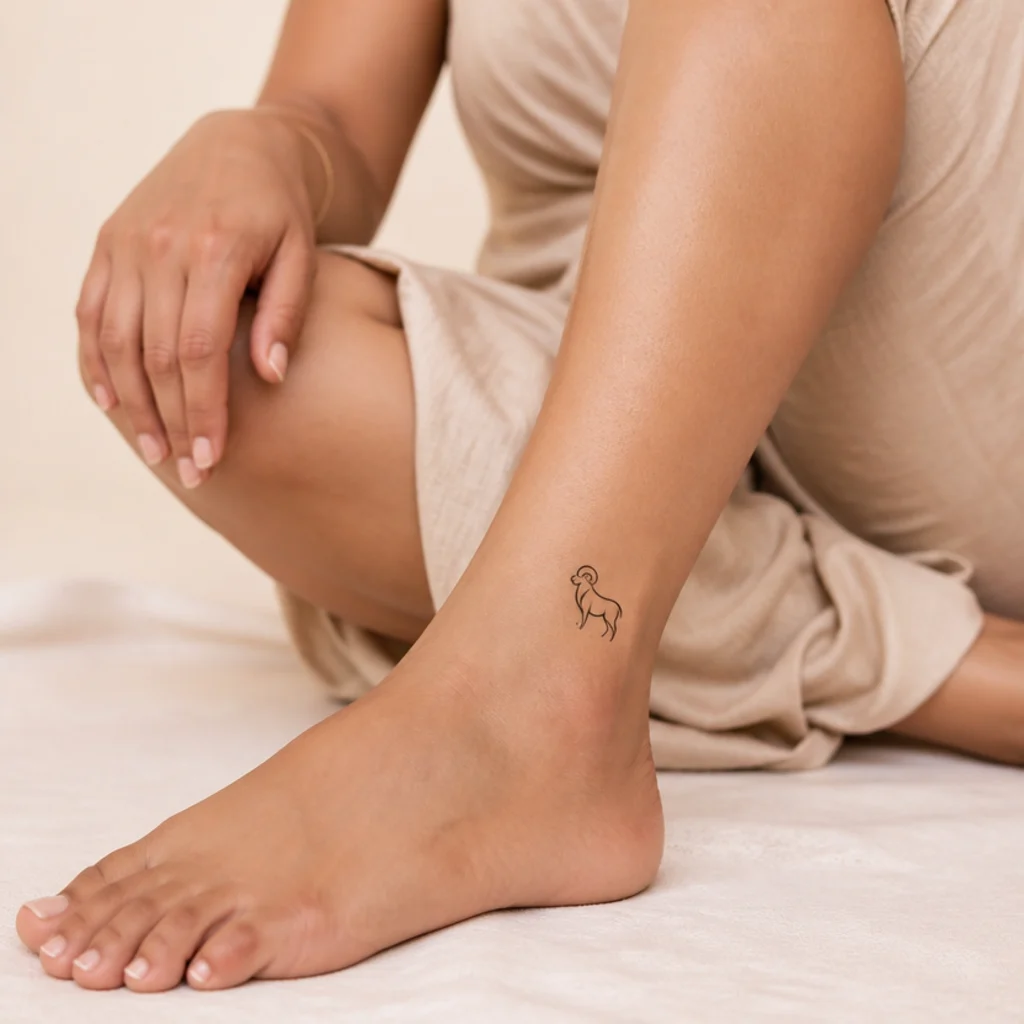
A micro ram, reduced to a few curved strokes that suggest a head and curling horns, sits neatly on the outer ankle at roughly half an inch. This is an aries ram tattoo stripped to its essentials, ideal if you love the animal symbolism but not a detailed illustration. Be clear-eyed about the placement: ankle skin flexes, rubs against socks and shoes, and sits close to bone, so linework here blurs faster than the forearm and the session can feel sharp and vibratey over the anklebone. Keep the design ultra-simple, three or four confident strokes at most, so it has room to age gracefully; internal fur lines or an eye dot will close into a blob within a year or two. It suits smaller frames and anyone who wants an easily concealed piece for work or formal wear. The outer ankle generally holds better than the inner ankle or the Achilles area, which crease and rub harder, and the flat plane just above the bone takes ink more evenly than the ridge itself. Plan on a touch-up at the one-year mark as normal, not as a failure. Pro tip: skip any internal detail at this size, and ask for a slightly deeper, more deliberate line here than you'd use on the forearm, since high-friction skin sheds delicate ink. Say to your artist: "a tiny simplified ram silhouette, outer ankle, three or four strokes, no internal detail, laid to survive friction."
04Behind-the-Ear Glyph
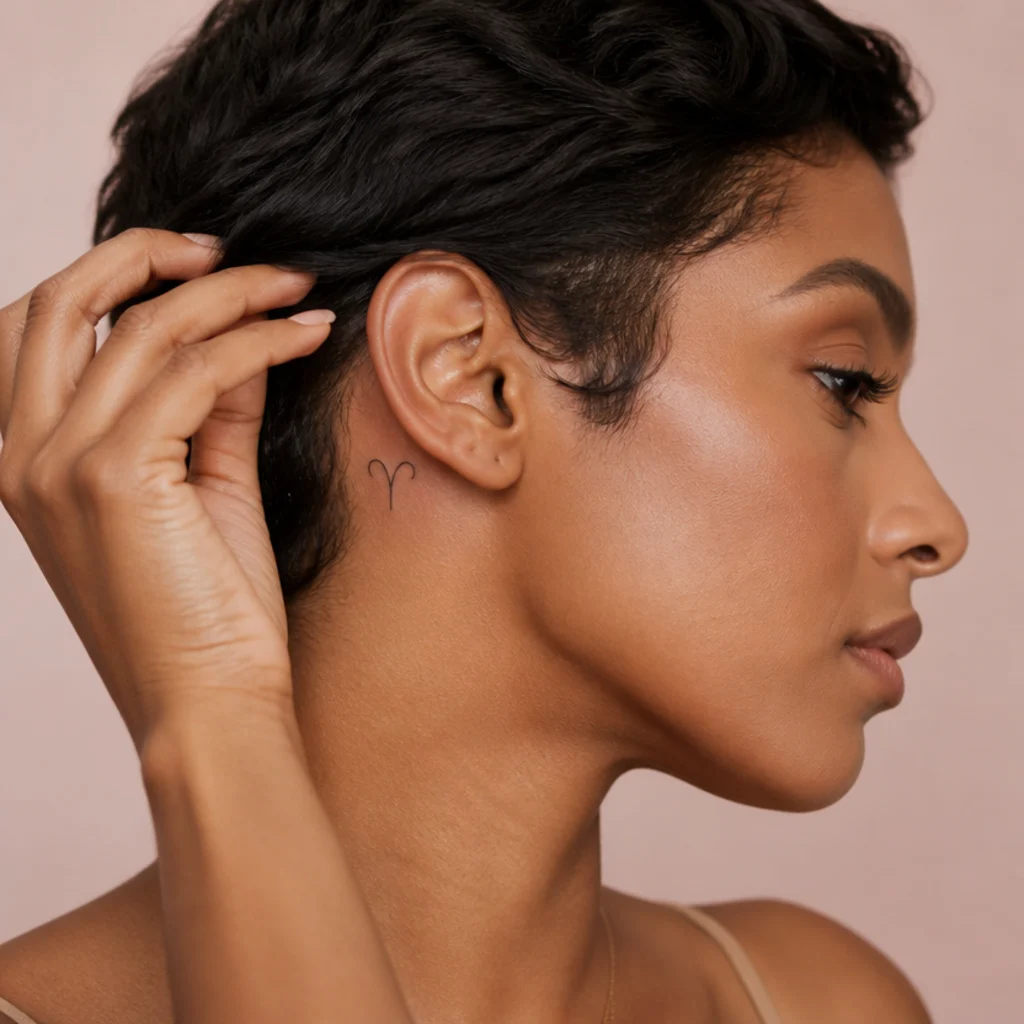
Tucked behind the ear, a small Aries glyph becomes a near-secret marker, visible only when you sweep your hair back. Restraint is everything here; a half-inch symbol is plenty, since the mastoid area is small, curved, and unforgiving of detail. The look flatters short hair, pixie cuts, shaved sides, and updos, and it's a favorite first zodiac piece precisely because it stays discreet at the office or on camera. The skin is thin and close to bone, so the session is quick but can feel buzzy and loud right against the skull. Fine lines in this spot soften over the years as the area catches sun and nightly pillow friction, so plan for a probable touch-up down the line and treat it as expected upkeep rather than a defect. It's a strong pick for an aries tattoo for women who want something personal rather than public-facing, and it pairs well with a matching micro piece elsewhere. Pro tip: have the artist place it just behind the crease on the soft plane rather than on the bony ridge, where ink holds more evenly and hurts less, and confirm the angle with your hair actually tucked, not pinned flat. Ask your tattoo artist for "a small Aries symbol behind the ear, delicate line, placed just off the bone on the soft area."
Save this to Pinterest to compare placements side by side.
05Watercolor Blush Wash
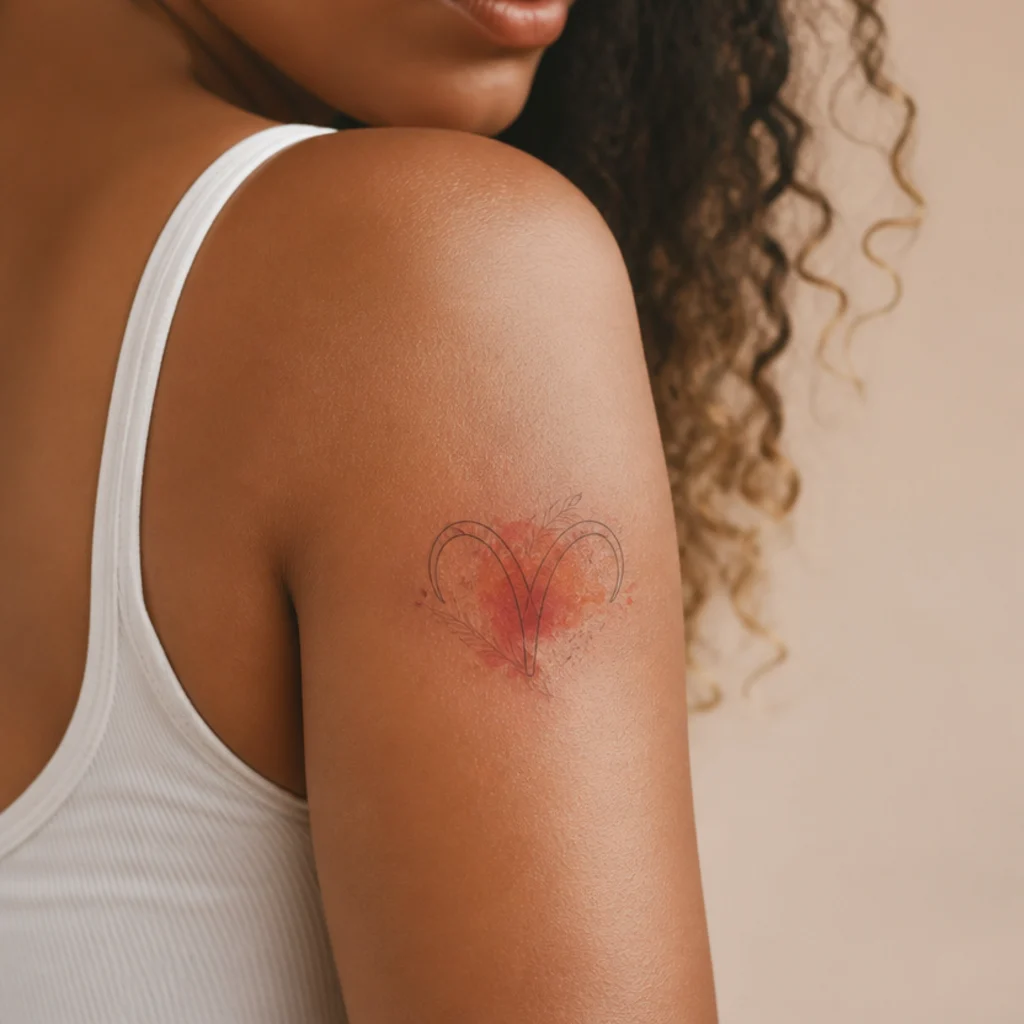
For a softer register, pair the ram glyph or a single star with a loose watercolor wash in muted blush, terracotta, or dusty coral. The color stays translucent, more suggestion than saturation, which keeps it firmly in minimalist territory rather than tipping into a full color piece. It reads beautifully across warm, neutral, and deep skin tones when the artist tunes pigment intensity to sit against your undertone; cooler pinks can go ashy on very warm skin, and pale washes can disappear on deeper skin, so a terracotta, peach, or rust base often wears truer and stays visible longer. The important caveat: watercolor has no crisp black outline anchoring it, so it fades less predictably and needs an artist who specializes in this exact style, not a liner who dabbles in color. Give it a lower-sun, roomier canvas like the upper arm, shoulder, or shoulder blade, and keep it well away from the daily UV that eats soft pigment fastest. Pro tip: ask for a thin fine-line element, a glyph or a single star, anchored inside or beside the wash, so there's some line structure to hold the shape as the color mellows over five-plus years. Bring this request to your consult: "a small ram glyph with a soft, translucent blush or terracotta watercolor accent, no hard outline, saturation tuned to my undertone."
06Geometric Ram Outline
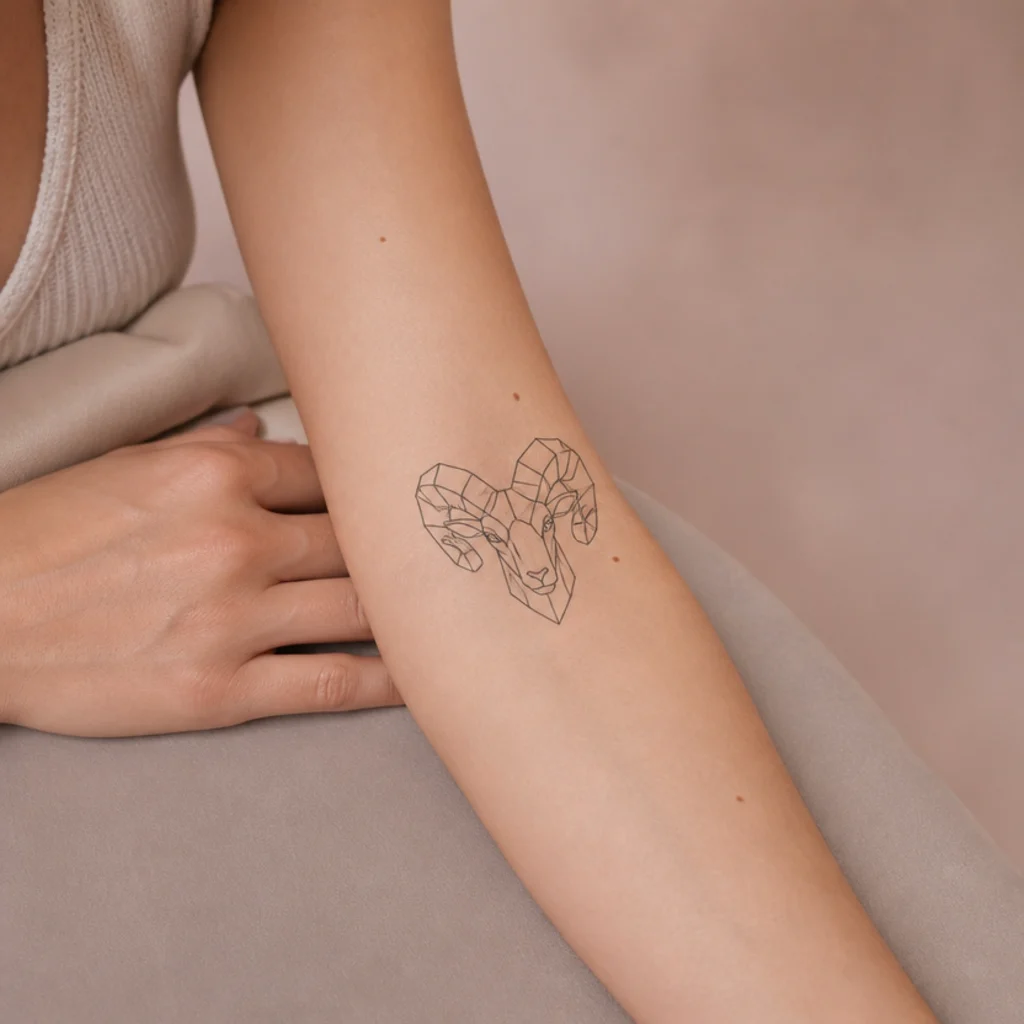
Here the ram's head and curling horns are abstracted into straight segments and clean angles, almost a constellation of the animal itself. The geometric treatment stays modern and graphic while remaining minimal, and it photographs well because the negative space between lines does a lot of the work. Straight lines are unforgiving, though: any waver, uneven spacing, or angle that drifts a degree shows immediately, so this rewards a steady hand and a flatter canvas like the forearm, calf, or shoulder blade where skin doesn't pull the geometry out of true. It flatters people who prefer structure and symmetry to organic curves, and it suits a moderate two-to-three-inch size that keeps the internal angles distinct. One practical upside is that angular strokes tend to age slightly more forgivingly than delicate curves, since the eye reads a straight line as intentional even after it softens. Avoid packing tiny facets close together, as they'll merge into a gray shape as the piece heals. Pro tip: ask for consistent line weight throughout rather than tapering, and request that the artist ghost the stencil across the flex point so the angles don't distort when you bend your arm. Ask your tattoo artist for "a geometric, angular ram head, even line weight, clean vertices, no shading or fill."
07Constellation With Birth Date
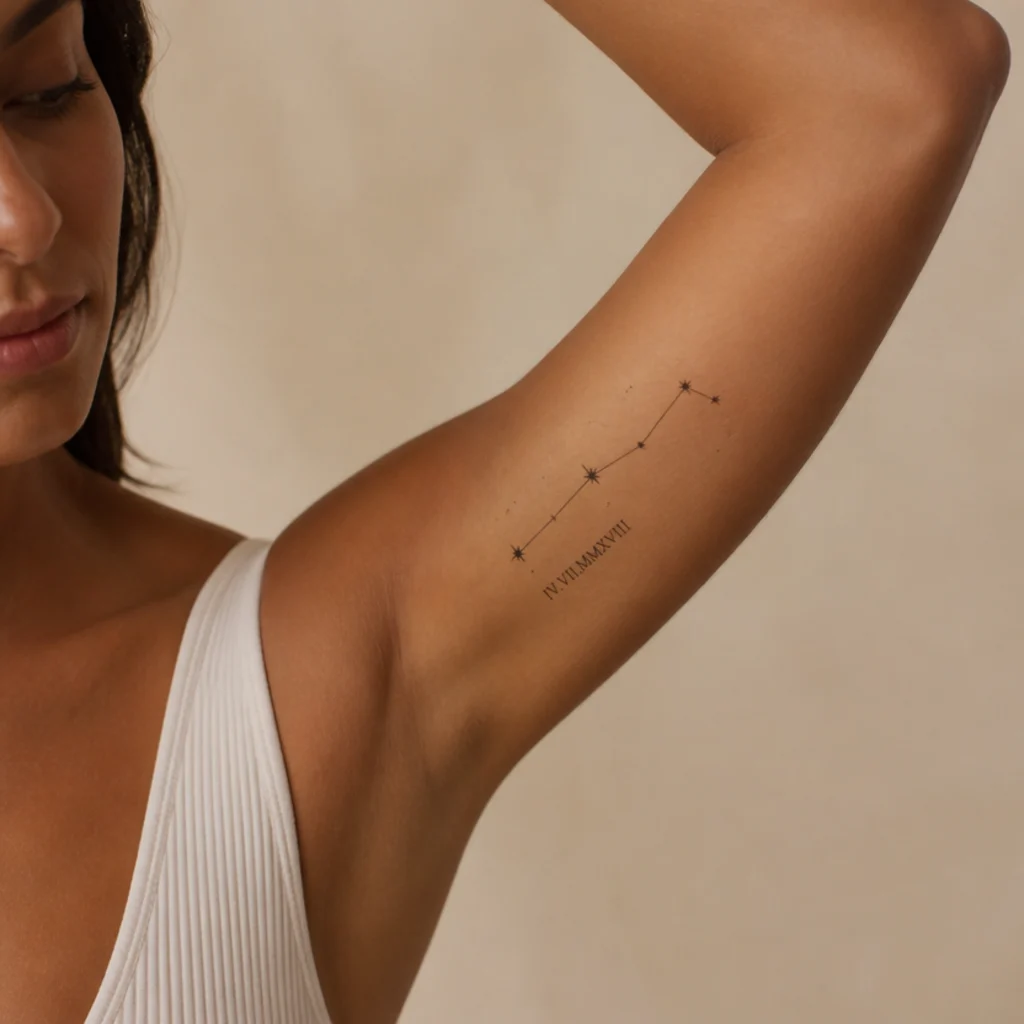
Combine the four-star Aries constellation with a small set of roman numerals or a slim date beneath it, marking a birthday, an anniversary, or another meaningful day. Keep the numerals fine but not hair-thin, since text is the single element most likely to blur and close up at small scale, and roman numerals fare better than a full written date because there are fewer tight letterforms to muddy. A short vertical arrangement suits the forearm, inner bicep, or ribcage. It's a natural fit for anyone who wants their aries constellation tattoo to carry a second layer of meaning without adding imagery. Font choice matters more than people expect: a clean, slightly open serif or a simple sans holds up far better than an ornate script, where thin serifs and tight counters mud together over the years. Give the numerals a touch more size than feels necessary, and treat any inner counters (the gaps inside letters) as the parts that will fill in first. Pro tip: have the artist leave generous spacing between characters and a clear buffer between the date and the stars, so nothing bridges as it heals, and confirm the numerals are correct twice before stenciling, since a text fix means a cover-up. Say to your artist: "the Aries constellation above a small date in thin, clean roman numerals, open spacing, no ornate serifs."
08Continuous One-Line Ram
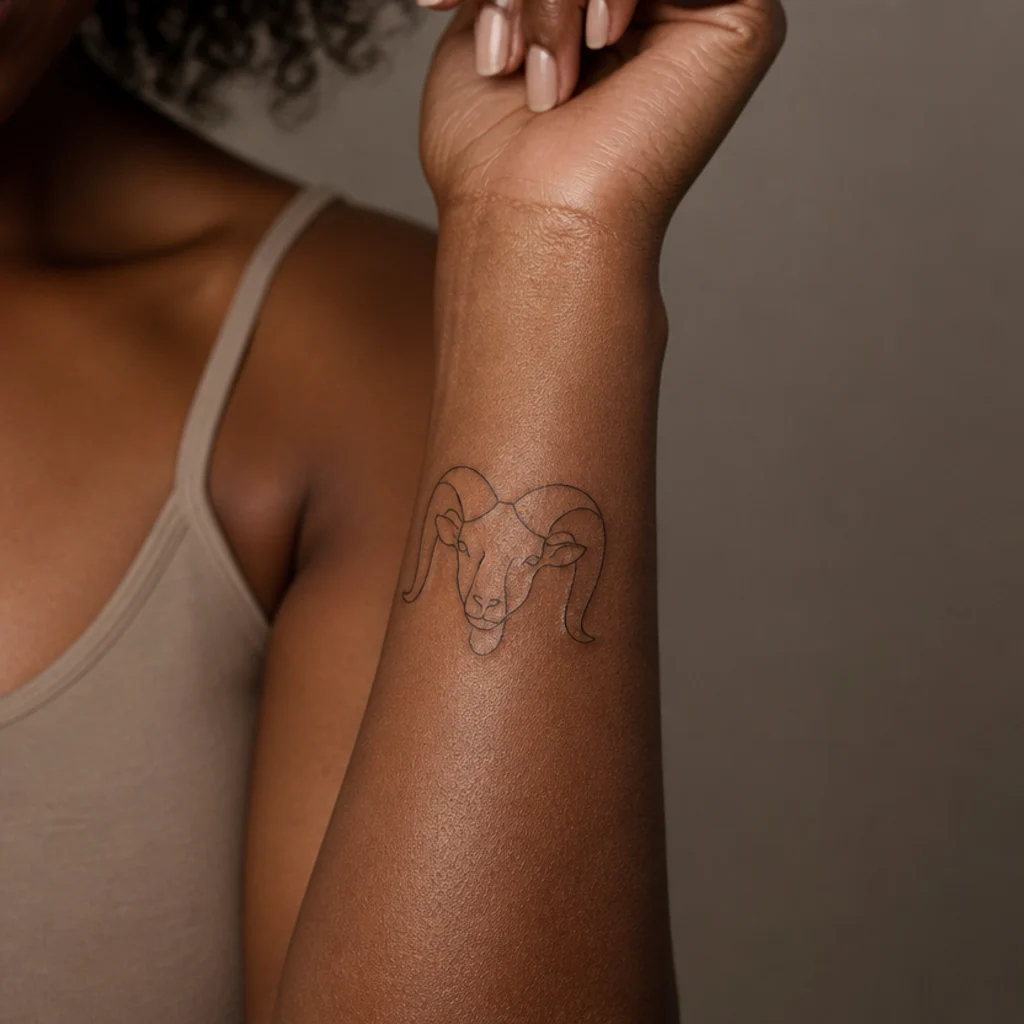
A single unbroken line that resolves into a ram's profile is one of the most elegant minimalist options, part illustration, part signature. The pen never lifts, so the whole animal emerges from one flowing stroke, and the result reads as art first, zodiac second. Precision is everything: because it's one continuous path, a confident artist will finalize the drawing digitally or on paper and map the stencil carefully before touching skin, since there's no hiding a correction mid-line, and any join in the loop must land where the eye won't catch it. The inner forearm, outer thigh, and upper arm give the curve room to breathe without crossing a hard flex point that would kink the line. It flatters anyone who loves line art and wants an aries ram tattoo that doesn't announce itself as a typical zodiac symbol. Scale it a little more generously than a plain glyph, ideally two inches or more, so the loops and the horn curl don't collapse into each other as they settle. Pro tip: ask to approve the exact line drawing in advance and to see it in the stencil position while you flex, since the composition, not the tattooing, is where a one-line piece is won or lost. Ask your tattoo artist for "a continuous one-line ram's head, single unbroken stroke, fine even weight, drawing approved before we start."
09Spine Constellation
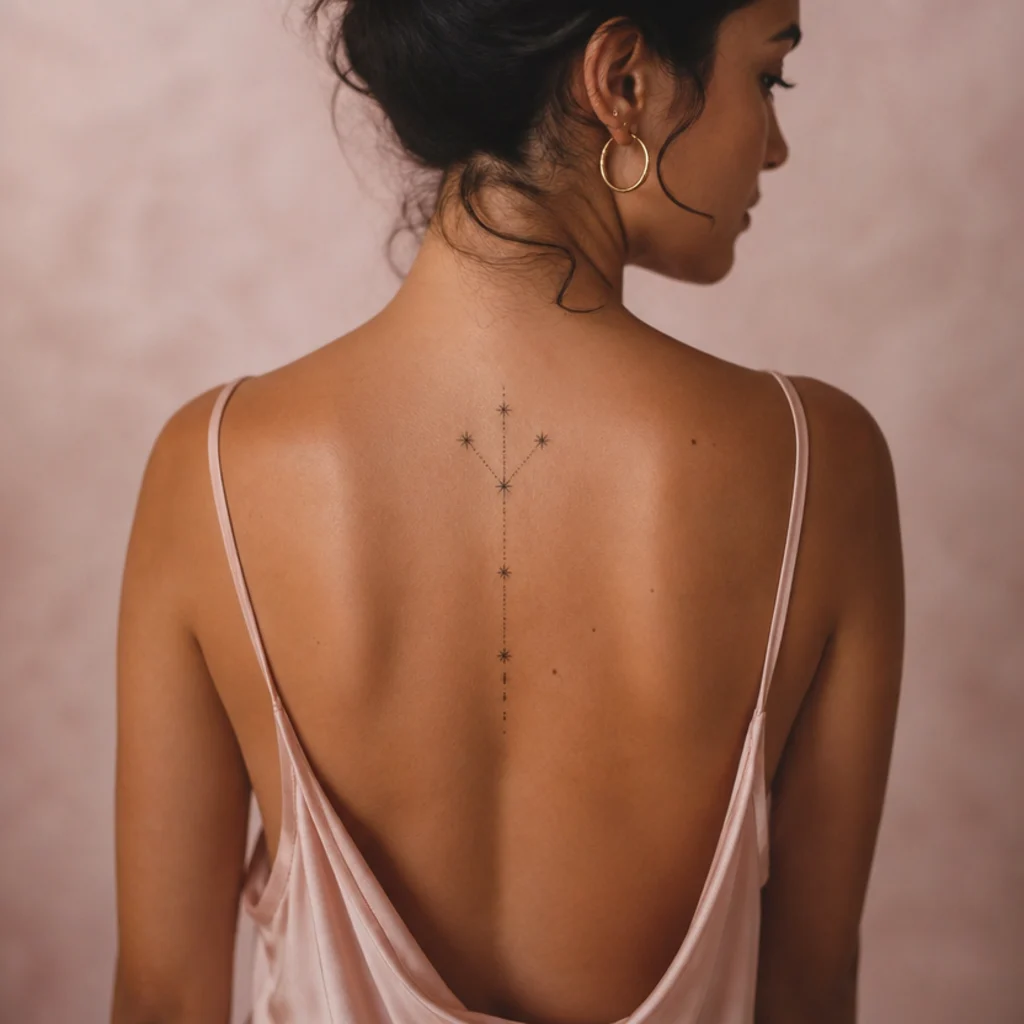
Running the Aries constellation vertically down the center of the upper spine turns the stars into a subtle column that follows your posture and elongates the back. Spaced dots with hairline connectors make a clean, architectural line that reads almost like jewelry. The placement flatters open-back tops and suits anyone who wants a piece that's private most of the time but striking when revealed. Be ready for the trade-off: the spine is bony, thin-skinned, and nerve-rich, so it's one of the sharper sits, and it runs along a flex point that shifts as you bend, which asks for a simple design and openness to a future touch-up. Alignment is the real technical challenge, so the artist should stencil against your standing posture, not while you're hunched on the table, or the "straight" column will bow once you stand. Keep the stars a hair larger and the connectors minimal, since spine skin blurs delicate line readily. Pro tip: have them check the stencil with you standing and relaxed, breathing normally, since spinal curvature and muscle tension can throw a level line off; a small plumb-line check goes a long way. Hand your artist this line: "the Aries constellation running vertically down the upper spine, small stars, thin connectors, aligned to my standing posture."
10Matching Micro Rams
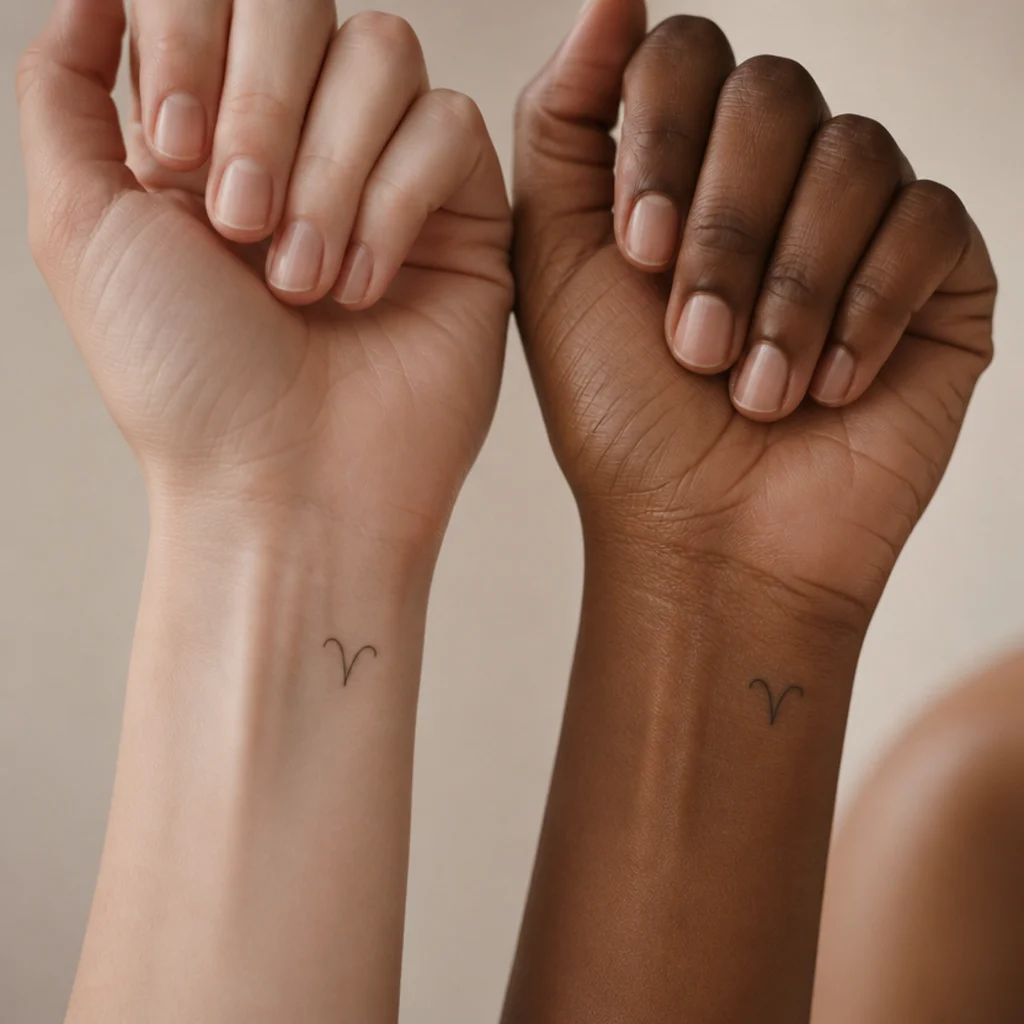
Two tiny matching rams or glyphs, one for you and one for a friend, sibling, or partner who shares the sign, make a quietly meaningful paired piece. Keep each under an inch and identical in style, size, and line weight so they clearly belong to the same set, small differences in scale read as mismatched even when the design is the same. Popular spots include the inner wrist, the back of the upper arm, and the ankle, ideally the same placement on both people for symmetry, though different skin types will still heal at slightly different rates. This is a favorite among aries tattoo for women marking a bond, and the micro scale keeps the commitment gentle and easy to hide. Consistency is the whole point, so get them done in the same session by the same artist whenever possible, working from a single shared stencil rather than eyeballing a copy. If schedules force separate sessions, have the artist save the exact stencil, needle, and machine settings. Pro tip: agree on placement and orientation together beforehand, since even a small mirror difference, one on the left wrist, one on the right, changes how "matched" they feel in side-by-side photos, and decide together whether you want them to mirror each other or match exactly. Tell your artist: "two identical tiny Aries glyphs from one stencil, matched line weight and size, same placement and orientation on both of us."
11Finger Glyph
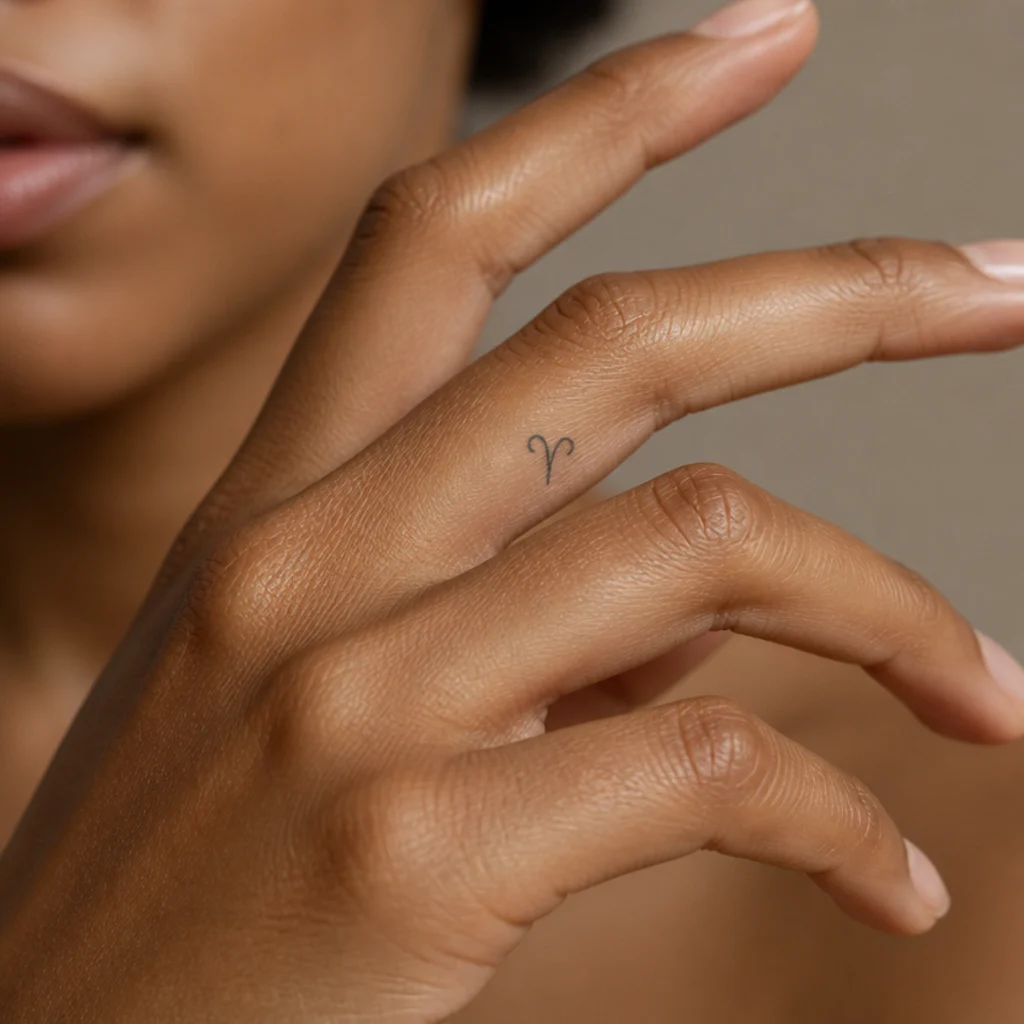
A minuscule Aries symbol on the side of a finger is about as subtle as ink gets, a modern, fashion-forward placement that peeks out only when you gesture. Be realistic about upkeep: fingers see constant washing, sanitizer, friction, sun, and stretchy skin, which makes finger tattoos among the fastest to fade, spread, and patch out, and many artists expect to redo them at least once and won't guarantee them. Keep it to a simple glyph with no internal detail to give it the best odds, and favor the side of the finger over the palm-side or the top of the knuckle, which wear even harder and shed ink fastest. It suits anyone who wants a barely-there aries minimalist tattoo and accepts the higher maintenance as part of the deal rather than expecting permanence. Heal it carefully, keep your hand dry early on, and keep it out of the sun long-term. Pro tip: ask the artist to lay the line a touch bolder and slightly deeper than they would on the forearm, since ultra-fine strokes on fingers can drop out entirely during healing, and book a free-or-cheap touch-up conversation up front so you know the redo policy. Ask your tattoo artist for "a tiny Aries symbol on the side of the finger, simplest possible line, laid slightly bolder to survive healing, and your finger touch-up policy."
12Ram Horns Only
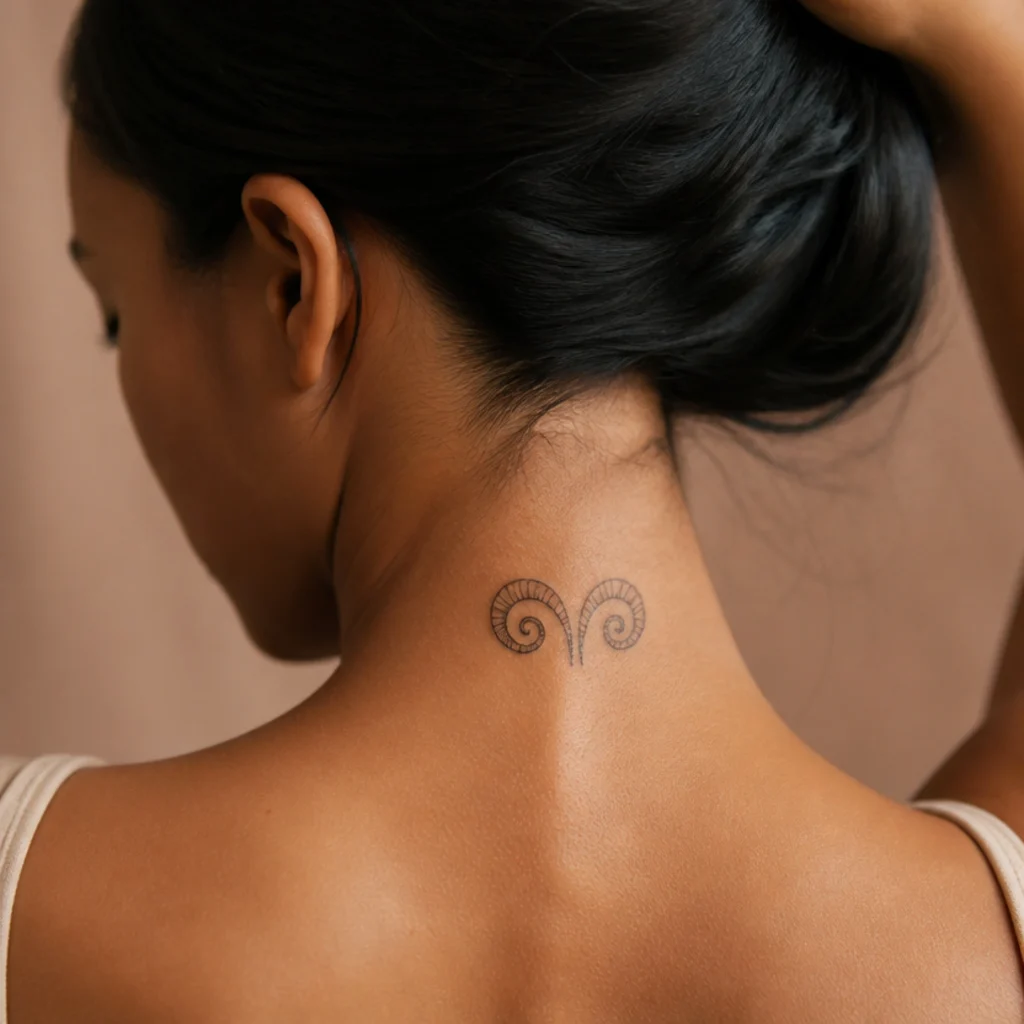
Skip the full animal and use just the curling horns, two mirrored spirals, as a stylized stand-in for Aries. It's bold in concept but minimal in execution, and the symmetry makes an arresting shape on the back of the neck, sternum, or forearm. This flatters anyone who wants something a little more decorative than the plain glyph without adding color or shading, and the twin-spiral form photographs cleanly from the front. Symmetry is the entire game, so the win happens at the stencil stage: a skilled artist will place it against your body's centerline and check both curls match, mirrored not merely similar, before any needle touches skin. The clean, moderate-weight curves age reasonably well, better than hairline detail, since there's real line to soften into, so this is a smart pick if you want fine-line looks with a bit more durability. Nape placement stays hidden under hair and revealed with an updo, while the sternum turns it into a centerpiece that follows the body's natural symmetry. Pro tip: on the back of the neck, have the artist align the horns to your spine's centerline with your head level rather than eyeballing it, since a small tilt is glaring once your hair is up in photos. Say to your artist: "symmetrical stylized ram horns only, fine even line, no face, balanced mirrored spirals aligned to my centerline."
13Constellation and Moon
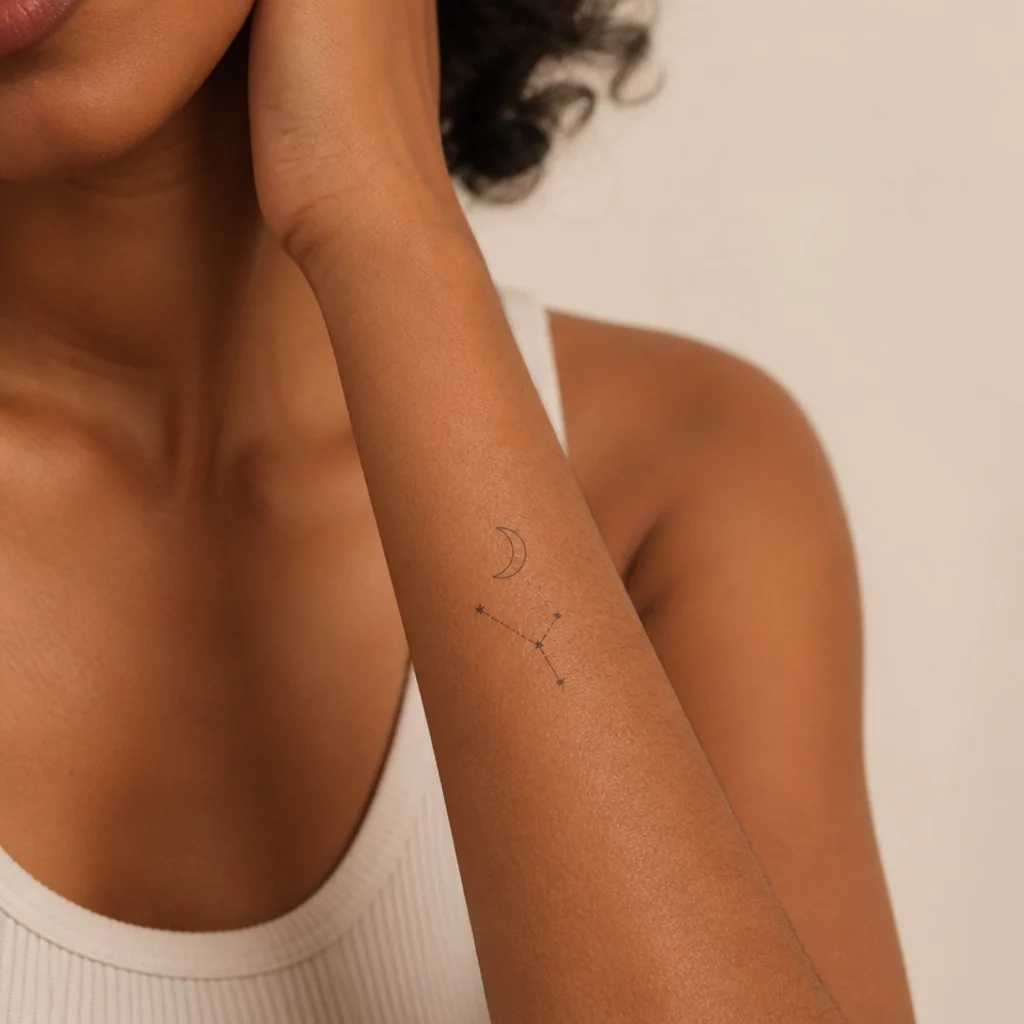
Pair the Aries constellation with a slim crescent moon for a celestial mini-scene that stays airy and uncluttered. The crescent adds a second point of interest and a little narrative while keeping the overall feel delicate, and it's an easy way to fold in a lunar detail like a moon phase that matters to you. It suits the forearm, outer shoulder, or ribcage and flatters anyone drawn to astronomy-inspired art. Keep the moon as a thin outline rather than a filled shape to stay minimal; a solid crescent tips the balance toward a heavier piece and competes with the fine stars for attention. As with any fine-line celestial work, the thinnest strokes soften first, so a periodic touch-up every few years keeps it reading crisply. Composition is worth planning: let the moon sit slightly apart from the constellation so the two elements don't crowd and merge as they heal, and decide whether the crescent cradles the stars or sits alongside them, since that changes the whole mood. It's a lovely, slightly more decorative aries constellation tattoo without straying from the minimalist brief. Pro tip: ask for the crescent and the star dots to share the same line weight, so the scene feels like one cohesive drawing rather than two stickers set side by side. Ask your tattoo artist for "the Aries constellation beside a thin crescent moon outline, matched line weight, small and delicate, no fill."
14Fine-Line Floral Ram
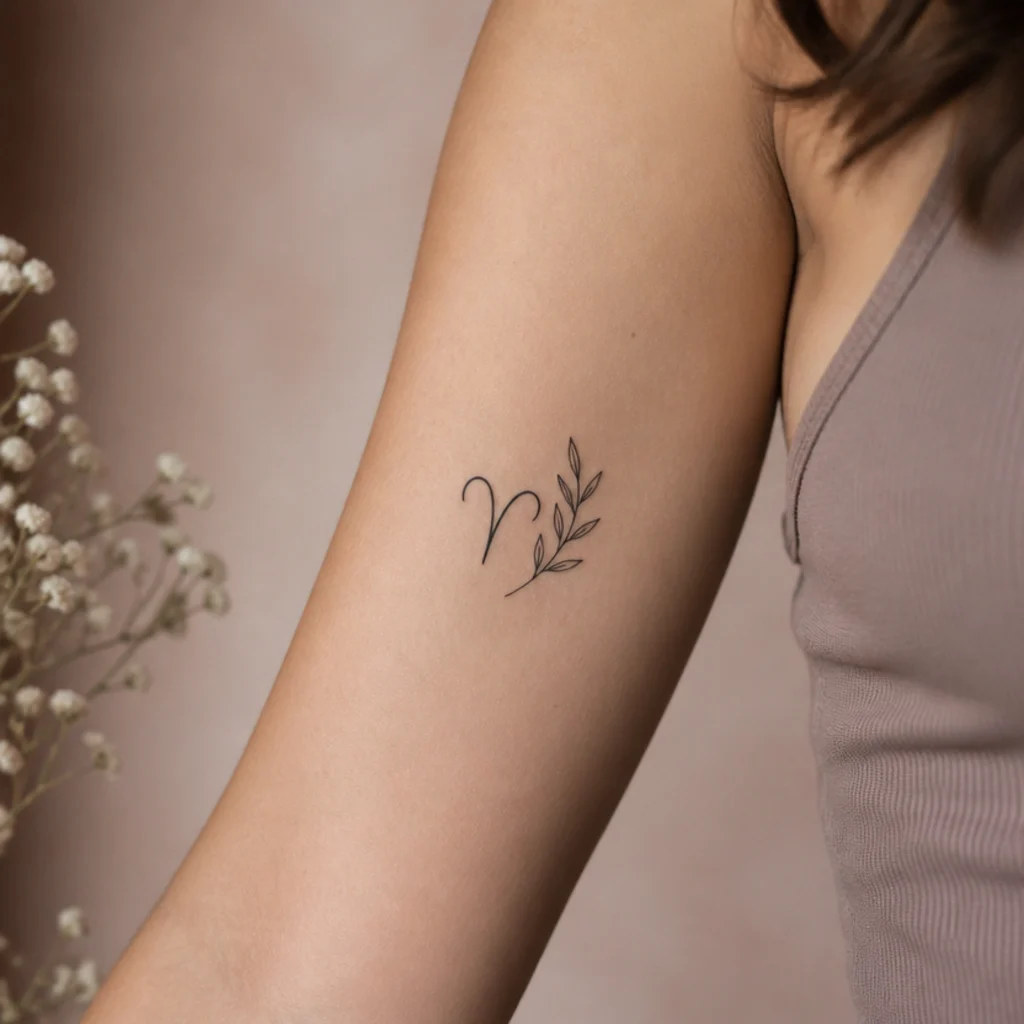
Weave a small sprig, a single stem of leaves or a tiny bloom, around or beneath the ram glyph for a softer, more organic feel. Aries pairs naturally with its traditional birth flowers, honeysuckle and thistle, if you want the botanical to carry extra meaning rather than being purely decorative, and either reads as delicate line art at small scale. The floral element keeps everything fine-line and understated while adding a personal touch, and it flatters anyone who wants their zodiac ink to feel gentle and botanical rather than graphic. The inner arm, ribcage, and outer shoulder all work, with the inner arm giving the softest, most intimate placement. Because you're combining two delicate elements, scale it generously enough, ideally two inches or more, that the leaf detail and the glyph don't bleed together as they heal and settle, which is the most common way these pieces disappoint. It's a warm, pretty option and a perennial favorite among aries tattoo for women ideas. Pro tip: ask the artist to vary line weight subtly, a hair more on the glyph, lighter on the foliage, so the eye reads the symbol first and the botanicals as a soft frame, and keep leaf tips from tapering to nothing since fine points drop out earliest. Bring this request to your consult: "a fine-line Aries glyph with a small delicate botanical sprig, honeysuckle or thistle, sized so details won't merge, no shading."
15Negative-Space Glyph
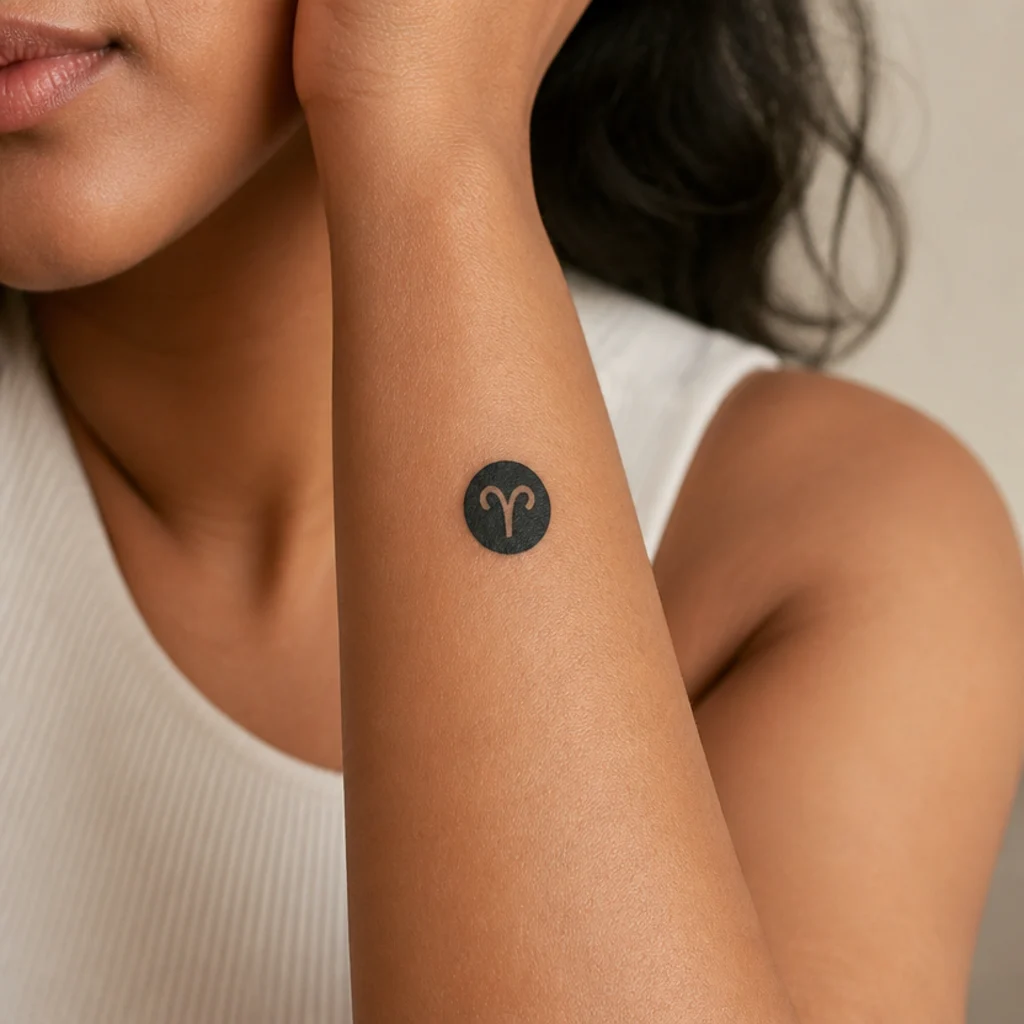
Instead of drawing the Aries symbol in line, let it emerge as negative space inside a small solid shape, a soft circle, square, or organic blob of saturated ink with the glyph left un-tattooed in the center. It's a clever, contemporary inversion that reads as minimal and graphic at once, and it's the boldest-looking option here despite using no color. This is also the most technically demanding idea, because the effect depends entirely on the surrounding fill being packed evenly, with no patchiness or holidays, so the empty glyph stays crisp and doesn't get encroached on as the solid ink settles and spreads slightly at the edges. That argues for an artist with proven solid-fill and blackwork experience, not a liner, and for a little more real estate: the forearm, outer shoulder, or calf give negative-space work the room it needs to stay legible. Keep the interior glyph a touch chunkier than a line version, since healing spread eats into open space from the outside in and a hairline reveal can close up. Solid black on deeper skin tones can read subtly, so discuss contrast honestly in person. Pro tip: ask how the fill is expected to heal and whether a fill touch-up is likely, since even saturation is where negative-space pieces most often need a planned second pass. Ask your tattoo artist for "the Aries symbol as clean negative space inside a small solid shape, even saturated fill, glyph kept slightly bold."
Save this to Pinterest so you don't lose your favorites.
Pro Tips from the Editor
- Vet healed work, not fresh photos. A fine-line piece looks flawless the day it's done. Ask your artist specifically for images of the same style healed six months to a year out, since that softened, settled look is what your tattoo will actually become.
- Size for the line, not the vibe. The single biggest cause of blurred micro tattoos is packing thin lines too close. If two strokes sit within about a needle's width of each other at small scale, they'll bridge as they heal; scale up or strip detail out until the design can breathe.
- Match placement to friction, not just looks. Forearm, outer bicep, calf, and shoulder blade hold fine lines longest. Fingers, feet, inner wrist, spine, and anything crossing a joint move, rub, and fade faster, so they need simpler designs, slightly bolder lines, and more frequent touch-ups.
- Protect it from the sun. UV is the top enemy of delicate black and especially watercolor ink. Once fully healed, keep the piece under SPF 30-plus whenever it's exposed; this one habit does more for longevity than anything else you can do.
- Follow the aftercare that fits your artist's ink and method. Surface healing runs roughly two to three weeks and full settling up to a couple of months; keep it clean, lightly moisturized, out of pools and long soaks early, and never pick or scratch, since scabbing off pigment is what creates patchy gaps.
- Book the specialist, not the generalist. Single-needle, watercolor, blackwork negative space, geometric, and one-line drawing are distinct skills. The right artist for a geometric ram may be the wrong one for a translucent wash, so match the portfolio to the specific technique you want.
- Budget for the touch-up from day one. Treat a refresh every few years as the price of delicate ink, not a defect. Ask up front about touch-up policy, cost, and timing so there are no surprises.
- Approve the stencil at actual size, on the actual spot. Look at it in a mirror, standing and moving, before you consent. Placement and scale are far cheaper to change on paper than in skin, and a five-minute adjustment now prevents years of regret.
Comparison at a Glance
| Design | Detail level | Best placements | Fade risk | Touch-up horizon |
|---|---|---|---|---|
| Ram glyph | Very low | Forearm, wrist, sternum | Low | 5-7 yrs |
| Constellation | Low | Forearm, collarbone, upper back | Medium (connectors) | 3-5 yrs |
| Ankle / finger micro | Very low | Ankle, side of finger | High | 1-3 yrs |
| Watercolor wash | Low-medium | Upper arm, shoulder | Medium-high | 3-5 yrs |
| Geometric / one-line | Medium | Forearm, thigh, calf | Low-medium | 5-7 yrs |
| Negative-space | Medium | Forearm, shoulder, calf | Medium (fill) | 3-5 yrs |
Ranges are general guidance; your skin, sun exposure, and aftercare shift them significantly. Confirm specifics with your artist.
Quick Brief for Your Artist
Copy the row that matches your pick into your consult message so nothing gets lost in translation.
| If you want... | Ask for | Watch-out to name |
|---|---|---|
| The most legible option | "Even-weight single-needle Aries glyph, ~1 inch, no shading" | Mirror-matched arcs; no tapering |
| The most subtle option | "Aries constellation, tiny dots, hairline connectors, ~2 inch span" | Connectors merging if too small |
| The most durable fine-line look | "Ram horns only or geometric ram, moderate even line" | Symmetry to centerline |
| A soft, colorful accent | "Translucent terracotta/blush wash with a fine-line anchor" | Style specialist only; UV fade |
| Text or a date included | "Clean roman numerals, open spacing, no ornate serifs" | Counters filling in; double-check the date |
| A bold graphic in one color | "Negative-space glyph in even solid fill, slightly chunky interior" | Patchy fill; planned fill touch-up |
How to Choose / Get the Look
Work through it in four decisions. First, meaning: the glyph is the most legible and iconic, the constellation is the most subtle and abstract, the ram (silhouette, one-line, or horns) is the most illustrative and personal, and add-ons like a date, moon, or botanical layer in a second story. Decide whether you want the piece to read instantly as Aries or to stay quietly private. Second, placement: flatter, lower-friction areas (forearm, upper arm, calf, shoulder blade) hold fine lines longest, while fingers, feet, inner wrist, spine, and anything over a joint fade faster and demand simpler designs and more frequent touch-ups; weigh visibility, concealability, and pain alongside longevity, since bony, thin-skinned spots sit sharper and heal less predictably. Third, scale and detail together: match the size to the amount of line, because a tiny piece packed with thin strokes will blur as it settles, so either scale up or pare detail down until the design can survive healing with room to spare. As a rough floor, a four-star constellation wants about two inches of span, and a one-line ram wants a bit more than a plain glyph so its loops don't collapse. Fourth, color and skin: black line suits every undertone, but for a watercolor wash ask specifically how the palette will read and wear against your undertone, and lean toward terracotta, peach, and rust on warmer or deeper skin where pale pinks can go ashy or vanish. Bring two or three reference images plus a plain-language note on the line weight you want, and ask your artist to mock it up at actual size on your skin and let you see it moving in a mirror before you commit. Design, sizing, placement, coverage feasibility, and healing are best confirmed directly with a licensed tattoo artist who can assess your skin, tone, and anatomy in person; no fine-line design can be guaranteed to fully cover an existing tattoo, scar, or birthmark, so discuss any cover-up honestly and in person before booking rather than assuming a small, light piece will hide it. Finally, plan for maintenance without flinching: fine-line work is beautiful precisely because it's delicate, which means daily SPF, careful aftercare, and the occasional touch-up are the price of keeping it sharp.
Frequently Asked Questions
Do minimalist Aries tattoos fade faster than bigger designs?
Fine-line work can soften sooner than bold, heavily saturated tattoos because the strokes start thin and carry less pigment, so there's less ink to lose before a line looks faint. Placement matters more than overall size: a well-placed one-inch glyph on the outer forearm will usually outlast a larger piece on a finger or foot. Choose lower-friction skin, keep it under SPF once healed, follow aftercare closely, and expect an occasional touch-up rather than assuming it will stay pristine forever. Delicate ink trades a little durability for its elegance, and that's a fair deal when you go in with eyes open.
What's the difference between the Aries glyph and the ram design?
The glyph is the abstract astrological symbol, an upward stem splitting into two arcs that stylize the ram's horns, while the ram design depicts the animal itself, whether as a simple silhouette, a continuous one-line drawing, or just the curling horns. The glyph reads clean, modern, and instantly recognizable as zodiac shorthand; the ram feels more illustrative, personal, and less obviously "sign" at a glance. Many people who want subtlety pick the ram or a one-line version for exactly that reason, while those who want the meaning to read immediately choose the glyph. You can also blend them, a glyph with a small ram or botanical accent, if you want both registers.
Where does a small Aries tattoo look best?
The forearm, outer wrist, upper arm, collarbone, and behind the ear are the most popular and the most reliable, because flatter, less-flexed areas keep delicate lines crisp longest. The spine, ribcage, and shoulder blade suit vertical constellation arrangements, and the sternum works well for symmetrical horns. Fingers, ankles, and feet look striking but wear hardest and need simpler, slightly bolder designs. The "best" spot balances how visible you want it, how easily you can conceal it for work, how much the area moves and rubs, and your pain tolerance, since bony, thin-skinned placements sit sharper. When in doubt, favor a forearm or upper arm for a first piece.
How small can an Aries constellation tattoo go?
It can go quite small, but the connecting lines set the floor, not the star dots. Roughly two inches of span is a sensible minimum for the four-star cluster; below that, the hairline connectors risk merging into each other or into the dots as the tattoo heals and the ink spreads slightly under the skin. If your artist says the design is fighting its size, size up a little or drop the connectors and let the dots stand alone rather than forcing it and watching it blur within a year. A dots-only "star map" version can actually age better at micro scale than a fully connected one.
Is a minimalist Aries tattoo a good first tattoo?
For many people, yes: it's small, relatively quick, low-commitment, and easy to place discreetly. The caveats are that fine-line work demands an experienced single-needle artist (this is not the place to save money on an inexperienced one), a forgiving placement, and realistic expectations about future touch-ups. Go in knowing that delicate ink trades some durability for its beauty, and you'll be happy with it. If you want something you can fully ignore for decades, a slightly bolder line, or a horns-only or geometric design with more line to soften into, ages more forgivingly than the very finest hairline work.
How much does a minimalist Aries tattoo cost?
Most micro pieces start at a studio's minimum charge, since even a tiny tattoo requires setup, sterile supplies, and an artist's time, and price climbs with size, detail, placement difficulty, and how in-demand the artist is. Single-needle specialists, watercolor artists, and blackwork negative-space work typically sit at the higher end because of the skill involved. Avoid choosing purely on price for fine-line work, since a cheaper, less experienced hand is where blurred, uneven results usually come from, and a redo often costs more than doing it right once. Always get a firm quote in person, and factor the eventual touch-up into your budget.
How long does a fine-line Aries tattoo take to heal?
The surface generally heals in about two to three weeks, during which it may flake or lightly scab, while the deeper layers can take up to a couple of months to fully settle, which is when you see the true final look and color. Keep it clean, lightly moisturized, and out of the sun, pools, saunas, and prolonged soaking during the early weeks, and never pick or scratch, since scabbing pigment off is a leading cause of patchy gaps in delicate work. Follow the specific aftercare your artist gives you, as it can vary with their ink, wrap method, and machine, and don't judge the final result until it's fully healed.
Can a minimalist Aries tattoo cover an old tattoo or scar?
Realistically, no, not on its own. Minimalist fine-line and negative-space designs use thin lines and open space, so they can't reliably hide the darker ink, texture, or discoloration underneath, and forcing a delicate design over a busy background usually reads as cluttered. Cover-ups and scar work are a specialized area with their own rules about size, density, ink saturation, and healing. Bring photos to a licensed tattoo artist who does cover-up work and let them assess it in person; never assume a small, light design will fully conceal what's already there, and be wary of anyone who promises it will sight unseen.
Does the tattoo need to include all four constellation stars?
Not necessarily. The Aries constellation is usually shown as four main stars (Hamal, Sheratan, Mesarthim, and a fainter fourth), but some artists render a cleaner three-star version, and either can read as Aries when connected. Fewer stars means fewer hairline connectors and a lower blur risk at small sizes, so if you're going very small, a simplified version can actually age better. Decide with your artist based on the scale and placement you've chosen rather than insisting on astronomical completeness at a size that can't support it. Bringing an accurate star map helps you and the artist agree on which stars carry the shape.
How do I know if an artist is right for fine-line Aries work?
Look for a portfolio heavy in the exact technique you want, single-needle line, watercolor, geometric, or negative-space blackwork, and specifically ask to see those pieces healed rather than fresh. A good fine-line artist will talk openly about sizing up when a design is too fussy, about which placements fade fastest, and about touch-up policy, instead of promising a hair-thin micro tattoo will stay perfect forever. Cleanliness, a clear consent and aftercare process, and a licensed, reputable studio are non-negotiable. If someone pressures you toward a size or placement you're unsure about, or guarantees a cover-up sight unseen, treat that as a reason to keep looking.