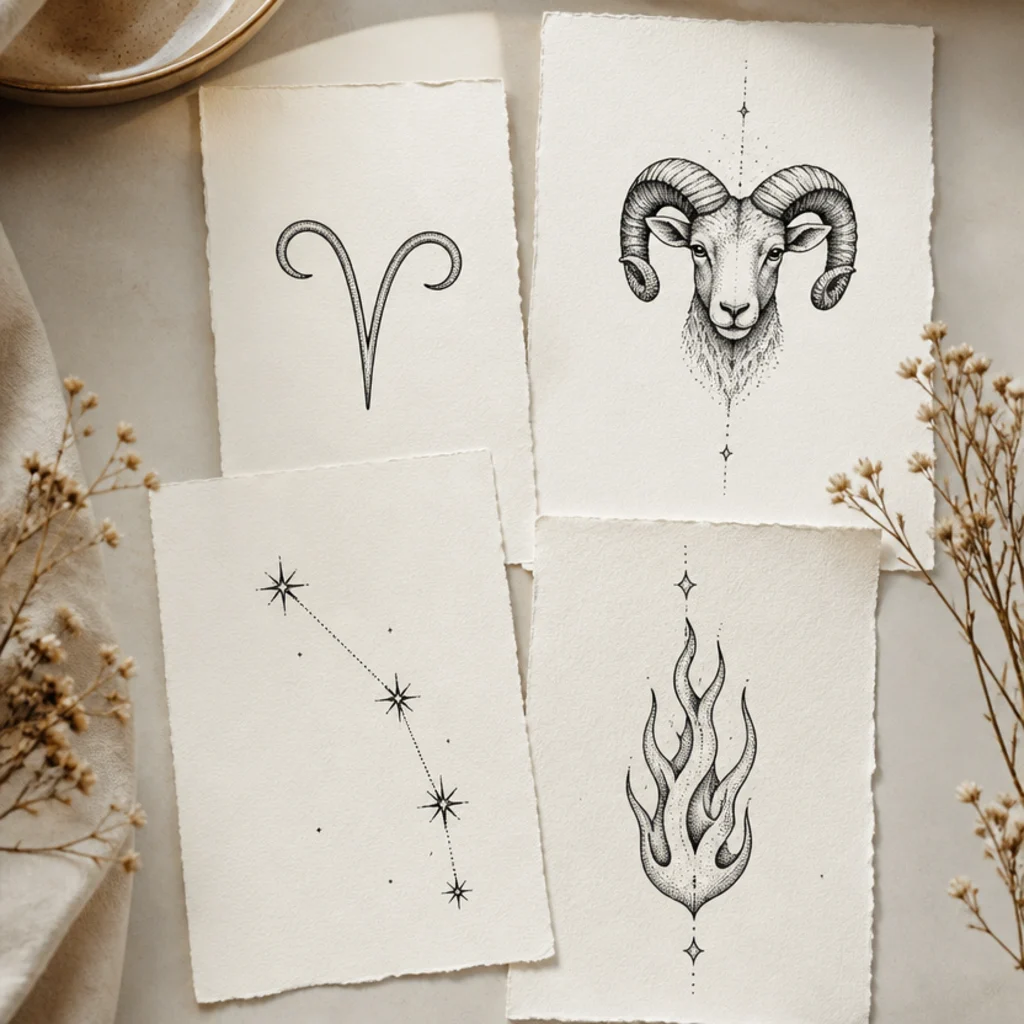
15 Aries Tattoo Designs for Women
The ram is bold, direct, and a little stubborn, and Aries tattoos tend to follow suit. This roundup gathers 15 distinct directions, from whisper-thin glyphs to painterly constellations, with editor notes on placement, ink longevity, line weight, and the exact wording to brief your artist so the piece still reads at year ten.
 Edited by Lena Rose · Published July 11, 2026 · 32 min read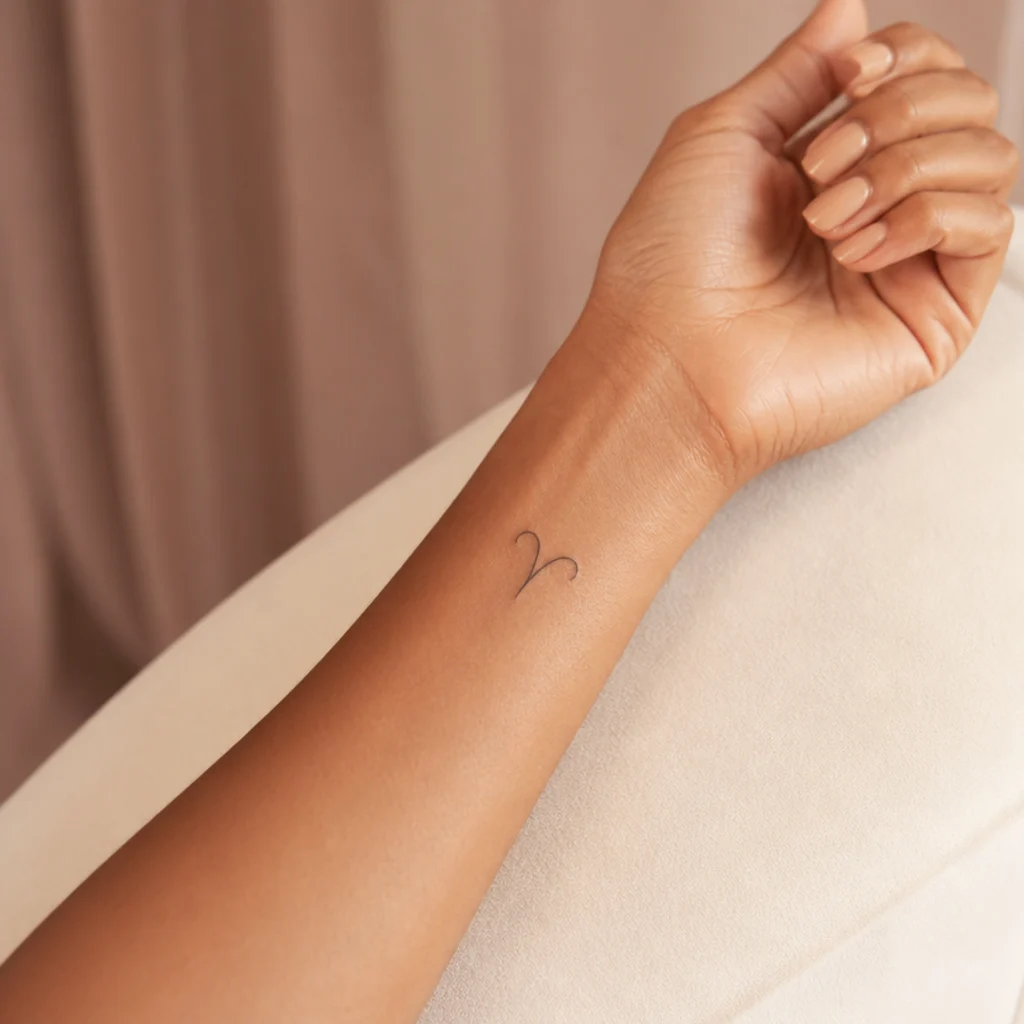
Quick Answer
- Best for: Aries suns, moons, or risings (roughly March 21 to April 19) who want a personal, symbol-driven piece with clear meaning and are willing to match line weight to placement.
- Who might skip it: Anyone who prefers imagery over astrology, wants ultra-tiny detail in a high-friction spot where it won't hold, or isn't ready to commit to occasional touch-ups on color and fine-line work.
- Maintenance: Fine-line and single-needle work softens first; budget a touch-up around years 3 to 7. Watercolor and warm color accents refresh soonest; solid blackwork can go a decade-plus untouched.
- Difficulty: From beginner-friendly glyphs (10 to 20 minutes in the chair) to detailed neo-traditional ram portraits and dense dotwork (multi-hour, sometimes multi-session).
- Cost: Highly variable. Small glyphs often sit at a shop minimum; blackwork, neo-traditional color, and dotwork climb well beyond it depending on size in centimeters, body region, and artist demand. Always treat online figures as ranges, never quotes.
- Wear time / longevity: Bold linework and evenly packed solid black age most reliably; watercolor washes and heavy saturated color read as the first to need refreshing, especially on lower legs, hands, and feet.
- Standout variation: The minimalist ram glyph, which stays legible at almost any size and suits nearly every placement.
- How to ask your tattoo artist: Bring two or three saved references and name the style, size in centimeters, line weight, finish (line-only, shaded, or packed), and exact placement.
In This Guide
- Minimalist Ram Glyph
- Fine-Line Aries Constellation
- Watercolor Ram Silhouette
- Micro Ram Behind the Ear
- Blackwork Ram Head
- Constellation and Birth-Flower Combo
- Geometric Ram in Linework
- Delicate Spine Constellation
- Flame and Ram Fusion
- Ram Skull with Florals
- Ankle Glyph with Tiny Stars
- Neo-Traditional Ram Portrait
- Dotwork Constellation Circle
- Script and Glyph Collarbone Piece
- Curved Horn Wrap Around the Wrist
Intro
An Aries tattoo can be as loud or as quiet as you want, which is why it suits so many women who claim the sign. Two motifs dominate the requests artists see: the ram, drawn from the constellation's mythology of the golden fleece, and the clean V-shaped glyph that abstracts its curling horns. From those two roots the options branch fast into fine-line stars, painterly color, sculptural blackwork, April botanicals, and hybrids that layer symbol on symbol. What separates a piece that still reads well at year eight from one that blurs is rarely the concept; it's line weight, scale, placement, and an artist whose specialty actually matches the style, a fine-line specialist for constellations, a blackwork hand for saturated fill, a color portfolio for neo-traditional. This guide walks through 15 designs that each take a different technical approach, so you can compare single-needle linework against dotwork, glyph against full portrait, and hidden placement against statement canvas side by side. For every idea you'll find who it flatters by body contour and skin undertone, how the ink tends to age in that spot, and language you can borrow when you brief a licensed tattoo artist. Whether you want an aries tattoo for women you can cover for work or a forearm centerpiece, there's a version here worth saving, and a smarter way to ask for it.
01Minimalist Ram Glyph
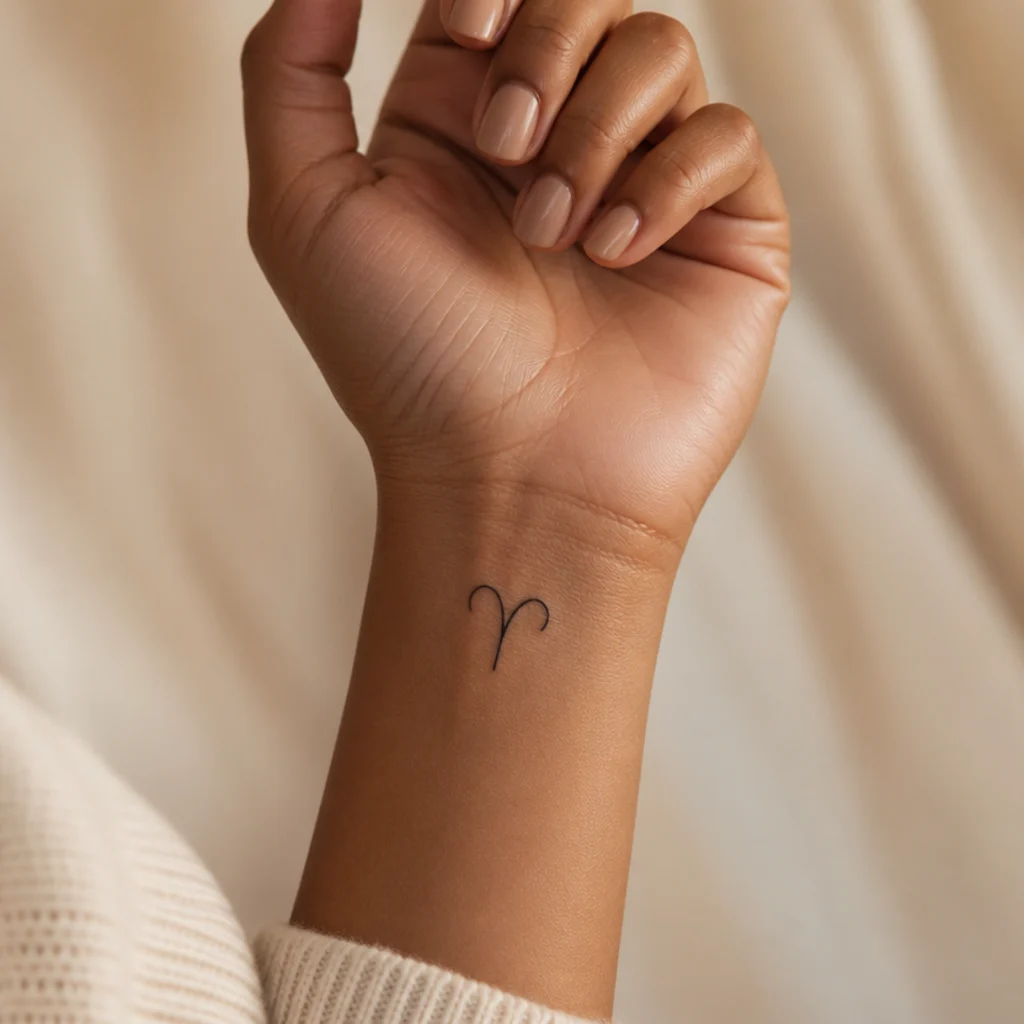
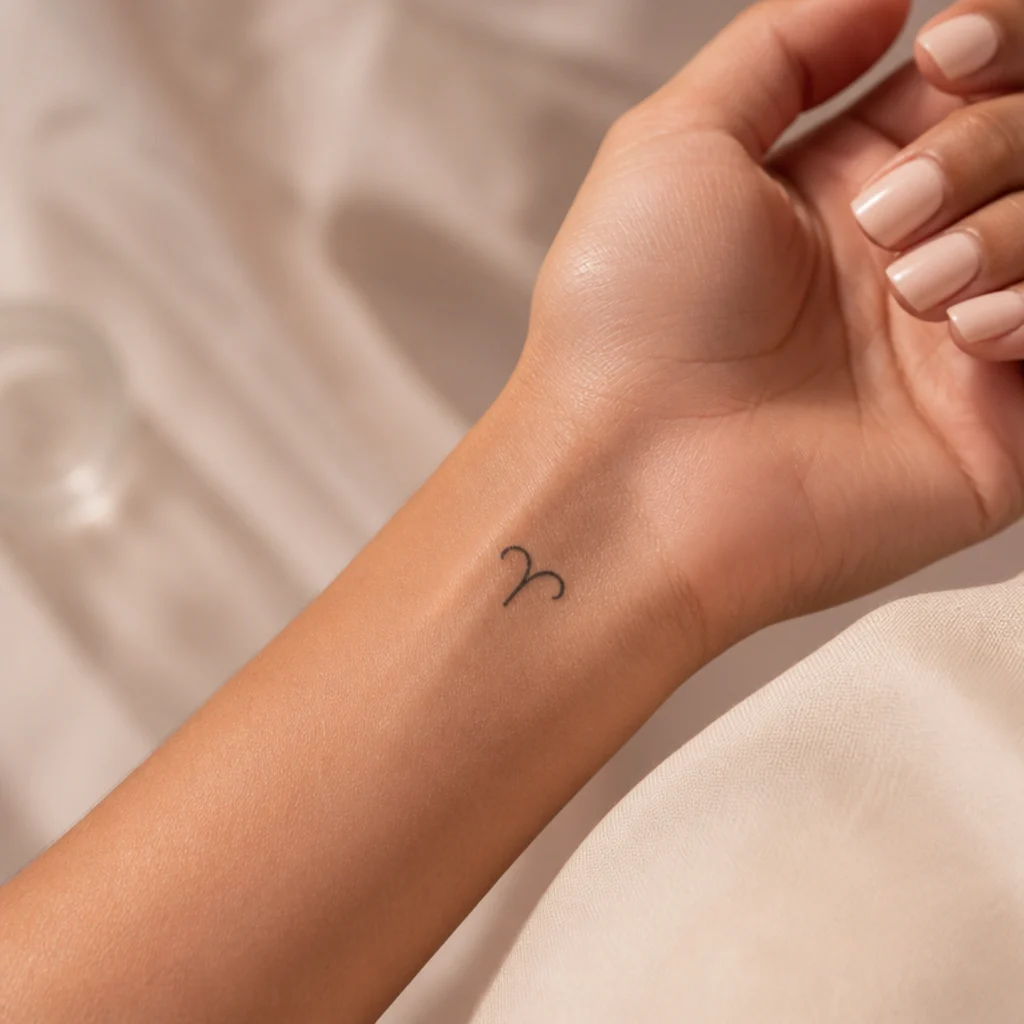
The glyph, two symmetrical curves meeting at a central stem, is the most economical way to wear the sign, and as an aries minimalist tattoo it holds at barely 2 centimeters, which is why it's such a common first tattoo. Placement is flexible: inner wrist, behind the ear, the sternum, or the side of a finger all read cleanly, though finger and foot placements demand a slightly heavier line, roughly a 5RL rather than a 3RL, because friction and constant flexing break down hairline ink fastest. Undertone matters less here than contrast; on deeper and rich melanin-rich skin a solid, confident line reads far better than a faint gray one, so ask for a true black single pass rather than a diluted wash. Keep the stem short so the curves stay dominant and the symbol stays recognizable at a glance. Maintenance is minimal, though very fine versions soften over the years and may want a light refresh around year 5. Pro tip: have your artist mock it in pen and photograph it on the actual spot before needling, since the glyph's balance shifts on a curved wrist and tilts on the sternum. Ask your artist for a "single-weight Aries glyph, no shading, roughly 2.5 centimeters, slightly bolder line if it lands on a finger."
02Fine-Line Aries Constellation
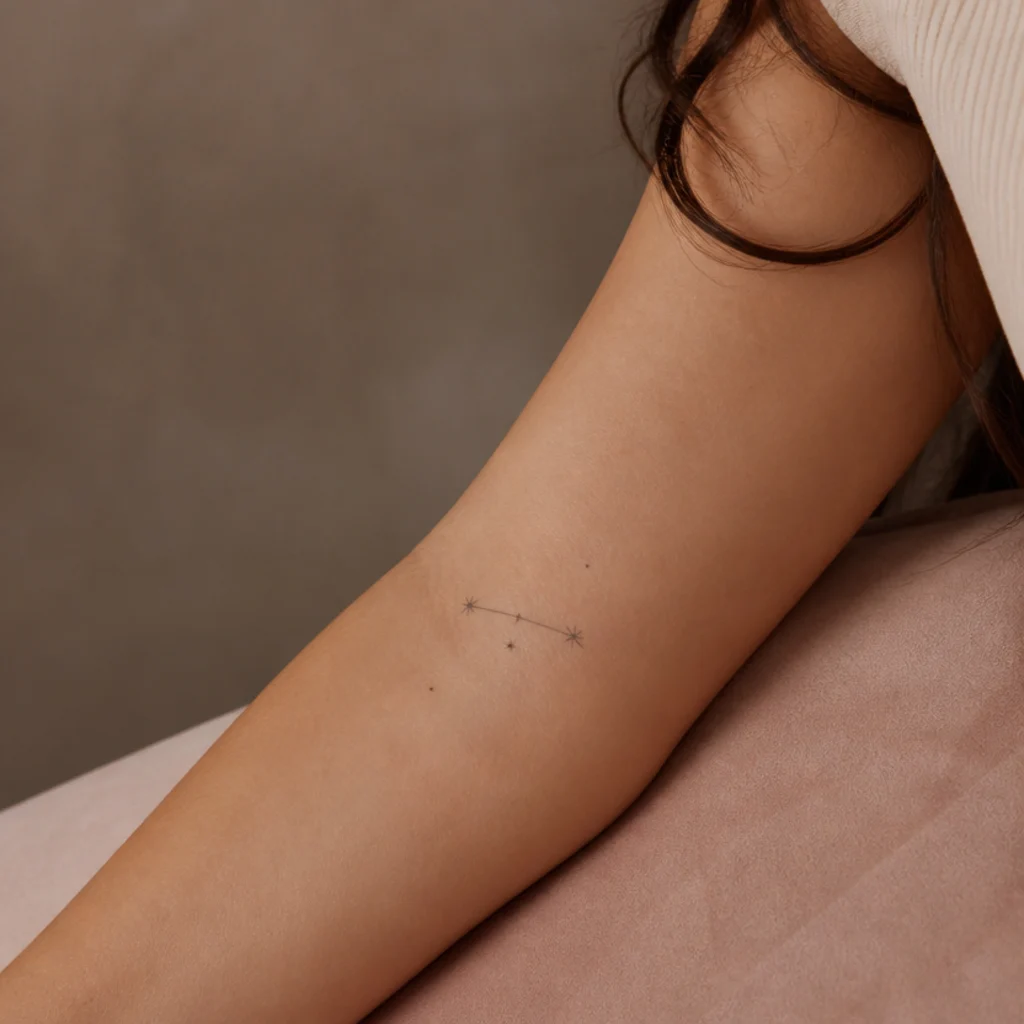
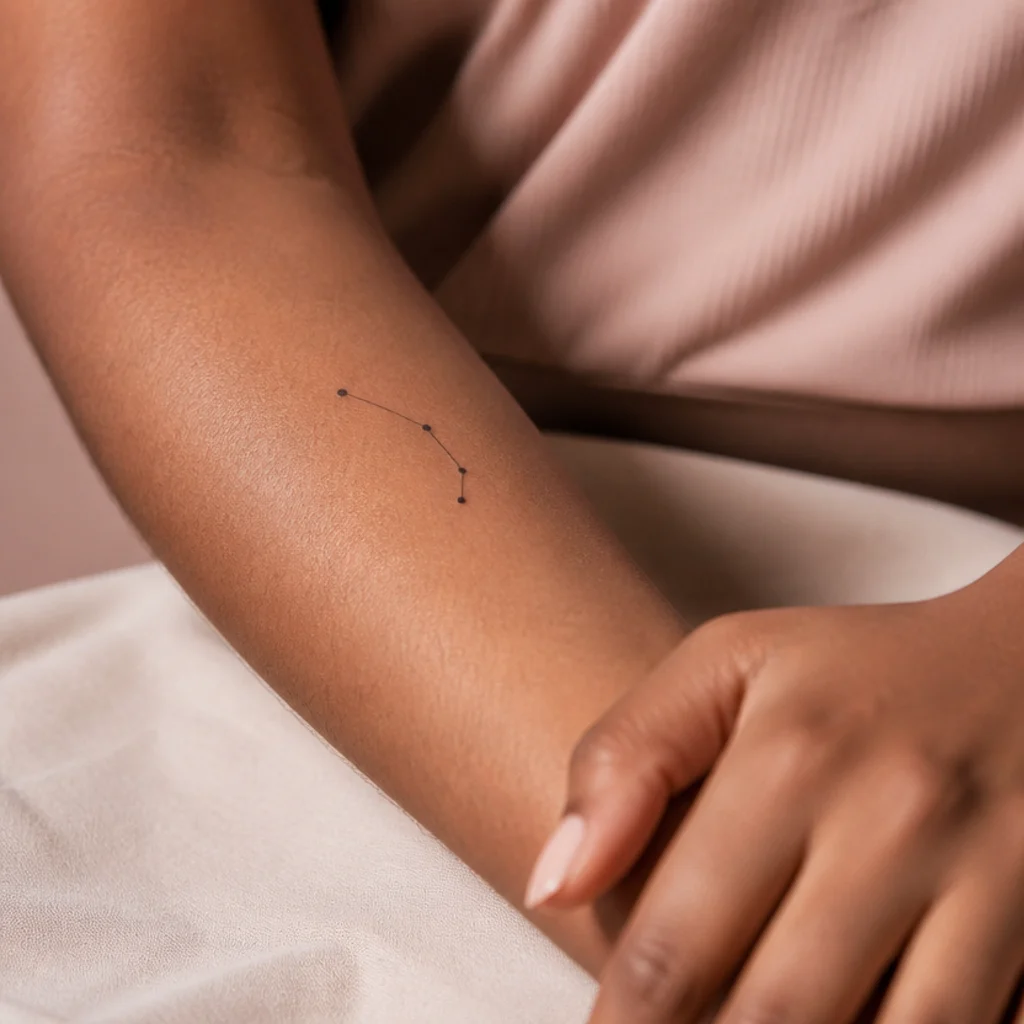
An aries constellation tattoo maps the sign's brightest stars, Hamal, Sheratan, and Mesarthim, into a short connected line that feels astronomical rather than cutesy. Rendered in fine black with tiny four-point or burst stars, it rewards a closer look. The inner forearm, upper arm, or ribcage gives the shape room to stretch along its natural diagonal without crowding, and a lean, longer canvas flatters the composition more than a compact one. Because single-needle star points are minute, they're the first elements to soften as they heal and blur further with sun exposure, so a fine-line specialist with a real healed-work portfolio matters more here than for almost any other design on this list. Scatter a few faint filler dots for surrounding stars so the piece doesn't read as a bare zigzag, and keep the connecting lines one needle-weight lighter than the star points so the stars stay the visual anchor as everything ages. Longer placements flatter this design most, and it suits anyone who wants understated astronomy over graphic impact. Plan on revisiting it around years 4 to 6. Pro tip: ask to see the star spacing stenciled on your actual limb, because the correct Aries proportions look subtly different curved around a forearm than they do flat on paper. Tell your artist you want "the accurate Aries star pattern, correct spacing, connecting lines kept subtle, a few filler dots, star points a touch heavier for longevity."
03Watercolor Ram Silhouette
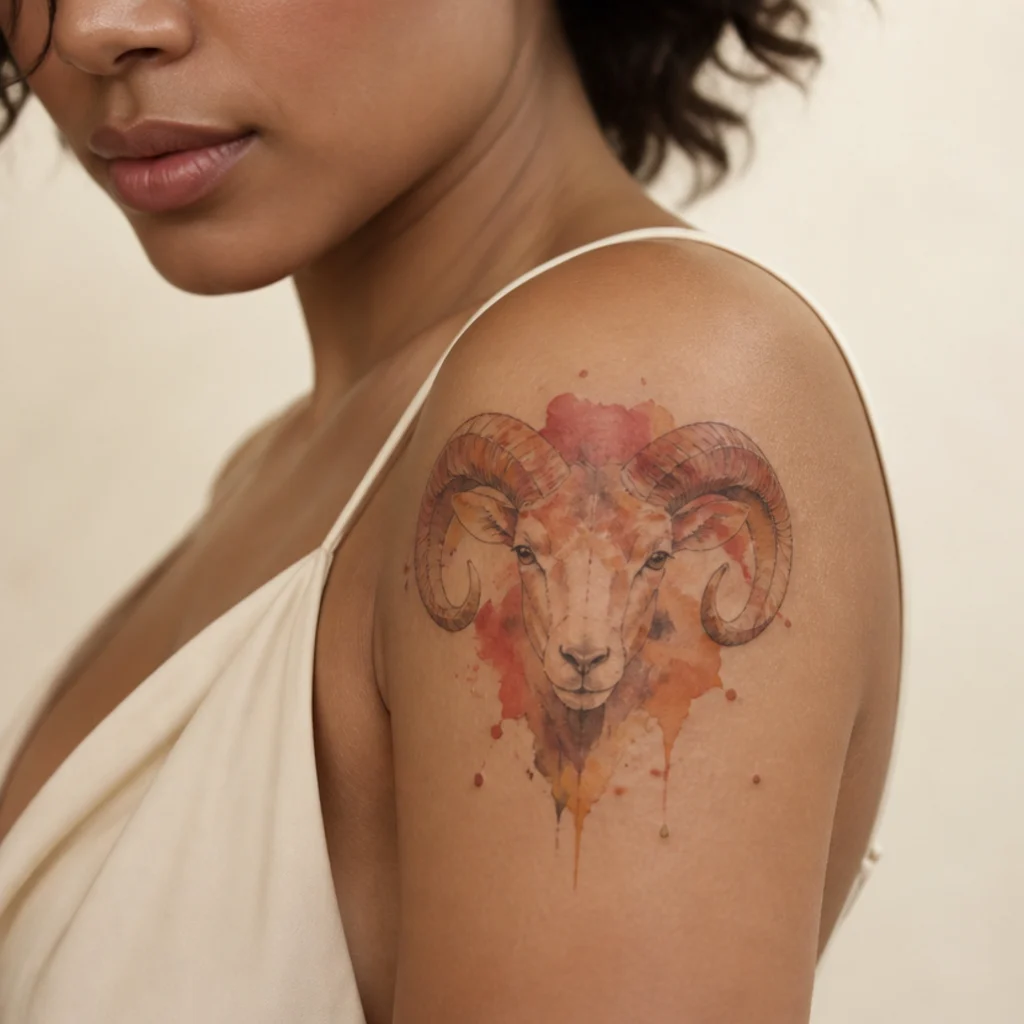
For color lovers, a watercolor ram trades hard outlines for washes of coral, rust, and amber that bleed like pigment on wet paper. The ram's head stays recognizable in silhouette while the color feels loose and expressive, a deliberate counterpoint to the sign's fiery reputation. The rounded shoulder, outer upper arm, or thigh gives the pigment room to breathe and diffuse, and these fleshier, lower-friction planes also hold saturated color longer than a hand or ankle would. The honest trade-off: watercolor is the least permanent look here. Washes without a structural anchor lose saturation soonest, so a light black or gray skeleton underneath, subtle enough not to read as an outline, is what keeps the shape legible past year 3. Warm coral-to-amber palettes hold better than pale pastels, which fade toward invisibility on many skin tones and read faintest on deeper complexions, so lean warm and mid-toned rather than icy. Pro tip: ask to see the artist's healed watercolor work, not just fresh photos, because fresh color always looks vivid and healed color tells the truth. Request "a ram silhouette with watercolor wash, warm coral-to-amber palette, a faint gray anchor underneath, minimal hard outline." This one's for women who want something painterly and don't mind color touch-ups every few years.
04Micro Ram Behind the Ear
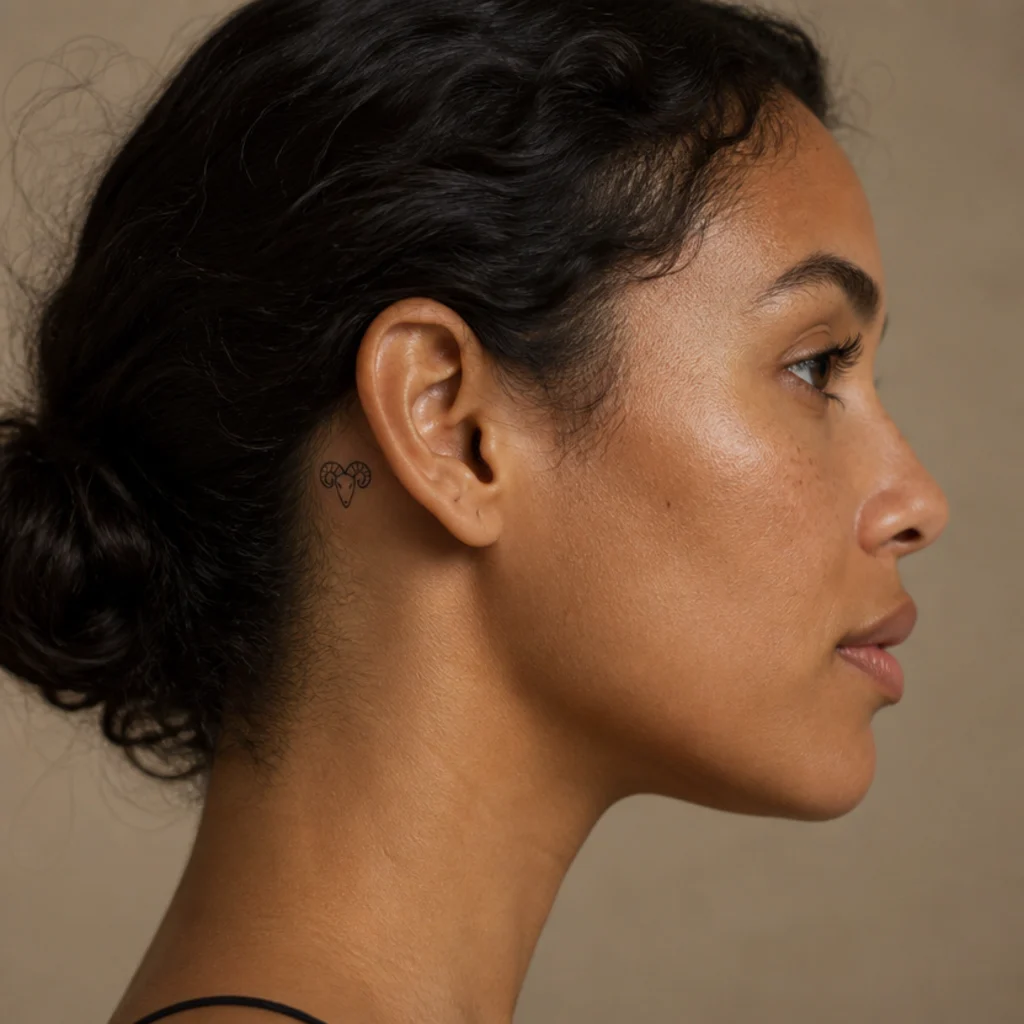
A micro ram behind the ear is discreet by design, visible only when you sweep your hair aside. At this scale the artist strips the ram to its essentials, two horns and a suggestion of the face, nothing that relies on interior detail, so the read has to survive on silhouette alone. It's an ideal hidden aries ram tattoo for strict dress codes or anyone who wants a small secret. Be realistic about the canvas, though. Skin behind the ear is thin, mobile, and close to bone and cartilage, which makes it tender to tattoo and quicker to soften, so extreme micro-detail rarely survives; a clean, slightly bolder simplification lasts far better than a fussy one, and 1.5 to 2 centimeters is a more honest minimum than the postage-stamp size clients often picture. Plan on a refresh sooner than a forearm piece, perhaps years 3 to 5. Pro tip: keep any negative space inside the horns generous, because gaps under about a millimeter tend to fill in solid as the ink settles and spreads, turning a defined ram into a dark blob. Request "a simplified ram head, under two centimeters, clean confident lines, open negative space so it stays legible as it heals."
Save this to Pinterest to build your placement mood board.
05Blackwork Ram Head
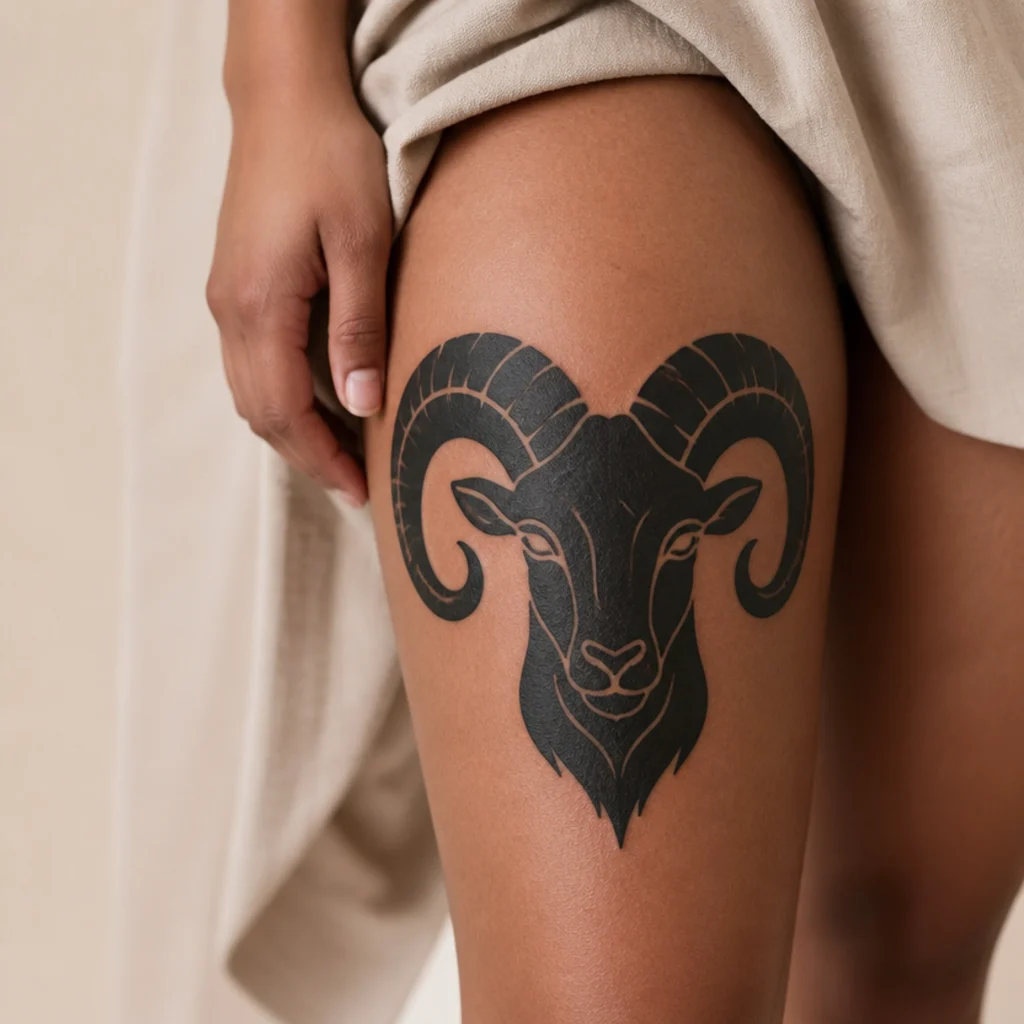
Blackwork leans fully into the ram's strength: heavy solid fill, thick curled horns, and high contrast that reads across a room. This is a statement piece, most at home on the thigh, calf, or outer upper arm where there's enough real estate for the density to breathe rather than crowd. Solid black is the longevity champion of this list; packed evenly in a single confident pass, it stays readable for decades and forgives sun and time better than any fine-line or color style, which makes it the smart pick if permanence is your priority. The trade is chair time and healing, since large saturated areas take longer to lay in and longer to scab and settle, and they demand disciplined aftercare to heal without patchiness. You can keep the face graphic and almost sculptural, or carve negative-space lines within the horns for texture and depth, which also keeps the piece from reading as a flat mass. Pro tip: ask for even saturation in one pass rather than patchy double-work, because unevenly packed black is exactly what forces early touch-ups and shows as gray blotching under the skin. Ask for "a bold blackwork ram, strong horn curl, high contrast, evenly packed fill, a little negative-space texture in the horns."
06Constellation and Birth-Flower Combo
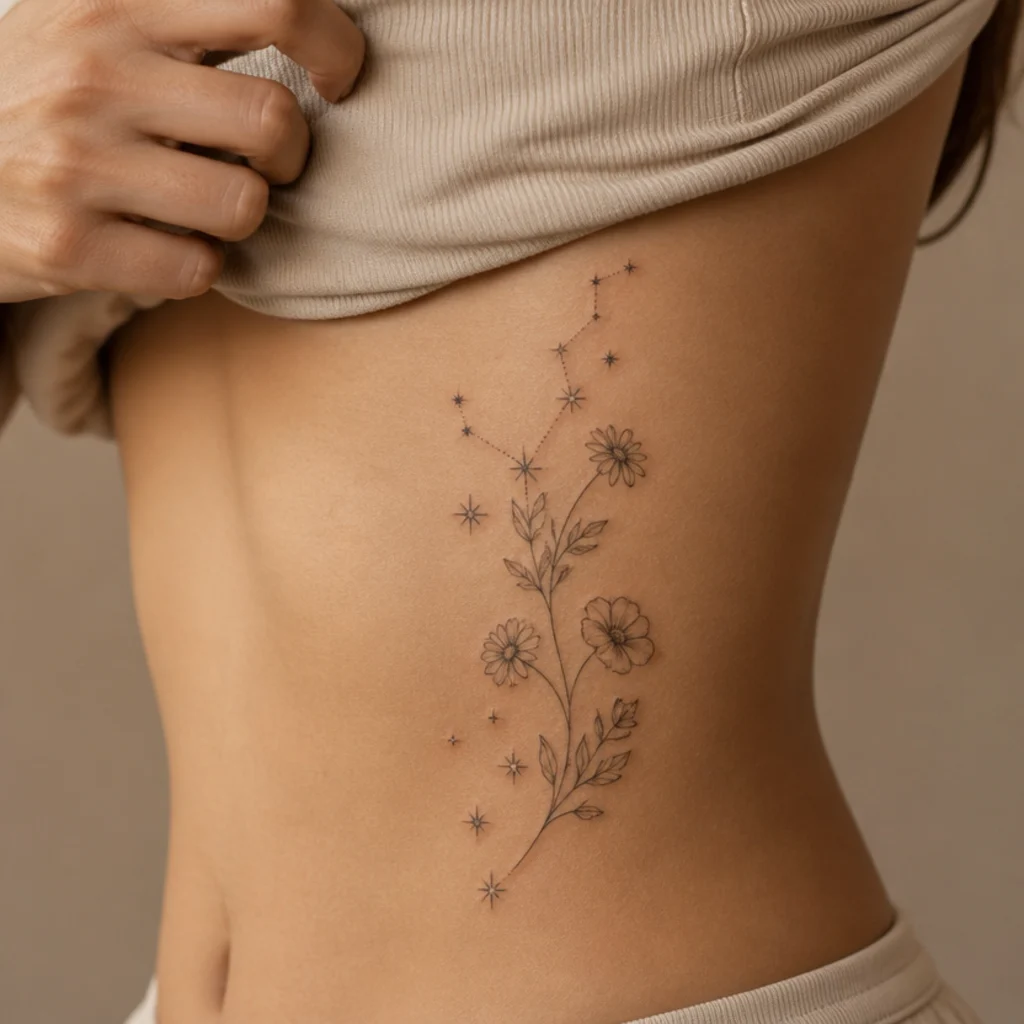
Layering the constellation with April birth flowers, the daisy and sweet pea, personalizes the piece well beyond the zodiac alone. The stars thread through the stems so the two elements read as woven rather than stacked, and the botanicals soften the astronomical geometry into something seasonal and quietly feminine. The ribcage, inner forearm, or upper thigh handles this vertical composition best, and a longer torso placement lets the stems trail without cramping. The technical risk is crowding: many small elements at small scale turn muddy as fine lines spread, so this design almost always needs to be sized up a touch more than clients expect, often to 10 centimeters or more of vertical run. Give your artist a clear reference for scale and a stated priority, stars or flowers, so one element leads and the other supports rather than competing for the eye. Pro tip: ask them to leave slightly more breathing room between petals and star points than looks necessary on paper, since healed ink always closes those gaps over the first year. Say you want "the Aries constellation integrated with April birth flowers, fine line, generous spacing, sized so nothing muddies as it heals." Go this route if you want a layered story and don't mind a longer, more detailed session.
07Geometric Ram in Linework
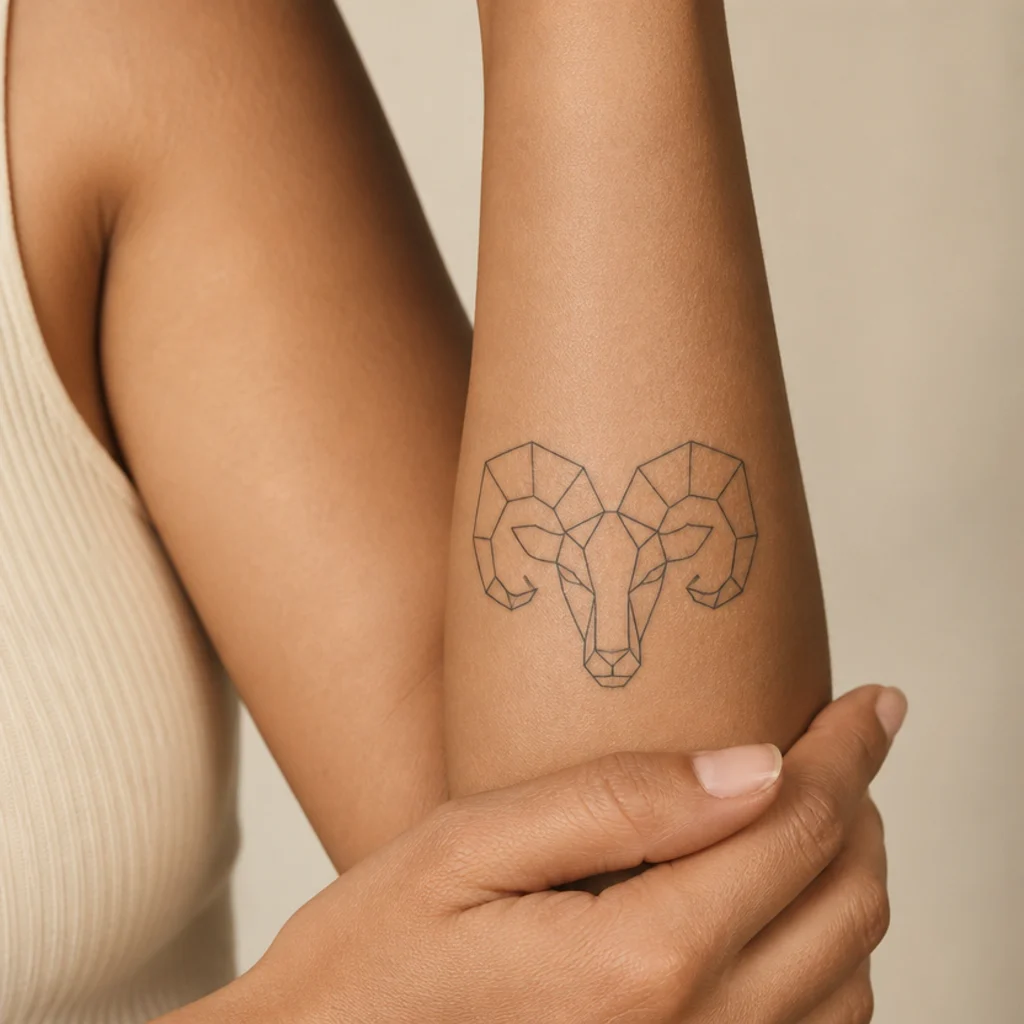
A geometric ram reinterprets the animal through straight lines, mirrored symmetry, and precise angles, giving it a modern, almost architectural feel. The horns become elegant spirals of connected segments and the face resolves into a stylized diamond or hexagon. This style suits flat, stable planes, the outer forearm, shin, or upper back, where crisp lines aren't distorted by constant flexing or a tight curve. Everything here rides on precision: a wobble or an off-angle is far more visible in geometry than in an organic ram, so vet the artist's linework portfolio specifically for clean straights and true symmetry, not just pretty florals. It ages well provided the lines aren't pushed too fine; ultra-thin geometry can drift out of alignment as it spreads, so a medium weight is the longevity-smart choice over hairline. Pro tip: request the design built on a true center axis and ask to see the stencil placed dead straight, checked against the limb's own line, before the first pass, because a geometric piece set even slightly crooked never fully reads right afterward and can't be nudged once it's in. Ask for "a geometric ram head, symmetrical linework, subtle angular horns, medium line weight for longevity." It's the pick for contemporary-minded women after the full ram rather than the glyph alone.
08Delicate Spine Constellation
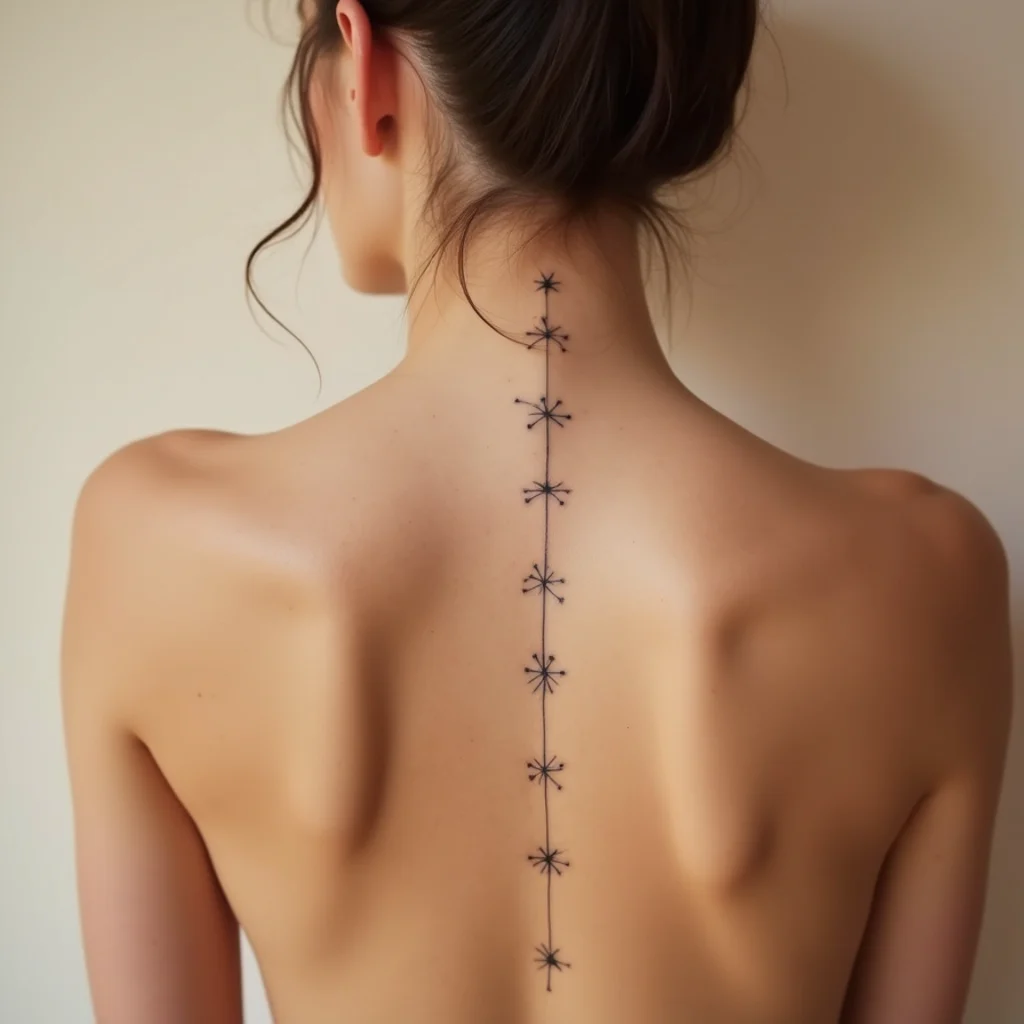
Running the constellation vertically down the spine stretches the star pattern into a graceful, elongated line, each star sitting like a point along the vertebrae with thin connectors between. It's quietly striking under a backless dress and reads elegant rather than flashy, flattering longer torsos especially. Two realities shape this placement. First, alignment is unforgiving; the spine's slight natural curve means the stencil must be checked while you stand, not lie flat, or the line will look crooked once you're upright and moving. Second, skin directly over the spine sits close to bone and can be one of the more sensitive spots on the body, so a shorter, well-planned session helps, and it's worth splitting a longer piece across sittings rather than pushing through discomfort that can make lines waver. It covers easily under almost any top, which suits anyone wanting flexibility. Pro tip: ask your artist to place and photograph the stencil with you standing and breathing normally, since the spine lengthens and the skin shifts between lying down and standing, and that shift is exactly what throws a spine line off true. Tell them you want "the Aries constellation aligned along the spine, evenly spaced stars, delicate connectors, stencil checked upright." This design rewards anyone drawn to a long, linear composition and a back-flattering placement.
09Flame and Ram Fusion
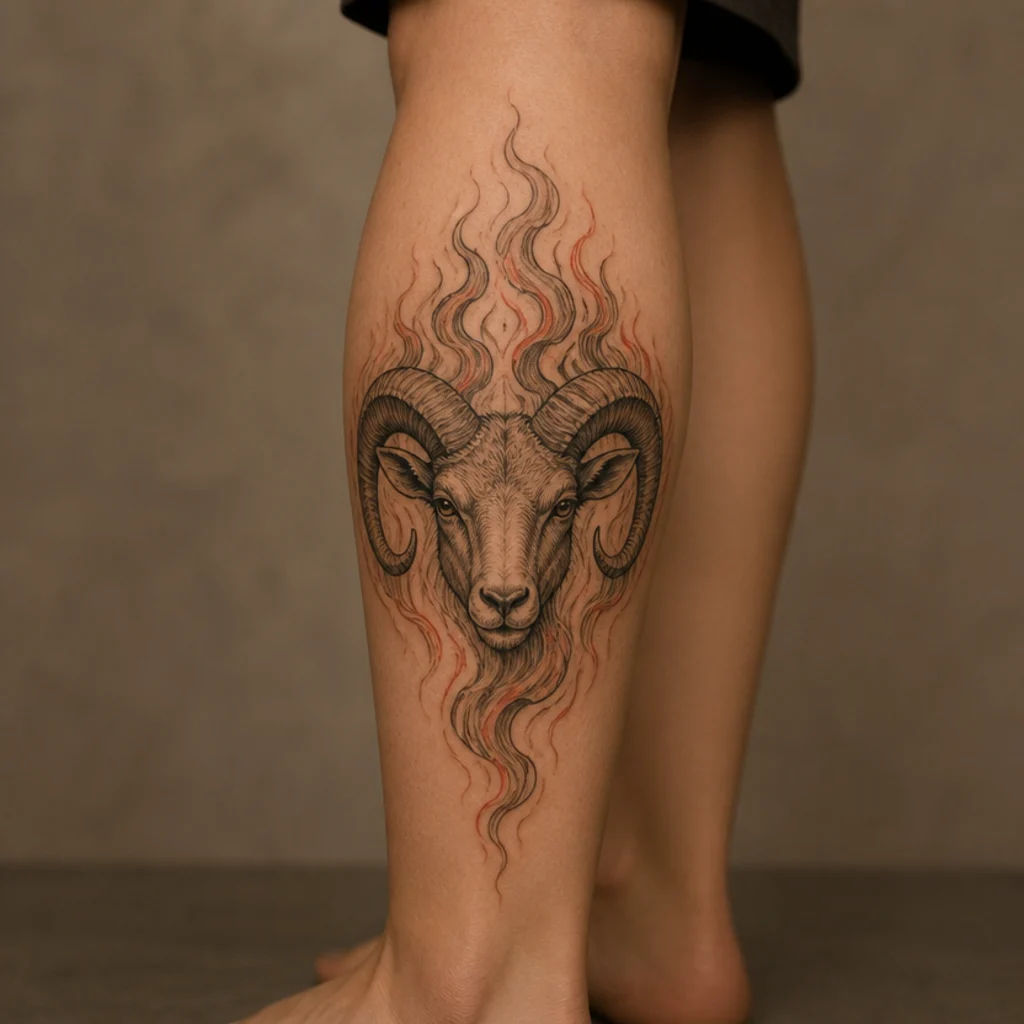
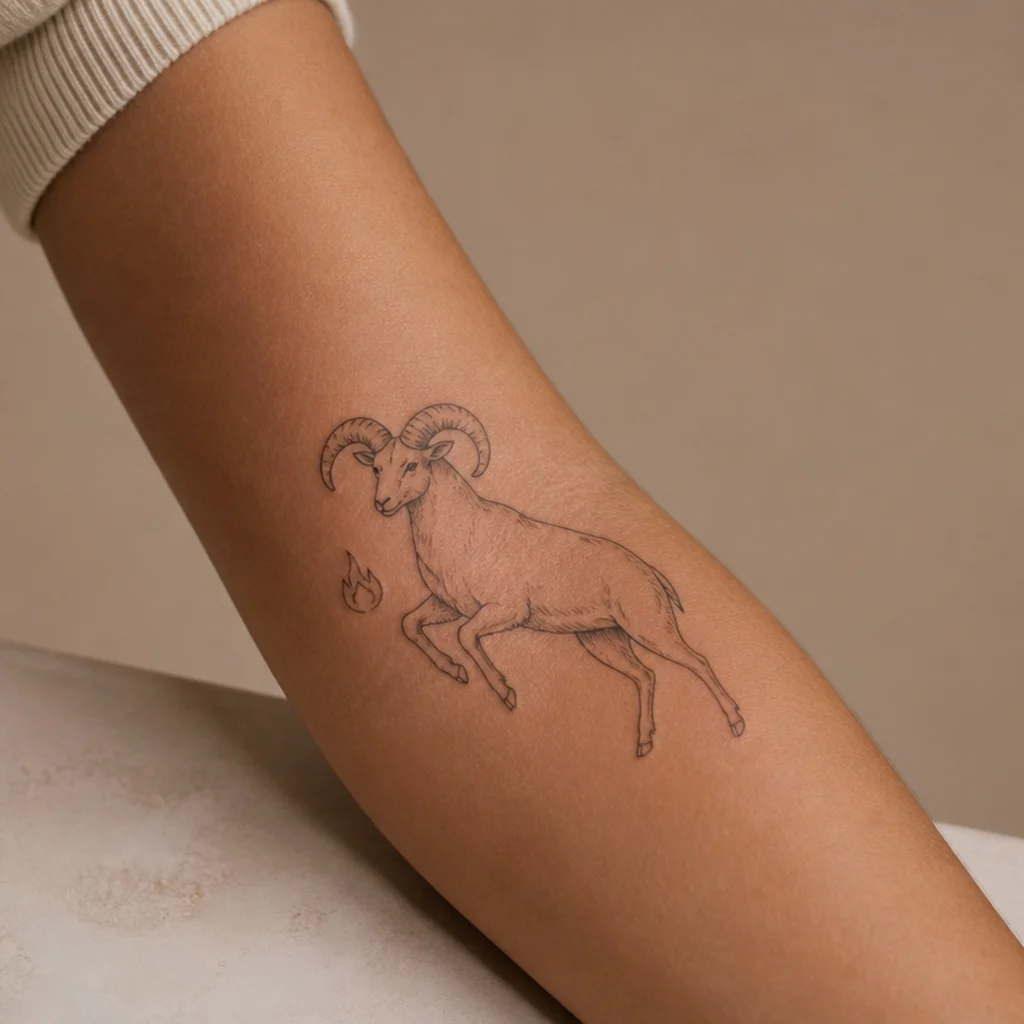
Aries is a fire sign, and morphing the ram's horns into curling flames leans into that symbolism without a single word of text. Worked in black with a controlled touch of warm red or ember-orange, the flames add movement and upward energy while staying just this side of cliche. The calf, outer thigh, or outer upper arm suits the design's vertical, upward flow, and the calf in particular gives the flames room to taper naturally. Keep the color proportion honest with yourself: the mostly-black structure will age reliably, while the red accents are what soften first and may want refreshing around year 4, especially on the lower leg where circulation and friction speed fading. This is a mid-size to larger piece, typically 12 centimeters or more, so plan for a fuller session and diligent aftercare on a busy, easily bumped area. Pro tip: ask the artist to anchor the flames with confident black linework first and treat red as an accent within that structure, not as the load-bearing element, so the piece still reads clearly even after the color mellows a few shades. Ask for "a ram head transitioning into stylized flames, strong black structure, minimal warm-red accents." For women who want their fire-sign identity to be the whole point of the piece, this is it.
10Ram Skull with Florals
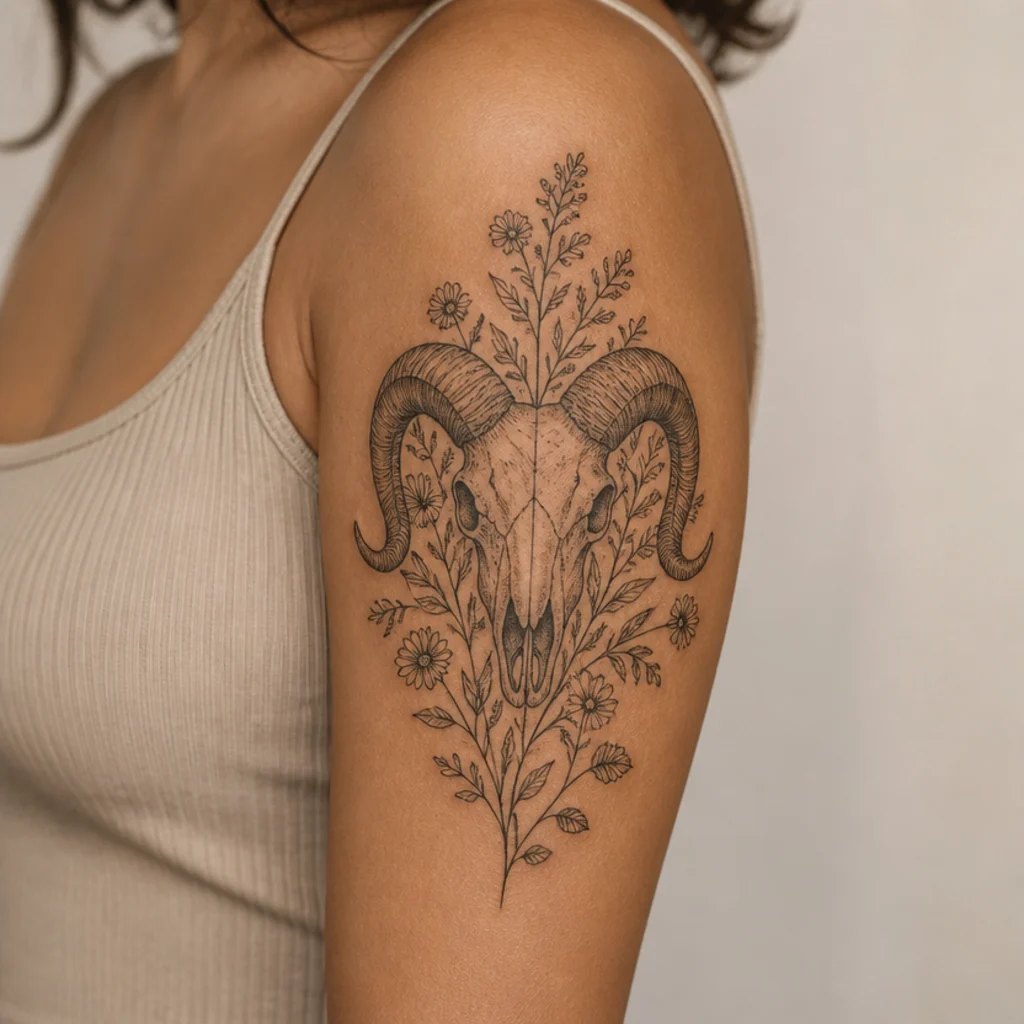
A ram skull paired with florals balances edge and softness, a pairing that has stayed popular because the contrast works. The skull supplies bold structure while fine-line wildflowers and trailing greenery wrap the horns to lighten the mood. The upper arm, thigh, or shoulder blade gives this composition the room it needs, and a rounded muscle plane lets the horns curl without distortion. The thing to plan for is uneven aging: solid skull work and delicate botanical lines age at different rates, so over many years the bold elements stay crisp while the finest stems soften, and the piece can start to look slightly mismatched unless the fine work isn't pushed too thin at the outset. Bring a clear reference so your artist can balance grit and greenery deliberately, and decide upfront whether the skull or the florals should dominate. Pro tip: ask them to keep the floral line weight one step heavier than typical fine-line, so the botanicals age closer in pace to the skull and the two elements stay visually married a decade on. Request "a ram skull with fine-line florals, deliberate contrast between bold and delicate, florals not too thin." Women who like a little grit with their botanicals, and want real artwork weight, tend to gravitate here.
Save this to Pinterest and compare it with the blackwork ram above.
11Ankle Glyph with Tiny Stars
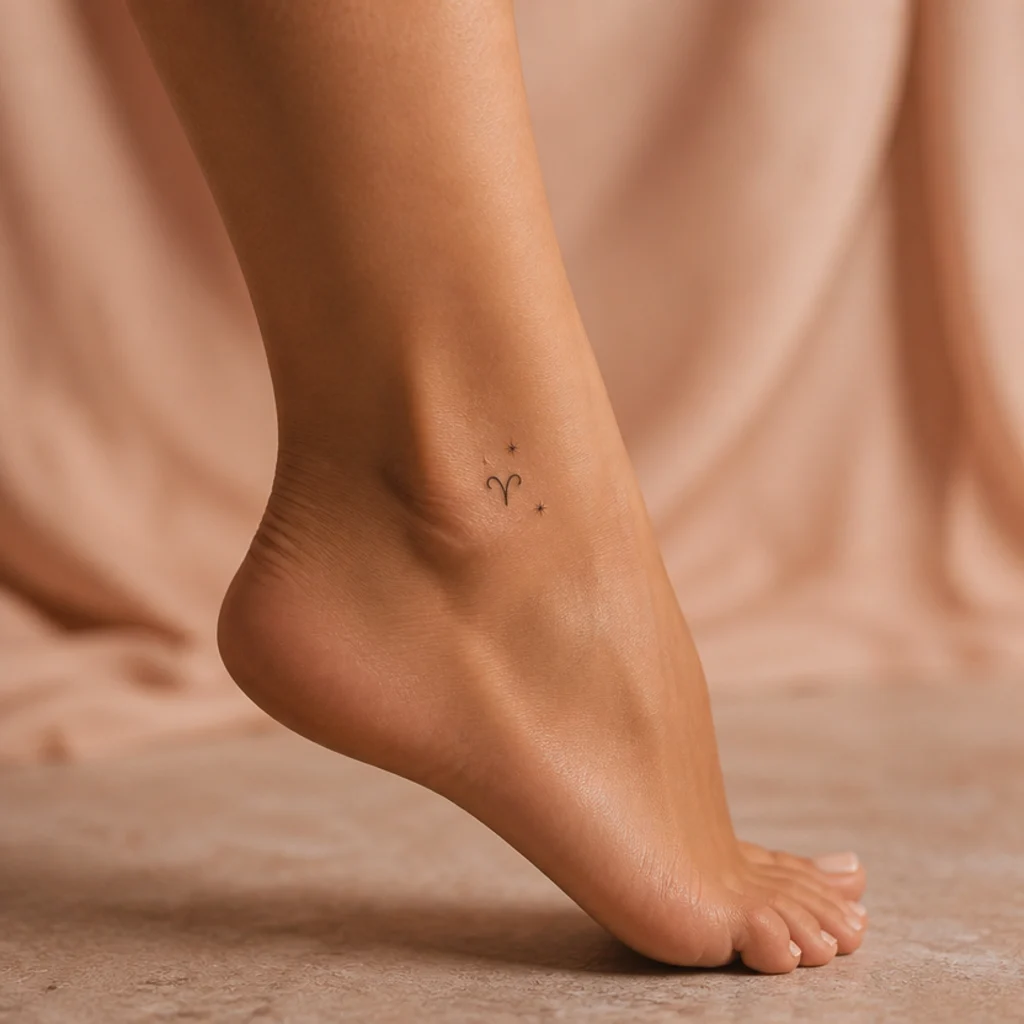
A small glyph on the ankle, accented with two or three scattered stars, is dainty, low-commitment, and easy to style with everything from sandals to boots. The stars nod to the constellation while keeping the footprint tiny. Be clear-eyed about the location, though: the ankle is one of the higher-friction, faster-fading spots on the body, in constant contact with socks, shoes, and hems, and the thin skin over the ankle bone takes ink less evenly than a fleshy forearm. Slightly heavier lines and a placement a touch above the bone rather than directly on the prominence both help it last, and even then a refresh around years 3 to 5 is realistic. It remains a strong first-tattoo option because the session is quick, often under half an hour, and the spot is easy to cover for work. Pro tip: ask the artist to set it just above the ankle bone, where the skin is fractionally thicker and better supported, rather than over the bony prominence itself, where ink scatters and fades fastest. Ask for "the Aries glyph with a few small stars, ankle placement above the bone, lines sturdy enough for a high-friction spot." This one's for anyone who wants something delicate and versatile and will accept a slightly faster fade in exchange.
12Neo-Traditional Ram Portrait
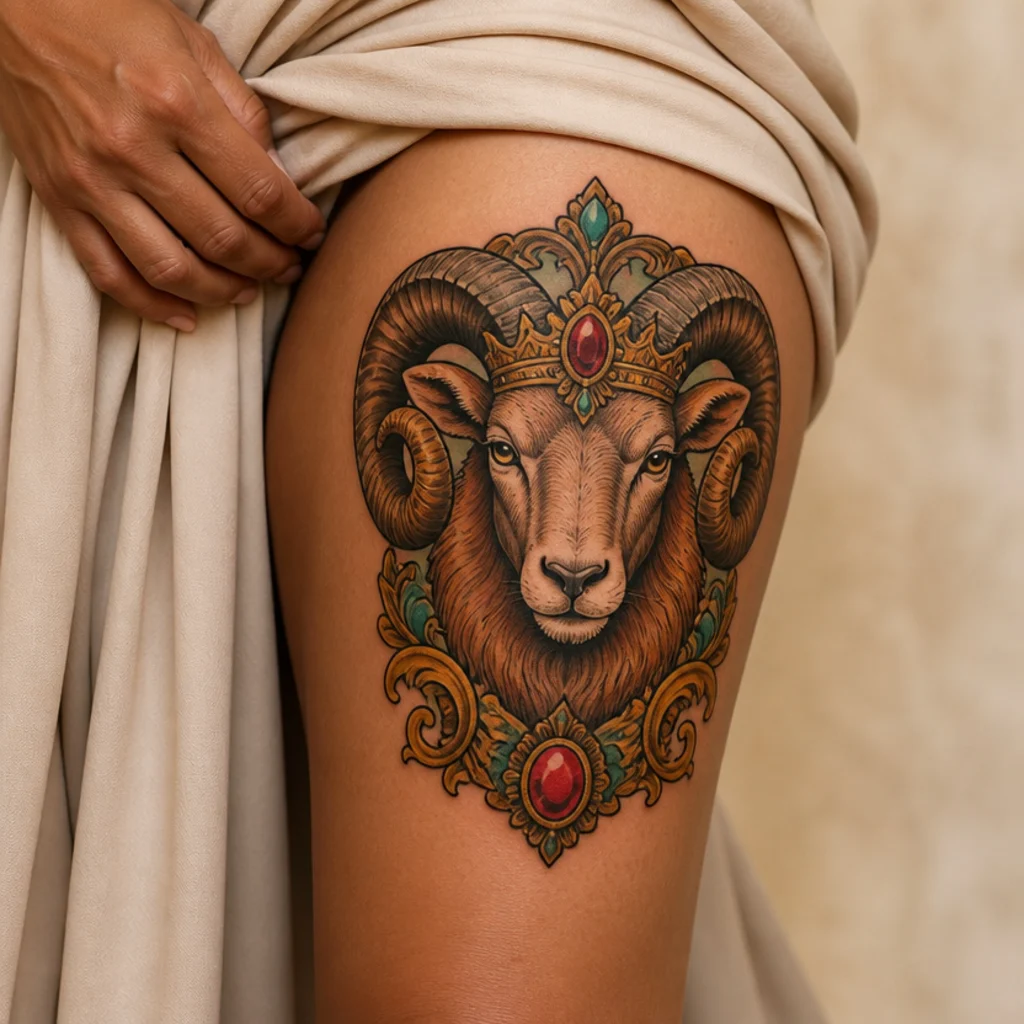
Neo-traditional gives the ram a full portrait treatment: bold confident outlines, saturated color, and decorative flourishes like faceted gems or a small crown set between the horns. It's illustrative and rich, turning the sign into real artwork. The thigh, outer upper arm, or calf offers the canvas this detail deserves; go too small and the decorative elements collapse into noise, so 15 centimeters or larger is the honest floor. Neo-traditional's strong outline is its longevity insurance, since the bold black holds the image together even as the color inside mellows, but expect the saturated tones to want a refresh over the years and budget accordingly for both the initial session and upkeep. This is a larger investment of time and money, and the single most important choice is the artist. Pro tip: shortlist artists by their healed color work specifically, and match undertones to your skin, warmer reds, ambers, and golds tend to stay vivid longer than cool pastels and teals on most tones, and read more reliably on deeper complexions. Ask for "a neo-traditional ram portrait, bold outlines, jewel or crown accents, warm saturated palette sized large enough to hold detail." This one's for women after a centerpiece with personality, who'll commit to a longer, involved session and a maintenance rhythm.
13Dotwork Constellation Circle
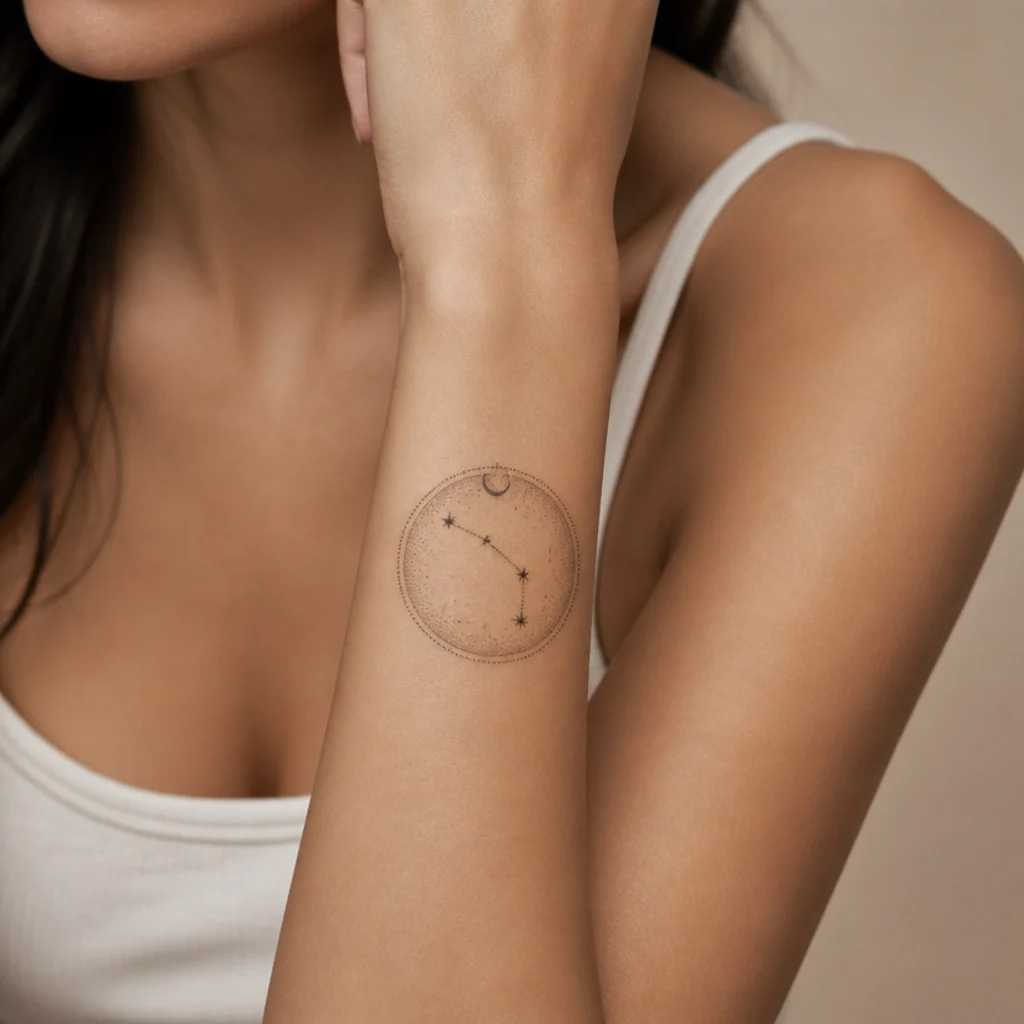
Framing the constellation inside a delicate dotwork circle gives the stars a celestial, almost tarot-card quality. Stippling builds soft graduated shading in the ring and a small moon-phase or sun motif, while the Aries stars sit cleanly at the center. The inner forearm, upper back, or the space just above the elbow suits this contained, medallion-style shape, and a flat, stable plane keeps the circle from distorting into an oval as skin flexes. Dotwork is time-intensive and rewards patience from both of you, since shading is built dot by dot rather than packed in a pass, which is why a rushed dotwork piece is so easy to spot. Its longevity depends almost entirely on density: dots spaced too sparsely read as gray mist and can fade to near-nothing within a few years, while properly dense stippling ages gently and holds its gradient for a long time. Pro tip: ask specifically for even dot density in the shaded ring, because inconsistent stippling is the tell of rushed work and the first thing to look patchy as it heals and lightens. Request "the Aries constellation inside a dotwork circle, dense even stippling, subtle graduated shading, a small celestial accent, a true circle checked on a flat plane." This design rewards anyone who loves symmetry, framing, and a piece that wears like a small emblem.
14Script and Glyph Collarbone Piece
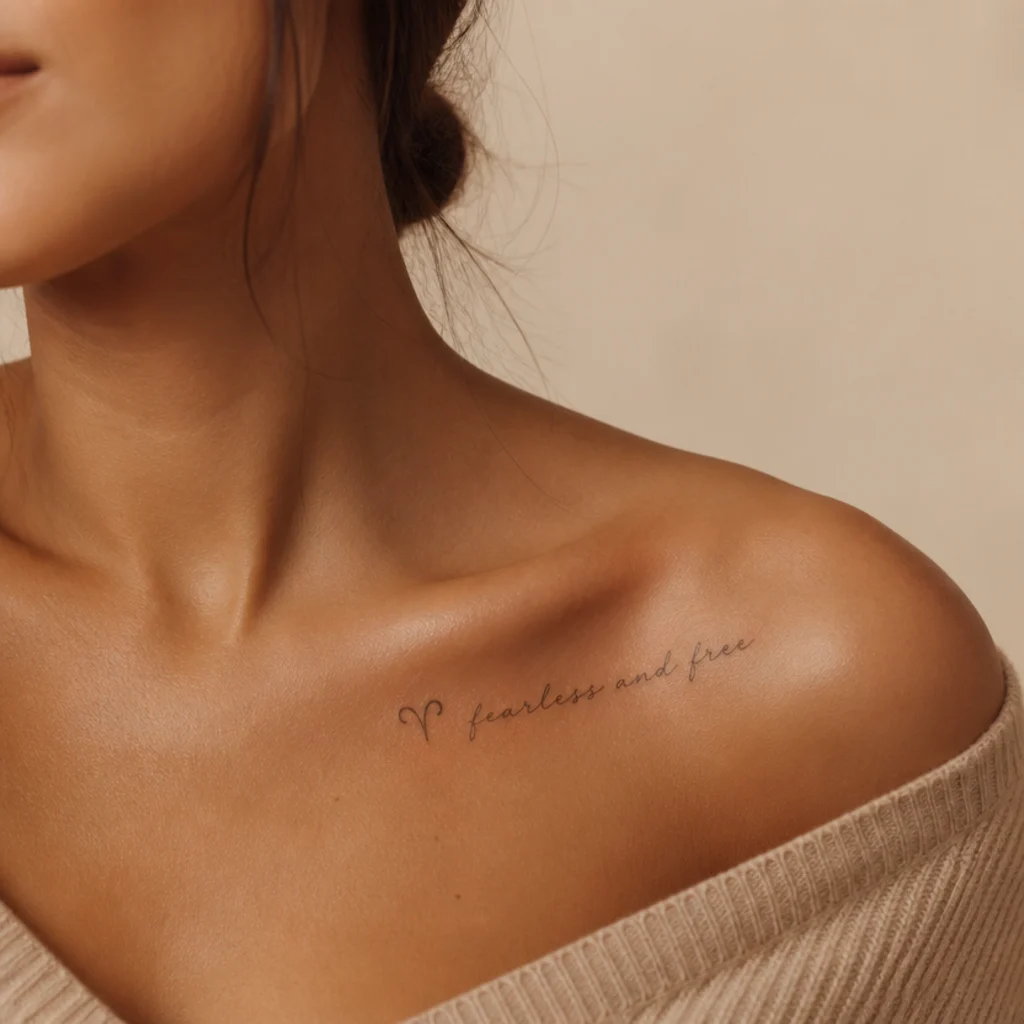
Pairing the glyph with a short word or date in fine cursive, "Aries," a birth month, or a personal mantra, makes the tattoo feel signed and specific. Along the collarbone the horizontal line of script follows the bone naturally and stays elegant under most necklines, flattering a longer clavicle line especially. The craft note that matters most is font choice: keep the lettering simple, because ornate scripts with hairline flourishes and tight interior loops are notorious for blurring shut as they settle, turning legible words into a smudge within a couple of years. Cap the word count too, since a long phrase forces the letters smaller and hastens that blur. The collarbone also sits close to bone and can be a more sensitive placement, so a shorter, well-planned session is kinder and steadier. It hides easily under most tops. Pro tip: ask the artist to size the lettering so the smallest gaps inside letters like a, e, and o stay visibly open at healed scale, not just fresh, because those are the first counters to close as ink spreads. Ask for "the Aries glyph with short fine-line script, collarbone placement, a clean simple font with open letter spacing, kept to a couple of words." Good for women who want words and symbol together without going large or busy.
15Curved Horn Wrap Around the Wrist
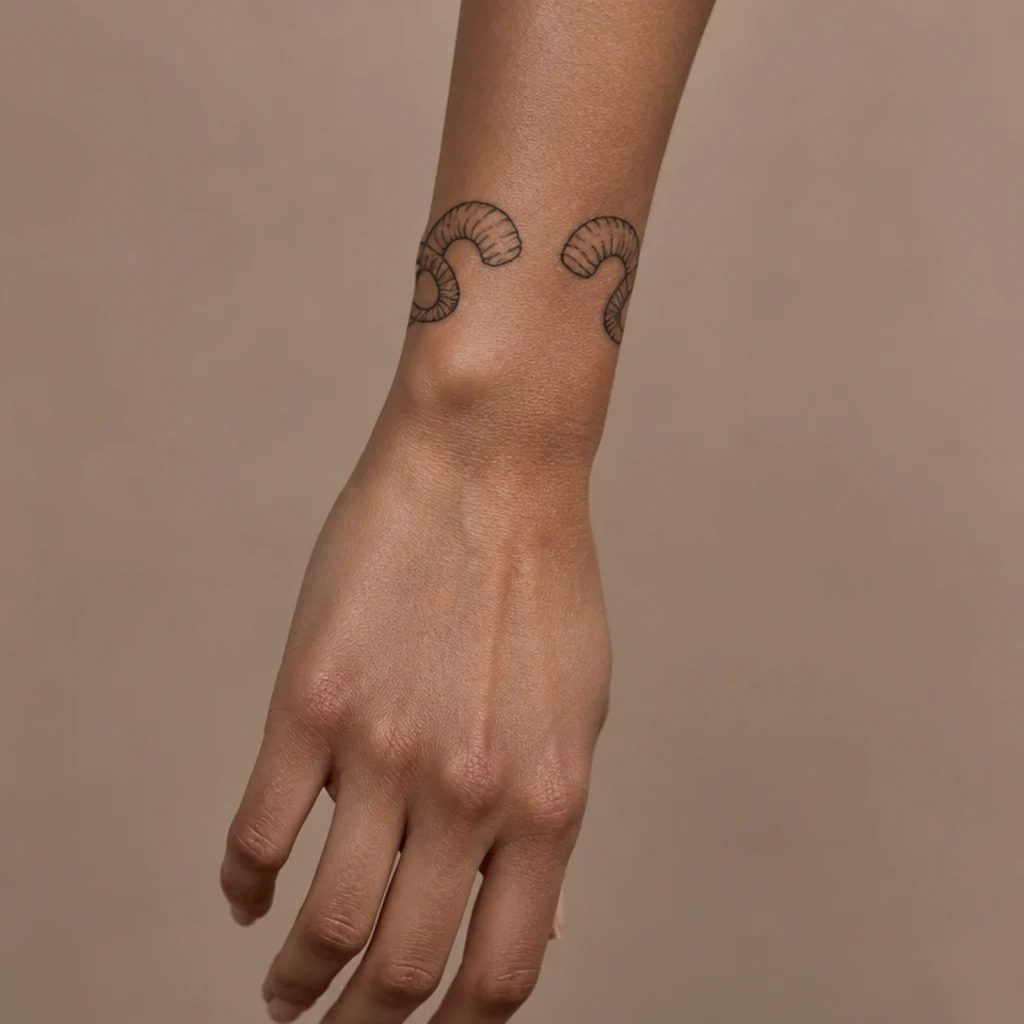
A pair of ram horns curving around the wrist reads like a subtle bracelet, elegant and a little unexpected. Rather than a full ram, the artist stylizes just the horns so they wrap the wrist with clean negative space between the tips, a fresh, feminine take on the aries ram tattoo. The wrist is a demanding canvas, though: it flexes constantly and the inner side especially sees friction from sleeves and watch straps, so slightly bolder lines age noticeably better than hairline ones here, and a refresh around years 4 to 6 is realistic. Placement around the wrist also needs mapping while your hand moves, since a horn that looks balanced with the wrist flat can pinch or gap when you flex or rotate. This is a quick, striking piece that draws the eye without being large. Pro tip: ask the artist to plan the tips and negative-space gap on the top of the wrist, away from the high-wear inner side and out from under a watch or bracelet, so the design's focal point sits where ink lasts longest. Request "stylized ram horns wrapping the wrist, bracelet-style, negative space at the front, slightly bolder lines for a flexing spot." This one's for women who want movement and a clever silhouette rather than a literal animal.
Save this to Pinterest so your artist can see exactly which wrap style you mean.
Pro Tips from the Editor
- Match line weight to the spot, not the trend. Fingers, wrists, ankles, feet, and the inner forearm flex and rub constantly; ask for a needle-weight heavier there and reserve true single-needle work for stable, protected planes like the outer forearm, ribcage, and upper arm.
- Judge artists on healed work, never fresh. Fresh photos flatter everyone; a portfolio of pieces shot months to years after healing tells you how their linework, color, and dotwork actually settle. This matters most for fine-line, watercolor, and stippling, and it is a fair, specific thing to ask to see.
- Match the artist's specialty to the style. A brilliant fine-line hand isn't automatically the right choice for packed blackwork or saturated neo-traditional color; hire for the exact technique your design needs, and look for depth in that lane rather than range.
- Size up small detailed designs. Constellations, floral combos, and script almost always need to be a touch larger than clients want, because healed ink spreads and closes the tiny gaps and counters that keep detail legible.
- Protect the investment from the sun. UV is the single biggest driver of fading, especially for color and fine gray work. Consistent SPF 30-plus on a fully healed tattoo does more for longevity than any touch-up schedule.
- Get the stencil right before the needle. Ask to see it placed and photographed in a natural position, standing for spine and collarbone, flexing for wrist, so alignment is confirmed on a living, moving body rather than a flat one.
- Prioritize one element in layered pieces. In a ram-skull-and-florals or constellation-and-flower design, tell your artist which element should lead so the composition has a clear focal point instead of competing detail.
- Build in the touch-up conversation up front. Ask, at consultation, roughly when this specific style and placement will want a refresh, so upkeep is a planned line item rather than a surprise.
Choosing by Style: A Quick Spec Table
| Design direction | Longevity | Best placements | Relative session length | Refresh outlook |
|---|---|---|---|---|
| Minimalist / micro glyph | High if line weight suits the spot | Wrist, behind ear, finger, sternum | Short | Light refresh ~yr 5 for very fine versions |
| Fine-line constellation | Moderate | Inner forearm, upper arm, ribcage | Short to medium | ~yrs 4 to 6 |
| Watercolor | Lower without a gray anchor | Shoulder, outer arm, thigh | Medium | Color every few years |
| Blackwork | Highest on this list | Thigh, calf, outer upper arm | Longer | Rarely, if packed evenly |
| Neo-traditional color | High outline, mellowing color | Thigh, upper arm, calf | Longest | Color refresh over the years |
| Dotwork | Good if dense | Forearm, upper back, above elbow | Long | Gentle, density-dependent |
How to Choose / Get the Look
Start with the feeling you want, because it narrows the field fast. A quiet personal marker points you toward a glyph, micro ram, or ankle piece; a statement points you toward blackwork, neo-traditional, or a flame fusion; an astronomy lean points toward a constellation, spine line, or dotwork circle. Next, be honest about placement and lifestyle. High-friction, high-flex, and close-to-bone spots, fingers, wrists, ankles, feet, spine, and collarbone, wear ink faster and hurt a little more, so choose bolder lines there and save the finest single-needle work for the forearm, ribcage, or upper arm. Factor in skin undertone as well: warm, mid-toned palettes and confident solid black read most reliably across the widest range of complexions, while pale pastels and hairline gray can disappear on deeper skin, so ask your artist how a given palette tends to heal on tones like yours. Then weigh your fade tolerance: solid black and strong outlines are the low-maintenance options, while color and delicate fine-line ask for touch-ups sooner, so pick a style whose upkeep you'll actually keep up with. Bring two or three saved references to the consultation so your artist reads your intended style, scale, and mood at a glance, and stay open to their sizing advice, since tiny detailed pieces usually need to grow a little to stay legible over time. Design, sizing, placement, coverage feasibility, and healing must always be confirmed with a licensed tattoo artist who can assess your specific skin, body contour, and existing ink in person; no online guide can promise a given design will heal a certain way, and no tattoo can be guaranteed to fully hide an existing tattoo or scar. Finally, budget for session length, since detailed color and dotwork take longer and cost more than a quick glyph.
Frequently Asked Questions
What does an Aries tattoo usually symbolize?
Most Aries tattoos reference the ram from the sign's mythology, tied to the golden fleece, or the V-shaped glyph representing its horns. People generally choose them to mark being an Aries sun, moon, or rising, and to nod to traits associated with the sign, drive, boldness, independence, and a certain go-first energy. The constellation versions add an astronomy layer, tracing the real star pattern of Hamal, Sheratan, and Mesarthim rather than the symbol, which appeals to people who want something less overtly zodiac and more celestial.
What is the smallest Aries tattoo that still looks good?
The glyph and a stripped-down micro ram can work at roughly 1.5 to 2 centimeters. Below that, keep lines a little heavier and interior gaps open, since extremely tiny fine-line tattoos blur as they heal and soften further over the years. If you love the idea of something minuscule in a high-friction spot like a finger, expect to accept a faster fade or a sooner touch-up. The glyph survives small far better than a ram image, because it has almost no interior detail to lose.
Do fine-line Aries constellation tattoos fade quickly?
Fine-line and single-needle work generally softens sooner than bold linework, especially in high-friction or sun-exposed areas. Many people schedule a touch-up somewhere between years three and seven. Choosing a protected placement, an experienced fine-line artist with healed-work photos, star points kept a touch heavier than the connecting lines, and consistent sunscreen once it's healed all meaningfully extend how long it reads crisply.
Where should I place an Aries tattoo if I need to hide it for work?
Behind the ear, the ribcage, the inner upper arm, the spine, the sternum, and the upper thigh are all easy to cover under everyday clothing. A micro ram or small glyph in these spots stays discreet while remaining meaningful. If you frequently wear short sleeves, the ribcage and upper thigh give you the most reliable coverage, and the spine hides under nearly everything except a backless dress you choose to wear.
How do I ask my artist for exactly the design I want?
Bring saved reference images and describe the style, size in centimeters, line weight, finish, and placement in plain terms, for example "a fine-line ram glyph, about two centimeters, inner wrist, single weight, no shading." Naming line weight and exact size is what prevents surprises, since it tells the artist how the piece needs to be built to heal well and stay legible. It's also fair to ask which of your references sits closest to their strengths.
Which Aries tattoo styles age the best over time?
Solid blackwork and designs with strong bold outlines, like neo-traditional portraits, age most reliably, because dense even black and confident linework hold their shape as skin changes. Dense, evenly spaced dotwork ages gently too. Watercolor, pale pastels, and hairline single-needle work are the first to soften. If long-term crispness with minimal upkeep is your priority, favor bolder, higher-contrast styles and a stable, low-friction placement.
Does the ram glyph or the ram image read better in small sizes?
The glyph wins at small scale almost every time, because it's built from just two curves and a stem, so there's little fine detail to lose as ink spreads. A ram image at tiny size has to shed its interior detail to survive, which can leave it looking like a generic shape or a dark blob. If you want something under two centimeters, the glyph is the safer, more legible choice, and a simplified horns-only motif is the next best option.
Which Aries placement hurts the least?
Comfort is individual, but fleshier, muscle-backed areas like the outer thigh, upper arm, and outer forearm are generally more tolerable than spots close to bone. The spine, collarbone, ribs, ankle, and behind the ear tend to be more sensitive because the skin is thin and near bone or cartilage. If you're nervous, start with a forearm or thigh piece and keep the first session short; there's no prize for pushing through discomfort that can make lines waver.
How much do Aries tattoos typically cost?
Cost varies widely by size, style, region, and artist demand, so treat any figure as a range rather than a quote. Small glyphs often land around a shop minimum, while blackwork, neo-traditional color, and detailed dotwork climb well above it because of the chair time involved. Your artist can give an accurate estimate once they see your reference, chosen size, and placement, and many quote larger pieces by session or by the hour.
Can an Aries tattoo cover an old tattoo or a scar?
Sometimes, but never assume it. Whether a design can conceal existing ink or scarring depends on the old piece's color and saturation, the scar's texture and age, your skin, and the new design's density. A denser style like blackwork has more coverage potential than fine-line, but only an in-person consult with a licensed tattoo artist can assess feasibility, and no cover-up can be guaranteed to fully hide what's underneath. A specialist may also suggest laser fading first or a design reworked specifically around the old mark.