20 Olive Green French Tip Nail Ideas
Olive green sits right between neutral and statement, and that's exactly why it reinvents the french tip better than almost any other color. Below are 20 distinct ways to wear it, from barely-there muted sage to deep, army-inspired lines and color-shifting chrome, each one with the exact undertone, shape, finish, and upkeep detail you need to choose with confidence and ask for it at the chair.
 Edited by Lena Rose · Published July 11, 2026 · 37 min read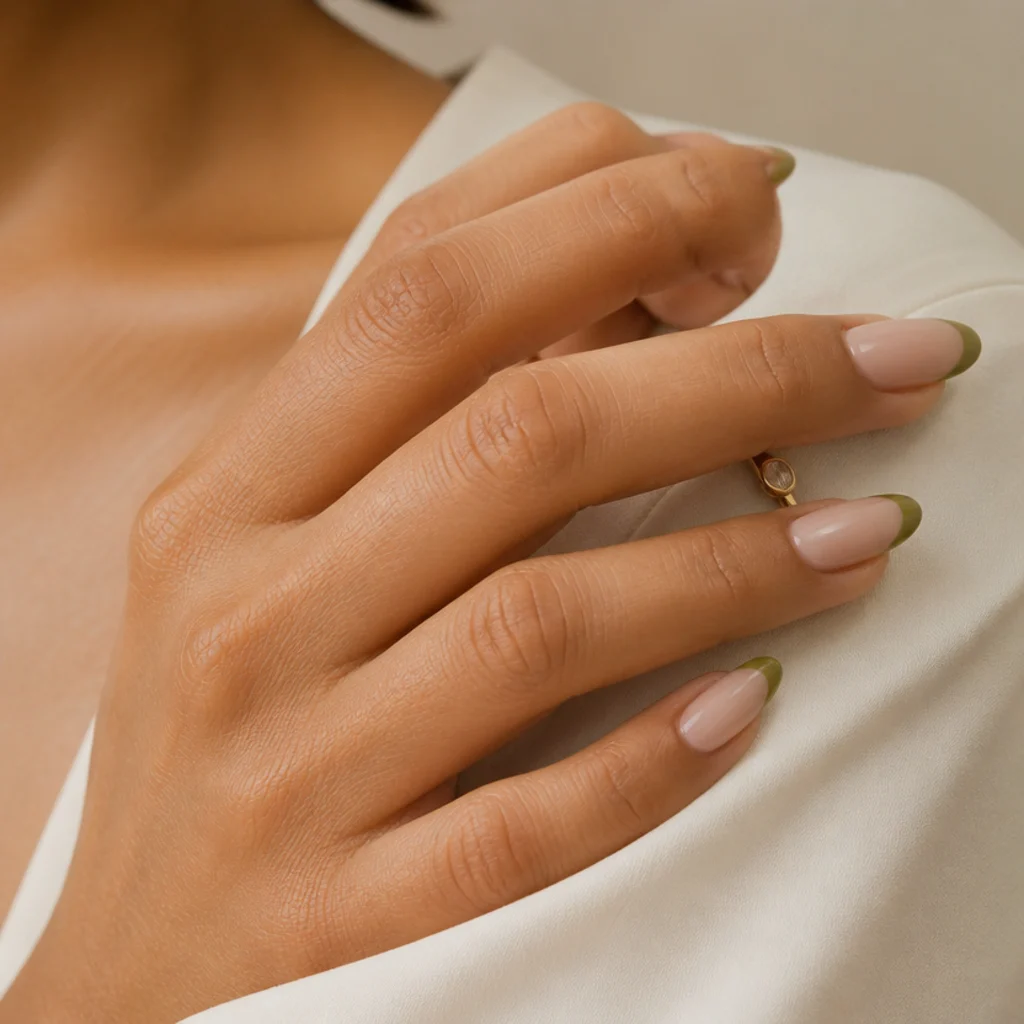
Quick Answer
- Best for: Anyone who loves a classic french but wants something warmer than white or pink. Olive flatters warm, olive, deep, and tanned skin especially well, and the muted grey-sage versions work on cool and fair tones too.
- Who might skip it: Anyone set on a true high-contrast, bright-white french, or who wants a flat cream with zero green cast. Olive always keeps a whisper of botanical undertone.
- Maintenance: Roughly 2 to 3 weeks in gel before cuticle regrowth shows; muted olive hides tip wear far better than bright shades. Chrome, matte, and glitter finishes may want a top-coat refresh before the fill.
- Difficulty: Beginner-friendly as a clean painted tip; intermediate once you add chrome powder, gold striping, double lines, deep V points, or freehand diagonals.
- Cost: Varies by region and salon. A simple gel french sits at the lower end; chrome, gold leaf, glitter gradients, and freehand detail add chair time and price. Ask for a quote when you book.
- Wear time / longevity: 2 to 3 weeks in gel with fills; regular polish looks its best for about 5 to 7 days before the tip dulls.
- Standout variation: Olive green chrome tips, which shift from mossy green to soft liquid gold as the light and hand move.
- How to ask your nail tech: Bring one saved photo, name the exact olive (dusty sage, army, or jelly), state the tip depth in millimetres or as thin/classic/wide, and call out every accent such as a gold micro-line, chrome, or cuticle bead.
In This Guide
- Classic Muted Olive French Tip
- Olive Green Chrome Tips
- Olive Green and Gold Micro-French
- Dark Olive Green Deep V Tips
- Sage-to-Olive Ombre Tips
- Olive French on Short Squoval Nails
- Skinny Olive Line French
- Olive and Cream Double French
- Matte Olive Green Tips
- Olive Green Coffin Tips with Gold Fleck
- Reverse Olive French (Half-Moon)
- Olive Green Glitter-Gradient Tips
- Almond Olive French with Gold Cuticle Bead
- Wide Olive French for Bold Statement
- Olive and White Layered French
- Olive Green Chrome and Nude Mix-and-Match
- Dark Olive Almond French for Fall
- Olive French with Tiny Gold Stars
- Olive Green Angled Diagonal Tips
- Olive Green Jelly French Tips
Intro
The white french tip earned its reputation by being quietly polished, but on a lot of hands it now reads as expected rather than considered. Swap the tip for olive green and you keep that same structure while adding warmth and depth, and you get a color that behaves like a neutral in most rooms yet still rewards a closer look. That range is the whole appeal. Olive isn't one hue, it's a family: a cool grey-sage on one side, a warm gold-brown army tone on the other, with dusty, moss, and khaki in between. Because it carries both temperatures, it sits well against a huge span of skin tones instead of fighting them, and it moves between office-neutral and evening-statement with just a shift in depth.
In practice, an olive green french tip nail works on nearly every length and shape. It layers well with gold, cream, chrome, or glitter, and it scales from a whisper-thin line to a deep army band. It also photographs well, which is why olive green chrome nails and olive green and gold nails keep resurfacing on Pinterest boards heading into autumn, then hold through spring in their lighter sage forms. This guide walks through 20 differentiated takes, from the softest muted-sage line to dark, moody dark olive green nails built for knits and boots. For each one you'll get who it flatters, the shape and length it favors, the finish mechanics, the upkeep to expect, and the exact words to bring to your nail tech. Save the ones that speak to you and mix a few.
01Classic Muted Olive French Tip
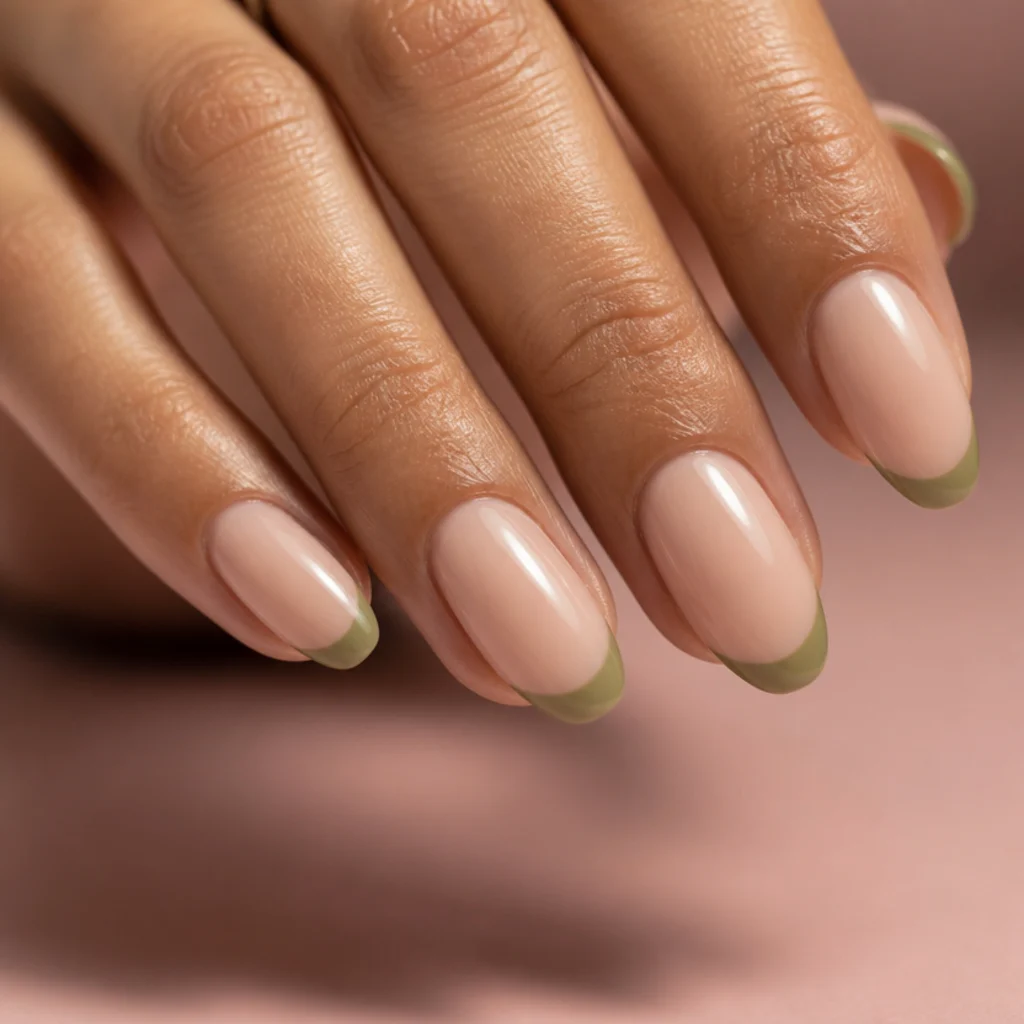
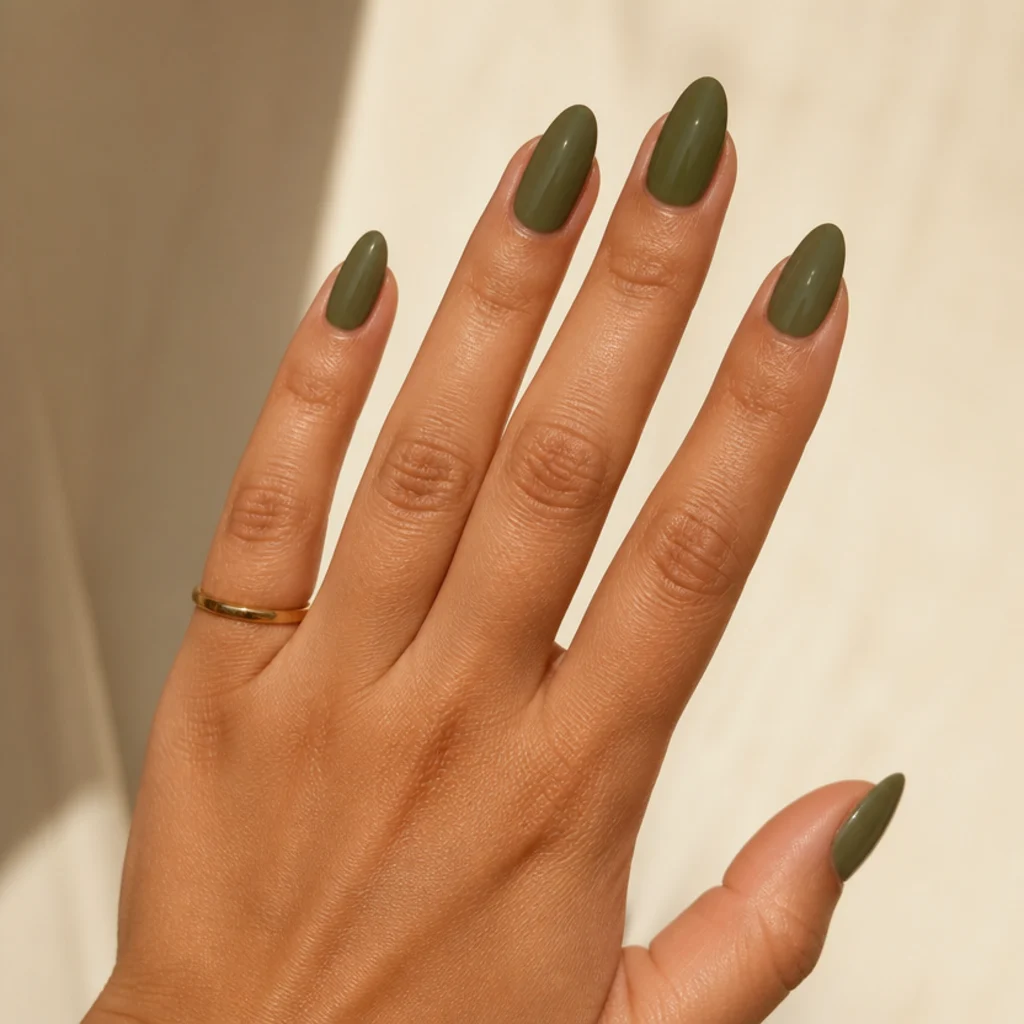
Start here for proof that olive belongs in the french-tip family. A soft, dusty olive with a grey-green undertone replaces the usual white, painted as a clean smile line roughly two to three millimetres deep over a sheer nude or milk-bath base. Because the tone never veers neon, it reads office-appropriate and sits well against fair, medium, and deep skin alike, and warmer undertones make it glow faintly gold. Almond and oval shapes flatter it most, visually lengthening shorter beds, though it works on any shape including squoval. The base coat matters more than people expect: a sheer nude one shade deeper than your skin keeps the tip looking painted-on rather than pasted-over. In gel, expect two to three weeks before regrowth shows at the cuticle, and the low base-to-tip contrast forgives minor edge wear between fills, which makes this one of the lowest-maintenance looks in the lineup. Style it with warm neutrals, denim, and gold jewelry. Pro tip: ask for a matte-then-gloss swatch-stick test first, since dusty olive can pull warmer under salon LED lamps than it looks in the pot. Ask your nail tech for a "soft dusty olive french, thin clean smile line, over a sheer nude base."
02Olive Green Chrome Tips
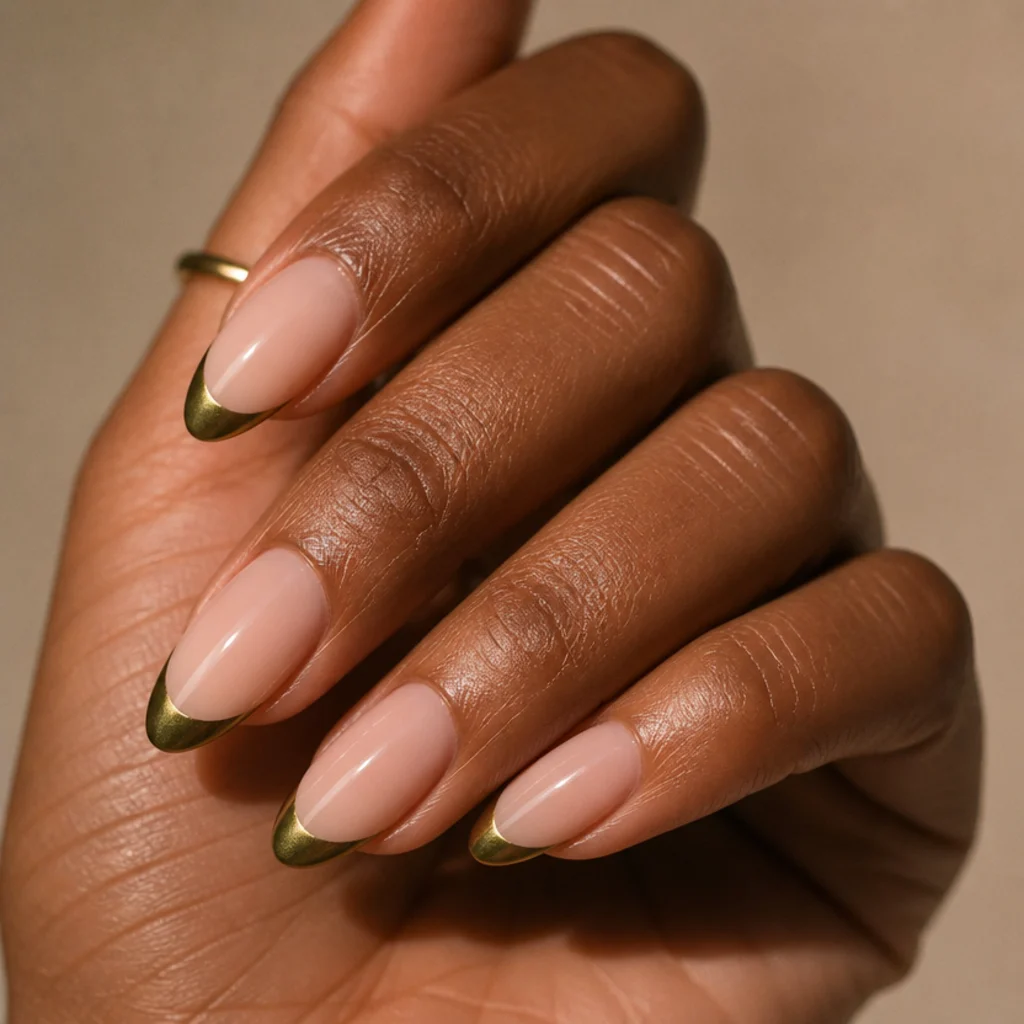
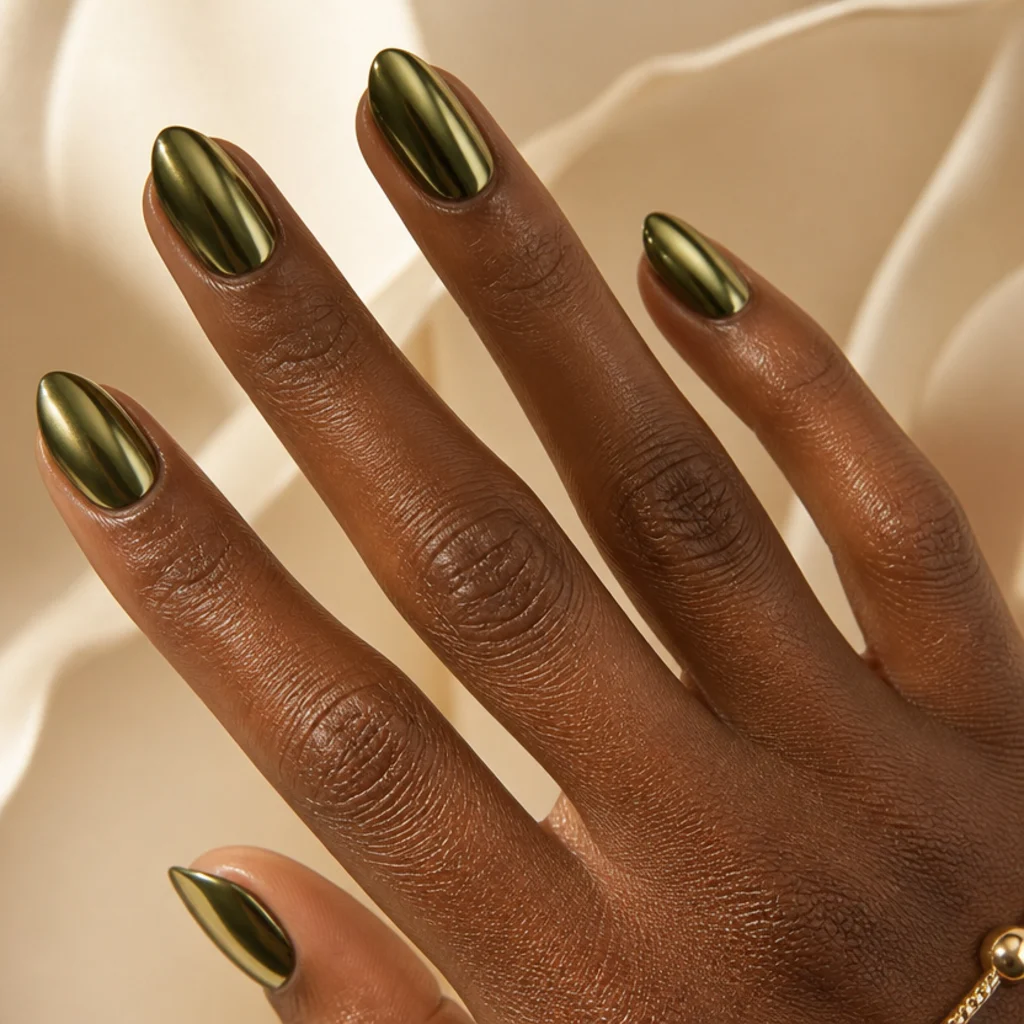
Olive green chrome nails are the showpiece of the whole lineup. A chrome or "aurora" powder gets buffed over a cured, tack-free olive gel base, then locked under a no-wipe top coat, so the tip shifts between mossy green and warm liquid gold as the hand moves — a depth flat polish just can't fake. Kept to the tips only, it turns a plain french into something that looks metallic-dipped rather than painted. The mirror finish reads especially rich on deep and tanned skin, and because reflection is doing the work, it makes short nails look expensive. The base color is the hidden lever: a black or deep-olive base under the powder deepens the metallic toward antique bronze, while a nude base keeps it lighter, greener, and more mermaid. Chrome needs that glossy seal to stay mirror-bright, so book it in gel rather than regular polish, and don't file the tips afterward, since that scuffs the reflection. Expect two to three weeks of wear, with a top-coat refresh if the shine dulls before your fill. Style it against black, emerald, or bronze. Pro tip: bring a photo showing whether you want green-dominant or gold-dominant chrome, since the base color decides it. Ask your nail tech for "olive green chrome on the tips only, high-shine, fully sealed over a deep base."
03Olive Green and Gold Micro-French
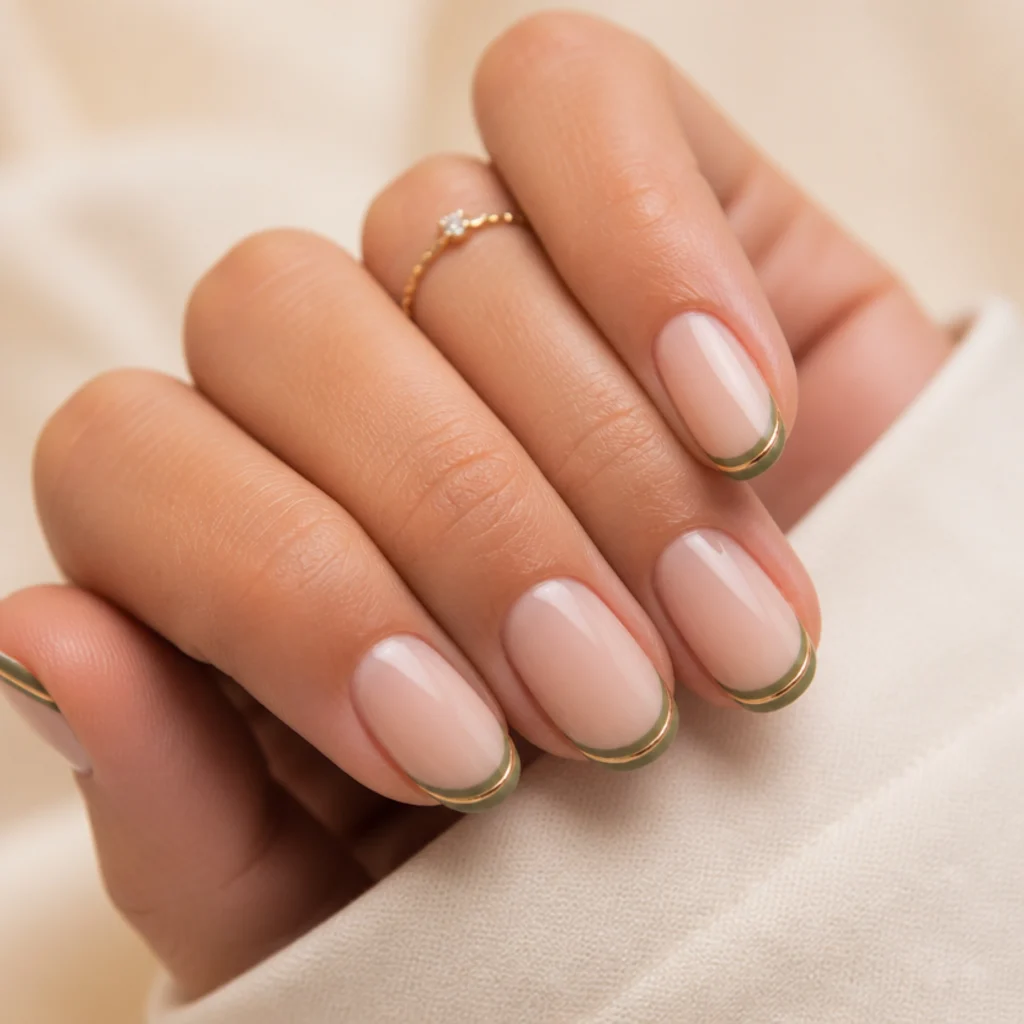
Here olive green and gold nails meet the micro-french trend. A very thin olive tip gets a hair-fine gold line traced just below it, so the two sit as parallel bands at the free edge — jewelry-like and deliberately dainty rather than loud. The pairing leans on olive's warm side, so a true metallic gold (foil, leaf, or a genuine gold striper, never flat yellow polish) reads richest; against cooler dusty olives the contrast turns crisp and modern. It suits shorter oval and almond nails, where a fuller design would crowd the plate, and it keeps the nail looking long and clean. The gold line needs a steady freehand hand or a 00 striping brush, which makes this an intermediate ask and adds a little chair time. Because the metallic catches light on camera, it's a reliable Pinterest performer and an elegant everyday-luxe option. Pair it with delicate gold rings and warm-toned outfits so the theme carries up the hand. Pro tip: have the gold line sealed under a thin gloss layer so the raised metallic doesn't chip off ahead of the color. Ask your nail tech for "a skinny olive french with a fine gold outline underneath, both lines kept thin and parallel."
04Dark Olive Green Deep V Tips
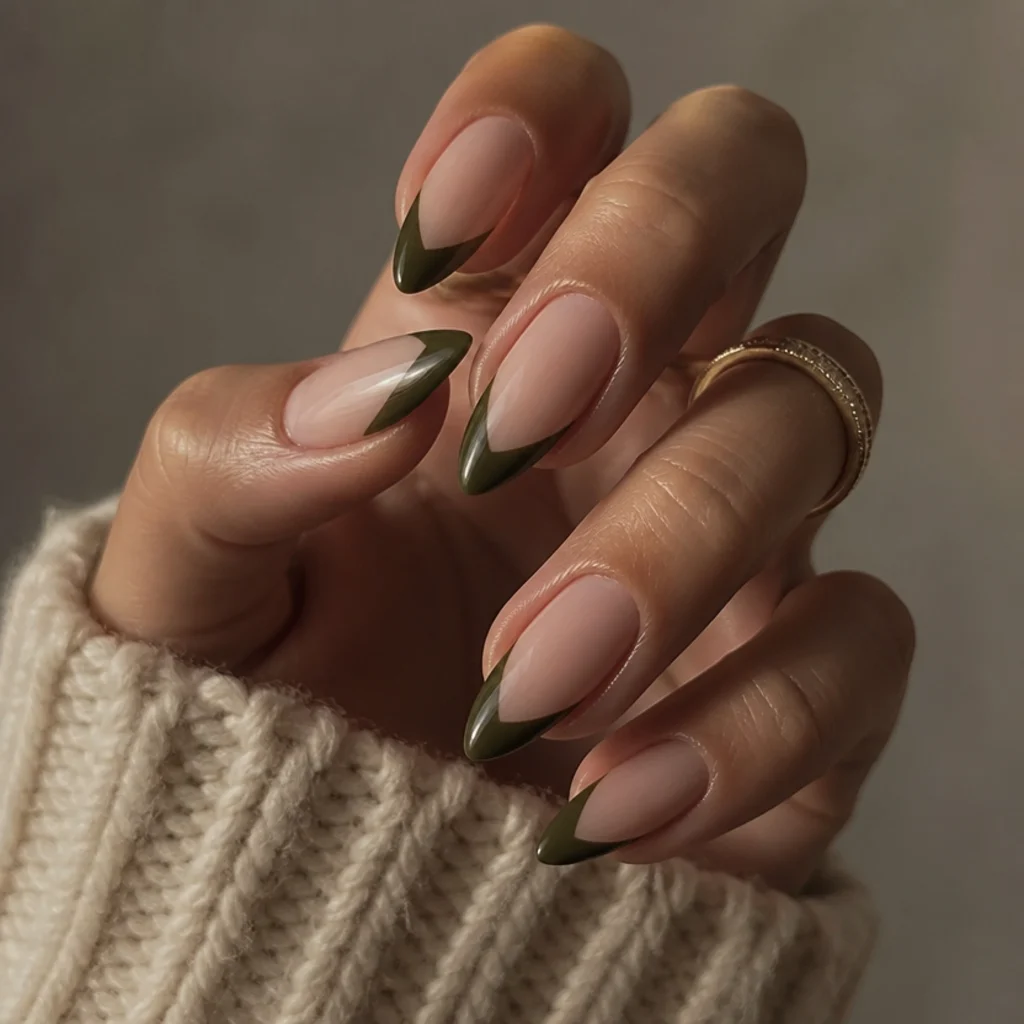
Dark olive green nails get real drama when the tip is shaped into a deep V rather than a rounded smile line. The point elongates the nail and adds a sharp, fashion-forward edge a curved french can't manage, and a deep army-olive that leans almost brown-green looks especially rich caught in the V. Long almond and stiletto shapes carry it best, since the length gives the point room to read; on short nails the V can look cramped and lose its architecture. This is intermediate work because the two angled walls have to meet cleanly and symmetrically at the centre, and any wobble shows immediately against the dark color. Expect standard two-to-three-week gel wear, but keep the point crisp, since a dark tone makes a chipped apex obvious from across a table. The moody depth makes it a natural for autumn and evening, sitting well with burgundy, chocolate, black, and gold hardware. Pro tip: ask for the V to start a touch shallower than you'd think, then deepen it in stages, so both sides stay even as the point extends. Ask your nail tech for "a deep V french in dark army olive, sharp symmetrical point at the centre."
05Sage-to-Olive Ombre Tips
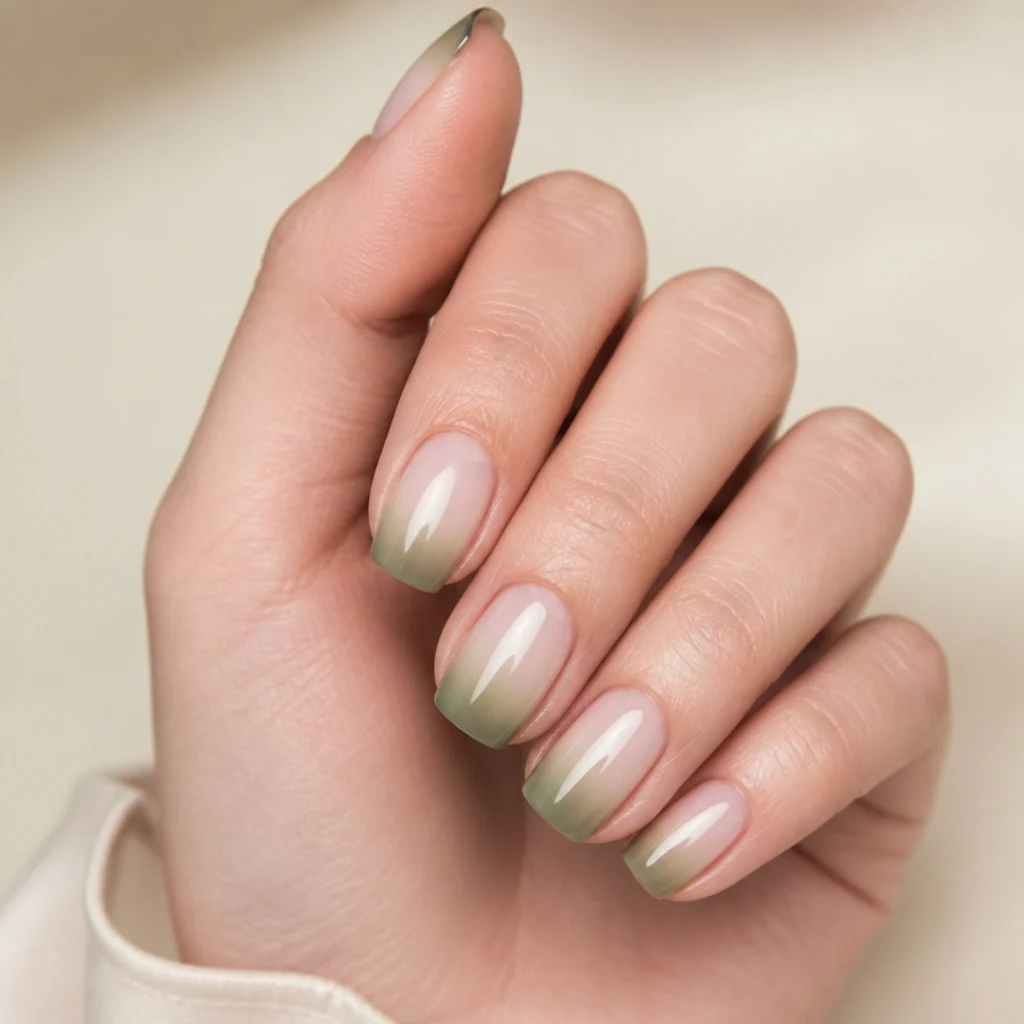
Instead of one flat olive, this tip fades from pale sage at the smile line into a deeper olive at the very edge. The gradient dissolves the boundary between base and tip, so the whole nail looks blended and dewy rather than blocked. The sage keeps it fresh, which is why it flatters cooler and neutral undertones particularly well; warmer skin can push the deep end toward a richer moss to keep the balance. Squoval and rounded shapes suit the gentle fade, giving the blend a broad surface to travel across. It's built with a makeup sponge or an airbrush, so it takes more chair time than a single painted line, and the layered pigment means an extra top coat for a smooth, ripple-free finish. The diffused edge makes regrowth exceptionally forgiving, since there's no hard line to grow away from the cuticle, which makes this a smart pick if you stretch time between fills. Style it with fresh, spring-leaning outfits and silver or mixed-metal jewelry. Pro tip: two thin sponged passes read far cleaner than one heavy one, which tends to look patchy where the pigment pools. Ask your nail tech for "a sage-into-olive ombre french, soft blend at the tips, no hard line."
Save this to Pinterest to build your olive green french tip mood board.
06Olive French on Short Squoval Nails
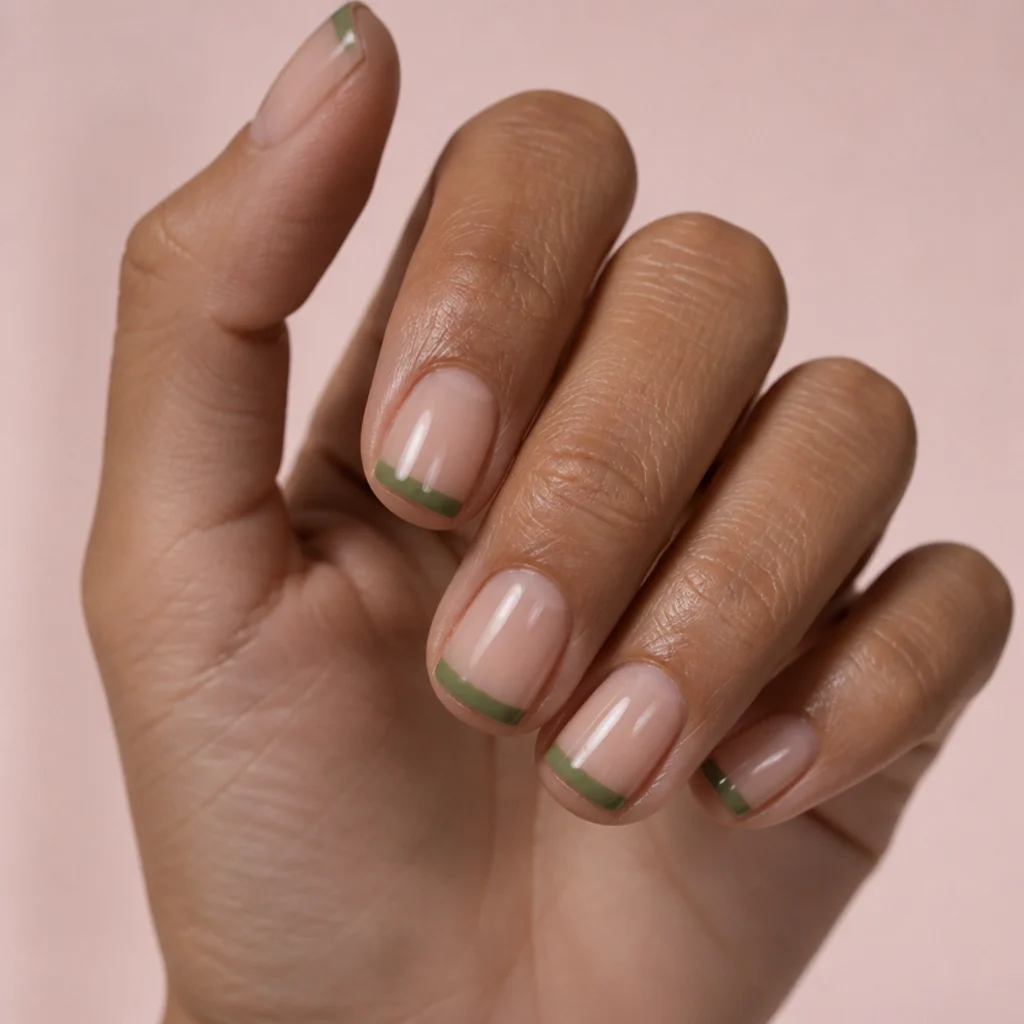
Proof you don't need length to wear this trend. On short squoval nails, a crisp mid-olive tip keeps everything neat and practical while still feeling deliberately styled, and the flat squared edge gives the french a clean, modern line a rounded tip softens. The short surface means faster application, easier at-home upkeep, and less leverage for chips, which makes this the most beginner-friendly version and an easy everyday choice for anyone who types, cooks, parents, or works with their hands all day. A muted mid-olive reads best at this length, since very dark tones can look heavy and crowd a small plate. Keep the tip on the thinner side, around two millimetres, so it stays in proportion. Expect straightforward two-to-three-week gel wear, and because the tip is small, even a chip is quick to patch between appointments. It suits every skin tone and pairs with almost anything, which is exactly why it earns its keep. Pro tip: keep the smile line following the squared free edge rather than curving it, so the tip looks intentional against the squoval shape instead of like a rounded french that missed. Ask your nail tech for "a clean olive french on short squoval nails, thin tip following the squared edge."
07Skinny Olive Line French
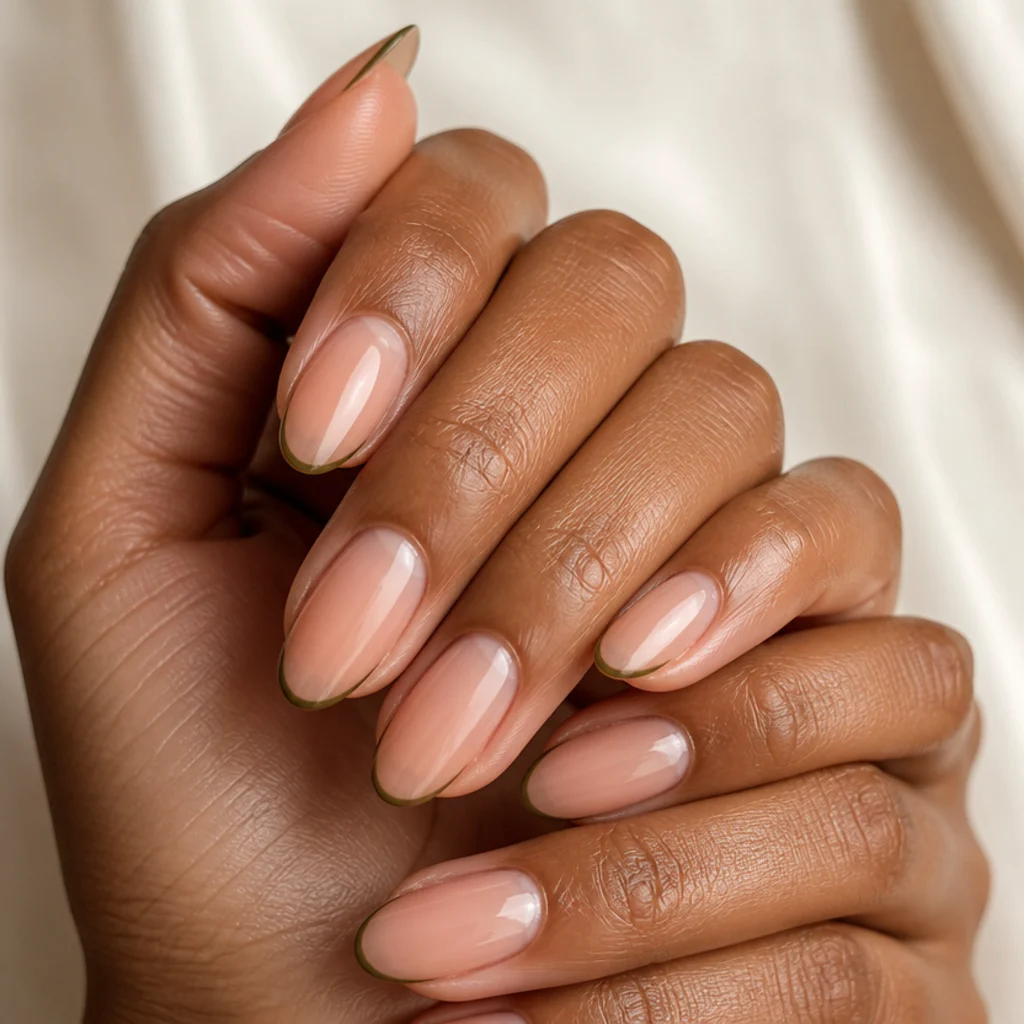
For minimalists, the entire design is a single hairline of olive right at the free edge — no block of color, just a fine ribbon tracing the nail's natural tip. It's quiet enough for conservative workplaces yet still delivers that hit of unexpected green, which is what keeps it from reading as a bare manicure. Any shape works, though almond and oval show the line most gracefully because their curved edge carries a thin stroke cleanly and evenly. The real challenge is consistency: the line has to stay equally thin across all ten nails, which takes a steady striping brush, good lighting, and a patient tech, so budget a touch more time than a basic tip despite how simple it looks. Wear tracks with your base, roughly two to three weeks in gel, and the minimal color means chips are barely visible, so it's low-fuss once it's on. This is the "clean-girl" french distilled to its essentials. Pair it with slip dresses, tailoring, and dainty jewelry. Pro tip: layer a glossy top coat over the line for a glassy finish that makes the single stroke look deliberate rather than accidental. Ask your nail tech for "the thinnest possible olive line french, just outlining the free edge, high-gloss."
08Olive and Cream Double French
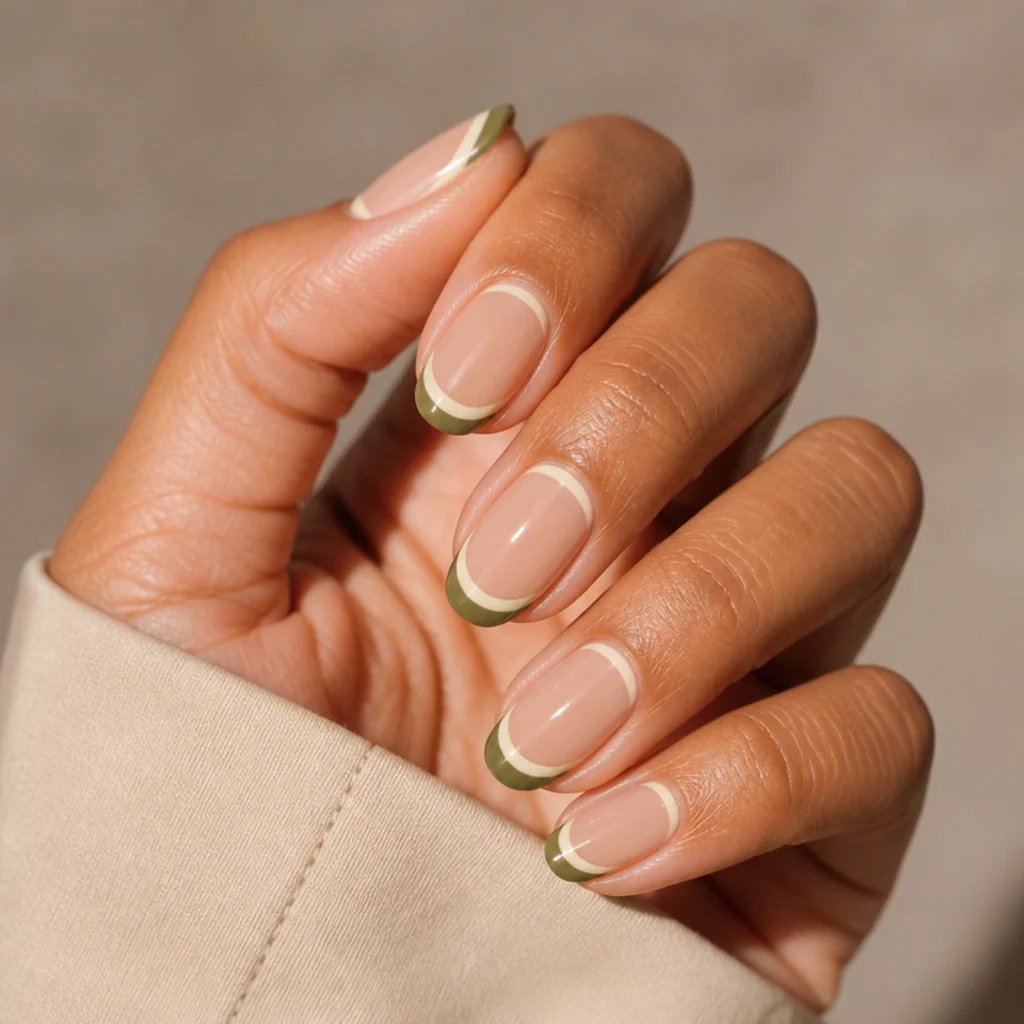
Double french means two smile lines stacked at the tip, here in cream and olive. The soft cream sits closer to the base and the olive caps the very edge, giving a layered, retro-modern result with more visual interest than a single line, and the cream stops the olive from feeling heavy so the whole thing stays wearable and light. It flatters medium to longer nails where two bands have room to breathe without crowding the plate; on very short nails the lines can merge and lose their separation. Both have to run parallel and evenly spaced, which makes this intermediate work and adds chair time, and two lines mean two edges to keep crisp at every fill. Expect normal two-to-three-week gel wear. It photographs with real depth, especially in daylight where the cream and olive separate cleanly. A warm ivory cream sits more naturally against olive than a stark white. Pro tip: ask for the cream band slightly wider than the olive so the tip doesn't read top-heavy as the nail grows. Ask your nail tech for "a double french, cream line then olive line at the tip, evenly spaced and parallel."
09Matte Olive Green Tips
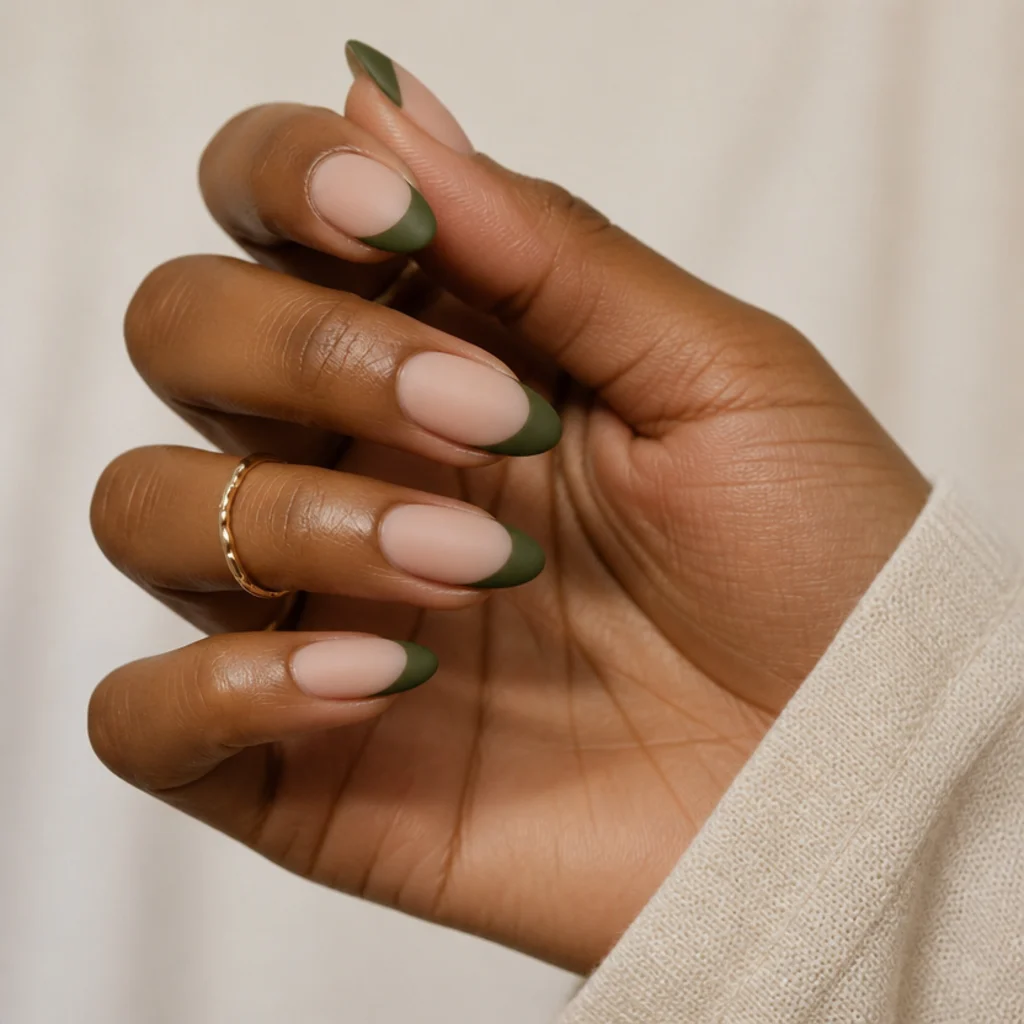
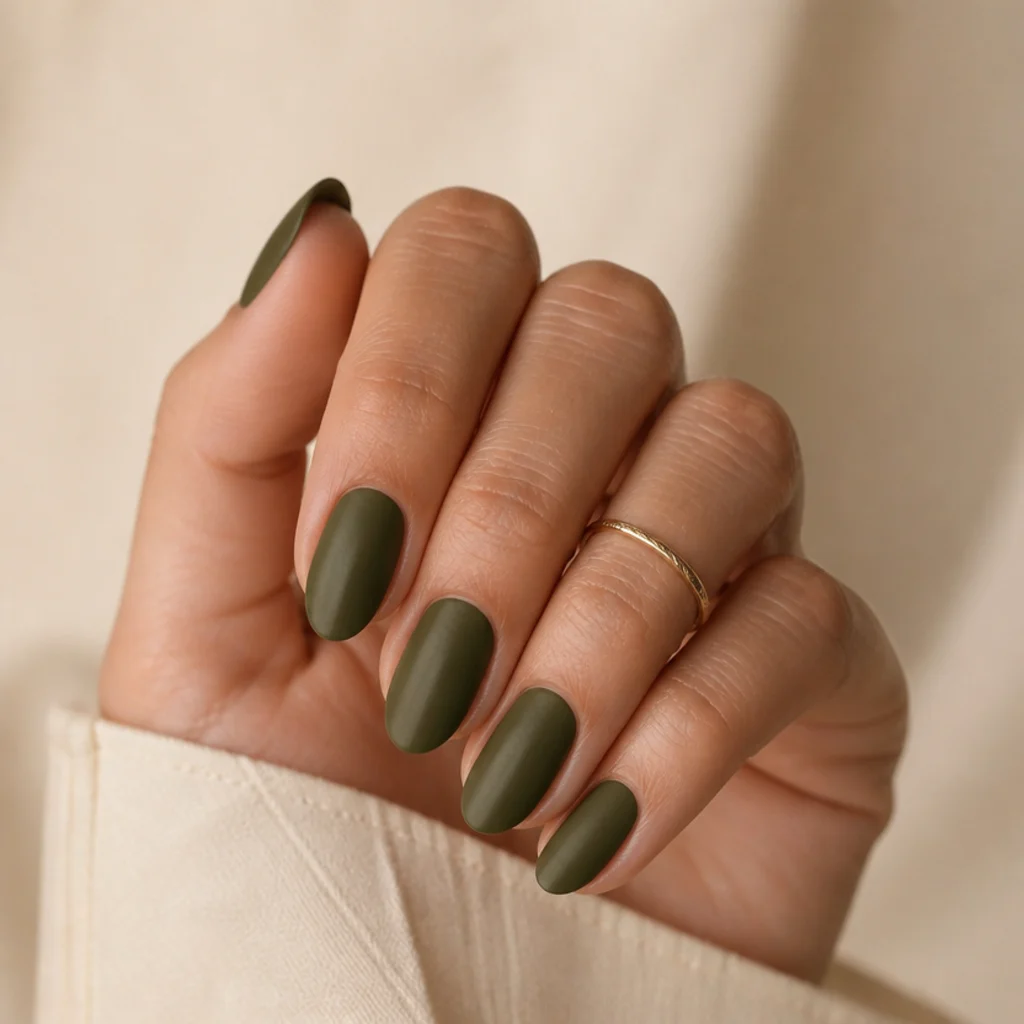
Take any olive tip, swap the shine for a matte top coat, and the whole mood shifts. Matte olive reads earthy and velvety, leaning into the color's botanical side, and it suits deeper, moss-leaning olives particularly well while pairing naturally with autumn and winter wardrobes of wool, suede, and leather. Any shape works; almond keeps it elegant and squoval keeps it modern. The trade-off is upkeep: matte finishes show fingerprints, dust, and the sheen from hand cream, and they can look dry, so a nourished cuticle and a spotless surface matter more here than with gloss. Wear time is the usual two to three weeks in gel, but the matte will gloss up in high-contact spots and may want a reapplied matte top coat before your fill. A glossy base under matte tips creates a subtle finish contrast that looks intentional. Pro tip: keep cuticle oil going nightly and buff hand cream in well below the nail, since well-conditioned skin around a matte nail is what keeps the look considered rather than chalky. Ask your nail tech for "olive green french tips with a matte top coat, and ask whether a glossy or matte base suits your hands."
10Olive Green Coffin Tips with Gold Fleck
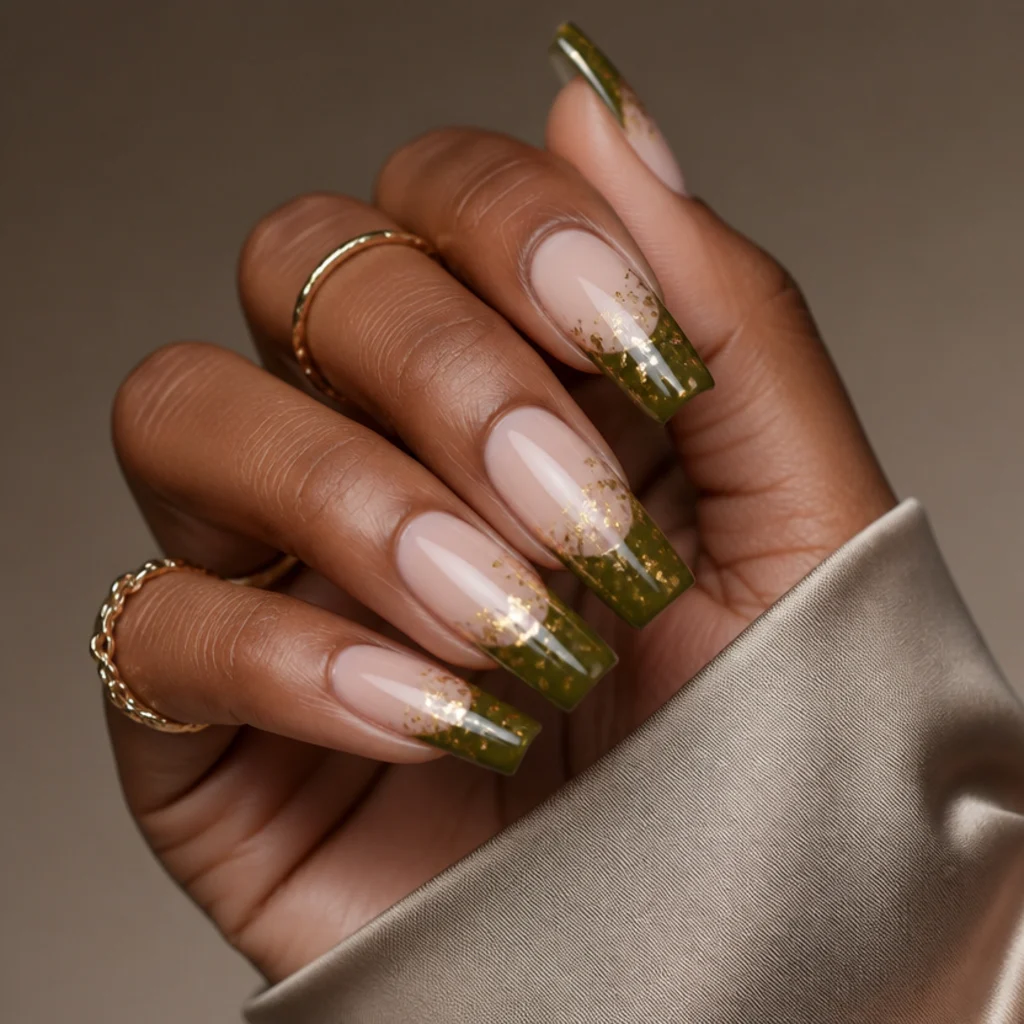
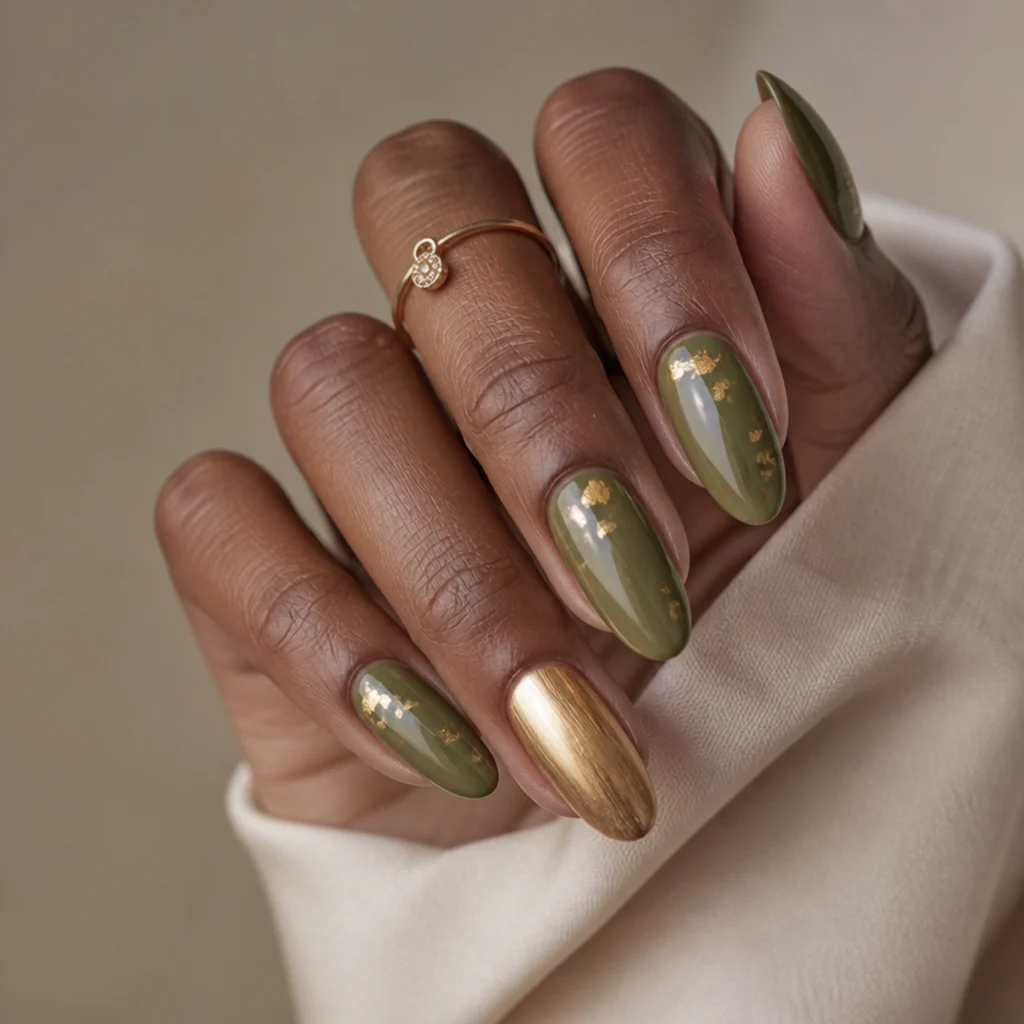
Coffin nails give a broad, flat tip that's an ideal canvas for olive green and gold nails with a little more going on. Fine gold leaf or flecks get pressed into the olive tip so tiny sparks catch the light without covering the whole nail, and the french shape anchors the sparkle so it still reads structured rather than busy. Longer coffin and ballerina shapes carry the width best, giving the flecks room to spread and the color room to sit. The look leans luxe, which makes it a strong pick for weddings, parties, and events where you want the light working for you. Gold leaf has to be pressed flat and fully sealed under top coat so the edges don't lift and snag, so this is intermediate work with a little extra chair time. Expect standard gel wear, and watch the sealed leaf at the free edge as the most likely lift point. Style it with jewel tones, satin, and gold hardware. Pro tip: keep flecks concentrated near the tip and sparse toward the smile line so the gradient of gold looks designed rather than sprinkled. Ask your nail tech for "olive green coffin french tips with scattered gold flecks, pressed flat and sealed smooth."
Save this to Pinterest and note which shapes you want to try.
11Reverse Olive French (Half-Moon)
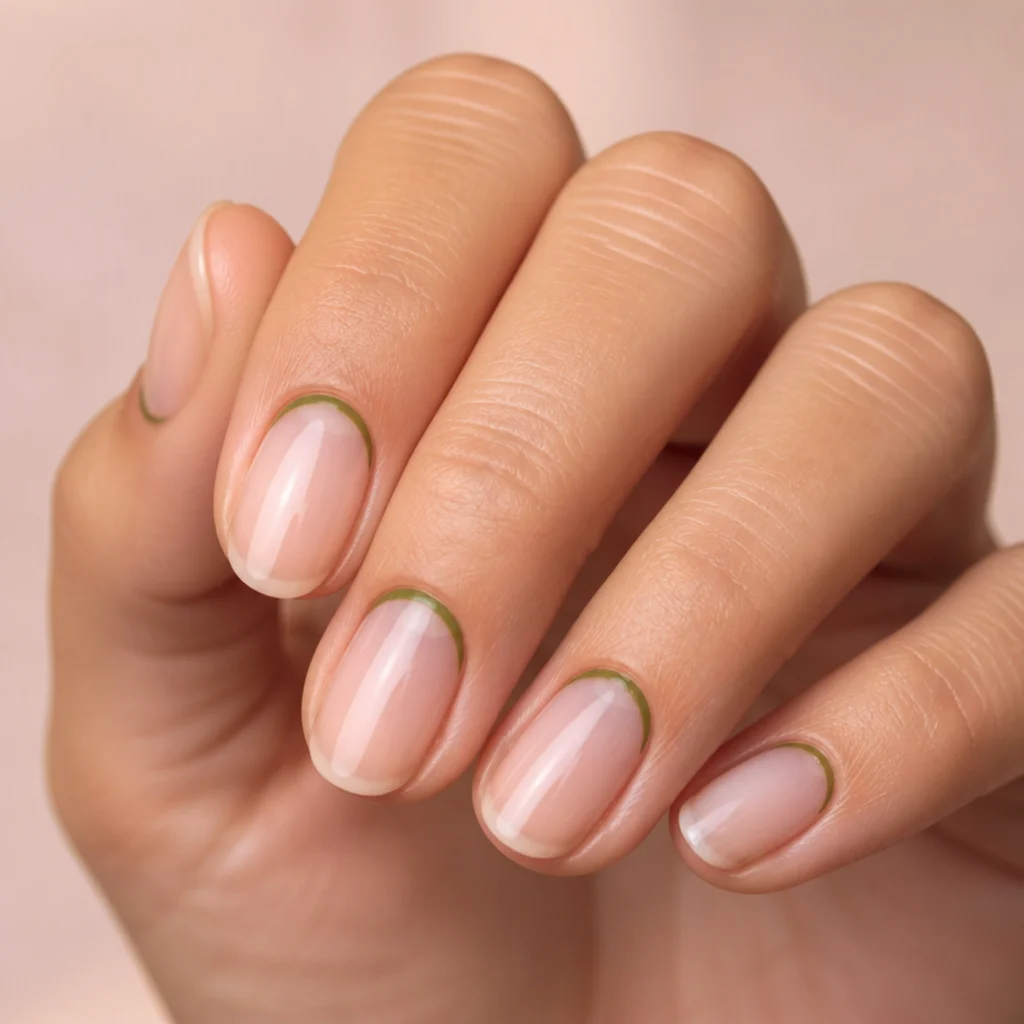
Flip the french and the olive lands at the cuticle as a half-moon instead of at the tip. This reverse french is a quiet signal that you know your nail history — the half-moon look predates the modern tip french entirely — and keeping the free edge clean reads as a longer-looking bed, which some people prefer. Olive's muted tone keeps the moon soft rather than costume-like, and oval and almond shapes flatter the curved shape most. The catch is regrowth: because the design sits right at the cuticle, new growth shows a little faster than a tip french, so shorter fill cycles of about two weeks keep it looking clean and centred. The half-moon itself has to be even, symmetrical, and consistently sized across all ten nails, which makes this a genuine intermediate ask. Pair it with a bare or very sheer base so the olive moon has crisp contrast and the empty tip looks intentional rather than unfinished. Pro tip: ask your tech to map the moon just inside your natural lunula line so it echoes your nail's own anatomy. Ask your nail tech for "a reverse olive french, half-moon at the cuticle, thin and evenly curved on every nail."
12Olive Green Glitter-Gradient Tips
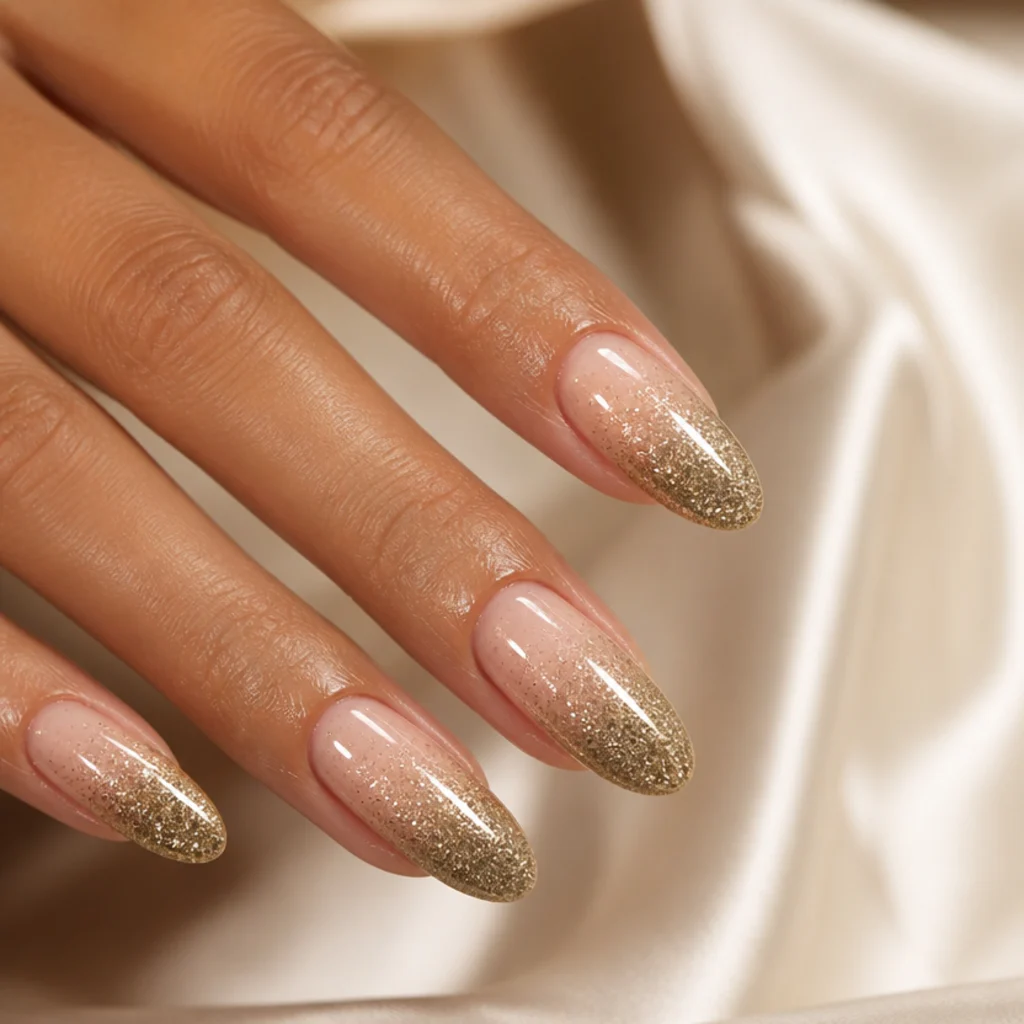
For sparkle without a full glitter nail, pack fine olive-toned glitter densely at the tip and fade it toward the base. The gradient keeps it from reading as a solid glitter block and gives a festive, celebratory finish with real dimension on camera, which is why it spikes on Pinterest every holiday season. It flatters medium to long nails, where the fade has room to travel, and almond and coffin shapes suit the spread best. Because glitter is stubborn to remove, book this in gel with a proper soak-off rather than regular polish, which saves your natural nail from the over-scraping cheaper removal invites. A thick glossy top coat, or a second layer, is essential so the surface feels glass-smooth rather than gritty, and it adds a step to your appointment. Expect solid two-to-three-week wear, with the dense tip edge being the spot to watch for lift. Style it for parties, New Year, and events. Pro tip: mix a fine and a slightly larger glitter for depth, but keep the palette to olive, gold, and clear so it stays sophisticated instead of craft-store. Ask your nail tech for "an olive glitter gradient at the tips, dense at the edge and fading out, sealed extra glossy."
13Almond Olive French with Gold Cuticle Bead
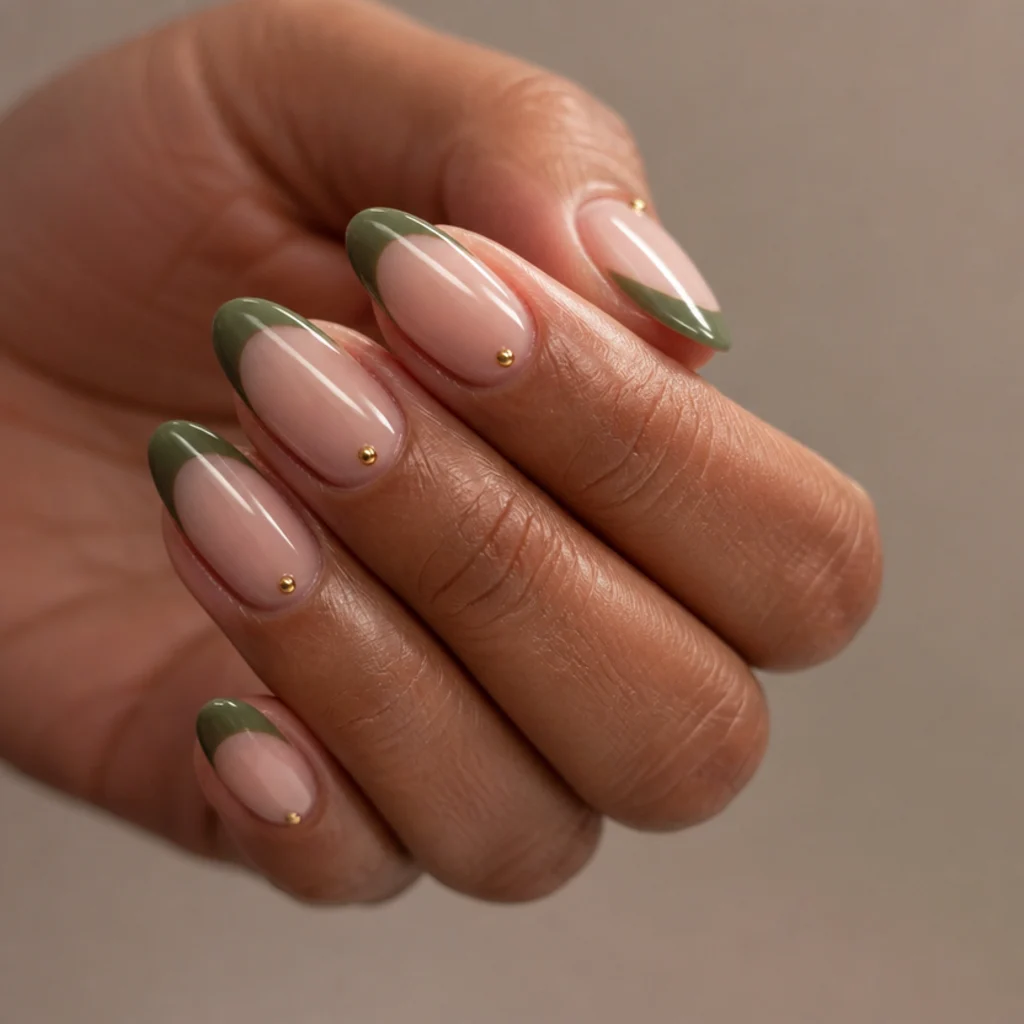
A clean almond olive french gets one tiny gold caviar bead or flat metallic dot placed at the cuticle of each nail. That single point of gold ties into the olive-and-gold pairing without committing to a full design, giving a finished, intentional feel with almost no added wear risk. It suits almond and oval shapes, where the negative space near the cuticle stays visible and lets the bead sit as a deliberate accent rather than clutter. The bead is a quick add-on most techs can place in minutes, so it barely changes your appointment length or cost, making it one of the highest-impact, lowest-effort upgrades in the lineup. Keep the beads consistent in size across all ten nails for a tidy result, and expect normal gel wear from the underlying french. It works for everyday polish that still feels considered, and for events when you want a hint of jewelry on the nail. Pro tip: a flat metallic dot lasts longer than a raised 3D bead if you're hard on your hands, since there's nothing to catch on hair or fabric. Ask your nail tech for "an olive almond french with one small gold bead at each cuticle, evenly sized and sealed."
14Wide Olive French for Bold Statement
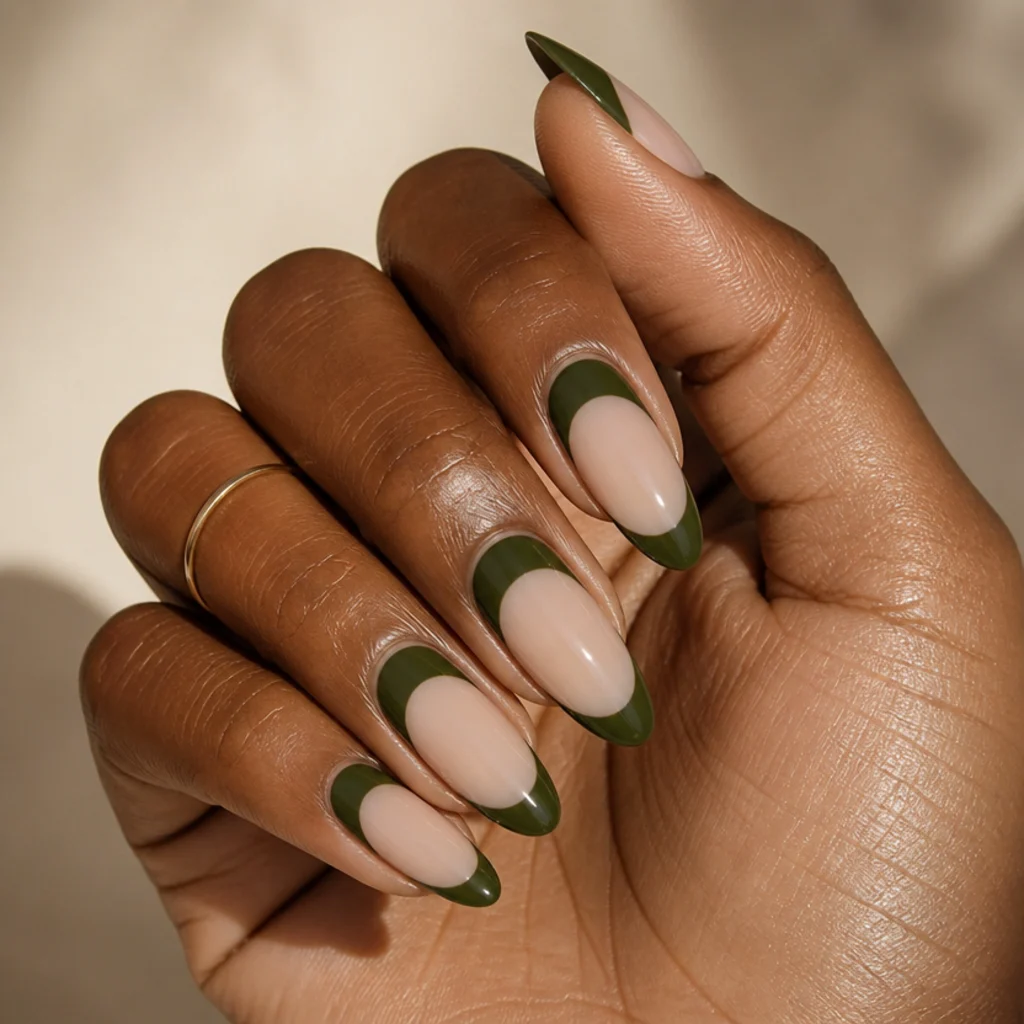
Take the tip much deeper, covering roughly the top third of the nail, for a bold, graphic take. The wide olive band turns the french into a real statement while a clean smile line keeps it polished rather than messy, and it suits longer almond, coffin, and squoval nails that give the color room to sit without swallowing the plate. A rich mid-to-dark olive looks most intentional at this scale; a pale sage can wash out and look uncertain over so much surface. Because more of the nail is colored, tip wear and regrowth are easier to spot, so a durable gel build and a glossy or matte seal earn their keep, and you may prefer fills closer to every two weeks. The proportion trick matters here: on shorter nails, drop to covering a quarter of the plate so the band doesn't overwhelm the bed. Style it with monochrome outfits and statement rings that echo the graphic mood. Pro tip: ask for the smile line to sit parallel to your cuticle line, not your free edge, so the wide band stays balanced and flattering as the nail grows. Ask your nail tech for "a wide, deep olive french covering the top third, crisp smile line parallel to the cuticle."
15Olive and White Layered French
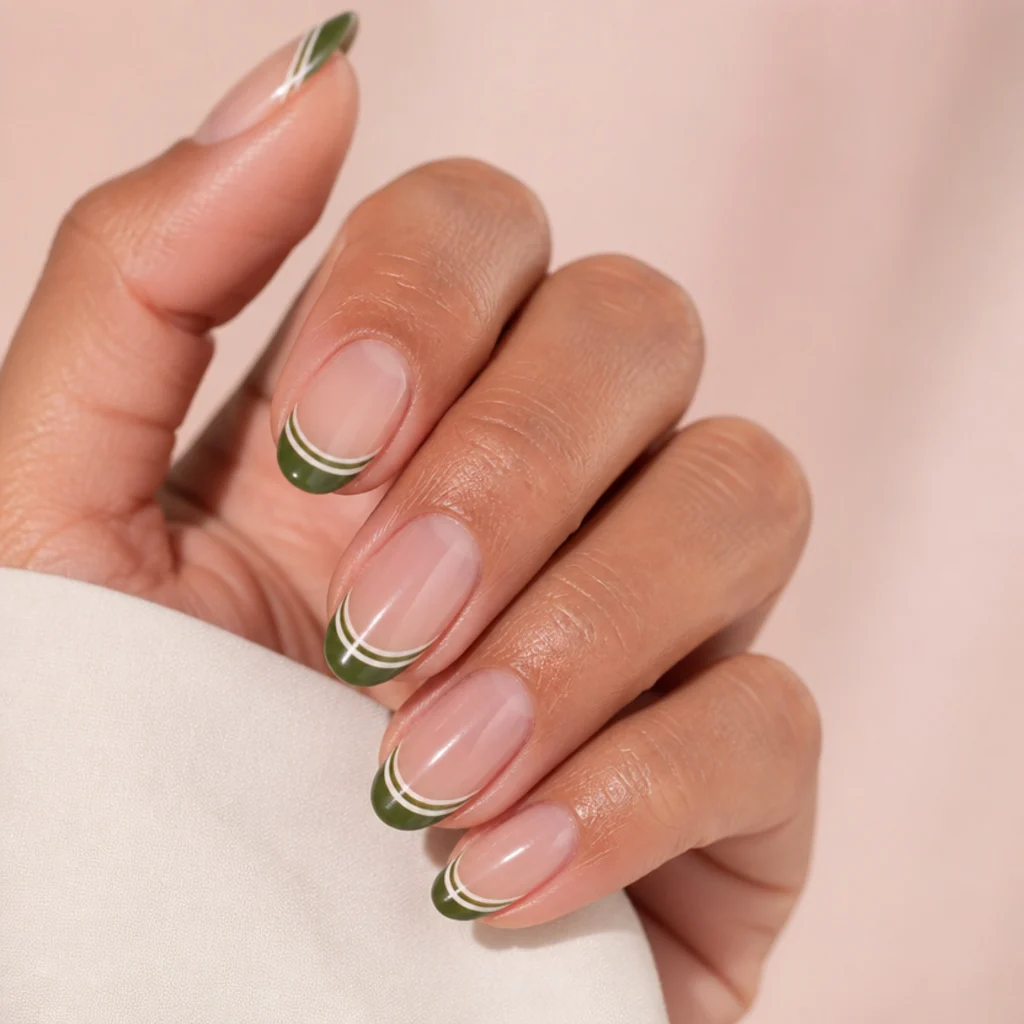
A nod to the classic white french without abandoning it: an olive tip sits at the edge with a thin white line separating it from the nude base. The white acts as a bright outline that makes the olive pop and keeps the whole design feeling fresh and crisp, and it flatters every skin tone because the white lifts everything regardless of undertone. Almond and oval shapes suit the layered lines best, giving the two crisp bands a clean curve to follow. Two parallel lines make this intermediate work and add a little chair time, and both have to stay sharp at fills to keep the effect. Expect the usual two-to-three-week gel wear. It bridges traditional and trendy, so it's a reassuring entry point if you're easing into colored french tips without leaving the familiarity of white behind. Pair it with crisp tailoring and classic accessories. Pro tip: a slightly warm off-white sits more naturally against olive than a stark bright white, which can look clinical and fight the color's warmth. Ask your nail tech for "an olive french tip with a thin warm-white line underneath it, both lines crisp and parallel."
Save this to Pinterest to compare the classic and layered versions.
16Olive Green Chrome and Nude Mix-and-Match
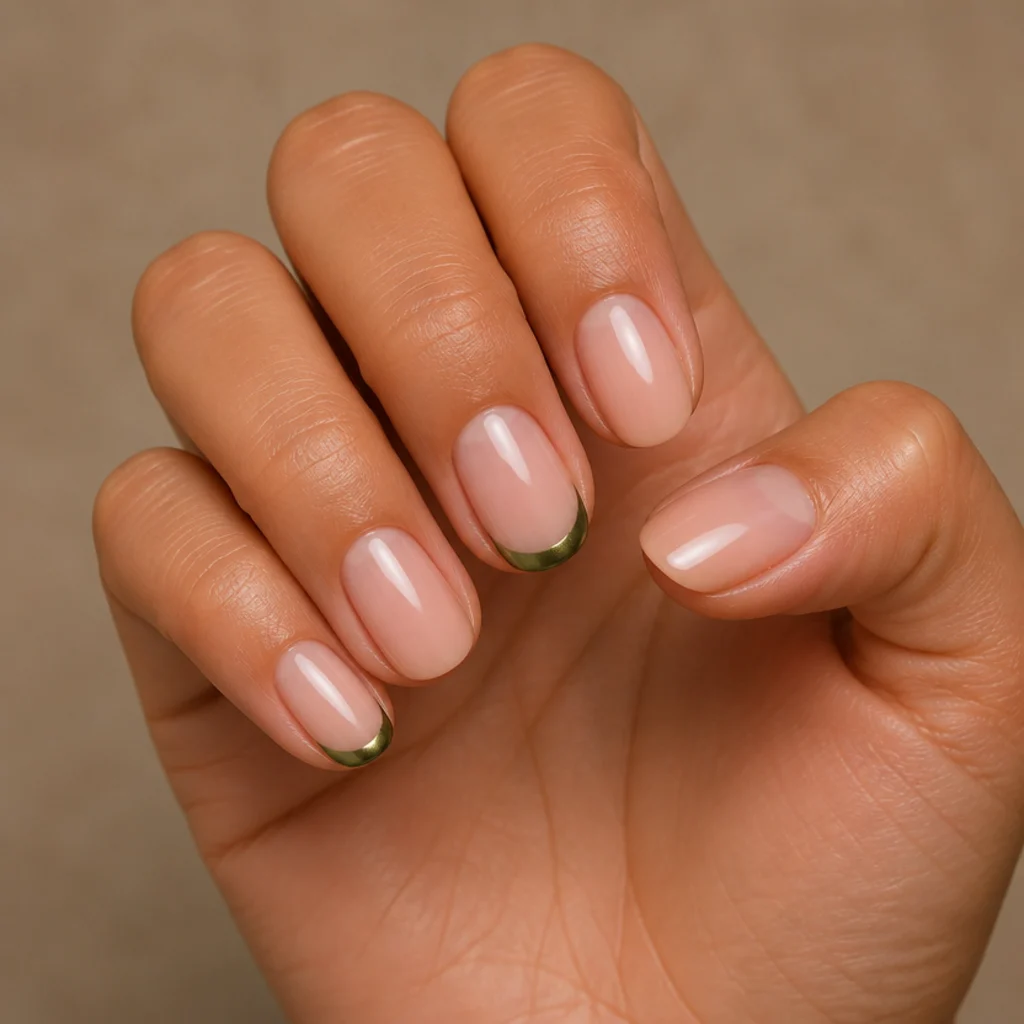
Not every nail has to match. Here two or three nails wear olive green chrome tips while the rest stay plain nude or glossy sheer, so the chrome behaves as an accent rather than a full commitment. Keeping the shimmer to select nails lets it be the hero without overwhelming the hand, and it reads modern precisely because of the restraint. It works on any length, and shorter nails especially benefit, since the plain nails balance the reflective ones and keep the look from feeling loud. Decide your accent placement in advance, usually the ring finger plus one other such as the index, so the layout looks intentional rather than random. Wear tracks with gel at two to three weeks, and the plain nails are quick to patch if one chips. This is also the smartest, cheapest way to trial chrome before committing all ten nails and the extra upkeep that brings. Style it minimally and let the nails do the talking. Pro tip: keep the plain nails in the same nude family as the chrome base so the two states of the manicure clearly belong together. Ask your nail tech for "olive chrome tips on the ring and index, sheer nude on the rest, balanced placement."
17Dark Olive Almond French for Fall
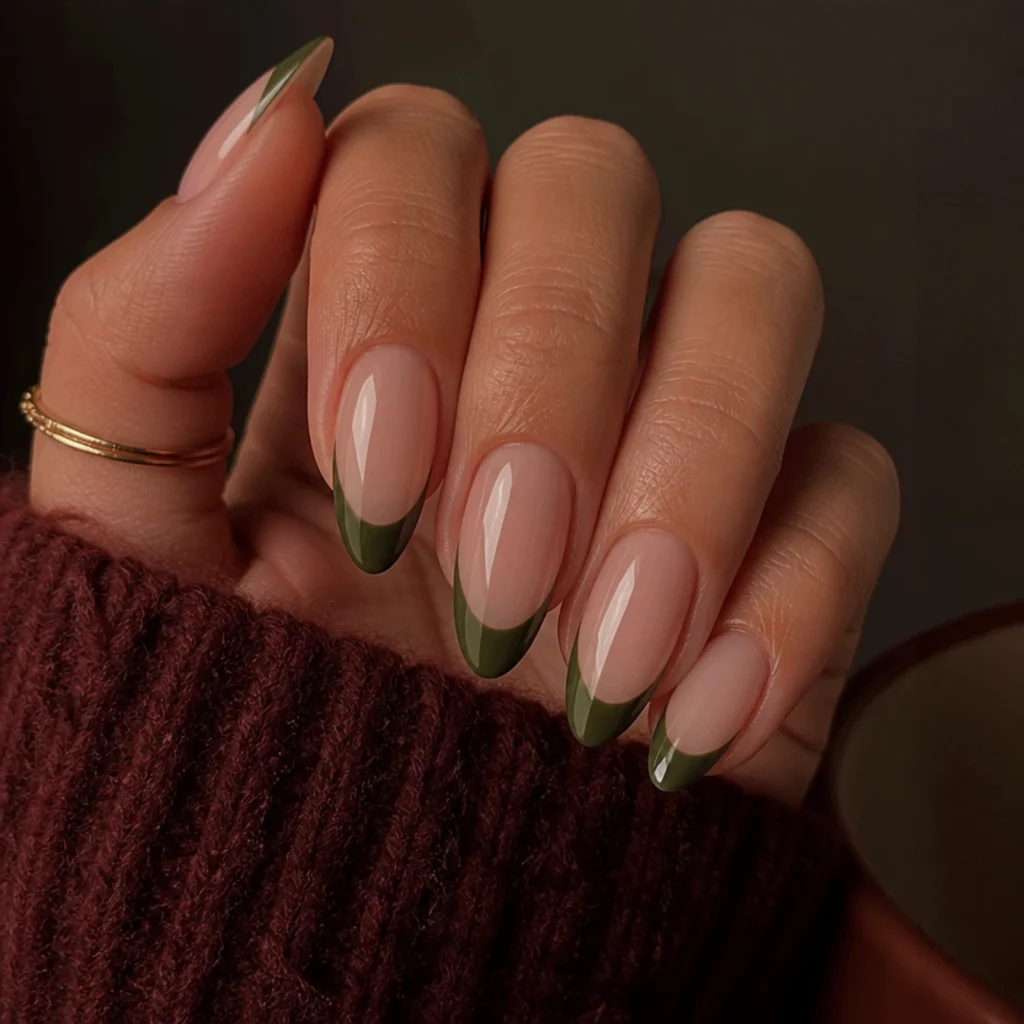
When the season turns, dark olive green nails feel right at home. A deep, army-toned olive painted as a clean almond french leans cozy and grounded, sitting beautifully alongside knits, camel coats, browns, and burgundy, while the french shape keeps it polished rather than gothic. Almond and oval shapes flatter the depth, drawing the eye down the nail, and warm and deep skin tones carry the richness with ease; cooler tones can choose an olive with a touch more grey so it doesn't tip toward black-green. Because the color is dark, a crisp smile line matters most, since any smudge or unevenness shows immediately against the depth. Expect standard two-to-three-week gel wear, and keep the free edge sealed so the dark tip doesn't chip visibly. It's one of the most versatile autumn manicures precisely because it stays a french rather than a full dark nail. Pro tip: a single thin gold micro-line under the dark olive instantly dresses it up for evening without changing the base look, so you get two manicures in one. Ask your nail tech for "a dark army-olive almond french, deep and clean at the smile line."
18Olive French with Tiny Gold Stars
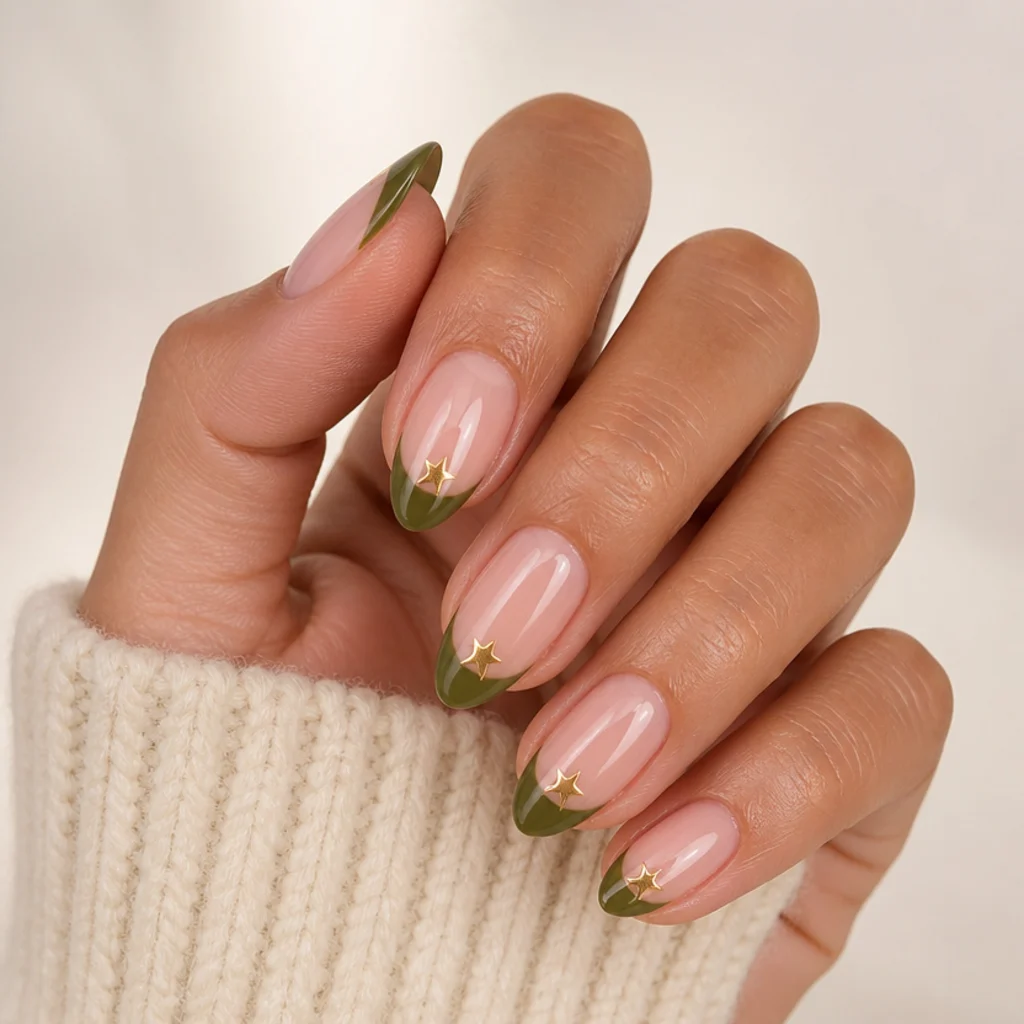
Playful but still grown-up: an olive tip gets one or two tiny gold star decals placed near the free edge. The stars add a celestial, whimsical touch that suits holidays, birthdays, and celebrations without tipping into novelty, because the olive-and-gold palette stays sophisticated and lets the stars read as a wink rather than a theme. Almond and coffin shapes give the decals room to sit near the tip without crowding, and any skin tone works since the accent is metallic. Keep the stars small and few, one or two per accent nail rather than a scatter, for the most tasteful result. Decals sit under top coat, so they stay smooth and wear well through the usual two-to-three-week gel cycle, with the sealed edge being the spot to watch for lift. It's an easy way to make a simple olive french feel occasion-ready. Pro tip: place stars on only one or two nails rather than all ten, so they feel like an accent instead of a full celestial set. Ask your nail tech for "an olive french with one or two tiny gold stars near the tip, sealed flat under gloss."
19Olive Green Angled Diagonal Tips
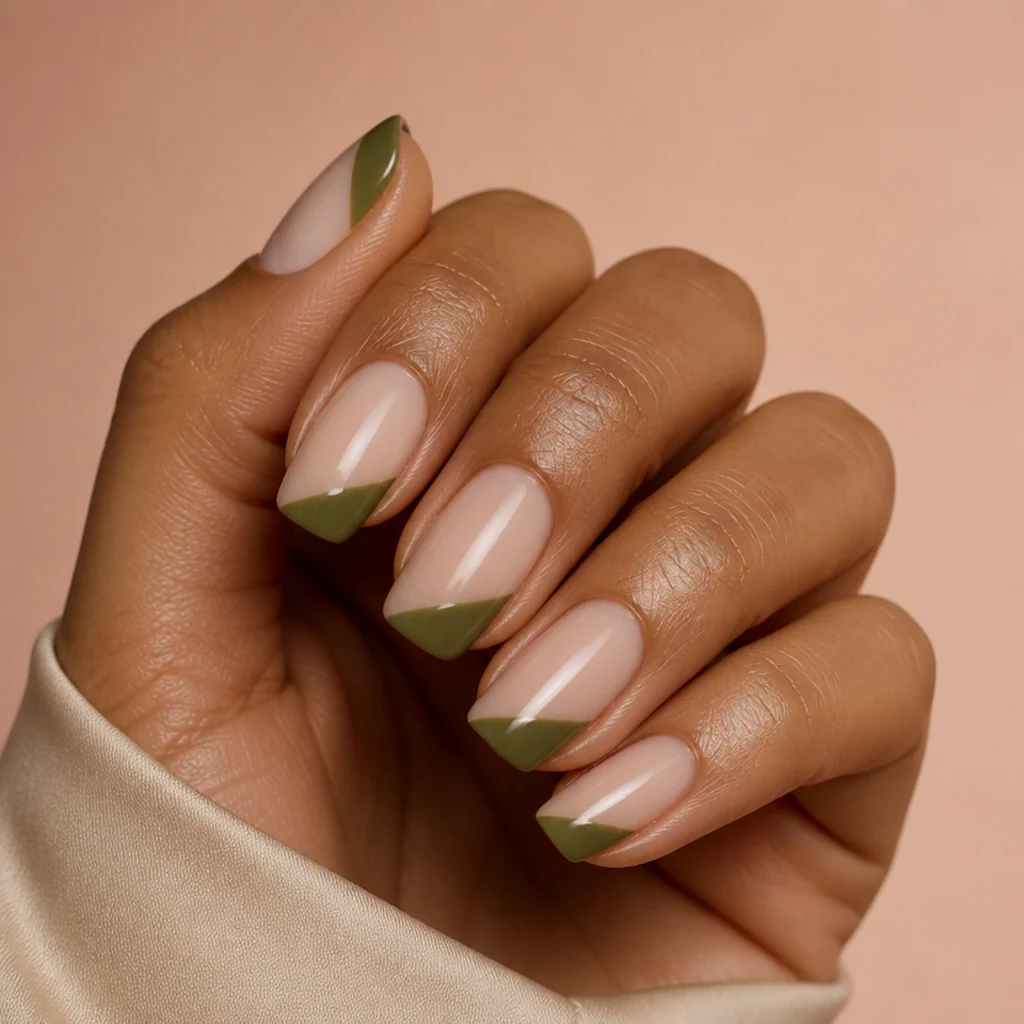
Rotate the smile line to a diagonal and the french turns architectural. The olive tip cuts across the nail at an angle instead of following the natural curve, giving a sharp, geometric look that feels current and design-led. It suits squoval and square shapes, where the straight free edge complements the diagonal, and a mid or dark olive keeps the graphic line reading clearly against the base. Consistency is the whole game: the angle should match direction and degree across all ten nails, which pushes this to intermediate-to-advanced work and adds chair time, so a tech with a steady hand and gel tape for clean edges is worth booking. Expect standard gel wear, and keep the sharp corner of the diagonal sealed, since it's the most exposed and lift-prone point. This is a strong pick if you want something clearly fashion-forward that still keeps the french DNA. Pro tip: decide whether the diagonal points the same way on both hands or mirrors inward, and tell your tech up front, because it changes the whole feel and can't be tweaked once painted. Ask your nail tech for "a diagonal olive french, angled tip, same direction and angle on every nail."
20Olive Green Jelly French Tips
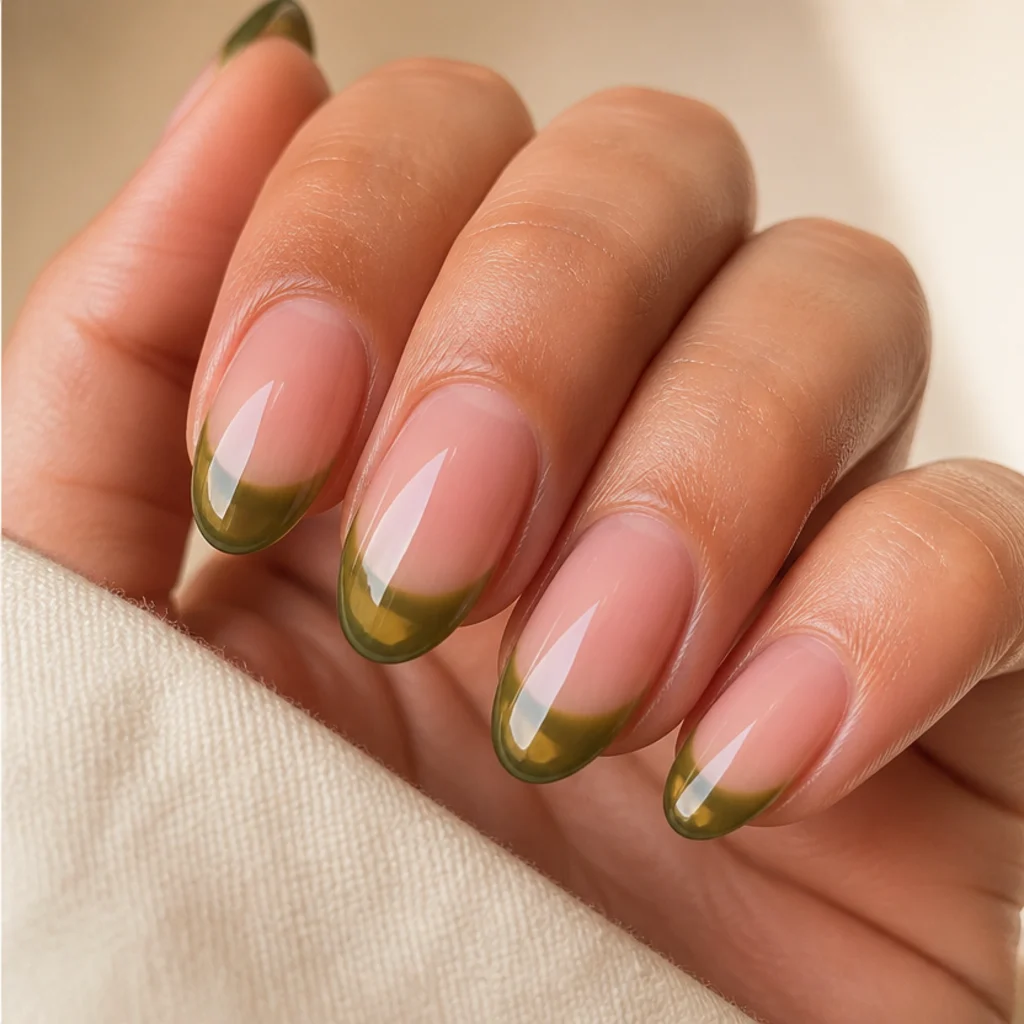
Jelly polish gives a translucent, stained-glass finish, and olive is lovely in that sheer form. Built in a couple of translucent, buildable layers at the tip, the jelly olive glows rather than sits flat, letting light pass through for a squishy, glossy effect that feels modern and low-commitment. The sheerness keeps it soft, so it flatters all skin tones and reads especially fresh on warmer hands where the light picks up gold. It's unusually forgiving of minor unevenness because there's no opaque block to expose a wobble, which makes it a friendly choice for anyone new to colored tips. Almond and oval shapes look juiciest, giving the translucent tip a smooth curve to glow across. Finish with a thick glossy top coat to amplify that jelly bounce; it adds a step but makes the whole look. Expect standard two-to-three-week gel wear, with the sheer color hiding tip wear well. Style it with fresh, summery outfits and dewy skin. Pro tip: two thin translucent coats read cleaner and glassier than one thick pass, which tends to pool and darken at the edge. Ask your nail tech for "a sheer jelly olive french, translucent buildable tip, high-gloss finish."
Save this to Pinterest so your whole olive green french board is ready for your next visit.
Pro Tips from the Editor
- Swatch before you commit. Dusty and sage olives can pull warmer or greyer under salon LED lamps than they look in the bottle; ask for a quick swatch-stick test cured under the lamp so the finished color is the one you actually chose, not a lucky guess.
- Match your gold, don't fake it. For olive-and-gold looks, insist on a true metallic gold (foil, leaf, chrome, or a genuine gold striper), since flat yellow polish reads cheap next to olive and kills the jewelry effect the pairing depends on.
- Let the base color steer chrome. A deep-olive or black base under chrome powder deepens the shift toward bronze, while a nude base keeps it lighter and greener, so decide the mood before you pick the base, not after.
- Seal every raised element. Gold leaf, beads, stars, glitter, and striping lines should all be pressed flat and locked under top coat, because a lifted edge is the single most common early-chip and snag point.
- Keep smile lines parallel to your cuticle. On wide and deep tips especially, a smile line that follows the cuticle rather than the free edge stays balanced and flattering as the nail grows out over the fill cycle.
- Book gel for anything textured. Chrome, glitter, and leaf all rely on a proper cure and a no-wipe seal, and they soak off far more kindly than they scrape off, which protects your natural nail from thinning over repeat sets.
- Condition daily, especially for matte and dark. A drop of cuticle oil each night keeps the skin around the nail healthy, which is what makes a matte or dark olive manicure look intentional rather than dry and chalky at the edges.
How to Choose / Get the Look
Treat this as a four-step decision rather than a single pick. First, start with undertone. Muted sage-olives, warm-white layered lines, and sheer jelly finishes flatter cooler and lighter skin, while deep army and dark olive tones look richest on deeper, tanned, and olive complexions; chrome and gold accents suit almost everyone because the shimmer behaves like a metallic rather than a fixed hue. If you're unsure, a muted mid-olive is the safest universal starting point and the easiest to build on later.
Second, match the design to your lifestyle. A thin classic tip, a skinny line, or a short squoval french handles hands-on days with the least upkeep and the fastest chip repair, while wide tips, chrome, glitter, and gold leaf show wear faster and want gel plus a glossy or matte seal to hold their finish.
Third, let shape guide the detail. Almond and oval elongate and carry freehand work like gold lines, beads, and stars; squoval and square anchor graphic diagonals and clean wide blocks; coffin and stiletto give room for gold fleck, glitter gradients, and deep V points.
Use this quick reference to line up finish, effort, and upkeep before you book:
| Look | Best nail shape | Skill level | Finish | Upkeep rhythm |
|---|---|---|---|---|
| Classic muted olive tip | Almond, oval | Beginner | Glossy | Fill every 2 to 3 weeks |
| Olive chrome tips | Any, short included | Intermediate | Mirror | Top-coat refresh as shine dulls |
| Olive and gold micro-french | Oval, almond | Intermediate | Glossy | Fill every 2 to 3 weeks |
| Dark deep V or wide band | Long almond, coffin | Intermediate | Glossy | Fill closer to every 2 weeks |
| Matte olive tips | Almond, squoval | Beginner to intermediate | Matte | Reapply matte top coat as it glosses up |
| Glitter or leaf tips | Coffin, long almond | Intermediate | Glossy, textured | Gel soak-off, watch tip edge |
| Jelly olive tips | Almond, oval | Beginner | High-gloss | Fill every 2 to 3 weeks |
Finally, communicate clearly at the chair. For color longevity, ask for gel over regular polish on anything with chrome, glitter, or leaf, and book fills every two to three weeks. Bring one or two saved photos, name the exact olive, state the tip depth in millimetres or as thin/classic/wide, and call out every accent so nothing is left to guesswork. A clear reference plus clear words gets you the closest result, and a swatch test before application removes the last surprise.
Frequently Asked Questions
What skin tones does an olive green french tip suit best?
Olive is unusually flexible because it carries both warm and cool undertones. Muted sage-olives, warm-white-lined versions, and sheer jelly finishes flatter lighter and cooler skin, while deep army and dark olive tones look especially rich on tanned, deep, and olive complexions. Chrome and gold accents read well across the board because the metallic finish behaves like a neutral. If you're unsure, a muted mid-olive is the most universally flattering starting point, and you can adjust warmth by shifting the base coat slightly deeper or lighter than your skin.
How long do olive green french tips last?
In gel, expect two to three weeks before cuticle regrowth becomes noticeable, and regular polish looks its best for about five to seven days. Muted olive hides minor tip wear better than bright shades, while chrome, glitter, and matte finishes may want a top-coat refresh sooner to keep their look sharp. Wide and dark tips show regrowth and wear a little faster because there's more color to grow away from the cuticle, so some people prefer fills closer to every two weeks to keep them crisp.
Are olive green chrome nails hard to maintain?
Chrome itself is durable once sealed, but it depends on a glossy no-wipe top coat to stay mirror-bright. Book it in gel rather than regular polish, and ask for a fresh top coat if the shine starts to dull before your fill. Avoid filing or buffing the tips afterward, which can scuff the chrome, and go easy on abrasive cleaning products and acetone-based removers around the edges, since they dull the reflective finish over time. Gloves for cleaning noticeably extend the mirror.
How do I ask my nail tech for the right olive shade?
Bring a saved photo and use plain descriptors: "muted dusty olive," "deep army olive," or "sheer jelly olive." Specify the tip depth as thin, classic, or wide (or in millimetres), and name any accent such as a gold line, chrome, or bead. A reference image plus these words gets you closest, and asking for a quick swatch-stick test cured under the lamp before application avoids surprises once the color sets, since olive shifts more than most shades between bottle and cured finish.
Can I do olive green french tips at home?
Yes, especially the simpler versions. A classic thin tip, a skinny line, or a short squoval french is beginner-friendly with a steady hand or adhesive french guides. Chrome, gold striping, double lines, deep V points, and diagonal tips are trickier and are often better left to a tech for a clean, even result. If you're DIYing, work in thin layers, cap and seal the free edge to prevent lifting, and finish with a quality top coat for the longest wear. A dotting tool makes cuticle beads and stars far easier to place evenly.
What finish should I choose for an olive french tip?
Let the finish set the mood. Glossy keeps olive fresh, modern, and low-fuss; matte turns it earthy and botanical but shows fingerprints and wants diligent cuticle oil; jelly makes the color glow with a translucent, stained-glass look; and chrome delivers a metallic, color-shifting tip. Gloss is the most forgiving and versatile all-rounder, while matte and chrome ask for a little more day-to-day care. If you want one manicure to do double duty, a glossy base with a matte top coat gives you subtle finish contrast.
Which nail shape works best with an olive green french?
Almond and oval are the most flattering all-rounders and carry freehand details like gold lines, beads, and stars gracefully. Squoval and square anchor graphic looks such as diagonal tips and clean wide blocks. Coffin and stiletto give room for gold fleck, glitter gradients, and deep V points. Short squoval is the easiest to maintain and the friendliest for hands-on days, so choose it if durability and quick upkeep matter more than dramatic length.
Do olive green and gold nails look good year-round?
Yes, though the palette leans slightly autumnal. Deep army olive with gold reads richest in fall and winter alongside knits and browns, while muted sage olive with a fine gold line stays fresh and wearable in spring and summer. Adjusting the depth of the olive and the amount of gold is all it takes to move the look across seasons without changing the concept, so the same theme carries from a cozy fall almond french to a light, airy spring micro-french.
How do I keep a dark olive smile line from looking smudged?
Dark tones expose any unevenness, so a crisp, well-defined smile line is essential. Ask your tech to build the line in thin, controlled passes rather than one heavy stroke, and to seal the free edge fully. At home, avoid picking at the tips and reapply top coat if the edge starts to wear, since a clean, glossy seal is what keeps a dark olive french looking deliberate rather than chipped. If you're doing it yourself, a slightly angled brush and a cleanup brush dipped in acetone tidy the smile line beautifully.