15 Olive Green and Gold Nails to Love
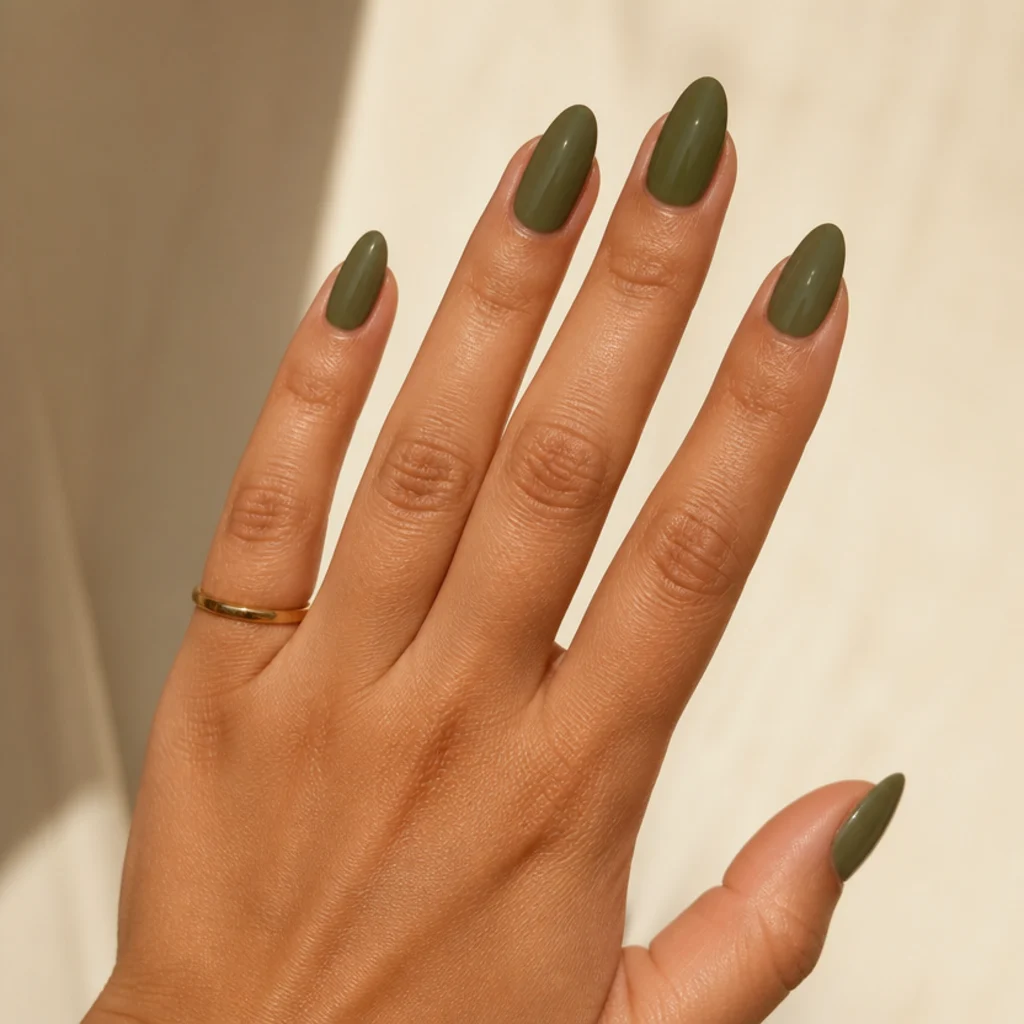
Olive is the one muted green that behaves like a neutral, and a measured hit of gold is what stops it reading like camo and starts it reading like fine jewelry. Below are 15 ways to pair the two, each mapped to the exact shade depth, finish, nail shape, wear window, and salon wording that make it land.
 Edited by Lena Rose · Published July 11, 2026 · 32 min read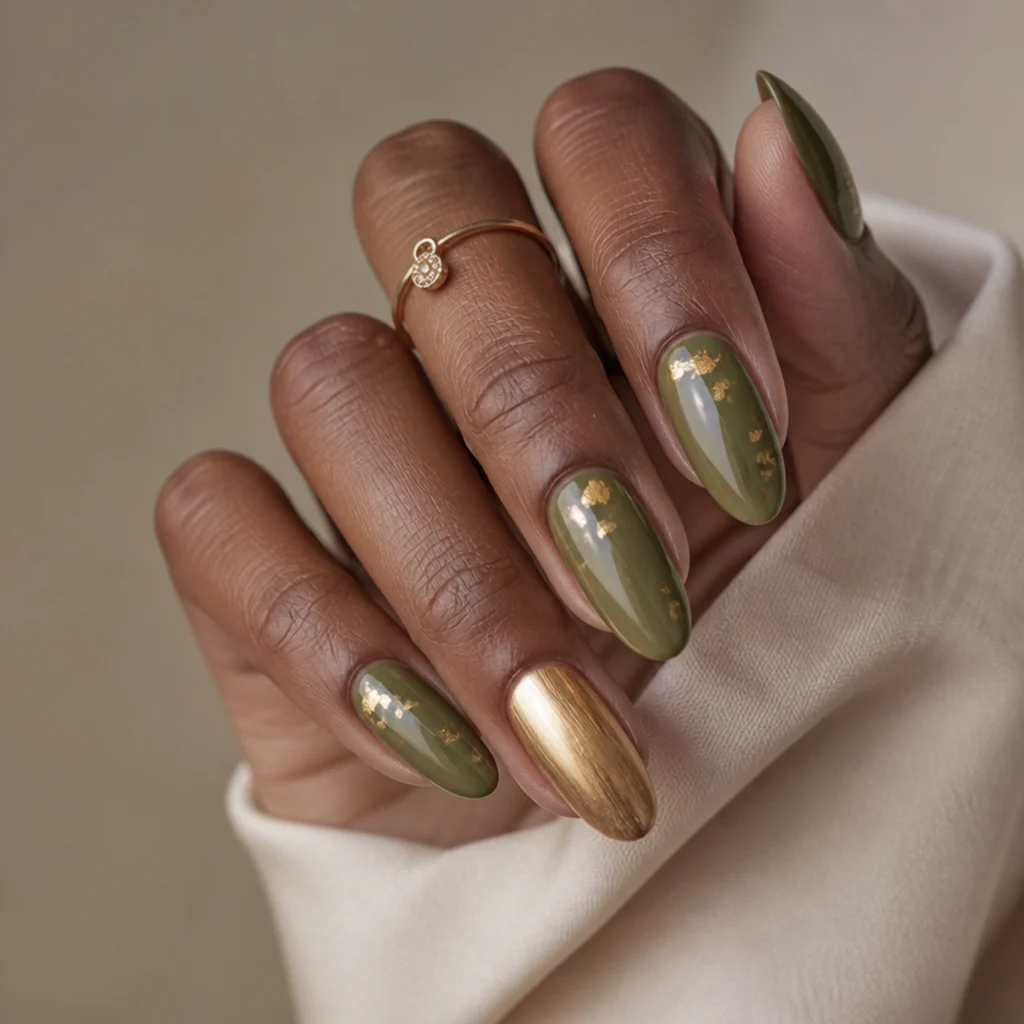
Quick Answer
- Best for: warm and neutral undertones, since olive shares the same yellow-brown axis as most skin; a greyer sage-olive extends the palette to cool tones without clashing.
- Who might skip it: very cool, high-contrast complexions who want a manicure to pop rather than blend, chronic nail-biters who can't support tip-heavy chrome and ombre, and anyone unwilling to schedule a mid-cycle top-coat refresh on metallics.
- Maintenance: two to three weeks in gel; foil, chrome, gilding, and ombre tips are the first to dull, so a top-coat refresh around day 10 to 14 buys back the second half of the wear window.
- Difficulty: solid olive and micro-french are beginner-to-intermediate; foil scatter and vertical ombre are intermediate; chrome, marble, aura, croc texture, gold leaf, and freehand line art are advanced and worth booking a specialist for.
- Cost: a standard gel set runs roughly $45 to $70; add about $15 to $40+ for chrome, hand-painted art, marble, or gold leaf, plus more for stiletto length or extensions. Ranges vary by region and salon tier.
- Wear time / longevity: 14 to 21 days before a fill; matte, jelly, and sheer finishes soften a few days sooner than glossy opaque color.
- Standout variation: olive green chrome nails with one brushed gold-leaf accent finger.
- How to ask your nail tech: bring one clear reference photo, name the depth out loud ("muted mid-olive," "dark forest-olive," "grey sage-olive"), and specify the gold finish (foil, mirror chrome, pressed leaf, or hand-painted line) so nothing is left to interpretation.
In This Guide
- Classic Olive with Gold Foil Flecks
- Olive Green Chrome Nails
- Olive Green French Tip Nails
- Dark Olive Green Nails with Gold Line Art
- Olive and Gold Marble
- Soft Sage-Olive Ombre
- Olive Matte with Gold Cuticle Cuff
- Gilded Olive Almond Nails
- Olive Green Aura Nails
- Micro-French Olive Tips
- Olive and Gold Leaf Botanicals
- Deep Olive Croc Texture
- Olive Jelly with Gold Flake Suspension
- Half-Moon Olive and Gold
- Olive Green Stiletto with Gold Chrome Ombre
Olive green and gold sits at the seam of earthy and elevated: it photographs well and still wears quietly in real life. Olive is just green desaturated with brown and grey, so instead of fighting your skin the way a saturated kelly or emerald can, it settles into the same warm, low-contrast register as most complexions and reads as a neutral rather than a statement color. Gold does the corrective work. As foil, mirror chrome, pressed leaf, or a single hand-painted line, it puts warmth and shine back in so the pairing doesn't tip flat or military-surplus. The range here is wide for a two-color story: you can stay barely-there with a grey sage-olive ombre that passes at a conservative office, go moody with a near-black dark olive lit by thin gold linework, or go full high-shine with an olive green chrome that swings from antique brass to deep moss as your hand moves. That range is probably why the pairing hasn't faded after one trend cycle and shows up year-round, with spikes in autumn and through the late-summer transition. Below you'll find the shape and length that carries each idea, a realistic upkeep window, and the exact wording to hand your tech so you leave with the manicure you pictured.
01Classic Olive with Gold Foil Flecks
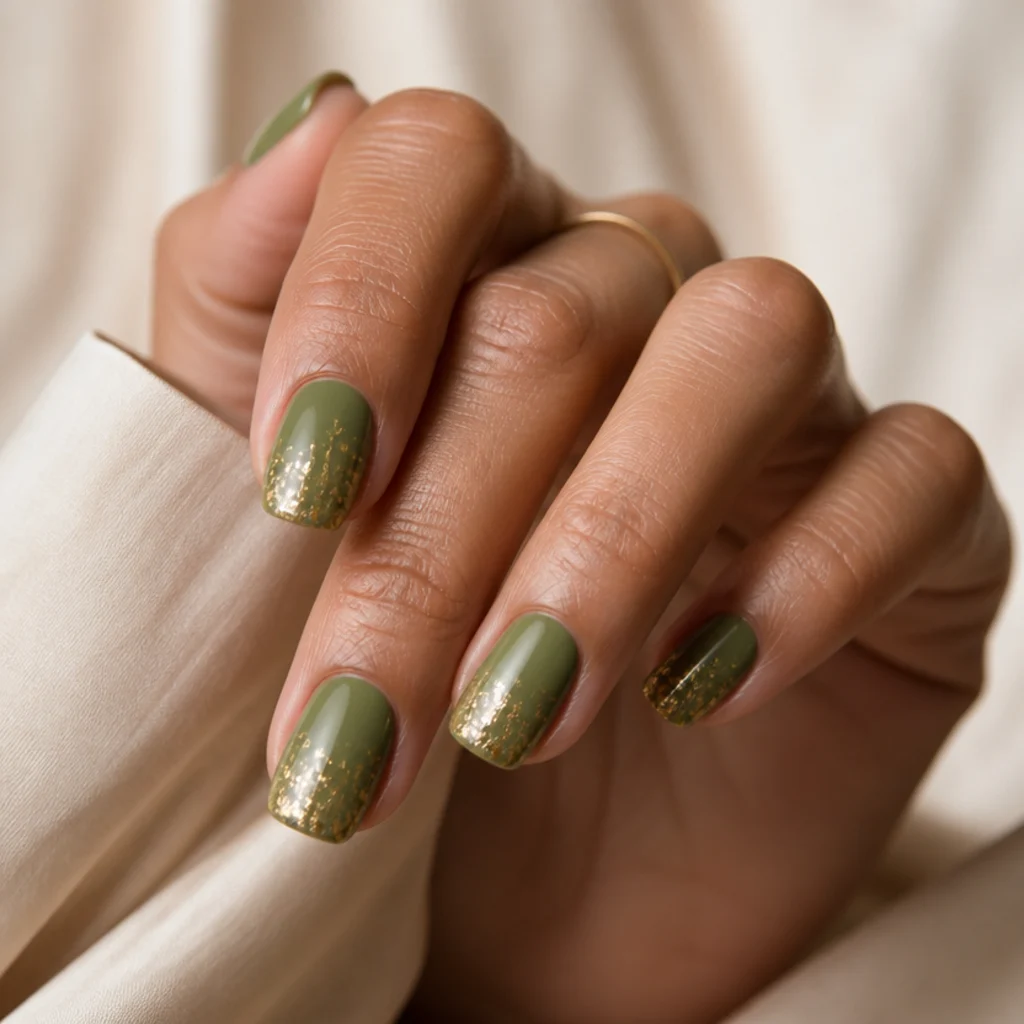
This is the easiest entry point, and the most forgiving. Start with a creamy mid-olive base with a yellow-grey undertone (not a cool blue-green), then press irregular gold foil flecks on while the gel's still tacky so they sit flush instead of proud. The scatter should look intentional but organic: heavier toward the free edge, thinning out near the cuticle, so the hand looks clean from across the room and only gives up the foil up close. It works at almost any length, but short-to-medium squoval keeps it desk-appropriate and snag-free, and suits wide or short nail beds since the vertical scatter draws the eye lengthwise. Foil is the first thing daily wear lifts, so ask for it sealed under two thin gel top coats rather than one thick dome, which yellows and shows every raised edge. Maintenance is low. Regrowth on a muted base stays quiet for two to three weeks, and a lost fleck just reads as patina, not damage. Pair it with warm yellow-gold jewelry to tie the whole hand together, and hand your tech a swatch of the exact olive so you land the right depth. Say "sparse gold leaf flecks, not full glitter" if you want to avoid a dense disco finish. Ask your nail tech for a light-hand scatter over a satin top coat if you want the foil to feel antique rather than shiny.
02Olive Green Chrome Nails
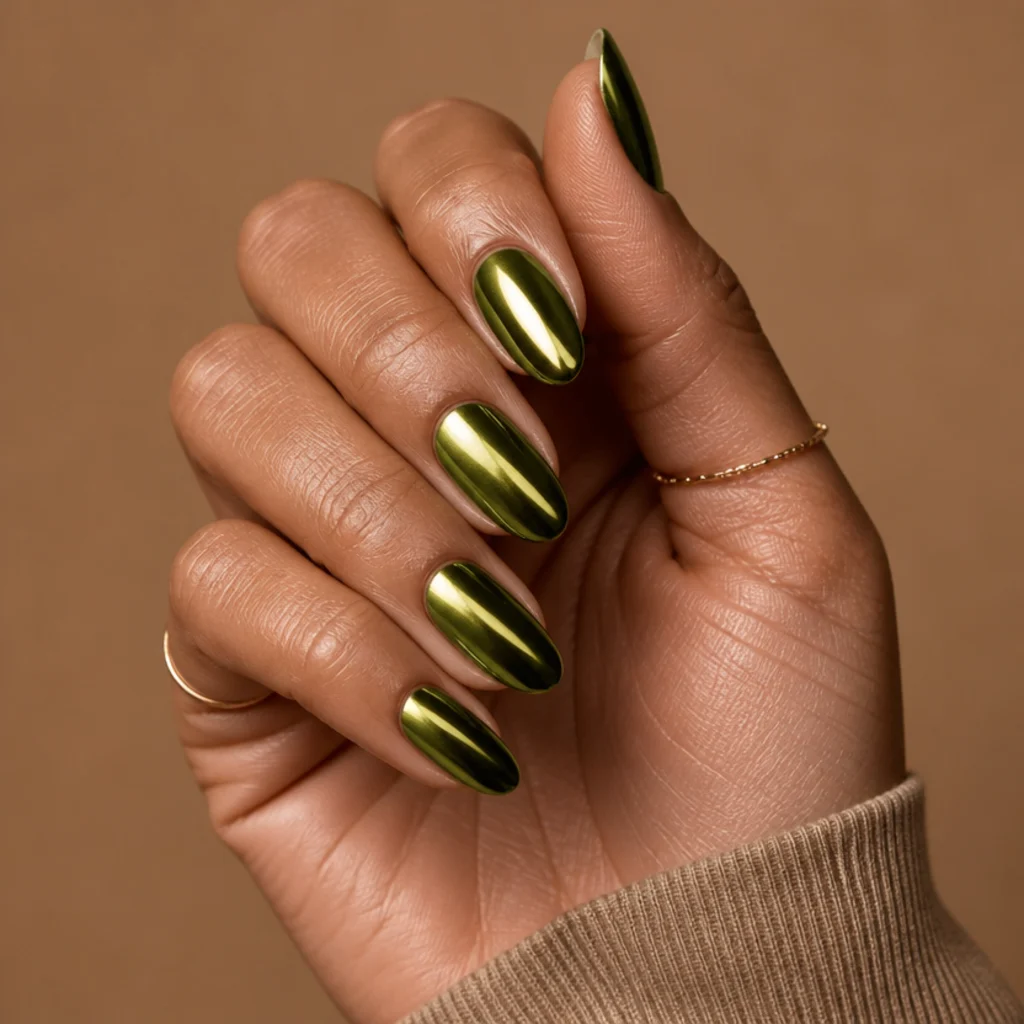
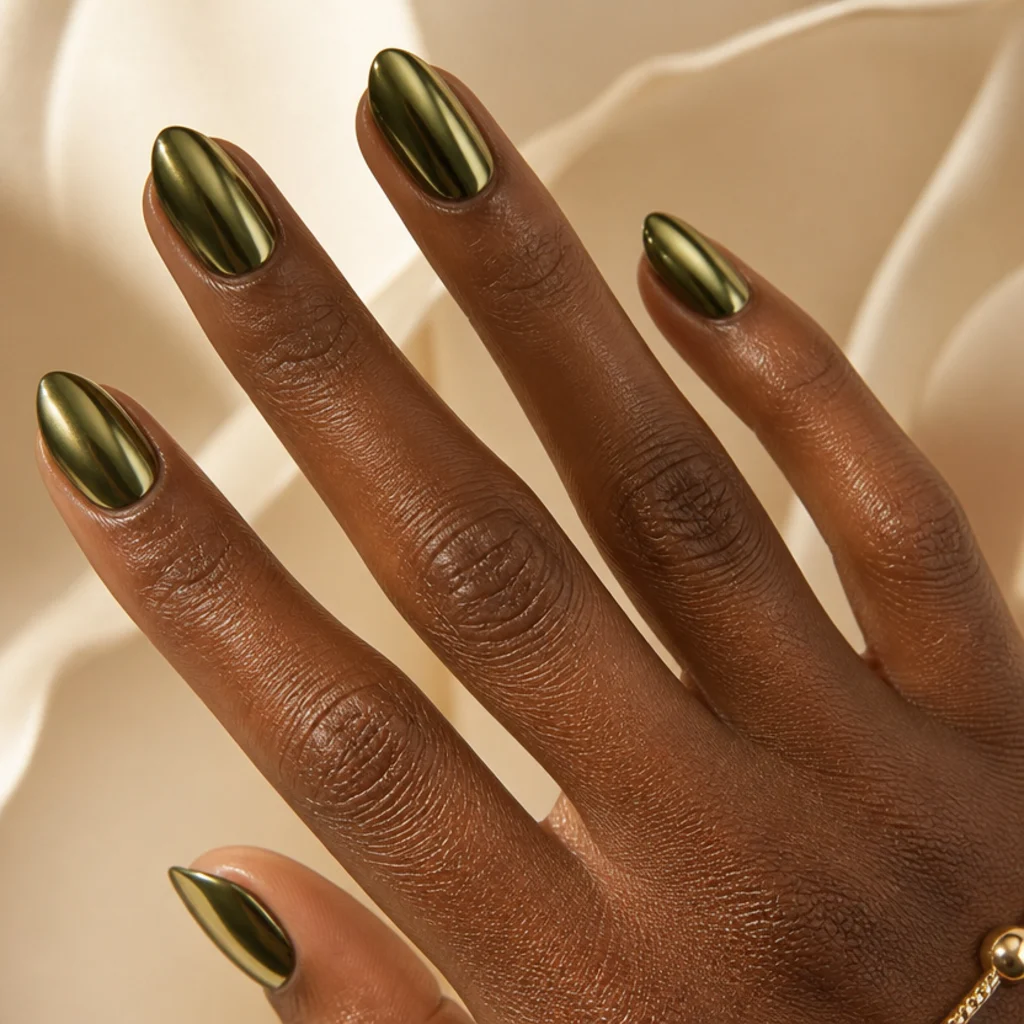
This is the showpiece of the palette, and the most-requested version by far. A chrome or aurora powder gets buffed over a cured olive gel base to build a liquid-metal mirror that swings between antique brass in direct light and deep moss in shadow. Almond and short coffin shapes bounce the reflection best, since a flatter, well-defined apex acts like a mirror; very curved, bitten, or heavily C-curved nails scatter the light and look duller. Any mirror finish amplifies texture, so every ridge, pin-dent, and file line shows through the metal. Prep matters more here than the powder brand does. Ask for a smoothing rubber base and a light buff before the chrome goes down, and request ridge-fill if your nails are naturally ribbed. Chrome then needs a compatible non-tacky top coat applied in one confident pass; over-brushing drags the powder and hazes the metal to a cloudy grey. Expect visible tip wear and slight dulling around day 12 to 14 (sooner if you type all day), so book a refill at two to three weeks. Chrome intensity varies a lot by brand, so bring a reference photo if you don't want a duller or brassier result than you pictured. Pair it with cool, minimalist gold rings so the mirror stays the hero. Ask your nail tech for "an olive base with gold-shift chrome powder, sealed with a chrome-safe top coat over a smoothed apex."
03Olive Green French Tip Nails
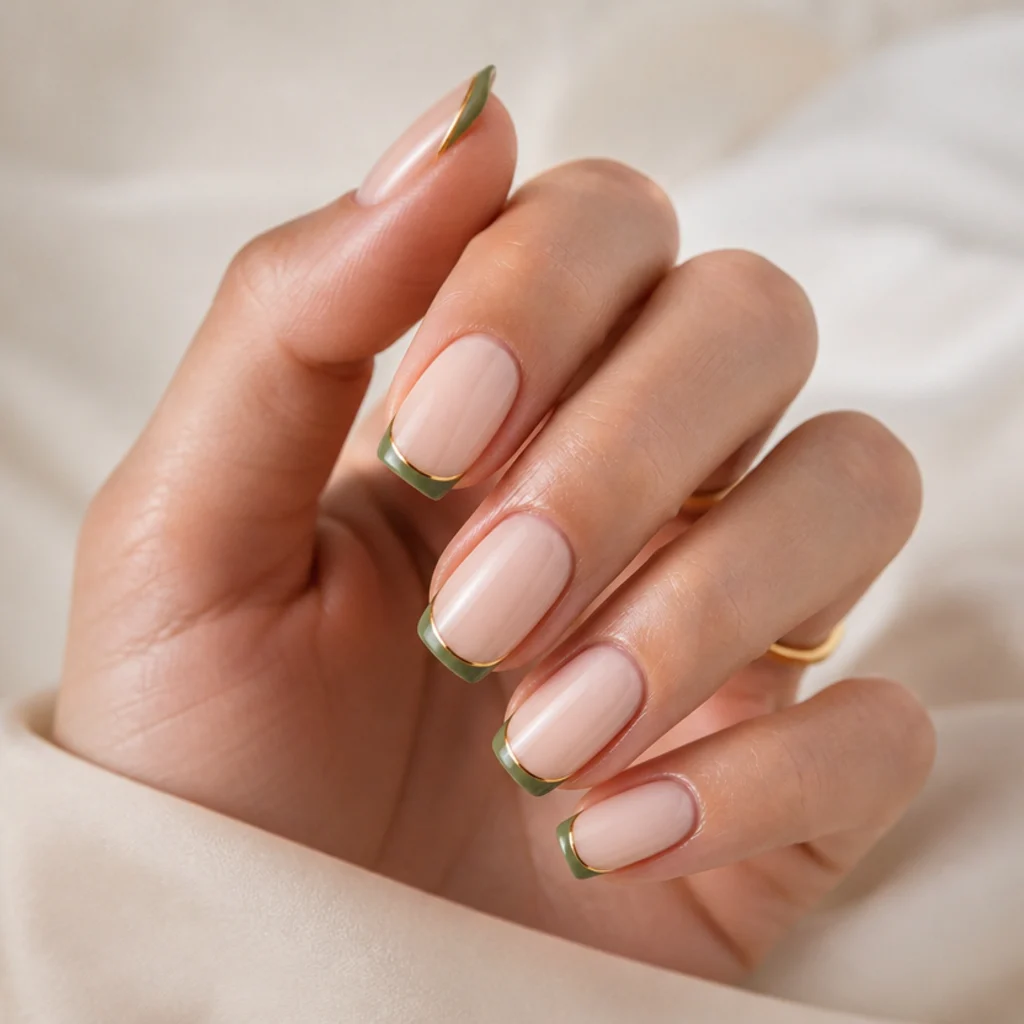
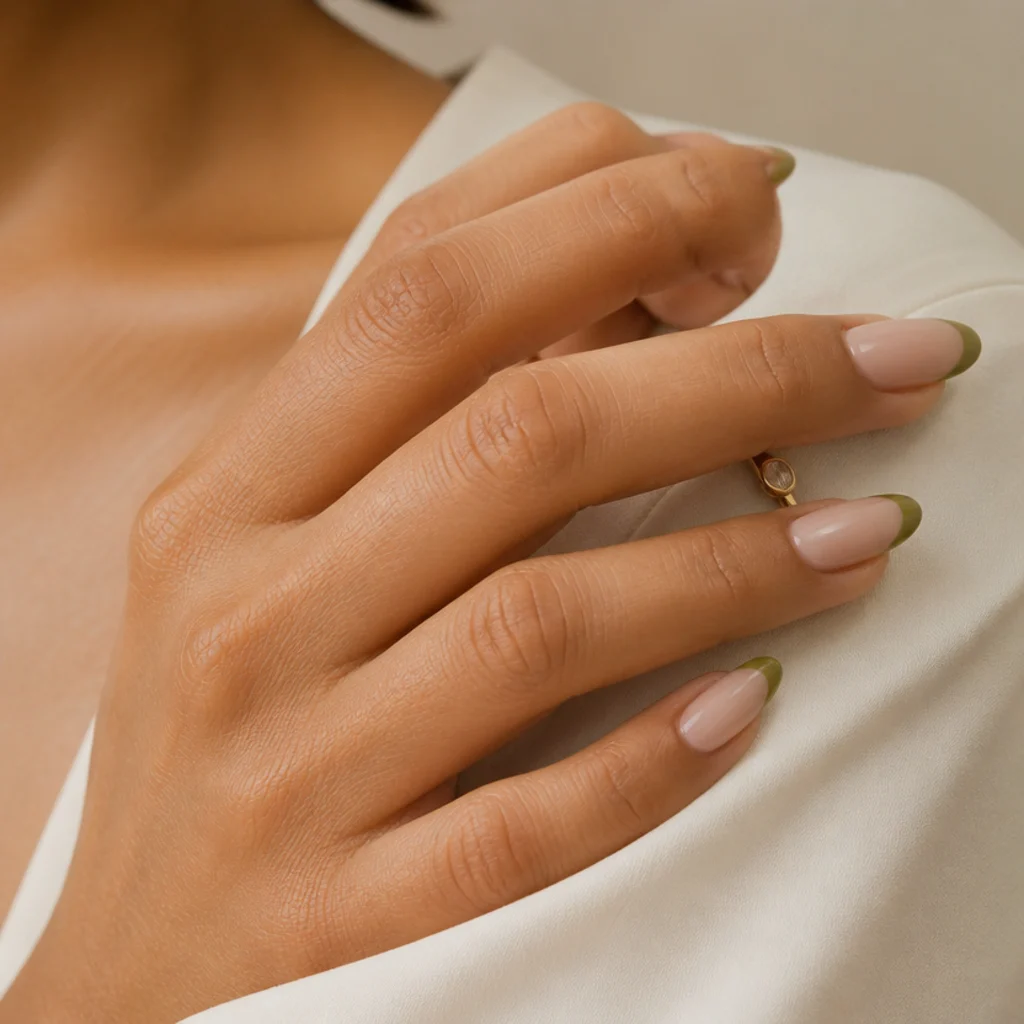
A modern take on the classic tip, and one of the most wearable looks on this list. Olive green french tip nails swap the stark-white smile line for a crisp olive edge, optionally traced with a hairline of gold that catches light and sharpens the border. Keep the base a sheer nude or milky wash so the olive stays the hero and the nail still reads natural at arm's length. The style suits longer squoval or almond nails, where there's room for an even, uncrowded band; on very short nails the tip eats the free edge and looks heavy, so scale the band down. Because the color lives at the tip while regrowth happens at the cuticle, this hides grow-out unusually well, a low-to-moderate upkeep choice good for two to three weeks. The one place it goes wrong is thickness, so ask for a slim band and a smile line that follows your natural free-edge curve rather than a dramatic deep V. The natural curve grows out cleaner and reads more expensive. Pair it with delicate gold jewelry to echo the outline. On narrow nail beds, angle the smile line slightly steeper at the sidewalls to lengthen the nail visually. Ask your nail tech for "a slim olive french tip with a fine gold outline, thin band, natural smile line."
04Dark Olive Green Nails with Gold Line Art
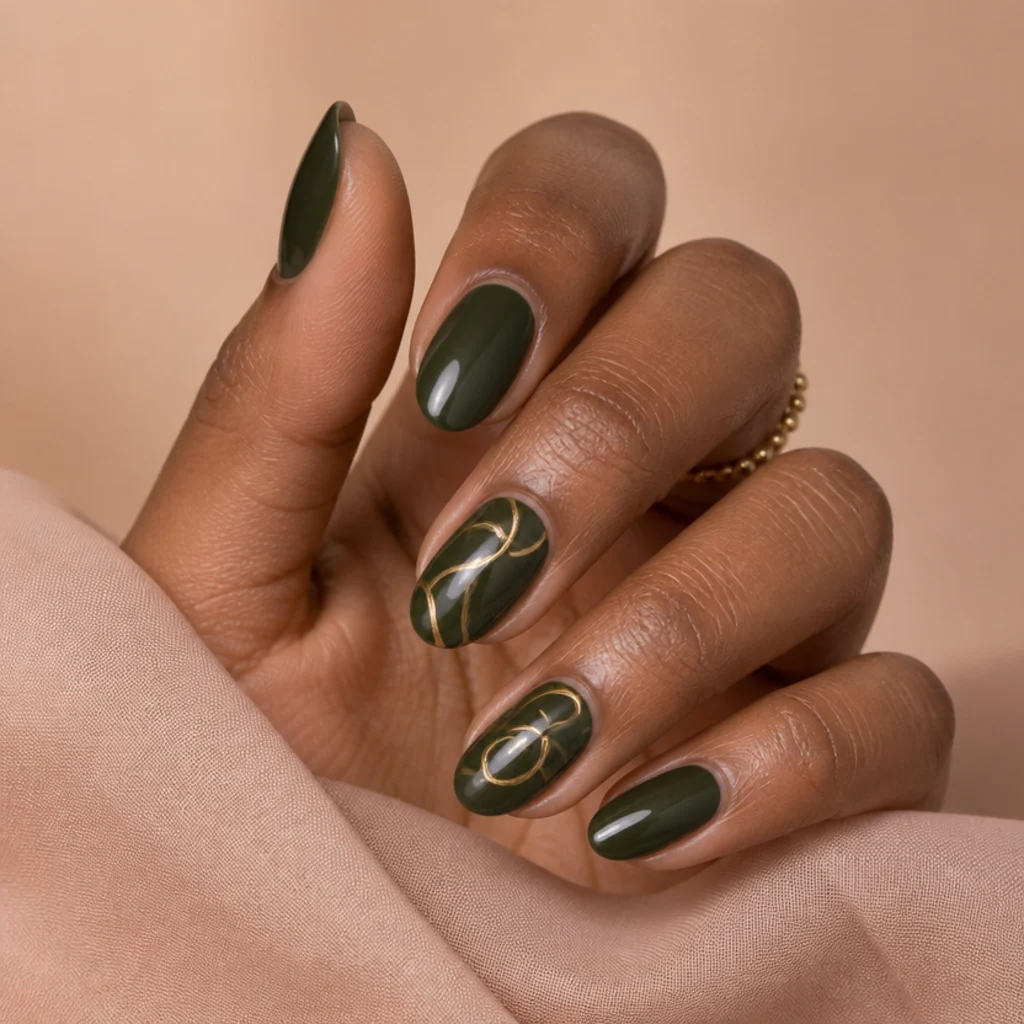
For something moodier, dark olive green leans almost forest-brown, close to a bottle-green softened with black, and gives thin gold linework a dramatic canvas. A confident tech freehands abstract lines, tiny arcs, or a single asymmetric stroke across one or two accent nails while the rest stay solid, using a fine detail brush and a true metallic gold, since a yellow shimmer disappears against the dark base. The contrast of deep, matte-leaning olive against bright reflective gold is striking on its own, no glitter needed, and that restraint is what keeps it looking grown-up. A color this saturated visually swallows very long extensions, so it flatters short-to-medium nails best, where the depth reads rich instead of heavy; almond is especially effective since it softens the drama. The gold detailing wears first, so it needs a durable, self-leveling top coat floated over the linework to stop it rubbing off at the raised ridges. Upkeep is moderate. Solid deep color shows cuticle regrowth a bit more than a pattern does, so plan a fill near two to three weeks. Pair it with antique-finish gold and deep autumn tones, and keep the art to one or two nails so the gold reads intentional, not busy. Ask your nail tech for "the darkest olive you carry, with hand-painted fine gold lines on the ring and index only."
Save this to Pinterest to build your olive-and-gold mood board.
05Olive and Gold Marble
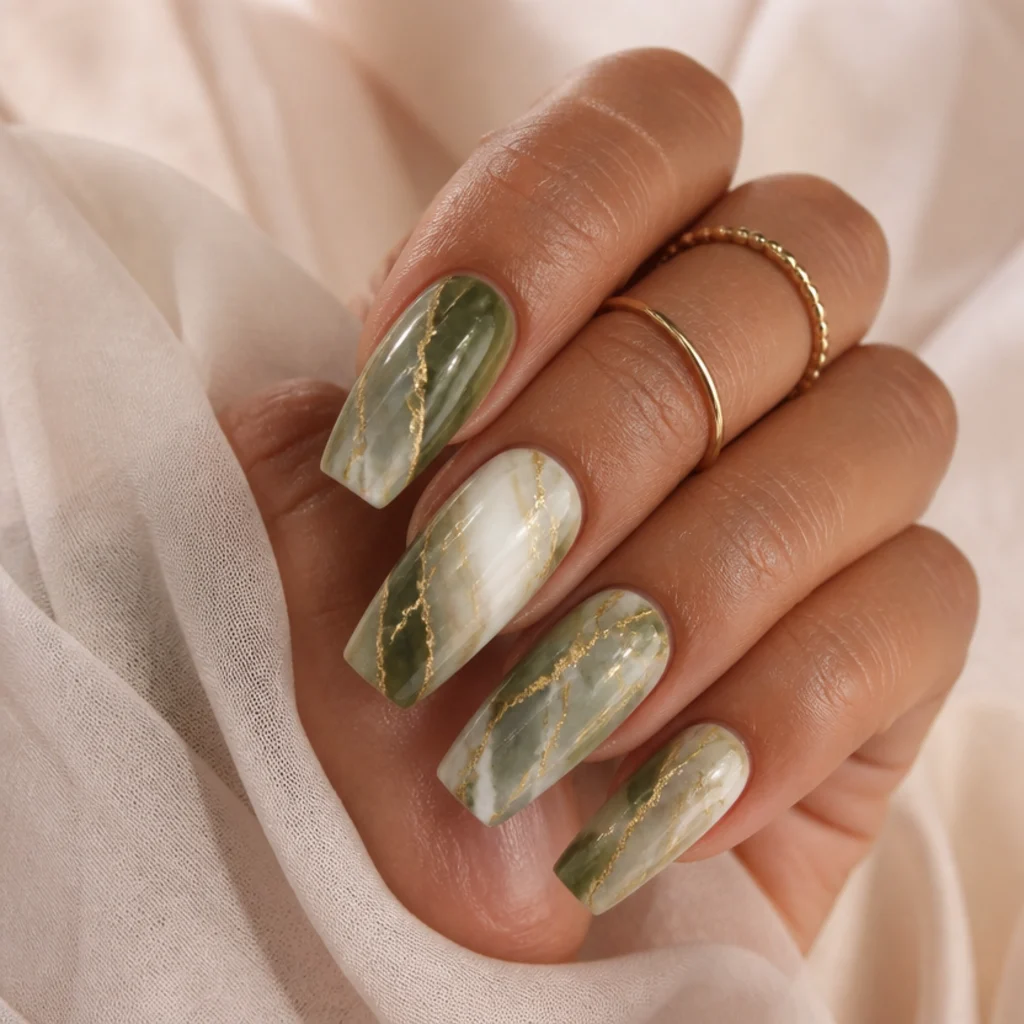
Marbling blends olive, cream, and a whisper of grey, then draws veins of metallic gold through the wet layers with a fine brush or a needle, so the metal looks fused into the stone instead of sitting on top. No two nails match — that's the whole appeal, and it means small asymmetries read as luxury rather than error. The effect mimics polished marble or serpentine and needs surface area to flow across, so coffin, long squoval, or a broad almond carry it best; the pattern crowds and muddies on short or narrow nails. It's built wet-on-wet across several passes, which makes it one of the more time-intensive designs here, so book extra chair time and expect a longer set, often 30 to 45 minutes beyond a solid application. The payoff is easy upkeep: a busy, non-repeating pattern hides regrowth and minor wear for the full two to three weeks. Pair it with a single slim gold band ring so the hand doesn't compete with the veining, and ask for the gold to stay sparse and directional, following one diagonal, not a web across the whole nail. That restraint is what separates elegant stone from tie-dye. Ask your nail tech for "olive-and-cream stone marble with thin, directional gold veining, varied intensity per nail."
06Soft Sage-Olive Ombre
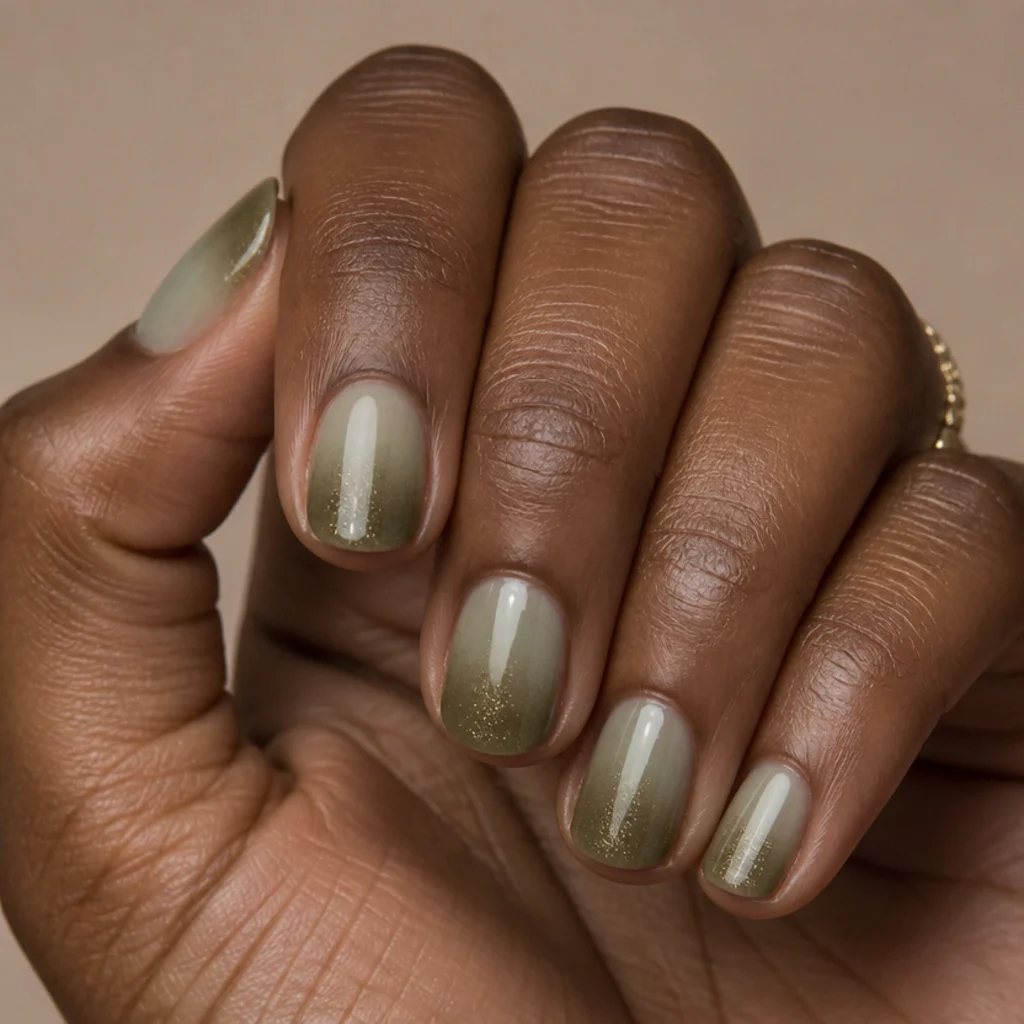
The gentlest, lowest-commitment entry here, and probably the most universally flattering. This fades from pale sage at the cuticle to a deeper olive at the free edge, finished with a barely-there gold shimmer dusted only over the tip so it catches light without turning glittery. The airy sage end is what makes it work across undertones, including cool complexions that usually find full olive too warm, since the desaturated top keeps the whole nail light and low-contrast against pale skin. Short round or squoval shapes keep it delicate and everyday; you could wear this to a job interview or a conservative office without a second thought. Vertical gradients also hide regrowth well, since the cuticle color is the palest point, so it stretches comfortably to three weeks before it looks grown out. It's built by sponging or airbrushing the two tones and blending the seam, so ask for a smooth transition with no visible band or sponge stipple. Pair it with thin gold hoops and a warm neutral wardrobe, and ask for the darkest point to stop just short of the very tip so a sliver of gold shimmer frames the free edge instead of blending into the olive. Ask your nail tech for "a sage-to-olive vertical ombre with a light gold shimmer on the tips, seamless blend, no visible band."
07Olive Matte with Gold Cuticle Cuff
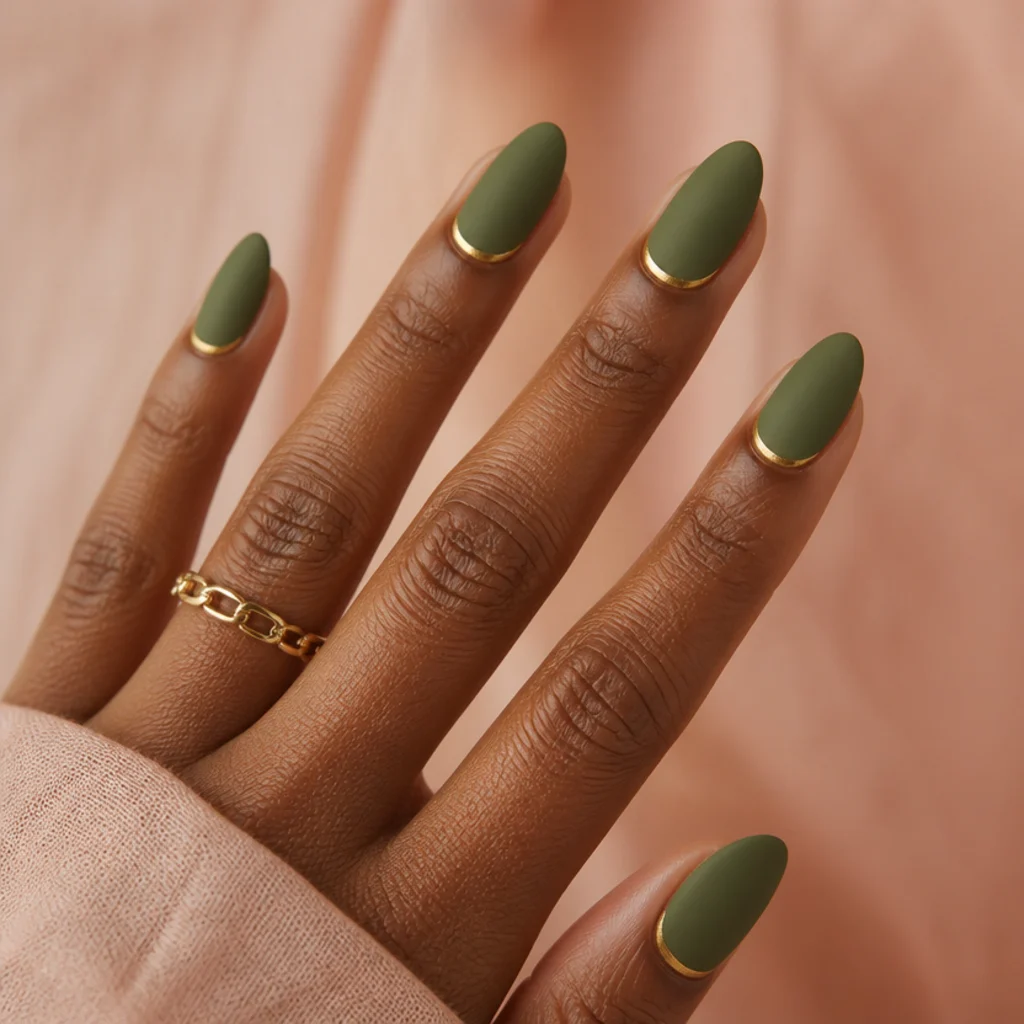
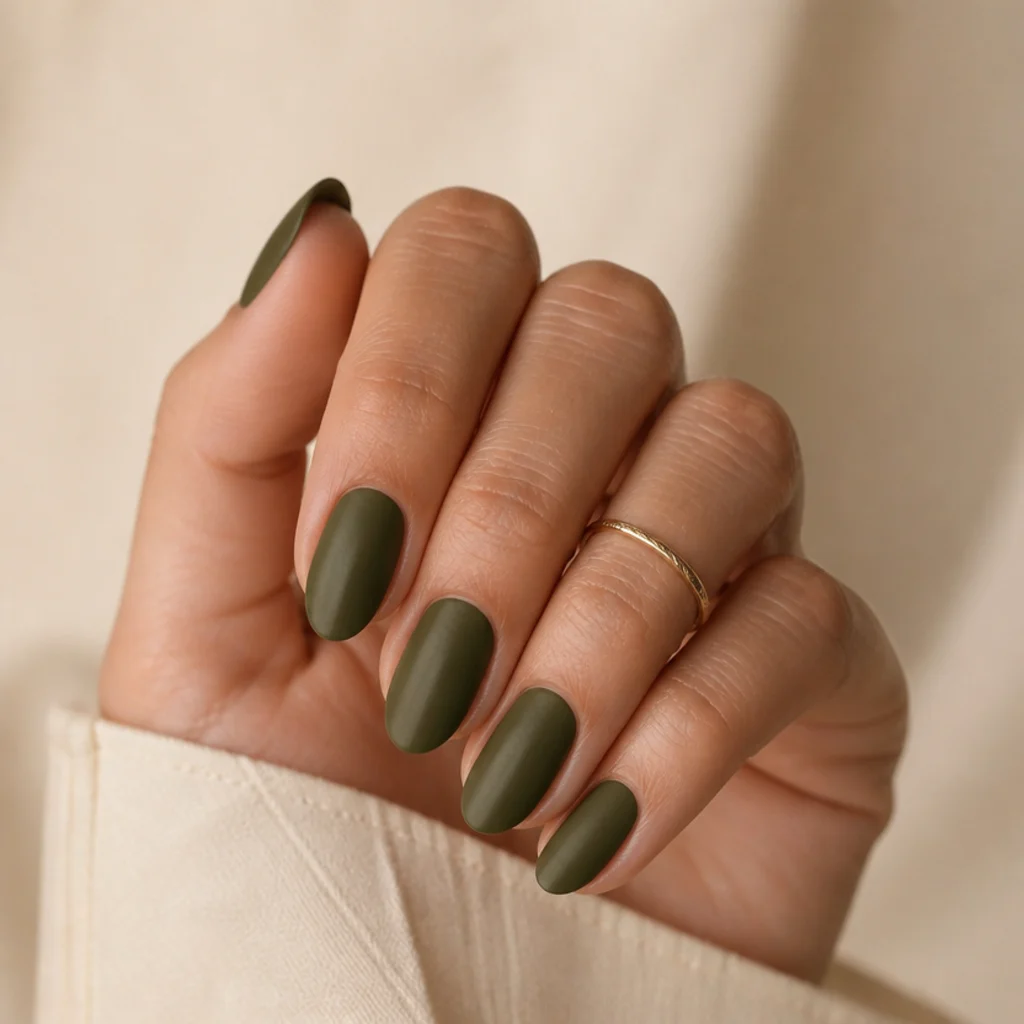
Matte olive turns the color velvety and modern, and a slim gold cuff hand-painted along the cuticle line finishes it like a piece of jewelry without covering the nail. The contrast between the flat, light-absorbing olive and the single reflective band is quiet but reads expensive, the kind of look for anyone who wants one deliberate detail rather than full nail art. It suits medium almond or squoval nails, where the cuff can follow a clean curved cuticle and read as inlay; on very short or bitten nails there isn't enough exposed plate to balance the band. The trade-off is that matte top coats lose their velvet as skin oils and hand cream build up, so the finish glosses unevenly over time. A quick matte re-coat around week two keeps it looking fresh. A cuff also demands a steady hand; a sticker version lifts at the edges and reads cheap up close. Pair it with a single stacked gold ring so the cuff echoes rather than competes, and keep the cuff thin, roughly a millimeter, so it looks like an inlaid line rather than a painted stripe. Ask your nail tech for "matte olive with a fine hand-painted gold cuticle cuff, and confirm it's freehand, not a sticker."
08Gilded Olive Almond Nails
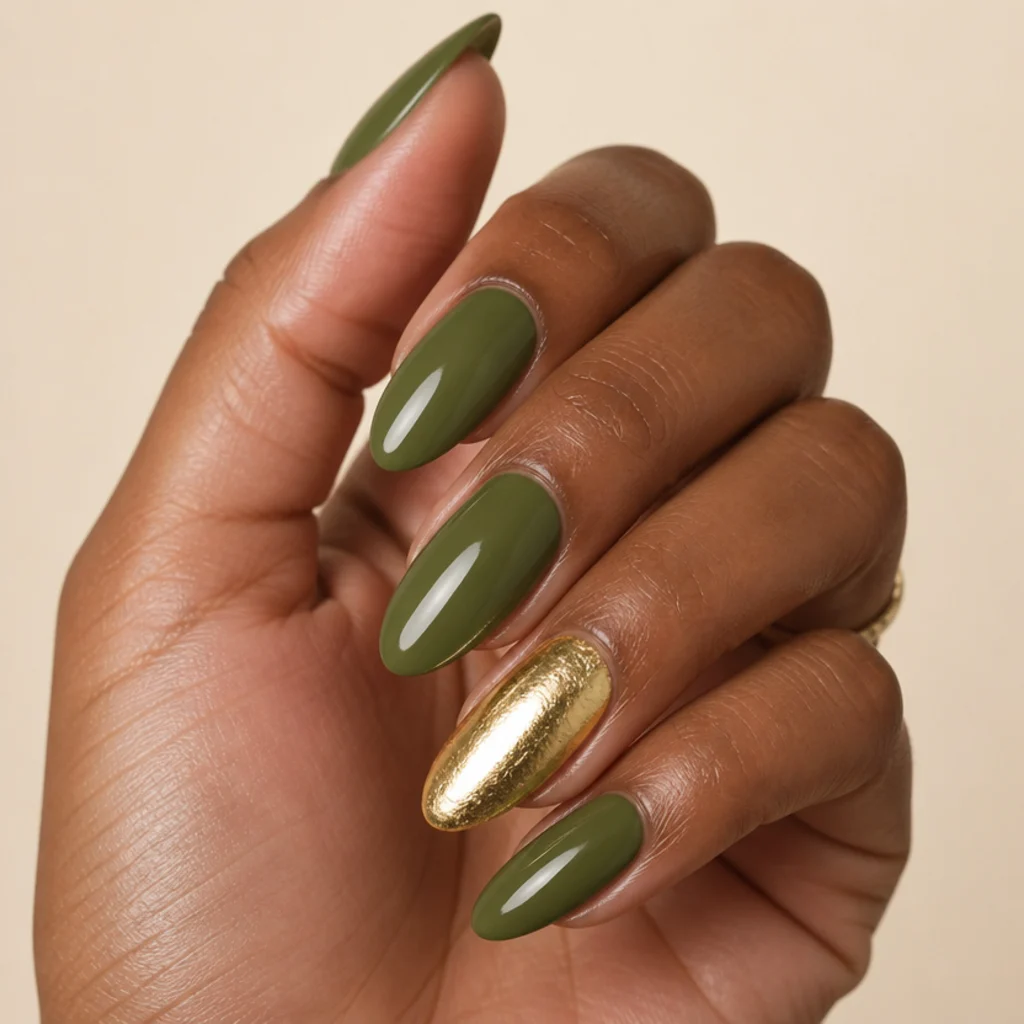
Here the gold takes the lead on a single fully gilded accent nail while the rest stay solid olive, a high-impact look that stays balanced because the surrounding muted green grounds all that shine. Long almond nails give the gold finger a slender, elegant footprint; on short or wide nails the full sheet of leaf can flatten into a foil-sticker look. The technique layers real or imitation gold leaf over an adhesive gel, then burnishes it flat with a soft tool before sealing. That flattening step is what separates a jewel-like finish from a crumpled, cracked one. The gilded nail is also the fragile one, since raised leaf lifts at the free edge, so it needs a thick, fully encapsulating top coat and a little daily care. Don't use that nail as a tool. This reads polished enough for events and weddings and photographs well with rings. Upkeep is moderate; the leaf nail usually needs attention before the four solid nails do. Pair it with warm gold jewelry, and skip competing silver tones. Place the accent on the ring finger, where it sits alongside rings and draws the eye without dominating the hand. Ask your nail tech for "solid olive on four nails and a full gold-leaf accent on the ring finger, burnished flat and fully sealed."
09Olive Green Aura Nails
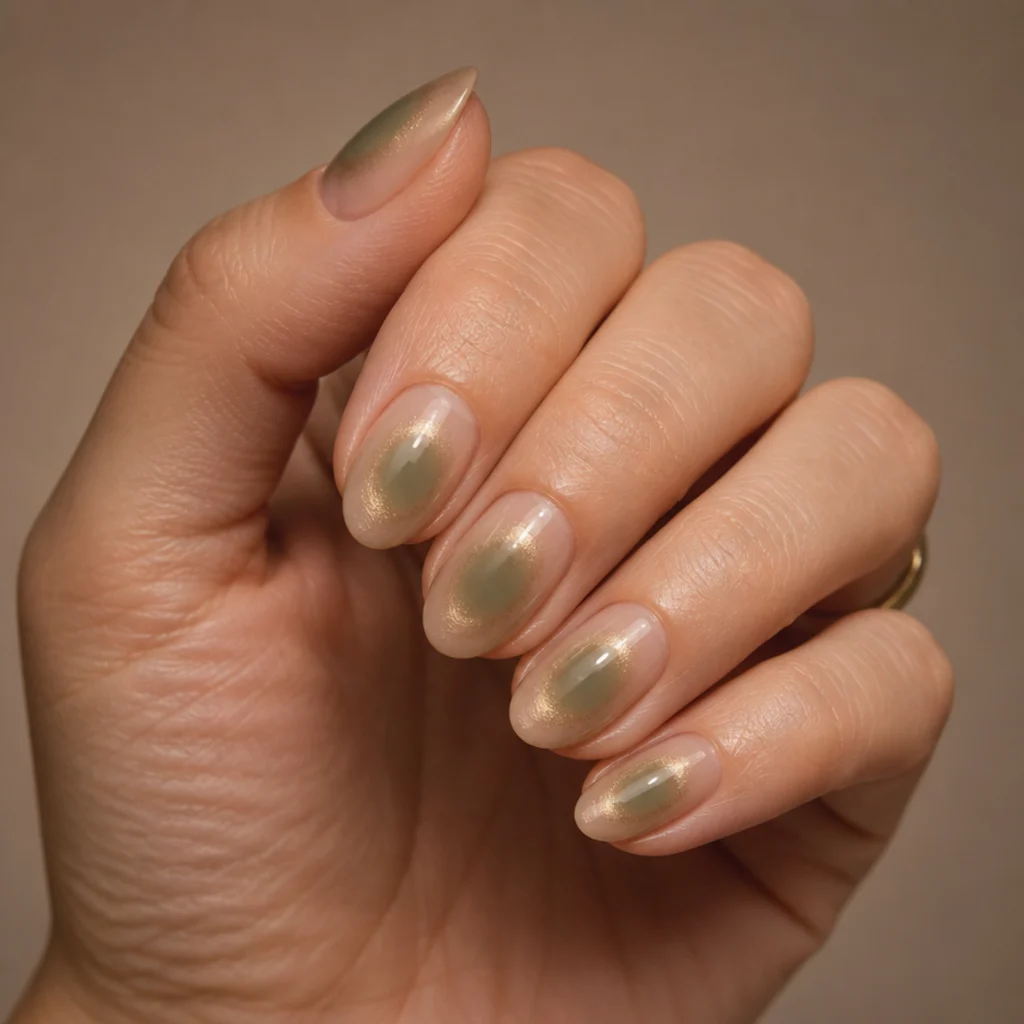
Aura nails float a soft, airbrushed halo of olive at the center of each nail over a sheer nude base, with an optional dusting of gold mist ringing the glow so it looks backlit. The blurred, diffused effect feels dreamy and photographic rather than graphic, one of the few designs here that looks better in motion and soft light than it does flat on a color chart. It reads best on short-to-medium almond or round nails, where the rounded apex helps the halo sit centered and radial instead of lopsided. Because the color pools in the middle and fades to bare nail at the edges, regrowth is nearly invisible, which makes this one of the lowest-maintenance designs in the guide, easily good for three weeks. The look lives or dies on airbrush control, so book a tech who does aura work regularly rather than as a first attempt, and confirm they use an airbrush rather than a sponge, which reads coarser. Pair it with barely-there gold jewelry so nothing competes with the glow, and bring a reference showing exactly how intense you want the center, since aura ranges from a faint breath of color to a saturated bloom. Ask your nail tech for "a centered olive aura over nude with a light gold halo, soft and diffused, airbrushed."
10Micro-French Olive Tips
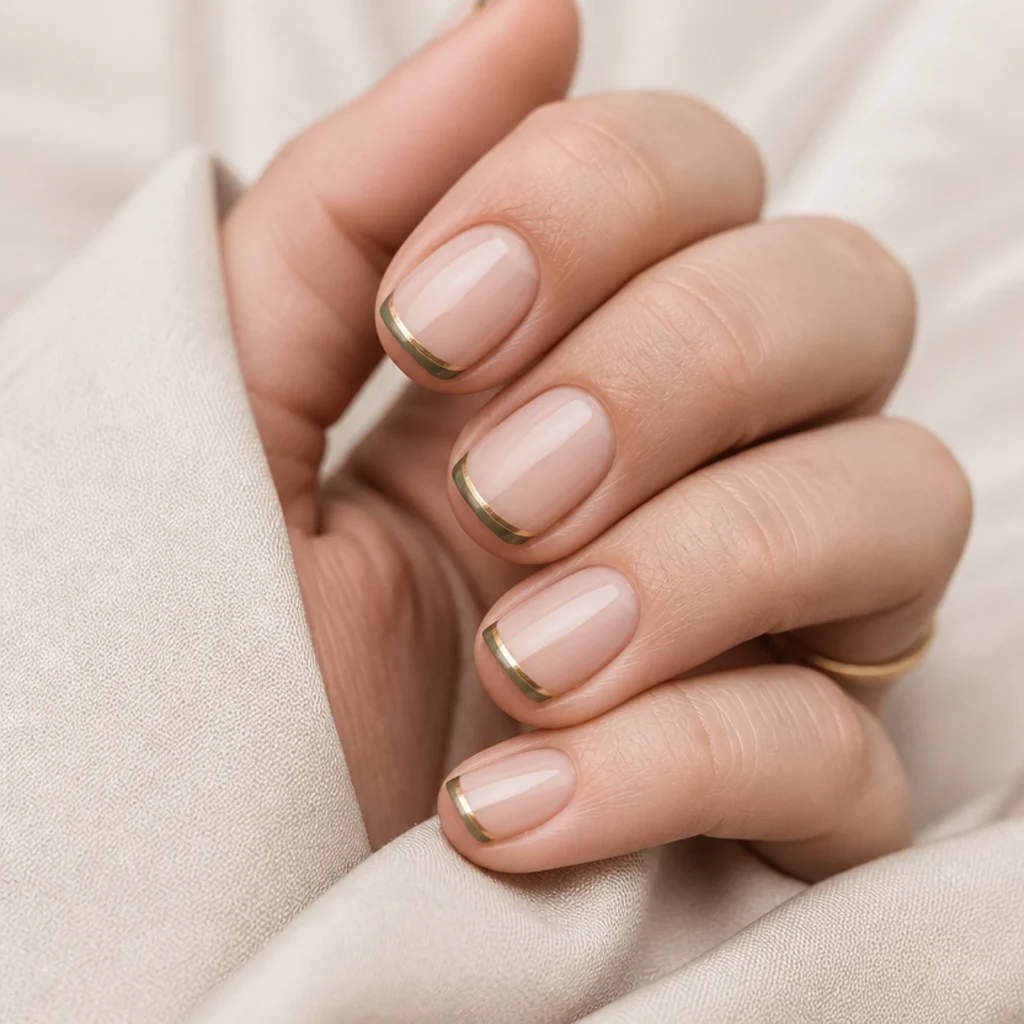
The quietest look on this list, and the most office-proof. A micro-french lays an ultra-thin olive line right at the free edge, so fine it reads almost like a natural nail with a tinted rim, optionally underlined with a hairline of gold for a barely-there glint. It's understated color, full stop. Good for anyone in a conservative workplace or anyone easing into green for the first time without committing to full coverage. Short squoval or round natural-length nails suit it best; the whole point is restraint, so extra length works against it. Because both the color and the metal sit at the very tip, regrowth stays discreet and upkeep is minimal, often lasting the full three weeks with no obvious grow-out. The only real skill is keeping the line even and hair-thin around the entire edge, including the sidewall corners where techs tend to thicken it, so pick someone comfortable with fine brushwork. Pair it with any jewelry at all, since the look is deliberately neutral, and ask for the line to hug the exact shape of your free edge rather than a straight bar. That's what makes it look grown-in rather than applied. Ask your nail tech for "the thinnest possible olive micro-french with a fine gold underline, even at the corners, barely there."
Save this to Pinterest if you love a subtle, wearable manicure.
11Olive and Gold Leaf Botanicals
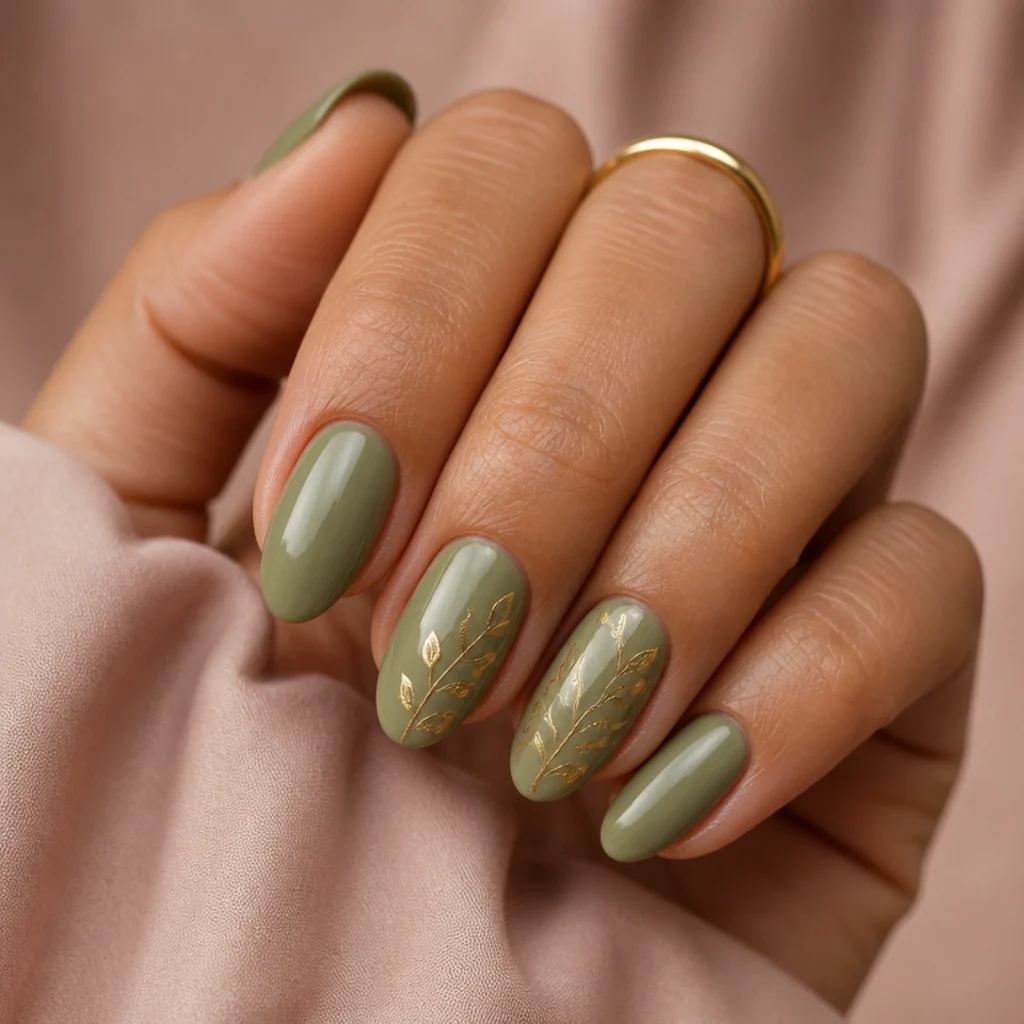
Leaning into olive's herbal, garden feel, this design scatters delicate gold botanical sprigs — tiny leaves, stems, buds — across one or two accent nails over a soft olive base. Hand-painted metallic gold gives the botanicals a pressed-leaf, keepsake quality that suits weddings, autumn, and anyone who likes a nature reference without going literal. It sits best on medium almond nails, which offer a small canvas for legible detail without crowding the sprig; on very short nails the motif shrinks past readability and turns into gold specks. The fine linework is the demanding part, so choose a tech who actually enjoys detail brushwork, and expect the art to need a careful, self-leveling top coat so the slightly raised gold doesn't catch and wear at the edges. Upkeep is moderate, roughly two to three weeks, with the plain nails aging more gracefully than the painted accents. Pair it with earthy tones, small gold studs, and a warm manicure oil to keep the surrounding olive from dulling, and keep the botanicals to two nails maximum so the design reads as an accent rather than a full garden. Ask your nail tech for "a soft olive base with thin gold leaf-and-stem botanicals on two accent nails, the rest solid."
12Deep Olive Croc Texture
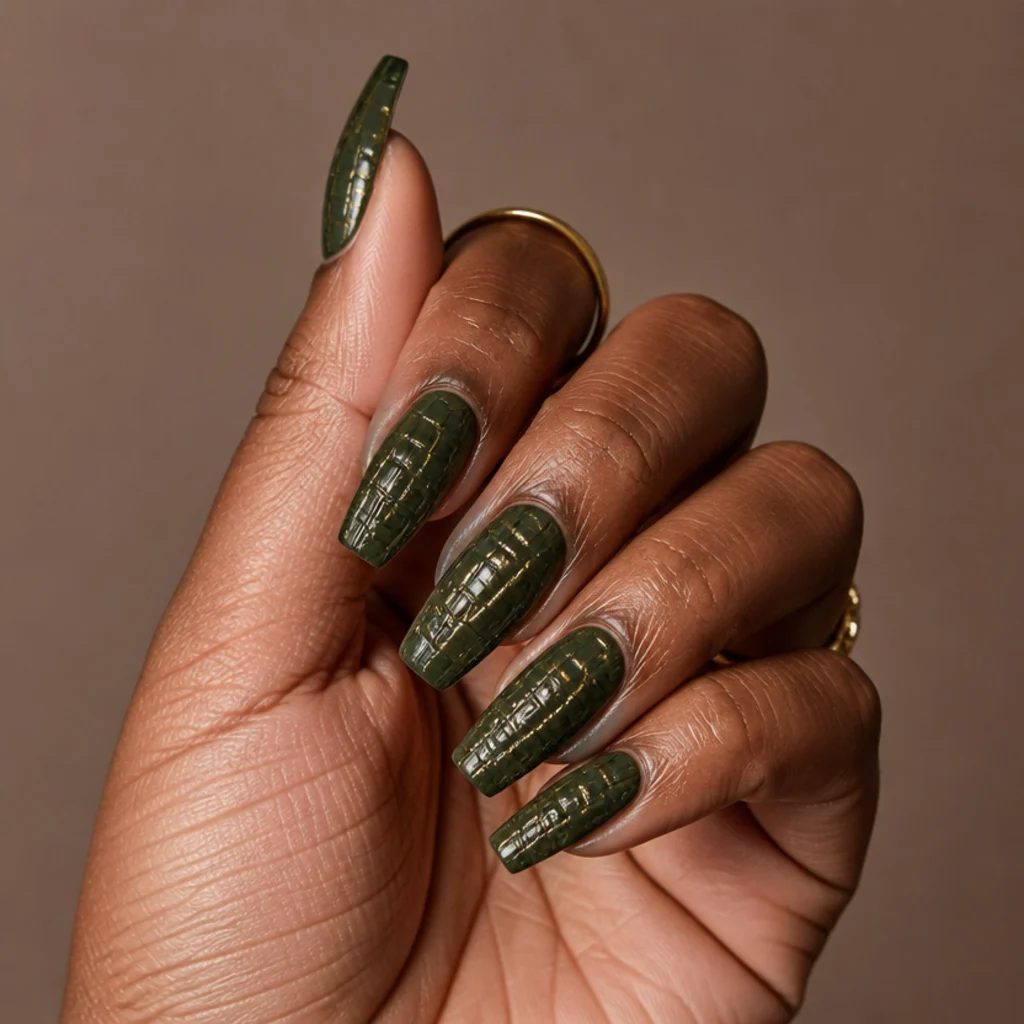
A tactile, dimensional option for anyone bored of flat color: a deep olive base worked into a subtle crocodile-skin pattern, with faint gold catching only the raised scales so the texture reads embossed, like fine leather. It's luxe and a little unexpected for a manicure, and the dark olive keeps it from tipping into novelty. It works on medium coffin or squoval nails, where the repeating scale pattern has room to sit evenly across a broad, flat surface instead of distorting around a tight curve. The main practical caveat: any raised texture snags on hair and fabric, so ask for a generous glossy top coat that fills between the scales and seals the surface smooth on top while the pattern still catches light beneath. This is a statement set, best saved for when you want something clearly different, not an everyday default. Upkeep is moderate; the busy texture hides wear, but a lifted edge can catch and peel, so keep cuticle oil handy. Pair it with heavier gold jewelry and structured autumn textures, and ask for the gold to stay in the recesses only, not brushed over the whole nail, so it reads as patina rather than glitter. Ask your nail tech for "dark olive croc-skin texture with gold in the recesses, sealed smooth on top."
13Olive Jelly with Gold Flake Suspension
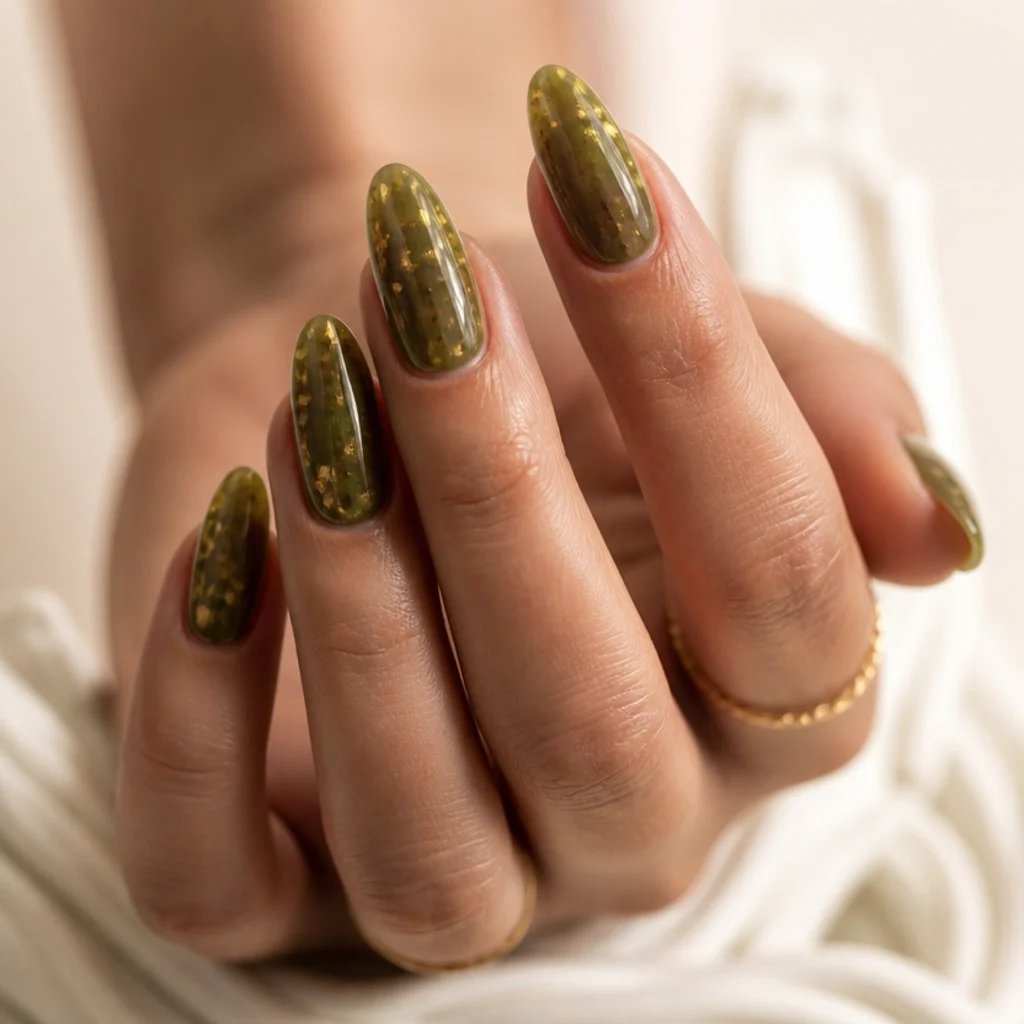
Jelly finishes are translucent by design, so this layers a sheer olive gel with real gold flakes suspended between the coats, giving depth like tinted glass with metal floating inside it. The see-through quality keeps an earthy green feeling light and summery, so it's the olive-and-gold version to reach for in warm months and on holiday. Medium almond or round nails let light pass through the free edge and make the suspension actually glow; opaque shapes and very thick applications kill that translucency. The technique is all about patience: color builds through translucent layers, so a rushed application looks patchy and streaky, and it wants unhurried, individually cured coats. The sheerness does mean cuticle regrowth shows a little sooner than an opaque color would, so plan a fill closer to two weeks if you want it pristine. Pair it with warm gold and a light summer palette that lets the glow read, and ask for the gold flakes to sit at different depths across the coats rather than all in one layer, so they read as suspended in glass instead of stuck on the surface. Ask your nail tech for "a sheer olive jelly with gold flakes suspended between the layers, and extra coats if I want richer color."
14Half-Moon Olive and Gold
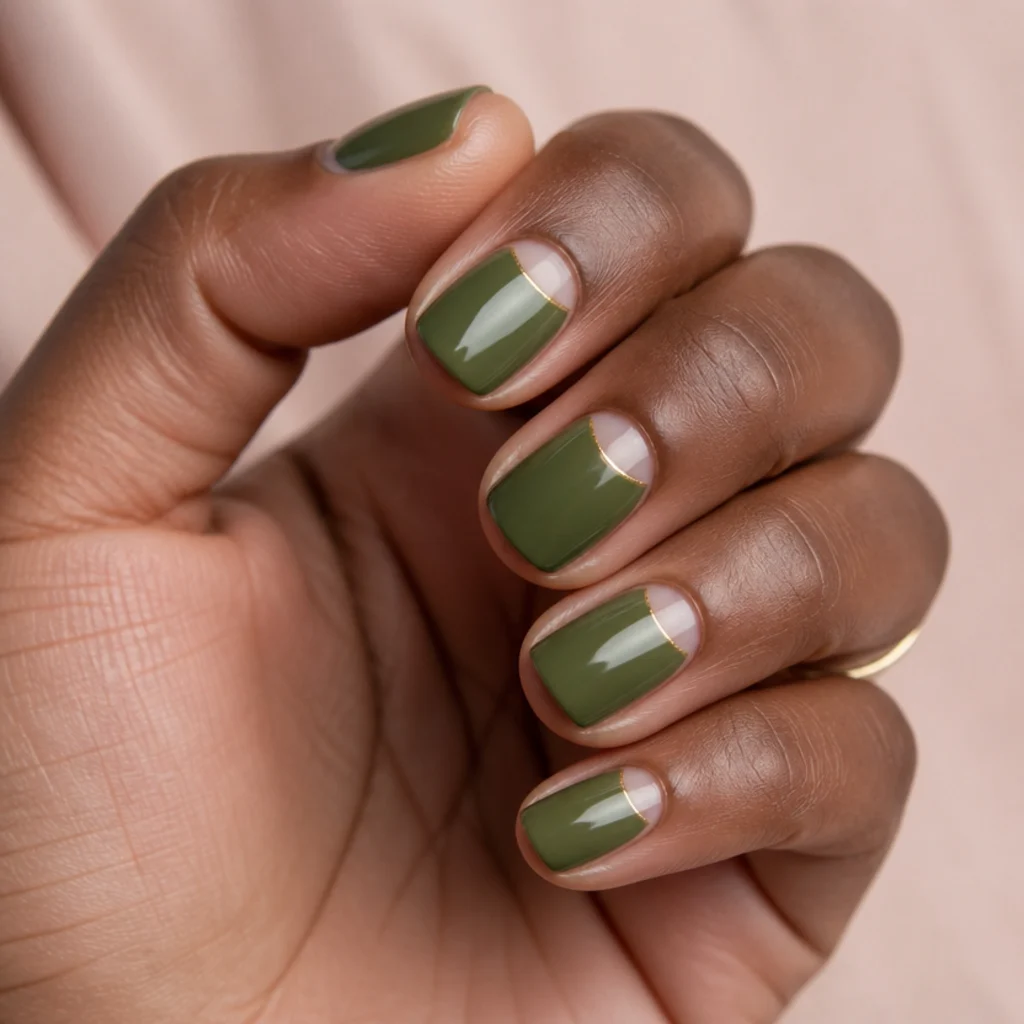
A retro-leaning graphic look that reads deliberately vintage: the nail body stays solid olive while the half-moon at the base is left as negative space and outlined in a crisp gold arc. The clean geometry feels intentional and a little Art Deco, and the single gold line ties it back into the rest of the palette without any glitter. Short-to-medium squoval nails frame the half-moon most cleanly, since a flatter, wider cuticle line gives the arc a clear, even sweep; a very curved cuticle makes the moon look pinched. This is a precision look. It lives entirely on the quality of the line, and a wobbly or asymmetric moon undoes the whole thing, so book a tech confident in sharp freehand or clean guide work. Upkeep is moderate and slightly self-defeating on the moon itself, since the negative-space base shows regrowth as the natural nail grows past the arc. Pair it with vintage-inspired gold and a monochrome outfit that lets the graphic read, and keep the moon shallow, following your real cuticle curve, so grow-out reads as a slightly larger moon rather than a mistake. Ask your nail tech for "an olive body with a negative-space half-moon and a thin, even gold outline."
15Olive Green Stiletto with Gold Chrome Ombre
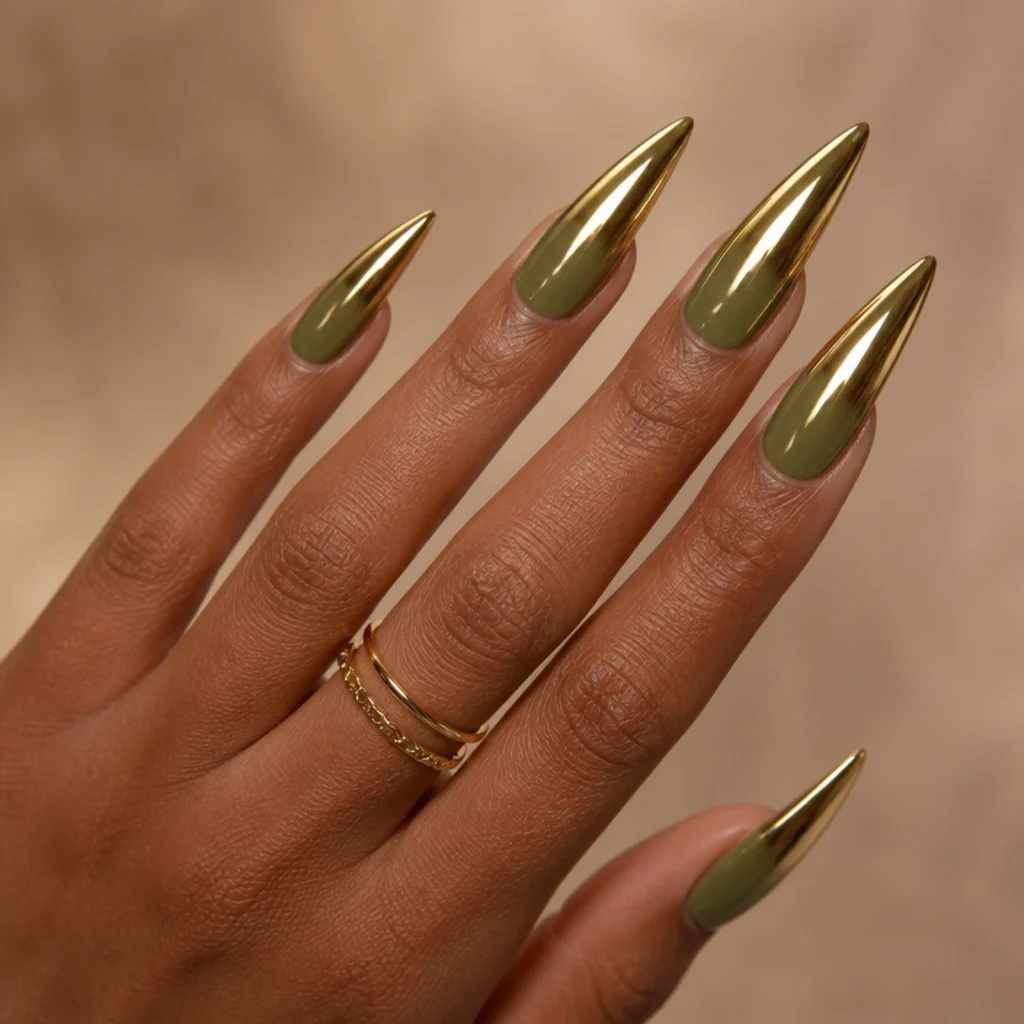
The most dramatic finish to close on: long stiletto nails in solid olive that melt into a gold chrome ombre toward the pointed tips, putting all the shine exactly where the eye lands. The metallic gradient gives a fierce, editorial edge and photographs like a campaign, the show-stopper of the set, not an everyday choice. Stilettos take real upkeep, length, and care, so they suit people already comfortable with a bold, pointed shape and willing to protect the fine tips from daily knocks. It's the most involved look here technically: the chrome section needs a flawlessly smooth base, since the point magnifies every ridge and file mark, plus a chrome-safe top coat floated on without over-brushing, or the mirror hazes to grey at the very tip. Both the length and the metallic tips take constant daily abuse, so the extensions need refills every two to three weeks, and the chrome dulls at the point first, so schedule a top-coat refresh mid-cycle. Pair it with statement gold and a monochrome look that lets the nails dominate, and ask for the chrome to start around the upper third and fade toward the middle so the gradient looks dipped rather than banded. Ask your nail tech for "an olive stiletto with a gold chrome ombre fading from the tip toward the middle, on a smoothed base."
Pro Tips from the Editor
- Match the gold to the mood, not just the green. Foil and pressed leaf read bohemian and warm; mirror chrome and fine linework read sleek and modern. Choosing the wrong gold is the most common reason a set looks off even when the olive shade is exactly right.
- Undertone-check your olive against your wrist, not your face. If your veins read green, warm yellow-olive sits beautifully; if they read blue, drop to a greyer sage-olive so the color complements rather than clashes with cool skin.
- Two thin top coats beat one thick one on anything metallic. Foil, leaf, and chrome lift and yellow under a single heavy layer, while thin, individually cured coats stay flush and hold their shine days longer.
- Prep is the whole game on chrome and croc. Both amplify surface texture, so a ridge-fill base and a light buff before powder do more for the result than the powder brand ever will.
- Put art and accents on the ring finger. It photographs alongside rings, draws the eye naturally, and keeps a bold detail from overwhelming the whole hand.
- Book chair time honestly. Marble, aura, botanicals, croc, and gold leaf run 30 to 60+ minutes beyond a solid set, and a rushed version of any of them looks patchy or crooked.
- Schedule the top-coat refresh, not just the fill. Chrome, foil, gilding, and ombre tips dull around day 10 to 14; a quick re-gloss then buys you the back half of the wear window.
Finish and Upkeep at a Glance
| Look | Best shape / length | Skill level | Realistic wear |
|---|---|---|---|
| Gold foil flecks | Short-medium squoval | Intermediate | 2-3 weeks |
| Olive chrome | Almond, short coffin | Advanced | 2 weeks to refresh |
| French / micro-french | Long or short squoval | Intermediate | 2-3 weeks |
| Dark olive line art | Short-medium almond | Advanced | 2-3 weeks |
| Marble | Coffin, long squoval | Advanced | 2-3 weeks |
| Sage-olive ombre | Short round/squoval | Intermediate | Up to 3 weeks |
| Matte + gold cuff | Medium almond | Intermediate | Re-matte at wk 2 |
| Gold-leaf accent | Long almond | Advanced | 2-3 weeks |
| Aura | Short-medium almond | Advanced | Up to 3 weeks |
| Jelly + gold flake | Medium almond/round | Intermediate | ~2 weeks pristine |
| Croc texture | Medium coffin | Advanced | 2-3 weeks |
| Half-moon | Short-medium squoval | Advanced | 2-3 weeks |
| Chrome stiletto ombre | Long stiletto | Advanced | 2-3 week refills |
How to Choose / Get the Look
Start with depth, because it drives every other decision. If you want a set you won't tire of, a soft sage-olive or a muted mid-olive is the safest bet and flatters the widest range of undertones, since the grey and brown in it keep it from clashing against warm or cool skin. Reserve dark olive green nails for when you actively want drama, and always pair that depth with gold linework or chrome so it doesn't read flat and heavy on the hand.
Then match the gold to the mood. Foil flecks and full leaf feel bohemian, warm, and a little handmade; mirror chrome and fine linework feel modern, sharp, and expensive. Pick one direction and commit, because mixing foil-bohemian with chrome-sleek on the same hand looks indecisive rather than layered.
Be honest about shape and length. Detailed art, botanicals, marble, and half-moons need canvas, so medium almond, squoval, or coffin nails carry them best. Micro-french, aura, and soft ombre are built for short, natural-length nails and look better restrained. Don't order marble on short bitten nails or a micro-french on long stilettos; the design and the shape have to agree, or one fights the other.
Factor in your nail bed and lifestyle. Wide beds love vertical elements like ombre and foil scatter that draw the eye lengthwise; narrow beds suit almond shapes and steeper smile lines. Hands-on jobs and frequent typing wear tip-heavy chrome and ombre fastest, so lean toward cuticle-side detail like a gold cuff or half-moon if your day is rough on your hands.
Budget for where wear shows. Anything with gold at the tips — chrome, foil, ombre, gilded edges — wears there first, so plan a top-coat refresh around week two rather than expecting three flawless weeks.
Finally, always bring a photo. Olive and gold both vary a lot by product, so a single clear reference is the most reliable way to land the exact tone and finish you pictured. Say the depth out loud, name the gold finish, confirm freehand versus sticker, and you'll get there.
Frequently Asked Questions
What skin tones do olive green and gold nails suit best?
Muted olive works on almost every skin tone. Warm and neutral undertones wear it most naturally because olive sits on the same warm yellow-brown axis as the skin, but cool tones can wear it too, especially in lighter, greyer sage-olive shades that lower the contrast. A quick check: if your wrist veins read green, lean into warm yellow-olive; if they read blue, choose a more desaturated sage-olive. The gold accent adds warmth that flatters nearly everyone regardless of undertone.
How long do olive green chrome nails last?
In gel, expect two to three weeks of solid wear. The chrome mirror itself is durable, but tip wear and slight hazing usually appear around day 12 to 14, sooner with heavy typing or frequent hand washing. A fresh chrome-safe top coat at week two restores most of the shine and buys you the rest of the window before a refill. Prep matters most for longevity: a smoothed base and a clean, non-tacky sealing coat stop the metal lifting early.
Are olive green french tip nails hard to maintain?
They are one of the lowest-maintenance options here. Because the color sits at the free edge and your nail grows from the cuticle, regrowth stays discreet, so the look holds up visually for two to three weeks before a fill. A thin, natural-curve smile line grows out more cleanly than a deep, dramatic V, and a slim band avoids the crowded, heavy look that dates a french tip fastest.
Can I do these designs on short nails?
Yes, but choose the right ones. Micro-french, aura, soft ombre, matte with a gold cuff, and the classic foil-fleck look are all built for short nails and often look better there. More detailed art, marble, botanicals, and croc texture want a larger canvas, so medium length carries those more comfortably without crowding or muddying the pattern. On short wide beds, vertical elements like ombre elongate the nail visually.
How do I ask my nail tech for the right shade of olive?
Bring one clear photo and name the depth: "muted grey-green olive," "sage-olive," or "dark forest-olive" depending on what you want. Olive varies widely between brands, so a reference image plus a specific descriptor gets you far closer than the word olive alone, which can land anywhere from khaki to army green to near-black. If you can, note whether you want a yellow-warm or grey-cool lean.
What is the difference between olive chrome and a gold chrome ombre?
Olive chrome covers the whole nail in a mirror powder over an olive base, so the entire nail shifts between brass and moss as it moves. A gold chrome ombre keeps most of the nail solid olive and fades gold chrome only into the tips. Chrome is the bolder, more all-over statement; the ombre is more wearable, concentrates shine where the eye lands, and grows out more gracefully because the cuticle stays solid color.
Are gel or press-on options better for olive and gold nails?
Gel in-salon gives the best result for chrome, marble, aura, and gold leaf, because those finishes rely on curing, buffing, and sealing that press-ons can't fully replicate. Quality reusable press-ons are a solid choice for solid olive, french tips, or foil flecks if you want a temporary set for an event, though the metallic finishes read slightly flatter than salon chrome. For a one-off occasion, press-ons win on cost and speed; for chrome that actually mirrors, book the gel.
How do I stop the gold from chipping or lifting first?
Gold foil, leaf, and chrome always wear before the color underneath, so the fix is in the sealing. Ask for two thin cured top coats rather than one thick layer, keep that finger away from hot water and picking for the first day, and book a quick top-coat refresh around week two. Avoid using your nails as tools, which is what lifts leaf edges fastest, and apply cuticle oil daily so the surrounding surface doesn't dry and peel.
Do olive and gold nails work year-round or just in autumn?
Year-round, though the styling shifts. Deep olive with gold line art, croc texture, and chrome read strongly autumnal and wintery. Sage-olive ombre, jelly with gold flake, and micro-french keep the palette light and summer-appropriate. The combination's grey-warm neutrality is why it moves across seasons better than a saturated green; you're just dialing the depth and finish up or down with the calendar.