20 Light Olive Green Nails Before and After
Light olive green is the easy way into an earthy manicure, and it has more range than you'd expect once you start layering pigment. These 20 looks move deliberately from subtle to bold, starting with a barely-there jelly wash and ending on a moody, glazed dark olive green, so you can see exactly where the shade turns from natural to editorial and pick your own stopping point.
 Edited by Lena Rose · Published July 11, 2026 · 33 min read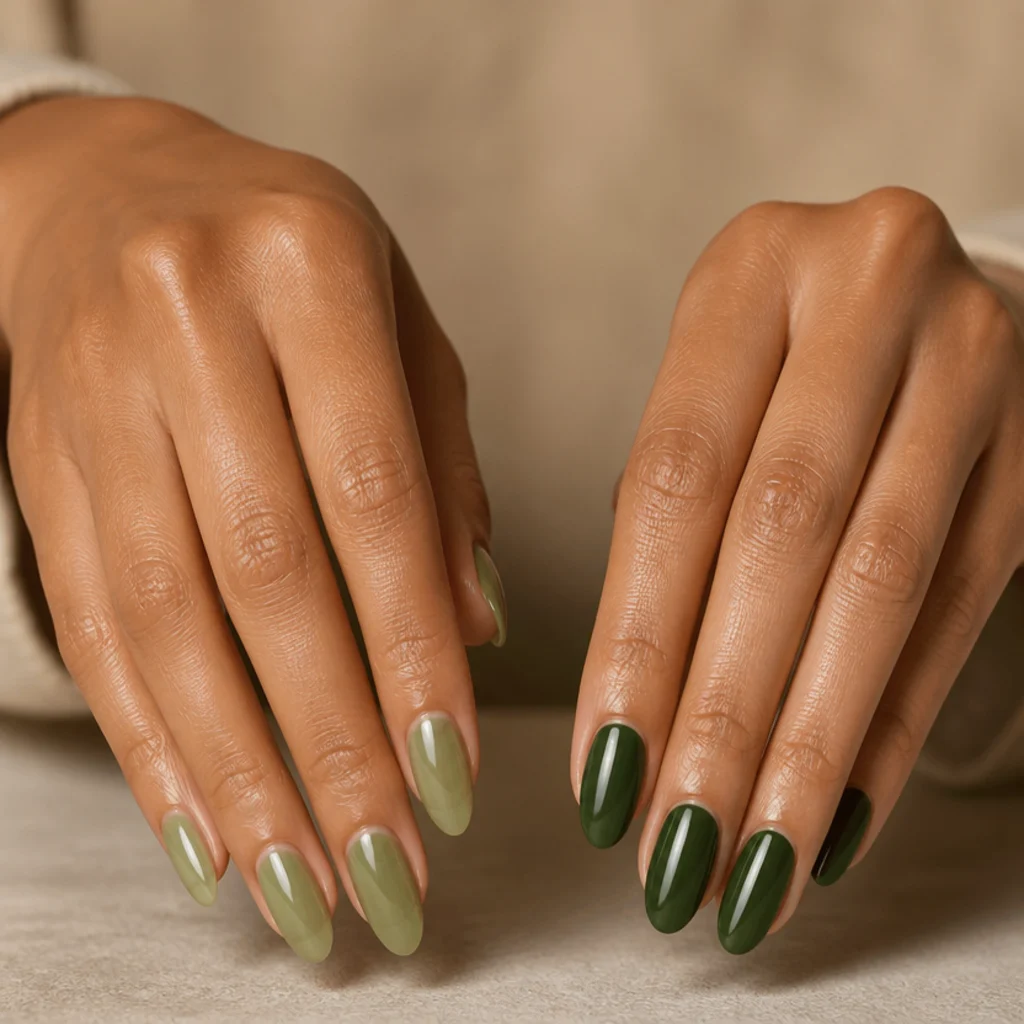
Quick Answer
- Best for: Olive-curious wearers who want to start soft and build up; flatters warm, cool, and neutral undertones because olive itself carries a gray-green base.
- Who might skip it: Anyone who wants a high-contrast pop color, or very yellow-warm skin that can find muted greens draining without a slightly cooler, grayer olive.
- Maintenance: Low to moderate. Sheer tints disguise regrowth and file wear; dense darks, chrome, and hand-painted art show tip wear and lifting sooner and do best on a two-week cadence.
- Difficulty: Easy for the sheer washes and milky creams; intermediate once you add negative space, foil, chrome, or fine art.
- Cost: Roughly a standard polish price for washes and creams; gel, chrome, foil, and hand-painted accents add a mid-tier design surcharge; acrylic extensions in almond, coffin, or stiletto sit at the higher end, plus fills.
- Wear time / longevity: About 5-7 days for regular polish, 2-3 weeks for gel, and 2-3 weeks between fills for acrylic sets.
- Standout variation: A light olive base that deepens to fully saturated dark olive green almond nails under a glass-gloss topcoat.
- How to ask your nail tech: Bring a saved photo, name the exact depth ("sheer and tinted" versus "deep and opaque"), and specify shape, length, and finish (glossy, matte, chrome, or glaze) before they open a single bottle.
In This Guide
- Sheer Light Olive Wash
- Soft Sage-Olive Milky Base
- Light Olive Green Short Squoval
- Olive-Tinted Sheer French
- Light Olive Green and White Negative Space
- Muted Olive Almond Nails
- Light Olive with Micro-Glitter Veil
- Olive Green and White Daisy Accents
- Mid-Olive Cream Coffin
- Olive Green Almond Nails with Gold Line
- Matte Mid-Olive Short Set
- Olive Green and White Color Block
- Deep Olive Chrome Sheen
- Olive Green Acrylic Long Almond
- Dark Olive Green French Tips
- Dark Olive Green Almond Nails
- Dark Olive Green Coffin with Leaf Art
- Olive Green Acrylic Stiletto
- Dark Olive Green and Gold Foil
- Moody Dark Olive Green Glazed Set
Light olive green nails are having a moment because they behave like a neutral without reading beige. The shade sits between sage and khaki, with just enough gray to stay soft in a sheer wash, then turns rich and almost architectural once you push the pigment toward dark olive green. That range is the whole point of this guide. These aren't real client before-and-afters. They're 20 styled progressions built to show how one color family matures, from barely-there tints through mid-olive creams to fully saturated, editorial depth. Along the way you'll see the shapes that flatter each stage (squoval, round, almond, coffin, stiletto), the finishes that change a color's personality (glossy, matte, chrome, glaze), and small art details like negative space, gold lines, foil, and tone-on-tone leaves. Each look comes with notes on undertone, wear, and the exact phrasing to hand your nail tech. Use it as a map: start wherever your nerve sits today, then climb the numbers as your confidence with green grows. Save whichever ones stop your scroll and note why. That's your appointment shortlist, done.
01Sheer Light Olive Wash
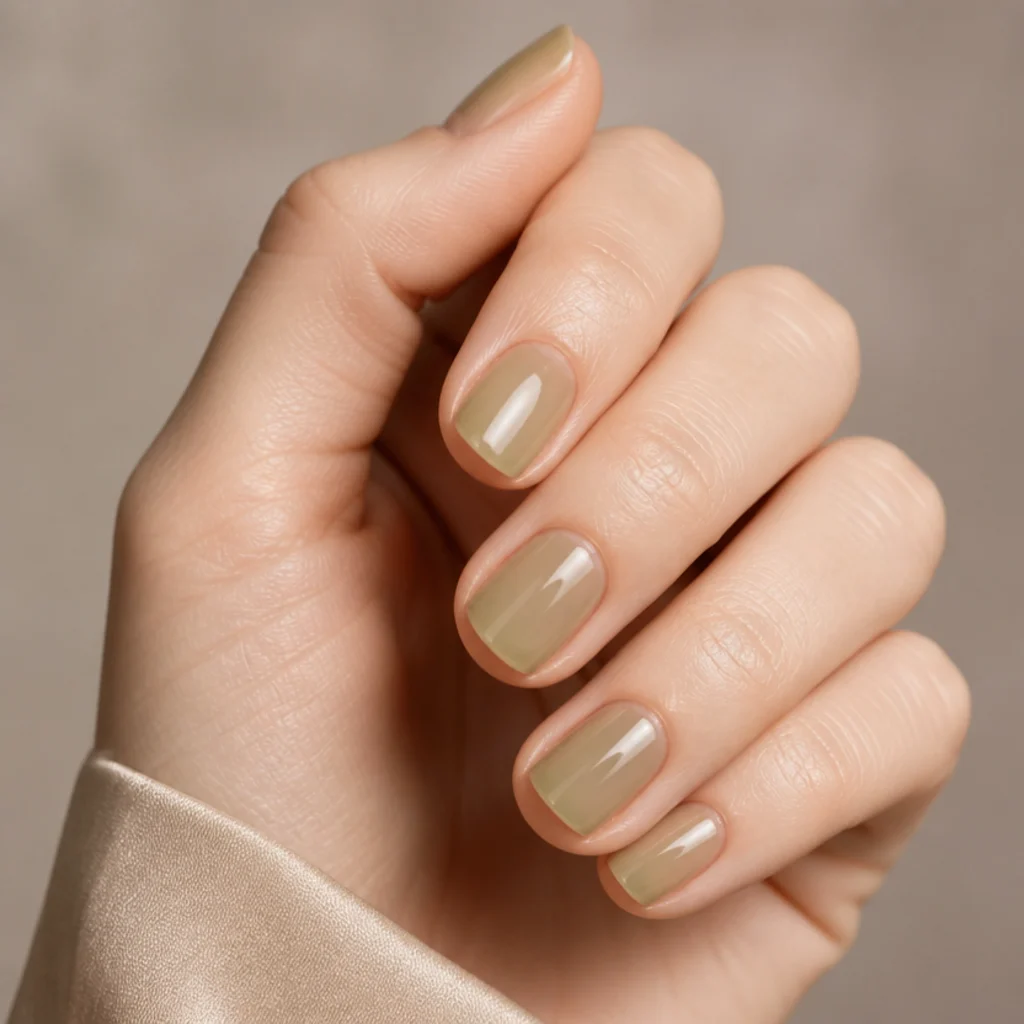
This is the softest entry point in the progression: one thin coat of sheer olive-green jelly over bare, buffed nails. Because the formula is translucent, your natural nail plate shows through, so the color reads more like a tinted gloss than full coverage, closer to a wash of celadon than true olive. It's the most forgiving option if you're nervous about green, and it works well on short, natural-length nails and rounded or oval shapes where the transparency keeps things low-key. Upkeep barely exists. Regrowth at the cuticle disappears under a sheer tint, so a fresh look can stretch a full week in regular polish or two in gel. Pro tip: apply the jelly in two whisper-thin passes rather than one thick coat, which prevents the streaky, uneven pooling sheer formulas are prone to. Ask for "sheer olive jelly, buffed base, two thin coats, glossy top." Think of it as testing the water before you wade in.
02Soft Sage-Olive Milky Base
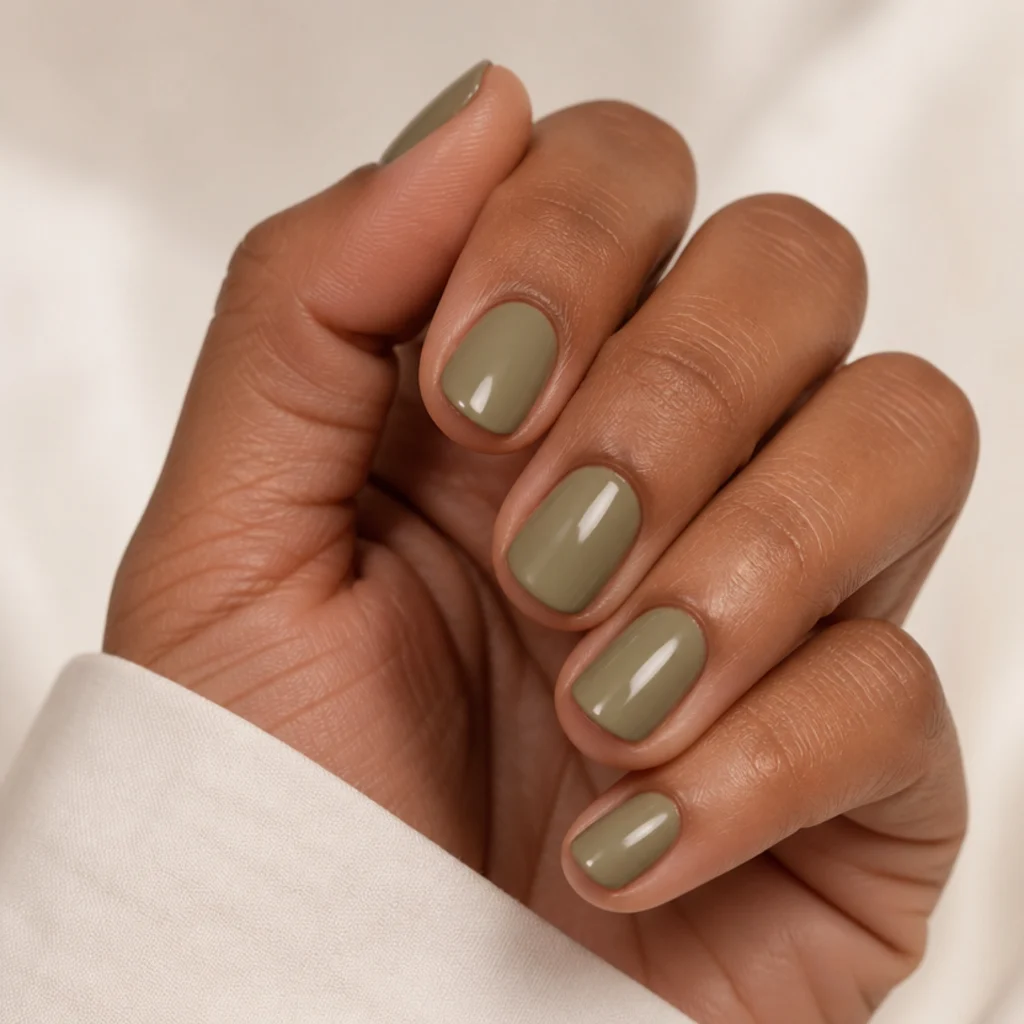
Add a drop of white to that sheer wash and you get milky sage-olive: still pale, but now opaque, creamy, and diffused. It's a cozy, quiet neutral that pairs with almost any wardrobe and photographs soft in daylight. Medium and tan skin do especially well with it, since the muted green picks up warmth without tipping yellow, and it stays clean on cool undertones thanks to the gray in the mix. Because the color is light, chips and tip filing stay subtle, which makes it a genuine two-week gel option with barely visible regrowth. A rounded shape keeps things gentle and snag-resistant for hands-on days. Pro tip: milky formulas need a color-correcting sheer base or a thin white underlayer, or they can look patchy over uneven nail tone. Tell your nail tech: "milky sage-olive, buildable to two coats, rounded, semi-gloss." It's only a shade bolder than the first look, but noticeably more finished.
03Light Olive Green Short Squoval
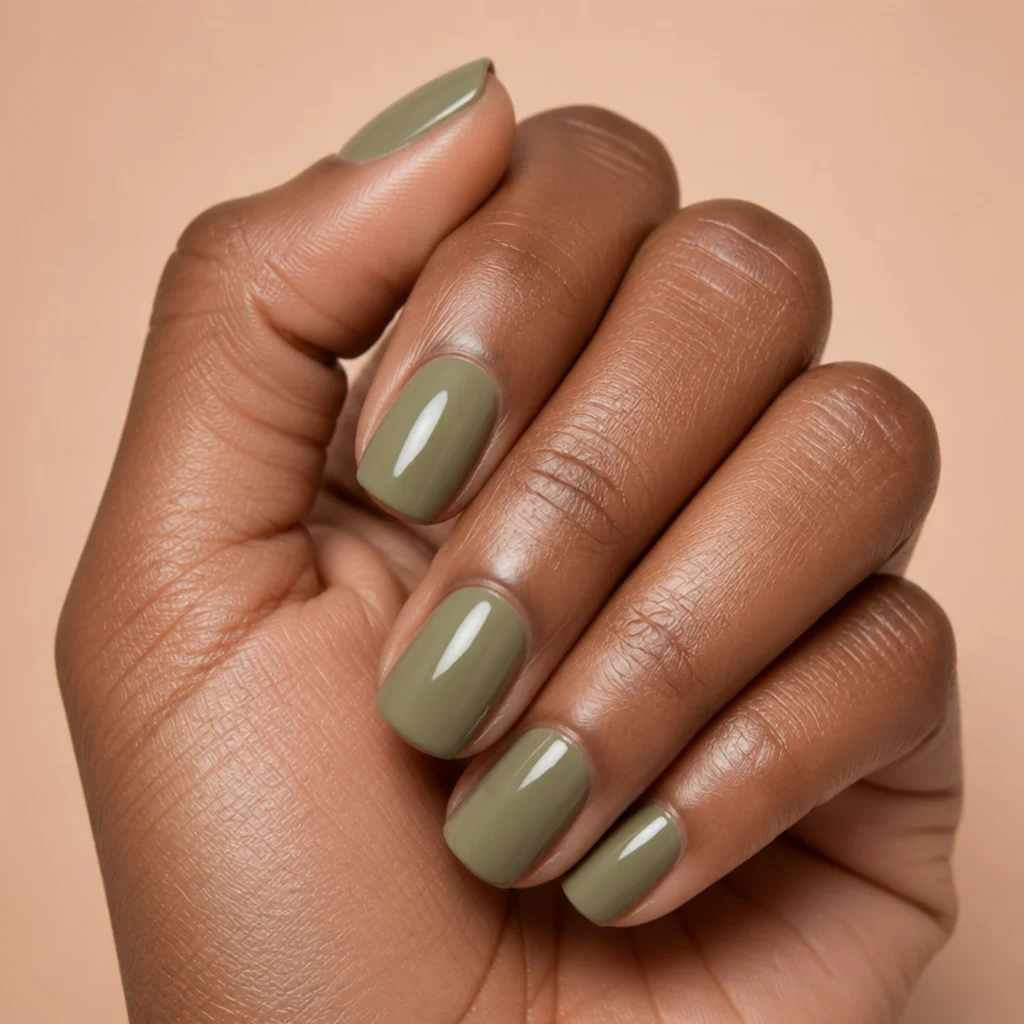
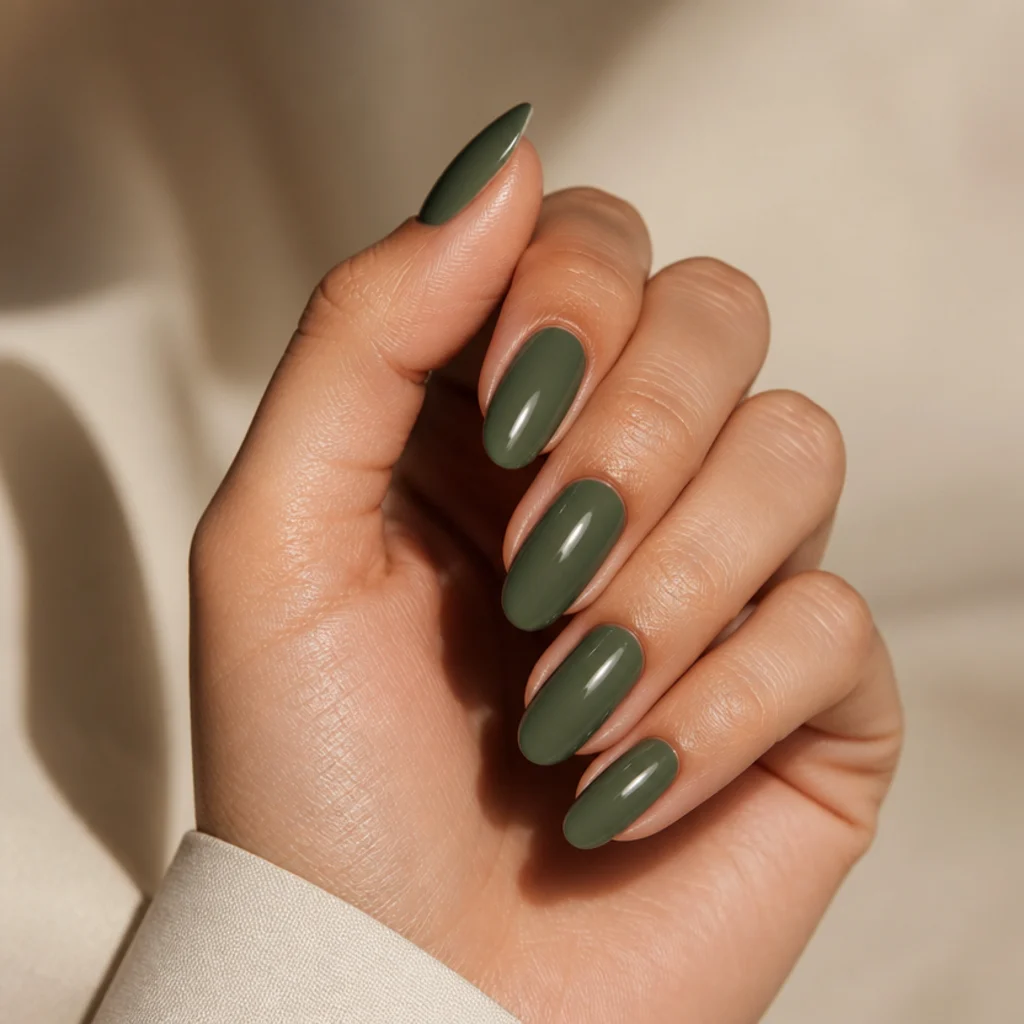
Here the pigment firms into a true light olive green cream on a tidy squoval, the squared tip with softened corners that's arguably the most universally flattering everyday shape. This is the workhorse of the set: practical, put-together, and low-drama enough for any dress code. On deep skin tones the light olive glows against the contrast and reads fresh rather than washed out; on fair skin it stays soft without disappearing. Maintenance is easy, since a mid-light cream masks minor cuticle regrowth for a solid two weeks in gel. Keep the sidewalls clean and the free edge short (a few millimeters past the fingertip) so the squoval stays crisp and office-appropriate. Pro tip: file squoval corners straight first, then barely soften them with the file held flush, which stops them rounding into a plain square. Ask for "two coats of opaque light olive, short squoval, clean sidewalls." This is where the progression stops being sheer and turns into a real, wearable color.
04Olive-Tinted Sheer French
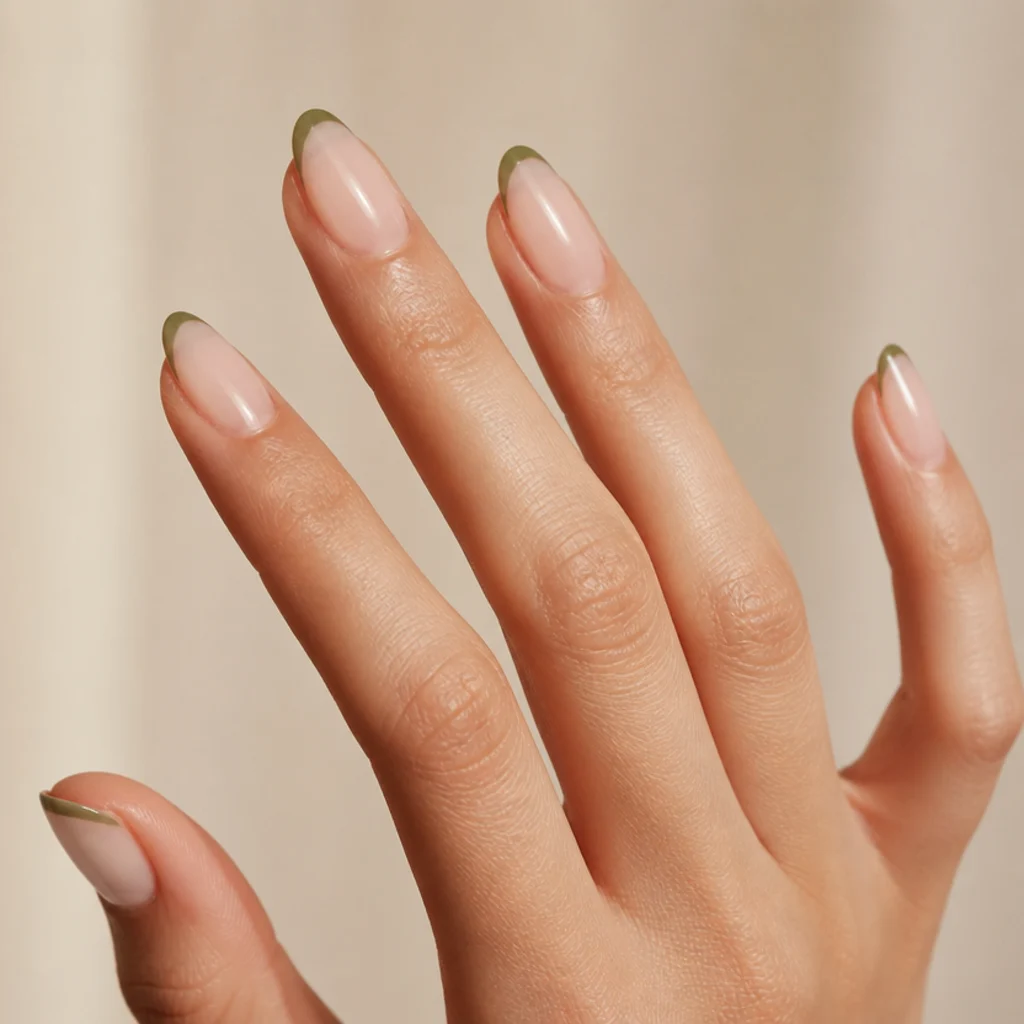
For a more designed feel without extra boldness, an olive-tinted French keeps the base sheer and paints only the free edge in soft olive. The effect is fresh and modern, a nature-toned rewrite of the classic white French that flatters longer natural nails where the tip has room to register. Anyone who likes a clean, bare-looking nail with just a whisper of color will like this, and it photographs well in close-up because the eye reads negative space plus a thin band. Upkeep is moderate: the smile line grows out visibly after about two weeks, so this rewards gel over regular polish. Keep the tip line thin (around 2-3 millimeters) and follow the natural curve of the free edge for the cleanest read. Pro tip: paint the tip freehand with a short flat brush, then clean the line with an angled brush dipped in remover, which beats fighting with guide stickers. Ask for a "micro French in soft olive on a sheer base, thin curved line." It bridges plain and painted without going to full coverage.
05Light Olive Green and White Negative Space
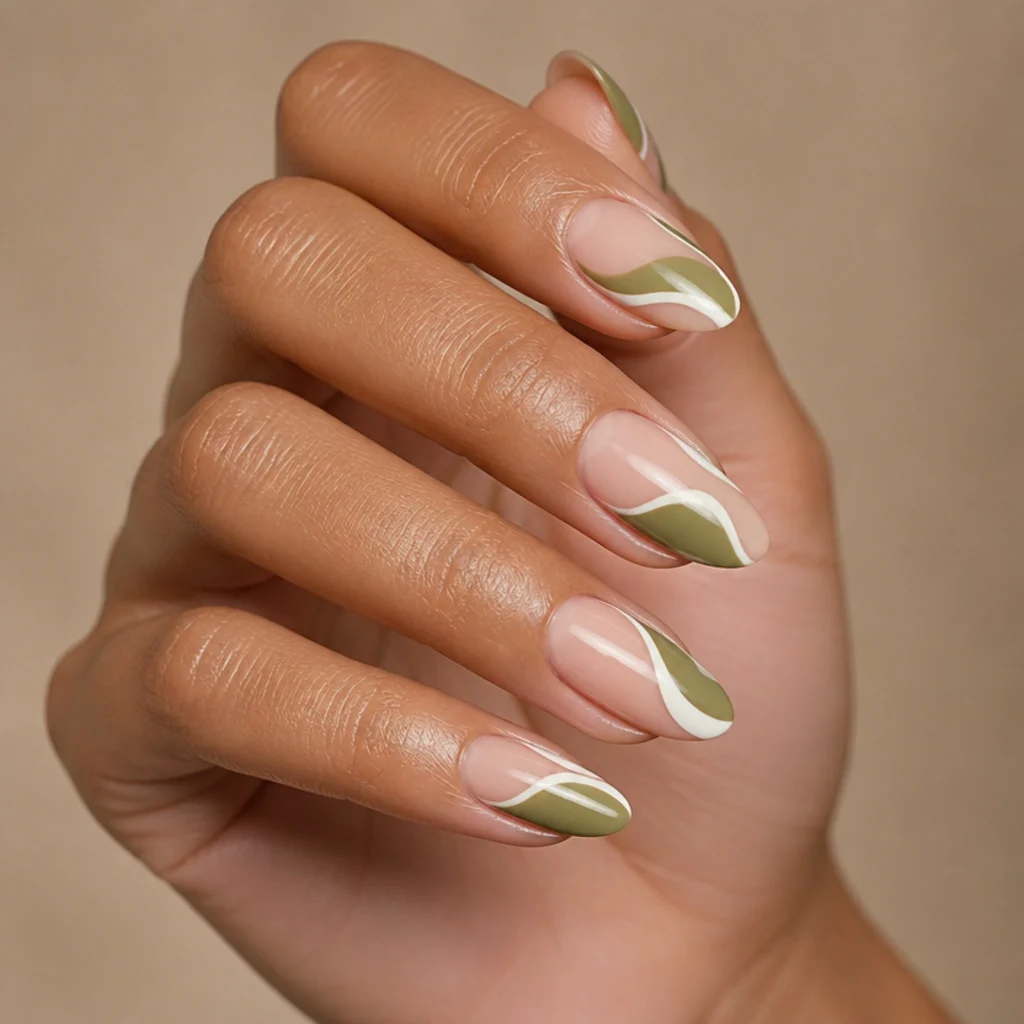
Olive green and white team up here in a negative-space design, where bare nail shows between curved bands of color. The result is graphic but airy, since the light olive keeps the contrast gentle rather than stark. Almond shapes suit it best, since the taper gives the curves a natural flow, and it's a smart pick if you want visible art without heaviness or upkeep panic. Maintenance is actually clever here: the exposed negative space lets regrowth blend in, so the design still looks intentional at week two or three. Since part of the plan is bare nail, buffing and a well-prepped, dehydrated nail plate matter, so the exposed sections stay smooth and shine-free. Pro tip: map the curves with thin liner tape or a steady liner brush before filling, and seal with gel so the exposed nail and the color wear at the same rate. Ask for "light olive and white negative-space waves, glossy gel finish." It's the most detailed look so far, though the pale palette keeps it quiet.
Save this to Pinterest so you can compare the soft looks side by side.
06Muted Olive Almond Nails
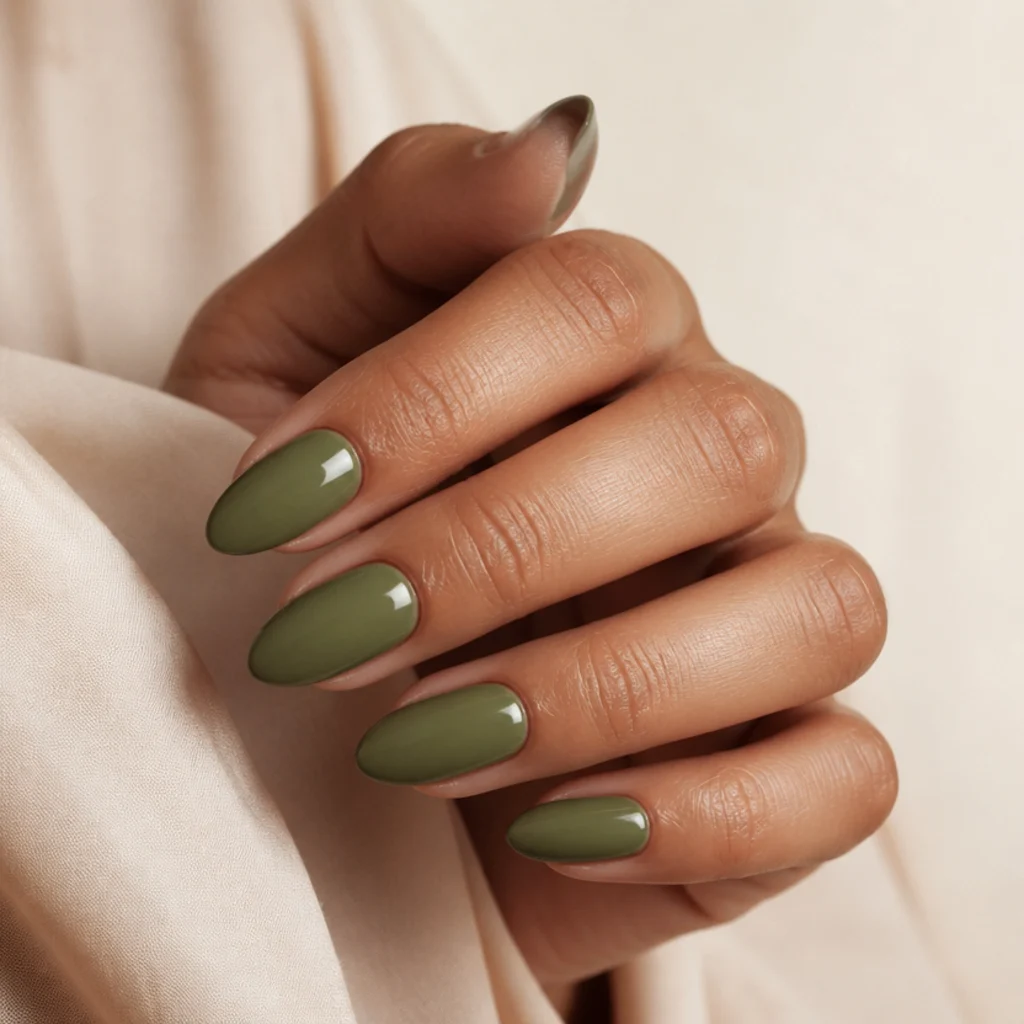
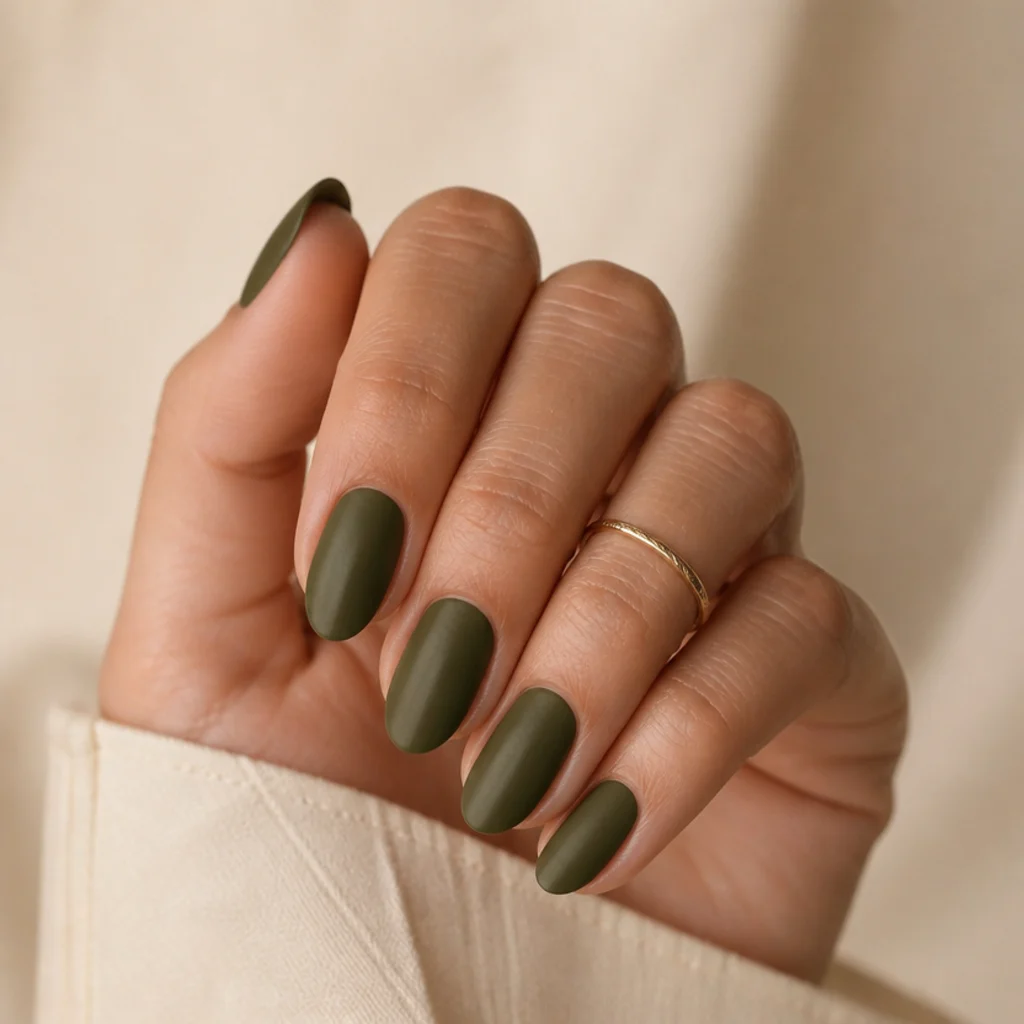
Saturation ticks up again with a fully opaque muted olive on classic almond nails. Almond tapers to a soft point that visually elongates the fingers and gives the earthy color an elegant frame, which is why it's the default request for a "grown-up" olive manicure. This shade reads unmistakably as olive from across a room while staying appropriate for work and everyday life, and it flatters nearly every skin tone because the gray in the pigment tempers any harshness. Upkeep runs low to moderate; the mid-depth cream shows tip wear only after real use, so a two-week gel cycle is realistic. Medium length (a few millimeters past the fingertip) keeps almond strong and snag-resistant rather than fragile. Pro tip: file both sidewalls toward a centered apex so the point sits dead center, otherwise almond skews crooked and catches the eye for the wrong reason. Ask for "opaque muted olive, almond, medium length, high gloss." This is the halfway pivot, where soft turns solidly stated.
07Light Olive with Micro-Glitter Veil
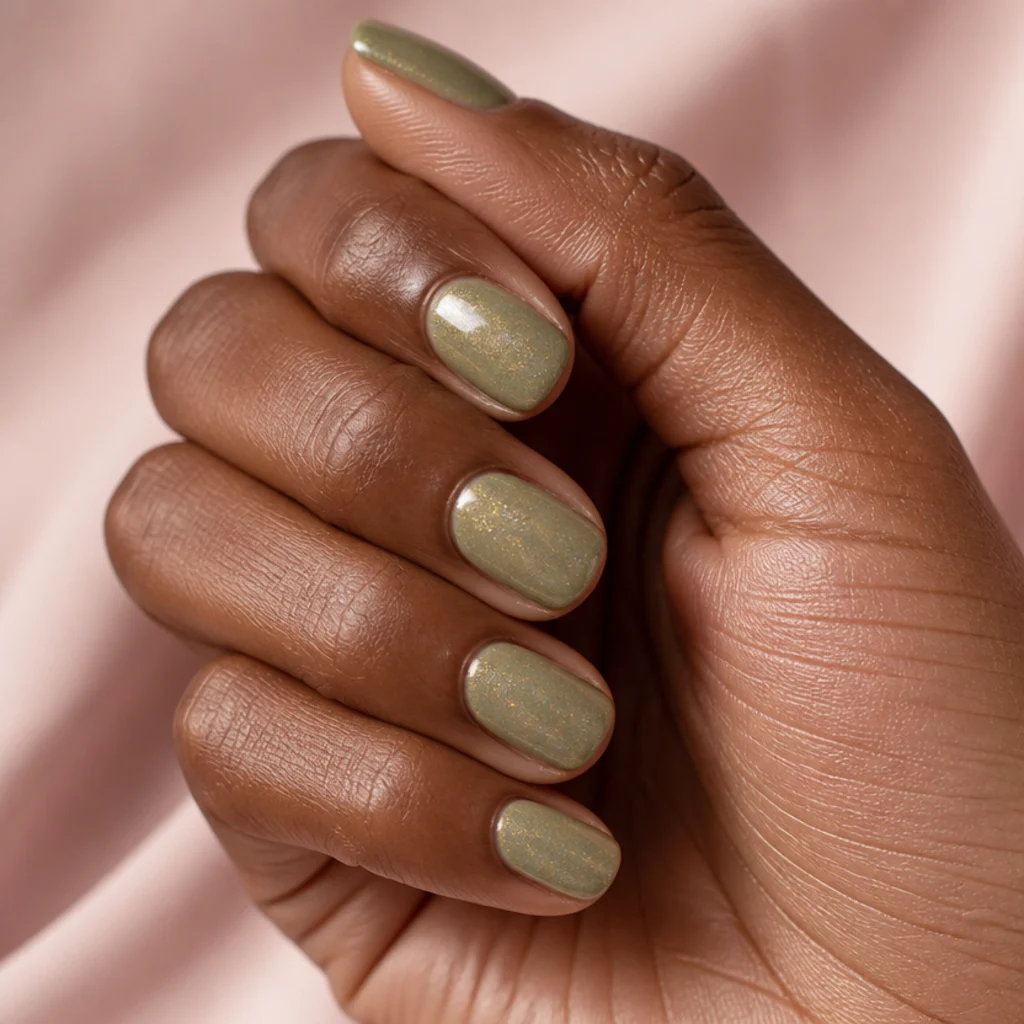
Same light olive base, now dusted with a sheer micro-glitter veil that only wakes up when it catches the light. That keeps the color pale while adding occasion-ready shimmer, so it works for events without tipping into full glam or novelty. If flat cream feels too plain, this adds texture that still reads refined, and it's forgiving on short oval or round nails where the shimmer softens the shape. Maintenance is easy, since fine glitter camouflages small surface imperfections and grows out gently with no hard regrowth line. The trade-off is removal: glitter grips, so this is worth doing in soak-off gel and taking off with foils and patience rather than scraping. Pro tip: choose a fine iridescent or pearl glitter over chunky flakes; small particles lie flat under topcoat and skip the gritty texture that snags on hair and fabric. Ask for "light olive base with a fine iridescent glitter veil, extra topcoat to bury the texture." The shimmer is the boldest element so far, which is exactly why it sits mid-ramp.
08Olive Green and White Daisy Accents
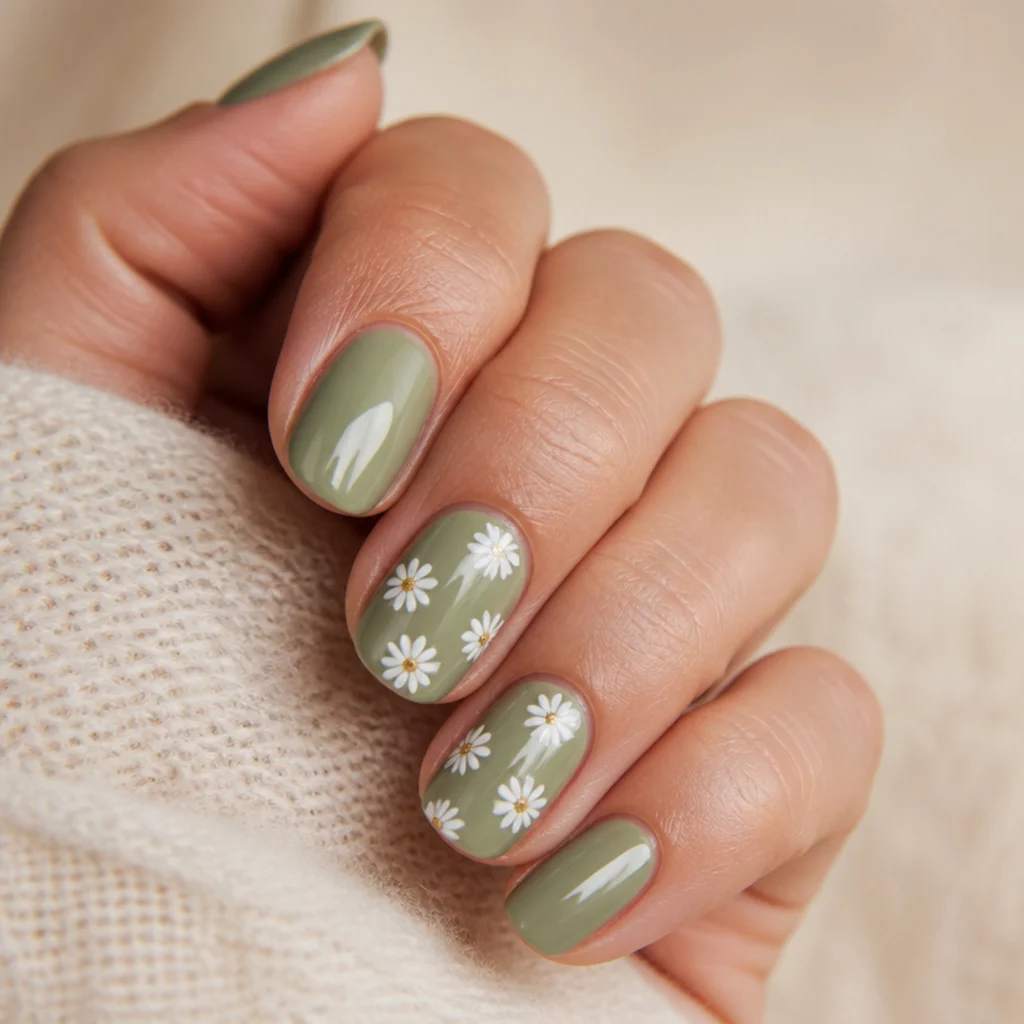
Playful but still pale, this pairs a light olive base with tiny white daisies on a couple of accent nails. The olive-and-white combination feels garden-fresh, and the small florals add personality without darkening the palette or committing every nail to art. Shorter squoval and round shapes suit it best, where the little flowers stay in proportion instead of stretching or distorting. Upkeep runs moderate, since hand-painted art wears at the tips first, so a thick glossy topcoat that seals over the flowers matters for longevity. It's a natural spring and summer choice, and it pairs nicely with the milky base from look two if you want a matching set. Pro tip: five dots in a ring with a dotting tool, plus a yellow center and two fine leaf strokes, makes a convincing daisy faster and cleaner than painting petals freehand. Ask for "light olive base with small white daisy accents on two nails, sealed under gloss." It's the last of the soft looks before the progression deepens for real.
09Mid-Olive Cream Coffin
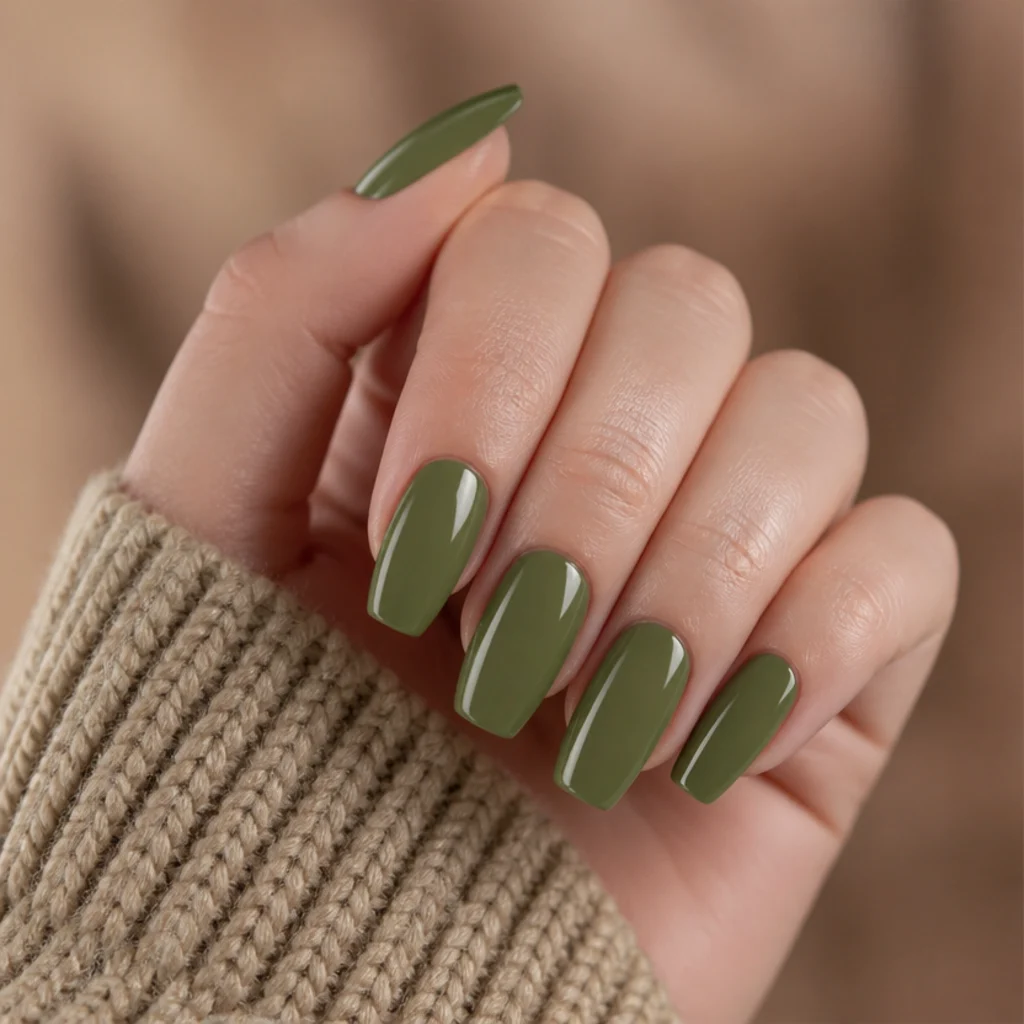
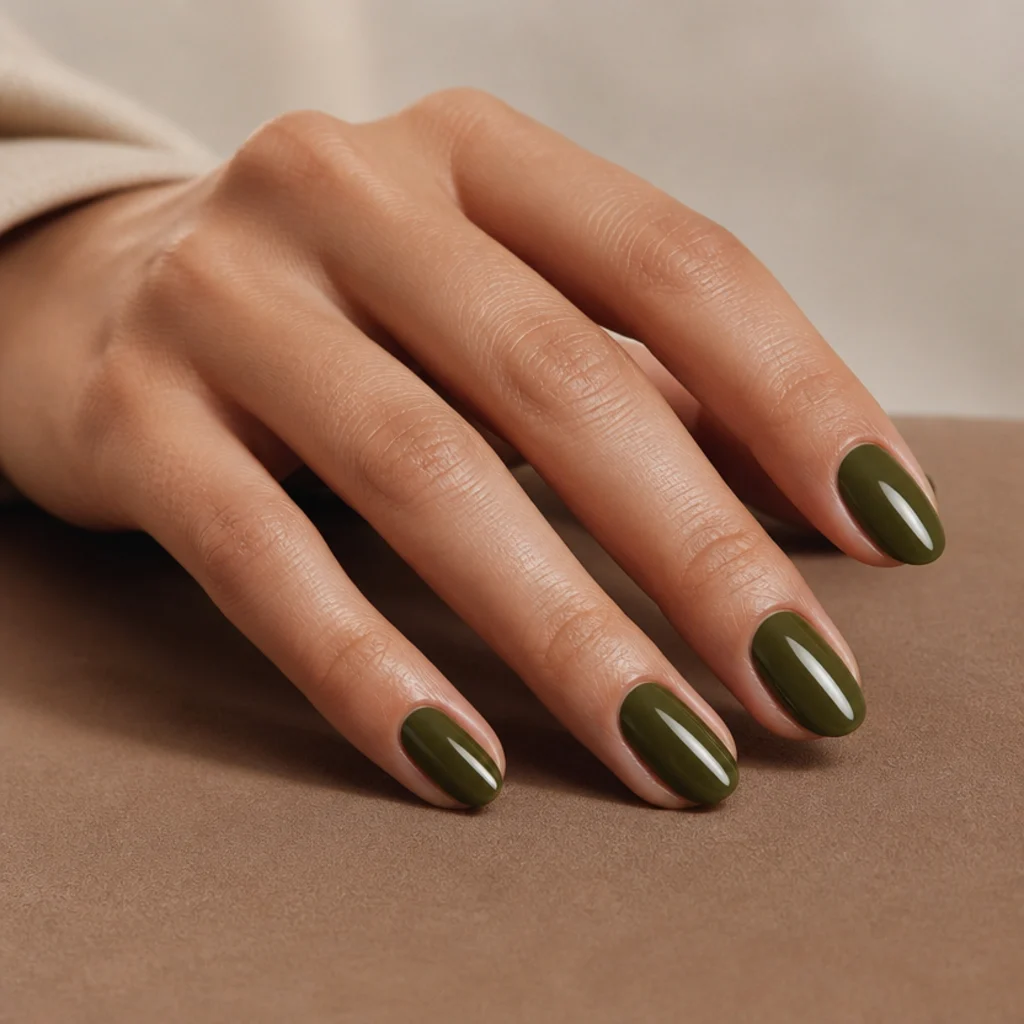
The color steps into mid-olive here, on a coffin shape, that tapered silhouette with a flat, squared-off tip that reads sleek and modern. Coffin gives the deepening green a runway-adjacent canvas and suits medium to long lengths, since a very short coffin can look stubby and lose the flattering taper. This is where olive stops whispering and starts holding a room: still versatile, but noticeably richer and more deliberate. It flatters cool and neutral undertones particularly well, where the added depth reads polished rather than muddy. Maintenance is moderate; a denser cream shows filing and tip wear sooner than pale tints, so plan a touch-up or gel refresh around the two-week mark. Pro tip: coffin lives and dies by symmetry, so ask that both sidewalls be filed at matching angles and the flat tip kept parallel to the cuticle line. Ask for "mid-olive cream, coffin, medium-long, high gloss." Consider this the gateway into the bolder half of the lineup.
10Olive Green Almond Nails with Gold Line
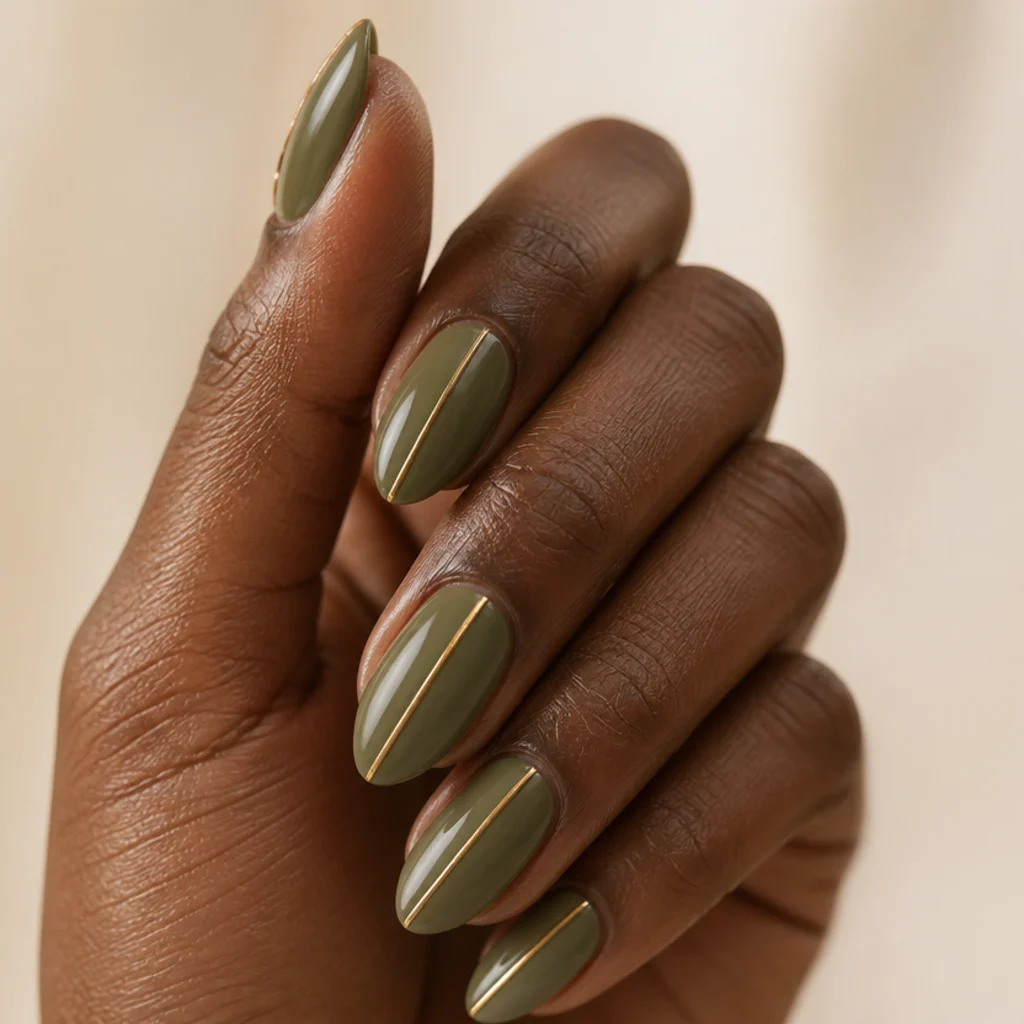
A single hair-thin gold line down each olive green almond nail adds quiet luxury for almost no extra chair time. The metallic catches light against the muted green and makes the manicure feel considered, like jewelry for the nail. It works well if you want a hint of shine, and it pairs especially with warm skin tones, where gold and olive share an obvious earthy harmony. Upkeep is moderate, since the fine line abrades at the tip, so sealing it under topcoat is non-negotiable if you want it to last two weeks. A centered vertical line also visually lengthens the nail, reinforcing the almond taper. Pro tip: pull the line in one confident stroke with a long striping brush loaded with gel gold, working cuticle to tip, rather than dabbing it in segments that show as breaks. Ask for "mid-olive almond with a single hair-thin gold center line, sealed with gloss." It's understated glamour, proof a metallic accent can push a color darker in feel without touching the base shade.
Save this to Pinterest and start building your appointment shortlist.
11Matte Mid-Olive Short Set
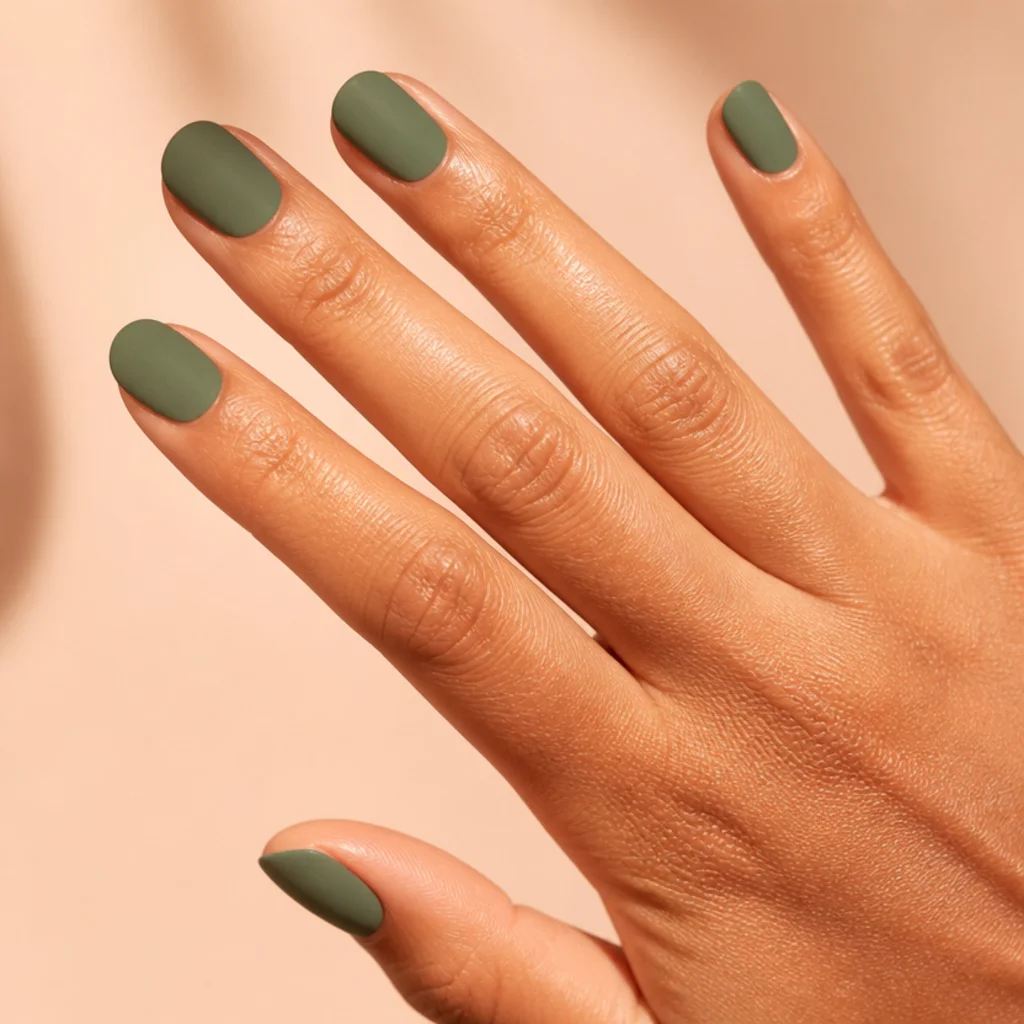
Swap gloss for a matte topcoat and mid-olive takes on a velvety, suede-like depth. The flat finish mutes any brightness and leans into the earthy, almost stone-and-moss quality of the color, which makes it feel more editorial than the same shade in gloss. It suits short round or squoval nails and anyone who wants a modern, understated look with no shine competing for attention. The trade-off is that matte shows oils, fingerprints, and micro-scratches, so maintenance means the occasional wipe with a lint-free cloth and a fresh matte topcoat every week or so to revive the finish. Keep hand cream off the nail surface, since oils are what dull matte fastest. Pro tip: cure a glossy gel first for durability, then apply matte topcoat over it. That wears better than a single matte layer and lets you buff back to gloss later if you change your mind. Ask for "mid-olive, glossy gel sealed under a matte topcoat, short round." The finish alone makes this read bolder than a shiny version of the same shade.
12Olive Green and White Color Block
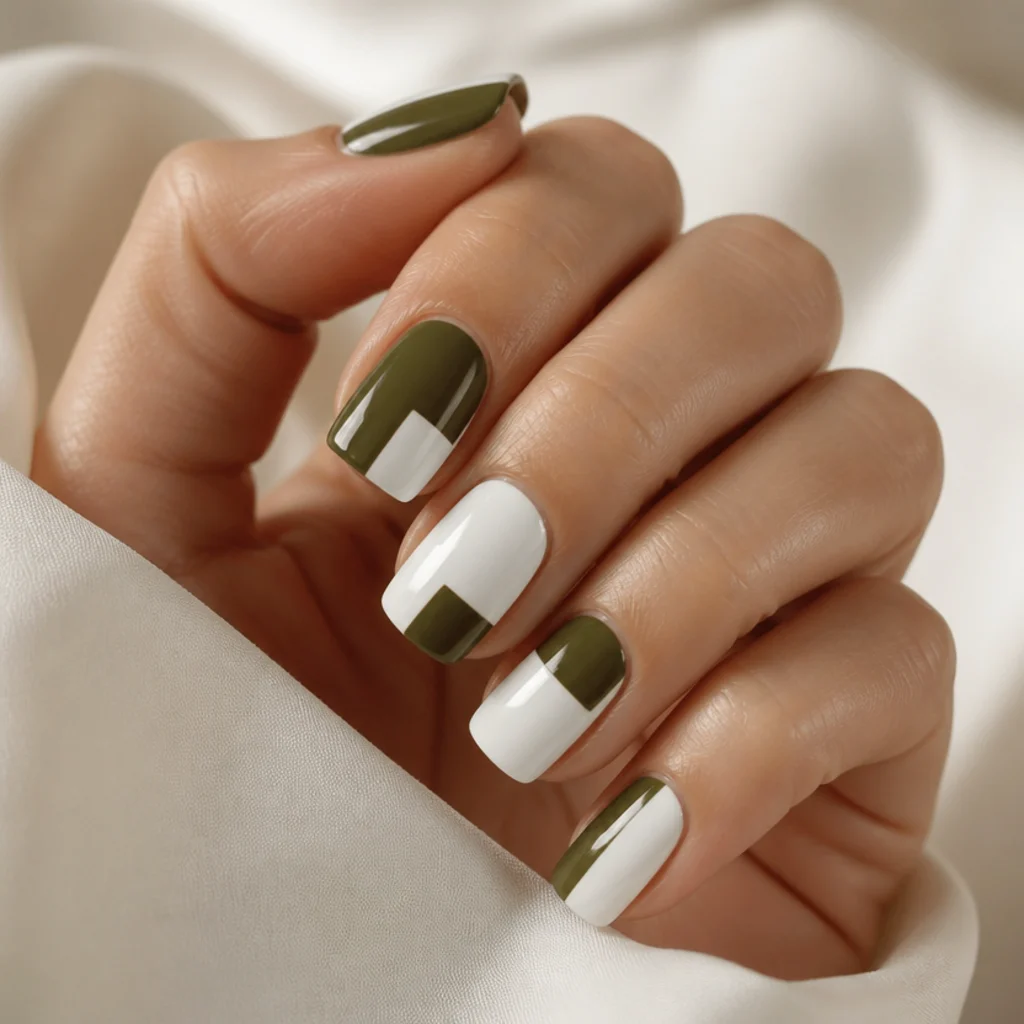
Olive green and white return, but now in bolder, higher-contrast color blocking. Each nail is split into clean geometric fields of deep-leaning olive and crisp white, for a confident, design-forward result that reads as intentional graphic art rather than a soft accent. Squoval and square shapes suit it best, since their straight edges make the blocks look sharp and the divisions crisp. It's a clear step up in visual impact from the earlier negative-space wave, thanks to the fuller saturation on both colors. Maintenance is moderate; hard lines and white both show wear fast, so a gel seal and careful handling matter more here than with a forgiving wash. Bright white in particular yellows and dulls first, so gel is the smart call. Pro tip: lay the lighter color first, let it fully cure, then tape off the division and apply the olive. That gives a cleaner edge than trying to butt two wet colors together. Ask for "olive and white color block, straight clean divisions, gel-sealed." At this point we've firmly left the soft washes behind.
13Deep Olive Chrome Sheen
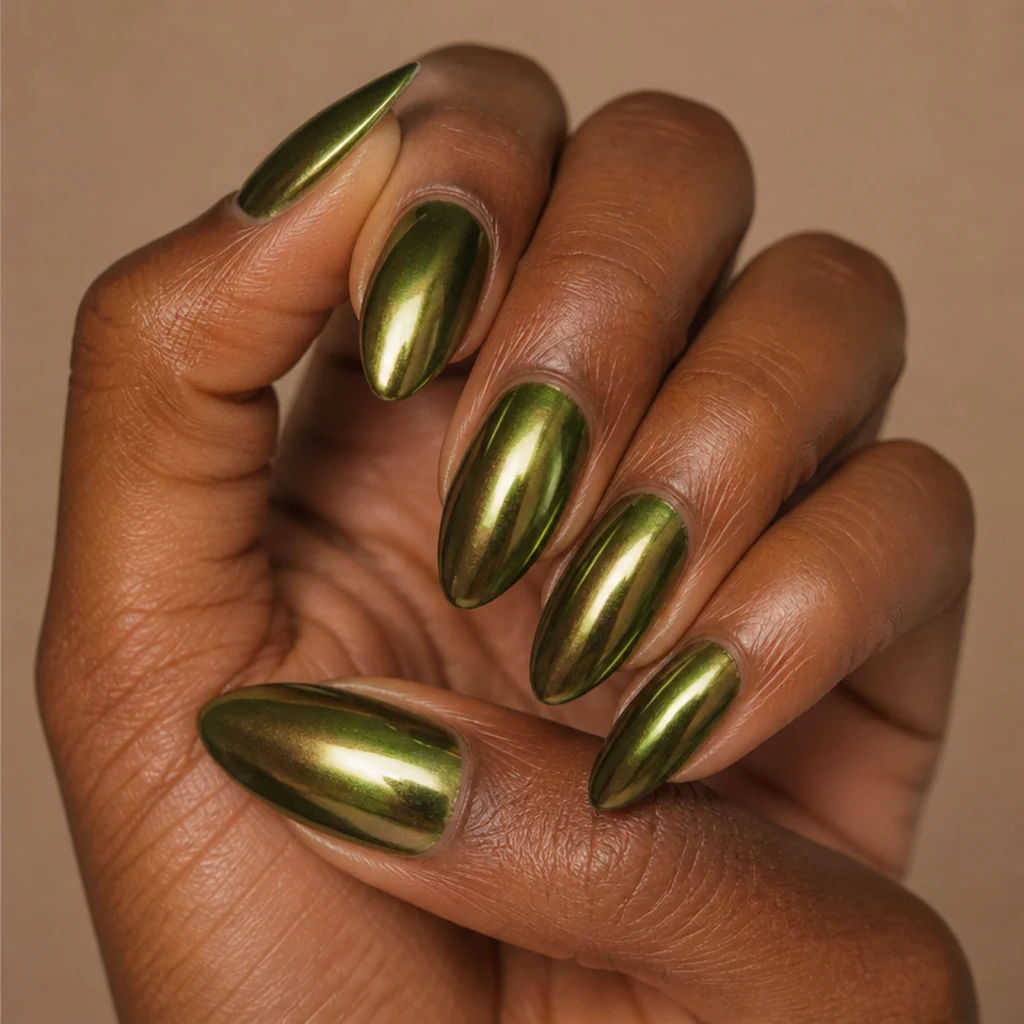
Chrome powder buffed over a deep olive base creates a mirror-like, metallic sheen that shifts between green and warm bronze as your hand moves. It's a high-shine finish that turns an earthy color into something almost liquid-metal. Almond and coffin shapes give the reflection room to play across a longer surface, and it makes a statement on any skin tone because the color-shift does the work. Upkeep runs moderate to higher: chrome must be sealed under a proper no-wipe gel topcoat to stay reflective, and the free edge needs capping or the mirror effect fogs within days. Regrowth is fairly visible too, since the reflective surface draws the eye straight to the cuticle. Pro tip: chrome only mirrors over a fully cured, tacky-free glossy base, so the gel needs to be wiped and hard-cured before the powder goes on, or the finish comes up patchy. Ask for "deep olive base with green-bronze chrome, edges capped, no-wipe gel sealed." We're clearly in bold territory now, with the drama coming from finish rather than art.
14Olive Green Acrylic Long Almond
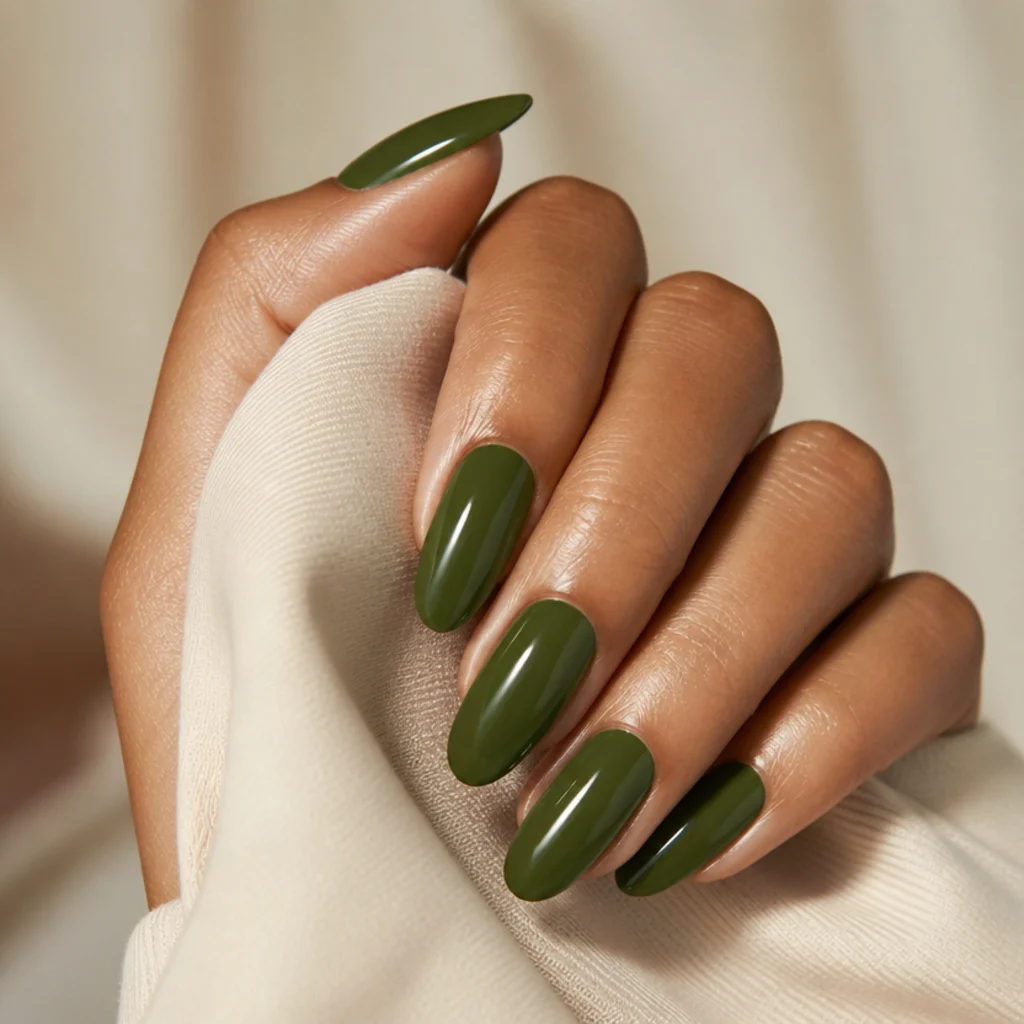
Length enters here, with olive green acrylic on long almond extensions. Acrylic builds a strong, uniform surface that lets you commit to a saturated, deep olive that looks smooth and even, without the thin-spot streaking that plagues polish on natural nails. The added length makes the color feel more dramatic and editorial while keeping the elegant almond taper, and the structural strength suits anyone whose natural nails are too soft to grow long unaided. Upkeep is higher: expect fills every two to three weeks as your natural nail grows out beneath the enhancement, plus a full rebalance or soak-off after several fill cycles. A proper apex built into the acrylic is what keeps long almond from snapping at the stress point. Pro tip: ask for a slightly thicker build over the apex zone (the middle third of the nail) rather than uniform thickness, since that structural arch carries the length without cracking. Ask for "olive green acrylic, long almond, structured apex, high gloss, two-to-three-week fills." Here boldness comes from commitment as much as color.
15Dark Olive Green French Tips
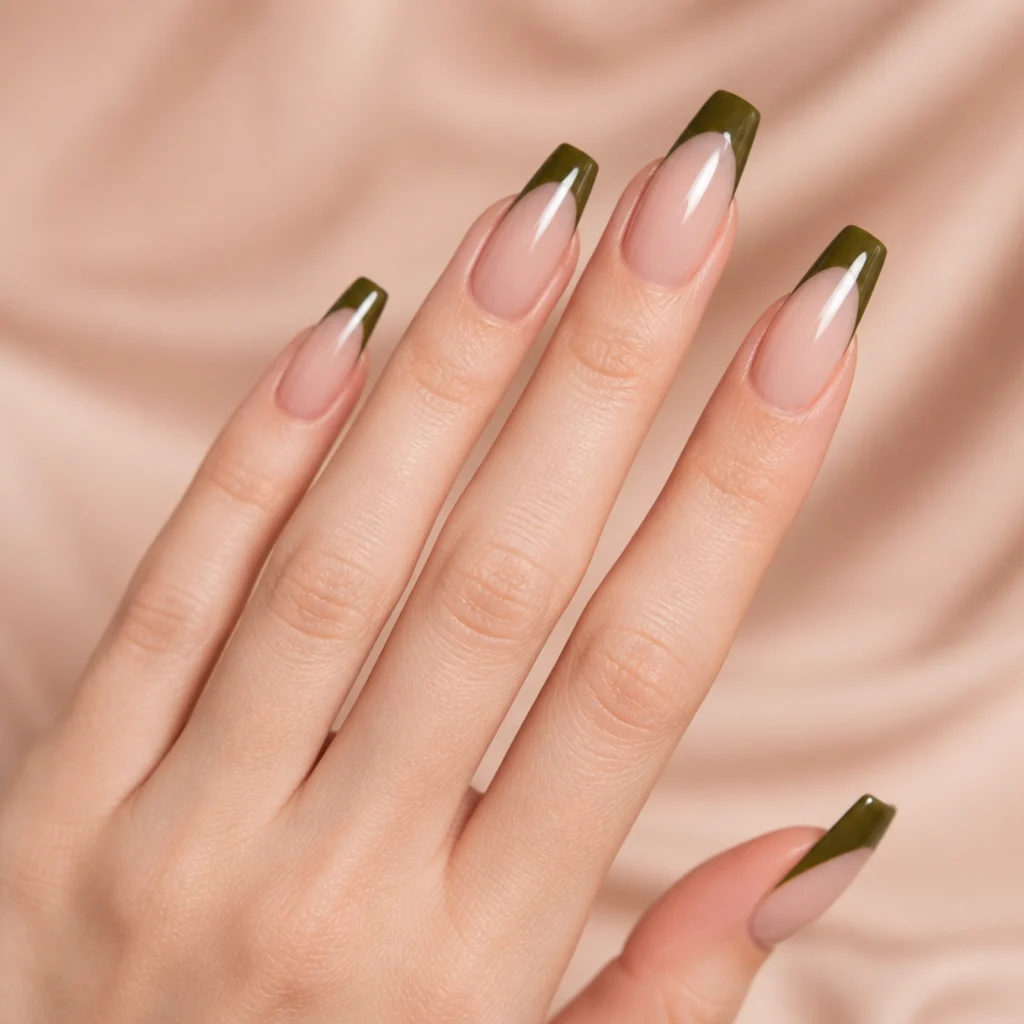
The French tip is back, but changed: a sheer or bare base with tips painted in true dark olive green. Compared with the soft olive French near the start, this version is high-contrast and confident, the deep green reading almost like a moody neutral floating against clean negative space. Long coffin and almond shapes give the tip a graceful, elongated sweep, and it suits anyone who wants dark color without the visual weight of full coverage. Maintenance is moderate because the crisp smile line grows out visibly, though the sheer base softens the regrowth line more kindly than an opaque nude French would. A slightly deeper, wider tip than a classic French balances the darkness of the olive. Pro tip: for a dark tip, paint two thin coats rather than one heavy pass, since deep pigments show brush drag and thin patches near the smile line where precision matters most. Ask for "dark olive green French tips on a sheer base, slightly deep clean line." It's a clever way to wear dark olive green part-way, and it shows how far the palette has traveled from look one.
Save this to Pinterest so the bold ideas are ready when you book.
16Dark Olive Green Almond Nails
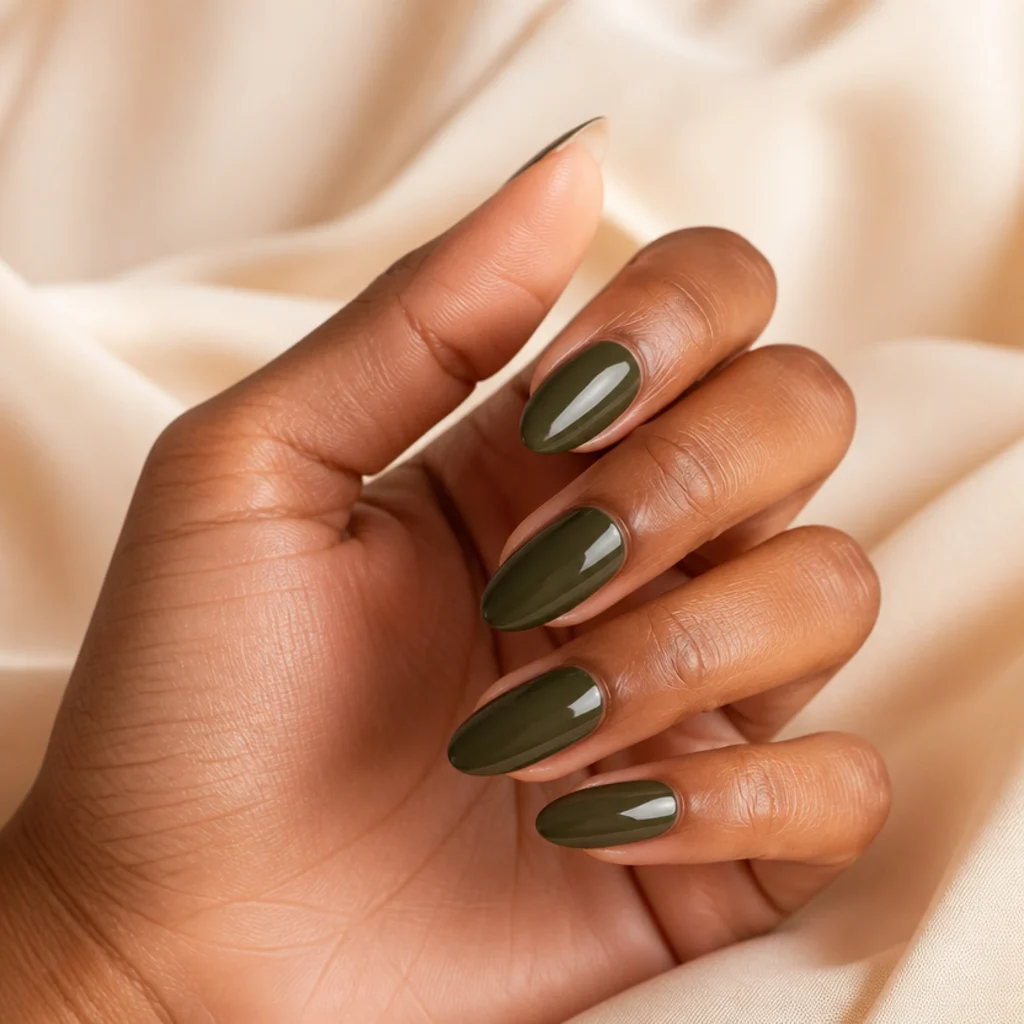
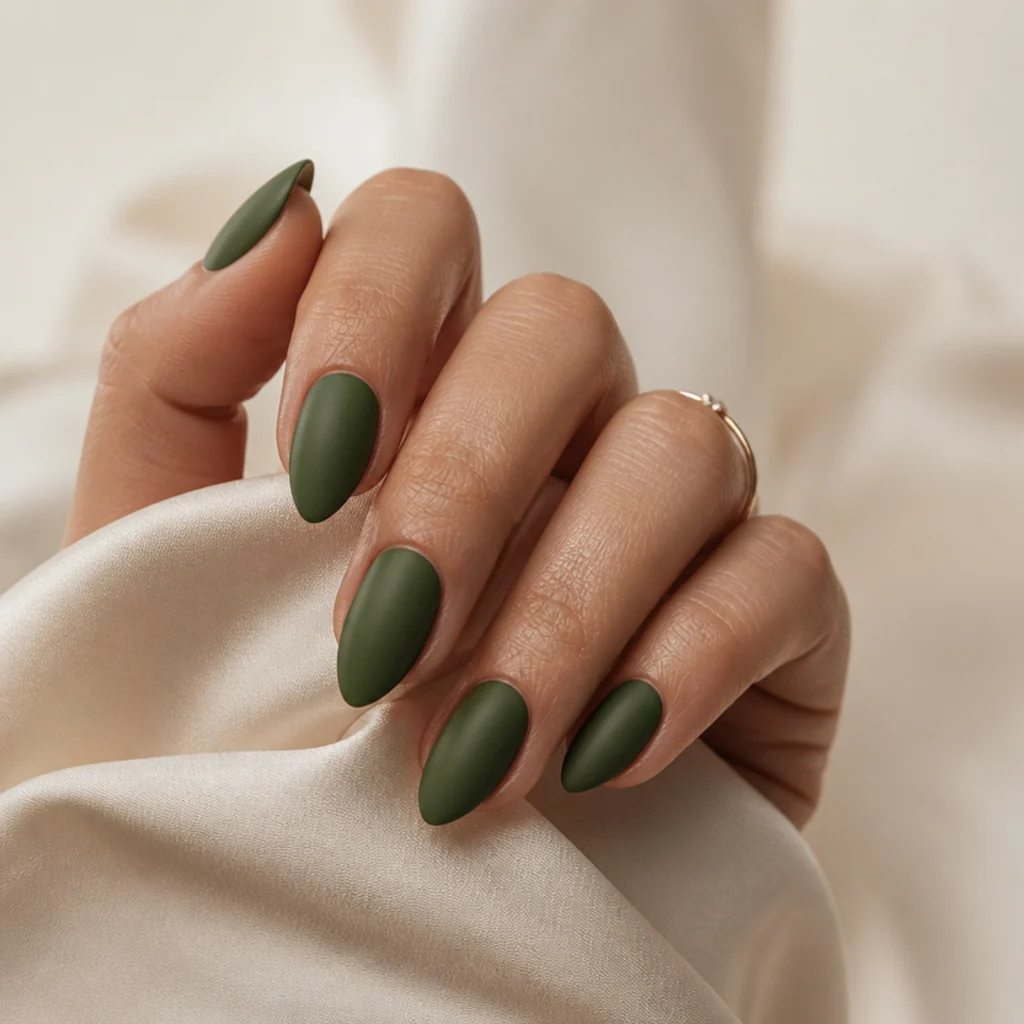
Here's the standout of the whole progression: fully saturated dark olive green almond nails under a glass-like gloss. The color is deep, grounded, and rich, the kind of shade that reads sophisticated in every season, cozy in autumn and crisp against summer skin. Almond keeps it elegant, and the density of pigment makes the manicure feel intentional rather than merely dark. It flatters every skin tone, though the depth is especially striking on deeper complexions where it glows, and it sits well with gold jewelry. Upkeep is moderate; dark, opaque color shows tip wear and cuticle regrowth far more than a pale tint, so plan a gel touch-up around two weeks and keep a matching bottle for edge repairs. Pro tip: apply dark creams over a thin white or nude base coat to reach full opacity in two coats instead of three, which avoids the thick, slow-drying, bubble-prone layers deep pigments otherwise need. Ask for "dark olive green, opaque, almond, medium-long, glass gloss." This is olive at full volume, and it earns the arrival.
17Dark Olive Green Coffin with Leaf Art
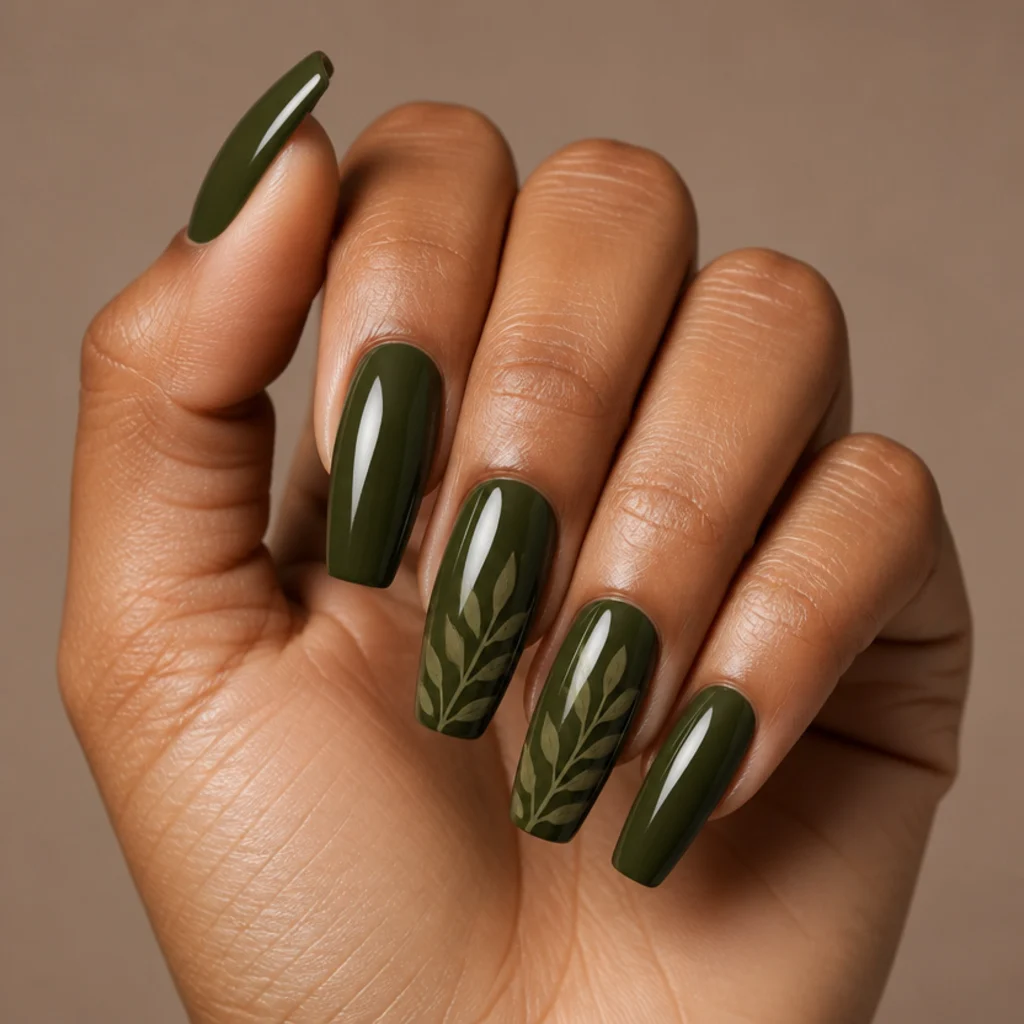
Take that deep olive and add tone-on-tone leaf art in a lighter olive on a couple of coffin-shaped accent nails. The botanical detail nods to where the color comes from and adds texture without a clashing hue, so the look stays cohesive rather than novelty. Longer coffin and almond shapes give the delicate leaves room to breathe and the vein detail space to read. Maintenance is higher because fine hand-painted art abrades at the edges first and benefits from a thick protective gel topcoat over every stroke. Doing the art on just two accent nails, not all ten, keeps both the cost and the wear manageable. Pro tip: paint the leaves in a shade only two or three steps lighter than the base so they read as elegant tone-on-tone shadow rather than hard contrast, then add one fine vein line per leaf with a detail brush. Ask for "dark olive base with tone-on-tone lighter-olive leaf accents on two nails, gel-sealed." It's one of the most detailed looks in the set, layering art onto an already bold color.
18Olive Green Acrylic Stiletto
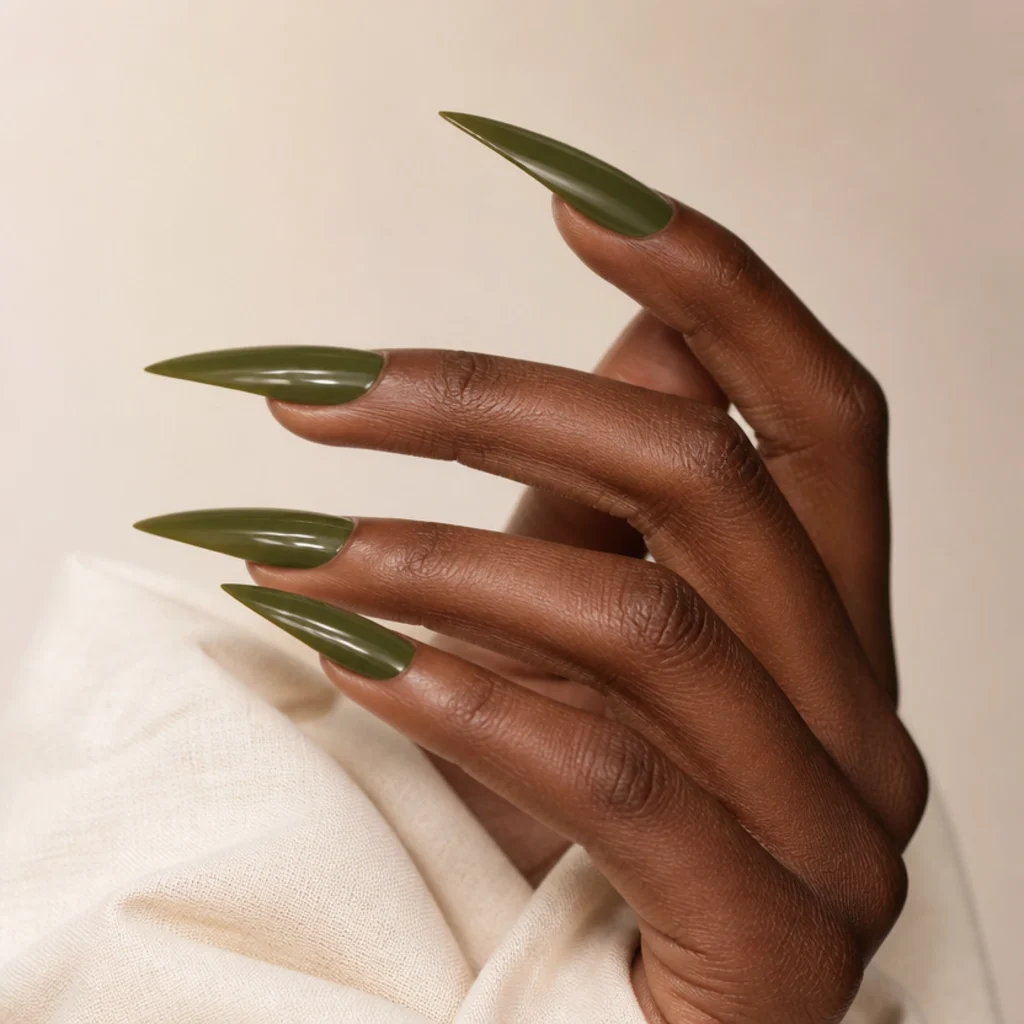
For maximum drama, olive green acrylic goes stiletto: long, sharply pointed, unapologetic. The elongated point makes the deep olive feel fierce and high-fashion, ideal if you treat nails as a statement accessory or a photo prop. It suits confident wearers ready for real length and willing to adapt daily habits around it, and it photographs well in editorial close-ups where the point leads the eye. Upkeep is the highest in the lineup: stiletto tips catch, snag, and lever against surfaces, so they need careful handling, prompt repair of any lifting, and fills every two to three weeks. The trade-off for the silhouette is practicality, since typing, buttons, and manual tasks all get harder. Pro tip: ask for the point to be filed slightly off the extreme sharp and the underside reinforced with an extra gel or acrylic layer, which blunts the fragility without losing the dramatic line. Ask for "deep olive acrylic, stiletto, long, reinforced tip, mirror gloss." This is the boldest shape in the set, pairing an already rich color with the most theatrical outline.
19Dark Olive Green and Gold Foil
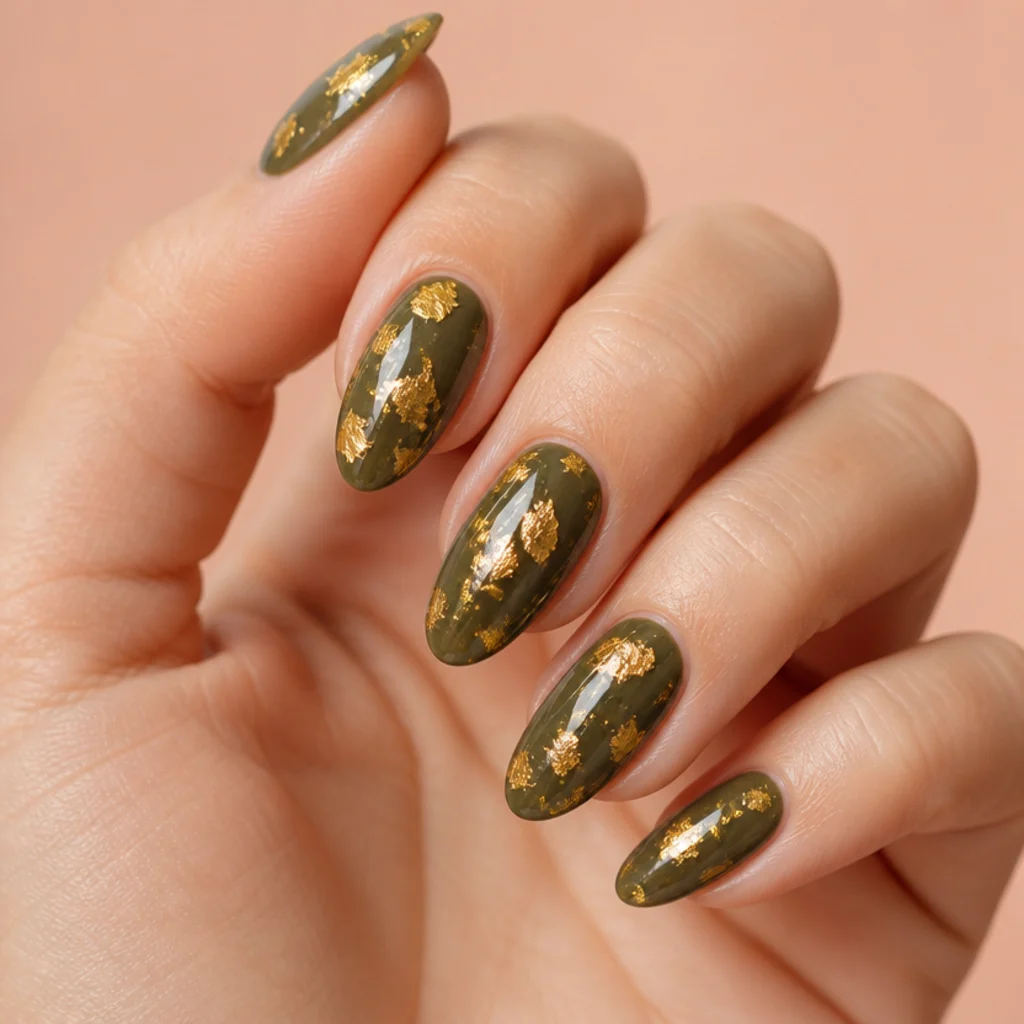
Scatter torn gold foil across a dark olive green base and you get a look that feels rich and slightly rebellious, like weathered, gilded metal. The gold flecks glint against the deep green and give each nail a one-of-a-kind pattern that's impossible to replicate exactly. Almond and coffin shapes suit it, and it pairs naturally with warm skin tones, where the gold-and-olive pairing echoes autumn foliage. Maintenance runs moderate to higher because foil edges lift and snag if exposed, so sealing every fleck under a leveling gel topcoat matters for both longevity and a smooth surface. Concentrating the foil near the cuticle or tip rather than covering the whole nail reads more editorial and wears better. Pro tip: press foil onto a tacky (not fully cured) gel layer with a silicone tool or fingertip for maximum grip, then flood with a thick topcoat to bury the raised edges completely so nothing catches. Ask for "dark olive base with torn gold foil flecks, fully encapsulated under gloss." It's opulent and textural, pushing the boldness further through a metallic accent.
20Moody Dark Olive Green Glazed Set
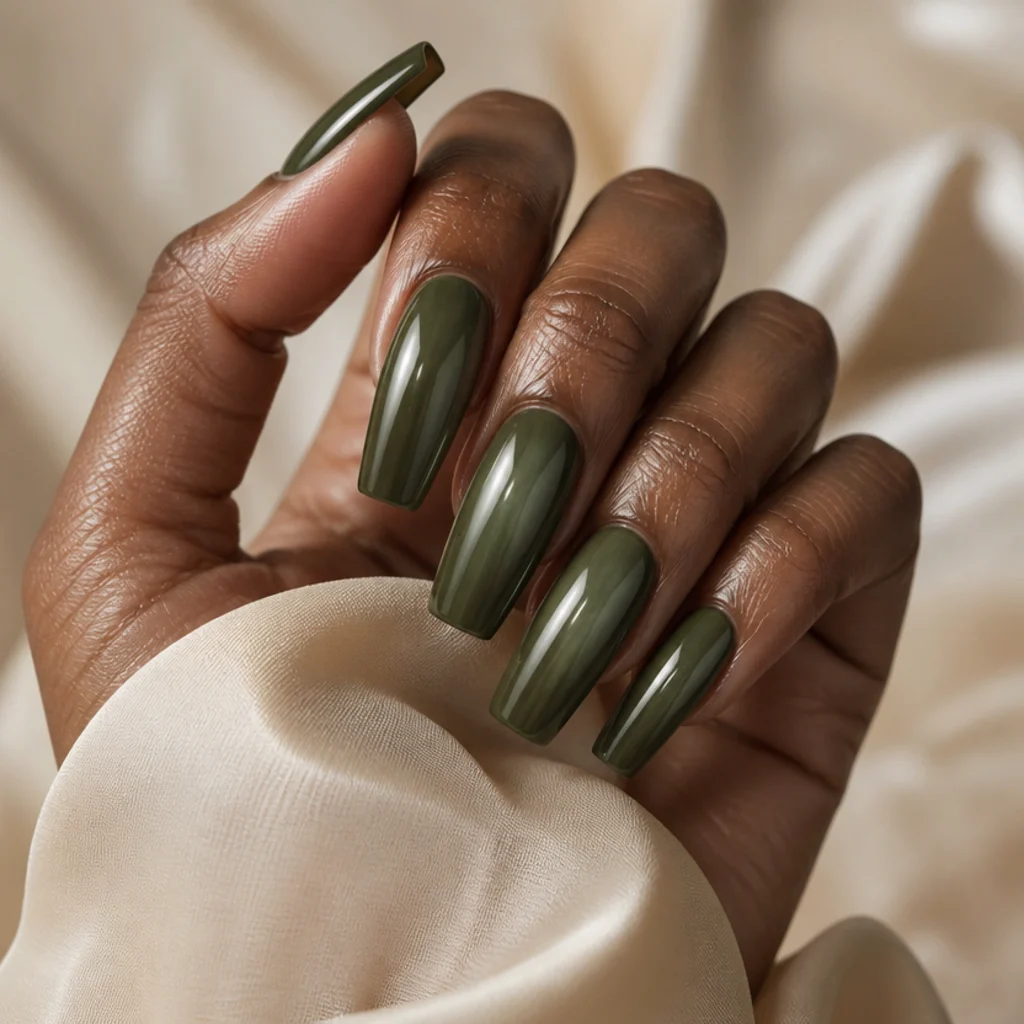
The progression ends at its most dramatic: the deepest dark olive green finished with a glazed, pearlescent overlay that adds dimension and a soft inner glow. The glaze, a sheer pearl or "glazed doughnut" style shimmer top, keeps the moody color from going flat and catches light like polished serpentine stone. Long coffin and almond shapes let the depth show and the overlay shift as the hand turns, making it a strong choice for evenings and events. Upkeep is higher because both the dark base and the pearl overlay reward careful gel sealing and timely fills; any regrowth or chip is obvious against the depth. Pro tip: build the glaze as a sheer pearl gel layered over the fully cured olive, then a final clear gloss on top, so the shimmer sits suspended mid-layer for that lit-from-within depth rather than a flat metallic coat. Ask for "deepest dark olive green with a suspended pearl glaze overlay, clear gel finish." From a sheer wash to this, the full arc shows how much range one green can carry.
Pro Tips from the Editor
- Prep dictates longevity more than polish does. Push back cuticles, gently buff the shine off the nail plate, and wipe with a dehydrator or alcohol before any color; olive gels and dark creams lift fastest off oily, unprepped nails.
- Cap the free edge on every dark or metallic look. Running a thin swipe of color and topcoat along the underside of the tip is the single biggest defense against the chipping that dark olive, chrome, and foil show first.
- Match the olive's undertone to your skin, not just its depth. Yellow-warm skin usually flatters a slightly grayer, cooler olive; cool and neutral skin can carry a warmer, browner khaki-olive. Test against your wrist in daylight, never store light.
- Two thin coats beat one thick one, always. Sheer jellies streak and dark creams bubble when applied heavy; thin, fully-cured layers give truer color and a smoother, longer-wearing surface.
- Gel is worth it the moment art enters. Negative space, foil, chrome, color block, and hand-painted leaves all wear at the edges; soak-off gel locks them for two-plus weeks where regular polish would fray in days.
- Keep a small "repair kit" for dark and opaque sets. A matching mini bottle plus a brush-on topcoat lets you patch a chipped tip or dulled edge and stretch a dark olive manicure a few extra days between appointments.
- Removal matters as much as application. Glitter, chrome, foil, and acrylic all grip hard; soak off with foils and patience rather than peeling or scraping, which strips layers of your natural nail and sabotages the next set.
Olive Depth, Finish and Upkeep at a Glance
| Look stage | Best shapes | Finish | Typical wear | Upkeep level |
|---|---|---|---|---|
| Sheer washes & milky creams (1-4) | Short round, oval, squoval | Glossy, semi-sheer | 1 wk polish / 2 wks gel | Low |
| Light art & mid-olive creams (5-9) | Almond, squoval, coffin | Glossy, matte | 2 wks gel | Low-moderate |
| Bold finishes & metallics (10-13) | Almond, coffin, square | Gold line, matte, chrome | 2 wks gel | Moderate |
| Dark & extension sets (14-20) | Long almond, coffin, stiletto | Gloss, foil, glaze | 2-3 wks + fills | Moderate-high |
How to Choose / Get the Look
Start by deciding how much attention you want your nails to draw, then find your spot on the progression. If you're olive-curious, begin with the sheer washes and milky creams in looks one through five; they're forgiving, easy to do at home, disguise regrowth, and wash off without drama if you change your mind. Ready for real color that still behaves? The mid-olive creams and almond sets in the middle (six through eleven) deliver unmistakable olive without heavy upkeep, and they translate cleanly to a two-week gel cycle. Chasing full impact? The dark olive green, chrome, acrylics, and glazed finishes near the end make the boldest statement but ask for more maintenance, capped edges, and usually a salon chair.
Then match the shape to your actual life, not just the photo. Short squoval and round wear best for hands-on, keyboard-heavy, caregiving, or workout-filled days, while long almond, coffin, and stiletto read editorial but need gentler hands and prompt repairs. Finish changes a color's whole personality, so decide between glossy, matte, chrome, and glaze before you book, since each one reframes the same olive completely. Undertone is the quiet decider: cooler, grayer olives flatter warm skin; warmer khaki olives flatter cool and neutral skin. Test against your wrist in daylight if you're unsure. Finally, communicate like a pro: bring a saved photo, name the exact depth ("light and sheer" versus "deep and opaque"), specify shape, length, and finish, and mention your lifestyle so your nail tech can steer you toward a version that survives your week. Clear references and honest upkeep expectations get you closer to the look than color names alone ever will.
Frequently Asked Questions
Are these real before-and-after transformations?
No. These 20 looks are illustrative styled progressions, not photos of real clients. They're arranged from soft to bold on purpose, to show how the light olive green family deepens toward dark olive green nails, so you can picture the full range, see how finish and shape change the effect, and pick your own comfort level before you book.
Does light olive green suit every skin tone?
Broadly, yes. Olive borrows from both warm and cool color families and carries a gray undertone that keeps it flattering across the board. Lighter tints tend to glow on deeper skin, while mid and dark olives read sophisticated everywhere. The real nuance is undertone: yellow-warm skin often prefers a cooler, grayer olive, while cool and neutral skin can carry a warmer khaki-olive. When in doubt, test a shade against your wrist in daylight.
How long do olive green acrylic nails last?
With proper prep and application, olive green acrylic sets typically hold up two to three weeks before a fill is needed, as your natural nail grows out beneath the enhancement. Darker, opaque olives show tip wear and regrowth a little sooner than sheer tints, so book maintenance accordingly. After several fill cycles, ask for a rebalance or full soak-off to keep the structure healthy.
What shape works best for dark olive green nails?
Almond and coffin are the popular picks because their length and taper flatter the deep, rich color and give art like leaves or foil room to sit. That said, dark olive looks just as chic on short squoval nails if you want low-maintenance length, and stiletto pushes it fully editorial. Choose based on lifestyle first and drama second: a shape you constantly snag won't stay beautiful long.
Can I get an olive manicure without going fully dark?
Yes, easily. Sheer washes, milky sage-olive creams, and olive-tinted French tips give you the color's earthy character while staying pale and low-key, and they hide regrowth better than any dark shade. You can always deepen the olive at your next appointment as your confidence with green grows, which is exactly what this subtle-to-bold progression is built to help you do.
Is olive green better in gel or regular polish?
It depends on the look. Sheer washes and milky creams are fine in regular polish for a week of easy wear and simple removal. The moment you add art, chrome, foil, dark opaque color, or extensions, gel is worth it: it locks fine details, resists the edge-chipping dark shades show first, and holds two to three weeks. Gel also cures instantly, which matters for deep pigments that stay tacky and dent in air-dry polish.
How do I stop dark olive polish from staining my natural nails?
Always use a clear base coat before any deep or pigment-heavy olive; bare application is what lets dark color seep into the keratin and leave a green-yellow cast. If a faint stain does appear after removal, a gentle buff and a few days bare usually clears it, and applying a whitening or ridge-filling base next time prevents a repeat. Never skip base coat to "save a step" with dark shades.
What makes olive green read warm versus cool on the nail?
The ratio of yellow to gray and blue in the formula. Olives leaning yellow-brown (closer to khaki or army green) read warm and cozy and flatter cooler skin. Olives with more gray or a faint blue-green base read cooler and more muted, which balances warm, yellow-toned skin. Finish nudges this too: matte pulls a color earthier and warmer, while chrome and glaze add cool, reflective light.
How often should I get olive green nails redone?
Regular polish looks its best for about five to seven days before chips and dulling show. Gel manicures hold roughly two to three weeks, limited more by regrowth than by wear. Acrylic and other extension sets want a fill every two to three weeks and a full rebalance or soak-off every couple of months. Dark and opaque olives, plus any art, tend to reveal regrowth and edge wear a touch sooner, so lean toward the shorter end of each range.