15 Olive Green Almond Nails for a Chic Look
Olive green is the quiet powerhouse of the earthy palette: grounded, a little moody, and impossible to date. Tapered into an almond, it lengthens the hand and reads polished without trying. Here are 15 art-directed takes, each with the finish, undertone, and exact wording to bring to your appointment.
 Edited by Lena Rose · Published July 11, 2026 · 24 min read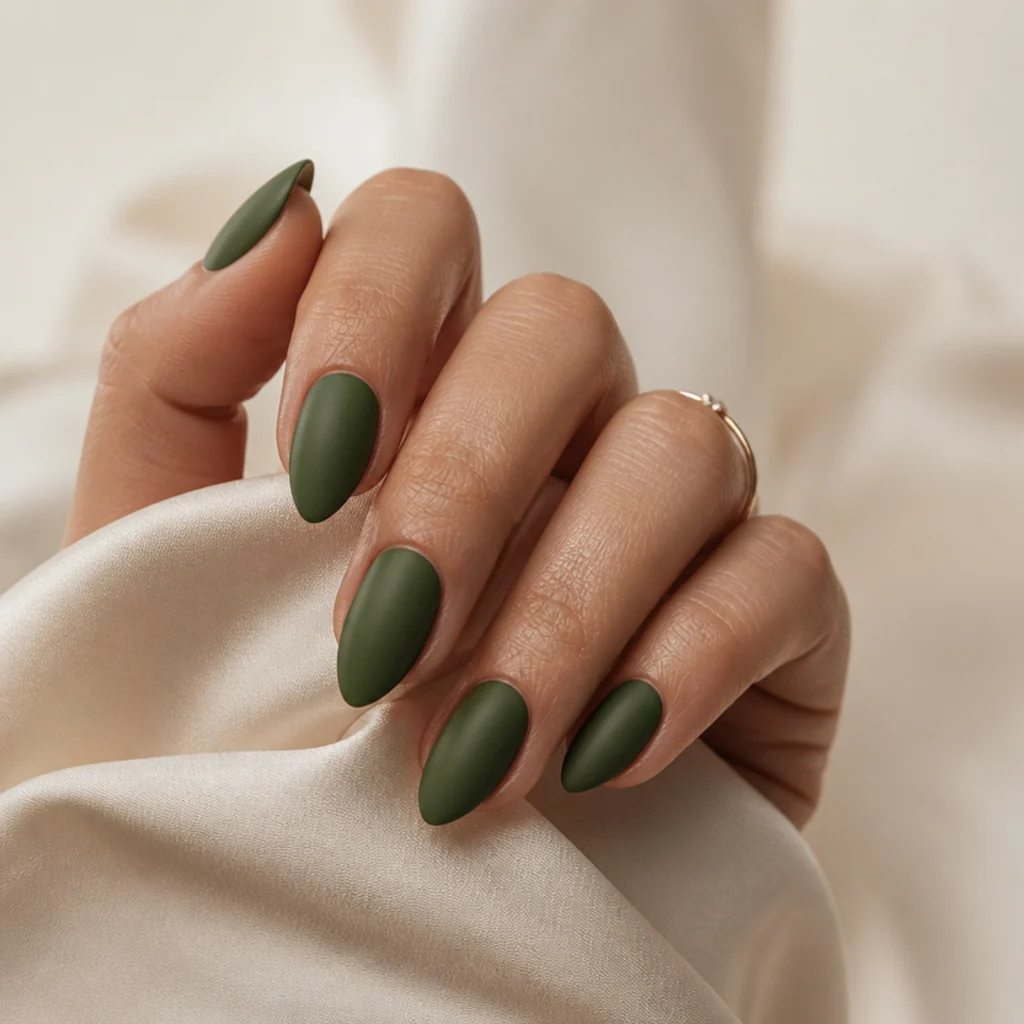
Quick Answer
- Best for: Warm, neutral, olive, and deep skin tones; anyone who wants a color that behaves like a neutral but still reads as a statement.
- Who might skip it: Very cool, high-contrast complexions who prefer clear brights, and anyone wanting a shade that pops from across a room rather than up close.
- Maintenance: Moderate. Plan a gel fill or fresh set every 2-3 weeks; matte and chrome need a topcoat refresh sooner.
- Difficulty: Beginner for solid color; intermediate for French, cat-eye, ombre, and color block; advanced for hand-painted florals.
- Cost: Variable by region and salon tier. Expect roughly a standard gel manicure price for solid olive, with a modest surcharge for chrome, foil, or hand-painted art, and more for acrylic sculpted extensions.
- Wear time / longevity: Gel typically holds 2-3 weeks; acrylic extensions hold shape 3-4 weeks between fills. Sheer, jelly, and ombre finishes disguise regrowth longest.
- Standout variation: Dark olive green nails in a soft matte finish, the most versatile and forgiving pick on this list.
- How to ask your nail tech: Bring 2-3 saved photos and name the depth ("deep, muted olive, not army green"), the finish, and any accent placement so nothing is left to interpretation.
In This Guide
- Classic Dark Olive Matte
- Glossy Olive Almond
- Olive Green and White Half-Moon
- Light Olive Green Wash
- Olive Chrome Mirror Tips
- Olive French Tip Almonds
- Olive Acrylic Extensions
- Olive and Gold Foil Accent
- Sheer Olive Jelly Finish
- Olive Green Ombre Fade
- Olive with Micro-Floral Art
- Deep Olive and Cream Color Block
- Olive Velvet Cat-Eye
- Olive and White Abstract Swirls
- Muted Sage-to-Olive Gradient Set
Intro
Olive green sits in the sweet spot between neutral and statement. It has the calm of a true earth tone but still reads as color, and that's why dark olive green nails have moved past their fall-only reputation into a year-round staple. Undertone is why it works so broadly: olive is basically green muted with yellow and a touch of grey, so it borrows warmth from your skin rather than fighting it. Put it on an almond shape and the effect softens even more — the tapered tip lengthens the nail bed and turns a moody shade elegant instead of heavy.
Shape and color do the work together here. Almond flatters short-to-medium beds and narrow fingers, and olive's low saturation keeps a bold length from tipping into costume territory. Below you'll find sheer washes, high-shine gloss, mirror chrome, magnetic cat-eye, olive green and white pairings, and sculpted olive green acrylic nails — fifteen ideas, each with who it suits, how demanding it is, a realistic maintenance timeline, and the exact words to hand your tech. Quiet-luxury minimal or a little more art: there's an olive here worth saving.
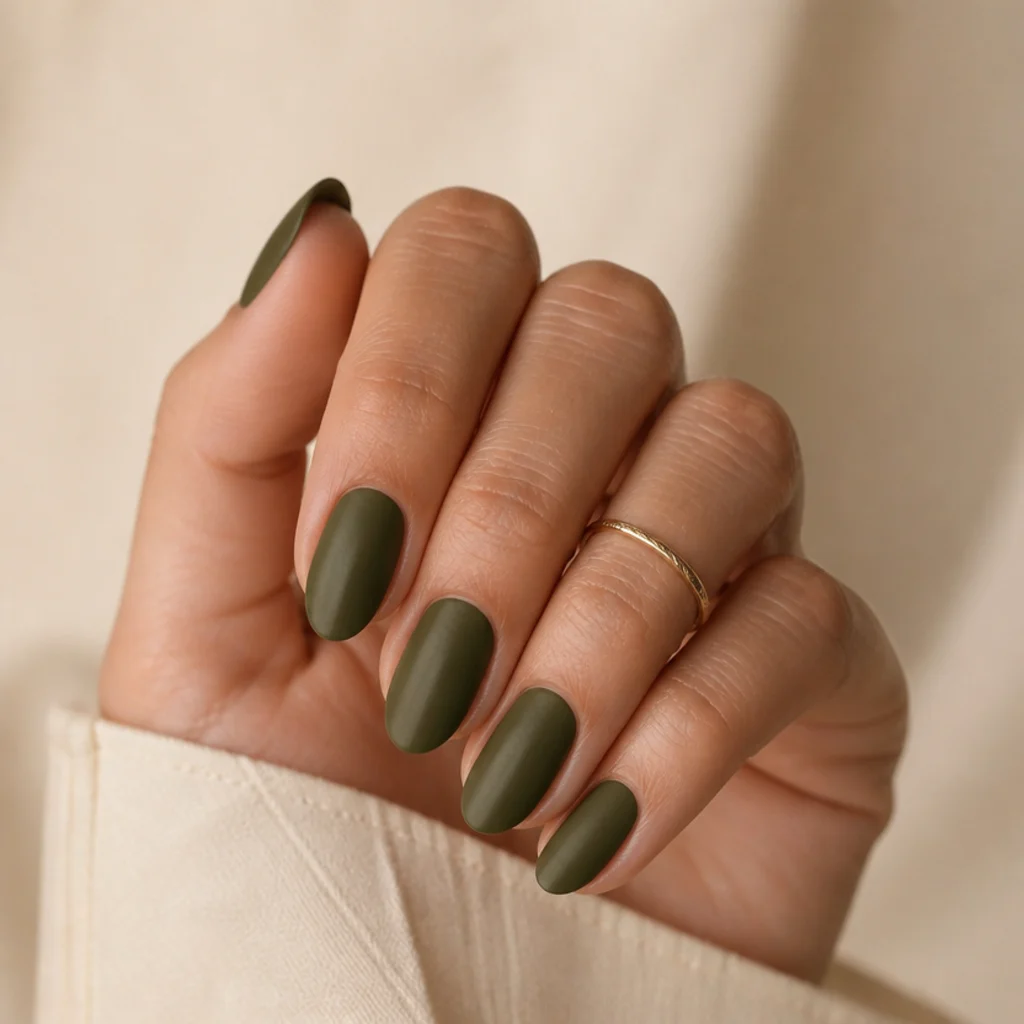
01Classic Dark Olive Matte
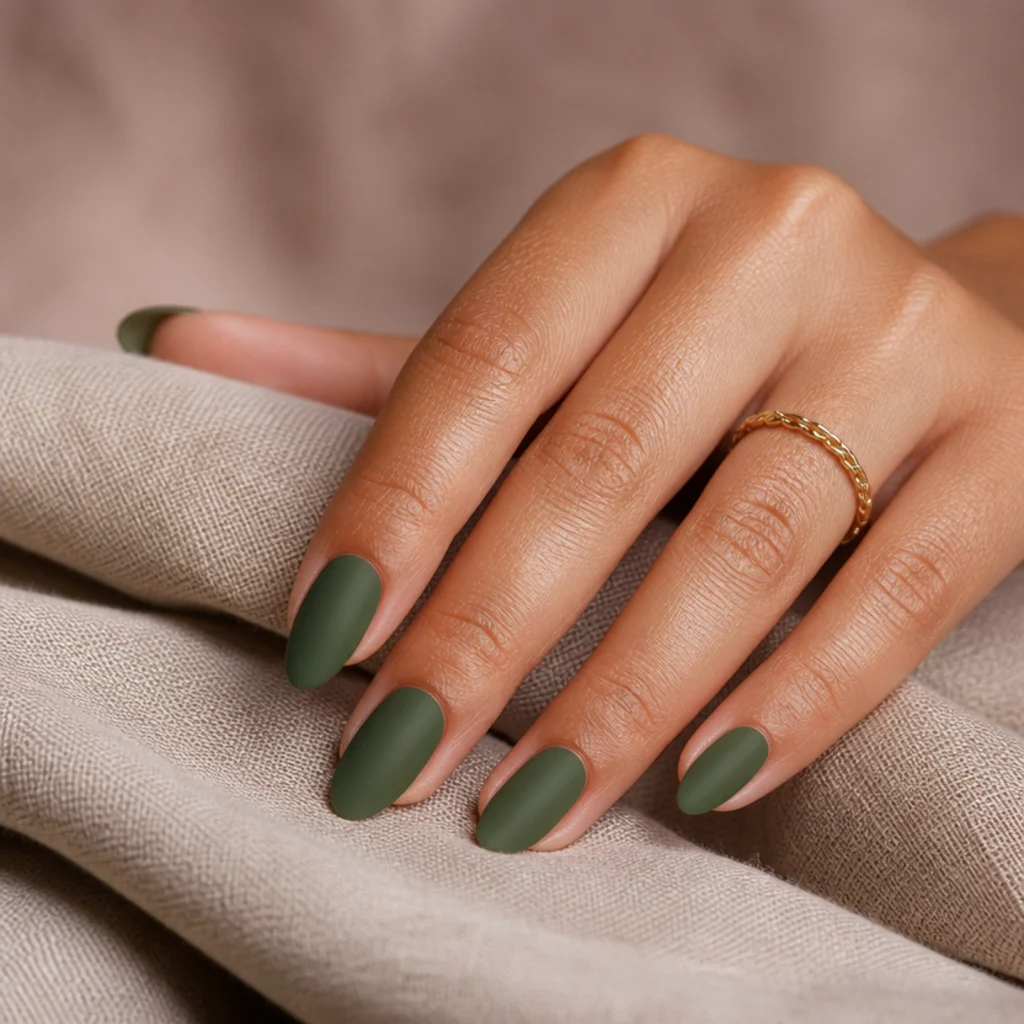
The anchor of the whole list. One saturated coat of deep olive under a fully matte topcoat turns the almond into something quietly expensive — killing the shine mutes the green another half-step, so it reads like suede or velvet instead of paint. That flat finish is what pairs so well with denim, camel tailoring, and gold jewelry.
Nearly everyone can wear it, but it glows hardest on warm, olive, and deep skin, where the yellow undertone in the polish echoes the warmth already there. Very cool complexions can read it as slightly grey, so go a shade deeper or add gloss if that happens. Maintenance is the one catch: matte surfaces scuff and dull faster than gloss, so plan a re-buff and fresh matte coat around week two to keep it soft. A matte-specific gel top holds up far longer than a matte polish top. Ask your tech for "deep, muted olive with a flat matte gel top, no shimmer."
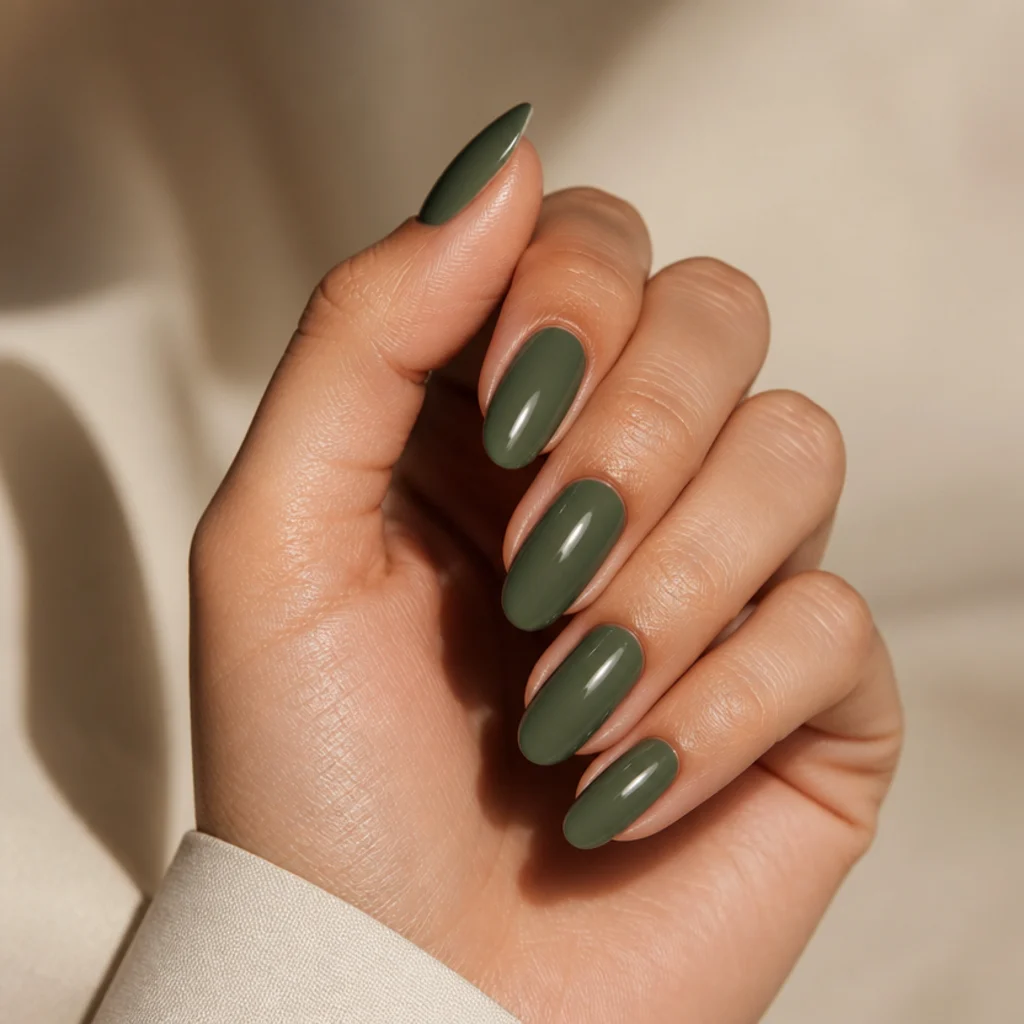
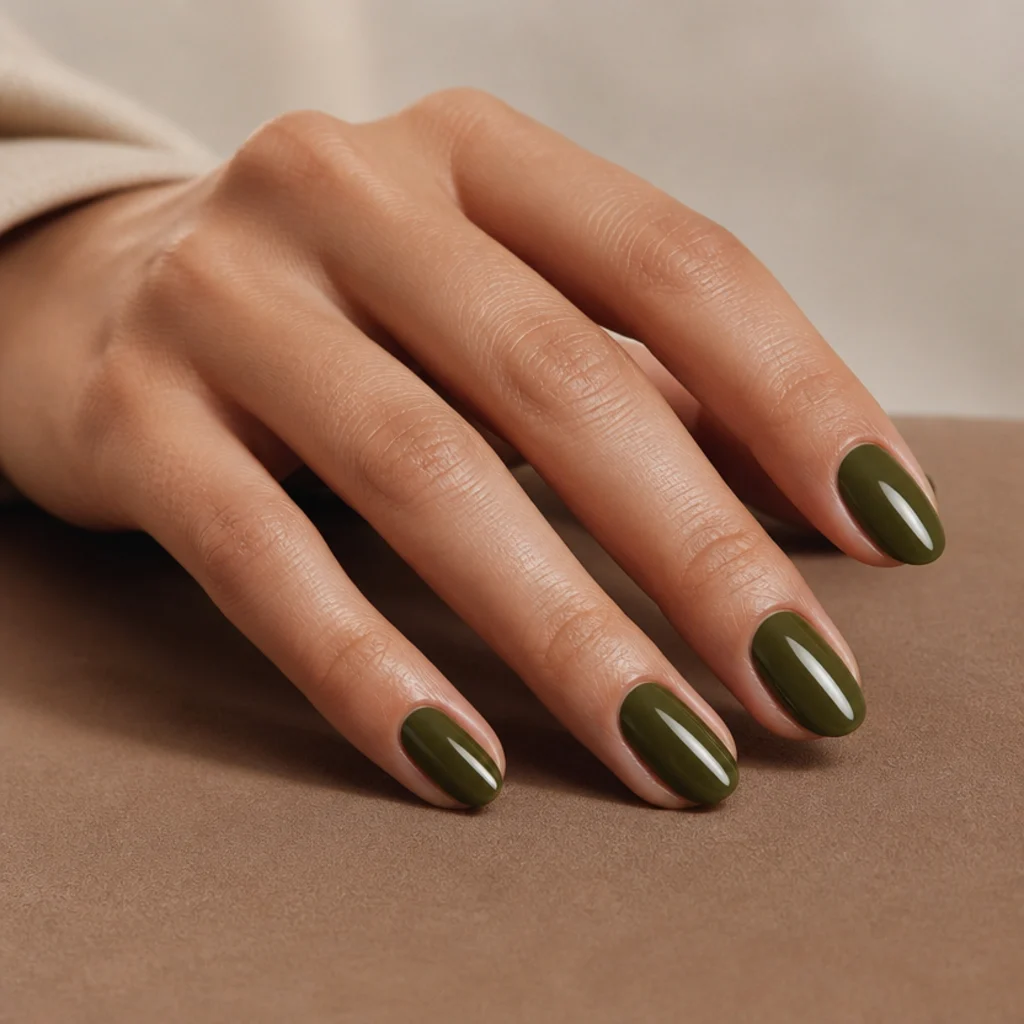
02Glossy Olive Almond
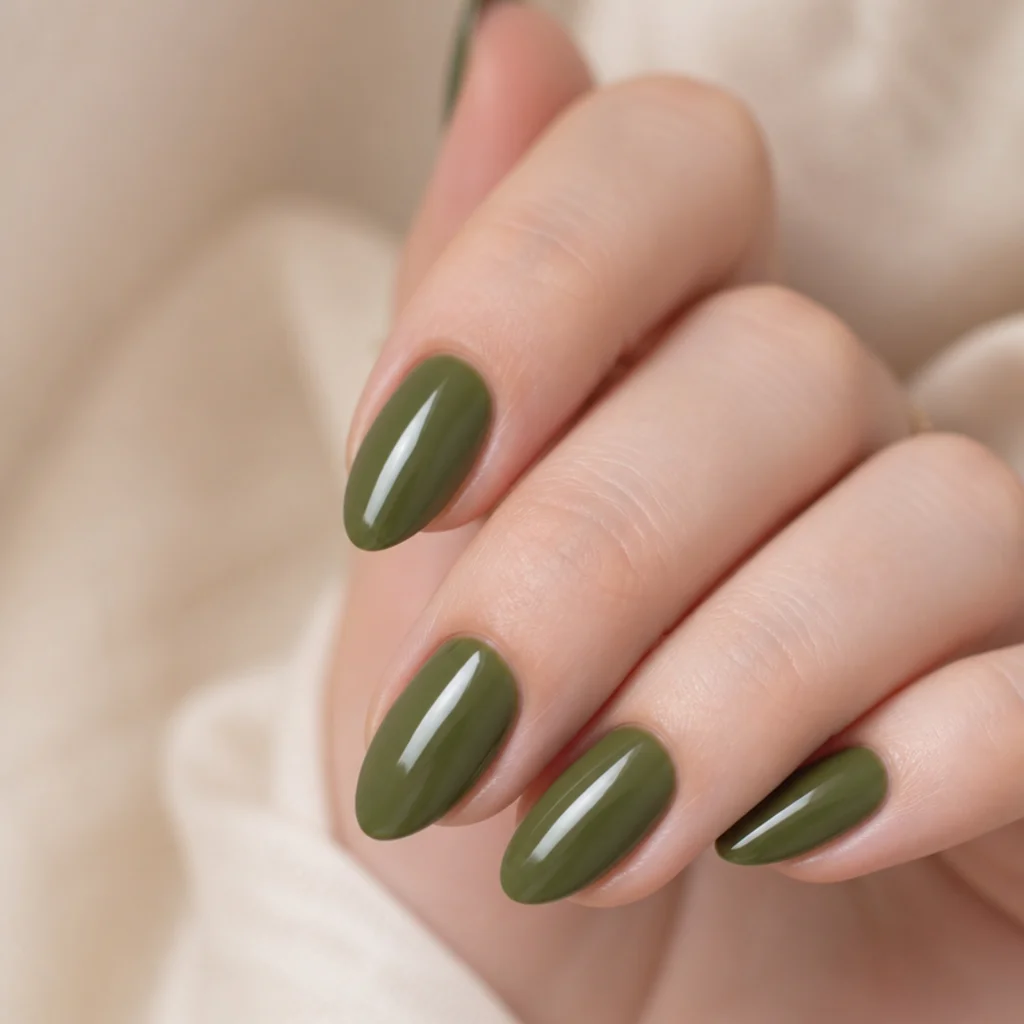
Same earthy base, opposite personality. A high-shine gel top bounces light along the almond curve and lifts a medium olive by a shade or two, for a fresher, dressier read. It's the version that photographs well across a dinner table or under ring light, since the gloss draws a clean highlight strip down each nail.
For daily wear, gloss is the practical pick — it resists the surface scuffing that shows up fast on matte, and it brightens cooler and neutral skin tones that can otherwise look flat under olive. The reflective finish also hides minor unevenness in the application, which makes it beginner-friendly. A standard 2-3 week fill applies; if your tips wear early from typing or gym work, a gel top keeps its shine longer than lacquer. Pro tip: cap the free edge with topcoat to seal it against chipping. Ask your tech for "medium olive in a high-gloss gel, tips capped."
03Olive Green and White Half-Moon
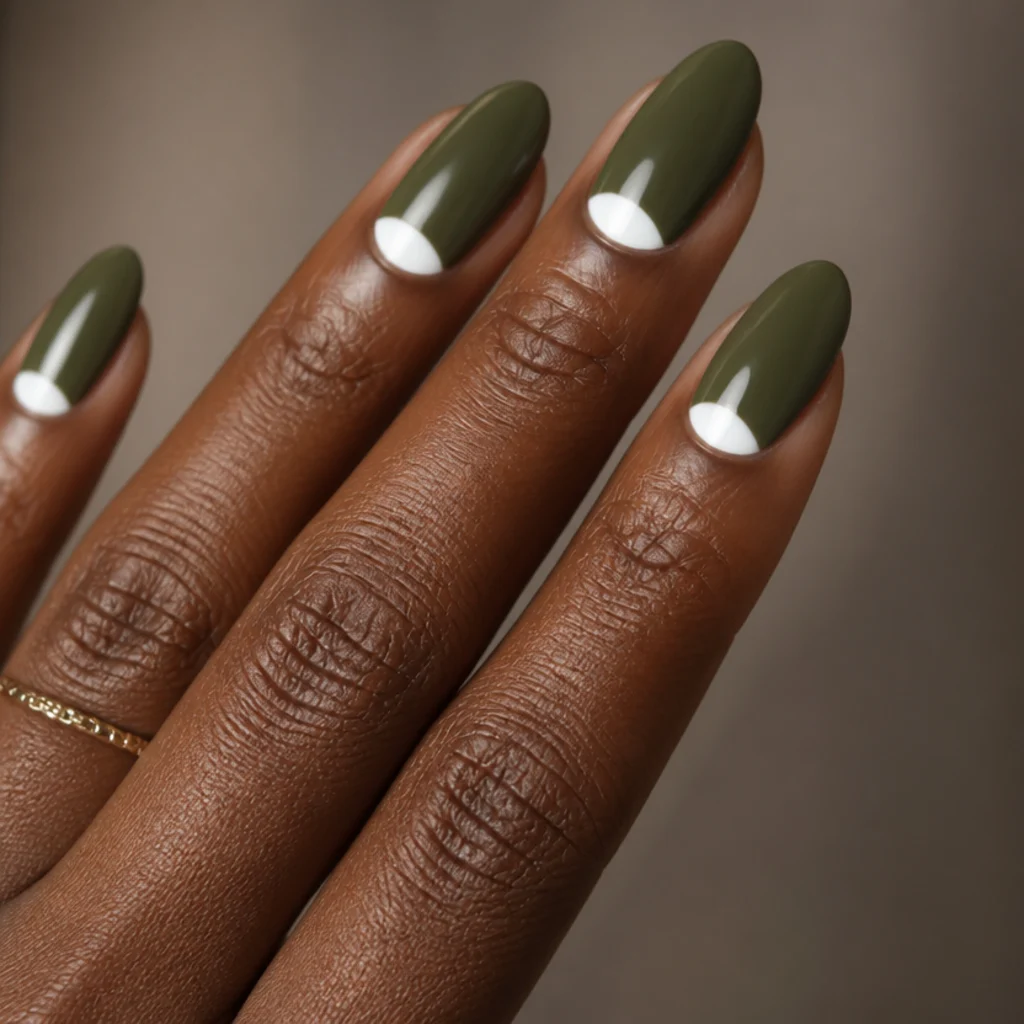
Olive green and white nails look instantly more designed, and the reverse half-moon is the cleanest way to pair them. A crisp white crescent at the base against a deep olive body nods to 1930s manicures while staying modern on an almond tip — the shape keeps the negative space elegant rather than retro-kitsch.
Because the contrast is high, the eye goes straight to your cuticle line, so book this when your cuticles are tidy and push-backs are fresh. The white works across skin tones as a bright reset against the moody green, so the pairing stays crisp on fair and deep hands alike. The freehand curved line puts it at intermediate difficulty, so budget extra chair time and look for a tech who's comfortable with a fine liner brush. Pro tip: a white base coat under the crescent stops the olive from muddying it. Ask for a "reverse French half-moon in opaque white over dark olive."
04Light Olive Green Wash
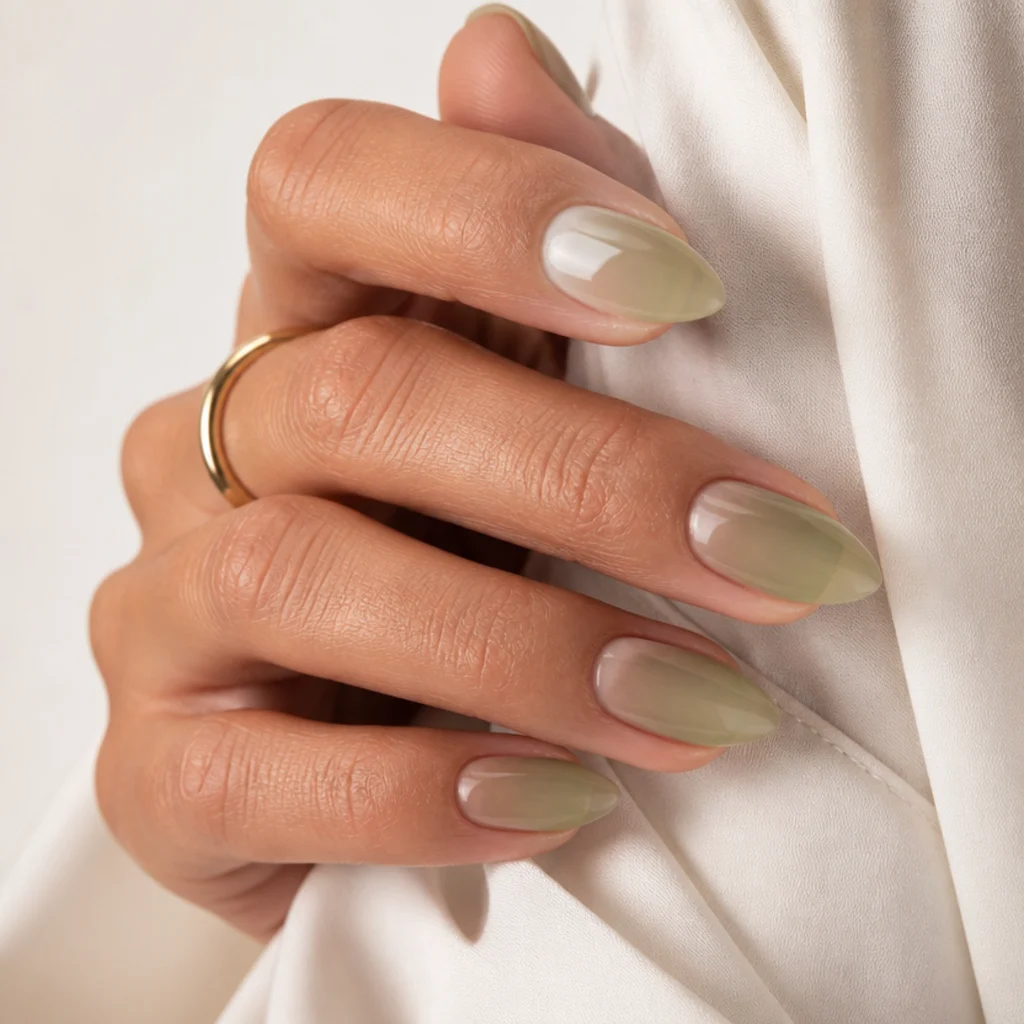
For a softer register, light olive green nails give you the shade's earthy character at a whisper. A sheer, lightly built wash lets some natural nail show through, which keeps it office-friendly and low-fuss — regrowth and small chips nearly disappear against the translucency instead of standing out.
This dusty, greyed-green suits neutral wardrobes and reads gentle on fair and medium skin; on deeper tones, add a second sheer pass so the color still shows. If a saturated shade feels like too big a leap, this is the easiest way into olive, and difficulty is low. Since it hides wear, you can stretch to three-plus weeks between visits. Pro tip: ask for a milky, jelly-adjacent base rather than a chalky pastel so it stays sophisticated. Ask your tech for a "sheer light olive, one to two translucent coats, natural nail showing through."
05Olive Chrome Mirror Tips
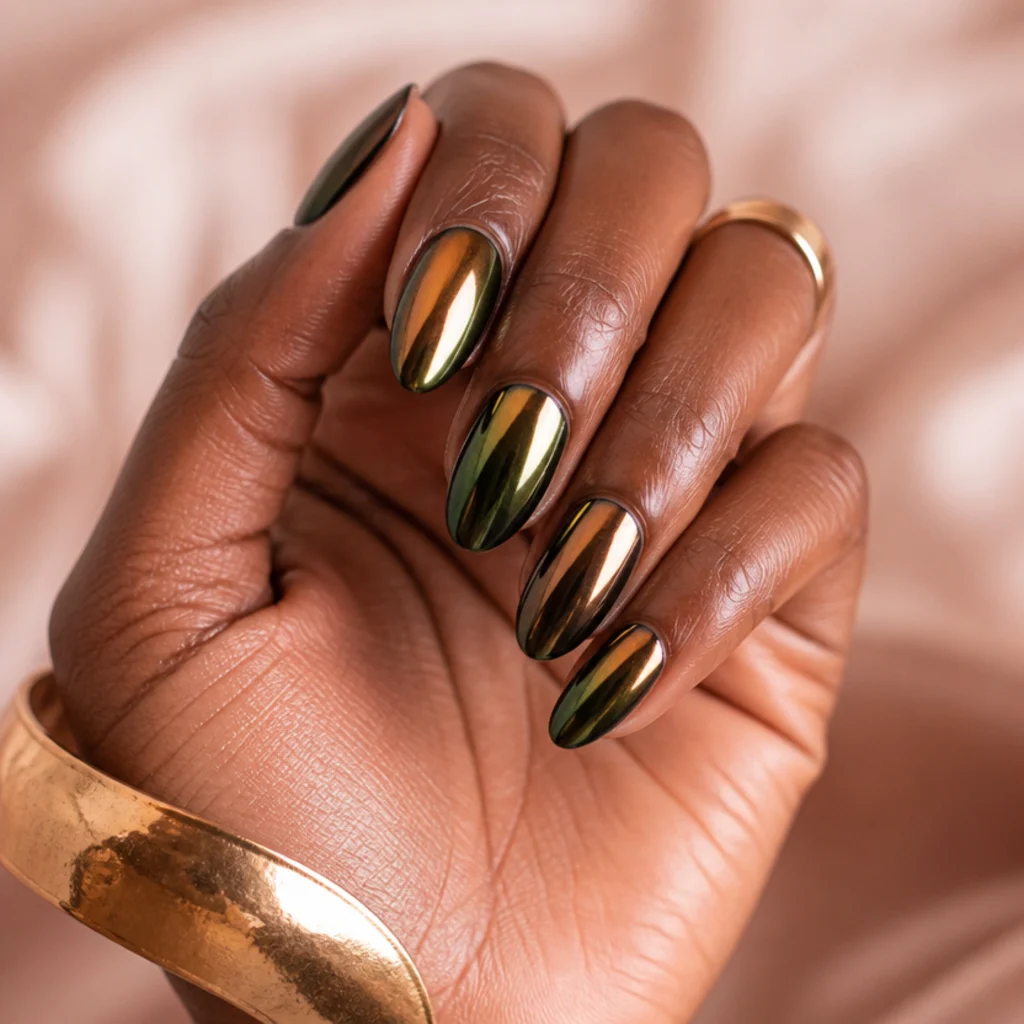
Chrome powder buffed over an olive base creates a liquid-metal shift that moves between antique bronze and deep forest as your hand turns. It's the most editorial look on this list and photographs like jewelry, a favorite for events, holidays, and anyone who wants drama concentrated at the tips.
Chrome shows every surface flaw, so it needs a perfectly smooth gel base from a practiced tech; a no-wipe glossy gel gives the mirror the most depth. Deep and olive skin get the most out of it, echoing gold jewelry, though fair hands can wear it too if you keep it to the tips instead of the full nail. Durability is the catch: chrome dulls first at the free edge, so a sealing gel top and gentle handling protect the shine. Pro tip: skip cuticle oil directly on chrome for the first day, since oil can cloud it. Ask for "an olive gel base with metallic chrome powder, sealed to a mirror finish."
Save this to Pinterest to build your fall and winter nail mood board.
06Olive French Tip Almonds
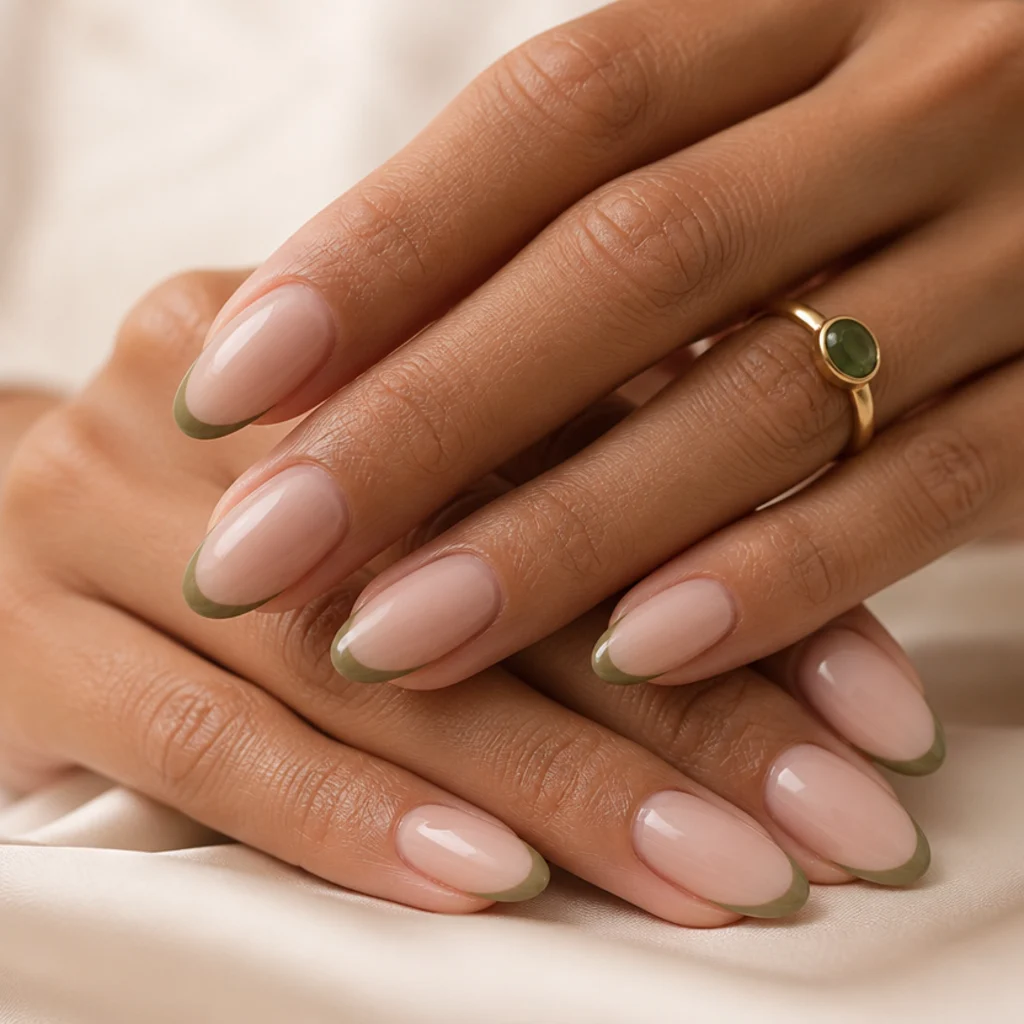
Swap the traditional white smile line for olive and the French turns quietly unexpected. A slim olive tip over a nude or sheer base keeps things minimal while still feeling intentional, and the almond's point exaggerates the tip so it looks longer and more refined — which is why it suits shorter beds so well.
It's one of the more versatile looks for work and low-key wear, since a well-matched nude base disappears into any skin tone and grows out almost invisibly. Precision on the smile line puts it at intermediate difficulty, so look for a steady-handed tech with a striper brush. Choose your nude by undertone: peachy on warm skin, rosy on cool, caramel on deep. Pro tip: a slightly thicker, more angular tip photographs sharper than a hairline. Say "olive green French tip, thin to medium line, nude base matched to my skin."
07Olive Acrylic Extensions
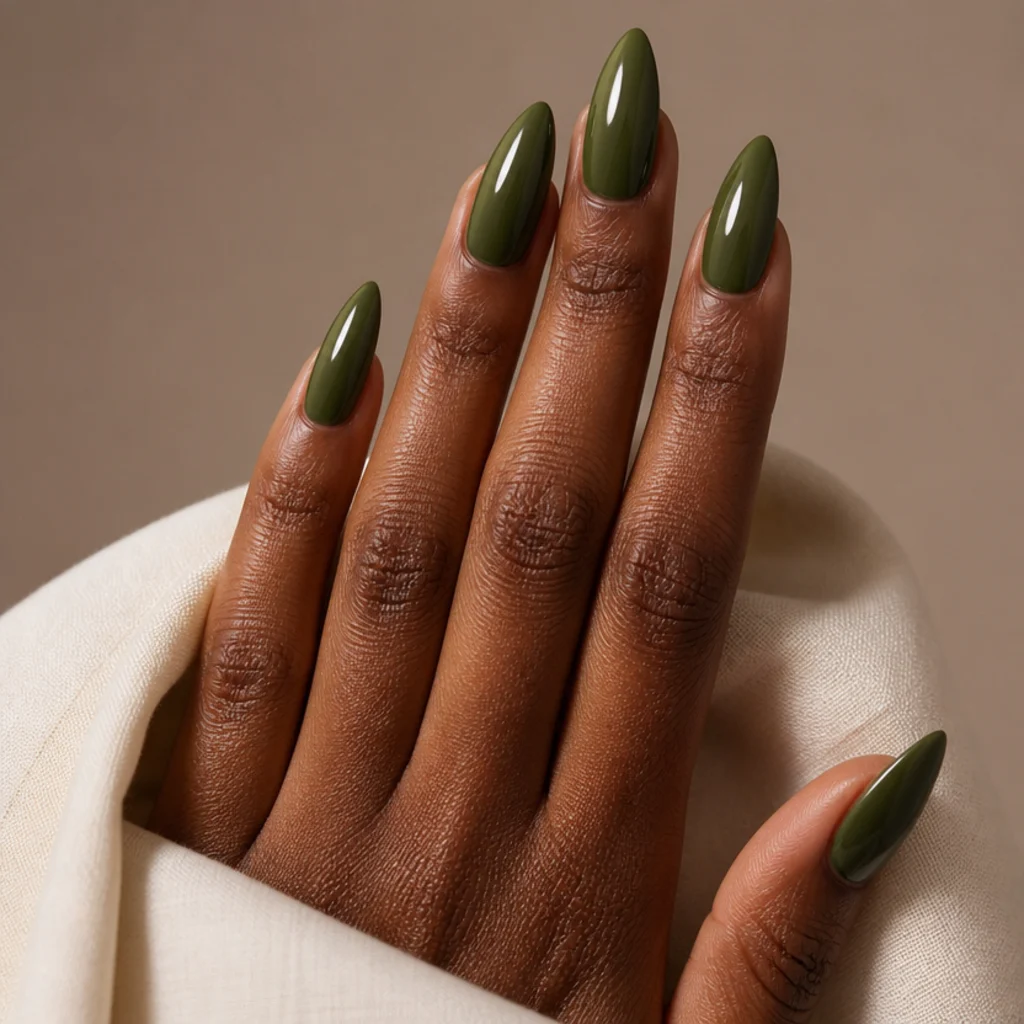
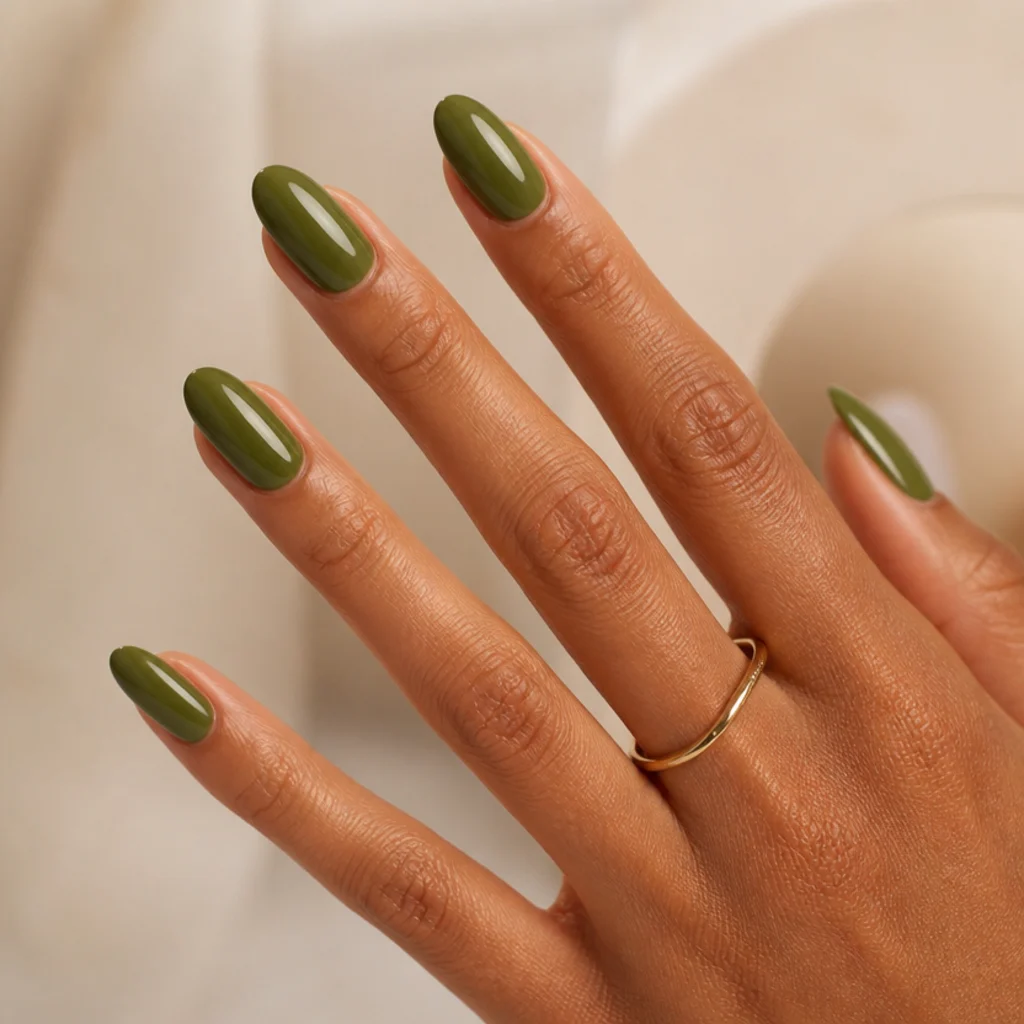
When your natural nails don't reach the almond length you want, olive green acrylic nails build the shape for you. Sculpted acrylic creates a strong, structured almond that holds dramatic length without flexing, and a rich, saturated olive looks properly luxe over that even canvas, since the color reads deep and consistent from base to point.
Length is a commitment: expect fills every 2-3 weeks, an adjustment period for typing and buttons, and a real apex built into the nail for strength. The bold shape and depth make a statement across skin tones, popping hardest on deep skin where the green contrasts beautifully. Structured gel or a soft-gel builder is a lighter alternative if acrylic sounds heavy. Pro tip: daily cuticle oil at the sidewalls keeps the natural nail underneath flexible and cuts down on lifting. Ask your tech for "medium-length sculpted almond acrylics in a deep olive, with a defined apex."
08Olive and Gold Foil Accent
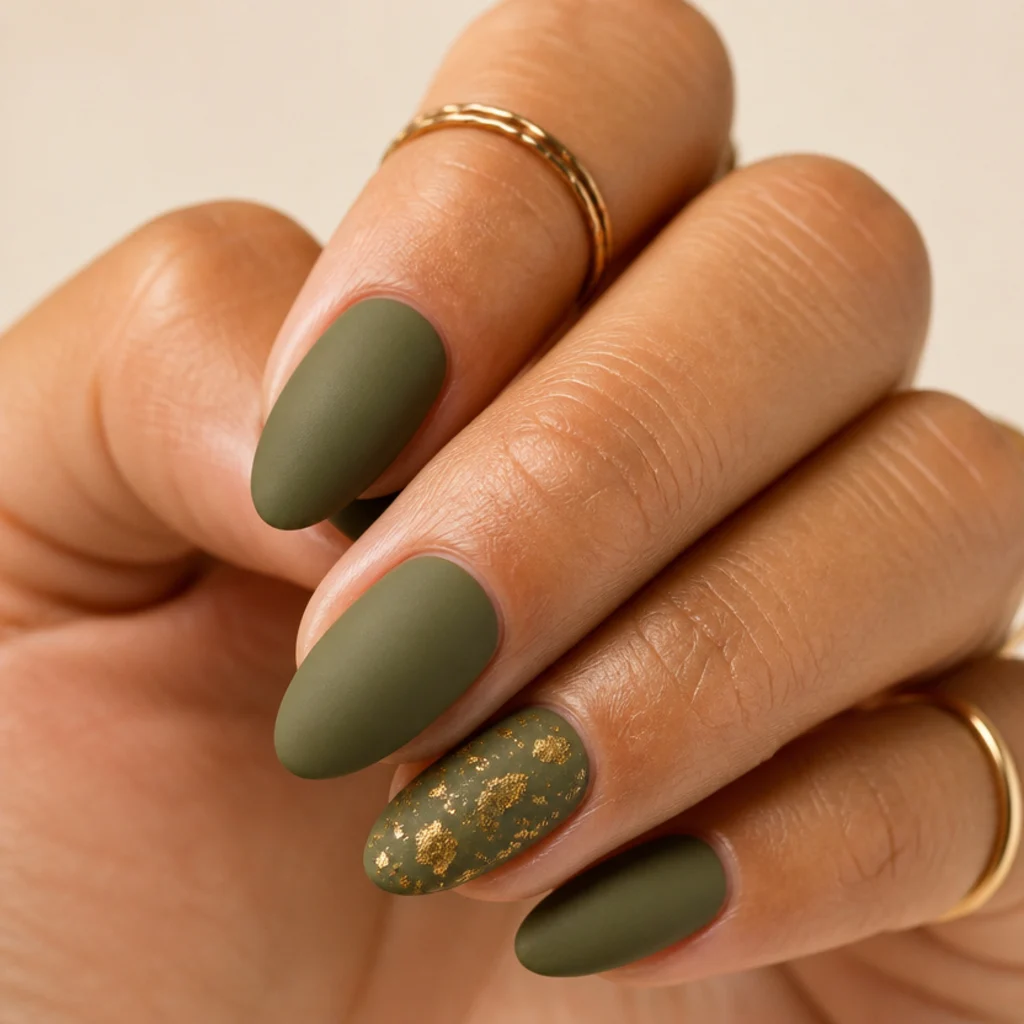
Olive and gold are a near-automatic pairing, and a touch of foil is the fastest way to dress up a plain set. Scattered flecks on one accent nail, or a thin foil vein at the cuticle, catch light against the muted green like ore running through stone, and it reads far more custom than glitter for the same effort.
Restraint is the whole game: keep foil to one or two nails so it stays refined instead of busy, and let matte olive on the rest make the metal look intentional. Warm and deep skin get the most from it, since gold undertones harmonize naturally; on cool skin, swap to a silver or pewter foil for the same effect. Difficulty runs beginner-to-intermediate depending on placement, and a gel top has to fully encase the foil so the edges don't lift or oxidize. Pro tip: press foil onto a tacky, not fully cured, base for the cleanest transfer. Ask for "matte olive with a gold foil accent nail, foil sealed under a glossy gel."
09Sheer Olive Jelly Finish
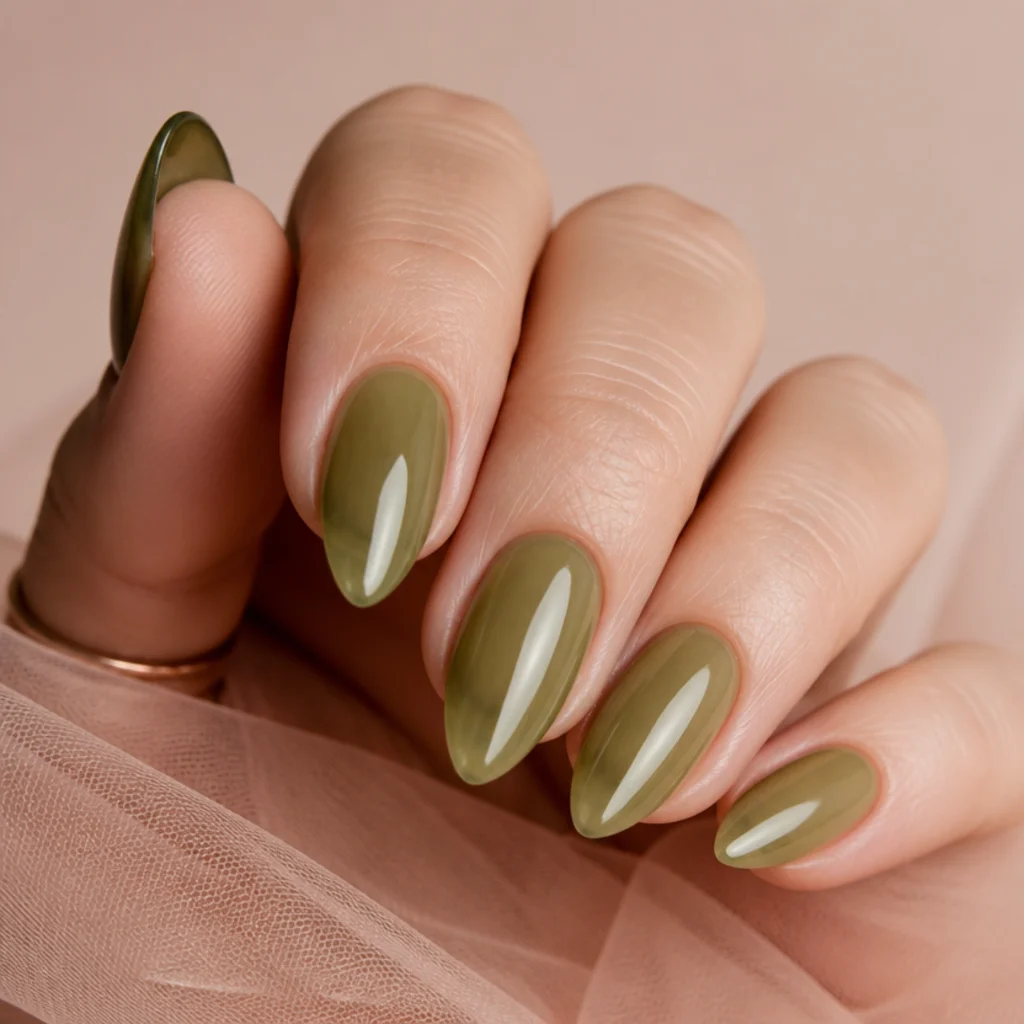
The jelly trend suits olive surprisingly well. A translucent, high-gloss build gives that squishy, sea-glass quality while holding onto the earthy tone, landing somewhere between the sheer wash and a full opaque color. It feels fresh and a little playful without tipping into juvenile, since olive's greyed base keeps even a candy-like finish grown-up.
Because jelly is see-through, it grows out softly and hides minor chips, which is handy if you go longer between visits, and the glassy shine looks especially good on lighter and neutral skin. Difficulty is low to moderate; the real skill is building even, thin layers so the color reads uniform instead of patchy at the sidewalls. Pro tip: three thin coats beat one thick one for that deep, glassy jelly clarity. Ask your tech for a "jelly olive, translucent and glossy, built in thin even layers."
10Olive Green Ombre Fade
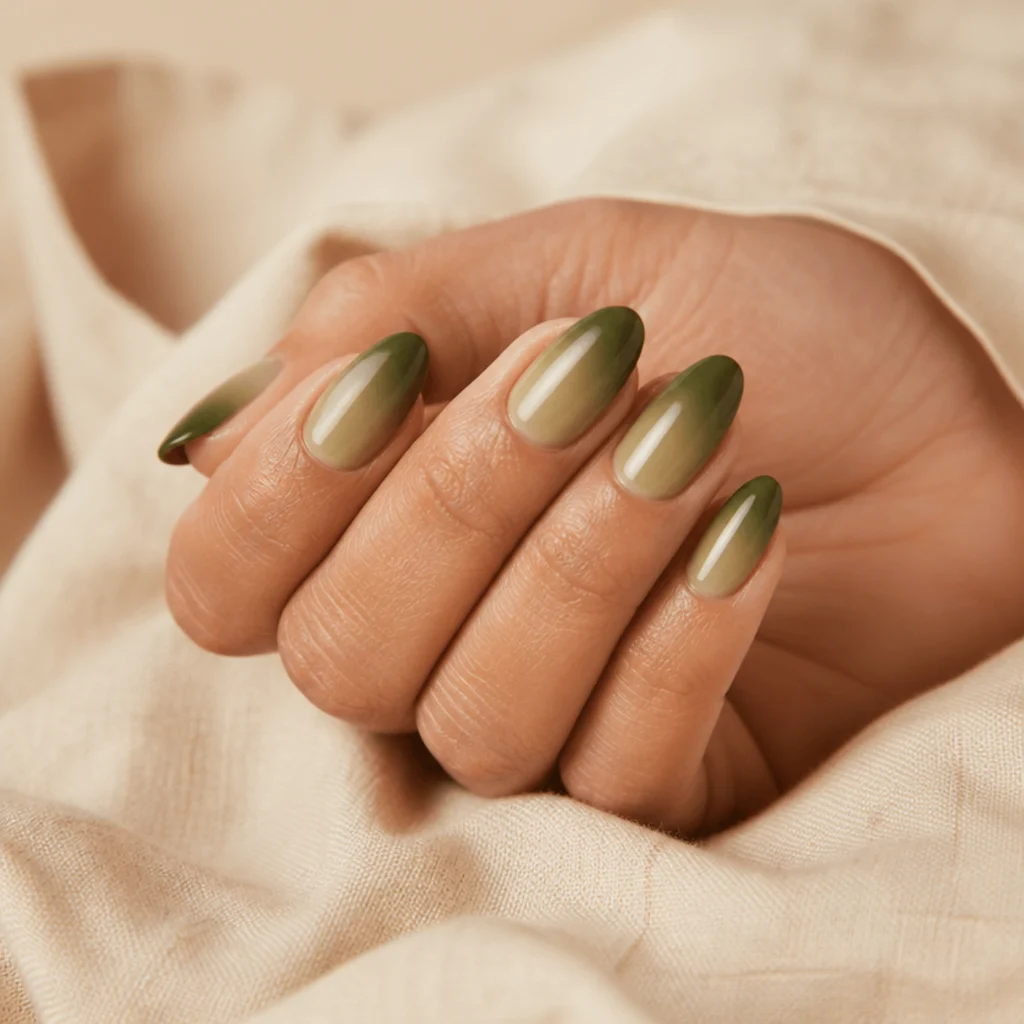
A fade from pale olive at the cuticle to deep olive at the tip adds dimension without introducing a second color family, so it stays cohesive and calm. The gradient stretches the almond even further and draws the eye toward the point, giving the whole set a soft, blended quality that feels quietly luxe rather than flashy.
Blending is the challenge here, which puts it at intermediate; techs usually work it with a makeup-style sponge or an airbrush over gel, curing between passes. The tonal fade is one of the more regrowth-friendly finishes on this list, since the light cuticle area hides new growth for weeks. It suits most skin tones because it spans light and dark within a single hue. Pro tip: for a smooth blend, ask the tech to keep the darkest color a hair short of the very tip so it doesn't read as a French. Ask for "a tonal olive ombre, light at the cuticle fading to deep olive at the tips."
11Olive with Micro-Floral Art
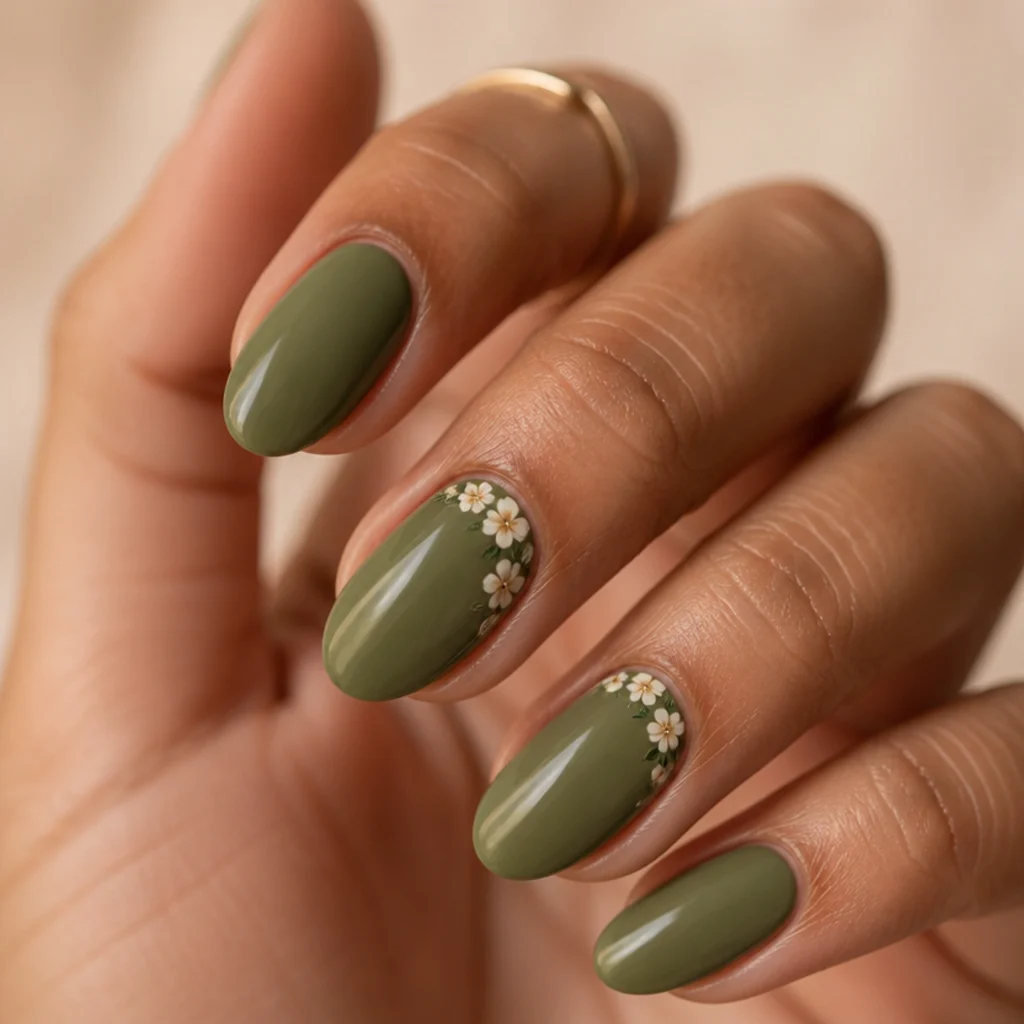
For something romantic, tiny hand-painted florals in cream, white, or dusty rose sit beautifully against an olive base, borrowing the garden-and-earth logic that keeps the pairing feeling natural rather than sweet. Clustering the flowers small and near the cuticle preserves the almond's clean line and keeps the design from crowding the tip.
This is the most artistic look on the list and depends entirely on your tech's fine-brush control, so it's firmly intermediate-to-advanced and takes noticeably longer in the chair — usually detail work on one or two accent nails. The muted olive backdrop keeps the florals from reading costume-like, so the look stays wearable across skin tones and dressy enough for events. A gel top is non-negotiable; it protects the artwork from smudging and lifts the colors slightly. Pro tip: ask for tone-on-tone cream florals for a subtler, quiet-luxury version. Ask for "small hand-painted florals near the cuticle over a solid olive base, sealed under gloss."
12Deep Olive and Cream Color Block
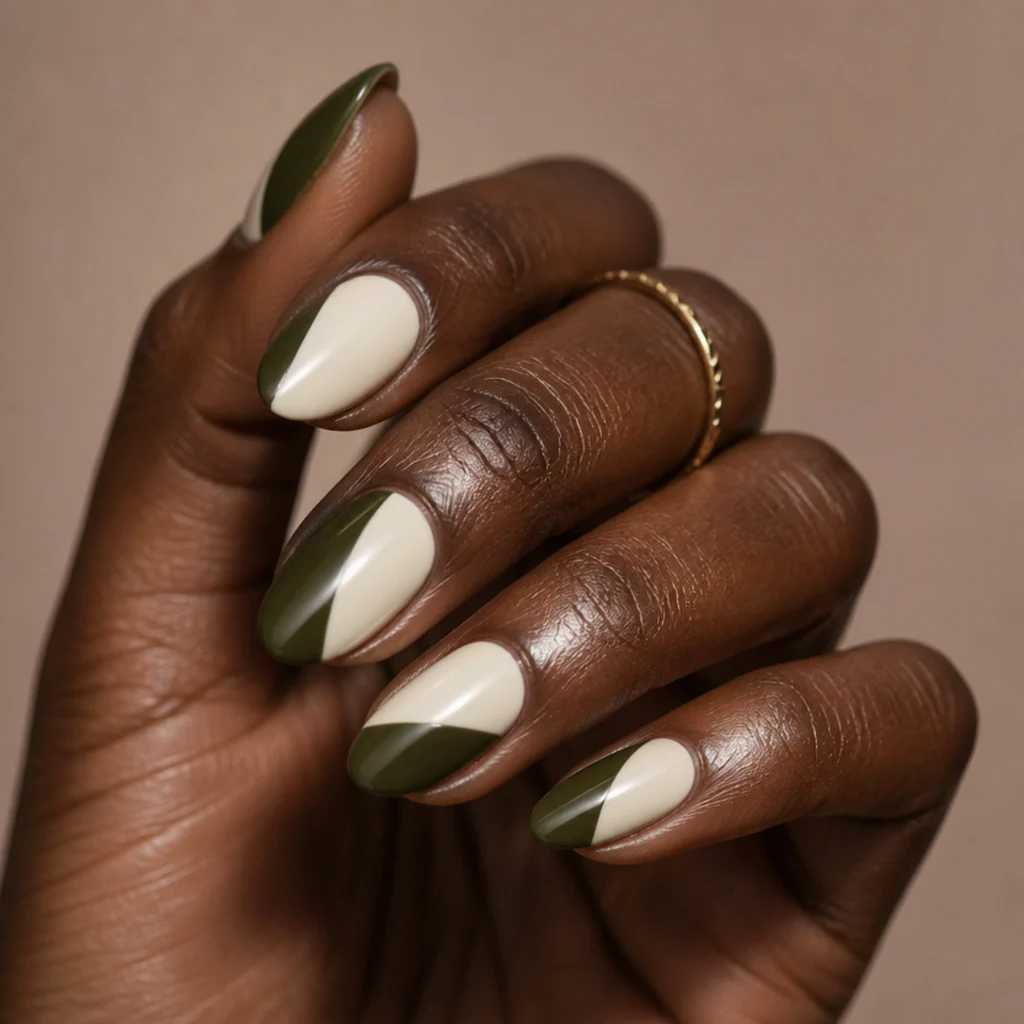
Color blocking pairs deep olive with a soft cream in bold, graphic sections, whether that's a diagonal split, a vertical half, or alternating full nails. The result is modern and architectural, letting the moody green share space with a warm neutral for contrast that's striking without shouting the way a black or neon pairing would.
Crisp edges are everything here, so it sits at intermediate difficulty and rewards a tech who works with striping tape or a steady liner brush. The cream keeps the whole set soft and flatters neutral and warm skin; on deep skin, a bone or ivory cream reads cleaner than a yellow-cream. Regrowth shows a touch more on the solid-olive sections, so plan a fill around week two to three. Pro tip: a thin metallic hairline along the divide hides any slightly imperfect edge and looks deliberate. Ask for "olive and cream color block, clean divide, matte or gloss to match."
13Olive Velvet Cat-Eye
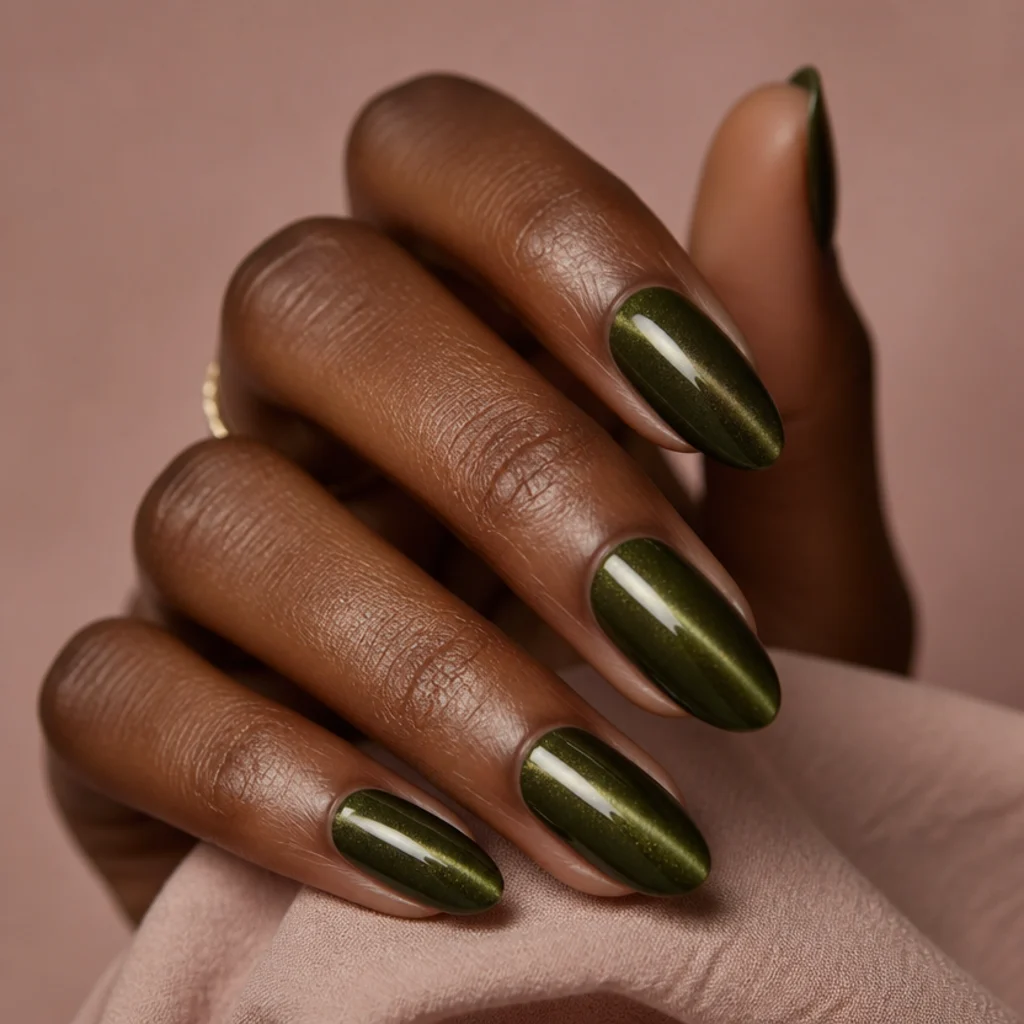
Magnetic velvet, or cat-eye, gel adds a soft band of light that shifts as you move your hand, giving olive a plush, twilight depth. The effect mimics brushed velvet and turns a simple set into something seasonal and rich, especially under warm evening light where the shimmer band comes alive.
You'll need magnetic gel and a tech comfortable drawing the shimmer band evenly with the magnet, so plan on intermediate difficulty; placement is what separates a luxe result from a muddy one. The dimensional shine suits deep and olive skin best, echoing the warmth already in the green, and it photographs with real depth. Maintenance is standard, though the effect looks sharpest under a glossy gel top that keeps the light band crisp. Pro tip: a vertical band elongates the almond, while a diagonal or curved pull reads more like a gemstone, so choose on purpose. Ask for "an olive cat-eye magnetic gel with a soft vertical shimmer band."
14Olive and White Abstract Swirls
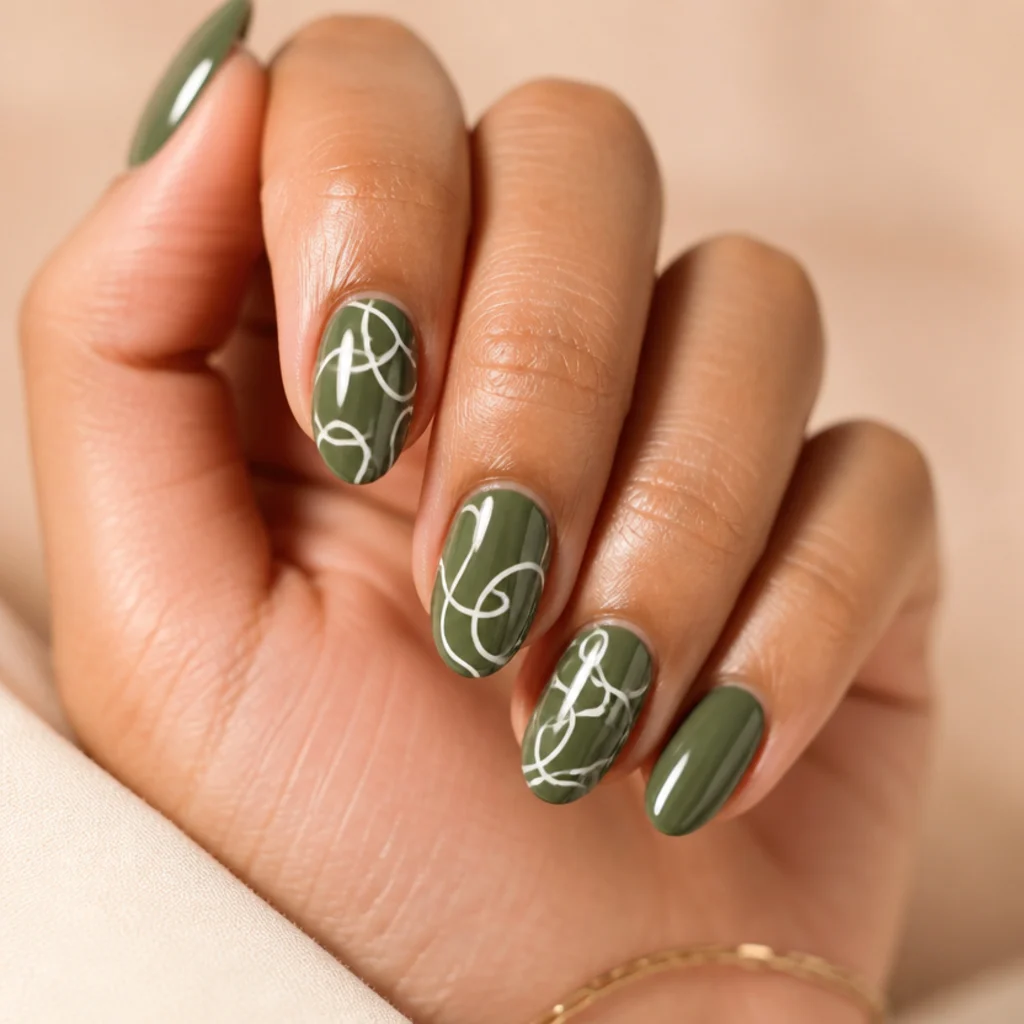
Another way to play with olive green and white nails: freehand white swirls looping across an olive base. The organic lines feel artistic and contemporary, and since they're meant to look easy rather than precise, small variations between nails read as charm instead of error — which takes the pressure off perfect symmetry.
The loose style is more forgiving than precise line work, but it still takes a confident brush hand and lands at intermediate. The high olive-and-white contrast pops across all skin tones, from fair to deep. Balance is the key styling call: keep swirls to a few nails and leave the rest solid olive so the set stays composed instead of chaotic. Pro tip: a slightly off-white or cream swirl reads softer and more expensive than a stark bright white against olive. Ask your tech for "white or cream abstract swirls over olive, kept loose and organic on two or three nails."
15Muted Sage-to-Olive Gradient Set
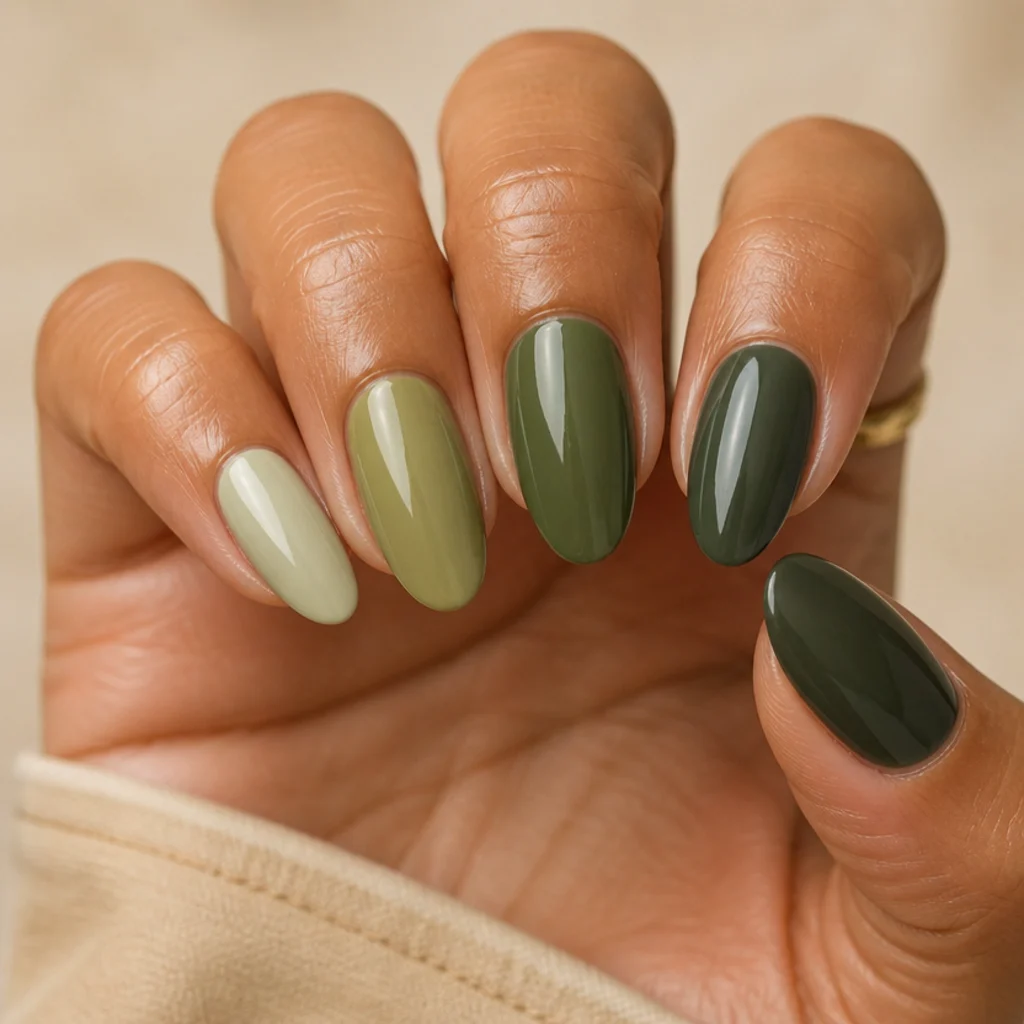
Rather than one shade, this skittle set paints each nail a slightly different tone, moving from pale sage on the pinky to deep olive on the thumb. It celebrates the whole green family at once and lets you wear light and dark olive together in one cohesive look — a smart way to figure out which olive you like best before committing to a full set.
Since each nail is a solid color, the technique itself is beginner-friendly; the skill is entirely in shade selection, so choose tones that step evenly instead of jumping. It suits every skin tone because it spans soft to saturated within one hue. Regrowth stays subtle on the lighter nails and shows slightly sooner on the darkest, so the thumb needs attention first. Pro tip: keep all five in the same finish, matte or gloss throughout, so the set reads intentional rather than mismatched. Ask for "a tonal green skittle set, pale sage through deep olive across the hand, one finish."
Pro Tips from the Editor
- Match olive to your undertone, not a swatch card: warm and olive skin can carry the deepest army-adjacent shades, while cool skin looks cleaner in a lighter, greyer olive or a glossy finish that brightens it.
- Almond is a long shape, so build an apex. On natural nails ask for a gel overlay for strength; the tapered tip is the first thing to snap without support.
- Finish changes the color more than the bottle does. The same olive reads suede in matte, jewel-like in gloss, and metallic in chrome, so decide finish before shade.
- For art or chrome that must last, insist on a gel topcoat and cap the free edge; lacquer tops let foil, florals, and mirror finishes dull or lift within days.
- Sheer, jelly, and ombre olives are the low-maintenance winners because they hide regrowth and chips, buying you an extra week between appointments.
- Photograph your favorite set in natural light before you leave the salon. It becomes your reference image and helps your tech recreate the exact depth next time.
- Keep a bottle of cuticle oil at your desk and use it nightly. Hydrated sidewalls reduce lifting on acrylics and keep matte and chrome from looking chalky.
How to Choose / Get the Look
Start with finish, because it changes everything else. Use this quick framework to narrow the field before you even pick a shade.
| Priority | Best finishes | Difficulty | Regrowth-friendly | Ask for |
|---|---|---|---|---|
| Easy everyday | Gloss, sheer wash, jelly | Beginner | High | "Medium olive, high-gloss gel" |
| Low upkeep | Sheer wash, ombre, skittle | Beginner-Intermediate | Highest | "Sheer or tonal olive, translucent" |
| Statement | Chrome, cat-eye, acrylic length | Intermediate-Advanced | Low-Medium | "Olive chrome tips" or "sculpted almond acrylics" |
| Art-forward | Half-moon, florals, swirls, color block | Intermediate-Advanced | Medium | "Freehand olive-and-white art, gel-sealed" |
Next, factor undertone. Olive's yellow-green base glows warmest against warm, olive, and deep skin, while cooler complexions usually prefer a lighter or glossier olive that brightens the hue instead of greying it. Then weigh upkeep honestly: opaque dark shades show regrowth soonest, so if you can only rebook every three-plus weeks, a tonal fade or sheer wash serves you better than a solid dark matte.
Finally, plan the appointment itself. Bring two or three saved images and name the specifics out loud: shade depth, finish, accent count, and placement. Ask whether gel overlay or acrylic better suits your natural length and lifestyle, request a gel topcoat if you're getting art or chrome, and confirm nail prep and cuticle work so your edges photograph clean. Cuticle oil at home is the single cheapest thing that keeps the whole set looking fresh.
Frequently Asked Questions
Do olive green nails suit every skin tone?
Broadly yes, once you adjust finish and depth. Olive's warm, muted base flatters warm, neutral, olive, and deep skin especially, where the yellow undertone in the polish echoes warmth in the skin. Cooler, high-contrast complexions often look best in a lighter, greyer olive or a glossy finish that brightens the hue so it doesn't read flat or drab.
Is olive green better in gel or acrylic?
It depends on your goal, not the color. Gel suits natural-length nails and shorter almond shapes with less commitment and a thinner feel, while acrylic sculpts longer, structured almond extensions that hold dramatic length without flexing. A soft-gel builder sits between the two. Discuss your natural nail health, length goals, and lifestyle with your tech before choosing.
How do I keep dark olive from looking dull?
Choose a glossy or gel topcoat rather than matte if brightness is the priority, and refresh the top the moment the surface starts to scuff. Nightly cuticle oil keeps the sidewalls and surface from going chalky, and wearing gloves for cleaning or dishes protects the finish. For matte specifically, a matte-formulated gel top holds its velvety look far longer than a matte lacquer.
What colors pair well with olive green nails?
White and cream give crisp, modern contrast, gold foil adds warmth and a luxe edge, and dusty rose softens hand-painted florals. Staying within the green family, sage to deep olive, creates elegant tonal sets. For cool skin, swap gold accents for silver or pewter so the metal harmonizes with your undertone rather than fighting it.
How long do olive almond nails last before a fill?
Most gel sets look their best for about two to three weeks before regrowth at the almond base becomes noticeable, while acrylic extensions hold shape closer to three to four weeks between fills. Sheer, jelly, ombre, and tonal finishes disguise regrowth longest and can stretch the interval, whereas solid dark shades reveal new growth soonest.
Is olive green a good year-round nail color?
Yes, and that's much of the appeal. The greyed, earthy base keeps it from feeling strictly autumnal, so it transitions easily: pair it with gold foil or cat-eye depth for fall and winter, and lighten to a sheer or sage-toned olive for spring and summer. Adjusting finish and depth lets one color family carry every season.
What length works best for olive almond nails?
Almond flatters short-to-medium natural lengths beautifully, since the taper alone lengthens the finger without needing extreme length. Deep, saturated olives and chrome read most striking on medium-to-long sets, while sheer, French, and light olive washes look elegant even on shorter almonds. If your natural nails are short, an overlay or acrylic builds the taper safely.
How do I ask for the exact olive shade I want?
Bring a reference photo and describe the color in relative terms: say "deep, muted olive, not bright army green" or "dusty light olive with grey in it, not pastel." Naming the finish (matte, gloss, jelly, chrome) alongside the depth removes guesswork, and asking your tech to swatch two olives on a tip before applying confirms the tone in your salon's lighting.