20 Short Leopard Print Nails That Stun
Short nails and leopard print are a smarter match than most people expect. This guide breaks down 20 distinct short sets by base color, spot scale, finish, and shape, so you can match the print to your undertone, your upkeep tolerance, and exactly how you want to brief your tech.
 Edited by Lena Rose · Published July 11, 2026 · 36 min read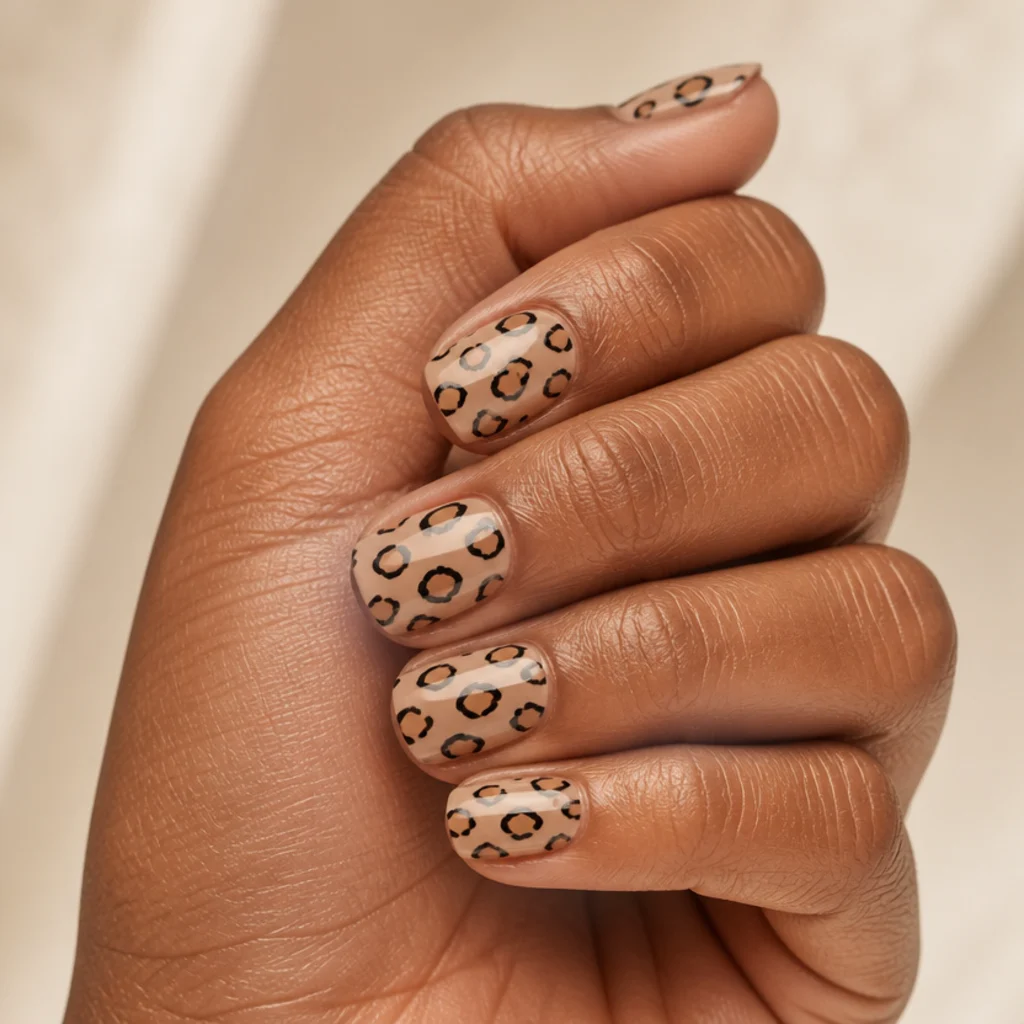
Quick Answer
- Best for: Anyone who wants high-impact nail art on a practical short length that stays out of the way at a keyboard, in gloves, or hands-deep in daily life.
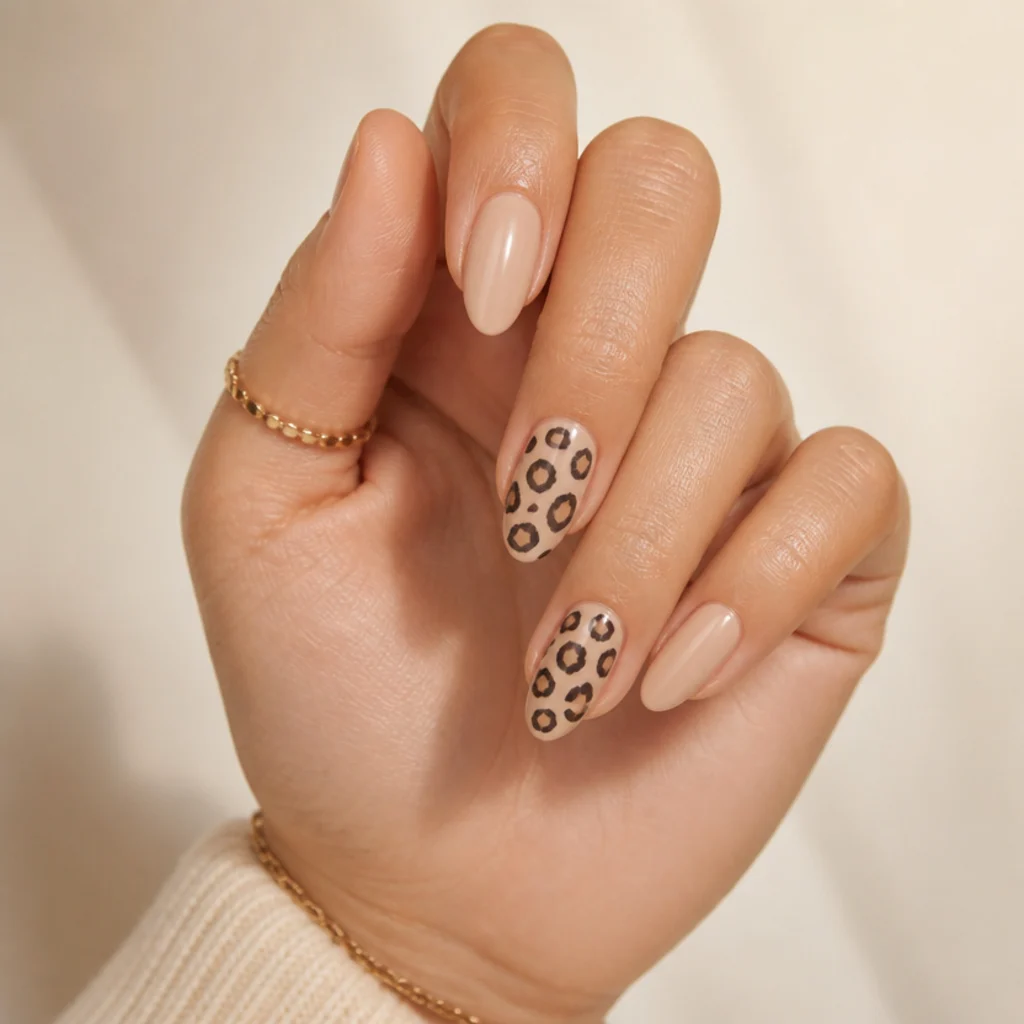
- Who might skip it: Anyone who wants maximum drama and dense, sprawling print, that reads better on medium-to-long almond or coffin; and true minimalists who prefer a bare, single-color nail.
- Maintenance: Low to moderate. Short gel sets typically hold two to three weeks with less tip lift than long nails, and regrowth hides easily against a neutral base.
- Difficulty: Beginner-friendly as freehand dots on a single accent nail; full multi-color rosettes on all ten are an intermediate-to-advanced tech job.
- Cost: Roughly the price of a standard gel manicure plus a nail-art surcharge, often charged per accent nail or per set; hand-painted freehand and foil or rhinestone detail sit at the higher end.
- Wear time / longevity: Two to three weeks for gel; acrylic and gel-x run a similar fill cycle. Short lengths lift less, so you often reach the full three weeks.
- Standout variation: A neutral short set with crisp black leopard print nails on two accent fingers, easy to wear, easy to book, and flattering on nearly every hand.
- How to ask your nail tech: Name the base color, the spot color, the outline color, the print scale (micro, classic, or bold), and how many nails you want printed, then bring one clear, well-lit reference photo.
In This Guide
- Classic Black Leopard on Nude
- White Leopard Print Nails
- Short Leopard French Tip
- Micro-Leopard on Squoval
- Single Black Leopard Accent
- Milky Base with Scattered Spots
- Matte Black-and-Tan Leopard
- Negative Space Leopard
- Short Leopard Acrylic Set
- Chocolate and Caramel Spots
- Gold Foil Leopard Accents
- Chrome Base Leopard
- Red Base with Black Spots
- Pastel Blush Leopard
- Short Almond Leopard
- Half-and-Half Leopard
- Glazed Donut Leopard
- Autumn Rust Leopard
- Rhinestone-Dotted Leopard
- Minimalist Two-Spot Leopard
Short leopard print nails prove you don't need length to make a statement. The spots carry the look while a compact canvas keeps the print crisp instead of stretched. Length is where most leopard sets go wrong: on a long nail the rosettes bloat and drift into safari kitsch, but on a short nail, well-spaced spots read modern and deliberate. Short sets flatter working hands, too. They resist snapping and tip lift, survive gloves and gym sessions, and regrowth practically disappears against a neutral base. Scale is the rule that governs everything here, because a leopard rosette is a broken shape: a soft color center with an interrupted dark ring around only part of it, and that ring needs room to register. Crowd it and you get mud. Space it and you get print. This guide is built to narrow your choices rather than repeat one idea twenty times. Each look changes something that actually matters: the base color, the spot palette, the print scale, the nail shape, the finish, or the occasion it suits. Watch which combinations keep pulling your eye; that pull is usually your answer. I've added upkeep notes and exact wording so a vague reference photo never derails your appointment.
01Classic Black Leopard on Nude
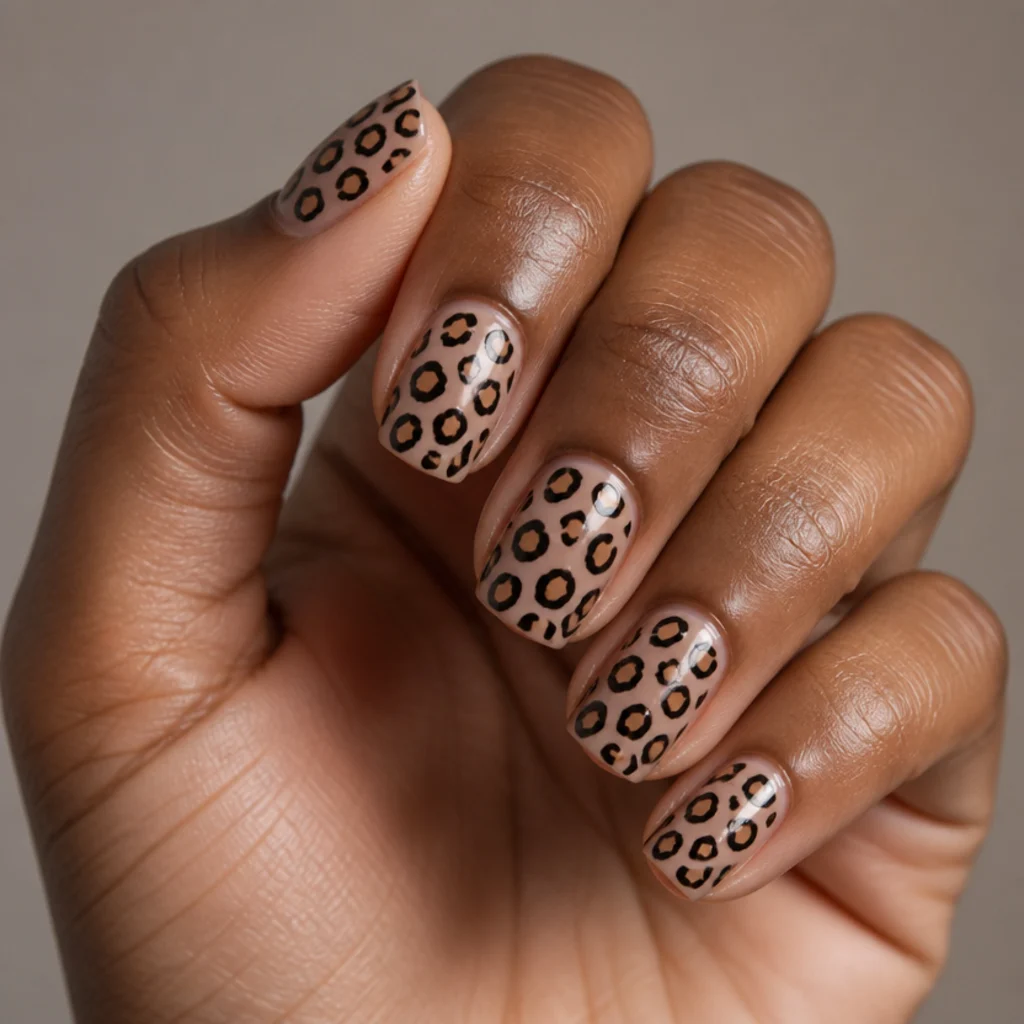
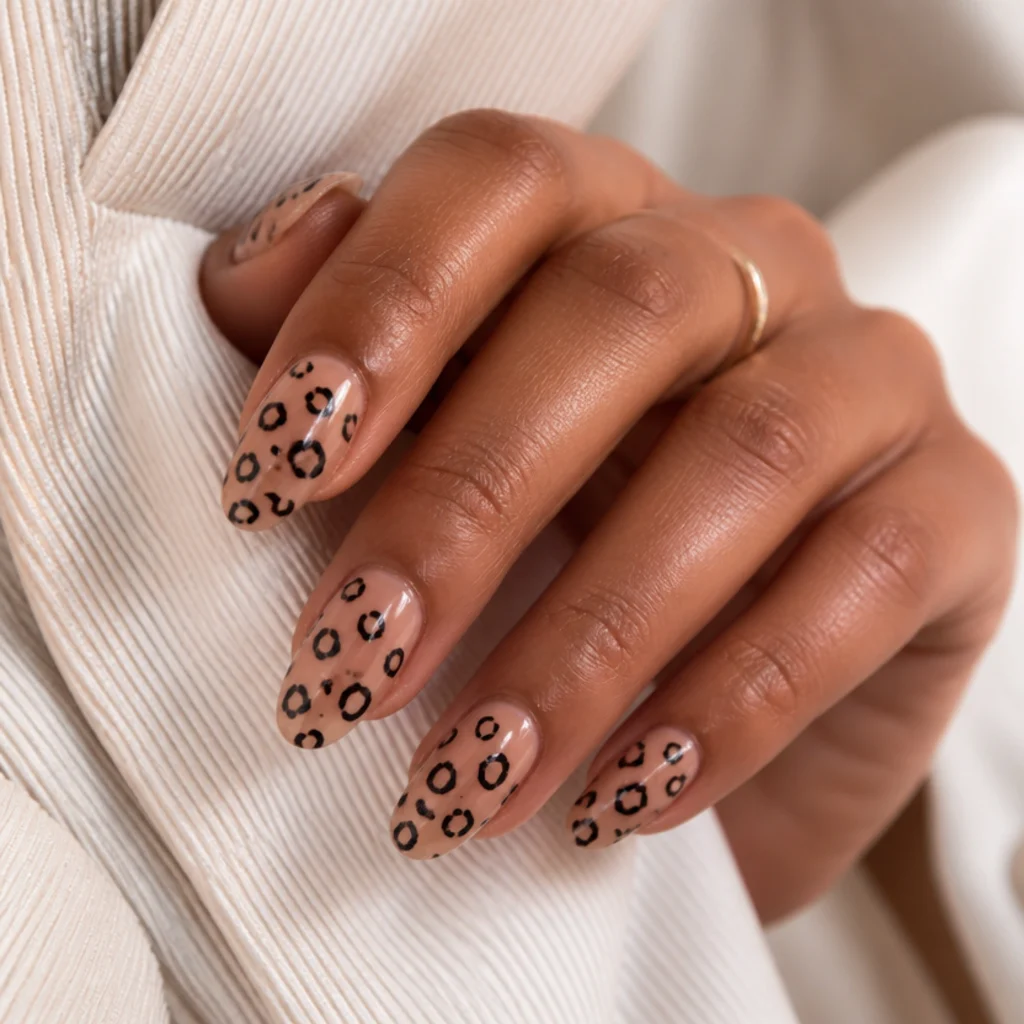
This is the anchor, and where most people should start. A sheer nude or soft-beige base carries tan or camel rosette centers ringed with a warm, near-black charcoal rather than a flat jet, which keeps the print polished instead of loud. The undertone trick is what makes black leopard print nails universal: warm the base toward peach-beige for golden and olive skin, cool it toward rose-beige for fair and neutral tones, and the whole set reads bespoke. Keep spots to three or four per nail, unevenly placed, with a few tiny satellite dots so the pattern looks organic. Short squoval or oval flatters it best because the flat surface lets the rosettes sit evenly. Upkeep is easy: regrowth blends into the neutral base, short length resists tip lift, and a soak-off and refresh every two to three weeks keeps it sharp. Pro tip: ask for a single glossy top-coat pass over the finished spots so the black outlines stay wet-looking and legible. To brief it, request "classic leopard rosettes in tan with warm-black broken outlines over a nude base," and specify all ten nails or just a couple of accents.
02White Leopard Print Nails
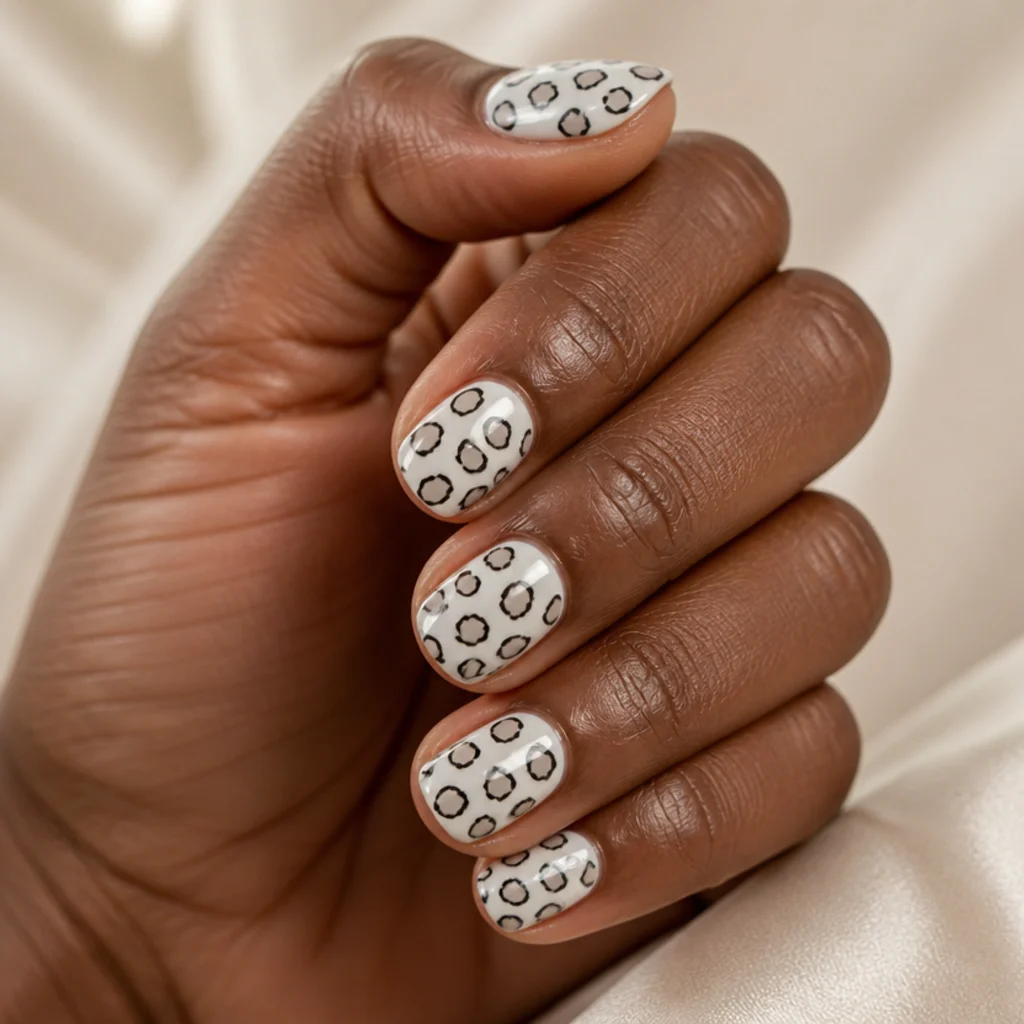
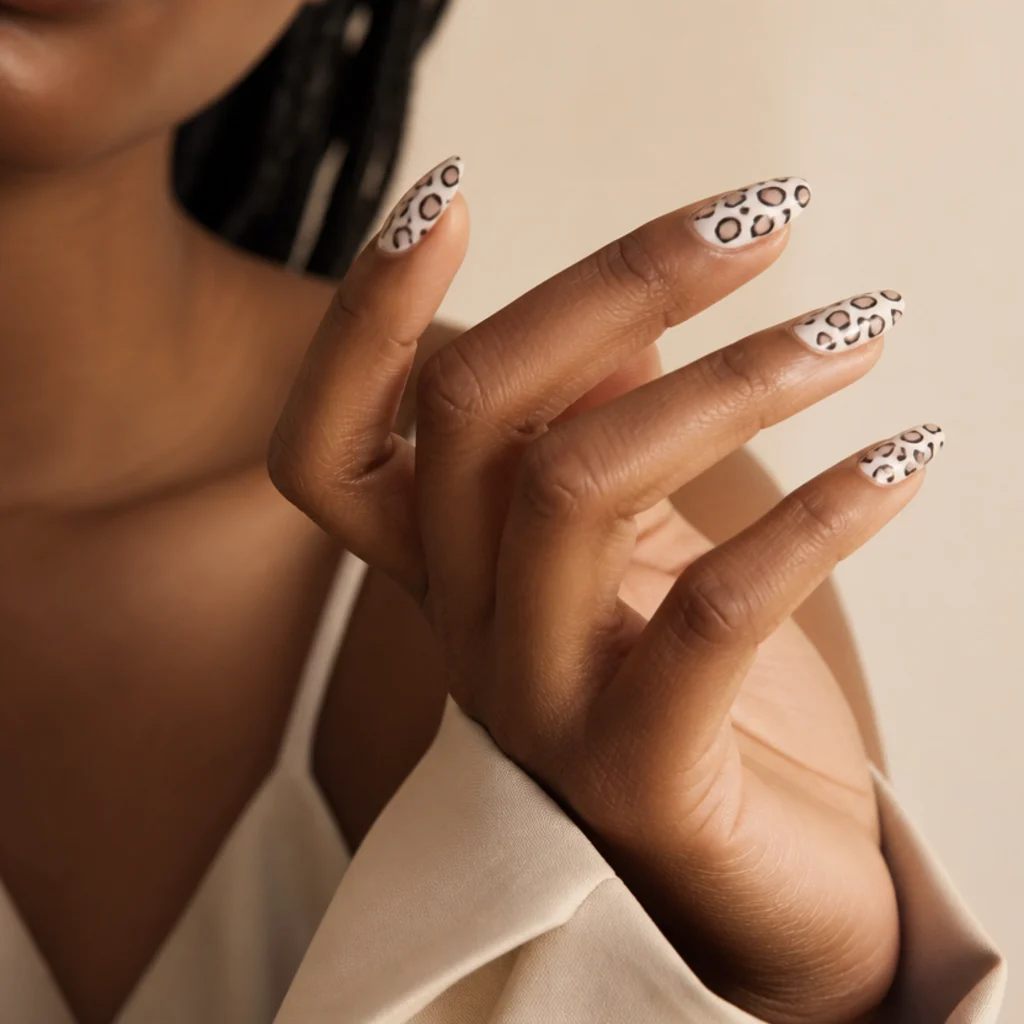
White leopard print nails trade the safari mood for something cleaner and more graphic. A milky, semi-opaque white reads softer and more wearable than a stark bright white, and pale dove-grey centers with fine charcoal outlines keep the print delicate on a short nail. The contrast logic matters here: white bases pop hardest against deeper and richer skin tones, where the manicure almost glows, while on very fair hands a milky white keeps things subtle rather than clinical. Scale down the rosettes and thin the outlines, because heavy black on white can tip into cow-print territory fast. This look suits anyone who loves a bright, tidy manicure and pairs well with gold jewelry and warm-toned outfits that keep the coolness in check. Maintenance runs standard for gel at two to three weeks, though a white base telegraphs regrowth a little sooner, so book slightly tighter if you're picky. Pro tip: a bright white needs two thin, fully cured coats to avoid streaking, so ask for that rather than one thick layer. Tell your tech you want "a milky-white base with dove-grey leopard centers and thin black broken outlines, sealed glossy."
03Short Leopard French Tip
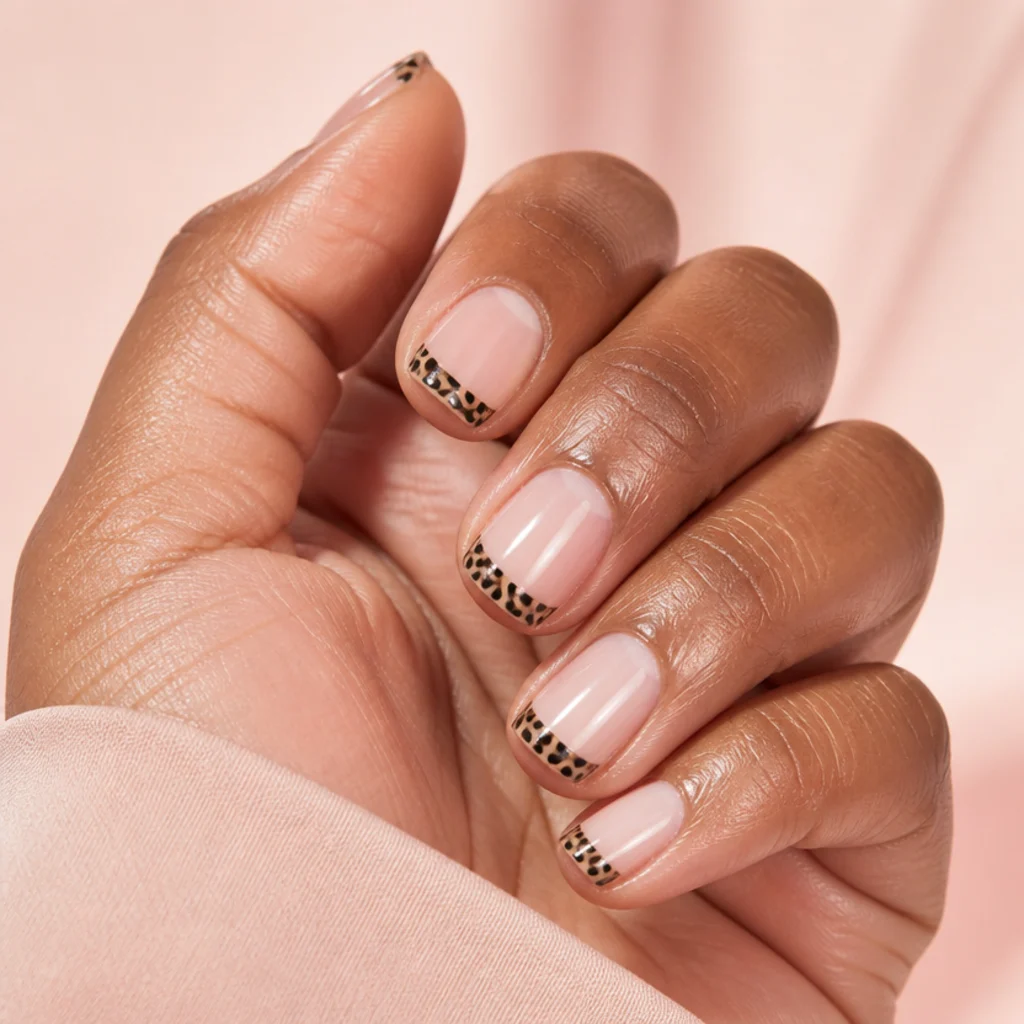
Here the classic French tip swaps its solid line for a band of leopard spots along the free edge. On a short nail this is the smartest way to wear print, because keeping the pattern at the tip leaves the base clean and visually lengthening, so the design feels balanced rather than busy. Depth is the variable that makes or breaks it: a shallow tip band of two to three millimeters looks editorial and modern, while a deep band starts to overwhelm a short plate, so name the depth you want. It's a good match for anyone who likes structured, elongating nail art with a wink of animal print, and it flatters shorter fingers because the clean base draws the eye down the nail. Upkeep is friendly: the neutral base hides regrowth, and only the tips carry detail that could wear. Pro tip: ask for the leopard to hug the natural smile line and blur slightly into the base, a hard straight edge under the print reads cheaper. Brief it as "a nude French with a leopard-print tip instead of a solid line, band kept shallow." It photographs cleanly and reads intentional, a strong pick for events and office alike.
04Micro-Leopard on Squoval
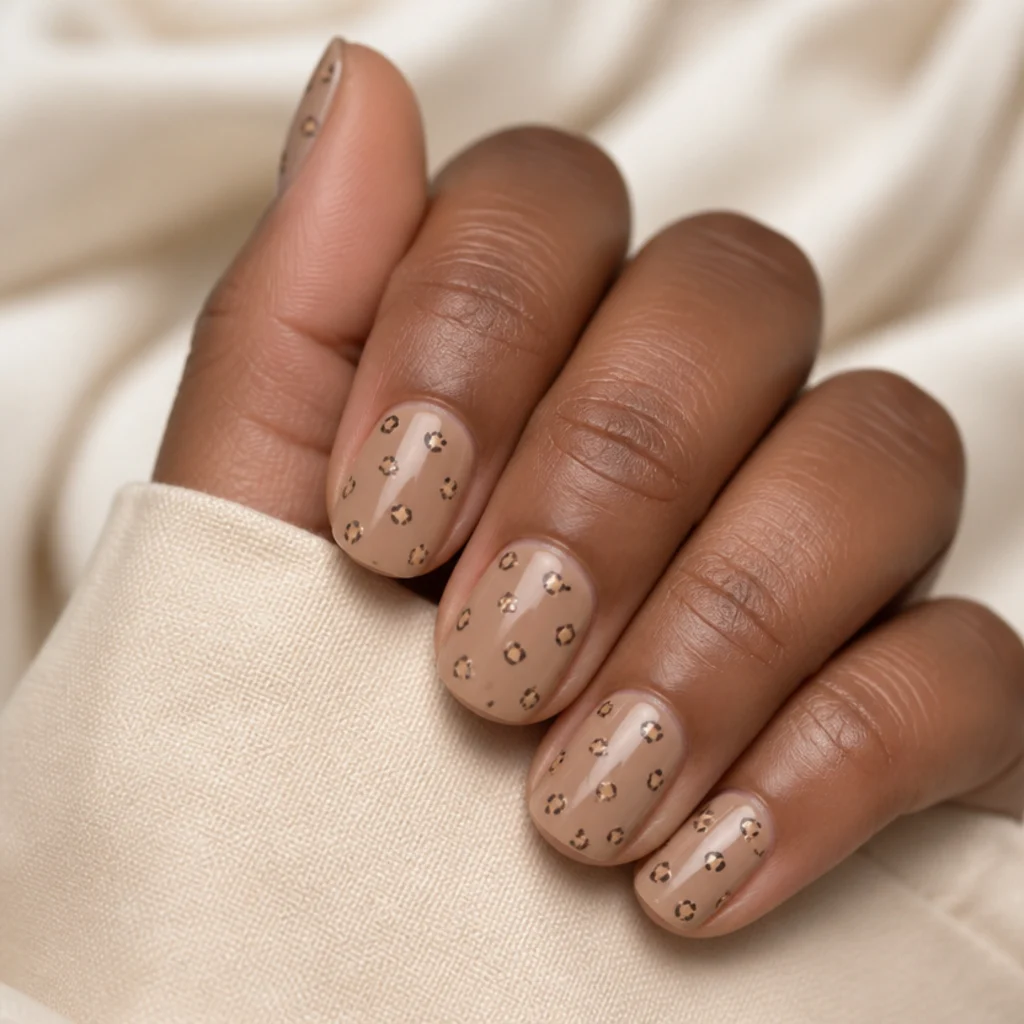
Scale is everything on short nails, and micro-leopard leans all the way in. Tiny, finely spaced rosettes over a greige or mushroom-beige base keep the print so subtle it reads as a textured neutral from arm's length, then reveals itself up close. This is the covert operator of the list, ideal for minimalists and anyone in a conservative workplace or client-facing role who still wants personality. Because the base stays neutral and the spots stay small, regrowth is nearly invisible and the set grows out gracefully. The catch is precision, those miniature broken rings demand a fine detail brush or a small dotting tool and a very steady hand, so this is a tech job rather than a first at-home attempt. Squoval is the ideal shape because the flat, even surface lets a dense micro-pattern sit uniformly without pooling toward the tip. Pro tip: ask for the spots in two closely related browns rather than one, subtle tonal variation is what stops a micro-print from looking like polka dots. Brief it as "micro-scale leopard rosettes in two soft browns over a greige base, kept sparse and even," and confirm a matte or satin top coat if you want the texture to feel even more understated.
05Single Black Leopard Accent
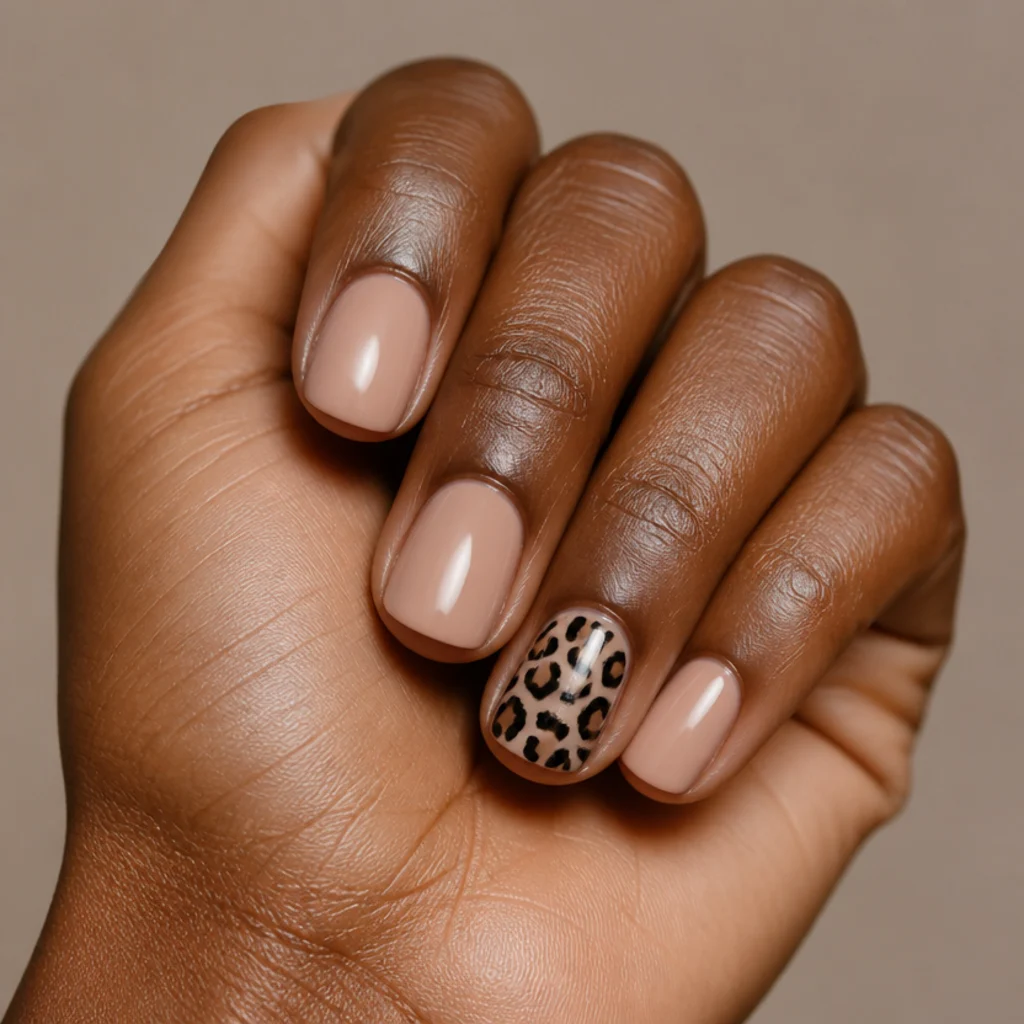
If a full set feels like too much, let one nail do the work. Nine glossy nude or soft-pink nails with a single leopard accent on each ring finger deliver the print without the commitment, and this is the easiest leopard look to book, to keep clean, and to flatter almost every hand. It's also the ideal entry point for at-home dotting, because you only have to land the pattern once per hand instead of ten times. Go slightly bolder on the accent than you would across a full set, three or four confident rosettes with black broken rings, since it's carrying the idea alone. Placement is a real choice: the ring finger is traditional and balanced, but a middle-finger accent reads more fashion-forward and an index accent draws the eye first in photos. Short length keeps the accent neat rather than crowded. Pro tip: match the base gloss exactly across all ten nails so the accent looks deliberate, a mismatched sheen is what makes a single-accent set look unplanned. Ask for "a glossy nude set with a black-and-tan leopard accent on the ring fingers," and name which finger if you want to break tradition.
Save this to Pinterest so you can compare short leopard styles side by side later.
06Milky Base with Scattered Spots
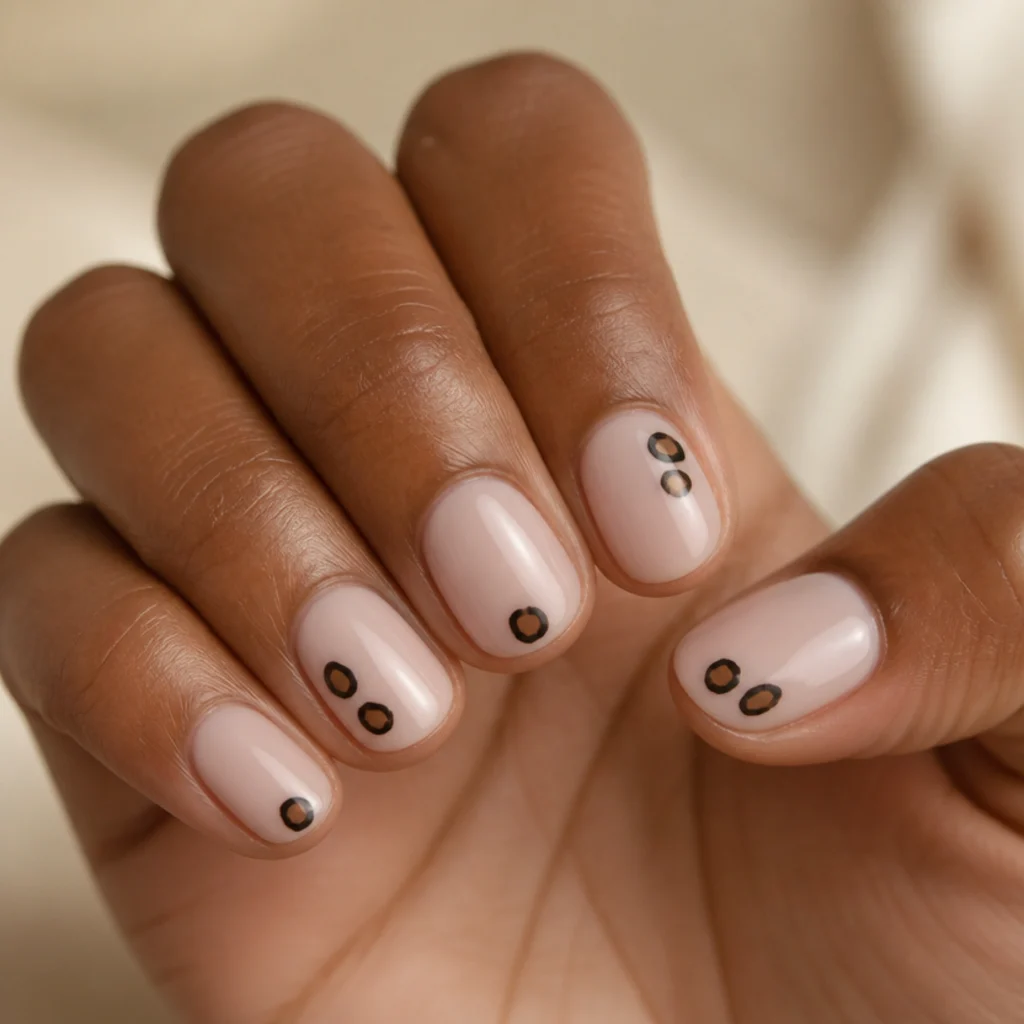
A milky, semi-sheer base gives short nails a soft-focus glow, and a scattering of leopard spots keeps it from reading plain. Restraint is what makes this work: three or four rosettes per nail placed unevenly, some drifting off the edge, look far more natural than a dense, centered grid. It suits anyone who loves the "clean girl" milky manicure but wants a whisper of print, and it photographs with a nice diffused quality in daylight. Because the base is translucent, the natural nail shows through slightly, so it reads best on evenly toned nail beds; if yours are uneven or stained, ask for a thin building layer or a milky builder gel underneath to even the canvas before the spots go on. Keep the spot colors soft, a warm brown and a diluted black, so nothing punches through the sheer base too hard. Regrowth practically vanishes against the milky tone, so this stays low-upkeep across its three-week wear. Pro tip: request the spots concentrated toward the cuticle and tip with a clear middle, that negative gap is what gives the scatter its casual look. Brief it as "a milky sheer pink base with a few scattered leopard spots in warm brown and soft black."
07Matte Black-and-Tan Leopard
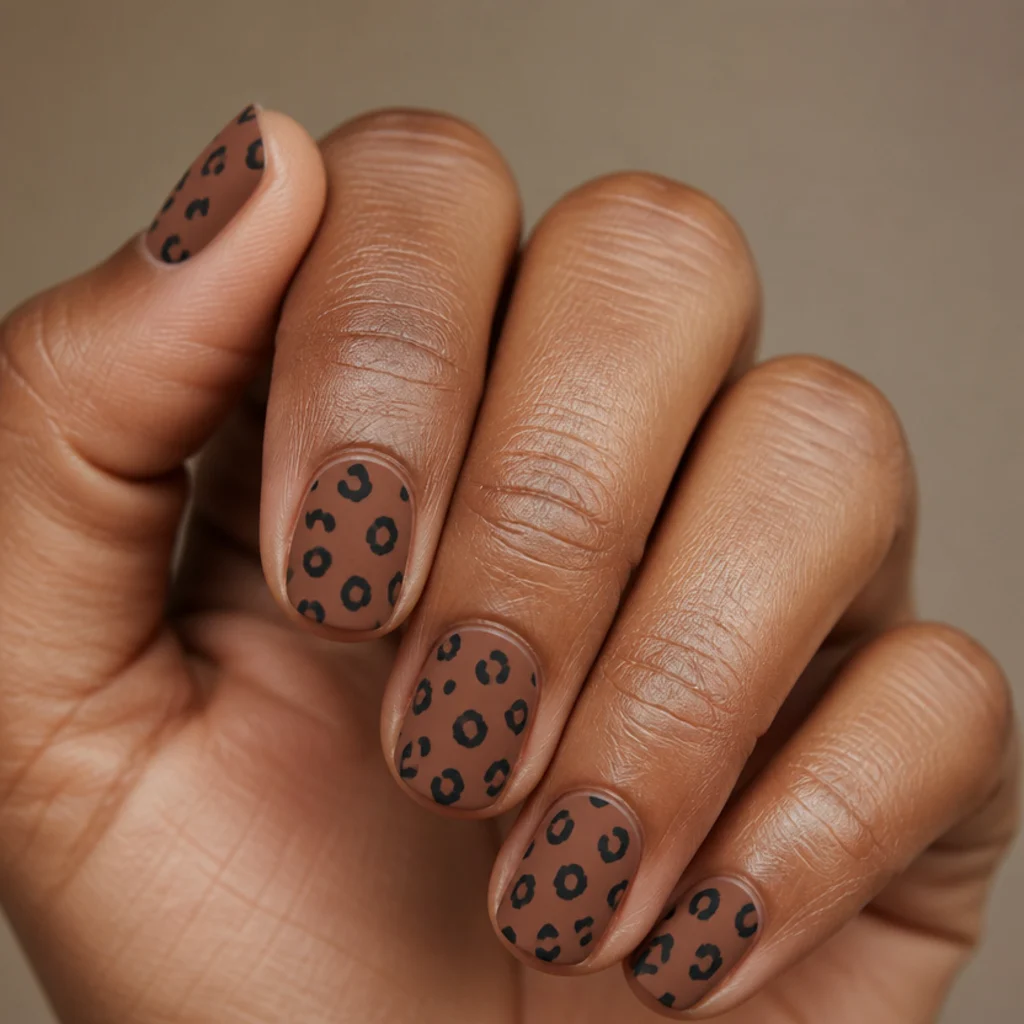
Swapping gloss for a matte top coat changes leopard print completely. A matte tan or fawn base with black rosettes turns earthy, tactile, and almost suede-like, and the flat finish plays down the shine that can make short nails look stubby under bright light. It suits autumn, cooler skin undertones that want warmth without shine, and anyone who prefers understated texture over polish. There's a real maintenance quirk here: matte top coats dull and develop shiny patches faster wherever hand cream, dish soap, and friction hit, especially around the cuticle and tips, so keep a matte refresher coat on hand and reapply after about a week to keep the finish uniform. The flat surface also disguises minor ridges and surface imperfections better than high shine, a bonus on natural nails. Pair it with warm-toned knits and gold jewelry for a cohesive fall look. Pro tip: ask your tech to paint and cure the leopard glossy first, then apply matte top coat over everything, layering the design under a single matte layer keeps the spots crisp and prevents a muddy, over-worked finish. Brief it as "a matte tan base with black leopard rosettes, everything sealed under one matte top coat."
08Negative Space Leopard
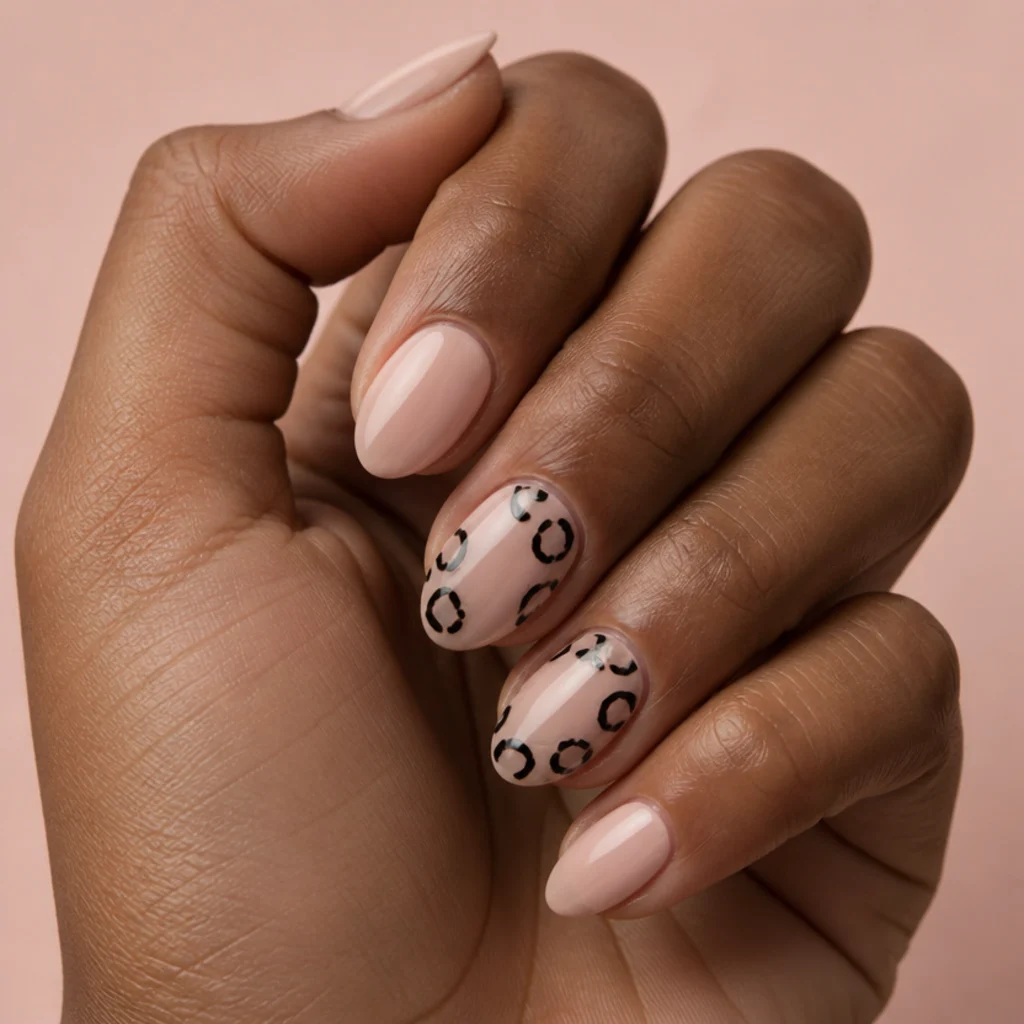
Negative space uses your natural nail as part of the design, with leopard rosettes drawn as open outlines around clear or bare sections. On a short nail this reads airy and contemporary, and leaving the centers unfilled makes the print feel intentional and gallery-like rather than half-finished. This appeals to anyone who likes minimalist nail art with an edge, and it grows out gracefully because the clear zones blend smoothly with regrowth. The trade-off is honesty of the canvas: bare negative space shows staining, ridges, and discoloration, so a smooth, evenly toned natural nail matters far more here than on an opaque base. Keep the design to two or three nails, or a few outlines per nail, so the empty space reads as a deliberate choice. Pro tip: ask for a clear builder-gel base coat under and over the design, it protects the exposed nail from staining and gives the outlines something durable to sit on so they don't chip off the bare surface. Brief it as "negative-space leopard with open black broken outlines and clear gaps, over a clear builder base." Champagne or fine gold outlines are a softer alternative to black if you want the airy effect without stark contrast.
09Short Leopard Acrylic Set
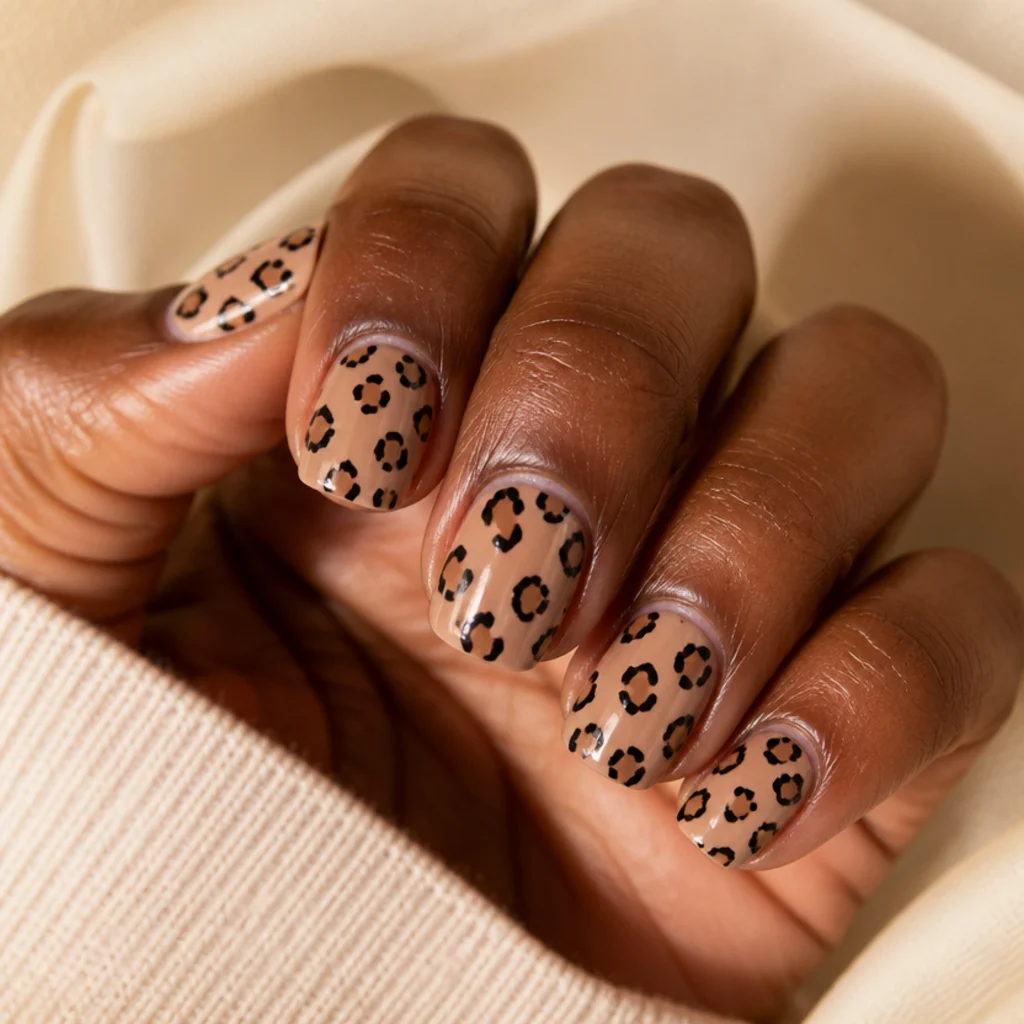
If your natural nails are thin, peel, or bend, short leopard print acrylic nails give you a sturdy, perfectly even canvas the print can sit on without dipping or telegraphing ridges. Kept at natural length, acrylic reads low-drama and genuine while holding a crisp pattern that resists the chipping thinner natural nails invite. It's the right call for anyone who wants two to three weeks of hands-on durability without sacrificing detail, and it takes fine freehand rosettes well because the surface is uniform and slightly forgiving. Upkeep means a fill every two to three weeks and a proper salon soak-off; never peel or pry acrylic off, that's how nail beds get thin and damaged. The single most important instruction is structure: ask for a thin application with a low apex and a natural C-curve so short acrylics don't look bulky or "clacky." Gel-x and soft-gel tips are a lighter-weight alternative if you want acrylic durability with a thinner feel. Pro tip: request the leopard painted after the acrylic is filed and refined but before the final top coat, so the design sits sealed and flush rather than raised. Brief it as "a short squoval acrylic set at natural length, thin and low-apex, with tan-and-black leopard rosettes."
10Chocolate and Caramel Spots
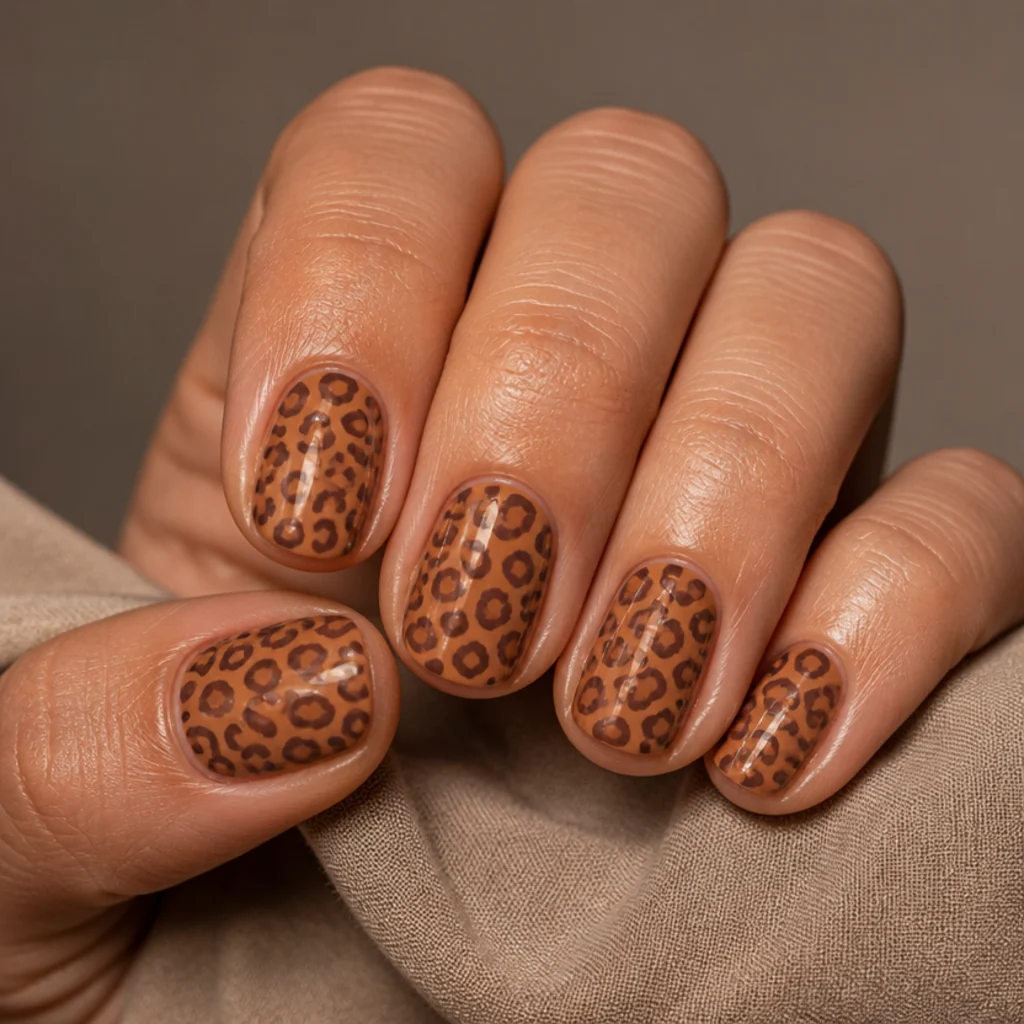
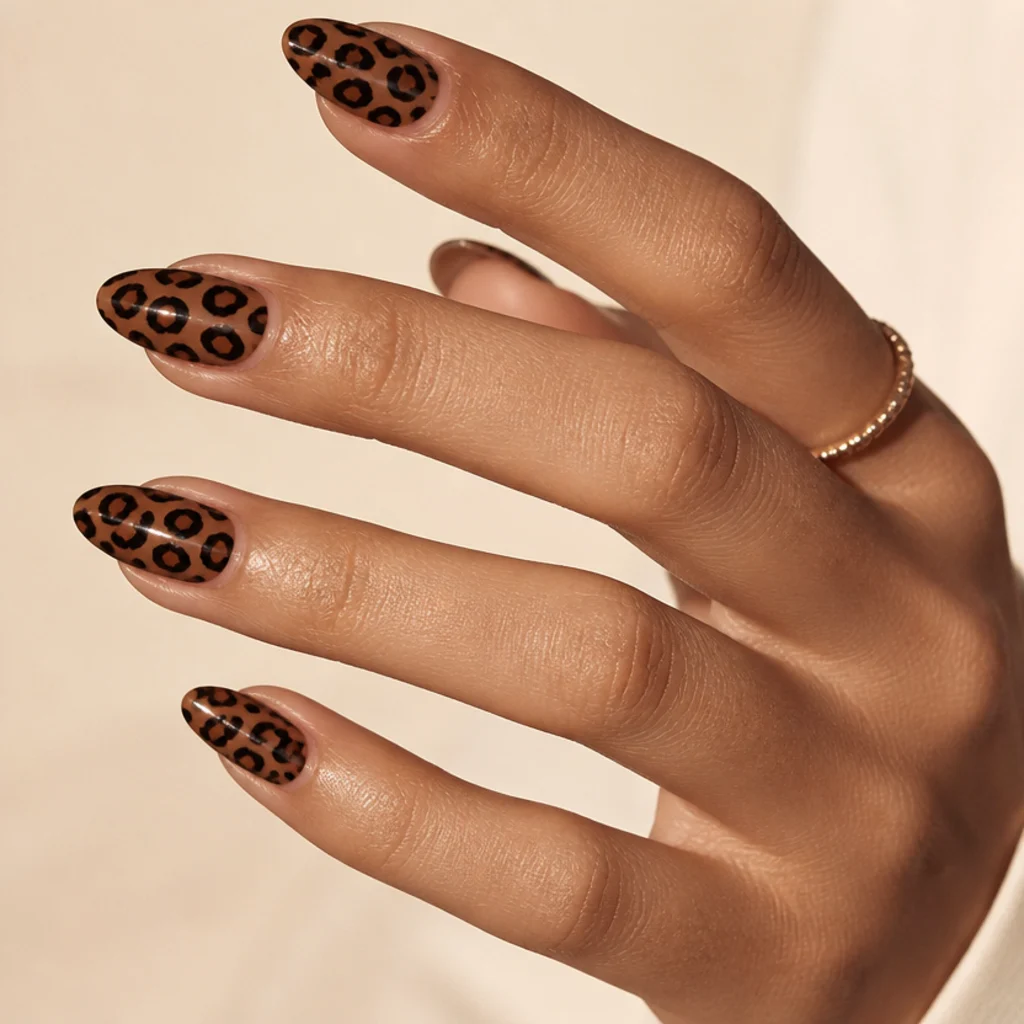
This is leopard at its warmest and most tonal, and one of the most quietly sophisticated looks on the list. A caramel or toffee base carries layered chocolate-brown rosettes and skips black entirely for a softer, richer, monochrome effect. Dropping the hard black outline is the trick: it pulls the print out of costume territory and into something that works from a desk to a dinner. It flatters warm, golden, and olive undertones especially, and pairs naturally with autumn wardrobes, camel coats, and tortoiseshell accessories. Because every element stays in the brown family, regrowth is nearly invisible and the set feels cozy rather than graphic, so it stays low-maintenance over its two-to-three-week life. Build the rosettes in at least two browns, a mid-caramel center shaded with a darker chocolate broken ring, so the tonal design keeps depth instead of flattening out. A short oval shape rounds off the warmth and keeps the whole thing soft and wearable. Pro tip: ask for a single espresso-brown micro-dot beside some rosettes, that tiny darkest accent gives an all-brown print the dimension black would normally provide. Brief it as "a caramel base with tonal chocolate leopard rosettes in two browns, no black outlines."
Save this to Pinterest so you can match a base color to your undertone before you book.
11Gold Foil Leopard Accents
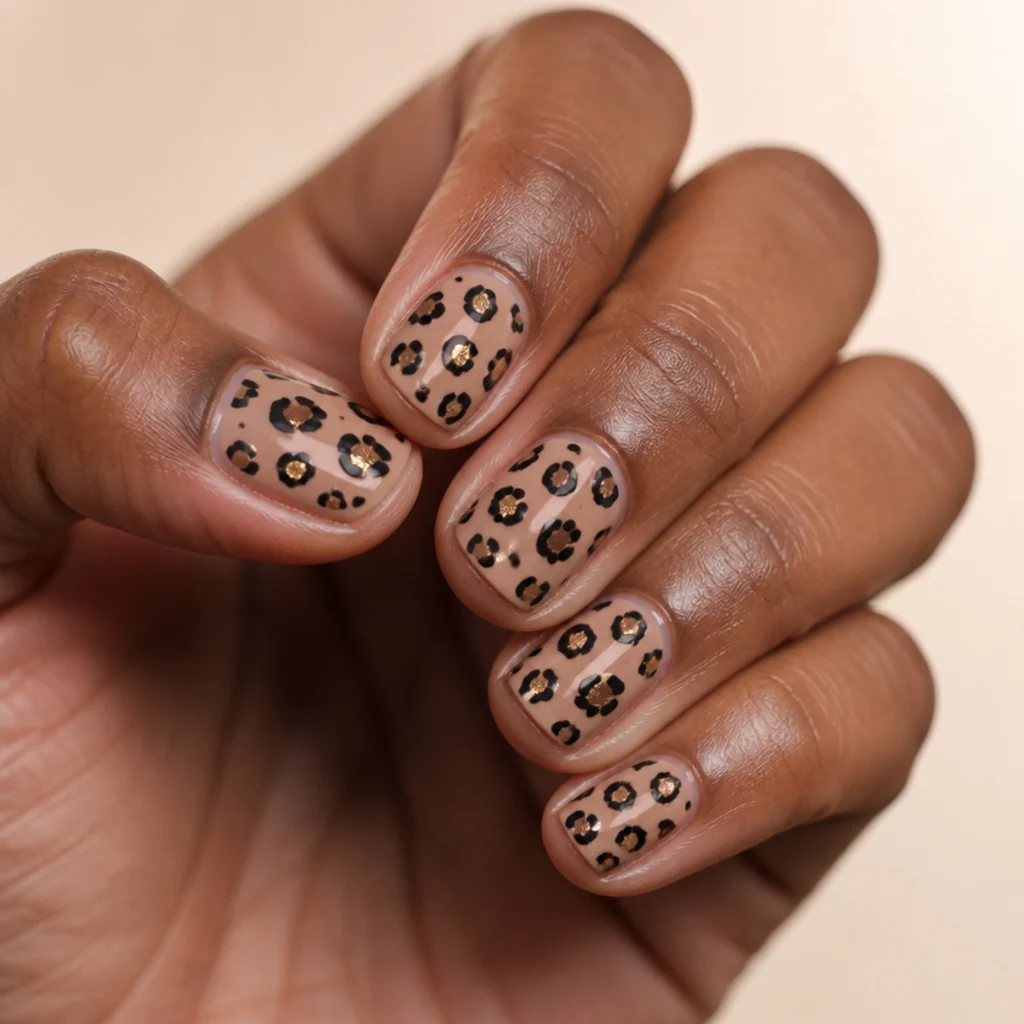
Adding gold foil to a handful of leopard centers turns a simple short set into something with quiet, shifting shine. Instead of filling every rosette with color, a few centers are dropped in with gold leaf so they catch the light as your hand moves, delivering sparkle without the maintenance of full glitter. This suits holidays, parties, and anyone who wants a metallic wink rather than an overload. Restraint is again the rule: foil in three or four spots across the set reads intentional, while foiling every rosette turns the design gaudy and busy. The foil sits sealed under the top coat, so it stays smooth and doesn't snag, and it reads especially rich against warm nude, caramel, and toffee bases where the gold harmonizes with the browns. Pro tip: ask for the foil applied over a thin layer of no-wipe gel tack rather than glue, it adheres cleaner and seals flatter, and request an extra top-coat pass so no foil edge lifts. Brief it as "nude leopard rosettes with gold-foil centers on a few select spots, sealed flat and glossy." Champagne or rose-gold foil is a softer alternative if bright yellow gold feels like too much against your skin tone.
12Chrome Base Leopard
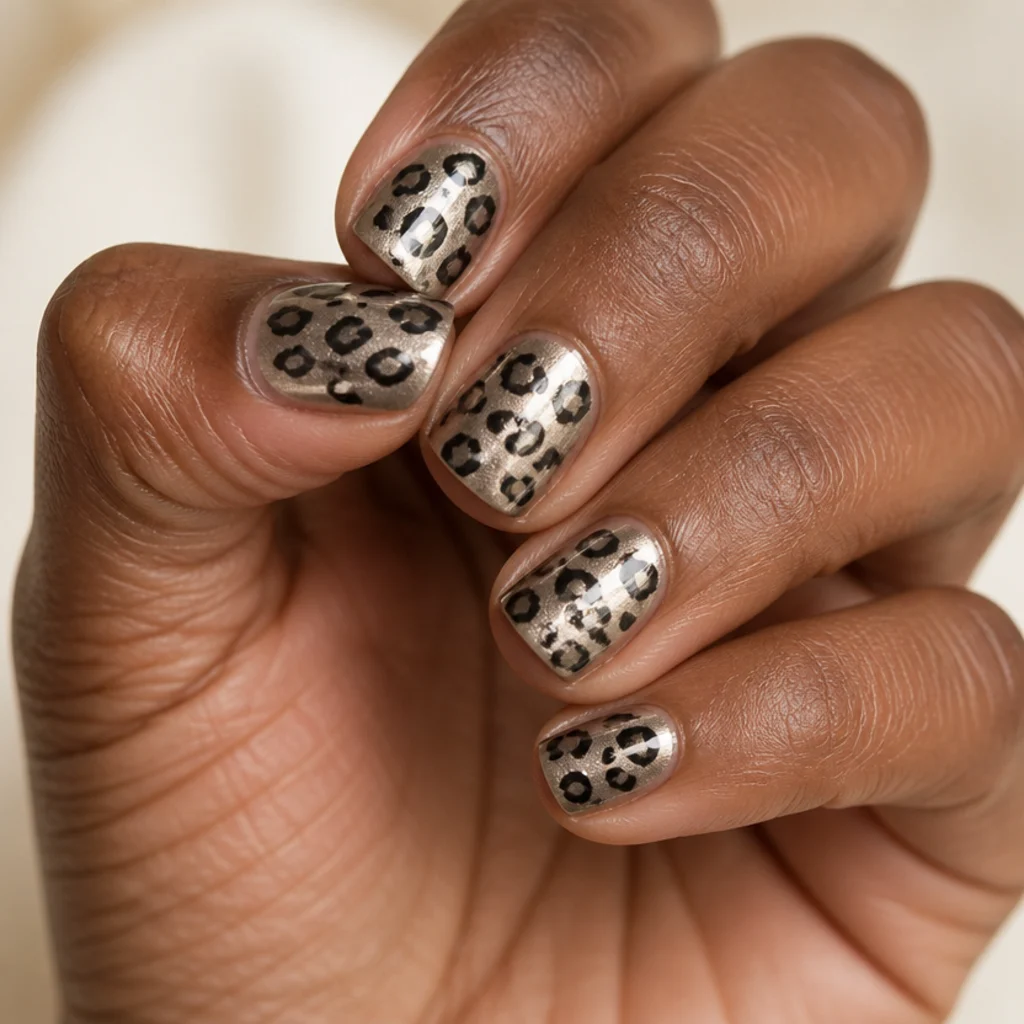
A chrome or pearl base gives short nails a mirror-like glow, and leopard spots painted over the top add unexpected, editorial contrast. The metallic shifts in the light while the print keeps it grounded and stops it from feeling coldly futuristic. This is for anyone who loves the chrome trend but wants more happening than a plain mirror finish. The finish choice matters a lot: a muted silver, champagne, or pewter chrome reads wearable day to day and keeps the spots legible, while a bright, high-mirror chrome fights the print for attention and shows every fingerprint. Chrome also demands a properly buffed, fully cured base to activate cleanly, and it telegraphs regrowth quickly, so this is firmly a salon job for a clean result. Because chrome powder can smear if worked over, the leopard must go on after the chrome is sealed. Pro tip: ask for the chrome locked under a top coat, then the black rosettes painted on top and sealed with a second top coat, that two-seal method keeps the print from dragging the powder. Brief it as "a soft pearl or champagne chrome base sealed first, then muted black leopard spots over the top, sealed glossy."
13Red Base with Black Spots
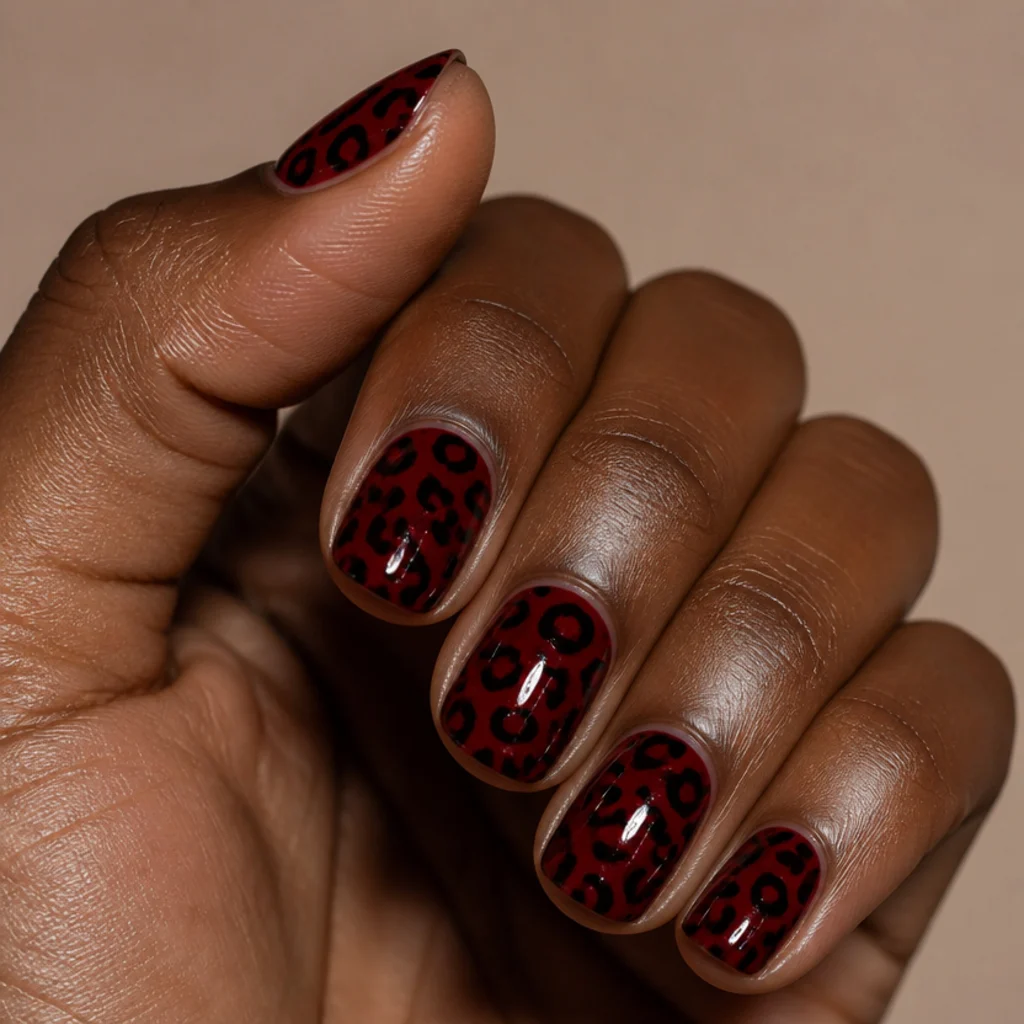
For maximum impact on a short nail, start with a rich red and drop black leopard spots on top. The high contrast is bold and confident, and the short length is exactly what keeps it from tipping into too much: a long red-and-black leopard set can overwhelm, but a short one stays sharp. It's built for anyone who loves a statement red manicure and wants an edgier twist for a night out, a holiday, or a party. Shade selection is where you tune it to your skin: cool, blue-based cherry and cranberry reds flatter fair and cool undertones, while warm brick, tomato, and rust reds sit better on golden, olive, and deep skin. Because both the base and the spots are strong, keep the rosettes sparse and generously spaced, two or three per nail, so the design stays clean rather than crowded and muddy. Red hides regrowth reasonably well, giving you a solid two-to-three-week wear. Pro tip: ask for the spots kept slightly off-center and away from the cuticle line, a clear band of pure red near the base makes the nail look more expensive and lets the color breathe. Brief it as "a glossy cherry-red base with sparse black leopard spots, kept off the cuticle."
14Pastel Blush Leopard
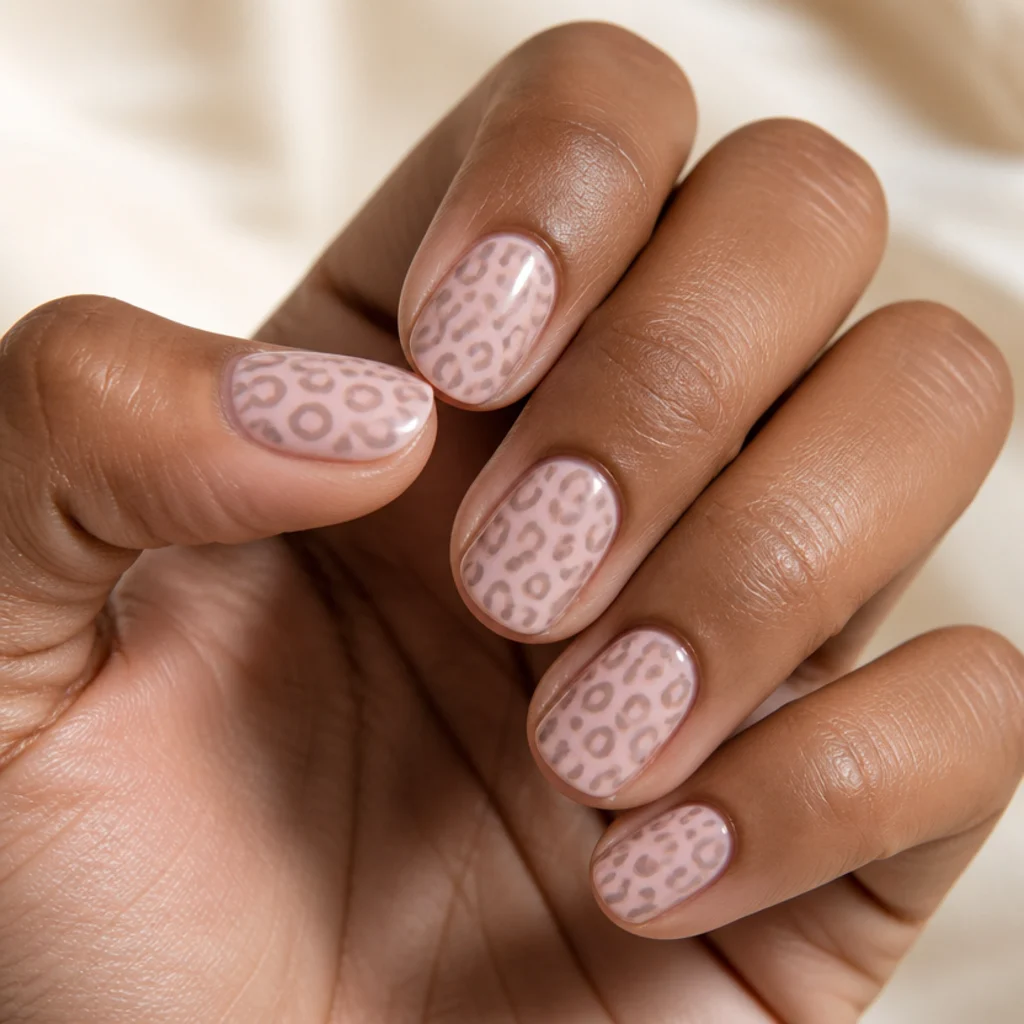
Pastel leopard softens the whole idea into something sweet and springy. A soft blush, petal-pink, or pale lilac base carries muted taupe rosettes with thin brown broken outlines, keeping the print gentle rather than bold. Dropping black is essential here: a hard black outline would shatter the soft mood, so the outline stays in a warm mid-brown that whispers instead of shouts. This works for anyone who wants a romantic, feminine manicure that still has texture and interest, and the low contrast keeps it office-appropriate. Because everything is pale and close in tone, regrowth barely registers, so it stays low-upkeep over its two-to-three-week life. A short oval or round shape completes the delicate feel, and a glossy top coat gives it a fresh, dewy finish that photographs well in daylight. Pastel bases are often sheer, so ask for two thin coats to keep the color even and prevent patchiness at the tips. Pro tip: request the taupe spots in a shade only two or three steps deeper than the base, the charm of pastel leopard is the barely-there contrast, and going too dark undoes it. Brief it as "a blush-pink base with muted taupe leopard rosettes and fine warm-brown outlines, no black."
15Short Almond Leopard
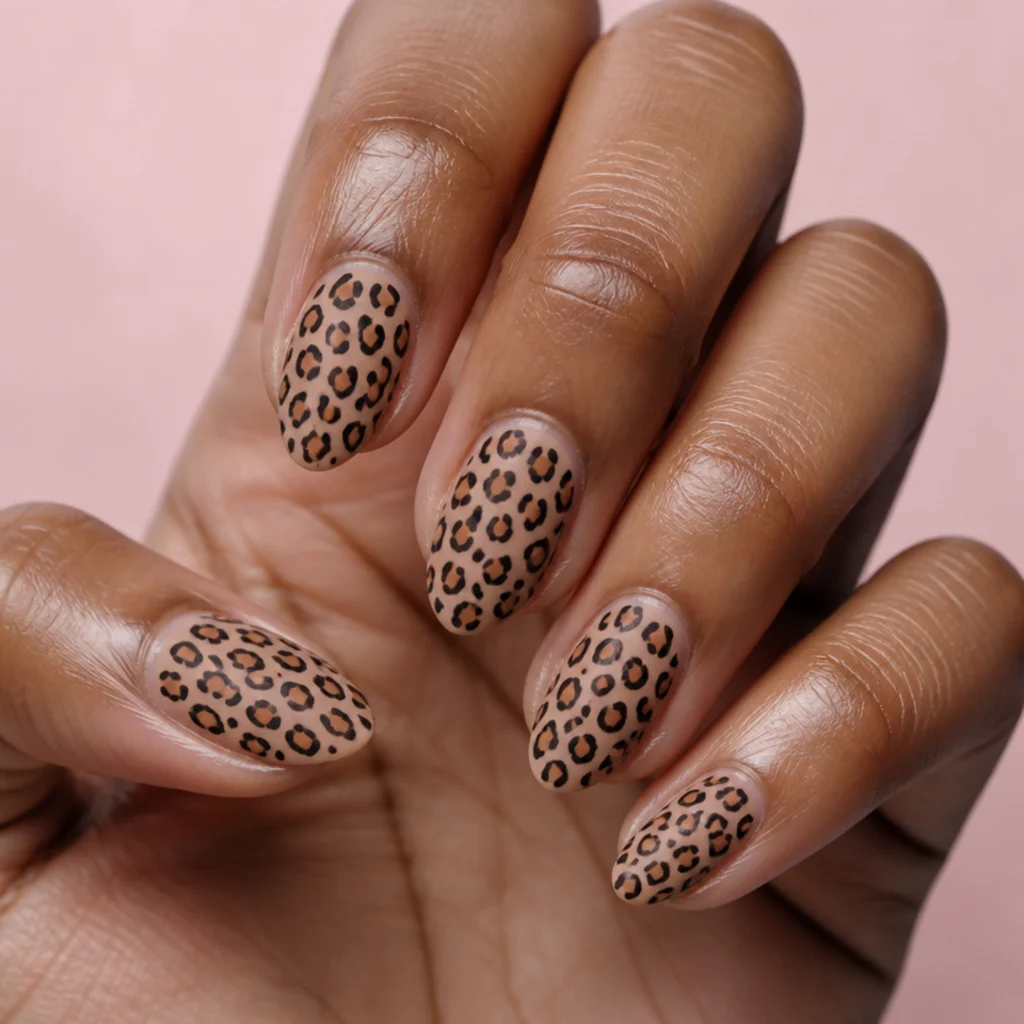
A short almond shape gives you a hint of taper without the fragility of long nails, and it flatters leopard print by adding a gentle point for the spots to follow. It's the flattering middle ground between squoval practicality and stiletto drama, and it makes short fingers look a touch longer while keeping length manageable and snag-resistant. This is a versatile everyday option that carries both tonal-brown and classic-black rosettes equally well, so it adapts to your wardrobe rather than dictating it. The one technical note that separates a good short-almond leopard from a clumsy one is spot scaling: because almond narrows toward the tip, evenly sized spots will look crowded at the point, so the rosettes should shrink slightly as they approach the tip to keep the pattern visually even. Suitability-wise, almond flatters most nail beds but favors ones with a bit of natural length in the plate; very wide, short beds may prefer squoval. Pro tip: ask your tech to keep the sidewalls straight and only taper the last third, an over-tapered short almond looks pinched and reads more claw than chic. Brief it as "a short almond shape, sidewalls straight, with all-over tan-and-black leopard on a nude base, spots scaled smaller toward the tip."
16Half-and-Half Leopard
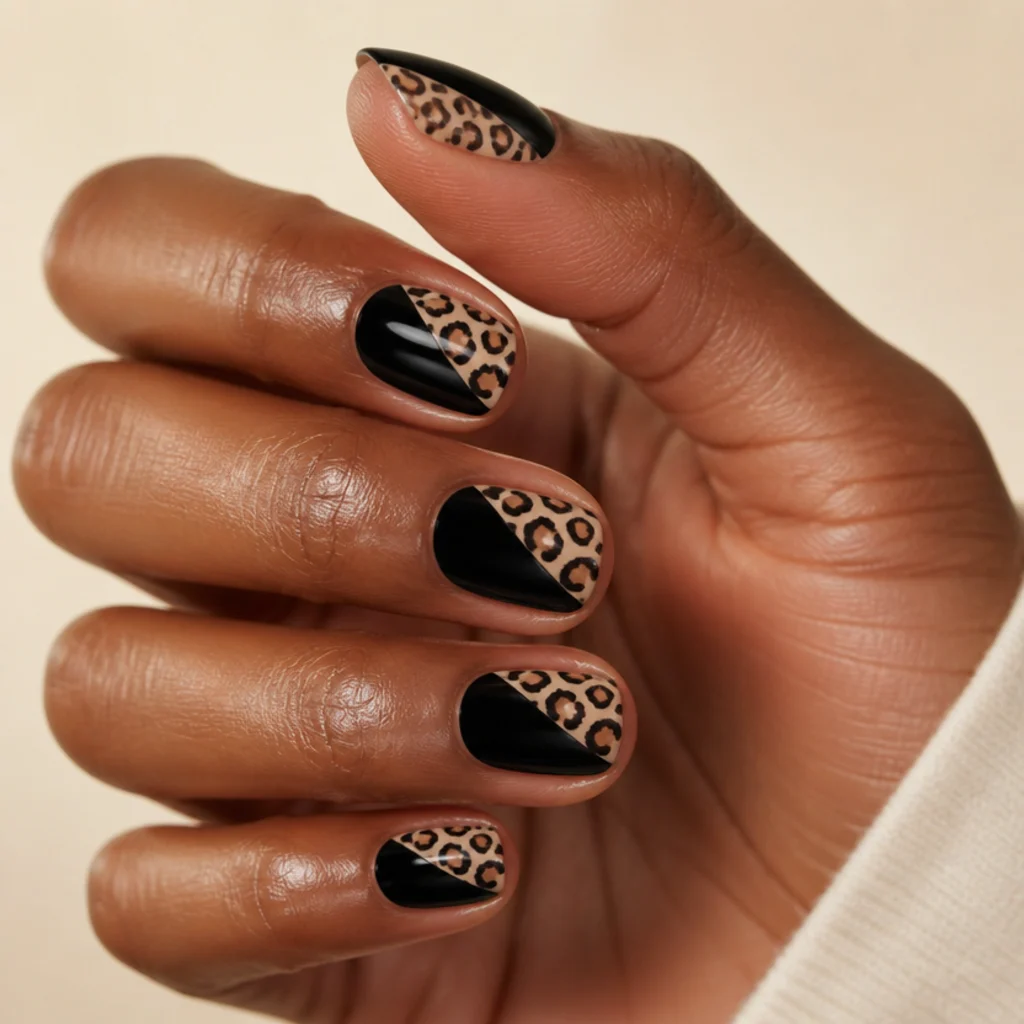
This graphic design splits each nail into two panels, pairing a solid block of color with a section of leopard print. On short nails the split reads bold and modern, like a mini editorial statement, and it appeals to anyone who likes color-blocking and geometric nail art with a twist. The split direction is your main creative lever: a vertical split down the center is the most balanced and beginner-friendly, a diagonal split feels the most dynamic and fashion-forward, and a horizontal split emphasizes width, so choose based on your nail proportions and name the exact angle. The design lives or dies on the crispness of that dividing line, so it's best done by a tech with a steady hand or using tape to mask the edge. To keep the two halves from clashing, the solid block should pull a color directly from the print, the tan of the rosette centers or the black of the outlines, so the sides feel connected rather than random. Pro tip: ask for the solid half painted and cured first, then the leopard added against the taped edge, that order gives you the sharpest seam. Brief it as "each nail split in half, one side solid black, one side tan leopard, vertical seam kept crisp," and specify the angle.
17Glazed Donut Leopard
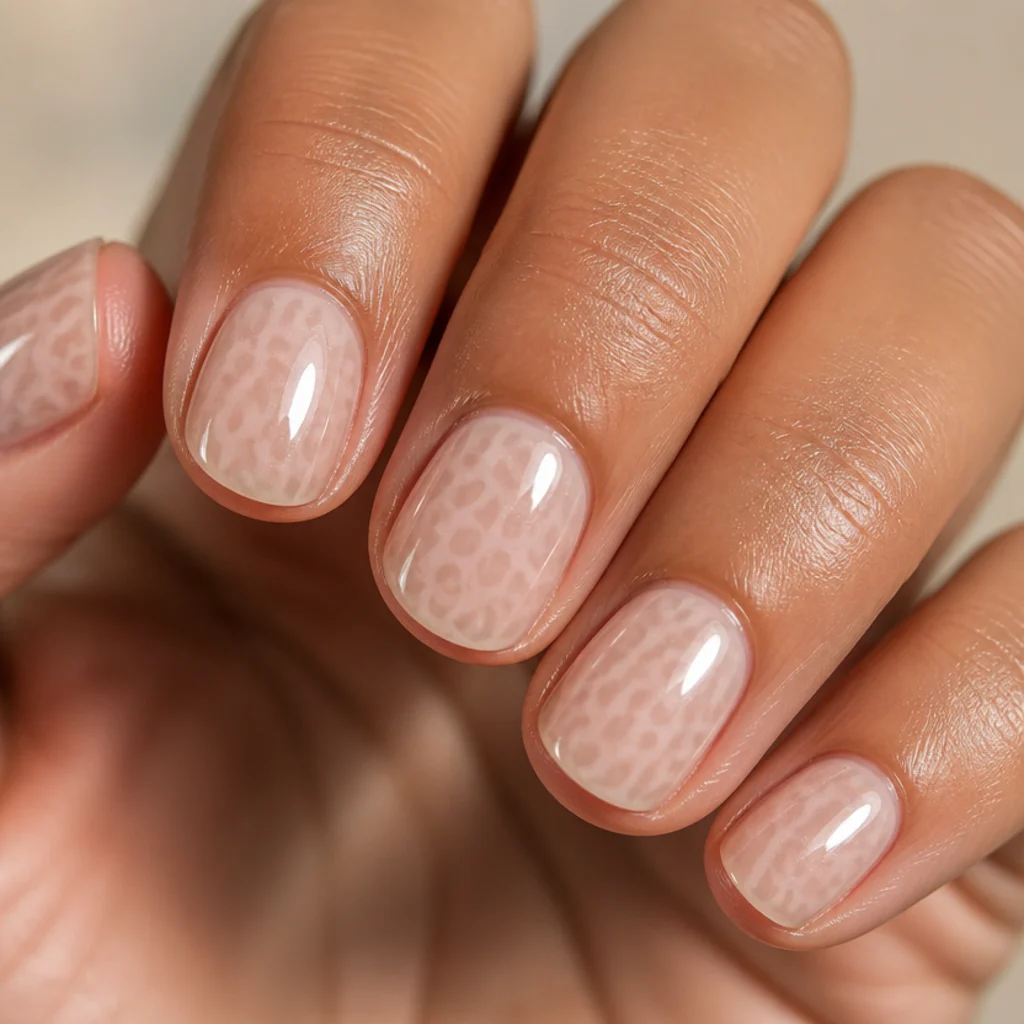
The glazed-donut finish layers a fine pearl shimmer over the whole nail, and here it floats over faint tonal leopard spots for a print you catch only up close. On short nails the effect is soft, expensive-looking, and extremely wearable, one of the most understated ways to wear leopard, ideal if you want pattern that nobody clocks at first glance. This is the pick for anyone who loves the glazed trend but wants a subtle secret hiding underneath, and the pearl shimmer forgives minor regrowth while reading neutral enough for work and formal settings alike. The instruction that matters most here is contrast: the underlying leopard must stay low-contrast, beige-and-taupe rosettes on a nude or milky base, because the pearl top layer mutes and diffuses everything above it, and a high-contrast print underneath would turn muddy and grey once the shimmer goes over it. A soft rose or pearl-white chrome powder buffed sheer creates that signature glazed glow. Pro tip: ask for the leopard sealed under a top coat first, then the sheer pearl chrome buffed lightly on top and sealed again, so the shimmer sits like a veil rather than smearing the spots. Brief it as "faint beige-and-taupe leopard spots sealed first, then a sheer glazed-donut pearl finish buffed over the top."
18Autumn Rust Leopard
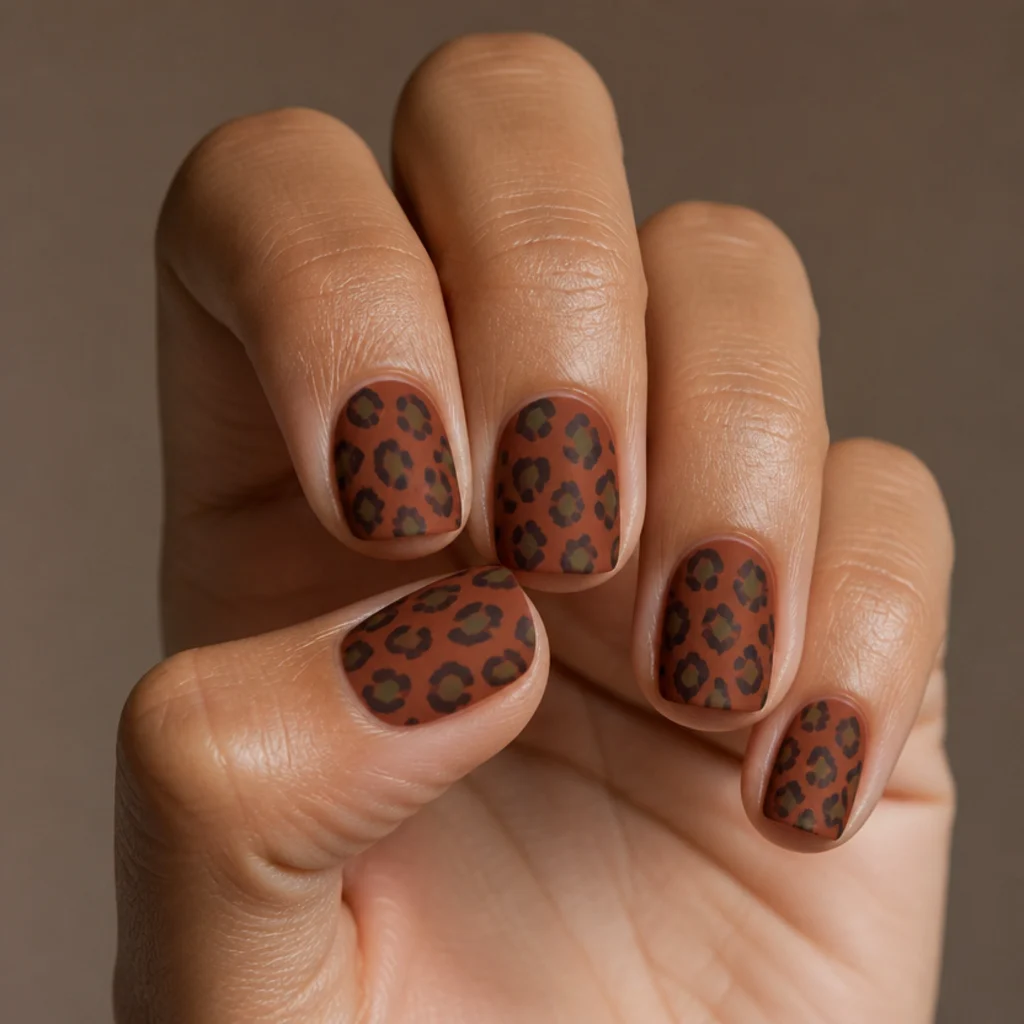
Shifting the palette into burnt rust, olive, and warm brown gives leopard print a distinctly autumnal, grounded feel. Instead of the usual tan-and-black, warm earth tones make the spots seasonal and rich, the nail equivalent of sweater weather. It's suited to anyone who leans into fall dressing and wants their manicure to sit alongside camel, olive, and oxblood in their wardrobe, and the muted, warm range flatters golden and olive undertones especially well. Because the palette stays earthy and close-toned, regrowth hides easily and the set wears its full two-to-three weeks without looking tired. Finish is a genuine styling choice here: a matte top coat pushes it deep into cozy, tactile territory, while a glossy finish keeps it a touch dressier for evenings, so decide based on the mood you want. Short squoval keeps the rich, saturated colors from feeling heavy and stays comfortable for everyday wear. Pro tip: ask for the spots built in olive and a darker rust-brown rather than black, keeping the darkest element within the warm family is what makes the whole set feel seasonal instead of just "brown leopard." Brief it as "a burnt-rust base with olive and warm-brown leopard rosettes, matte for cozy or glossy for dressy."
19Rhinestone-Dotted Leopard
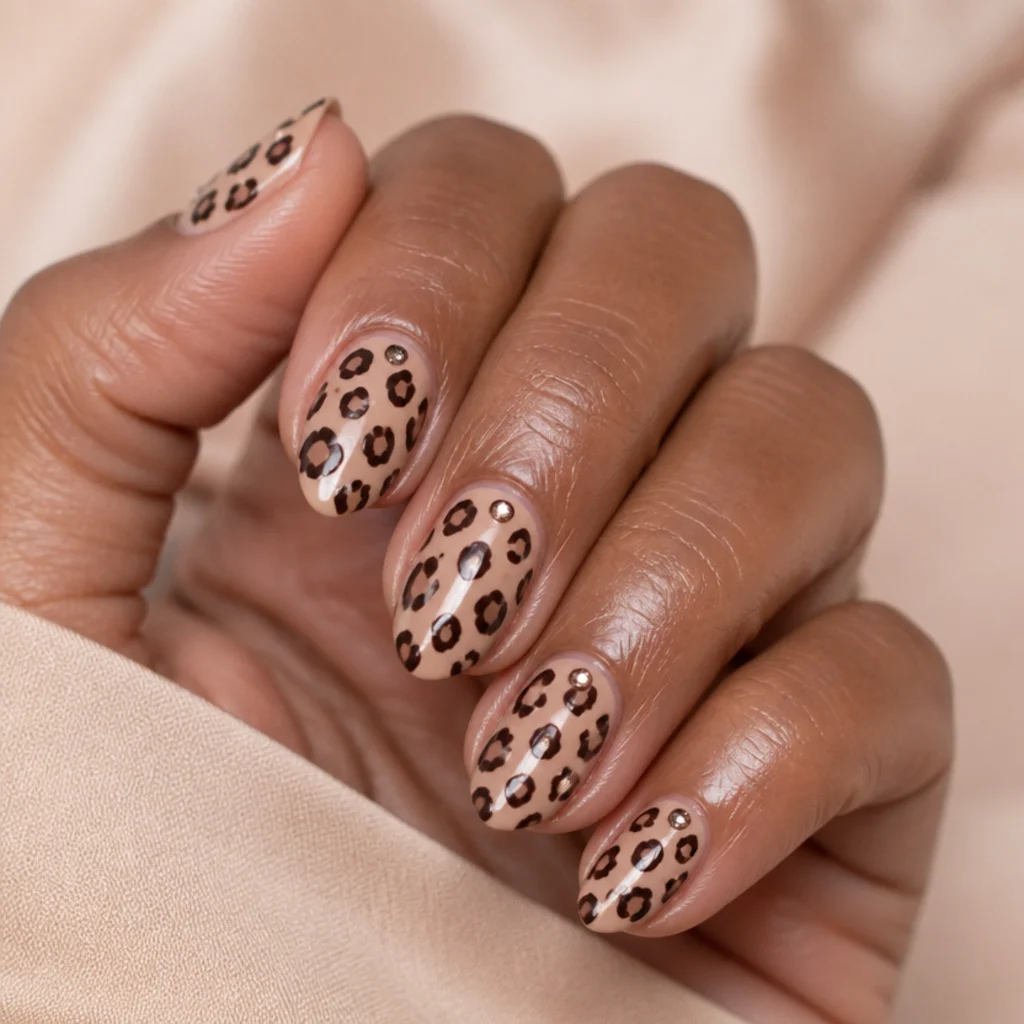
For a little glam, a few leopard rosettes get swapped for small clear or champagne rhinestones set flush into the design. On short nails, keeping the stones tiny and sparse means they add sparkle without catching on hair, fabric, or gloves, and short length helps here because less surface area means fewer chances to knock a stone loose. This suits weddings, holiday parties, and special occasions where you want dimension and light. Placement is what makes it look intentional: concentrate the stones near the cuticle or cluster them on a single accent nail rather than scattering one per finger, which reads accidental. The stones sit under a thick top coat for hold, but they still demand gentler treatment than plain gel, so this is a set to protect from hard knocks. Pro tip: ask for the stones set into a small bead of clear builder gel and then encapsulated with top coat flooded around each base, that little gel "cradle" is what keeps a rhinestone on for two-plus weeks instead of two days. Brief it as "nude leopard print with a few tiny clear or champagne rhinestones replacing select spots, encapsulated in builder gel and sealed well," and say whether you want them clustered on one accent nail.
20Minimalist Two-Spot Leopard
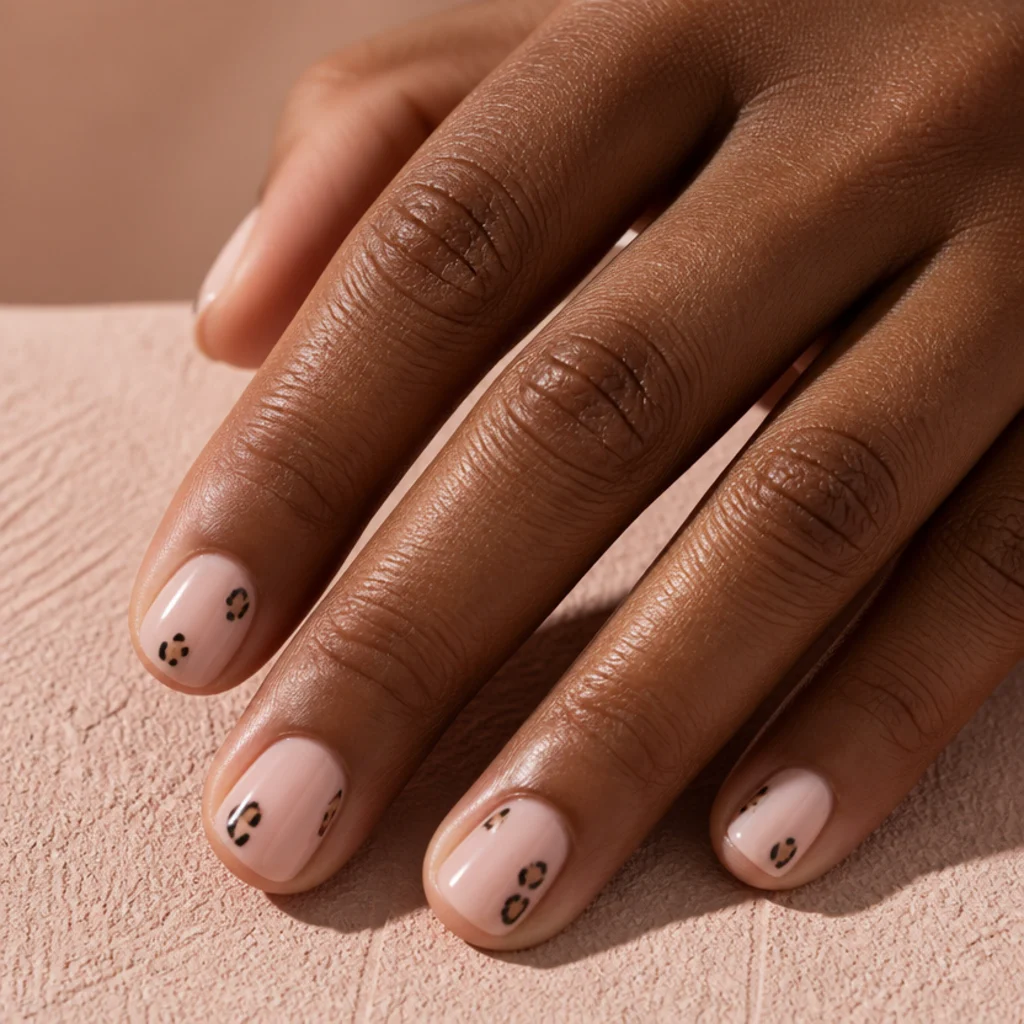
The most pared-back look on the list reduces leopard to just two small rosettes per nail over a sheer nude base. It's barely-there print for anyone who wants the idea of leopard without the full pattern, and it satisfies the most minimalist tastes and the strictest dress codes, corporate, medical, hospitality, wherever a full print would not fly. Regrowth is invisible against the sheer base, upkeep is minimal, and it's the easiest design on this list to recreate at home with a single dotting tool. The look hinges on placement and irregularity: vary the position of the two spots from finger to finger, one high near the cuticle on one nail, one drifting toward the sidewall on the next, so the set looks organic and hand-done rather than stamped and identical. Keep the two spots in soft brown with just a partial, broken outline so each one still reads as a true leopard rosette rather than a plain dot. Pro tip: at home, dot the color center first, let it set, then use the tip of a bobby pin or fine brush to add a broken half-ring in brown, the incomplete ring is the single detail that turns a dot into leopard. Brief it as "a sheer nude base with just two small, softly outlined leopard spots per nail, placement varied finger to finger."
Pro Tips from the Editor
- Master the rosette shape before anything else: a leopard spot is not a solid dot but a soft color center with a broken, interrupted dark ring around only part of it, plus a stray micro-dot or two nearby. Get that broken ring right and even a two-spot set reads as leopard.
- Let scale follow length. On short nails, smaller and sparser almost always wins, aim for three to four rosettes per nail with clear space between them, and shrink the spots slightly wherever the nail narrows toward the tip.
- Choose your darkest element deliberately. A warm charcoal or espresso-brown outline reads softer and more expensive than flat jet black; save true black for high-contrast bases like red, white, or chrome where you want the print to punch.
- Keep a clean band near the cuticle. Leaving a small stretch of bare base color at the base of the nail makes any leopard set look more polished and buys you a longer window before regrowth becomes obvious.
- Layer for durability. Ask for freehand designs painted and cured under the final top coat, not on top of it, so the print sits sealed and flush; this is what prevents spots from chipping or peeling within the first week.
- Match your finish to your life. Glossy top coats keep outlines crisp and legible; matte reads tactile and modern but dulls faster at friction points, so keep a matte refresher for a mid-cycle touch-up.
- Bring one great reference, not five mediocre ones. A single clear, well-lit, close-up photo plus your spoken specs (base color, spot color, outline color, scale, number of nails) will get you a closer match than a scattered mood board.
How to Choose / Get the Look
Start with base color, because it does most of the work. Nude, beige, greige, and milky tones are the safest, most flattering, and easiest to grow out: they hide regrowth and suit every skin tone with a small undertone tweak. White, chrome, and pearl are brighter and show regrowth sooner, so book slightly tighter. Red and rust make the boldest statement and are best kept short and sparse. Next, decide contrast: hard black broken outlines read graphic and modern and suit white, red, and chrome bases, while tonal brown, taupe, and caramel spots feel soft, office-friendly, and forgiving. Then set the scale, which matters more on short nails than anything else: micro and classic scales read cleaner than dense print, so ask your tech to keep rosettes well spaced and size them down toward the tip. For shape, squoval and short almond are the most versatile and flatter the pattern best; round is the softest and most natural; almond adds a lengthening taper for shorter fingers. Match your undertone to the base: warm and olive skin loves caramel, rust, and warm-beige, while cool and fair skin suits rose-beige, milky white, and blue-red. If your natural nails are thin or peel, short leopard print acrylic nails or gel-x give a sturdier, even canvas, provided you insist on a thin, low-apex application so they never look bulky. Finally, price and effort scale with detail: a two-spot or single-accent set is quick and affordable, while all-ten freehand, foil, chrome, and rhinestone work sits at the higher end and takes longer in the chair. Name the base color, spot color, outline color, scale, finish, and nail count, and bring one clear reference. The more specific you are, the closer the result.
| Look | Base | Best undertone | Contrast | Upkeep | Difficulty |
|---|---|---|---|---|---|
| Classic black on nude | Nude/beige | All (tune base) | Medium | Low | Easy–intermediate |
| White leopard | Milky white | Deep, rich skin | Medium–high | Moderate | Intermediate |
| Micro-leopard | Greige | All | Low | Very low | Advanced (tech) |
| Single accent | Glossy nude | All | Medium | Very low | Beginner-friendly |
| Chrome base | Pearl/champagne | Neutral–cool | Medium | Higher | Advanced (salon) |
| Red with black | Cherry/brick | Match red to skin | High | Low–moderate | Intermediate |
| Caramel & chocolate | Caramel | Warm, olive | Low | Very low | Intermediate |
| Rhinestone-dotted | Nude | All | Medium | Higher (fragile) | Intermediate |
Frequently Asked Questions
Do leopard print nails work on short nails?
Yes, and often better than on long ones. A shorter canvas keeps the rosettes looking crisp instead of stretched, and smaller, well-spaced spots read cleaner than a crowded print. Short nails also resist chipping and tip lift, hide regrowth more easily over a neutral base, and stay out of the way at a keyboard or in gloves, so they hold their look longer than length-forward sets.
What is the easiest leopard look to do at home?
A single accent nail or a minimalist two-spot design. Both need only a dotting tool and a steady hand for a few spots rather than an even pattern across all ten nails. The key skill is the rosette: dot a soft color center, let it set, then add a broken partial ring around only part of it in a darker shade, plus a stray micro-dot nearby. Practice that broken ring on paper first, the incomplete outline is what turns a plain dot into leopard.
Are black leopard print nails hard to keep clean-looking?
Not especially. Black outlines over a neutral base hide regrowth well and stay legible as they grow. A glossy top coat keeps the spots sharp, and short length means fewer chances for tip wear to distract from the print. For an even more polished, expensive look, ask for a warm charcoal outline rather than flat jet and leave a small clean band of base color near the cuticle.
How long do short leopard sets last?
A gel set typically lasts two to three weeks, and acrylic or gel-x fills run on a similar schedule. Short lengths lift less than long ones, so you often reach the full three weeks before a refill or soak-off. Longevity depends on prep and sealing, so ask for the design cured under the top coat and be gentle with foil or rhinestone accents, which are the first elements to wear.
Should I choose gel or acrylic for leopard print?
Gel suits natural nails that are reasonably strong and gives a thin, glossy finish. Acrylic and gel-x are better if your nails are thin, peel, or need extra durability and an even canvas for detailed freehand. All hold leopard detail well; the deciding factor is the health and strength of your natural nail. Whichever you choose, ask for a thin, low-apex application so short nails don't look bulky.
How do I ask for the leopard spots so they do not look like polka dots?
Use the word "rosette" and describe the broken ring. Tell your tech you want "leopard rosettes, a soft center with a broken dark outline around part of it, not solid dots," and ask for the spots varied in size and unevenly spaced with a few tiny satellite dots. Requesting two closely related spot colors rather than one flat shade also adds the depth that separates real leopard from dots.
Which base color is most flattering for my skin tone?
Warm, golden, and olive undertones glow against caramel, rust, warm-beige, and peachy nude bases. Cool and fair undertones suit rose-beige, milky white, blush, and blue-based reds. Neutral undertones can wear almost anything, including chrome and greige. If you're unsure, a warm-tuned nude with tonal brown spots is the closest thing to a universal flatterer on the list.
Can I get leopard nails for a wedding or formal event?
Yes, just steer toward the softer, dressier variations. Glazed-donut leopard, gold-foil accents, tonal caramel-and-chocolate, and rhinestone-dotted nude all read elegant rather than casual. Keep the print low-contrast and sparse, choose a neutral or metallic base that matches your palette, and concentrate any sparkle near the cuticle or on a single accent nail so it looks placed and intentional in photos.
Will a matte or glossy top coat suit leopard better?
It depends on the mood. Glossy keeps outlines crisp, colors saturated, and the set looking wet and polished, the safer choice for high-contrast and event looks. Matte reads tactile, earthy, and modern, and it disguises minor surface ridges, but it dulls faster wherever hand cream and friction hit. If you love matte, keep a matte refresher coat and reapply mid-cycle to keep the finish even.