15 Stylish Leopard Print Acrylic Nails
Leopard reads best on acrylic because sculpted length and a true apex give each rosette room to sit clean. This guide breaks down 15 distinct sets by base color, spot scale, shape, and finish, so you can match the print to your hands and your real upkeep tolerance before you book.
 Edited by Lena Rose · Published July 11, 2026 · 26 min read
Quick Answer
- Best for: Anyone who wants sculpted length plus high-impact animal print that still reads polished, on any hand shape, nail bed, or skin undertone.
- Who might skip it: Nail biters mid-repair, anyone with very thin or peeling natural nails needing a rest, or hands-on workers who cannot commit to two-week fill cycles.
- Maintenance: Moderate to high. Plan a fill every 2 to 3 weeks; hand-painted spots at high-wear tips may want a touch-up before that.
- Difficulty: Advanced. Extension and apex work belong to a licensed tech; the freehand spots are the approachable part once a base is set.
- Cost: Variable. A full sculpted print set typically runs higher than a plain acrylic full set, with chrome, foil, ombre, and stone work adding to the design fee. Ask for a quote when you book.
- Wear time / longevity: 2 to 3 weeks between fills; a full set can carry 6 to 8 weeks with disciplined fills before a full rebalance or soak-off.
- Standout variation: Black leopard on a milky white base. The high contrast flatters every undertone and photographs crisply in any light.
- How to ask your nail tech: Name five things in order: base color, spot color, print scale, nail shape, and finish, plus how many nails carry print.
In This Guide
- Classic Black Leopard on Nude
- Black Leopard Print Nails on White
- Short Leopard Print Acrylics
- Black-and-Gold Leopard Coffin
- White Leopard Print Nails on Black
- Leopard French Tip Acrylics
- Matte Black Leopard Almond
- Single Black Leopard Accent Nail
- Stiletto Black Leopard Glam
- Chrome Leopard on Long Acrylics
- Negative Space Black Leopard
- Autumn Leopard in Rust and Black
- Micro Black Leopard on Short Squoval
- Black Leopard with Rhinestone Accents
- Ombre Nude to Black Leopard
Leopard reads nostalgic and current at once, and acrylic is where it finally gets room to work. A sculpted enhancement gives you a defined apex and a smooth planar surface, so a nail tech can space and scale each rosette instead of cramming pattern onto a curved natural nail. Length matters too — it lets the print breathe and lets the eye read whole rosettes rather than smudged dots. A genuine leopard rosette isn't a solid dot. It's a broken ring, usually a tan or tonal center bordered by two or three black crescents that never fully close, and getting that structure right is what separates an editorial set from a costume one. Across these fifteen ideas, one variable changes each time: base color, spot scale, shape, finish, or occasion. Black leopard print nails anchor most of them because a black outline stays crisp over almost any base, from milky white to burnt rust. As you scroll, notice which combinations keep pulling your eye — that repetition is usually your answer. Each entry closes with the upkeep reality and the exact language to hand your tech, since a vague reference photo is the fastest route to a set you don't love.
01Classic Black Leopard on Nude
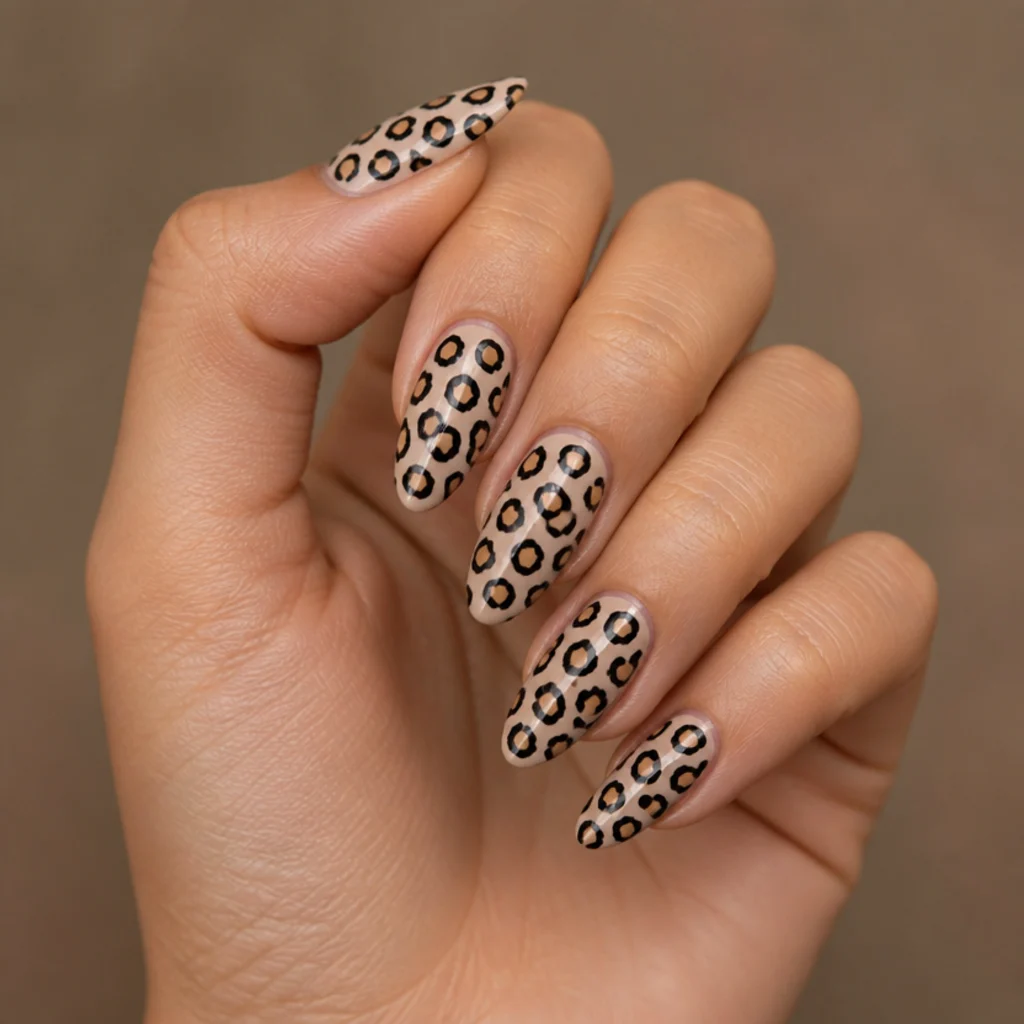
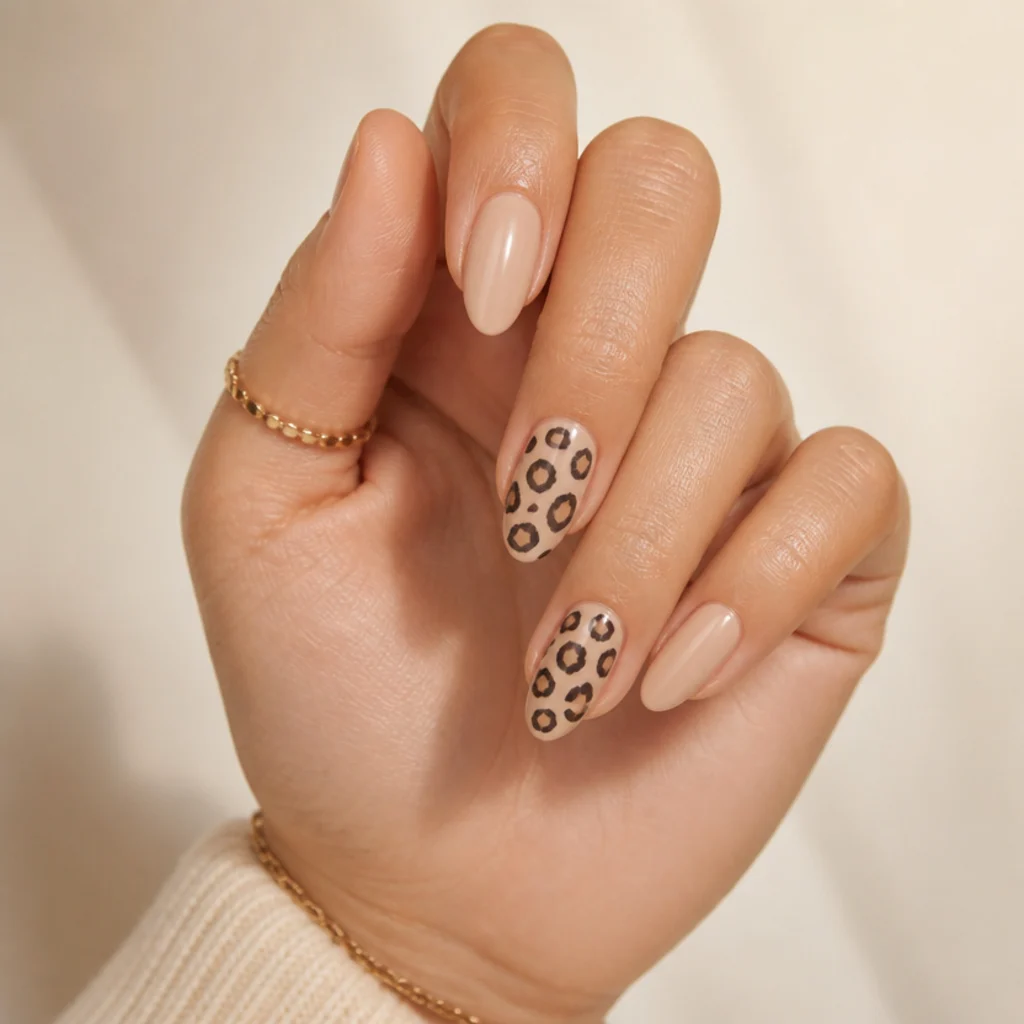
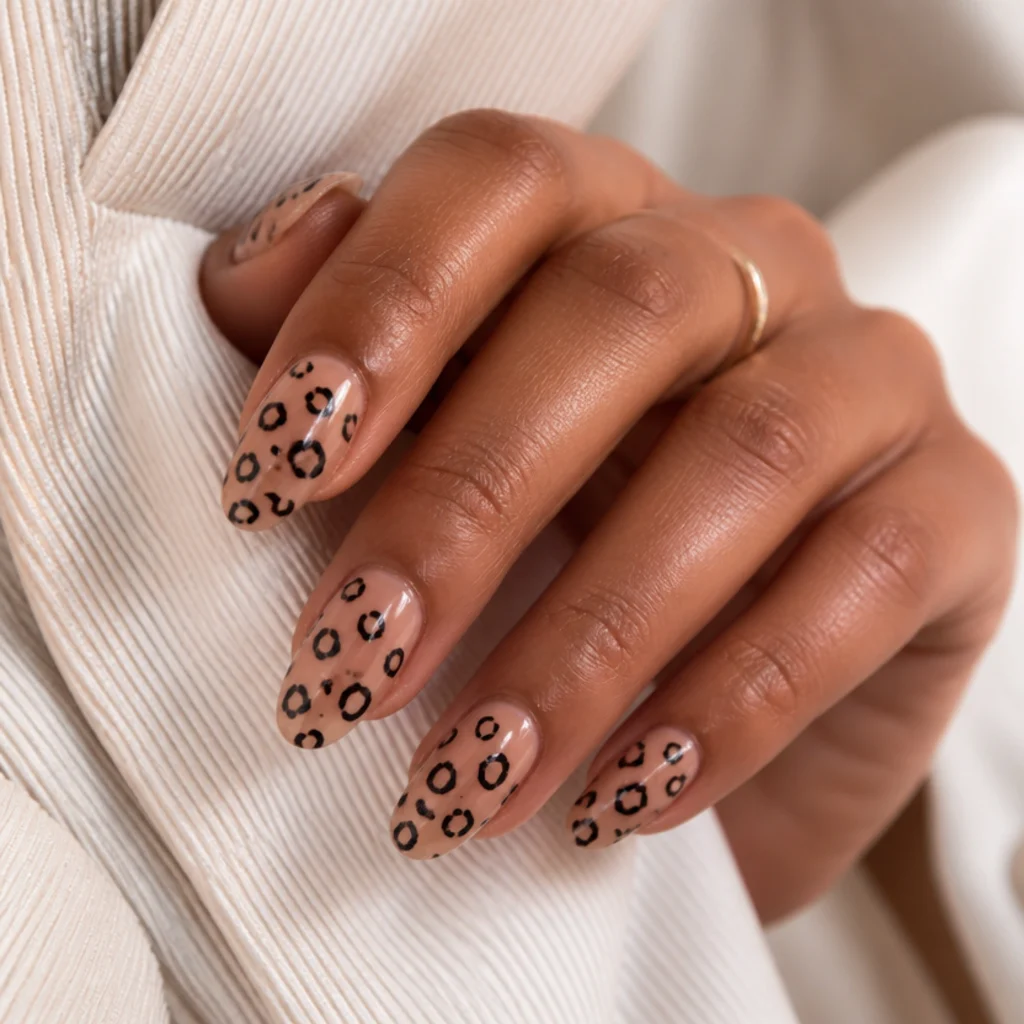
This is the original for a reason, and it lives or dies on undertone matching. A sheer nude or beige acrylic base carries tan rosette centers ringed in true black, and the whole set reads elegant rather than loud. Ask your tech to pull the base warm (peach-beige) for warm or olive undertones and cool (rosy or greige) for cool undertones, then keep the tan centers one or two shades deeper than the base so the rosettes have dimension instead of disappearing. Almond and oval shapes flatter the pattern best because the taper gives each rosette a natural sight line from cuticle to tip. Upkeep is low: neutral regrowth blends at the cuticle, so you can stretch to a three-week fill without an obvious grow-out line. Pro tip: have the artist outline each rosette with a broken ring of two or three separate black strokes rather than a closed circle, which is the detail that keeps it from looking like polka dots. Ask your nail tech for classic broken-ring rosettes in tan and black over a nude base, on all ten or just a scattered few.
02Black Leopard Print Nails on White
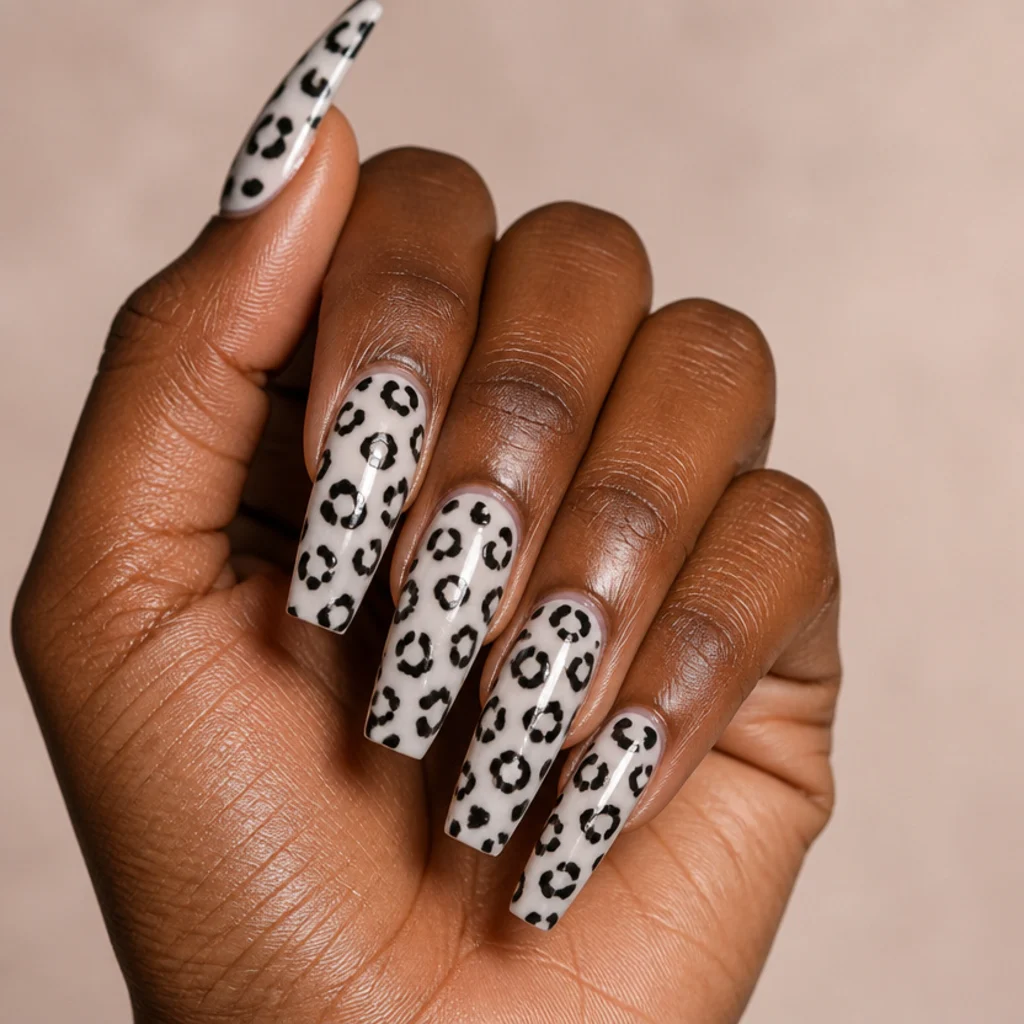
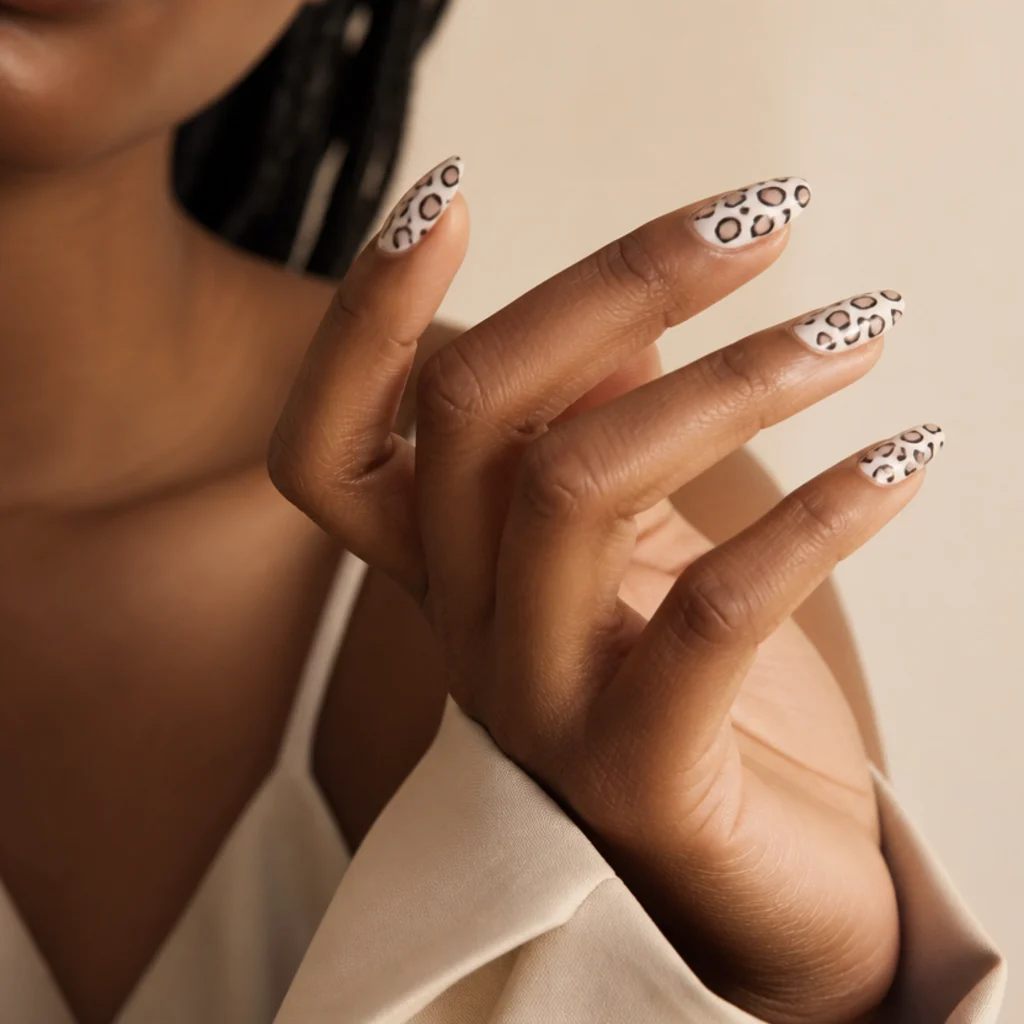
Swapping to a milky white base makes black leopard print nails read graphic and clean, like ink pressed onto paper. Skip the tan filler here: solid black spots on white is a two-tone graphic look, and adding brown muddies the contrast that gives it punch. It flatters every skin tone because black and white are universally balancing, and it suits anyone who wants a crisp modern take over a warm safari feel. Coffin and square shapes give the flat white field enough real estate for confident spot placement. The one honest drawback: a pale, near-opaque base shows lifting and cuticle grow-out faster than a sheer nude, so watch your side walls and book your fill on time instead of stretching it. Pro tip: ask for a milky, slightly translucent white rather than a chalky stark white, which looks more expensive and hides minor shadowing at the cuticle. Ask your nail tech for a milky white base with solid black leopard spots, no tan filler, and say whether you want the spots drifting toward the tips or scattered evenly.
03Short Leopard Print Acrylics
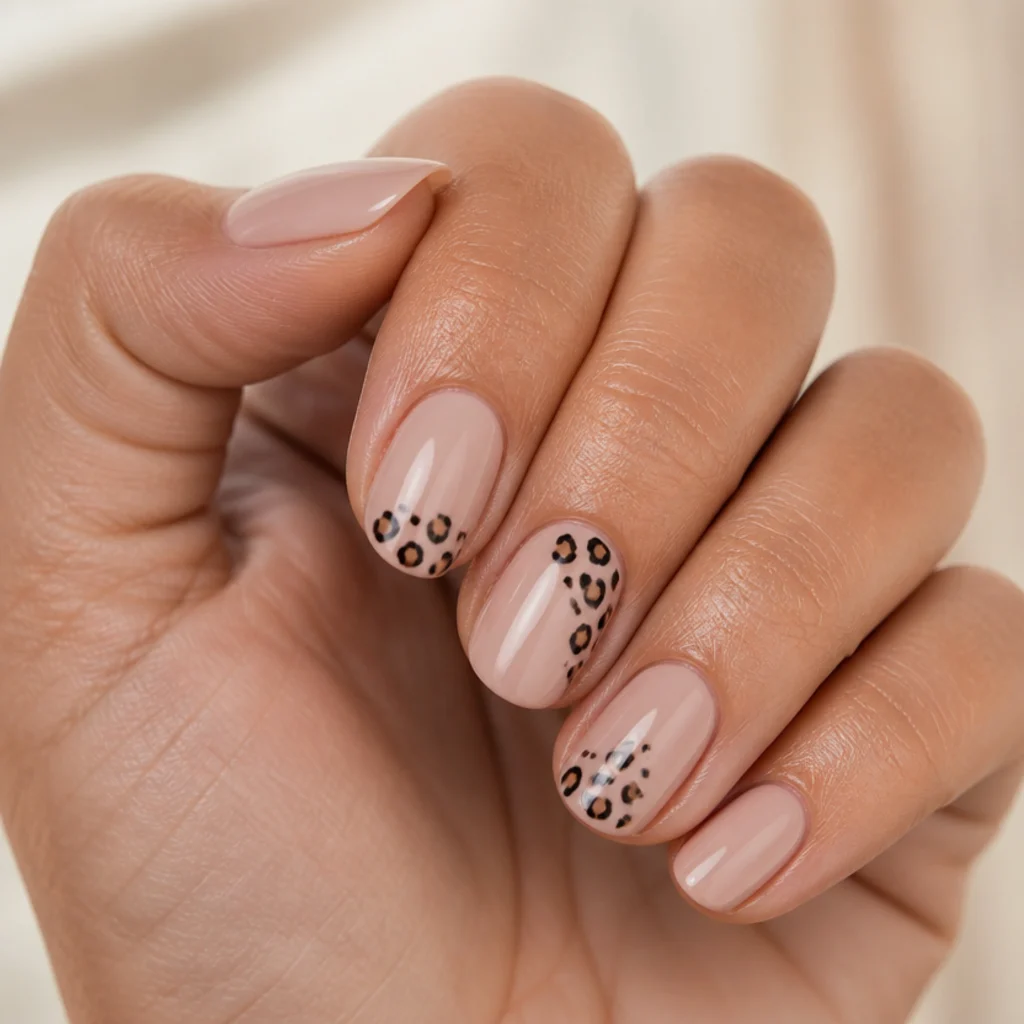
You don't need dramatic length to wear this print. You need correct scale. Short leopard print nails on acrylic keep the sculpted strength and clean edge while staying practical for typing, parenting, or a hands-on job, and the whole set succeeds or fails on spot sizing. Oversized rosettes crowd a short nail, so ask for compact spots and cap it at two or three per nail with intentional negative space between them. A nude or soft-taupe base with small black-and-brown rosettes looks tidy and grown-up. Short sets also lift less, since there's less surface to catch on pockets, hair, and door handles, which quietly extends your time between fills. Round and squoval shapes suit shorter length best; both keep the free edge strong. Pro tip: have the artist place print on the accent and pinky nails where the eye lands first, leaving thumbs and index fingers cleaner so daily hand use does not read as clutter. Ask your nail tech for short squoval or round acrylics, a nude base, and small-scale leopard spots on two or three nails.
04Black-and-Gold Leopard Coffin
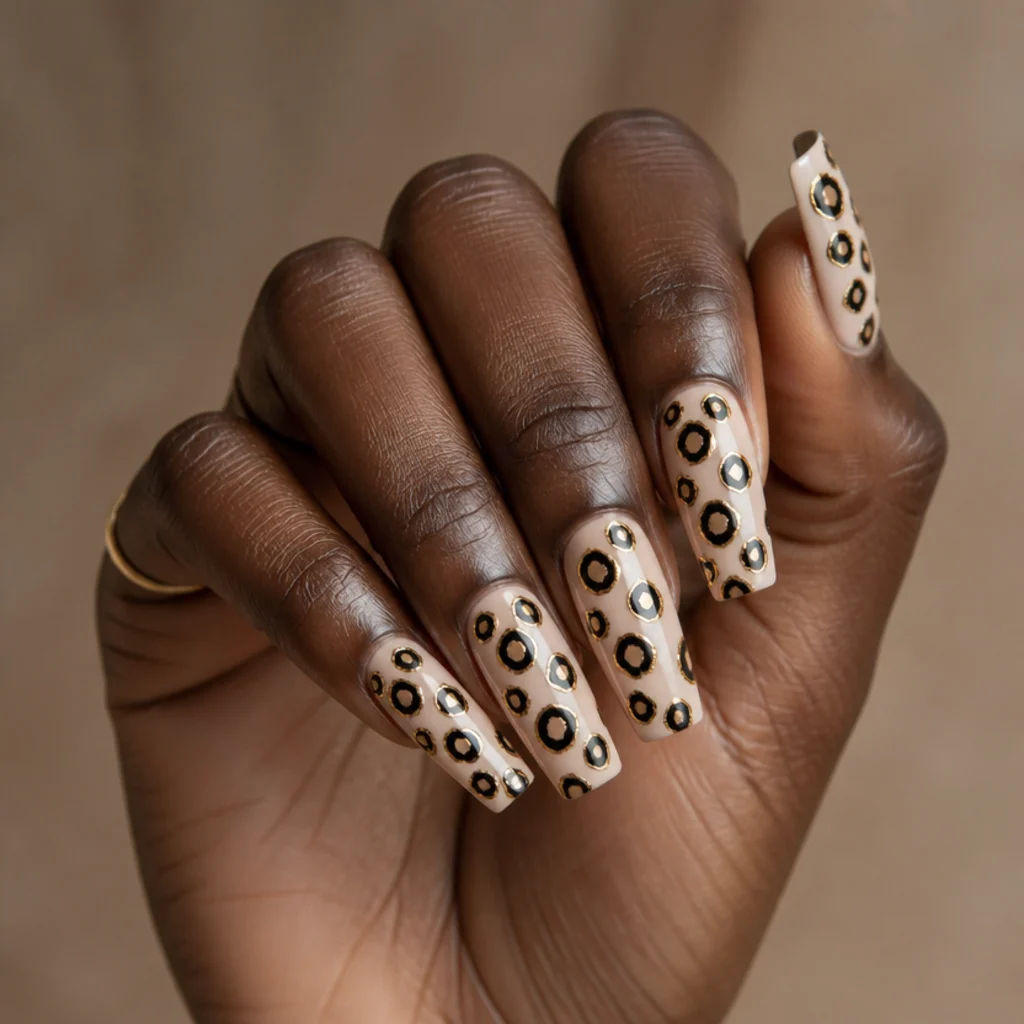
Gold is what pushes leopard from casual to occasion-ready. On long coffin acrylics, a warm beige base carries black rosettes trimmed with fine gold foil or a thin metallic liner, so the pattern flickers as your hand moves under light. Warm metallics are especially flattering on deep and olive skin, and the coffin silhouette gives the foil detailing a long, flat stage to sit on. Be realistic about fragility, though: coffin length plus applied foil means more snag points, so plan gentle handling and a fill inside two weeks before any lifting can pry at an edge. Keep the gold restrained. Foil on every rosette turns busy fast, so concentrate it on one or two statement fingers and let the rest stay matte-black print. Pro tip: ask for the gold to be sealed under a gel top coat rather than sitting on top, which stops foil edges from catching and dulling within days. Ask your nail tech for long coffin acrylics, a beige base, and black leopard rosettes with gold foil accents on two feature nails.
Save this to Pinterest so you can compare bases and finishes side by side later.
05White Leopard Print Nails on Black
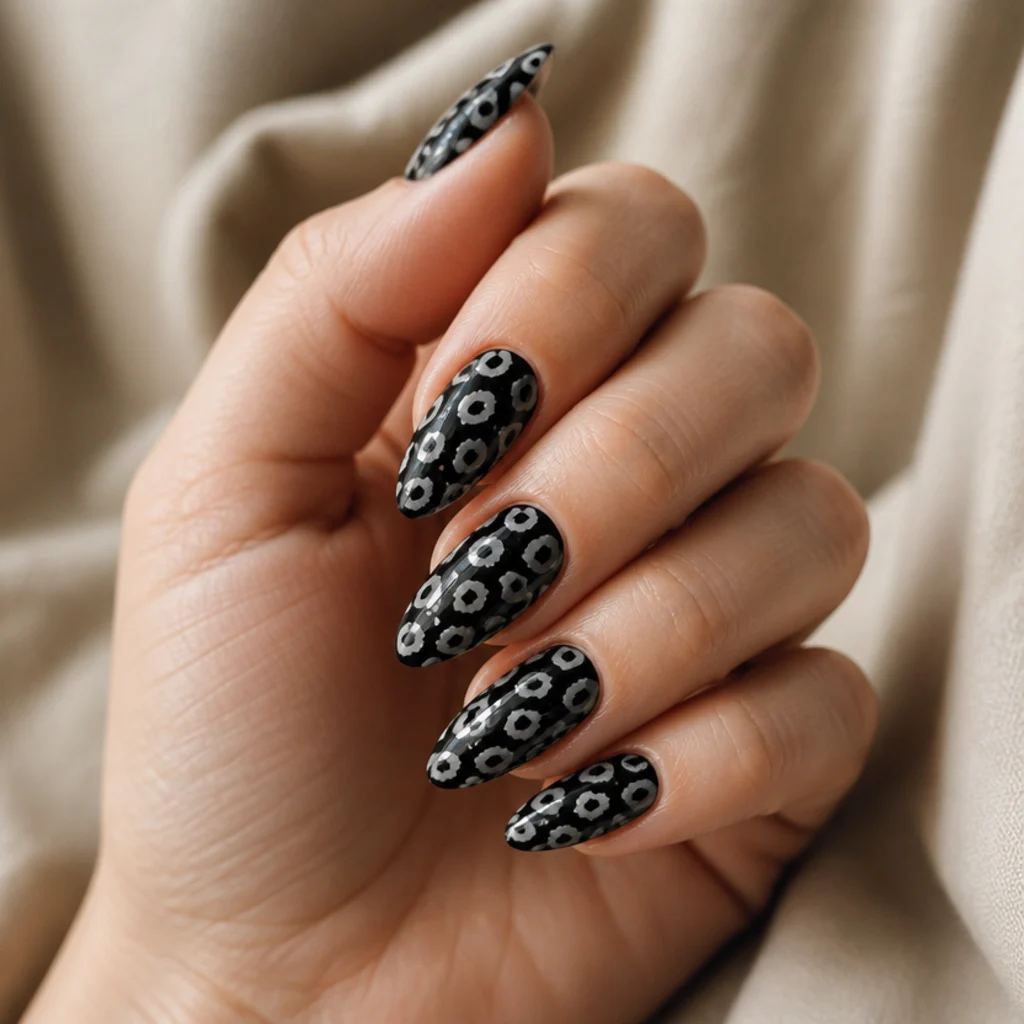
Flip the formula and you get a striking after-dark set. The acrylic base is a deep glossy black and the rosettes are painted in white with soft-gray shadowing, so white leopard print nails become the highlight against a dark canvas. It reads moody and editorial, and it suits anyone who loves a dark manicure but wants texture instead of a flat color. The trick is the gray: pure white spots on black look flat and stark, but a gray inner tone gives each rosette the same broken-ring depth the classic tan version has. High contrast flatters every skin tone, though this leans going-out rather than boardroom. Almond and stiletto shapes amplify the drama; a soft-square keeps it a touch more wearable. Black shows dust and lint, so a quick buff with a soft cloth keeps it photo-ready. Pro tip: request a glossy, not matte, black base under white print; the shine reflects light through the spots and stops the set from reading like a chalkboard. Ask your nail tech for a glossy black base with white and gray leopard rosettes, and note if you prefer a matte top coat for a softer, suede effect.
06Leopard French Tip Acrylics
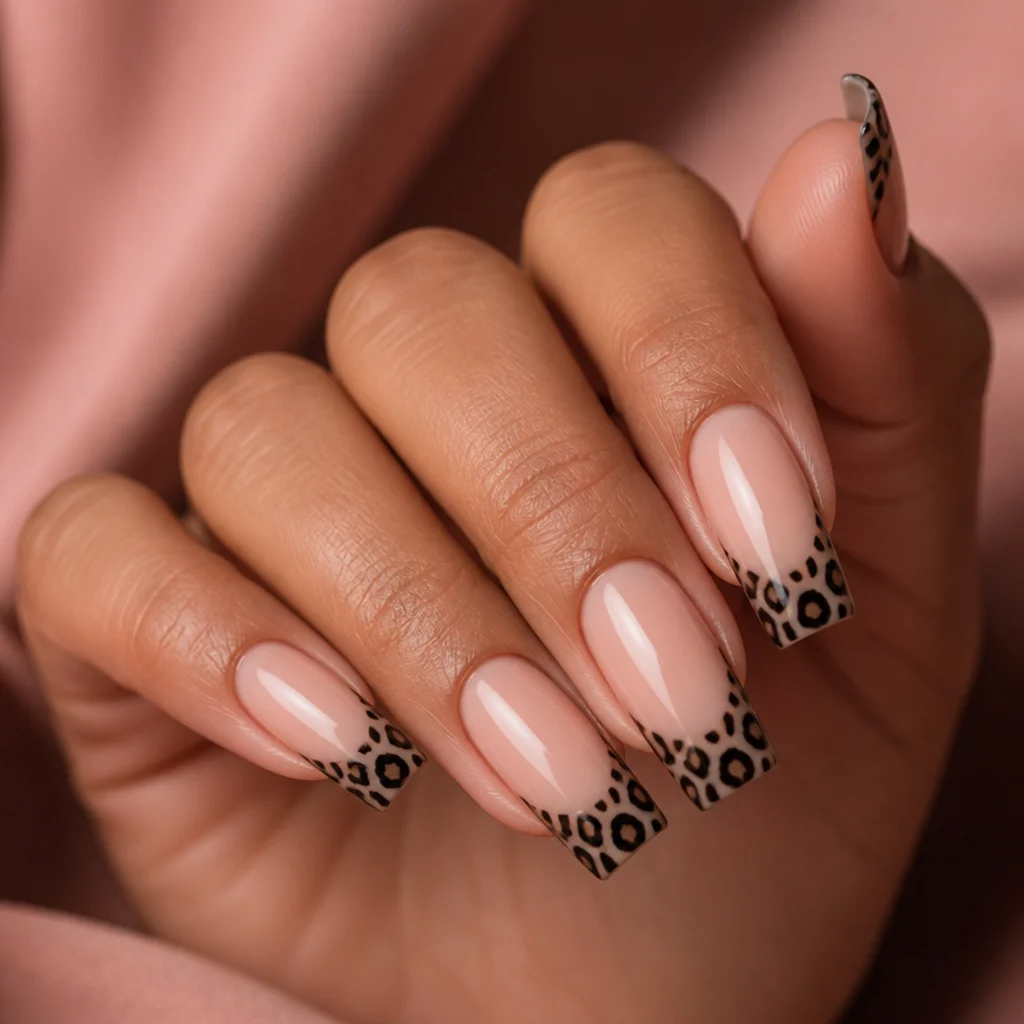
If a full set feels like a lot, keep the print where a French tip would sit. A sheer nude base stays clean across the nail bed while black leopard fills only the tip, giving you the animal print in a controlled, professional-friendly dose. The nude bed also keeps regrowth nearly invisible, which makes this one of the lower-upkeep looks here. Length and shape matter: a longer square or squoval gives the tip enough width for two or three whole rosettes, while a short tip only has room for spots that get sliced off at the free edge and look unfinished. Tell your tech how deep to drop the print line, roughly the top third, so the tips stay balanced and don't creep down into the bed. Pro tip: ask for the leopard tip to follow a soft diagonal or freehand edge rather than a hard straight smile line, which looks more organic than a ruler-clean French. Ask your nail tech for a nude French base with a black leopard tip instead of a white smile line, and specify how deep the print should sit.
07Matte Black Leopard Almond
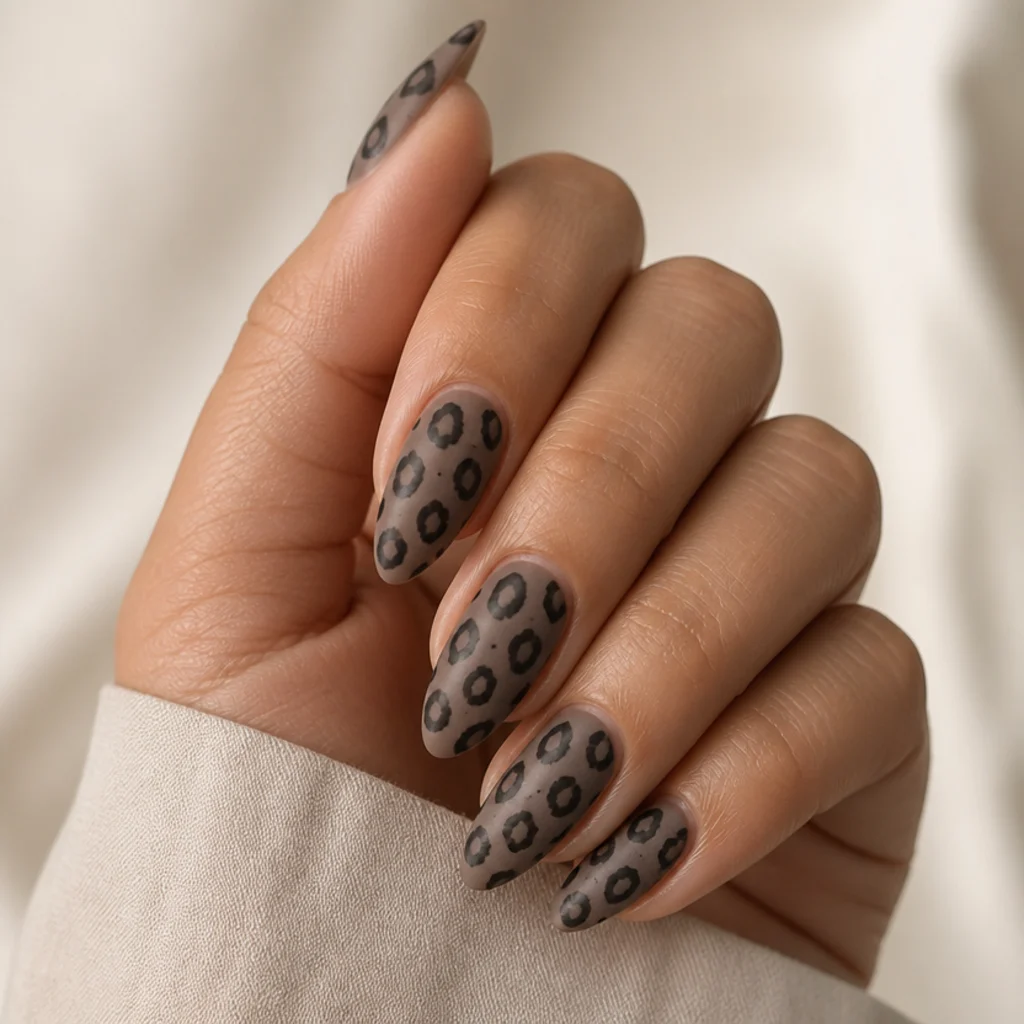
A matte top coat rewrites leopard entirely, trading shine for a soft, velvety surface that reads quiet and expensive. On almond acrylics, a matte taupe or greige base with tonal black rosettes looks considered rather than flashy, the kind of neutral set that works with tailoring and knitwear. Keep the spots soft-edged and tonal, one deep charcoal-to-black range rather than high contrast, so the whole look stays cohesive and muted. Almond suits the mood because its rounded taper feels softer than a sharp square. Two honest maintenance notes: matte shows fingerprints and skin oils, and the flat finish physically wears faster at the tips than gel gloss, so a matte top coat refresh mid-cycle keeps it from going patchy and shiny in high-touch spots. Pro tip: buff the natural oils off with a lint-free wipe before a photo; matte comes alive on camera when it's flat. Ask your nail tech for almond acrylics, a matte taupe base, tonal black leopard spots, and a matte top coat.
08Single Black Leopard Accent Nail
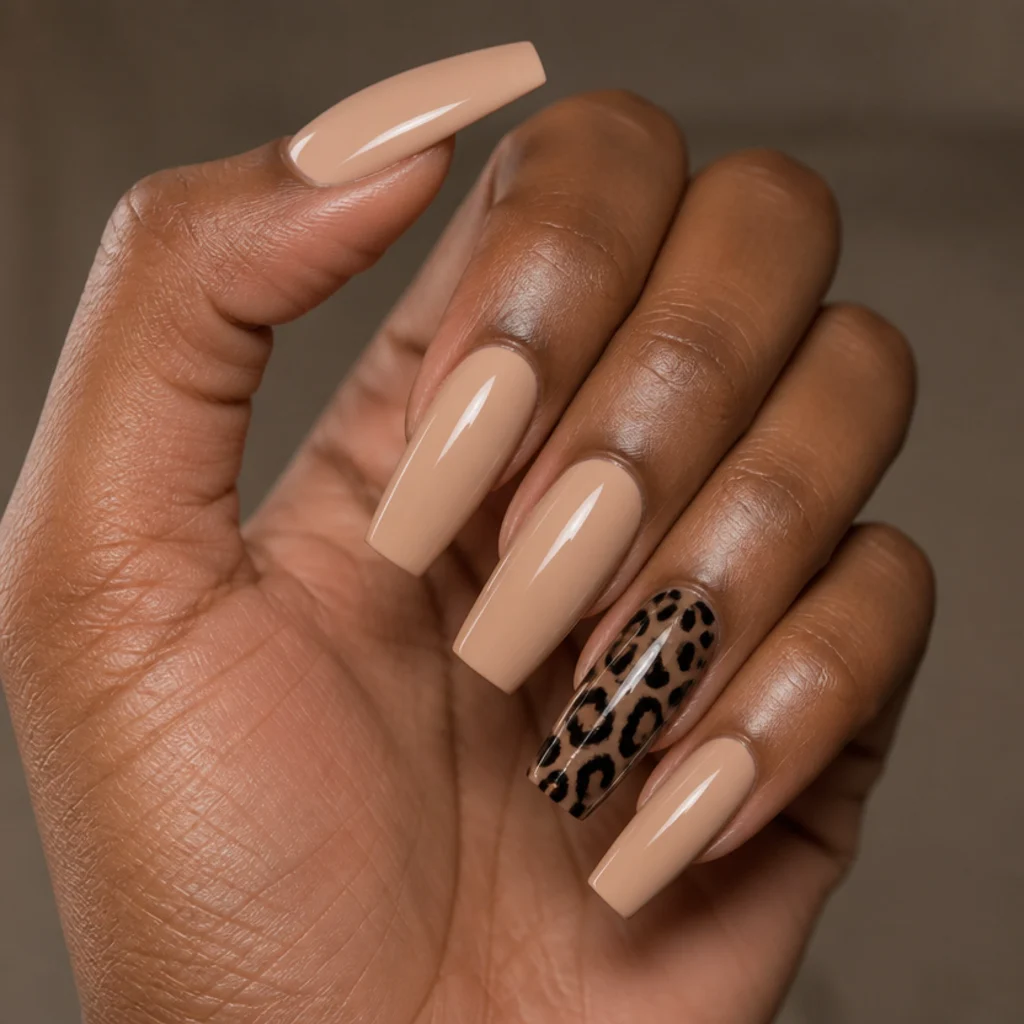
The easiest way to wear the print is to commit to a single nail. Keep nine nails a solid nude, blush, or soft brown, then let one ring-finger accent carry the black leopard rosettes. This is the lowest-maintenance option in the guide, since most of the set is a plain color that hides regrowth, and it books faster and often costs less than full freehand print on ten nails. It also lets you test the look before going all in. Match the accent base to the solid nails, or drop it a shade for subtle definition, and keep the rosettes properly scaled so the one busy nail still reads as design rather than a smudge. Pro tip: put the accent on the ring finger of each hand for symmetry, and if you want more later, add the middle finger before jumping to a full set, so the hand builds up in balanced pairs. Ask your nail tech for solid nude acrylics with one black leopard accent nail on each ring finger.
09Stiletto Black Leopard Glam
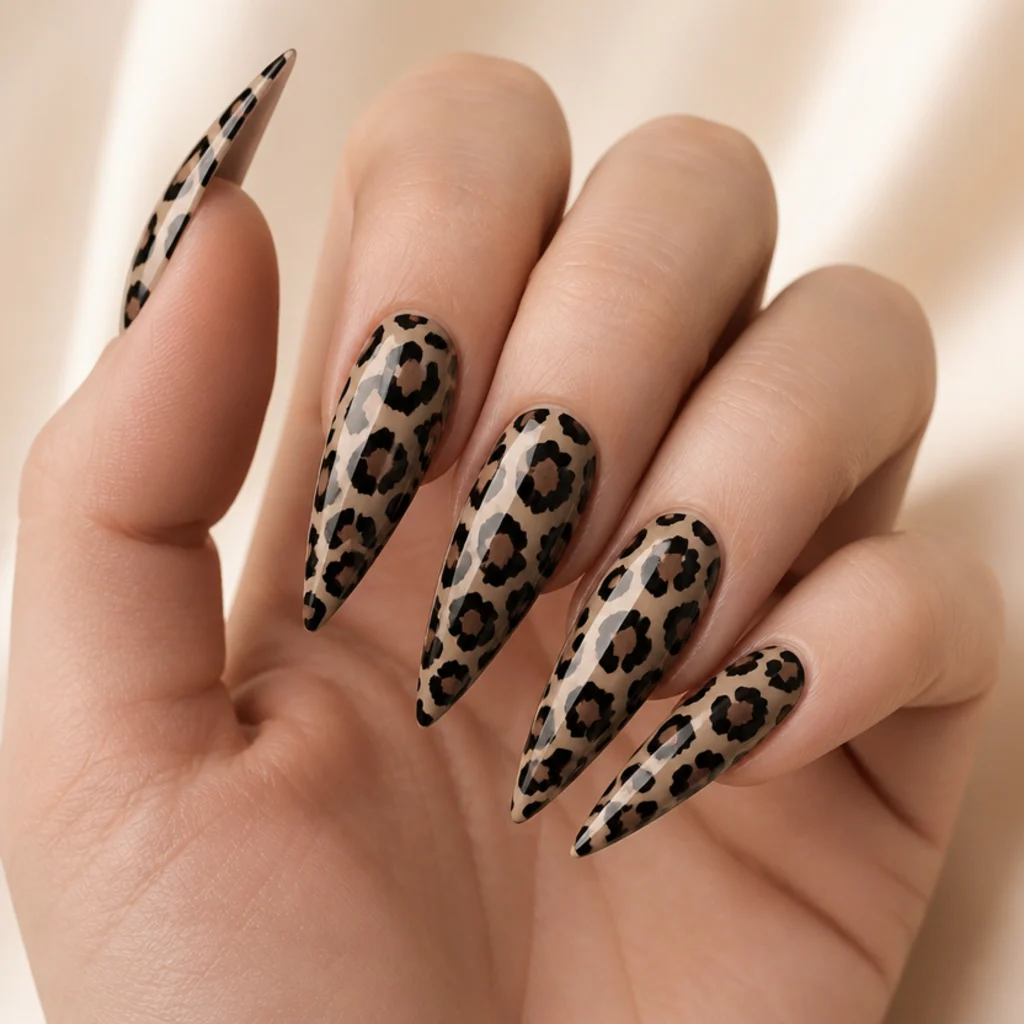
For maximum drama, take the print to a long stiletto. The sharp taper stretches every rosette into an elongated shape, giving black leopard print nails a fierce, editorial line that suits bold, high-glam sets. A nude base with dense black-and-tan rosettes under a high-gloss gel top coat photographs like a campaign. Be honest about lifestyle first, though: stiletto is the most fragile shape and the least forgiving for anything hands-on, so it favors events and shoots over daily wear, and the pointed tip is prone to catching if the apex isn't built correctly. Because the rosettes stretch on a stiletto, ask the artist to elongate the spot spacing to match, or the pattern bunches near the cuticle and thins at the point. Pro tip: ask your tech to reinforce the apex and slightly thicken the stress area near the sidewalls, which is where a long stiletto snaps first. Ask your nail tech for long stiletto acrylics, a nude base, dense black leopard rosettes, and a high-gloss finish.
10Chrome Leopard on Long Acrylics
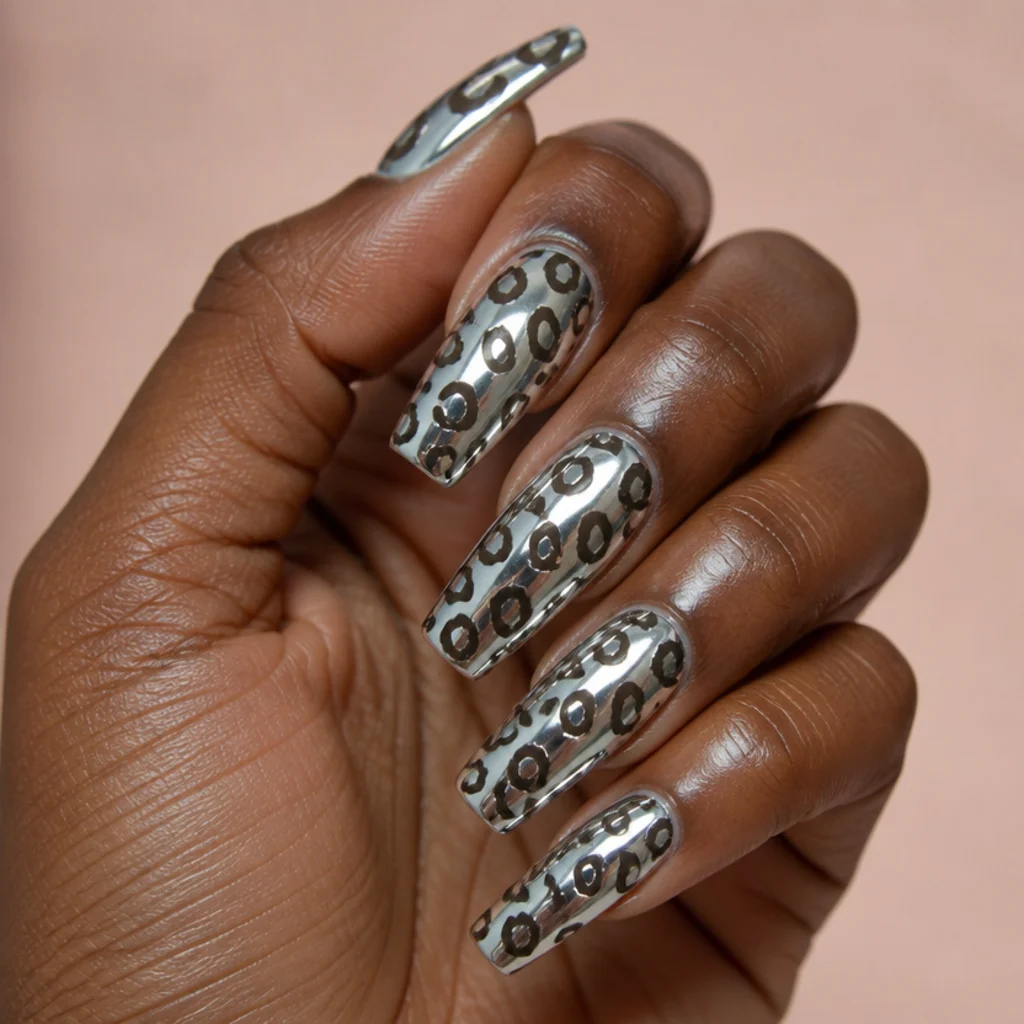
Chrome powder gives leopard a futuristic, mirror-like glow. On long acrylics, a pearl or silver chrome base carries black spots that appear to float on the reflective surface, and the print shifts as light moves across your hand. This suits anyone who loves a trend-forward, high-shine manicure and doesn't mind a set that draws the eye. Two realities keep it looking right: chrome needs to be sealed, and it shows every bit of cuticle regrowth against the metallic field, so shorter fill cycles, closer to two weeks, keep the mirror line clean. Order also matters. The spots should be painted over the chrome and then sealed, so the print doesn't sit under the powder and go cloudy. Coffin length gives the reflective surface a long, flat plane that maximizes the mirror effect. Pro tip: pair the chrome with one or two solid-black accent nails; the matte-black contrast makes the chrome read even brighter and gives busy light something to rest against. Ask your nail tech for a pearl chrome base with black leopard spots on long coffin acrylics, sealed under gloss.
Save this to Pinterest and pin the finish that fits your real routine, not just the flashiest photo.
11Negative Space Black Leopard
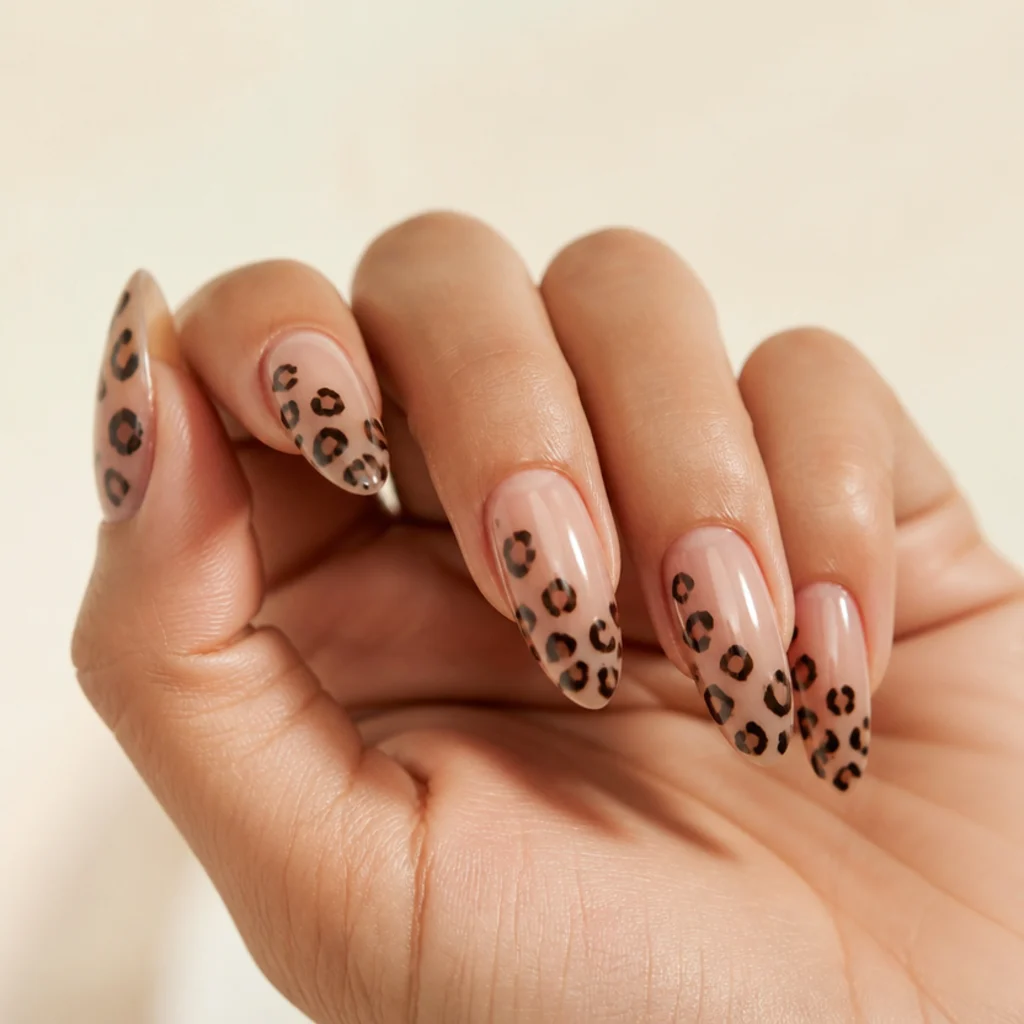
Negative space keeps things airy by letting your natural nail show through as the background. Instead of a solid base, black leopard rosettes float across a clear or sheer acrylic, so the print reads light and graphic rather than heavy. It suits anyone who likes minimal, modern nail art and wants pattern without full coverage, and because so much of the nail stays sheer, regrowth is forgiving here, a smart low-upkeep pick. One honest catch: the clear areas show whatever the natural nail looks like, so a clean, even, healthy nail bed does a lot of the work, and any ridges or staining will be visible. Almond and oval shapes keep the negative space elegant. Pro tip: ask the artist to concentrate the spots toward the tip and outer edges and leave the cuticle area clearest, which lengthens the nail visually and keeps grow-out invisible. Ask your nail tech for clear negative-space acrylics with scattered black leopard spots, balanced so no nail looks empty or crowded.
12Autumn Leopard in Rust and Black
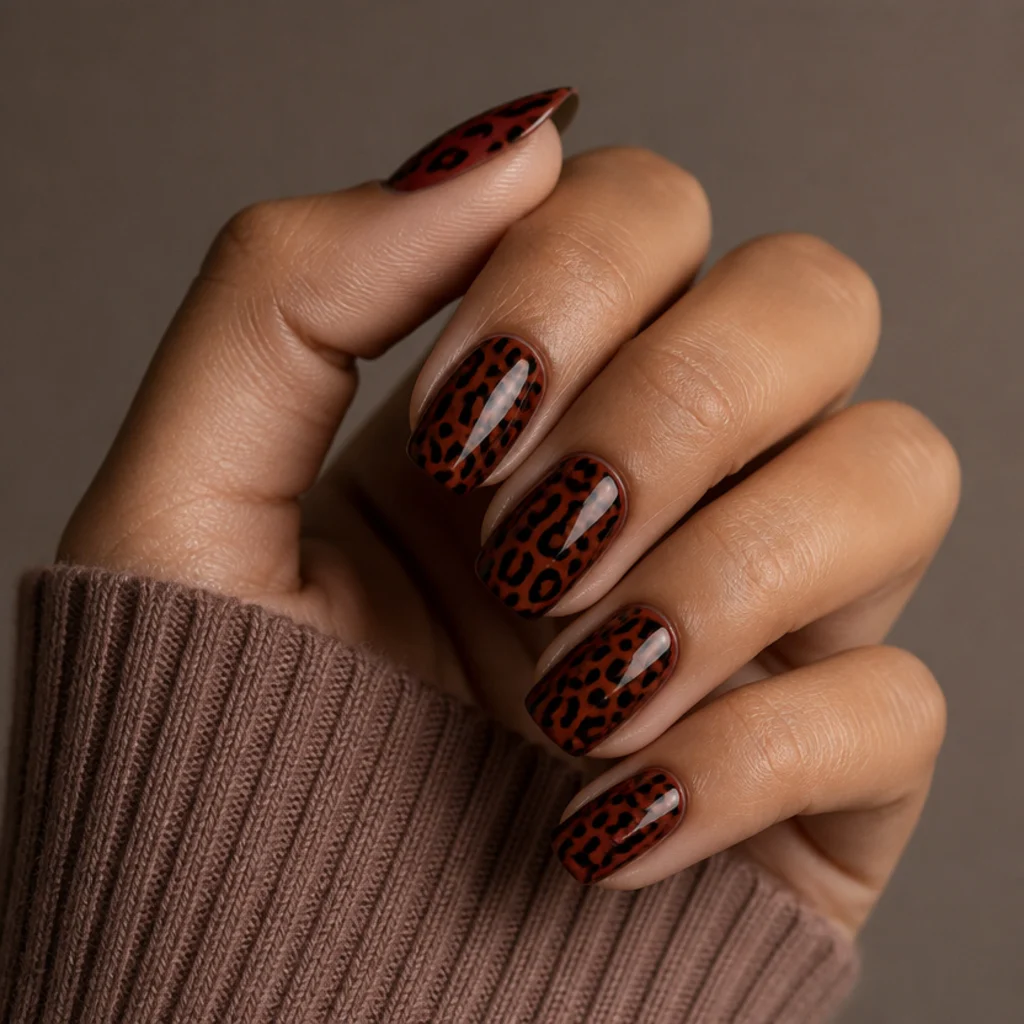
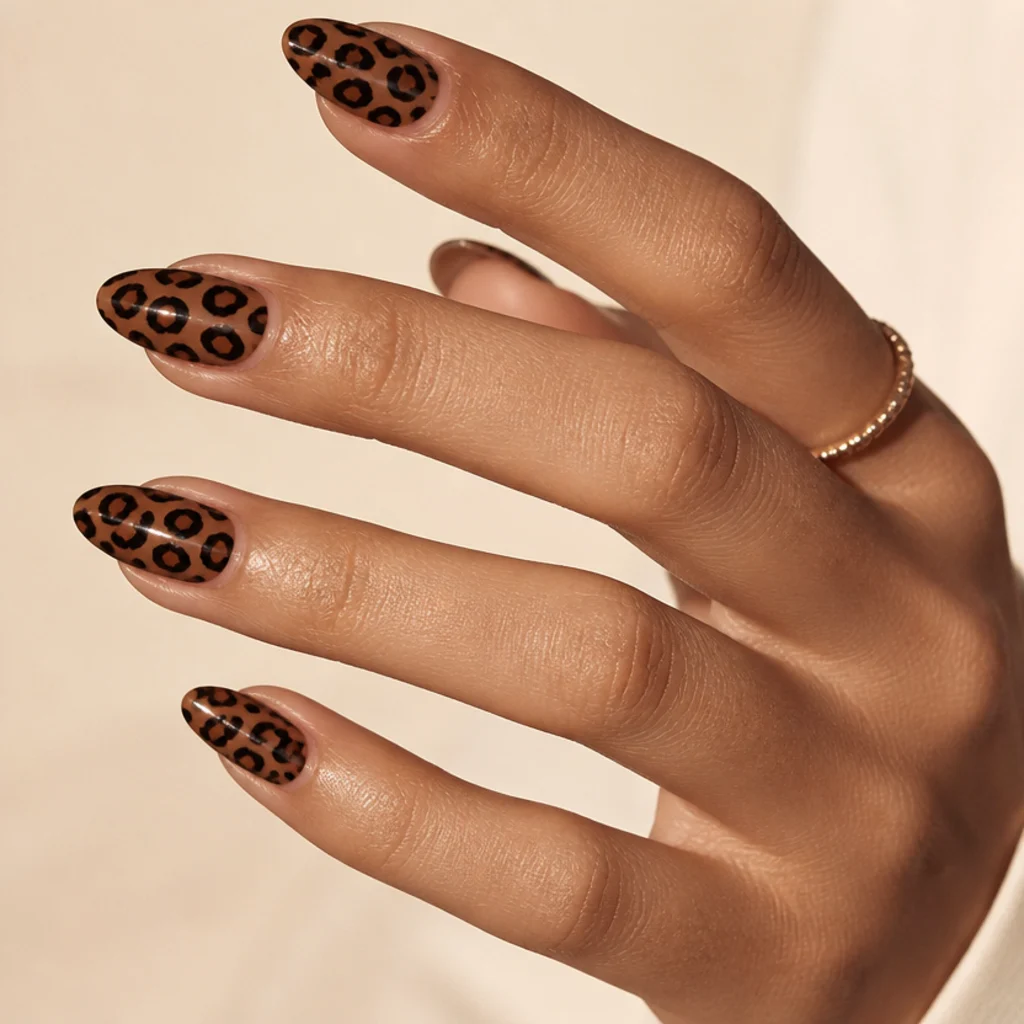
Warm it up for fall by swapping the neutral base for rust, cinnamon, or burnt orange. Black rosettes pop against the deeper base, giving leopard a cozy, seasonal feel that pairs with camel coats and knit textures. The warm tones flatter medium, olive, and deep skin especially well, and a richer base hides tip wear better than a pale color, so this holds its look a little longer between fills. Squoval and almond shapes suit the mood, and a glossy top coat keeps the rust looking saturated rather than dusty. Keep the rosettes true black; a brown outline on a rust base blends and loses definition, so the spots need the contrast of black to stay legible. Pro tip: add a single olive, oxblood, or chocolate-brown accent nail to deepen the palette into a full autumn story rather than one flat orange. Ask your nail tech for a warm rust base with black leopard rosettes and a glossy finish, plus one deeper accent nail; upkeep stays standard at a fill every two to three weeks.
13Micro Black Leopard on Short Squoval
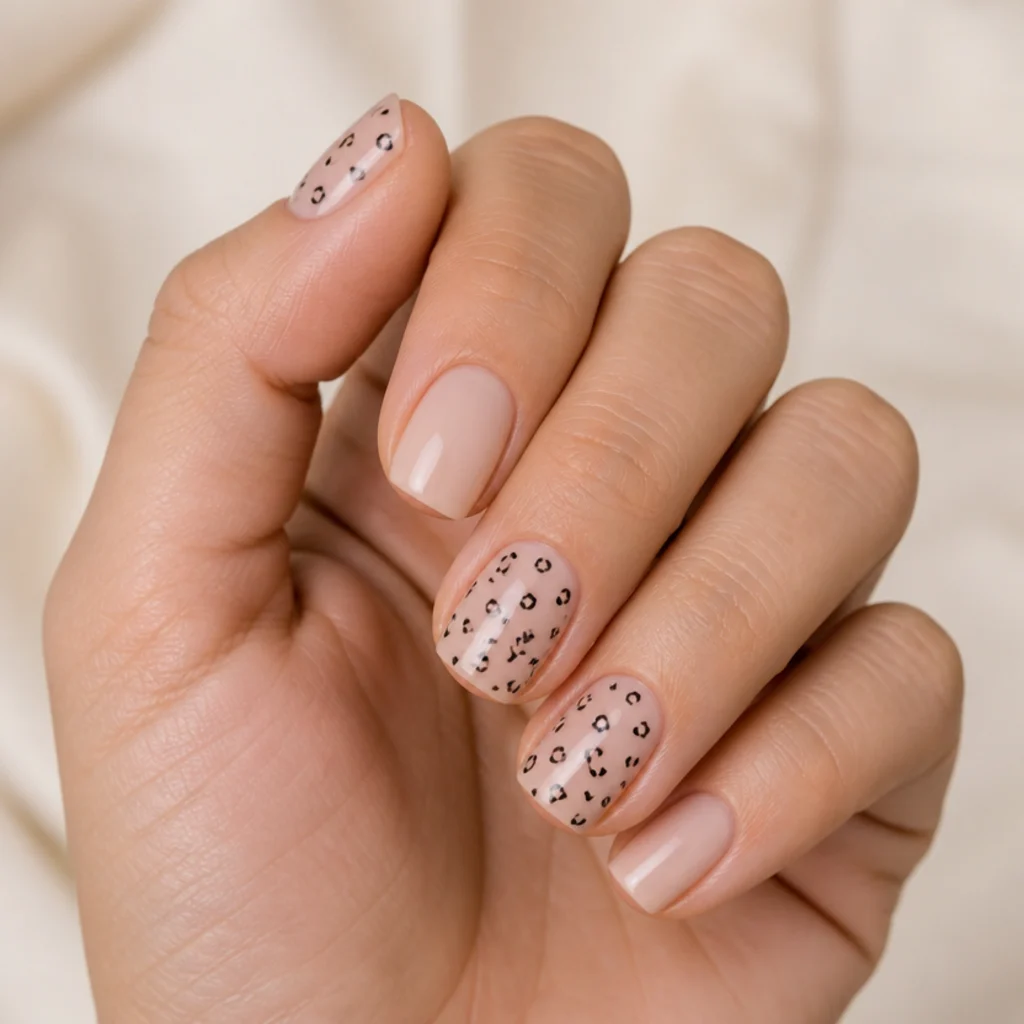
Scaling the print way down gives you a subtle, refined take that barely announces itself. On short squoval acrylics, tiny black spots scattered over a nude base read almost like a fine texture rather than a bold animal print, which makes this the most office-friendly set in the guide. The short length and neutral base keep it practical and low-maintenance, with regrowth that blends in at the cuticle. The fine detail is the catch: micro-scale rosettes demand a steady hand and a very thin brush or a small dotting tool, so this is firmly a leave-it-to-your-tech design, not a DIY one. Because the spots are so small, keep them to a few nails. The smallest rosettes crowd instantly if they cover the whole hand. Pro tip: ask for the micro spots to still follow the broken-ring shape in miniature rather than solid dots, which reads as leopard up close instead of a sprinkle. Ask your nail tech for short squoval acrylics, a nude base, and micro-scale black leopard spots on a few nails.
14Black Leopard with Rhinestone Accents
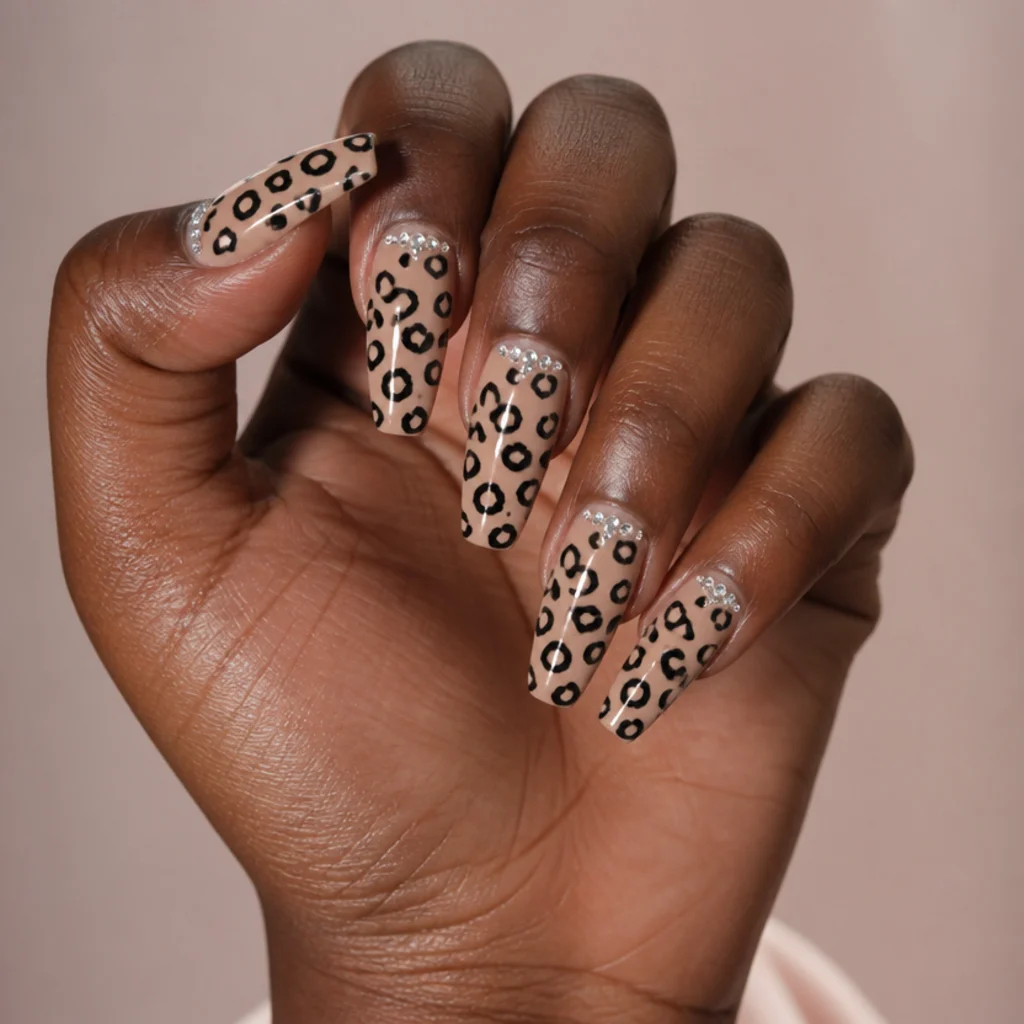
Add sparkle by tucking a few clear or crystal rhinestones among the spots. On beige coffin acrylics, black leopard gets a little glamour where the stones catch light, which suits an event, a party, or anyone who loves embellishment. Placement is everything: cluster the stones near the cuticle or run a small line along one accent nail rather than scattering them across every finger, so the design stays intentional instead of busy. Mix stone sizes within a cluster, one slightly larger anchor stone with smaller ones around it, for a more custom, less uniform look. The honest trade-off is durability. Stones are snag points that can pop off on hair, sweaters, and bags, so this set needs gentle handling and the occasional re-glue. Pro tip: ask your tech to set the stones in a bead of gel and cure them fully, and to seal the base edges, which holds them far longer than a dot of glue alone. Ask your nail tech for beige coffin acrylics, black leopard spots, and a small cluster of graduated clear rhinestones near the cuticle, placed where they won't catch.
15Ombre Nude to Black Leopard
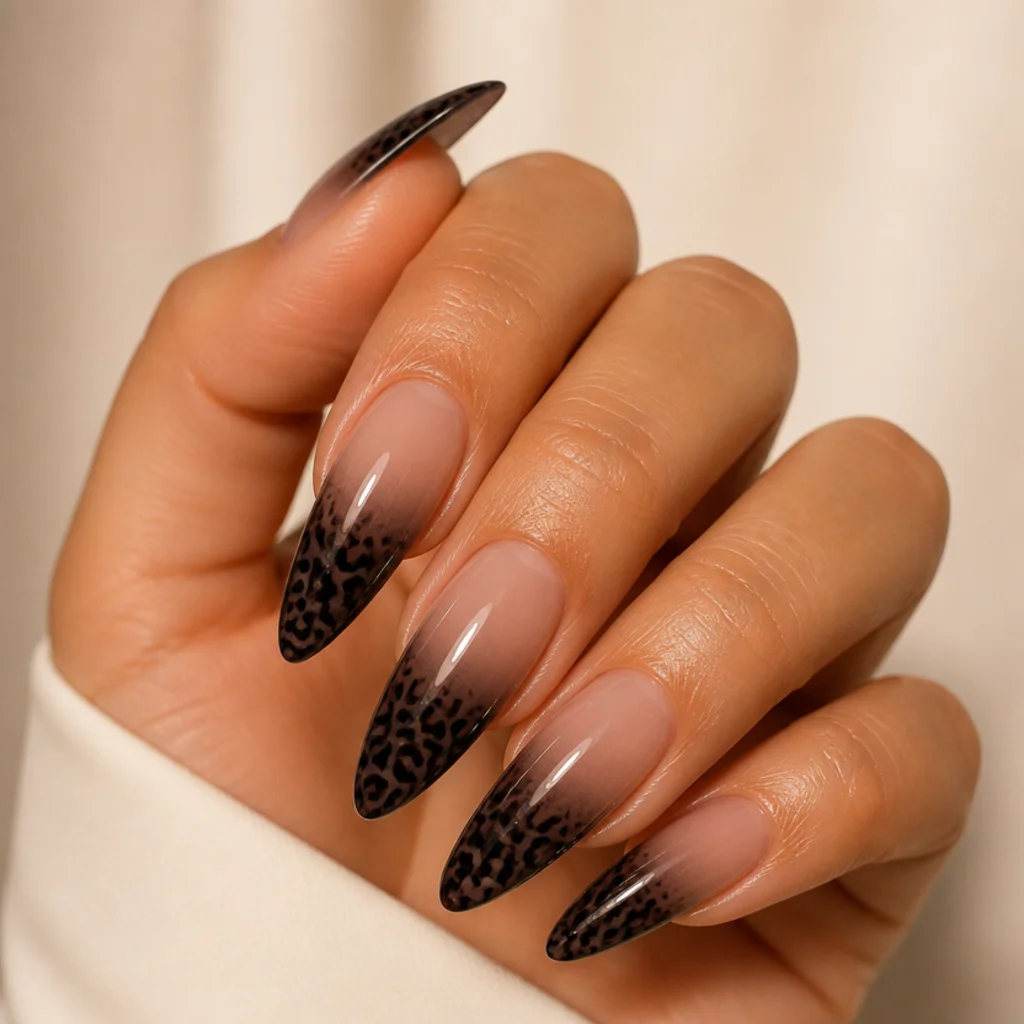
Blend two ideas by fading the base from nude at the cuticle to deep black at the tip, then letting the rosettes gather where the color deepens. On long almond acrylics, the ombre gives the set dimension, and the print at the tips reads like a natural extension of the gradient rather than a separate layer. It suits anyone who wants something more custom than a flat base and doesn't mind a longer appointment, since a smooth fade takes patience to blend without banding. The gradient also hides regrowth well, because the lightest color sits at the cuticle where new growth appears, though the darker tips may show wear first. Keep the spots concentrated in the transition and tip zone so they don't fight the clean nude base. Pro tip: ask for the spots to shift from black on the nude section to gray or tonal on the black section, so the rosettes stay visible across the whole fade instead of vanishing into the dark tip. Ask your nail tech for nude-to-black ombre acrylics with leopard spots concentrated at the tips, blended soft so the fade and print read as one design.
Pro Tips from the Editor
- Insist on the broken ring. A real rosette is an open C-shape or two or three separate crescents, never a closed circle. This one structural detail is what separates editorial leopard from costume polka dots, so say the words "broken-ring rosettes" when you book.
- Match spot scale to nail length, not the reference photo. A rosette sized for a long stiletto will crowd a short squoval. Ask your tech to scale spots down and reduce spot count as length drops.
- Choose your base for your grow-out tolerance. Sheer nude and gradient bases hide regrowth at the cuticle, while opaque white, chrome, and glossy black show a lifting line within a week or two and demand punctual fills.
- Seal everything under gel. Foil, chrome, rhinestones, and freehand paint all last dramatically longer sealed under a cured gel top coat than sitting exposed; unsealed embellishment dulls or lifts fast.
- Concentrate print where the eye lands. Ring and accent fingers carry a look; loading print onto thumbs and index fingers reads as clutter and shows wear from daily hand use first.
- Book the fill before you need it. Two to three weeks is the window; stretching past it invites lifting, which lets water and bacteria under the enhancement and shortens the whole set's life.
- Protect the investment with oil, not neglect. Daily cuticle oil keeps the sidewalls flexible and slows lifting, which does more for longevity than any single product at the salon.
How to Choose / Get the Look
Work through five decisions in order and the whole set falls into place. First, base color, because it sets the mood and your upkeep: nude and milky white keep black leopard print nails versatile and flattering on every undertone, while rust, chrome, and glossy black push toward statement territory and show regrowth faster. Second, length and lifestyle — be honest here. If you work with your hands, a short squoval or round set serves you far better and lifts less than a long stiletto or coffin, which photograph beautifully but are the most fragile and demanding shapes. Third, dose of print: a full set for maximum impact, a French tip or single accent for something wearable, or negative space for a light, modern read. Fourth, finish: gloss looks bold and reflective, matte looks quiet and expensive but wears faster and shows fingerprints. Fifth, spot scale, which must follow your length rather than the photo you saved.
| If you want... | Best base | Best shape | Upkeep | Print dose |
|---|---|---|---|---|
| Everyday, office-safe | Nude / soft taupe | Short squoval or round | Low | Micro spots, few nails |
| Wearable but noticed | Nude / milky white | Almond | Low to moderate | French tip or single accent |
| High-glam / events | Nude, chrome, glossy black | Stiletto or coffin | High | Full dense print |
| Seasonal / autumn | Rust or cinnamon | Squoval or almond | Moderate | Full print, one accent |
| Minimal / modern | Clear negative space | Almond or oval | Low | Scattered floating spots |
When you book, bring one clear reference photo and name the base color, spot color, print scale, nail shape, and finish, plus how many nails carry print. Acrylic extensions should always be applied and removed by a licensed nail tech to protect your natural nails, and never peel or pry a lifting set. A fill every two to three weeks keeps the enhancement healthy and the print looking fresh.
Frequently Asked Questions
Are leopard print acrylics hard to do at home?
The extension and apex work is the hard part and belongs to a licensed tech, both for durability and to protect your natural nail. If you already have a cured base, painting simple broken-ring spots yourself is approachable with a thin liner brush or a small dotting tool. Start with the tan or gray center, then add two or three separate black crescents around it rather than a closed ring, and seal with a top coat.
How long do leopard print acrylic nails last?
Plan a fill every two to three weeks as your natural nail grows out, and a full set can carry six to eight weeks with disciplined fills before it wants a rebalance or soak-off. Hand-painted spots at the high-wear tips may need a touch-up before the base does, especially under a matte finish, which physically wears faster than gel gloss.
What base color works best for black leopard print nails?
Nude and milky white are the most versatile and flatter every undertone; nude also hides regrowth best. For bolder sets, rust reads seasonal, chrome reads futuristic, and glossy black reads editorial. High-contrast bases make black spots crisp, but opaque and metallic bases show cuticle grow-out sooner, so they ask for punctual two-week fills.
Can I get leopard print on short acrylic nails?
Yes, and short is one of the most wearable ways to do it. The key is scaling the spots down and limiting them to two or three per nail so the pattern stays legible on a smaller surface. Squoval and round shapes suit short length, keep the free edge strong, and lift less than long shapes because there's less surface to catch.
How do I ask my nail tech for leopard print acrylics?
Bring one reference photo and name five things in order: base color, spot color, print scale, nail shape, and finish. For example, "milky white coffin acrylics with solid black broken-ring leopard spots and a glossy top coat, print on all ten." Adding "broken-ring rosettes" tells your tech you want real leopard structure, not solid dots.
What is the difference between leopard spots and real leopard rosettes?
A rosette isn't a solid dot. It's a broken ring: a tan, gray, or tonal center bordered by two or three separate black crescents that never fully close. Solid dots read as polka dots and instantly look like costume print, so asking specifically for broken-ring rosettes is the single most useful thing you can say to get an authentic, editorial result.
Which nail shape suits leopard print best?
Almond and oval are the most flattering all-rounders because the taper gives each rosette a clean sight line and elongates the hand. Coffin and square offer the flattest, widest field for confident placement and detail like foil or chrome. Stiletto is the most dramatic but the most fragile and stretches the spots, so the spacing must be elongated to match.
Do chrome, foil, and rhinestone leopard sets need extra upkeep?
Yes. Embellished sets have more to catch and dull, so they favor shorter, punctual fill cycles closer to two weeks. Chrome shows regrowth fast against its metallic field, foil edges lift if not sealed under gel, and rhinestones are snag points that occasionally pop and need re-gluing. Sealing everything under a cured gel top coat and handling your hands gently is what keeps these looking fresh.
Are acrylics or gel extensions better for leopard print?
Both work; the print technique is the same freehand painting on either. Acrylic offers strong, sculptable length and a firm apex that suits long stiletto and coffin drama, while soft gel or builder gel feels lighter and can be gentler on thin natural nails. Discuss your natural nail health with your tech and let them recommend the system, since durability depends more on correct application than on the material name.