15 Easy Hair Tinsel Looks for Blonde Hair
Fairy hair, sparkle strands, glitter tinsel: whatever you call it, this shimmer trend was engineered for blondes. Here are 15 easy hair tinsel looks that read as light, not glitter, plus the exact shades, strand counts, and salon scripts for each one.
 Edited by Lena Rose · Published July 11, 2026 · 28 min read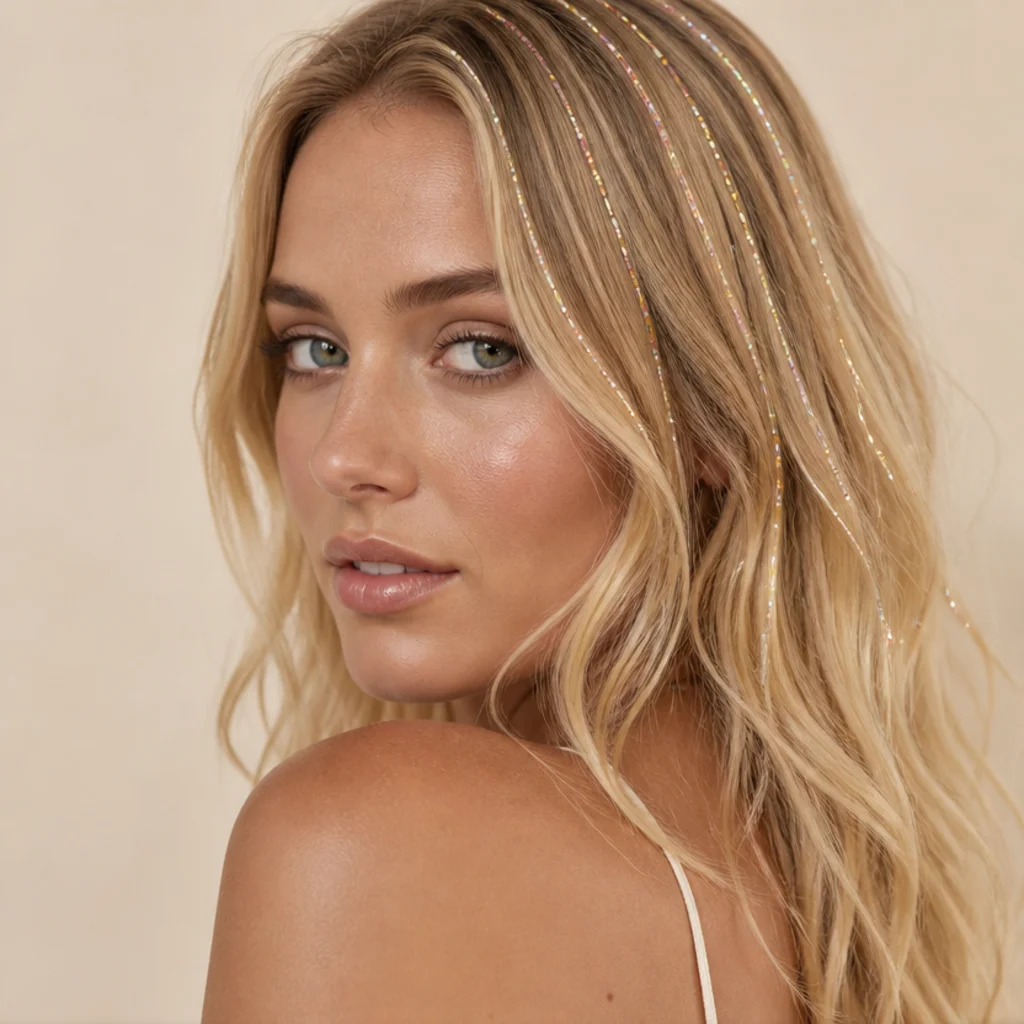
Quick Answer
- Best for: Blonde, bleached, and light-balayage hair where fine metallic or iridescent strands read as glimmer rather than contrast; levels 8 to 10 show tinsel most convincingly.
- Who might skip it: Anyone with very fine or actively shedding hair (each tie-in anchors to 15 to 20 hairs), or anyone who brushes aggressively at the root, since that is where knots loosen first.
- Maintenance: Tie-in strands last 4 to 6 weeks and wash normally; clip-in and micro-bead tinsel refresh in minutes. Expect to lose a strand or two per week and re-tie a small top-up around week three.
- Difficulty: Beginner-friendly. Most looks need only a rat-tail comb, a loop tool or crochet hook, and a mirror; braided placements are the one step up.
- Cost: Roughly $20 to $60 for a home kit of 100-plus strands; salon tie-in service commonly runs about $2 to $5 per strand or a $40 to $120 flat add-on, varying by region and strand count.
- Wear time / longevity: A single tie-in strand can hold 6-plus weeks if left undisturbed; festival and clip-in looks are same-day to one week.
- Standout variation: Iridescent "diamond" tinsel scattered through face-framing pieces refracts a soft rainbow from every angle and suits every blonde undertone.
- How to ask your stylist: "I'd like fine tie-in tinsel, not bonded or heat-fused, scattered asymmetrically through my top two layers, in a shade matched to my undertone."
In This Guide
- Gold Tinsel on Loose Waves
- Iridescent Diamond Sparkle Part
- Rose-Gold Tinsel Face Frame
- Festival Tinsel Braid
- Silver Ice Tinsel on Platinum
- Hidden Tinsel Under-Layer
- Tinsel Half-Up Bubble Ponytail
- Holographic Tinsel on Beach Waves
- Champagne Tinsel Money Piece
- Tinsel Dutch Braid Crown
- Multicolor Confetti Tinsel
- Tinsel Slicked-Back Bun
- Warm Honey Tinsel Blend
- Tinsel Space Buns for Festivals
- Subtle Everyday Gold Strands
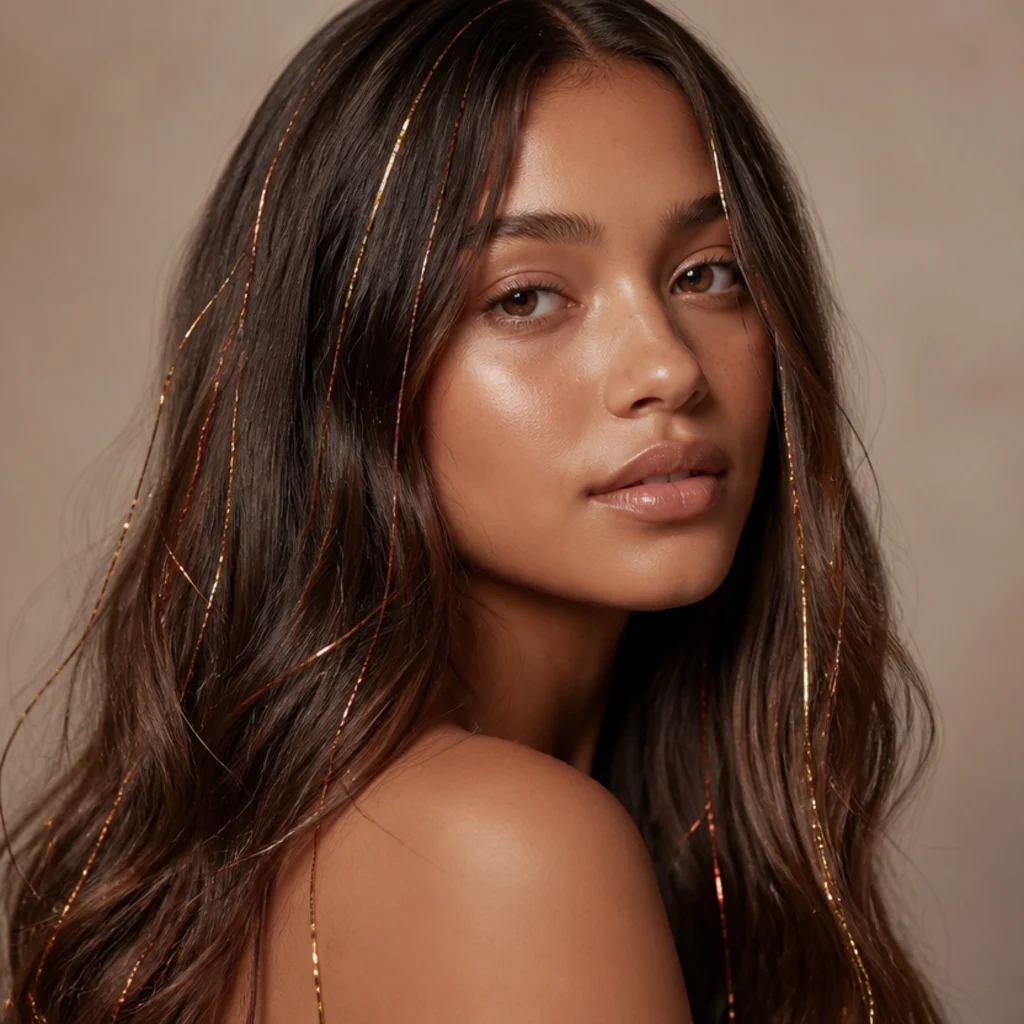
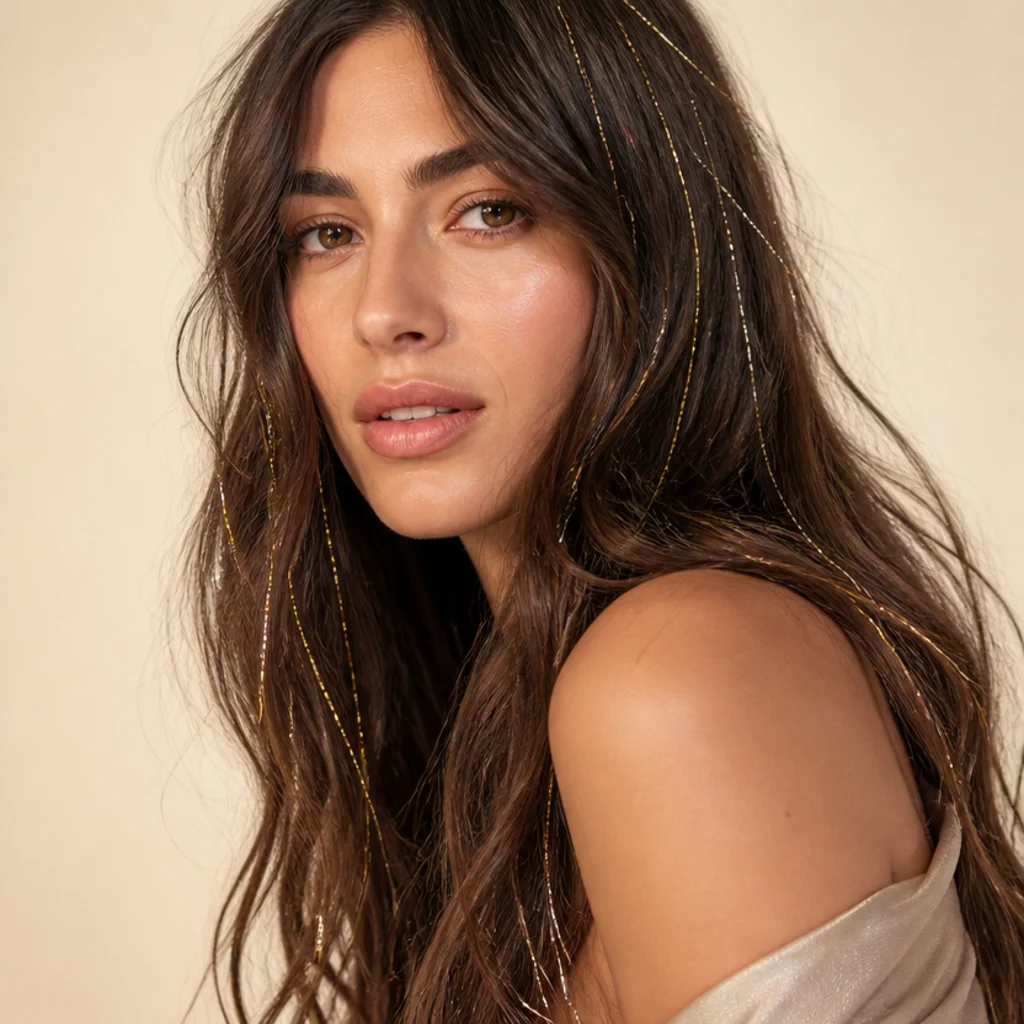
Hair tinsel is the lowest-commitment sparkle upgrade around, and blondes get the cleanest payoff. Fine metallic or iridescent strands nearly vanish into pale hair until light hits them, then flash gold, silver, or refracted rainbow. A blonde base already sits high on the level scale, so you get shimmer without the hard line of contrast that shows up on dark hair — that's what keeps it wearable instead of costume-y. The trick most people miss is undertone matching: warm honey blondes glow under gold and champagne, cool ashy and platinum tones stay crisp only in silver, ice, and clear iridescent, and rose-gold bridges the two. This guide covers 15 placements and techniques, from a single face-framing strand you can tie before work to festival braids packed with holographic strands. For each you'll get the exact shade family, how many strands to use, who it flatters by face shape and hair texture, a realistic upkeep timeline, styling pairings, and the words to hand your stylist. Whether you want a barely-there desk-job glimmer or full concert sparkle, there's a version here that works, and hair tinsel blonde looks translate almost directly to hair tinsel brunette placements once you swap the color.
01Gold Tinsel on Loose Waves {#1}
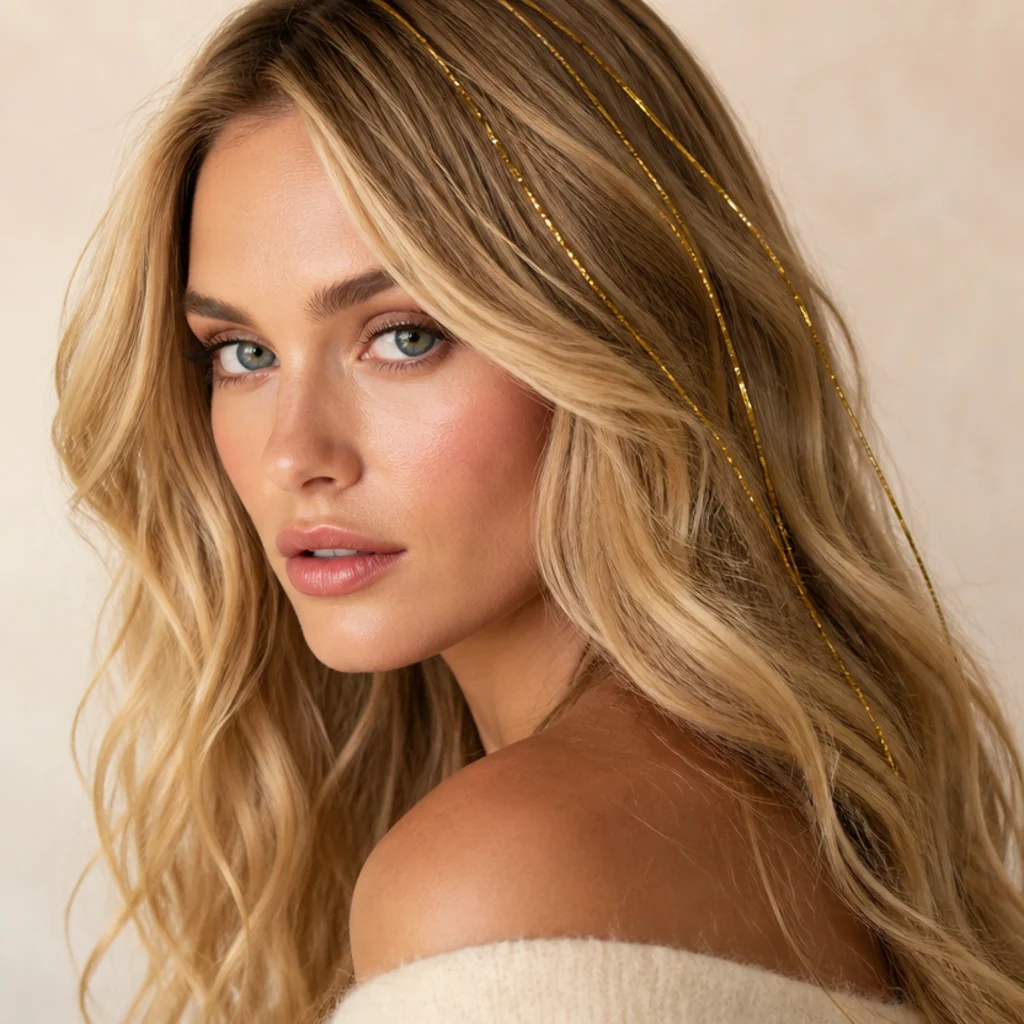
The most forgiving entry point: warm gold tinsel scattered lightly through loose, barrel-curled waves. Gold reads best on honey, golden, and level-8 buttery blondes because the strand echoes warmth already in the hair instead of fighting it; on very ashy tones it can look slightly brassy, so shift to champagne. Scatter eight to twelve tie-in strands across the crown and mid-lengths, weighting them toward the side you part on so they surface as the waves shift. Keep placement deliberately asymmetrical — evenly spaced strands read as tinsel, random ones read as light. Curl with a one-inch barrel away from the face so the waves open and expose the strands rather than burying them. Tie-ins last four to six weeks; expect to lose one or two by week three and top up. Round and heart face shapes get nice vertical movement here. Pro tip: mist a dry-texture spray before curling so waves grip and the strands stay lofted instead of sliding flat. Ask your stylist for "fine gold tie-in tinsel, lightly scattered through the top layers, nothing bonded."
02Iridescent Diamond Sparkle Part {#2}
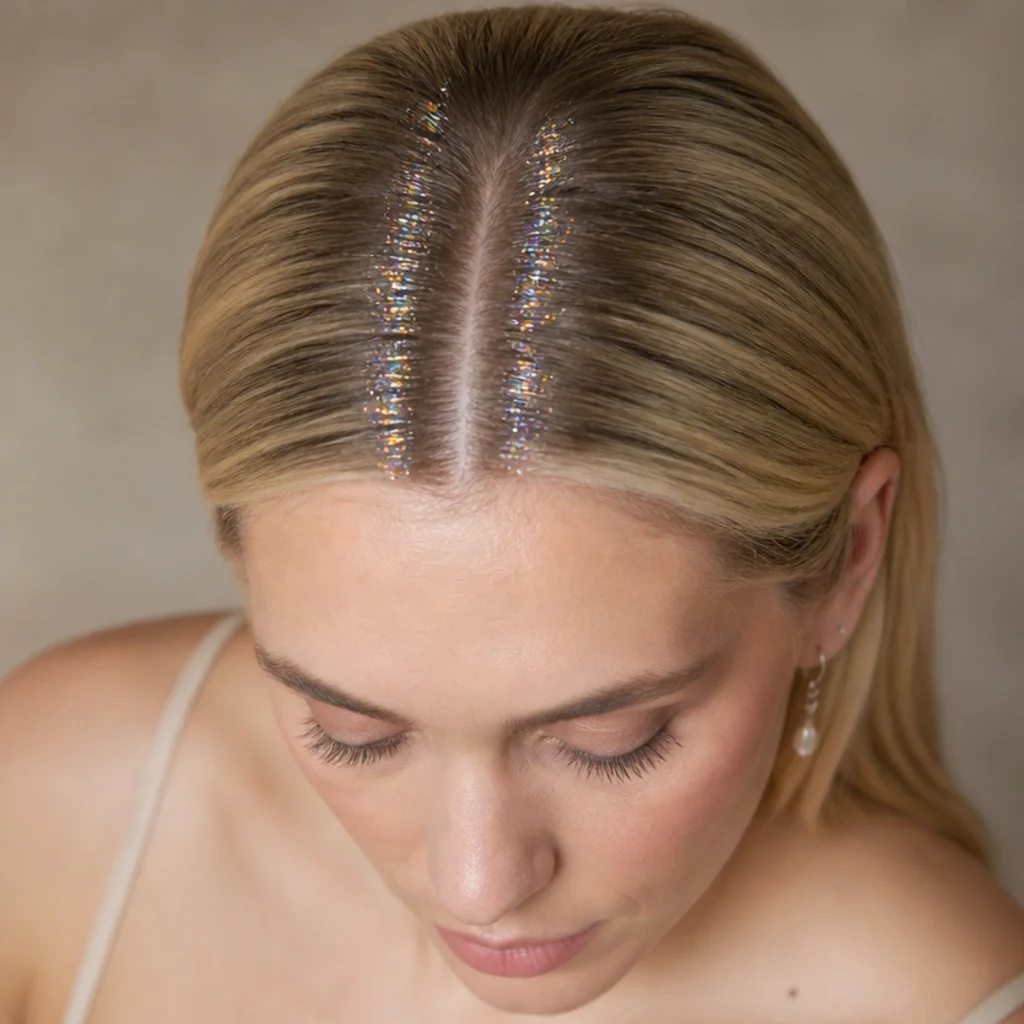
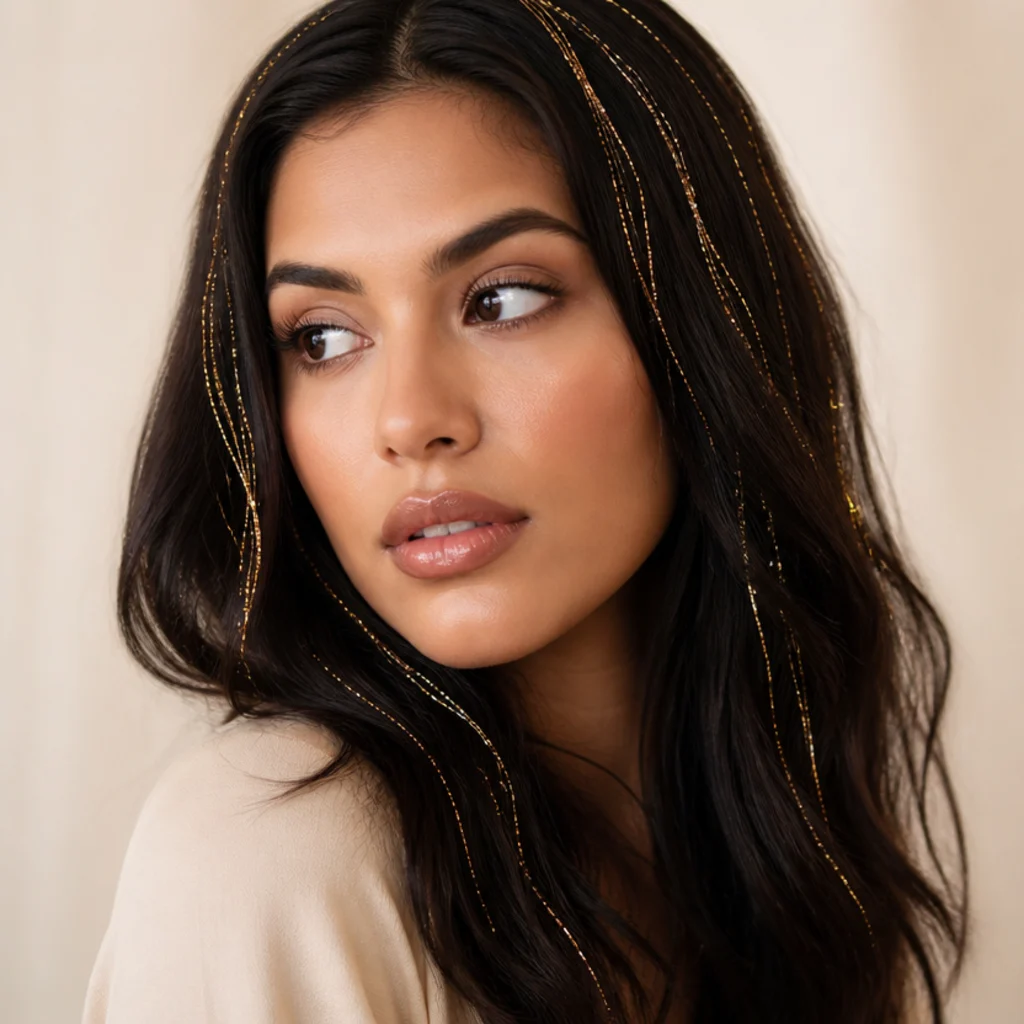
Line your center or side part with clear iridescent "diamond" tinsel that refracts a soft rainbow rather than a fixed metal tone. Because it sits right along the parting, it's the first thing anyone sees, framing the face like a low halo. The strands stay colorless until light passes through them, which is why this placement works across every blonde undertone — ashy, neutral, golden, platinum, no exceptions. Place six to ten strands within an inch of the part on each side, staggering them so they don't form a solid stripe. Precision matters more than volume here: section the part with a rat-tail comb and keep it razor-clean, since a wandering part exposes the knots. It photographs exceptionally under overhead and ring light, where the refraction actually travels as you move. Oval and long face shapes suit a dead-center part; widen to a slight side part to soften a longer forehead. Pro tip: set the finished part with a whisper of hairspray on a spoolie so flyaways don't compete with the shimmer. Ask your stylist for "clear iridescent tinsel worked tight along my part line."
03Rose-Gold Tinsel Face Frame {#3}
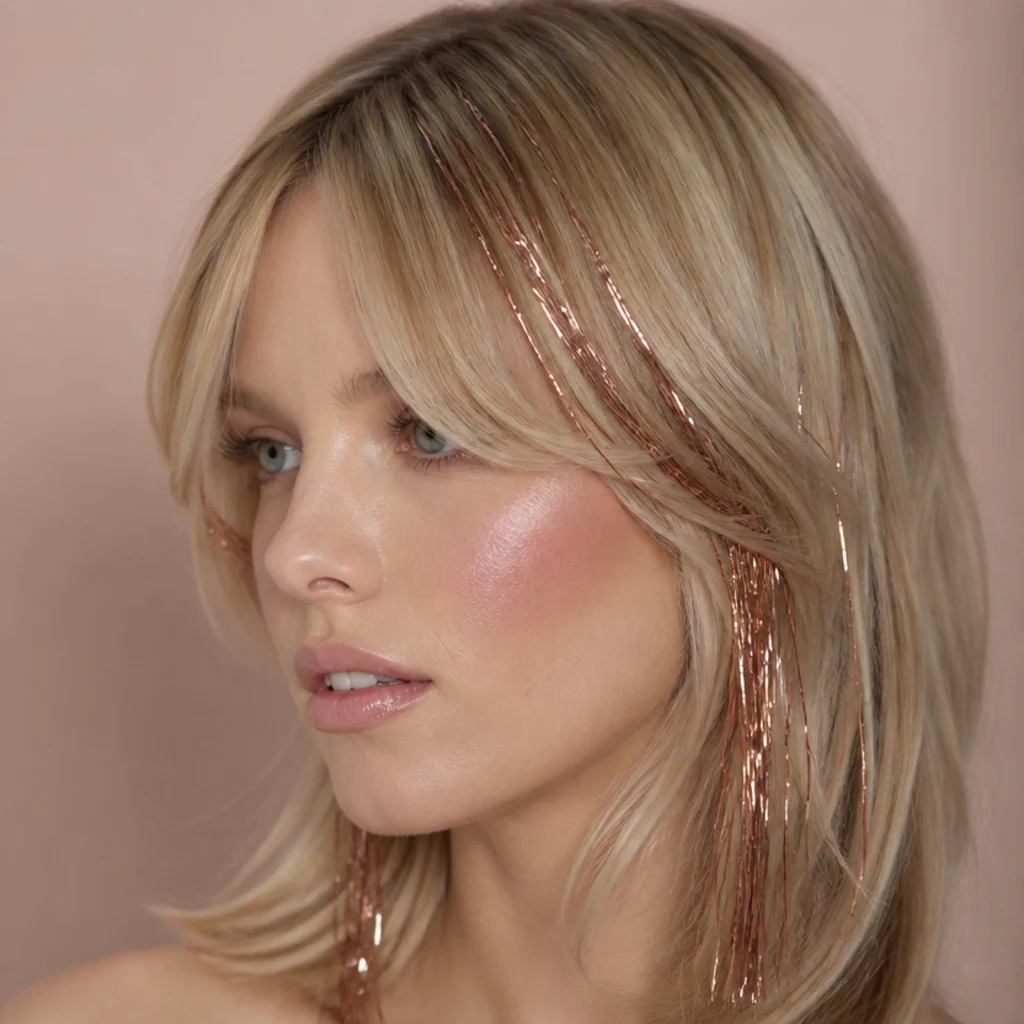
Concentrate rose-gold tinsel on your face-framing pieces or curtain fringe so the shimmer pulls light up toward the cheekbones and eyes. Rose-gold is the diplomatic middle ground for neutral and cool blondes who find yellow-gold too warm: the pink undertone brightens fair and medium skin and flatters cool complexions without going brassy. Use only four to six strands per side so the effect stays soft rather than stripey, and anchor them an inch or two back from the hairline so the knots hide behind the top layer. Because the sparkle sits near the front, it reads intentional even on an unstyled day — one of the easiest everyday picks on this list. Curl the frame away from the face with a wand so the strands ride on top of the curl instead of tucking underneath. It flatters round and square faces especially, where the vertical face-frame draws the eye longer. Upkeep is easy since front strands are the easiest to reach and re-tie. Pro tip: place one strand slightly higher near the temple to catch light when you tuck hair behind your ear. Ask your stylist for "rose-gold tie-in tinsel on my face frame only, kept subtle."
04Festival Tinsel Braid {#4}
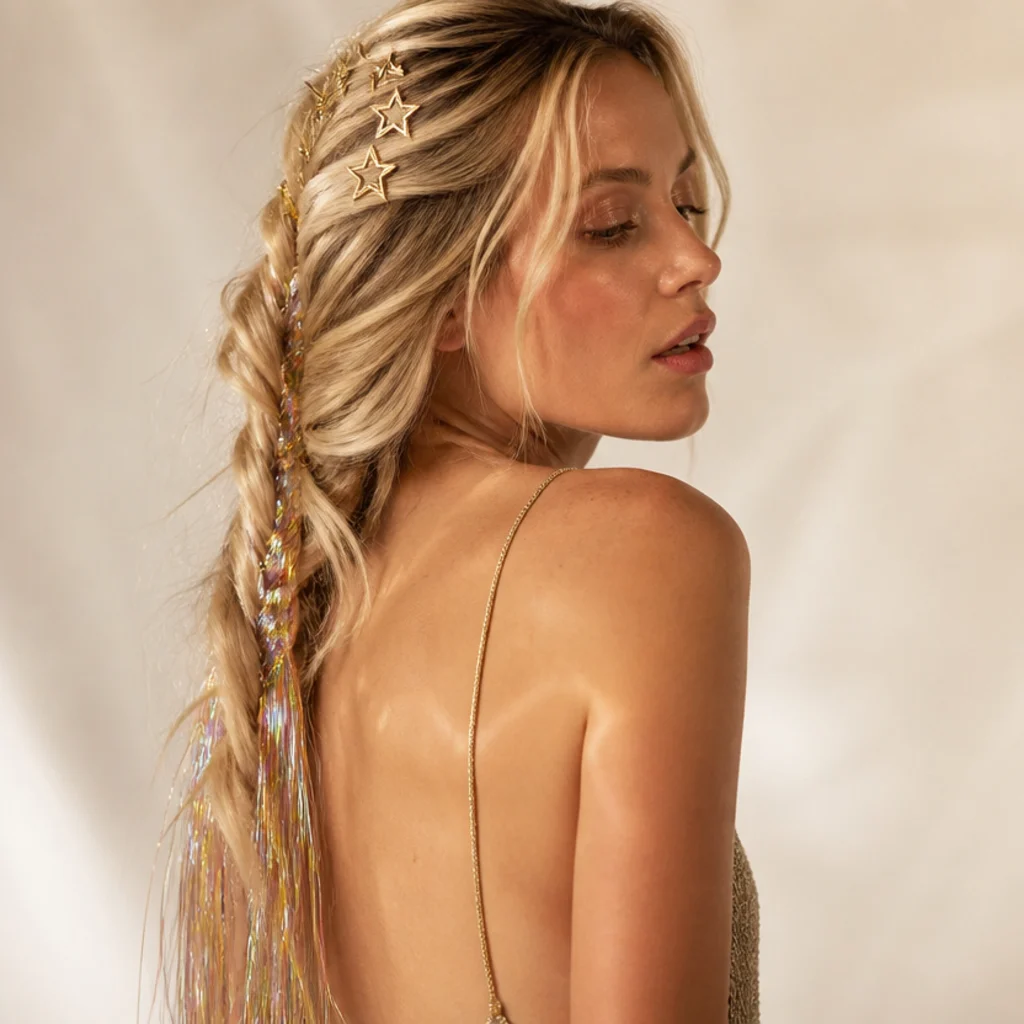
Braiding hides the knots and concentrates the payoff, so a loose side braid loaded with mixed gold and holographic strands is peak festival energy. Tie fifteen to twenty strands across the section before you braid, distributing them so each pass of the plait picks up a few, then braid loosely and gently pancake the edges to fan the tinsel outward. Because a braid physically traps the strands, this style outlasts loose hair through a long day of dancing and crowds. Every blonde depth wears it, though it looks richest on dimensional balayage, where the braid stacks light and shadow behind the sparkle. Thick and medium hair braids most cleanly here; very fine hair should braid slightly tighter and add clip-in tinsel for density. Leave face-framing pieces out and curl them for softness. Pro tip: braid on second-day hair with a little texture spray so the plait grips and the pancaking holds its shape all night. To make it last the weekend, sleep in the braid on a silk pillowcase, then re-fan in the morning. Ask your stylist for "a loose festival braid with mixed gold and holographic tinsel woven in before braiding."
Save this to Pinterest for your next festival hair plan.
05Silver Ice Tinsel on Platinum {#5}
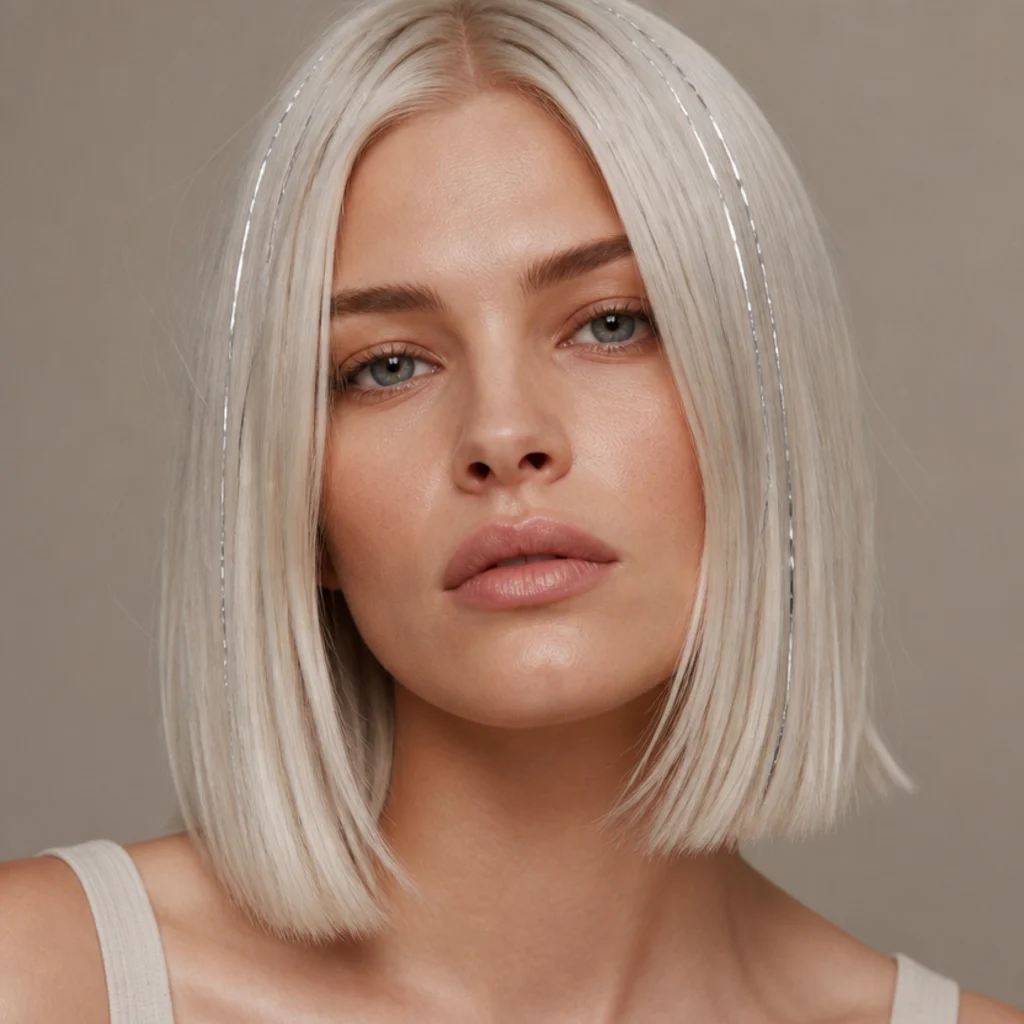
Cool platinum and icy-blonde hair calls for silver or "ice" tinsel, which reads like frost where gold would read like warmth. Keep the hair sleek and glassy, whether a blunt lob or a long one-length, so the strands lie flat and mirror the light in a clean line. Scatter ten to fourteen strands through the top and second layers, keeping them poker-straight with the surrounding hair so nothing kinks the reflection. Wear it in July as easily as December — silver tinsel skips the holiday-only feel that gold and glitter usually carry. If your platinum carries any residual yellow, cool silver strands can visually neutralize it by contrast, making the whole base look one shade icier. Blunt, one-length cuts and glassy blowouts show it best; heavy layering scatters the reflection. Pro tip: run a drop of shine serum over the mid-lengths after styling so the hair and the tinsel share the same wet-glass finish. Upkeep is minimal on straight hair since there's no curl to loosen the knots. Ask your colorist for "silver or 'ice' tie-in tinsel matched to my platinum tone."
07Tinsel Half-Up Bubble Ponytail {#7}
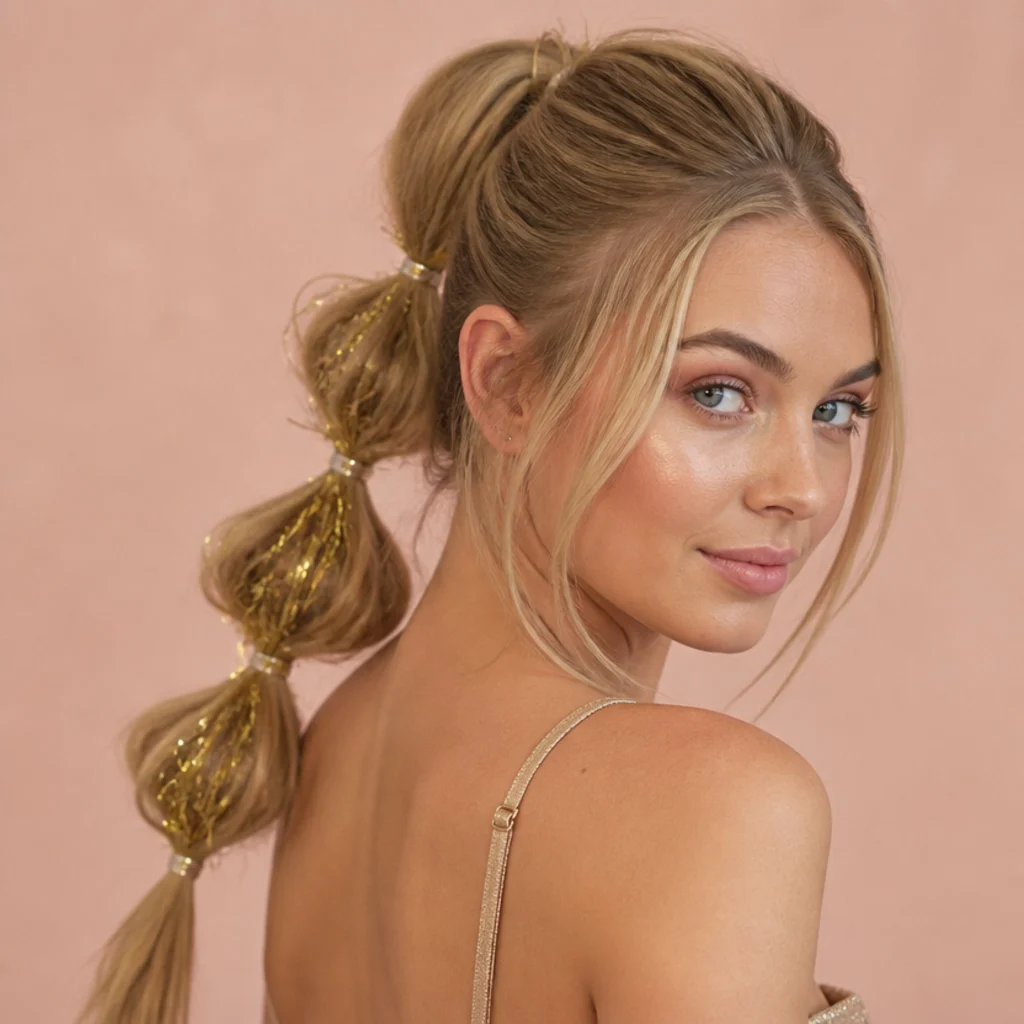
A half-up bubble ponytail already draws the eye, and threading tinsel through each bubble multiplies the sparkle at every segment. Gather the top half, space clear elastics down the tail, then gently expand each section into a puff and let tinsel strands fan out inside it. Clip-in tinsel is the practical choice here because you can position it exactly where each bubble sits and remove it after; tie-ins work too if you already have them placed at the crown. It's fast and playful — right for brunch, a birthday, or a bridal shower — and takes under ten minutes once the elastics are in. Medium to long blonde hair with enough length for three or more bubbles works best; shorter hair gets one or two. Loosen each segment outward with your fingers so the strands spread and the bubble reads full rather than tight. Pro tip: tug the bubbles wider at the front of the tail than the back so the sparkle stays visible from the side profile. Ask a stylist to "set a half-up bubble pony and tuck clip-in tinsel into each bubble."
08Holographic Tinsel on Beach Waves {#8}
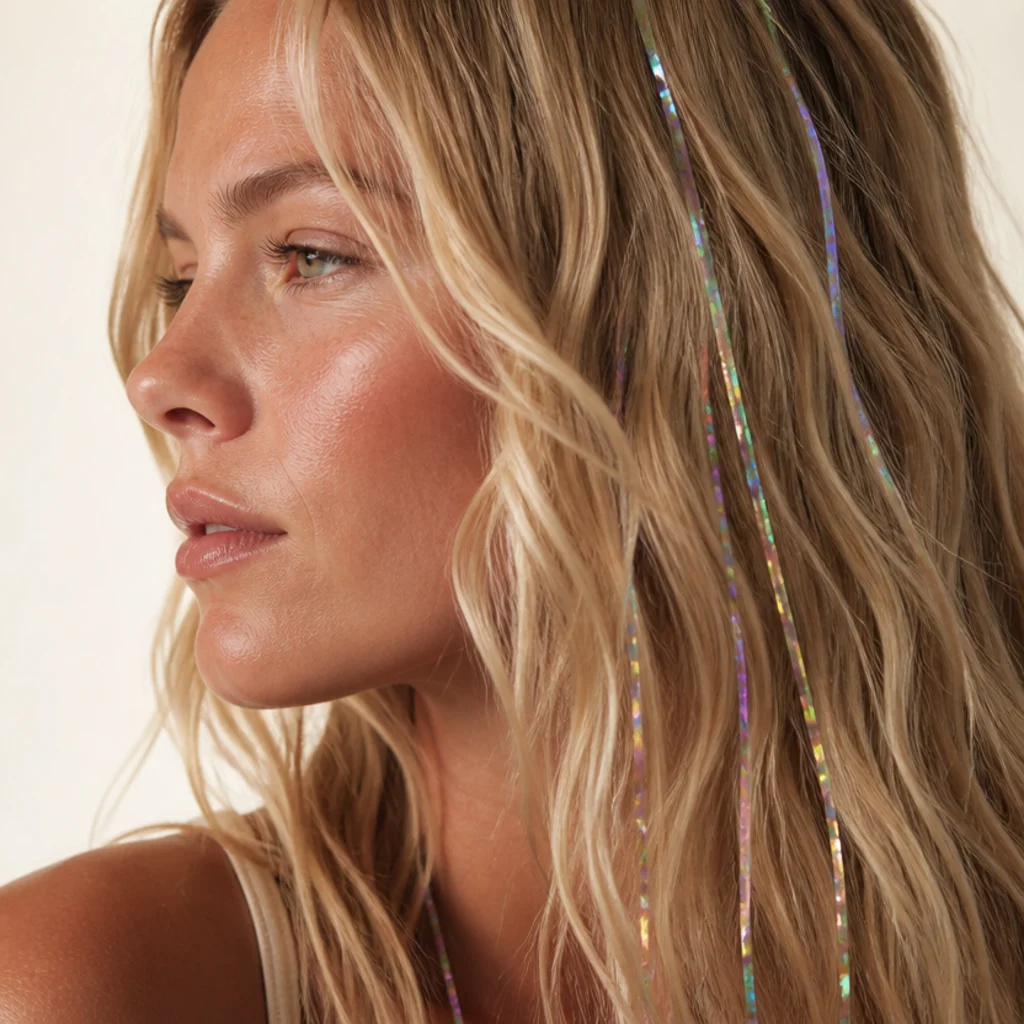
Undone, tousled beach waves give holographic tinsel the movement it needs to flash rainbow as the texture shifts. Scatter twelve to sixteen strands broadly across the crown and lengths rather than clustering them, so the shimmer reads sun-caught instead of placed. Holographic strands throw far more color than flat gold or silver, so restraint matters: a dozen strands on pale blonde does more than two dozen. It's the vacation-forward, daylight pick of the bunch, and it photographs beautifully in natural sun, where the refraction reads as tiny prisms. Every blonde tone and wave pattern works, from natural bend to wanded S-waves — the looser and more lived-in the texture, the more naturally the strands blend in. Fine hair benefits from a mousse base for grip. Pro tip: mist sea-salt spray, scrunch upward toward the scalp, and let the strands settle into the wave bends so they peek out of the crook of each bend. It reads casual enough for the beach yet sparkly enough to carry into a sunset dinner. Ask your stylist for "holographic tinsel scattered loosely for a beach-wave finish."
09Champagne Tinsel Money Piece {#9}
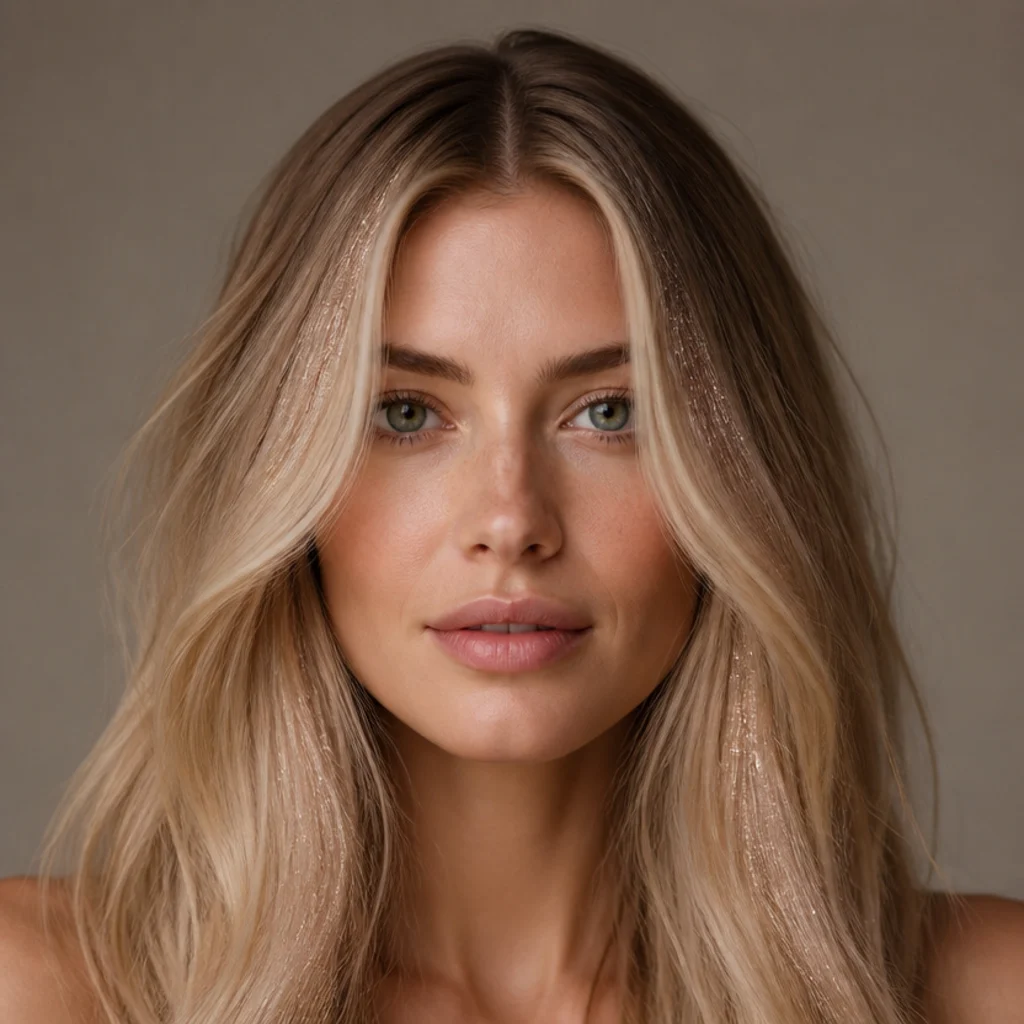
If you already wear a brightened money piece, work champagne-toned tinsel straight into those front sections to double the lit-from-within brightness you paid your colorist for. Champagne sits precisely between gold and silver, so it flatters warm and cool blondes alike and blends nearly invisibly until it sparkles, so it reads as an extension of the color you already paid for, not an add-on accessory. Keep it to the two front money-piece sections, six to eight strands total, for a clean editorial feel. It's the smoothest look on the list for anyone who wants tinsel that a casual observer reads as expensive highlighting. Style with a middle part so both sides show evenly and the shimmer stays balanced across the face. Every face shape wears it, and it works on straight or waved hair since the front sections catch light either way. Pro tip: have the tinsel placed at the same time as a gloss or toner appointment so the strand tone is matched to the freshly refreshed money piece. Ask your colorist for "champagne tie-in tinsel worked into my money piece."
Save this to Pinterest if you love a bright money piece.
10Tinsel Dutch Braid Crown {#10}
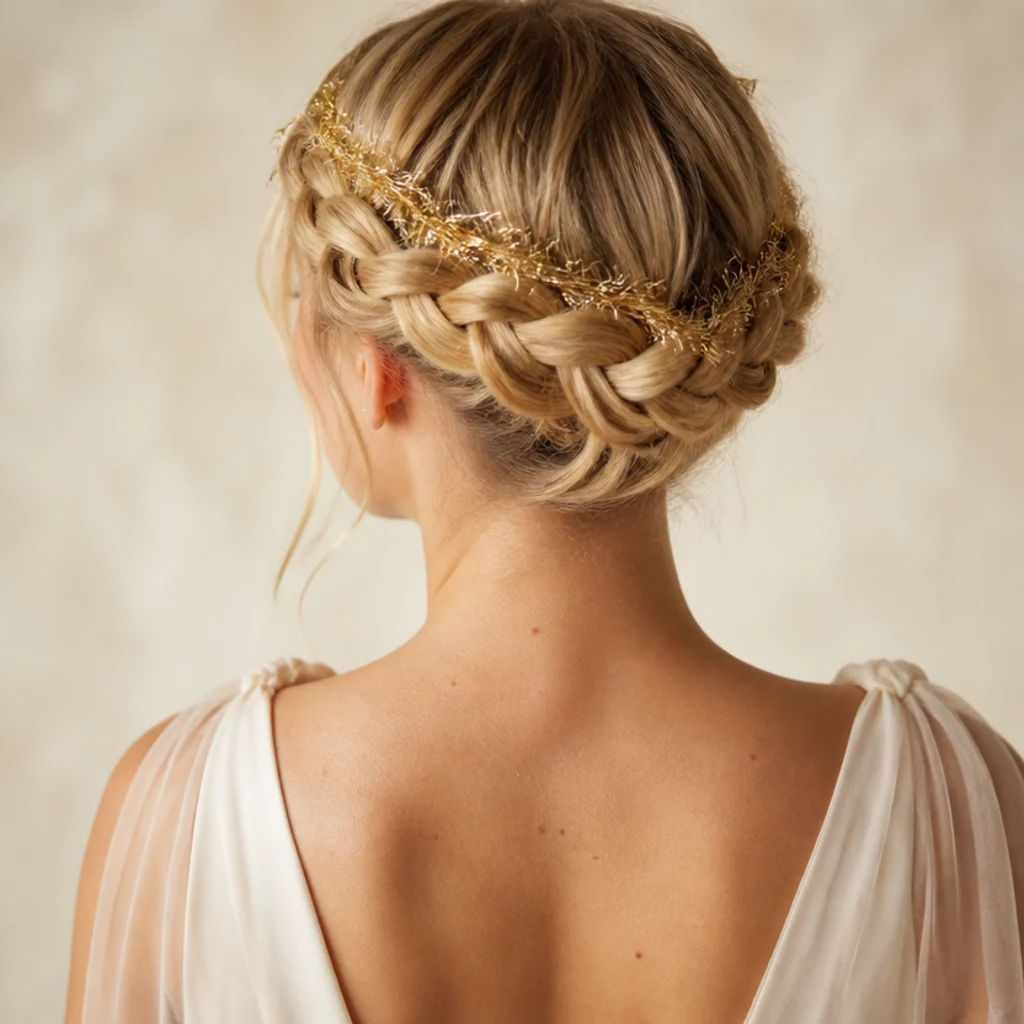
Two Dutch braids wrapped into a crown place the tinsel along the raised, outward-facing braid lines, where it catches overhead light like a fine tiara. Because Dutch braids sit on top of the hair rather than tucking under like French braids, the strands stay fully visible; tie ten to fourteen in before braiding so they ride the outermost strand of each plait. Gold is the classic romantic, bridal-adjacent pick here, while silver keeps cool and platinum blondes from tipping warm. The two-braid crown wrap makes this the most technical style here, though the tinsel placement itself is simple once the braids are set. It flatters weddings, showers, christenings, and garden parties, and works on medium to long hair with enough length to cross the crown. Thick hair holds the crown most securely; fine hair should backcomb lightly at the base first. Pro tip: pancake the outer edge of each braid slightly before pinning so the tinsel fans wider and reads from a distance. Ask your stylist for "a Dutch braid crown with gold tinsel along the braid lines" and set it with flexible-hold spray.
11Multicolor Confetti Tinsel {#11}
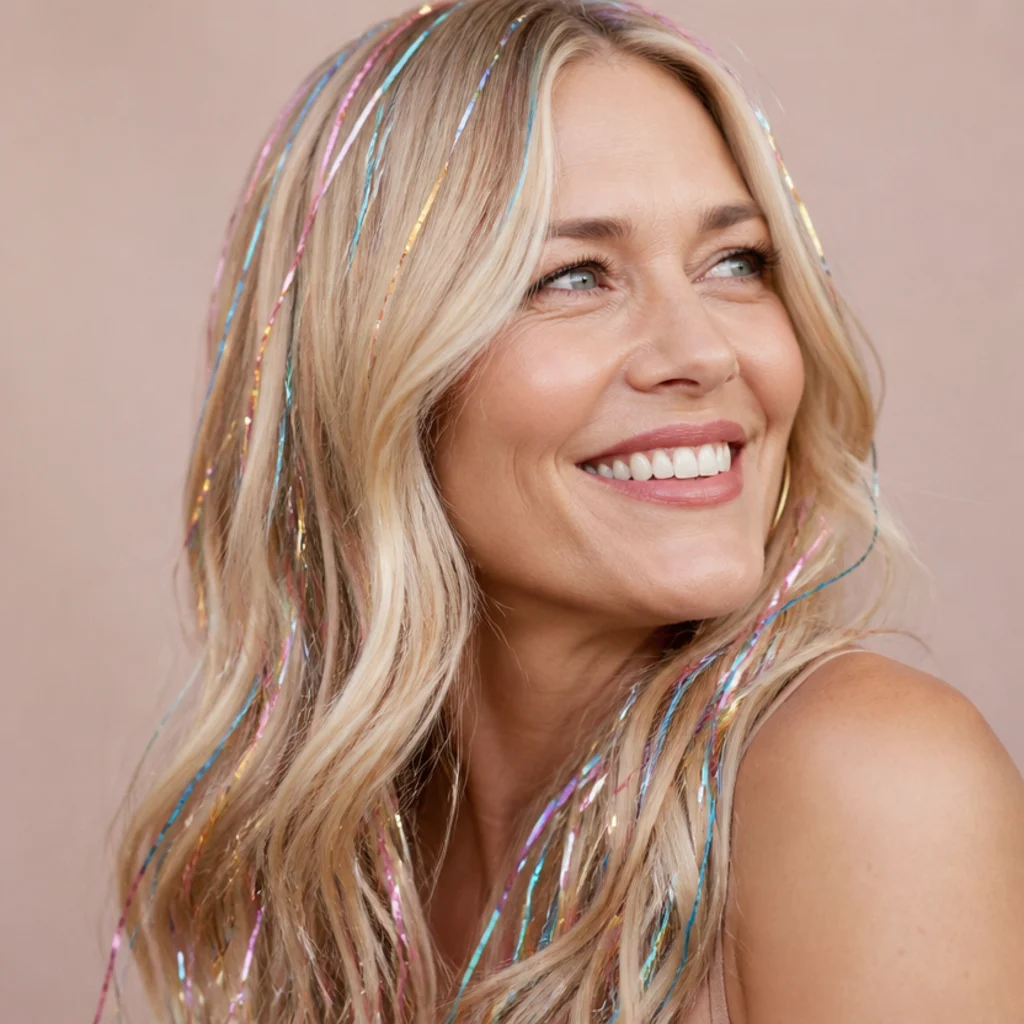
Go maximal with a confetti mix: pink, blue, lilac, and gold strands scattered together so the effect reads joyful and celebratory. Pale, level-9-to-10 blonde is the ideal canvas because each color stays vivid against the light base, where the same strands would mute on darker hair. Reach for it at birthdays, Pride, concerts, or any moment that calls for a deliberate pop of color. Scatter fifteen to twenty mixed strands across the crown and lengths, keeping the color ratio uneven so it looks tossed rather than arranged. Because the colors are bold and event-specific, reach for clip-in or micro-bead tinsel so you can remove the whole set easily afterward instead of living with it for six weeks. Keep makeup and jewelry pared back so nothing competes with the hair. Every face shape wears it, on any length past the chin. Pro tip: cluster two or three same-color strands loosely together in one or two spots so the eye reads intentional color moments, not random static. Ask a stylist for "removable confetti tinsel in a pink, blue, and gold mix for one event."
12Tinsel Slicked-Back Bun {#12}
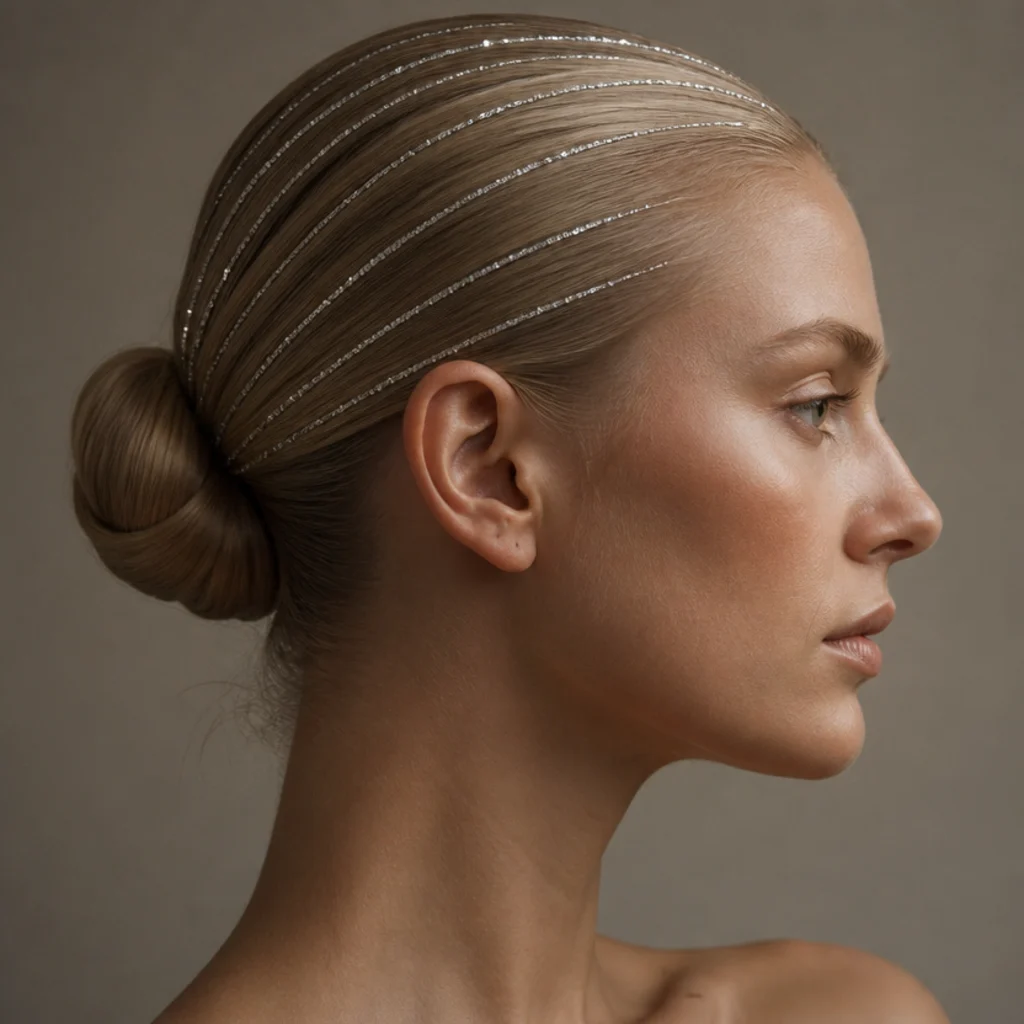
A sleek, slicked-back bun shows tinsel along the smooth surface of the hair, where every strand lies flat and mirror-bright against the polished sweep. Line the slicked sections from hairline to bun with silver or gold strands so they trace the exact direction of the style, following the comb marks rather than crossing them. It's the most grown-up, editorial look here, carrying offices, galas, weddings, and evening events with equal ease. Every blonde tone wears it — match the metal to your undertone, silver for cool, gold for warm, champagne if you can't decide. Because the hair is pulled taut and glassy, the strands stay put and the knots hide inside the bun. Any hair length that gathers into a bun works, and slicked styles are especially kind to fine or flat hair since the surface tension creates its own shine. Pro tip: apply gel in thin passes with a boar-bristle brush so the surface stays glassy and no strand lifts out of the sweep. Ask your stylist for "fine tinsel laid along my slick-back sections, following the direction of the style."
13Warm Honey Tinsel Blend {#13}
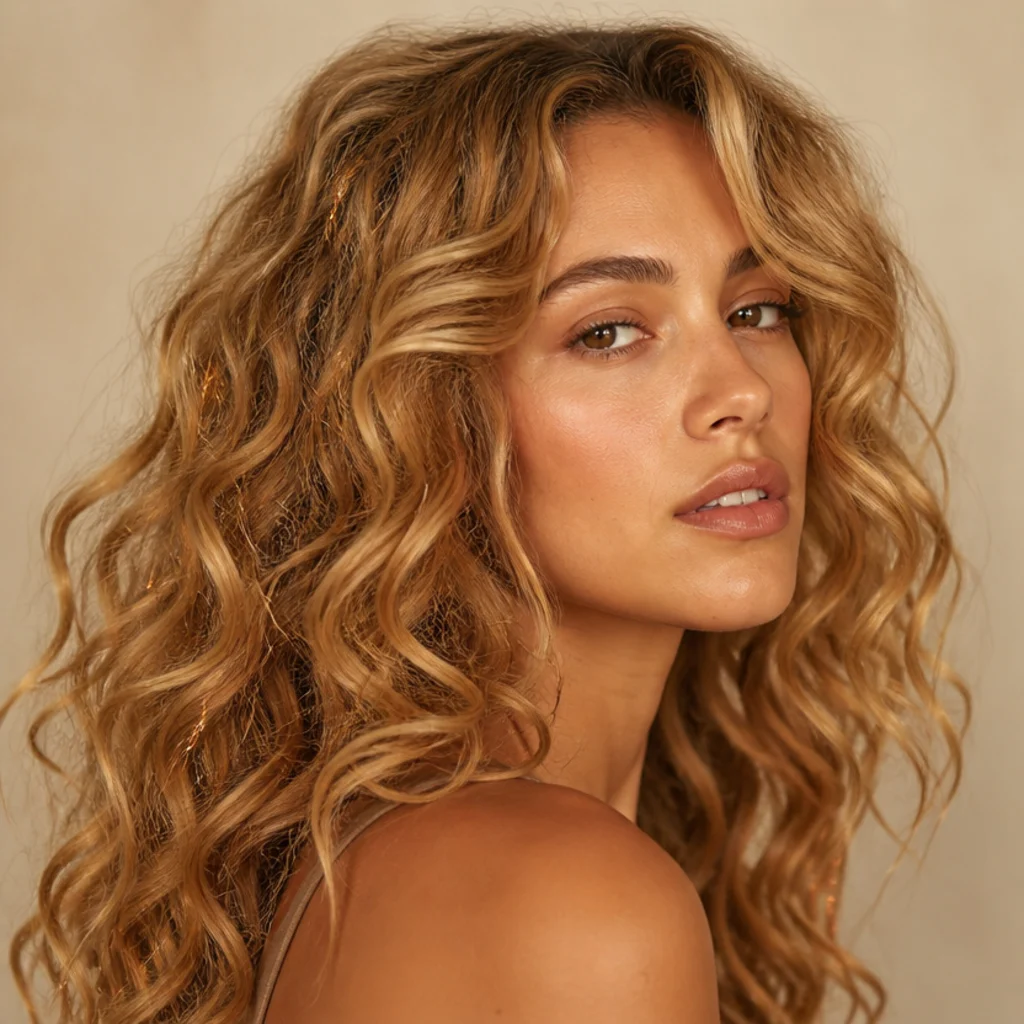
For golden and honey blondes, blend warm gold and amber-toned tinsel so it melts into the natural warmth instead of standing apart from it. It's the subtlest option here: the strands read as extra dimension and shine rather than obvious sparkle, closer to a well-placed highlight than a party accessory. Scatter ten to twelve strands through soft curls, keeping each one tonal with your base so the effect is depth, not glint. It's the ideal choice if you love the idea of tinsel but want people to think your hair just catches more light than usual. Warm-skinned complexions and autumn palettes suit it especially, and it eases trend-cautious wearers in gently. It works on natural curls, wand curls, and soft waves alike since the tonal match forgives movement. Pro tip: mix two amber shades a half-level apart rather than one flat gold so the blend has the same variation as real highlights. Upkeep is easy because a lost strand is barely noticeable against a matched base. Ask your stylist for "warm gold and amber tinsel blended tonally through my curls."
14Tinsel Space Buns for Festivals {#14}
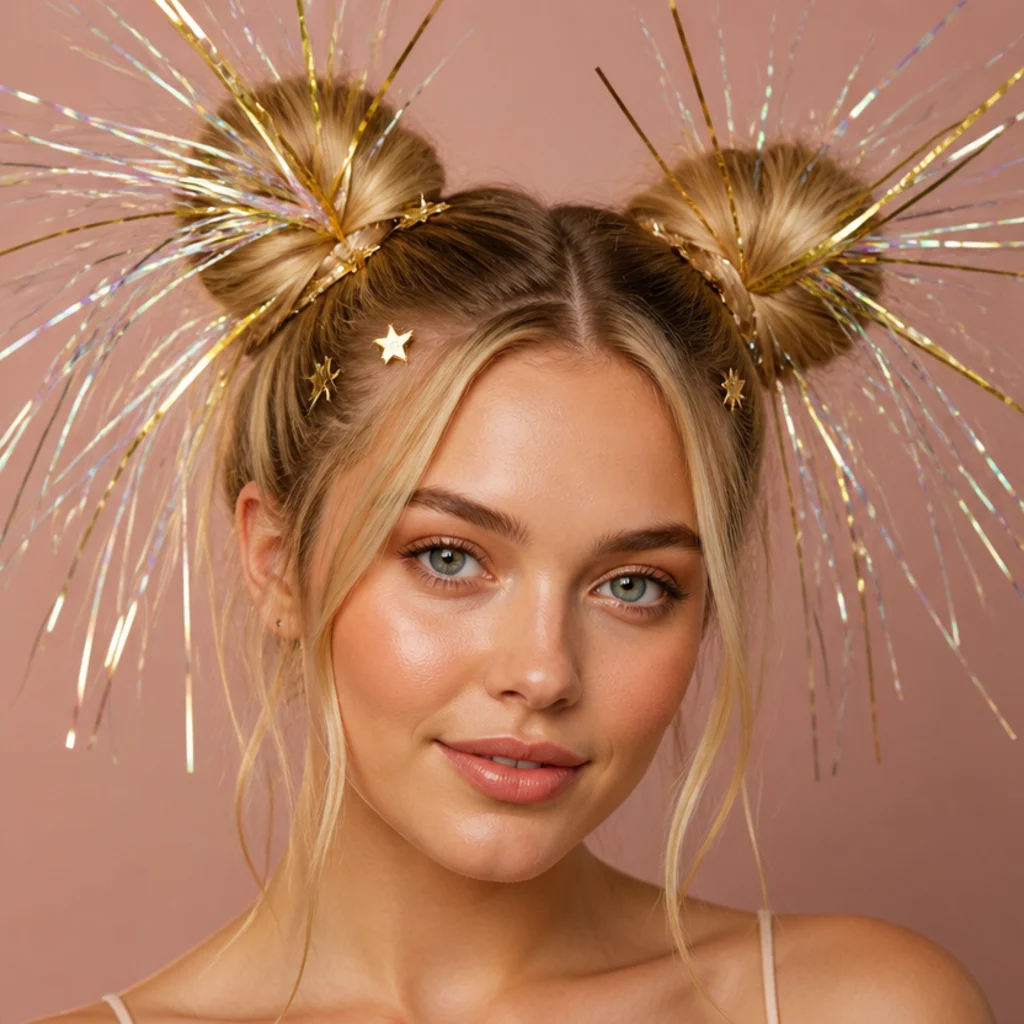
Double space buns with tinsel spilling from each are pure festival fun and a reliable favorite for concerts, raves, and themed events. Tie ten to sixteen strands into each section before you twist the buns so the tinsel fans out from the center like sparks radiating from the knot. Holographic and gold strands both work; mix them for extra dimension and let a few trail out of the base of each bun. It reads young and playful, and works best on shoulder-length to long blonde hair with enough length to wrap a full bun; shorter hair can do mini half-buns instead. Leave a few face-framing strands loose and slightly waved for movement so the style doesn't look too severe. Difficulty is low once the buns are secure. Pro tip: place the buns slightly higher and further apart than feels natural so they photograph clearly from the front in a crowd. Set everything with a firm-hold hairspray so the buns and strands survive a long, high-energy day, and add small star clips at the base for a finishing sparkle. Ask a stylist for "double space buns with holographic tinsel fanning out of each."
Save this to Pinterest for festival season.
15Subtle Everyday Gold Strands {#15}
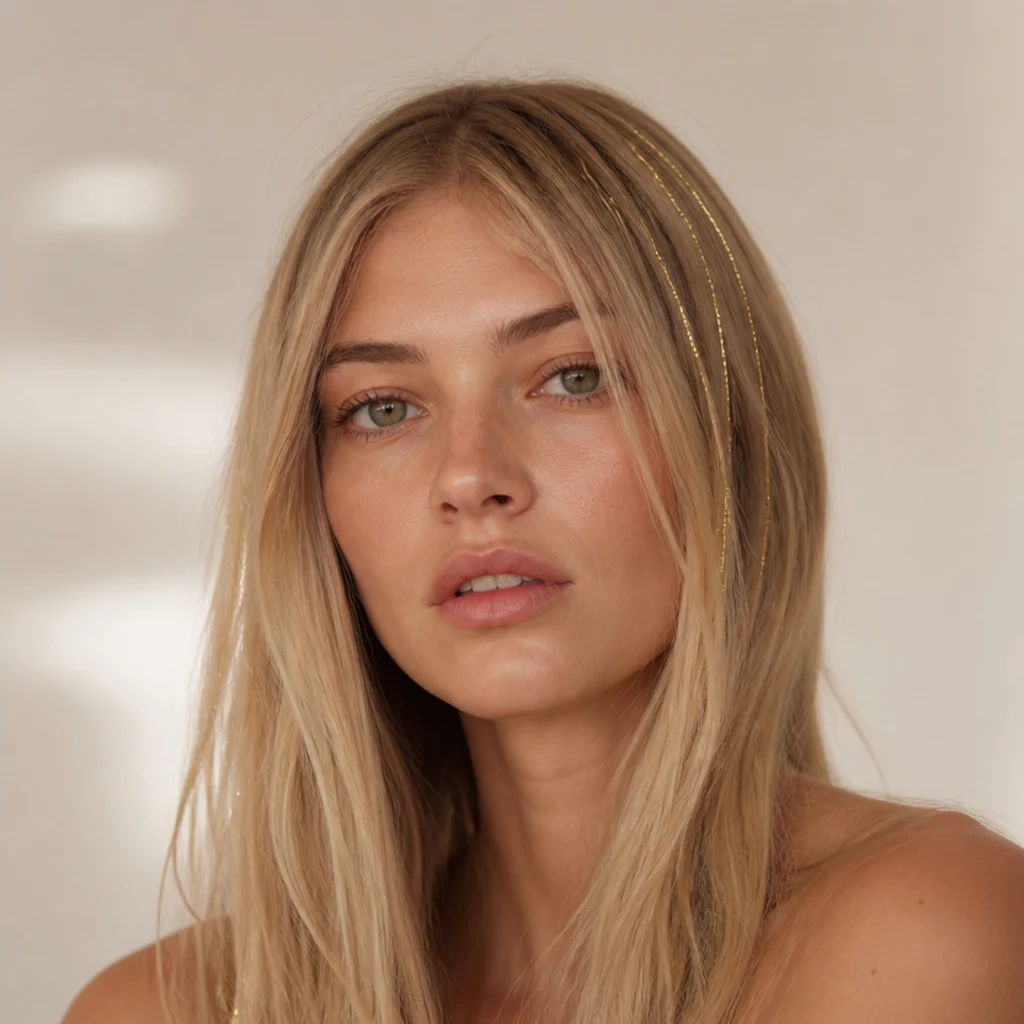
Sometimes the best tinsel is the quietest. Just three to five fine gold strands tucked into natural, air-dried hair give a barely-there glimmer that works with jeans and a T-shirt or a Monday at a desk. It's the most versatile, lowest-stakes option here, and the smartest way to test whether you like tinsel before committing to a fuller placement. Set the strands near the crown and slightly off the part so they catch daylight as you move without ever announcing themselves. Every blonde tone and face shape wears it, and it needs zero special styling — that's the point. Air-dried, straightened, or lightly waved, it reads the same. Because there are so few strands, they're trivial to remove, refresh, or add to whenever you want more. Fine and thick hair both wear it well since the low count never weighs anything down. Pro tip: place a single strand where your hair naturally falls forward over one shoulder, so it catches light in conversation and selfies without any effort. Ask your stylist for "just a few fine gold tie-in strands, very subtle, near my part."
Pro Tips from the Editor
- Match the metal to your undertone, not your hair color. Warm and golden blondes take gold, amber, and champagne; cool, ashy, and platinum blondes stay crisp only in silver, ice, and clear iridescent. Rose-gold is the safe bridge for neutral tones. A wrong-temperature strand is what makes tinsel look cheap.
- Anchor to enough hair. Each tie-in should grab roughly 15 to 20 hairs. Too few and the knot slips out in days; too many and it tugs and shows a bump at the root. Aim for a section about the width of the metallic strand itself.
- Scatter asymmetrically and where light lands. Even spacing reads as tinsel; random placement near the part, crown, and face frame reads as light. Weight strands toward the side you actually part on.
- Keep heat below the knot. Metallic strands tolerate heat, but the knot holds best undisturbed. Curl and flat-iron from mid-shaft down, and never clamp a hot tool directly on the anchor.
- Remove by sliding, never pulling. Loosen the knot and slide it down and out along the hair shaft. Yanking a strand takes real hairs with it, which matters most on bleached, fragile blonde.
- Plan the shade around your salon calendar. Book tinsel at the same visit as a gloss or toner so the strand tone matches your freshest color, and re-tie a small top-up around week three when the first strands loosen.
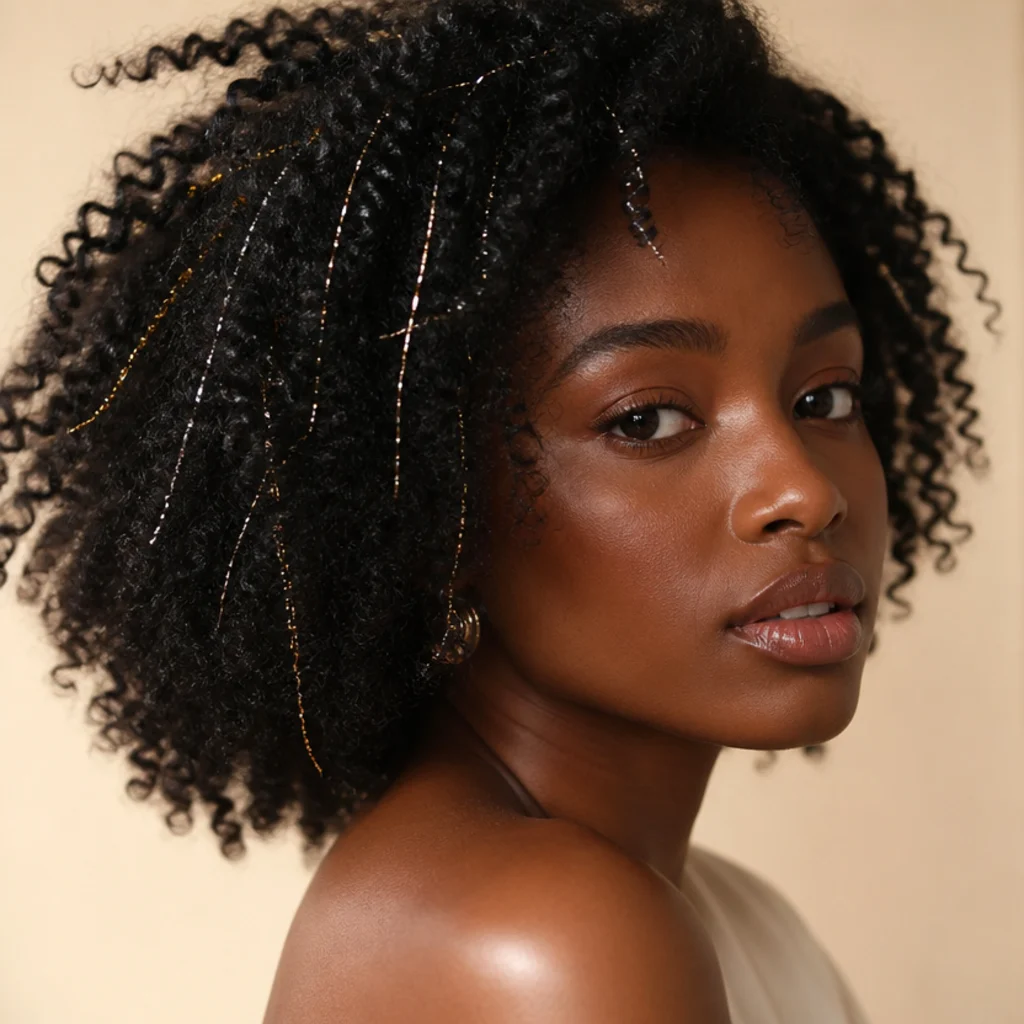
- For hair tinsel brunette translations, keep the technique and swap the color. Everything here applies to darker bases; reach for copper, deep gold, and gunmetal instead of pale silver so the strands still register against depth.
Comparison: Tinsel Attachment Methods
| Method | How it attaches | Typical wear time | Reusable | Best for | Rough cost |
|---|---|---|---|---|---|
| Tie-in (knotted) | Slip knot at the root, no heat or glue | 4 to 6 weeks | No (single use) | Everyday, low-maintenance shimmer | ~$2 to $5 per strand at salon |
| Micro-bead / bonded | Clamped in a small silicone-lined bead | 1 to 3 weeks | Yes | Bold or seasonal colors you'll change | Kit ~$20 to $40 |
| Clip-in | Small clips or wefts, on and off in minutes | Same day | Yes | Events, bubbles, buns, confetti mixes | Kit ~$15 to $35 |
| Heat-fused | Keratin or heat bond at the root | 4 to 8 weeks | No | Longest hold (less gentle on bleach) | Salon add-on, varies |
How to Choose / Get the Look
Work through four decisions in order, and the right look almost picks itself.
1. Start with undertone. Warm, golden, and honey blondes glow under gold, amber, and champagne; cool, ashy, and platinum blondes look crispest in silver, ice, and iridescent clear; rose-gold is the flexible in-between for neutral tones. If you're not sure, clear iridescent (look 2) flatters every blonde because it has no fixed color of its own.
2. Decide your commitment. Tie-in strands are knotted at the root, last four to six weeks, and wash and heat-style normally when you keep tools below the knot. Micro-bead and clip-in tinsel come out in minutes, which makes them the right call for one-night events or bold colors you don't want living in your hair for a month. Match the method to the occasion, not the other way around.
3. Choose placement by lifestyle. Desk job or strict dress code? Go hidden under-layer (6) or subtle everyday strands (15). Big event or photos? Diamond part (2), Dutch crown (10), or slicked bun (12). Festival or concert? Braid (4), space buns (14), or confetti (11). Want it to look like color work? Champagne money piece (9) or honey blend (13).
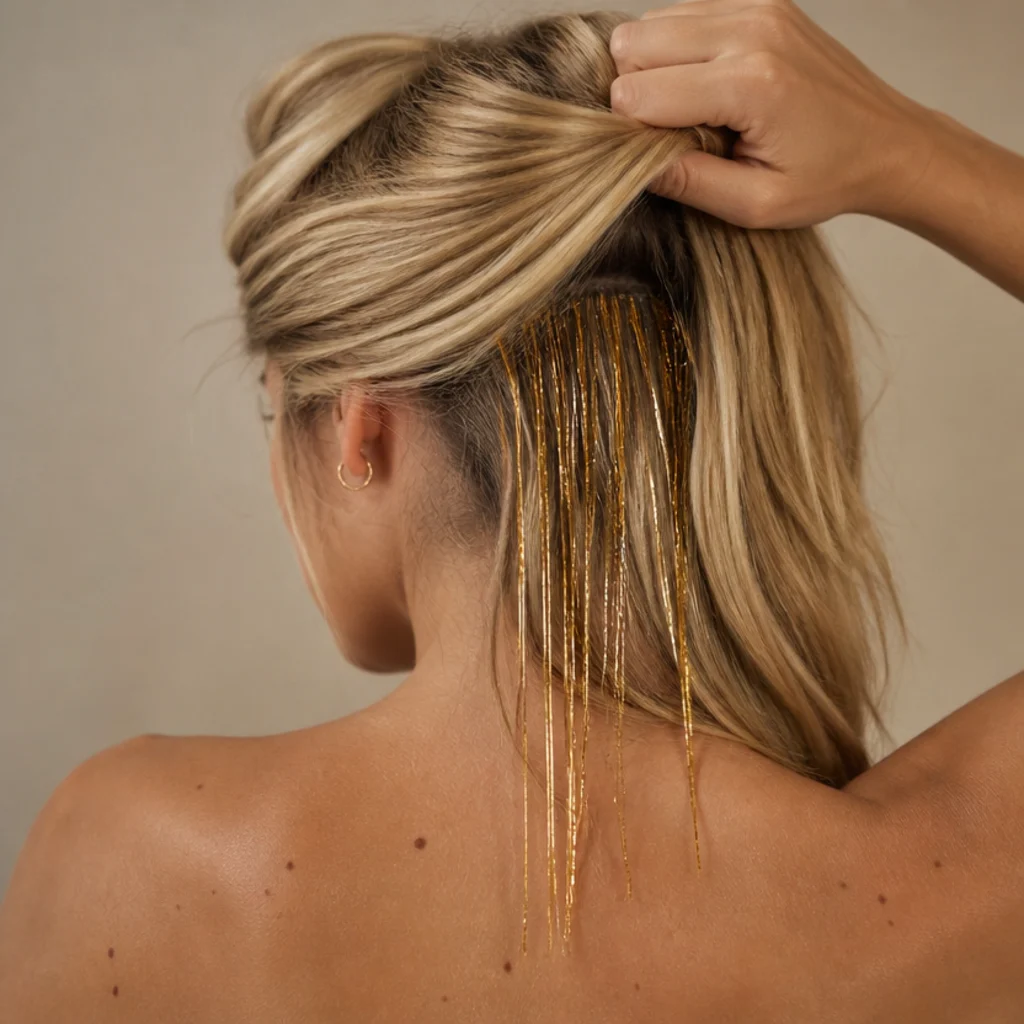
4. Do it yourself or book it. For how to put tinsel in hair at home you need only a loop tool or crochet hook, a rat-tail comb for clean parting, and a slip knot: isolate about 15 to 20 hairs at the root, fold the strand around them, thread the ends through the loop, and tie a small double knot close to the scalp. Scatter asymmetrically, always place near light-catching zones, and start with fewer strands than you think you want, because you can always add more. If you'd rather have it done, the salon scripts under each look above give your stylist exactly the shade, method, and placement to use. The same framework covers hair tinsel brunette looks; only the strand color changes, with coppers and deep golds flattering darker bases.
Frequently Asked Questions
How long does hair tinsel last in blonde hair?
Tie-in (knotted) tinsel typically lasts four to six weeks and survives washing, brushing, and heat styling below the knot. You'll usually lose a strand or two per week as they work loose, so most people re-tie a small top-up around week three. Clip-in and micro-bead strands are meant to be removed the same day or within one to three weeks.
Does tinsel damage blonde or bleached hair?
Tie-in and clip-in tinsel attach with a knot or a small clip, not glue or heat, so they are gentle even on bleached hair. The one rule that protects fragile blonde is to remove strands by sliding the knot down and out along the shaft rather than pulling, and to avoid clamping hot tools directly on the knot. Heat-fused methods hold longer but are the least gentle option on very processed hair.
What color tinsel is best for blonde hair?
Match the strand to your undertone rather than your overall shade. Gold and champagne flatter warm and golden blondes, silver and "ice" suit cool and platinum tones, and rose-gold works for neutral blondes. Clear iridescent flatters everyone because it has no fixed color until light refracts through it, and holographic or confetti mixes pop on any pale base for festivals.
Can I wash and style my hair with tinsel in?
Yes. With tie-in strands you can wash, condition, blow-dry, curl, and straighten as usual; just keep heat tools below the knot at the root. Metallic strands tolerate heat well, but the knot holds best when the anchor point is left undisturbed. Brush gently and start from the ends so you don't drag a bristle straight through a knot.
How do I put tinsel in hair at home?
Use a loop tool or crochet hook. Isolate about 15 to 20 hairs at the root, fold the tinsel strand around them, thread the ends through, and tie a small double knot close to the scalp. Repeat wherever you want sparkle, scattering asymmetrically near the part, crown, and face frame. Start with a handful of strands, check them in daylight, and add more only where the light doesn't catch.
How many strands of tinsel should I use?
It depends on the effect: three to five for a subtle everyday glimmer, eight to fourteen for a visible-but-wearable scatter, and fifteen to twenty-plus for festival or confetti looks. Pale blonde needs fewer strands than darker hair to register, and holographic or iridescent strands read stronger than flat metallics, so use those more sparingly.
Will hair tinsel work on fine or thin blonde hair?
Yes, with two adjustments. Anchor each strand to slightly fewer hairs so it doesn't tug, and keep the overall count low so nothing looks sparse or weighed down. Placement styles like the money piece, face frame, or subtle everyday strands flatter fine hair best because they concentrate a few strands where light already hits, rather than spreading them thin across the whole head.
Can I sleep in hair tinsel?
You can, and for festival braids and buns sleeping in the style helps it last the weekend. Protect the strands by loosely braiding loose hair, using a silk or satin pillowcase to reduce friction, and avoiding tight tension on the knots. Re-fan or reshape in the morning. If you toss a lot in your sleep, a loose braid keeps the strands from tangling out.
Is hair tinsel the same for brunettes?
The technique is identical; only the strand color changes. Hair tinsel brunette looks swap pale silver and light gold for copper, deep gold, bronze, and gunmetal so the shimmer registers against a darker base. Every placement in this guide, from the hidden under-layer to the Dutch braid crown, translates directly once you shift the color to suit the depth.