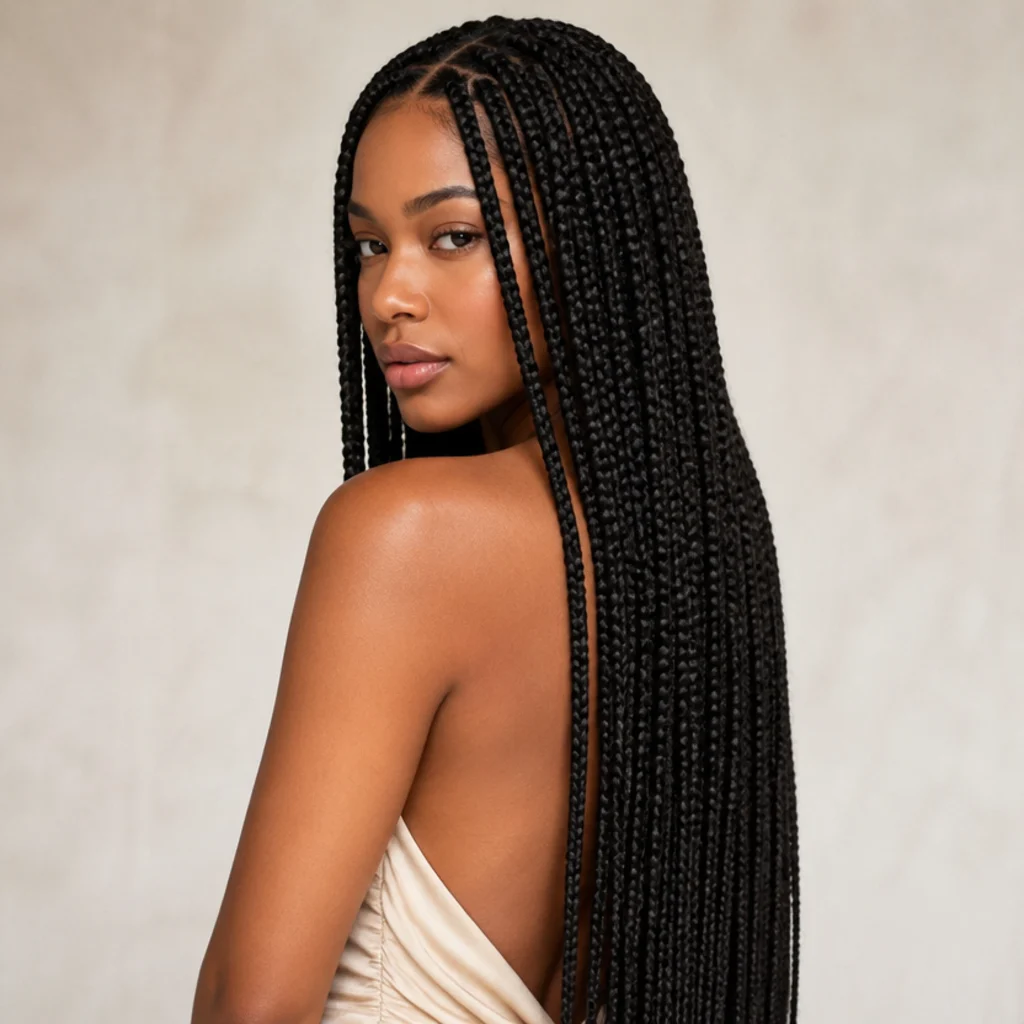
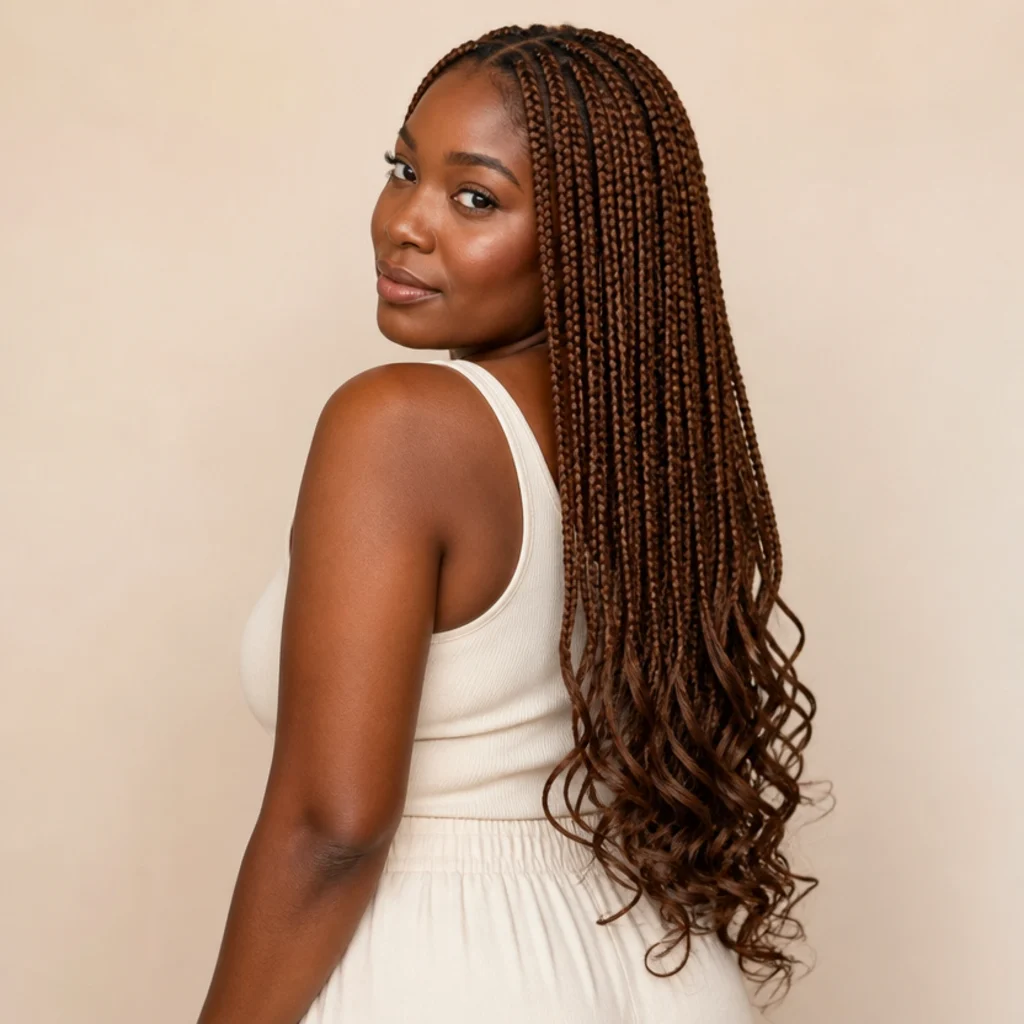
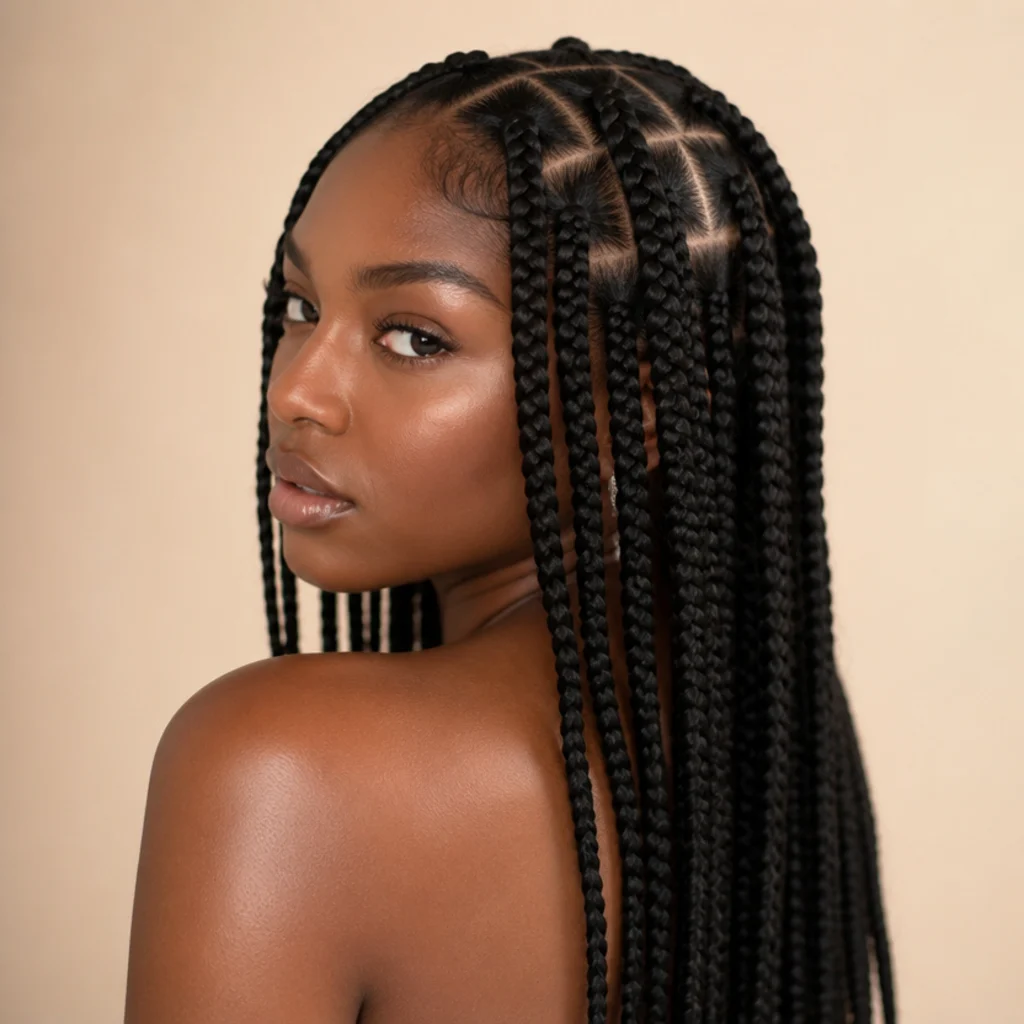
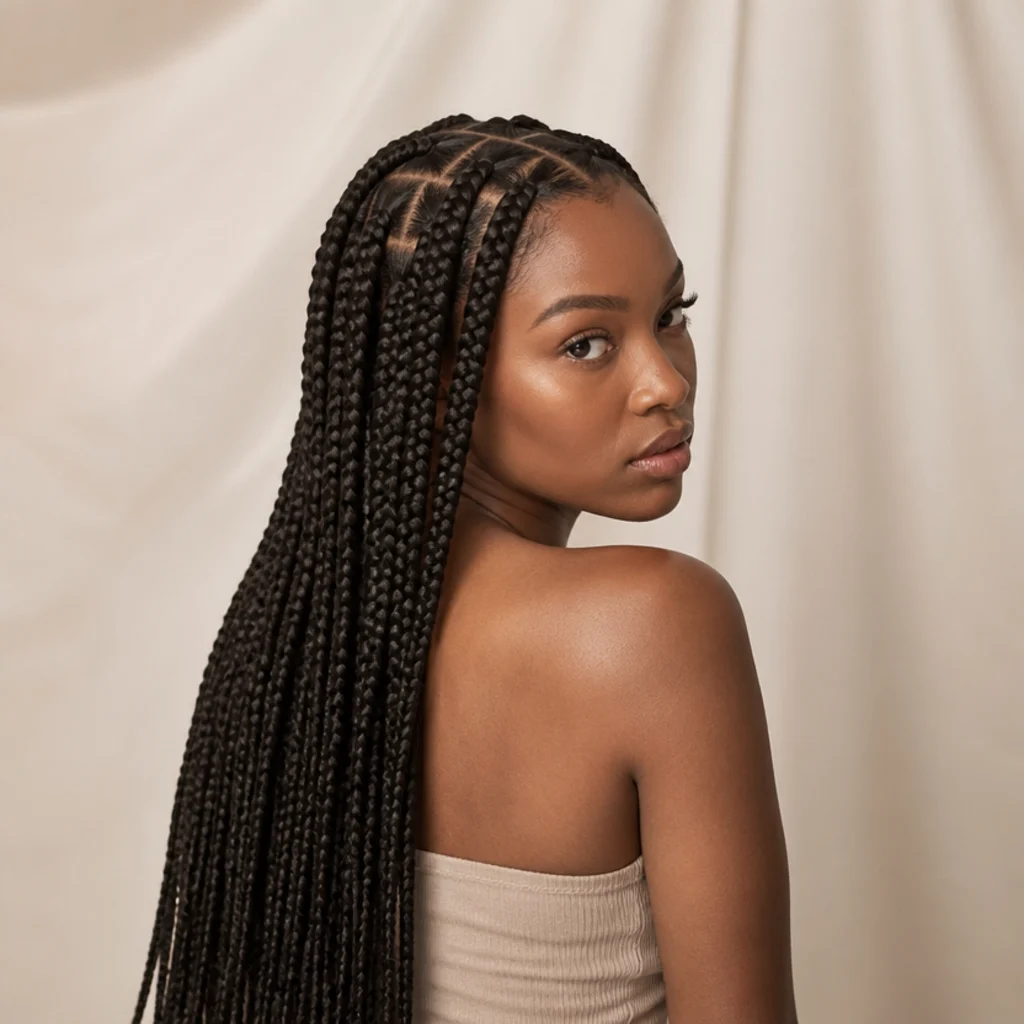
15 Short Jumbo Box Braids Styles to Try
Fewer braids, chunkier sections, and a chin-to-shoulder fall that installs in a single sitting and stays feather-light on your scalp. Here are 15 editor-vetted ways to wear the length, from curly ends and sleek blunt bobs to burgundy ombre, triangle parts, and beaded finishes, each with the shade codes, tension notes, and booking language that separate a great install from an average one.
 Edited by Lena Rose · Published July 11, 2026 · 30 min read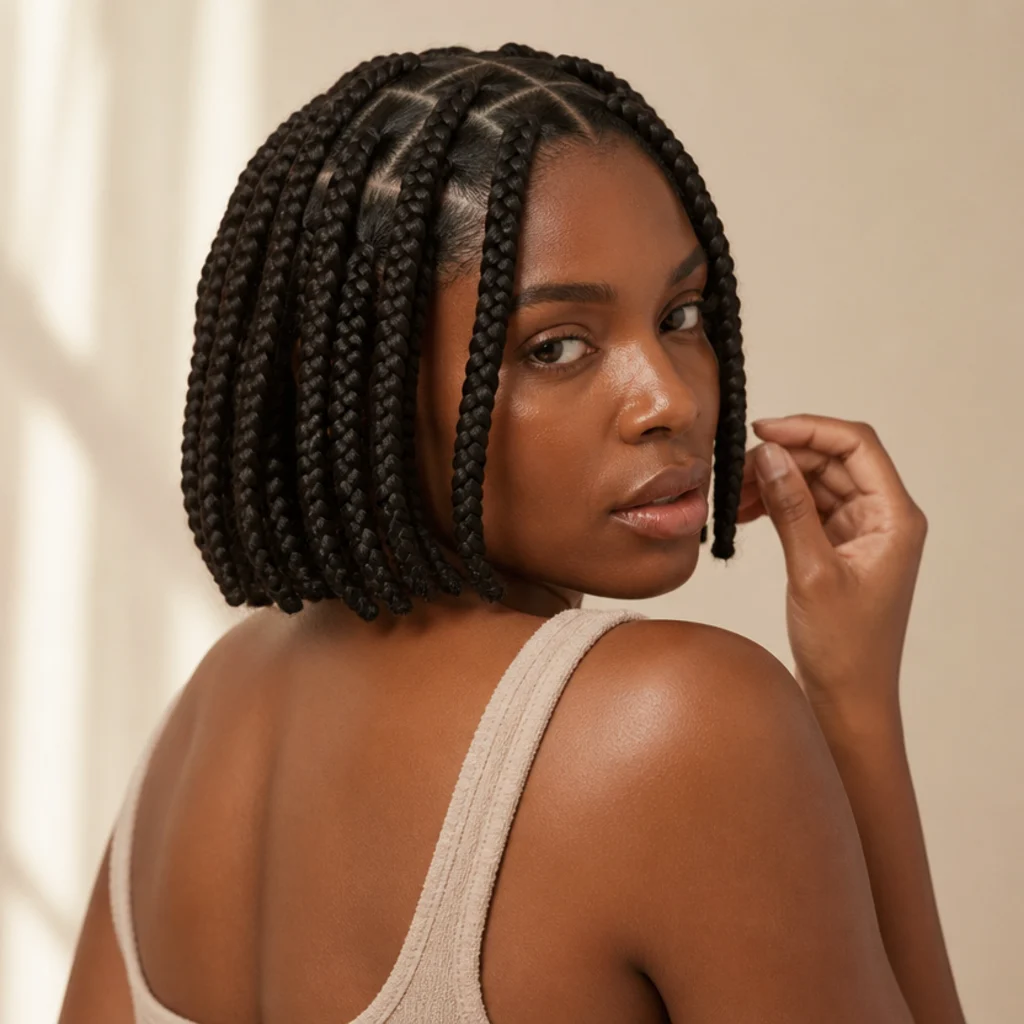
Quick Answer
- Best for: Anyone who wants a bold, low-density protective style with a fast install, light scalp tension, and easy day-to-day handling; strong first-timer style and an ideal summer reset between longer sets.
- Who might skip it: Anyone set on swingy waist-length movement, anyone who dislikes visible scalp or wide parts, or very fine hair worried about jumbo weight at the roots (knotless and looser edge tension solve most of this).
- Maintenance: Low. Satin bonnet nightly, a lightweight scalp oil twice a week, and a diluted scalp cleanse around week three; curly and ombre versions add a mousse or curl-refresh step every week or two.
- Difficulty: Beginner to intermediate for DIY. So few sections make the braiding forgiving, but blunt cuts, symmetric parts, and even feed-in roots reward a steady, practiced hand.
- Cost: Variable by region and stylist. Expect a lower ticket than small or mid-back knotless because of shorter chair time; jumbo knotless, curly ends, and multi-pack color add to the upper end of your local range.
- Wear time / longevity: Four to six weeks looking fresh. Short length mats far less than long braids, so lifted roots, not frizzy braids, usually call time first.
- Standout variation: Chin-length jumbo bob with curly ends, for face-framing movement without added weight.
- How to ask your braider: Name the length against a body landmark (chin, jaw, shoulder), state your parting pattern, specify blunt versus soft ends, and bring one clear reference photo of the exact cut line.
In This Guide
- Classic Chin-Length Jumbo Bob
- Jumbo Knotless Short Braids
- Curly-End Jumbo Bob
- Honey Blonde Short Jumbos
- Center-Part Jumbo Bob
- Half-Up Jumbo Bun
- Shoulder-Grazing Jumbo Braids
- Triangle-Part Short Jumbos
- Burgundy Ombre Short Braids
- Blunt Jumbo Bob
- Side-Swept Jumbo Braids
- Beaded Short Jumbo Braids
- Ear-Length Micro-Short Jumbos
- Two-Tone Caramel Jumbo Bob
- Curly Bob With Face-Framing Pieces
Intro
Short jumbo box braids strip the style down to its friendliest form: wide, low-count braids cut to a bob or shoulder length that install fast and stay light on the scalp. Each section is generous, roughly finger-to-two-finger width, so a braider gets through a fraction of the braids a small or medium set demands. You leave with a finished head in a couple of hours instead of an all-day marathon, and the cropped fall means less drag at the nape and fewer overnight tangles. That combination makes the look a smart first protective style, a summer reset between longer installs, or just a standing choice for anyone who wants hair that moves and behaves. The length flatters more people than you'd expect: a blunt bob sharpens a round or heart face, curly ends and face-framing pieces soften a square or long one, and a deep side part slims a broad forehead. Across these 15 ideas you'll see the real range the length holds, from graphic blunt bobs and airy jumbo knotless box braids to honey blonde, burgundy ombre, and the triangle, center, and side jumbo box braids parting pattern choices that change the whole silhouette, plus beads and jumbo box braids with curls. Every entry covers who it suits, the exact shades and hair types, the upkeep rhythm, the difficulty, and the precise words to give your braider so you leave with the shape you actually pictured.
01Classic Chin-Length Jumbo Bob {#1}
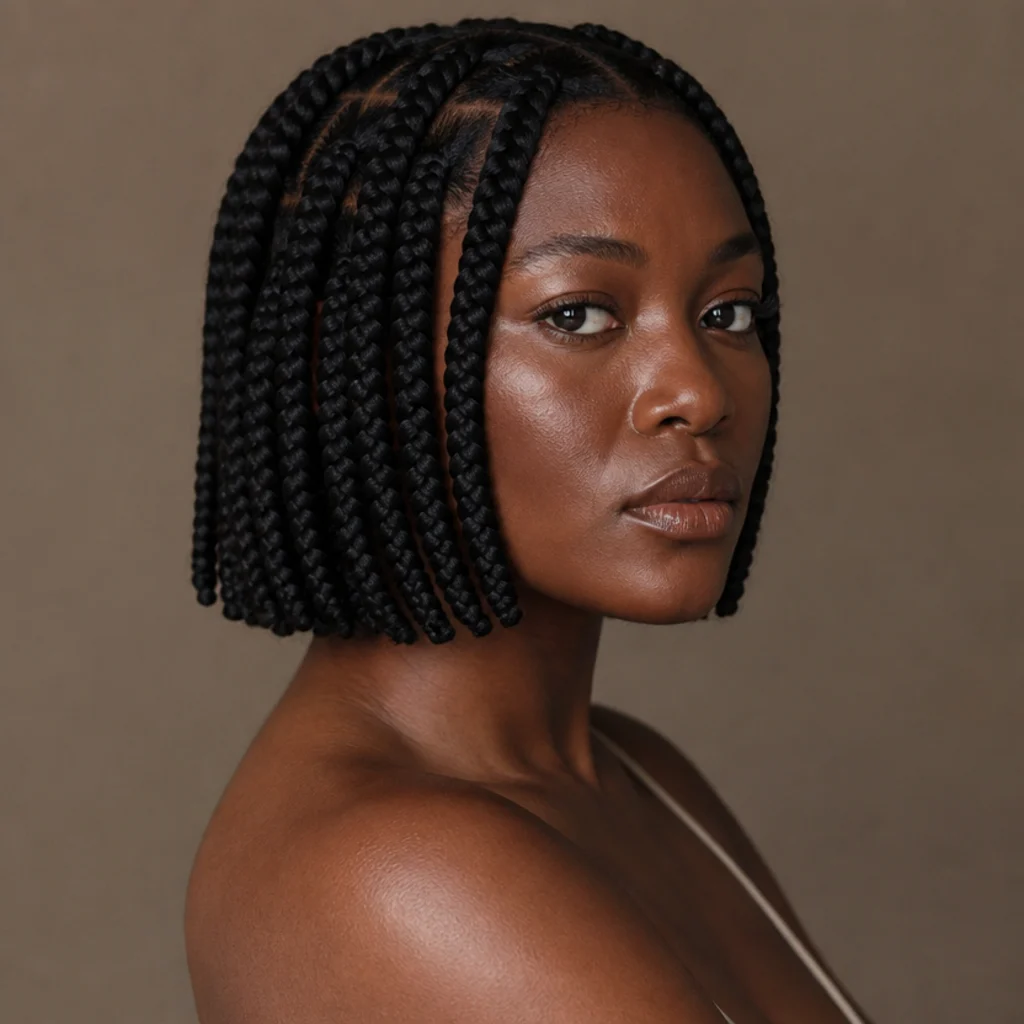
The chin-length jumbo bob anchors this whole list: uniform braids in a true natural black (1B, which carries a soft warmth rather than the flat, wig-like look of jet 1) cut straight across so they graze the jaw and swing when you turn. Wide square parting keeps the braid count low, usually somewhere in the 30-to-40 range for a full head, so tension stays gentle and even and the sitting itself is easy to get through. Round and heart shapes benefit most, since the blunt bottom line adds structure right along the jaw where those faces want definition. If your face runs very round, drop the line a centimetre past the jaw so it lengthens rather than widens it. Upkeep stays minimal, just a satin bonnet nightly, a satin pillowcase as backup, and a daily mist of diluted leave-in on the perimeter so the ends stay smooth instead of frizzing. A strong lip and hoops finish off that clean short-bob attitude. Pro tip: ask for the cut line a fingertip below your jawbone, since sealed synthetic ends shrink and read shorter than they hang wet. To book it, tell your braider you want "jumbo box braids cut to a chin-length blunt bob, square parting, sealed ends," and ask for a mirror check before the ends get dipped.
02Jumbo Knotless Short Braids {#2}
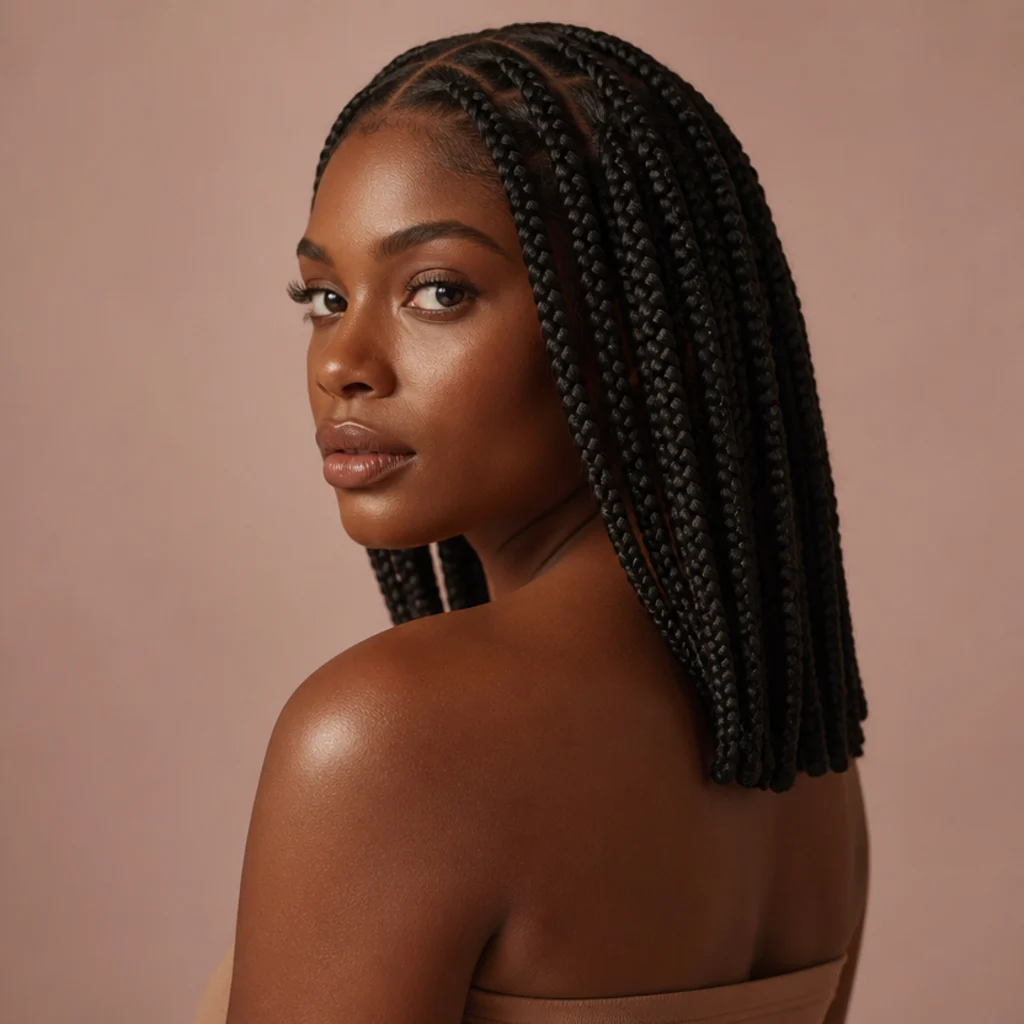
Jumbo knotless box braids swap the built-up base of the traditional method for a feed-in start, so the root lies flat against the scalp and the braid tapers in gradually as small amounts of hair get added row by row. On a short length the payoff shows immediately: no visible knots at the part, markedly less pull at the hairline, and a smoother exit where each braid leaves the scalp. It's the gentlest option here for fine edges, a tender scalp, or anyone whose past installs left soreness or little pinpricks of breakage at the temples. Maintenance stays low, though feed-in roots slip and loosen a touch faster than knotted ones, so plan a root refresh nearer week five. Difficulty sits at intermediate: even feed-ins need a consistent hand to keep each braid the same thickness from root to tip and avoid a thin, straggly start. Pro tip: keep the first two or three feed-in sections at each temple deliberately airy and low-tension, since that front row is where knotless either protects your edges or, gripped too tight, quietly damages them. Ask your braider for "jumbo knotless box braids, shoulder length, feed-in roots with light tension at the edges," and flag any tender spots before the first braid.
03Curly-End Jumbo Bob {#3}
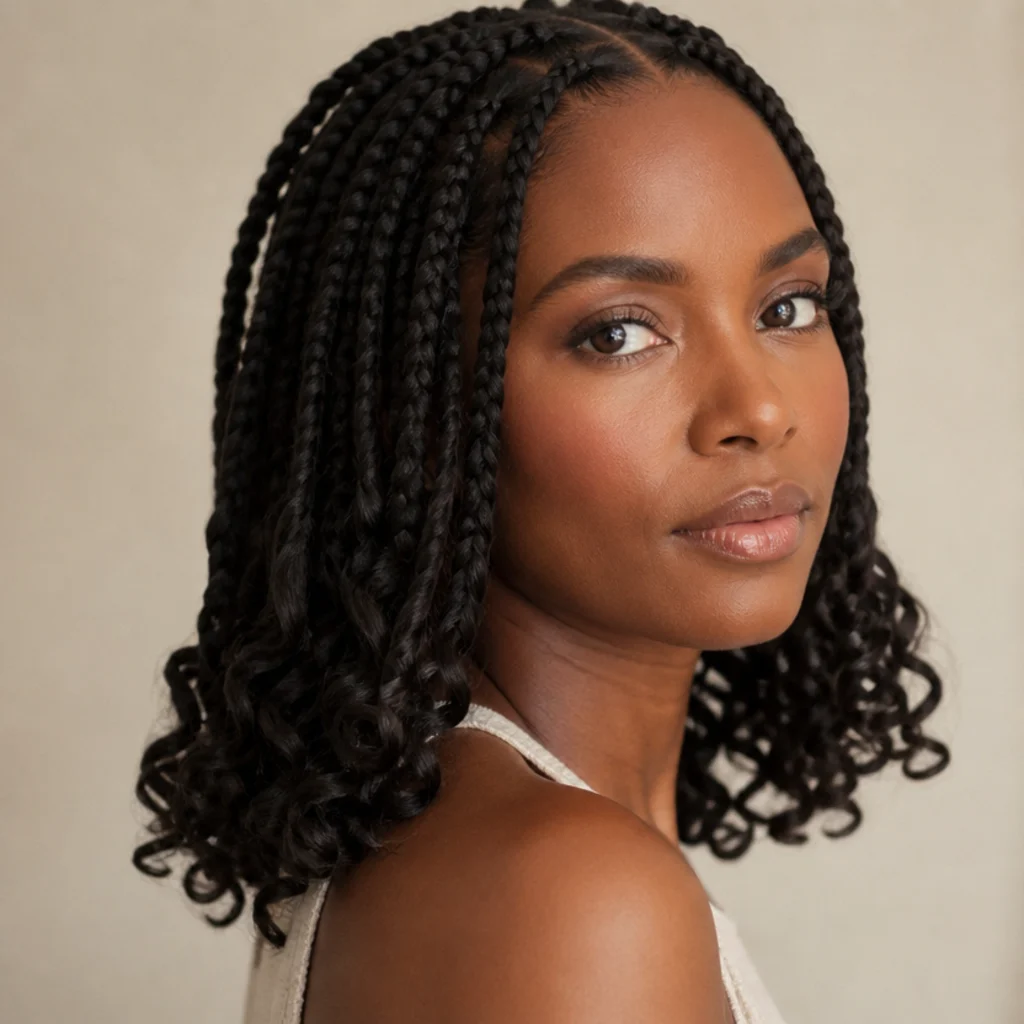
This is where jumbo box braids with curls earn their spot on the list. The braid runs smooth and sleek from the root, then releases into a loose spiral over the last few inches, set with water-wave or bouncy-curl hair left unbraided and dipped in hot (not quite boiling) water to lock the pattern. Freetress water wave gives a soft, beachy S-bend, while a defined spiral curl reads tighter and more sculpted, so name the texture, not just "curly." The effect breaks up the blunt bob line and adds face-framing bounce without the weight a fully curled long style carries. Anyone who finds a straight bob too severe should look here, and the softness balances square and angular jaws especially well. Upkeep means reviving the curls with a light mousse or a curl-refresh spray as they relax and stretch over a week or two, plus a gentle scrunch after a shower, never a brush-out. Pro tip: have the curl begin just below your chin rather than right at the jaw, so the smooth section frames your face and the volume sits lower where it flatters. Ask for "short jumbo box braids with curly ends, curl starting just below the chin," and specify tight ringlets versus a looser beach wave, since the hair type sets that from the first pack.
04Honey Blonde Short Jumbos {#4}
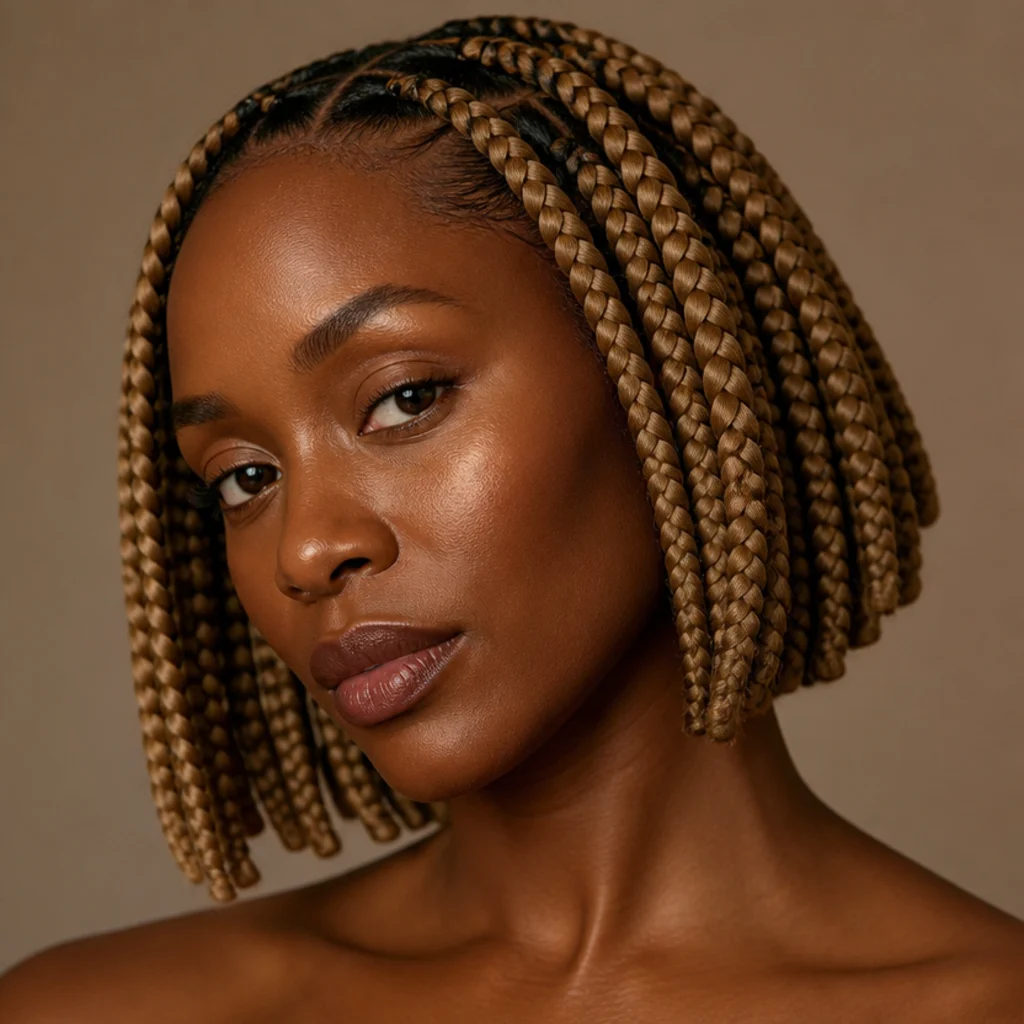
A honey blonde pack warms up the short jumbo bob instantly and reads sun-lit against deeper skin tones. Jumbo braids expose more braiding hair per section than small braids do, so color choice carries real visual weight here: a golden, caramel-leaning honey (think a soft 27, or a 27/30 blend, rather than a harsh 613 platinum) tends to look richest and most natural. Warm and golden undertones suit it best, and it gives anyone bored of all-black a real lift without committing to a full bleach-out. Upkeep matches any short set, plus an occasional color-safe or lightly purple-tinted rinse if the tone starts to dull or turn brassy under indoor light. Difficulty stays beginner for the braiding itself, since the color lives in the pre-colored hair, not the technique. Pro tip: hold the pack against your jaw and collarbone in daylight before committing, and mix in one shade darker (a 1B or 4) through the roots for a lived-in melt instead of a flat wall of blonde. Ask your braider for "jumbo box braids in honey blonde, chin to jaw length, rooted slightly darker," and confirm the exact shade number in natural light, not under shop bulbs.
05Center-Part Jumbo Bob {#5}
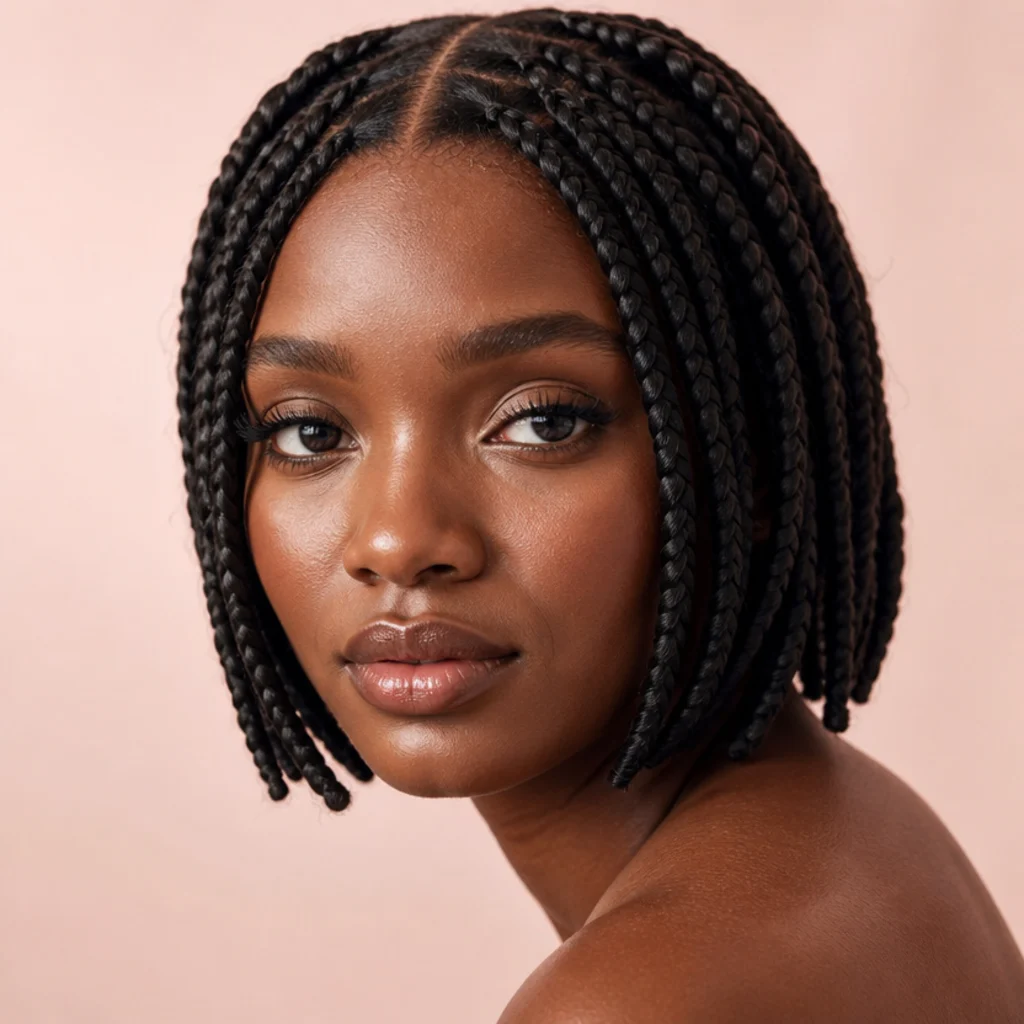
A crisp center part changes the whole feel of a jumbo bob, splitting the braids into two even curtains that frame the face symmetrically. The jumbo box braids parting pattern is the real craft here: a clean, ruler-straight line down the middle with matching square sections mirrored on each side, so both curtains carry the same weight. Oval and long faces get the most from it, since it adds editorial polish and gives a plain bob a considered, styled edge. Maintenance is simple, though the exposed part does better with a lightweight, non-greasy scalp oil worked along the line so it doesn't photograph dry or ashy. Difficulty runs intermediate for the braider, because symmetry is unforgiving and any drift in the part line shows immediately across sections this wide. Pro tip: choose and set your part before a single braid goes in, and check it against the bridge of your nose in the mirror, since a center part even a few millimetres off throws the whole face-framing effect. Ask for "jumbo box braids with a clean center part and matching square sections either side," and request a mirror check while the part is still adjustable and nothing's locked in.
Save this to Pinterest and start a board for your next braid appointment.
06Half-Up Jumbo Bun {#6}
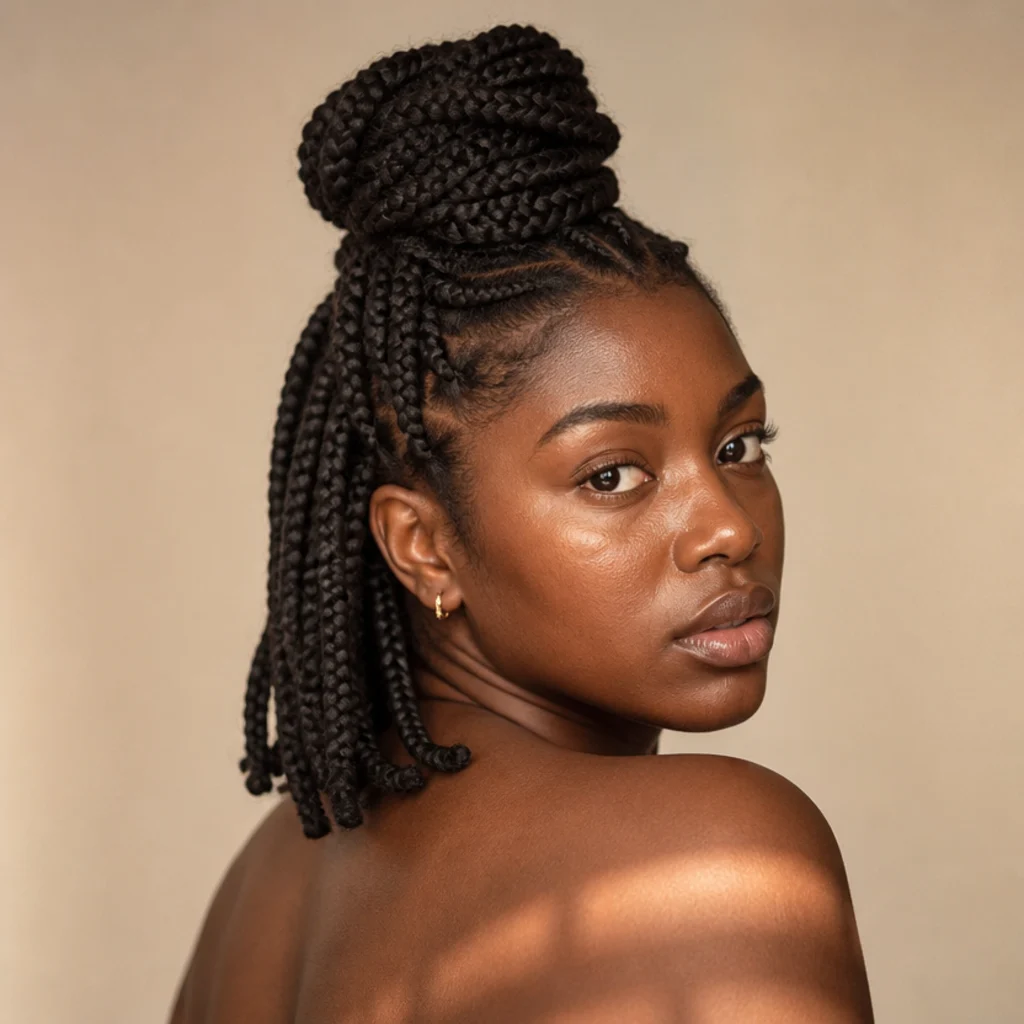
Even at a short length, jumbo braids gather into a satisfying half-up bun: pull the crown braids into a rounded knot at the top and let the rest fall loose around the neck. It's the go-to when you want your face and neckline clear for a hot day, a workout, or a night out, but still want length and shape showing at the back. This flatters nearly every face shape, elongates a rounder one by adding height at the crown, and doubles as a smart way to restyle a set that's a week or two old and starting to loosen at the roots. Upkeep is nothing beyond a fresh tie and a quick pass of edge control along the hairline. Difficulty stays easy, since this is a styling move rather than an install decision. Pro tip: reach for a large spiral or coil hair tie rather than a thin elastic; jumbo braids are heavy, and a thin band both slips out and dents the braids with a crease. To keep it possible, tell your braider at booking that you want "enough length at the crown to gather a half-up bun," so the top sections don't get cut too short to reach the tie.
07Shoulder-Grazing Jumbo Braids {#7}
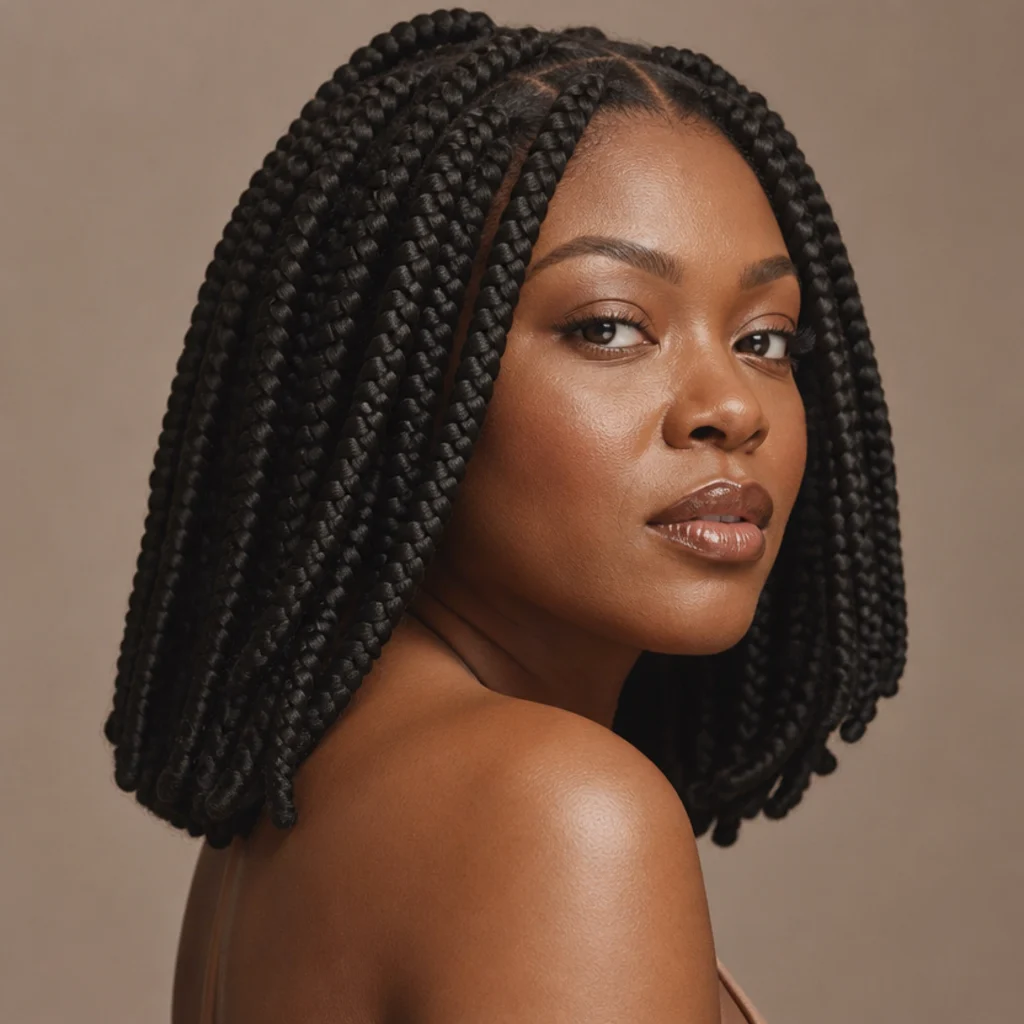
Shoulder-grazing jumbo braids land at the most versatile length on this list, somewhere between a bob and long hair. They're long enough to pull into a low pony, a half-up, or a loose side sweep, yet short enough to stay light and tangle-free through the week. This length suits almost everyone and makes a comfortable middle ground if you're nervous about a proper crop but don't want the weight of a longer install. Maintenance is low: the usual satin wrap, a light scalp oil twice weekly, and a root refresh around week six. Difficulty stays beginner, since there's no cut precision or curl set to manage. Pro tip: decide up front whether you want a hard blunt edge or a softer, slightly staggered finish. The two read completely differently: blunt looks sharp and deliberate, staggered looks lived-in and casual, and a staggered hem forgives a braider's uneven ends far more than a razor-straight line. Ask for "jumbo box braids ending right at the shoulder," and specify a blunt cut across versus a softly rounded, uneven finish so the shape matches the vibe you're after.
08Triangle-Part Short Jumbos {#8}
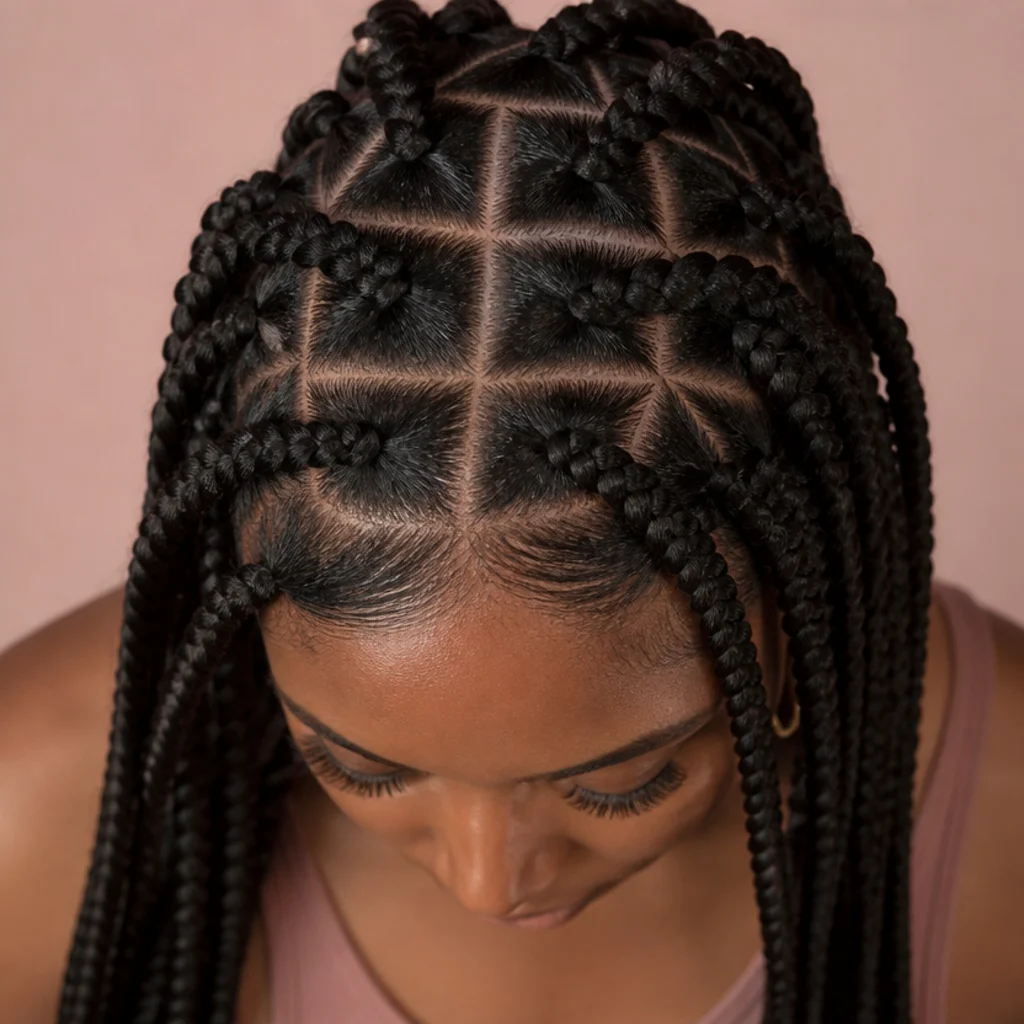
Swapping square boxes for triangle sections is a subtle, scalp-level way to make the jumbo box braids parting pattern more interesting. The triangle base grips the braid at a slightly different angle and creates a geometric, honeycomb effect across the head. It reads especially well on a short cut, where more scalp shows and the pattern gets to be the feature. Anyone who wants visual detail without added color or length should try this one, and it photographs beautifully from above, which is why it dominates crown-shot inspiration. Upkeep matches any short set, with the crisp parting rewarding a little scalp care so the lines stay sharp. Difficulty runs intermediate, because triangle sections take real precision to keep uniform, and inconsistent sizing shows fast on braids this wide. Pro tip: triangle parts point the braid outward and give more root lift than squares, so they read as fuller crown volume, a quiet ally for anyone with a flatter crown or a wider part than they'd like. Ask your braider for "short jumbo box braids with a consistent triangle parting pattern," and confirm before you commit that they're comfortable keeping the triangles even across the whole head, since not every braider parts this way by default.
09Burgundy Ombre Short Braids {#9}
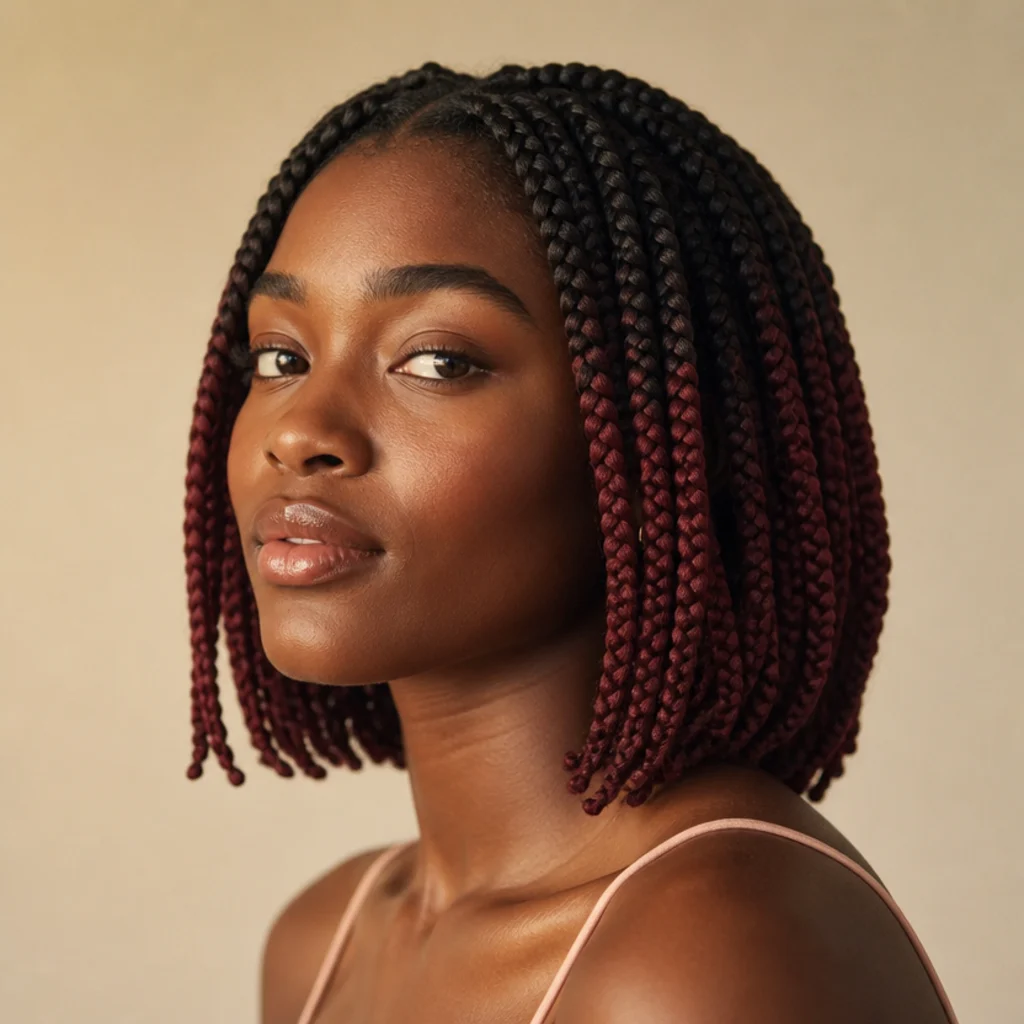
A dark-to-burgundy ombre gives a short jumbo bob depth and a hint of drama without the upkeep of an all-over color. The roots stay natural black (1B) and melt into a deep wine tone, often a 99J or a rich burgundy pack, toward the ends. It flatters cool and neutral undertones and glows under warm and evening light. Because the fade lands near the cut line, it pulls the eye straight to the movement and shape of the bob, so the color pulls double duty as a styling trick. Upkeep is standard, plus color-safe, sulfate-free products so the burgundy doesn't oxidize dull or bleed onto light collars in the first week. Difficulty ranges from beginner to intermediate depending on whether you buy pre-ombre hair or the braider blends two shades by hand as they feed in. Pro tip: place the color break lower than feels natural, roughly two-thirds down each braid, so the fade frames the ends instead of sitting awkwardly at eye level or the jaw. Ask for "jumbo box braids with a black-to-burgundy ombre, color starting around two-thirds down," and bring a physical swatch so the exact wine tone matches the one in your head, since burgundy varies widely between brands.
10Blunt Jumbo Bob {#10}
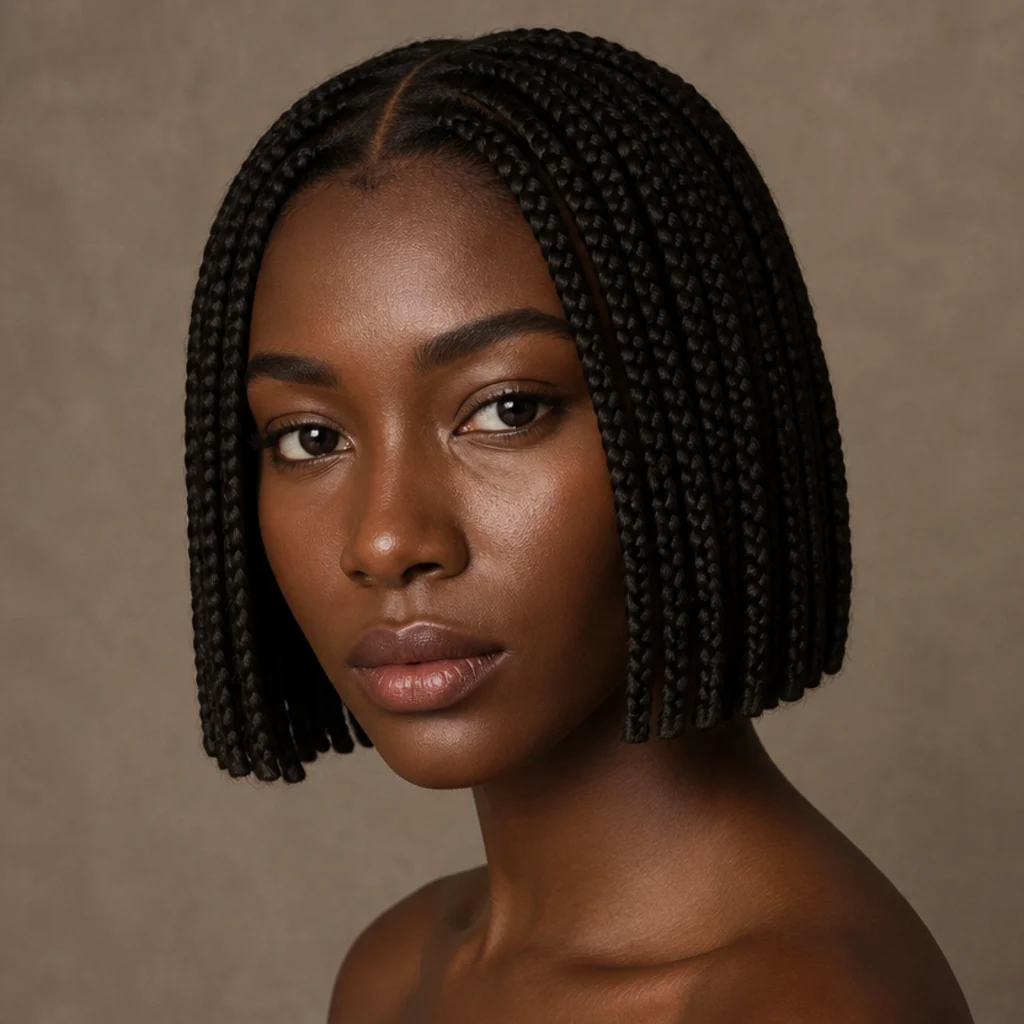
The blunt jumbo bob leans all the way into structure: every braid cut to precisely the same jaw length so the bottom edge reads as one clean, graphic line. It's the sharpest, most modern silhouette on this list and makes a strong statement with almost no daily fuss. Oval and square faces suit it best, along with anyone who likes a defined, architectural outline; if your face runs very round, nudge the length just past the jaw so the line lengthens the face rather than widening it. Maintenance stays easy, but the blunt line only looks its best when the ends stay sealed and smooth, so mist and bonnet nightly and reseal any ends that start to fray or fan out. Difficulty sits at intermediate, since an even cut across jumbo braids won't forgive a single stray length. Pro tip: have the braider cut the ends dry and level, comb in hand, only after every braid is finished and hanging naturally. Cutting mid-install almost guarantees an uneven hem once the rest settles into place. Ask for "a blunt-cut jumbo box braid bob, all ends level at the jaw," and have them dip or lightly singe the ends afterward so the line stays crisp instead of frizzing soft.
Save this to Pinterest before you lose the look you love.
11Side-Swept Jumbo Braids {#11}
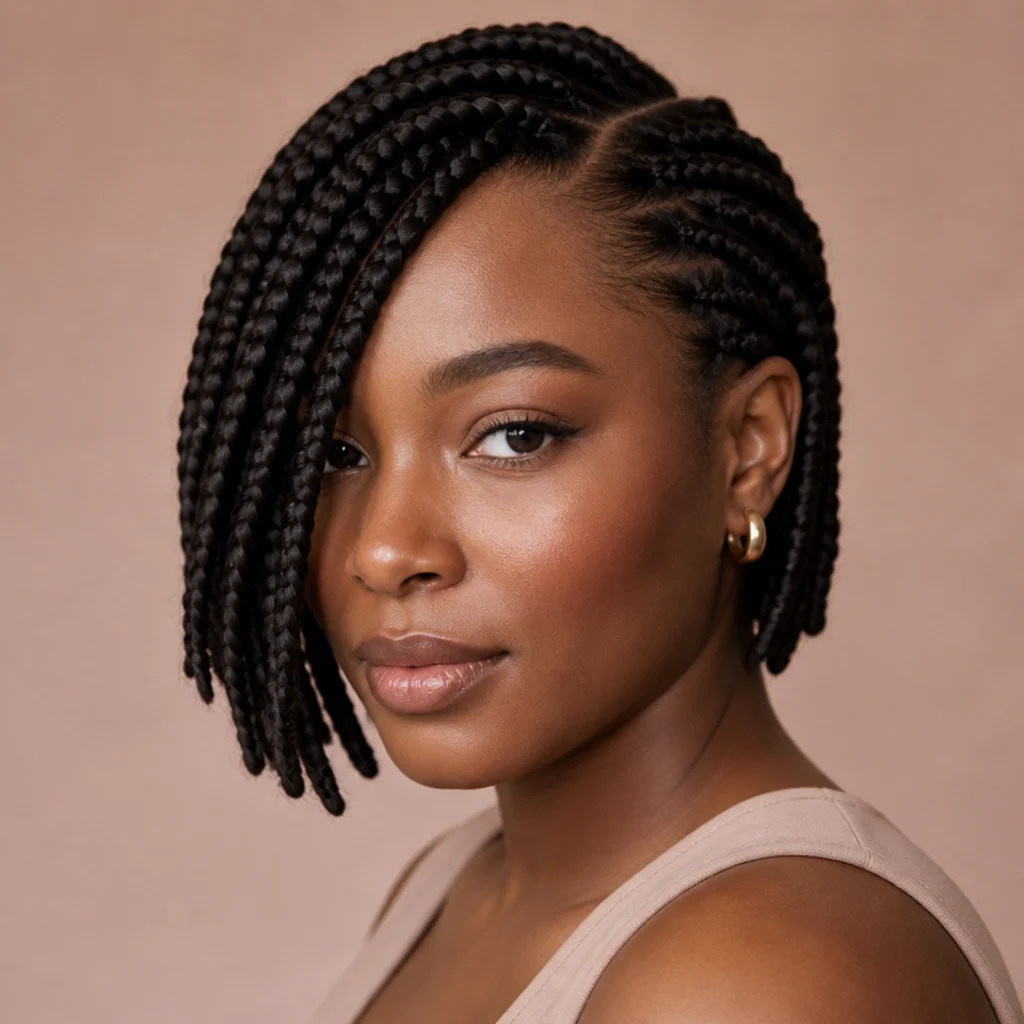
A deep side part sweeps the jumbo braids dramatically across the forehead, giving a short bob instant asymmetry and old-Hollywood attitude. The heavier side falls over one brow while the other stays tucked back, which softens a broad forehead, breaks up a square hairline, and frames the face without any extra styling. Round and square faces suit this one particularly well, since the diagonal line does the slimming work a center part can't. Upkeep is easy: the braids hold the sweep on their own thanks to jumbo weight, needing only a gentle nudge back into place after sleep. Difficulty stays beginner, because the effect comes entirely from part placement rather than any special technique. Pro tip: part on the opposite side to your natural fall for the most lift and drama, but if you want the sweep to stay put with zero coaxing, part on your natural side so the hair works with gravity instead of fighting it all day. A deep part concentrates weight on one row of edges, so keep that front section low-tension. Ask your braider for "jumbo box braids with a deep side part swept to one side," and tell them which side you naturally part on so the fall sits comfortably.
12Beaded Short Jumbo Braids {#12}
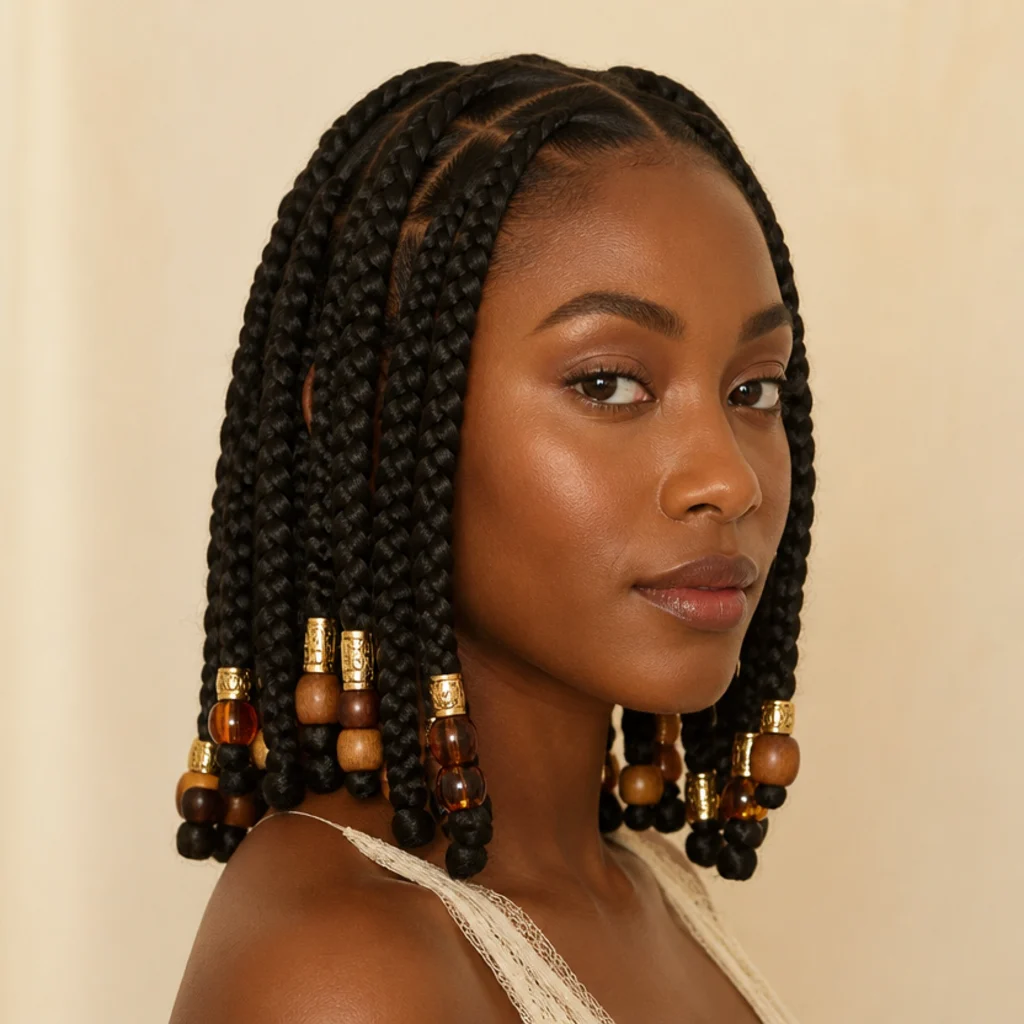
Beads bring texture, movement, and a soft click of sound to a short jumbo set, threaded near the ends in wood, gold, amber, or matte black tones that pop against the braids. On jumbo braids the rule is fewer and larger: a handful of chunky beads reads intentional and heritage-rooted, while dozens of tiny ones look cluttered and add fussy weight. Anyone who wants a bit of personality should try this, and it works especially well for events, festivals, and photos. Maintenance means securing each bead with a small elastic or a knot so it doesn't slide off, and staying aware of the modest extra drag the beads add at the ends over long wear, especially at the front hairline. Difficulty stays beginner to add, whether at install or later at home with a beading tool. Pro tip: place beads on the front and face-framing braids only rather than the whole head, so they draw the eye to your face and keep the back light and easy to sleep on without lumps under the bonnet. Ask for "short jumbo box braids finished with a few large beads near the ends on the front sections," and pick the bead colors in person so they match any secondary tone woven through your braiding hair.
13Ear-Length Micro-Short Jumbos {#13}
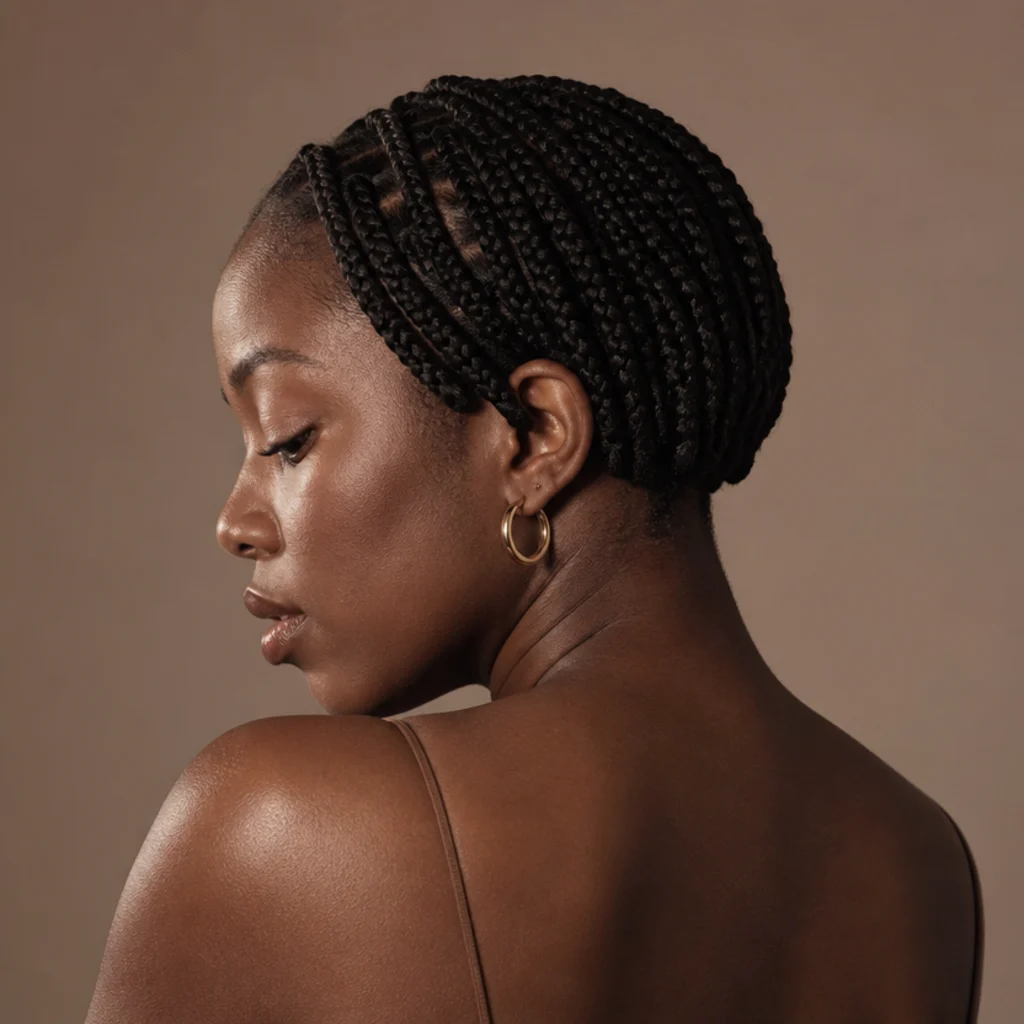
For the boldest take, ear-length jumbo braids sit right at or just below the ears in a rounded, French-crop-adjacent shape. It's the shortest option here and the most striking, pulling every bit of attention to the face, cheekbones, and neck. Confident, angular, and oval faces suit it best, and it's a real statement cut for anyone ready for one; long or narrow faces should keep a touch of width at the sides so the crop doesn't elongate the face further. Upkeep is the lowest of any style on this list, since there's barely enough length to tangle, and a bonnet does the whole job at night with no gathering required. Difficulty stays beginner to braid, though the short finish demands a careful, deliberate cut, since there's almost no room to correct a mistake once you've gone too short. Pro tip: taper the sections slightly shorter at the nape and longer toward the front. That creates a soft, rounded shape that flatters far more than a flat, helmet-like blunt line at this length, and keeps the crop from reading boxy. Ask for "very short jumbo box braids at ear length with a rounded, slightly graduated shape," and agree on the exact cut line, ideally marked against your ear in the mirror, before any braiding begins.
14Two-Tone Caramel Jumbo Bob {#14}
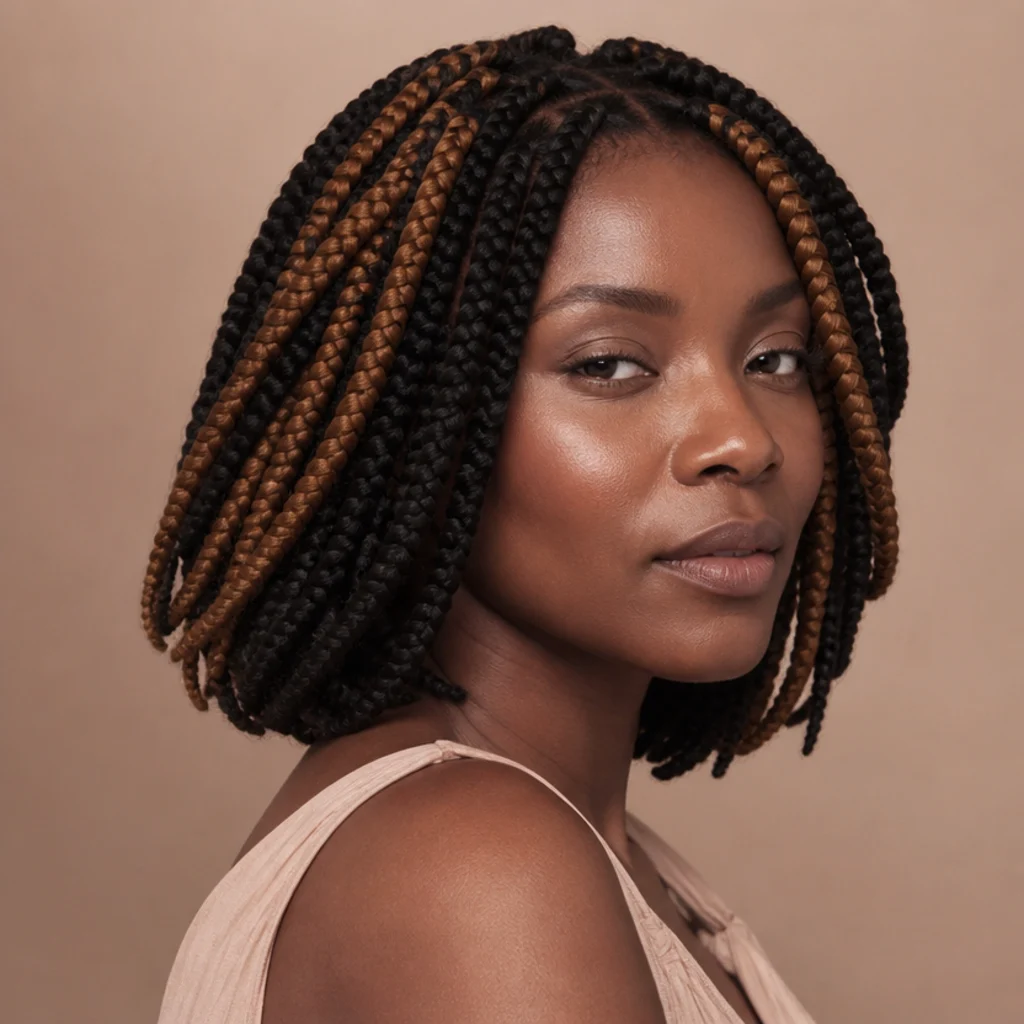
Instead of a top-to-bottom fade, a two-tone bob alternates dark and caramel braids throughout, so the color reads as a woven, dimensional blend rather than a single block. Pairing a 1B or 4 base with a caramel 27 or 30 gives the cleanest contrast, and on jumbo braids the effect lands bold but balanced, the caramel strands catching the light to add warmth around the face without the commitment of a full-head lift. Warm and neutral undertones suit it best, along with anyone who wants a sunny, dimensional color that still feels wearable to the office. Upkeep is standard, with color-safe care for the lighter caramel strands so they hold their tone and don't go brassy. Difficulty stays beginner, since the whole effect comes from the hair you choose, not the braiding technique. Pro tip: weight the caramel a little heavier around the hairline and face-framing sections and keep the back mostly dark, so the color brightens your complexion where it counts and the look stays grounded rather than washed out or stripey. Ask your braider for "a two-tone jumbo box braid bob mixing natural black and caramel, caramel concentrated around the face," and settle your exact ratio, braid by braid if needed, before the pack gets opened.
15Curly Bob With Face-Framing Pieces {#15}
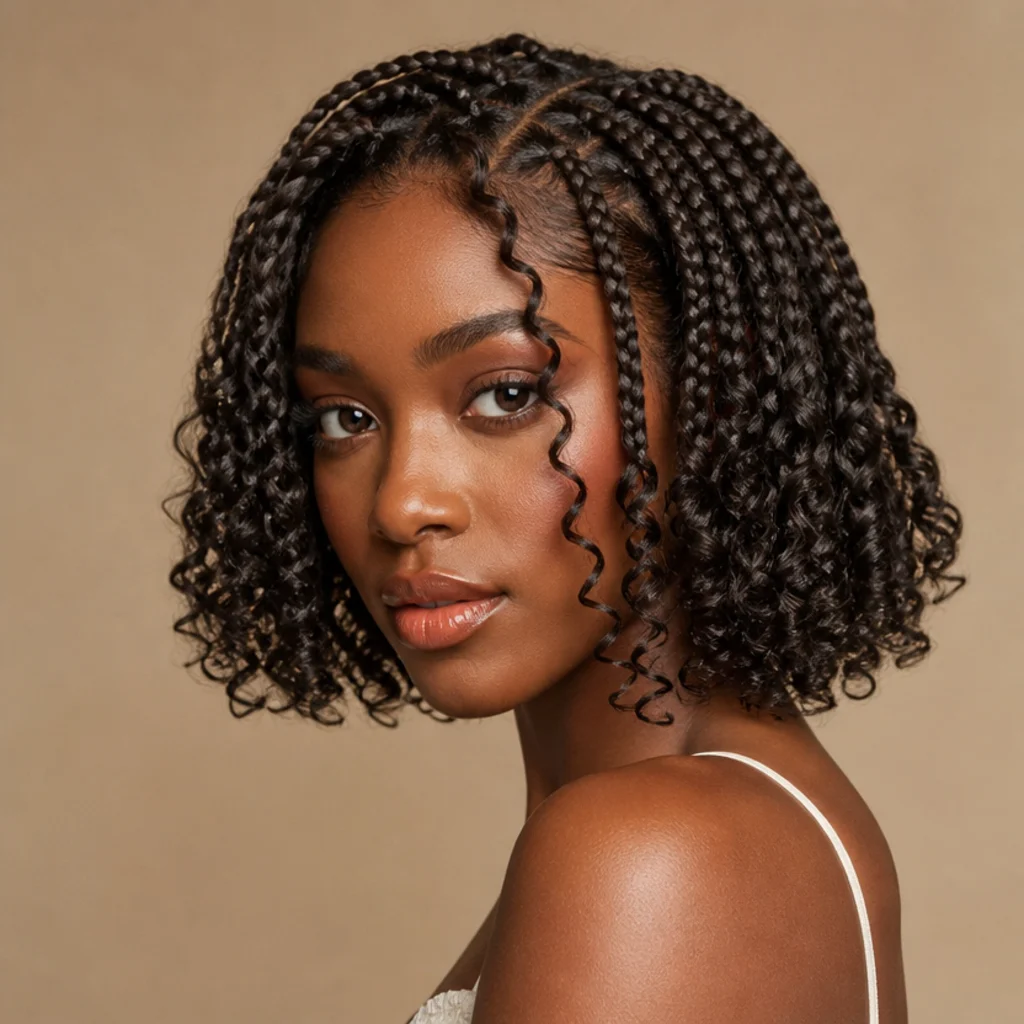
The finale combines two of the best ideas on this list: a curly-ended jumbo bob with two longer curly pieces left loose at the front to frame the face. The bulk sits at chin length with soft spirals for body, while the face-framing strands fall a touch longer, shaped to soften, lengthen, or narrow the face depending on where they land. It suits every face shape, since those two front pieces are adjustable and do the tailoring a one-length bob can't. Upkeep means refreshing all the curls with mousse or a curl spray as they loosen, and keeping the framing pieces defined and separated so they read as a deliberate design detail rather than stray braids escaping the set. Difficulty runs intermediate, for both the curl set and the placement of the framing strands. Pro tip: have the face-framing pieces cut to hit right at your collarbone or jaw, the same anchor points a hairstylist uses for flattering layers, so they highlight your best features instead of hanging at some random, unhelpful length. Ask for "a short jumbo box braid curly bob with two longer curly face-framing pieces," and specify exactly where you want those front strands to sit against your face, since a centimetre changes which feature they draw the eye toward.
Save this to Pinterest so the full set of 15 is ready when you book.
Pro Tips from the Editor
- Buy the right amount of hair. Jumbo box braids use fewer sections but more hair per braid, so three to five packs of pre-stretched braiding hair usually covers a short jumbo set, more if you want curly ends or a colored blend. Bring your own and you'll skip the shop markup and get to pick the exact shade number.
- Prep clean, stretched hair. Wash, deep-condition, and blow-dry or band-stretch your natural hair the day before. Braiding over damp or shrunken hair invites a mildew smell, root slippage, and early frizz; stretched hair also grips the braid more securely.
- Guard your edges from day one. If any section pings, throbs, or pulls at your hairline during install, say so right away and have it redone looser. Tension damage from that first row is the leading cause of thinning temples, and it's entirely preventable, never worth "letting it settle."
- Seal ends deliberately. Dip synthetic ends in near-boiling water or lightly singe them so blunt and curly lines stay crisp. Skip this step and bobs unravel and frizz within a week; that's the difference between a graphic line and a fuzzy one.
- Sleep like it matters. A satin or silk bonnet plus a satin pillowcase as backup is the single biggest factor in how long the style looks fresh. Even a chin bob benefits from being loosely gathered at night to stop friction at the perimeter.
- Refresh, don't neglect. Around week three, dilute a sulfate-free shampoo in an applicator bottle, cleanse the scalp directly in rows, and follow with a light oil. Clean roots extend wear and prevent the itch that tempts an early takedown.
- Take them down gently. Never rip braids out. Unravel, then detangle in sections with slippery conditioner and a wide-tooth comb, and expect a pile of shed hair, which is normal buildup released at once, not breakage.
How to Choose / Get the Look
Start with length, since that one decision shapes everything else. Ear-length reads boldest and needs the least upkeep, a chin bob is the classic, most flattering middle, and shoulder-grazing keeps the most styling options open, like buns and ponies. Match that to your face: blunt bobs sharpen round and heart shapes, curly ends and face-framing pieces soften square and angular ones, and a deep side sweep slims a broad forehead. Next, decide on finish. Blunt ends give structure, curly ends add movement, and beads or ombre bring personality, so pick one hero detail rather than stacking several and keep the look intentional. Jumbo braids expose more braiding hair per section, which means color carries extra weight, so hold any shade to your face in daylight before you commit. For comfort, jumbo knotless box braids are gentlest on edges and a sensitive scalp, while traditional jumbos give a fuller, more textured base and a slightly faster install.
Use this quick spec table to line the styles up side by side.
| Style focus | Best face shapes | Upkeep level | Difficulty | Standout detail |
|---|---|---|---|---|
| Chin / blunt bob | Round, heart, square | Low | Intermediate | Graphic, structured jaw line |
| Knotless short | All, esp. fine edges | Low | Intermediate | Flat, tension-free roots |
| Curly ends | Square, angular, oval | Medium | Intermediate | Soft face-framing bounce |
| Color (blonde, ombre, two-tone) | Matched to undertone | Medium | Beginner | Dimension and warmth |
| Ear-length crop | Angular, oval | Lowest | Beginner | Bold statement shape |
It also helps to match the length to how much hair to buy and what you can realistically style, so use this second guide before you shop.
| Length | Approx. packs | Curl / color add | Styles it allows |
|---|---|---|---|
| Ear-length crop | 2–3 | +1 for curls | Down only, rounded shape |
| Chin bob | 3–4 | +1 for curls or color | Down, deep side part, small clip-back |
| Shoulder-grazing | 4–5 | +1–2 for curls or color | Half-up bun, low pony, side sweep |
When you book, bring one clear photo, name the length against a body landmark such as the chin or shoulder, and specify your parting pattern, whether square, triangle, center, or deep side. Tell your braider about tender areas so the first sections stay airy, and plan upkeep in advance: bonnet nightly, oil the scalp lightly twice a week, cleanse around week three, and refresh roots around week four to six.
Frequently Asked Questions
How long do short jumbo box braids last?
Most sets look their best for four to six weeks. The shorter length tangles far less than long braids, so the braids themselves stay neat, but new growth lifting the roots is usually the real signal that it's time to take them down or refresh the front. Cleansing the scalp around week three, oiling lightly, and wrapping at night can stretch that window comfortably; curly and ombre versions may want a mid-cycle product refresh sooner.
Are jumbo box braids faster to install than smaller braids?
Yes, noticeably. The sections are so wide that there are far fewer braids to complete, often 30 to 40 for a full short head, so a set frequently goes in within two to three hours rather than the six-plus a small or medium install can take. That shorter chair time is also why jumbo sets usually cost less than smaller styles of the same length, since most braiders price partly by the hour.
Do short jumbo braids put less tension on the scalp?
Shorter braids weigh less, which cuts down on pulling at the nape and hairline compared with a long jumbo install. Jumbo knotless box braids reduce tension further, since the feed-in root lies flat instead of building a knot at the base. The bigger factor, though, is how tightly the braider grips at the root, so speak up the moment anything feels sore during the install rather than hoping it eases afterward. Early soreness rarely settles on its own.
Can I add curls to a short jumbo bob?
Yes, and it's one of the most requested finishes. Curls come from leaving the last few inches of each braid unbraided in water-wave or curly hair, then dipping the ends in hot water to set the spiral, usually starting just below the chin. You can choose tight ringlets or a looser beach wave depending on the hair type, and revive the pattern at home with a little mousse or a curl-refresh spray as the curls relax; scrunch, don't comb.
What parting pattern works best for jumbo braids?
Square sections are the standard and the most forgiving, but triangle parts add a geometric, honeycomb look with a little extra crown lift, and center or deep side parts change the whole shape and face-framing effect. On jumbo braids, even sizing matters most of all, since any unevenness in the parts shows quickly on sections this wide. Decide the pattern before booking and confirm your braider is comfortable executing it, since not everyone triangle-parts by default.
How much hair do I need for short jumbo box braids?
For a short jumbo set, three to five packs of pre-stretched braiding hair is a typical range, with an extra pack or two if you're adding curly ends or a colored blend. Buying your own hair lets you control the exact shade number and quality, and it usually costs less than the shop-supplied packs. Ask your braider for their preferred brand and pack count before your appointment, and buy one spare to be safe.
Are short jumbo braids good for fine or thinning hair?
They can be a kind choice, since fewer, lighter braids mean less overall pull than a heavy long style. The safest route for fine strands or fragile edges is jumbo knotless with deliberately loose tension around the hairline, skipping beads or heavy ends that add drag, and keeping the front sections airy. Give your scalp a rest of a week or two between installs so it isn't under constant tension, and stop if you see recurring soreness or shedding at the temples.
Can I wash short jumbo box braids?
Yes, and you should. Around week two or three, dilute a gentle sulfate-free shampoo in an applicator bottle, apply it directly to the scalp in rows, massage lightly without ruffling the braids, and rinse thoroughly. Follow with a leave-in mist and let the braids fully air-dry, ideally with a bonnet dryer or plenty of time, since trapped moisture at the roots causes odor and mildew. For colored sets, stick to color-safe products so the tone holds.
Do short jumbo braids work for all hair textures?
Yes. Box braids install over any natural texture from loose curls to tight coils, since the braiding hair carries the length and shape, not your own hair. The main variable is grip: very smooth or freshly conditioned natural hair can slip at the root, so stretched, product-free hair on install day gives the braids a more secure, longer-lasting base. A light braid-grip mousse can help the first inch hold if your texture runs especially silky.