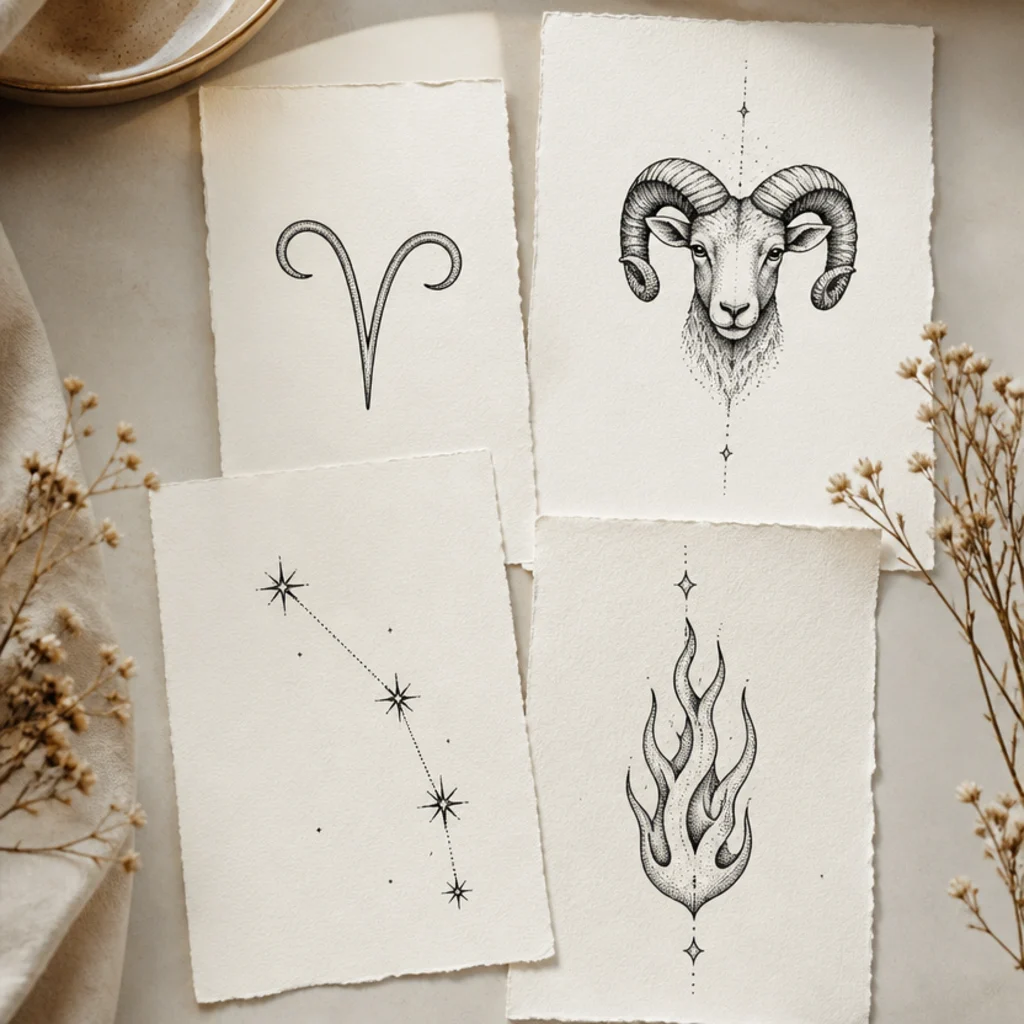
25 Dreamy Aries Constellation Tattoo Ideas
Aries is a compact four-star line, which makes it one of the most versatile zodiac motifs to wear at any scale. These 25 ideas run from whisper-quiet dotwork to bold ram-and-fire statements, each with the shade, placement, sizing, and upkeep detail you'll need to brief an artist with confidence.
 Edited by Lena Rose · Published July 11, 2026 · 38 min read
Quick Answer
- Best for: Aries-born folks (roughly March 21–April 19) and anyone drawn to star maps, rams, and fire symbolism; the linework reads cleanly across skin tones and body placements.
- Who might skip it: Anyone wanting a large color statement on a tight budget, or those set on a hand, finger, or foot placement where fine star lines blur fastest.
- Maintenance: Fine-line and micro star patterns want diligent SPF and a touch-up every few years; blackwork and bold ram or fire pieces hold their edges far longer between refreshes.
- Difficulty: Ranges from beginner-friendly minimalist dot clusters to advanced illustrative ram, micro-realism, and goddess compositions.
- Cost: Varies widely by region, artist demand, size, and detail; small line pieces sit near a shop minimum, while illustrative or full-color work is priced by the hour and can run several sessions.
- Wear time / longevity: Blackwork and dotwork age most gracefully; watercolor, fine white ink, and delicate single-line work soften soonest.
- Standout variation: A fine-line Aries constellation woven with a single ram silhouette and a flicker of fire.
- How to ask your tattoo artist: Bring two or three references and say you want the four Aries stars kept to accurate proportions, with line weight and spacing chosen to age well on your skin.
In This Guide
- Minimalist Fine-Line Aries Constellation
- Dotwork Star Map on the Forearm
- Aries Ram Head with Constellation Horns
- Watercolor Nebula Aries
- Bold Blackwork Aries Tattoo for Men
- Aries Fire and Constellation Fusion
- Aries Flower Tattoo with Honeysuckle
- Behind-the-Ear Micro Constellation
- Aries Goddess Portrait
- Geometric Aries with Sacred Lines
- Spine Constellation Column
- Aries Ram in a Celestial Circle
- Collarbone Star Trail
- Aries Glyph and Constellation Combo
- Fine-Line Ram Silhouette with Flames
- Moon-Phase and Aries Constellation
- Ankle Constellation Bracelet
- Aries Fire Tattoo Sleeve Accent
- Negative-Space Ram and Stars
- Aries Wildflower and Star Cluster
- Matching Couple Aries Constellations
- Aries Goddess with Fire Crown
- Sternum Constellation Centerpiece
- Micro-Realism Ram and Star Chart
- Full-Color Cosmic Aries Ram
Aries (the Ram) is one of the smaller zodiac constellations, anchored by just a few bright stars, Hamal, Sheratan, and Mesarthim, in a short bent line. That simplicity is exactly why it wears so well: it reads clearly at a couple of inches or blown up into a full illustrative scene, and it slots neatly around the curves of a wrist, collarbone, or spine. Below are 25 distinct directions. Several are tuned as an aries tattoo for men who want something graphic and grounded, using a bold ram head, heavy blackwork, or fire as the anchor; others lean celestial, floral, or mythic for a softer read. As you scroll, weigh the placement and upkeep notes carefully, because a star map on a high-friction spot like the hand or ankle wears very differently from one sheltered along the ribs or inner arm. Aries pairs naturally with ram, fire, and goddess symbolism, and the strongest pieces usually commit to one clear focal element rather than crowding several. Treat this as a starting library: shortlist your two or three favorites, then bring them to a licensed artist who can adapt the linework, sizing, and shading to your body, undertone, and the way your skin heals.
01Minimalist Fine-Line Aries Constellation
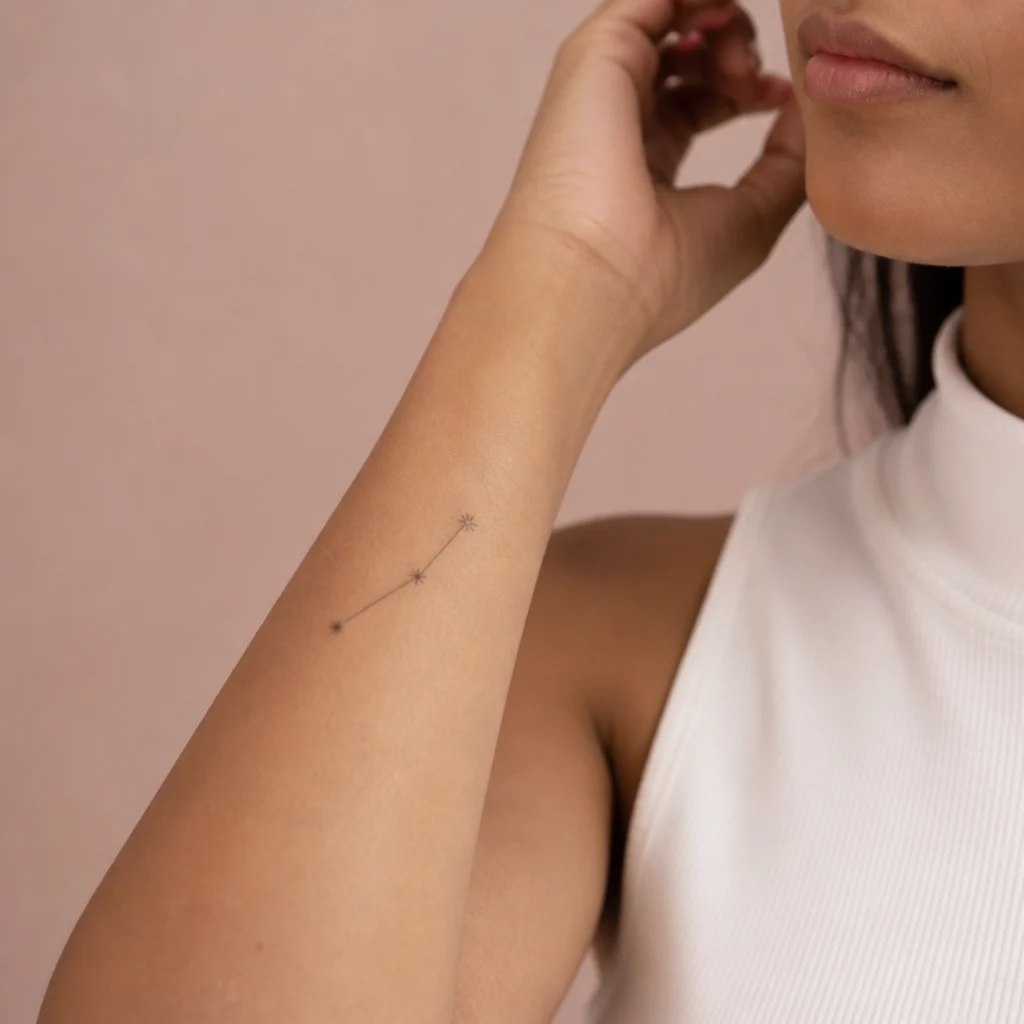
The purest version: the four Aries stars connected by a single hairline path that traces the constellation's actual bend, kept to a couple of inches or less. It suits slim, low-friction spots, the inner forearm, inner wrist, or the ankle bone, where skin stays relatively still and the line reads crisp. Single-needle work lays down very little pigment, so it will soften and lighten over five to ten years; plan for one touch-up in that window. On deeper skin tones a whisper-grey line can disappear, so ask your artist to test a warm-black at a slightly heavier weight, which holds contrast far better than pale grey. Keep star sizes varied to hint at Hamal being the brightest, and let generous negative space do the work rather than crowding in background specks. Pro tip: have the artist stencil it seated and standing, since inner-arm skin shifts and you want the line straight in the position you show it most. Ask your tattoo artist for a "single-needle, low-saturation" line if you want it to stay delicate.
02Dotwork Star Map on the Forearm
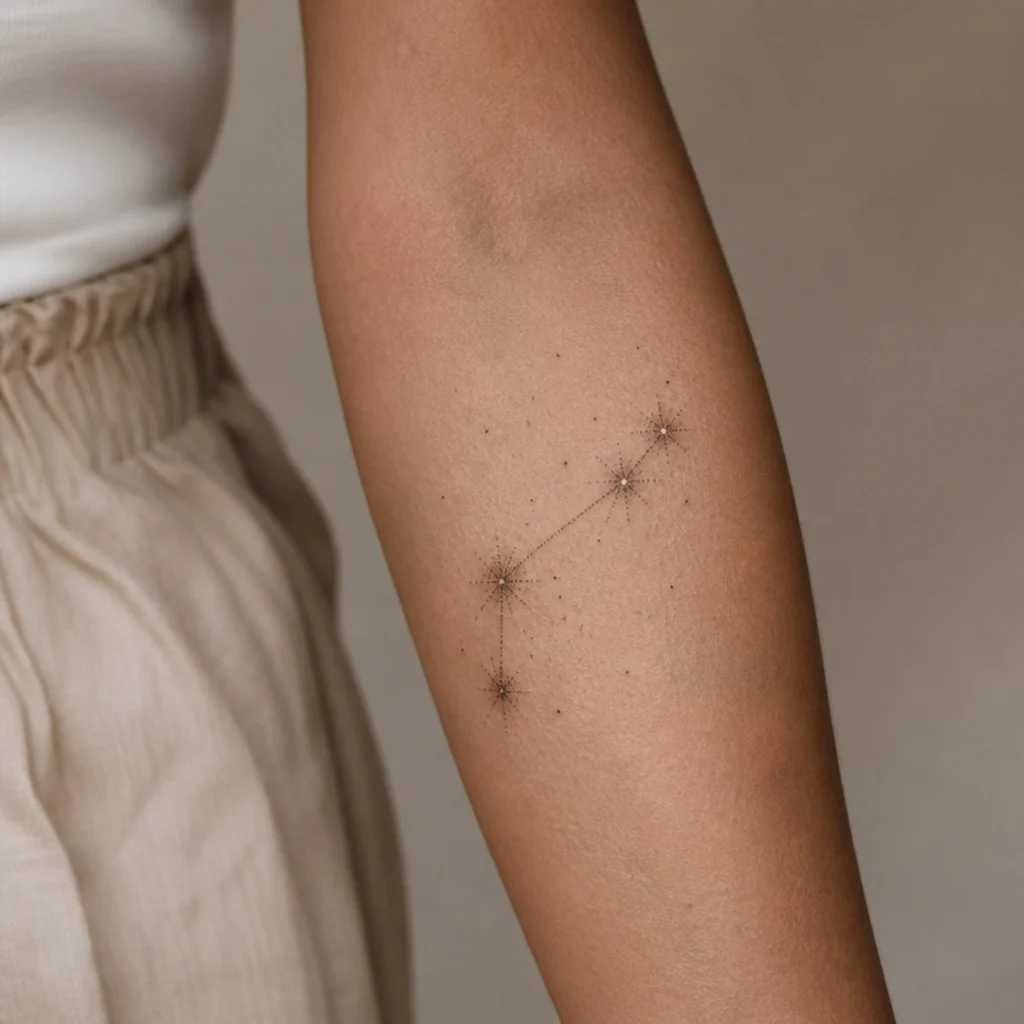
Instead of solid points, each star is built from clustered stipple that fades at the edges, giving a soft, printed-on-paper feel. Dotwork ages unusually well because stippling blurs slowly and evenly instead of bleeding into a solid blob the way a thin line can. The outer or inner forearm gives enough length to space the four stars to accurate proportions and scatter faint background specks for a night-sky drift. Density is the whole game: tightly packed dots read as bright stars, loose dots as distant ones, so the piece gets depth without any grey wash. Expect a longer session than a plain line, since stippling by hand is slow, and budget accordingly if your artist charges hourly. It suits people who like quiet, considered detail over bold graphics, and it layers well with a later moon or planet. Worth asking for: graduated dot sizes rather than uniform ones, which is what keeps stippled skies from looking mechanical. Ask your tattoo artist for "hand-poked or machine dotwork with graded density" so the stars carry real dimension.
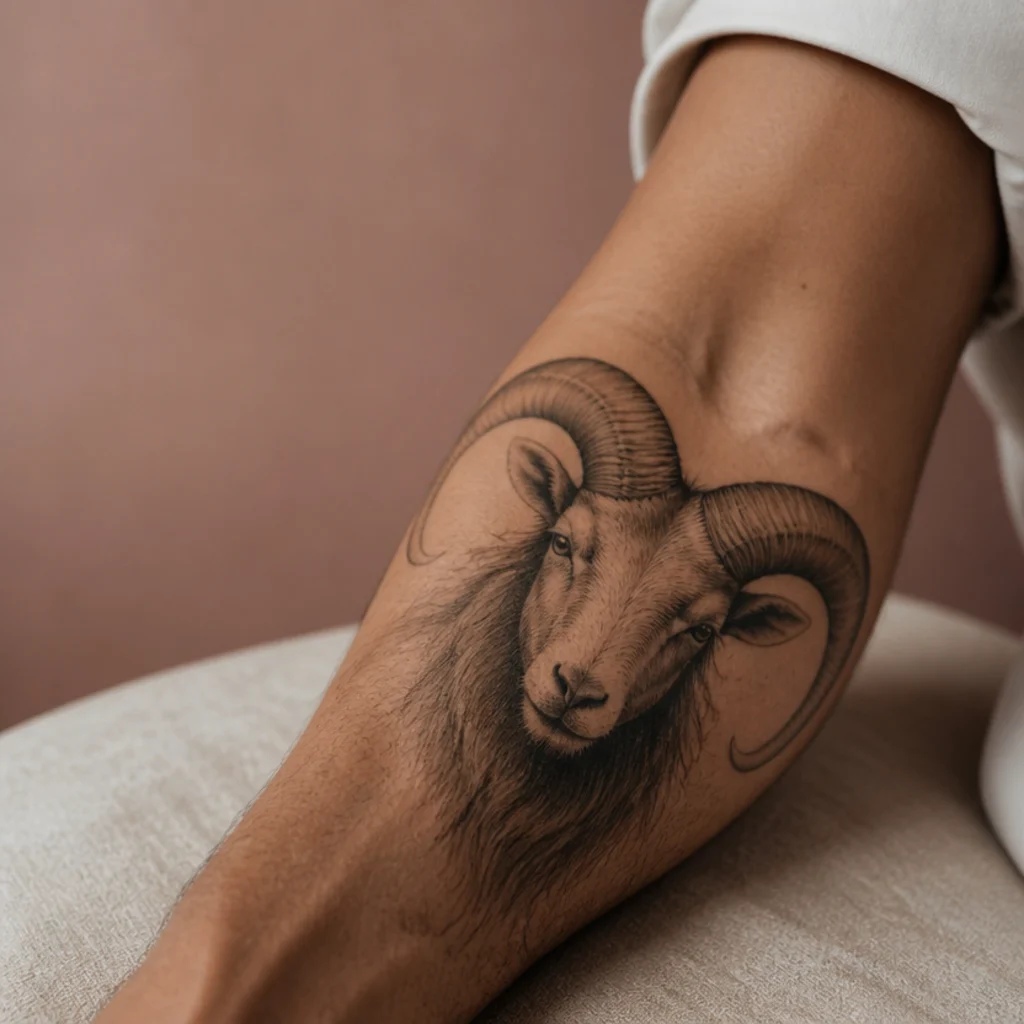
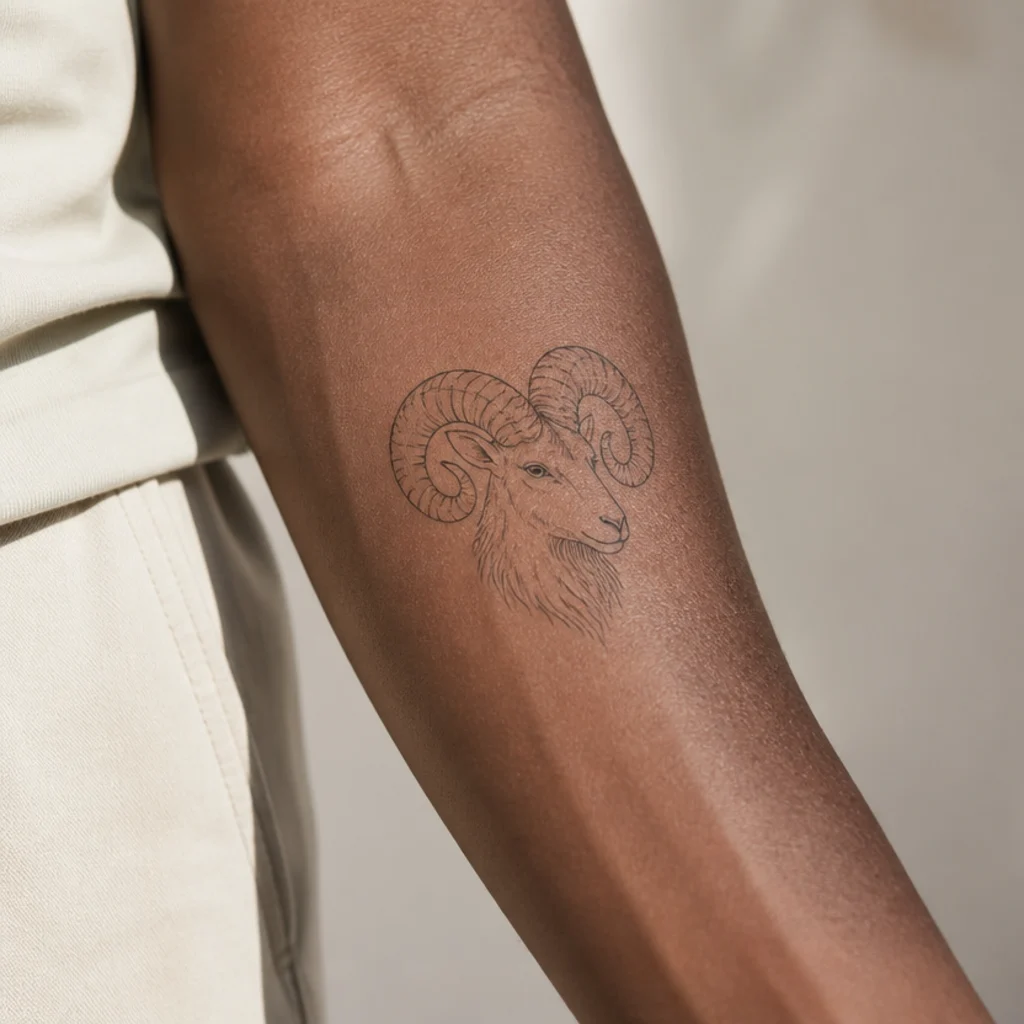
03Aries Ram Head with Constellation Horns
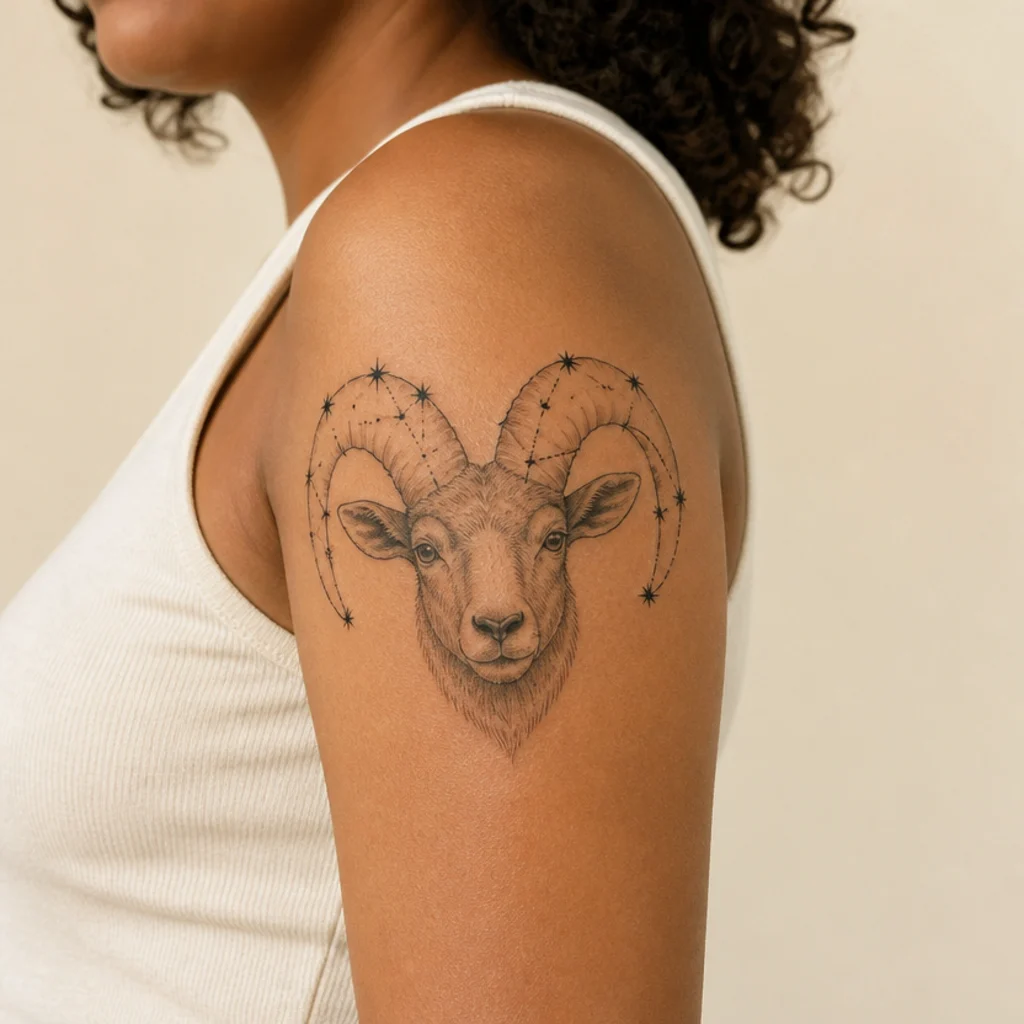
Here the classic aries ram tattoo meets the star map: the ram's curled horns are drawn as constellation lines, with a star seated at each turn of the spiral. It's a neat two-in-one that signals the sign without any text or glyph. Give it a medium canvas, the upper arm, outer calf, or shoulder blade, so the horn curls keep their legibility as skin moves; squeezed onto a wrist, the spirals muddle. You can push it two ways: soft black-and-grey shading on the muzzle and brow for a naturalistic ram, or pure fine linework for a graphic, badge-like read. Keep the eye and nostril simple, since over-rendered ram faces read as heavy and age poorly. This is a strong pick for an aries tattoo for men who want the animal symbolism front and center while keeping the celestial thread intact. Ask to see the horn geometry mocked up over a photo of the actual placement first, because the curl has to follow your muscle, not fight it. Ask your tattoo artist for "constellation-integrated horns" so the stars structure the shape rather than sit on top of it.
04Watercolor Nebula Aries
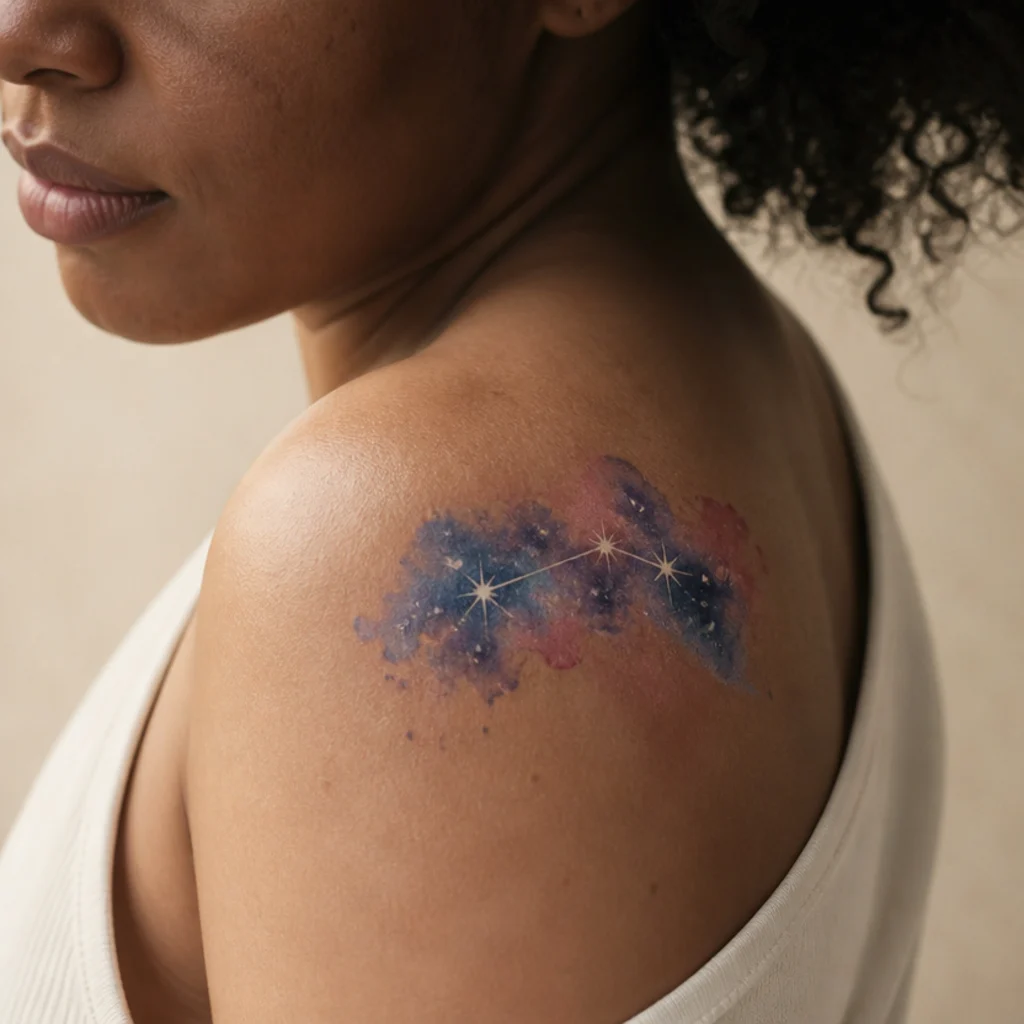
Set the constellation against loose watercolor washes, cobalt into violet with a breath of blush, so the stars float in a pocket of galaxy. It's dreamy and expressive, a good fit for anyone who loves color and painterly movement. Be clear-eyed about upkeep, though: watercolor's soft, edgeless bleeds carry less pigment than lined-and-filled work, so they can fade and haze sooner and often want a refresh within a handful of years. Vivid blues and violets also read differently over different undertones, so ask your artist to adjust value and saturation for your skin rather than copying a reference exactly. The shoulder, outer thigh, or upper back gives the washes room to breathe without crowding. Anchor the piece with fine white or negative-space stars and at least a thread of dark line so the constellation still reads once the color settles; pure watercolor with no structure tends to lose definition first. Worth requesting: a subtle black or deep-navy "skeleton" under the color for longevity. Ask your tattoo artist for "watercolor with a fine grounding line" so it holds shape as it heals.
05Bold Blackwork Aries Tattoo for Men
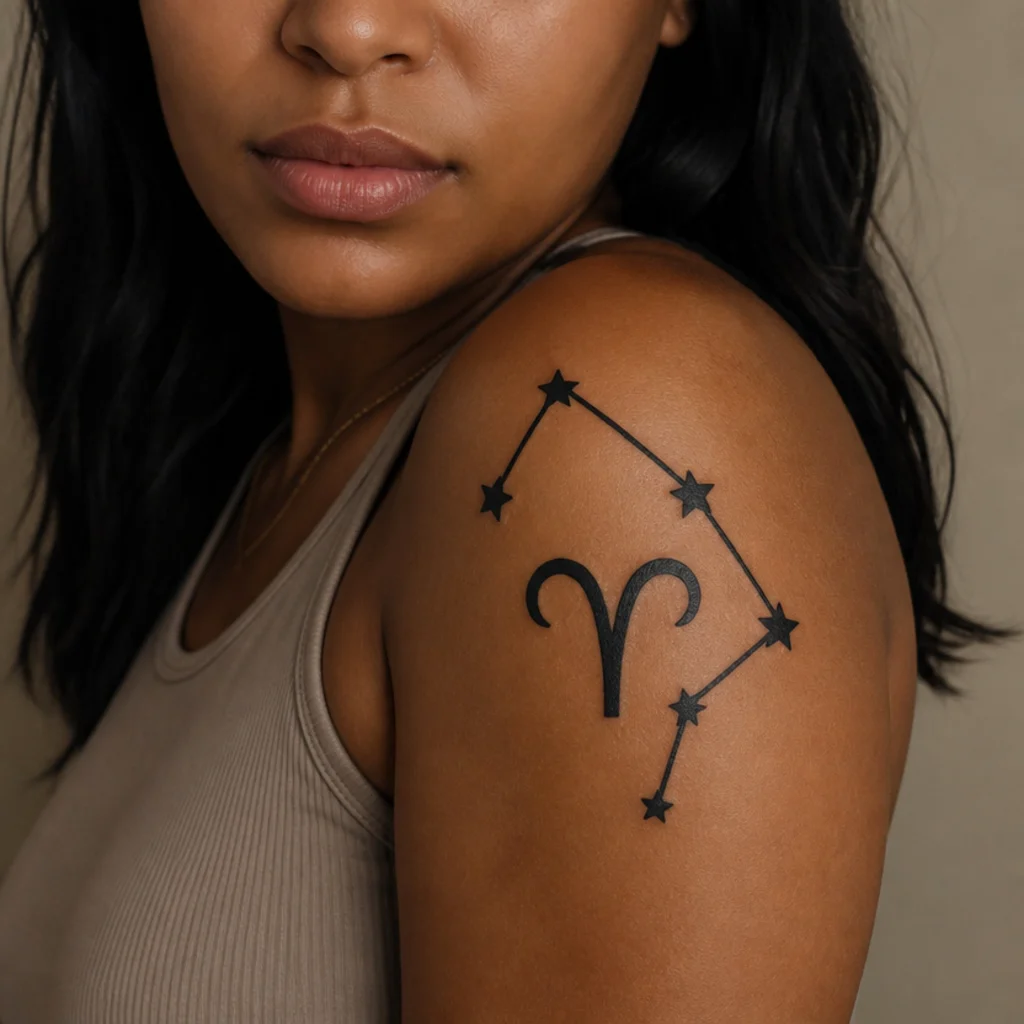
For a graphic, high-contrast look, go heavy: solid filled stars, thick connecting lines, and often a bold ram glyph anchoring the composition. Blackwork is one of the most durable choices in tattooing; dense saturation resists fading and holds a crisp edge for years, which makes it a practical aries tattoo for men who want strong visual weight and low upkeep. The shoulder, chest, or outer forearm carries that density best, where flat planes let the solid black stay even. The make-or-break factor is saturation: patchy fill is the most common blackwork flaw, so choose an artist whose healed blackwork photos show solid, uniform coverage, not just fresh shots. If you want depth, soften the graphic punch with a few open-line or dotwork stars orbiting the solid core, which reads as near and far without diluting the impact. Good to ask about: on larger solid areas, whether a second saturation pass at the touch-up stage is included, since big black fills sometimes heal unevenly and benefit from it. Ask your tattoo artist for a "bold blackwork Aries with even solid fill."
Save this to Pinterest to compare bold blackwork against the softer fine-line options above.
06Aries Fire and Constellation Fusion
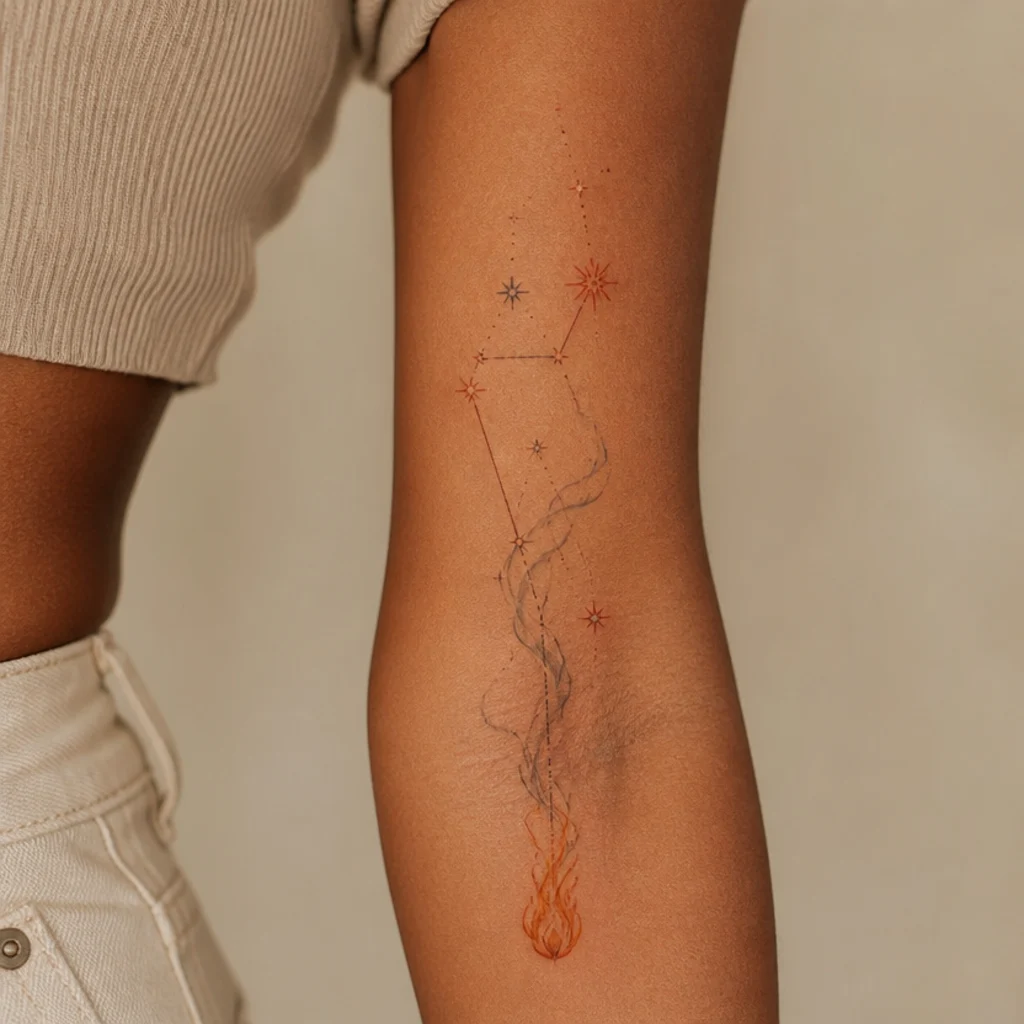
Aries is a cardinal fire sign, so folding flame into the star map fits the symbolism neatly. Picture the constellation rising out of a low, stylized flame, or the connecting lines dissolving into thin wisps of fire at the tips. This aries fire tattoo can stay monochrome black-and-grey for a moody, smoky read, or add warm orange, amber, and gold for literal heat. Its natural flow is vertical, so the inner forearm, outer calf, or the ribs suit it, following the direction real flame moves. Keep the fire stylized and graphic rather than photo-real; hyper-realistic flames rely on fine value transitions that soften and lose legibility at small scale. If you go color, put the warm tones in the flame and keep the stars cool or plain so the two elements stay distinct. One thing that helps: ask for the flame to read clearly as a silhouette first, then add interior detail, since a shape that works in pure black will survive years of settling. Ask your tattoo artist for "stylized flame with a legible silhouette."
07Aries Flower Tattoo with Honeysuckle
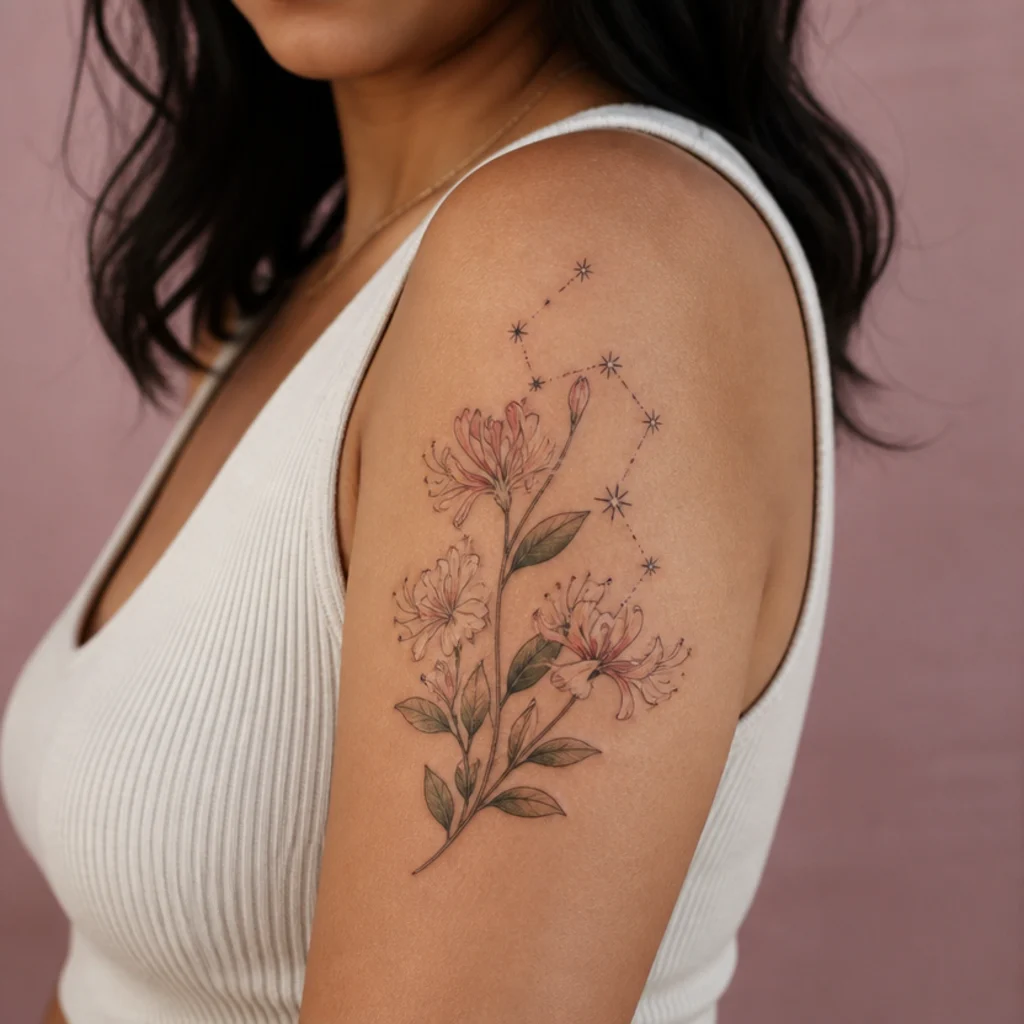
Honeysuckle is Aries' traditional birth flower, and thistle is often linked to the sign too, which makes an aries flower tattoo a softer, symbol-rich way to nod to it. Weave the four-star line through a loose spray of blooms so the stars peek between petals like they've settled there. It balances celestial and botanical, appealing to anyone who wants something organic rather than purely graphic. The upper arm, inner forearm, or shoulder gives the florals room to curve with the limb. Fine botanical linework lives or dies on spacing: petals and stems drawn too close will bleed together as the tattoo heals and the lines spread slightly with age, so ask your artist to open up the negative space more than looks necessary on paper. Add muted, desaturated color, dusty coral or sage, if you want warmth, or keep it all black and grey for a classic finish that ages predictably. Practical tip: choose a few "hero" blooms to render in detail and keep the rest as suggestion, which stops the piece from turning into a solid mass over time. Ask your tattoo artist for "open-spaced honeysuckle with a woven constellation."
08Behind-the-Ear Micro Constellation
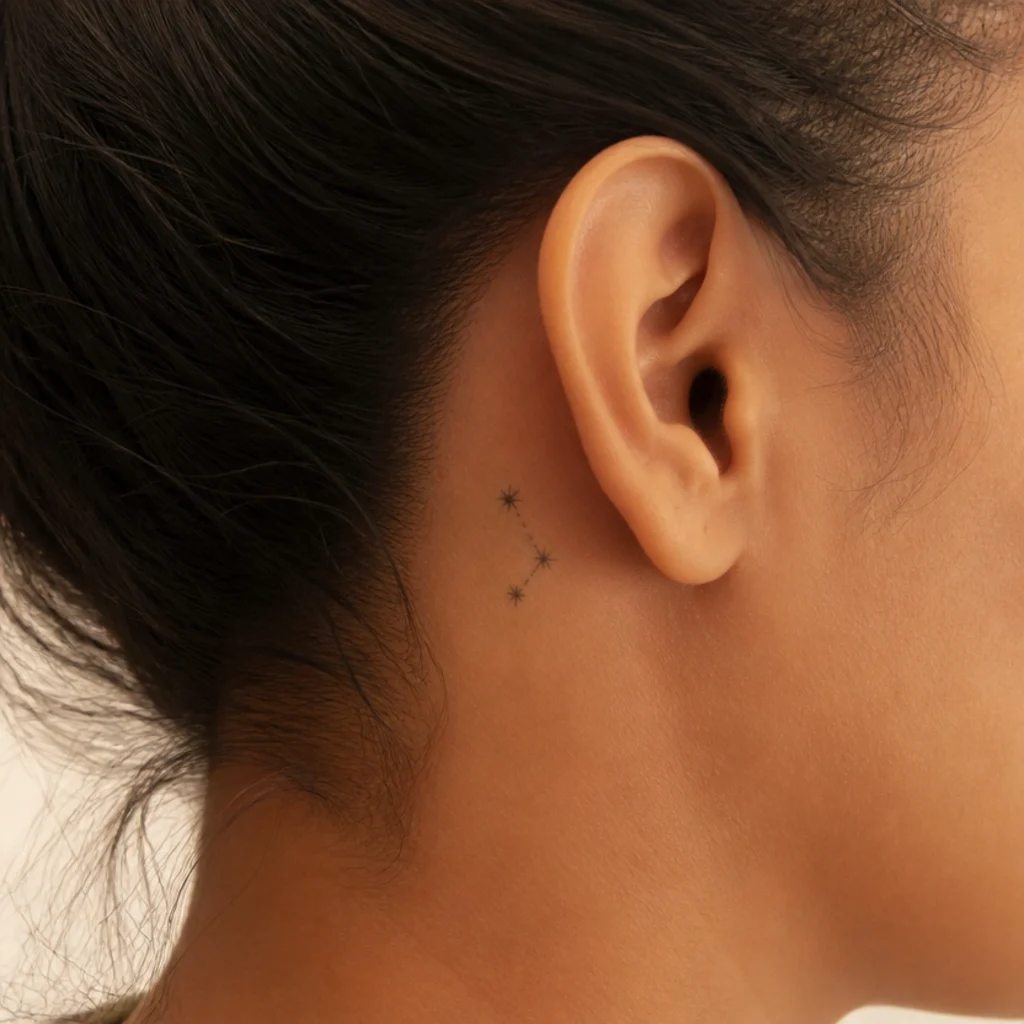
A whisper of a piece: the Aries stars, tiny, behind the ear, joined by the faintest thread and revealed only when hair is tucked back. This one's for people who want their sign present but nearly private. Be realistic about the trade-off, though: skin behind the ear is thin, mobile, and close to the hairline, so micro work here blurs faster than almost anywhere else, and single-needle detail can fill in over a few years. Keep it to three or four points with deliberate breathing room, avoid any interior star detail that will merge, and accept that a refresh is part of the deal. It sits quickly, an appealing low-commitment first tattoo, and pairs neatly with other small ear or neck pieces. At this scale a millimeter changes the whole shape, so nail the star spacing at the stencil stage. Good to know: ask the artist to place it slightly higher and more forward than feels obvious, so it stays visible when your hair is down and doesn't vanish into the crease. Ask your tattoo artist for a "simple micro constellation with maximum spacing."
09Aries Goddess Portrait
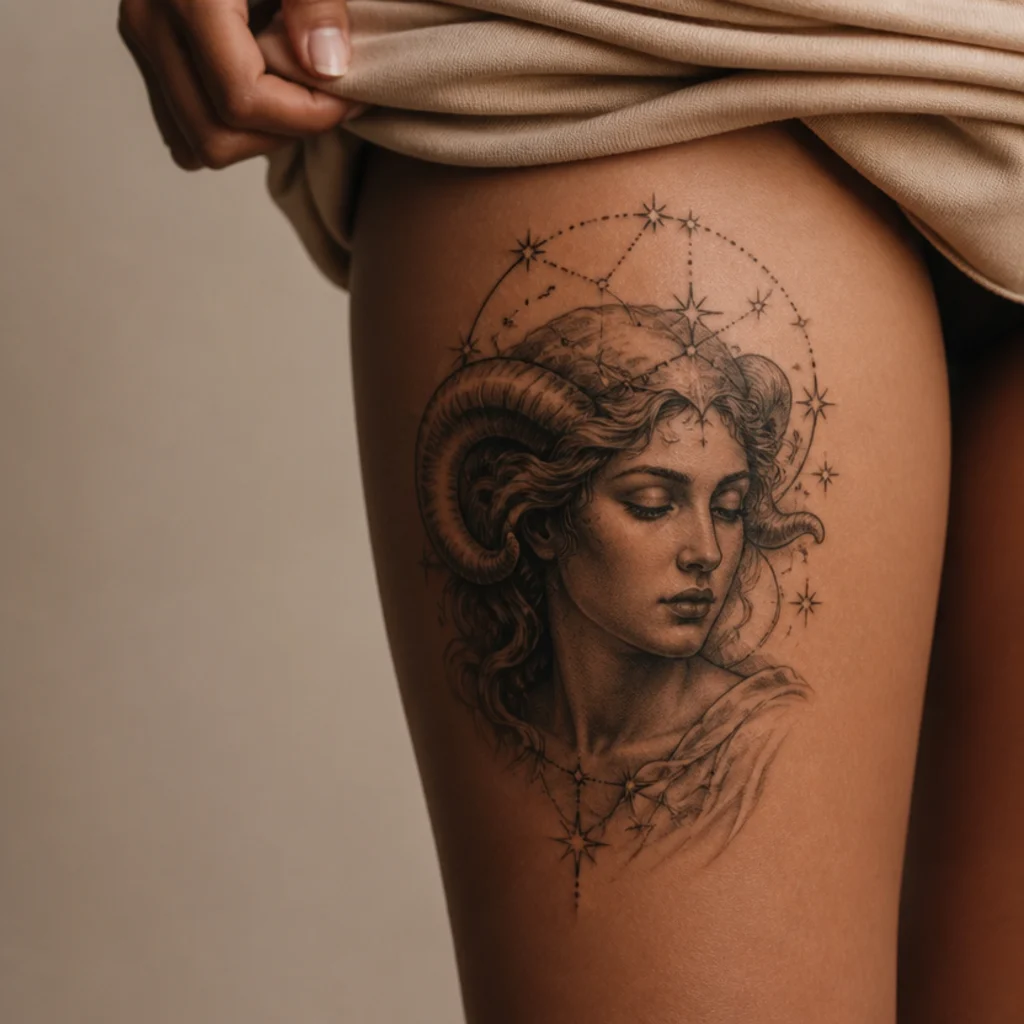
An aries goddess tattoo turns the sign into a figure: a calm feminine face crowned with subtle ram horns and a halo of constellation stars. This illustrative direction carries real presence and needs a larger, flatter canvas, the outer thigh, upper arm, or upper back, so the features stay in proportion and read from a normal viewing distance. Fine black-and-grey shading gives the face its dimension, while the star halo keeps the zodiac reference unmistakable. Portraits are among the least forgiving styles: a slightly-off eye or lip reads wrong forever, and heavy shading can go muddy as it heals, so vet the artist on healed illustrative faces, not just crisp fresh photos. Ask specifically how their soft grey shading has settled after a year. It rewards someone who connects with Aries as an archetype of courage and initiative rather than a date range on a calendar. Worth remembering: keep the horns and halo delicate so they frame the face instead of competing with it; the portrait should be the hero. Ask your tattoo artist for "black-and-grey portrait with a fine ram-horn crown."
10Geometric Aries with Sacred Lines
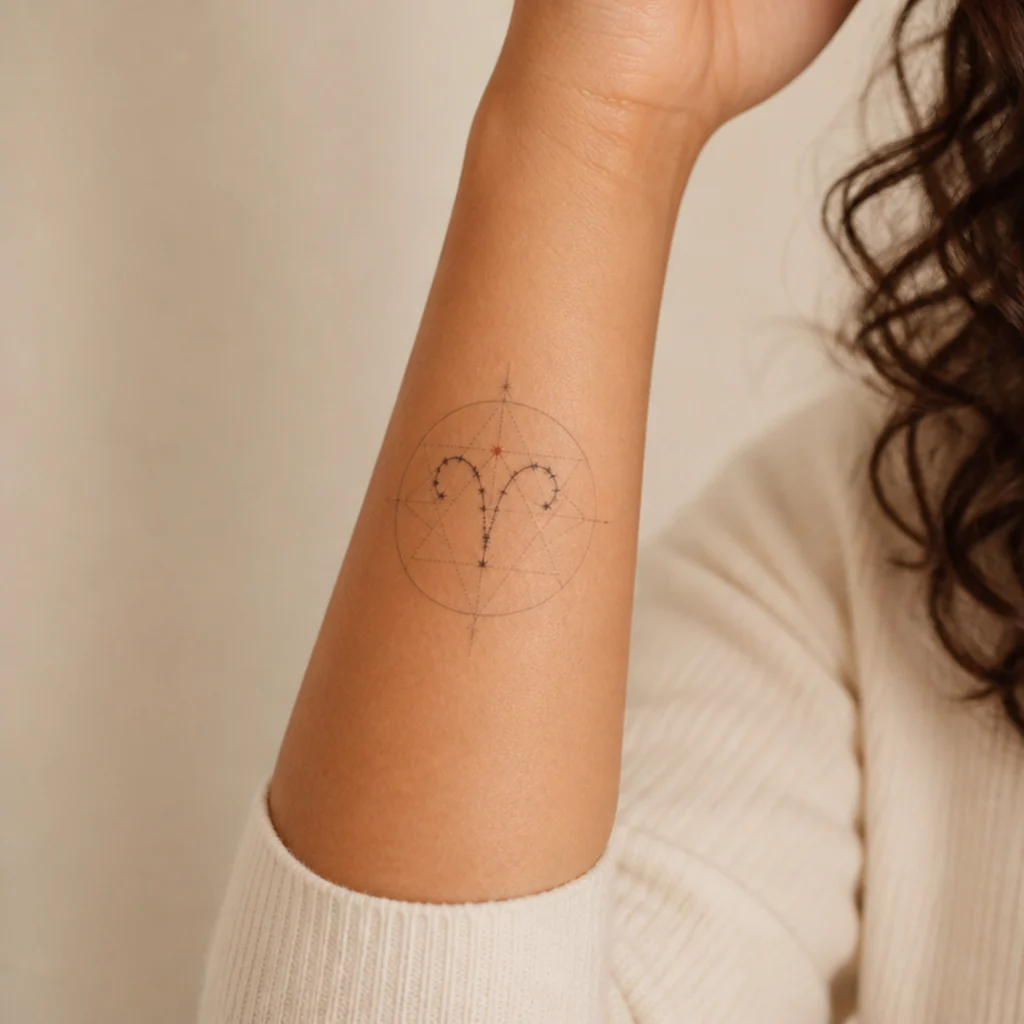
Frame the constellation inside crisp geometry: a thin circle, a few intersecting axes, or a light mandala backdrop that gives the loose star pattern a sense of order. It reads modern and architectural, and it looks especially sharp on flat, stable canvases like the outer forearm or the front of the calf, where straight lines stay straight. Precision is everything here: a geometric circle telegraphs any wobble far more than an organic shape does, so this is a piece for an artist with clean, confident line control and, ideally, one who uses a stencil rather than freehanding the frame. Keep the geometry minimal and subordinate; its job is to hold the stars, not out-shout them. A single dot of color at the brightest star (Hamal) makes a subtle, effective focal accent without breaking the monochrome discipline. Small detail that matters: ask for the circle to be drawn with a template or ellipse guide, not freehand, since healed skin is unforgiving of an off-round frame. Ask your tattoo artist for "clean sacred-geometry framing with a stencilled circle."
Save this to Pinterest and start a shortlist of your top three so far.
11Spine Constellation Column
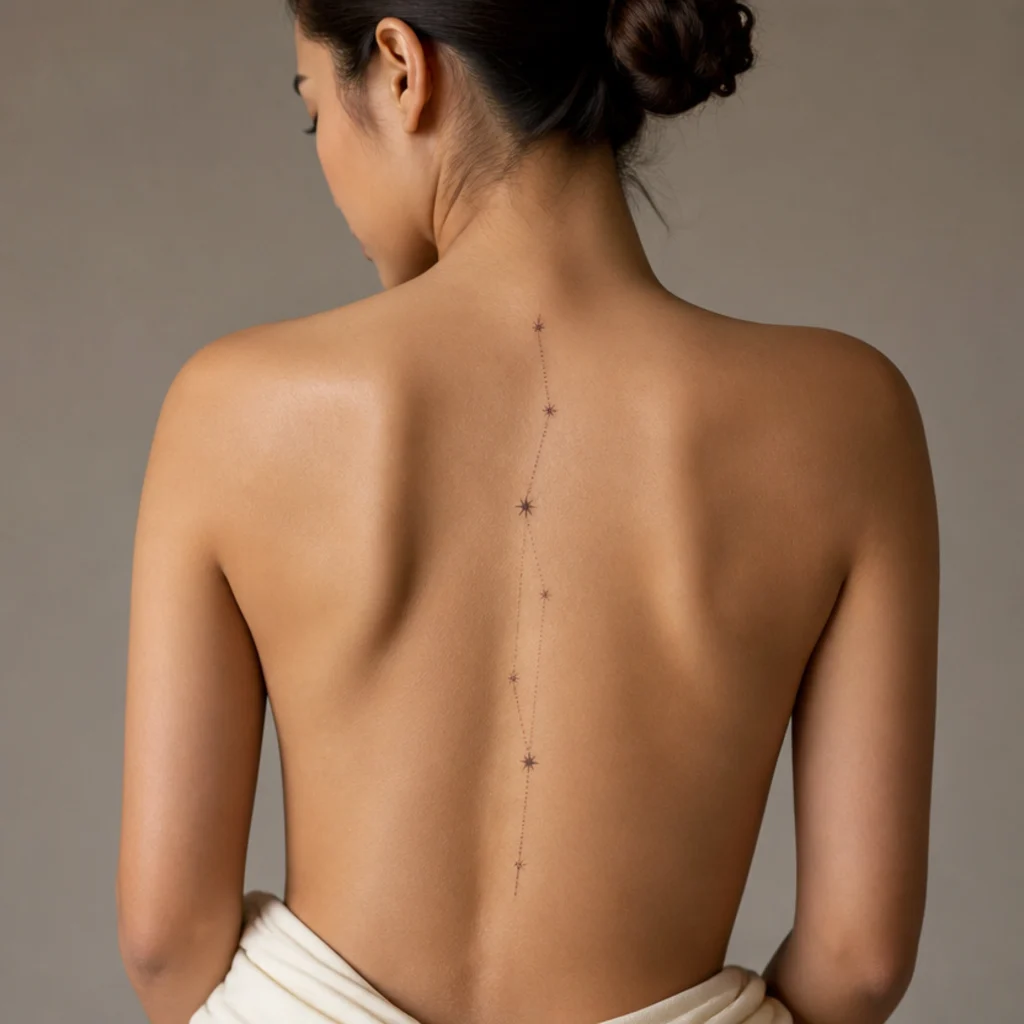
Run the constellation vertically down the spine so the stars follow the body's central line: elegant, elongating, and easy to scale up with generous spacing. The placement gives you room to space the four stars widely, or to treat this as the starting axis of a larger back piece added later. Two practical notes shape the decision: the spine sits close to bone with thin padding, so many people find it a more sensitive area to tattoo, worth discussing session length and breaks with your artist; and a long vertical line demands the artist keep it straight along a curving, breathing back, which is harder than it looks. Keep the stars evenly weighted top to bottom so the column stays balanced, and let the spacing breathe, since cramped spine pieces lose their elongating effect. It suits people who want something striking but easily covered by everyday clothing. One detail worth getting right: have the alignment marked while you stand naturally, not while you're hunched on the table, so the finished line reads vertical when you're upright. Ask your tattoo artist to "map the column to your standing spine line."
12Aries Ram in a Celestial Circle
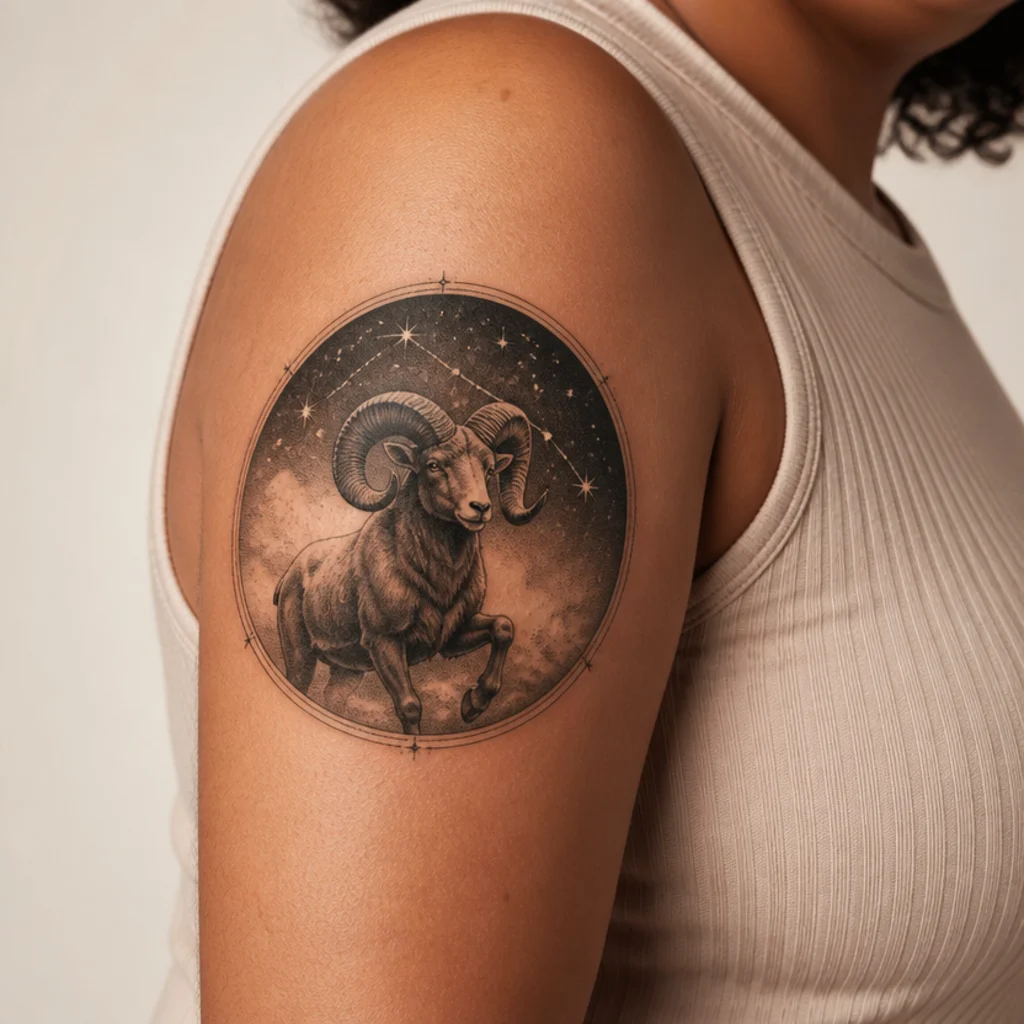
Set a full aries ram tattoo inside a circular night-sky frame, with the constellation scattered in the background behind the animal, like a window cut into the cosmos. The containing circle gives it a polished, badge-like quality that feels finished on its own. The upper arm, shoulder cap, or outer thigh holds a round composition well, since those areas let a circle stay round rather than distorting over a sharp curve. The design challenge is depth without clutter: keep the ram as the crisp foreground hero and push the background stars into soft dotwork so the sky recedes instead of fighting the animal. Balanced shading is what stops the ram from getting lost; aim for clear tonal separation between subject and sky. This makes a satisfying medium-to-large piece for anyone who wants both the animal and the star map in one contained scene. Nice touch: ask for the ram to sit slightly off-center or breaking the circle's edge, which reads more dynamic than a perfectly centered specimen. Ask your tattoo artist for "a framed ram with a receding dotwork sky."
13Collarbone Star Trail
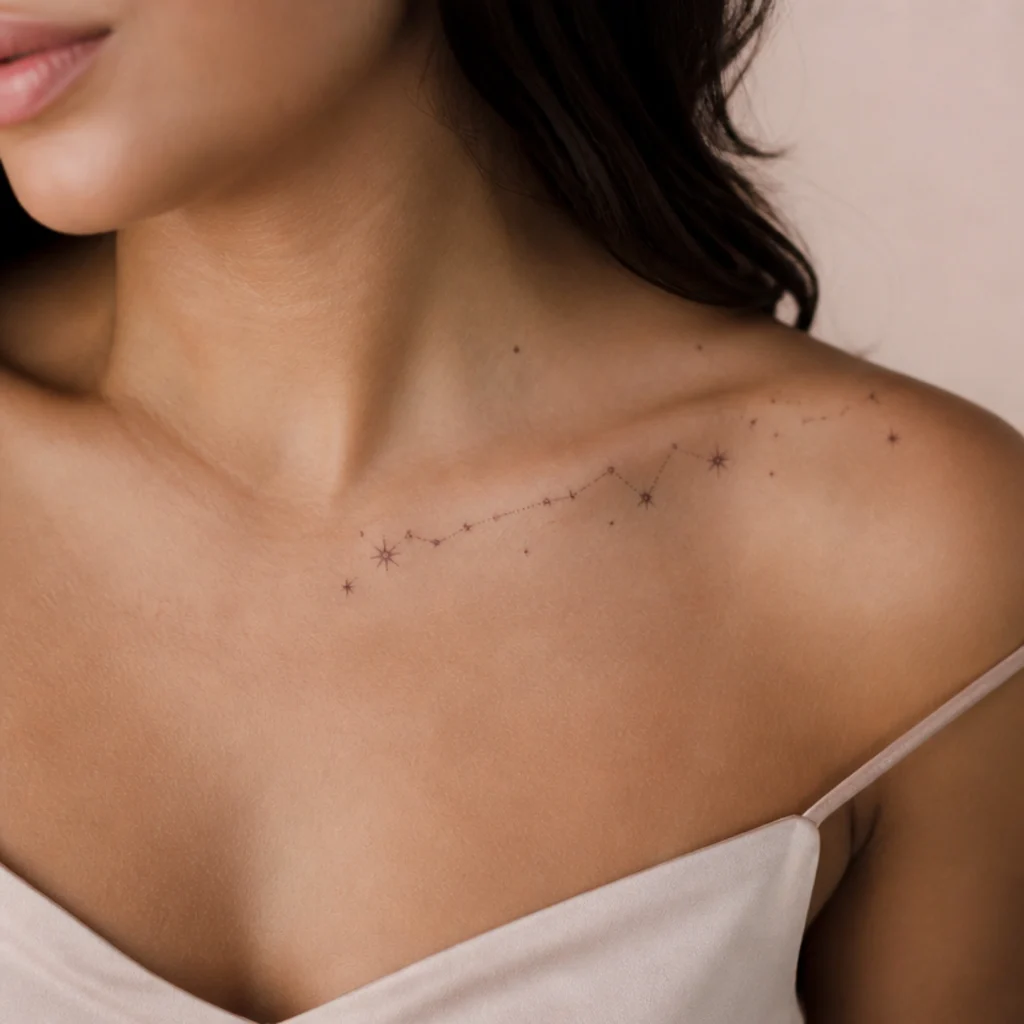
Let the stars trail along the collarbone, following the natural line of the bone so the constellation feels tailored to your body and peeks out of a wide neckline like fine jewelry. It's a flattering, delicate placement that reads well on anyone despite its softer, ornamental feel. Two things to plan for: the skin over the collarbone is thin and moves with shoulder and arm motion, so keep the design airy and the line light, since dense or crowded work here is more likely to spread; and the bone's angle shifts noticeably between sitting, standing, and reaching. Because of that movement, positioning has to be checked live. Have your artist mark it while you're seated and standing so it sits evenly in the poses you actually hold. A few scattered background specks can extend the trail toward the shoulder for a longer sweep. One easy way to make it look custom: mirror the star spacing to the bone's own curve rather than forcing a straight line. Ask your tattoo artist to "follow the collarbone contour with airy spacing."
14Aries Glyph and Constellation Combo
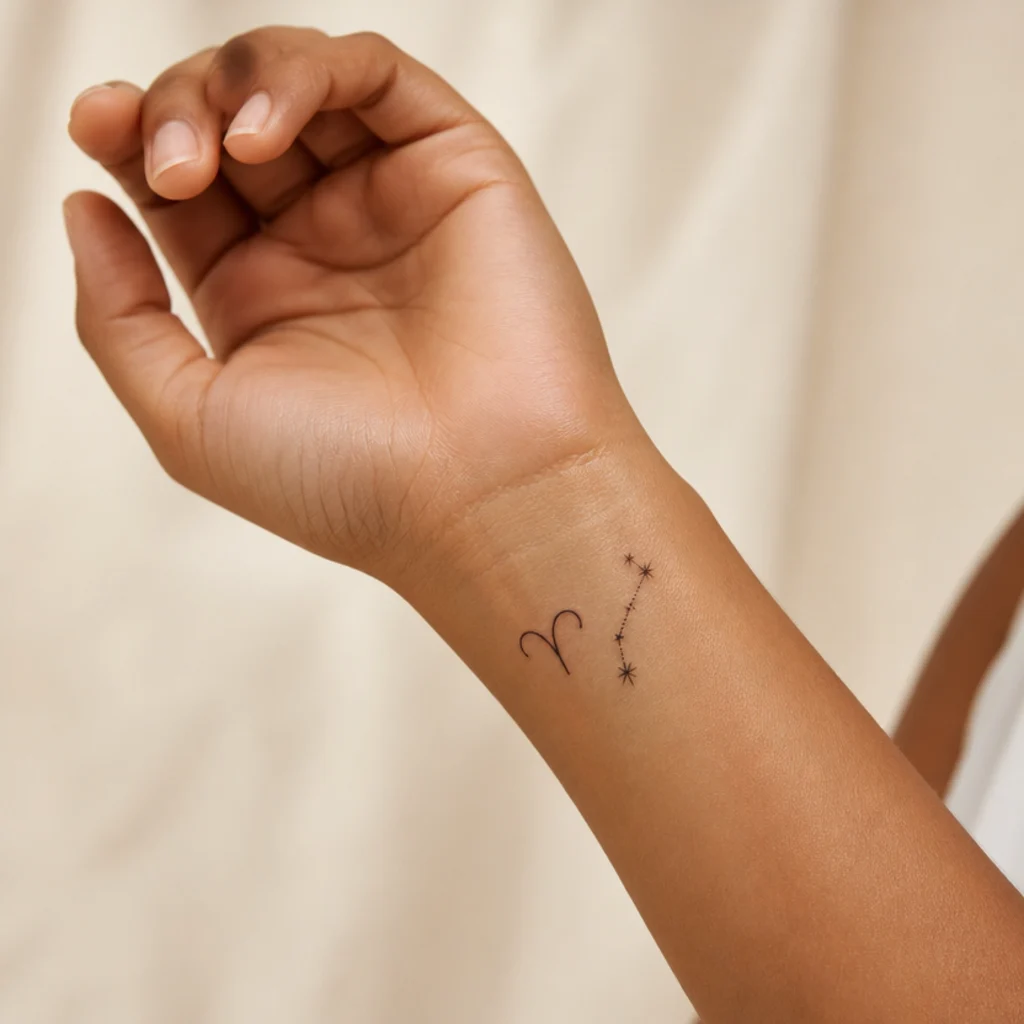
Combine the Aries glyph (the simple upward ram-horn symbol) with the constellation so the two references reinforce each other: the glyph delivers instant recognition while the stars add the celestial layer. This compact combo stays clean at small sizes and suits the inner wrist, forearm, or ankle. Keep the glyph's twin curves smooth and even, since it's a symbol most people know and any lopsidedness is immediately obvious, and give the stars a little separation from it so the two elements stay legibly distinct rather than merging into one busy mark. This is a smart pick when you want the meaning unmistakable without committing to a large illustrative scene, and it works equally well as a confident first tattoo or as an addition to an existing small collection. Decide this early: whether the glyph or the constellation is the lead element, and size the other down, since giving them equal weight tends to read as cluttered at wrist scale. Ask your tattoo artist for "a clean glyph paired with a subordinate star line."
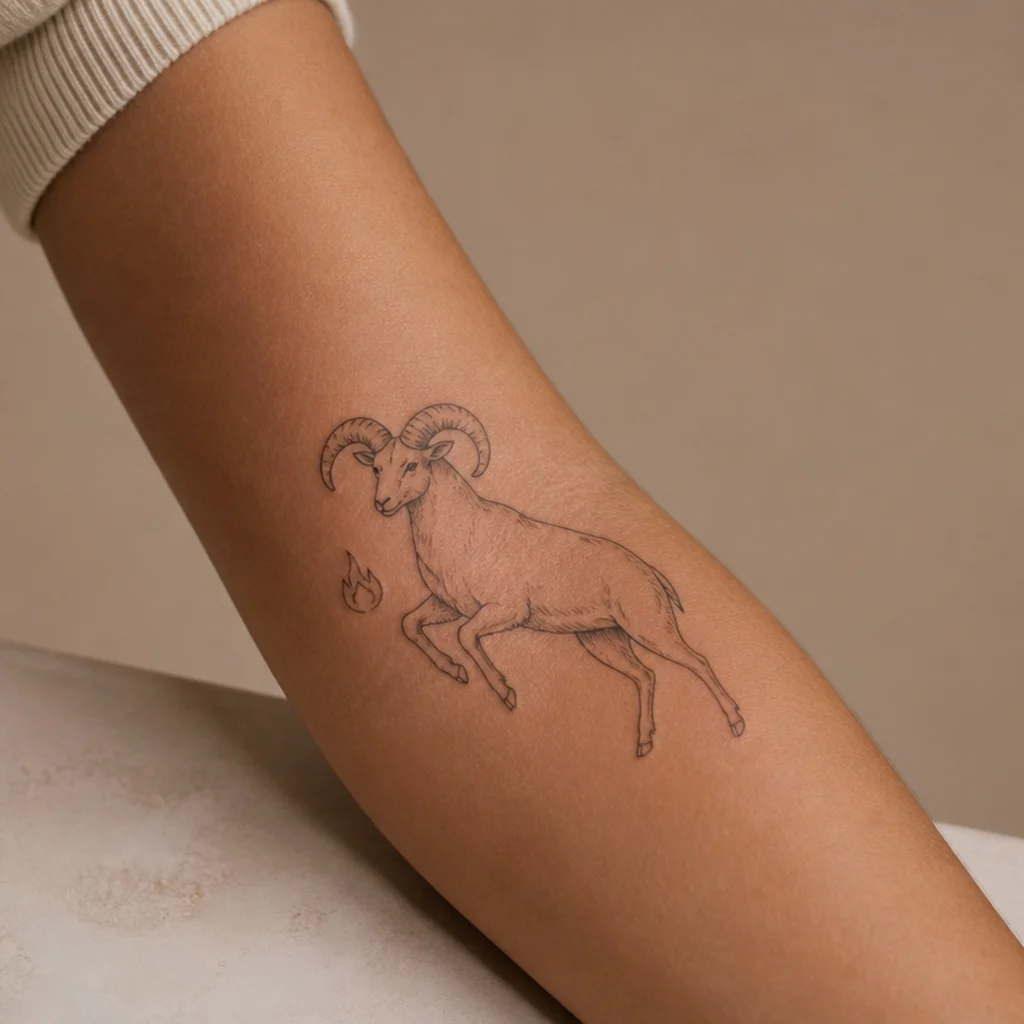
15Fine-Line Ram Silhouette with Flames
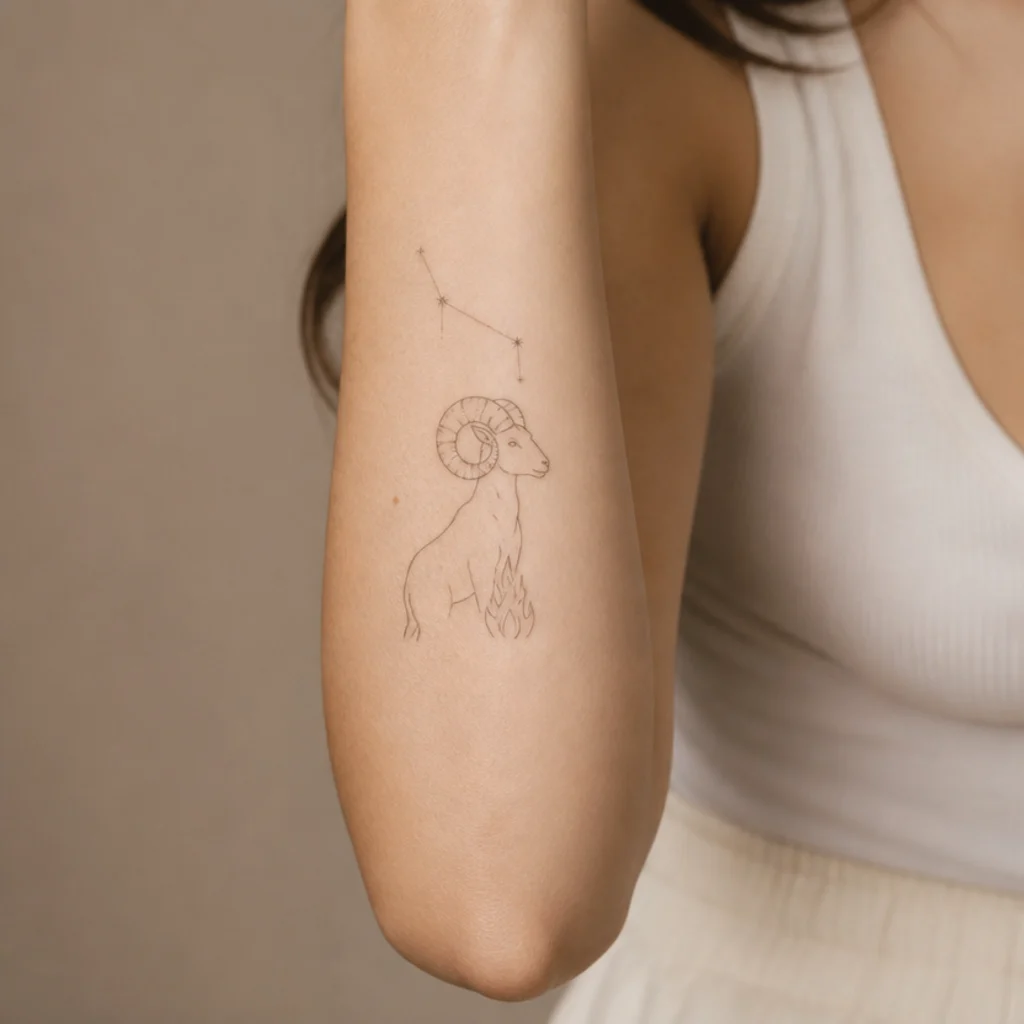
A slim ram silhouette in profile, a small lick of fire at the base, and the constellation floating above the horns, all in fine line. It ties ram, fire, and stars into one restrained composition: the full Aries story without heavy saturation. Its vertical stack suits the inner forearm, outer calf, or upper arm. The whole thing lives on spacing: three distinct elements stacked in fine line will merge into a smudge if crowded, so give your artist room to breathe between the flame, the ram, and the star cluster, and expect the piece to want a little more length than you might first sketch. Keep each element reading as a clear silhouette on its own; that legibility is what survives years of the lines softening and spreading slightly. This is a versatile aries tattoo for men and women alike who want symbolism-rich detail that still sits light on the skin. Before it goes on skin: ask for a quick thumbnail of the full stack sized to the placement, so the proportions are locked. Ask your tattoo artist for "a spaced vertical stack of ram, flame, and stars."
Save this to Pinterest before moving into the moon, floral, and goddess ideas below.
16Moon-Phase and Aries Constellation
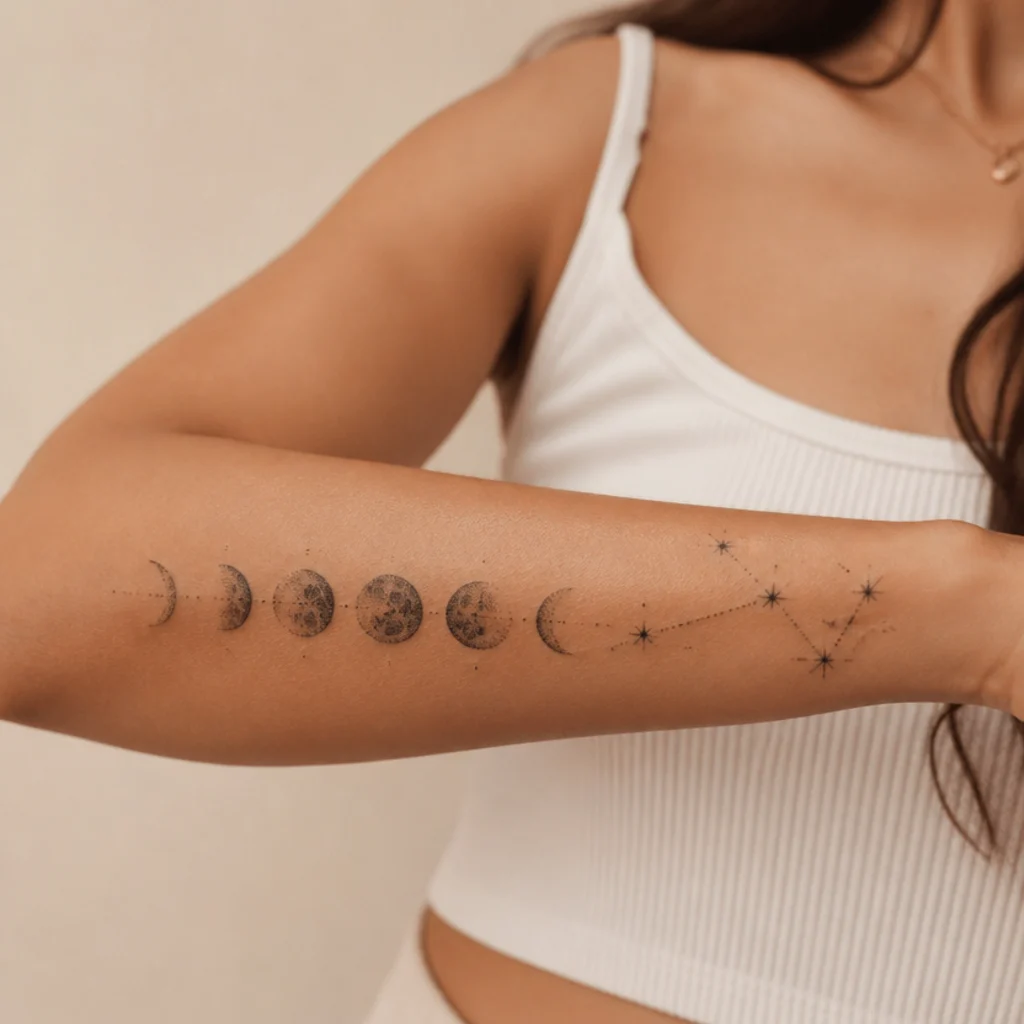
Pair a row of moon phases, new through full and back, with the Aries stars for a broader celestial theme. The moons add rhythm and let you extend the piece into a longer band along the inner forearm or down the outer bicep, a natural home for a horizontal or diagonal run. Soft dotwork shading on the moons keeps them gentle against crisp star points, and the graduated fill from crescent to full gives the row built-in movement. Keep the moons evenly sized and evenly spaced so the sequence reads as deliberate rather than drifting; an uneven row is the most common way these lose their tidy, chart-like appeal. This suits people who love astronomy generally, not just their own sign, and it's one of the easiest designs to extend later with a sun, a small planet, or a second sign. Order of operations: settle the moon count to your available length first, then space the Aries stars to match. Fitting the constellation in afterward often forces it out of accurate proportion. Ask your tattoo artist for "an even moon-phase band with a proportioned Aries line."
17Ankle Constellation Bracelet
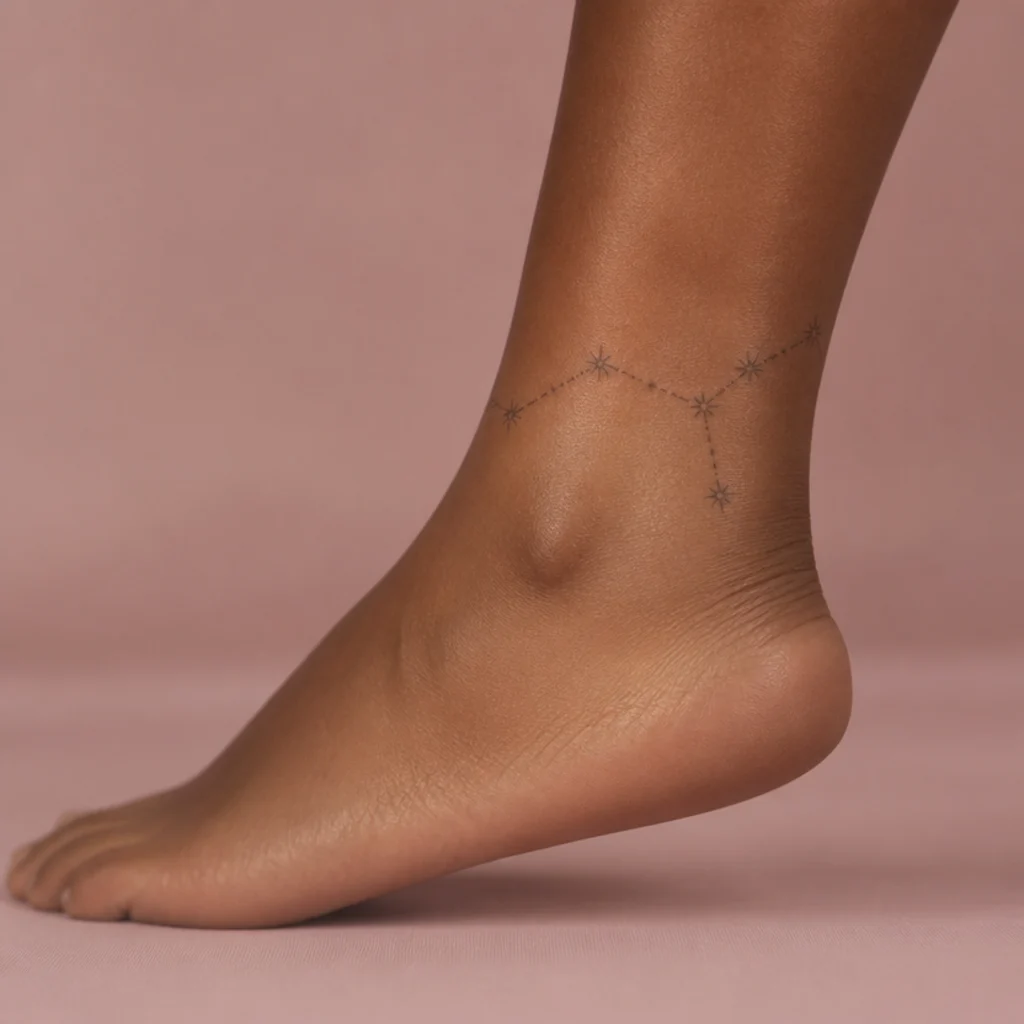
Wrap the constellation around the ankle like a fine star anklet, with the connecting line continuing partway around the joint so it mimics jewelry. It's a pretty, understated placement that hides easily and shows only when you want it to. The honest caveat is friction: ankle skin takes constant rub from socks, shoes, and boots, so this is one of the faster-fading spots on the body, and a delicate line here will likely want a touch-up sooner than the same design on a sheltered inner arm. Keep the stars small, the line light, and the wrap partial rather than a full band, which flatters the joint and gives the design a little slack as the ankle flexes. Because the shape shifts with movement, confirm the wrap live. Check it in motion: have the artist mark it with your foot both flat and flexed, so the stars stay evenly spaced when you walk, not just when you're lying still. Ask your tattoo artist for "a partial ankle wrap positioned for a flexed foot."
18Aries Fire Tattoo Sleeve Accent
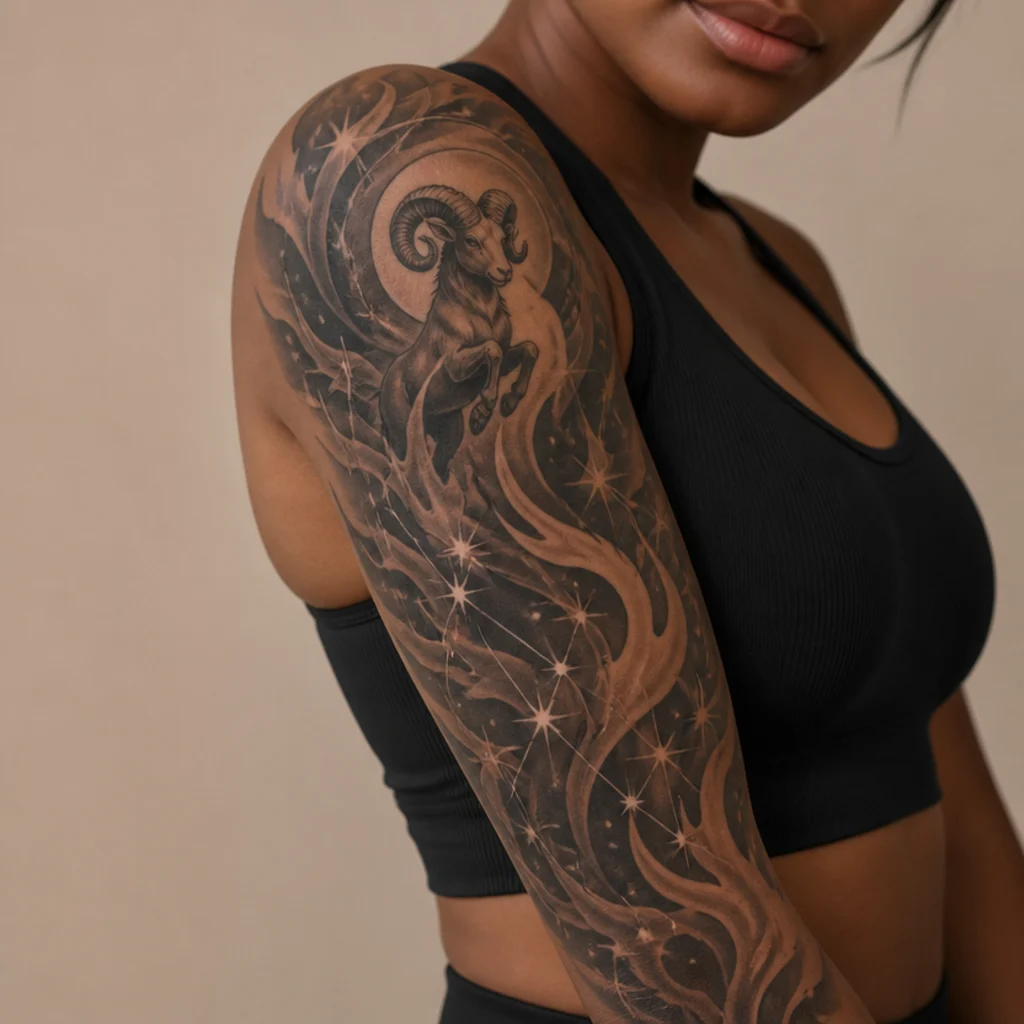
If you're building or already wear a sleeve, weave an aries fire tattoo accent into the flow: flames rising through the negative space with the constellation set among them, rather than a self-contained scene. As part of a larger composition, it borrows impact from the surrounding work and threads your sign into the bigger story on your arm. The key is coordination, ideally with the same artist who owns the sleeve, so line weight, black density, and shading style match; a mismatched insert reads as an afterthought. Because sleeves are dense, the accent needs enough visual weight to hold its own: bold flame shapes and solid or heavily dotted stars keep pace, where thin fine line would get swallowed by the work around it. Think of it as connective tissue, filler with meaning, that ties existing panels together. Placement trick: put it in a transitional gap between two heavier elements so it earns its space and improves the sleeve's overall flow. Ask your tattoo artist to "match the sleeve's weight and use it as a connective accent."
19Negative-Space Ram and Stars
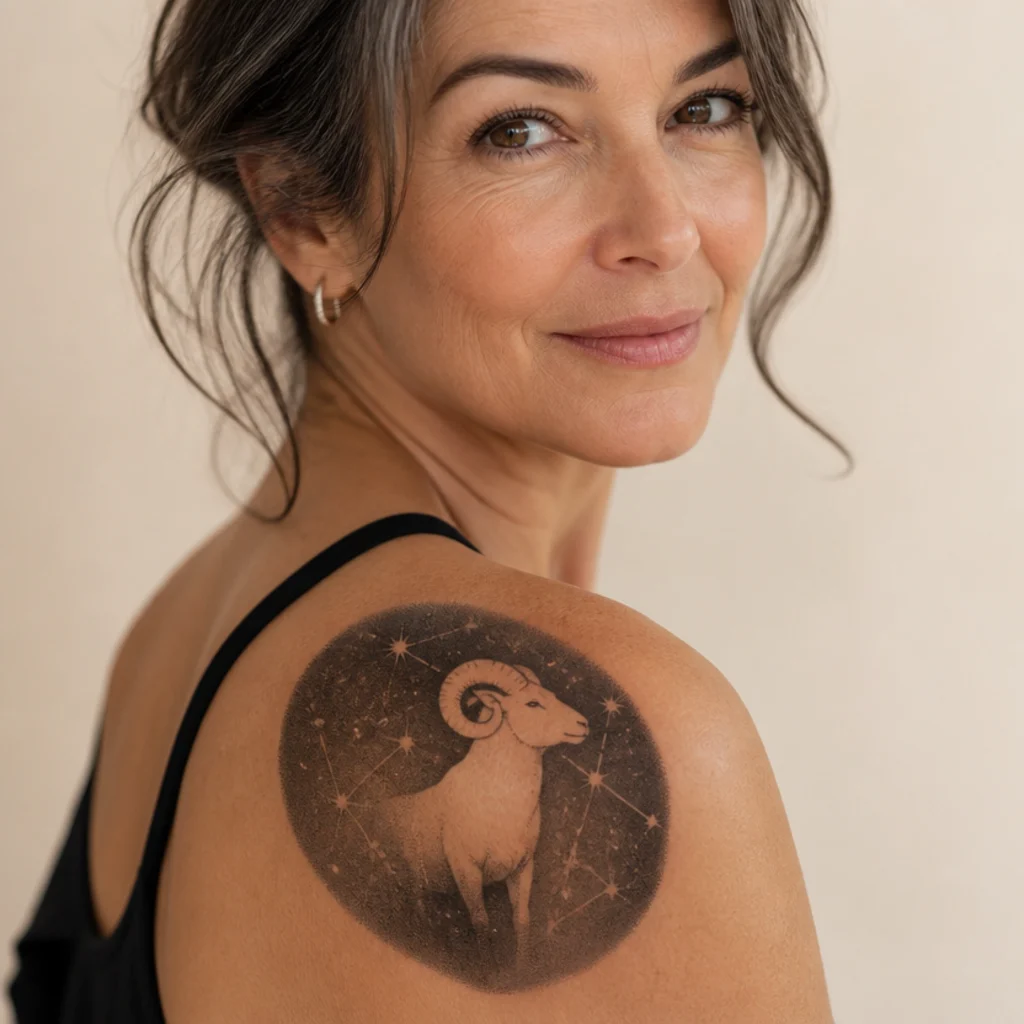
Flip the usual approach: shade a dark field and let the ram and the stars emerge as untouched skin. Negative-space work is striking and modern, but it's technically demanding. The illusion lives entirely on clean, even saturation around the shapes, and any patchiness in the black background gives the trick away, so an experienced hand is non-negotiable. The shoulder, outer thigh, or calf offers enough flat area for the contrast to land. Be realistic about how it translates to your skin: the effect is boldest on lighter tones, where reserved skin pops against solid black, while on deeper tones the shapes rely more on the shaded field and edge definition, so ask to see the artist's healed negative-space work on skin like yours. Keep the reserved shapes simple, since fine interior detail inside skin-tone areas tends to close up as the surrounding black settles. Ask for a little extra room: request slightly larger reserved gaps than feel necessary, since black fill spreads inward a touch during healing. Ask your tattoo artist for "even negative-space fill with generous reserved shapes."
20Aries Wildflower and Star Cluster
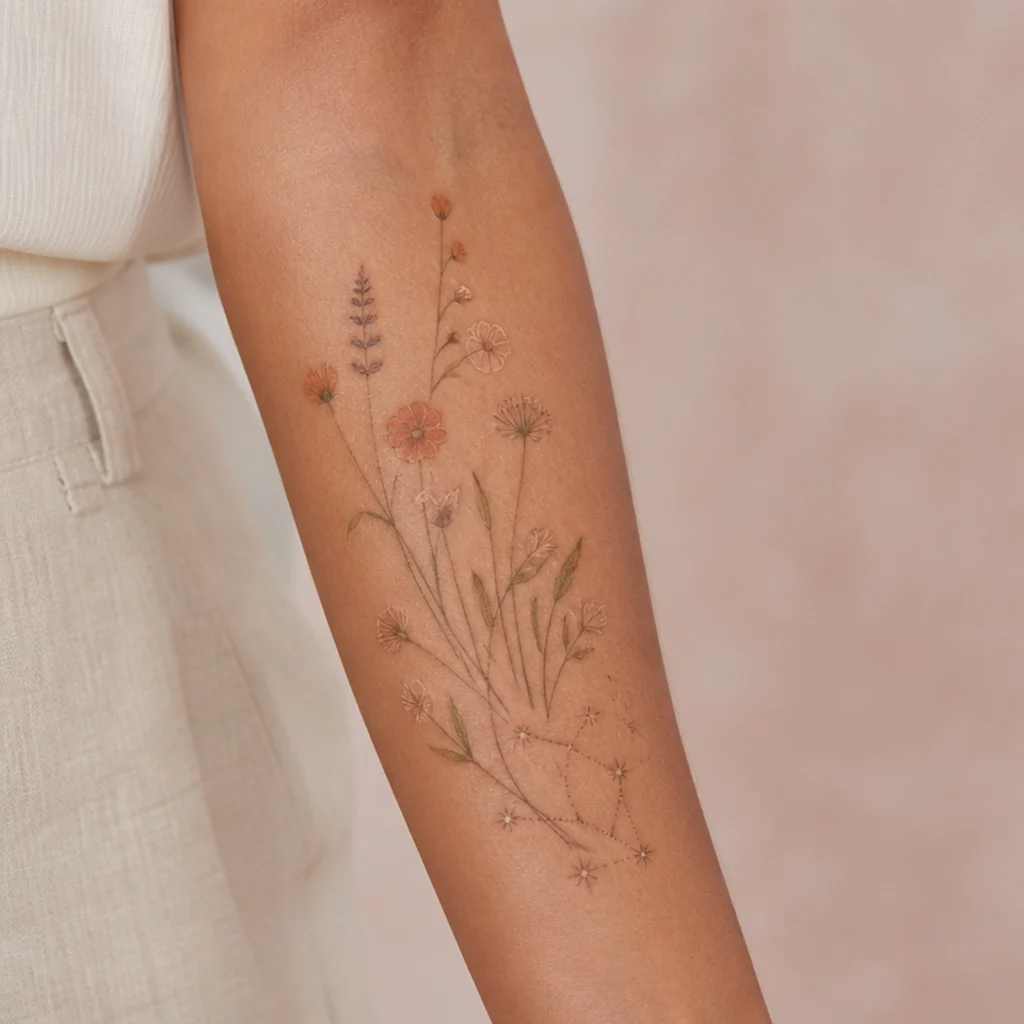
A looser, meadow-style aries flower tattoo: a small gathering of wildflowers with the constellation tucked among the stems like stars that fell into the grass. It feels organic and gentle, a softer counterpoint to the ram and fire directions, and it reads as personal rather than symbolic. The inner forearm, upper arm, or thigh gives the stems room to sway and cross naturally instead of standing stiff. As with any fine botanical work, thoughtful spacing is what keeps petals and stems distinct as the piece settles and the lines spread slightly with age, so err toward more air between elements than the reference shows. Add muted color, dusty lilac, soft ochre, sage, for warmth, or keep it black and grey for a finish that ages more predictably. It suits people who want the zodiac reference woven quietly into nature rather than spelled out in glyphs and rams. One way to keep it loose: let a couple of stems break the cluster's outline so it reads as a gathered handful rather than a tidy bouquet. Ask your tattoo artist for "loose, airy wildflowers with the stars tucked among the stems."
Save this to Pinterest so your botanical and celestial favorites live in one place.
21Matching Couple Aries Constellations
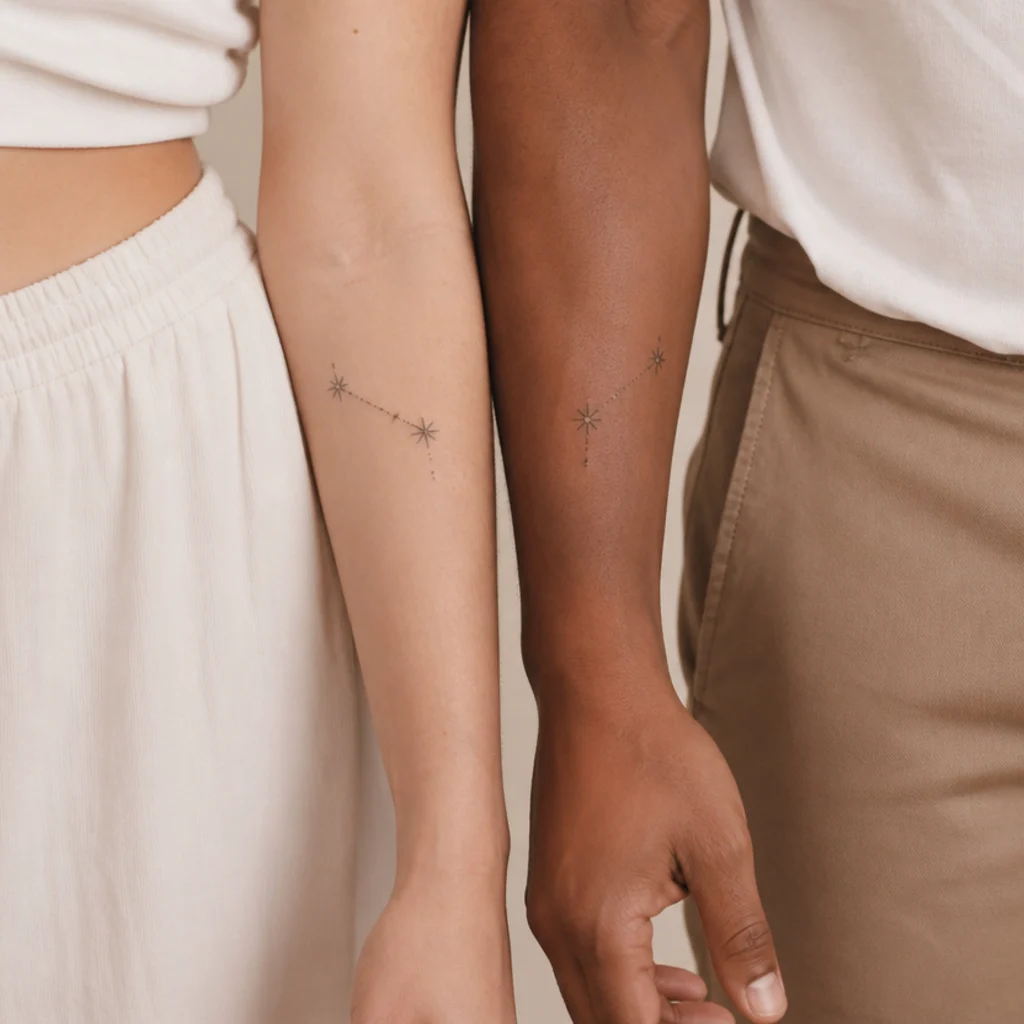
For two Aries who share the sign, or a couple marking a shared birth month, matching constellations make a quietly meaningful pair. Keep them identical, or mirror them so the two lines meet and complete each other when your arms sit side by side. Fine line keeps a matching set coordinated and understated, and the constellation's simplicity means it scales down easily for a low-commitment first tattoo for either of you. Decide placement together, inner wrist, forearm, or ankle, so the pieces align in the pose you'll actually show them. The one thing that quietly undermines a matching set is drift: if the two are done in separate sessions or by different artists, small differences in line weight and star size add up. To avoid that, book them back to back with the same artist and lock the sizing in one shared stencil. Lock this down ahead of time: have both stencils printed from a single master file so the star spacing is identical, not just close. Ask your tattoo artist to "cut both stencils from one master so the pair matches exactly."
22Aries Goddess with Fire Crown
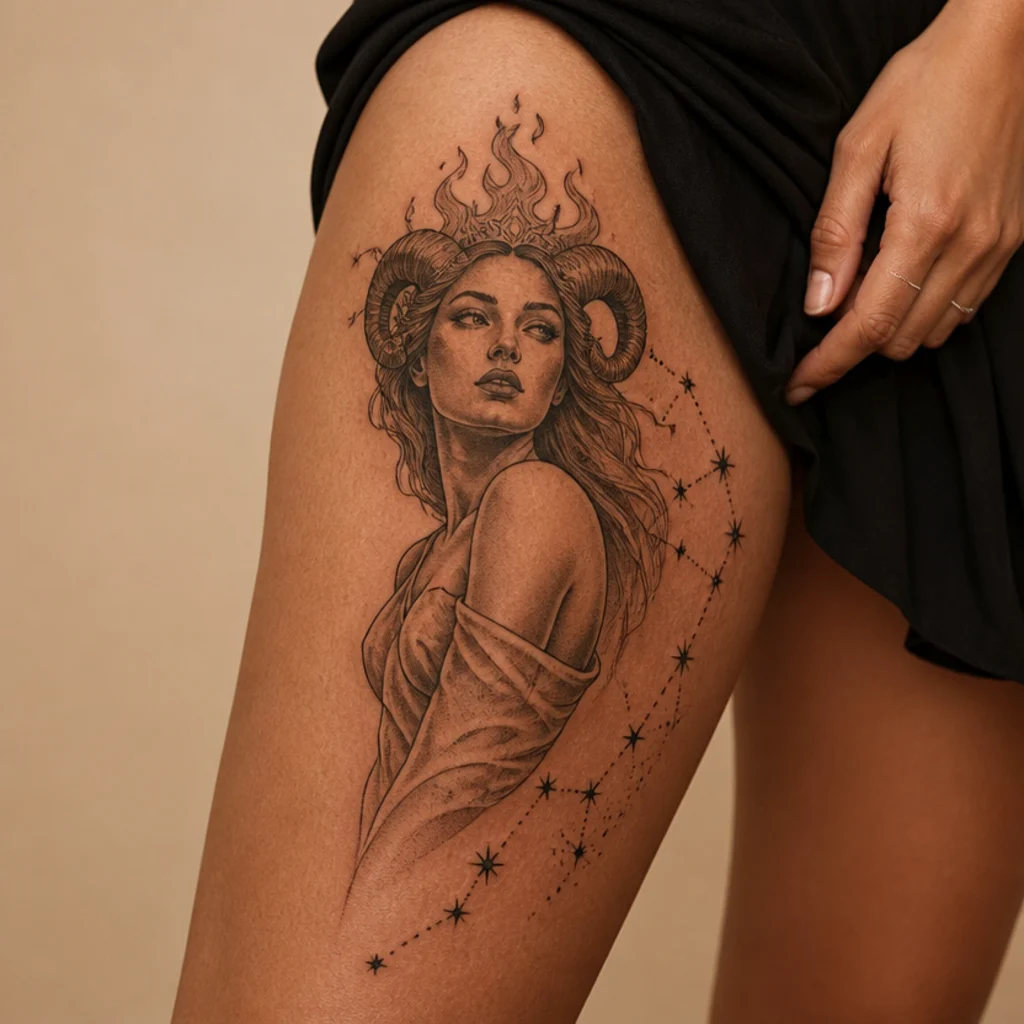
Take the goddess concept further with a fire crown: a serene figure wearing a headdress of stylized flames, the constellation trailing behind like a veil. It unites goddess, fire, and stars into one dramatic aries goddess tattoo, best as a larger statement on the thigh, back, or upper arm where the composition has room to breathe. This is firmly advanced illustrative territory. It leans on confident black-and-grey shading and clean rendering of the face, so vet the artist's healed portrait work and ask how their soft grey has held up after a year. The crown is the usual failure point: over-detailed flames turn into a heavy, unreadable mass around the head, so insist it stays stylized and legible as a silhouette, framing the face rather than swallowing it. The result feels mythic and powerful, ideal for someone who reads Aries as pioneering, bold energy. One value trick: keep the fire crown a shade or two lighter than the face so the eye lands on the portrait first. Ask your tattoo artist for "a legible stylized flame crown that frames, not floods, the face."
23Sternum Constellation Centerpiece
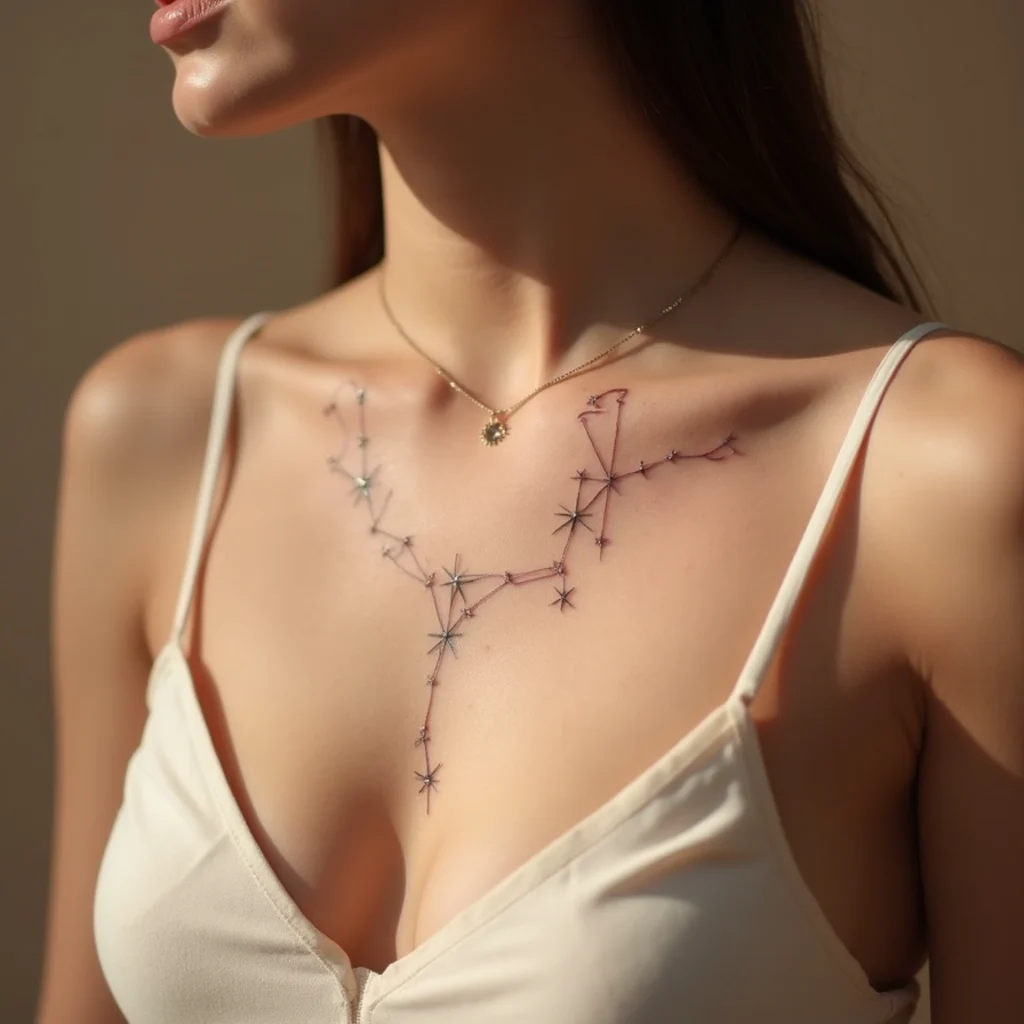
Center the constellation on the sternum, flanked by light ornamental lines or a subtle mandala for symmetry, so it follows the body's midline like a pendant. It makes a graceful, easily covered statement and photographs well. Two realities shape the plan: the sternum sits over bone with little padding and is, for many people, a more tender area to tattoo, so talk through session length and breaks; and the chest's curve means a design that looks symmetrical flat on paper can pull out of true on the body, so the stencil has to be placed and adjusted directly on the contour. Keep the ornamental elements delicate and secondary, so the four stars stay the clear focus rather than getting lost in filigree. It pairs naturally with existing chest or underbust work if you're building outward over time. Check this in the mirror: have the artist confirm symmetry with you sitting upright, since chest tissue shifts between lying down and standing and you want it even when you're vertical. Ask your tattoo artist to "set the centerpiece to your midline and verify symmetry upright."
24Micro-Realism Ram and Star Chart
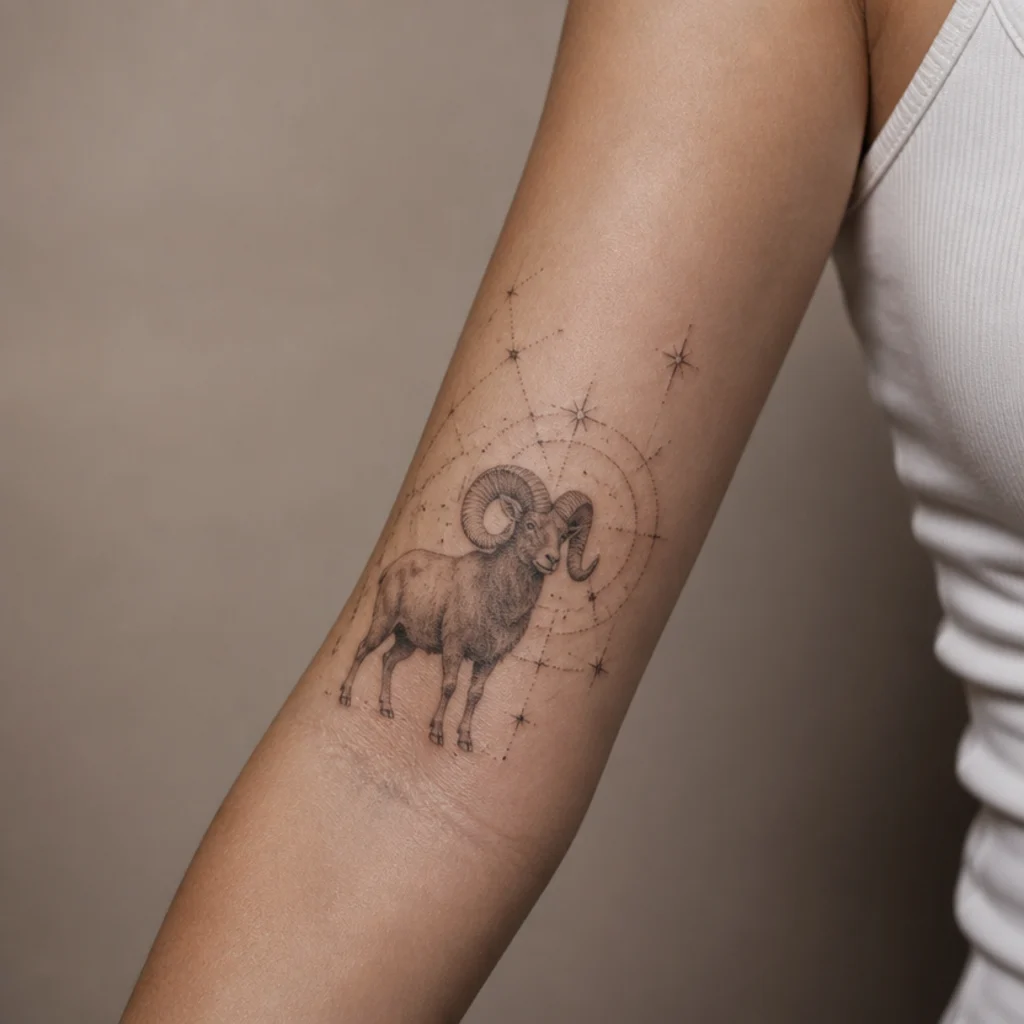
For detail lovers: a micro-realism ram, textured fur, lifelike horn ridges, a catchlight in the eye, set beside a precise dotwork star chart. This is one of the most advanced ideas here and rewards a specialist in fine realism, not a generalist. The inner or outer forearm gives the detail room to read without crowding, and it wants to be sized up rather than down: pack too much fine texture into too small an area and it will blur into a grey smudge within a few years as the skin heals and settles. Ask directly about the smallest detail the artist is confident will still read at a year and beyond, and size the piece to that answer rather than to how crisp it looks fresh. Pairing the naturalistic ram with the clean geometry of the star chart is what makes it work: contrast of texture against precision. Prioritize this over evenness: a few areas of sharp detail (eye, horn tip) hold up better long term than uniform rendering everywhere. Ask your tattoo artist for "a fine-realism ram sized so the key detail survives healing."
25Full-Color Cosmic Aries Ram
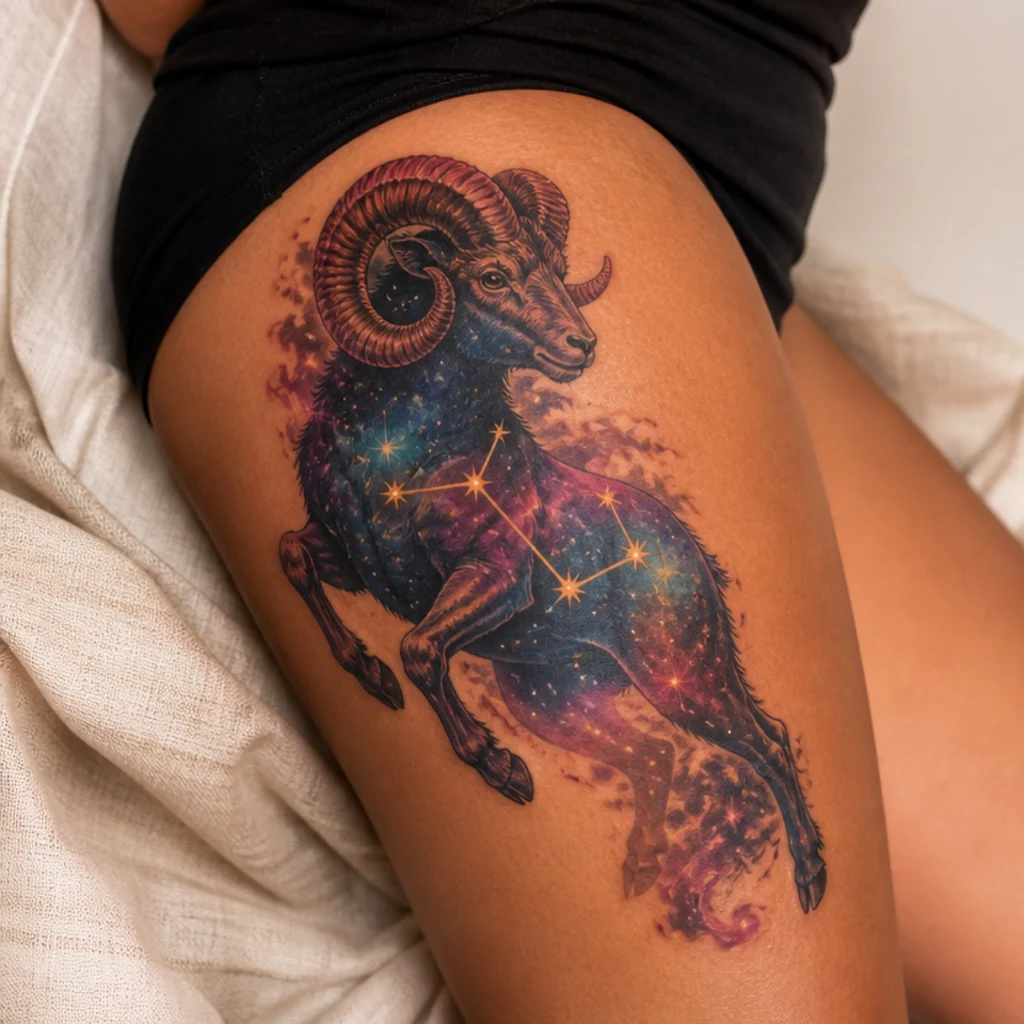
Go all in: a ram whose body is filled with a swirling galaxy, deep blues, magenta, a wash of gold, with the constellation glowing across its form like a star chart come alive. This is the boldest, most saturated idea in the set and belongs on a larger, flatter canvas, the thigh, upper arm, or back, with the time and budget for multiple sessions. Rich color is demanding on both sides of the needle: it needs an artist with real color-packing skill and even saturation, and it needs diligent aftercare and long-term SPF from you, since bright pigments, magentas and light blues especially, are the first to shift and fade. Colors also settle differently across undertones, so review the palette on your skin rather than copying a reference exactly, and ask the artist which hues they'd adjust for you. Contrast a saturated galaxy body against clean, bright stars so the constellation stays readable over the color. Budget ahead for this: a color touch-up at 12 to 18 months in, since large color fills commonly need one to even out. Ask your tattoo artist for "a saturated cosmic fill with a palette tuned to your skin."
Pro Tips from the Editor
- Get the star proportions right. Aries is a recognizable four-star bend anchored by bright Hamal; ask your artist to keep the spacing and relative brightness accurate, an "off" constellation reads as generic stars to anyone who knows the sky.
- Always judge an artist on healed work, not fresh photos. Fine line, watercolor, portraits, and micro-realism all look sharpest the day they are done; the honest test is how their work looks a year later, so ask specifically for healed examples in your chosen style.
- Match the style to the placement's friction. Hands, fingers, feet, and ankles fade fastest; inner arm, ribs, and upper arm hold longest. Choose durable blackwork or dotwork for high-movement spots and save delicate fine line for sheltered skin.
- Give fine line and florals more space than looks necessary. Tattoo lines spread slightly as they heal and again over years; deliberate negative space is what keeps petals, stems, and stacked elements legible long term.
- Tune ink choice to your undertone. Whisper-grey can disappear on deeper skin; a warm-black at a slightly heavier weight holds contrast far better. Ask your artist to adjust value and saturation for you rather than copying a reference.
- Budget for one touch-up from the start. Most delicate celestial pieces want a refresh within a few years, and large color or blackwork fills often need a saturation pass; plan for it rather than treating it as a surprise.
- Bring two or three references, not one. The strongest custom pieces come from an artist blending elements you love, so hand over a small shortlist and let them adapt the linework to your body.
How to Choose / Get the Look
Start by naming the single most important constraint, then work backward from it.
1. Visibility and coverage. If you need to hide the piece at work, lean fine-line or dotwork on the wrist, ankle, collarbone, sternum, or behind the ear. If you want a statement, the ram, fire, and goddess directions reward larger, flatter canvases, thigh, upper arm, or back.
2. Upkeep tolerance. Be honest about how much refreshing you'll do. Durable choices hold their edges for years; delicate ones ask for periodic touch-ups.
3. Budget and time. Small line pieces sit near a shop minimum and take one short session; illustrative color, portraits, and micro-realism are priced hourly and can span several sittings.
Use this quick comparison to match style to priorities:
| Style direction | Durability | Relative upkeep | Best canvases | Skill level |
|---|---|---|---|---|
| Fine-line constellation | Moderate | Touch-up every few years | Inner wrist, forearm, ankle | Beginner-friendly |
| Dotwork / stipple | High | Low | Forearm, calf, shoulder | Intermediate |
| Bold blackwork | Very high | Low | Shoulder, chest, outer forearm | Intermediate |
| Watercolor / full color | Lower | Higher (SPF + refresh) | Thigh, upper arm, back | Advanced |
| Illustrative (ram, goddess, realism) | Moderate–high | Moderate | Thigh, upper arm, back | Advanced |
Once you've narrowed the direction, bring two or three reference ideas to your consultation rather than one, so your artist can blend the elements you love into an original design suited to your body, undertone, and how your skin heals. Ask to see healed examples in the exact style you want, since fresh photos can look sharper than a piece a year on. Finally, always confirm design, sizing, placement, coverage feasibility, and healing expectations with a licensed tattoo artist, and never assume a new tattoo will fully hide an existing tattoo or scar without a professional, in-person assessment.
Frequently Asked Questions
What does an Aries constellation tattoo mean?
It represents the Aries zodiac sign, tied to themes many associate with the sign such as courage, drive, and initiative. Because the constellation itself is simple, four stars in a short bend, it also reads as a personal star map, letting you carry your sign quietly or pair it with ram, fire, or goddess symbolism for a fuller statement. Meaning is personal, so the same design can be about a birth month, a loved one, or the archetype rather than astrology at all.
Is an Aries tattoo a good choice for men?
Yes. An aries tattoo for men often blends the constellation with a bold anchor, a ram head, heavy blackwork stars, fire, or a negative-space field, which suits graphic, high-contrast placements on the shoulder, chest, or outer forearm. The design scales easily from a small glyph-and-star combo to a large illustrative ram or full cosmic scene, so it works whether you want something subtle or a statement piece.
Where is the best placement for a small constellation tattoo?
Sheltered, lower-friction spots, the inner forearm, upper arm, ribs, sternum, and collarbone, keep fine lines crisp longest. High-movement, high-rub areas such as hands, fingers, feet, and ankles look great but tend to fade faster, so factor in earlier touch-ups if you choose those. Skin that stays relatively still and sees less sun and friction is your friend for delicate star work.
How do I keep fine-line star tattoos looking crisp?
Follow your artist's aftercare closely while it heals, then protect it long-term with SPF once fully healed, since UV exposure is the biggest driver of fading. Keep the skin moisturized, and expect fine and micro pieces to want a periodic touch-up. Choosing accurate line weight and generous spacing up front, and a sheltered placement, does more for longevity than any single aftercare step.
How much does an Aries constellation tattoo cost?
It varies widely by region, the artist's demand, size, and detail, so treat any figure you see as a rough guide rather than a quote. Small fine-line or glyph pieces usually sit near a shop's minimum; dotwork, illustrative, portrait, and full-color work is typically priced by the hour and can run several sessions. Ask for an estimate at consultation once size and style are set, and remember touch-ups may add to the total.
Does an Aries tattoo have to include the ram or fire?
Not at all. The constellation stands alone as a clean star map, and many people prefer it that way. Ram, fire, honeysuckle, moon phases, and goddess motifs are optional layers that make the sign more explicit or more symbolic, choose one clear anchor if you want added meaning, and skip them entirely if you prefer something minimal and quiet.
Do watercolor and full-color Aries tattoos fade faster than black?
Generally yes. Solid black and dense blackwork hold their edges longest, while soft watercolor washes and bright pigments, light blues and magentas especially, tend to lighten and haze sooner and benefit from more diligent SPF and periodic refreshes. If low upkeep matters most, a black-and-grey or dotwork approach ages most predictably; if you love color, plan for the extra maintenance.
How small can an Aries constellation tattoo be?
Small, but there's a floor. Because the constellation is only a few stars, it works nicely at a couple of inches or even less, yet very tiny versions on thin, mobile skin (behind the ear, fingers) blur faster as the lines settle. Keep at least a little breathing room between star points, since at micro scale even a millimeter changes how the shape reads. Your artist can advise the smallest size that will still hold up on your chosen spot.
Can an Aries tattoo cover an old tattoo or scar?
Sometimes, but never assume it will fully hide one. Cover-ups depend on the size, color, and age of what's underneath, and scar tissue takes ink differently than unmarked skin. A delicate constellation rarely has enough density to conceal existing work on its own. Book a consultation with a licensed artist who can assess the area in person and tell you what's realistically achievable before you commit to a design.