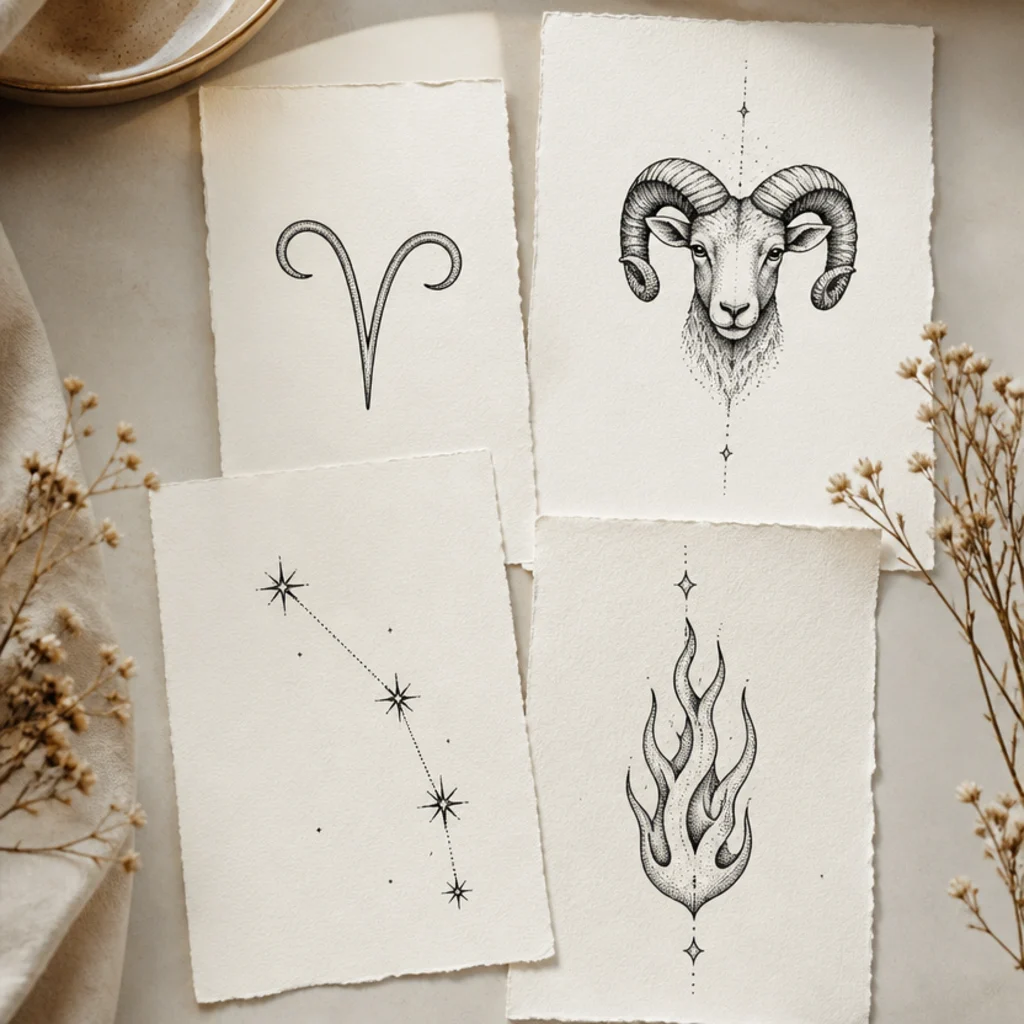
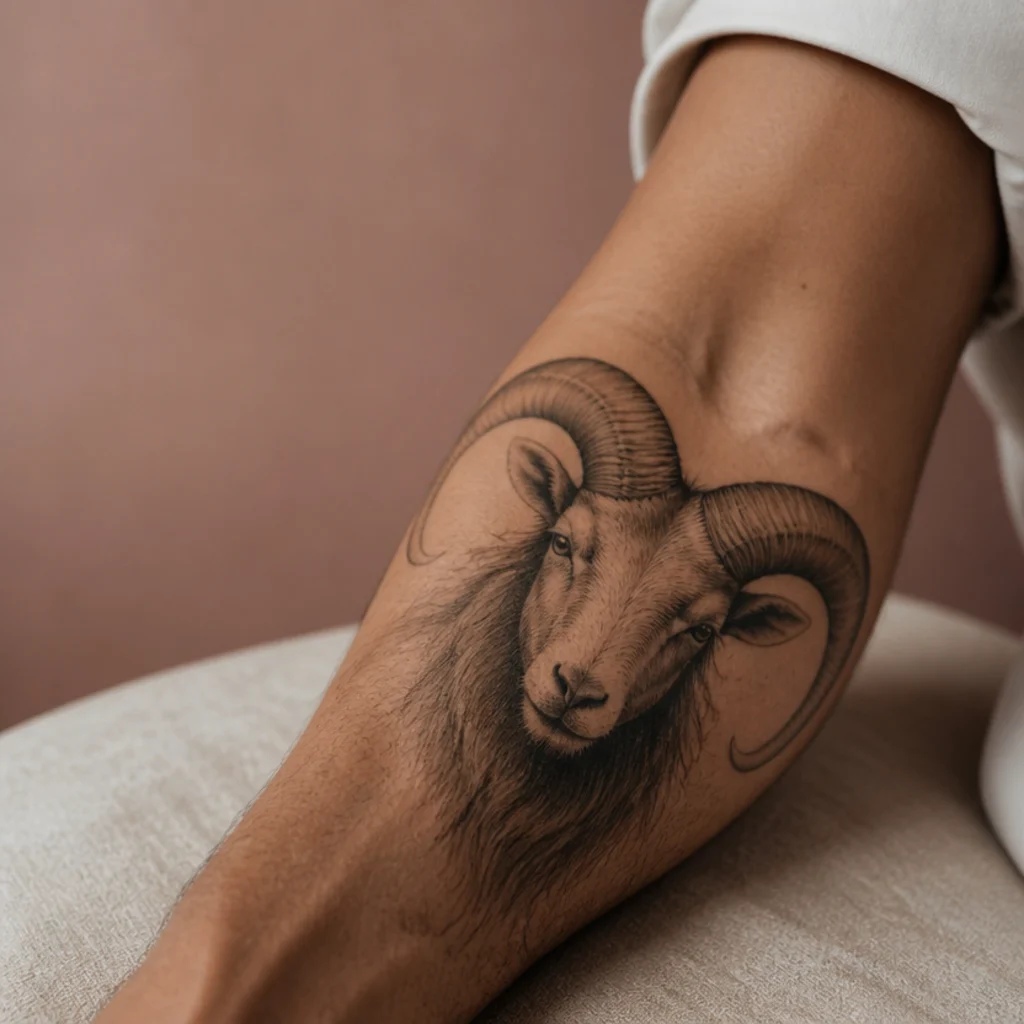
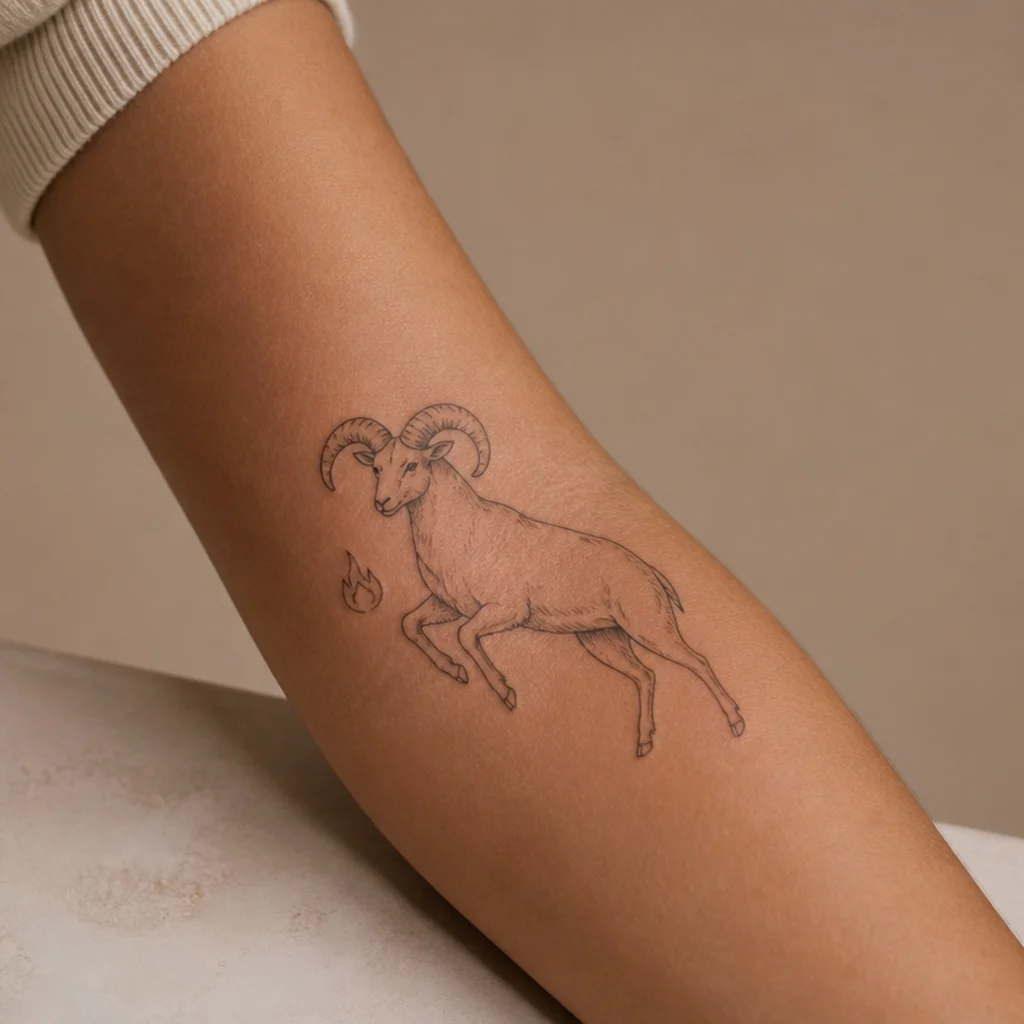
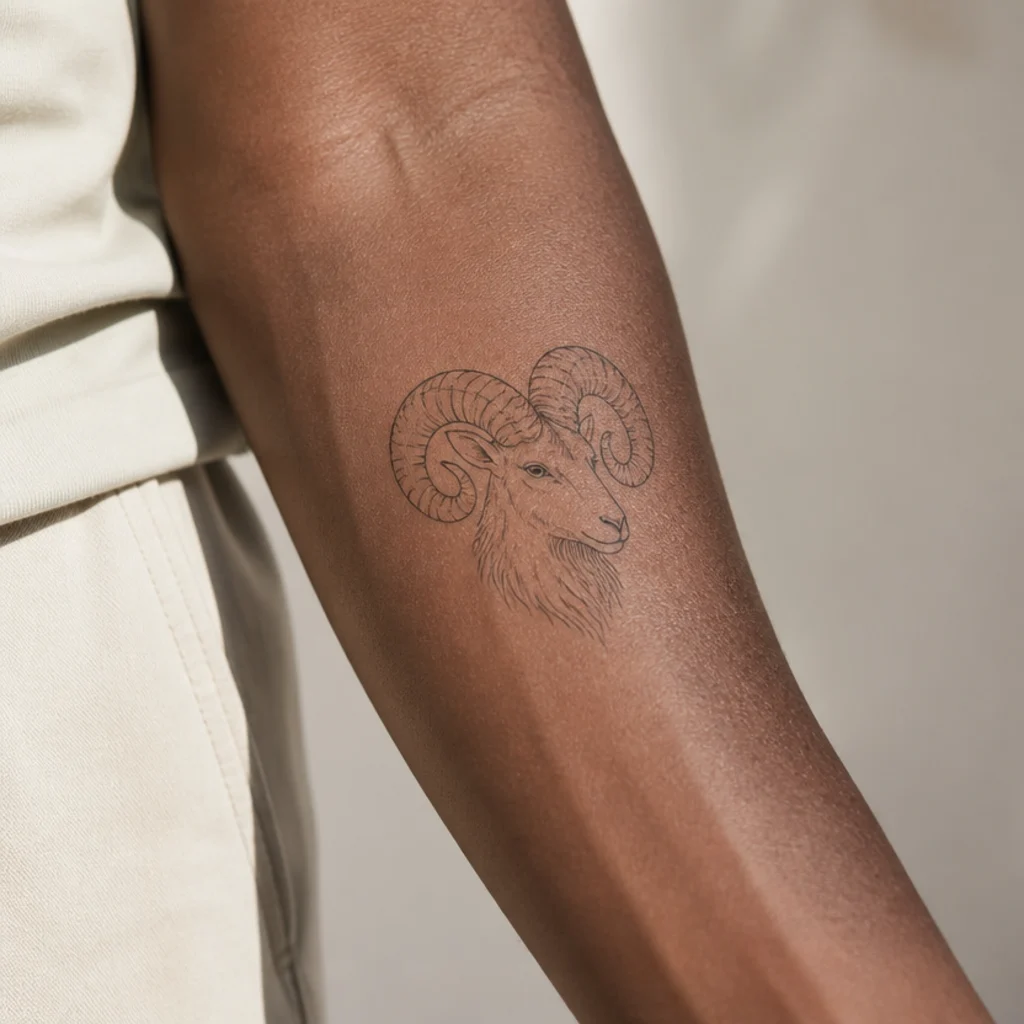
15 Aries Flower Tattoo Ideas to Love
Aries runs on fire and forward motion, but wrapping the ram in flowers softens the symbol without dulling its edge. These 15 designs pair the glyph, the ram head, and bloom motifs with the concrete style, placement, and upkeep notes you need to walk into a consultation prepared.
 Edited by Lena Rose · Published July 11, 2026 · 25 min read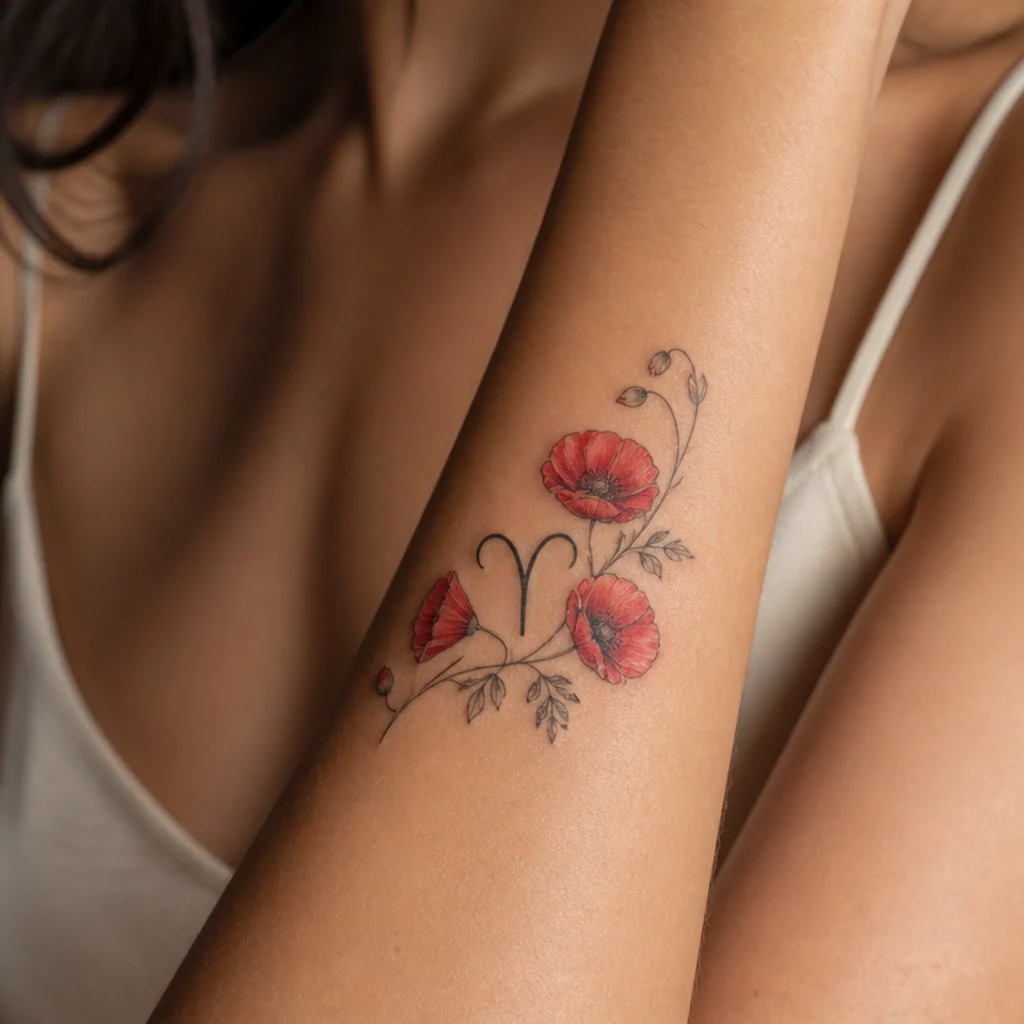
Quick Answer
- Best for: Aries suns (March 21 to April 19), anyone honoring an Aries loved one, and people who like bold-meets-botanical symbolism that scales from a wrist glyph to a shoulder statement.
- Who might skip it: Those wanting a purely floral or purely minimalist piece with no astrological read, or anyone set on a single tiny tattoo that will not carry the ram plus a bloom legibly.
- Maintenance: Bold traditional and solid blackwork hold shape for a decade-plus; fine-line, single-needle, watercolor, and white-ink details soften faster and usually want a touch-up every 3 to 6 years.
- Difficulty: Ranges from a 30-minute fine-line glyph to multi-session neo-traditional color and portrait work.
- Cost: Widely variable by region, artist demand, size, and color load; small glyphs sit at shop-minimum territory, while wreaths, portraits, and sleeve starts run into multi-hour or multi-session pricing. Ask for a written quote by piece, not by hour, when you can.
- Wear time / longevity: Blackwork and traditional age best; saturated reds, oranges, and any white ink are the first to lose punch.
- Standout variation: A solid ram silhouette wreathed in red poppies, blending aries fire tattoo mood with soft floral contrast.
- How to ask your tattoo artist: Bring 3 to 4 references, name the style (fine-line, traditional, neo-traditional, blackwork, dotwork), the feeling (bold, romantic, celestial), and the placement, then ask to see healed photos in that exact style.
In This Guide
- Fine-Line Ram Glyph With Wildflowers
- Bold Ram Skull and Poppy Piece
- Aries Fire Bloom Fusion
- Watercolor Ram and Peony Sleeve Start
- Minimal Glyph With a Single Stem
- Aries Goddess and Rose Portrait
- Blackwork Ram Horns and Thistle
- Geometric Ram Framed in Florals
- Traditional Ram Head With Peony
- Fire and Marigold Forearm Band
- Constellation and Baby's Breath
- Neo-Traditional Ram and Ranunculus
- Spine Glyph With Trailing Vine
- Ram Silhouette in a Poppy Wreath
- Dotwork Ram With Chamomile
Introduction
Aries carries a reputation for boldness, so it makes sense that an aries tattoo for men often leans into rams, flames, and heavy black lines. Flowers give the sign somewhere gentler to land. As the cardinal fire sign ruled by Mars, Aries reads as initiative and heat, and a poppy, peony, or sprig of wildflower beside the ram glyph adds contrast, narrative, and a reason to slow down and look closer. That tension between the horned aggressor and the soft bloom is exactly why the pairing has stayed popular on save-heavy Pinterest boards rather than fading as a passing trend. The 15 ideas below mix an aries flower tattoo with ram silhouettes, fire motifs, and even goddess imagery, so there is room for a cautious first small piece and a committed statement alike. For each one you'll find who it tends to suit, the style mechanics that make it work, how much upkeep it asks for, and what to raise at a consultation. Design, sizing, placement, coverage feasibility, and healing should always be confirmed with a licensed tattoo artist who can adapt these concepts to your body, skin undertone, and lifestyle. Treat them as an informed starting point, then let a pro make the linework yours.
01Fine-Line Ram Glyph With Wildflowers
The Aries glyph, that clean two-horn arc, reads beautifully in fine-line or single-needle work when a few wildflower stems, think loose forget-me-nots, cosmos, or a slim daisy, curl around it. It works well for anyone wanting a quiet first tattoo or an addition to an existing minimalist arm, and slimmer limbs keep the small footprint proportional. Placement on the inner forearm or bicep keeps it visible on your terms and away from high-friction zones. Because single-needle lines can run as thin as one to three needle groupings, they carry less ink and soften over five to eight years, so ask your artist to hold the glyph at a slightly heavier line weight than the florals for contrast that survives. Keep the flowers un-shaded and airy for a sketch-like feel that stays legible at roughly two inches. You end up with an aries ram tattoo that doesn't shout, and it layers easily with future pieces. Ask your tattoo artist for a stripped-back stipple-free version if you want the fastest-healing, lowest-blur result.
02Bold Ram Skull and Poppy Piece
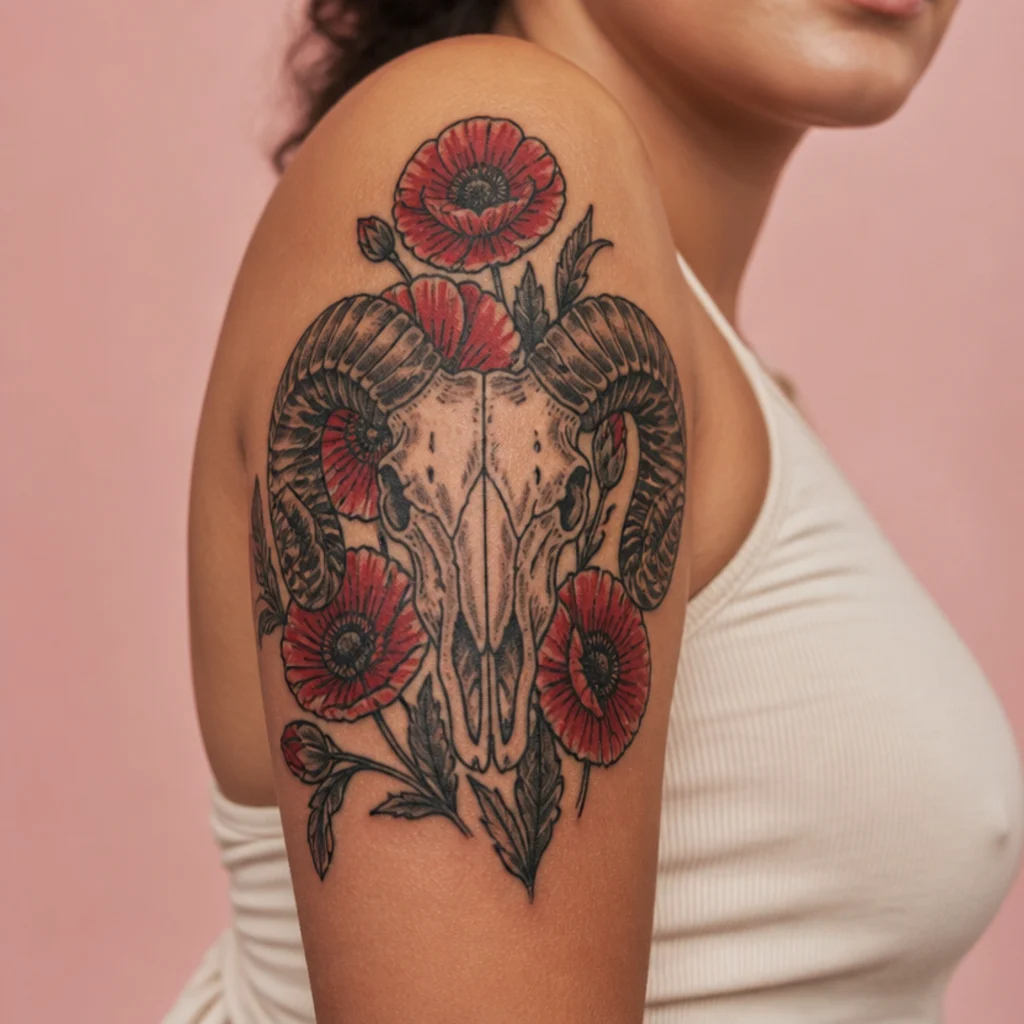
For a stronger statement, a ram skull anchored by red poppies leans into American-traditional weight. The signature thick outlines, restrained palette, and generous black fill are engineered to age well; the bold lines spread slightly over decades but the image stays readable, which is why old-school work still looks sharp at 20 years. Go broad with placement here, the outer upper arm, shoulder, or calf, where the curling horns and skull have room to breathe without crowding. Poppies bring a saturated cadmium red plus a note of memory or rest, balancing the skull's edge. It's a natural aries tattoo for men who want boldness with a botanical counterweight. Expect a longer single session for the solid black and packed color, and budget for a touch-up on the brightest reds around the five-year mark, since warm reds oxidize faster than black. Ask your tattoo artist to keep negative-space gaps between the horns and petals so the piece doesn't read as one dark mass from arm's length.
03Aries Fire Bloom Fusion
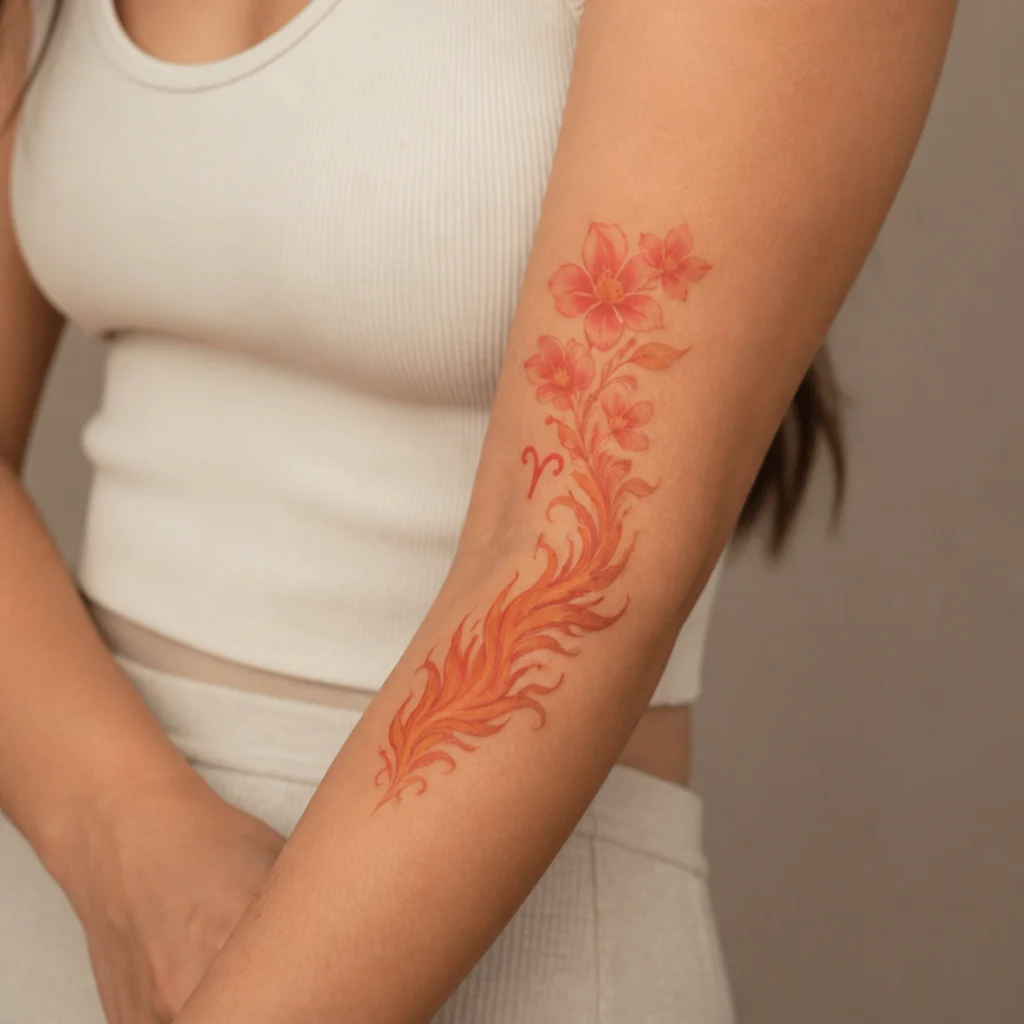
Aries is a fire sign, so an aries fire tattoo that morphs flames into petals plays directly to the Mars-ruled element. The lower licks read as fire; higher up, the shapes resolve into blooming petals, ideally poppies or ranunculus whose ruffled edges mirror a flame's tongue. It is a clever concept for anyone who wants symbolism without a literal ram, and the vertical motion flatters a long forearm or outer thigh where the fire can climb. Warm oranges graduating into deeper reds carry the effect, and a skilled artist blends the transition with layered magenta and yellow so it never looks like two glued-together ideas. Because gradient color relies on even saturation, it's the least forgiving choice on cooler or deeper skin undertones, where oranges can read muted; ask to see healed examples on skin close to yours. Plan for touch-ups every few years to keep the fire bright rather than muddy. Ask your tattoo artist how much black anchoring the base needs to stop the gradient from washing out.
04Watercolor Ram and Peony Sleeve Start
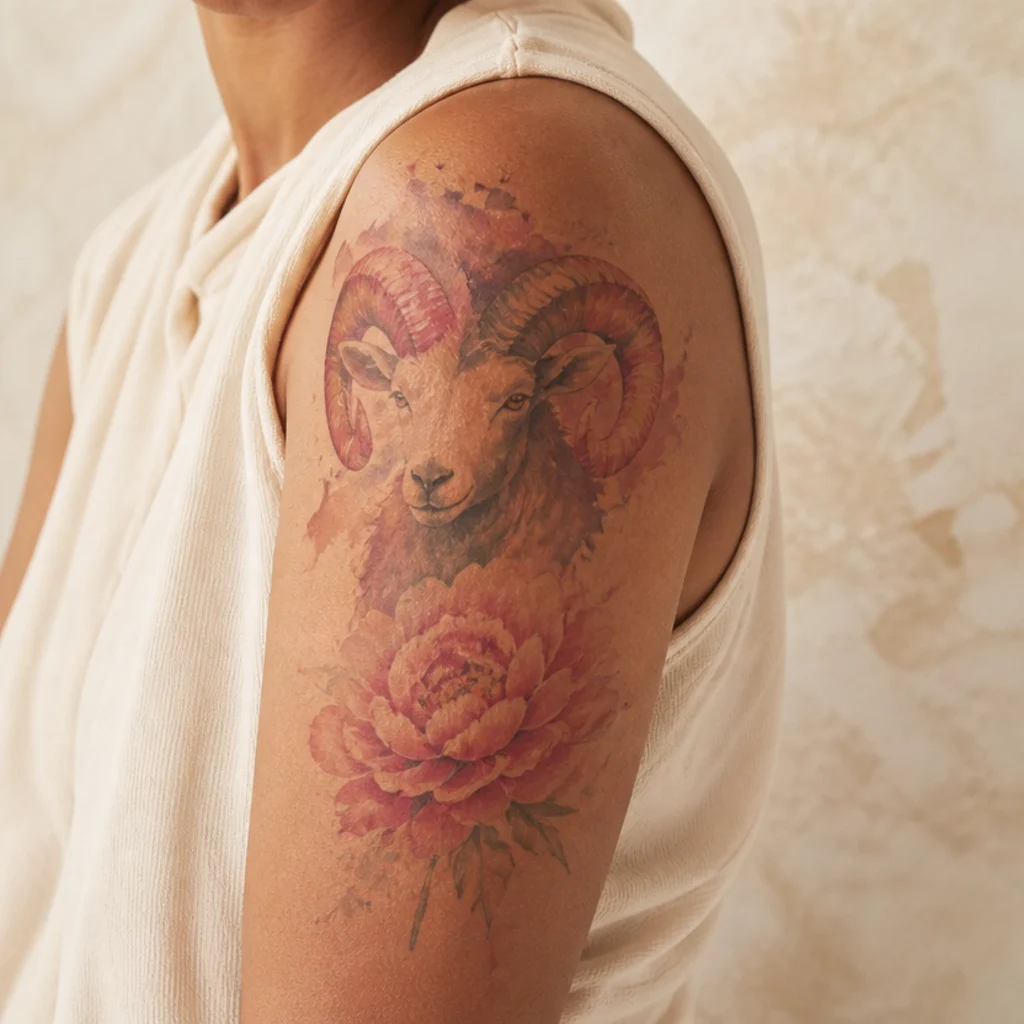
A watercolor ram paired with a full peony makes a soft, painterly foundation for a future sleeve. Washes of color extend past the outlines for that spilled-paint effect, while the many-petaled peony becomes the standout element in blush pink and coral. Readers who like a modern, illustrative look over hard traditional lines will gravitate here, and it reads especially well on the upper arm, where you can grow the composition outward later. The style's honest drawback is durability: true watercolor often skips heavy black anchoring, so pigment can diffuse and lose crispness within five to seven years. Ask your artist whether a subtle grey or fine black skeleton underneath, sometimes called an anchored watercolor, would help it hold without killing the airy look. Keep the highest-fade colors, pale pinks and light purples, as accents rather than the whole story. Ask your tattoo artist to map the peony as your anchor point so any future sleeve panels flow from it rather than fighting it.
Save this to Pinterest so your consultation references stay together.
05Minimal Glyph With a Single Stem
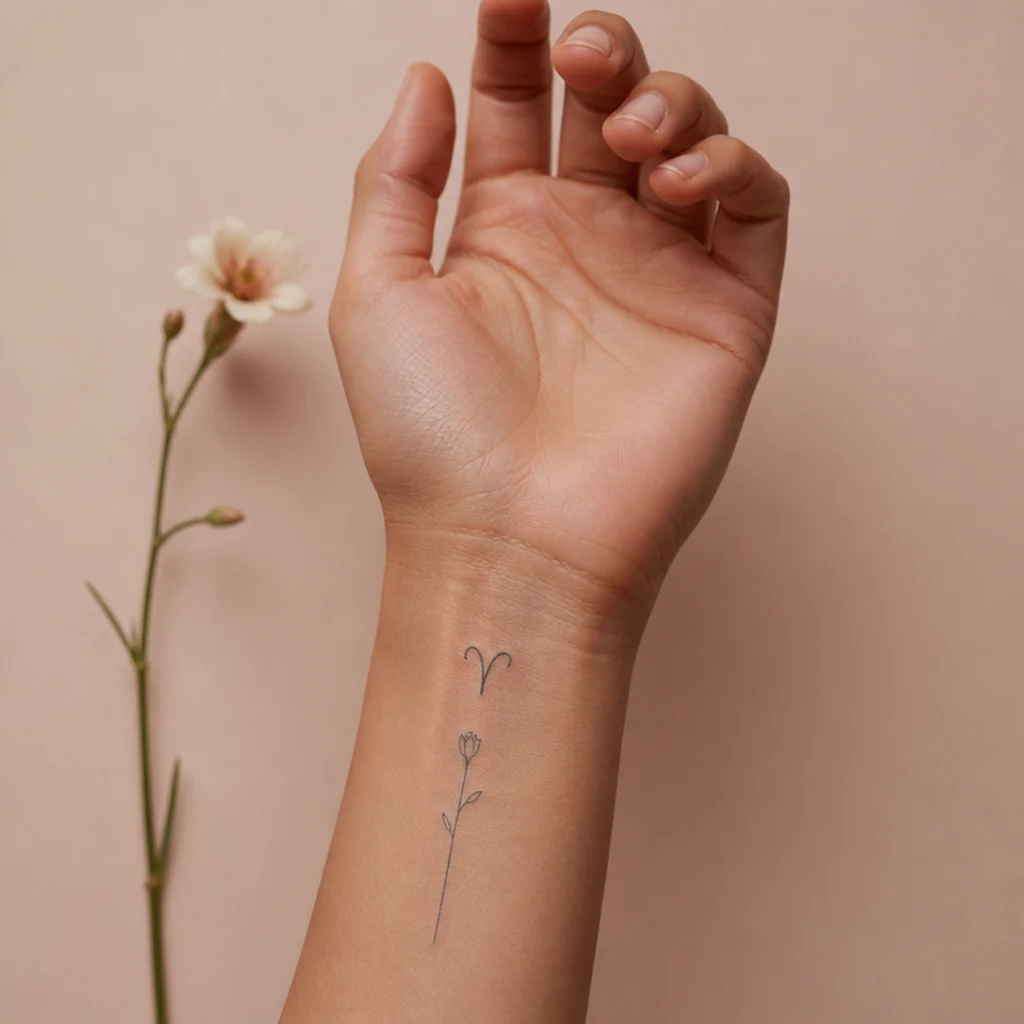
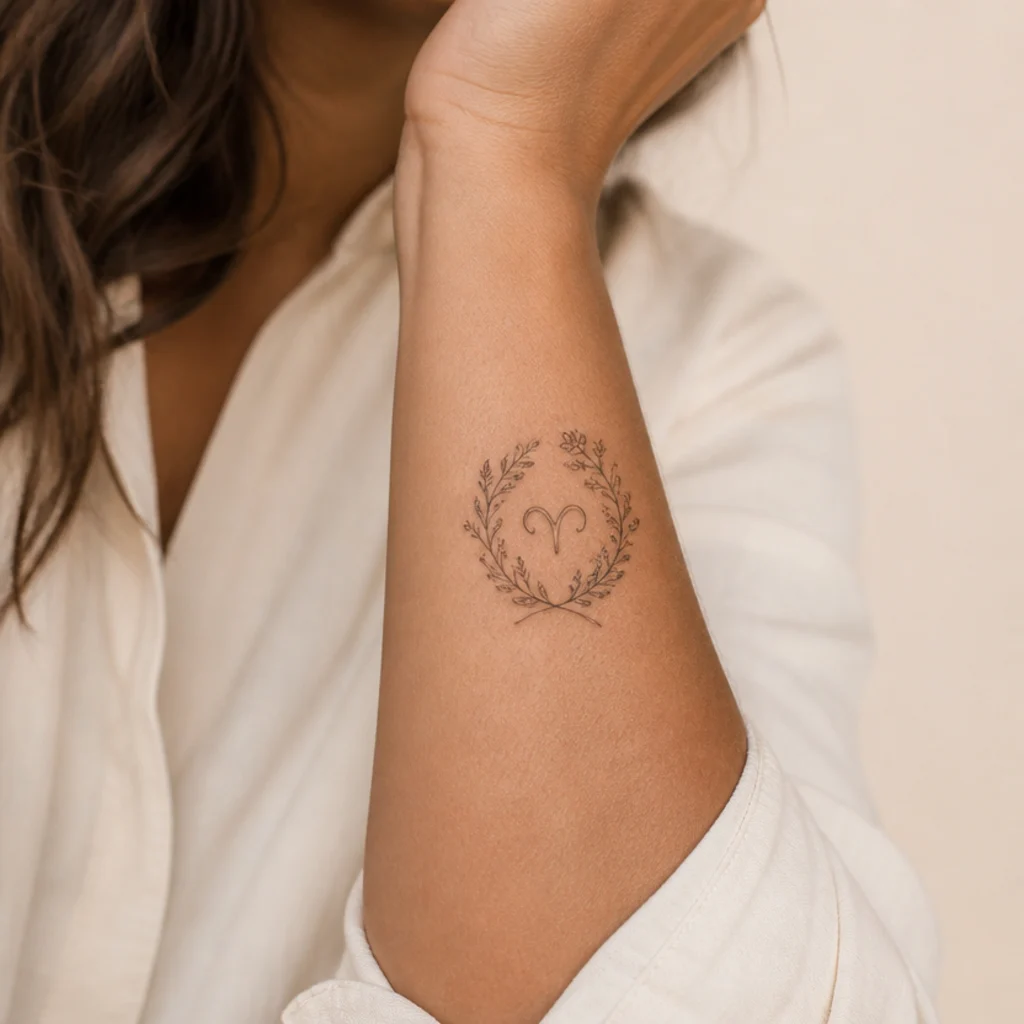
Sometimes restraint says the most. A single Aries glyph with one slender flower stem works on the wrist, inner ankle, or behind the ear, and it is a natural pick for a first tattoo or a matching piece with a partner. Make the bloom a birth-month flower, sweet pea for April or daisy for April as well, so the glyph carries a personal layer without extra clutter. The small footprint keeps sessions short and cost at or near shop minimum. The trade-off is that tiny fine-line work sits close together, so detail can bridge and blur as skin ages, especially on the flexing wrist; keep the design under roughly one and a half inches and let negative space do the heavy lifting. Avoid packing tiny leaves against the stem, since they're the first marks to fill in. It's understated but unmistakably an aries flower tattoo. Ask your tattoo artist to draw it slightly larger than feels necessary so it survives 10 years of wrist movement.
06Aries Goddess and Rose Portrait
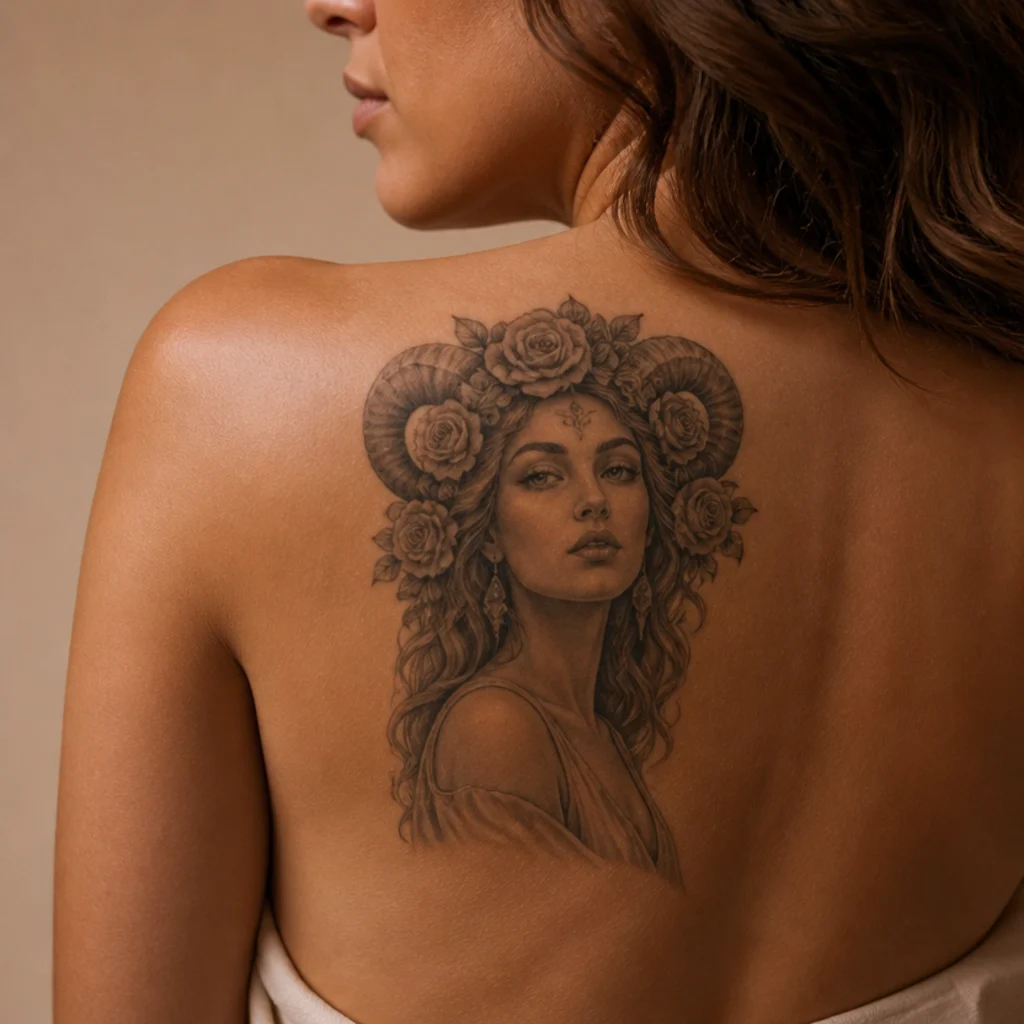
An aries goddess tattoo reimagines the sign as a figure, usually a woman crowned with subtle ram horns and a halo of roses. This ambitious concept needs a larger canvas, the shoulder blade, outer thigh, or upper back, and it's not a starter piece. Black-and-grey portrait work lives or dies on smooth gradient shading and accurate proportion, so review healed portrait photos, not just fresh ones, and confirm the artist specializes in realism before booking. Roses soften the horns and tie the piece to classic tattoo symbolism, while a whipshaded background can lift the figure off the skin. Portraits are detail-heavy and typically run two to four sessions with heal time between, plus periodic touch-ups as skin naturally shifts over the years. Faces are the least forgiving subject in tattooing, so budget accordingly and don't rush the linework session. Ask your tattoo artist to mock up the horn scale first, since oversized horns can tip the goddess from regal into caricature.
07Blackwork Ram Horns and Thistle
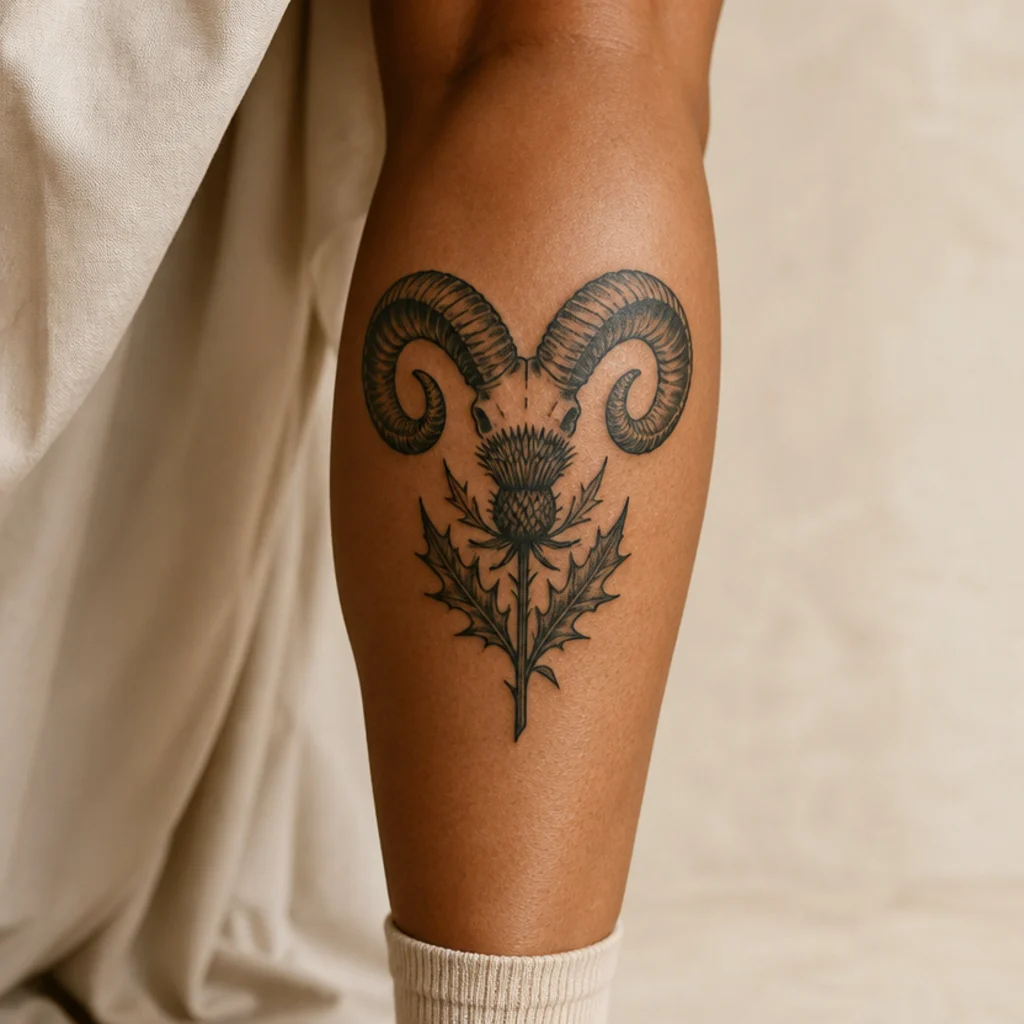
Blackwork trades color for graphic impact. A pair of curling ram horns rendered in solid black, paired with a thistle, gives a rugged, almost heraldic feel, and the thistle's spiky silhouette echoes the horns' toughness while still counting as a floral element, a nod to Scottish emblem tradition. The calf, forearm, or outer shoulder are good spots for it, since bold shapes carry from several feet away, and it works across the full range of skin tones because solid black stays legible where subtle color wouldn't. Well-packed black is among the most durable and lowest-maintenance choices, often going a decade before needing a top-up. The one risk is density: too much unbroken black can read as a heavy blob and can be harder to lighten later if you ever revise. Ask your tattoo artist to build in fine negative-space lines within the horns so the design keeps dimension up close rather than flattening into a single mass.
08Geometric Ram Framed in Florals
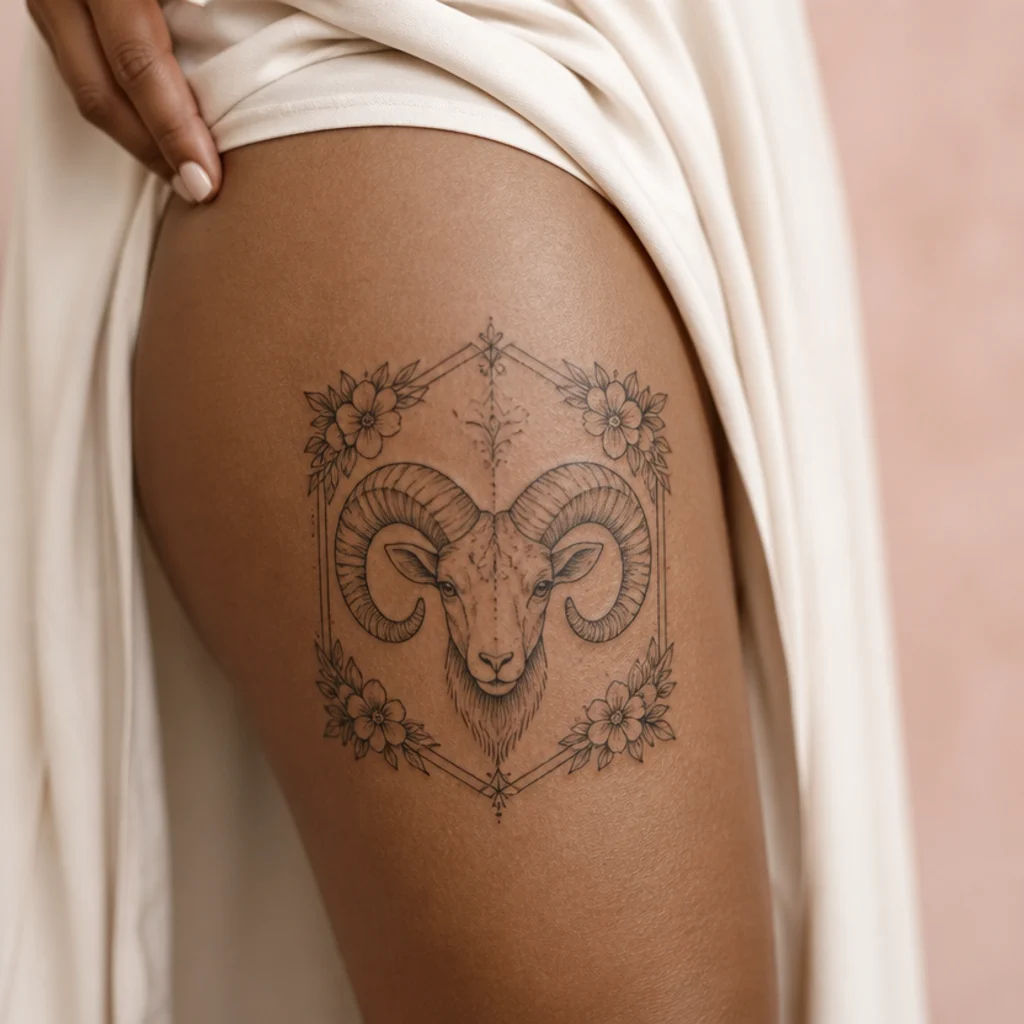
Geometry gives Aries a structured, modern edge. A ram head sits inside a hexagon or mandala frame, with symmetrical florals filling the corners, appealing to readers who like clean lines, precise symmetry, and a designed, intentional look. Choose a flat, stable plane, the outer thigh, forearm, or chest, so the frame doesn't distort over a curve as the design heals and the body moves. Precise line work is unforgiving; a wavering hexagon or an off-center axis is instantly visible, so vet an artist whose healed geometric pieces still hold true lines. The florals prevent the design from feeling cold, adding organic softness against the hard angles, and they let you scale detail up or down inside the frame. Dotwork shading inside the geometry adds depth but lengthens the session. Ask your tattoo artist to stencil and photograph the placement from multiple angles before the first line, since symmetry that looks right head-on can skew on a rounded limb.
09Traditional Ram Head With Peony
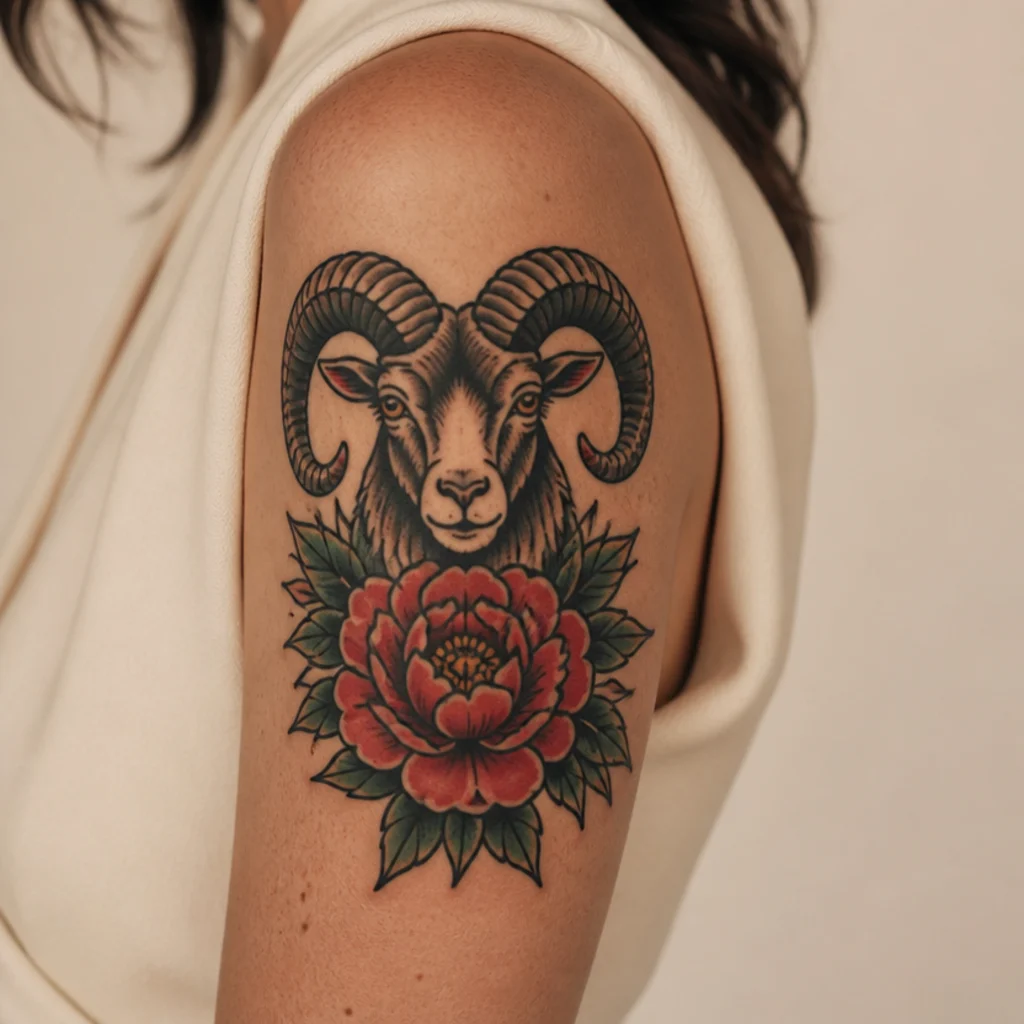
Classic American traditional never dates. A front-facing ram head with a bold peony uses the style's signature thick outlines, limited palette of red, green, and black, and high contrast, all of which are engineered for legibility over decades. Anyone who wants a piece that stays crisp with minimal fuss will like this, and the bold real estate of the upper arm, chest, or calf lets the horns and bloom read clearly. Traditional work is among the most durable styles going, so upkeep is lighter than delicate fine-line or watercolor pieces. The rounded peony complements the ram's angular horns, and the tight palette means it photographs cleanly and pairs with other traditional flash if you build a themed half-sleeve later. That makes it a dependable aries tattoo for men who value longevity over trend-driven micro-detail. Ask your tattoo artist to keep the outlines a consistent weight throughout, since mixed line thickness is what makes faux-traditional pieces look off as they settle.
10Fire and Marigold Forearm Band
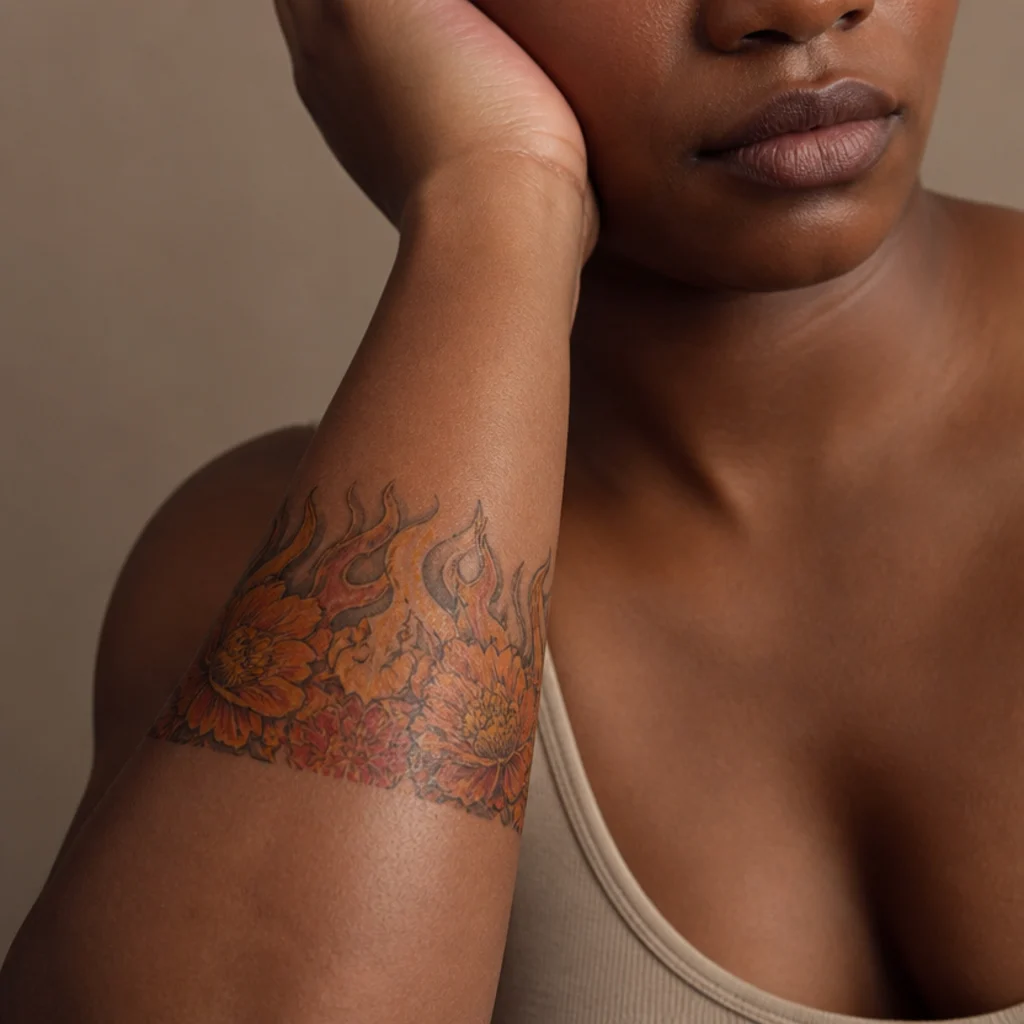
A wraparound forearm band mixes flame shapes with marigolds, whose ruffled orange petals echo fire so closely the two motifs blend into a single cohesive ring. Bands work for readers who want coverage that circles the arm without committing to a full sleeve, and the format flatters a mid-to-larger forearm where there's enough circumference for the flow to breathe. Because the design wraps, your artist must map it live to your arm's curve so the flames climb naturally and the seam where the band meets doesn't stack awkwardly; this is why a wrap always needs an in-person stencil session, not a flat printout. Warm oranges and yellows keep the fire theme unified, though those exact hues are also the fastest to soften, so expect touch-ups to keep the marigolds vivid over the years. Consider a thin black keyline top and bottom to hold the band's shape. Ask your tattoo artist to draw the wrap directly on your skin so the composition reads whole from every viewing angle.
Save this to Pinterest to compare placements before you book.
11Constellation and Baby's Breath
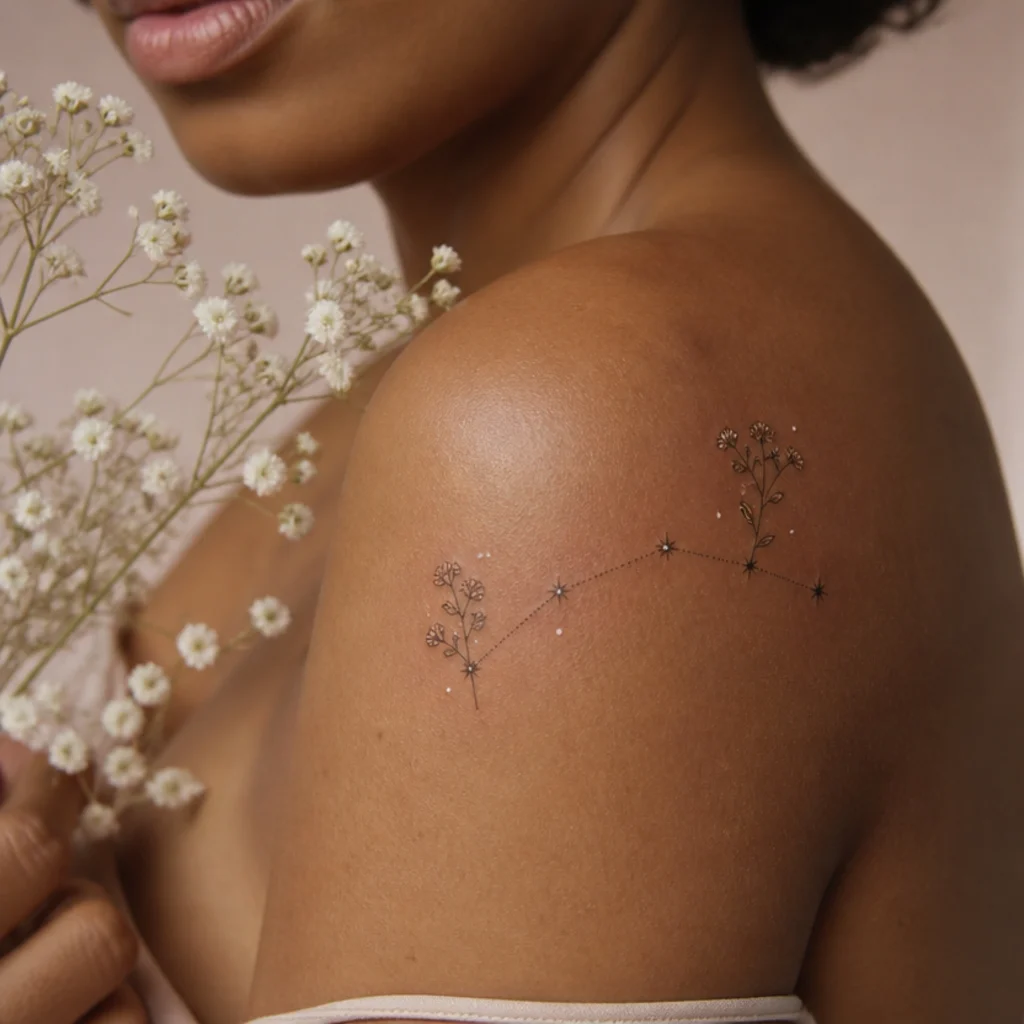
For a celestial angle, the Aries constellation, a short line of connected stars anchored by Hamal, its brightest, pairs with airy sprigs of baby's breath. The shoulder, collarbone, or spine suit this delicate concept, and it works for anyone wanting subtle symbolism over bold imagery. Fine dotted stars and gauzy flowers keep it light, but the same delicacy is its weakness: tiny, finely spaced elements soften over time, so keep the gaps generous and the detail restrained. White ink for the star points is popular yet unpredictable, it fades unevenly, can heal slightly raised, and behaves differently on every skin tone, often reading closer to a subtle scar than bright white on deeper skin. Discuss white-ink expectations honestly before committing, and consider a pale grey wash as a more reliable alternative. It's a quiet, cosmic aries flower tattoo, and it layers easily with other small pieces. Ask your tattoo artist for a healed white-ink example on skin like yours before you count on the stars staying visible.
12Neo-Traditional Ram and Ranunculus
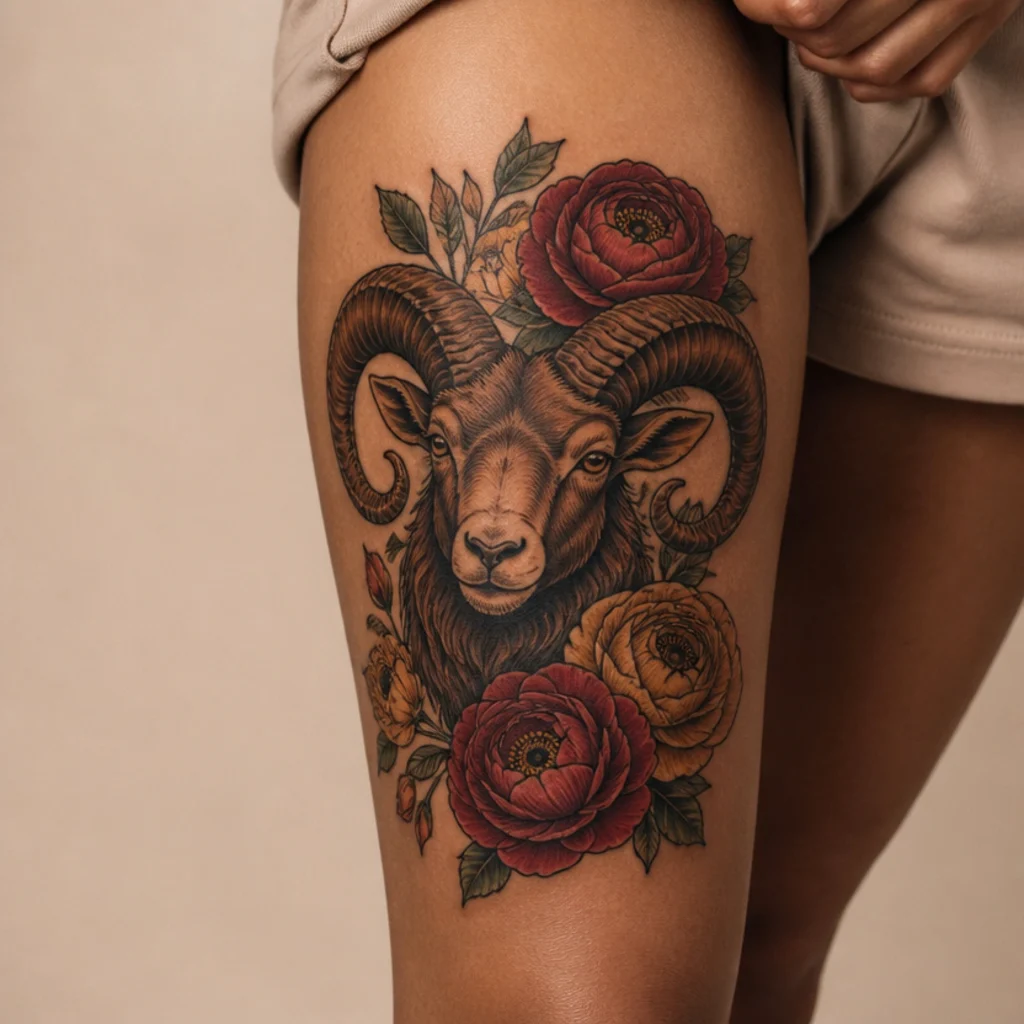
Neo-traditional keeps the bold outlines of old-school work but adds richer shading, dimensional rendering, and a broader jewel-toned palette. A ram paired with layered ranunculus blooms gains real depth in the petals and fur, sitting on the middle path between the flatness of traditional and the fragility of watercolor. Readers who love traditional structure but want more realism tend to pick this, and it rewards a large, stable canvas like the outer thigh, upper arm, or chest where the many-petaled ranunculus has room to layer. This style is more durable than watercolor because the retained black outlines hold the image even as color mellows, though the deep purples and teals will soften first. Expect one to two sessions depending on size and color density. The result photographs beautifully and reads as current without chasing a fleeting micro-trend. Ask your tattoo artist to show healed neo-traditional color work, since the style's depth depends entirely on how cleanly their shading settles.
13Spine Glyph With Trailing Vine
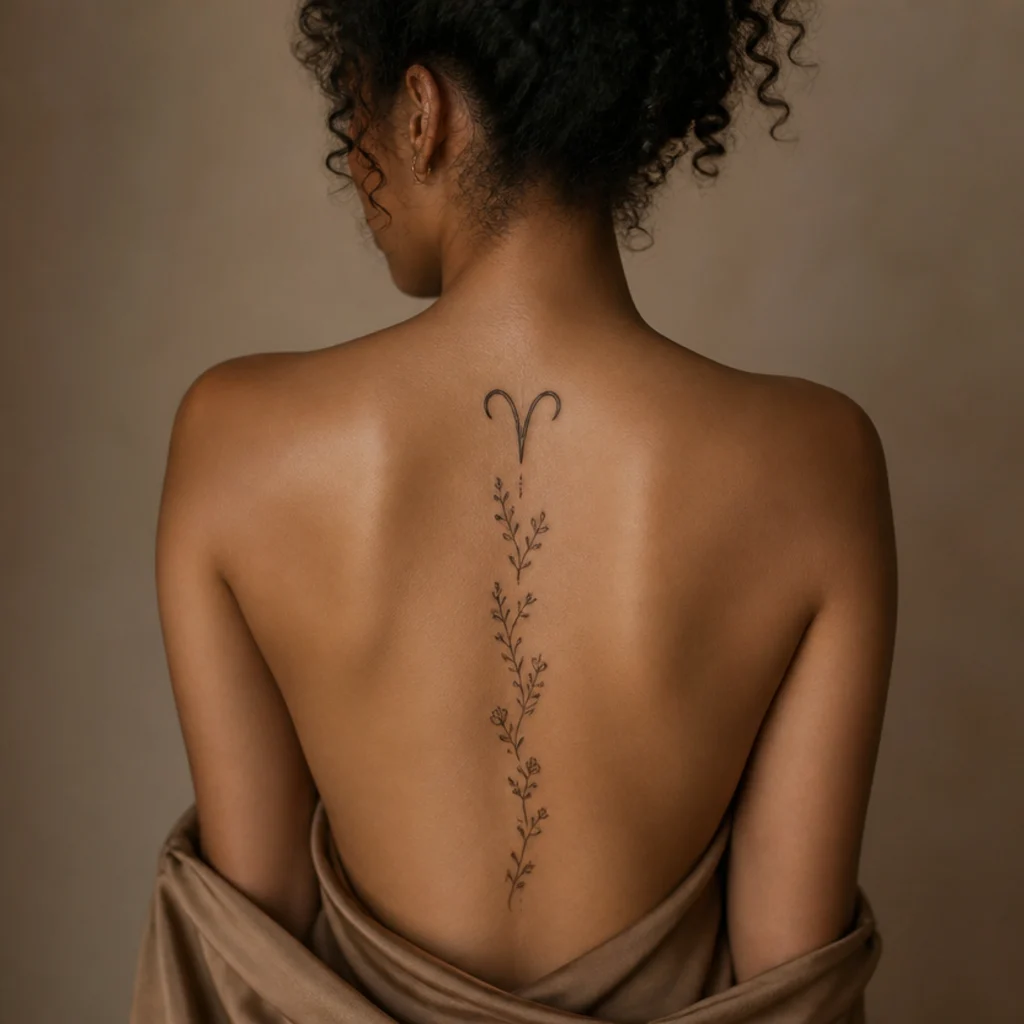
Running the Aries glyph down the spine with a trailing floral vine creates an elegant vertical line that follows the body's own axis. It's a good fit for readers comfortable with a longer, thinner placement and drawn to the drama of a center-back piece; the vine's small leaves and buds keep the eye moving downward. Be realistic about the sensation, spine tattoos sit directly over bone with little cushioning, so the feeling is sharper than fleshier spots and long sessions can be taxing, worth talking through and planning breaks for. Alignment is the technical challenge: the artist must stencil straight along the vertebrae while you stand naturally, since a spine piece drawn on a hunched back can look crooked once you straighten. Keep the linework fine but not hair-thin, or it will blur where the back flexes. It's a refined aries flower tattoo, both botanical and architectural. Ask your tattoo artist to check the stencil alignment while you are standing upright, not lying down.
14Ram Silhouette in a Poppy Wreath
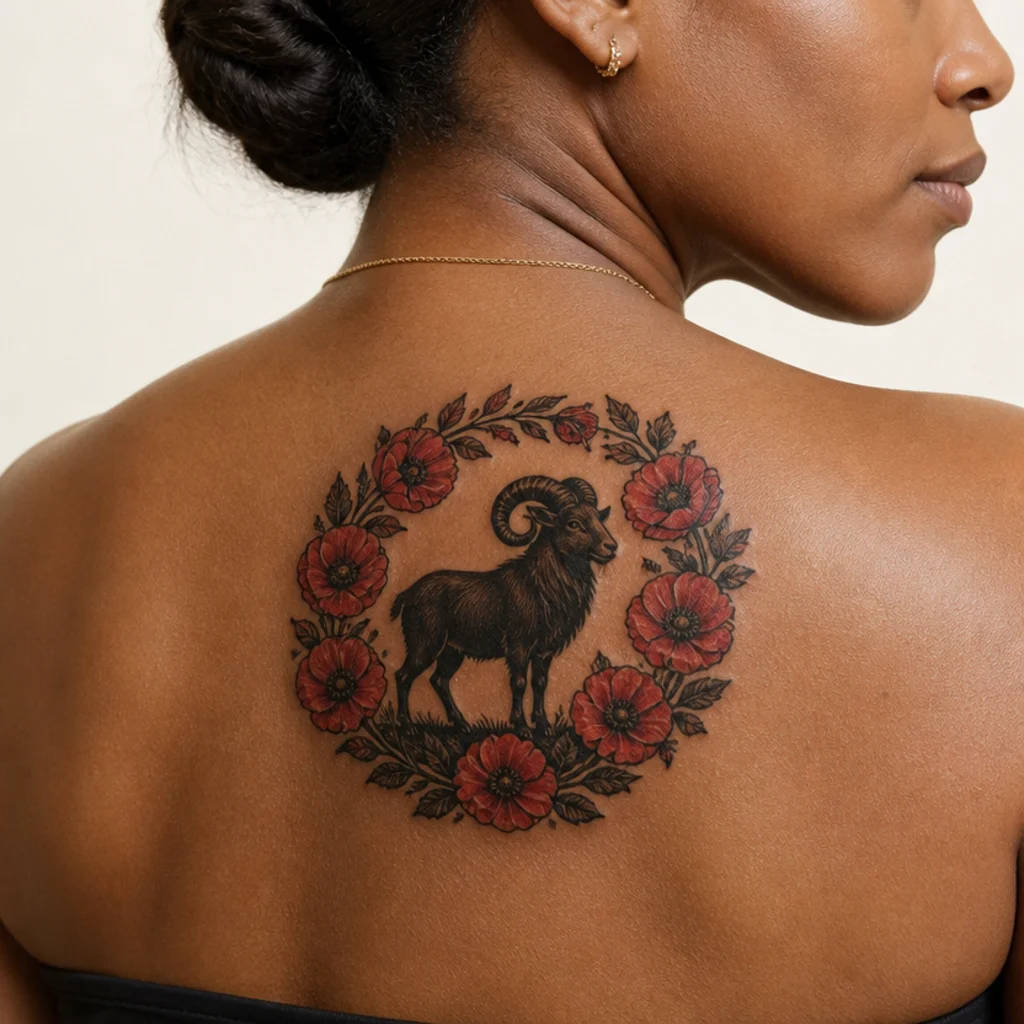
A solid ram silhouette encircled by a wreath of red poppies is the standout of this list, balancing stark blackwork against soft color. The filled ram reads instantly even from across a room, while the poppy ring frames it like a crest or family emblem. The back of the shoulder, upper back, or outer thigh works well here, where a circular composition has room to sit symmetrically. The contrast of matte black against saturated red gives a bold aries fire tattoo mood without literal flames, and the two-element palette keeps it graphic and legible on most skin tones. Durability is split: the solid black holds for a decade-plus, while the red poppies will want a refresh sooner, so treat the color as the maintenance item. It works as a standalone emblem or the centerpiece of a larger themed arrangement you build outward over time. Ask your tattoo artist to keep a clean ring of negative space between the ram and the wreath so both elements stay distinct as the ink settles.
15Dotwork Ram With Chamomile
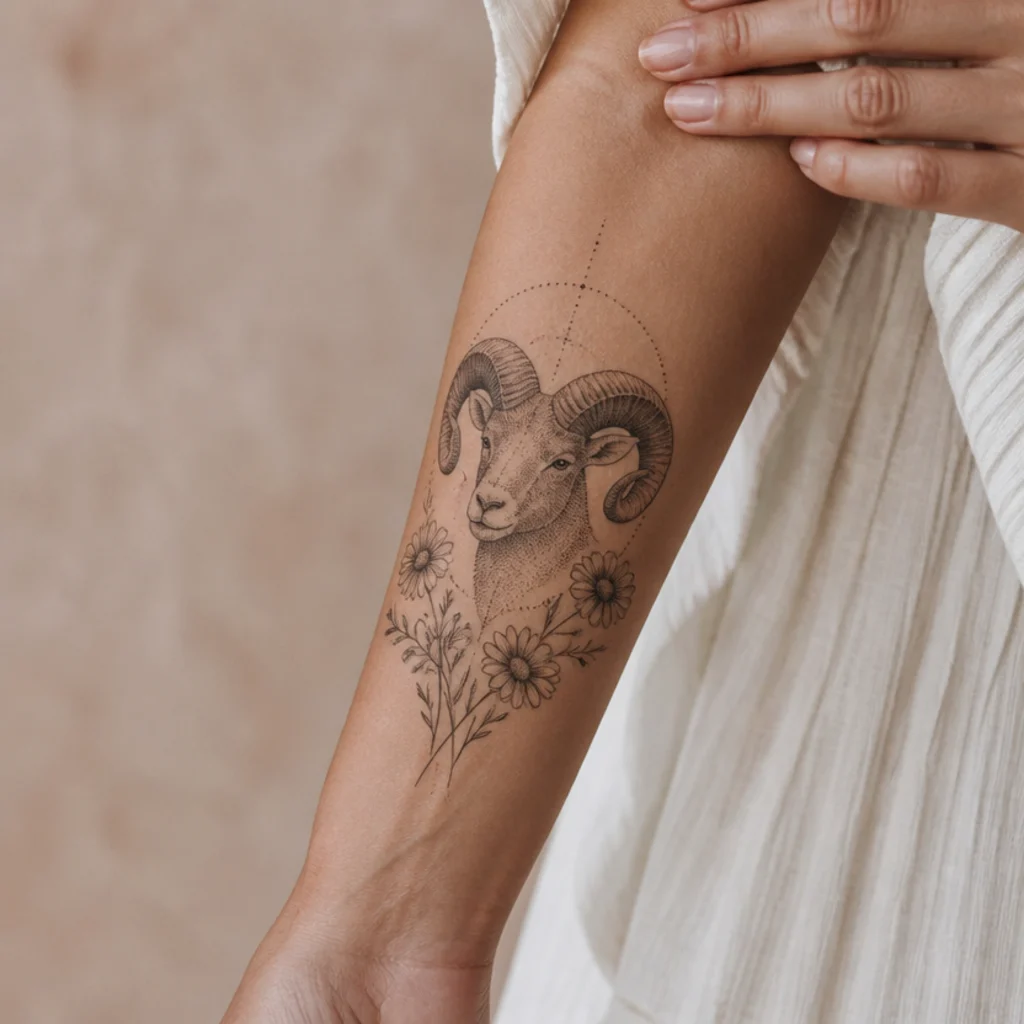
Dotwork builds tone from thousands of individually placed stippled dots, giving a soft, matte, almost hand-drawn finish. A ram head paired with chamomile daisies feels gentle and meditative, an approachable close to this list, and it appeals to readers who like intricate detail and a non-glossy look. The forearm, calf, or shoulder blade gives the stippling room to build smooth gradients from dense shadow to open highlight. Because tone comes from point density rather than solid packing, dotwork sessions run longer than an equivalent solid piece, so plan for the extra chair time and a slightly different healing feel. It also ages gracefully when the dots are well spaced; crowd them and the gradients can eventually merge into flat grey. Chamomile's simple white-centered daisies keep the mood calm against the ram's strength. Ask your tattoo artist how they handle dot spacing in the darkest zones, since that is where beginners blur dotwork into mud.
Pro Tips from the Editor
- Anchor delicate color with black. Watercolor, fire gradients, and pastel florals last far longer with even a subtle grey or black skeleton underneath; ask specifically for anchored versions if longevity matters.
- Match the style to your undertone. Warm oranges and reds pop on warmer, lighter skin but can read muted on cooler or deeper tones, where high-contrast blackwork and dotwork usually stay crisper. Always request healed photos on skin close to yours.
- Size up small pieces on purpose. Wrist, ankle, and behind-the-ear tattoos flex and blur fastest, so a glyph drawn slightly larger than feels necessary will still read cleanly in a decade.
- Treat red and white as maintenance items. Saturated reds oxidize and white ink fades or heals unevenly; budget a touch-up cycle for anything leaning on them rather than expecting them to stay vivid untouched.
- Book the artist for the style, not the shop. A brilliant traditional artist is the wrong choice for a fine-line goddess portrait. Filter portfolios by the specific style you want and by healed work, not fresh-off-the-needle shots.
- Bring feeling words, not just images. Telling your artist you want it bold, romantic, or celestial lets them adapt the reference rather than copy it, which also keeps you clear of tracing someone else's custom work.
- Never bank on full cover-up. If you're placing one of these over old ink or a scar, treat total concealment as impossible to guarantee; let a licensed artist assess the existing piece before you commit.
How to Choose / Get the Look
Start with what actually pulls you in, the ram, the glyph, the fire element, or the flowers, then decide how loud you want the piece to be and how long you need it to last untouched. Use this quick framework to narrow the field before your consultation.
| Priority | Best-fit styles | Placement sweet spot | Upkeep |
|---|---|---|---|
| Longevity, low fuss | Traditional, blackwork, dotwork | Upper arm, calf, shoulder, forearm | Lightest; touch-up ~10 yrs |
| Soft, painterly look | Watercolor, neo-traditional | Upper arm, outer thigh, chest | Higher; color refresh 3–6 yrs |
| Subtle, first tattoo | Fine-line, single-needle, minimal glyph | Wrist, ankle, inner forearm, behind ear | Moderate; details soften 5–8 yrs |
| Statement / narrative | Goddess portrait, poppy wreath, sleeve start | Shoulder blade, back, thigh | Multi-session; periodic touch-ups |
Match concept to placement: small glyphs suit wrists and ankles, while portraits, wreaths, and sleeves want the arm, thigh, or back. Bring three or four reference images and describe the feeling you want so your artist can adapt rather than copy. Ask to see healed photos in the style you like, not just fresh work, since color and fine lines change as they settle. Confirm sizing, placement, coverage feasibility, and healing expectations with a licensed tattoo artist, and be honest about your pain tolerance, budget, and sun exposure, since UV is the single biggest long-term fade factor. If you're considering covering an existing tattoo or scar, know that no artist can promise it will fully disappear; a licensed pro can assess your skin and tell you what's realistic before you commit.
Frequently Asked Questions
Are these designs only for Aries?
Not at all. Many people choose them for the ram or floral symbolism alone, to honor an Aries partner, parent, or child, or simply because they like the bold-meets-botanical contrast. The imagery stands on its own even if the sign isn't yours, and no one reads a ram or a poppy as strictly astrological.
Which style lasts the longest?
Bold American-traditional, solid blackwork, and well-spaced dotwork generally age best thanks to thick lines and high contrast. Fine-line, watercolor, and white-ink details are lovely but usually soften and need touch-ups sooner. Sun exposure accelerates fading across every style, so consistent SPF on healed tattoos does more for longevity than any single ink choice. Your artist can advise for your specific skin.
Do flower and fire elements suit men's tattoos?
Yes. An aries tattoo for men often pairs the ram or flames with flowers for contrast and depth. Poppies, thistle, and marigold read bold rather than delicate and work especially well in traditional, blackwork, and neo-traditional styles, where heavy line weight keeps them from looking dainty.
How big should an aries flower tattoo be?
It depends on detail. A bare glyph or single stem can sit around one to one and a half inches, while portraits, wreaths, and sleeves need several inches to keep linework legible as it ages and spreads slightly. Your artist will recommend a minimum size so details stay crisp; going smaller than that is the most common reason a piece blurs within a few years.
Can one of these cover an old tattoo?
Sometimes, but never assume full coverage. Cover-ups depend on the old ink's size, saturation, color, and darkness, and darker or larger existing work is much harder to hide. A licensed artist can assess your existing piece in person and tell you what is realistic, which may mean a larger or darker design than you first pictured, or a session of laser lightening first.
Which flowers pair best with the ram or glyph?
Poppies, peonies, ranunculus, marigolds, thistle, chamomile, and baby's breath all appear here for a reason: poppies and marigolds echo Aries fire, thistle mirrors the horns' toughness, and airy blooms like chamomile or baby's breath soften bold blackwork. Birth-month flowers (daisy or sweet pea for April, or your own month) add a personal layer without changing the composition.
Does placement affect how much it hurts?
Yes, significantly. Fleshier areas like the outer upper arm, thigh, and calf are generally more comfortable, while bony or thin-skinned spots, the spine, ribs, wrist, ankle, and behind the ear, tend to be sharper and can make long sessions harder. Factor this in when choosing between, say, a spine glyph and a forearm band, and tell your artist your pain tolerance so they can plan breaks.
How long will a piece take to heal?
Surface healing typically takes about two to three weeks, but full settling of color and fine detail can run several months, which is exactly why healed photos matter more than fresh ones. Larger color and portrait work spread across multiple sessions extends the overall timeline. Follow your artist's specific aftercare, keep it out of direct sun, and avoid soaking it while it heals.