20 Red Leopard Print Nail Designs
Swap the usual gold-and-tan leopard for red and the whole print catches fire. These 20 editor-picked sets run from barely-there french tips to full crimson statement nails, each with the exact shade family, nail shape, finish and upkeep timeline you need to recreate it, plus the words to say at the salon so nothing gets lost in translation.
 Edited by Lena Rose · Published July 11, 2026 · 38 min read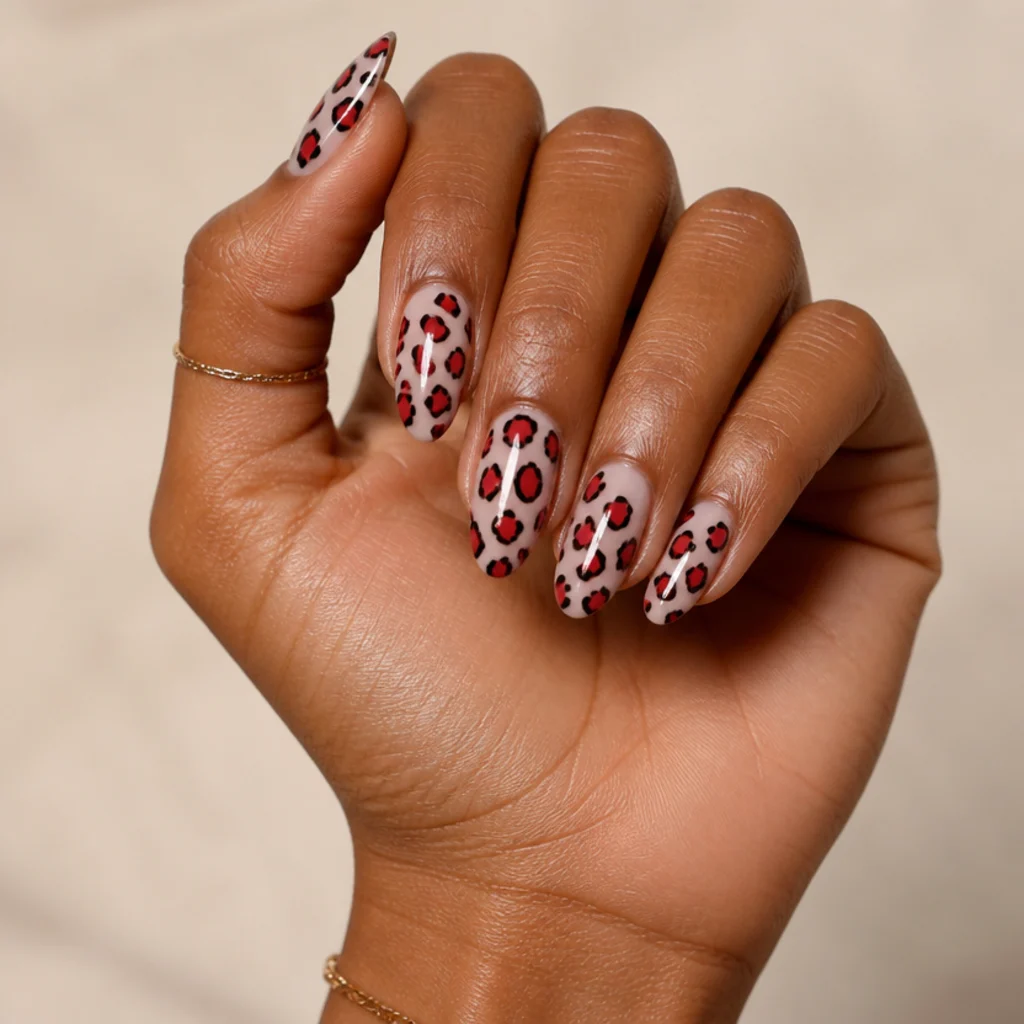
Quick Answer
- Best for: Anyone who wants animal print with more heat and edge than classic caramel leopard, and who likes a look that photographs well and pairs with red-family lipstick, gold jewelry or a monochrome outfit.
- Who might skip it: Very active hands, guitarists, climbers, or anyone who finds high-contrast art distracting at a keyboard, unless you keep it short with two or three minimal spots per nail.
- Maintenance: Fills every two to three weeks for gel or acrylic; freehand spots grow out more gracefully than stamped or gemmed ones, and neutral bases buy you three to five extra days between visits.
- Difficulty: Moderate. Loose freehand spots are forgiving; crisp french smile lines, negative-space half-moons, chrome and mixed-red tonal work want a steadier hand or an experienced artist.
- Cost: Roughly the price of a standard gel or acrylic set plus a nail-art surcharge, which usually scales with the number of accent nails and any gems, chrome or foil. Full-coverage and micro-detail sets add appointment time, so expect to pay for the extra chair time.
- Wear time / longevity: Two to three weeks of clean wear on gel; freehand art lasts the full grow-out, while rhinestones, foil and chrome tips are the first elements to show wear.
- Standout variation: Red leopard french tip nails, with the print sitting only on the smile line for a wearable, office-friendly finish.
- How to ask your nail tech: Bring one or two saved photos, name the exact base shade (scarlet, cherry, burgundy, milky pink), and say "open-center spots with broken black arcs, not solid dots" so the print actually reads as leopard.
In This Guide
- Classic Red Leopard Almond
- Red Leopard French Tip
- Short Square Red Leopard
- Pink and Red Leopard Mix
- Crimson Accent Nail
- Nude Base Red Spots
- Black and Red Leopard
- Cherry Red Glazed Leopard
- Coffin Red Leopard Ombre
- White Tip Red Leopard French
- Short Round Red Leopard
- Burgundy Autumn Leopard
- Chrome Red Leopard
- Matte Red Leopard
- Red and Gold Leopard
- Micro Leopard on Red
- Red Leopard with Rhinestones
- Pink Base Red Leopard
- Half-Moon Red Leopard
- Full Red Statement Leopard
Leopard print never really leaves the rotation, but the red version feels current right now. A red leopard nail keeps the print's usual grammar, clustered irregular spots with open centers and broken black arcs, then swaps caramel and gold for scarlet, cherry, or burgundy. That one change resets the mood: it reads bolder, more fashion-led, and it's more flexible across skin tones, because the exact red you pick does the flattering work. Cool undertones (visible blue veins, silver jewelry that looks good on you) lean toward cherry and cranberry; warm and olive complexions come alive in burgundy and red-gold; a milky pink base cools the whole thing down for daytime and suits fair-to-medium skin best. Across these 20 designs you'll find delicate short leopard nails for anyone who types all day, dramatic full crimson sets for an event, and plenty of french tip versions that leave most of the nail bare. Each entry covers the shape, length, finish, who it flatters, a realistic upkeep timeline, and the exact phrasing to hand your tech so nothing gets lost at the salon. Save whichever ones speak to you, then mix elements freely, a base from one, a spot placement from another, and build a set that's actually yours.
01Classic Red Leopard Almond
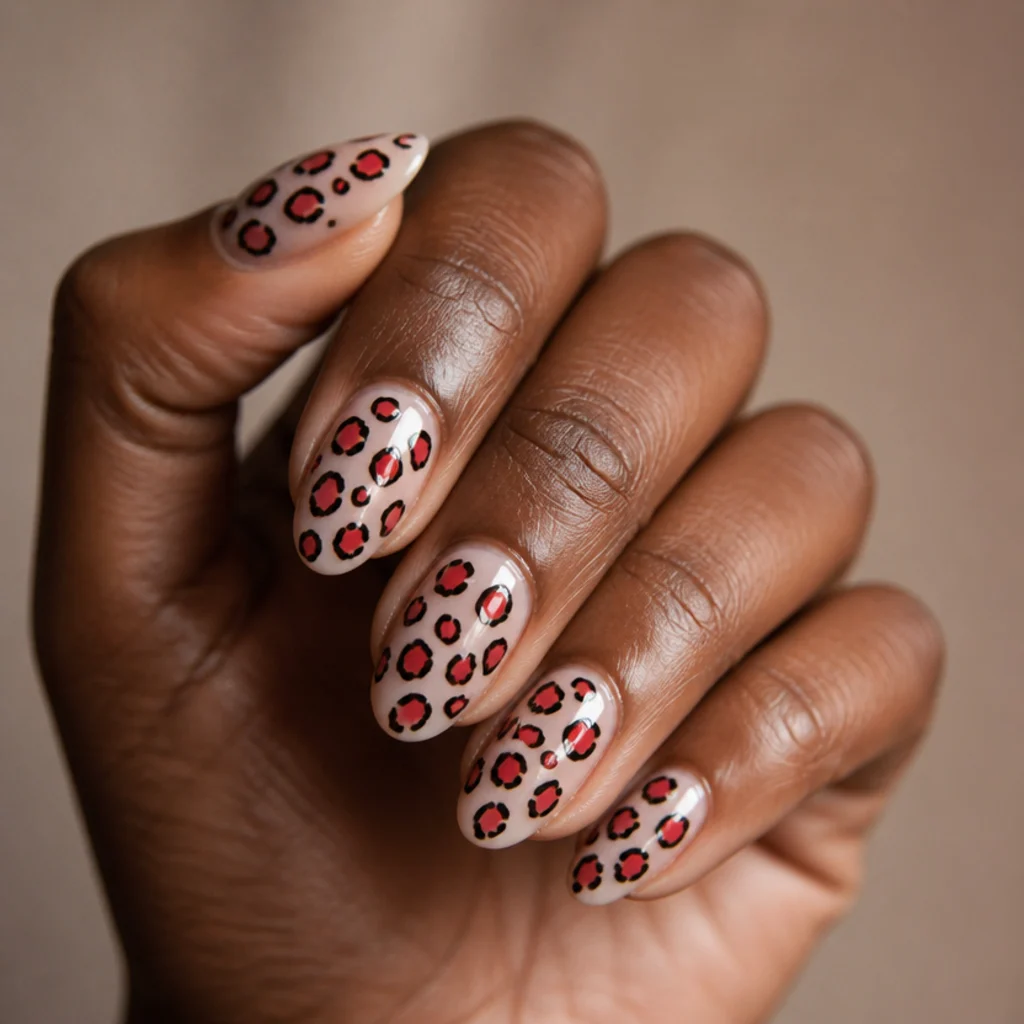
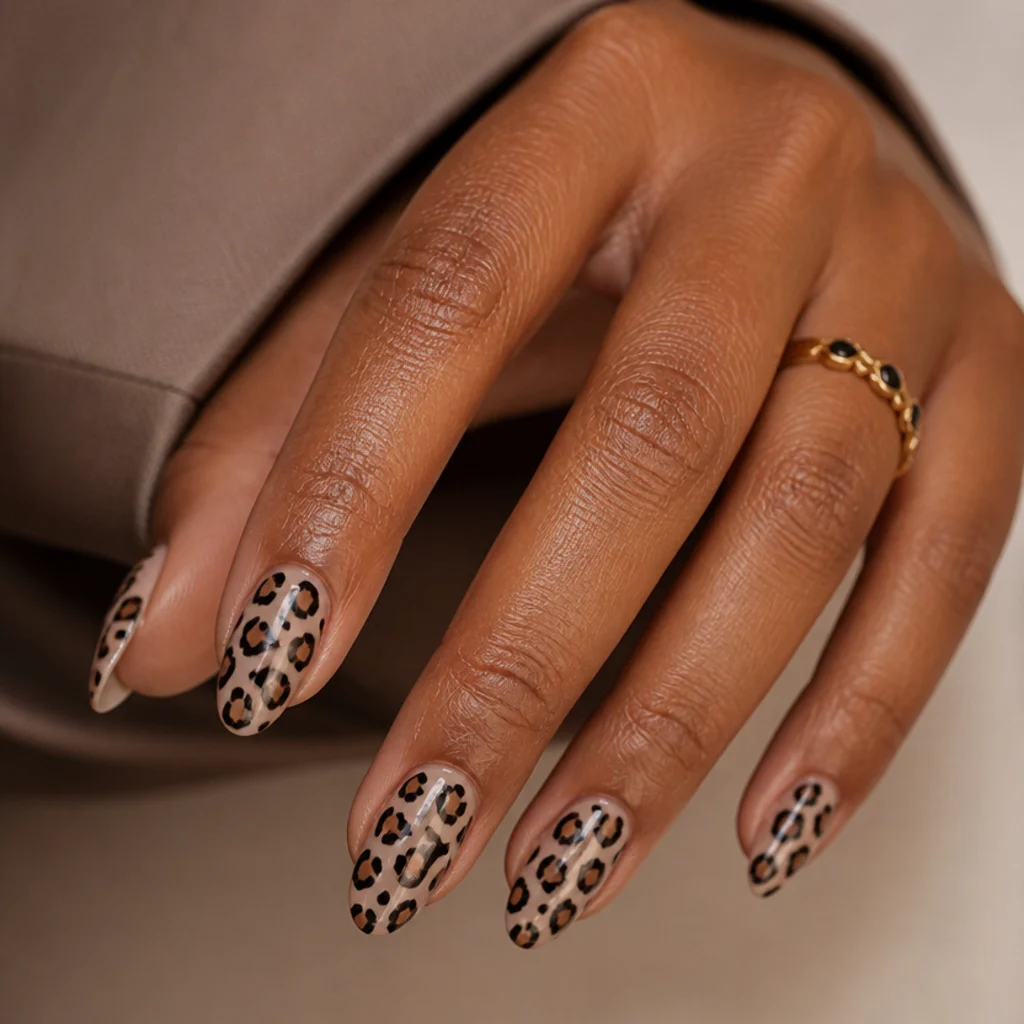
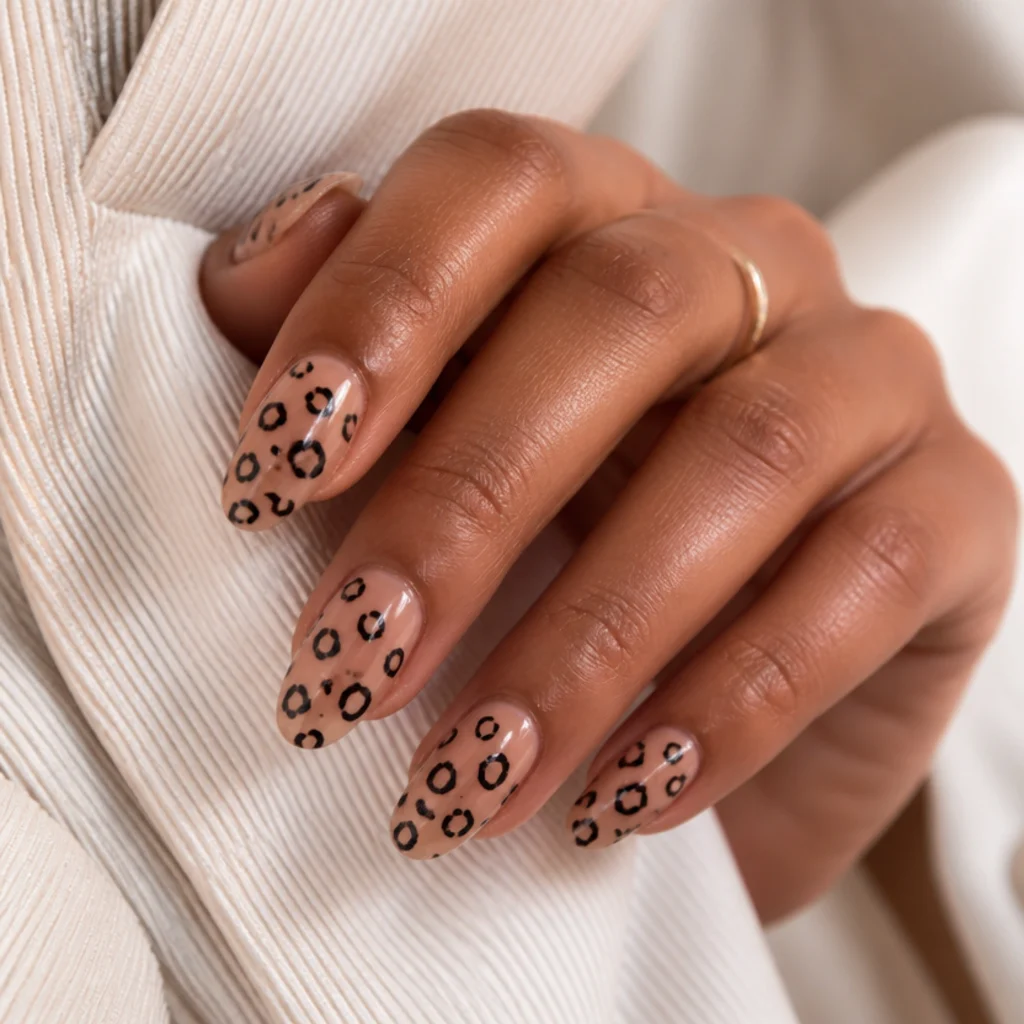
The most versatile entry point, and the one to book if you've never worn animal print. Picture a sheer, skin-matched nude base with scarlet spots outlined in fine black on a medium almond, a shape whose tapered tip lengthens the finger and softens the print so it reads styled rather than costume. The neutral background does the balancing, which is why this set flatters almost every undertone and slips under office dress codes. The technical key is open-center spots with broken, comma-like black arcs rather than solid dots; solid dots read as polka dots, not leopard. Keep the clusters irregular, off-center, and denser toward the tip than the cuticle for a natural pelt effect. Regrowth hides for a few extra days thanks to the muted base, so you can stretch to three weeks between gel fills without it looking grown-out. It suits short, wide nail beds especially, since the almond taper adds visual length. Pair it with warm-red or berry lip colors and gold jewelry. Ask your nail tech for a "sheer nude almond, open-center red leopard spots with fine black outlines, spaced not crowded, heavier at the tips."
02Red Leopard French Tip
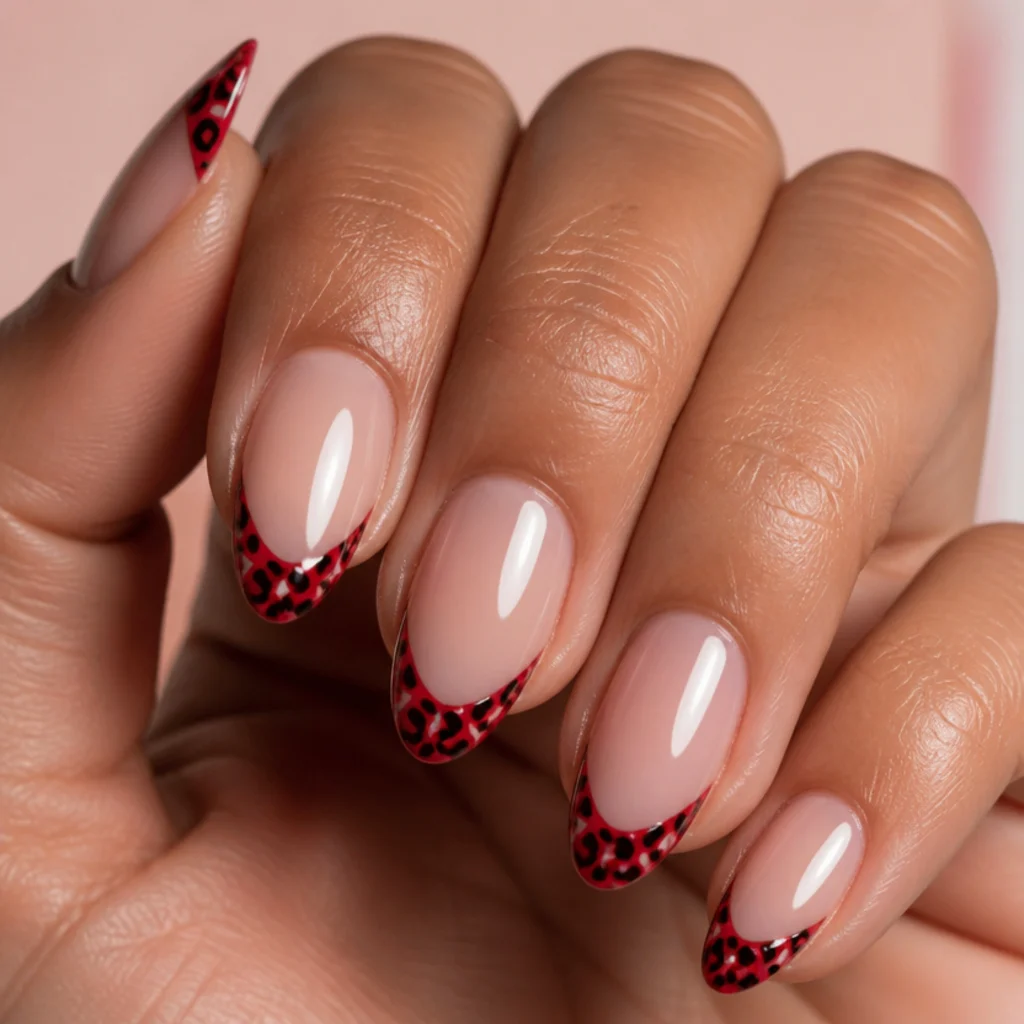
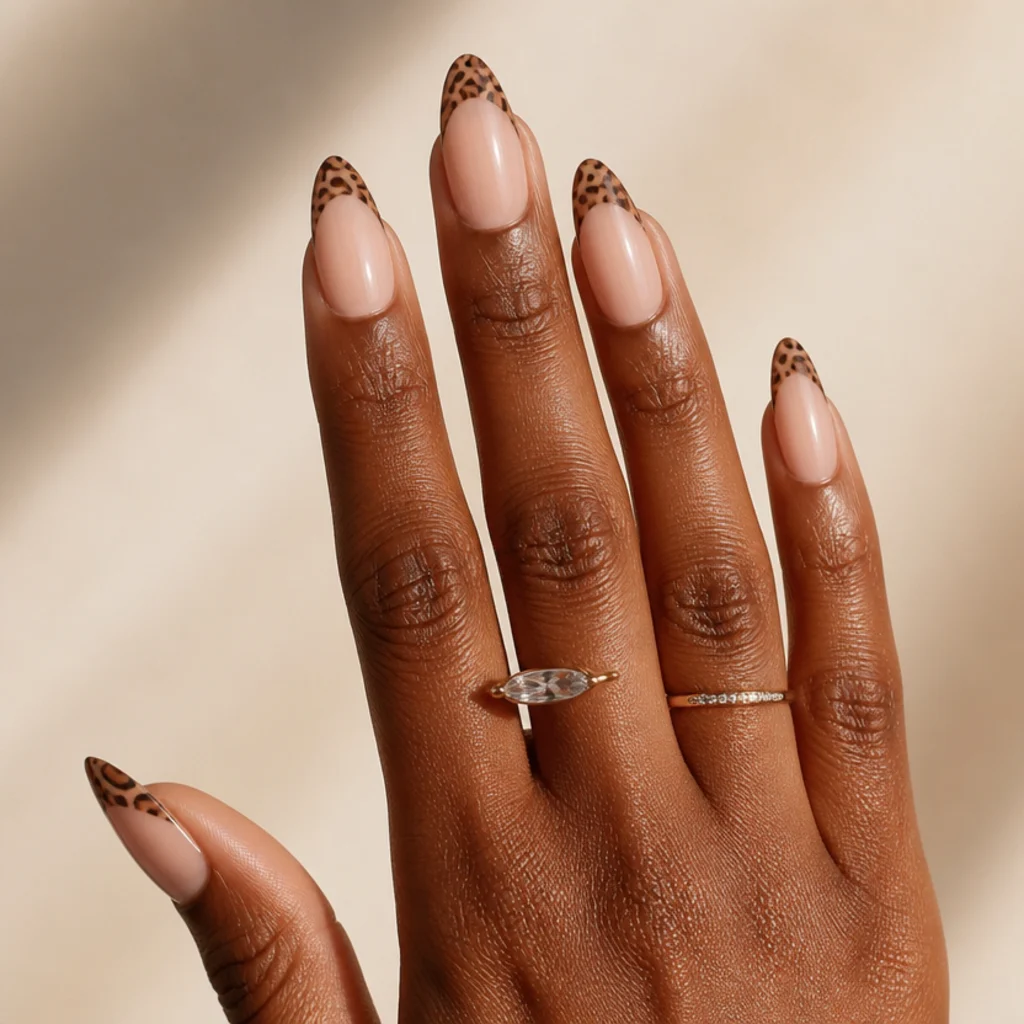
Here the print lives only on the free edge, tracing the smile line like a traditional french but filled with red-and-black leopard instead of solid white. Leopard print french tip nails sit right at the midpoint between statement and subtle: the bare, clear nail bed keeps them boardroom-appropriate while the tip carries the personality. They work best on medium to long nails, where the tip has room for two or three spots without crowding; on very short nails the print collapses into a smudge, so favor length here. Because all the art sits at the edge, regrowth is forgiving, easily four weeks before it looks off. That makes this one of the lowest-upkeep designs in the guide, a smart pick if you tend to stretch time between appointments. Vary the tip depth to your nail length: a slim three-to-four-millimeter french on shorter nails, a deeper one on long almond. Pro tip: ask for the spots to straddle the smile line, half above and half spilling onto the tip, so the print looks intentional rather than stamped on. A cool cherry tip flatters blue-toned skin; a warm scarlet suits golden complexions. Ask your nail tech for a "red leopard french tip, spots straddling the smile line, clear base."
03Short Square Red Leopard
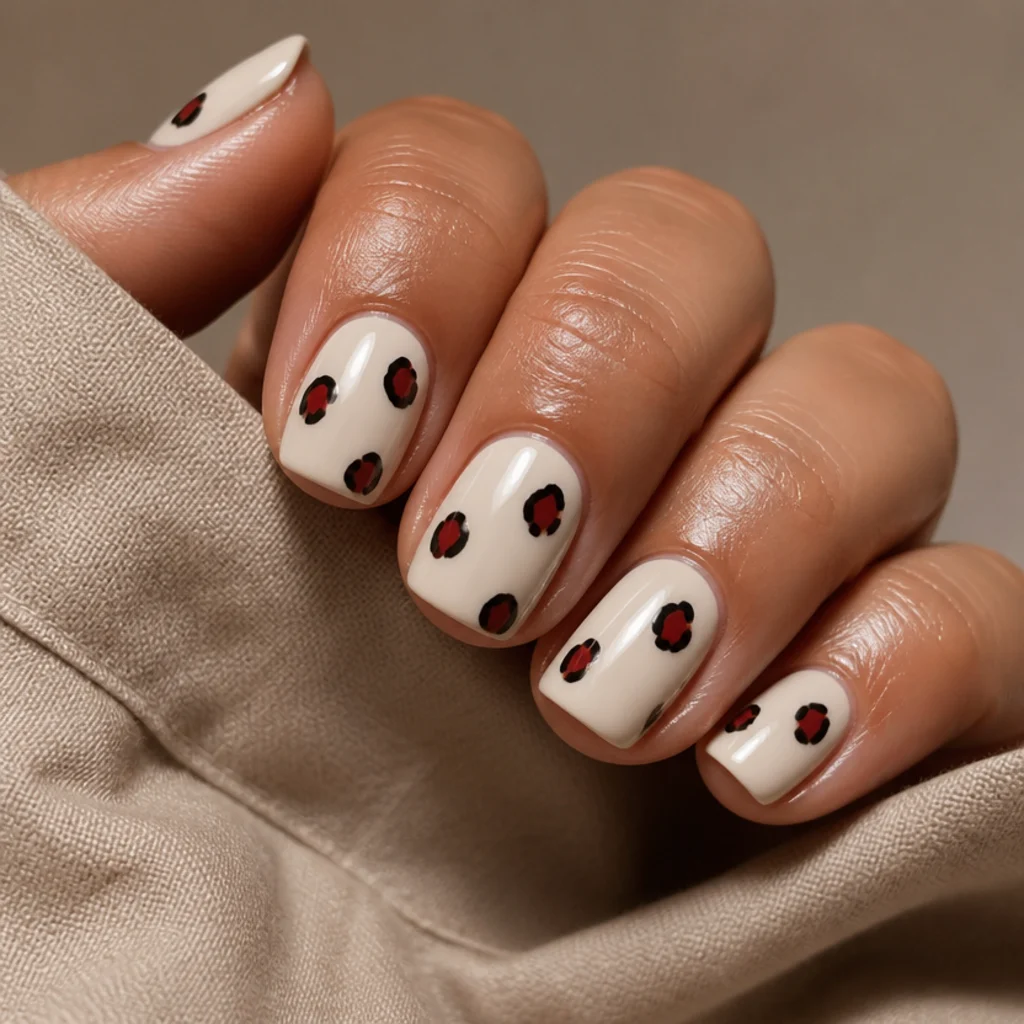
Proof that short leopard print nails can still command attention. On a short squoval, the shape that keeps a flat, strong free edge with softened corners, the spots are scaled down and spaced a touch wider so the print reads clean instead of cramped. A warm ivory or pale beige base lightens the visual weight at this length; a darker base on short nails can look blocky and shorten the finger. This is the pragmatic pick for anyone hands-on at work: short squoval resists snags, tolerates typing, and lifts far less at the edges than a long tapered shape, so it holds up for nurses, parents and keyboard-bound professionals. Cap it at two or three spots per nail and let some fingers carry fewer for an unforced scatter. Because the free edge is short and thick, it stays structurally sound between appointments, and you can push fills toward three weeks. Add a single high-gloss topcoat so the reds stay saturated and the flat surface catches light. It flatters narrow nail beds by keeping the print proportional. Ask your nail tech for "short squoval, two or three larger red leopard spots per nail on a warm nude base, glossy top."
04Pink and Red Leopard Mix
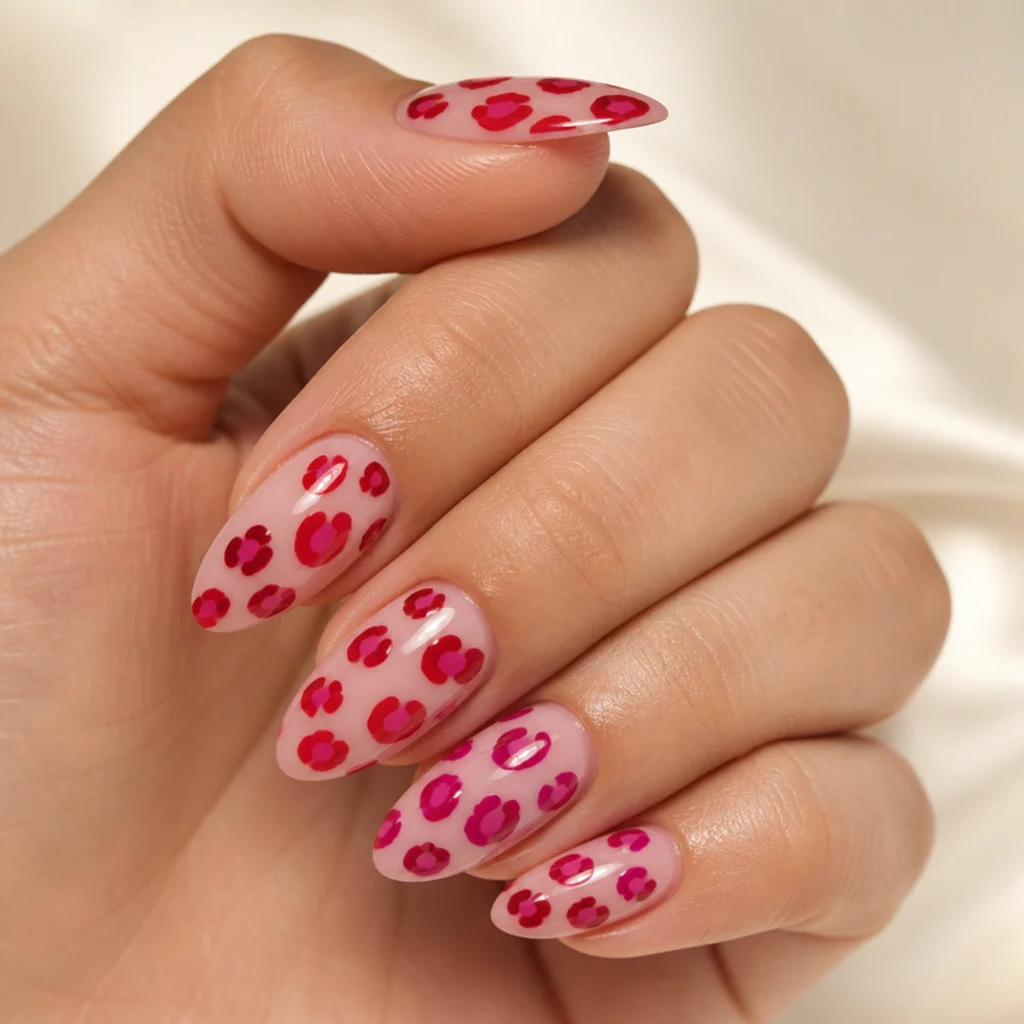
For anyone torn between soft and bold, this marries pink leopard print nails with red accents. A milky, semi-sheer pink base carries spots in two reds, a bright scarlet and a deeper berry, so the print gains real depth instead of one flat tone. The pink keeps the effect flirty and warm, flattering fair to medium skin especially, though a slightly deeper rose or mauve base extends the same idea to richer complexions without washing them out. What lifts the look is asymmetry: let two or three nails lean pink-heavy and one or two lean red-dominant, so the set looks collected rather than matchy. Upkeep is average for gel, roughly two to three weeks, and the pale base disguises early regrowth, buying you extra days. It sits happily at any length but is prettiest on a medium almond where both reds have room to read. Pro tip: two distinct reds photograph far better than one, giving dimension in close-up Pinterest shots, and layering the berry spots slightly over the scarlet ones adds shadow. Bring a reference and ask your nail tech for a "milky pink base with two-tone red leopard, scarlet and berry, mixed across the fingers" so they blend the shades rather than defaulting to gold.
05Crimson Accent Nail
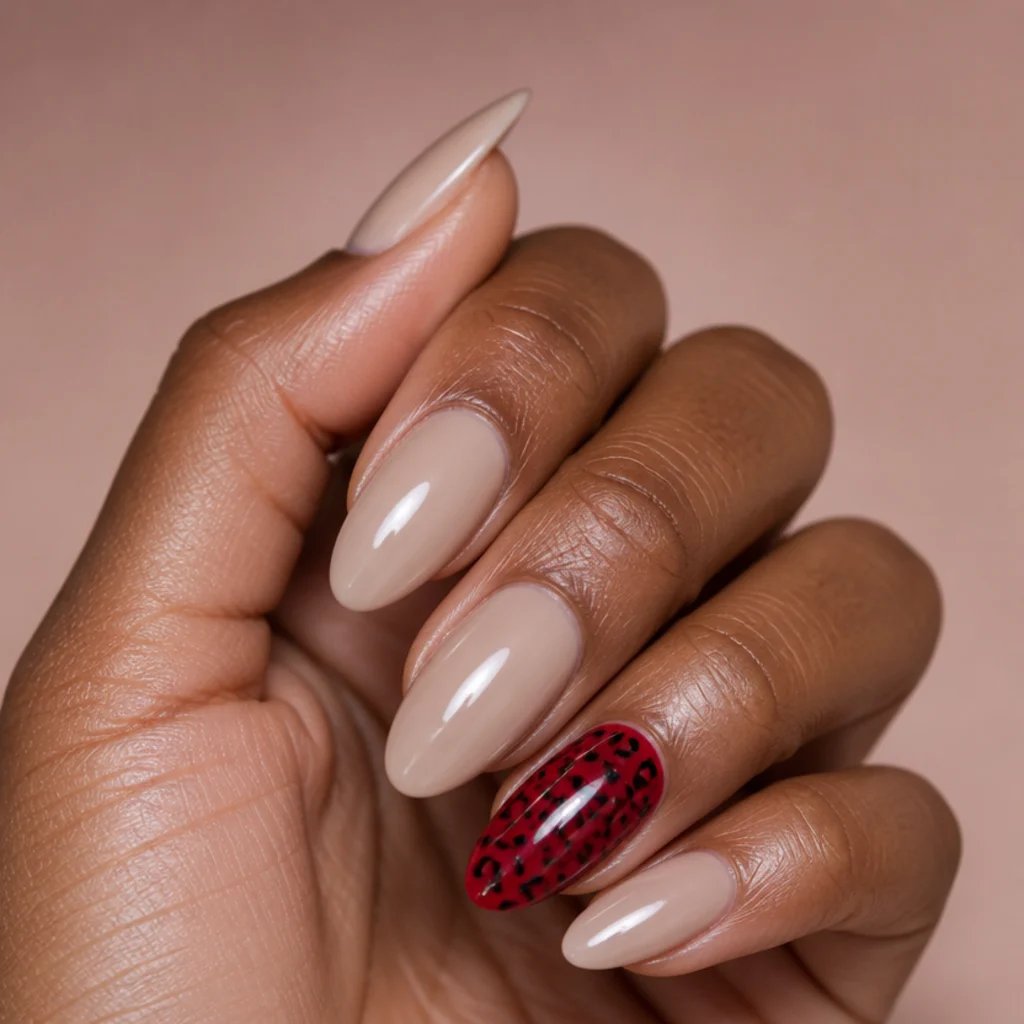
Minimalists, this is your entry. Keep four nails a clean nude or sheer pink, then turn one, classically the ring finger, into a crimson leopard accent. The single statement nail delivers the print without committing every finger, and it's fast and inexpensive to swap out later, which makes it ideal if you like changing looks often or want to test animal print before going all in. It suits any length and shape, though a longer accent nail gives the spots more breathing room and a more editorial result. Because only one nail carries art, touch-ups are cheaper and quicker, and if the accent chips you can refresh a single nail rather than the whole set, which keeps this among the lowest-cost designs here. Consider placing the accent on the same finger on both hands for symmetry in photos, or mirror it on opposite fingers for a subtler balance. Pro tip: match the crimson to your go-to lipstick so the manicure reads as a deliberate part of your look rather than an afterthought, and keep the four plain nails in a finish that echoes the accent, gloss with gloss. Ask your nail tech for a "crimson leopard accent on the ring finger, the rest sheer nude, matching finish."
Save this to Pinterest to keep the accent-nail idea handy.
06Nude Base Red Spots
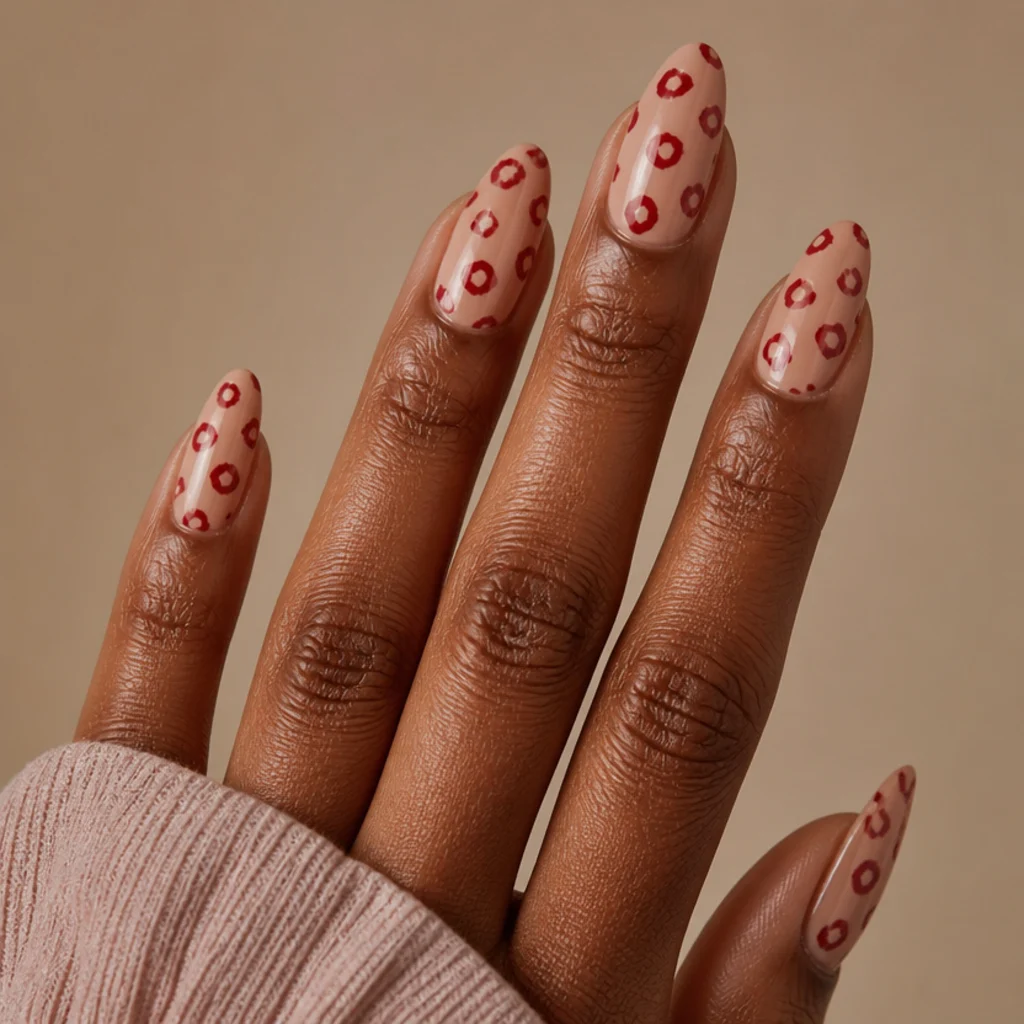
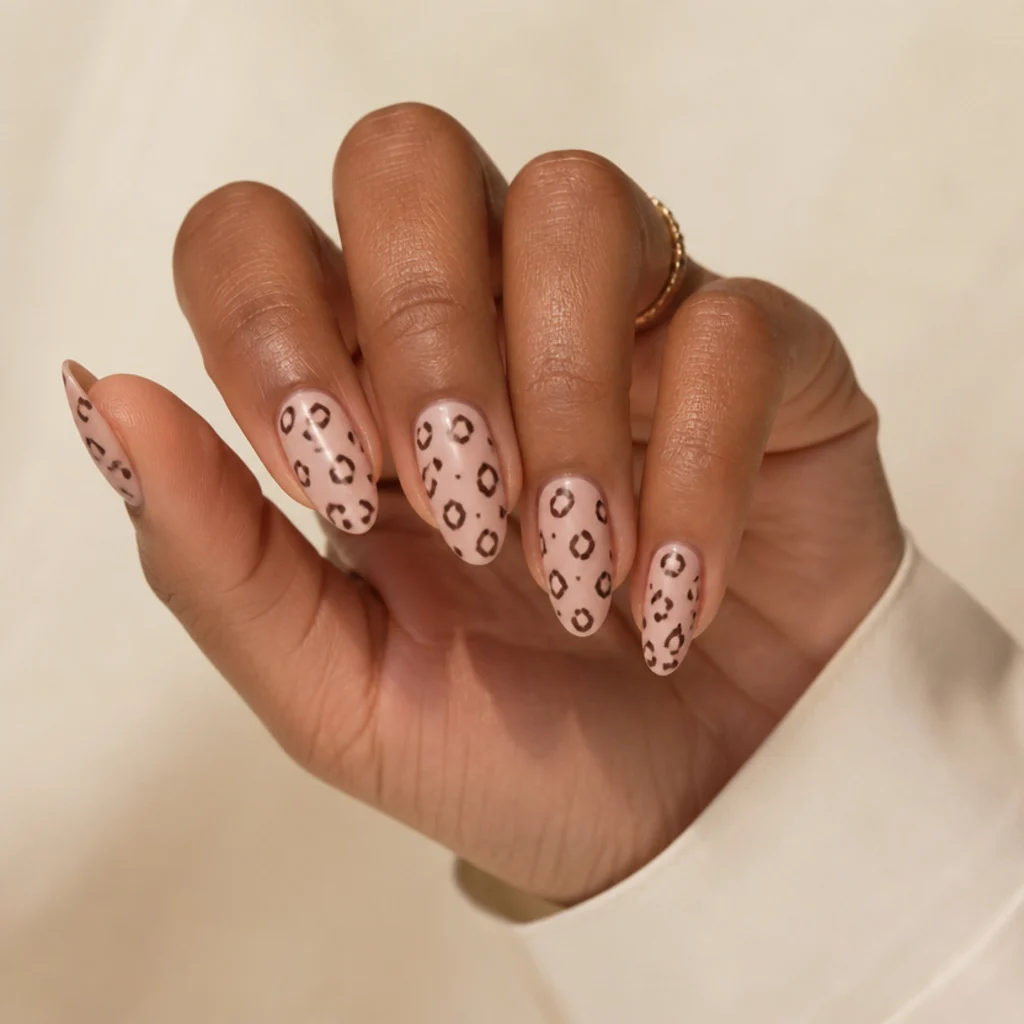
A close cousin of the classic that drops the black outline entirely for a softer, more modern read. Open-center scarlet spots sit directly on a warm nude, letting the base tone show through for a your-nails-but-hotter effect. Without the black arcs, the design reads more like a printed textile than a graphic, which many people prefer for daytime and for a quieter office register. It flatters deeper skin tones especially well, since a warm, slightly caramel nude complements rich undertones better than a pinkish one; choose your nude to sit just a shade deeper than your own skin so the hand reads elongated, not ashy. Maintenance is easy thanks to the smooth, low-contrast base, so regrowth barely registers for the first couple of weeks and you can comfortably reach three. The scale suits long almond, where the spots have room to breathe, but shrinks nicely onto a short squoval too. Pro tip: outlining even a few spots faintly with a tone-on-tone deeper red, instead of black, keeps the softness while adding just enough definition so the print doesn't disappear at arm's length. Ask your nail tech for "no black outline, just open-center red spots on a warm nude base, a couple ghost-outlined in deeper red."
07Black and Red Leopard
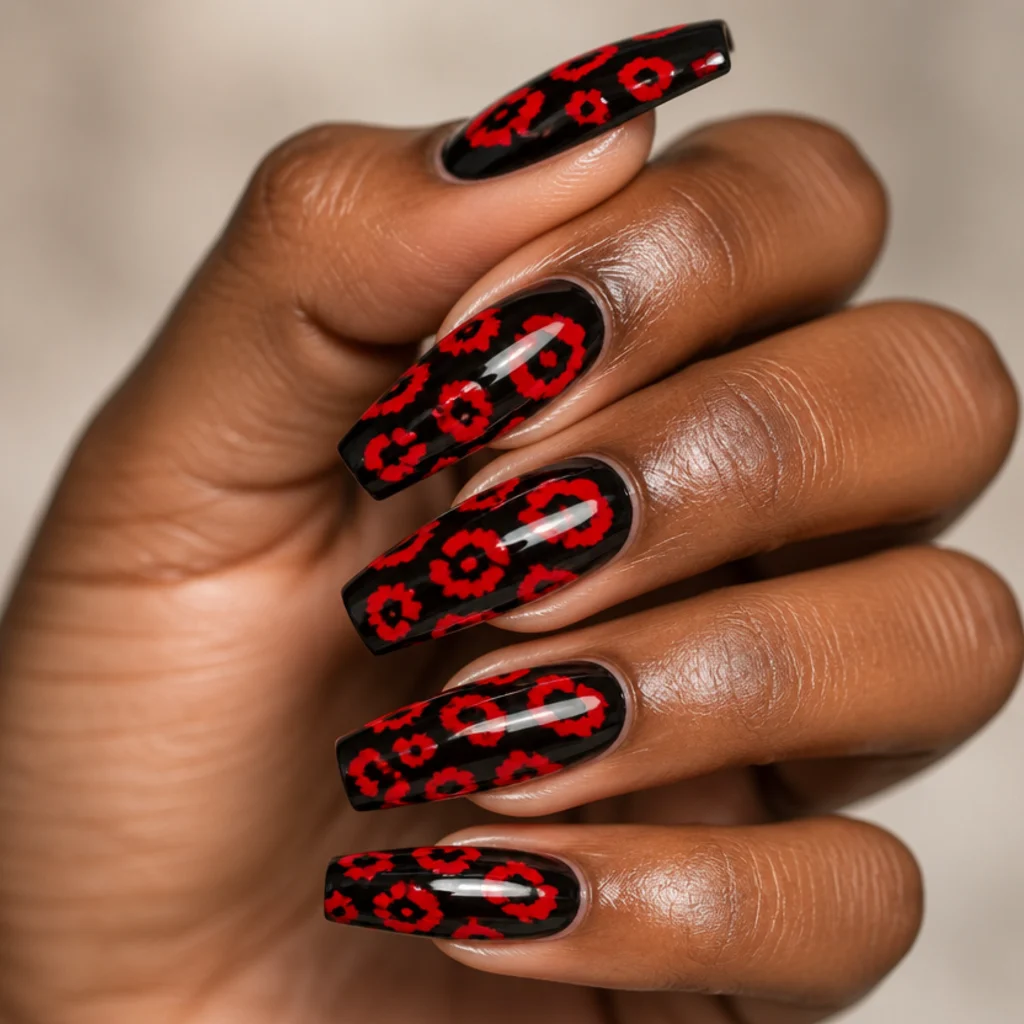
Flip the formula: instead of red on nude, go red on black. A glossy jet base with bright scarlet open-center spots is high-drama and reads almost rock-and-roll, a natural night-out and fall-winter choice for bolder personalities who want their hands noticed. Coffin or long almond shapes carry the darkness best, giving the black room to feel intentional; very short nails in full black can look stark and stubby and shorten the finger. Be realistic about upkeep, high contrast is unforgiving of regrowth right at the cuticle, so this is a book-your-fill-on-time look, ideally every two weeks, and any chip on a glossy black base shows immediately against skin. A hard gel or a properly capped acrylic keeps the edge crisp and resists the tip wear that dark bases advertise. Pro tip: ask for the red spots to skew slightly larger and sparser than usual, since black swallows fine detail and a busy print can turn muddy in low light. A cooler scarlet with a hint of blue pops harder against black than a warm brick red. Pair with silver or gunmetal jewelry rather than gold. Ask your nail tech for a "glossy black base, bright red open-center leopard, larger and sparse, sealed with a high-shine top."
08Cherry Red Glazed Leopard
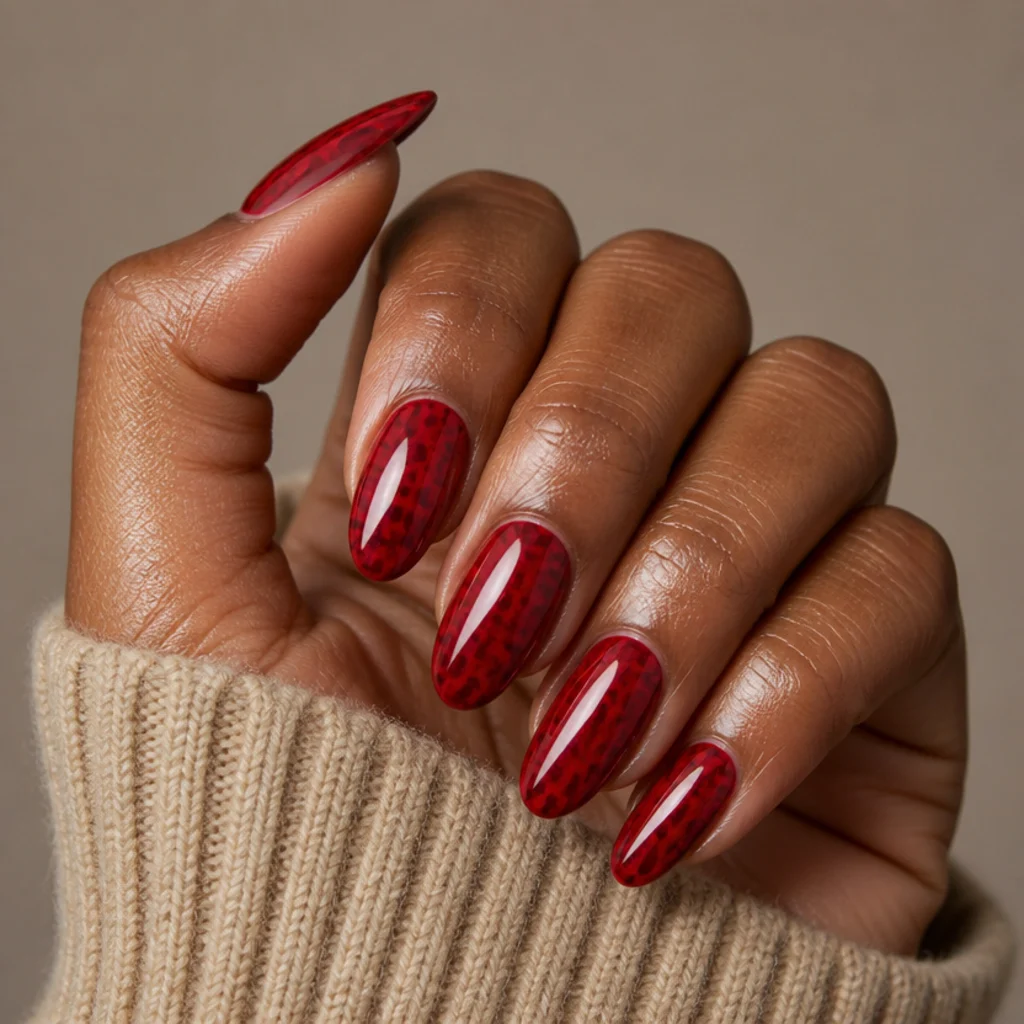
A juicy, near-monochrome take: a glazed cherry-red base with leopard spots in a slightly deeper, oxblood-adjacent red, so the print is tonal rather than contrasting. From across a room it reads as a solid glossy red; up close the leopard reveals itself, which is the quiet-luxury appeal and why it photographs like a jelly finish. It works year-round and flatters cool and neutral undertones nicely, since cherry carries a subtle blue base that brightens the hands and makes them look fresh. The whole effect hinges on the finish. That "glazed," wet look depends on a real high-shine no-wipe gel topcoat cured under a lamp, so skip anything matte or satin here and avoid air-dry tops that dry back to a duller sheen. Because the spots are low-contrast, this is one of the more forgiving prints to freehand and to grow out, and minor tip wear hides in the tonal blend. It suits medium almond best, where the curve amplifies the glassy reflection. Pro tip: a thin layer of sheer red over the whole finished nail before the final top coat deepens the glaze and unifies base and spots. Ask your nail tech for a "glazed cherry base with tonal darker-red leopard, no-wipe gloss and extra glaze."
09Coffin Red Leopard Ombre
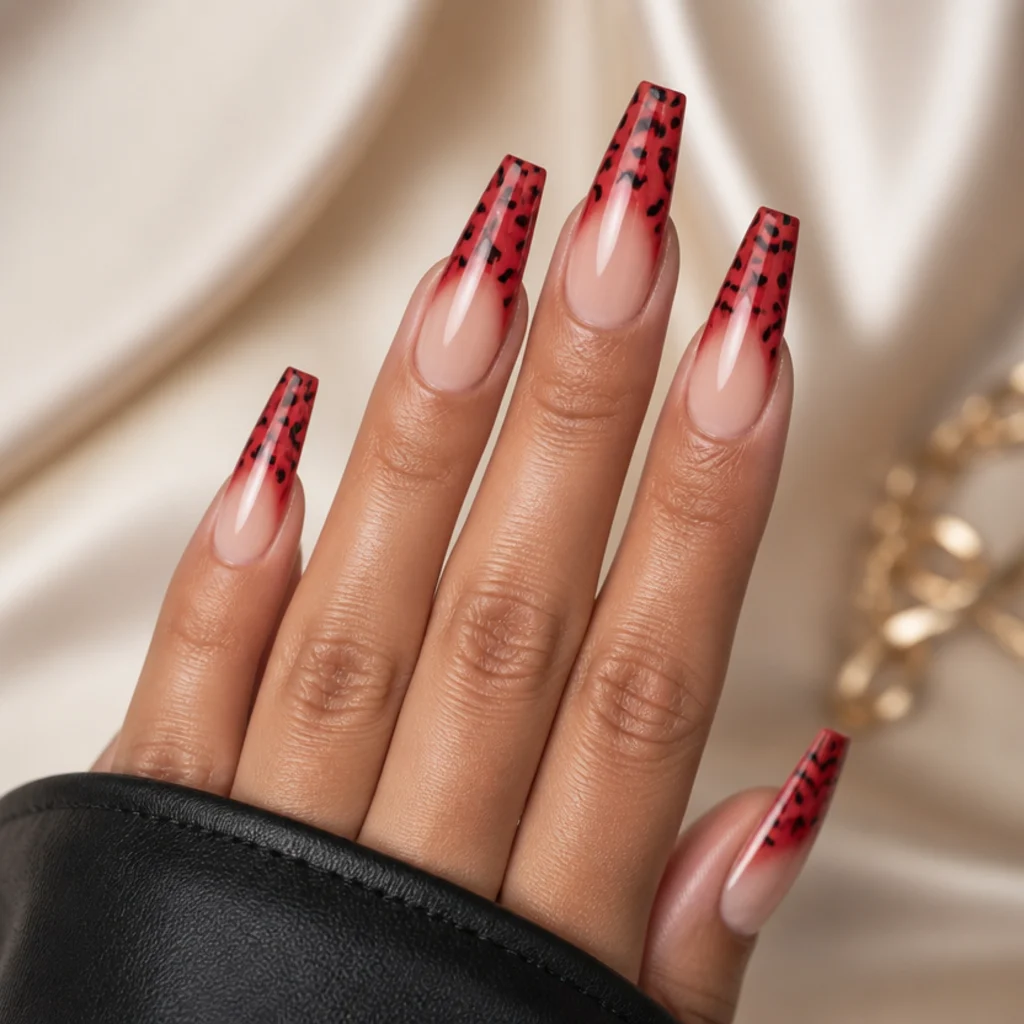
Length lovers, meet your set. Long coffin nails, tapered then squared off at the tip, fade from a nude cuticle to a red tip, with leopard spots concentrated where the color deepens. The gradient gives the print a home without overwhelming the whole nail, and the coffin silhouette keeps everything sleek and elongating, so it flatters shorter fingers by adding line. This is an advanced design: it wants a tech fluent in both sponged or airbrushed ombre blending and freehand spots, so vet the portfolio for both skills first rather than assuming any artist does gradients cleanly. Upkeep runs higher given the length and the gradient, the ombre has to be re-blended as the nail grows or the fade line marches down the nail, so budget fills every two weeks and expect a longer, pricier appointment. Pro tip: concentrating the spots in the darkest third and letting them fade out toward the cuticle looks more organic than an even scatter, and adding a few partial spots at the very tip mimics a real pelt. Choose a cool cranberry tip for blue-toned skin or a warm scarlet for golden. Bring a reference and ask your nail tech for a "nude-to-red coffin ombre with leopard spots massed at the tips and fading out."
10White Tip Red Leopard French
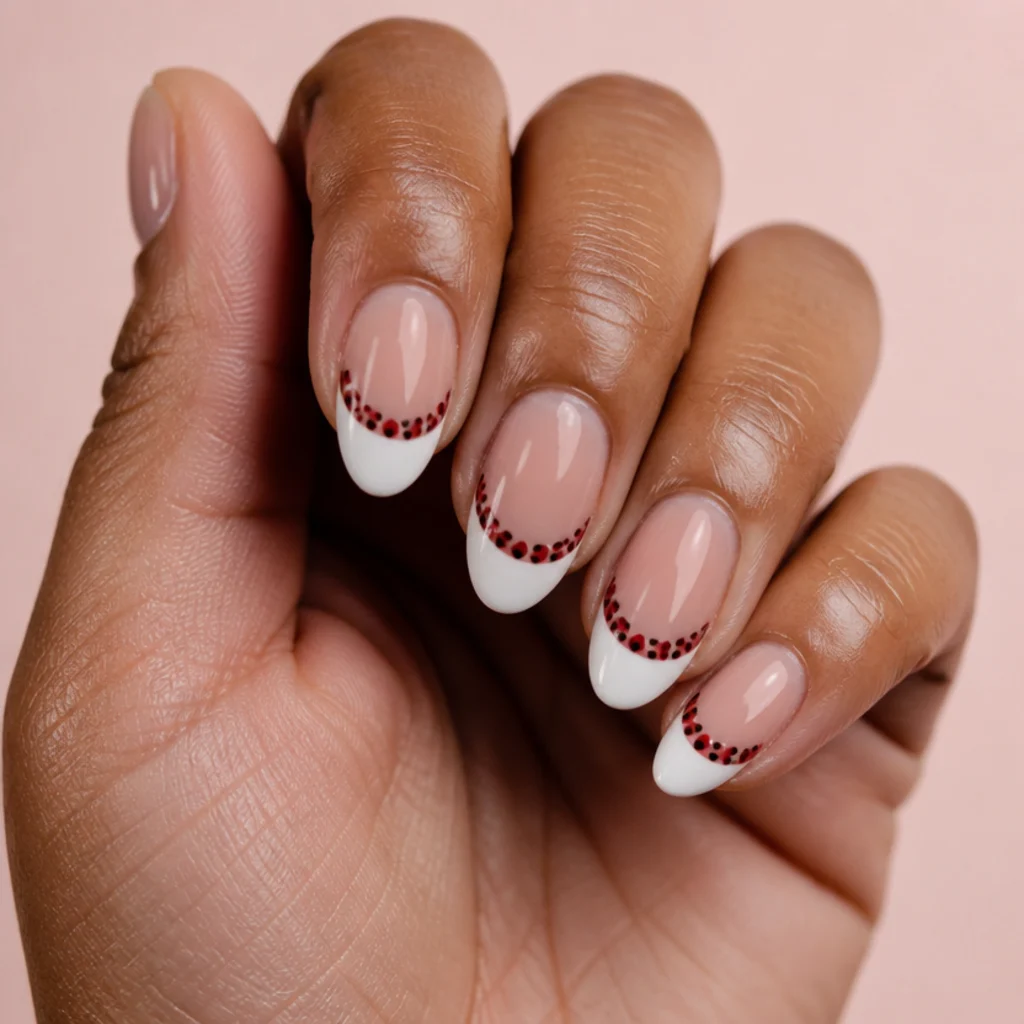
A twist on the french that keeps the classic white tip, then runs a line of red leopard spots right along the smile line where white meets nude. You get the familiar french silhouette plus a jolt of animal print exactly at the border, a great bridge for someone who loves a traditional manicure but wants a little more voltage without abandoning the look entirely. It looks cleanest on medium almond or squoval nails with a crisp, well-defined tip; a wobbly smile line undermines the whole effect, so this is worth a steady hand or a tech who uses a french guide. Because the print sits mid-nail rather than at the cuticle, regrowth is forgiving, comfortably three weeks, and the white tip refreshes easily. Pro tip: keep the leopard spots small and confined to a single row so they accent the french rather than compete with it, and pick a soft off-white rather than stark white so the red reads warm against it. This suits every skin tone thanks to the neutral field. Ask your nail tech for a "white french tip with a thin single row of red leopard along the smile line, crisp smile."
Save this to Pinterest if french manicures are your comfort zone.
11Short Round Red Leopard
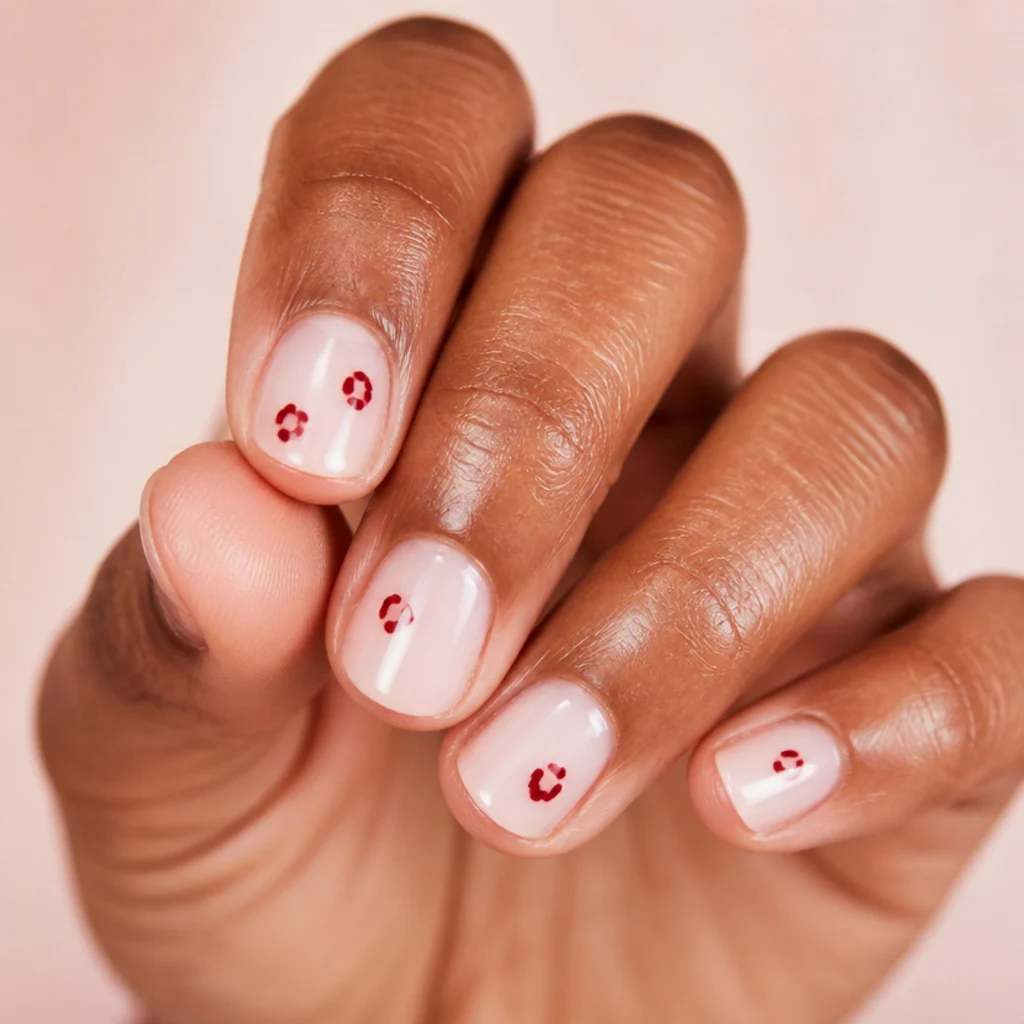
The gentlest short leopard print nails on the list, and the most natural-nail-friendly. On a short round shape, which follows the fingertip's own curve and is the least snag-prone of any silhouette, a sheer base carries just one or two delicate red spots per nail for a look that's more suggestion than statement. It's tailor-made for a first-timer, a conservative workplace, or anyone growing out and strengthening their natural nails, since it can be done in regular polish or a thin gel overlay without added length or an enhancement. So much bare nail shows that it flatters every skin tone equally, and it keeps short, wide nail beds looking neat rather than stubby. Maintenance is low, too, minimal print means nothing dramatic to grow out, and you can refresh a worn spot at home with a dotting tool in minutes. Pro tip: place the spots slightly off-center toward the tip so they stay visible as the nail grows and the cuticle area stays clean; a single tiny black arc on one spot per nail adds just enough leopard cue. Ask your nail tech for "a few small, subtle red leopard spots on a sheer base, short and round, spots toward the tip."
12Burgundy Autumn Leopard
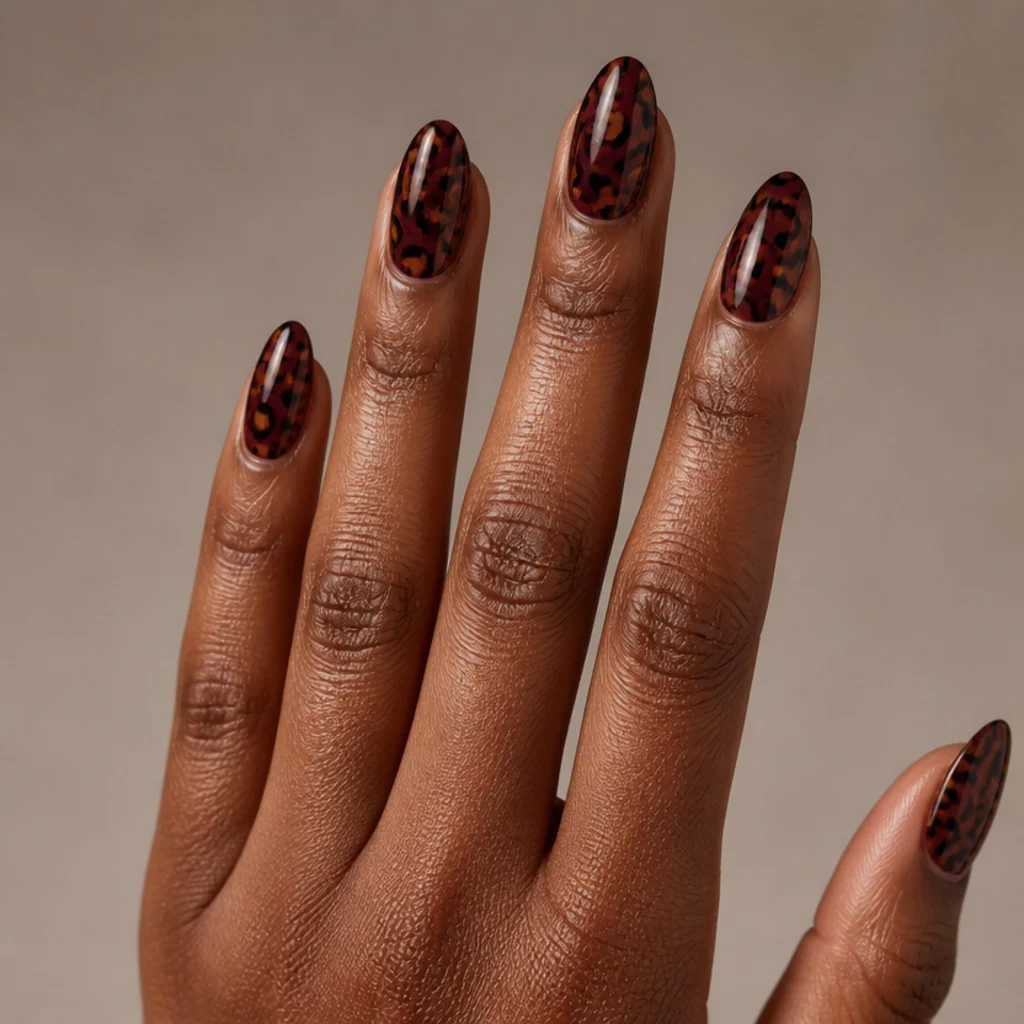
For fall, deepen the red all the way to burgundy and warm the spots with caramel and black. This is the sweater-weather version of red leopard, less bright and more wine-toned, with spots that nod to the heritage tan palette while the base keeps it firmly red. Burgundy carries warmth and a touch of brown that flatters warm, golden and olive undertones especially, and it pairs naturally with rust, camel and chocolate wardrobes, so it earns its keep from September through the holidays. Medium almond or squoval shapes feel seasonally right and keep it grown-up rather than gothic. Upkeep is average, and the dark, muted base is kind to minor tip wear and regrowth, hiding both longer than a bright glossy red would. Pro tip: adding a single caramel spot among the black-and-red ones ties the manicure to a tan trench or brown boots and reads more expensive than an all-red print, since that heritage tan is what the eye expects from leopard. A satin rather than high-gloss top coat suits the moody register. Ask your nail tech for a "burgundy base with warm caramel-and-black leopard spots, one caramel accent per nail, satin finish."
13Chrome Red Leopard
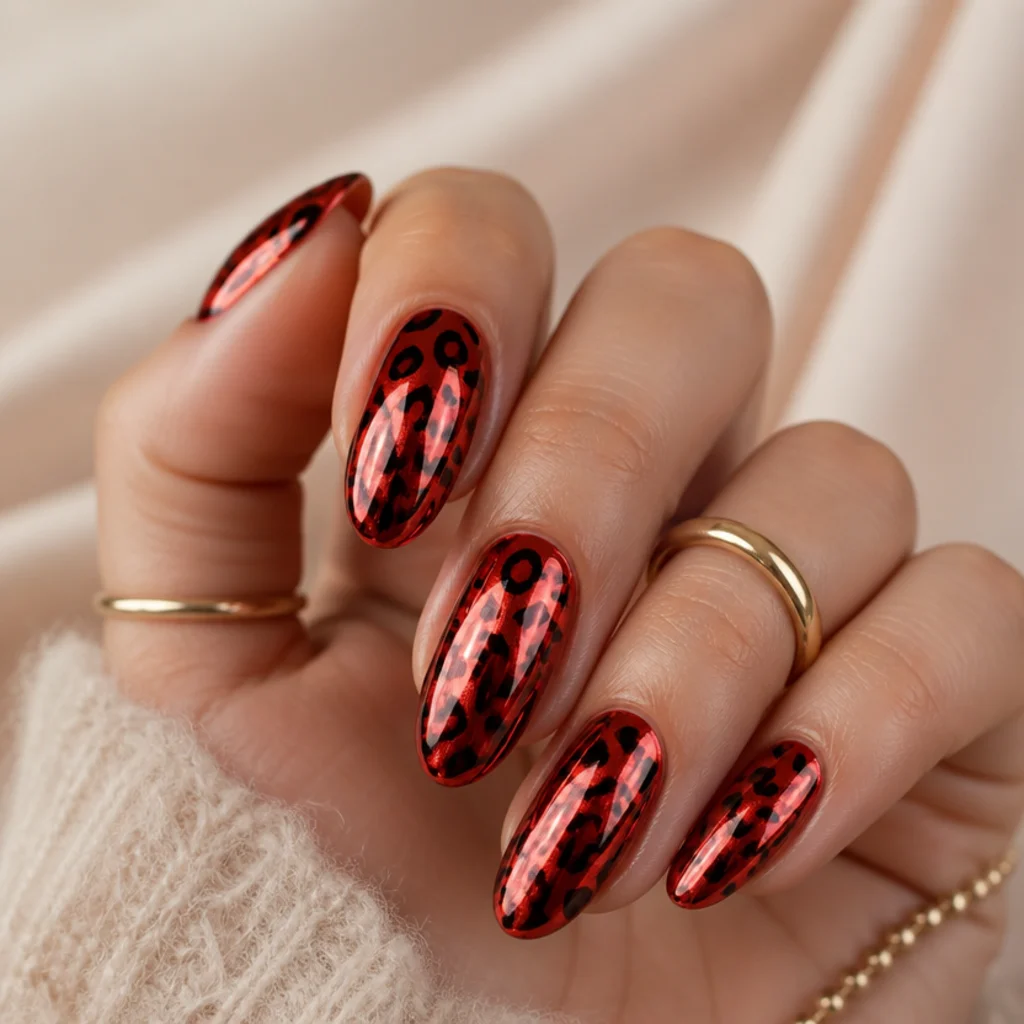
Add mirror shine with a chrome finish. A metallic red base catches the light while the leopard spots, done in a deeper red or black, shift and flash as the hand moves. It's the design here that photographs best under any lighting, from restaurant candlelight to a phone flash. Chrome is technical: the powder is buffed over a cured no-wipe gel and then sealed with a specific chrome-compatible top coat, and it telegraphs every ridge and imperfection underneath, so a smooth prep and a skilled application matter more here than anywhere else on the list, budget for an experienced tech. It suits medium to long nails where the reflective surface has room to work and the mirror effect reads clearly. Maintenance runs a touch higher because chrome tends to dull first at the very tips and can cloud if the seal is imperfect, so on-time fills matter. Pro tip: keep the leopard spots matte or satin against the mirrored base for a texture contrast that reads intentional and stops the spots from vanishing into the reflection. A rose-gold-leaning red chrome flatters warm skin; a cooler ruby chrome suits blue undertones. Ask your nail tech for a "red chrome base with darker matte leopard spots, sealed with the proper chrome top coat."
14Matte Red Leopard
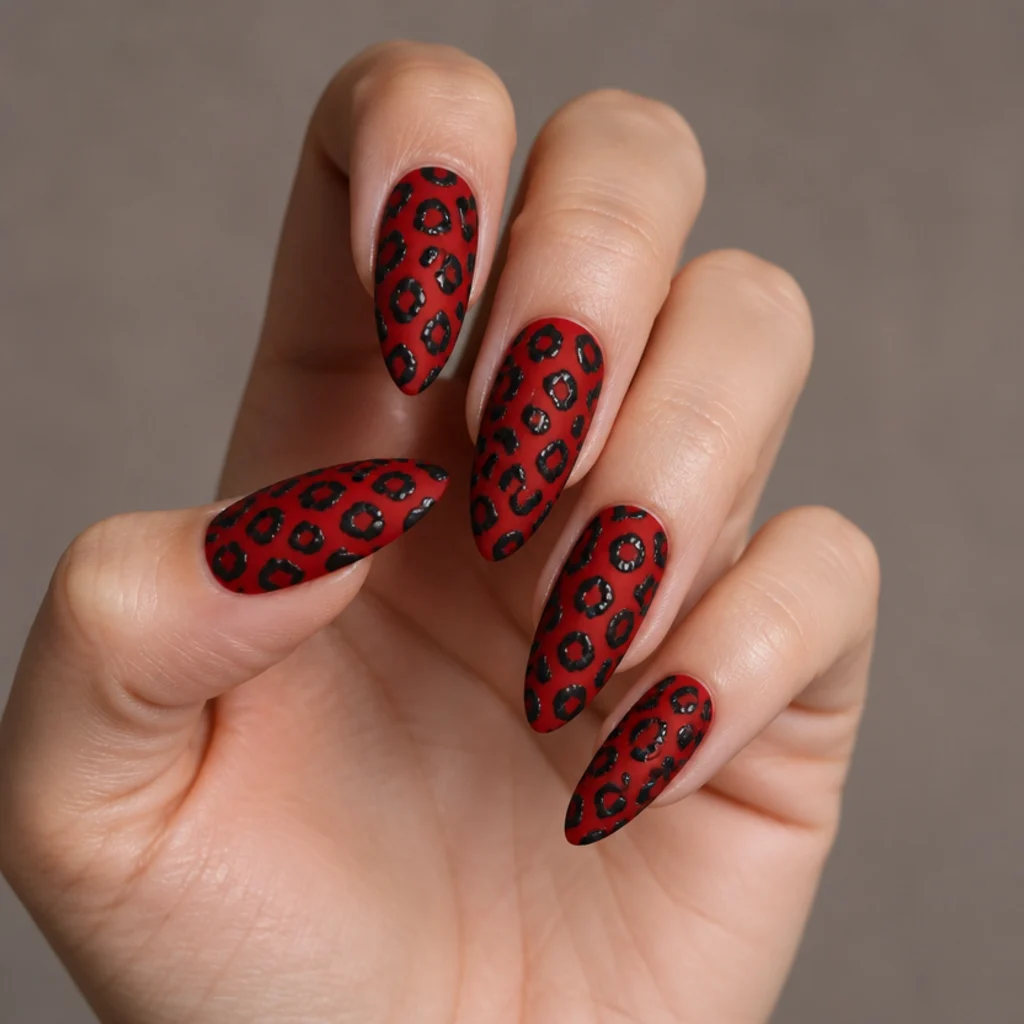
The opposite energy: kill the shine entirely. A matte true-red base with glossy black leopard spots creates a texture contrast, velvety flat against wet-look shine, that feels modern and quietly expensive. The matte finish reads softer and deeper than gloss and makes the shiny spots appear to float on top, a trompe-l'oeil effect that rewards a close look. It suits every skin tone and looks especially strong on longer almond or coffin shapes where the flat surface reads as one clean plane. One honest caveat: matte top coats show fingerprints, oils and micro-scratches faster than gloss and can go patchy at the tips, so this is a slightly higher day-to-day upkeep, keep hand cream off the surface, blot rather than rub, and reapply matte top a little sooner than you would a gloss. Pro tip: leave the spots glossy rather than making the whole nail matte, the contrast is the entire point, and a single coat of glossy top dotted only on the spots achieves it cleanly. A true blue-red goes coolest and most graphic here; a warm brick softens it. Ask your nail tech for a "matte true-red base with glossy black leopard spots, spots gloss-sealed only."
15Red and Gold Leopard
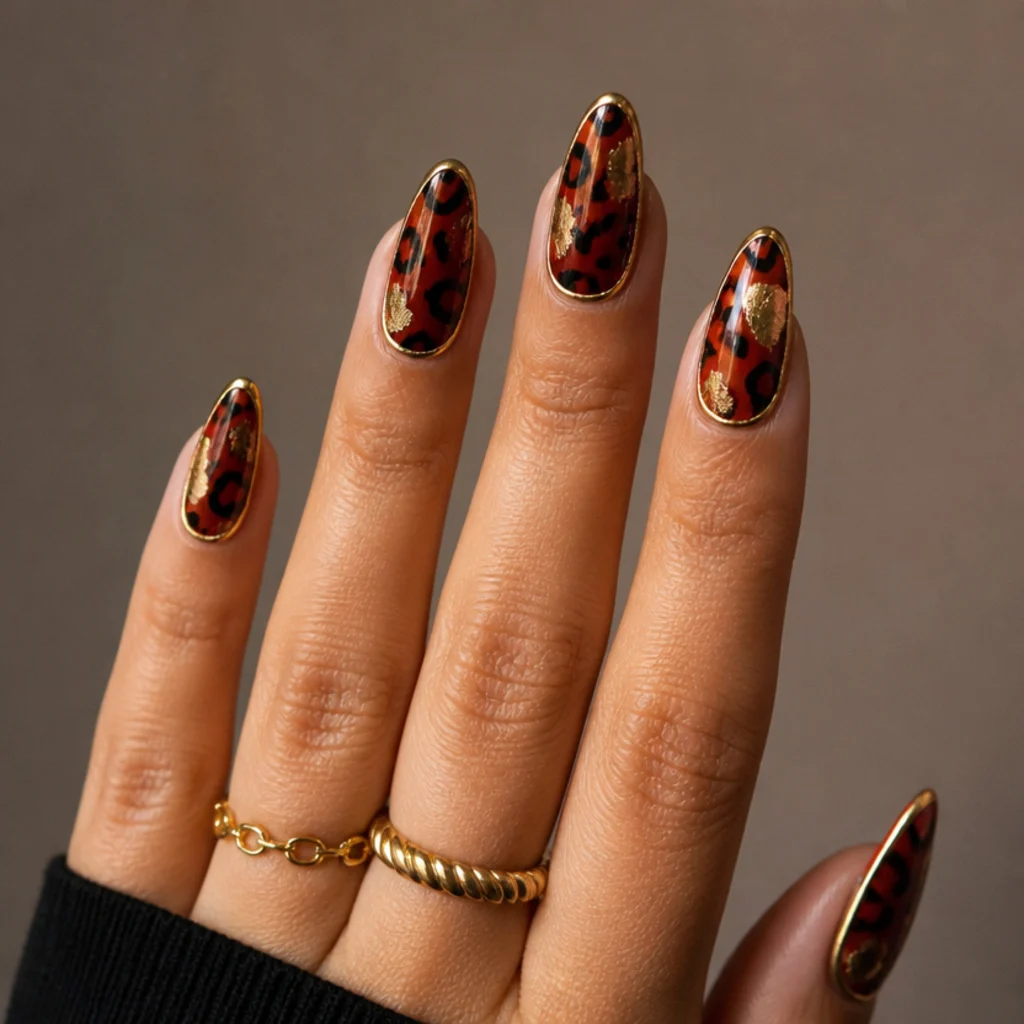
Keep one foot in the heritage look by pairing red with gold. A red base carries leopard spots accented with gold foil or thin gold outlines, marrying the classic gold-leopard lineage with the newer red palette for a result that's luxe, warm and holiday-ready. It flatters warm and deep undertones beautifully, and real gold catches candlelight for an evening out, which makes it a party-season staple you can rewear from October through New Year. Decide between two golds: flat metallic foil flakes give a broken, textured shimmer, while a painted gold liner gives crisp outlined spots, so specify which shine you want before the brush comes out. Upkeep is average, though loose foil can lift at the edges if not sealed thoroughly, so ask for a generous top coat over any flakes. It sits well on medium to long almond, where the metallic has room to read. Pro tip: gold-outline a few spots and gold-fill just one or two, rather than every spot, so the metallic reads as an accent, not a full glitter nail, and the red still leads. Pair with yellow-gold jewelry to echo the finish. Ask your nail tech for a "red base with gold-accented leopard, and specify foil flakes versus a painted gold line."
Save this to Pinterest for your next holiday manicure.
16Micro Leopard on Red
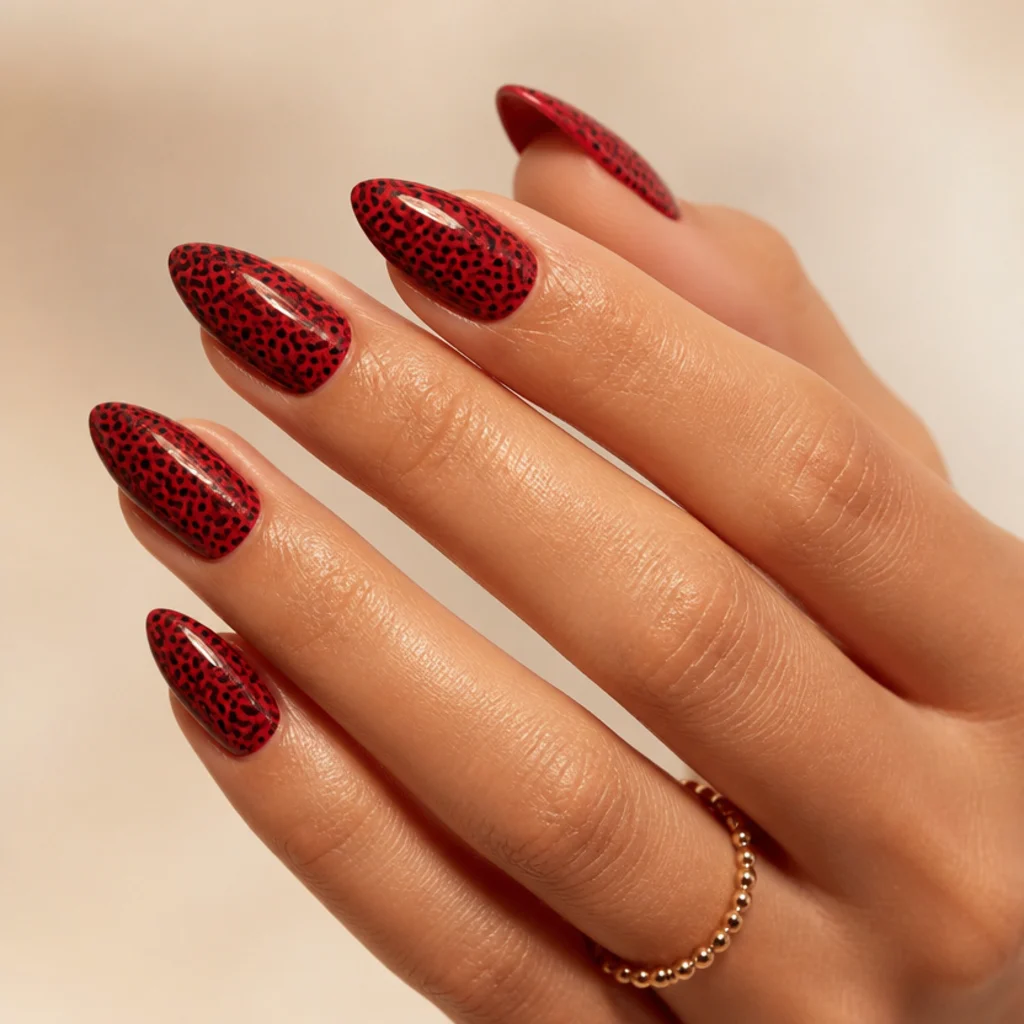
Scale everything down. On a solid red base, tiny, densely packed leopard spots create an almost textile-like print, closer to a patterned silk than bold animal spots, which reads as sophisticated and rewards a close look. The miniature scale is the whole appeal, and also the challenge: it demands a fine detail brush, a patient hand and a longer appointment, so book a detail-oriented tech and expect to pay for the extra time in the chair. Longer almond or coffin nails give the small spots the canvas they need; on short nails the density turns to noise and the print loses its silk-like read. Because each spot is so fine, regrowth is fairly forgiving and any single worn spot is easy to miss, so despite the involved application the upkeep is only moderate. Pro tip: vary the micro-spot sizes slightly and cluster them unevenly, perfectly uniform tiny dots drift back toward polka dots, and leaving small bare gaps of the red base between clusters keeps it breathing. A slightly deeper tonal red for the spots reads more refined than black at this scale. Ask your nail tech for a "solid red base with small, dense, varied micro-leopard spots, tonal not black."
17Red Leopard with Rhinestones
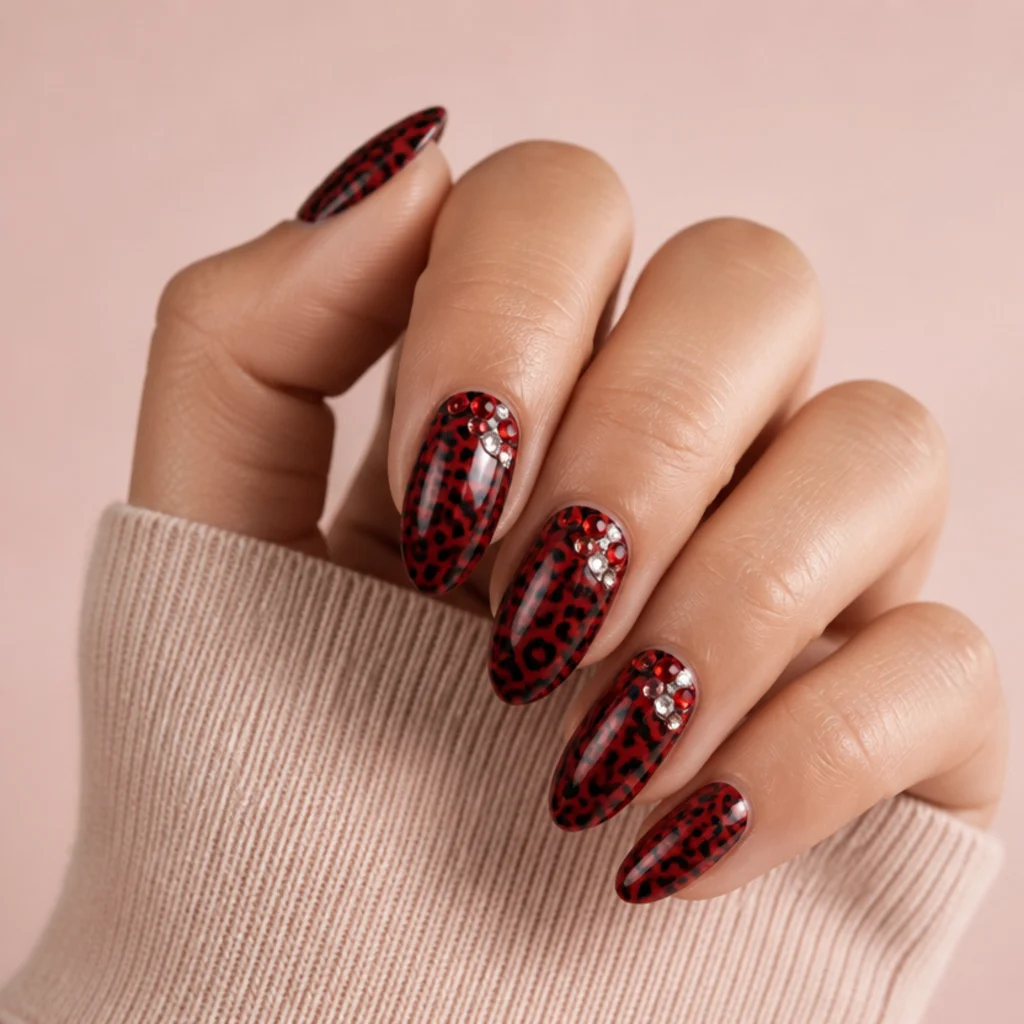
Turn up the glamour with a little sparkle. Classic red leopard gets a scatter of clear or red rhinestones, usually clustered near the cuticle of one or two nails so the print still leads and the gems accent rather than take over. The stones add dimension and throw light without tipping into full bling, which keeps the manicure looking editorial rather than costume. This is a special-occasion design, bridal showers, birthdays, holidays, and it suits any length, though longer nails balance larger stones more comfortably and give a cluster room to sit. Be realistic: rhinestones are the first thing to catch on hair and fabric and pop off, so this runs the highest day-to-day upkeep on the list, and proper application matters, gems set into a gel bead and capped at the edges with top coat last far longer than ones just glued on top. Pro tip: cluster an odd number of stones, three or five, in a loose triangle near the cuticle rather than a straight line for a more organic, editorial look, and mix two stone sizes for depth. Clear crystals stay versatile; red stones read more monochrome and modern. Ask your nail tech for "red leopard with a small odd-numbered rhinestone cluster near the cuticle, gel-set and edge-capped."
18Pink Base Red Leopard
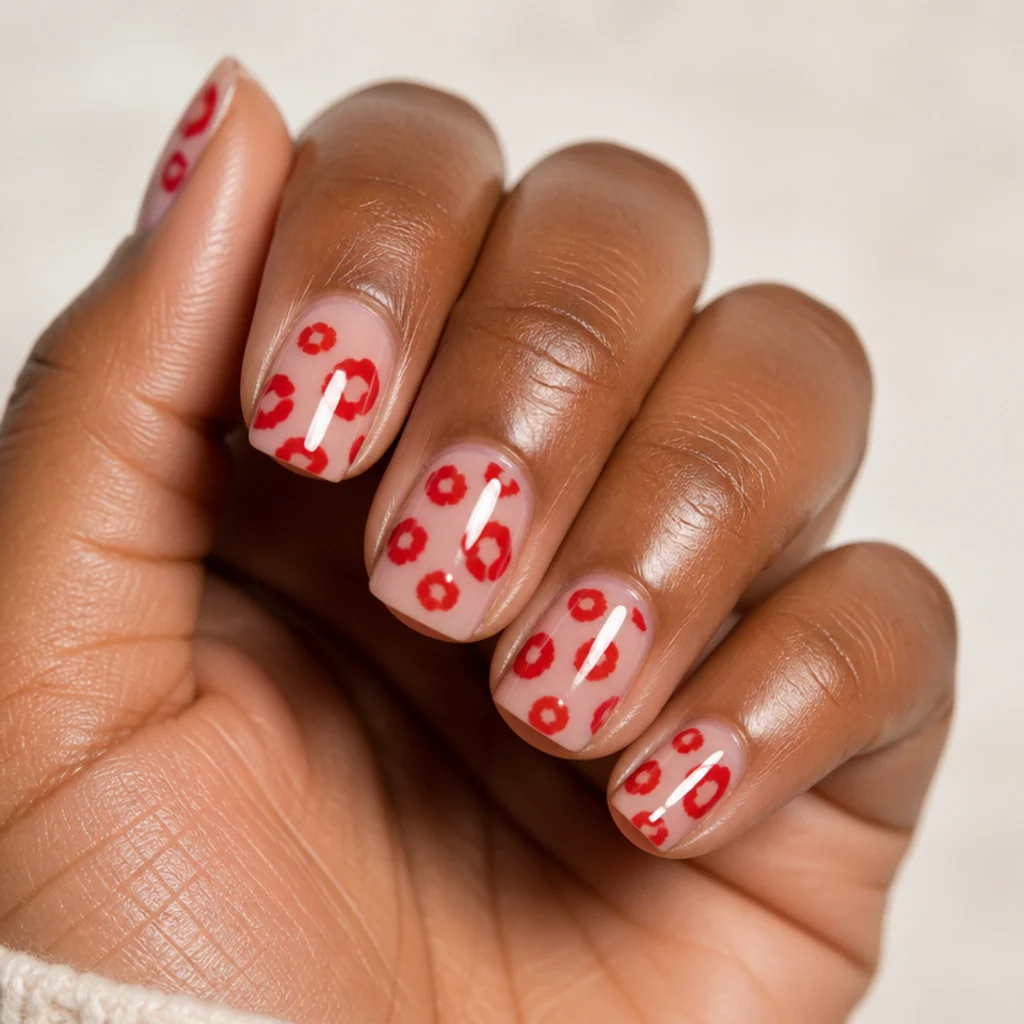
A softer everyday option that leans into pink leopard print nails territory. A soft, semi-opaque pink base carries bright red leopard spots, so the look is warm and sweet rather than fierce, the pink cooling the red into something you can wear to the office or to brunch without a second thought. It flatters fair to medium skin especially, and a slightly deeper mauve-pink base carries the same idea onto richer complexions while keeping the softness. It works at any length but looks especially sweet on a short squoval, where it stays tidy and snag-resistant, and it keeps short nail beds looking neat. Upkeep is average and the light base disguises early regrowth, easily stretching to three weeks between fills. Pro tip: skipping the black outline keeps this in sweet, wearable territory, while adding a fine black arc to a portion of spots pushes the same design toward bolder and edgier, so choose based on the register you want and tell your tech which. A cool baby pink reads fresh on blue undertones; a warm peachy pink suits golden skin. Ask your nail tech for a "soft pink base with bright red leopard spots and no black outline, unless you want edge."
19Half-Moon Red Leopard
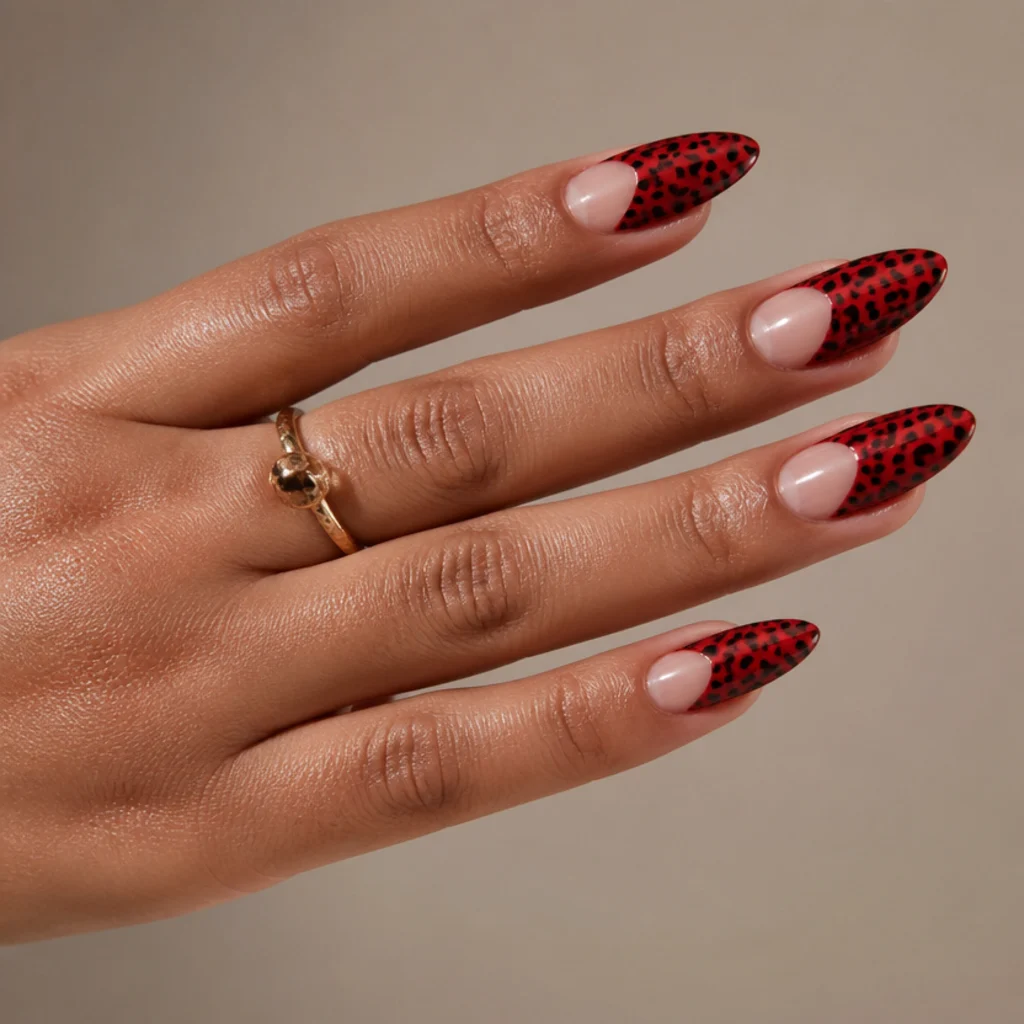
Borrow from vintage manicures with a half-moon detail. Leave a bare, negative-space half-moon at the cuticle and fill the rest of the nail with red leopard print. The exposed crescent adds a retro, editorial feel and, practically, breaks up the print so a busy design gets room to breathe, which stops full-nail leopard from reading heavy. It looks best on medium to long nails where the moon stays a clean, defined arc; on very short nails there isn't enough real estate for both the moon and the print, and the crescent gets lost. This one takes precision, the crisp curved edge of the half-moon is the hard part, so a steady-handed tech or one who uses a half-moon guide is worth seeking out. The payoff is upkeep: because the cuticle area is deliberately bare, regrowth blends into the negative space almost invisibly. It's one of the most graceful grow-outs here, comfortably three-plus weeks. Pro tip: match the half-moon to your skin tone with a sheer nude rather than leaving it fully raw for a more finished, deliberate result, and echo the moon's curve in the spot placement above it. Ask your nail tech for a "sheer-nude negative-space half-moon with red leopard filling the rest, clean arc."
20Full Red Statement Leopard
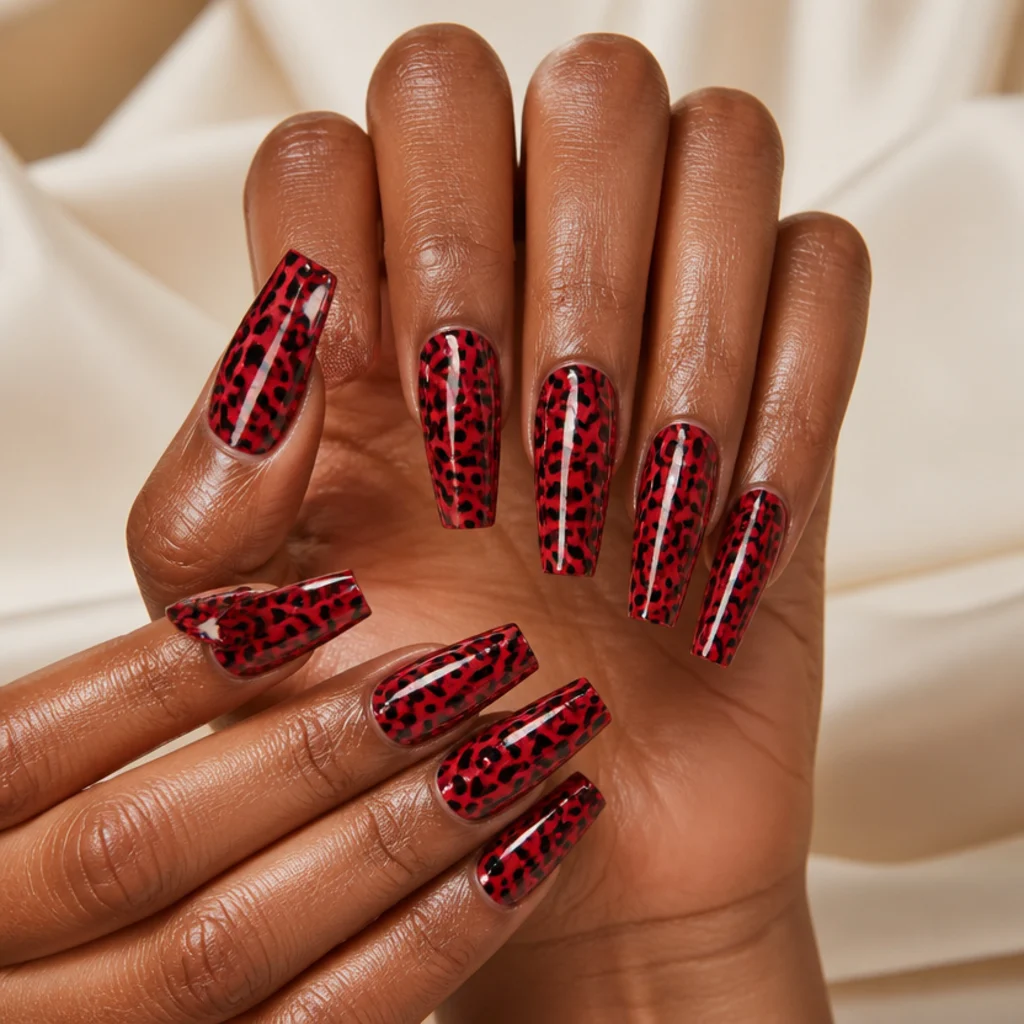
Go all in. Every nail, fully covered, bold scarlet-and-black leopard from cuticle to tip on long coffin or almond nails. This is the maximalist finale: no bare space, no accent nails, just unapologetic print on all ten fingers, ideal for a photoshoot, an event, or anyone who loves a dramatic set and wants their hands to be the accessory. Length amplifies the impact and gives each cluster of spots room to read clearly, while a high-gloss topcoat makes the reds ring out under a flash. Be honest with yourself about upkeep, this is the highest-maintenance look on the list: full coverage plus length means every bit of regrowth shows at the cuticle, fills are due every two weeks, and the long free edge needs care to avoid catching on hair and fabric. Pro tip: ask for a mix of spot sizes and a few "broken" partial spots at the sidewalls so the print looks like a continuous pelt rather than a repeating stamp, and vary the density finger to finger so it doesn't read mechanical. A cooler blue-red photographs most graphically against black. Ask your nail tech for "full red-and-black leopard, all ten nails, varied spot sizes, long coffin, high gloss."
Save this to Pinterest if you are ready to go full statement.
Pro Tips from the Editor
- Insist on open centers. The single detail that separates real leopard from polka dots is the open-center spot ringed by broken black arcs, never a solid filled dot. Say those exact words when you book, and ask for the arcs to be partial commas, not complete rings.
- Choose your red by undertone, not by favorite. Scarlet is the neutral all-rounder; cherry and cranberry flatter cool undertones with their blue base; burgundy and red-gold suit warm and olive skin; a milky pink base softens the whole thing for daytime and fair-to-medium complexions.
- Let neutral bases buy you time. Sheer nude and soft pink bases disguise regrowth for three to five extra days, so a busy schedule points you toward the wearable designs, not the black-based or fully covered ones that advertise every millimeter of growth.
- Freehand outlasts gems and chrome. For the longest clean wear, freehand spots win, they grow out gracefully and have nothing to pop off. Rhinestones, foil and chrome tips are the first elements to show wear, so skip them if longevity beats sparkle for you.
- Scale the print to the nail. Fewer, slightly larger spots on short squoval and round nails; smaller or denser spots on long almond and coffin. Matching spot scale to length is what keeps the print from looking cramped or sparse, and heavier density toward the tip mimics a real pelt.
- Match the topcoat to the effect. A no-wipe high-gloss gel top makes glazed and cherry reds look wet and glassy; matte and chrome need their own dedicated top coats, and mismatching them dulls the finish or clouds the mirror.
- Book the right tech for the design. Ombre, half-moons, micro-leopard and mixed-red tonal work reward an experienced artist, ask to see freehand animal print specifically in a portfolio, not just solid colors or stamped nail art, before committing to the advanced sets.
How to Choose / Get the Look
Work through four decisions in order and any set on this list becomes easy to brief.
1. Pick the red. Scarlet is the most versatile and flatters the widest range of skin tones; cherry and cranberry lean cool and elegant on blue undertones; burgundy reads autumnal and warm on golden and olive skin; milky pink-red blends feel soft and daytime-friendly. Let your undertone lead rather than defaulting to the brightest option, and if you're unsure, a nude base with red spots balances nearly every complexion.
2. Decide how much print. Full coverage is a commitment and a mood; a french tip, single accent nail, or a few scattered spots keeps things wearable and grows out gracefully. Be honest about your work and lifestyle here, not just what looks best in a single photo, because you live with the grow-out for weeks.
3. Match the shape. Almond and coffin give spots room to breathe and read editorial and elongate shorter fingers; short squoval and round call for fewer, slightly larger spots so the print doesn't crowd. Shape also affects durability, short and round snag least and lift least, which matters if you're hands-on.
4. Budget the upkeep. Freehand spots grow out more gracefully than stamped, gemmed or chrome designs, and neutral bases hide regrowth longer than dark ones. Plan fills every two to three weeks and match the design's demands to how often you can realistically get to the salon.
| Design family | Best nail shape & length | Difficulty | Fill window | Upkeep level |
|---|---|---|---|---|
| Nude-base classic / soft spots | Almond, short-to-medium | Easy | 2–3 weeks | Low |
| French tip / white-tip french | Medium-long almond or squoval | Moderate | 3–4 weeks | Low |
| Short square / short round | Short squoval or round | Easy | 2–3 weeks | Low |
| Cherry, matte, burgundy full-nail | Medium-long almond | Moderate | 2–3 weeks | Medium |
| Black-based / full statement | Long coffin or almond | Harder | ~2 weeks | High |
| Ombre / half-moon / micro-leopard | Long almond or coffin | Harder | ~2 weeks | Medium–High |
| Chrome / rhinestone / gold-foil | Medium-long almond | Harder | ~2 weeks | High |
Not sure which red suits you? Use this quick undertone guide, then pair it with a base and spot combination.
| Undertone | Tell-tale signs | Best red family | Base + spot pairing |
|---|---|---|---|
| Cool | Blue veins, silver flatters, pink-blue skin | Cherry, cranberry, blue-red | Cherry glaze with tonal spots; black base with cool scarlet |
| Warm | Green veins, gold flatters, golden skin | Burgundy, brick, red-gold | Burgundy with caramel spots; red base with gold-foil accents |
| Neutral / olive | Mixed veins, both metals work | Scarlet, true red | Nude base with scarlet spots; matte true-red with glossy black |
| Any / unsure | — | Scarlet on nude | Sheer nude a shade deeper than skin with open-center red spots |
When you book, bring one or two reference photos, name the exact base color, and specify "open-center spots, not solid dots" so the print actually reads as leopard. A gel top coat, matched to the finish you want, keeps any of these looks glossy or matte and chip-resistant for weeks.
Frequently Asked Questions
Are red leopard print nails hard to do at home?
The spots themselves are forgiving because leopard is meant to look irregular. Start with a nude or light base, use a fine liner brush or a dotting tool for the open-center red spots, then add loose, broken black arcs around only some of them, never a full ring. The trickier elements are crisp french smile lines, negative-space half-moons, chrome and set rhinestones, so those are worth a salon. If you're freehanding, work over a cured base coat, keep a thin brush and a little acetone on a clean-up brush to tidy edges, and seal with a gel or a quick-dry top to protect the art.
What nail shape works best for leopard print nails?
Almond and coffin give the print the most room and look the most editorial, since the elongated surface lets clusters of spots read clearly and adds visual length to shorter fingers. Short leopard print nails on a squoval or round shape work well too; just use fewer, slightly larger spots so the design doesn't feel cramped. Round is the most snag-resistant if you're hard on your hands, while long coffin makes the biggest statement but demands the most upkeep.
Which red suits my skin tone?
Scarlet is a safe all-rounder that flatters almost everyone. Cool undertones (blue veins, silver jewelry) tend to love cherry and cranberry, which carry a subtle blue base; warm and olive undertones (green veins, gold jewelry) look striking in burgundy or a red-and-gold pairing. Pink-red and milky-pink blends flatter fair to medium skin. When in doubt, a nude base with red spots balances nearly every complexion, and choosing a nude a shade deeper than your own skin keeps it from washing you out.
How long do these designs last?
With a gel base and top coat, expect two to three weeks before regrowth becomes noticeable. Freehand spot designs grow out more gracefully than gemmed or chrome sets, and neutral bases hide regrowth longer than black ones. Longer, fully covered nails need fills roughly every two weeks to stay sharp, while a nude-base french or accent nail can comfortably stretch to three or four. Daily hand cream around the cuticles and a swipe of fresh top coat once a week both extend clean wear.
Can I make leopard print look office-appropriate?
Yes. Stick to a french tip, a single accent nail, or a few subtle spots on a nude or soft pink base, and skip the black outlines for a softer, more professional register. Keeping most of the nail bare reads as tasteful print rather than statement, and shorter lengths reinforce that. Save the black-based, chrome and full-coverage sets for evenings and events, and reach for a satin or natural gloss rather than high-shine if your workplace is conservative.
What is the difference between red leopard and classic gold-tan leopard?
The print language is identical, clustered irregular spots with open centers and broken outlines, but the palette resets the mood. Classic leopard uses caramel and tan spots with brown-black outlines for a neutral, heritage feel, while red leopard swaps in scarlet, cherry or burgundy, which reads bolder and more fashion-forward and pairs more obviously with red-family lips and monochrome outfits. Red also flatters a wider range of undertones because you can dial it cool with cherry or warm with burgundy, whereas tan leans neutral-warm only.
How do I keep the red spots from looking like polka dots?
Three things: keep the centers open rather than solid, vary the size and spacing so nothing is uniform, and add broken, comma-shaped black or tonal arcs around a portion of the spots instead of a complete ring. Uniform, evenly spaced solid dots always drift toward polka dots. Ask your nail tech specifically for "open-center, irregular leopard spots," cluster them off-center rather than marching them in a straight line, and let density build toward the tip.
Do red leopard nails work on short natural nails?
Yes, and it's one of the more forgiving versions to wear. A short round or squoval shape with one or two delicate red spots per nail on a sheer base is one of the most wearable and lowest-maintenance looks in the guide, and it can be done in regular polish or a thin gel overlay without any added length. Keep the print minimal and slightly toward the tip so it stays visible as the nail grows, and it flatters every skin tone because so much bare nail shows.
Which red leopard design lasts the longest between appointments?
A french tip or single accent nail on a neutral base wins, because the art sits away from the cuticle and the muted background disguises regrowth, often for three to four weeks. Freehand spots outlast anything applied on top of the nail, so skip rhinestones, foil and chrome if longevity is your priority. Fully covered, dark-based and long designs show regrowth fastest and want a fill about every two weeks to stay looking intentional.
Gel, acrylic or regular polish for red leopard nails?
Gel is the sweet spot for most of these: it cures hard and glossy, holds freehand detail crisply, and lasts two to three weeks without chipping. Acrylic or hard gel makes sense when you want real length or strength for coffin and full-statement sets, since the added structure resists the tip catching that long nails invite. Regular polish is perfectly fine for the short, minimal designs, numbers 3, 5, 11 and 18, especially at home, though it'll chip sooner and the art is less protected, so seal it well and refresh the top coat every few days.